


Abstract
A substantial number of potential underground carbon storage reservoirs exist in regions that contain permafrost (continuously frozen layers of the subsurface), such as in the Alaskan North Slope. The extent and depth of these permafrost layers are changing globally at a rapid pace on the geologic timescale, which warrants continued research and observation. In order to prepare for successful carbon sequestration projects in these regions, in this work, we investigate the outcome from the potential scenario of carbon dioxide encountering the permafrost at depth. This article reviews currently available literature pertaining to the characteristics of permafrost for carbon storage in the case of the injection of carbon dioxide into deep onshore underground reservoirs. This study compares research showing evidence of both the flow of carbon dioxide gas through permafrost and the storage of carbon dioxide gas by permafrost. The findings suggest more research is needed, and several future research areas are outlined in this work.
1. Introduction
Alaska has significant potential for carbon sequestration. Recent projects have investigated shipping carbon dioxide (CO2) from Japan to Alaska for potential injection and geologic storage [1] and developing a commercial-scale carbon dioxide storage facility in the North Slope region of Alaska [2]. Potential carbon dioxide storage locations include depleted or low-value oil and gas reservoirs, saline aquifers, or coal seams [3]. These potential storage reservoirs are typically permeable volumes of rock contained by an overlaying impermeable “caprock.” The integrity of the caprock is important for ensuring that the carbon dioxide is trapped in the intended location. Many of these potential carbon dioxide storage reservoirs in Alaska are in regions that contain permafrost, particularly on the North Slope [4,5]. It is intended that the caprock will securely store the carbon dioxide; however, it is important to study and create contingency plans for a potential release of carbon dioxide through the caprock and the possibility of migrating to the base of the permafrost. While typical carbon dioxide storage reservoirs are at depths of 1–4 km [4], the deepest that the base of the permafrost in Alaska has been observed is 500–600 m [6,7,8].
The interaction of carbon dioxide and permafrost is not well characterized, even though both are widely studied. Flow of carbon dioxide through unfrozen porous media has been studied experimentally for enhanced oil recovery [9], geothermal system evaluation [10], or carbon sequestration [11,12], and efforts to model the process have been undertaken [13,14,15,16,17]. Permafrost has been studied as well for monitoring changes in the climate and implications on the global ecosystem and infrastructure [18,19]. However, few have investigated the flow of carbon dioxide in applicable frozen media. Therefore, the fate and effects of underground carbon dioxide flowing into the base of the permafrost at depth are unknown. Recent literature is conflicting about whether carbon dioxide may flow through or be trapped. Permafrost is a heterogeneous and dynamic porous medium, and there may not be a simple answer.
Understanding the transport of carbon dioxide through permafrost is important for the success of carbon capture and sequestration (CCS) projects. With a reliable understanding of the mechanisms and models predicting carbon dioxide flow velocity and pathways, projects can be undertaken to ensure secure storage of the carbon in the subsurface or mitigated as required if carbon dioxide is able to exit the reservoir and migrate to the permafrost. Typical geomechanical or hydrogeologic reservoir models of carbon sequestration do not include modeling the flow of carbon dioxide through permafrost. Furthermore, the movement of carbon in permafrost is of high importance to global carbon emissions. The path of carbon dioxide flow through permafrost is typically not included in climate models, but may have a notable impact on results. Ciais et al. suggest that the terrestrial biosphere held around 700 Pg more inert carbon during the Last Glacial Maximum (~20,000 years ago), much of it likely stored in permafrost and tundra soils. The release of this carbon during deglaciation may have contributed significantly to the ~100 ppm rise in atmospheric carbon dioxide observed at the end of the Last Glacial Maximum [20].
Considerable investigation of permafrost and carbon interactions is of the active layer, or the most shallow section of soil, interfacing with the ambient air. Furthermore, studies of carbon emissions from thawing permafrost regions focus on the exposure of previously frozen carbon material being converted to carbon dioxide [21]. This does not address the situation of carbon being released from deeper within the earth, beneath the frozen layer of permafrost. In this review, recent publications on the effects of permafrost on geologic gas storage are discussed. Studies of the flow of carbon dioxide in gas or liquid form through permafrost are examined in Section 2. In Section 3, mechanisms of carbon storage in permafrost are reviewed. Finally, future areas of research and gaps in current understanding of the characteristics of permafrost in Alaska as they relate to CCS projects are described.
2. Flow of Carbon Dioxide Through Permafrost
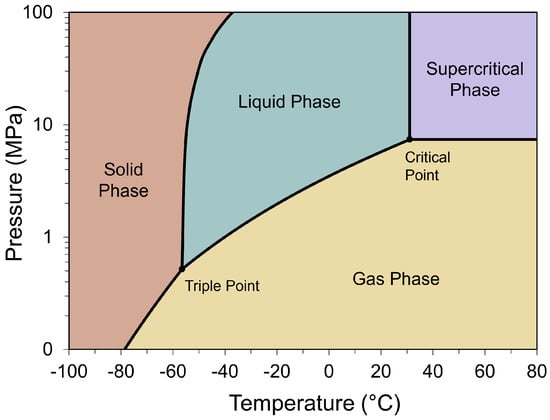
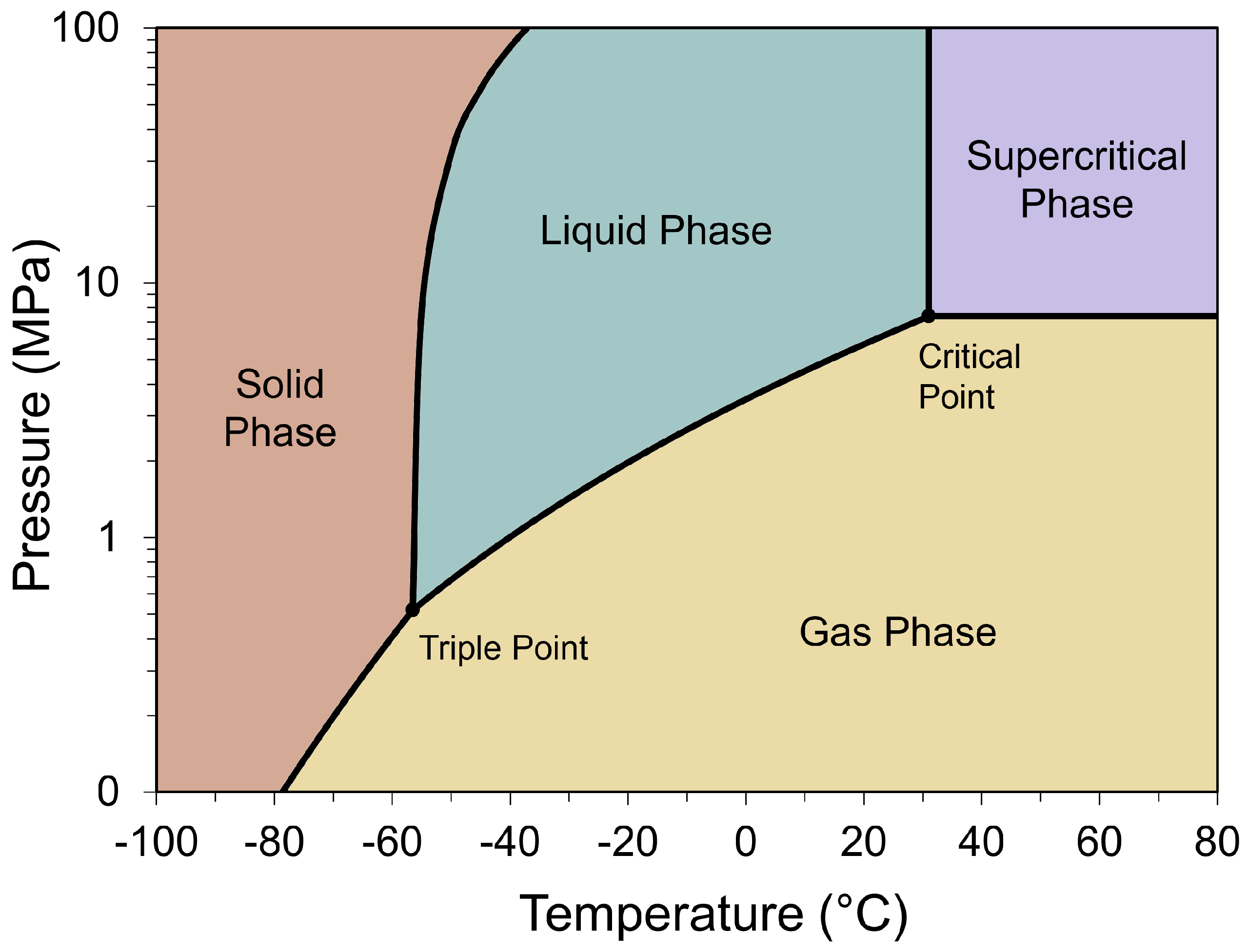
Industrial-scale CCS projects typically inject carbon dioxide in a supercritical state through wells to the deep reservoir rock. CCS in Alaska may potentially involve injecting carbon dioxide in a liquid state due to the lower ambient temperatures. Once injected underground, carbon dioxide will rise towards the surface due to having a lower density than water (liquid or ice) and may transition to the gas phase based on the temperature and pressure (Figure 1). A mass of carbon dioxide in the gas phase has a significantly larger volume than in the supercritical phase. In this review, we first examine the possibility of carbon dioxide flowing through permafrost, as either a gas (Section 2.1) or liquid (Section 2.2).
Figure 1.
Pressure-temperature phase diagram of carbon dioxide.
2.1. Gas Permeability of Permafrost
First, the extent to which gas can flow through, or permeate, permafrost is investigated. Due to the lack of studies on solely carbon dioxide gas in permafrost, studies of gases in permafrost, including methane, are included in this review for possible implications for carbon dioxide gas in the same environment. Measurements of gases over CCS projects have shown that the composition and variability of underground gases are extensive and highly dependent on the subsurface matrix and path taken during the movement or leak [22].
Studies of methane gas permeability in permafrost may provide insight into possible carbon dioxide gas permeability in permafrost. Carbon dioxide and methane have different physicochemical properties. Compared to methane, carbon dioxide gas is 10 times more soluble [23], and the sorption of carbon dioxide gas to coal is two to four times higher than for methane [24]. Additionally, carbon dioxide gas is 2.7 times denser [25] and 35.6% more viscous [26]. Therefore, methane gas permeability in permafrost may provide an upper bound to possible carbon dioxide gas permeability, as carbon dioxide may rise from geologic reservoirs more slowly and interact more with minerals and liquids as it migrates than methane gas.
In permafrost areas, gas has been observed naturally being emitted from lakes or land at the surface, sometimes creating craters [27] which demonstrates that permafrost areas can be permeable to gas. However, there is a lack of understanding of the permeability and pathways of the gases migrating through permafrost [28]. In the Prudhoe Bay area, methane gas found in the permafrost has been determined to be primarily (50–70%) of thermogenic origin as opposed to microbial [29]. While this means the gas mostly migrated to the permafrost from much deeper underground, it does not necessarily mean the gas moved through the frozen layers, as the gas may have migrated to the location before the area froze.
Permeability is used to describe the ability of a fluid to flow through porous media such as rock or permafrost as governed by Darcy’s law. The permeability of porous media is a measure of the connectivity of the pore space within and between rocks. While empirically developed for water flow, Darcy’s law can be used to characterize gas flow through porous media, assuming the flow is laminar, and the media is homogeneous.
Chuvilin has analyzed and conducted several studies of the gas permeability of frozen sands. Frozen sand comprising 0.1–0.25 mm grain size with an ice content of 75% was measured to have a gas permeability of 0.36 mD (Ananyan et al. 1972 as summarized in English in [30]), which, while low, is still permeable and therefore would allow carbon dioxide to pass through.
Chuvilin showed that when the ice content of marine permafrost sands from West Siberia rises above 50%, the gas permeability lowers by orders of magnitude [30], as the ice blocks the pore space and connections. This implies the gas permeability of permafrost depends on the ice content. Drier permafrost regions may allow carbon dioxide to flow through in the gas phase, whereas wetter permafrost zones may not.
Gas permeability of frozen sediment may be more complicated than moisture content alone, as frozen sediment can have significantly lower permeability than unfrozen sediment. Frozen permafrost was found to have 10 times less permeability than unfrozen [30]. Many samples of frozen fine sand and silty sand had gas permeabilities lower than the detection level (<0.01 mD), but had permeabilities of 0.27 to 60 mD when unfrozen [31]. Values are shown in Table 1 and compared to other published values.
Table 1.
Published gas permeabilities of frozen sand and soil.
In Antarctica, concentrations of carbon dioxide (as well as methane and helium) have been measured at the base of the active layer, therefore at the top of the permafrost, being emitted at significant volumes, up to 3.44% by volume of carbon dioxide or 1.73 g m−2d−1 [33]. The study suggests the source is brine beneath the permafrost migrating inland [33]. This implies a flow of carbon dioxide through the permafrost to the active layer. Interestingly, in the study, locations of high carbon dioxide emissions do not appear to align with locations of high methane emissions. Therefore, flow paths may not be confined to faults but rather diffuse through the permafrost matrix.
Besides the diffusion of carbon dioxide through porous mineral matrix, fractures or faults may exist in the permafrost, which may allow for another type of flow path. Are [34] analyzed several studies published in Russian relating to gas observed in permafrost. Besides the typical dispersed microporosity, Are [34] describes the pore space distribution of permafrost, which can contain long, lens-shaped horizontal macrocavities with widths of up to 5 cm in the top 10 m of Russian permafrost as seen from cores. While these may be smaller at greater depth due to increased pressure, they may provide for high permeability passageways for carbon dioxide migration through permafrost and a volume for carbon dioxide to be stored within. Studies by Ermakov et al., published in Russian, attributed ascending gas migration paths to be mainly at joints between rocks, based on a detailed study of the relationship between tectonic jointing zones and gas fields in Siberia [34]. Geologic methane emitted along fault lines and in areas of permafrost thaw has been measured [35,36]. This suggests faults are possible pathways for carbon dioxide, as pathways permeable to methane are likely permeable to carbon dioxide as well.
Studies of the gas permeability of permafrost largely focused on methane gas. Specific to permafrost, no studies of the permeability of carbon dioxide gas through permafrost were found. However, pertaining to carbon dioxide in unfrozen sediment, in central Italian grasslands, subsoil carbon dioxide has been measured at higher fluxes in areas over high-permeability faults compared to areas without faults [37]. The source of this carbon dioxide may be geological, as carbon dioxide is naturally released from the upper mantle and carbonate portions of the crust of the Earth, with estimates of 102–103 Mt carbon dioxide/year globally. Besides volcanic emissions, these geologic carbon dioxide emissions also occur at locations of active tectonics, thin crust, or oil and gas fields [38]. Again, implying faults may play a role in the movement of carbon dioxide through the subsurface.
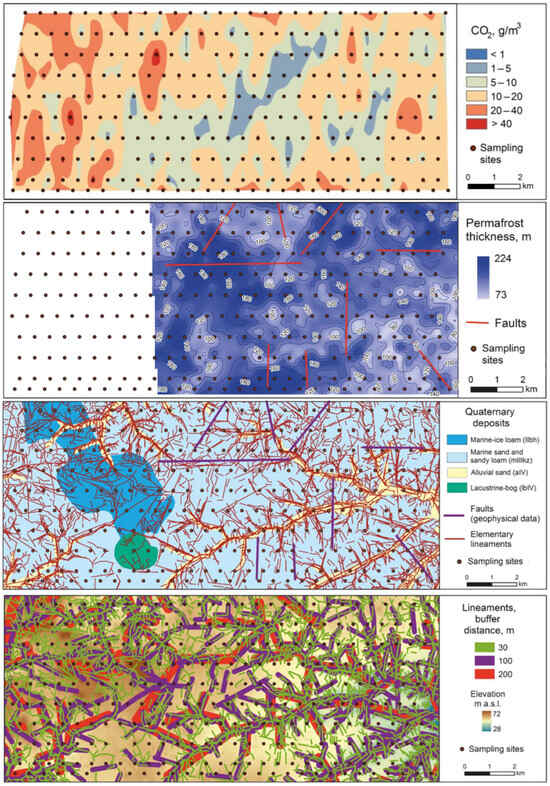
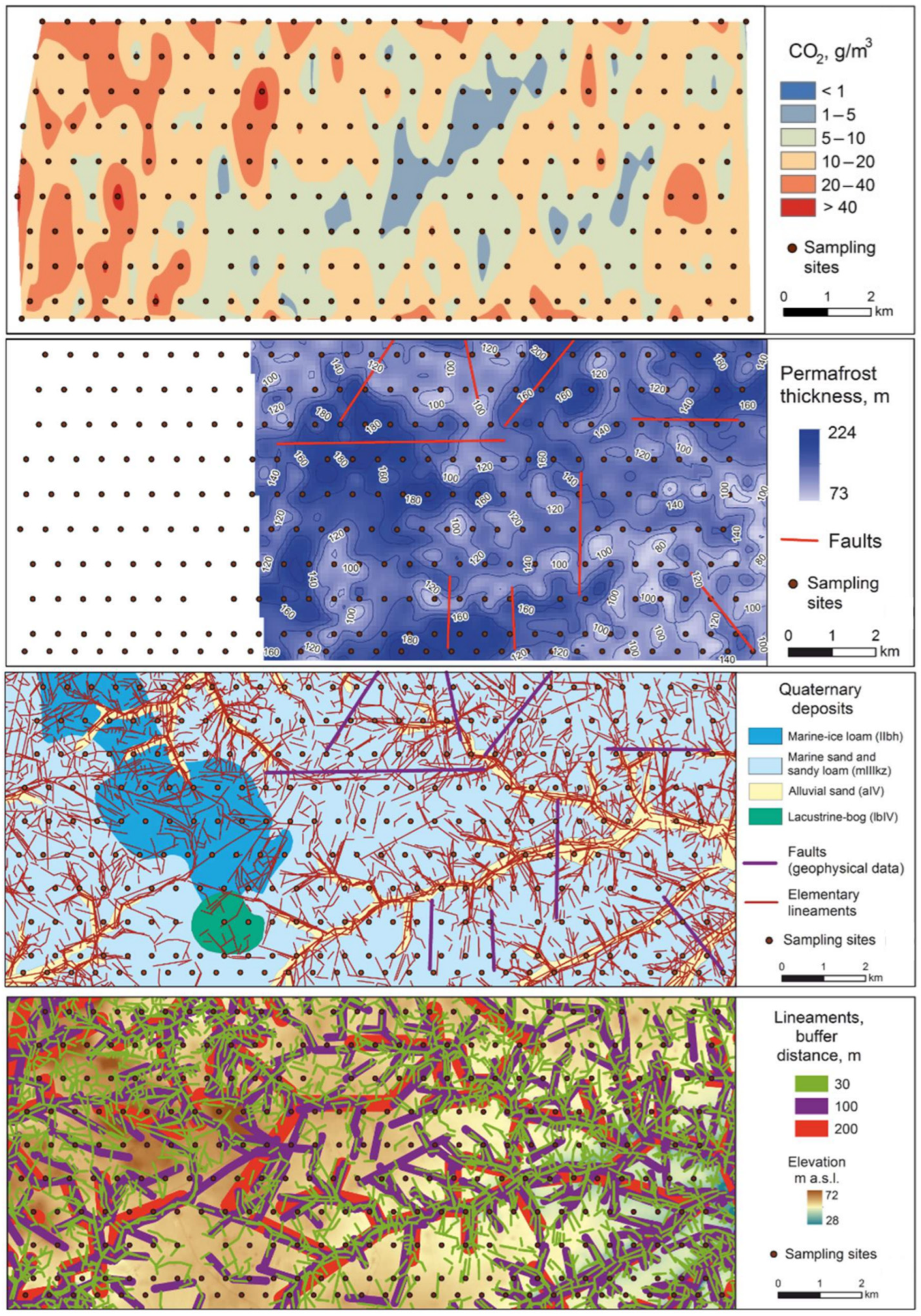
Permafrost and faults of low ice content are still possibly permeable as well. A recent study in Russia attempted to trace the path of carbon dioxide through permafrost. The study measured gases in the top 1 m of frozen soil over permafrost in winter, overlying oil and gas fields in West Siberia [28]. As this is in the active layer, this study will not have captured previously stored carbon dioxide that was emitted during previous summer thaw(s). They found frozen soils in this area contained a concentration of carbon dioxide of 11.5 g/m3 on average, with samples ranging from 4 to over 40 g/m3 [28]. Higher concentrations of carbon dioxide were seen in areas of thinner permafrost [28].
While both geologic and biogenic sources likely contributed to the measured carbon dioxide in soil above permafrost, the amount that migrated from beneath the permafrost is unknown. Some concentrations of helium were observed, suggesting travel of gases from deeper geologic sources, such as the mantle [28]. High concentrations of hydrocarbons were measured over 95% of the study area and are attributed to diffuse flow from underground geologic reservoirs.
The study by Kraev et al. [28] looked at the connection between carbon dioxide concentrations in soil above permafrost and detailed fault or lineament (surface features of faults) mapping (Figure 2). Electromagnetic geophysical methods were used to determine the subsurface structure 400 m below the surface, including permafrost depths and faults or fractures. No strong link was found between carbon dioxide concentrations measured in frozen soil and geologic fault features. However, minor links were found between carbon dioxide concentration and lineaments, land cover, and terrain aspect, with an even lesser link to permafrost thickness [28]. This could be due to permafrost blocking carbon dioxide flow, or permeable pathways, such as faults, have allowed carbon dioxide to be emitted prior to measurement. The researchers in the study note that the carbon dioxide could still be of deeper geologic origin, as they measured higher concentrations of methane aligning with tectonic boundaries (300% higher methane near lineaments). Micro-seeps, or channels for fluid migration through the permafrost, with higher concentrations of methane and helium, were found and aligned with tectonic margins, suggesting geologic pathways along deep faults [28]. Even if the measured carbon dioxide did not align with mapped lineaments, the carbon dioxide may have traveled through deeper faults vertically and migrated horizontally through the permafrost or other rock layers before reaching the active layer.
Figure 2.
Concentrations of carbon dioxide at depths of 0.6–0.7 m in frozen soil in winter and permafrost thickness, faults, and geology. Adapted from [28] under CC-BY 4.0 license.
Drilling wells through permafrost can degrade the permafrost and form caverns, and increase erosion around the well [39]. This could potentially create permeable pathways in the immediate vicinity of a well in a CCS project.
Frozen soil appears to often have higher permeability than frozen sediment, although possibly because much of the soil is above the water table. It is possible that soil exists in permafrost layers that are not the active layer, and so it is possible that carbon dioxide from a CCS project could encounter permafrost soil. A few studies investigate the permeability of frozen soil as opposed to frozen sediment. In an experimental study of frozen soil, moisture content had the most significant impact on the gas permeability of nitrogen [32]. Gas permeabilities measured ranged widely from 0.037 mD to 0.69 D in frozen soils with moisture contents of 5.8% to 25% [32]. High gas permeabilities have been observed in frozen saline loams in Yamal in Northern Russia [34]. Soil can also contain plant matter, which offers potential pathways for carbon dioxide to be transported through [28].
2.2. Liquid Permeability of Permafrost
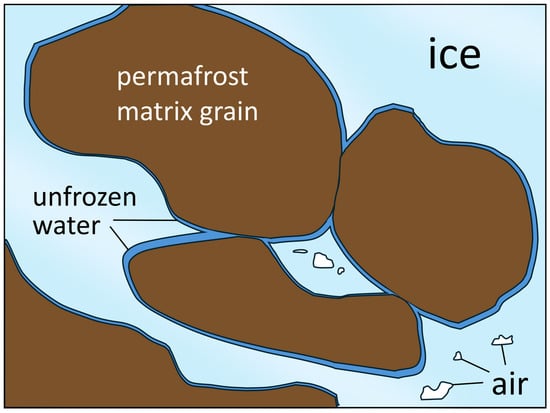
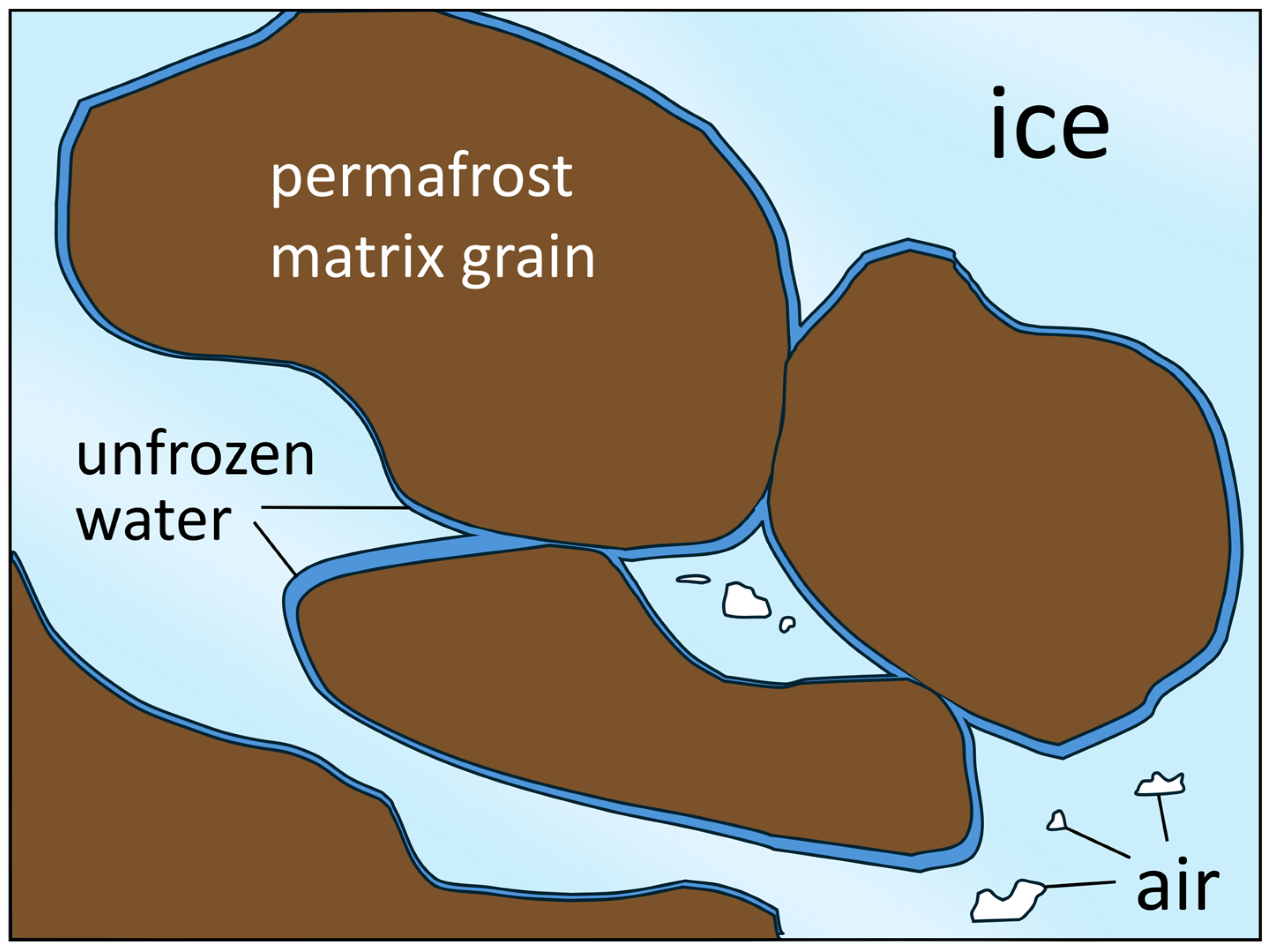
There is a small probability that any carbon dioxide rising from deep geologic storage from CCS projects will be in the liquid phase when encountering permafrost, as the locations that are cold enough and deep enough are limited. However, there is a possibility that carbon dioxide will be dissolved in water and encounter the permafrost as a liquid solution. Gas-phase carbon dioxide may be able to flow through liquid water. Unfrozen water close to permafrost matrix grains may possibly provide a flow path for carbon dioxide even if the pore space is filled with frozen ice [40]. Figure 3 illustrates the concept of permafrost mineral grains surrounded by ice. Different flow paths could be considered between coarse-grain and fine-grain permafrost, as well as with different amounts of entrapped gases or liquid water. Liquid flow can be influenced by capillary, gravitational, and viscous forces, but for rock is still often described with permeability and Darcy’s Law. Liquid permeabilities are typically much lower than gas permeabilities for porous media. Liquid permeabilities, particularly of frozen sediment, are low. Aguirre-Puente and Gruson reported a permeability of 10−18 m2 (0.001 mD) for silty sediment at a temperature of −0.3 °C [41].
Figure 3.
Diagram of permafrost matrix and pore space containing frozen water (ice), bound unfrozen water close to the grains, and pockets of air.
Studies of the liquid permeability and hydrology of permafrost are often focused on surface water and the impacts of changes in permafrost. Permafrost areas have unique features that drive hydrology in these regions. Taliks, unfrozen zones under bodies of water in permafrost areas, may provide flow paths for both groundwater and, therefore, carbon dioxide as a solution in water [42]. If taliks are present around a potential CCS project area, they should be considered when analyzing potential fluid or carbon dioxide flow paths. Several cryohydrogeology models exist for analyzing groundwater flow in permafrost regions [42,43]. Most studies of permafrost hydrology focus on the active layer, surface water, and other water movement above the permafrost [44], rather than through the various depths, as by definition, permafrost is frozen and no substantial amount of liquid water exists. The warming and melting of permafrost may bring on new challenges and complicated flow paths. Water and solute travel times are not only affected by permeability, as is typical, but the freeze/thaw cycle further delays travel, regardless of geological parameters [45]. Other unique characteristics of permafrost and potential movement of carbon dioxide from CCS projects include cryosuction, or the suction of water into frozen areas due to freezing and capillary forces [46].
Carbon dioxide is significantly more soluble in water than methane [47] implying it may travel more easily than methane by dissolving into water and following any flow paths of unfrozen water in permafrost areas such as taliks or brines. Carbon dioxide dissolved in water forms an acidic solution, which may provide for different permeability than water alone or a water–methane solution due to dissolution of minerals or other geochemical reactions.
3. Storage of Carbon Dioxide by Permafrost
3.1. Mechanical Storage
Permafrost could potentially form a barrier impermeable to carbon dioxide flow. If ice fully blocked the pores and remained frozen, carbon dioxide would not be able to flow through and therefore be trapped or stored within or below the permafrost. Gleeson et al. acknowledge that if the pores of rocks and soils are filled with frozen water, gases such as carbon dioxide can be inhibited from flowing through [48]. Snow has been shown to inhibit the flow of carbon dioxide from the soil [49], however, to what extent is debated.
Pockets of gases have been observed to be trapped within permafrost in general. Gases in the upper portions of the permafrost in West Siberia have been observed at quantities larger than possible by biological processes alone [34]. While the gas in these studies from West Siberia had a high methane content, helium and argon were also present. This indicates that the gas comes from deeper geologic sources, which are likely to contain carbon dioxide as well. Yakushev (1989) and Ershov et al. (1990) (both in Russian but described in English in [34]) recorded drilling into pressurized methane gas pockets in the uppermost 100 m of the permafrost in the Yamburg gas field in the Russian Arctic. Are [34] indicated these are free gases as opposed to gas hydrates, as they are outside the hydrate stability zone. Methane has a larger molecular size compared to carbon dioxide, which could possibly allow for carbon dioxide to diffuse more easily through very tight nanoporous rock, although other interactions may drive the storage more significantly [50].
More recent studies have also shown that methane has been trapped lithologically in permafrost at shallow depths (<30 m), with one measuring methane being emitted at rates up to 0.8 × 10⁶ g day−1 m−2 [51]. When drilled into, the permafrost has released significant volumes of gas from depths below 150 m with flow rates from 50 to 14,000 m3/day and with durations of days to 6 months [52]. These gases are primarily methane or nitrogen but do contain 4–10% carbon dioxide [27]. This further shows carbon dioxide can accumulate within permafrost. While the study attributes much of the gas production to microbes in the permafrost, it also notes that gas can migrate from deep reservoirs to the permafrost. Thawing permafrost may potentially pose safety risks if carbon dioxide concentrations are high and volume is large.
A release of methane gas from the Siberian permafrost, as measured from PULSE satellite data, has been observed to correlate with exposed carbonate rock at the surface [53]. The timing correlated with a period of above-freezing 2 m air temperature in the region. This implies that thawing permafrost may allow for the release of previously stored gas.
A study of emissions of volatile organic compounds (VOC) from Arctic permafrost found emissions from thawing permafrost were mostly due to the direct release of old, trapped gases from the permafrost. The average VOC fluxes from thawing permafrost were four times higher than those from the active layer above the permafrost [54]. Potentially, pockets of carbon dioxide could be similarly trapped in permafrost.
Some pingos, hills containing ice that form in permafrost environments, in the Yamal Peninsula of Russia, have significant gas contents (up to 10% by volume) and have been documented emitting gases explosively, which can indicate the permafrost may store gases prior to release [55]. It is not well documented what gases are emitted during these events, but reports include methane, hydrogen, and helium [55]. The presence of hydrogen and helium implies that permafrost trapped gases migrating from deeper depths. Carbon dioxide is likely able to be contained as well, which demonstrates another possible situation of the storage of carbon dioxide by permafrost. Similarly, satellite images and field data of craters and disruption of frozen lakes in the Yamal Peninsula of Russia imply explosive release of primarily methane gas in a permafrost area [56]. These examples of explosive releases potentially show that permafrost is able to contain gases at higher pressures with good sealing.
At a shallower depth, frozen soil may be impermeable to gas and therefore store carbon dioxide in unfrozen soil below; the quantity of carbon dioxide stored in this way is unknown [28]. Gases were determined to be held over winter in the top 1 m of frozen soil in West Siberia at a mass of 0.01 to 0.1% of the soil organic matter mass in the study mentioned previously, linking carbon dioxide and methane frozen soil concentrations to geologic factors [28]. In a separate study in the Alaskan North Slope, an attempt to quantify the amount of carbon dioxide trapped in snow and frozen soil has been made by drilling <1 m holes; however, results were highly variable [57]. The study did show carbon dioxide emission from undisturbed permafrost during winter was up to two orders of magnitude greater during the first minute after being drilled into, showing carbon dioxide had been trapped until mechanically released. More recently, in Alaska, measurements of carbon dioxide concentration in the top 1 m of soil in continuous and discontinuous permafrost regions show significantly higher (roughly double) carbon dioxide concentrations in the continuous permafrost than in the discontinuous [58]. This is attributed to physically limited gas transport in the continuous permafrost location, not chemical production [58] meaning the carbon dioxide has been trapped and stored by the permafrost.
A project assessing the feasibility and capacity of carbon dioxide storage in the Russian permafrost was carried out by the French Geologic Survey and the Russian Academy of Sciences in 2009 [39]. Although this study looked mainly at injecting carbon dioxide directly into permafrost, the study states that the permafrost would act as a secondary caprock trapping the carbon dioxide if the primary caprock should fail. Le Nidre assumes that because the permafrost is continuous, it “guarantees the sealing effect for CO2.” However, this is not shown as it has not been proven or cited that carbon dioxide cannot flow through permafrost. The project found that the carbon dioxide hydrate stability zone overlapped with the permafrost in the study area in Western Siberia and that the carbon dioxide would be trapped as a carbon dioxide hydrate in the permafrost if injected at this depth. However, the study noted it assumed there would be difficulties in injecting into permafrost as the formation of solid carbon dioxide hydrate would plug available injection flow paths. They arrived at the conclusion that deep injection of carbon dioxide in a liquid or supercritical state into geologic reservoirs for storage is preferred and simultaneously potentially helpful for enhanced oil recovery (EOR). Permafrost in this region is similar to that on the North Slope of Alaska, with maximum permafrost depths of 500–600 m. CCS in Alaska would likely inject carbon dioxide into deep reservoirs instead of directly into permafrost.
Walter Anthony et al. have indicated that permafrost can form a “cryosphere cap” of an icy impermeable layer that can trap gases such as methane or carbon dioxide, preventing these gases from escaping to the atmosphere [35]. Measurements of more than 150,000 seeps from around 6700 lakes and fjords in Alaska show methane being emitted along boundaries of permafrost thaw and receding glaciers. The methane is of geologic origin, as opposed to shallow ecological origin, as shown with isotope analysis and radiocarbon dating. Relevant to areas of Alaska for potential CCS projects, in the northern continuous permafrost region of Alaska, this study showed gas emissions coincided with lakes and rivers and attributed this to locally high permeability due to deep thaw bulbs under water bodies, allowing gas to migrate upward [35]. This demonstrates that the surrounding frozen permafrost is capable of mechanically storing gas, such as carbon dioxide, as only the unfrozen area allows for the release of the gas. Later research further supported this claim with synthetic aperture radar (SAR) data analysis and field sampling that showed thawed locations in lakes in permafrost areas (taliks) outgassing [59]. Therefore, carbon dioxide may still find a path to migrate to the surface, even in an area of generally continuous permafrost, and permafrost might not be considered a perfect seal. As frozen permafrost is shown to have an order of magnitude less permeability than thawed permafrost [30], and if permafrost is indeed blocking the flow of rising carbon dioxide, thawing permafrost could potentially release geologic carbon dioxide emissions in addition to the oxidation of previously frozen organic material.
3.2. Chemical Storage
Carbon dioxide dissolved in water can be precipitated as a carbonate if the right geochemical situation exists, which can affect the porosity and permeability of the overall porous media. Carbonate deposition does occur at temperatures below freezing, such as would be within permafrost [60]. Calcium in Alaskan Arctic permafrost soils has been shown to decrease the amount of carbon dioxide released by combining with carbon dioxide through the formation of aragonite or calcite (CaCO3) [61], showing carbon dioxide can be trapped chemically in these cold locations rather than released to the atmosphere. While Stimmler et al. showed the mineral formation possible in thawed permafrost, the same reactions are likely possible in frozen permafrost. Compared to warmer temperatures, these chemical reactions involving carbon dioxide are substantially slower but will still occur [39]. Therefore, carbon dioxide entering the permafrost may mineralize and stay stored in the permafrost. This mineral deposition may also fill fractures and seal off other flow paths through the permafrost, mechanically impeding flow. As permafrost thaws and temperatures in the sediment and soils rise, carbonate precipitation would occur at an increased rate, potentially concealing any escaping geologic emissions.
Additionally, the solubility of carbon dioxide in water increases at lower temperatures and is estimated to be up to 3 times higher in aquifers in permafrost regions than in more temperate latitudes [39], with an estimate of 12–44 L CO2/L H2O. This means carbon dioxide may be absorbed into groundwater below permafrost if any escapes the geologic storage formation. Carbon dioxide in water forms an acidic condition, which would have the potential to dissolve carbonate minerals in any surrounding grains and potentially affect flow paths or storage efficiency [62,63].
A notable amount of research has been published on hydrates or clathrates, which can form if carbon dioxide gas is present near water as it transitions from liquid to frozen (at appropriate pressure and temperature regimes). However, the conditions to form carbon dioxide clathrates would likely not occur within existing permafrost, as the sediment or rock formation would by definition be already frozen. There is a possibility of carbon dioxide encountering methane hydrates in the permafrost and replacing the methane. The carbon dioxide would then be stored as a carbon dioxide hydrate [64].
3.3. Biological Storage
If the carbon dioxide makes it through the permafrost to the active layer, vegetation may accumulate more of the carbon, decreasing emissions to the atmosphere [65]. A study of the North Slope of Alaska found warmer conditions led to increased mineralization, transfer of carbon from the soil to the vegetation, and accumulation of carbon in the vegetation [65]. The permafrost carbon feedback, though highly important in global climatic models, is still highly uncertain at the scale [66]. The incorporation of “leaky” carbon dioxide from permafrost as a facet of the feedback could modify the current level of effects on both vegetative and microbial interactions due to the quality of the carbon being emitted [67]. The global vegetation model LPJmL4 simulates growth and productivity of both managed and natural vegetated landscapes in explicit detail, yet fails to account for any carbon percolation from depths below 13 m from the surface [68,69].
4. Implications
Understanding carbon dioxide interactions with permafrost can potentially affect regulations of CCS projects within permafrost regions. In 2023, a review of legislation governing carbon capture, utilization, and storage (CCUS) was conducted in several U.S. states with the intent of informing decisions by the State of Alaska [70]. However, this review lacks consideration of permafrost implications and effects on CCS and relevant legislation, as other states do not significantly contain permafrost compared to Alaska.
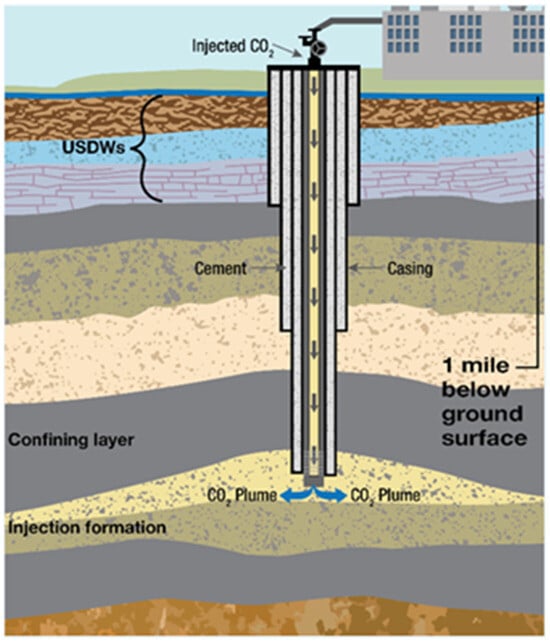
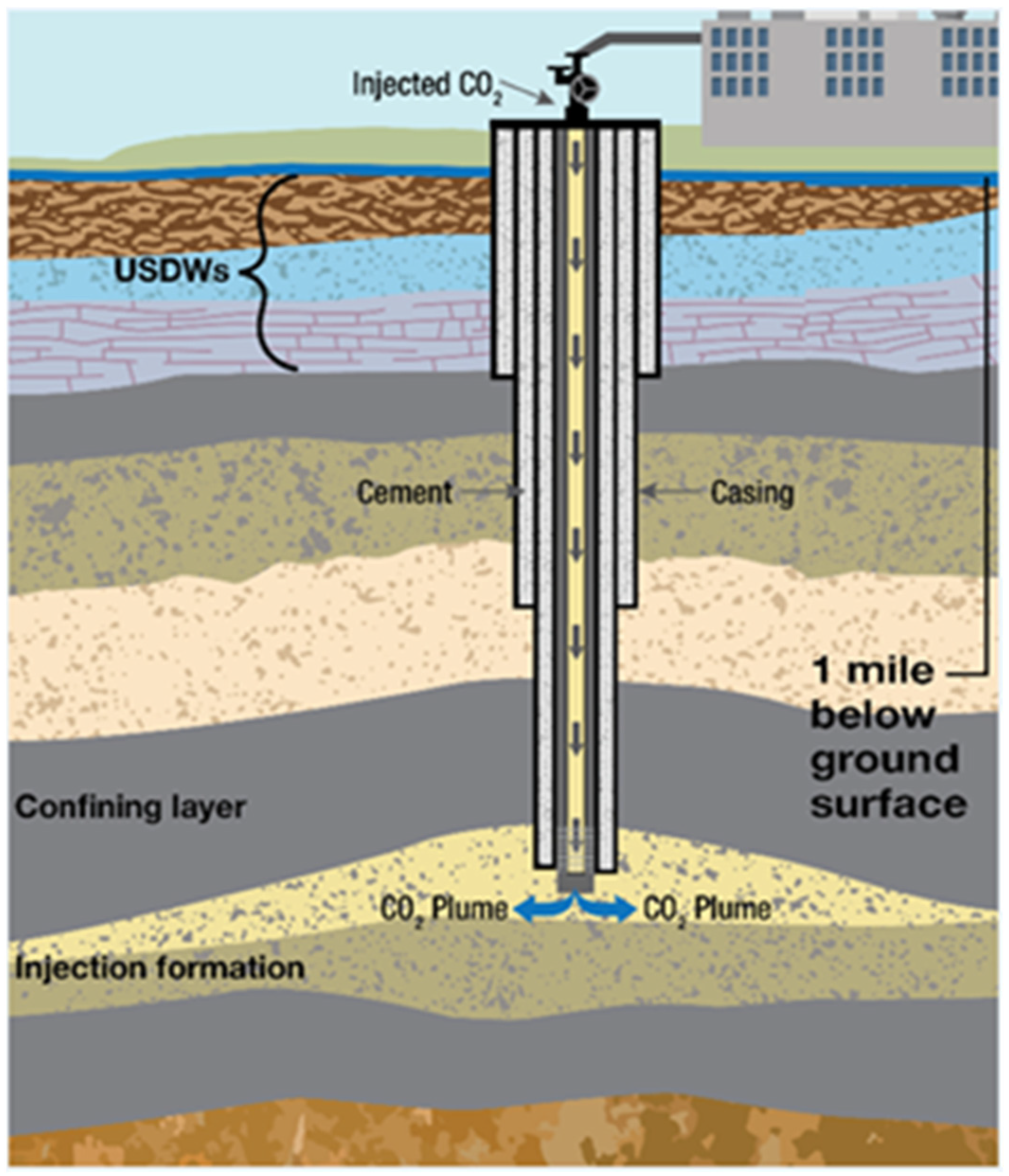
The Federal Safe Drinking Water Act (SDWA) Underground Injection Control (UIC) Program regulates CCS injection wells. Wells under the UIC program are classified into one of six classes. Class II wells are used to inject fluids related to oil and gas production, including the injection of carbon dioxide for EOR. Class VI wells are used to inject carbon dioxide for storage (Figure 4). Rigorous requirements for the wells are in place to ensure safety. For example, some of the requirements include: the site must be characterized to ensure the area can receive and contain the carbon dioxide, model extent of the injected carbon dioxide plume, corrosion-resistant well construction used, and monitoring during the injection of carbon dioxide. The permitting process itself requires a thorough technical review and public comment [71].
Figure 4.
Diagram of carbon dioxide injection well (not to scale) showing carbon dioxide is injected deep (>1 mile) underground. Source: Ref. [71], public domain.
Models show CCS has the potential to drastically reduce global carbon dioxide emissions in the coming years [72]. Understanding CCS in permafrost areas may impact the extent to which the emissions or costs vary. Alaska contains one of the largest oil and gas fields, which implies large storage reservoirs that could be a prime candidate for large-scale carbon dioxide storage. However, much of this area is overlain by permafrost, which presents a unique situation not encountered by most existing CCS projects.
CCS in northern Alaska may encounter differences from other CCS projects due to the considerably lower temperatures of the region. A study conducted geomechanical stress experiments of sandstone from the North Sea at 15, −5, and −10 °C to determine the influence of freezing temperatures on the mechanical properties (elastic moduli) of the rock. The mechanical properties of the rock affect the volume available for carbon dioxide storage and the ability of the confining rock to fracture. Lab experiments showed that rock at lower freezing temperatures was stronger, but possibly more brittle [73].
As with all CCS projects, injection of supercritical carbon dioxide can result in stress due to large temperature changes. A study in the Norwegian North Sea showed injection of carbon dioxide resulting in an 80 °C temperature change in the reservoir from 110 °C to 30 °C, and the impact of this change on the geomechanics of the reservoir [74]. The permafrost in Alaska modifies the geothermal gradient at the shallow depths of the region. Depending on the reservoir temperatures in Alaska and the chosen injection conditions of carbon dioxide, CCS projects in Alaska may experience thermally induced stresses, which is an important aspect to consider.
5. Further Research Areas
Several potential future research questions are posed by this review that highlight the need for further study of the potential movement of carbon dioxide through permafrost. On a microscopic scale, what factors control the permeability of carbon dioxide in permafrost with the interplay of pore size and shape, pressure regime, and distribution of frozen water? Are microbes, plants, or fungi absorbing or utilizing the carbon dioxide within the permafrost? How do different temperatures and chemical compositions of permafrost affect carbon dioxide flow? What chemical reactions can occur with carbon dioxide in permafrost, and do any “capture” carbon? Are those reactions different from those in unfrozen soil? Geochemical modeling, such as TOUGHREACT [75] or Geochemist’s Workbench (GWB) [76], could be used to determine possible reactions and implications. What is the deposition rate and its effect on fracture aperture or pore space closure? Is carbon dioxide dissolved into ice in the way it can be dissolved into water? To what extent do moisture content, depth of permafrost, or presence of ice wedges and other features inhibit gas flow through permafrost?
At the mesoscale, could geophysics be used to map potential major carbon dioxide pathways in permafrost, such as faults? What is the origin of carbon dioxide emitted from thawing permafrost, more geological or more shallow plant and microbial emission? Is thawing permafrost releasing additional stored gases from deeper geologic sources rather than just soil carbon? Are current studies overestimating or underestimating carbon dioxide emissions due to this? Are there potentially pockets of carbon dioxide held at the base of permafrost in some areas, such as trapped natural releases of carbon dioxide from mechanisms such as magma outgassing? Most studies focused on shallow depths or the surface, and deeper data (>150 m) is needed. Maps of potential carbon sequestration reservoirs and current overlapping overlying permafrost are needed. Are emissions of carbon dioxide measured from permafrost mistaken for originating from the permafrost when, in reality, they originated at geologic depths and are only released when the permafrost thaws or melts and allows the gases to pass through to the surface?
Experimental studies of carbon dioxide flowing through permafrost are needed, as well as field measurements of carbon dioxide at various depths and locations of permafrost. What are the best methods for measuring carbon dioxide levels within soil and rock in situ? Modeling of mechanisms of carbon dioxide flow in permafrost is needed as well. Computational fluid dynamics models of carbon dioxide flow through permafrost could be created.
There is no mention of how permafrost affects CO2 transport and storage in the studies of industrial carbon sequestration projects. What are the gaps in regulation and policy? Should monitoring of permafrost over sequestration projects be required in Environmental Impact Statements (EIS) for CCS projects? What are the logistical difficulties of CCS in permafrost regions (such as road, pipeline, and wellbore stability, cement curing issues when built on the active layer)? Distributed fiber optic sensing, such as strain sensing (DSS), temperature sensing (DTS), and acoustic sensing (DAS) [77,78] could be useful methods to employ in monitoring CCS projects. Does the melting of permafrost impact CCS projects deep in underground reservoirs? Are the geomechanical unloading of caprock effects large enough to significantly change fracture apertures and flow paths? How long would it potentially take for carbon dioxide to get from the intended storage reservoir to the permafrost in the event of a leak? How long would it potentially take carbon dioxide to flow through the permafrost and to potentially reach the atmosphere?
6. Conclusions
Individually, both CCS projects and the dynamics of permafrost are important factors in the global impact of industrial fossil fuel use. Understanding both and the interplay between them will be essential for mitigating the impact. Further research is needed to fully investigate the potential outcome of carbon dioxide entering the base of the frozen permafrost at depth. Permafrost with a low ice content may still be substantially permeable, potentially allowing flow of carbon dioxide through open pore spaces or faults. Or permafrost could form an impenetrable barrier that could trap a pocket of carbon dioxide.
Many studies investigate the soil-atmosphere interaction in permafrost regions, focusing only on the shallowest portion of the active layer above the permafrost, leaving the deeper frozen permafrost layers largely unexplored. Investigating these deeper areas within and below the permafrost is challenging, as accessing these depths can be prohibitively expensive since permafrost can extend hundreds of meters below the ground surface.
Notably, no literature has directly investigated the ability of carbon dioxide to flow through permafrost. In general, there is a lack of understanding of the gas permeability of permafrost. Research is conflicting, with some studies suggesting gas is able to transmit through permafrost and some showing evidence of impedance and gas storage. Of the limited relevant research that has been done, verification of findings should be conducted.
In conclusion, extending the knowledge base to further the understanding of carbon sequestration dynamics and biogeophysics in permafrost regions is worthwhile for future research studies. This review highlighted many studies of the gas permeability of permafrost, as well as examples of when permafrost impeded flow and forms pockets of gases. Studying hypothetical scenarios of carbon dioxide entering the permafrost can uncover much about the carbon cycle interaction with permafrost, as well as prepare for all CCS project situations and minimize risk.
Author Contributions
Conceptualization, J.T.P., F.J.L. and J.S.; methodology, J.T.P. and F.J.L.; formal analysis, J.T.P.; investigation, J.T.P.; writing—original draft, J.T.P. and F.J.L.; writing—review and editing, J.T.P., F.J.L. and J.S.; supervision, F.J.L.; project administration, F.J.L.; funding acquisition, F.J.L. and J.S. All authors have read and agreed to the published version of the manuscript.
Funding
This research was funded by DOE HQ—Fossil Energy GT&C: A2412-089-096-072333.0. The APC was funded by DOE HQ—Fossil Energy GT&C: A2412-089-096-072333.0.
Institutional Review Board Statement
Not applicable.
Informed Consent Statement
Not applicable.
Data Availability Statement
The data presented in this study are available on request from the corresponding author.
Conflicts of Interest
The authors declare no conflicts of interest. The funders had no role in the design of the study; in the collection, analyses, or interpretation of data; in the writing of the manuscript; or in the decision to publish the results.
Abbreviations
The following abbreviations are used in this manuscript:
| APC | article processing charge |
| CCS | carbon capture and sequestration |
| CCUS | carbon capture, utilization, and storage |
| CO2 | carbon dioxide |
| CRREL | Cold Regions Research and Engineering Laboratory |
| DOE | Department of Energy |
| EIS | Environmental Impact Statements |
| ERDC | Engineer Research and Development Center |
| mD | millidarcy |
| ppm | parts per million |
| SDWA | Safe Drinking Water Act (SDWA) |
| UIC | Underground Injection Control |
| USACE | United States Army Corps of Engineers |
| VOC | volatile organic compounds |
References
- Vikara, D.; Munson, C.; Zaremsky, C.; Sheriff, A.; Dooley, K.; Smith, R.; Conwell, C.; Okita, P.; Lee, J.; Mora, T.; et al. U.S. Japan CO2 Shipping Feasibility Study: Screening Assessment; U.S. Department of Energy, Office of Fossil Energy and Carbon Management, National Energy Technology Laboratory: Albany, OR, USA, 2025. [Google Scholar]
- U.S. Department of Energy Office of Fossil Energy and Carbon Management. Project Selections for FOA 2711: Carbon Storage Validation and Testing (Round 3): North to the Future Carbon Capture and Sequestration Hub. Available online: https://www.energy.gov/hgeo/project-selections-foa-2711-carbon-storage-validation-and-testing-round-3 (accessed on 16 January 2026).
- Worden, R.H. Carbon Dioxide Capture and Storage (CCS) in Saline Aquifers versus Depleted Gas Fields. Geosciences 2024, 14, 146. [Google Scholar] [CrossRef] [Scilit]
- Craddock, W.; Buursink, M.; Covault, J.; Brennan, S.; Doolan, C.; Drake, R., II; Merrill, M.; Roberts-Ashby, T.; Slucher, E.; Warwick, P.; et al. Geologic Framework for the National Assessment of Carbon Dioxide Storage Resources: Alaska North Slope and Kandik Basin, Alaska; USGS: Reston, VA, USA, 2014; p. 60. [Google Scholar]
- Jones, K.; Barnhart, L.; Warwick, P.; Corum, M. Preliminary GIS Representation of Deep Coal Areas for Carbon Dioxide Storage in the Contiguous United States and Alaska; USGS: Reston, VA, USA, 2019; p. 21. [Google Scholar]
- Osterkamp, T.E.; Payne, M.W. Estimates of Permafrost Thickness from Well Logs in Northern Alaska. Cold Reg. Sci. Technol. 1981, 5, 13–27. [Google Scholar] [CrossRef] [Scilit]
- Lachenbruch, A.H.; Sass, J.H.; Marshall, B.V.; Moses, T.H. Permafrost, Heat Flow, and the Geothermal Regime at Prudhoe Bay, Alaska. J. Geophys. Res. 1982, 87, 9301–9316. [Google Scholar] [CrossRef] [Scilit]
- Jorgenson, T.; Yoshikawa, K.; Kanevskiy, M.; Shur, Y.; Romanovsky, V.; Marchenko, S.; Grosse, G.; Brown, J.; Jones, B. Permafrost Characteristics of Alaska. In Proceedings of the 9th International Conference on Permafrost, Fairbanks, AK, USA, 29 June–3 July 2008. [Google Scholar]
- Li, Z.; Dong, M. Experimental Study of Carbon Dioxide Diffusion in Oil-Saturated Porous Media under Reservoir Conditions. Ind. Eng. Chem. Res. 2009, 48, 9307–9317. [Google Scholar] [CrossRef] [Scilit]
- Evans, W.C.; Sorey, M.L.; Kennedy, B.M.; Stonestrom, D.A.; Rogie, J.D.; Shuster, D.L. High CO2 Emissions through Porous Media: Transport Mechanisms and Implications for Flux Measurement and Fractionation. Chem. Geol. 2001, 177, 15–29. [Google Scholar] [CrossRef] [Scilit]
- Doughty, C.; Pruess, K. Modeling Supercritical Carbon Dioxide Injection in Heterogeneous Porous Media. Vadose Zone J. 2004, 3, 837–847. [Google Scholar] [CrossRef] [Scilit]
- Abidoye, L.K.; Khudaida, K.J.; Das, D.B. Geological Carbon Sequestration in the Context of Two-Phase Flow in Porous Media: A Review. Crit. Rev. Environ. Sci. Technol. 2015, 45, 1105–1147. [Google Scholar] [CrossRef] [Scilit]
- Kolditz, O.; Bauer, S.; Böttcher, N.; Elsworth, D.; Görke, U.-J.; McDermott, C.-I.; Park, C.-H.; Singh, A.K.; Taron, J.; Wang, W. Numerical Simulation of Two-Phase Flow in Deformable Porous Media: Application to Carbon Dioxide Storage in the Subsurface. Math. Comput. Simul. 2012, 82, 1919–1935. [Google Scholar] [CrossRef] [Scilit]
- Dentz, M.; Tartakovsky, D.M. Abrupt-Interface Solution for Carbon Dioxide Injection into Porous Media. Transp. Porous Media 2009, 79, 15–27. [Google Scholar] [CrossRef] [Scilit]
- Basirat, F.; Sharma, P.; Fagerlund, F.; Niemi, A. Experimental and Modeling Investigation of CO2 Flow and Transport in a Coupled Domain of Porous Media and Free Flow. Int. J. Greenh. Gas Control 2015, 42, 461–470. [Google Scholar] [CrossRef] [Scilit]
- Dumitrache, L.; Suditu, S.; Branoiu, G.; Neagu, D.; Alecu, M.D. Carbon Management and Storage for Oltenia: Tackling Romania’s Decarbonization Goals. Sustainability 2025, 17, 6793. [Google Scholar] [CrossRef] [Scilit]
- Eparu, C.N.; Suditu, S.; Doukeh, R.; Stoica, D.B.; Ghețiu, I.V.; Prundurel, A.; Stan, I.G.; Dumitrache, L. Software for CO2 Storage in Natural Gas Reservoirs. Energies 2024, 17, 4984. [Google Scholar] [CrossRef] [Scilit]
- Pastick, N.J.; Jorgenson, M.T.; Wylie, B.K.; Nield, S.J.; Johnson, K.D.; Finley, A.O. Distribution of Near-Surface Permafrost in Alaska: Estimates of Present and Future Conditions. Remote Sens. Environ. 2015, 168, 301–315. [Google Scholar] [CrossRef] [Scilit]
- Jorgenson, M.T.; Douglas, T.A.; Shur, Y.L.; Kanevskiy, M.Z. Mapping the Vulnerability of Boreal Permafrost in Central Alaska in Relation to Thaw Rate, Ground Ice, and Thermokarst Development. J. Geophys. Res. Earth Surf. 2025, 130, e2024JF008030. [Google Scholar] [CrossRef] [Scilit]
- Ciais, P.; Tagliabue, A.; Cuntz, M.; Bopp, L.; Scholze, M.; Hoffmann, G.; Lourantou, A.; Harrison, S.P.; Prentice, I.C.; Kelley, D.I.; et al. Large Inert Carbon Pool in the Terrestrial Biosphere during the Last Glacial Maximum. Nat. Geosci. 2012, 5, 74–79. [Google Scholar] [CrossRef] [Scilit]
- Schädel, C.; Bader, M.K.-F.; Schuur, E.A.G.; Biasi, C.; Bracho, R.; Čapek, P.; De Baets, S.; Diáková, K.; Ernakovich, J.; Estop-Aragones, C.; et al. Potential Carbon Emissions Dominated by Carbon Dioxide from Thawed Permafrost Soils. Nat. Clim. Change 2016, 6, 950–953. [Google Scholar] [CrossRef] [Scilit]
- Rouchon, V.; Magnier, C.; Miller, D.; Bandeira, C.; Gonçalves, R.; Dino, R. The Relationship between CO2 Flux and Gas Composition in Soils above an EOR- CO2 Oil Field (Brazil): A Guideline for the Surveillance of CO2 Storage Sites. Energy Procedia 2011, 4, 3354–3362. [Google Scholar] [CrossRef] [Scilit]
- Ramdin, M.; Amplianitis, A.; Bazhenov, S.; Volkov, A.; Volkov, V.; Vlugt, T.J.H.; de Loos, T.W. Solubility of CO2 and CH4 in Ionic Liquids: Ideal CO2/CH4 Selectivity. Ind. Eng. Chem. Res. 2014, 53, 15427–15435. [Google Scholar] [CrossRef] [Scilit]
- Harpalani, S.; Prusty, B.K.; Dutta, P. Methane/CO2 Sorption Modeling for Coalbed Methane Production and CO2 Sequestration. Energy Fuels 2006, 20, 1591–1599. [Google Scholar] [CrossRef] [Scilit]
- Hwang, C.-A.; Iglesias-Silva, G.A.; Holste, J.C.; Hall, K.R.; Gammon, B.E.; Marsh, K.N. Densities of Carbon Dioxide + Methane Mixtures from 225 K to 350 K at Pressures up to 35 MPa. J. Chem. Eng. Data 1997, 42, 897–899. [Google Scholar] [CrossRef] [Scilit]
- Mohammed, M.; Ciotta, F.; Trusler, J.M. Viscosities and Densities of Binary Mixtures of Hexadecane with Dissolved Methane or Carbon Dioxide at Temperatures from (298 to 473) K and at Pressures up to 120 MPa. J. Chem. Eng. Data 2017, 62, 422–439. [Google Scholar] [CrossRef] [Scilit]
- Chuvilin, E.; Ekimova, V.; Davletshina, D.; Sokolova, N.; Bukhanov, B. Evidence of Gas Emissions from Permafrost in the Russian Arctic. Geosciences 2020, 10, 383. [Google Scholar] [CrossRef] [Scilit]
- Kraev, G.; Belonosov, A.; Veremeeva, A.; Grabovskii, V.; Sheshukov, S.; Shelokhov, I.; Smirnov, A. Fluid Migration through Permafrost and the Pool of Greenhouse Gases in Frozen Soils of an Oil and Gas Field. Remote Sens. 2022, 14, 3662. [Google Scholar] [CrossRef] [Scilit]
- Collett, T.S. Permafrost-Associated Gas Hydrate Accumulationsa. Ann. N. Y. Acad. Sci. 1994, 715, 247–269. [Google Scholar] [CrossRef] [Scilit]
- Chuvilin, E.M.; Grebenkin, S.I.; Sacleux, M. Influence of Moisture Content on Permeability of Frozen and Unfrozen Soils. Kriosf. Zemli 2016, 20, 66–72. [Google Scholar]
- Chuvilin, E.; Grebenkin, S.; Zhmaev, M. Gas Permeability of Sandy Sediments: Effects of Phase Changes in Pore Ice and Gas Hydrates. Energy Fuels 2021, 35, 7874–7882. [Google Scholar] [CrossRef] [Scilit]
- Lin, Q. Laboratory Studies of Gas Permeability of Frozen Soil; University of Alaska Fairbanks: Fairbanks, AK, USA, 2003. [Google Scholar]
- Ruggiero, L.; Sciarra, A.; Mazzini, A.; Florindo, F.; Wilson, G.; Tartarello, M.C.; Mazzoli, C.; Anderson, J.T.H.; Romano, V.; Worthington, R.; et al. Antarctic Permafrost Degassing in Taylor Valley by Extensive Soil Gas Investigation. Sci. Total Environ. 2023, 866, 161345. [Google Scholar] [CrossRef] [Scilit]
- Are, F.E. The Problem of the Emission of Deep-Buried Gases to the Atmosphere. In Permafrost Response on Economic Development, Environmental Security and Natural Resources; Paepe, R., Melnikov, V.P., Overloop, E., Gorokhov, V.D., Eds.; Springer: Dordrecht, The Netherlands, 2001; pp. 497–509. [Google Scholar]
- Walter Anthony, K.M.; Anthony, P.; Grosse, G.; Chanton, J. Geologic Methane Seeps along Boundaries of Arctic Permafrost Thaw and Melting Glaciers. Nat. Geosci. 2012, 5, 419–426. [Google Scholar] [CrossRef] [Scilit]
- Kohnert, K.; Serafimovich, A.; Metzger, S.; Hartmann, J.; Sachs, T. Strong Geologic Methane Emissions from Discontinuous Terrestrial Permafrost in the Mackenzie Delta, Canada. Sci. Rep. 2017, 7, 5828. [Google Scholar] [CrossRef] [Scilit] [PubMed]
- Etiope, G. Subsoil CO2 and CH4 and Their Advective Transfer from Faulted Grassland to the Atmosphere. J. Geophys. Res. 1999, 104, 16889–16894. [Google Scholar] [CrossRef] [Scilit]
- Mörner, N.-A.; Etiope, G. Carbon Degassing from the Lithosphere. Glob. Planet. Change 2002, 33, 185–203. [Google Scholar] [CrossRef] [Scilit]
- Le Nindre, Y.-M.; Allier, D.; Duchkov, A.; Altunina, L.K.; Shvartsev, S.; Zhelezniak, M.; Klerkx, J. Storing CO2 underneath the Siberian Permafrost: A Win-Win Solution for Long-Term Trapping of CO2 and Heavy Oil Upgrading. Energy Procedia 2011, 4, 5414–5421. [Google Scholar] [CrossRef] [Scilit]
- Vosoughi, E.; Giroux, B.; Duchesne, M.J.; Dupuis, J.C. Understanding the Effects of Permafrost Degradation through a Multiphysics Approach. Geophysics 2024, 89, MR107–MR124. [Google Scholar] [CrossRef] [Scilit]
- Aguirre-Puente, J.; Gruson, J. Measurement of Permeability of Frozen Soils. In Proceedings of the 4th International Conference on Permafrost, Fairbanks, AK, USA, 17–22 July 1983; National Academy Press: Washington, DC, USA, 1983. [Google Scholar]
- Walvoord, M.A.; Kurylyk, B.L. Hydrologic Impacts of Thawing Permafrost—A Review. Vadose Zone J. 2016, 15, vzj2016-01. [Google Scholar] [CrossRef] [Scilit]
- Bui, M.T.; Lu, J.; Nie, L. A Review of Hydrological Models Applied in the Permafrost-Dominated Arctic Region. Geosciences 2020, 10, 401. [Google Scholar] [CrossRef] [Scilit]
- Tananaev, N.; Teisserenc, R.; Debolskiy, M. Permafrost Hydrology Research Domain: Process-Based Adjustment. Hydrology 2020, 7, 6. [Google Scholar] [CrossRef] [Scilit]
- Frampton, A.; Destouni, G. Impact of Degrading Permafrost on Subsurface Solute Transport Pathways and Travel Times. Water Resour. Res. 2015, 51, 7680–7701. [Google Scholar] [CrossRef] [Scilit]
- Painter, S.L.; Moulton, J.D.; Wilson, C.J. Modeling Challenges for Predicting Hydrologic Response to Degrading Permafrost. Hydrogeol. J. 2013, 21, 221–224. [Google Scholar] [CrossRef] [Scilit]
- Duan, Z.; Sun, R.; Zhu, C.; Chou, I.-M. An Improved Model for the Calculation of CO2 Solubility in Aqueous Solutions Containing Na+, K+, Ca2+, Mg2+, Cl−, and SO42−. Mar. Chem. 2006, 98, 131–139. [Google Scholar] [CrossRef] [Scilit]
- Gleeson, T.; Smith, L.; Moosdorf, N.; Hartmann, J.; Dürr, H.H.; Manning, A.H.; Van Beek, L.P.H.; Jellinek, A.M. Mapping Permeability over the Surface of the Earth: Mapping Global Permeability. Geophys. Res. Lett. 2011, 38, L02401. [Google Scholar] [CrossRef] [Scilit]
- Björkman, M.P.; Morgner, E.; Cooper, E.J.; Elberling, B.; Klemedtsson, L.; Björk, R.G. Winter Carbon Dioxide Effluxes from Arctic Ecosystems: An Overview and Comparison of Methodologies. Glob. Biogeochem. Cycles 2010, 24, 2009GB003667. [Google Scholar] [CrossRef] [Scilit]
- Zhou, W.; Zhu, J.; Wang, H.; Kong, D. Transport Diffusion Behaviors and Mechanisms of CO2/CH4 in Shale Nanopores: Insights from Molecular Dynamics Simulations. Energy Fuels 2022, 36, 11903–11912. [Google Scholar] [CrossRef] [Scilit]
- Kraev, G.; Rivkina, E.; Vishnivetskaya, T.; Belonosov, A.; Van Huissteden, J.; Kholodov, A.; Smirnov, A.; Kudryavtsev, A.; Teshebaeva, K.; Zamolodchikov, D. Methane in Gas Shows from Boreholes in Epigenetic Permafrost of Siberian Arctic. Geosciences 2019, 9, 67. [Google Scholar] [CrossRef] [Scilit]
- Yakushev, V.S.; Chuvilin, E.M. Natural Gas and Gas Hydrate Accumulations within Permafrost in Russia. Cold Reg. Sci. Technol. 2000, 31, 189–197. [Google Scholar] [CrossRef] [Scilit]
- Froitzheim, N.; Majka, J.; Zastrozhnov, D. Methane Release from Carbonate Rock Formations in the Siberian Permafrost Area during and after the 2020 Heat Wave. Proc. Natl. Acad. Sci. USA 2021, 118, e2107632118. [Google Scholar] [CrossRef] [Scilit]
- Li, H.; Väliranta, M.; Mäki, M.; Kohl, L.; Sannel, A.B.K.; Pumpanen, J.; Koskinen, M.; Bäck, J.; Bianchi, F. Overlooked Organic Vapor Emissions from Thawing Arctic Permafrost. Environ. Res. Lett. 2020, 15, 104097. [Google Scholar] [CrossRef] [Scilit]
- Buddo, I.; Misyurkeeva, N.; Shelokhov, I.; Shein, A.; Sankov, V.; Rybchenko, A.; Dobrynina, A.; Nezhdanov, A.; Parfeevets, A.; Lebedeva, M.; et al. Modeling of Explosive Pingo-like Structures and Fluid-Dynamic Processes in the Arctic Permafrost: Workflow Based on Integrated Geophysical, Geocryological, and Analytical Data. Remote Sens. 2024, 16, 2948. [Google Scholar] [CrossRef] [Scilit]
- Bogoyavlenskiy, V.; Bogoyavlenskiy, I.; Oleg, S.; Nikonov, R.A.; Kargina, T. Earth Degassing in the Artic: Remote and Field Studies of the Thermokarst Lakes Gas Eruption. Arct. Ecol. Econ. 2019, 2, 31–47. [Google Scholar] [CrossRef] [Scilit]
- Oechel, W.C.; Vourlitis, G.; Hastings, S.J. Cold Season CO2 Emission from Arctic Soils. Glob. Biogeochem. Cycles 1997, 11, 163–172. [Google Scholar] [CrossRef] [Scilit]
- Byun, E.; Yang, J.-W.; Kim, Y.; Ahn, J. Trapped Greenhouse Gases in the Permafrost Active Layer: Preliminary Results for Methane Peaks in Vertical Profiles of Frozen Alaskan Soil Cores. Permafr. Periglac. Process. 2017, 28, 477–484. [Google Scholar] [CrossRef] [Scilit]
- Engram, M.; Anthony, K.W. Synthetic Aperture Radar (SAR) Detects Large Gas Seeps in Alaska Lakes. Environ. Res. Lett. 2024, 19, 044034. [Google Scholar] [CrossRef] [Scilit]
- Spötl, C.; Koltai, G. Cryogenic Cave Carbonates: New Insights from Alpine Ice Caves. Chem. Geol. 2025, 685, 122808. [Google Scholar] [CrossRef] [Scilit]
- Stimmler, P.; Obst, M.; Lehmann, J.; Stein, M.; Hockmann, K.; Goeckede, M.; Schaller, J. Reduced CO2 Release from Arctic Soils Due to CO2 Binding to Calcium Forming Aragonite. Environ. Sci. Technol. 2024, 58, 17695–17702. [Google Scholar] [CrossRef] [Scilit]
- Gaus, I. Role and Impact of CO2–Rock Interactions during CO2 Storage in Sedimentary Rocks. Int. J. Greenh. Gas Control 2010, 4, 73–89. [Google Scholar] [CrossRef] [Scilit]
- Major, J.R.; Eichhubl, P.; Dewers, T.A.; Olson, J.E. Effect of CO2–Brine–Rock Interaction on Fracture Mechanical Properties of CO2 Reservoirs and Seals. Earth Planet. Sci. Lett. 2018, 499, 37–47. [Google Scholar] [CrossRef] [Scilit]
- Goel, N. In Situ Methane Hydrate Dissociation with Carbon Dioxide Sequestration: Current Knowledge and Issues. J. Pet. Sci. Eng. 2006, 51, 169–184. [Google Scholar] [CrossRef] [Scilit]
- Jiang, Y.; Rocha, A.V.; Rastetter, E.B.; Shaver, G.R.; Mishra, U.; Zhuang, Q.; Kwiatkowski, B.L. C–N–P Interactions Control Climate Driven Changes in Regional Patterns of C Storage on the North Slope of Alaska. Landsc. Ecol. 2016, 31, 195–213. [Google Scholar] [CrossRef] [Scilit]
- Miner, K.R.; Turetsky, M.R.; Malina, E.; Bartsch, A.; Tamminen, J.; McGuire, A.D.; Fix, A.; Sweeney, C.; Elder, C.D.; Miller, C.E. Permafrost Carbon Emissions in a Changing Arctic. Nat. Rev. Earth Environ. 2022, 3, 55–67. [Google Scholar] [CrossRef] [Scilit]
- Chen, L.; Liang, J.; Qin, S.; Liu, L.; Fang, K.; Xu, Y.; Ding, J.; Li, F.; Luo, Y.; Yang, Y. Determinants of Carbon Release from the Active Layer and Permafrost Deposits on the Tibetan Plateau. Nat. Commun. 2016, 7, 13046. [Google Scholar] [CrossRef] [Scilit]
- Schaphoff, S.; Heyder, U.; Ostberg, S.; Gerten, D.; Heinke, J.; Lucht, W. Contribution of Permafrost Soils to the Global Carbon Budget. Environ. Res. Lett. 2013, 8, 014026. [Google Scholar] [CrossRef] [Scilit]
- Schaphoff, S.; von Bloh, W.; Rammig, A.; Thonicke, K.; Biemans, H.; Forkel, M.; Gerten, D.; Heinke, J.; Jägermeyr, J.; Knauer, J.; et al. LPJmL4—A Dynamic Global Vegetation Model with Managed Land—Part 1: Model Description. Geosci. Model Dev. 2018, 11, 1343–1375. [Google Scholar] [CrossRef] [Scilit]
- Stantec Consulting Services. Peer-State Carbon Capture, Utilization, And Sequestration Regulatory Regimes; Alaska Department of Natural Resources: Anchorage, AK, USA, 2023; p. 54. [Google Scholar]
- EPA. Class VI—Wells Used for Geologic Sequestration of Carbon Dioxide. Available online: https://www.epa.gov/uic/class-vi-wells-used-geologic-sequestration-carbon-dioxide (accessed on 29 September 2025).
- Paltsev, S.; Morris, J.; Kheshgi, H.; Herzog, H. Hard-to-Abate Sectors: The Role of Industrial Carbon Capture and Storage (CCS) in Emission Mitigation. Appl. Energy 2021, 300, 117322. [Google Scholar] [CrossRef] [Scilit]
- Reppas, N.; Davie, C.T.; Gui, Y.; Wetenhall, B.; Graham, S.P. The Effects of Cooling on Fine-Grained Sandstone in Relation to Wellbore Injection of Carbon Dioxide. Rock Mech. Rock Eng. 2023, 56, 7619–7637. [Google Scholar] [CrossRef] [Scilit]
- Grande, L.; Griffiths, L.; Park, J.; Skurtveit, E.; Thompson, N. Cooling-Induced Geomechanical Response of North Sea Reservoirs, and Relevance for CO2 Storage Monitoring. Int. J. Greenh. Gas Control 2024, 138, 104228. [Google Scholar] [CrossRef] [Scilit]
- Xu, T.; Sonnenthal, E.; Spycher, N.; Pruess, K. TOUGHREACT—A Simulation Program for Non-Isothermal Multiphase Reactive Geochemical Transport in Variably Saturated Geologic Media: Applications to Geothermal Injectivity and CO2 Geological Sequestration. Comput. Geosci. 2006, 32, 145–165. [Google Scholar] [CrossRef] [Scilit]
- Aqueous Solutions LLC. The Geochemist’s Workbench. Available online: https://www.gwb.com (accessed on 16 January 2026).
- Quinn, M.C.L.; Wagner, A.M.; Doran, A.; Coclin, C.; Winters, K.E. Non-Destructive Distributed Fiber Optic Sensing Considerations. In Geotechnical Frontiers 2025; ASCE: Reston, VA, USA, 2025; pp. 366–376. [Google Scholar] [CrossRef] [Scilit]
- Quinn, M.C.L.; Wagner, A.M.; Engel, C.S.; Winters, K.E.; Coclin, C.G.; Picucci, J.R. Distributed Fiber Optic Sensing in Cold Regions. In Geo-Congress 2024; ASCE: Reston, VA, USA, 2024; pp. 536–544. [Google Scholar] [CrossRef] [Scilit]

Disclaimer/Publisher’s Note: The statements, opinions and data contained in all publications are solely those of the individual author(s) and contributor(s) and not of MDPI and/or the editor(s). MDPI and/or the editor(s) disclaim responsibility for any injury to people or property resulting from any ideas, methods, instructions or products referred to in the content. |
© 2026 by the authors. Licensee MDPI, Basel, Switzerland. This article is an open access article distributed under the terms and conditions of the Creative Commons Attribution (CC BY) license.