1. Introduction
Urban heat is intensifying, and its burden is not shared equally. Low-income neighbourhoods, older adults, and communities with less green infrastructure consistently face higher heat exposure and fewer resources to cope with it [
1,
2]. As cities grow hotter and more unequal, resilience planning needs tools that can capture this complexity rather than treating heat as a single, city-wide average.
Most current planning approaches remain fragmented: environmental models, social vulnerability assessments, and governance decisions are typically developed in isolation, with little integration between them. Urban Digital Twins (UDTs)—dynamic, data-driven virtual replicas of cities—offer a promising way to close this gap, allowing planners to simulate interventions before implementing them in the real world. However, most existing UDT applications remain narrowly technical, focused on physical systems such as temperature, energy, or infrastructure, with limited attention to social vulnerability or institutional decision-making [
3,
4].
Framing this integration challenge purely as a technical one, however, risks overlooking who gets to shape and use these tools. Critiques of smart-city governance show that initiatives marketed as citizen-centric often reduce residents to consultation rather than empowerment, echoing long-standing critiques of tokenistic public engagement in planning [
5,
6]. Participatory-modelling research reaches a similar conclusion: involvement is usually justified instrumentally, to improve model accuracy, rather than to redistribute who defines the problem [
7]. A UDT framework that inherits this instrumental logic risks formalizing the same exclusions in code, dressing technocratic decisions in the appearance of data-driven neutrality.
This paper addresses that gap. It proposes a conceptual UDT framework for urban climate resilience that integrates three core dimensions—environmental systems, social vulnerability, and institutional governance—into a single, reusable architecture. The framework supports scenario testing across physical interventions, social support mechanisms, and policy strategies, enabling decision-makers to evaluate not just whether an intervention reduces heat, but whether it does so equitably. This shifts UDT design from a purely technical tool to a decision-support system centred on distributional equity, giving planners a structured way to protect the most vulnerable residents rather than optimizing for city-wide averages alone.
Equity here means more than one thing; it has three connected parts: distribution (who gets the benefits and burdens), recognition (whether vulnerable groups’ specific needs and knowledge are acknowledged), and participation (whether those groups help make the decisions that affect them) [
8]. Most Urban Digital Twin (UDT) studies, and most climate governance work in general, cover only the first part—mapping who faces the most heat—while recognition and participation stay implicit or missing. This gap is also why this review matters: existing UDT reviews list technical features, such as sensors and simulation tools, without checking whether the underlying studies seriously engage social vulnerability and institutional governance, so claims that UDTs support equitable resilience are rarely tested against real evidence. And where equity is discussed in smart-city and UDT research, it is usually reduced to exposure mapping, leaving recognition and participation under-explored [
5,
6,
7,
8]. This paper addresses both gaps directly: using a systematic review of 61 studies, we test whether the literature actually supports a three-part Systems–People–Policy architecture, show where the evidence is strong or thin, and use that evidence, not assumptions, to define what such an architecture needs to include.
2. Methodology
This study applies a systematic literature review (SLR) to develop a conceptual Urban Digital Twin (UDT) framework for urban climate resilience. The methodology proceeds in three stages: (1) systematic identification of relevant literature, (2) screening and selection against defined inclusion criteria, and (3) structured data extraction and coding to support thematic synthesis.
2.1. Systematic Literature Review (SLR)
A systematic search was conducted in the Web of Science database to identify peer-reviewed literature at the intersection of digital twin technology, urban climate resilience, and equity-focused governance. The following search string was applied to titles, abstracts, and keywords, as follows.
(“digital twin” AND (“urban” OR “city”)) AND (“urban heat” OR “microclimate” OR “climate resilience” OR “heatwave”) AND (“equity” OR “justice” OR “vulnerable”) AND (“policy” OR “governance” OR “planning”)
The search string combined three types of terms to match the framework’s three dimensions—technical (“digital twin,” “urban heat,” “microclimate”), social (“equity,” “justice,” “vulnerable”), and institutional (“policy,” “governance,” “planning”)—and covered English-language, peer-reviewed articles and conference papers from 2010 to 2025. The string was kept narrow on purpose, choosing precision over recall: broader terms such as “co-production,” “participatory modelling,” or “adaptation” were left out, since each anchors a much larger literature only loosely connected to digital twins. As a result, this review captures the UDT-adjacent literature specifically, not the full field of equity-focused climate governance research; that wider literature is instead engaged narratively, to interpret and contextualize the findings, rather than through the coded corpus [
5,
6,
7,
8,
9]. The review also relies on a single database, Web of Science, which offers broad coverage but under-indexes regional, non-English, and grey literature.
2.2. Screening and Selection Process
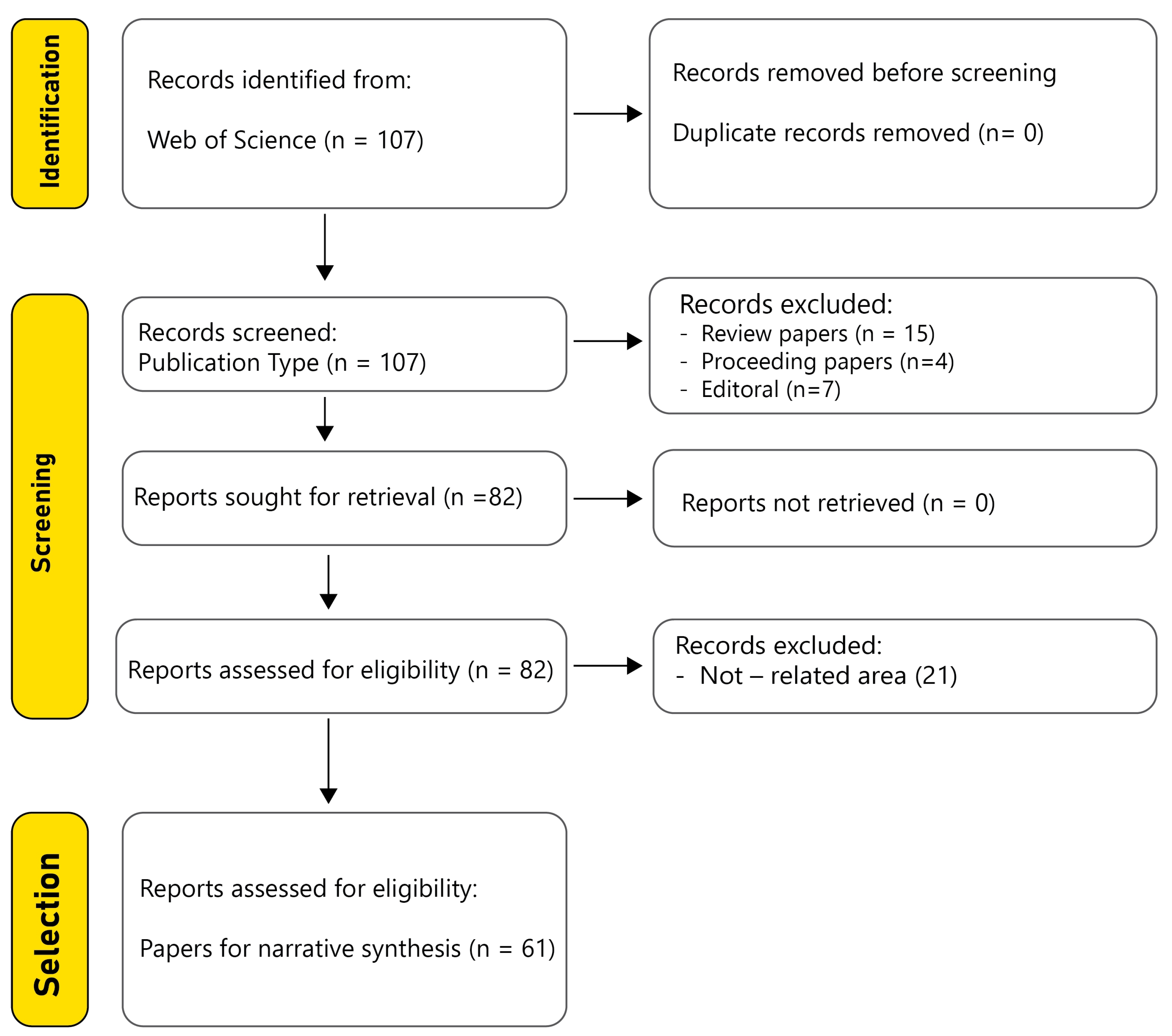
Records retrieved from the search were screened in two stages, following a PRISMA-informed process. First, titles and abstracts were screened to remove duplicates and studies clearly unrelated to urban climate resilience or digital twin concepts. Second, the full texts of remaining papers were assessed against explicit inclusion criteria: the paper had to (i) address urban climate resilience, particularly heat-related hazards, and (ii) engage at least one of the three core dimensions of the proposed framework—environmental/physical systems, social vulnerability, or institutional governance. Papers were excluded for non-urban contexts, unrelated hazards, or insufficient detail to support coding; on this basis, 21 of the 82 full texts assessed were excluded at the eligibility stage as not related. This process resulted in 61 papers for the final narrative synthesis.
Figure 1 shows the PRISMA framework for this study.
2.3. Coding Framework and Data Extraction
To keep the analysis transparent and replicable, each of the 61 included papers was coded against a structured codebook rather than read impressionistically. The codebook recorded the following: (i) engagement with each core dimension—environmental, social, institutional—coded as absent, partial, or full, where full required at least one measurable indicator or modelling component, and partial meant discussion without operationalization; (ii) modelling technology (e.g., GIS, computational fluid dynamics, machine learning, agent-based modelling, system dynamics, none reported); (iii) data source (administrative/policy documents, remote sensing, survey/interview, census/socioeconomic, IoT sensors, computer vision); (iv) scenario-testing capability and case-study status (real-world, simulated, none); (v) geographic context and spatial scale; and (vi) equity-related indicators, including whether vulnerable groups were defined using an explicit index or criteria, and whether community or stakeholder engagement was direct, nominal, or absent. This codebook operationalizes the three core dimensions referred to throughout
Section 3 and underlies the counts reported there.
2.4. Thematic Synthesis
Using the codebook categories above, papers were compared along the three core dimensions—environmental, social, and institutional—both individually and in combination, and across the cross-cutting technical, spatial, and equity indicators recorded during coding. This comparative synthesis identified integration gaps systematically and provided the empirical basis for the conceptual UDT framework.
3. Results
3.1. Identification and Spatial Context
The systematic review process identified 61 papers for synthesis, thematically addressing components relevant to Urban Digital Twins (UDT) and urban climate resilience. The temporal distribution of the corpus reveals a markedly accelerating research trajectory: while only 12 studies were published between 2010 and 2019, 40 of the 61 papers (approximately two-thirds) appeared between 2021 and 2025 alone, with 2025 representing the single most productive year (11 papers). This pattern indicates that UDT research for climate resilience is a rapidly consolidating rather than mature field, with conceptual and technical foundations still actively being established rather than settled.
Spatially, the reviewed literature is heavily concentrated in the Global North, with studies situated in the USA alone accounting for roughly a third of the corpus (20 papers), followed by a cluster of European contexts (13 papers across the UK, The Netherlands, Austria, Sweden, Germany, Italy, and Spain) and a smaller but notable presence of Chinese case studies (5 papers). A further 18 papers were either explicitly global in scope or not tied to a specific location, often reflecting conceptual or methodological contributions rather than site-based applications. Only isolated studies engaged with contexts outside these dominant regions (e.g., Singapore, South Korea, Canada, Australia, and a single paper situated in Ghana), underscoring a pronounced Global South gap in empirically grounded UDT resilience research. Most studies (47 of 61) operate at the city-wide level, while only two explicitly engage the building scale, suggesting a bias toward aggregate systems over fine-grained, community-level analysis.
3.2. UDT and Core Framework Alignment
Despite the corpus’s thematic relevance, few studies actually constitute or claim to be UDTs in the technical sense: explicit UDT terminology appeared in only 6 of 61 papers, 13 used a closely related concept (e.g., smart city platforms, simulation environments) without the UDT label, and 42 made no reference to digital twin concepts at all. Correspondingly, the maturity assessment found that 42 papers were not UDTs by any definition, 10 offered conceptual proposals only, and just 9 reported a working prototype or pilot implementation. This confirms that the field remains predominantly aspirational, justifying treatment of the corpus as components of the literature from which a conceptual framework can be synthesized, rather than as mature, comparable UDT implementations.
When mapped against the three core dimensions of the proposed framework—environmental/systems, social/people, and institutional/policy—the reviewed literature shows a clear asymmetry. The environmental module was addressed, at least implicitly, in 59 of 61 papers (57 fully, 2 partially), confirming that biophysical and climate-hazard modelling is the best-established pillar of UDT-relevant research. The social vulnerability module was present in 57 papers (49 fully, 8 partially), reflecting growing but less consistent attention to equity and population exposure. The institutional/governance module was the weakest of the three, fully addressed in only 45 papers and entirely absent in 7, and tended to concentrate on physical or technical modelling without engaging decision-making structures, policy actors, or governance processes. Only 40 papers integrated all three modules simultaneously, suggesting that while the individual building blocks of a Systems–People–Policy UDT framework already exist in the literature, their systematic co-integration into a single coherent architecture remains rare, constituting the central gap this review’s proposed framework seeks to address.
This pattern reflects more than coverage; it shows an uneven methodological maturity across dimensions. Papers coded as fully engaging the environmental module usually reported quantified, validated indicators (e.g., land-surface temperature, exposure indices), while papers fully engaging institutional governance relied more on qualitative document analysis without similar validation, so “full” engagement was judged more strictly there. This suggests that environmental modelling looks stronger partly because of disciplinary convention, not because authors take governance less seriously. The corpus also shows a real tension: the most technically advanced papers, combining machine learning or agent-based simulation with real-time data, reported the least stakeholder engagement, while papers with the strongest community involvement used simple, non-computational models. This inverse pattern, discussed further in
Section 4, suggests that technical sophistication and social inclusion have so far developed on separate tracks rather than together.
3.3. Technical and Methodological Detail
The corpus shows a strong bias toward geospatial and physically based environmental modelling over data-driven approaches. GIS-based methods were the single most common modelling technology, appearing in 21 of 61 papers, followed by computational fluid dynamics/microclimate simulation (10 papers) and machine learning/AI techniques (9 papers). Agent-based modelling remained marginal, used in only 4 studies, and system dynamics or network-based approaches (graph/complex network analysis) appeared in just 1–2 papers each. Notably, 28 papers (46%) reported no specific modelling technology, being conceptual rather than computational contributions. This reinforces
Section 3.2: the hybrid physical-simulation/data-driven machinery that a fully computational UDT requires is scattered across a minority of studies rather than integrated within single systems.
Data infrastructure shows a similarly fragmented picture. Administrative and policy documents were the most frequently used data source (23 papers), followed by remote sensing/satellite data (20 papers), surveys and interviews (15 papers), and census/socioeconomic data (14 papers). Real-time or high-frequency data streams—IoT sensors and computer vision—were used in only 5 and 1 papers, respectively, showing that live-monitoring, a defining feature of a true “twin,” is still rare. Only 18 of 61 papers (30%) demonstrated scenario-testing functionality, mostly testing physical interventions rather than social or combined scenarios—again reflecting the environmental-module dominance noted earlier. Empirical grounding was comparatively stronger: 31 papers (51%) validated their approach against a real-world case, while 15 relied on simulated or hypothetical cases and 14 remained purely conceptual with no applied case at all. Together, these patterns show strong, empirically tested environmental modelling, but the real-time, multi-technology integration and dynamic scenario-testing central to an operational UDT remain underdeveloped—a key gap for the proposed framework to address.
3.4. Equity and Governance Lens
Most of the reviewed papers do care about fairness, but few turn that concern into something a UDT could actually act on. Equity was an explicit focus in 37 of 61 papers, and a further 20 mentioned it without deeper analysis, showing that the field broadly accepts that climate risk is unevenly distributed. Vulnerable groups were also defined with some kind of index or clear criteria in 31 papers, which is useful because named criteria can be built directly into a digital twin. Still, 18 papers named vulnerable groups only in passing, and 11 did not address them at all. Community and stakeholder engagement was even weaker: only 26 papers involved communities directly, while 28 had none, and a handful only proposed engagement without carrying it out. On the governance side, 40 papers did link their work to real decision-making, but far fewer showed how affected communities would actually take part in those decisions. Overall, the literature is good at identifying who is vulnerable but weaker at giving them a voice—a gap the proposed framework should close by treating participation as a core design feature, not an afterthought.
3.5. UDT Proposed Framework
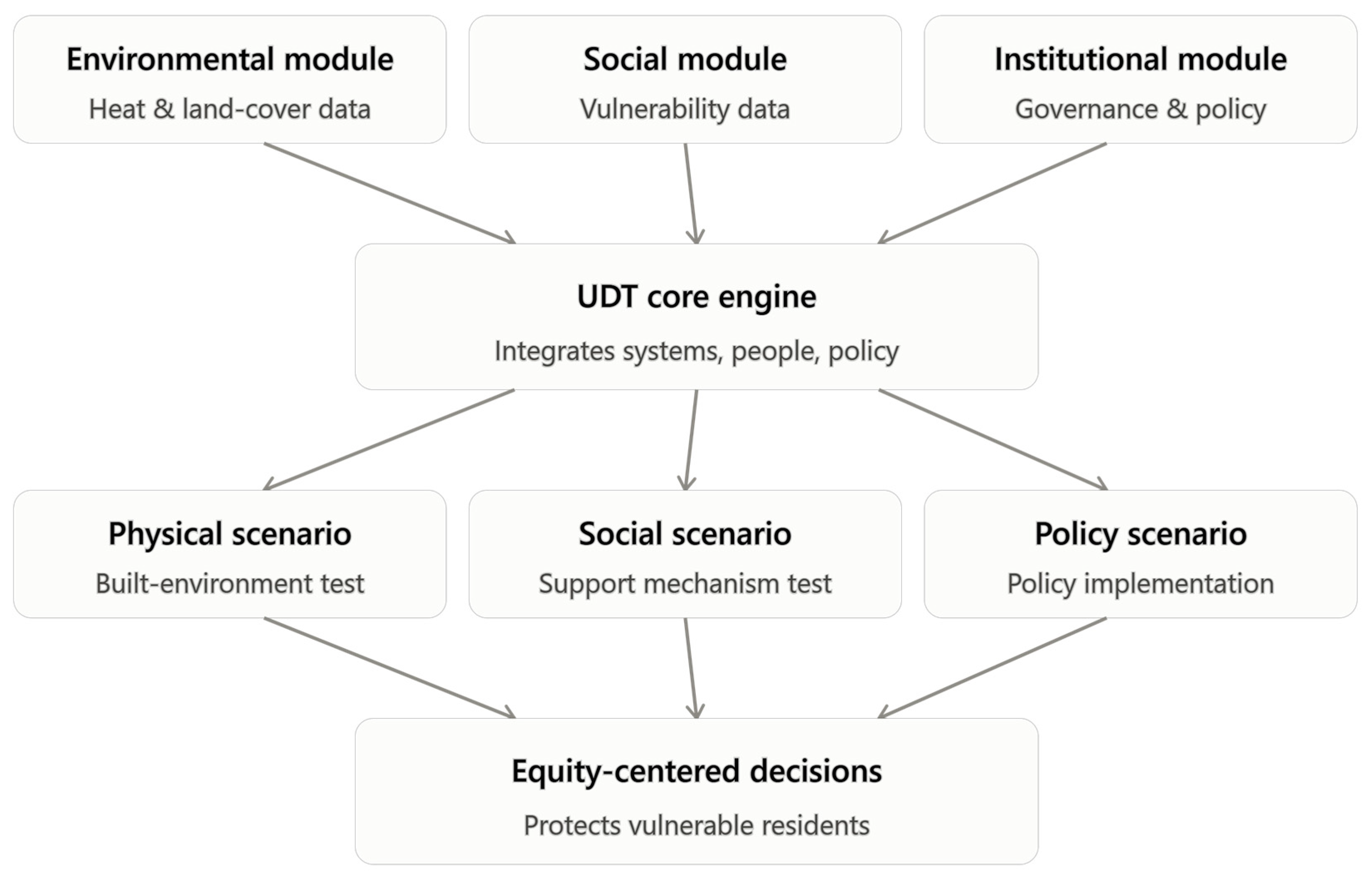
The proposed framework structures a UDT around three input modules mirroring the review’s core gaps: environmental (heat exposure, land-cover data), social (population vulnerability), and institutional (governance and policy actors). These feed into a UDT core engine that integrates systems, people, and policy data into a single, dynamic city representation, enabling three types of scenario testing: physical (e.g., green infrastructure), social (e.g., cooling centres), and policy (e.g., zoning rules). Outputs feed equity-centred decisions that protect the most vulnerable residents rather than optimizing for city-wide averages, with a feedback loop recalibrating the modules as new data, hazards, or policies emerge.
Figure 2 shows the UDT proposed framework for urban climate resilience modules.
Two terms in
Figure 2 warrant explicit definition. A “module” constitutes an input layer of the UDT: a defined set of data, indicators, and update rules representing one dimension of the city—environmental, social, or institutional—for the core engine to process. The environmental module draws on remote-sensing and land-cover data; the social module uses census, survey, and socioeconomic data organized around a vulnerability index rather than a single proxy; and the institutional module uses policy documents identifying decision-makers, their mandates, and available regulatory instruments. A “scenario” is an operation the core engine performs: a defined change to one or more modules (e.g., increased tree canopy, an expanded cooling-centre network, or a revised zoning rule), with effects evaluated jointly across all three modules rather than in isolation. This joint evaluation distinguishes the proposed engine from the single-module tools common in the reviewed literature: a scenario is complete only once its effects on vulnerable groups and responsible institutions have been calculated, not merely its effect on temperature. Operationalizing this requires data flows rarely reported together—heat-exposure results linked to the social module’s vulnerability index, then routed to the institutional module for evaluation against existing policy—supported by a shared spatial layer, a regular update cycle, and clear governance rules on which institution may act on a given result; without these, the engine can calculate equity impacts but cannot connect them to action. Because only 40 of 61 reviewed papers integrated all three dimensions (
Section 3.2), and real-time data remains rare (
Section 3.3), these requirements exceed what most existing systems—and this proposal—have yet demonstrated; the framework should be read as a specification of what an equity-centred UDT requires, not a description of one already built.
4. Discussion and Conclusions
Results show that most of the building blocks needed for an Urban Digital Twin (UDT) already exist in the literature: strong environmental and climate-hazard modelling, a growing (if uneven) attention to social vulnerability, and a reasonable link to real-world decision-making. Yet these pieces rarely come together in one system. Only a minority of papers combined all three core dimensions of environmental, social, and institutional analysis, and even fewer used the word “digital twin” or built anything close to a working one. This confirms that UDT research for climate resilience is still forming, not settled: the ideas are ahead of the tools, and the tools are ahead of their integration. The heavy concentration of studies in the USA, Europe, and China also means that the framework as currently understood is shaped mostly by Global North cities, leaving open how well it would travel to lower-resource or fast-growing urban contexts elsewhere.
This review therefore suggests that UDTs for urban climate resilience are promising but still structurally incomplete. The literature is strongest on environmental modelling, growing on social vulnerability, and weakest on institutional governance. Thus, the central challenge is no longer simply whether UDTs can simulate climate risk, but whether they can connect risk analysis to equitable decision-making. In this sense, the findings reinforce the need to understand UDTs not only as technical modelling environments, but also as decision-support systems that connect environmental evidence with planning and resilience governance.
This regional concentration also shapes the institutional barriers that the framework is likely to encounter. Global North and Global South cities face structurally different obstacles—ageing, contested infrastructure in the former; rapid informal growth and limited fiscal capacity in the latter—though fragmented policy implementation is common to both [
9]. A framework built on evidence from well-resourced contexts risks assuming a level of data infrastructure and coordination that is precisely what is missing where vulnerability is highest. Equity-focused planning is also inescapably political: decisions about which neighbourhoods receive cooling infrastructure first, or who counts as “vulnerable”, can redistribute resources and are inherently contested. Presenting a UDT as a neutral tool risks letting institutional actors depoliticize these choices by framing them as model outputs rather than decisions with winners and losers, echoing broader critiques of smart-city technologies as instruments of stewardship rather than empowerment [
6,
8]. Treating community participation as a core design feature (
Section 3.4) keeps the political visible.
A deeper interpretation of the synthesis indicates that this challenge is not simply one of technical immaturity, but also a mismatch between technical sophistication and social usefulness. The review shows that technically advanced studies, including those using machine learning, agent-based simulation, and real-time data, often reported weaker stakeholder engagement, whereas studies with stronger community involvement tended to rely on simpler modelling approaches. This pattern suggests that social inclusion has not yet developed alongside technical sophistication and is often treated as an additional component rather than as a design principle.
This tension between technical sophistication and social inclusion (
Section 3.2) is more than an academic pattern: a UDT that is technically accurate but socially disconnected risks reinforcing the very inequities it aims to address, since decision-support built for governments is not the same as decision-support built with communities. Closing this gap is a design choice, not just a technical one, and it is exactly what the proposed Systems–People–Policy framework is meant to guide.
From an engineering standpoint, these findings define a systems-integration problem rather than a conceptual one. Individual components are already mature—GIS and remote-sensing pipelines for the environmental module, census- and survey-based indices for the social module—yet pipelines combining physical simulation with data-driven inference remain uncommon, and real-time streams are rarer still. Realizing the core engine in
Figure 2 is therefore chiefly an interoperability challenge: a common spatial data model to ingest heterogeneous formats on a shared update cycle, plus an API through which institutional actors can query scenario outputs without operating the underlying models directly. This carries a practical sequencing implication: cities lacking the administrative data digitization reported in
Section 3.3 would need to invest in data infrastructure before scenario-testing capability can be meaningfully added.
These conclusions carry clear limitations. The review draws on a single database and a narrow search string, so it characterizes the UDT-adjacent literature rather than the broader scholarship on climate governance, environmental justice, or participatory modelling, which is instead engaged narratively; additionally, the proposed Systems–People–Policy architecture remains a synthesis of what the literature would need to support, not a system that has been built or tested. The evidence nonetheless shows genuine progress in environmental modelling alongside persistent gaps in institutional integration, real-time data, and community involvement—gaps this paper treats as a starting point rather than a shortcoming.
Overall, this study therefore argues that UDTs for climate resilience should evolve from technically sophisticated but fragmented tools into integrated decision-support systems that connect physical modelling, social vulnerability, and governance within a single architecture. The review shifts the focus from whether a city can be modelled digitally toward whether that digital representation can support more equitable, accountable, and actionable climate-resilience decisions. Future work should therefore pilot the coding protocol on literature from underrepresented regions to test whether the three-module pattern holds beyond the Global North; build and test the proposed data model and API in a single case-study city before attempting real-time integration; and empirically test whether treating participation as a core module input changes which interventions a UDT recommends, compared with treating it as a downstream consultation step.