
Integration of Sustainable Urban Drainage Systems (SUDSs) in Highway Projects in Small Island Developing States (SIDSs) for Improved Resilience to Flooding †


Abstract
1. Introduction
2. Literature Review
2.1. Types of Sustainable Urban Drainage Systems (SUDSs)
2.2. Barriers and Enablers to SUDSs Implementation
2.3. SUDS Application in Island Countries and Difficult Environments
3. Materials and Methods
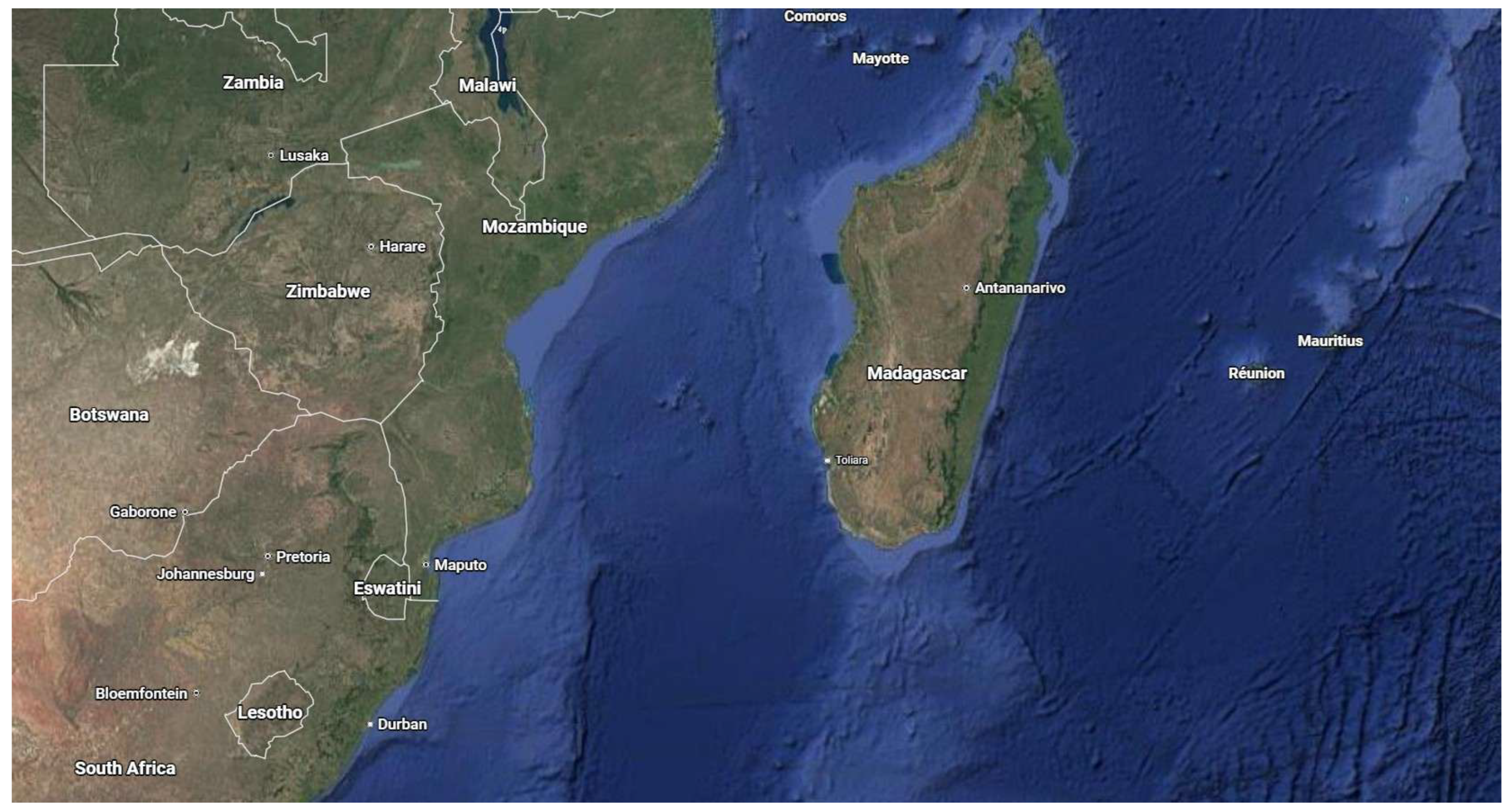
3.1. Study Context
3.2. Study Approach
3.3. Data Analysis
4. Results and Discussion
4.1. SUDS Components for Integration in Highway Projects
4.2. Barriers for SUDS Integration in Highway Projects
4.2.1. Technical Barriers
“Before selecting SUDS, there is a need to have detailed information on soil properties, position of the water table and the existing topography. These are often not available due to restricted site investigations …”[Participant 3]
“Although swales and infiltration trenches are easy to construct, precautionary measures such as lining on high slopes to prevent erosion during frequent high-intensity rainfall…”[Participant 10]
4.2.2. Financial Barriers
“SUDS require significantly more land compared to traditional drainage systems and in Mauritius, with the land scarcity issue, this increases the project costs through expensive land acquisition…”[Participant 1]
“More maintenance is required for SUDS as they are prone to silting and overgrown vegetation during the rainy season and therefore a higher budget …”[Participant 5]
4.2.3. Regulatory Barriers
“Existing international design documents cannot be used. There is a need to have guidelines developed for the island given its specificities …”[Participant 7]
“To increase SUDS adoption, laws need to be put in place to ensure that designers are considering these solutions during the initial project stages…”[Participant 16]
4.2.4. Organisational Barriers
“It has not yet been proven that SUDS will solve the issue of flooding fully. Therefore, management is sometimes very reluctant to adopt this measure and prefer the traditional drainage systems that they know will perform satisfactorily…”[Participant 2]
“Projects are often carried out in silos by organisations, with early designs not incorporating SUDS measures. Once the land acquisition process has been completed, there is little room to incorporate SUDS due to the larger land requirements…”[Participant 14]
4.2.5. Individual Barriers
“Design of SUDS is different to traditional stormwater systems. Training is required to build up the skills for designing and implementing SUDS…”[Participant 4]
“There are very few projects that have been successfully implemented and demonstrated that they are performing better than the traditional systems. These could have been used for reference purposes to increase trust in SUDS…”[Participant 12]
“There is better acceptance of traditional drainage systems since this has always been used and there is resistance to change to new and untried solutions…”[Participant 11]
4.3. Enablers for SUDS Integration in Highway Projects
“It will help to increase SUDS adoption if we can show that the SUDS measures are working efficiently through small scale pilot projects …”[Participant 3]
“Suppliers of sustainable drainage solutions need to market their products with the highway authorities and local consultancy firms to increase awareness…”[Participant 5]
“Clients and consultants need to be trained in SUDS so that these measures can be adopted during the early project phases such as during planning …”[Participant 9]
“During the construction phase, health and safety issues arise due to bulk earthworks required for ponds and site personnel should also be trained to cope …”[Participant 13]
“We have to show that this type of drainage has more benefits even though it costs more. Cost–benefit analysis taking into account both direct and indirect benefits should be made for these new measures …”[Participant 1]
“Maintenance of the existing traditional drainage system is done infrequently and therefore the cost may appear to be low compared to maintenance budget for SUDS. There is a need to have a clearly defined maintenance plan for both systems before assessing the costs…”[Participant 13]
“Mauritius has specific characteristics in terms of varying soil infiltration rates, difficult topography in some regions, high water table and high intensity rainfall. We need to have guidelines on SUDS developed considering all these parameters…”[Participant 4]
“The drainage authority needs to have a team which is well versed in SUDS to carry out monitoring of these implemented projects to capture information with respect to their performance and disseminate it to all relevant stakeholders…”[Participant 10]
“Coordination amongst stakeholders during early project lifecycle is needed to break the fragmented approach and ensure that a holistic approach is being adopted when implementing the highway infrastructure….”[Participant 6]
5. Conclusions
Funding
Institutional Review Board Statement
Informed Consent Statement
Data Availability Statement
Acknowledgments
Conflicts of Interest
References
- Holl, A. Highways and local development: Insights from two decades of investments. Reg. Reg. Stud. 2025, 59, 2461297. [Google Scholar] [CrossRef] [Scilit]
- Kahangirwe, P.; Vanclay, F. Social impacts arising from road infrastructure projects in Sub-Saharan Africa: Better management of social issues is needed in road construction, upgrading and rehabilitation. Impact Assess. Proj. Apprais. 2024, 42, 309–322. [Google Scholar] [CrossRef] [Scilit]
- Quium, A.S.M.A. Transport Corridors for Wider Socio–Economic Development. Sustainability 2019, 11, 5248. [Google Scholar] [CrossRef] [Scilit]
- Pregnolato, M.; Ford, A.; Wilkinson, S.M.; Dawson, R.J. The impact of flooding on road transport: A depth-disruption function. Transp. Res. Part D Transp. Environ. 2017, 55, 67–81. [Google Scholar] [CrossRef] [Scilit]
- Xu, S.; Liu, D.; Chen, H.; Huang, G.; Hong, C.; Chen, L. Flood Risk Assessment Considering the Spatial and Temporal Characteristics of Disaster-Causing Factors. Sustainability 2026, 18, 3646. [Google Scholar] [CrossRef] [Scilit]
- Chen, X.; Wang, H. Enhancement of roadway pavement resilience to flooding: Impact assessment and mitigation strategies. Transp. Res. Part D Transp. Environ. 2025, 148, 104946. [Google Scholar] [CrossRef] [Scilit]
- Ma, C.; Chen, Z.; Zhao, K.; Xu, H.; Qi, W. Improved urban flood risk assessment based on spontaneous-triggered risk assessment conceptual model considering road environment. J. Hydrol. 2022, 608, 127693. [Google Scholar] [CrossRef] [Scilit]
- Oladunjoye, O.; Proverbs, D.; Xiao, H. Retrofitting Sustainable Urban Drainage Systems (SuDS): A Cost-Benefit Analysis Appraisal. Water 2022, 14, 2521. [Google Scholar] [CrossRef] [Scilit]
- Fayomi, G.U.; Onyari, E.K.; Jaiyeola, A.T. Quantitative assessment of open drainage and storm water runoff capacity in Nigeria: Consequences and way forward. Case Stud. Chem. Environ. Eng. 2024, 9, 100766. [Google Scholar] [CrossRef] [Scilit]
- Jiménez Ariza, S.L.; Martínez, J.A.; Muñoz, A.F.; Quijano, J.P.; Rodríguez, J.P.; Camacho, L.A.; Díaz-Granados, M. A Multicriteria Planning Framework to Locate and Select Sustainable Urban Drainage Systems (SUDS) in Consolidated Urban Areas. Sustainability 2019, 11, 2312. [Google Scholar] [CrossRef] [Scilit]
- Abellán García, A.I.; Cruz Pérez, N.; Santamarta, J.C. Sustainable Urban Drainage Systems in Spain: Analysis of the Research on SUDS Based on Climatology. Sustainability 2021, 13, 7258. [Google Scholar] [CrossRef] [Scilit]
- Guptha, G.C.; Swain, S.; Al-Ansari, N.; Taloor, A.K.; Dayal, D. Assessing the role of SuDS in resilience enhancement of urban drainage system: A case study of Gurugram City, India. Urban Clim. 2022, 41, 101075. [Google Scholar] [CrossRef] [Scilit]
- Mabrouk, M.; Han, H.; Fan, C.; Abdrabo, K.I.; Shen, G.; Saber, M.; Kantoush, S.A.; Sumi, T. Assessing the effectiveness of nature-based solutions-strengthened urban planning mechanisms in forming flood-resilient cities. J. Environ. Manag. 2023, 344, 118260. [Google Scholar] [CrossRef] [Scilit]
- Chen, S.S.; Tsang, D.C.W.; He, M.; Sun, Y.; Lau, L.S.Y.; Leung, R.W.M.; Lau, E.S.C.; Hou, D.; Liu, A.; Mohanty, S. Designing sustainable drainage systems in subtropical cities: Challenges and opportunities. J. Clean. Prod. 2021, 280, 124418. [Google Scholar] [CrossRef] [Scilit]
- Monachese, A.P.; Gómez-Villarino, M.T.; López-Santiago, J.; Sanz, E.; Almeida-Ñauñay, A.F.; Zubelzu, S. Challenges and Innovations in Urban Drainage Systems: Sustainable Drainage Systems Focus. Water 2025, 17, 76. [Google Scholar] [CrossRef] [Scilit]
- Ortega, A.D.; Rodríguez, J.P.; Bharati, L. Building flood-resilient cities by promoting SUDS adoption: A multi-sector analysis of barriers and benefits in Bogotá, Colombia. Int. J. Disaster Risk Reduct. 2023, 88, 103621. [Google Scholar] [CrossRef] [Scilit]
- Haddad, H.; Bryden, J.; Connop, S. Practitioner Perceptions of Mainstreaming Sustainable Drainage Systems (SuDS): A Mixed Methods Study Exploring Direct Versus Indirect Barriers. Sustainability 2025, 17, 2093. [Google Scholar] [CrossRef] [Scilit]
- Almeida, J.; Proaño, O.; Avila, C.; Villacres, D.; Rivera-Tapia, E.D. Island ecosystems unleashed: Rain gardens transforming flood management in Galápagos. Urban Water J. 2025, 22, 186–199. [Google Scholar] [CrossRef] [Scilit]
- Gurung, S.B.; Wasson, R.J.; Bird, M.; Jarihani, B. Impact of Climate Change on Water-Sensitive Urban Design Performances in the Wet Tropical Sub-Catchment. Earth 2025, 6, 99. [Google Scholar] [CrossRef] [Scilit]
- Ang, S.Y.; Goh, H.W.; Shaharuddin, S.; Azizan, N.A.; Kamal Yed, M.; Dinno, N.D.; Mohamed, H.A. Effectiveness of pilot-scale multi-pond constructed wetland system (MPCWS) for tropical island domestic sewage treatment. Ecohydrol. Hydrobiol. 2026, 26, 100725. [Google Scholar] [CrossRef] [Scilit]
- Bernal-Basurco, C.; Rodríguez-Sinobas, L.; Segovia-Cardozo, D.A. Socio-economic impact of Sustainable Urban Drainage Systems (SUDS): Literature review and research challenges. J. Environ. Manag. 2026, 414, 130458. [Google Scholar] [CrossRef] [Scilit]
- Bleicher, J.; Kumar, P. A novel framework integrating resilient and sustainable urbanism for designing climate resilient sustainable urban neighbourhoods. Sustain. Cities Soc. 2025, 130, 106577. [Google Scholar] [CrossRef] [Scilit]
- Broom, J.; Broom, A. Qualitative research methods: Powerful tools for understanding practice and informing change. J. Hosp. Infect. 2024, 149, 182–183. [Google Scholar] [CrossRef] [Scilit]
- Braun, V.; Clarke, V. Using thematic analysis in psychology. Qual. Res. Psychol. 2008, 3, 77–101. [Google Scholar] [CrossRef] [Scilit]
- Naeem, M.; Ozuem, W.; Howell, K.; Ranfagni, S. A Step-by-Step Process of Thematic Analysis to Develop a Conceptual Model in Qualitative Research. Int. J. Qual. Methods 2023, 22, 16094069231205789. [Google Scholar] [CrossRef] [Scilit]
- Sousa, M.; Dinis Almeida, M.; Fael, C.; Bentes, I. Permeable Asphalt Pavements (PAP): Benefits, Clogging Factors and Methods for Evaluation and Maintenance—A Review. Materials 2024, 17, 6063. [Google Scholar] [CrossRef] [Scilit]
- Albalawneh, A.; Haddad, N. Constructed wetlands as a nature-based solution for sustainable use of non-conventional water in arid and semi-arid regions: A scoping review. Next Sustain. 2026, 7, 100348. [Google Scholar] [CrossRef] [Scilit]


| SUDS Type | Details |
|---|---|
| Soakaways | Shallow excavated areas with porous materials for stormwater runoff collection and infiltration |
| Swales | Shallow channels lined with vegetation to convey and filter stormwater and that allow soil infiltration |
| Permeable paving | Pavers or cellular blocks with spaces in-between that promote stormwater infiltration and filtering |
| Infiltration trench | Trenches excavated and filled with porous materials for stormwater capture and infiltration |
| Infiltration basin | Basins temporarily hold stormwater runoff, allowing infiltration and are usually dry between rainfall events |
| Detention ponds | Excavated basins temporarily hold stormwater runoff and release it gradually at controlled rates |
| Retention ponds | Ponds designed to capture and store stormwater, reducing peak flows to mitigate flooding downstream. |
| Constructed wetlands | Engineered systems to mimic natural wetlands and allow stormwater storage, treatment and infiltration. |
| Study and Year | Location | SUDS Type | Context | Findings |
|---|---|---|---|---|
| [18] 2025 | Residential roads in Santa Cruz Island, Galapagos | Infiltration garden and permeable pavements | Tropical climate, flat terrain and moderate permeability | Cost effective, sustainable and visually appealing stormwater management solutions |
| [19] 2025 | Residential area in Saltwater Creek, Cairns, Australia | Infiltration trench, retention areas and permeable pavements | Tropical climate, site with steep slopes and low permeability | Only retention-based systems performed well. Site-specific constraints need to be considered for optimum results |
| [20] 2026 | Universiti Sains Campus, Penang, Malaysia | Constructed wetlands | Ponds with flat slopes in tropical climate | Effective, ecological solution for wastewater treatment but with odour and high maintenance issues |
| SUDS Type | Very Difficult | Difficult | Neutral | Easy | Very Easy | RII | Rank |
|---|---|---|---|---|---|---|---|
| Soakaways | 0 | 1 | 3 | 10 | 6 | 0.81 | 1 |
| Swales | 1 | 4 | 3 | 9 | 3 | 0.69 | 3 |
| Permeable paving | 5 | 5 | 4 | 6 | 0 | 0.51 | 6 |
| Infiltration trench | 0 | 2 | 3 | 11 | 4 | 0.77 | 2 |
| Infiltration basin | 2 | 8 | 3 | 5 | 2 | 0.57 | 5 |
| Detention ponds | 2 | 8 | 3 | 4 | 3 | 0.58 | 4 |
| Retention ponds | 3 | 10 | 2 | 5 | 0 | 0.49 | 7 |
| Constructed wetlands | 10 | 7 | 3 | 0 | 0 | 0.33 | 8 |
Disclaimer/Publisher’s Note: The statements, opinions and data contained in all publications are solely those of the individual author(s) and contributor(s) and not of MDPI and/or the editor(s). MDPI and/or the editor(s) disclaim responsibility for any injury to people or property resulting from any ideas, methods, instructions or products referred to in the content. |
© 2026 by the author. Licensee MDPI, Basel, Switzerland. This article is an open access article distributed under the terms and conditions of the Creative Commons Attribution (CC BY) license.
Share and Cite
Doomah, Z. Integration of Sustainable Urban Drainage Systems (SUDSs) in Highway Projects in Small Island Developing States (SIDSs) for Improved Resilience to Flooding. Environ. Earth Sci. Proc. 2026, 45, 12. https://doi.org/10.3390/eesp2026045012
Doomah Z. Integration of Sustainable Urban Drainage Systems (SUDSs) in Highway Projects in Small Island Developing States (SIDSs) for Improved Resilience to Flooding. Environmental and Earth Sciences Proceedings. 2026; 45(1):12. https://doi.org/10.3390/eesp2026045012
Chicago/Turabian StyleDoomah, Zaheer. 2026. "Integration of Sustainable Urban Drainage Systems (SUDSs) in Highway Projects in Small Island Developing States (SIDSs) for Improved Resilience to Flooding" Environmental and Earth Sciences Proceedings 45, no. 1: 12. https://doi.org/10.3390/eesp2026045012
APA StyleDoomah, Z. (2026). Integration of Sustainable Urban Drainage Systems (SUDSs) in Highway Projects in Small Island Developing States (SIDSs) for Improved Resilience to Flooding. Environmental and Earth Sciences Proceedings, 45(1), 12. https://doi.org/10.3390/eesp2026045012