
The Impacts of Producing Bio-Briquettes Made from Organic Waste as an Alternative Source of Fuel †



Abstract
1. Introduction
2. Study Objectives
3. An Assessment of Raw Materials Used in Bio-Briquettes Production
3.1. Feedstock Characterization and Properties
3.2. Sub-Saharan Africa Feedstock Suitability and Characteristics
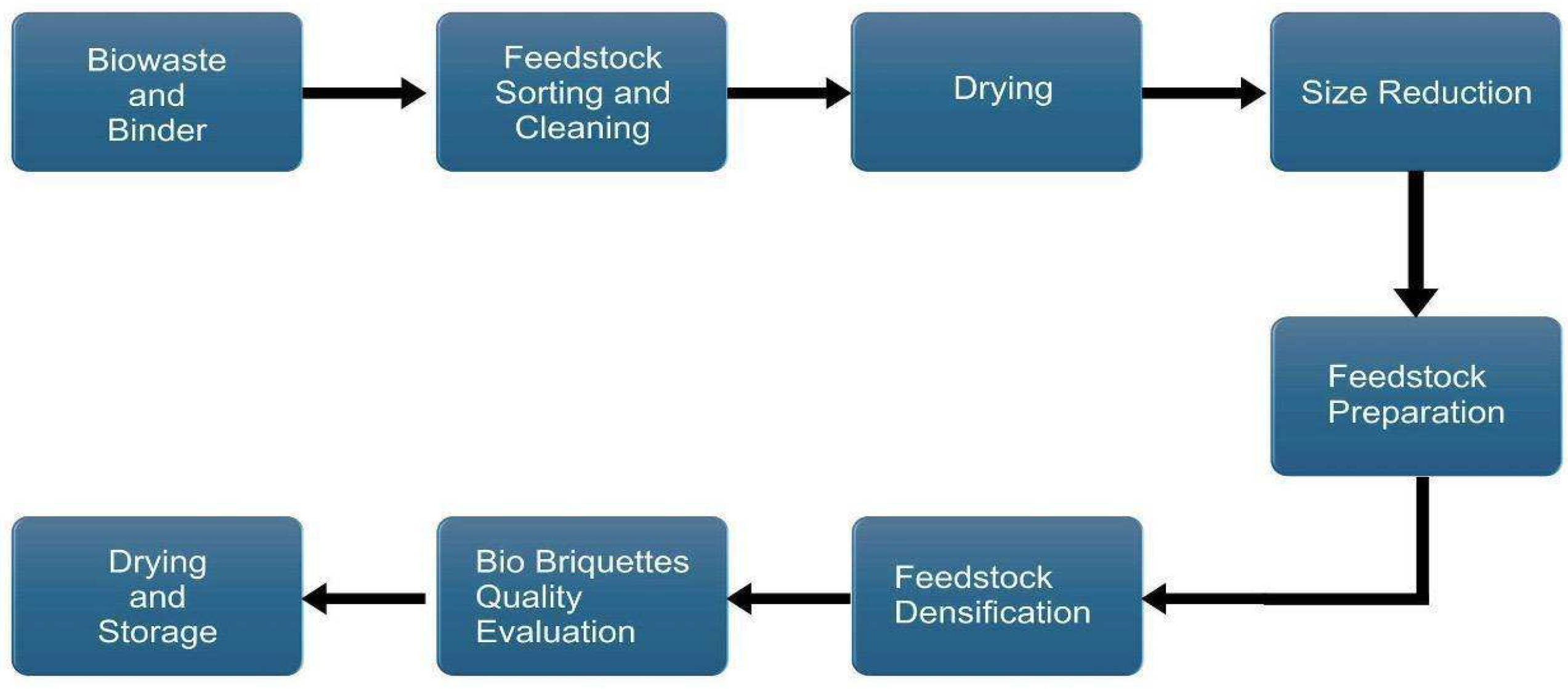
4. Analyses of Bio-Briquette Production Process and Properties
4.1. Organic Waste Drying
4.2. Organic Waste Size Reduction
4.3. Organic Waste Carbonization
4.4. Binding Agents
4.5. Briquetting and Densification
4.6. Briquettes Drying
4.7. Quality Control
5. Impacts of Briquettes Production on Sustainable Development and Climate Change Mitigation in Sub-Saharan Africa
5.1. Positive Impacts
5.1.1. Environmental Benefits
5.1.2. Economic and Social Benefits
5.1.3. Technological
5.1.4. Reduced Greenhouse Gas Emissions and Forest Preservation
5.1.5. Improved Waste Utilization and Supporting Circular Economy
5.2. Negative Impacts
5.2.1. Deforestation and Unsustainable Biomass Sourcing
5.2.2. Greenhouse Gas Emissions and Air Pollution During Production
5.2.3. Water Use and Resource Conflicts
5.2.4. Economic and Social Implications
5.2.5. Lifecycle Emissions and Net Impact
5.2.6. Technical and Adoption Barriers
5.3. Potential Climate Drawbacks of Bio-Briquettes
5.3.1. Carbon Dioxide Emissions and Airborne Particulates
5.3.2. Dependence on Non-Renewable Energy
5.3.3. Unsustainable Biomass Harvesting and Land Use Impacts
6. Conclusions
Author Contributions
Funding
Data Availability Statement
Acknowledgments
Conflicts of Interest
Abbreviations
| AI | Artificial Intelligence |
| CH4 | Methane |
| CO2 | Carbon dioxide |
| GHG | Greenhouse gases |
| IoT | Internet of Things |
| MJ/kg | Megajoules per kilogram |
| SDGs | Sustainable Development Goal |
References
- Jekayinfa, S.O.; Orisaleye, J.I.; Pecenka, R. An assessment of potential resources for biomass energy in Nigeria. Resources 2020, 9, 92. [Google Scholar] [CrossRef] [Scilit]
- Dinesha, P.; Kumar, S.; Rosen, M.A. Biomass briquettes as an alternative fuel: A comprehensive review. Energy Technol. 2019, 7, 1801011. [Google Scholar] [CrossRef] [Scilit]
- Pode, R.; Diouf, B.; Pode, G. Sustainable rural electrification using rice husk biomass energy: A case study of Cambodia. Renew. Sustain. Energy Rev. 2015, 44, 530–537. [Google Scholar] [CrossRef] [Scilit]
- Adeleke, O.; Bamisaye, A.; Adegoke, K.A.; Adegoke, I.A.; Jen, T.C. Optimizing the energy values of solid biofuel through acidic pre-treatment: An evolutionary-based neuro-fuzzy modelling and feature importance analysis. Fuel 2025, 380, 133182. [Google Scholar] [CrossRef] [Scilit]
- Talaat, M.; Alblawi, A.; Tayseer, M.; Elkholy, M.H. FPGA control system technology for integrating the PV/wave/FC hybrid system using ANN optimized by MFO techniques. Sust. Cities Soc. 2022, 80, 103825. [Google Scholar] [CrossRef] [Scilit]
- Bot, B.V.; Axaopoulos, P.J.; Sakellariou, E.I.; Sosso, O.T.; Tamba, J.G. Energetic and economic analysis of biomass briquettes production from agricultural residues. Appl. Energy 2022, 321, 119430. [Google Scholar] [CrossRef] [Scilit]
- Yunusa, S.U.; Mensah, E.; Preko, K.; Narra, S.; Saleh, A.; Sanfo, S. A comprehensive review on the technical aspects of biomass briquetting. Biomass Convers. Biorefin. 2024, 14, 21619–21644. [Google Scholar] [CrossRef] [Scilit]
- Lubwama, M.; Birungi, A.; Nuwamanya, A.; Yiga, V.A. Characteristics of rice husk biochar briquettes with municipal solid waste cassava, sweet potato and matooke peelings as binders. Mater. Renew. Sustain. Energy 2024, 13, 243–254. [Google Scholar] [CrossRef] [Scilit]
- Sanchez-Roque, Y.; Orantes-Flores, H.J.; López-de-Paz, P.; Pérez-Luna, Y.C.; Canseco-Pérez, M.A.; Zenteno-Carballo, A.G. Biomass briquettes: Raw material, technologies and densification parameters, quality and future challenges. Sci. Agropecu. 2025, 16, 293–306. [Google Scholar] [CrossRef] [Scilit]
- ASTM D4442-20; Standard Test Methods for Direct Moisture Content Measurement of Wood and Wood-Based Materials. ASTM International: West Conshohocken, PA, USA, 2020. Available online: https://store.astm.org/d4442-20.html (accessed on 23 August 2026).
- ASTM D3174-12(2018) e1; Standard Test Method for Ash in the Analysis Sample of Coal and Coke from Coal. ASTM International: West Conshohocken, PA, USA, 2018. Available online: https://store.astm.org/standards/d3174 (accessed on 23 August 2026).
- ASTM D5865/D5865M-19; Standard Test Method for Gross Calorific Value of Coal and Coke. ASTM International: West Conshohocken, PA, USA, 2019. Available online: https://contitesting.com/astm-d5865/ (accessed on 23 August 2026).
- ASTM D4239-18e1; Standard Test Method for Sulfur in the Analysis Sample of Coal and Coke Using High-Temperature Tube Furnace Combustion. ASTM International: West Conshohocken, PA, USA, 2018. Available online: https://store.astm.org/d4239-18e01.html (accessed on 23 August 2026).
- Manyuchi, M.M.; Mbohwa, C.; Mutusva, T.N.; Stinner, W. An analysis of the effect of temperature and pressure on bio pellets physicochemical properties. S. Afr. J. Chem. Eng. 2025, 54, 29–43. [Google Scholar] [CrossRef] [Scilit]
- Fawzy, S.; Osman, A.I.; Doran, J.; Rooney, D.W. Strategies for mitigation of climate change: A review. Environ. Chem. Lett. 2020, 18, 2069–2094. [Google Scholar] [CrossRef] [Scilit]
- Mansyur, S.; Nugroho, A.P. Proximate analysis of rice husk waste briquettes and dried leaves as alternative fuel. J. Engine Energi Manufaktur Dan Mater. 2025, 9, 206–214. [Google Scholar] [CrossRef] [Scilit]
- Rashif, M.N.; Hartini, S.; Sari, D.P.; Ramadan, B.S.; Matsumoto, T.; Balasbaneh, A.T. Life cycle assessment of biomass waste briquettes as renewable energy. Glob. J. Environ. Sci. Manag. 2025, 11, 207–224. [Google Scholar] [CrossRef]
- Soeherman, G.P.; Putri, P.G.; Joen, D.A.Z.; Indrawan, I.; Pratiwi, N. Characterization of Biobriquette from Carbonized Durian Peel Using Coconut Shell as the Binder. Asian J. Appl. Res. Community Dev. Empower. 2023, 7, 129–135. [Google Scholar] [CrossRef] [Scilit]
- Waheed, M.A.; Akogun, O.A.; Enweremadu, C.C. An overview of torrefied bioresource briquettes: Quality-influencing parameters, enhancement through torrefaction and applications. Bioresour. Bioprocess. 2022, 9, 118. [Google Scholar] [CrossRef] [Scilit] [PubMed]
- Silva, D.A.L.; Filleti, R.A.P.; Musule, R.; Matheus, T.T.; Freire, F. A systematic review and life cycle assessment of biomass pellets and briquettes production in Latin America. Renew. Sustain. Energy Rev. 2022, 157, 112042. [Google Scholar] [CrossRef] [Scilit]
- Ferronato, N.; Mendoza, I.J.C.; Portillo, M.A.G.; Conti, F.; Torretta, V. Are waste-based briquettes alternative fuels in developing countries? A critical review. Energy Sustain. Dev. 2022, 68, 220–231. [Google Scholar] [CrossRef] [Scilit]
- Velusamy, S.; Kasilingam, K.; Ayyasamy, T.; Shanmugamoorthy, M.; Subramaniam, N.K.; Sivakumar, V.; Subbaiyan, A. Energy Harvesting from Agro Biomass in the Form of Solid Briquettes and Its Combustion Characteristics: A Review. Solid Fuel Chem. 2026, 60, 69. [Google Scholar] [CrossRef] [Scilit]
- Obi, O.F.; Pecenka, R.; Clifford, M.J. A review of biomass briquette binders and quality parameters. Energies 2022, 15, 2426. [Google Scholar] [CrossRef] [Scilit]
- Zhang, X.; He, Z.; Wu, Y.; Yu, W.; Liu, T. Corn-distillers-derived hard carbon: A sustainable high-rate, long-life anode for sodium-ion batteries. Acta Phys.-Chim. Sin. 2025, 41, 100199. [Google Scholar] [CrossRef] [Scilit]
- Fikri, E.; Sartika, C. Study on the Use and Composition of Bio-Charcoal Briquettes Made of Organic Waste. J. Ecol. Eng. 2018, 19, 81–88. [Google Scholar] [CrossRef] [Scilit] [PubMed]
- Nunes, L.J.R.; Matias, J.C.O.; Catalão, J.P.S. Biomass combustion systems: A review on the physical and chemical properties of the ashes. Renew. Sustain. Energy Rev. 2016, 53, 235–242. [Google Scholar] [CrossRef] [Scilit]
- Ibitoye, S.E.; Mahamood, R.M.; Jen, T.C.; Loha, C.; Akinlabi, E.T. Design and fabrication of biomass densification machine for teaching and research purposes. Biomass Convers. Biorefinery 2024, 14, 24253–24264. [Google Scholar] [CrossRef] [Scilit]
- Sengar, A.; Sharma, V.; Joshi, K.; Agrawal, R. A fuzzy Analytic Hierarchy Process based analysis for prioritization of enablers to pine briquettes-based energy generation. Biomass Bioenergy 2022, 168, 106580. [Google Scholar] [CrossRef] [Scilit]
- Olugbade, T.O.; Ojo, O.T. Biomass torrefaction for the production of high-grade solid biofuels: A review. BioEnergy Res. 2020, 13, 999–1015. [Google Scholar] [CrossRef] [Scilit]
- Marreiro, H.M.P.; Peruchi, R.S.; Lopes, R.M.B.P.; Yamaji, F.M.; Silva, D.A.L. Empirical studies on biomass briquette production: A literature review. Energies 2021, 14, 8320. [Google Scholar] [CrossRef] [Scilit]
- Nakimuli, C.N.; Kaggwa, F.; De Greef, J.; Okot, D.K.; Blondeau, J.; Kawuma, S. Review of machine learning applications for predicting the quality biomass briquettes for sustainable and low-carbon energy solutions. Green Energy Resour. 2025, 3, 100130. [Google Scholar] [CrossRef] [Scilit]
- He, H.; Wang, Y.; Sun, Y.; Sun, W.; Wu, K. From raw material powder to solid fuel pellet: A state-of-the-art review of biomass densification. Biomass Bioenergy 2024, 186, 107271. [Google Scholar] [CrossRef] [Scilit]
- Eling, J.; Okot, D.K.; Menya, E.; Atima, M.R. Densification of Raw and Torrefied Biomass: A Review; Mbarara University of Science and Technology: Mbarara, Uganda, 2024; Available online: http://ir.must.ac.ug/handle/123456789/3588 (accessed on 23 August 2026).
- Roman, K.; Grzegorzewska, E. The comparison of physical and chemical properties of pellets and briquettes from hemp (Cannabis sativa L.). Energies 2024, 17, 2210. [Google Scholar] [CrossRef] [Scilit]
- Bot, B.V.; Sosso, O.T.; Tamba, J.G.; Lekane, E.; Bikai, J.; Ndame, M.K. Preparation and characterization of biomass briquettes made from banana peels, sugarcane bagasse, coconut shells and rattan waste. Biomass Convers. Biorefin. 2023, 13, 7937–7946. [Google Scholar] [CrossRef] [Scilit]
- Mulyana, C.; Suryaningsih, S. Integrated model of utilization of organic waste into bio briquettes with community empowerment in West Java. IOP Conf. Ser. Mater. Sci. Eng. 2019, 550, 012007. [Google Scholar] [CrossRef] [Scilit]
- Alanya-Rosenbaum, S.; Bergman, R.D. Life-cycle impact and exergy-based resource use assessment of torrefied and non-torrefied briquette use for heat and electricity generation. J. Clean. Prod. 2019, 233, 918–931. [Google Scholar] [CrossRef] [Scilit]
- Saba, S.; El Bachawati, M.; Malek, M. Cradle to grave Life Cycle Assessment of Lebanese biomass briquettes. J. Clean. Prod. 2020, 253, 119851. [Google Scholar] [CrossRef] [Scilit]
- Nganko, J.M.; Koffi, E.P.M.; Toure, A.O.; N’Guessan, Y.A.; Kouassi, E.A. Comparative assessment of pollutant emissions between biofuel briquettes and charcoal: Implications for domestic cooking fuel selection. Carbon Res. 2025, 4, 15. [Google Scholar] [CrossRef] [Scilit]
- Kizito, G. Assessment of the socio-economic and technical aspects of biomass waste derived briquettes for energy supply in Uganda. Master’s Thesis, Makerere University, Kampala, Uganda, 2024. Available online: https://makir.mak.ac.ug/handle/10570/14135 (accessed on 23 August 2026).
- Sarker, T.R.; Nanda, S.; Dalai, A.K.; Meda, V. A review of torrefaction technology for upgrading lignocellulosic biomass to solid biofuel. BioEnergy Res. 2021, 14, 645–669. [Google Scholar] [CrossRef] [Scilit]
- Mwampamba, T.H.; Owen, M.; Pigaht, M. Opportunities, challenges and way forward for the charcoal briquette industry in Sub-Saharan Africa. Energy Sustain. Dev. 2013, 17, 158–170. [Google Scholar] [CrossRef] [Scilit]
- Kpalo, S.Y.; Zainuddin, M.F.; Abd Manaf, L.; Roslan, A.M. A review of technical and economic aspects of biomass briquetting. Sustainability 2020, 12, 4609. [Google Scholar] [CrossRef] [Scilit]
- Granado, M.P.P.; Suhogusoff, Y.V.M.; Santos, L.R.O.; Yamaji, F.M.; De Conti, A.C. Effects of pressure densification on strength and properties of cassava waste briquettes. Renew. Energy 2021, 167, 306–312. [Google Scholar] [CrossRef] [Scilit]
- Zinla, B.T.D.; Yobouet, Y.A.; Trokourey, A. Life Cycle Assessment of cashew nutshell briquettes produced in Côte d’Ivoire. Open J. Appl. Sci. 2024, 14, 2411–2430. [Google Scholar] [CrossRef]


| Feedstock | Moisture % | Volatile Matter (%) | Fixed Carbon (%) | Ash (%) | Carbon (C) (%) | Hydrogen (H) (%) | Nitrogen (N) (%) | Oxygen (O) (%) | Lignin (%) | Calorific Value (MJ/kg) |
|---|---|---|---|---|---|---|---|---|---|---|
| Sawdust | 8.2 | 78.0 | 12.3 | 1.5 | 48.0 | 6.0 | 0.5 | 43.0 | 28.0 | 18.9 |
| Rice Husks | 10.5 | 65.2 | 4.5 | 19.8 | 41.0 | 5.0 | 0.4 | 33.0 | 25.0 | 14.2 |
| Groundnut Shells | 9.0 | 70.5 | 17.3 | 3.2 | 50.0 | 5.5 | 0.8 | 40.0 | 30.0 | 18.1 |
| Bagasse | 50.0 | 75.0 | 19.5 | 2.5 | 48.0 | 6.0 | 0.3 | 43.0 | 22.0 | 17.5 |
| Feedstock | Seasonal Availability | Moisture (%) | Ash (%) | Calorific Value (MJ/kg) | Potential Advantages | Main Limitations | References |
|---|---|---|---|---|---|---|---|
| Sawdust | Year-round | 8–10 | 1–2 | 18–19 | High lignin (self-binding), easy to process | Requires collection from sawmills; high transport costs if centralized. | [7,8,9,10,11,12,13,14,15] |
| Rice Husks | Seasonal (harvest) | 10–12 | 18–20 | 14–15 | Massively abundant, very cheap | High silica content causes clinker formation requires high-temperature combustion. | [16,17,18,19,20,21,22,23,24,25,26,27,28,29,30] |
| Bagasse | Seasonal (sugarcane) | 45–50 | 2–3 | 17–18 | High energy content, abundant in sugar-producing regions | Extremely high moisture requires intensive drying; often used internally in sugar mills. | [5,7,31,32,33,34,35,36,37,38,39,40,41] |
| Groundnut Shells | Seasonal | 8–10 | 3–4 | 18–19 | High fixed carbon, good binding properties | Limited to harvest seasons; requires bulk storage for year-round production. | [4] |
| Palm Kernel Shells | Year-round | 10–15 | 1–2 | 20–22 | Very high calorific value, low ash, hard and durable | Highly sought after industrial export, creating local market competition. | [41] |
| Municipal Organic Waste | Continuous | 60–80 | 10–20 | 10–15 | Constant supply directly solves urban waste management crises | Very high moisture, high contamination (plastics, glass) requiring rigorous sorting and cleaning | [6,17] |
| Cost/Revenue Item | Amount (USD) |
|---|---|
| Direct Production Costs | |
| Feedstock Collection & Transport | $20.00 |
| Electricity, Machinery & Maintenance | $30.00 |
| Binder (Molasses) & Labor | $35.00 |
| Total Cost per Ton | $85.00 |
| Revenue | |
| Local Market Selling Price per Ton | $130.00 |
| Net Profit per Ton | $45.00 |
| Metric | Traditional Coal | Bio-Briquette (This Study) | Environmental Benefit | Measurement Method |
|---|---|---|---|---|
| Sulfur Content | 0.8–1.5% | <0.1% | 60–90% reduction in acid rain | [13] (Ultimate/Bomb Calorimetry) |
| Ash Content | 10–20% | 2–4% | 80% reduction in ash waste | [11] (Proximate Analysis) |
| CO2 Emissions (kg CO2e/MJ) | ~0.095 | ~0.000 carbon neutral | Net-zero climate impact | Literature-based LCA calculation [42,43,44,45] |
| Deforestation Impact | High (mining) | Low (waste valorization) | Preserves local forests | Qualitative assessment based on feedstock sourcing |
| Property | Unit | Coal | Firewood | Charcoal | Bio-Briquette (This Study) |
|---|---|---|---|---|---|
| Calorific value | MJ/kg | 24–29 | 15–18 | 28–32 | 22–25 |
| Bulk Density | kg/m3 | 700–900 | 200–400 | 200–300 | 600–800 |
| Sulfur Content | % | 0.8–1.5 | <0.1 | <0.1 | <0.1 |
| Ash Content % | % | 10–20 | 1–3 | 2–5 | 2–4 |
| Emission Factor | (CO2) g CO2 | ~95 | ~80 | ~70 | ~0 (Net neutral) |
Disclaimer/Publisher’s Note: The statements, opinions and data contained in all publications are solely those of the individual author(s) and contributor(s) and not of MDPI and/or the editor(s). MDPI and/or the editor(s) disclaim responsibility for any injury to people or property resulting from any ideas, methods, instructions or products referred to in the content. |
© 2026 by the authors. Licensee MDPI, Basel, Switzerland. This article is an open access article distributed under the terms and conditions of the Creative Commons Attribution (CC BY) license.
Share and Cite
Bhanda, R.; Manyuchi, M.M.; Stinner, W.; Mbohwa, C. The Impacts of Producing Bio-Briquettes Made from Organic Waste as an Alternative Source of Fuel. Environ. Earth Sci. Proc. 2026, 42, 26. https://doi.org/10.3390/eesp2026042026
Bhanda R, Manyuchi MM, Stinner W, Mbohwa C. The Impacts of Producing Bio-Briquettes Made from Organic Waste as an Alternative Source of Fuel. Environmental and Earth Sciences Proceedings. 2026; 42(1):26. https://doi.org/10.3390/eesp2026042026
Chicago/Turabian StyleBhanda, Roseline, Musaida Mercy Manyuchi, Walter Stinner, and Charles Mbohwa. 2026. "The Impacts of Producing Bio-Briquettes Made from Organic Waste as an Alternative Source of Fuel" Environmental and Earth Sciences Proceedings 42, no. 1: 26. https://doi.org/10.3390/eesp2026042026
APA StyleBhanda, R., Manyuchi, M. M., Stinner, W., & Mbohwa, C. (2026). The Impacts of Producing Bio-Briquettes Made from Organic Waste as an Alternative Source of Fuel. Environmental and Earth Sciences Proceedings, 42(1), 26. https://doi.org/10.3390/eesp2026042026