1. Introduction
Biological wastewater treatment often leaves toxic organic micropollutants in the water, such as pharmaceutical and cosmetic compounds, which require further treatment to remove. Advanced Oxidation Processes are well-suited as supplementary processes, based on the efficient generation of radicals via a combination of appropriate UV light and oxidants [
1]. Operating costs are often high, particularly for photochemical processes, but they are effective as a supplement to biological wastewater treatment, i.e., as quaternary wastewater treatment, for the oxidation of non-biodegradable organic pollutants. These processes include the UV/H
2O
2 and UV/PDS methods, based on
•OH and SO
4•− generation, respectively [
1,
2]. The transformation of organic compounds is based on the reactions with radicals (
•OH and SO
4•−).
The 254 nm low-pressure mercury vapor lamp is widely used as a light source in wastewater treatment. However, in the near future, the use of Hg-containing light sources will be limited due to mercury’s harmful environmental and health effects. An alternative can be the KrCl excimer lamp, which emits at 222 nm. Excimer lamps are light sources filled with a noble gas or a noble-gas–halogen mixture, in which the wavelength of the emitted light depends on the composition of the filling gas. The KrCl excimer lamp, which emits 222 nm UV light with excellent disinfecting properties, has been used in the past decade not only for air disinfection but also for UV-based water treatment [
3]. The molar absorbance of oxidizing agents, such as H
2O
2 and PDS, increases as the wavelength decreases. Consequently, the KrCl excimer lamp may be more effective at generating radicals than a mercury vapor lamp [
4].
In this study, the commonly used antibiotic trimethoprim (TRIM), classified as a persistent pollutant, was utilized as an organic model compound. It is mainly used to treat urinary and respiratory tract infections. Due to its widespread use and poor biodegradability, TRIM has been detected in surface and groundwater in numerous cases [
5]. Both
•OH and SO
4•− are effective in transforming TRIM [
6,
7], so UV/H
2O
2 and UV/PDS processes were also examined and compared, using a low-pressure mercury vapor lamp and a KrCl excimer lamp as light sources. The matrix can significantly affect the efficiency of the transformation, so methods were tested in biologically treated municipal wastewater. The organic and inorganic components of water can influence the rate of pollutant degradation, and the matrix components can absorb photons and act as internal filters. Moreover, reactions of inorganic ions with
•OH and SO
4•− can produce so-called secondary radicals, which can also react with the organic compound.
2. Materials and Methods
Ultrapure Milli-Q water was used to prepare all solutions, except for the matrix effect study. For the matrix effect study, biologically treated municipal wastewater was used. The synthetic wastewater was an aqueous solution of NaCl (VWR, Debrecen, Hungary) and NaHCO3 (VWR, Hungary), with the same concentrations of Cl− and HCO3− as in the wastewater. The concentration of the oxidizing agents (H2O2 and PDS, VWR, Hungary) was varied between 1 × 10⁻⁴ and 2 × 10⁻³ M, while the concentration of the trimethoprim solution was 5 × 10⁻³ M in all cases.
A low-pressure Hg-vapor lamp (LPM, LightTech, Dunakeszi, Hungary) emitting at 254 nm and a KrCl excimer lamp (UV Can Sanitize, Covington, GA, USA) emitting at 222 nm were used as light sources. The electrical power of the lamps was the same (15 W); the UV power of the LPM was 4.3 W, whereas the UV intensity of the excimer lamp was 3000 μW/cm2. The lamp was immersed in the treated solution (450 mL). The thickness of the illuminated solution layer was the same for both lamps (1.5 cm). The solution was bubbled with air for 15 min before the start of the measurement and continuously thereafter. Treatment was started by switching on the lamp. The residual PDS and H2O2 in the samples were decomposed using Na2S2O3 (VWR, Hungary) and catalase solutions, respectively.
The photon flux of the lamps was determined by actinometric measurement in both cases. For the lamp emitting at 254 nm, iron oxalate actinometry [
8] was used, while for the 222 nm lamp, uridine actinometry [
9] was applied. The photon flux of LPM and KrCl excimer lamp were 4.39 × 10
−6 mol
foton s
−1 and 5.18 × 10
−7 mol
foton s
−1, respectively. A diode array spectrophotometer was used to record the absorption spectra of the samples. The H
2O
2 concentration was measured using a colorimetric assay, and the decomposition of PDS was monitored by ion chromatography, measuring the SO
42− concentration. An HPLC equipped with a UV DAD detector (Agilent 8453; Santa Clara, CA, USA) was used to separate the sample components and determine the TRIM concentration (Agilent 1100, column Kinetex 5u ECO C18 100 A, Phenomenex; Torrance, CA, US) methanol:formic acid solution (1%) = 8:92, 1.0 cm
3 min
–1).
3. Results and Discussion
3.1. The UV Photolysis of H2O2 and PDS
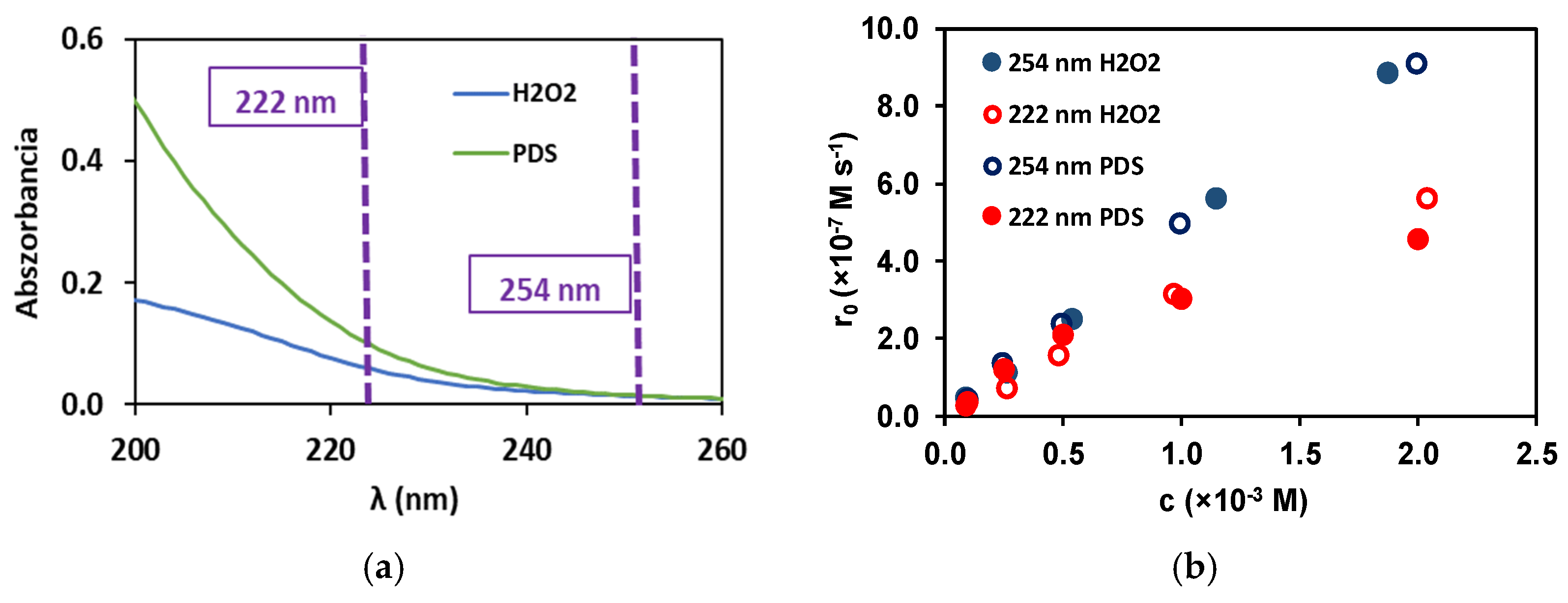
The molar absorbance of H
2O
2 and PDS increases significantly as the wavelength decreases. The molar absorbance values of H
2O
2 and PDS were determined based on the Lambert-Beer law and were found to be 17 and 79 M
−1 cm
−1 for H
2O
2 and 21 and 175 M
−1 cm
−1 for PDS, respectively, at 254 and 222 nm (
Figure 1a). The initial transformation rate (r
0) of the oxidants during UV photolysis was determined by fitting the initial part of the kinetic curves (concentration vs. time) to a first-order model.
The rate of photolysis increases with the initial concentrations of H
2O
2 and PDS, as the absorbance increased according to the Lambert-Beer law (
Figure 1b). Particularly, at initial concentrations of c > 5 × 10
−4 M, the rate of transformation of oxidants in the case of the LPM emitting at 254 nm exceeded the values measured in solutions irradiated with the KrCl excimer lamp emitting at 222 nm. The lower transformation rate observed, despite the higher molar absorbance at 222 nm, is due to the one order-of-magnitude lower photon flux of the KrCl lamp compared to the LPM. At the same time, the quantum efficiency values for the photolysis of H
2O
2 and PDS were the same at 254 (ϕ(-H
2O
2)
254nm = 0.89 ± 0.08 and (ϕ(-PDS)
254nm = 0.69 ± 0.06) and at 222 nm (ϕ(-PDS)
222nm = 0.65 ± 0.10).
The organic and inorganic components of the matrix can compete with H
2O
2 or PDS for photons and react with
•OH and SO
4•−, thereby functioning as radical scavengers. The biologically treated municipal wastewater was used as a matrix that primarily contained Cl
− (120 mg dm
–3) and HCO
3− (103 mg dm
–3), as well as organic components (9 mg
C dm
–3). Inorganic ions had no effect on the H
2O
2 and PDS photolysis rates, but the matrix decreased these rates, particularly at 222 nm (
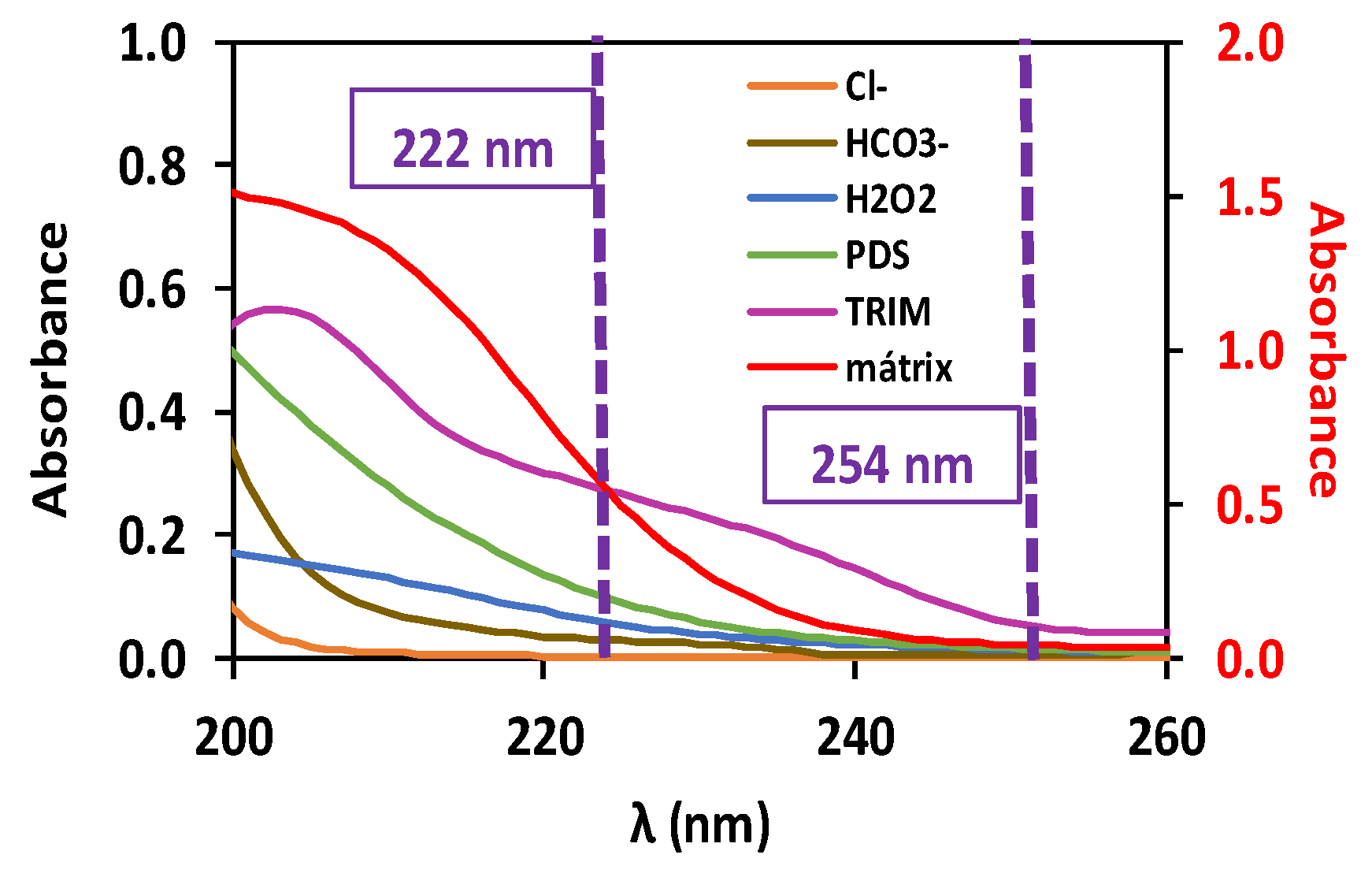
Table 1). Comparing the absorbance of the matrix with that of the oxidants, it is evident that the competition for 222 nm photons must be significant, while competition for 254 nm photons between matrix components and oxidant could be negligible (
Figure 2). The absorbance of the matrix at 222 nm can be comparable to or even exceed that of the oxidants.
3.2. Transformation of Trimethoprim
TRIM does not react with H
2O
2 or PDS; its slow photolysis is observed at 222 nm, while no transformation occurs under 254 nm light. In UV-irradiated H
2O
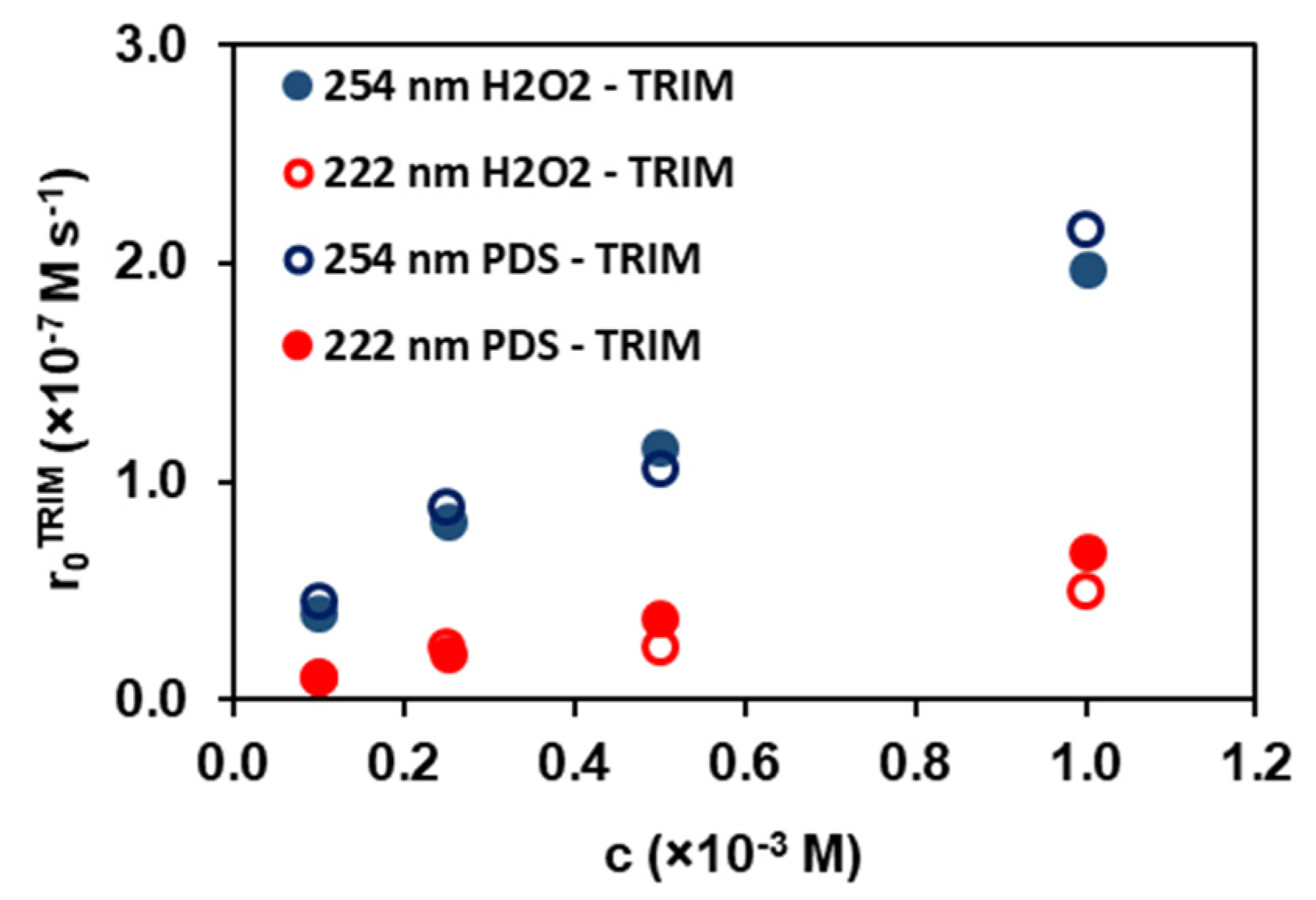
2 and PDS solutions, TRIM transformation is efficient, and its decomposition rate increases with the oxidant concentration (
Figure 3).
The TRIM conversion rate at 254 nm, despite an order-of-magnitude higher photon flux, is only 3–4 times that measured at 222 nm. The presence of TRIM also affects PDS conversion. TRIM reduced the rate of photolysis of PDS at 222 nm because TRIM and PDS compete for the 222 nm photons. Thus, the organic target material acts as an internal filter, reducing the rate of radical formation. At 254 nm, the competition is negligible due to the much lower absorbance of both oxidants and TRIM.
The HCO
3− and Cl
− in the matrix do not significantly affect the transformation rate, despite their radical-scavenging capacity (
Table 2). However, the matrix’s organic content also acts as an internal filter, further reducing the rates of H
2O
2 and PDS photolysis in the presence of TRIM. In addition, the organic content of the matrix acts as an effective radical scavenger, further increasing the negative effect (
Table 2). In solutions irradiated with 254 nm light, the radical-scavenging effect is primarily responsible for the reduction in efficiency, whereas in solutions irradiated with 222 nm light, both the radical-scavenging effect and photon competition are responsible for the decrease in efficiency.
4. Conclusions
The 222 nm KrCl excimer lamp offers a viable, mercury-free alternative to the 254 nm low-pressure mercury vapor lamp in water treatment. Shorter wavelengths lead to more efficient radical generation due to the higher molar absorptivity of the oxidizing agents. However, the molar absorbance of organic compounds and matrix components also increases significantly as wavelength decreases in the UV-C range. As a result, photon competition becomes more pronounced, significantly reducing the efficiency of both UV/H2O2 and UV/PDS processes. It is worth investigating further the direct UV photolysis of inorganic ions and their effect on the efficiency and transformation of organic compounds under 222 nm irradiation.
Author Contributions
Conceptualization, T.A.; methodology, T.A.; investigation, R.B., K.E. and B.V.; writing—original draft preparation, R.B. and T.A.; writing—review and editing, R.B. and T.A.; visualization, R.B. and T.A.; supervision, T.A. All authors have read and agreed to the published version of the manuscript.
Funding
This research was funded by the National Talent Program of the Ministry for Culture and Innovation, grant number NTP-NFTÖ-25-0467.
Institutional Review Board Statement
Not applicable.
Informed Consent Statement
Not applicable.
Data Availability Statement
The data presented in this study are available upon request from the corresponding author.
Conflicts of Interest
The authors declare no conflicts of interest. The funders had no role in the design of the study; in the collection, analyses, or interpretation of data; in the writing of the manuscript; or in the decision to publish the results.
References
- Stefan, M.I. UV/Hydrogen peroxide process. Adv. Oxid. Process. Water Treat. 2017, 2, 7–100. [Google Scholar] [CrossRef]
- Nathalie Karpel, V.L. Sulfate radical ion—Based AOPs. Adv. Oxid. Process. Water Treat. 2017, 10, 429–455. [Google Scholar]
- Ning, P.; Han, Y.; Liu, Y.; Liu, S.; Sun, Z.; Wang, X.; Wang, B.; Gao, F.; Wang, Y.; Wang, Y.; et al. Study on disinfection effect of a 222-nm UVC excimer lamp on object surface. AMB Express 2023, 13, 102. [Google Scholar] [CrossRef] [PubMed]
- Payne, E.M.; Liu, B.; Mullen, L.; Linden, K.G. UV 222 nm Emission from KrCl* Excimer Lamps Greatly Improves Advanced Oxidation Performance in Water Treatment. Environ. Sci. Technol. Lett. 2022, 9, 779–785. [Google Scholar] [CrossRef]
- Le, T.X.; Munekage, Y. Residues of selected antibiotics in water and mud from shrimp ponds in mangrove areas in Viet Nam. Mar. Pollut. Bull. 2004, 49, 922–929. [Google Scholar] [CrossRef] [PubMed]
- Luo, X.; Zheng, Z.; Greaves, J.; Cooper, W.J.; Song, W. Trimethoprim: Kinetic and mechanistic considerations in photochemical environmental fate and AOP treatment. Water Res. 2012, 46, 1327–1336. [Google Scholar] [CrossRef] [PubMed]
- Luo, Y.; Su, R.; Yao, H.; Zhang, A.; Xiang, S.; Huang, L. Degradation of trimethoprim by sulfate radical-based advanced oxidation processes: Kinetics, mechanisms, and effects of natural water matrices. Environ. Sci. Pollut. Res. 2021, 28, 62572–62582. [Google Scholar] [CrossRef] [PubMed]
- Hatchard, C.G.; Parker, C.A. A new sensitive chemical actinometer—II. Potassium ferrioxalate as a standard chemical actinometer. Proc. R. Soc. Lond. A Math. Phys. Sci. 1956, 235, 518–536. [Google Scholar] [CrossRef]
- Zhang, J.-Y.; Boyd, I.W.; Esrom, H. UV intensity measurement for a novel 222 nm excimer lamp using chemical actinometer. Appl. Surf. Sci. 1997, 109–110, 482–486. [Google Scholar] [CrossRef]
| Disclaimer/Publisher’s Note: The statements, opinions and data contained in all publications are solely those of the individual author(s) and contributor(s) and not of MDPI and/or the editor(s). MDPI and/or the editor(s) disclaim responsibility for any injury to people or property resulting from any ideas, methods, instructions or products referred to in the content. |