
Proceeding Paper

Removing the Nitrogen Barrier: Ammonium Recovery via Ion Exchange as an Operational Pathway for Low-GHG Wastewater Treatment Plants †
Faculty of Civil and Environmental Engineering, Technion-IIT, Haifa 3200003, Israel
*
Author to whom correspondence should be addressed.
Presented at the 6th International Conference on Efficient Water Systems (EWaS6), Thessaloniki, Greece, 11–14 May 2026.
These authors contributed equally to this work.
Environ. Earth Sci. Proc. 2026, 44(1), 39; https://doi.org/10.3390/eesp2026044039
Published: 30 June 2026

Abstract

Municipal wastewater treatment plants (WWTPs) are designed and operated with nitrogen removal as the primary constraint. Reliance on nitrification–denitrification-based treatment results in significant nitrous oxide (N2O) emissions. We propose a paradigm shift in WWTP operation, in which nitrogen removal is transformed into an opportunity for resource recovery. Ammonium remaining in the treated effluent is subsequently recovered via ion exchange (IX) and converted into high-purity ammonium salts using a novel, closed-loop, high-pH, low-volume, controlled-regeneration process. Two IX materials are investigated for compliance with the method: zinc hexacyanoferrate composite beads and clinoptilolite-type zeolite. Operating WWTPs using this approach can achieve energy self-sufficiency while contributing to a circular nitrogen economy.

1. Introduction

Municipal wastewater treatment plants are among the most energy-intensive public infrastructure and represent a non-negligible source of global greenhouse gas emissions. Current estimates suggest that wastewater treatment contributes approximately 1–2% of global anthropogenic GHG emissions, primarily in the form of CO2, CH4, and N2O [1,2,3,4,5,6,7]. N2O emissions are of particular concern due to their high global warming potential, approximately 300 times that of CO2 over a 100-year horizon [4].
The prevailing operational paradigm for WWTPs centers on complete nitrogen transformation into benign nitrogen gas. This objective has shaped process design for decades, leading to the widespread adoption of activated sludge systems operated at long sludge retention times to sustain slow-growing nitrifying microorganisms [4,5]. Although effective in meeting discharge regulations, this approach is inherently inefficient from both an energy and resource perspective. A large amount of oxygen is consumed to oxidize ammonia to nitrate, additional organic carbon is required for denitrification, releasing in CO2 emissions to the atmosphere, and valuable nitrogen is irreversibly lost. Moreover, nitrification–denitrification is a major source of N2O emissions. Operating without biological nitrogen removal inevitably leaves ammonium in the treated effluent. To comply with discharge regulations and enable the recovery of this valuable resource, ammonium must be removed and recovered using alternative methods. Ion exchange is a particularly suitable technology for this purpose, as it selectively removes ammonium ions from water at ambient conditions. Both natural zeolites and engineered ion-exchange materials can be employed, depending on wastewater composition and performance requirements [8,9]. However, a key disadvantage of ion-exchange processes is the need to periodically regenerate exhausted material, which generates liquid waste streams. In most conventional systems, the regeneration solution must be frequently replaced, resulting in increased chemical consumption, increased disposal requirements, and higher overall operational costs [8].
An alternative approach that addresses these limitations is regeneration in a closed loop using a high-concentration sodium chloride solution under controlled, high-pH conditions. Maintaining elevated pH shifts the ammonium–ammonia equilibrium toward dissolved ammonia, facilitating efficient desorption with a low regeneration solution volume. The regeneration process can be tightly controlled using pH-based monitoring, enabling precise determination of the regeneration endpoint and minimizing chemical consumption. For example, the pH difference between the feed tank and the column effluent can serve as a control parameter, with very low values acting as a stopping point, and vice versa. Following regeneration, the ammonium-rich solution can be processed to recover nitrogen in the form of a marketable product, NH4Cl salt, through drying and thermal sublimation. Reference [8] demonstrated the economic feasibility of this closed-loop regeneration approach using chabazite zeolite as the ion-exchange medium.
In the present study, we examine the applicability of this regeneration and recovery concept of two ammonium adsorbent materials for the purpose of ammonium extraction from municipal WWTP effluent instead of the chabazite zeolite in the high-pH closed-loop method: (1) ZnHCF adsorbent material, which was suggested by [1] for the extraction process due to the material’s high affinity for ammonium ions, which allows reuse of the regeneration solution almost indefinitely, even in the presence of competing cations; and (2) clinoptilolite zeolite type IX material, which is similar in its ion affinity sequence to the chabazite-type zeolite used in [8]. Moreover, clinoptilolite has a lower capacity, is cheaper, and is generally domestically available.

2. Materials and Methods

2.1. Ion Exchange Resins and Experimental Apparatus

The clinoptilolite-type zeolite was obtained ready for use from a local retailer in Israel. ZnHCF was synthesized in situ and polymerized within PES to form ZnHCF composite beads, following the procedure described in [9,10,11]. Briefly, 0.5 M solutions of ZnCl2 and K4[Fe(CN)6]·3H2O were mixed at a 2:3 volume ratio to produce a white precipitant- K2Zn3(Fe(CN)6)2·6H2O, denoted herein as ZnHCF. The precipitate was dried and mixed with polyether sulfone dissolved in N-methylpyrrolidine, and the mixture was dripped at a controlled rate into a water bath to produce the ZnHCF composite beads. All the column experiments were conducted using a PVC column with the following dimensions: BV = 442 mL, I.D. = 3.2 cm, H = 55 cm.

2.2. ZnHCF Experiments

2.2.1. Capacity Characterization

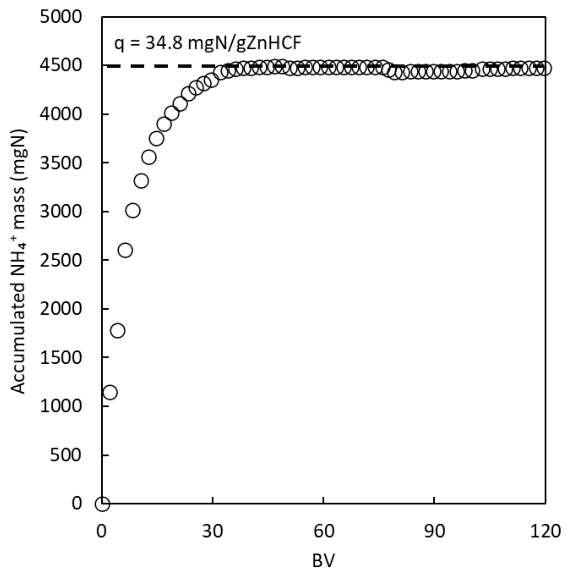
Initially, 4 L of ZnHCF beads were placed in a 40 L solution of 3 M NH4Cl to achieve a uniform, high N-loading equilibrium capacity, providing a uniform starting point for the experiments. To determine the loading capacity of the beads, a regeneration experimetn was performed in a column packed with ammonium-loaded ZnHCF beads (127 g), using a single-batch treatment of 46 L (~138 BV) of a 4 M NaCl regeneration solution at neutral pH. The results presented in Figure 1 show that the capacity reached a steady state after ~50 BV at ~34.8 mgN/gZnHCF.

2.2.2. High-pH Regeneration (Closed-Loop Scheme)

Ammonium-loaded ZnHCF beads (see Section 2.2.1) were packed in the PVC column, and 1 L of a 4 M NaCl regeneration solution at pH 12 was recirculated through the column in a closed-loop batch mode (a new solution was used for each repetition). To minimize NH3 stripping, the regeneration bulk solution was covered with Styrofoam balls. The pH of the regeneration solution was controlled using a Titrino device (STAT-Titrino 718, Metrohm, Herisau, Switzerland) with 6 M NaOH used as the titrant. Samples for total ammonia nitrogen (TAN) analysis were taken from the regeneration solution, and the rate of the base titration was also recorded. In this process, there is a direct 1:1 molar correlation between the base dosage and the desorbed ammonium due to the need to maintain a constant pH and the change in total acidity (see [8] for a detailed explanation).

2.3. Clinoptilolite Experiments

The clinoptilolite zeolite (439 g) was packed in a PVC column, and a series of ammonium adsorption and regeneration cycles via the closed-loop process were conducted as follows, without replacing the zeolite: (1) a 15 L 1 gN/L NH4Cl solution was pumped through the column at a 1.5 L/h flow rate while measuring the cumulative effluent concentration to assess the adsorbed TAN mass; (2) regeneration was performed in a closed-loop scheme (see Section 2.2.2, [8]) using 1 L of 1 M NaCl solution, with pH = 12 maintained in the feed tank. The pH was also monitored at the column exit (i.e., the column effluent).

2.4. Custom pH Calibration Solutions

To accurately measure pH in high-salinity solutions, the electrodes were calibrated with custom buffer solutions containing ionic backgrounds resembling those in the experiments (1 and 4 M Na+), using the phosphate weak acid system. The concentrations of the required salts were calculated using the PHREEQC software (Version 3.8.6.17100, SIT database) [8].

2.5. Analyses

TAN was determined using the salicylate method. Immediately after collection, TAN samples were diluted tenfold and acidified by lowering the pH with 0.1 M HCl to prevent NH3 volatilization [12]. The NaOH titrant solution concentration was measured via HCl titration.

3. Results

3.1. ZnHCF Composite as an Alternative IX Medium

The closed-loop regeneration process developed by [8] for ammonium extraction was used with ZnHCF beads as the adsorbent, as theoretically suggested in [1], to assess their feasibility in this process. Two repetitions were performed using the ammonium-loaded ZnHCF beads in the closed-loop regeneration process.
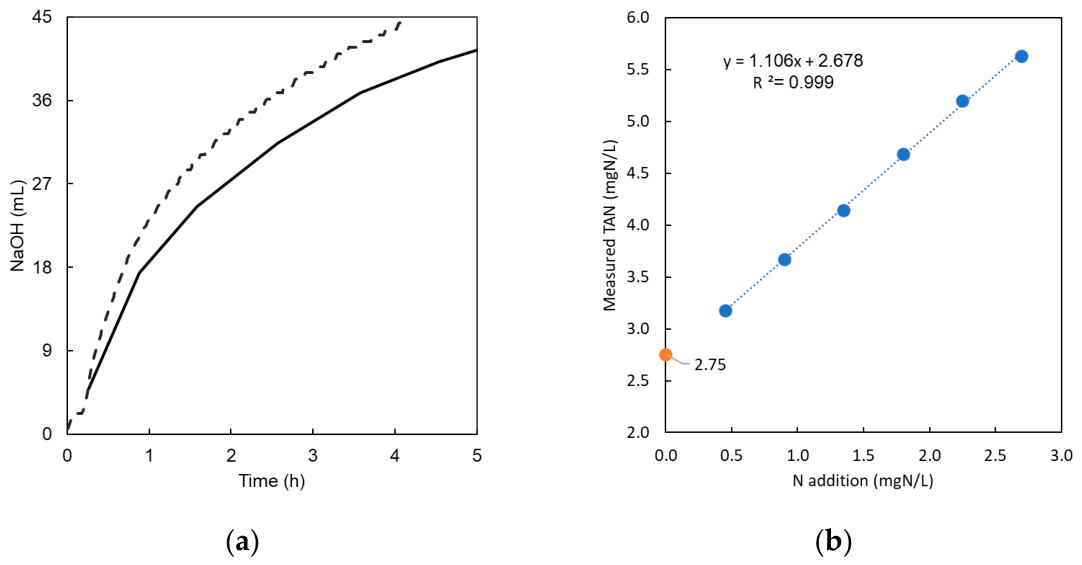
From the initial characterization (see Section 2.2.1), the desorbed TAN mass was expected to be 4.35 gN, which correlates to 52 mL of base. Figure 2a demonstrates the NaOH titration during the regeneration. As can be seen, during the experiment, the NaOH consumption did not reach its potential (<52 mL), indicating that only 86% of the TAN was desorbed (~45 mL of NaOH corresponds to 3.78 gN, or ~86% of the total adsorbed mass). Samples taken during the experiment show TAN concentrations below 1 mg/L, with only the final sample averaging at 2.75 mgN/L, a value three orders of magnitude lower than expected from the titrated base (3.78 gN in 1 L, or ~3780 mgN/L). To validate that this result was not an analysis error, a spiking test was performed on the samples (Figure 2b, n = 3), yielding a back regression result of 2.67 mgN/L, which is in good agreement with the single-point result of 2.75 mgN/L. A test was performed to ensure that ammonia stripping was not the cause of the results by circulating 4 gN/L TAN at pH 12 overnight in a system without the column; the results showed no change in TAN concentration, indicating that stripping is not the mechanism for the loss of ammonia.
These results suggest the presence of a second adsorption mechanism for the uncharged ammonia (NH3) species, which, to the best of our knowledge, has not been reported in the literature for dissolved ammonia. Data are available on ammonia gas adsorption in various metal hexacyanoferrates, where it is hypothesized that a second vacancy site in the crystal serves as an adsorption site for water or ammonia molecules [13,14,15].

3.2. Clinoptilolite as an Alternative IX Medium

Clinoptilolite was also tested to assess its feasibility and performance compared to the chabazite-type zeolite used in [8], i.e., ammonium adsorption, regeneration in a high-pH closed-loop process, and reuse of the regeneration solution by separating the ammonium fraction via a drying and sublimation separation scheme [8,11].
Three repetitions were conducted without replacing the IX medium. Results for each examined step of the tested process are presented below.

3.3. Ammonium Adsorption and Regeneration Steps

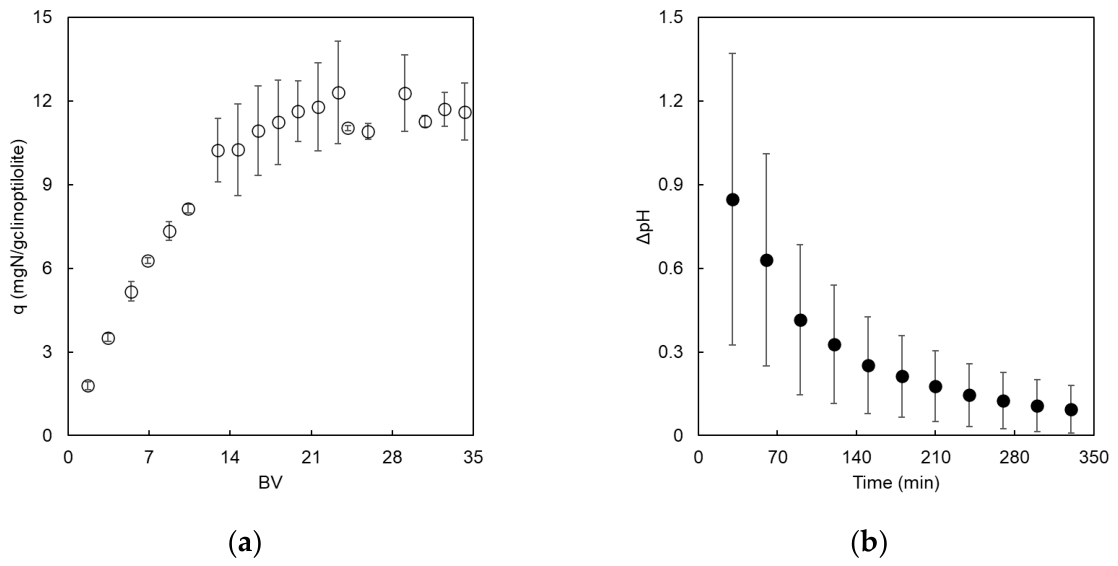
The clinoptilolite-packed column underwent three full adsorption–regeneration cycles. The results are presented in Table 1 and Figure 3. As shown in Figure 3a, the IX appeared to tend toward a steady state, as the capacity at the end of each adsorption step converged to a range of ~11.62 ± 1.03 mgN/gIX. The regeneration step also appeared to reach steady state conditions, as indicated by the low ΔpH values at the end of each regeneration step (Figure 2b). Variations in ΔpH initial values are expected due to differences in the initial adsorbed mass (Figure 2b). Looking at the three repetitions as a total set (Table 1), we can see that at least 90% of the adsorbed ammonium was desorbed using the closed-loop process. The strong base titrated volume provides a better estimation of the desorbed ammonium mass, as no dilution factors or analytical interferences are involved, with a calculated 99.8% recovery of ammonium. A reduction in capacity from the first step to the next is expected when using pristine IX material.

4. Conclusions

Clinoptilolite and ZnHCF were tested for ammonium extraction and reuse using the novel closed-loop, high-pH regeneration process. The tests were performed to determine a suitable candidate for further examination in real WWTP effluent, where competing cations, precipitation of solids, organic matter, and other challenges are expected.
Clinoptilolite was shown to be a suitable candidate for use in the process, although its lower capacity compared to chabazite may lead to higher capital costs. Strong evidence for a new adsorption mechanism in the ZnHCF material was observed for dissolved ammonia species, allowing the uptake of both charged and uncharged species. Unfortunately, this adsorption mechanism disqualifies the ZnHCF material for use in the closed-loop regeneration process.

Author Contributions

Conceptualization, O.L., P.N. and C.D.-J.; methodology, O.L., P.N. and C.D.-J.; software, P.N. and C.D.-J.; validation, O.L., P.N. and C.D.-J.; writing-original draft preparation and review and editing, O.L., P.N., A.W., R.B.-A., S.O. and C.D.-J. All authors have read and agreed to the published version of the manuscript.

Funding

This research received no external funding.

Institutional Review Board Statement

Not applicable.

Informed Consent Statement

Not applicable.

Data Availability Statement

All the required data are available within the paper.

Acknowledgments

During the preparation of this work, ChatGPT and Grammarly were used to refine writing and improve readability. The authors meticulously reviewed and edited the AI-generated content as necessary and take full responsibility for the content of this publication.

Conflicts of Interest

The authors declare no conflicts of interest.

References

  1. Nativ, P.; Weisbrod, A.; Lahav, O. Should wastewater treatment plants’ operational mode radically change to minimize GHG emissions? Sci. Total Environ. 2024, 926, 171835. [Google Scholar] [CrossRef] [PubMed]
  2. Hou, X.; Deng, Y.; Qin, L.; Xie, X.; Sun, Y.; Yan, G.; Li, M. Synergistic strategies for pollution and carbon emission reduction in China’s wastewater treatment: A comprehensive tiered assessment and benchmarking framework. Eco-Environ. Health 2025, 4, 100155. [Google Scholar] [CrossRef] [PubMed]
  3. Xu, Q.; Wang, Q.; Huang, Z.; Zhu, X.; Song, Y.; Wang, H.; Wang, A.; Liu, W. Underestimated Greenhouse Gas Emissions from Sludge Treatment Processes in WWTPs. Environ. Sci. Technol. 2025, 59, 26469–26478. [Google Scholar] [CrossRef] [PubMed]
  4. Yang, B.; Wang, X.; Feng, X.; Shi, H.; Xiao, Z.; Jiang, C.; Wang, W.; Zhang, W.; Yang, F.; Ren, N. Assessing carbon neutrality potential of constructed wetlands: An improved neural network-based strategy for environmental impact analysis and control. J. Clean. Prod. 2025, 525, 146606. [Google Scholar] [CrossRef]
  5. Parravicini, V.; Nielsen, P.H.; Thornberg, D.; Pistocchi, A. Evaluation of greenhouse gas emissions from the European urban wastewater sector, and options for their reduction. Sci. Total Environ. 2022, 838, 156322. [Google Scholar] [CrossRef] [PubMed]
  6. Duan, H.; van den Akker, B.; Thwaites, B.J.; Peng, L.; Herman, C.; Pan, Y.; Ni, B.-J.; Watt, S.; Yuan, Z.; Ye, L. Mitigating nitrous oxide emissions at a full-scale wastewater treatment plant. Water Res. 2020, 185, 116196. [Google Scholar] [CrossRef] [PubMed]
  7. Duan, J.; Phan, J.V.; Tsukamoto, J.; Hori, T.; Terada, A. Microaerophilic activated sludge system for ammonia retention from high-strength nitrogenous wastewater: Biokinetics and mathematical modeling. Biochem. Eng. J. 2023, 191, 108790. [Google Scholar] [CrossRef]
  8. Dagan-Jaldety, C.; Lahav, O.; Ben-Asher, R.; Saller, G.; Oz, S.; Nativ, P. Innovative ammonia harvesting from wastewater: A controlled closed-loop process at high pH for enhanced nutrient recovery. Chem. Eng. J. 2025, 503, 158201. [Google Scholar] [CrossRef]
  9. Kang, J.H.; Oh, G.G.; Son, M.; Kang, S. Sustainable removal of ammonia via a coupled ion exchange and electrolysis system. J. Environ. Manag. 2025, 392, 126661. [Google Scholar] [CrossRef] [PubMed]
  10. Takahashi, A.; Kitajima, A.; Parajuli, D.; Hakuta, Y.; Tanaka, H.; ichi Ohkoshi, S.; Kawamoto, T. Radioactive cesium removal from ash-washing solution with high pH and high K+-concentration using potassium zinc hexacyanoferrate. Chem. Eng. Res. Des. 2016, 109, 513–518. [Google Scholar] [CrossRef]
  11. Dagan-Jaldety, C.; Nativ, P.; Cristal, Y.S.; Lahav, O. A Prussian-blue analogue (PBA) ion-chromatography-based technique for selective separation of Rb+ (as RbCl) from brines. Water Res. 2023, 247, 120757. [Google Scholar] [CrossRef] [PubMed]
  12. Willis, R.B.; Montgomery, M.E.; Allen, P.R. Improved Method for Manual, Colorimetric Determination of Total Kjeldahl Nitrogen Using Salicylate. J. Agric. Food Chem. 1996, 44, 1804–1807. [Google Scholar] [CrossRef]
  13. Usuda, H.; Mishima, Y.; Kawamoto, T.; Minami, K. Desorption of Ammonia Adsorbed on Prussian Blue Analogs by Washing with Saturated Ammonium Hydrogen Carbonate Solution. Molecules 2022, 27, 8840. [Google Scholar] [CrossRef] [PubMed]
  14. Minami, K.; Takahashi, A.; Sakurai, K.; Mikasa, H.; Takasaki, M.; Doshu, N.; Aoyama, K.; Nakamura, T.; Iwai, R.; Kawamoto, T. Apparatus for ammonia removal in livestock farms based on copper hexacyanoferrate granules. Biosyst. Eng. 2022, 216, 98–107. [Google Scholar] [CrossRef]
  15. Fayaz, M.; Lai, W.; Li, J.; Chen, W.; Luo, X.; Wang, Z.; Chen, Y. Prussian blue analogues and their derived materials for electrochemical energy storage: Promises and challenges. Mater. Res. Bull. 2024, 170, 112593. [Google Scholar] [CrossRef]
Figure 1. Accumulated mass of desorbed ammonium during the regeneration step performed using the ammonium-loaded ZnHCF beads. The dashed line shows the average calculated capacity from the accumulated column effluent (q = 34.8 mgN/gZnHCF).
Eesp 44 00039 g001
Figure 2. (a) Volume of strong base (6 M NaOH) added to maintain pH 12 during the closed-loop regeneration process of the ZnHCF beads; experiment #1 (dashed) and #2 (continuous). (b) TAN spiking results for samples collected at the end of the ZnHCF regeneration step, showing the original measurement (orange circle) and the spiking samples with the corresponding linear regression.
Eesp 44 00039 g002
Figure 3. (a) Breakthrough curve of the adsorption step, showing the capacity for ammonium ions. (b) ΔpH values between the feed and the column effluent in the regeneration step are an indication of the regeneration progress. n = 3, clinoptilolite mass: 439 g.
Eesp 44 00039 g003
Table 1. Ammonium mass from the adsorption and regeneration steps, with analytical and calculated TAN mass for the regeneration step (n = 3).
Adsorbed TAN (g)Desorbed TAN (g)
Based on TAN Analysis
Desorbed TAN (g)
Based on NaOH Correlation
#16.13.23.8
#25.14.85.4
#34.66.16.5
Total15.714.215.7
Recovery ratio 90.0%99.8%
Disclaimer/Publisher’s Note: The statements, opinions and data contained in all publications are solely those of the individual author(s) and contributor(s) and not of MDPI and/or the editor(s). MDPI and/or the editor(s) disclaim responsibility for any injury to people or property resulting from any ideas, methods, instructions or products referred to in the content.