
Proceeding Paper

Assessment of Non-Revenue Water Using a Monthly Standard Water Balance Approach: Application to a DMA in Antalya †
1
Environmental Engineering Department, Engineering Faculty, Akdeniz University, Antalya 07070, Türkiye
2
Antalya Water and Wastewater Administration, Antalya 07090, Türkiye
*
Author to whom correspondence should be addressed.
Presented at the 6th International Conference on Efficient Water Systems (EWaS6), Thessaloniki, Greece, 11–14 May 2026.
Environ. Earth Sci. Proc. 2026, 44(1), 28; https://doi.org/10.3390/eesp2026044028 (registering DOI)
Published: 24 June 2026

Abstract

Efficient and sustainable management of urban water resources is challenged by increasing water demand and water losses in distribution networks. Developing a Standard Water Balance (SWB) at the District Metered Area (DMA) scale is an effective method for quantifying water losses and supporting Non-Revenue Water (NRW) reduction strategies. This study applies a monthly SWB to a pilot DMA in Antalya, Türkiye. System input volumes were obtained from SCADA-based flow measurements, while billed authorized consumption was calculated using customer billing records from the local water utility. The results show distinct monthly variations in system input volume, with higher water losses observed during periods of increased demand. These findings demonstrate that a monthly, DMA-based SWB is a practical decision-support tool for sustainable water loss management.

1. Introduction

Water losses are a major concern for urban water utilities. A significant share of treated water is lost before reaching customers due to leaks, meter inaccuracies, unauthorized use, and operational problems. These losses reduce revenue and increase operational and environmental costs.
Non-Revenue Water (NRW) is the difference between the System Input Volume (SIV) and billed consumption. It includes Real Losses (RL), Apparent Losses (AL), and Unbilled Authorized Consumption (UAC) [1,2]. The International Water Association (IWA) developed the Standard Water Balance (SWB) to assess these components in a consistent way. Although NRW is often reported annually, this approach may hide seasonal variations, especially in Mediterranean cities where demand and pressure change significantly. Therefore, several studies have applied SWB at the DMA level using SCADA data [3,4,5]. For instance, a study in Greece applied a bimonthly water balance to the Kos town network and showed that such shorter-term assessments can identify peak Real Losses that annual evaluations fail to capture [6]. A study conducted in Colombo, Sri Lanka, analyzed NRW in five different DMAs using monthly water consumption data and found that fluctuations in water consumption had a significant impact on both percentage and volumetric NRW [7].
Water balance studies divided into monthly or billing periods provide a clearer understanding of changes in consumption and leakage [8,9]. Standardized procedures are needed to ensure reliable and comparable results [10,11]. In Turkey, percentage indicators are commonly used, but they are influenced by consumption levels and do not clearly separate loss components. For this reason, the Infrastructure Leakage Index (ILI) is recommended as a more reliable performance indicator [12,13,14]. Additionally, there is no clear relationship between ILI and NRW expressed as a percentage of the system input. A low NRW percentage does not necessarily reflect effective management of Real Losses [15]. Moreover, in the ILI formulation, the pressure multiplier of UARL varies over time; however, the formula uses an average value. As a result, the linear dependency of UARL on pressure does not fully reflect the actual network conditions of the evaluated area, which can introduce uncertainties [16,17,18]. Moreover, factors such as pipe age, material, diameter, and other characteristics are not considered in the UARL formulation. As noted by Lambert, it is assumed that proper selection and installation of pipe materials and construction can significantly reduce leakage in the network (e.g., minimum night flows) [19]. In this study, a monthly SWB was applied at the DMA scale in a pilot area in Antalya using SCADA data for system input and billing records for authorized consumption.

2. Material and Methods

2.1. Study Area and Data

This study was conducted in the Konyaaltı DMA located in the Konyaaltı district of Antalya. This DMA was selected as the pilot area because it is hydraulically isolated. In addition, its network infrastructure is relatively well maintained compared to other DMAs in Antalya. Konyaaltı DMA has a single inlet point, where a SCADA monitoring system is installed. The DMA inlet manhole has two supply lines: the main line and a bypass line. During maintenance or repair of the flowmeter and manometer, the main line is closed and water is supplied through the bypass line, allowing uninterrupted operation of the DMA. Through SCADA system, the flow rate and pressure of the water entering the DMA are measured and recorded every 15 min. The data used in this study were obtained from the SCADA central system of Antalya Water and Wastewater Administration (ASAT), where all measurements are stored and archived. Using this monitoring system, 15 min interval data collected over a one-year period were analyzed within the scope of this research. In addition, pressure management is implemented in the DMA through a Pressure Reducing Valve (PRV) installed at the inlet manhole in January 2025 to control excessive pressure. Additional information can be found at the Supplementary Materials.

2.2. Monthly Standard Water Balance (SWB) and ILI Calculation

During the preparation of the SWB, the first step is the calculation of the SIV using flowmeter data recorded by the SCADA system. In the second step, billed metered consumption is determined from customer billing records. In the third step, billed unmetered consumption, if present, is identified. In the fourth step, these components are combined to calculate the billed authorized consumption. Real Losses is calculated as: (RL = SIV − Authorized Consumption − AL). Although a complete SWB consists of seventeen components according to the International Water Association (IWA) water balance structure, the procedure becomes simpler when all consumers are metered, since fewer assumptions are required. These stages represent the main steps for determining water losses. Additionally, in Türkiye, within the Standard Water Balance (SWB) framework, Real Losses are shown in two columns: one under the heading ‘Leakage on Transmission Lines & Service Connections’ and the other for ‘Reservoir leakage and overflows‘ [20].
Real Losses correspond to the physical losses from the system and are expressed as Current Annual Real Losses (CARL). The Unavoidable Annual Real Losses (UARL) which is calculated based on the equation introduced by the IWA Water Loss Task Force [12]:
UARL (Liter/day) = (18 × Lm + 0.8 × Nc + 25 × Lp) × P
where Lm is the length of mains in kilometers, Nc is the number of service connections, Lp is the total length of underground service pipes in kilometers, and P is the average operating pressure in meters. Based on this, the Infrastructure Leakage Index (ILI) is defined as the ratio of the CARL to the UARL:
I L I = C A R L U A R L

3. Result and Discussion

3.1. Monthly SWB Results

To prepare the monthly SWB, the meter reading dates in the pilot study area were first reviewed. In the Konyaaltı DMA, customer meters are typically read at regular intervals of 27–35 days. The billing-based consumption data were compared with the corresponding meter reading dates, and a representative average day was identified for each reading period. From the existing billing cycles, 12 periods were selected, and the SWB calculations were carried out based on these selected periods. The periods considered in the monthly water balance analysis have different numbers of days, ranging from a minimum of 27 to a maximum of 35; therefore, the numerical values were normalized for comparison purposes, and then a periodic analysis was performed. For these selected periods, the SWB was prepared accordingly. An accepted standard reflecting the whole of Türkiye has been used, and it has been determined that 60% of water losses are Real Losses and 40% are Apparent Losses. Due to the varying number of days in each period, the results were normalized to allow a consistent comparison. The normalized SWB results are presented in Table 1.
Globally, percentage (%) indicators are not preferred for evaluating water losses. However, in Türkiye, percentage values are still used within the SWB framework. Otherwise, percentage-based indicators can be misleading because they change depending on the level of water consumption. Table 1 shows NRW values range between 23,473 m3/month (Period 7) and a markedly higher value of 29,370 m3/month (Period 11). In percentage terms, NRW varies from 34% to 40%, indicating that a substantial portion of the system input volume does not generate revenue throughout the year. During the initial periods (Periods 1–4), NRW remains relatively stable, fluctuating between 25,543 and 28,480 m3/month, corresponding to 36–37%, suggesting a consistent but already elevated level of inefficiency. A gradual increase is observed in Period 5 (28,739 m3/month, 38%), mainly driven by higher physical losses (13,013 m3/month), indicating increased leakage levels. This is followed by a moderate decline during Periods 7–8, where NRW decreases to its minimum levels (23,473–25,165 m3/month; 34–37%). These periods exhibit relatively low total water loss percentages (25%); however, the lowest water loss is observed in Period 12.
However, system performance worsens during the summer periods. NRW increases to 28,903 m3/month (39%) in Period 9 and 28,279 m3/month (38%) in Period 10, and then shows a rise to 29,370 m3/month (40%) in Period 11. This large increase is not only due to Real Losses, although they also reach their highest level (13,517 m3/month). Apparent Losses also make an important contribution (9011 m3/month), mainly due to meter inaccuracies and unauthorized consumption. The high NRW value in Period 11 suggests that, in addition to seasonal effects. In the final period (Period 12), NRW decreases to 26,001 m3/month (37%), indicating some improvement because of physical water losses decreased due to the repair of burst pipes and active leakage control efforts. The results clearly demonstrate that NRW is strongly influenced by seasonal demand patterns.
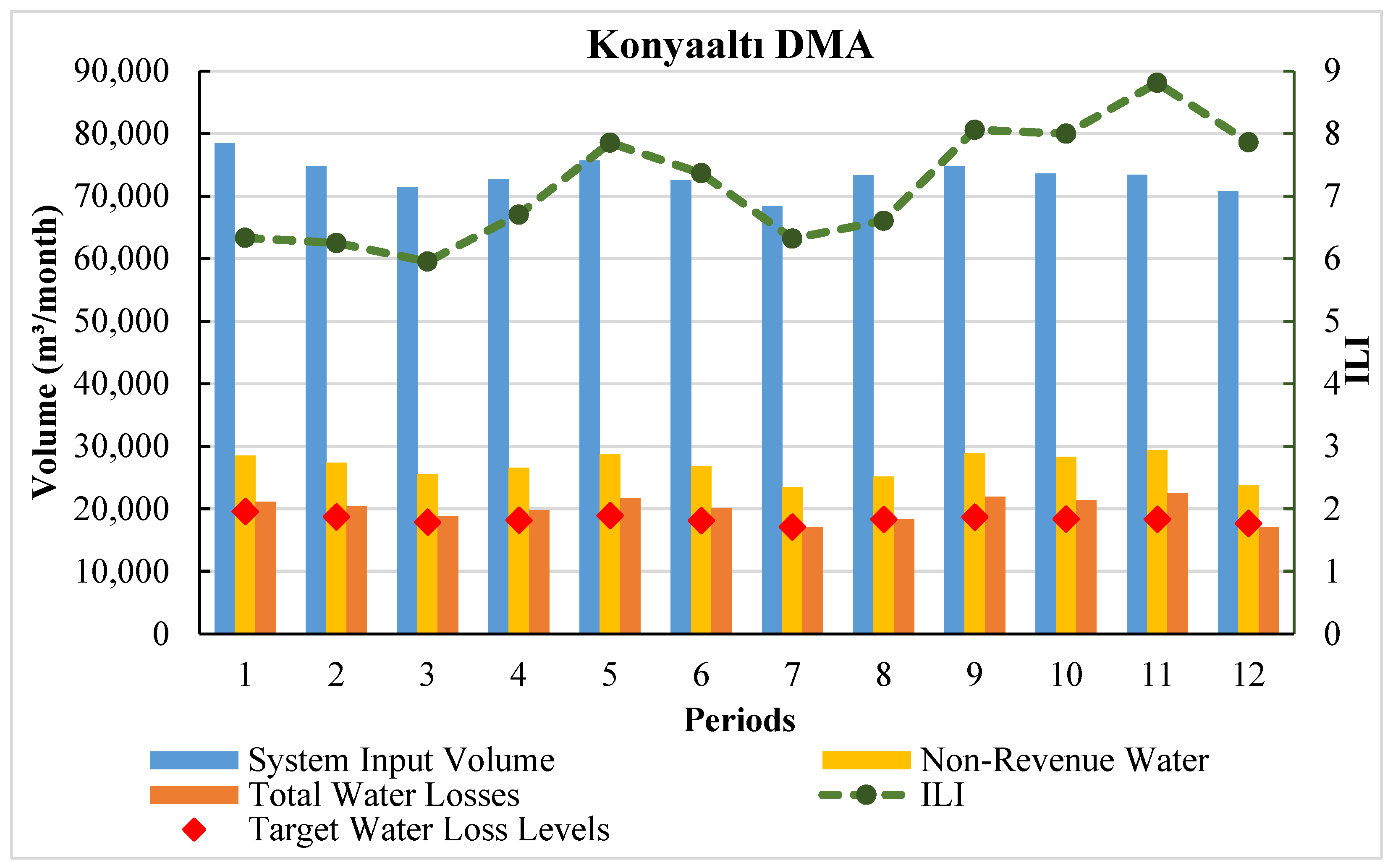
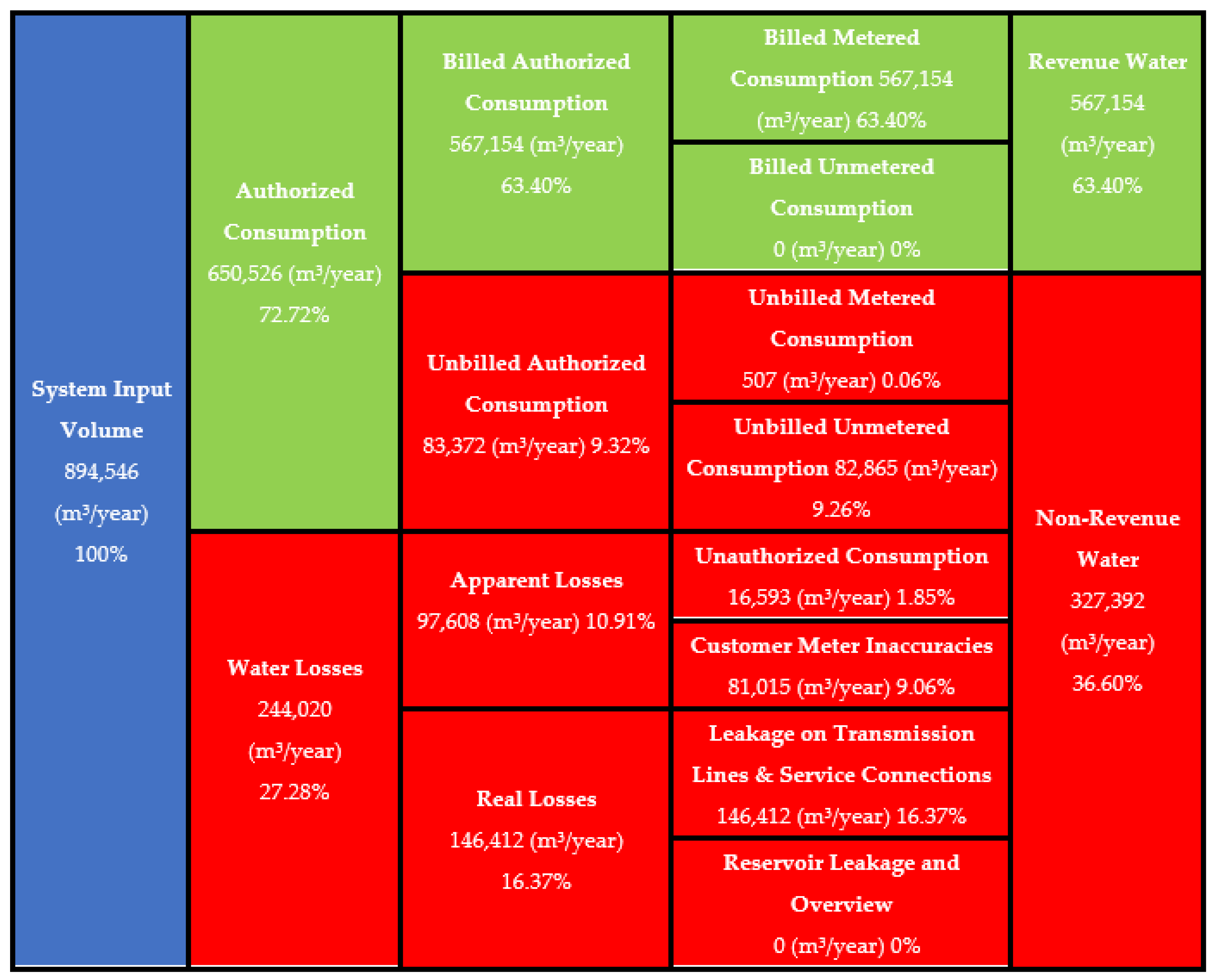
Figure 1 shows all the columns of the SWB and their total annual values in m3/year. According to Turkish regulations, since the percentage of water losses is still used, local governments are required to publish the percentage value of each unit in the SWB columns. Furthermore, according to the Regulation on the Control of Water Losses in Drinking Water Supply and Distribution Systems, metropolitan and provincial municipalities must reduce their water loss rate to 25% [21]. Therefore, the target value in Figure 2 is shown as 25%.
The annual SWB results for the Konyaaltı DMA indicate that the SIV is 894,546 m3/year, of which 72.72% is authorized consumption. Total water losses correspond to 27.28% of the SIV, and RL (16.37%) constitute the larger share compared to Apparent Losses (10.31%), showing that physical leakage is the dominant loss component in the system. Based on these results, the total water losses in the annual SWB exceed the target value. Also Unbilled Authorized Consumption is very high. This is because, in Türkiye, water is provided free of charge to facilities such as places of worship, parks, and public toilets. Consumption, particularly from places of worship (e.g., mosques and churches), can be relatively high, which increases the share of unbilled authorized consumption in the SWB. Unauthorized consumption accounts for 17% of Apparent Losses, while customer meter inaccuracies constitute the remaining 83%. This can be attributed to the regular field inspections carried out to detect illegal connections. At the same time, the high proportion of Apparent Losses is mainly due to customer meter measurement errors, selection of incorrect meter sizes, and errors in meter reading and data entry. Therefore, the normalized results together with the target value are presented in the graph for comparison (Figure 2).
Figure 2 indicates that total water losses fluctuate between 24% and 31%, with the regulatory target of 25% included as a reference. Water losses exceed this threshold in almost all periods, remaining at or slightly below 25% only during periods 7 and 8. The NRW ratio varies between 34% and 40%, reaching its maximum in period 11 (40%), followed by periods 9 (39%), 5 (38%), and 10 (38%) in summer days. As observed, the increase in total water losses during these summer months is accompanied by higher ILI values; however, the highest ILI occurs in Period 11. This is due to the low average pressure during this period, resulting in the minimum UARL value. In addition, the highest NRW is also observed in this period. Overall, the Konyaaltı DMA water losses consistently remain above the 25% limit.

3.2. Leakage Performance Assessment (ILI Analysis)

These calculations were performed for each month over a 12-month period. The results for Konyaaltı DMA are summarized in Table 2, showing the monthly ILI. This provides important information on the amount of water lost in the system and helps with planning and managing the network more efficiently. To summarize the characteristics of the Konyaaltı DMA network, the total main pipeline length (Lm) is 26.94 km, the number of service connections (Nc) is 867, and the total length of service connections (Lp) is 21.675 km.
For the Konyaaltı DMA, ILI values vary between 5.95 and 8.81 over the 12 monitoring periods. The lowest ILI is observed in Period 3 (5.95), while the highest occurs in Period 11 (8.81). In the later periods, the decrease in both average pressure and UARL is mainly due to the reduction in the inlet pressure of the Konyaaltı DMA, which directly lowers the overall system average pressure. Average pressure gradually decreases from 38.86 m in Period 1 to 25.32 m in Period 12, and correspondingly, UARL values decrease from 2006 m3/month to 1307 m3/month. However, CARL fluctuate between 12,702 m3/month and 9951 m3/month without showing a consistent decreasing trend. In Period 5, despite a decrease in average pressure, CARL increased significantly. Therefore, the ILI value also increased. This indicates that the rise in Real Losses was not pressure-driven but likely caused by a pipe burst or localized system failure. In Period 9, the relatively low average pressure reduced the UARL value, while the CARL and ILI values increased significantly. This suggests that seasonal demand increases associated with the Mediterranean climate may have intensified existing leaks or caused new failures within the system. In Period 11, the highest ILI value (8.81) was observed despite the low average pressure. This decrease in pressure primarily resulted in a decrease in UARL, while CARL did not decrease, and physical losses remained relatively high. This shows that pressure management alone is not sufficient to reduce actual losses, and persistent or undetectable leaks continue to dominate system performance. Overall, the results show that changes in ILI are primarily due to variations in average pressure rather than actual losses, as average pressure is directly proportional to UARL and inversely proportional to ILI.

4. Discussion

This study applied a monthly Standard Water Balance (SWB) at the DMA scale in Antalya to assess water losses and NRW. The NRW remained high, ranging from 31% to 40% of system input, showing a substantial portion of supplied water does not generate revenue. The ILI ranged from 5.95 to 8.81. These ILI values indicate that the DMA’s technical performance falls within category B, as defined by the IWA technical performance categories. This means significant potential for improvement in network pressure management, and active leakage control should be implemented [13,19]. The difference between CARL and UARL highlights the potential for reducing physical losses. Monthly analysis showed that higher ILI coincided with lower average system pressure and higher CARL, emphasizing the importance of monthly SWB in capturing temporal variations. While ILI is widely recognized for benchmarking system performance, complementary metrics such as Real Losses per mains length or per connection could be considered in future studies. According to IWA’s Performance Indicators’ Manual, normalized indicators such as Real Losses per mains length (volume per km of mains per day) and Real Losses per connection (volume per service connection per day) are effective for benchmarking physical losses under pressurized conditions. Moreover, pressure control applied through the PRV in the DMA plays an important role in influencing Real Losses and overall system performance. Annual water balance alone is insufficient; shorter-term analyses are needed to capture real leakage dynamics. These results align with previous research indicating that annual assessments may underestimate peak leakage conditions. Overall, monthly monitoring provides a more realistic representation of system behavior and is essential for effective leakage management and decision-making.

5. Conclusions

This study applied a monthly Standard Water Balance (SWB) at the DMA scale in a pilot area of Antalya to evaluate water losses and NRW. The results showed that water losses varied from month to month, reflecting seasonal changes in demand, with higher losses observed during periods of increased consumption. ILI values indicate that the DMA’s technical performance is moderate, suggesting opportunities to improve pressure management and control leakage. The difference between CARL and UARL further demonstrates the potential to reduce physical losses. Monthly analysis also showed that ILI values varied with changing system pressures. Even though pressure was reduced in the area using PRVs, the measure alone was not sufficient to control water losses. The results indicate that persistent or hidden leaks continue to dominate system performance. Therefore, in addition to pressure management, further leak detection and repair activities are necessary to effectively reduce both physical and Apparent Losses. Overall, a DMA-based monthly SWB provides a practical approach for monitoring system performance and supporting sustainable water loss management.

Supplementary Materials

The following supporting information can be downloaded at: www.kentsuverim.com (accessed on 9 June 2026).

Author Contributions

Conceptualization, P.U. and H.M.; methodology, P.U.; software, P.U.; validation, P.U., A.M. and T.A.; formal analysis, P.U.; investigation, P.U., A.M. and T.A.; resources, H.M.; data curation, P.U.; writing—original draft preparation, P.U.; writing—review and editing, P.U. and H.M.; visualization, P.U.; supervision, H.M.; project administration, H.M.; funding acquisition, H.M. All authors have read and agreed to the published version of the manuscript.

Funding

This study was conducted within the framework of the project titled “Increasing Efficiency and Reliability in Urban Water Supply Systems for Combating Climate Change”, which is co-financed by the European Union (Instrument for Pre-Accession Assistance (IPA II) frame) and Türkiye (Ministry of Environment, Urbanization and Climate Change) through the Climate Change Adaptation Grant Programme (CCAGP)-EuropeAid/170484/ID/ACT/TR, grant number TR2017 ESOP MI A304/CCAGP/141. The project is led by Akdeniz University, and the main implementing institution is Antalya Water and Wastewater Administration (ASAT).

Institutional Review Board Statement

Not applicable.

Informed Consent Statement

Not applicable.

Data Availability Statement

The data presented in this study are available upon request from the corresponding author.

Conflicts of Interest

The authors declare no conflict of interest.

References

  1. Lambert, A.; Hirner, W. Losses from water supply systems: Standard terminology and recommended performance measures. J. Water Supply Res. Technol.—AQUA 2000, 49, 307–320. [Google Scholar]
  2. Alegre, H.; Baptista, J.M.; Cabrera, E., Jr.; Cubillo, F.; Duarte, P.; Hirner, W.; Merkel, W.; Parena, R. Performance Indicators for Water Supply Services, 3rd ed.; IWA Publishing: London, UK, 2016. [Google Scholar]
  3. Kara, S.; Karadirek, I.E.; Muhammetoğlu, A.; Muhammetoğlu, H. Real-time monitoring and control in water distribution systems for improving operational efficiency. Desal. Water Treat. 2016, 57, 11506–11519. [Google Scholar] [CrossRef]
  4. Görkem, Y.; Karaman, M.F.; Hayber, Ş.E. The analysis of water losses and leakages in drinking water networks using SCADA system: A case study from Yozgat. J. Sci. Technol. Eng. Res. 2024, 5, 223–243. [Google Scholar] [CrossRef]
  5. Picazo, M.A.P.; Tekinerdogan, B. Urban water distribution networks: Challenges and solution directions. In Management and Engineering of Critical Infrastructures; Elsevier: Amsterdam, The Netherlands, 2024; pp. 245–264. [Google Scholar] [CrossRef]
  6. Kanakoudis, V.; Tsitsifli, S. Using the bimonthly water balance of a non-fully monitored water distribution network with seasonal water demand peaks to define its actual NRW level: The case of Kos town, Greece. Urban Water J. 2013, 10, 443–456. [Google Scholar] [CrossRef]
  7. Pathirane, A.; Kazama, S.; Takizawa, S. Dynamic analysis of non-revenue water in district metered areas under varying water consumption conditions owing to COVID-19. Heliyon 2023, 10, e23516. [Google Scholar] [CrossRef] [PubMed]
  8. Lambert, A. Water losses management and techniques. Water Sci. Technol. Water Supply 2002, 2, 1–20. [Google Scholar] [CrossRef]
  9. Farley, M.; Trow, S. Losses in Water Distribution Networks: A Practitioner’s Guide to Assessment, Monitoring and Control; IWA Publishing: London, UK, 2003. [Google Scholar]
  10. American Water Works Association (AWWA). Water Audits and Loss Control Programs, 3rd ed.; AWWA: Denver, CO, USA, 2009. [Google Scholar]
  11. Klingel, P.; Knobloch, A. A review of water balance application in water supply. J. Am. Water Work. Assoc. 2015, 107, E339. [Google Scholar] [CrossRef]
  12. Lambert, A. International Report on Water Loss Management: IWA Task Force on Water Losses; IWA Publishing: London, UK, 1999. [Google Scholar]
  13. International Water Association (IWA). Performance Indicators for Water Supply Services; IWA Publishing: London, UK, 2010. [Google Scholar]
  14. Muhammetoğlu, A.; Muhammetoğlu, H.; Adıgüzel, A.; İritaş, Ö.; Karaaslan, Y. Management of water losses in water supply and distribution networks in Turkey. Turk. J. Water Sci. Manag. 2018, 1, 58–75. [Google Scholar] [CrossRef]
  15. Winarni, W. Infrastructure leakage index (ILI) as water losses indicator. Civ. Eng. Dimens. 2009, 11, 126–134. [Google Scholar]
  16. Germanopoulos, G. A technical note on the inclusion of pressure dependent demand and leakage terms in water supply network models. Civ. Eng. Syst. 1985, 2, 171–179. [Google Scholar] [CrossRef]
  17. Van Zyl, J.E.; Cassa, A.M. Modeling elastically deforming leaks in water distribution pipes. J. Hydraul. Eng. 2014, 140, 182–189. [Google Scholar] [CrossRef]
  18. Giustolisi, O.; Mazzolani, G.; Berardi, L.; Laucelli, D.B. From advanced hydraulic modelling to performance indicator for the efficiency of investments in leakage management of pressurized water systems. Water Res. 2024, 258, 121765. [Google Scholar] [CrossRef] [PubMed]
  19. Lambert, A.; Brown, T.; Takizawa, M.; Weimer, D. Review of performance indicators for real losses from water supply systems. J. Water Supply Res. Technol.—AQUA 1999, 48, 227–237. [Google Scholar] [CrossRef]
  20. Muhammetoğlu, H.; Muhammetoğlu, A. Handbook on the Control of Water Losses in Drinking Water Supply and Distribution Systems; Republic of Türkiye, Ministry of Forestry and Water Affairs: Ankara, Turkey, 2017. [Google Scholar]
  21. Republic of Türkiye, Ministry of Forestry and Water Affairs. Regulation on the Control of Water Losses in Drinking Water Supply and Distribution Systems; No. 28994; Official Gazette of the Republic of Türkiye: Ankara, Türkiye, 2014. [Google Scholar]
Figure 1. Konyaaltı DMA yearly SWB (7 October 2024–8 October 2025).
Eesp 44 00028 g001
Figure 2. Konyaaltı DMA monthly SIV, NRW, water losses, target water loss levels and ILI graph.
Eesp 44 00028 g002
Table 1. The normalized Konyaaltı DMA SWB results.
Periods No
&
Dates
SIV
(m3/Month)
Authorized Consumption (m3/Month)Total Water Losses
(m3/Month)
Total Water Losses
(%)
Real Losses (m3/Month)Apparent Losses
(m3/Month)
NRW (m3/Month)
1 (7 October–9 November 2024)78,42657,25621,17027%12,702846828,480
2 (9 November–9 December 2024)74,84454,44220,40227%12,241816127,377
3 (9 December 2024–10 January 2025)71,47052,58818,88226%11,329755325,543
4 (10 January–7 February 2025)72,74052,95219,78927%11,873791626,568
5 (7 February–9 March 2025)75,65553,96721,68829%13,013867528,739
6 (9 March–8 April 2025)72,52952,49620,03328%12,020801326,793
7 (8 April–10 May 2025)68,39651,29817,09925%10,259683923,473
8 (10 May–9 June 2025)73,32054,98818,33225%10,999733325,165
9 (9 June–7 July 2025)74,74152,80421,93729%13,162877528,903
10 (7 July–11 August 2025)73,60052,18121,41929%12,852856828,279
11 (11 August–7 September 2025)73,41850,89022,52831%13,517901129,370
12 (7 September–8 October 2025)70,78753,66717,12024%10,272684823,718
Table 2. Normalized monthly ILI results for Konyaaltı DMA.
Konyaaltı DMA
Dates
PeriodsAverage P
(m)
CARL
(m3/Month)
UARL
(L/Day)
UARL
(m3/Month)
ILI
7 October–9 November 2024138.8612,70266,85620066.33
9 November–9 December 2024237.9412,24165,28019586.25
9 December 2024–10 January 2025336.8711,32963,42619035.95
10 January–7 February 2025434.3211,87359,03617716.70
7 February–9 March 2025532.1013,01355,23316577.85
9 March–8 April 2025631.6212,02054,39616327.37
8 April–10 May 2025731.4610,25954,11516236.32
10 May–9 June 2025832.2610,99955,49416656.61
9 June–7 July 2025931.6413,16254,43916338.06
7 July–11 August 20251031.1412,85253,56716078.00
11 August–7 September 20251129.7313,51751,14015348.81
7 September–8 October 20251225.3210,27243,55513077.86
Disclaimer/Publisher’s Note: The statements, opinions and data contained in all publications are solely those of the individual author(s) and contributor(s) and not of MDPI and/or the editor(s). MDPI and/or the editor(s) disclaim responsibility for any injury to people or property resulting from any ideas, methods, instructions or products referred to in the content.