
Proceeding Paper

Reynolds Number Effect on the Turbulent Micropolar Open-Channel Flow with Sediment Transport †
by
George Sofiadis
1,*,
Christos Liosis
1,2,
Theodoros Karakasidis
3 and
Ioannis Sarris
3
1
Department of Mechanical Engineering, University of West Attica, Egaleo, 12241 Athens, Greece
2
Department of Biomedical Engineering, University of West Attica, Egaleo, 12243 Athens, Greece
3
Condensed Matter Physics Laboratory, Department of Physics, School of Science, University of Thessaly, 35100 Lamia, Greece
*
Author to whom correspondence should be addressed.
Presented at the 6th International Conference on Efficient Water Systems (EWaS6), Thessaloniki, Greece, 11–14 May 2026.
Environ. Earth Sci. Proc. 2026, 44(1), 23; https://doi.org/10.3390/eesp2026044023 (registering DOI)
Published: 24 June 2026

Abstract

The present work focuses on the investigation of the turbulent Reynolds number effect on the characteristics of an open-channel flow with sediment transport, by employing the micropolar model. The micropolar model is essentially a Eulerian non-Newtonian model that has already been proven to correctly describe the secondary phase of turbulent wall-bounded flows. The current under investigation geometry, open channel, comprises an ideal candidate to further test the characteristics of the micropolar model as many environmental flows contain a secondary phase. Such flows are of great engineering and physics interest for applications such as sedimentation transport and debris flow. Direct Numerical Simulations (DNSs) have been carried out on an open channel for three different turbulent Reynolds numbers. The simulated results are compared against previous DNS data of similar flows. The micropolar model is capable of describing the same problem but in a Eulerian frame, thus significantly simplifying the computational cost and complexity.

1. Introduction

Sediment transport flow can be categorized as a complex flow due to its inherent characteristics. This type of flow is commonly found in many environmental as well as industrial processes. A typical example may be considered the river flow, which can many times entail sediment transport of granular material. This example can be modeled as an open-channel flow case where a secondary phase is present, which both alters the physics of the flow and increases the modeling complexity.
The secondary phase of a flow, such as granular material, can affect the general hydrodynamics behavior, especially very close to the wall vicinity, when such wall boundaries are present. When turbulence is also present this alteration may lead to turbulence enhancement or attenuation. Many studies in the past decades, both numerical and experimental, have attempted to shed more light into the dynamics of such systems. Many of the experimental studies have explored the influence of the secondary phase in turbulence structure formation, by varying the sediment particle size or the concentration [1,2,3,4].
Particles’ degrees of freedom, inertia and spin gradient can be listed as additional characteristics of the transported phase that play crucial roles in the turbulence structure dynamics. Numerical studies have tried to utilize turbulence models and Direct Numerical Simulations to better capture the phenomena described above [5,6,7,8,9].
Most of the numerical studies that have investigated this type of two-phase flows utilize Lagrangian methods. In addition, contradicting results have been published on the subject. In a recent work by Sofiadis et al. [10], the case of a turbulent open channel flow, including a secondary phase, has been studied for the first time by employing the micropolar model. The micropolar model solves the constitutive set of equations for both the carrier and the secondary phase in a Eulerian frame of reference. This method has been proven to be much more computationally efficient than the respective Lagrangian methods, producing accurate results and examining the turbulent structure behavior from a different perspective [10,11,12,13]. In the present work, the Reynolds number effect is examined as Direct Numerical Simulations are employed along with the micropolar model for the special case of the turbulent open-channel flow with sediment transport.

2. Materials and Methods

The constitutive set of equations that has been solved via Direct Numerical Simulations in the present study has been kept in alignment with previous DNS studies in turbulent micropolar open-channel flows [10]. The set of equations includes the continuity and micropolar linear and angular momentum equations, as originally described in the work of Eringen [14].
u = 0
u t + u u = P + 1 R e 2 u + m R e × ω
J N m ω t + u ω = 1 R e 2 ω + N R e × u 2 N R e ω
In Equations (1)–(3), t denotes time, ω the angular velocity, and u, P the linear velocity and pressure, respectively. A full derivation is given in the Appendix of Sofiadis and Sarris [12]. Non-dimensionalization uses a characteristic length δ, with channel total height h = 2δ, characteristic velocity U0, and reference density ρ0. The Reynolds number is defined as Reh = ρU0h/(μ + κ), or equivalently Reb = ρU0(2h)/(μ + κ), where μt = μ + κ is the total viscosity (μ molecular, κ micropolar). The remaining non-dimensional parameters are: the vortex viscosity parameter m = κ/(μ + κ), the dimensionless microinertia J = j/δ2, and the spin gradient viscosity parameter N = κδ2/γ. The values N = 8.3 × 10⁴ and J = 1 × 10⁻⁵ are held constant throughout the study. Finally, the friction Reynolds number can be written as Reτ = uτh/ν, where the (τ) subscript denotes values normalized to wall units.
The boundary conditions and geometry representation that have been utilized in the present study can be seen in Table 1 and Figure 1, respectively.

3. Results

The set of Equations (1)–(3), has been implemented in the finite volume open-source software, OpenFoam-V10.0. By modifying a solver of this software, the equations have been solved on appropriate meshes using Direct Numerical Simulations.
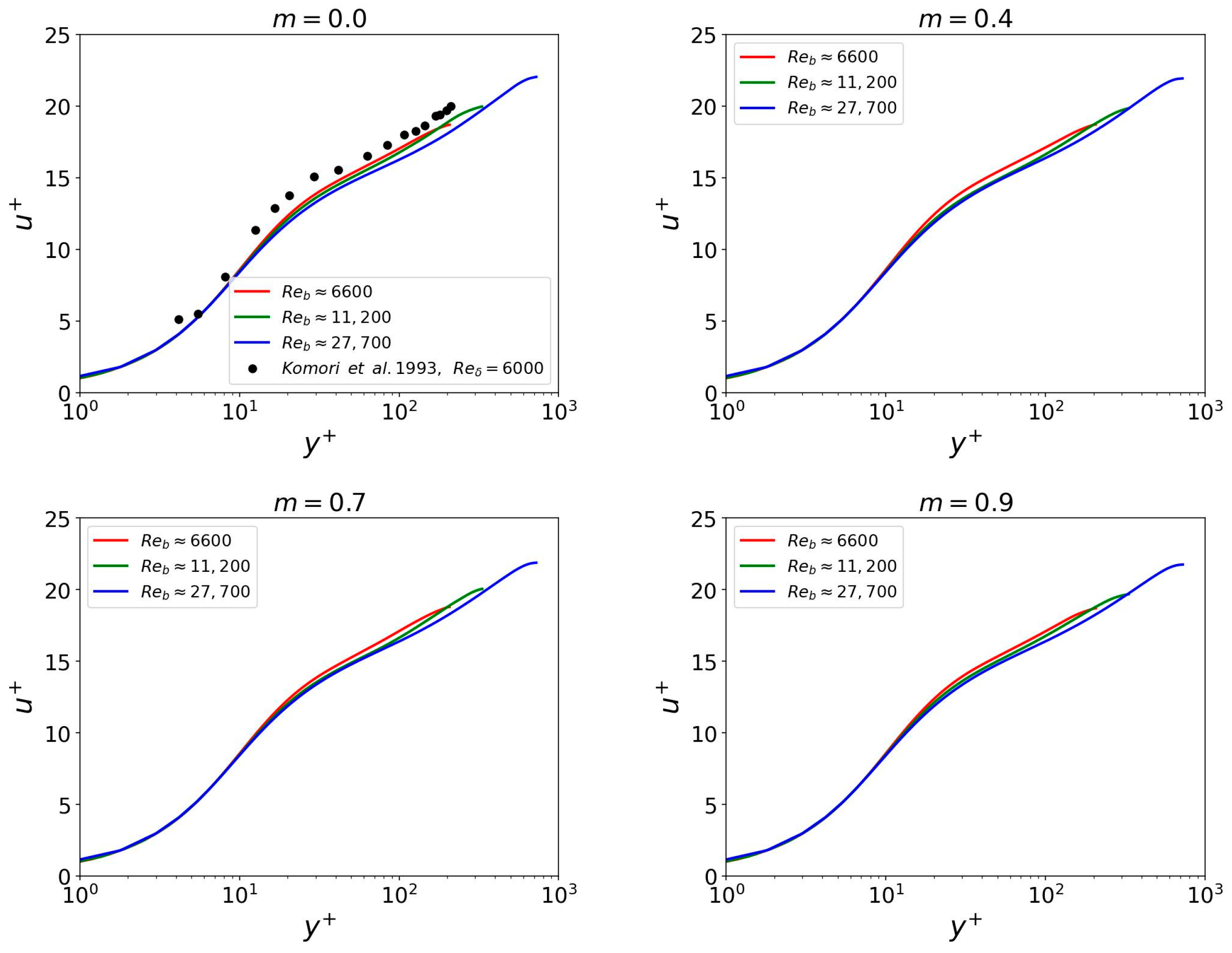
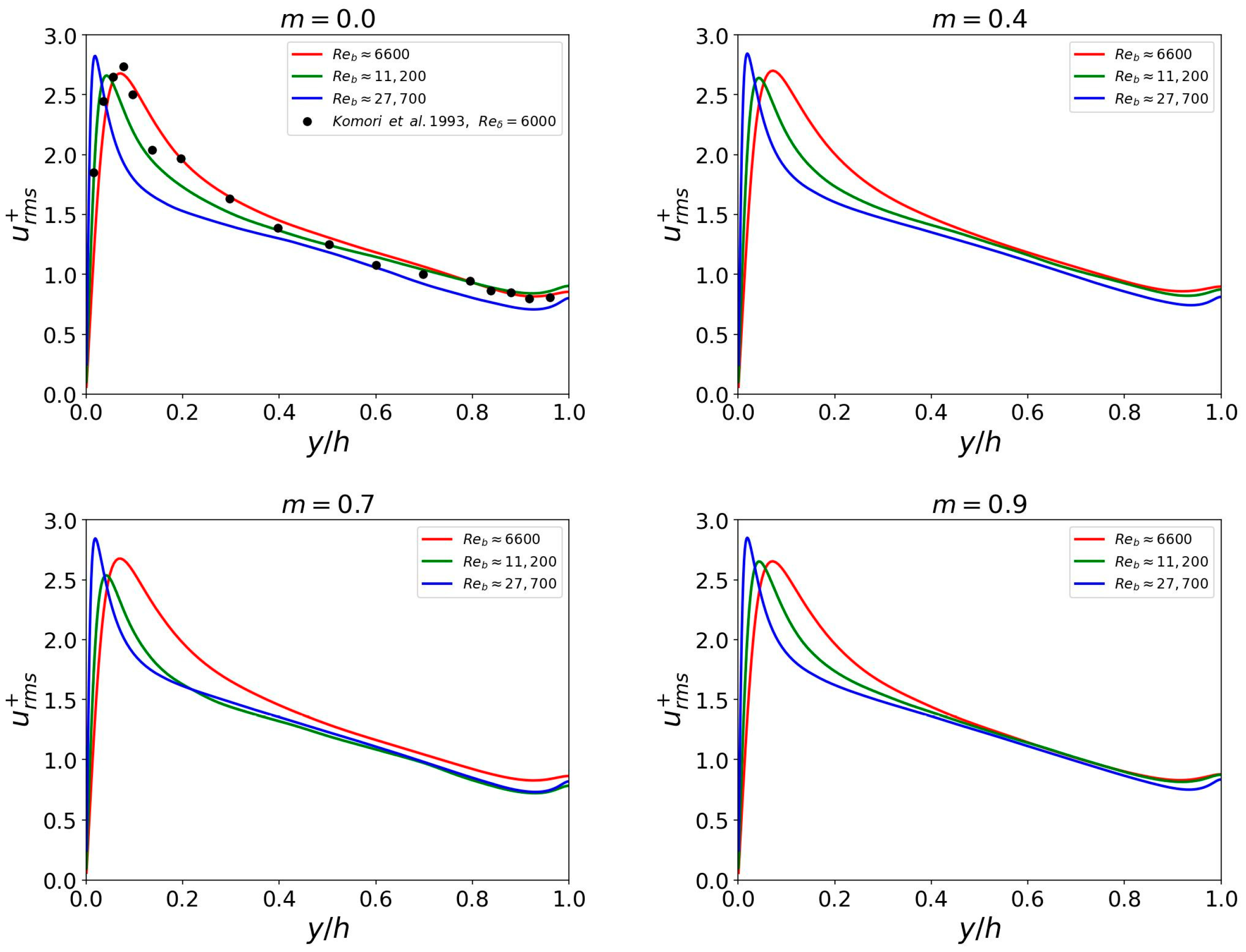
In order to examine the effect of Reynolds number on the flow characteristics, both Reb and the vortex viscosity parameter (m) have been varied. The vortex viscosity parameter tunes essentially the “strength” of the secondary phase of the flow. Results have been post-processed and two main variables have been examined and presented in this work. In Figure 2, the normalized mean velocity profile has been plotted for various vortex viscosity parameter values and for three different Reb values and compared against data of Komori et al. [15]. The variables have been normalized with the respective variables in wall units, following the usual procedure. In Figure 3, the root mean square (rms) normalized velocity profiles are presented once again for various vortex viscosity parameter and Reb values. For this initial presentation of the current work, the streamwise velocity has been chosen to provide a first insight into the flow characteristics. In both figures, the streamwise coordinate has been plotted along the wall-normal direction, as the other two directions of the flow are periodic.

4. Discussion

In a previous study on the turbulent open-channel flow, conducted by the author [10], a single Reynolds number value had been examined. In that study just the vortex viscosity parameter (m) had been varied. This variation revealed marginal differences among the various micropolar cases. On the other hand, the comparison against the unladen case was very interesting and provided further insight into an ongoing debate in this field. More specifically, the study of Sofiadis et al. [10] confirmed the suggestions of Yu et al. [16] that the velocity distribution of the particulate flow presents mixed behavior compared to the unladen one. The velocity values of the particulate flow exceed the respective unladen ones in the inner region, while they collapse to lower values in the outer region. This observation has been attributed by the authors to the particles’ trend of being accelerated by turbulent structures in the near-wall region.
Results of the present study reveal a consistent trend among the cases with a secondary phase as Reb is varied. By closer examining Figure 2, it is clear that in all cases Reb increment leads to lower normalized mean velocity values. This behavior corresponds to turbulence intensification and follows the trend of the unladen case. Interestingly, when the variation in Reb has been examined for the closed channel case (no-slip BC on both walls), the higher vortex viscosity cases did not follow this trend [11]. The no-slip boundary condition seems to have a strong effect and alter near-wall turbulence structure dynamics in contrast with the slip boundary condition that is assigned to the channel top wall in the present case. The effect of boundary conditions for the micropolar model should be further investigated by varying the parameters for both the linear and angular velocity.
The mean rms velocity profiles that are presented in Figure 3 also show a consistent trend among the cases examined here. For both the hydrodynamic (m = 0) and the laden cases, the peaks of mean rms velocity profiles shift closer to the wall as Reb increases. This is a further clear indication of near-wall turbulence intensification without exception for all cases. Furthermore, the value of the peak seems also to increase along with Reb consistently, with small deviations. The same observations have been made for this parameter also in the closed channel case.

5. Conclusions

The goal of this work was to better understand how the Reynolds number shapes the dynamics of turbulent open-channel flow when a granular phase is present. Using DNS together with the micropolar model in OpenFOAM, we tested three different bulk Reynolds numbers, 6600, 11,200, and 27,700, while also varying the vortex viscosity parameter (m) to control the intensity of the secondary phase. By examining the mean velocity profiles and streamwise velocity fluctuations, it became clear that both parameters leave a noticeable imprint on the flow, especially near the wall. In particular, higher Re intensifies near-wall turbulence, while increasing m effectively modulates granular secondary effects. Additional comparisons against the closed channel case revealed interesting differences which require further investigation of the boundary conditions’ influence. These results confirm the micropolar model’s ability to capture Re-dependent granular interactions accurately. Finally, the micropolar model handled the complexity of the current problem in a mathematically elegant and computationally efficient way, confirming its value as a computationally tractable framework for sediment transport problems.

Author Contributions

Conceptualization, G.S. and I.S.; methodology, G.S.; software, G.S.; validation, G.S., C.L. and I.S.; formal analysis, G.S.; investigation, G.S.; resources, G.S.; data curation, T.K.; writing—original draft preparation, G.S.; writing—review and editing, G.S.; visualization, C.L.; supervision, I.S. and T.K.; project administration, I.S.; funding acquisition, I.S. All authors have read and agreed to the published version of the manuscript.

Funding

This research received no external funding.

Institutional Review Board Statement

Not applicable.

Informed Consent Statement

Not applicable.

Data Availability Statement

Data are available to the interested reader upon request.

Acknowledgments

The registration fees were totally covered by the University of West Attica. The authors would like to acknowledge the support of the Greek Research and Technology Network (GRNET) for the computational time granted in the National HPC facility ARIS.

Conflicts of Interest

The authors declare no conflicts of interest.

References

  1. Rashidi, M.; Hetsroni, G.; Banerjee, S. Particle-turbulence interaction in a boundary layer. Int. J. Multiph. Flow 1990, 16, 935–949. [Google Scholar] [CrossRef]
  2. Kaftori, D.; Hetsroni, G.; Banerjee, S. Particle behavior in the turbulent boundary layer. II. Velocity and distribution profiles. Phys. Fluids 1995, 7, 1107–1121. [Google Scholar] [CrossRef]
  3. Nezu, I.; Azuma, R. Turbulence characteristics and interaction between particles and fluid in particle-laden open-channel flows. J. Hydraul. Eng. 2004, 130, 988–1001. [Google Scholar] [CrossRef]
  4. Kulick, J.D.; Fessler, J.R.; Eaton, J.K. Particle response and turbulence modification in fully developed channel flow. J. Fluid Mech. 1994, 277, 109–134. [Google Scholar] [CrossRef]
  5. Crowe, C.; Troutt, T.; Chung, J. Numerical models for two-phase turbulent flows. Annu. Rev. Fluid Mech. 1996, 28, 11–43. [Google Scholar] [CrossRef]
  6. Dritselis, C.D.; Vlachos, N.S. Numerical study of educed coherent structures in the near-wall region of a particle-laden channel flow. Phys. Fluids 2008, 20, 055103. [Google Scholar] [CrossRef]
  7. Balachandar, S.; Eaton, J.K. Turbulent dispersed multiphase flow. Annu. Rev. Fluid Mech. 2010, 42, 111–133. [Google Scholar] [CrossRef]
  8. Kidanemariam, A.G.; Chan-Braun, C.; Doychev, T.; Uhlmann, M. Direct numerical simulation of horizontal open-channel flow with finite-size, heavy particles at low solid volume fraction. New J. Phys. 2013, 15, 025031. [Google Scholar] [CrossRef]
  9. Gao, W.; Samtaney, R.; Richter, D.H. Direct numerical simulation of particle-laden flow in an open channel at Reτ = 5186. J. Fluid Mech. 2023, 957, A3. [Google Scholar] [CrossRef]
  10. Sofiadis, G.; Liakopoulos, A.; Palasis, A.; Sofos, F. Turbulent Micropolar Open-Channel Flow. Fluids 2024, 9, 202. [Google Scholar] [CrossRef]
  11. Sofiadis, G.; Sarris, I. Reynolds number effect of the turbulent micropolar channel flow. Phys. Fluids 2022, 34, 075126. [Google Scholar] [CrossRef]
  12. Sofiadis, G.; Sarris, I. Turbulence Intensity Modulation by Micropolar Fluids. Fluids 2021, 6, 195. [Google Scholar] [CrossRef]
  13. Sofiadis, G.; Sarris, I. Microrotation viscosity effect on turbulent micropolar fluid channel flow. Phys. Fluids 2021, 33, 095126. [Google Scholar] [CrossRef]
  14. Eringen, A.C. Theory of micropolar fluids. J. Math. Mech. 1966, 16, 1–18. [Google Scholar] [CrossRef][Green Version]
  15. Komori, S.; Nagaosa, R.; Murakami, Y.; Chiba, S.; Ishii, K.; Kuwahara, K. Direct numerical simulation of three-dimensional open-channel flow with zero-shear gas–liquid interface. Phys. Fluids 1993, 5, 115–125. [Google Scholar] [CrossRef]
  16. Yu, K.; Yoon, B.; Kim, D. Re-evaluation of change of mean velocity profiles in turbulent open-channel flows due to introducing sediment particles. KSCE J. Civ. Eng. 2014, 18, 2261–2267. [Google Scholar] [CrossRef]
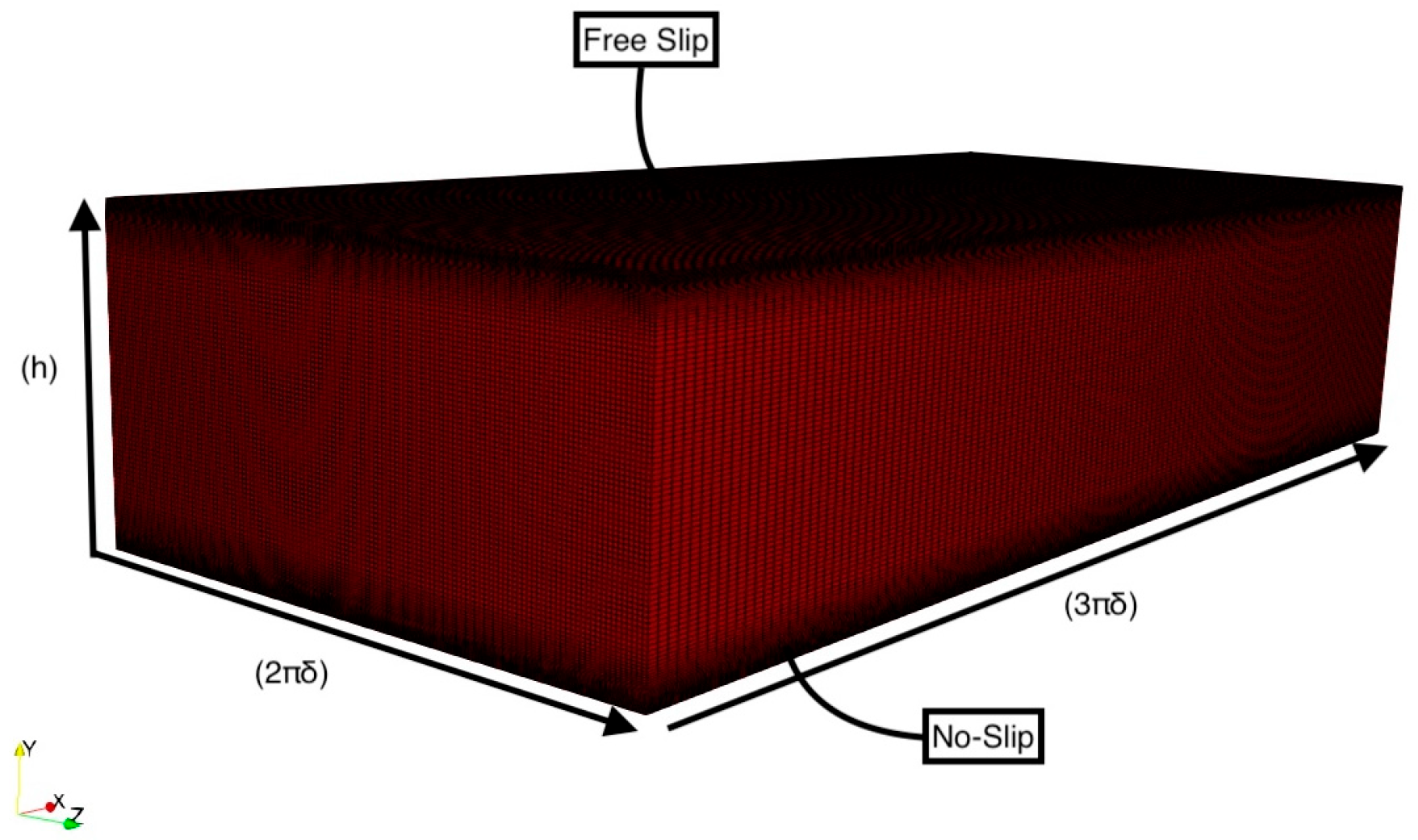
Figure 1. Schematic of the geometry that has been used in the present study, where h = 2δ.
Eesp 44 00023 g001
Figure 2. Normalized mean velocity profiles of the present hydrodynamic and micropolar cases (m = 0.0–0.9), for three different Reb: 6600, 11,200 and 27,700 and compared against data of Komori et al. [15].
Eesp 44 00023 g002
Figure 3. Normalized urms velocity profiles of the present hydrodynamic and micropolar cases (m = 0.0–0.9), for three different Reb: 6600, 11,200 and 27,700 and compared against data of Komori et al. [15].
Eesp 44 00023 g003
Table 1. Velocity boundary conditions prescribed to the current computational domain.
SurfaceBoundary Condition
Top PlaneFree-Slip
Bottom PlaneNo-Slip
Side PlanesPeriodic
InletPeriodic
OutletPeriodic
Disclaimer/Publisher’s Note: The statements, opinions and data contained in all publications are solely those of the individual author(s) and contributor(s) and not of MDPI and/or the editor(s). MDPI and/or the editor(s) disclaim responsibility for any injury to people or property resulting from any ideas, methods, instructions or products referred to in the content.