
Proceeding Paper

Assessing Seasonal Streamflow Predictability in Alpine Catchments of Contrasting Geological Settings †
by
Maria Stergiadi
1,* and
Maurizio Righetti
2
1
Competence Centre for Sustainability, Free University of Bozen–Bolzano, 39100 Bozen–Bolzano, Italy
2
Faculty of Agricultural, Environmental and Food Sciences, Free University of Bozen–Bolzano, 39100 Bozen–Bolzano, Italy
*
Author to whom correspondence should be addressed.
Presented at the 6th International Conference on Efficient Water Systems (EWaS6), Thessaloniki, Greece, 11–14 May 2026.
Environ. Earth Sci. Proc. 2026, 44(1), 14; https://doi.org/10.3390/eesp2026044014 (registering DOI)
Published: 22 June 2026

Abstract

Seasonal streamflow predictability in alpine catchments is governed by the interplay between initial hydrological conditions (IC) and climate forcing (CF), with catchment geology exerting a modulating influence. This study applied the Ensemble Streamflow Prediction (ESP)/reverse ESP (revESP) framework, which isolates predictability arising from IC and CF, respectively, to two alpine catchments of differing geology and subsurface storage, resulting in markedly different hydrological behavior. The results were contrasted with End Point Blending (EPB) experiments that quantify the relative contributions of IC and CF to the forecast skill. The two approaches exhibited strong agreement under well-defined hydrological regimes but diverged during transitional periods, highlighting implications for operational seasonal forecasting and reservoir management in snow-dominated regions.

1. Introduction

Seasonal hydrological forecasts provide critical information for managing water resources in regions where streamflow variability strongly affects socio-economic activities and ecosystem functioning [1,2]. In alpine environments, where water availability is closely linked to snow accumulation and melt processes, seasonal predictions are particularly valuable for anticipating periods of surplus and scarcity [3]. Such forecasts support decision-making across multiple sectors, including reservoir operation, hydropower generation, irrigation planning, flood preparedness, and drought risk management [4]. By extending lead times (LTs) beyond short-range forecasts, seasonal outlooks enable proactive strategies that enhance system efficiency and resilience under increasing hydroclimatic variability [5,6].
A central source of seasonal streamflow predictability arises from the initial hydrological conditions (IC) at forecast initialization, including snowpack and subsurface water content (SWC), which can sustain memory beyond atmospheric predictability [7]. The operationally established Ensemble Streamflow Prediction (ESP) [8] exploits this property by initializing a hydrological model with observed IC and forcing it with resampled historical meteorological sequences to produce probabilistic forecasts. To disentangle the relative roles of IC and climate forcing (CF), the ESP is commonly paired with the reverse ESP (revESP), in which observed CF is employed during the forecast period, while the IC are drawn from the climatology [9]. The ESP/revESP framework has been widely used to diagnose sources of seasonal forecast skill [10,11,12], while extensions such as the Variational Ensemble Streamflow Prediction Assessment (VESPA) [13] and the End Point Blending (EPB) [14] allow an assessment of the impact of intermediate levels of uncertainty in the predictability sources (i.e., IC, CF) to forecast predictability.
The effectiveness of ESP-based forecasts is closely linked to the persistence of catchment moisture states, often termed catchment memory, which determines how strongly IC influence predictability at increasing LTs [14,15,16]. This persistence is primarily controlled by geology, with highly permeable catchments exhibiting stronger IC-dominated predictability than catchments of lower permeability [7,17]. Understanding these geological controls is therefore essential for interpreting seasonal forecast skill and for developing robust, catchment-specific forecasting strategies in alpine regions.
Building on these foundations, the novelty of the present work is twofold. First, we conduct a detailed, side-by-side analysis of two alpine catchments with distinct geological settings: one highly permeable with large subsurface storage and slow response and one of low permeability with limited storage and faster response. These catchments are the end members, in terms of geological characteristics, of a set of catchments in the Upper Adige river basin (north-eastern Italy), analyzed by [17]. The focused design adopted in this work enables a thorough interpretation of how geology-mediated storage controls the balance between IC- and CF-related seasonal streamflow predictability. Second, we provide the first direct comparison between conclusions drawn from the conventional benchmark ESP/revESP experiments and those obtained using the EPB on the same sites [18], clarifying where the integrative EPB framework corroborates, refines, or diverges from the benchmark approach. Collectively, this dual evaluation provides clearer insight into seasonal streamflow predictability and a more robust methodological assessment across contrasting hydrogeological regimes.

2. Materials and Methods

2.1. Study Area

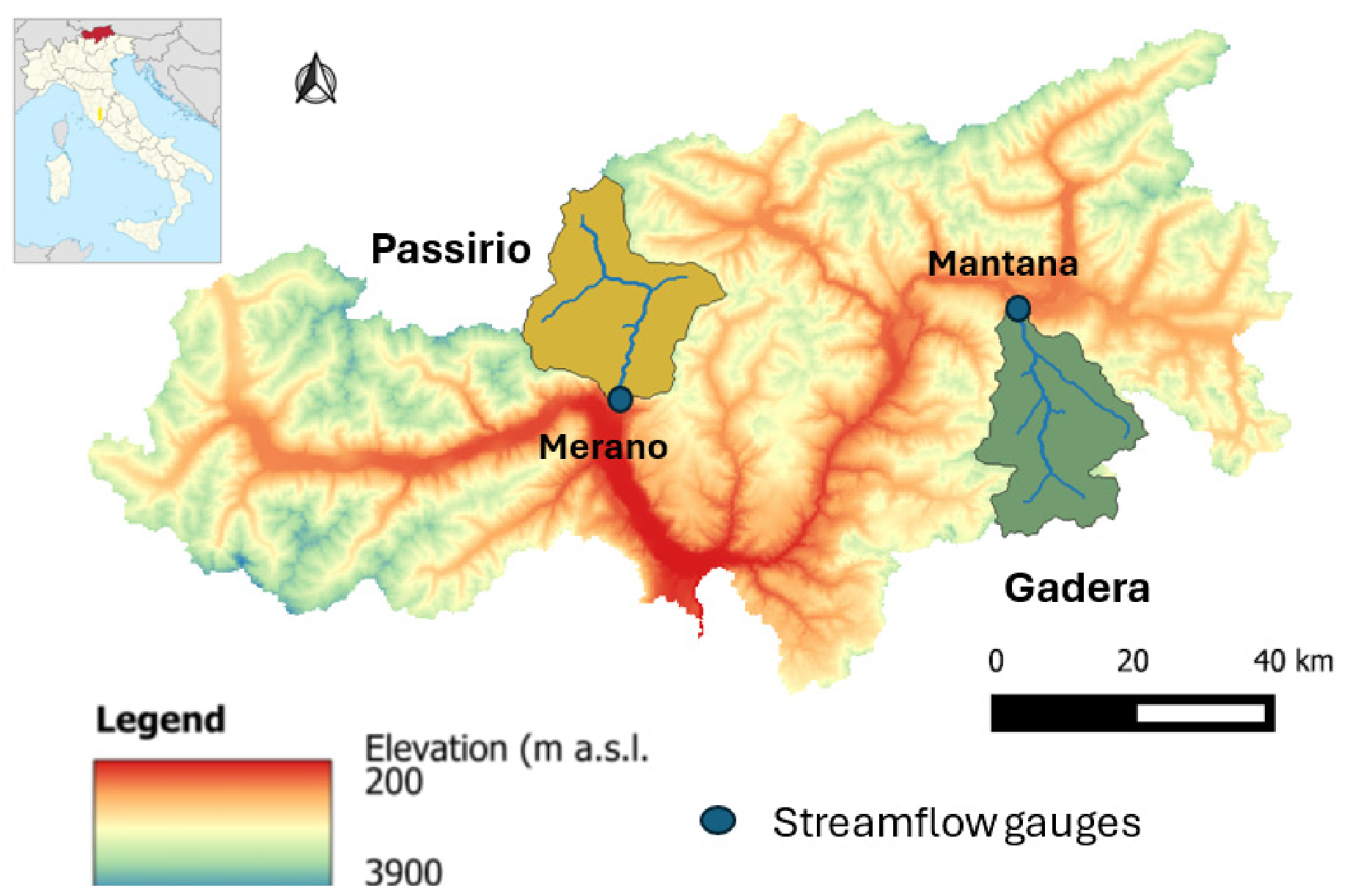
To assess the influence of geology on seasonal streamflow predictability in alpine settings, we applied the ESP/revESP framework to two snow-dominated catchments located in the Upper Adige river basin (north-eastern Italy), characterized by contrasting hydrogeological characteristics and distinct hydrological responses: the Gadera catchment (gauged at Mantana), which exhibits a slow response, and the Passirio catchment (gauged at Merano), which responds more rapidly (Figure 1). The catchments experience comparable climatic conditions, with precipitation peaking during summer and autumn. Following the April–June snowmelt period, marked by a pronounced reduction in snow water equivalent (SWE), SWC, and streamflow decline in the Passirio catchment, with a slight increase observed in the Gadera catchment. The persistence of land–surface hydrological states, defined as the combined storage of SWE and SWC and quantified using autocorrelation at varying time lags, is generally higher in the Gadera catchment, reflecting its larger subsurface storage and longer moisture-state memory [18].

2.2. Model Description

A detailed description of the model structure, calibration, and validation is provided in [18]. Briefly, the ESP and revESP experiments were conducted using the Integrated Catchment Scale Hydrological Model (ICHYMOD) [19,20], a semi-distributed conceptual rainfall–runoff model operating at a daily time step. The model represents key hydrological processes through modules describing snow accumulation and melting, soil moisture storage, groundwater dynamics, and runoff generation. Streamflow at the basin outlet results from the combination of fast response pathways associated with direct runoff and slower subsurface flow components routed through conceptual storage reservoirs. As seasonal forecasting applications typically focus on cumulative rather than day-to-day variability in hydrological variables [7,9,12], daily model outputs were aggregated to monthly time scales.

2.3. ESP and revESP Experiments

The ESP/revESP framework [9] was employed to generate seasonal streamflow hindcasts (i.e., retrospective forecasts) with LTs of 1–6 months. Following established practice [7,21,22], a control simulation forced with observed precipitation and temperature was first conducted to generate proxy streamflow observations, thereby isolating hindcast skill from model structural uncertainty and attributing errors solely to uncertainties in IC and CF. The resulting proxy observations were employed to evaluate the performance of the ESP and revESP experiments.
All hindcasts were initialized on the first day of each calendar month over a 17-year period (2002–2018), leading to a total of 16 ensemble members (excluding the target year). A leave-one-year-out climatological sampling strategy was adopted. For the ESP hindcasts, ensemble members were generated by resampling historical CF sequences from the remaining years starting on the same calendar date, while deterministic IC from the control simulation were employed. In contrast, the revESP ensembles were obtained by resampling the corresponding IC from the control simulation while using the observed CF of the hindcast year.
The skill of the ESP and revESP hindcasts was assessed using the mean absolute error (MAE) ratio and mean squared error (MSE) ratio, defined as M A E E S P / M A E r e v E S P and M S E E S P / M S E r e v E S P , respectively. Errors were obtained by comparing the ensemble-mean hindcast streamflow H C i t ¯ at LT t of hindcast H C for the year i against the proxy observations O i t at LT t for the year i , according to the following equations:
M A E H C t = 1 Y i = 1 Y H C i t ¯ O i t
M S E H C t = 1 Y i = 1 Y H C i t ¯ O i t 2
where HC refers to the ESP and revESP hindcasts, and Y is the number of years that the experiments were performed (i.e., 17; 2002–2018). Ratios were calculated for each hindcast initialization month and each LT. To examine seasonal variations, the monthly ratios were subsequently aggregated by season using the median across initialization months. Winter was defined as December–February (DJF), spring as March–May (MAM), summer as June–August (JJA), and autumn as September–November (SON). Ratios below 1 indicate the dominance of IC, whereas values above 1 reflect a greater influence of CF.

3. Results and Discussion

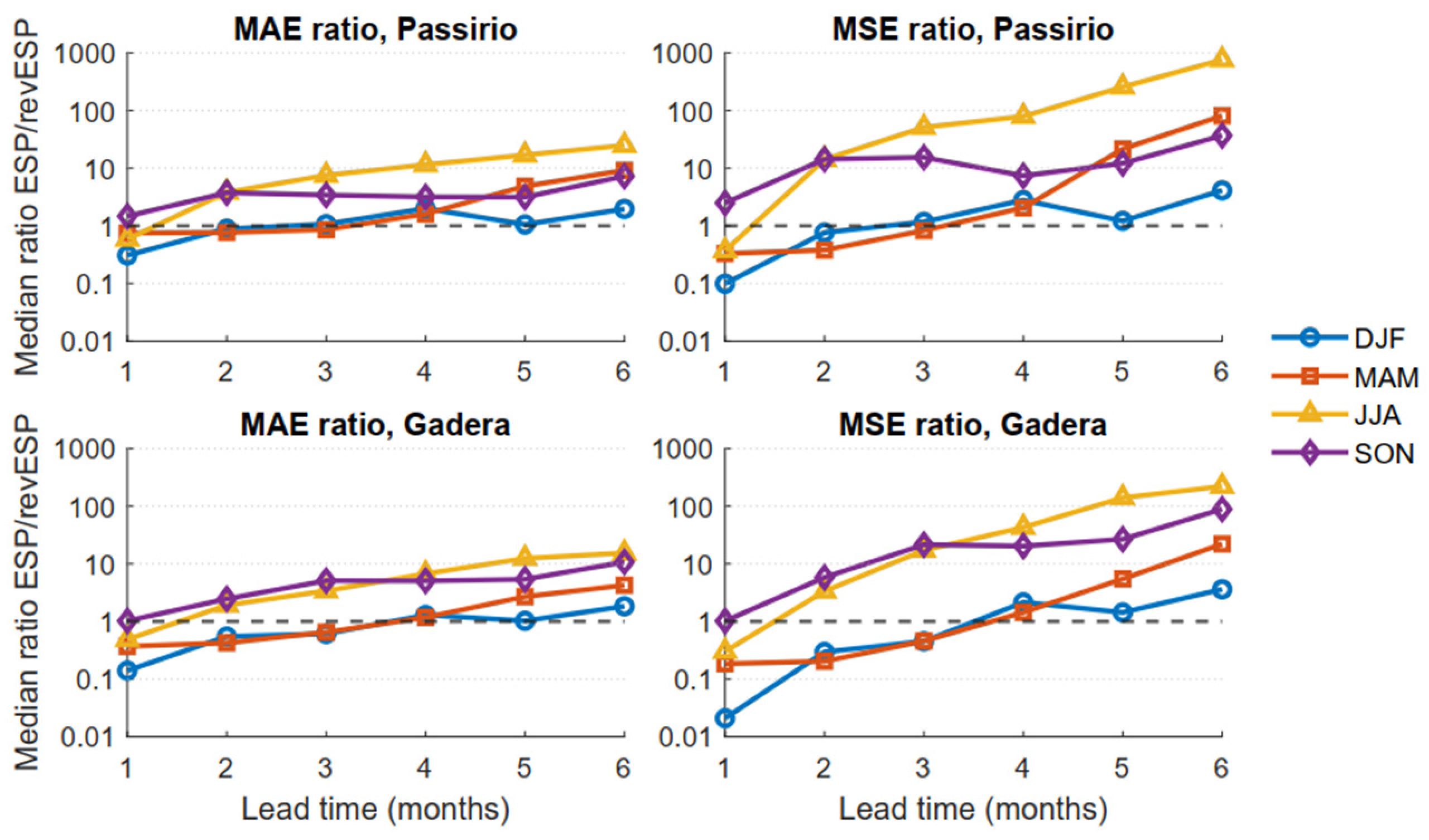
Figure 2 presents the seasonal median MAE and MSE ratios as a function of LT for the two catchments. The logarithmic scale on the vertical axis facilitates a balanced visualization of deviations around the unity threshold (i.e., equal performance of ESP and revESP), allowing differences in magnitude to be consistently compared across LTs. In line with typical ESP/revESP practice, statistical significance testing was not conducted. Results were interpreted in terms of the magnitude and persistence of deviations in the median ratios from the unity threshold.
Across both catchments, IC dominance is most pronounced for winter and spring initializations at short LTs. For example, winter MAE ratios at LT 1 are 0.31 in the Passirio catchment and 0.14 in the Gadera, indicating strong IC control. In the Passirio, the transition toward CF dominance occurs rapidly, with ratios approaching unity by LT 2 (0.89), and exceeding 1 from LT 3 onward. In contrast, the Gadera catchment maintains IC dominance longer, with winter ratios remaining below unity up to LT 3 (0.61). A similar pattern appears in spring, with ratios remaining below 1 up to LT 3 in the Gadera but approaching unity earlier in the Passirio. Summer and autumn initializations instead show CF dominance at shorter LTs, with MAE ratios exceeding unity by LT 2 in summer and already at LT 1 in autumn. Differences between the catchments are further amplified for MSE ratios due to their greater sensitivity to large forecast errors. These patterns highlight the role of catchment storage and baseflow contribution in sustaining IC-driven predictability and underline the importance of accounting for catchment memory and seasonal hydroclimatic regimes in forecast system design [7,23,24,25].
A comparison between the ESP/revESP results obtained here and the EPB experiments previously conducted for the same catchments [18] reveals both robust agreement and systematic divergence. The two frameworks converge under well-defined hydrological regimes, identifying IC-dominated predictability during winter and snowmelt conditions and CF dominance during summer and autumn rainfall regimes. For example, during spring initializations in the Gadera catchment, ESP/revESP ratios remain well below unity (MAE ratios of 0.37 and 0.42 at LTs 1 and 2), indicating strong IC influence, consistent with EPB results attributing 70–97% of forecast skill to IC. In contrast, transitional phases reveal more pronounced differences between the two approaches. While the ESP/revESP tends to attribute dominance to a single predictability source, the EPB indicates concurrent IC and CF contributions, particularly in the slower-responding Gadera catchment. These divergences suggest that dominance inferred from the ESP/revESP framework does not necessarily imply exclusive control, and that the EPB can provide additional diagnostic insight during regime transitions.

4. Conclusions

This study examined how catchment geology influences seasonal streamflow predictability by applying the ESP/revESP framework to two alpine catchments of contrasting geological settings and by directly comparing its outcomes with EPB-based assessments. While both approaches consistently identify periods of clear IC or CF dominance, their comparison reveals important differences during hydrological transition phases, when predictability sources overlap rather than act independently. These findings are of particular importance for operational forecasting in snow-dominated regions, especially in reservoir-regulated systems supporting water storage and hydropower production, as they highlight that reliance on the ESP/revESP alone may oversimplify the underlying drivers of forecast skill. Combining the benchmark ESP/revESP approach with integrative approaches such as the EPB can therefore support more robust interpretation of seasonal forecasts and better-informed reservoir operation, by clarifying when decisions should prioritize current hydrological states conditions versus anticipated atmospheric drivers.
Within this context, several limitations should be acknowledged. The ESP framework is based on historical meteorological forcing and may therefore be limited in representing hydrological responses under unprecedented or rapidly evolving climatic conditions. Furthermore, the revESP constitutes a diagnostic experiment rather than an operational forecasting configuration, as it assumes prior knowledge of future CF. In practical forecasting applications, seasonal predictions would instead rely on climate model outputs, which introduce additional sources of uncertainty related to model structure, initialization, and post-processing. Finally, extending the analysis to longer hindcast periods and to a larger and more diverse set of catchments would enable a more comprehensive evaluation of the robustness and broader applicability of the patterns identified in this study. Despite these limitations, the combined ESP/revESP–EPB framework presented in this study is readily transferable and can be implemented in other basins, where appropriate hydrological models and meteorological forcing datasets are available.

Author Contributions

Conceptualization, M.R. and M.S.; methodology, M.S.; software, M.S.; validation, M.S.; formal analysis, M.S.; investigation, M.S.; resources, M.R.; data curation, M.S.; writing—original draft preparation, M.S.; writing—review and editing, M.S. and M.R.; visualization, M.S.; supervision, M.R.; project administration, M.S. and M.R.; funding acquisition, M.R. All authors have read and agreed to the published version of the manuscript.

Funding

This research received no external funding.

Institutional Review Board Statement

Not applicable.

Informed Consent Statement

Not applicable.

Data Availability Statement

Data available upon request to M.S.

Conflicts of Interest

The authors declare no conflicts of interest.

References

  1. Gleick, P.H. Basic Water Requirements for Human Activities: Meeting Basic Needs. Water Int. 1996, 21, 83–92. [Google Scholar] [CrossRef]
  2. Chenoweth, J. Minimum Water Requirement for Social and Economic Development. Desalination 2008, 229, 245–256. [Google Scholar] [CrossRef]
  3. Viviroli, D.; Dürr, H.H.; Messerli, B.; Meybeck, M.; Weingartner, R. Mountains of the World, Water Towers for Humanity: Typology, Mapping, and Global Significance. Water Resour. Res. 2007, 43. [Google Scholar] [CrossRef]
  4. Kaune, A.; Chowdhury, F.; Werner, M.; Bennett, J. The Benefit of Using an Ensemble of Seasonal Streamflow Forecasts in Water Allocation Decisions. Hydrol. Earth Syst. Sci. 2020, 24, 3851–3870. [Google Scholar] [CrossRef]
  5. Troin, M.; Arsenault, R.; Wood, A.W.; Brissette, F.; Martel, J.-L. Generating Ensemble Streamflow Forecasts: A Review of Methods and Approaches Over the Past 40 Years. Water Resour. Res. 2021, 57, e2020WR028392. [Google Scholar] [CrossRef]
  6. Slater, L.J.; Anderson, B.; Buechel, M.; Dadson, S.; Han, S.; Harrigan, S.; Kelder, T.; Kowal, K.; Lees, T.; Matthews, T.; et al. Nonstationary Weather and Water Extremes: A Review of Methods for Their Detection, Attribution, and Management. Hydrol. Earth Syst. Sci. 2021, 25, 3897–3935. [Google Scholar] [CrossRef]
  7. Harrigan, S.; Prudhomme, C.; Parry, S.; Smith, K.; Tanguy, M. Benchmarking Ensemble Streamflow Prediction Skill in the UK. Hydrol. Earth Syst. Sci. 2018, 22, 2023–2039. [Google Scholar] [CrossRef]
  8. Day, G.N. Extended Streamflow Forecasting Using NWSRFS. J. Water Resour. Plan. Manag. 1985, 111, 157–170. [Google Scholar] [CrossRef]
  9. Wood, A.W.; Lettenmaier, D.P. An Ensemble Approach for Attribution of Hydrologic Prediction Uncertainty. Geophys. Res. Lett. 2008, 35, L14401. [Google Scholar] [CrossRef]
  10. Paiva, R.C.D.; Collischonn, W.; Bonnet, M.P.; de Gonçalves, L.G.G. On the Sources of Hydrological Prediction Uncertainty in the Amazon. Hydrol. Earth Syst. Sci. 2012, 16, 3127–3137. [Google Scholar] [CrossRef]
  11. Yuan, X.; Ma, F.; Wang, L.; Zheng, Z.; Ma, Z.; Ye, A.; Peng, S. An Experimental Seasonal Hydrological Forecasting System over the Yellow River Basin—Part 1: Understanding the Role of Initial Hydrological Conditions. Hydrol. Earth Syst. Sci. 2016, 20, 2437–2451. [Google Scholar] [CrossRef]
  12. Zhang, X.; Tang, Q.; Leng, G.; Liu, X.; Li, Z.; Huang, Z. On the Dominant Factor Controlling Seasonal Hydrological Forecast Skill in China. Water 2017, 9, 902. [Google Scholar] [CrossRef]
  13. Wood, A.W.; Hopson, T.; Newman, A.; Brekke, L.; Arnold, J.; Clark, M. Quantifying Streamflow Forecast Skill Elasticity to Initial Condition and Climate Prediction Skill. J. Hydrometeorol. 2016, 17, 651–668. [Google Scholar] [CrossRef]
  14. Arnal, L.; Wood, A.W.; Stephens, E.; Cloke, H.L.; Pappenberger, F. An Efficient Approach for Estimating Streamflow Forecast Skill Elasticity. J. Hydrometeorol. 2017, 18, 1715–1729. [Google Scholar] [CrossRef]
  15. Koutsoyiannis, D. Hydrologic Persistence and The Hurst Phenomenon. In Water Encyclopedia; John Wiley & Sons: Hoboken, NJ, USA, 2005; pp. 210–221. ISBN 9780471478447. [Google Scholar]
  16. Girons Lopez, M.; Crochemore, L.; Pechlivanidis, I.G. Benchmarking an Operational Hydrological Model for Providing Seasonal in Sweden. Hydrol. Earth Syst. Sci. 2021, 25, 1189–1209. [Google Scholar] [CrossRef]
  17. Norbiato, D.; Borga, M.; Merz, R.; Blöschl, G.; Carton, A. Controls on Event Runoff Coefficients in the Eastern Italian Alps. J. Hydrol. 2009, 375, 312–325. [Google Scholar] [CrossRef]
  18. Stergiadi, M.; Di Marco, N.; Avesani, D.; Righetti, M.; Borga, M. Impact of Geology on Seasonal Hydrological Predictability in Alpine Regions by a Sensitivity Analysis Framework. Water 2020, 12, 2255. [Google Scholar] [CrossRef]
  19. Borga, M. Accuracy of Radar Rainfall Estimates for Streamflow Simulation. J. Hydrol. 2002, 267, 26–39. [Google Scholar] [CrossRef]
  20. Zaramella, M.; Borga, M.; Zoccatelli, D.; Carturan, L. TOPMELT 1.0: A Topography-Based Distribution Function Approach to Snowmelt Simulation for Hydrological at Basin Scale. Geosci. Model Dev. 2019, 12, 5251–5265. [Google Scholar] [CrossRef]
  21. Alfieri, L.; Pappenberger, F.; Wetterhall, F.; Haiden, T.; Richardson, D.; Salamon, P. Evaluation of Ensemble Streamflow Predictions in Europe. J. Hydrol. 2014, 517, 913–922. [Google Scholar] [CrossRef]
  22. Pappenberger, F.; Cloke, H.L.; Parker, D.J.; Wetterhall, F.; Richardson, D.S.; Thielen, J. The Monetary Benefit of Early Flood Warnings in Europe. Environ. Sci. Policy 2015, 51, 278–291. [Google Scholar] [CrossRef]
  23. Araya, D.; Mendoza, P.A.; Muñoz-Castro, E.; McPhee, J. Towards Robust Seasonal Streamflow Forecasts in Mountainous Catchments: Impact of Calibration Metric Selection in Hydrological Modeling. Hydrol. Earth Syst. Sci. 2023, 27, 4385–4408. [Google Scholar] [CrossRef]
  24. Donegan, S.; Murphy, C.; Harrigan, S.; Broderick, C.; Foran Quinn, D.; Golian, S.; Knight, J.; Matthews, T.; Prudhomme, C.; Scaife, A.A.; et al. Conditioning Ensemble Streamflow Prediction with the North Atlantic Oscillation Improves Skill at Longer Lead Times. Hydrol. Earth Syst. Sci. 2021, 25, 4159–4183. [Google Scholar] [CrossRef]
  25. Yossef, N.C.; Winsemius, H.; Weerts, A.; van Beek, R.; Bierkens, M.F.P. Skill of a Global Seasonal Streamflow Forecasting System, Relative Roles of Initial Conditions and Meteorological Forcing. Water Resour. Res. 2013, 49, 4687–4699. [Google Scholar] [CrossRef]
Figure 1. Study catchments in the Upper Adige river basin (north-eastern Italy).
Eesp 44 00014 g001
Figure 2. Seasonal median values of the mean absolute error (MAE) and mean squared error (MSE) ratios (defined as E r r o r E S P / E r r o r r e v E S P ) as a function of lead time (LT) for the Passirio and Gadera catchments. ESP denotes Ensemble Streamflow Prediction and revESP its reverse configuration. Seasons correspond to December–February (DJF), March–May (MAM), June–August (JJA), and September–November (SON). Values below 1 indicate predictability dominated by initial hydrological conditions (IC), whereas values above 1 reflect a stronger influence of climate forcing (CF). The dashed horizontal line denotes equal performance between ESP and revESP (ratio = 1).
Eesp 44 00014 g002
Disclaimer/Publisher’s Note: The statements, opinions and data contained in all publications are solely those of the individual author(s) and contributor(s) and not of MDPI and/or the editor(s). MDPI and/or the editor(s) disclaim responsibility for any injury to people or property resulting from any ideas, methods, instructions or products referred to in the content.