Proceeding Paper

Olivine and Pyroxene as Tracers of Petrological Processes of Norilsk Intrusions †

by
Nadezhda Krivolutskaya
1,*,
Bronislav Gongalsky
2 and
Natalia Svirskaya
1
1
Vernadsky Institute of Geochemistry and Analytical Chemistry, Russian Academy of Sciences, 119991 Moscow, Russia
2
Institute of Geology of Ore Deposits, Petrography, Mineralogy and Geochemistry, Russian Academy of Sciences, 119117 Moscow, Russia
*
Author to whom correspondence should be addressed.
Presented at the 3rd International Online Conference on Mineral Science (IOCMS 2026), 10–12 March 2026; Available online: https://sciforum.net/event/IOCMS2026.
Environ. Earth Sci. Proc. 2026, 43(1), 3; https://doi.org/10.3390/eesp2026043003
Published: 1 July 2026

Abstract

Rock-forming minerals, olivine and pyroxene, from three ore-bearing intrusions in the Norilsk districts were studied. They are the Norilsk 1 and the Northern and Southern Maslovsky massifs with PGE-Cu-Ni ores, located in the Norilsk syncline. Trace elements such as Al, Ti, Co, Cu, Nd, Sm, Ce, Cr, V, Dy, Y, Yb, Er, Sr, and Eu were determined by LA-ICP-MS. The authors found differences in mineral compositions between picritic gabbro-dolerites from these intrusions. The parental melt of the Southern Maslovsky intrusion corresponded to tholeiitic basalt containing (wt.%) H2O—0.65, CO2—0.16, and B—0.004. It was concluded that parental magmas for ore-bearing intrusions had no specific features and were closed to intraplate basalts.

1. Introduction

The Norilsk district, the leading region in PGE and Ni resources in the world, is located on the NW Siberian Platform. It comprises many ultrabasic–basic intrusions with sulfide mineralization, but only a few of them have economic value [1], such as Talnakh, Norilsk 1, Kharaelakh, etc.. This selective ore occurrence has long raised a question about why sulfides appear in some massifs. Over the past three decades, many publications have assumed a leading role of the parental magma composition and volatile components in ore-bearing intrusions [2,3,4]. However, neither the composition of magmas themselves nor the content of fluids have been reported.
Therefore, the authors decided to estimate the melt composition and fluid regime for ore-bearing intrusions using the Maslovsky deposit located within the Norilsk syncline, to the south of the Norilsk 1 intrusion. We have studied the composition of rock-forming minerals (olivine and pyroxene) and melt inclusions in them that are trapped during crystallization.

2. Geological Background

Cambrian–Middle Permian sedimentary deposits and Late Permian–Early Triassic magmatic rocks are exposed at the surface in the Norilsk district. Basic–ultrabasic intrusions are mostly located within the carbonate-terrigenous rocks, and some of them occur at the surface as well. Intrusions are subdivided in several complexes; the differentiated massifs belong to the Norilsk intrusive complex. Their average thickness is about 100 m, and some of them contain disseminated PGE-Cu-Ni and massive sulfide ores.
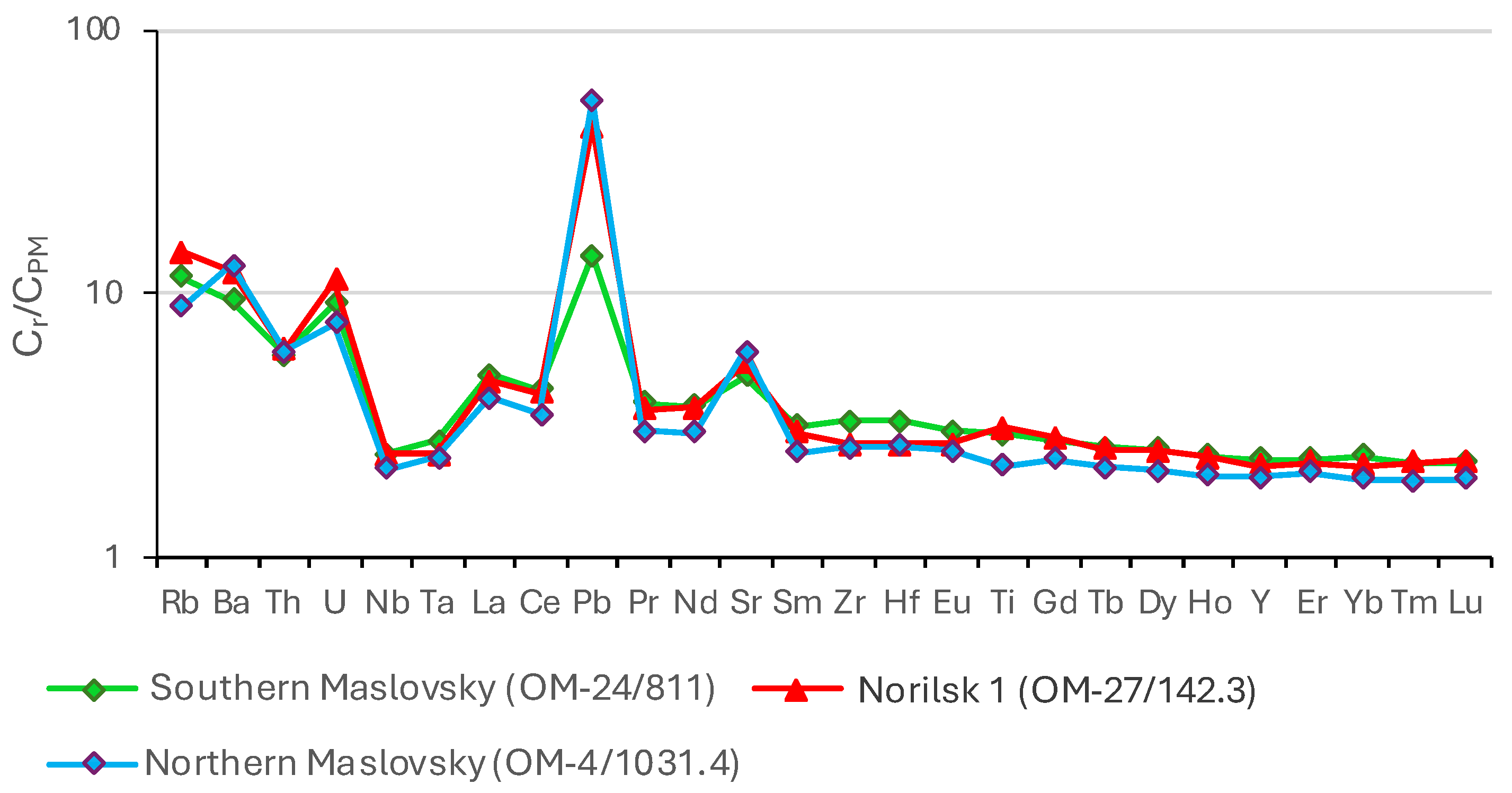
All ore-bearing massifs have a similar inner structure, with the following types of gabbro-dolerites (from bottom to top): contact, taxitic, picritic, olivine, olivine-bearing, and olivine-free. The upper parts of the intrusions consist of leucogabbro and gabbro-diorites; sometimes they include upper taxitic and picritic gabbro-dolerites, as well as upper contact gabbro-dolerites. Sulfide mineralization is concentrated in the lower taxitic and picritic gabbro-dolerites. Veins of massive ore are located at the lower endo- and exo-contacts. They consist of pyrrhotite, chalcopyrite, and pentlandite, with abundant amounts of cubanite, bornite, and pyrite. Upper zones of the intrusions contain low-sulfide PGE mineralization. The largest deposits are Talnakh, Oktyabr’sky, Norilsk 1, and Maslovsky (Figure 1). All mineralized intrusions have a similar chemical composition, regardless of their position in the stratigraphic section, i.e., whether they occur in carbonate, terrigenous, or volcanic rocks (Table 7 in reference [5]). The most representative composition is the weighted average composition of the Norilsk 1 massif. It was estimated from 54 boreholes and has the following composition (wt.%): 46.19 SiO2, 0.74 TiO2, 15.53 Al2O3, 13.44 FeO, 0.15 MnO, 11.36 MgO, 10.33 CaO, 1.32 Na2O, 0.69 K2O, and 0.2 P2O5. This composition is similar to that of tholeiitic basalts, but the intrusions have a higher MgO content compared to basalts (6–7 wt.% MgO). The patterns of the rocks from the studied intrusions are also similar (Figure 2).

3. Materials and Methods

Samples for our study were taken from the boreholes drilled in the Northern and Southern Maslovsky intrusions and in the Norilsk 1 massif. They represent picritic, taxitic, olivine and olivine-bearing gabbro-dolerites (44 samples). The authors studied the composition of minerals using a micro-X-ray spectral analysis on a JXA-8200 Geol microprobe (Jeol Ltd., Tokyo, Japan) at the Max Planck Institute of Chemistry in Mainz, Germany, with a probe current of 300 nA and an accelerating voltage of 20 kV, which allowed for an increased measurement accuracy for olivine impurity elements, such as Al, Ti, and Co, up to 20 ppm [8]. Trace elements, such as Co, Cu, Nd, Sm, Ce, Cr, V, Dy, Y, Yb, Er, Sr, and Eu, were determined using inductively coupled plasma mass spectrometry with laser ablation at the Max Planck Institute. This technique involved the use of a Thermo Finnigan ELEMENT 2 mass spectrometer (Thermo Scientific TM, Dreieich, Germany) equipped with a New Laser Wave UP 193 laser (Elemental Scientific Lasers LLC, Bozeman, MT, USA).
Single melt inclusions in pyroxenes were heated primarily in a Sobolev–Slutsky heating stage to estimate the temperature of their homogenization (1190 °C), and, subsequently, many inclusions were heated in a high-temperature furnace with controlled oxygen fugacity (QFM) at the GEOKHI RAS (analysts A.A. Kargaltsev).

4. Results

4.1. Norilsk 1 and Maslovsky Deposit

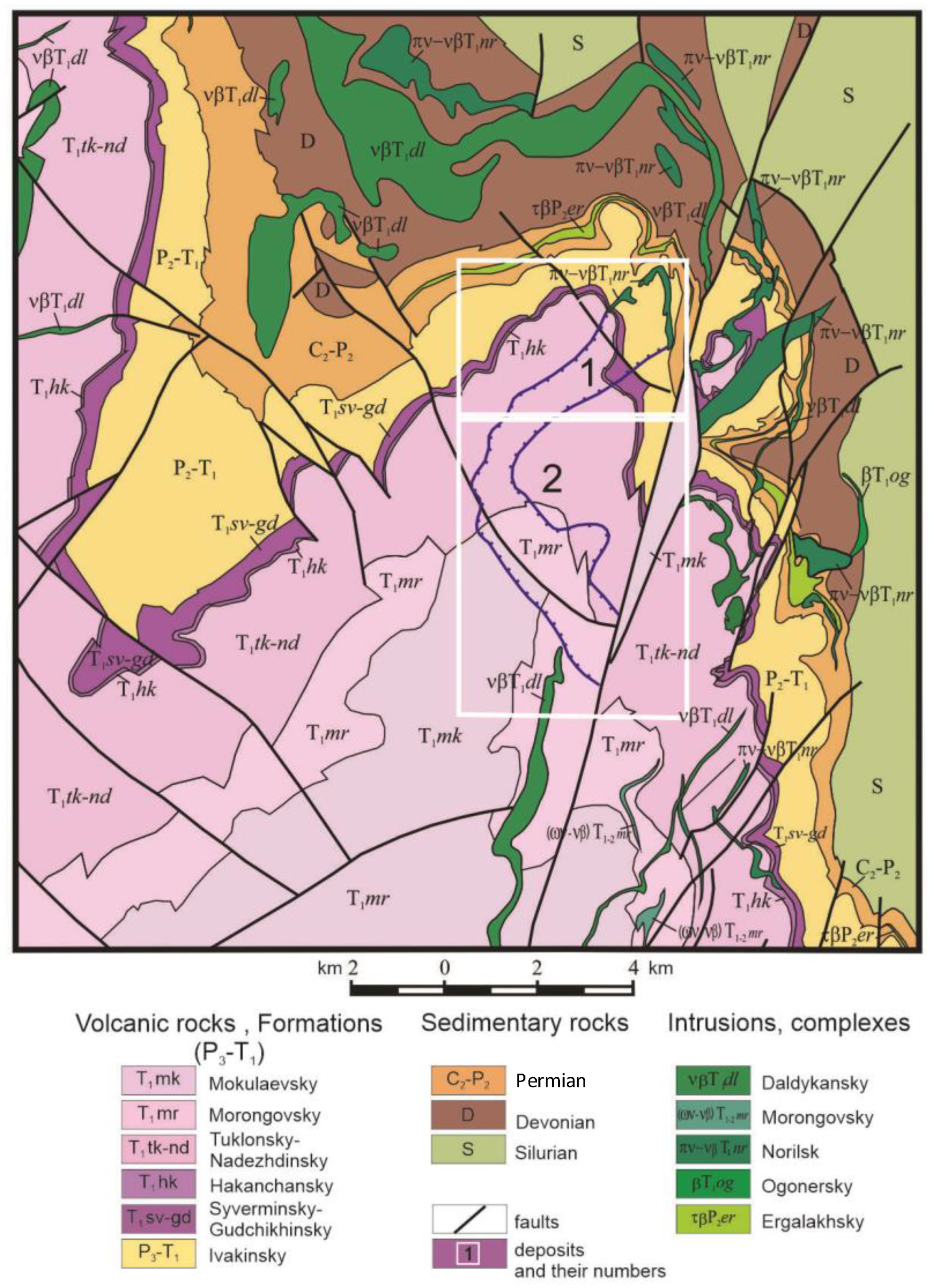
The Norilsk 1 deposit (Figure 1) is associated with the massif bearing the same name, situated in the north of the Norilsk syncline. It elongates in the N–S direction. The Maslovsky deposit is regarded as a continuation of the Norilsk 1 intrusion (Figure 1). It is composed of two massifs, the Northern and the Southern, which have a similar internal structure but differ in the thickness of their individual horizons. In the first massif (380 m), picritic gabbro-dolerite is the dominant rock type, while taxitic varieties play a subordinate role. In contrast, in the second massif (420 m), taxitic and olivine-bearing dolerites constitute the largest part of the section, and the olivine-bearing gabbro-dolerites are found in the upper portion of the intrusion and have a greater thickness. The main emphasis was placed on picritic, olivine-bearing gabbro-dolerites, and so-called prismatic–granular varieties. The first rocks contain earlier liquidus olivine, while the second contain earlier liquidus pyroxene.

4.2. Composition of Rock-Forming Minerals

The composition of main rock-forming minerals varies in vertical sections of the intrusions. The main minerals are plagioclase, olivine, and clinopyroxene—the proportions of which vary from the bottom to the top of the section. Plagioclase dominates in the upper part of the section in leucogabbro, as well as in the taxitic varieties localized above the lower-contact gabbro-dolerite. Olivine dominates in the picritic gabbro-dolerites. The subordinated minerals (up to 5 vol.%) include orthopyroxene and chromspinele. The Fo content in olivine in these three massifs changes from Fo67 to Fo81.5 and correlates with MgO in the rocks. The greatest amount of magnesium olivine occurs in the picritic gabbro-dolerites, as the most magnesium clinopyroxene (Mg# 85). This regularity was described by many geologists and summarized by Ryabov [9].
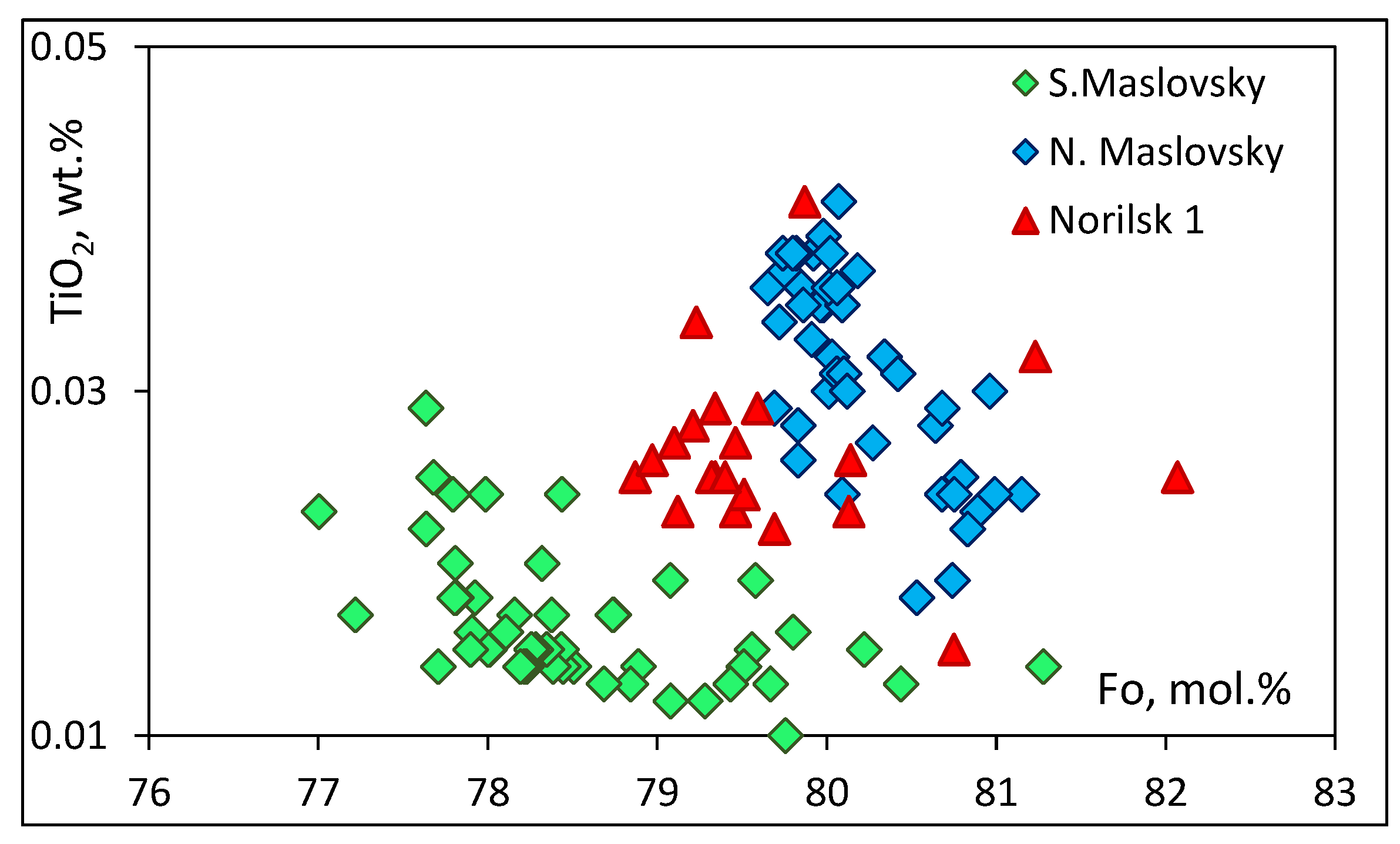
But for the first time we demonstrated that the distribution of trace elements in olivine and pyroxene depends on the magnesium content of the host mineral and produces a specific trendline for each horizon in vertical sections of the intrusions [10]. The slope of the trend compositions formed by the points increases in the most magnesian olivines (Fo78–Fo80), i.e., in picrite gabbro-dolerites, in comparison with the olivine-bearing ones. Figure 2 shows these trendlines for olivines from picritic horizons of three mentioned intrusive bodies: Norilsk 1 and Northern and Southern Maslovsky. According to the TiO2 content in the mineral, there are three fields in the Fo-TiO2 diagram (Figure 3). The area of points for the Northern Maslovsky intrusions is close to Norilsk 1, while the points of olivine compositions from the Southern Maslovsky massif occur in the bottom of the diagram and are separated from the first two. In general, this sequence reflects the metal resourses of these intrusions: Norilsk 1 and Northern Maslovsky are richer than the Southern Maslovsky massif.

4.3. Melt Inclusions in Clinopyroxene

Olivine and pyroxene contain melt, fluide and crystalline inclusions. Melt inclusions dominate, and they are represented by glassy (5–30 µm) and crystallized (10–70 µm) inclusions, which can be partially or fully crystallized. The daughter minerals include orthopyroxene, ilmenite, pyrrhotite, chalcopyrite, and chromspinel. The shape and size of the melt inclusions do not vary significantly from one massif to another, but the proportion between glassy and crystallized inclusions can fluctuate. Inclusions in olivine may not always be completely homogenized, but when they are, they produce results comparable with those obtained experimentally from pyroxene. The best inclusions in minerals were found in clinopyroxene from olivine-bearing rocks of the Southern Maslovsky intrusion. Therefore, we demonstrate the obtained compositions of primary melts for this massif.
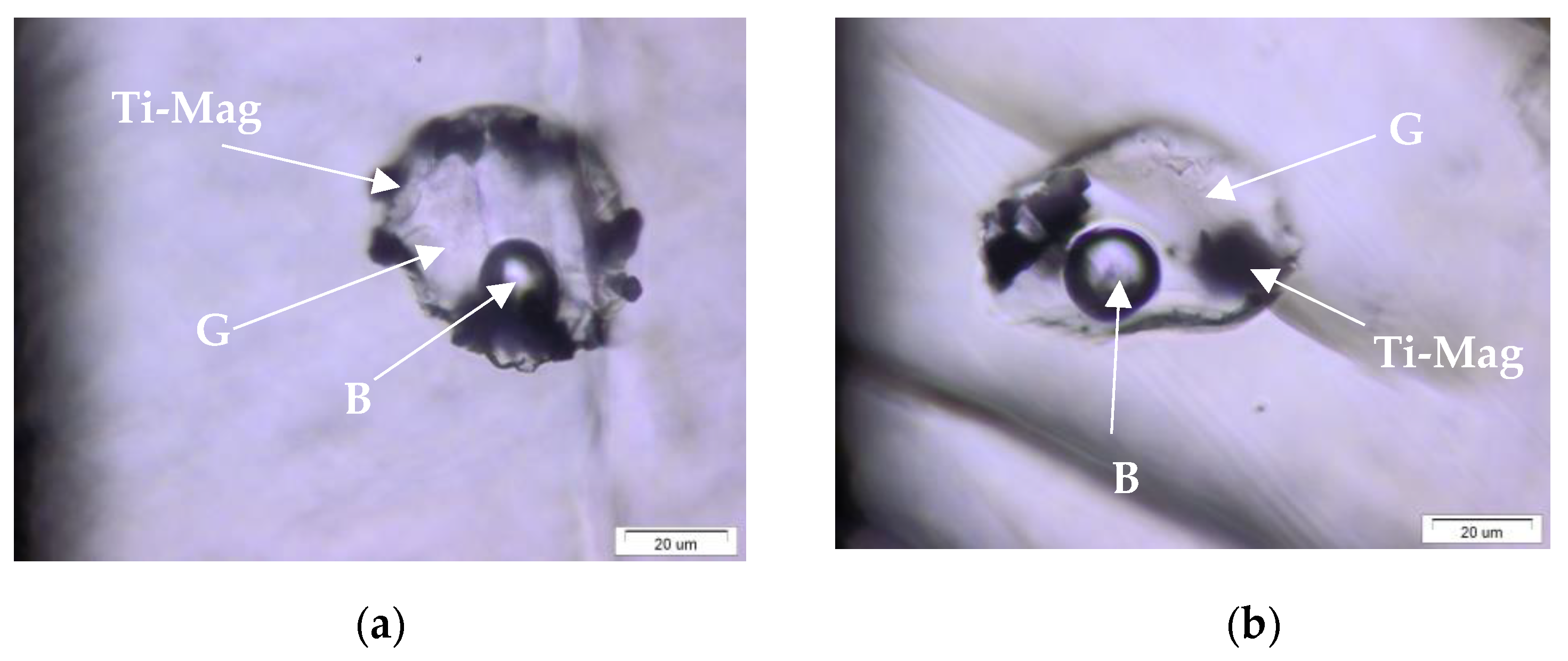
A horizon with large inclusions in pyroxene is located close to the upper contact of the massif and is characterized by the fast cooling of the parental magma. This is evidenced by glass in interstitial minerals and glassy inclusions in minerals (clinopyroxenes and plagioclases). Melt inclusions have oval, round (Figure 4) and sometimes irregular morphologies and consist of (vol.%) glass (80), titanomagnetite and hercynite (up to 10) and bubbles (10). Their sizes vary from 15–20 to 100–120 µm. The homogenization of inclusions (in glass without bubbles) ranges from 1170 °C to 1190 °C depending on the MgO content in the melt (and Mg# pyroxeme, respectively). Following experiments, the contents of major elements in inclusions were measured by EPMA, and trace elements (including volatile components) were determined by SIMS.
The average composition of 16 inclusions is as follows (wt.%) (average of 16): 50.01 SiO2, 1.62 TiO2, 14.43 Al2O3, 12.99 FeO, 0.22 MnO, 6.41 MgO, 10.49 CaO, 2.91 Na2O, 0.61 K2O, 0.21 P2O5, and 0.18 Cl. This corresponds to tholeiitic basalt. The concentrations of fluid components are typical of intraplate magmas (wt.%): H2O—0.65, CO2—0.16, and B—0.004 [9].

5. Discussion and Conclusions

For several decades, the indication of ore-bearing intrusions among many thousands of basic–ultrabasic intrusive bodies in the Siberian Platform has been a problem for geologists [11,12,13]. First of all, the composition of silicate rocks as a product of the crystallization of primary magmas for ore-bearing intrusions has been used. Indeed, the massifs with economic mineralization have similar weighted mean compositions (Figure 2) and differentiated structures. They were combined into the Norilsk intrusive complex [1]. Later, it was discovered that similar characteristics are typical of very poorly mineralized and even barren intrusions in terms of major and trace elements. The idea of the enrichment of ore-bearing magma with volatile components emerged when thick metamorphic and metasomatic halos were discovered around the Talnakh intrusion [14,15], which should be used in the discovery new deposits. However, none of these criteria have led, so far, to a successful result, even in the northwest of the Siberian magmatic province. Attempts to use rock-forming minerals for this purpose have also been repeated, with special attention paid to the nickel content in olivine [9]. The interest in olivine is justified, as it is the earliest liquid phase, which records differences in the composition of the parental melts and the conditions under which they crystallized.
The development of modern local methods for the study of minerals has led to a new level of mineral exploration. Using laser ablation and an ion microprobe for the first time, we were able to determine the contents of several trace elements, including rare earth and volatile components in melt inclusions and host minerals (olivine and pyroxene) from the different intrusions in the Norilsk district [16]. These data demonstrate that the ore-bearing massifs crystallized from typical within-plate tholeiitic magmas with ordinary concentrations of volatile components, i.e., low water and carbon dioxide levels [17]. For the first time, it has been found that impurity elements in rock-forming minerals create their own patterns during the crystallization of each layer, when the composition of the host mineral varies. These data can be used to estimate the ore content in newly discovered intrusions [10].

Author Contributions

Conceptualization, N.K. and B.G.; field trips, N.K. and B.G.; analytical work, N.S. All authors have read and agreed to the published version of this manuscript.

Funding

This research was financially supported by state programs GEOKHI RAS FMMZ-2024-0042 and IGEM RAS FMMZ-2024-0013.

Data Availability Statement

Data are contained within the article in [16].

Acknowledgments

The authors thank the geologists of Norilskgeologiya LLC, V.A. Radko, S.G. Snisar, and others for the opportunity to study the borehole cores from the Norilsk deposits. The authors are particularly grateful to A.V. Sobolev for his help in carrying out analytical work in the laboratories of the Max Planck Institute of Chemistry (Mainz, Germany).

Conflicts of Interest

The authors declare no conflicts of interest.

References

  1. Dyuzhikov, O.A.; Distler, V.V.; Strunin, B.M. Geology and Ore Content of the Norilsk Region; Nedra: Moscow, Russia, 1988; 279p. (In Russian) [Google Scholar]
  2. Distler, V.V.; Sluzhenikin, S.F. Platinum ores of the Norilsk stratified intrusions: The ratio of magmatic and fluid concentrations of precious metals. Geol. Ore Depos. 1999, 41, 241–265. (In Russian) [Google Scholar]
  3. Barnes, S.-J.; Le Vaillant, M.; Godel, B.; Lesher, M. Droplets and bubbles: Solidification of sulfide-rich vapor-saturated orthocumulates in the Norilsk-Talnakh Ni-Cu-PGE intrusions. J. Petrol. 2019, 60, 269–300. [Google Scholar] [CrossRef]
  4. Yao, Z.; Mungall, J. Linking the Siberian Flood Basalts and Giant Ni-Cu-PGE Sulfide Deposits at Norilsk. J. Geophys. Res. Solid Earth 2021, 126, e2020JB020823. [Google Scholar] [CrossRef]
  5. Krivolutskaya, N.A. Formation of PGM–Cu–Ni Deposits in the Process of Evolution of Flood Basalt Magmatism in the Noril’sk Region. Geol. Ore Depos. 2011, 53, 309–339. [Google Scholar]
  6. Hofmann, A.W. Chemical differentiation of the Earth: The relationship between mantle, continental crust and oceanic crust. Earth Planet. Sci. Lett. 1988, 90, 297–314. [Google Scholar] [CrossRef]
  7. Krivolutskaya, N.A.; Gongalsky, B.I.; Kedrovskaya, T.B.; Kubrakova, I.V.; Tyutyunnik, O.A.; Chikatueva, V.Y.; Bychkova, Y.V.; Magazina, L.; Kovalchuk, E.N.; Yakushev, A.I. Geology of the Western Flanks of the Oktyabr’skoe Deposit, Noril’sk District, Russia: Evidence of a Closed Magmatic System. Miner. Depos. 2019, 54, 611–630. [Google Scholar]
  8. Sobolev, A.V.; Hofmann, A.W.; Kuzmin, D.V.; Yaxley, G.M.; Arndt, N.T.; Chung, S.L.; Danyushevsky, L.V.; Elliott, T.; Frey, F.A.; Garcia, M.O.; et al. Amount of Recycled Crust in Sources of Mantle-Derived Melts. Science 2007, 316, 412–417. [Google Scholar] [CrossRef] [PubMed]
  9. Ryabov, V.V. Olivines of the Norilsk Intrusions as Indicators of Petrogenesis and Ore Formation; Nauka Publisher: Novosibirsk, Russia, 1992; 102p. [Google Scholar]
  10. Krivolutskaya, N.A.; Gongalsky, B.I.; Kuzmin, D.V. Rock-Forming Minerals of the Norilsk Intrusions; Publishing House “KMK Partnership”: Moscow, Russia, 2024; 240p. (In Russian) [Google Scholar]
  11. Kotulsky, V.K. About the origin of magmatic copper-nickel deposits. Dokl. Acad. Sci. USSR 1946, 51, 381–384. (In Russian) [Google Scholar]
  12. Godlevsky, M.N. Traps and Ore-Bearing Intrusions of the Noril’sk District; Gosgeoltekhizdat: Moscow, Russia, 1959; 61p. (In Russian) [Google Scholar]
  13. Naldrett, A.J. Magmatic Sulphide Deposits: Geology, Geochemistry and Exploration; Springer: Berlin/Heidelberg, Germany; New York, NY, USA, 2004. [Google Scholar]
  14. Zotov, I.A. The Genesis of Trap Intrusions and Metamorphic Rocks of the Talnakh Deposit; Nauka: Moscow, Russia, 1979. (In Russian) [Google Scholar]
  15. Marakushev, A.A.; Paneyakh, N.A.; Zotov, I.A. Petrological model of the formation of the Norilsk copper-nickel deposits. Petrology 2003, 11, 476–494. [Google Scholar]
  16. Krivolutskaya, N.A.; Konyshev, A.A.; Kuzmin, D.V.; Nikogosian, I.K.; Krasheninnikov, S.P.; Gongalsky, B.I.; Fedulov, V.S. Is the Permian–Triassic mass extinction related to the Siberian Traps? Geochem. Int. 2022, 60, 1323–1351. [Google Scholar] [CrossRef]
  17. Naumov, V.B.; Naumov, V.B.; Kovalenko, V.I.; Dorofeeva, V.A.; Girnis, A.V.; Yarmolyuk, V.V. Average compositions of igneous melts from main geodynamic settings according to the investigation of melt inclusions in minerals and quenched glasses of rocks. Geochem. Int. 2010, 48, 1185–1207. [Google Scholar] [CrossRef]
Figure 1. Geological map of the Norilsk syncline. After Norilskgelogiya LTD data. Deposits: 1—Norilsk 1, 2—Maslovsky.
Eesp 43 00003 g001
Figure 2. Spider diagrams for the picritic gabbro-dolerites from the studied massifs. Normalized to primitive mantle after [6]. Data from [7]. Line names correspond to the intrusion names and sample numbers in brackets (core abbreviation/depth in meters).
Eesp 43 00003 g002
Figure 3. Diagram Fo–TiO2 for olivine from the ore-bearing intrusions in the Norilsk district.
Eesp 43 00003 g003
Figure 4. Melt inclusions in clinopyroxene from the Southern Maslovsky intrusion: (a) titanomagnetite grains are located along the perimeter of the inclusion and (b) titanomagnetite grains are concentrated in two localities within the inclusion. Scale is 20 µm. G—glass, Ti-Mag—titanomagnetite, B—bubble.
Eesp 43 00003 g004
Disclaimer/Publisher’s Note: The statements, opinions and data contained in all publications are solely those of the individual author(s) and contributor(s) and not of MDPI and/or the editor(s). MDPI and/or the editor(s) disclaim responsibility for any injury to people or property resulting from any ideas, methods, instructions or products referred to in the content.