Proceeding Paper

Immediate and Residual Effects of Cattle Corralling and Mineral Fertilizer in Maize Cropping Systems in the Sub-Humid Zone of Northern Benin: Yields, Resource-Use Efficiency, Economic Profitability, and Post-Harvest Soil Fertility †

by
Pierre G. Tovihoudji
,
Sourogou Anasse Gounou
*,
Mouiz W. I. A. Yessoufou
,
Sissou Zakari
,
André Adjogboto
and
P. B. Irénikatché Akponikpè
Laboratory of Hydraulics and Environmental Modeling (HydroModE Lab), Faculty of Agronomy, University of Parakou, Parakou 03 BP 351, Benin
*
Author to whom correspondence should be addressed.
Presented at the 2nd International Electronic Conference on Land (IECL 2025), 4–5 September 2025; Available online: https://sciforum.net/event/IECL2025.
Environ. Earth Sci. Proc. 2025, 36(1), 10; https://doi.org/10.3390/eesp2025036010

Published: 9 December 2025
(This article belongs to the Proceedings of The 2nd International Electronic Conference on Land)

Abstract

Effective management of organic and inorganic fertilizers is vital for sustaining productivity in intensive cropping systems. This four-year study (2012–2015) assessed the immediate and residual effects of cattle corralling combined with mineral fertilizer on maize in northern Benin using a strip-plot design with five corralling levels No corralling(NM), immediate application (C0) and residual effects one (C1), two (C2), and three (C3) years after the initial corralling and three fertilizer rates F0 (no fertilizer), F1 (50% of the recommended rate) and F2 (the recommended rate). Cattle corralling doubled maize yield from 2.0 to 4.0 t ha−1 and increased net profitability from 384 to 1000 USD ha−1 compared to non-manured plots. Water-use efficiency increased from 3.4 to 6.8 kg ha−1 mm−1, and soil organic carbon increased nearly fourfold (3.0 to 11.2 g kg−1). Residual effects declined over time without mineral inputs (C0 > C1 > C2 > C3 > NM); however, these benefits were sustained or enhanced when combined with fertilizer (C3 > C2 > C1 > C0 > NM). Fertilizer responses were minor in C0 and C1 but significant in C2 and C3, demonstrating a strong organic–inorganic synergy. Nutrient recovery efficiency was initially lower in recently corralled plots but surpassed non-manured levels after two years. These results confirm that integrating livestock corralling with optimized fertilizer use strengthens soil fertility, resource efficiency, and profitability, providing a sustainable intensification pathway for maize systems in sub-humid, low-fertility regions.

1. Introduction

Soils in Sub-Saharan Africa (SSA) are continuously degrading due to severe nutrient depletion, which represents a major constraint to global agricultural productivity. Water scarcity aggravates the problem, since most farmers rely on erratic rainfall increasingly influenced by climate change [1]. Several strategies have been developed to address these limitations. These include organic amendments, conventional fertilization, fertilizer microdosing, integrated soil fertility management (ISFM), and integrated crop–livestock systems, all aimed at improving nutrient-use efficiency and sustaining soil fertility. Among these, cattle corralling (also known as kraaling or penning) is a traditional practice widely used in West Africa, where livestock are confined overnight on cropland to enrich soils with manure [2].
Corralling is preferred because it requires little labor, avoids manure transport and spreading, and can reduce nitrogen losses by 40–60% [2]. However, the long-term and residual effects of corralling—particularly the optimal intervals between applications and its interaction with mineral fertilization—are still not well understood. Therefore, this study evaluates both the immediate and residual impacts of cattle corralling combined with mineral fertilization on maize productivity in the sub-humid zone of northern Benin.

2. Material and Methods

2.1. Study Site

This study was conducted over four consecutive maize growing seasons (2012–2015) at the Agricultural Research Station of Northern Benin, located in Ina. The site receives an average annual rainfall of 1148 mm and has a mean daily temperature of 27.5 °C. The soil is classified as ferruginous tropical.
A strip-plot experimental design was used to assess two main factors: cattle corralling and mineral fertilization, with three replications. For corralling, treatments included immediate application (C0) and residual effects one (C1), two (C2), and three (C3) years after the initial corralling. A control (NM) received no manure. It must be noted that the cattle corralling (manure application) was performed once per plot at the beginning of its respective experimental season. Plots that received manure in 2012 (C0) did not receive additional manure in subsequent years. From 2013 (C1) to 2015 (C3), the residual effects were assessed. The corralled plots from subsequent years all follow the same timeline. Corralling was carried out once per plot by confining 38–44 cattle in 490 m2 enclosures for 10 nights between 10 and 20 May. This corresponded to an average of 8.2 ± 0.7 t DM ha−1, equivalent to 1771 ± 325 kg C, 144 ± 29 kg N, 29 ± 4 kg P, and 21 ± 13 kg K ha−1. Within each manure treatment, three fertilizer regimes were tested: F0 (no fertilizer), F1 (3.2 g NPK 14-23-14 + 1.6 g urea per pocket, equivalent to 50% of the recommended rate), and F2 (6.4 g NPK 14-23-14 + 3.2 g urea per pocket, the recommended rate, following national fertilizer recommendations, equivalent to 200 Kg/ha of NPK and 100 Kg/ha of urea).
Land preparation was carried out uniformly using tractor disk-plowing. The improved maize variety DMR-ESR-W (potential yield: 4 t ha−1) was sown and thinned to a density of 62,500 plants per hectare.

2.2. Measurements and Calculations

Before cattle corralling and fertilizer application, the experimental site was divided into three equal sections, where soil profiles were excavated and sampled at five depths (0–0.2, 0.2–0.4, 0.4–0.6, 0.6–0.8, and 0.81 m), with composite samples formed from multiple subsamples. For surface soils (0–20 cm and 20–40 cm), additional samples were collected to enhance representativeness. Before sowing, three composite soil samples were taken from Cor-0 plots. Maize grain yield (GY) was determined on a dry-weight basis. For nutrient uptake, samples were separated into stover and grain, oven-dried (65 °C for 48 h), milled, and analyzed for total N, P, and K at the International Crops Research Institute for the Semi-Arid Tropics (ICRISAT) laboratory [3]. Water-use efficiency (WUE) was computed using the seasonal water use (evapotranspiration, ETR). Soil organic carbon stock (SOC) and the annual rate of SOC sequestrated (CS) were calculated based on C concentration, bulk density, and soil depth.
Economic profitability was analyzed based on net profit (NP) and value–cost ratio (VCR). Costs included fixed and variable costs (seeds, labor, fertilizers, and manure/corralling).
Statistical analyses involved a mixed-effects model, considering the block as a random factor and corralling/fertilizer treatments as fixed factors. The model considered data from the 2015 growing season and included the NM, C0, C1, C2, and C3 treatments, thereby capturing residual effects up to three years after corralling. This approach was chosen to allow for a simultaneous assessment of the long-term residual effects (up to three years) of all corralling treatments under the identical environmental conditions of the final cropping year.

3. Results and Discussion

3.1. Maize Yield and Water-Use Efficiency

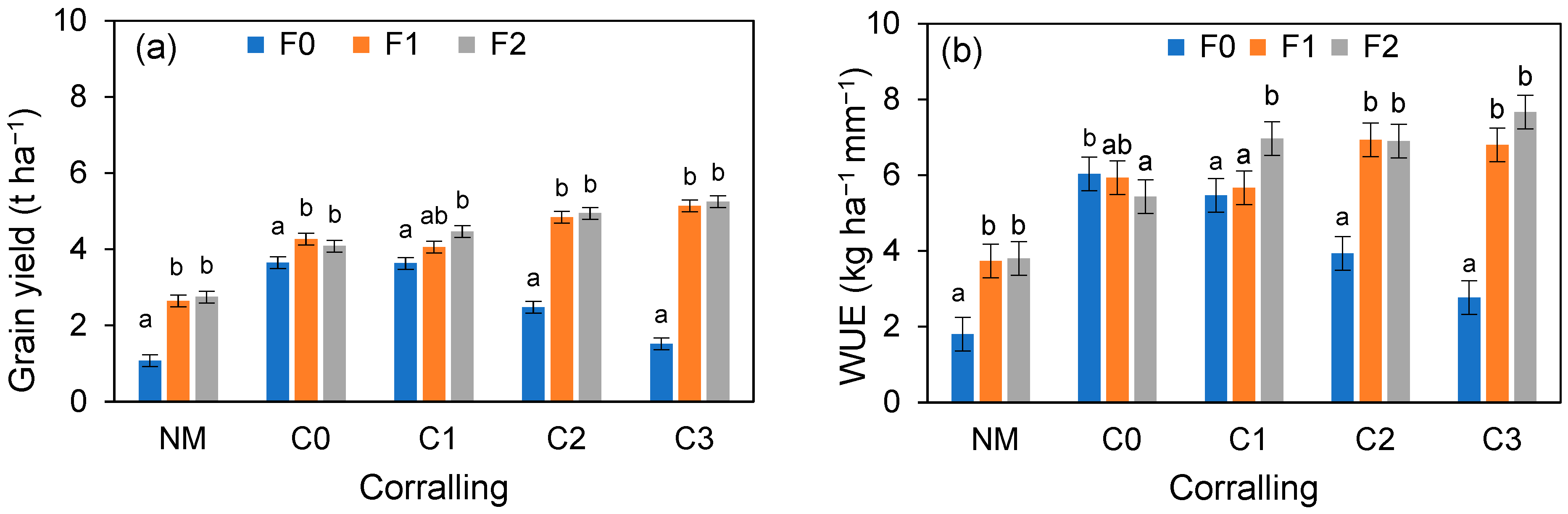
Grain yield (GY) was significantly increased by corralling (p < 0.001), rising from about 2.0 t ha−1 in unfertilized plots (NM) to nearly 4.0 t ha−1 under immediate corralling (C0). Half of the recommended fertilizer rate (F1) produced yields similar to the full rate (F2). In contrast, without mineral fertilizer (F0), residual effects of corralling declined over time (C0 > C1 > C2 > C3 > NM). When combined with fertilizer (F1 or F2), however, residual benefits were sustained or even amplified (C3 > C2 > C1 > C0 > NM) (Figure 1a). Water-use efficiency (WUE) followed similar patterns (p < 0.001), increasing from 3.4 kg ha−1 mm−1 in NM to 6.8 kg ha−1 mm−1 in C0. Fertilizer effects were negligible in C0 and C1 but became significant in C2 and C3, matching those of NM (Figure 1b). The persistence of yield and WUE benefits over 3–4 years corroborates earlier reports from the Sahel [4,5] and is attributed to improved soil structure, enhanced infiltration, and greater root biomass development [6].

3.2. Economic Profitability

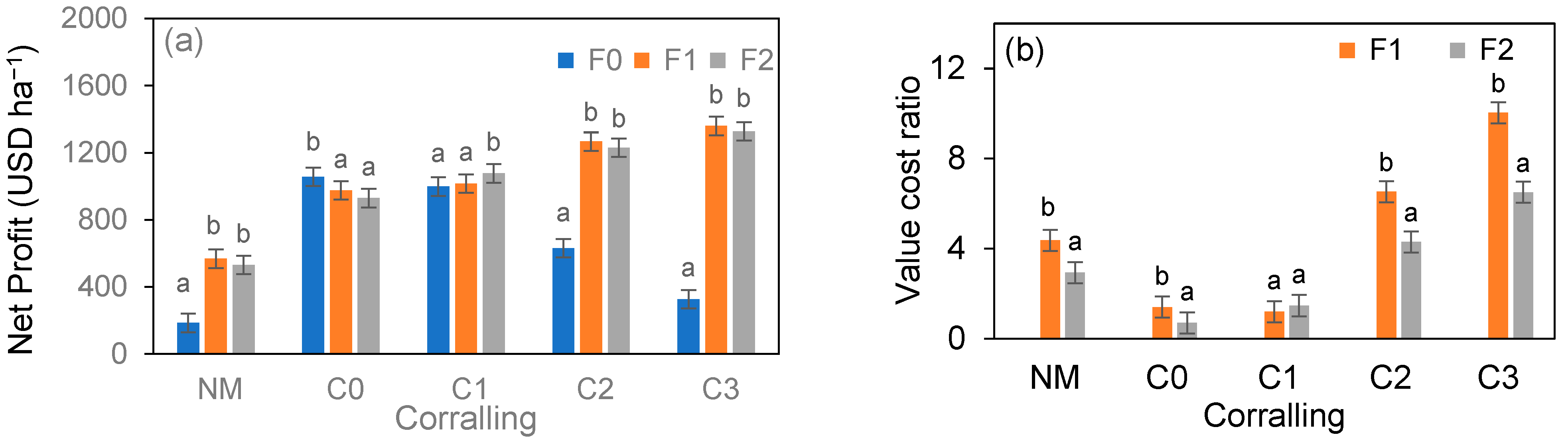
Cattle corralling markedly increased net profit (NP), from about USD 384 ha−1 in non-corralling plots (NM) to roughly USD 1000 ha−1 in immediate corralling (C0). Residual treatments (C1–C3) maintained NP values similar to C0 (Figure 2). In terms of the value–cost ratio (VCR), corralling alone (F0) was generally uneconomical in C0 (VCR < 1), and the C0–F2 treatment (full fertilizer dose) also remained unprofitable. However, VCR improved progressively from C2 onward, with the combination of corralling and the half fertilizer dose (F1) offering the best economic returns (Figure 2b). Net profit trends mirrored those of grain yield, declining over time without mineral fertilization (C0 > C1 > C2 > C3 > NM) but increasing when combined with F1 or F2 (C3 > C2 > C1 > C0 > NM) (Figure 2a). Applying the full recommended dose (F2) in the same year as immediate corralling (C0) could lead to an overabundance of nutrients, thereby increasing costs without yielding a proportional benefit in grain yield. This synergy between moderate mineral input and organic amendment optimizes nutrient-use efficiency and profitability while minimizing environmental losses [7,8].

3.3. Soil Organic Carbon and Soil Chemical Properties

Cattle corralling significantly increased soil organic carbon (SOC) from 3.0 g kg−1 in non-corralling plots (NM) to 11.2 g kg−1 in immediate corralling (C0). This also enhanced carbon sequestration, from 1.3 to 59 t ha−1 yr−1 (Table 1). Although SOC and sequestration values declined progressively in residual treatments (C1–C3), they remained significantly higher than in NM. The decline in residual effects over time was markedly reduced when corralling was combined with mineral fertilization (F1 or F2), sustaining higher nutrient availability across years. The strong improvements in SOC and carbon sequestration stem from direct organic matter inputs from livestock excreta and trampling [9], with measurable residual benefits persisting for up to three years [10].

4. Conclusions

Integrating cattle corralling with targeted mineral fertilizer is a promising strategy for sustainable maize intensification in northern Benin. Corralling provides substantial immediate benefits (C0) and residual effects lasting up to three years, which are amplified by mineral fertilization. Applying a half-dose of mineral fertilizer (F1), particularly from the second year (C2), offers the optimal balance between agronomic performance and economic returns. This integrated approach improves soil organic carbon, enhances carbon sequestration, and reduces dependence on excessive chemical inputs, thereby minimizing environmental risks.

Author Contributions

Conceptualization, P.G.T. and P.B.I.A.; Methodology, P.G.T. and S.A.G.; Validation, S.Z. and P.G.T.; Formal analysis, P.G.T. and S.A.G.; Investigation, P.G.T. and A.A.; Resources, P.G.T. and P.B.I.A.; Data curation, M.W.I.A.Y. and S.A.G.; Writing—original draft preparation, S.A.G. and P.G.T.; Writing—review and editing, P.G.T. and S.Z.; Visualization, S.A.G.; Supervision, P.B.I.A.; Project administration, P.B.I.A.; Funding acquisition, P.B.I.A. All authors have read and agreed to the published version of the manuscript.

Funding

This research was funded by the “Climate Change Agriculture and Food Security (CCAFS)” program of the CGIAR and the West Africa Agricultural Productivity Program (WAAPP-Benin).

Institutional Review Board Statement

Not applicable.

Informed Consent Statement

Not applicable.

Data Availability Statement

The data supporting the reported results will be made available on request.

Acknowledgments

We are grateful to the staff of Agricultural Research Center of Northern Benin (INRAB CRA-Nord) for their technical help.

Conflicts of Interest

The authors declare no conflicts of interest.

References

  1. Liu, Y.; Song, W. Modelling crop yield, water consumption, and water use efficiency for sustainable agroecosystem management. J. Clean. Prod. 2020, 253, 119940. [Google Scholar] [CrossRef]
  2. Powell, J.M. Feed and manure use in low-N-input and high-N-input dairy cattle production systems. Environ. Res. Lett. 2014, 9, 11. [Google Scholar] [CrossRef]
  3. Tovihoudji, P.G.; Akponikpè, P.B.I.; Agbossou, E.K.; Bertin, P.; Bielders, C.L. Fertilizer microdosing enhances maize yields but may exacerbate nutrient mining in maize cropping systems in northern Benin. Field Crops Res. 2017, 213, 130–142. [Google Scholar] [CrossRef]
  4. Bielders, C.L.; Gérard, B. Millet response to microdose fertilization in south–western Niger: Effect of antecedent fertility management and environmental factors. Field Crops Res. 2015, 171, 165–175. [Google Scholar] [CrossRef]
  5. Schlecht, E.; Hiernaux, P.; Achard, F.; Turner, M.D. Livestock related nutrient budgets within village territories in western Niger. Nutr. Cycl. Agroecosyst. 2004, 68, 199–211. [Google Scholar] [CrossRef]
  6. Demelash, N.; Bayu, W.; Tesfaye, S.; Ziadat, F.; Sommer, R. Current and residual effects of compost and inorganic fertilizer on wheat and soil chemical properties. Nutr. Cycl. Agroecosyst. 2014, 100, 357–367. [Google Scholar] [CrossRef]
  7. Sime, G.; Aune, J. Maize Response to Fertilizer Dosing at Three Sites in the Central Rift Valley of Ethiopia. Agronomy 2014, 4, 436–451. [Google Scholar] [CrossRef]
  8. Vanlauwe, B.; Descheemaeker, K.; Giller, K.E.; Huising, J.; Merckx, R.; Nziguheba, G.; Wendt, J.; Zingore, S. Integrated soil fertility management in sub-Saharan Africa: Unravelling local adaptation. SOIL 2015, 1, 491–508. [Google Scholar] [CrossRef]
  9. Qaswar, M.; Huang, J.; Ahmed, W.; Li, D.; Liu, S.; Zhang, L.; Cai, A.; Liu, L.; Xu, Y.; Gao, J.; et al. Yield sustainability, soil organic carbon sequestration and nutrients balance under long-term combined application of manure and inorganic fertilizers in acidic paddy soil. Soil Tillage Res. 2020, 198, 104569. [Google Scholar] [CrossRef]
  10. Taaime, N.; El Mejahed, K.; Oukarroum, A.; Choukr-Allah, R.; Pittelkow, C.; Bouabid, R.; Gharous, M.E. Residual Effects of Compost and Manure Fertilizers on Quinoa Production and Nutrient Uptake. J. Soil Sci. Plant Nutr. 2024, 24, 4338–4348. [Google Scholar] [CrossRef]
Figure 1. Residual effects of cattle corralling and fertilizer on maize productivity (a) grain yield, (b) water-use efficiency. NM: No corralling, C0: Corralling the same year, C1: One year after the first corralling, C2: Two years after the first corralling, C3: Three years after the first corralling. F0: No fertilizer, F1: Half of recommended fertilizer application rate, F2: Recommended fertilizer application rate. Different letters above the bars indicate statistically significant differences among treatments at p < 0.05 based on Tukey’s Honest Significant Difference (HSD) post hoc test, error bars show the standard error of the mean.
Eesp 36 00010 g001
Figure 2. Residual effects of cattle corralling and fertilizer on economic profitability (a) net profit, (b) value–cost ratio. NM: No corralling, C0: Corralling the same year, C1: One year after the first corralling, C2: Two years after the first corralling, C3: Three years after the first corralling. F0: No fertilizer, F1: Half of recommended fertilizer application rate, F2: Recommended fertilizer application rate. Different letters above the bars indicate statistically significant differences among treatments at p < 0.05 based on Tukey’s Honest Significant Difference (HSD) post hoc test, error bars show the standard error of the mean.
Eesp 36 00010 g002
Table 1. Effects of cattle corralling and mineral fertilizers on soil organic carbon (SOC) and carbon sequestration (CS).
SOC (g kg −1)CS (tha−1 yr−1)
CorrallingC010.3 c53.4 d
C19.3 c15.5 c
C26.9 b6.3 b
C37.0 b4.6 b
NM3.1 a1.0 a
FertilizerF06.3 a14.6
F17.7 b16.8
F27.9 b17.1
PvaluesCorralling<0.001<0.001
Fertilizer0.0100.067
Corralling ×Fertilizer0.8950.993
NM: No corralling, C0: Corralling the same year, C1: One year after the first corralling, C2: Two years after the first corralling, C3: Three years after the first corralling. F0: No fertilizer, F1: Half of recommended fertilizer application rate, F2: Recommended fertilizer application rate. Different letters indicate significant differences at p < 0.05.
Disclaimer/Publisher’s Note: The statements, opinions and data contained in all publications are solely those of the individual author(s) and contributor(s) and not of MDPI and/or the editor(s). MDPI and/or the editor(s) disclaim responsibility for any injury to people or property resulting from any ideas, methods, instructions or products referred to in the content.