Article

An All-Metal Millimeter-Wave High-Gain Fabry–Perot Antenna Based on Metal Integrated Suspended Lines


1
College of Electronics and Information Engineering, Sichuan University, Chengdu 610064, China
2
Yibin Industrial Technology Research Institute of Sichuan University, Yibin 644000, China
*
Author to whom correspondence should be addressed.
Microwave 2026, 2(2), 10; https://doi.org/10.3390/microwave2020010
Submission received: 9 March 2026 / Revised: 16 April 2026 / Accepted: 8 May 2026 / Published: 11 May 2026

Abstract

In this work, a Fabry–Perot (F–P) antenna based on metal integrated suspended lines (MISLs) at the K-band for microwave wireless power transmission (MWPT) is proposed. The antenna’s contribution lies in its adaptation of the MISL structure and its all-metal design, which achieves low loss, high gain, and high-power capability. The entire antenna structure is dielectric-free, further reducing apparent dielectric loss at high frequencies. Meanwhile, the radiation structure is surrounded by a metallic wall to minimize radiation loss. A metal partially reflective surface (PRS) on the top of the antenna, together with a metal ground plane, constitutes an air-filled resonant cavity. The reflection and transmission of electromagnetic waves in the PRS are effectively controlled to be in phase, thereby enhancing its gain by optimizing the PRS and resonant cavity dimensions. A simple slot antenna is employed as the primary source for the F–P resonant cavity. The antenna is processed layer by layer and then assembled to lower machining costs and complexity. Experimental results indicate that the proposed F–P antenna achieves an aperture efficiency over 60% and a measured peak gain of 18.4 dBi at 23.85 GHz with an aperture size of 2.86 λ0 × 2.86 λ0.

1. Introduction

Microwave wireless power transmission (MWPT) aims to eliminate cable constraints and provide reliable delivery for mobile devices in complex environments. A typical MWPT system usually contains microwave sources, transmitting and receiving antennas, and rectifiers [1,2,3,4,5,6]. The higher the operational frequency is, the smaller the system dimensions are. Millimeter-wave transmission schemes offer distinctive advantages: their short wavelength characteristic enables the use of compact antennas to form highly focused narrow beams, achieving a favorable trade-off between transmission efficiency and system size [7,8]. However, the severe loss inherent in the millimeter-wave band creates a strong demand for high-gain antennas in MWPT systems [9]. Antenna arraying is a direct and effective way to enhance antenna gain. However, antenna arrays usually require a complex feeding network, resulting in additional transmission loss and design complexity. Therefore, antenna solutions that provide high gain while maintaining low loss, structural simplicity, and good integrability remain highly desired.
Among the available high-gain antenna solutions, Fabry–Perot (F–P) antennas have attracted considerable attention, since they can realize high directivity and gain with a relatively simple configuration. A typical F–P antenna consists of a ground plane, a primary radiator, and a partially reflective surface (PRS). In recent years, various F–P antenna designs have been reported. In ref. [10], a high-gain and wideband F–P antenna based on a compact single PRS layer was reported. By employing a synthesized PRS with a positive reflection-phase gradient, the fabricated antenna achieved a 42% impedance bandwidth, a 36% 3 dB gain bandwidth, and a peak gain of 14.7 dBi at 16 GHz. Ref. [11] proposed a F–P antenna with a non-uniform frequency-selective surface (FSS) superstrate and an electromagnetic band gap (EBG) ground to flexibly control the attenuation constant over a large aperture while maintaining the resonance condition. The measured antenna gain reached 24 dBi with a return loss bandwidth of 5.3% and a 3 dB gain bandwidth of 3.2%. In ref. [12], a dual-polarized low-sidelobe F–P antenna using a circular-lattice tapered PRS was presented. The measured antenna sidelobe was reduced to below −21.3 dB in both principal planes, with a measured impedance bandwidth of 2.71% and 1.79% for the two ports.
More recently, ref. [13] proposed an all-metallic metasurface-based antenna array employing dual F–P resonant cavities to improve both bandwidth and directivity. By combining gap-waveguide technology with a metasurface-assisted dual-cavity configuration, the design achieved a measured bandwidth of 21% and a measured peak gain up to 22.9 dBi with an aperture of 4.0 λ0 × 4.0 λ0. In ref. [14], a F–P antenna fabricated by conductive inkjet and additive printing was proposed to realize low cost and broaden the bandwidth. By employing a multilayer PRS structure, the antenna achieved an impedance bandwidth and a 3 dB gain bandwidth of 31.3% and 24.5%, respectively, together with a maximum gain of 13.2 dBi.
Despite these research advances, existing F–P antenna designs still involve evident performance trade-offs. In general, bandwidth enhancement, sidelobe suppression, and gain improvement are usually achieved at the expense of increased structural complexity or more elaborate PRS or resonant cavity configurations. For example, designs targeting extremely high gain and aperture efficiency may suffer from relatively narrow bandwidth, whereas advantages like low-sidelobe or wideband performance generally rely on more sophisticated metasurface or cavity engineering. Therefore, for practical high-gain applications, it remains highly desirable to develop F–P configurations that can simultaneously maintain a simple structure and high gain.
For millimeter-wave antennas, the transmission structure remains a key factor affecting the overall antenna loss and efficiency. Conventional transmission lines, such as microstrip lines [15,16], strip lines [17], coplanar waveguides (CPW) [18], SIWs [19,20,21], and substrate-integrated suspended lines (SISLs) [22] are implemented on dielectric substrates and suffer from non-negligible dielectric loss at high frequencies, limiting antenna efficiency. In contrast, MISLs are an all-metal structure without dielectric loading, which makes it attractive for millimeter-wave applications requiring low loss, high efficiency, and high power-handling capability [23,24,25].
In this work, a dielectric-free F–P antenna based on MISLs is proposed for K-band applications. The proposed antenna combines the MISL structure, a resonant cavity, and a PRS to realize a simple structure, low loss, and a high-gain F–P configuration. Although the antenna exhibits the typical bandwidth limitation associated with the resonant structure, it provides an effective implementation route for high-frequency applications requiring low loss and high gain. On this basis, this paper realizes an all-metal F–P antenna, establishes a feasible approach for achieving simple structure and high gain performance at high frequencies, and develops a low-loss radiating structure suitable for high-frequency applications. These characteristics make the proposed antenna a promising candidate for high-frequency MWPT systems.

2. Principle

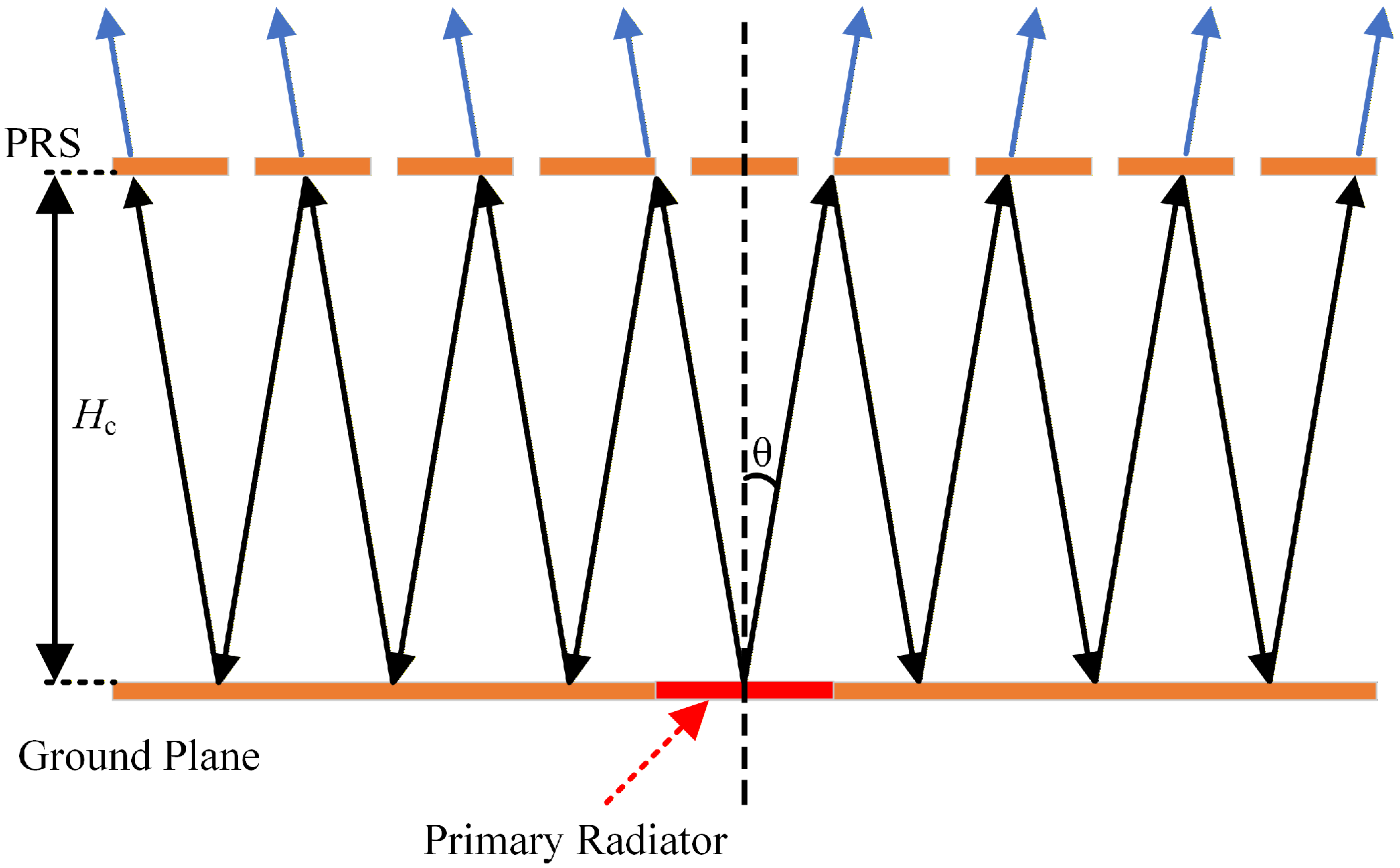
As shown in Figure 1, the typical F–P antenna mainly consists of a primary radiator, a resonant cavity, and a PRS. The primary radiator usually uses a patch, slot, dipole, or waveguide aperture, serving to provide stable electromagnetic excitation for the resonant cavity. Accordingly, it is generally expected to be simple, compact, and easy to feed. The PRS is positioned on the top of a F–P antenna and is usually composed of periodic metallic elements or metasurface structures, which partially reflect and transmit electromagnetic waves. The reflection coefficient and phase characteristics have a significant influence on the antenna gain, bandwidth, and operating frequency. In addition, the resonant cavity height Hc determines the phase accumulation of the waves inside the cavity, and is the key parameter for achieving in-phase superposition in the main boresight direction.
To achieve maximum gain in the normal direction (θ = 0°), the relationship of the cavity height Hc, the reflection phase of the PRS ΦPRS, and the reflection phase of the ground plane ΦGND is given by Equation (1), where ΦGND is taken as π, and ΦPRS is determined by the PRS geometry:
4 π H c λ   Φ P R S Φ G N D = 2 n π ,   n = 0 ,   1 ,   2   .
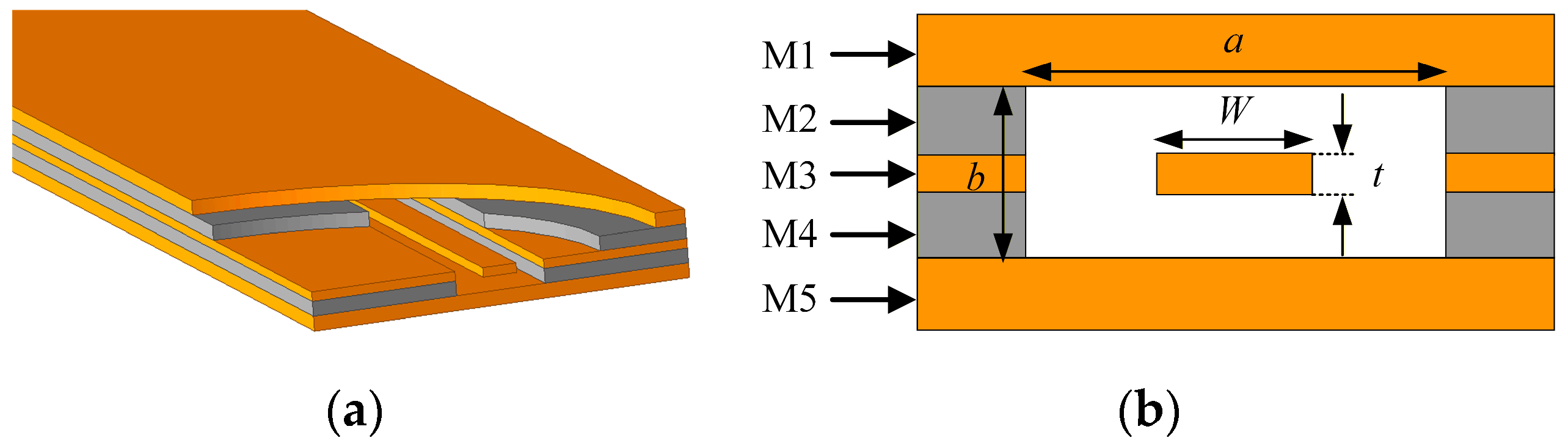
The conventional three-dimensional MISL structure is illustrated in Figure 2. It consists of five stacked metal layers. The circuit layer is located in M3 and surrounded by an air cavity. The corresponding regions of the air cavity are hollowed out in M2, M3, and M4. M1 and M5 are solid metal plates used to form a closed shielding cavity structure.
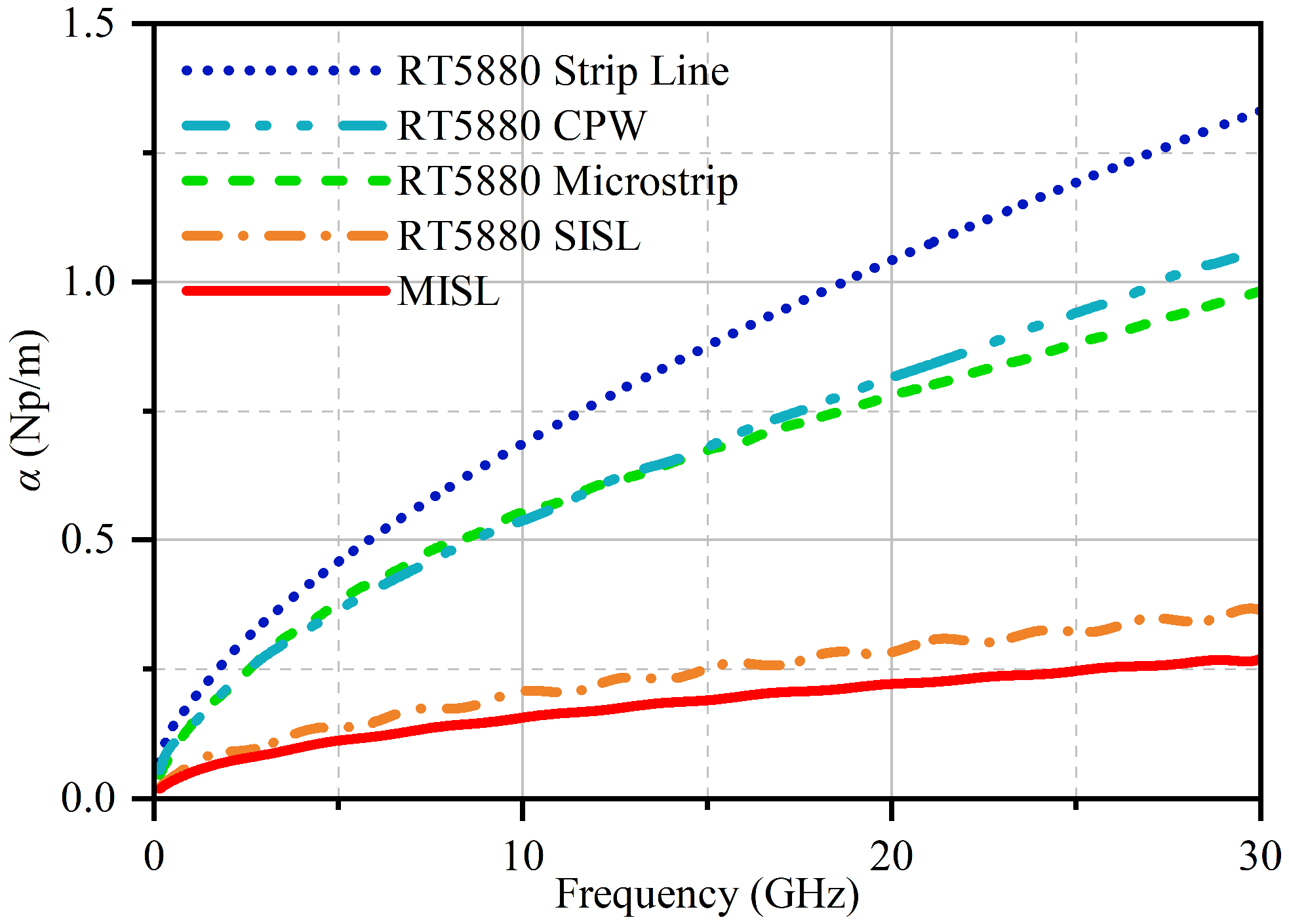
Compared with other types of transmission lines, MISL’s primary advantages lie in its simultaneous attainment of structural simplicity, extremely low loss, and good frequency stability. The attenuation constants of MISL, strip line, microstrip line, CPW, and SISL transmission lines implemented on the same dielectric substrate are simulated in Ansys HFSS, as shown in Figure 3. The simulation results show that MISL exhibits the lowest loss, and this advantage becomes increasingly obvious as frequency increases. These results indicate that the MISL structure delivers substantial high-frequency performance and is well-suited to practical millimeter-wave applications.

3. Antenna Design and Analysis

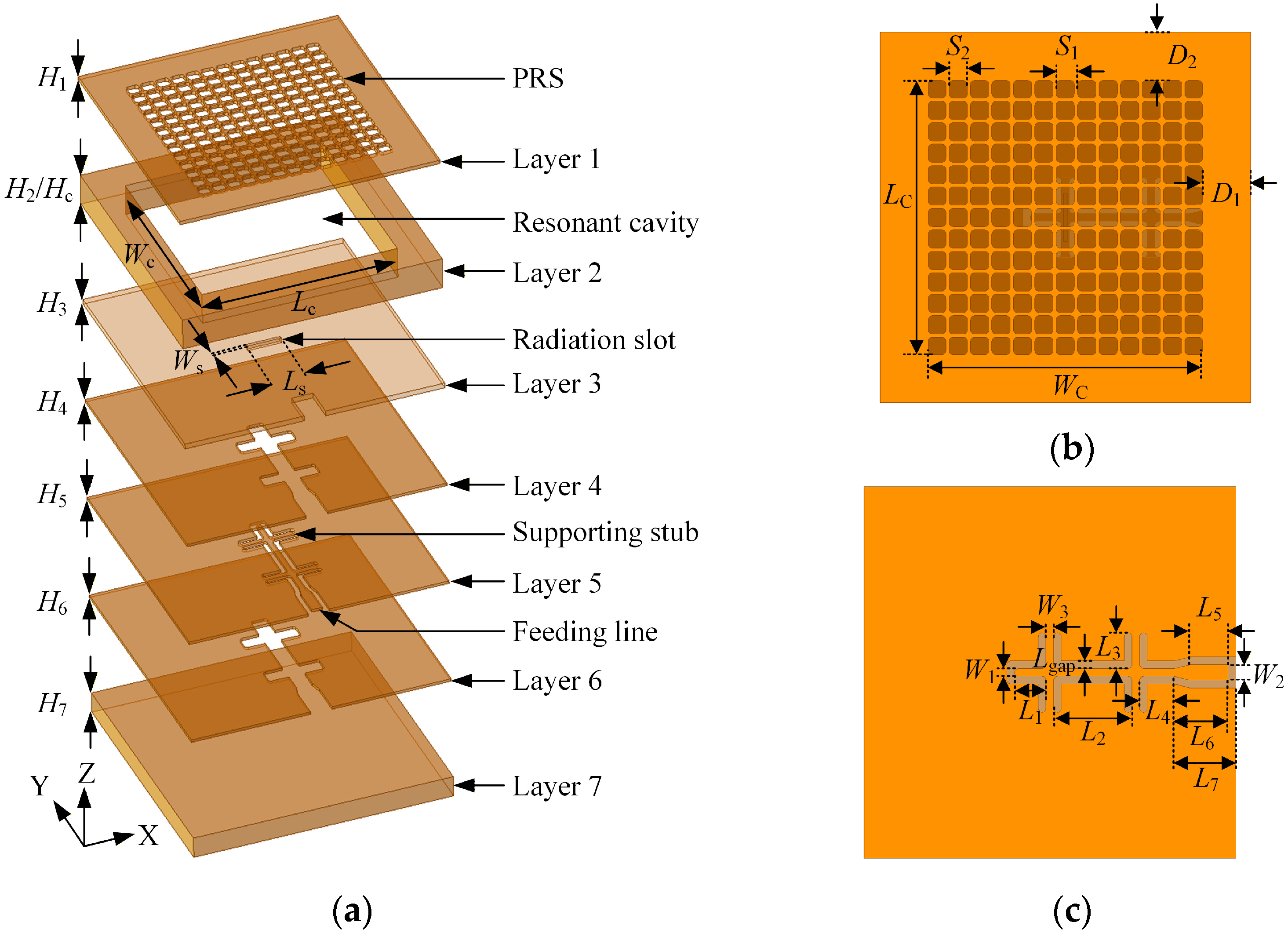
The proposed antenna utilizes a resonant cavity and a PRS to achieve high gain. It also adopts a MISL feed line to minimize the antenna loss by eliminating dielectric substrates. The overall antenna structure and corresponding parameters are shown in Figure 4 and Table 1.
As depicted in Figure 4a, the antenna comprises seven metal layers. The top two layers form the PRS and the resonant cavity. Layers 3 to 7 compose the primary radiator, consisting of a slot radiating element and a MISL feeding structure. The top PRS is a periodic grid structure that, together with the resonant cavity formed by Layer 2, controls the phase of the transmitting electromagnetic waves. Four threaded holes are placed on the sides of layers 2 and 7 for fixing a SMA connector. Outside the main antenna body, a metal wall featuring through-holes encircles. The seven layers are fixed in place with metal screws. The specific design process is described as follows.
A.
Design of the primary radiator in the MISL
The primary radiator adopts a simple and easy-to-implement slot antenna. It consists of a slot and a MISL feeding structure and is composed of Layers 3–7 in Figure 4. Layers 4 to 6 form the main body of the MISL feed network. Layer 5 consists of the main feed line and four short-ended stubs serving as a supporting structure. The surrounding 1 mm space around the feed line is completely hollowed out. Layers 4 and 6 are hollowed at the corresponding area of Layer 5 to form an air cavity to enable wave propagation. Layer 3 consists of a metal plate with a slot, which serves as the primary radiator for the F–P cavity. Layers 7 and 3 together form a closed metal cavity that constitutes the MISL feed structure.
Before integrating with the PRS and the resonant cavity, the standalone performance of the primary radiator is first investigated to verify its radiation characteristics. The simulated radiation patterns of the radiator at 24 GHz are shown in Figure 5. After optimization, the radiator achieved a simulated peak realized gain of 7.97 dBi at 24 GHz and a high radiation efficiency of 97.2%. To evaluate the effect of the feeding structure on radiation efficiency, a reference radiator employing the same slot radiator but fed by a microstrip line was also simulated. Its simulated realized gain and radiation efficiency were 6.2 dBi and 91.1%, which were lower than the 7.97 dBi and 97.2% obtained with the proposed MISL-fed radiator. This comparison verifies the advantage of the MISL structure in improving antenna radiation efficiency.
B.
Design of the Resonant Cavity and PRS
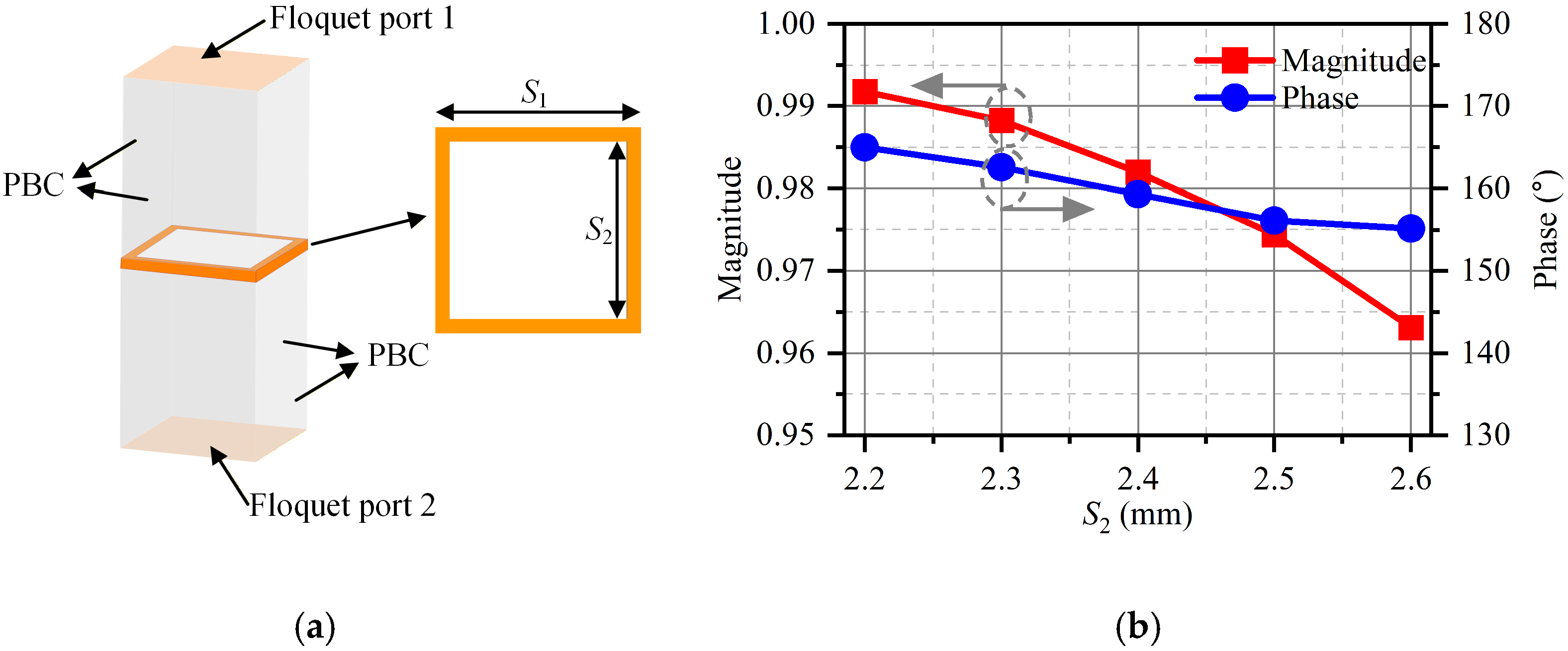
The periodic unit cell structure of the PRS formed by Layer 1 is shown in Figure 6a. The unit’s dimensions affect both the reflection magnitude and phase. The unit was simulated in Ansys HFSS using periodic boundary conditions (PBCs) and Floquet port excitations. Figure 6b presents the simulated reflection magnitude and phase versus S2 when S1 = 2.8 mm. Considering the trade-off among aperture, profile, and fabrication difficulty, S2 is set to 2.4 mm, with the ΦPRS of 159.3°. Substituting this value into Equation (1) yields the resonant cavity height Hc (H2) equal to 5.89 mm. The entire PRS employs a 11 × 11 unit cell structure.
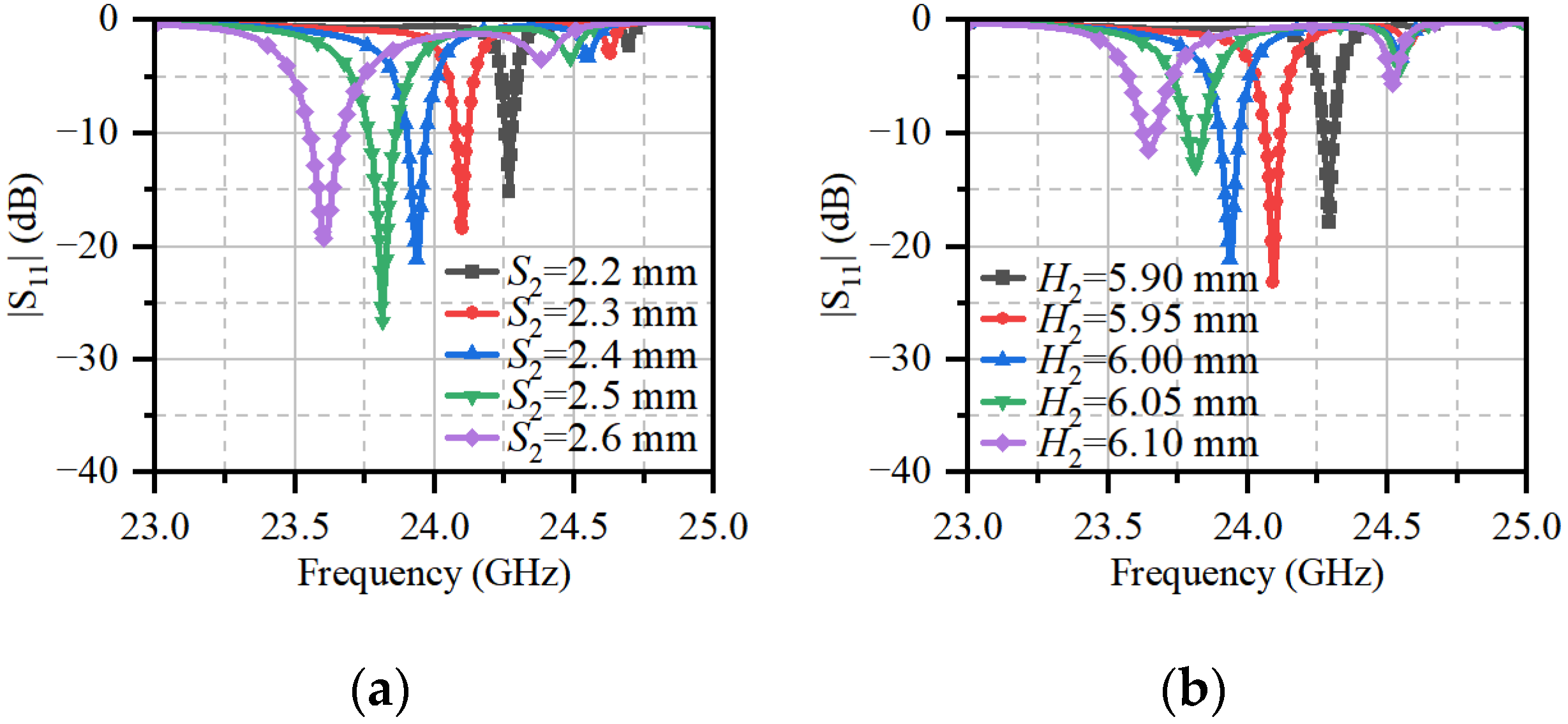
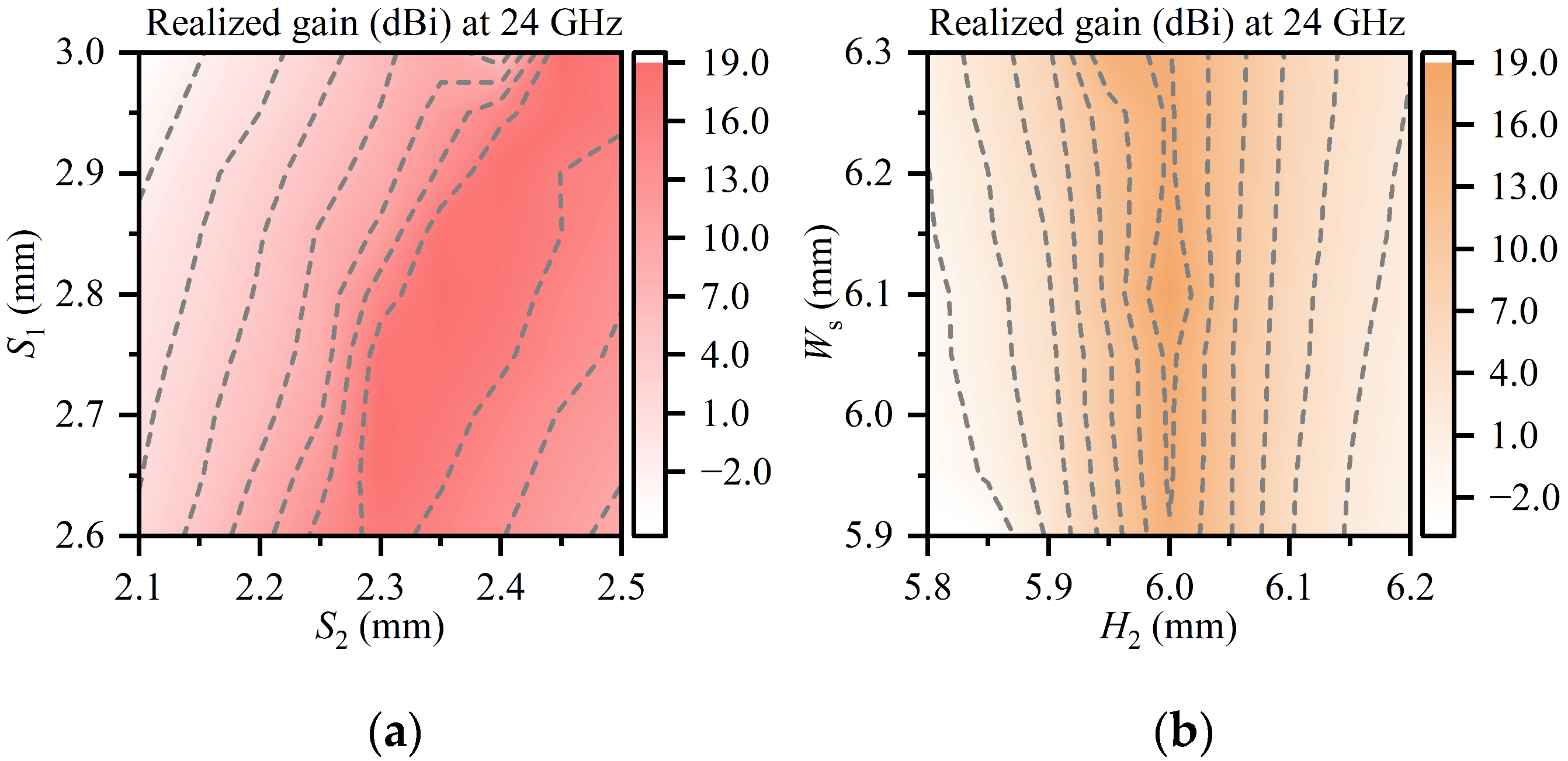
Then, the aforementioned PRS, resonant cavity, and radiator are optimized together. Compared with the other structural parameters, H2 and S2 exhibit relatively more pronounced effects on the antenna impedance matching and operating frequency. Figure 7 presents the simulated input reflection coefficient |S11| of the complete F–P antenna as a function of parameters H2 and S2, with all other parameters fixed at the values given in Table 1. The results indicate that variations in these parameters alter both the operating frequency and impedance matching of the antenna. The antenna’s operating frequency decreases with increasing H2 and S2. Figure 8 shows that the simulated realized gain of the antenna varies with parameters S1, S2, Ls, and H2, with all other parameters fixed at the values given in Table 1. The results indicate that parameters S1, S2, and H2 significantly affect the antenna’s gain. When S1 = 2.8 mm, S2 = 2.4 mm, and H2 = 6 mm, the antenna achieves optimal impedance matching and radiation performance. The resonant cavity and PRS in the antenna effectively improve antenna gain, achieving a maximum simulated realized gain of 18.96 dBi at 23.94 GHz—an improvement of approximately 11 dB compared to the primary radiator alone.

4. Experimental Results

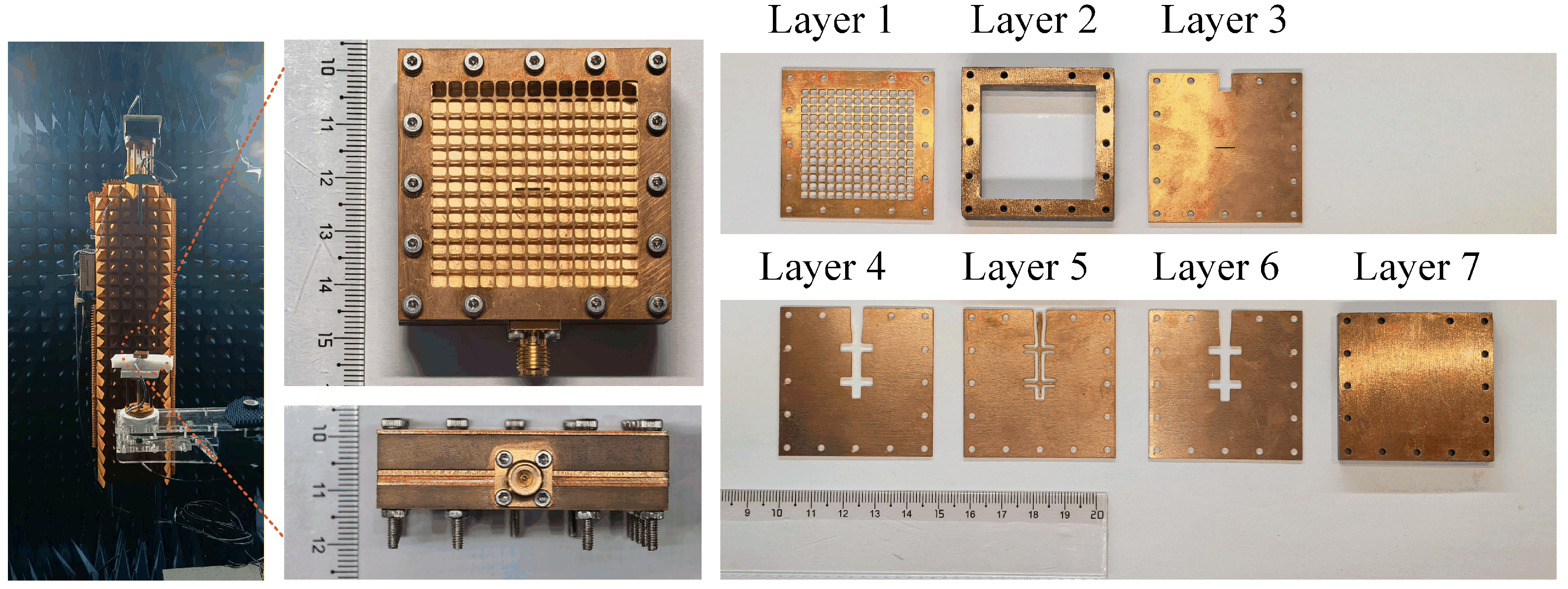
The proposed antenna was manufactured layer by layer using laser cutting technology. A 2.92 mm SMA connector soldered to the feed line in Layer 5 was used to connect a signal source, and the connector was secured in Layers 2 and 7 by screws. Finally, all layers were stacked in sequence and fastened together, as shown in Figure 9. The S-parameter was measured with a vector network analyzer (E8363C, Agilent Technologies, Santa Clara, CA, USA). The gain and radiation patterns were measured using the millimeter-wave near-field measurement system in the anechoic chamber depicted in Figure 9, and the far-field results were obtained from the near-field data through the embedded near-field to far-field transformation function of the measurement system.
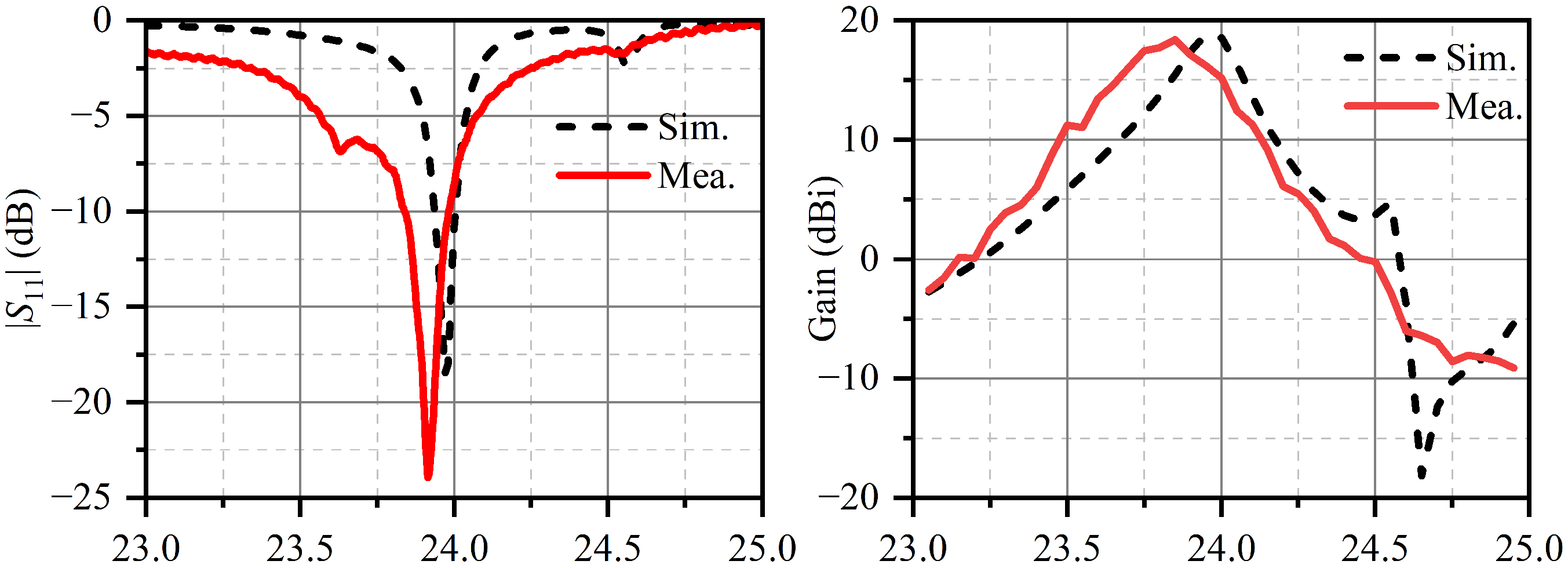
The simulated and measured |S11| results are presented in Figure 10. The measured resonant frequency is 23.85 GHz, which signifies good impedance matching. The simulated and measured realized gains as functions of frequency are also shown in Figure 10. The measured results indicate that the antenna achieves a measured peak realized gain of 18.4 dBi at 23.85 GHz, whereas the simulated peak realized gain is 18.96 dBi at 23.94 GHz. The simulated total efficiency of the proposed antenna is 90.6%, while the estimated measured total efficiency is 80.5%, calculated by the simulated directivity and the measured gain. Compared with the simulated result, the measured reflection coefficient exhibits a slightly broader bandwidth, and the measured gain is also slightly lower. These differences suggest the presence of additional practical losses in the fabrication antenna, which may lead to a lower actual total efficiency than predicted by simulation. Since a direct efficiency measurement was not available with the present experimental setup, the measured realized gain, together with the aperture efficiency, is used as supplementary validation of the antenna performance.
A slight frequency shift is observed between the simulated and measured results. The measured operating frequency shows a shift of about 0.09 GHz (0.38%) toward a lower frequency compared with the simulation. According to the analysis in Figure 7, dimensional deviations within ±0.05 mm have only a limited influence on the antenna performance. Since the fabrication provider specifies a machining tolerance within ±0.05 mm, the observed discrepancy between simulation and measurement is considered to be within an acceptable range. In addition to fabrication tolerances, assembly-related inaccuracies, such as slight layer misalignment during stacking, small cavity height deviations introduced during screw fastening, and soldering variations in the connector, may also contribute to the measured frequency shift and the slight gain difference.
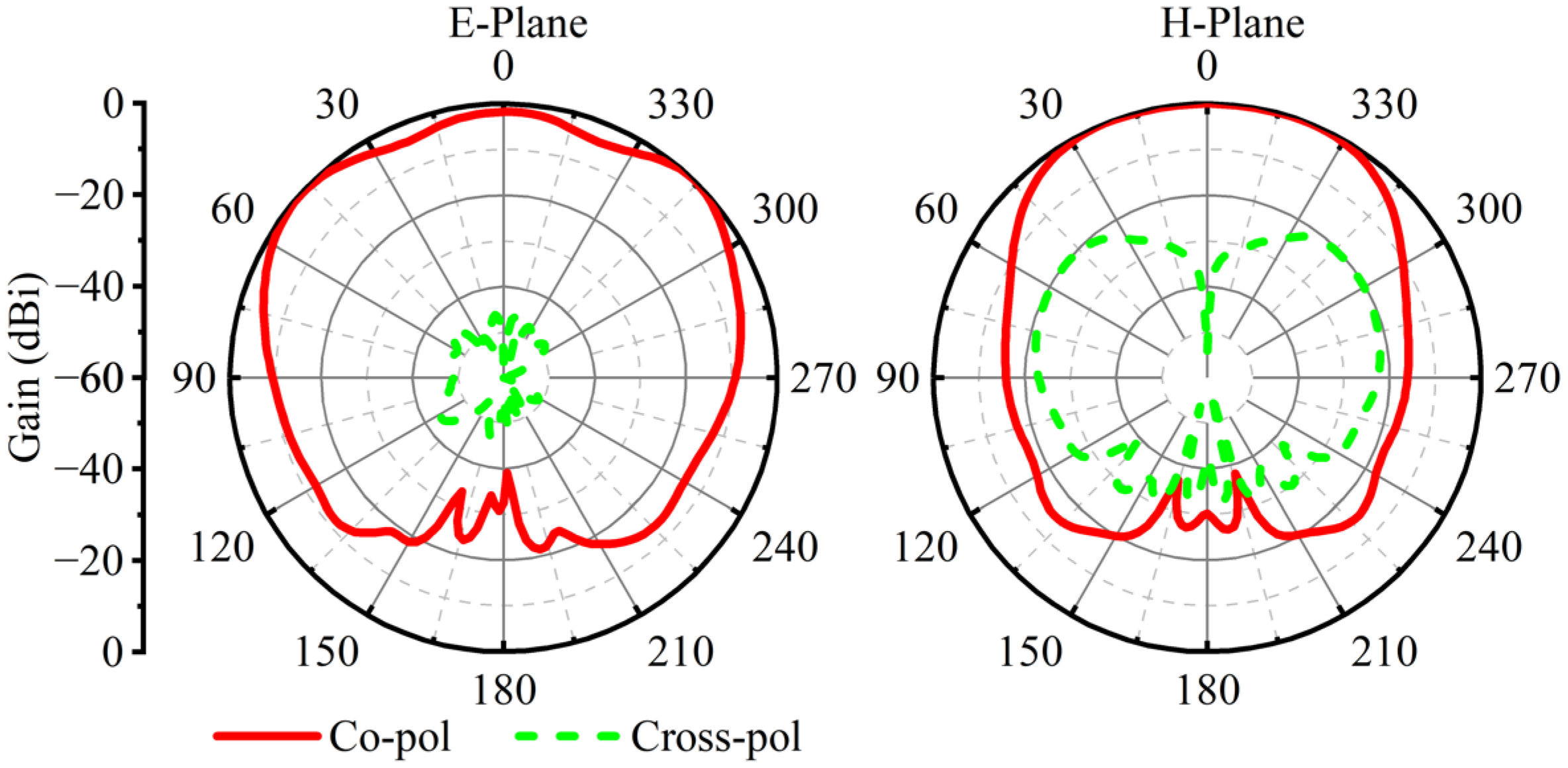
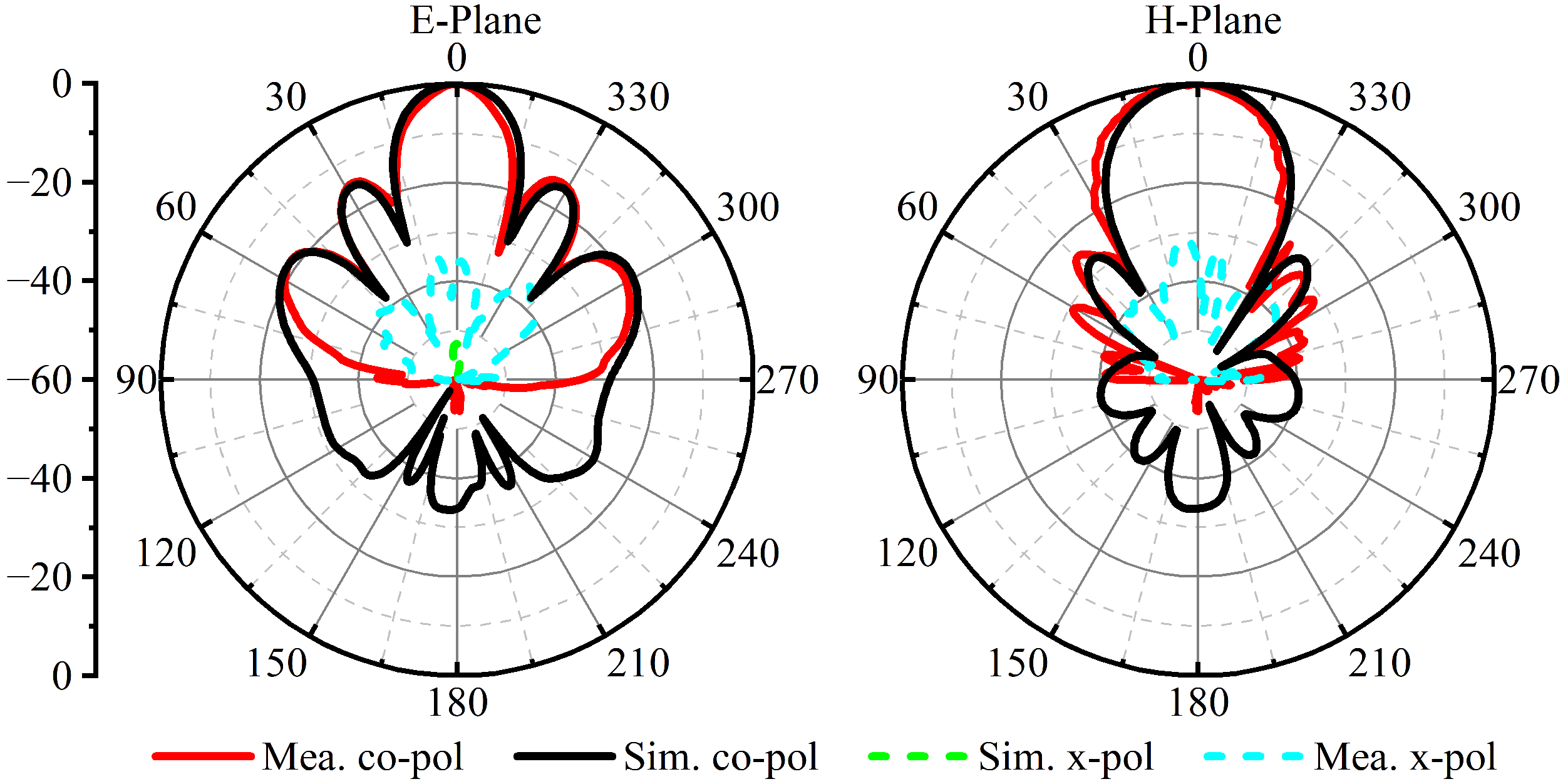
The simulated and measured normalized radiation patterns in the E- and H-planes of the proposed antenna at 23.85 GHz are compared in Figure 11, showing good agreement. The measured results confirm favorable radiation characteristics. The measured sidelobe levels are below −14.8 dB. The 3 dB beamwidths measured in the E- and H-planes are 12° and 24°, respectively. In addition, the co-polarization level is approximately 35 dB higher than the cross-polarization level in the boresight direction, indicating excellent polarization purity of the antenna. The measured aperture efficiency is 67.4%. The measured back radiation is lower than the simulated result. This difference may be partly attributed to the practical measurement configuration, since the antenna was mounted on a horizontal turntable during measurement, and the supporting structure may introduce additional shielding effects to the backward radiation. Moreover, practical fabrication and assembly factors that are not fully included in the ideal simulation model may also contribute to this difference.
Finally, a comparison of the proposed antenna with previous F–P antennas and millimeter-wave high-gain antennas is summarized in Table 2. Compared with the F–P antenna designed in [26,27], the proposed F–P antenna achieved higher gain at higher frequencies. Compared with the millimeter-wave band F–P antennas in [28,29,30], the proposed antenna has a simpler structure and higher aperture efficiency. The antenna in [29] achieves a very high gain by integrating a PRS structure with a Fresnel zone plate (FZP), yet its size is relatively large. Compared with other types of high-gain antennas in [31,32], the proposed antenna employs a simpler feeding structure and achieves a higher gain. As reported in [31], a SIW-fed patch-array antenna achieves a peak gain of 17.3 dBi at 28 GHz. The complex SIW feeding network introduces additional loss and increases design complexity. The grid-array antenna reported in [28] achieved a peak gain of 18.18 dBi and an aperture efficiency of 53.5%. The antenna is constructed from transparent materials, offering advantages in integrated applications. To summarize, the proposed antenna in this work achieves a relatively high gain with a compact size and simple structure, while maintaining high aperture efficiency.

5. Conclusions

This work presents an all-metal F–P antenna based on a MISL structure, featuring high gain, high power-handling, low loss, and low cost. The integrated F–P cavity with the PRS effectively enhances the antenna gain while maintaining a compact size. The use of purely metallic antenna construction not only eliminates the expensive, high-performance dielectric substrates required in conventional millimeter-wave applications, thereby reducing loss and cost, but also enhances the antenna’s power-handling capability. In addition, by adopting layered manufacturing and a stack assembly process, the processing complexity and cost are significantly reduced. Furthermore, the fabricated antenna exhibited excellent performance, achieving a peak gain of 18.4 dBi and an aperture efficiency of 67.4% at 23.85 GHz. These exceptional performance characteristics provide a reliable solution for future high-performance and low-cost millimeter-wave designs, offering promising application prospects in high-power MWPT scenarios.

Author Contributions

Conceptualization, X.P., Z.H. and C.L.; methodology, X.P., Z.H. and C.L.; investigation, L.Y.; writing—original draft preparation, X.P.; writing—review and editing, X.P., K.S. and Z.H. All authors have read and agreed to the published version of the manuscript.

Funding

This research was funded in part by the National Natural Science Foundation of China (NSFC) under grant numbers U22A2015 and JCKY.

Data Availability Statement

The original contributions presented in this study are included in the article. Further inquiries can be directed to the corresponding author.

Conflicts of Interest

The authors declare no conflicts of interest.

References

  1. Shinohara, N. History and Innovation of Wireless Power Transfer via Microwaves. IEEE J. Microw. 2021, 1, 218–228. [Google Scholar] [CrossRef]
  2. He, H.; Liao, C.; He, Z.; Yan, L.; Liu, C. High-Efficiency Ultrawideband Microwave Rectifier Based on Adaptive Harmonic Control. IEEE Trans. Microw. Theory Tech. 2025, 73, 10017–10027. [Google Scholar] [CrossRef]
  3. He, Q.; Liu, C. An enhanced microwave rectifying circuit using HSMS-282. Microw. Opt. Technol. Lett. 2009, 51, 1151–1153. [Google Scholar] [CrossRef]
  4. Liu, C. A New Open Access Journal for Microwave Technologies. Microwave 2025, 1, 1. [Google Scholar] [CrossRef]
  5. Zhou, Y.; Fan, R.; Liu, C. Low-Power Rectennas in Microwave Wireless Power Transmission. Microwave 2025, 1, 5. [Google Scholar] [CrossRef]
  6. Dan, Z.; He, Z.; Lin, H.; Liu, C. A Patch Rectenna with an Integrated Impedance Matching Network and a Harmonic Recycling Filter. IEEE Antennas Wirel. Propag. Lett. 2022, 21, 2085–2089. [Google Scholar] [CrossRef]
  7. Khan, T.A.; Heath, R.W. Wireless Power Transfer in Millimeter Wave Tactical Networks. IEEE Signal Process. Lett. 2017, 24, 1284–1287. [Google Scholar] [CrossRef]
  8. Hong, W.; Jiang, Z.; Yu, C.; Hou, H.; Wang, H.; Guo, C. The Role of Millimeter-Wave Technologies in 5G/6G Wireless Communications. IEEE J. Microw. 2020, 1, 101–122. [Google Scholar] [CrossRef]
  9. Roh, W.; Seol, J.-Y.; Park, J.; Lee, B.; Lee, J.; Kim, Y. Millimeter-wave Beamforming as an Enabling Technology for 5G Cellular Communications: Theoretical Feasibility and Prototype Results. IEEE Commun. Mag. 2014, 52, 106–113. [Google Scholar] [CrossRef]
  10. Melouki, N.; Hocini, A.; Denidni, T.A. High Gain and Wideband Fabry-Perot Resonator Antenna Based on a Compact Single PRS Layer. IEEE Access 2022, 10, 96526–96537. [Google Scholar] [CrossRef]
  11. Hei, Y.; Wang, M.; Wu, W.; Wu, Y. A Fabry-Perot Cavity Antenna with Non-Uniform Superstrate and EBG Ground for High Gain and High Aperture Efficiency. IEEE Access 2021, 9, 101239–101245. [Google Scholar] [CrossRef]
  12. Niaz, M.W.; Yin, Y.; Zheng, S.; Zhao, Z. Dual-Polarized Low Sidelobe Fabry–Pérot Antenna Using Tapered Partially Reflective Surface. Int. J. RF Microw. Comput. Aided Eng. 2020, 30, e22070. [Google Scholar] [CrossRef]
  13. Gomes, B.F.; Zaman, A.U.; Mejía-Salazar, J.R. All-Metallic-Metasurface-Based Wideband Dual Fabry–Perot Resonance Antenna Array with High Directivity and Polarization Purity. IEEE Trans. Antennas Propag. 2025, 73, 3692–3703. [Google Scholar] [CrossRef]
  14. Anelli, F.; Loconsole, A.M.; Francione, V.V.; Khan, M.I.; Prudenzano, F. Cost-Effective Fabry–Pérot Antenna via Conductive Inkjet and Additive Printing. IEEE Antennas Wirel. Propag. Lett. 2025, 24, 2182–2186. [Google Scholar] [CrossRef]
  15. Li, H.; Zhu, L. Study on Bandwidth Properties of EH1-Mode Microstrip Leaky-Wave Antenna for Broadside Radiation. IEEE Antennas Wirel. Propag. Lett. 2021, 20, 2028–2032. [Google Scholar] [CrossRef]
  16. Chen, C.; Huang, S.; Zhang, X.; Sim, C. Microstrip-Fed Circular Ring-Slot Antennas with Very Wideband Harmonic Suppression. IEEE Antennas Wirel. Propag. Lett. 2020, 19, 2295–2299. [Google Scholar] [CrossRef]
  17. Danuor, P.; Sulemana, A.-A.D.B.; Moon, J.-I.; Jung, Y.-B. High-Gain Endfire Array Antenna Using a Stripline-to-Radiating via Monopole for 5G mmWave. IEEE Antennas Wirel. Propag. Lett. 2025, 24, 3564–3569. [Google Scholar] [CrossRef]
  18. Taringou, F.; Dousset, D.; Bornemann, J.; Wu, K. Broadband CPW Feed for Millimeter-Wave SIW-Based Antipodal Linearly Tapered Slot Antennas. IEEE Trans. Antennas Propag. 2013, 61, 1756–1762. [Google Scholar] [CrossRef]
  19. Jiang, W.; Huang, K.; Liu, C. Ka-Band Dual-Frequency Single-Slot Antenna Based on Substrate Integrated Waveguide. IEEE Antennas Wirel. Propag. Lett. 2018, 17, 221–224. [Google Scholar] [CrossRef]
  20. Hu, H.-T.; Chan, K.F.; Chan, C.H. 60 GHz Fabry–Pérot Cavity Filtering Antenna Driven by an SIW-Fed Filtering Source. IEEE Trans. Antennas Propag. 2022, 70, 823–834. [Google Scholar] [CrossRef]
  21. Gandini, E.; Ettorre, M.; Sauleau, R.; Neto, A. Mutual Coupling Reduction of Fabry–Perot SIW Feeds Using a Double Partially Reflecting Pin-Made Grid Configuration. IEEE Antennas Wirel. Propag. Lett. 2011, 10, 647–650. [Google Scholar] [CrossRef]
  22. Yan, N.; Yuan, H.; Luo, Y.; Ma, K. A Wideband Millimeter-Wave Circularly Polarized Dielectric Resonator Antenna with a Stacked Strip Using SISL Technology for 5G Applications. IEEE Antennas Wirel. Propag. Lett. 2025, 24, 262–266. [Google Scholar] [CrossRef]
  23. Wang, H.; Wang, Y.; Ma, K. Three-Dimensional Low-Loss Power-Dividing Networks Based on Metal Integrated Suspended Line (MISL) for High Power Applications. IEEE Trans. Compon. Packag. Manuf. Technol. 2025, 15, 1479–1493. [Google Scholar] [CrossRef]
  24. Liu, R.; Ma, K.; Wu, Y.; Yan, N.; Wang, Y. A Metal Integrated Suspended Line Fed Bidirectional Radiation Slot Array for Millimeter-Wave Application. IEEE Trans. Antennas Propag. 2025, 73, 4104–4109. [Google Scholar] [CrossRef]
  25. Wu, Y.; Ma, K. Design of Dual-Band Bandpass Filters Based on Metal-Integrated Suspended Line Technology. IEEE Microw. Wirel. Technol. Lett. 2024, 34, 615–618. [Google Scholar] [CrossRef]
  26. Khang, G.G.; Kim, S.J.; Kim, D. High-Gain Fabry–Perot Cavity Antenna with an Artificial Magnetic Conductor Side Wall. IEEE Antennas Wirel. Propag. Lett. 2023, 22, 2245–2249. [Google Scholar] [CrossRef]
  27. Jamal, M.Y.; Li, M.; Yeung, K.L.; Li, X.; Jiang, L.; Itoh, T. A Low-Profile Fabry–Pérot Cavity Antenna Using Anisotropic Metasurface. IEEE Antennas Wirel. Propag. Lett. 2022, 21, 356–360. [Google Scholar] [CrossRef]
  28. Goudarzi, A.; Honari, M.M.; Mirzavand, R. A Millimeter-Wave Fabry–Perot Cavity Antenna with Unidirectional Beam Scanning Capability for 5G Applications. IEEE Trans. Antennas Propag. 2022, 70, 1787–1796. [Google Scholar] [CrossRef]
  29. Zhang, J.; Wong, H. A High-Gain Millimeter-Wave Fabry–Perot Cavity Antenna with Phase Correction on a Meta-Ground Reflective Surface. IEEE Trans. Antennas Propag. 2024, 72, 6187–6194. [Google Scholar] [CrossRef]
  30. Hosseini, A.; Capolino, F.; De Flaviis, F. Gain Enhancement of a V-Band Antenna Using a Fabry-Pérot Cavity with a Self-Sustained All-Metal Cap with FSS. IEEE Trans. Antennas Propag. 2015, 63, 909–921. [Google Scholar] [CrossRef]
  31. Zhang, T.; Lian, R.; Wu, D.; Li, Y.; Zhang, J. A Broadband High-Gain Patch Antenna Array for 5G Millimeter-Wave Applications. IEEE Antennas Wirel. Propag. Lett. 2024, 24, 803–807. [Google Scholar] [CrossRef]
  32. An, K.; Sun, P.; Deng, Y.; Chen, A. A Large-Scale High-Gain Transparent Grid Array Antenna for Millimeter-Wave Communication. IEEE Antennas Wirel. Propag. Lett. 2024, 23, 1598–1602. [Google Scholar] [CrossRef]
Figure 1. Schematic of a typical Fabry–Perot antenna.
Microwave 02 00010 g001
Figure 2. Configuration of the metal-integrated suspended line. (a) 3-D view. (b) Cross-section view.
Microwave 02 00010 g002
Figure 3. The attenuation constant of different transmission lines varies with frequency.
Microwave 02 00010 g003
Figure 4. Configuration of the proposed antenna. (a) 3-D view; (b) top view of Layer 1; (c) top view of Layer 5.
Microwave 02 00010 g004
Figure 5. Simulated normalized radiation patterns of the MISL-based primary radiator at 24 GHz.
Microwave 02 00010 g005
Figure 6. Simulation setup and results of the PRS at 24 GHz. (a) Unit cell geometry. (b) Simulated reflection magnitude and phase versus S2.
Microwave 02 00010 g006
Figure 7. Simulated input reflection coefficient |S11| of the proposed F–P antenna for different values of (a) S2 and (b) H2.
Microwave 02 00010 g007
Figure 8. Simulated realized gain of the proposed antenna varies with (a) S1 and S2, and (b) H2 and Ls.
Microwave 02 00010 g008
Figure 9. Measurement setup and fabrication of the proposed F–P antenna.
Microwave 02 00010 g009
Figure 10. Simulated and measured input reflection coefficient |S11| and realized gain vary with frequencies in the proposed F–P antenna.
Microwave 02 00010 g010
Figure 11. Simulated and measured E-Plane and H-Plane normalized radiation patterns of the proposed F–P antenna at 23.85 GHz.
Microwave 02 00010 g011
Table 1. Parameters of the Fabry–Perot antenna.
ParameterValue (mm)ParameterValue (mm)ParameterValue (mm)
H10.7WS0.5L14.1
H2/HC6.0LS6.1L210.2
H31.0D16.3L35.2
H40.5D26.3L44.5
H50.5S12.8L55.0
H60.5S22.4L67.0
H74.0W11.0L78.0
WC35.8W22.0Lgap1.0
LC35.8W31.0
Table 2. Comparison with previous high-gain antennas.
Ref.Ant. TypeCharacteristicFreq. (GHz)Aper. (λ03)Bandwidth (%)Gain. (dBi)Aper. Eff. (%)
[26]Fabry–PerotHigh-gain53.3 × 1.7 × 0.62012.629
[27]Fabry–PerotLow-profile124 × 4 × 0.125516.27-
[28]Fabry–PerotBeam-scanning275.3 × 4.5 × 0.54-14.512
[29]Fabry–PerotHigh-gain287.6 × 7.6 × 1.39.62435
[30]Fabry–PerotHigh-gain604.6 × 3.7 × 0.35.515.632
[31]Patch arrayWideband283.74 × 4.84 × 0.162017.356.3
[32]Grid arrayHigh-gain255.4 × 5.1 × 0.047.218.1853.5
This WorkFabry–PerotHigh-gain23.852.86 × 2.86 × 1.060.618.467.4
Disclaimer/Publisher’s Note: The statements, opinions and data contained in all publications are solely those of the individual author(s) and contributor(s) and not of MDPI and/or the editor(s). MDPI and/or the editor(s) disclaim responsibility for any injury to people or property resulting from any ideas, methods, instructions or products referred to in the content.