1. Introduction
Understanding the relations between knowledge and information, whether by juxtaposition or conflation, is inherently complex. Knowledge and information are intricate, intangible concepts that necessitate their theoretical and methodological contexts to be grasped. This enquiry is fundamentally predicated upon a reflexive awareness of our theoretical standpoint from which the analysis proceeds. Consequently, etymological, philosophical, and scientific perspectives within their specific approaches and under our original framework, synthesis of definitions, classifications and practical standpoints, essentially structure the following elaboration on the problem of knowledge, information, their forms, and related challenges.
From an etymological perspective, the ancient Greeks had a rich vocabulary for different aspects of “knowledge”, while today it is most often related to the words gnosis and epistêmê. Gnosis is a noun form with the meaning “a knowing, knowledge; investigation; a being known”, derived from gnō-, a Proto-Indo-European root that means “to know”, with the corresponding verb ginóskó, meaning “to come to know”, “to recognise”, or “to perceive.” Also, the Latin form gnoscere and the English word “know” share their root [
1]. The second Greek word epistêmê means “knowledge, acquaintance with (something), skill, experience”, particularly referring to scientific knowledge. It is derived from the verb epistasthai, which means “to know how to do, understand”, and its literal meaning suggests a sense of “standing over” or “mastering” a subject [
2,
3].
Ergo, both terms are often viewed as expressing complementary dimensions of knowledge. Gnosis typically highlights the experiential or intuitive process of knowing, while episteme emphasises the justified, theoretical outcome that underpins scientific understanding. Other Greek terms, such as sophia (“skill, wisdom, philosophy”) and nous (“mind, intelligence”), are also worth mentioning in denoting specific types of faculty of knowledge [
4,
5,
6].
Etymologically, “information” derives from the Latin verb informāre, which denotes the act of imparting structure or delineation. Beyond its literal sense of giving form, the term conveys the figurative notion of pedagogical cultivation—to train, instruct, or educate. Consequently, the noun informātiōnem historically functioned as a conceptual bridge between the abstract “outline” or “concept” and the dynamic “arrangement” or “instruction” required to transmit ideas [
7,
8]. While the etymological root of “information” is Latin, its conceptual lineage parallels themes in ancient Greek philosophy [
9]. Though the Greeks lacked a direct lexical equivalent, related concepts were expressed through terms such as eidos (form), logos (word, reason), and sēma (sign, symbol), collectively capturing the various facets embedded in the word’s Latin origins [
10].
Remarkably, the contemporary understanding of “information” is characterised by a semantic duality, operating simultaneously in its etymological and modern senses. For example, the core medieval meaning of “information” as “knowledge communicated concerning a particular topic” persists; modern technology and information theory have caused the term to acquire specialised, abstract senses, specifically referencing data, signals, and computing [
7,
9].
Etymological emphases directly mirror the developmental vectors observed in philosophical and scientific thought concerning knowledge and information. The theorisation of knowledge has laid the philosophical foundations, essentially forming its ontology (forms of being). The delineation of knowledge discloses its aporetic nature, encompassing diverse ideal entities, faculties and mental states related to proposition, justification, understanding and representation regarding extant and hypothetical entities. This understanding extends from recognising something or experiential familiarity to the collective, preserved learning of civilisations, even extending to intuitions or speculative conjectures. Knowledge has a phenomenal nature, consisting of justified constructs situated as structures of individual, social, transcendental consciousness (such as beliefs, ideas, facts, images and concepts) that may be regarded as true [
10]. This conceptualisation has been extensively elaborated upon across centuries by philosophers, thinkers and scientists, specifically through the definition of the nature, criteria and methods by which knowledge can be obtained. Consequently, these historical discourses have fundamentally configured our and all possible understandings of knowledge. Moreover, the Greek origins not only established epistemology, the branch analysing the nature, limits and reliability of knowledge [
11], but has also shaped scientific methodologies and knowledge criteria for centuries.
Knowledge was explicitly explored in ancient philosophy (e.g., Plato, Aristotle and the sophists), primarily in relation to ontological themes. Since Plato [
12], knowledge (episteme) has been contrasted with opinion or belief (doxa). This dichotomy opposes profound, complete knowledge, coinciding with its object, to superficial, fragmentary knowledge, deemed as delusion, that deviates from genuine reality. Plato argued that genuine knowledge is unchanging, certain, infallible and stable. In contrast, belief, or opinion, is inherently fallible and unstable. Even a “true opinion” lacks the rational foundation required for security, succeeding by chance or existing without a complete understanding [
13]. Therefore, scepticism and dialectics are necessary methods for exposing contradictions in cognition and acquiring what can be called knowledge. Plato maintained that for a belief to qualify as knowledge, it needs “logos”, or justification. A true belief must be clearly articulated, with a coherent explanation, linked to its underlying reasons or principles, supported by evidence and withstands scrutiny [
14,
15].
Consequently, an object of knowledge is necessity, implying it pertains to invariable entities or necessary truths. For Aristotle [
16], genuine scientific knowledge (episteme) focuses on what cannot be otherwise. He argued that this knowledge originates from demonstrations derived from first principles (universal and proper) that are indispensable, accurate, primary, direct and elucidate the cause [
17]. Therefore, for Aristotle, Plato, and later for Kant, justification, ultimately shaping scientific knowledge characteristics, is based on axioms, foundations of science, and self-evident truths, theses, definitions, hypotheses and postulates [
17,
18].
Classical, dating back to the seventeenth century, and contemporary philosophy address a range of knowledge issues, generally following antique traditions. Epistemology, in particular, has been developing unique systems aiming to define the ultimate foundations of knowledge and cognition, and methodologies for acquiring knowledge in both theoretical and applied sciences, alongside the qualities unique to each. Particularly important in the context of our research is the two-type distinction in understanding and analysing the problems of knowledge. This perspective separates classical and non-classical approaches and strategies, which define types of knowledge, criteria, epistemic status, and how it can be obtained [
11].
Classical epistemology remains relevant today as the ideal model of knowledge by evolving the considerations posed by Plato and Aristotle. It critically examines the opinion-knowledge relationship, distinguishes image from reality and justifies these differentiations. Central scrutinies, from Descartes [
19] to Popper [
20] and contemporary thinkers, have thus been established to ascertain the veracity of knowledge and critique both ideal and current models.
Its prime issue is the justification of the foundational ideal settings of knowledge—the established standards, methods and norms for what qualifies as knowledge. This is critical because knowledge fundamentally derives from diverse origins (sources), including experience (e.g., Locke [
21]), reason (e.g., Kant [
18]), axioms (e.g., Descartes [
19]), science (e.g., Mach [
22]), and logic (e.g., Frege [
23]), among others, thus requiring specific epistemological programs.
The classical model also refers to the understanding of knowledge as a construct describing reality presented by two epistemic orientations [
17]. It implies the objective orientation, Aristotle’s namesake tradition, that seeks to know the object itself, the correspondence between knowledge and the object. While the subjective orientation or Socratic tradition, a priori, cognises through reflection. Therefore, philsophical (scientific) enquiry necessitates reflection on the fundamental principles used. Ultimately, any analysis of knowledge confronts what it might reflect—whether an empirical object or a rational construction [
18]—revealing the awareness and the level of consistency and appropriateness of implied epistemologies.
Undoubtly, a classical view positions science as the most trustworthy source of knowledge, suggesting scientific knowledge represents the highest form (e.g., Mach [
22]) and thereby placing the responsibility for reliability squarely on scientific methods (e.g., Hahn, Neurath and Carnap [
24]).
Thereby, the evolution of scientific knowledge necessitates a rethinking of problems related to valid knowledge production methods, forging new connections between epistemology, other areas of philosophy, culture, society and science [
25]. The emerging non-classical (or post-classical) epistemology challenges prior assumptions, emphasising relativism, conditional trust, equivalence of different standards, pluralism of criteria, open discussion, rejection of fundamentalism and subject-centrism and a transdisciplinary understanding of consciousness. This shift is fundamentally reshaping the relationship between knowledge theory and the sciences, leading to new demands and expectations for knowledge itself, including awareness of paradigm-specific epistemologies specific to each discipline [
26].
Notably, non-classical epistemology is more tolerant of the juxtaposition between information and knowledge, often allowing or not objecting to their interchangeability. The reasons for this position are related to the fact that contemporary understanding of information has predominantly evolved through a scientific perspective of logic, communication and cybernetics, that is, within the flourishing non-classical epistemology. Generally, the concept of information is considered highly useful for representing an ideal message that reduces or eliminates uncertainties in evaluating and choosing among many alternatives [
27].
Situated within the context of knowing in general, information and its acquisition are forms of cognition; specifically, abstract conceptualisations are reified into operationalised meanings within modern scientific paradigms. Among the seminal frameworks shaping the concept are information as a quantified message (the number of distinguishable and transmittable symbols), contributed by Ralph Hartley [
28], followed by Shannon’s [
29] introduction of the bit as the basic unit. Norbert Wiener consolidated the view of information as something that has the power to inform. Rather than juxtaposing information to knowledge, he compared it to matter and energy, emphasising its unique capacity for transmission and processing, irrespective of its physical medium [
30]. Altogether, they laid the foundations not only for the development of information theory and cybernetics but also for how we currently understand and apply the term “information” across various disciplines and extrapolate it to multiple contexts.
As articulated by Chernavsky [
27], information is fundamentally contingent upon material carriers, appearing as coded messages such as genetic sequences or neural impulses. This biocomputational paradigm serves as the prototype, establishing the nexus between its conceptual system and knowledge theory, operating with modern technological architectures. This conceptual extrapolation finds parallels in bibliometrics and knowledge management, for example, where the concept of the “knowledge carrier” was introduced to define the mediating entities that facilitate the transfer of knowledge from its source to a functional target [
31]. This cross-disciplinary continuity is further substantiated by the study of biological information systems, which code, condense and carry data to govern developmental processes and functioning. The link between the conceptual apparatus of information and knowledge becomes more solid, particularly when examining the evolution of these biological information structures into self-emergent cognitive systems that co-create signals from the environment and the internal structures of organisms [
32,
33].
Cognitive science significantly contributed to establishing information as a unit of highly developed, organised cognitive systems (e.g., perception, psyche, consciousness, artificial intelligence). These systems use the cognitive information they create to control both their environment and their own states [
34]. Cognitive science together with contemporary epistemologies (e.g., genetic, evolutionary, constructive, and realist) successfully experiment with extended understandings of cognition as a structured sequence of stages and operations—hypothetical units that process input information to generate a response and output and model processes like encoding, perception, memory retrieval, concept formation and judgment [
35,
36].
Contemporary conceptualisations of artificial neural networks as “dynamic processors” underscore information as a series of implicit processes embedded within biological and organic, physical or advanced and synthetic technological systems. This implicit information is subsequently perceived and systematised into domain-specific symbolic codes, which are then decoded and integrated into higher-order knowledge structures that are readable and understandable for the designated target audience [
37].
Despite the functional interaction between conceptual systems of information and knowledge, they are ideal entities with different ontologies, and, by nature, belong to different conceptual realms; their core attributes delineate the boundary between them. Information is meaning-dependent, random and unpredictable; particularly, semantic information is well-formed data that conveys meaningful messages if they also qualify as contingently truthful. It is objective and measurable in a manner suitable for scientific and mathematical analysis encompassing quantity, digitalisation and capacity [
29,
38,
39,
40]. Synthesising the gestalt of knowledge and information relations, knowledge is an expanded process that involves the understanding of implicit and coded messages. While information represents data with the potency to be meaningful and veridical, then, knowledge is its teleological interpretation and functional outcome. In this sense, knowledge represents an epistemic state whose meaning transcends mere quantitative distributions and statistical arrangements [
39].
Nevertheless, in the contemporary landscape, characterised by an unprecedented demand for linguistic toolsets regarding cognition, the conceptual boundaries between knowledge and information are increasingly fluid. This semantic blurring is driven by pragmatic reasons.
Rapid technological development has strongly intertwined the information landscape with the general knowledge context, shaping “new” existential spaces of social cognition. This has polysemised the modern usage of “information”. Although “knowledge” largely retains its classical Greek foundations, it has adapted to the digital age by functioning as a bridge between data and meaning that organises the “data of humanity”, the vast and complex experiences, and transforms its latent potency into coherent, structured understanding.
In communication and interaction, often also academic, “knowledge” divests of its denotation as clear, defined propositions. Rather than representing a pure conceptualisation of what is regarded as fact, truth or necessity, it functions as a fluid epistemic construct, often indistinguishable from symbolic exchange and data that constitute social cognition. If knowledge, as an ideal entity, establishes a verifiable relation to reality, thus generating varied epistemic claims, then information operates primarily as a diversity of extensive propositions [
29]. Information is defined less by its epistemological properties [
41] than by its role as a carrier or medium characterised by high quantity, chaotic variety, implicit character and computational probability. As a result, knowledge assumes the functional character of information as a message, whose content implies a multitude of epistemic modalities and, in principle, requires only ecological validity. This shift is accelerated by the digital era, which seemingly determines the speed, efficiency and conceptual depth of communication and cognition [
42,
43].
Scholars emphasise the aporia surrounding the definitions of knowledge and information, arguing that a clear and universal hierarchy of knowledge and information does not exist [
44,
45]. Indeed, we cannot draw a definite boundary between information and knowledge because their relationship depends on the specific dimension in which they are placed, the conceptual frameworks and philosophical (scientific) stance employed. For example, the polysemous nature of the informational landscape and the “consumption” paradigm often leads information to be treated as a good rather than a conceptual entity [
40]. The issue is particularly acute in our information society, where the relentless demand for being informed leads to a superficiality that erodes the boundaries between “quantitative and qualitative” cognition. While social consciousness is saturated with “information” (vast data, carriers, volumes), this abundance does not equate to “knowledge” in the sense of truth, meaning and wisdom [
46].
A critical failure occurs when the medium or carrier of information is conflated with the validity of knowledge itself and origins. In this context, information is transmitted, whereas genuine knowledge requires a knowing subject to engage in a deliberate act of understanding and interpretation [
47]. This distinction is increasingly important in the era of artificial intelligence, where algorithmic systems generate well-formed information without epistemic responsibility and depth [
48]. Digital media are at the hub of social cognition, and in scientific enquiry, they are used to manage the visibility of scientific knowledge. However, they often become more influential than the original scientific source, thereby blurring the concept of what a knowledge source is [
49].
Yet the absence of scholarly terminological consensus regarding information and knowledge relations is additionally exacerbated in social cognition. While social representations rely on the focal distinction between “data with meaning” for information and “justified true belief” for knowledge [
45], these boundaries are often blurred or entirely ignored, leading to misconceptions about cognition and its entities.
The paper addresses this stumbling block, particularly how the conceptual juxtaposition of knowledge and information is manifested in contemporary academic and popular cognition. Whether various means—ranging from traditional scientific knowledge sources to popular science and social media—exemplify themselves as genuine knowledge sources (embodying validated forms and carriers) or rather as informational mediums and channels remains to be determined. Currently, the scientific landscape presents a significant gap in knowledge concerning the general images of these sources: how they are perceived by social consciousness and how their “conceptual constructs” are shaped within the subjective, social and philosophical realms of cognition.
Extensive research incorporating original theoretical, methodological and empirical perspectives was undertaken to address this matter. This article is part of this broader research project, building on a series of prior publications [
50,
51,
52,
53]. It completes this series by providing a comprehensive and structured analysis of the targeted sources and their holistic images, thereby reflecting current tendencies in both academic and social cognition.
Following this introduction, the paper is organised into five subsequent sections. The
Section 2 clarifies the terminological use of the concept “source” (specifically, the “knowledge source”) and situates it within the context of the means of cognition and the origins of knowledge. It further outlines the classification framework employed in this study and provides a brief compilation of the scientific, social and common-sense perceptions of the targeted academic and popular sources, characterising them in terms of content, function and pragmatics. The
Section 3 and
Section 4 delineate the theoretical and methodological crux of the study, wherein we propose an original theory and semantic methodology developed to capture and analyse the assessments of university academics, the primary expert users of these conduits. In the
Section 5, we conduct an empirical analysis of the epistemological profiles of the targeted sources, involving categorical and semantic interpretations and reflect the conceptual constructs of these sources within the delineated problem of knowledge and information. Finally, the
Section 6 synthesises these findings, offering critical insights and theoretical implications for future scholarly discourse.
2. Academic and Popular Sources
The term “knowledge source” has various conceptual facets for its understanding. Two major approaches treat the term differently. Philosophical, epistemological and scientific landscapes traditionally understand the source as the origin of knowledge (which is further not reducible). Another scientifically operational, methodological and common-sense (general everyday usage) approach treats it as “means of cognition”.
According to the earliest understanding, before the classical Greek philosophical idea, the origin of knowledge was logos as a cosmic realm. Then, Plato distinguished the origins of how true ideas and external reality are cognised; he thought of reason (dialectics), memory (anamnesis) and transcendental ideal entities (forms) as sources of knowledge (episteme), while senses are rather a source of opinion (doxa) than knowledge. While Socrates acknowledged foremost introspection [
12,
13,
14,
15]. Aristotle advanced Plato’s thought in different directions, considering also senses and perception (experience) as a fundamental source of knowledge, specifically distinguished induction, deduction and justification (as means of reason) [
16,
17]. This classical framework also shaped the further elaboration of the origins of knowledge, deeper structuring reason, distinguishing logic [
23], categories and axioms [
18,
19] as a priori forms, and science [
22].
In general, modern epistemological classifications are grounded on this fundamental philosophical framework. Essential additions include, specifically, focus on categories of consciousness, such as intuition (e.g., Bergson [
54]). Also, particular emphasis is placed on means of science and social cognition, such as testimony, as recognised epistemic sources, together with perception, memory, consciousness and reason, in contemporary classifications [
55]. However, there are debates about testimony, whether it is an original source or derivative (for example, reducible to perception or reason).
Testimony (or testimonial knowledge) is the knowledge source that the current paper focuses on. It is, in general understanding, “knowledge from others”; the source of social knowledge and belief and its transmission, whose true value depends on the source status of having justified belief or reliable reports (statement is a reliable indicator of true), and the target source (receiver) are perception and reason (to determine the source credibility) [
55,
56]. Testimony includes informal testimony, such as general, conversational and folk [
57], and formal testimony, such as structured delivery of reliable content by an authority, expert or science [
58]. Testimony is, essentially, a communicative act of social experience, knowledge and scientific expertise [
56]. Particularly, the study focuses on testimony in the explicit knowledge form. Explicit knowledge is articulated knowledge, expressed in formal, systematic language [
59], in order to be recorded, stored and transmitted, and manifested via “external sources” in their various formats.
The framework of “external knowledge sources” represents scientifically operational and common-sense application in the social cognition landscape to designate not the origins of knowledge (epistemic sources), but rather “means of cognition”. In this context, these sources function as conduits, through which diverse forms of content (data, information and knowledge) are transmitted and accessed.
At the operational level, external knowledge sources (also referred to as information sources [
60]) are categorised according to their scientific, non-scientific or communicative contexts. These are classified through the lens of information science as primary, secondary or tertiary sources [
61], or through the functional typologies of formal and informal [
62,
63], and as traditional versus digital media. Another concept of the “existing source”, a term synonymous with “knowledge-in-stock”, represents recorded and stored expertise and data available for retrieval [
31]. Bråten and Ferguson [
64] expand the definition by characterising external knowledge sources as both theory-based and experientially derived knowledge of instruction; whether individually or collectively held, this knowledge is memorised, organised and reproduced in diverse formats for cognition.
Within this framework, external knowledge sources are conceptualised as comprising the following general forms: formalised (theory-based), digital, popular, social media and experimental (research-based). Formalised sources encompass explicit, authoritative and institutionalised content, such as the epistemic authority of the educator [
60,
65,
66], and structured sources of expertise (scientific), including monographs, peer-reviewed articles, handbooks and professional literature [
67]. Acknowledged scientific websites and databases (e.g., Scopus, Web of Science), as well as educational platforms, function as primary mediums of this formalised knowledge [
68]. Social, popular and professional knowledge is mediated through digital platforms such as LinkedIn, X (formerly Twitter), Telegram, Facebook, Instagram, Reddit, YouTube and others [
69] alongside traditional popular media such as popular science magazines and books, newspapers, broadcasting and podcasts [
70]. Furthermore, scholarly and professional social networks (e.g., ResearchGate, Academia, PhilPapers) represent a hybrid space for professional discourse [
71]. Finally, experiential and research-based sources emerge from individual and collective engagement in practical contexts, where knowledge is created and co-created through interaction, mastery and experimentation, synthesising various sources and conduits.
Building on this general taxonomy of formal, social and popular sources, the study delineates a scope of external sources central to the current cognition landscape, collectively categorised as academic and popular sources. Their operational definition encompasses an expansive array of explicit content, including diverse knowledge forms (e.g., scientific and non-scientific, theoretical and practical, formalised and conversational), which are encoded across multiple modes, such as quantitative data, information and visual representations; they are manifested through various conduits of transmission, like written reports, oral instructional accounts and digital mediums, and are channeled through both traditional and contemporary media.
In the context of this definition, a critical distinction is maintained between epistemic sources (the origins of knowledge) and conduits (the mechanisms of transmission). These conduits are categorised into carriers, mediums and channels, which are already implied herein as linguistic units. The carrier serves as a vehicle, the physical or digital entity (object) that embodies the stored knowledge (e.g., human or non-human carriers) [
31,
72]. The medium serves as the mode of expression and communication, outlining the symbolic form that content adopts during transmission from source to recipient, whether written, spoken, visual or digital [
72]. Complementing this, the channel is the method, or technical way, by which the content is delivered, encompassing both traditional (e.g., print and broadcasting) and contemporary media (e.g., social media and mobile applications) [
73]. While these categories are analytically distinct, they often overlap; for example, a digital environment often functions simultaneously as a medium of expression and a technical channel of delivery, acting as a unified conduit. This conceptual apparatus is salient across different epistemologies of sciences, particularly information science, knowledge management, bibliometrics and media and communication studies. By integrating it, the framework of the aforementioned external sources acquires the necessary precision and clarity of their structural formats and functions regarding their content.
The final critical note regarding terminology. This study focuses exclusively on testimony as the epistemic origin (source) in the philosophical sense. Aligning with the mentioned classifications, the term “source” is also used as a generalised umbrella term for academic and popular sources, serving as the “external knowledge sources” for explicit testimony (written and oral testimonial expertise, scientific and folk testimony, and authority). Additionally, the term “knowledge source” is used in an abstract sense to designate the denotative meaning of such external sources. Furthermore, the study employs the aforementioned conceptual apparatus to characterise and emphasise the specific functional roles, acting as a carrier, medium or channel, of the specific sources targeted for our enquiry.
For theoretical and empirical examination, the study compiles a range of academic and popular sources with diverse forms, content, functionality, utility and value. Seven types of epistemic content conduits were selected for their contemporary relevance: (1) scientific journal articles; (2) scholarly monographs; (3) knowledge shared by university lecturers; (4) textbooks and handbooks; (5) popular science books and magazines; (6) academic social networks; and (7) social media. In the subsequent subsections, they are analysed from the structural and functional perspectives, applying the aforementioned epistemological and scientific frameworks of criteria, characteristics and standards to sketch their “collective images” situated within academic and societal domains.
2.1. Scientific Journal Articles
Scientific sources, often categorised as academic, scholarly or educational, represent scientific cognition and a distinct, validated body of knowledge. They include established research methods, conceptual and methodological frameworks, data gathering, analysis and the interpretation of results [
74]. Accordingly, scientific journal articles and scholarly monographs are the foundational pillars for scientific understanding.
Scientific journal articles (SJAs), also referred to as academic or scholarly articles, are peer-reviewed publications that present fundamental and applied research across various scientific fields [
75]. As a primary carrier for disseminating scientific knowledge, they serve as a bedrock of strong evidence in academia. Peer review is essential in selecting articles and evaluating their scientific merit [
76]. This process serves to provide an independent critique to ensure the publication of high-quality manuscripts that demonstrate validity and reliability, thereby securing the integrity of the work and existing sources [
77]. At the same time, a heavy academic reliance on traditional quality indicators, such as metrics and journal impact factor, along with peer review, risks prioritising the status of the carrier over the value of the research. Consequently, there is a growing emphasis on more nuanced, alternative approaches to monitor and ensure that the originality and quality of the work is not compromised by the unsustainability of these traditional indicators [
78,
79].
Drawing on epistemology, the philosophy of science has established the formal criteria and normative standards required to define knowledge and its functionality. Research rigour, a common standard applied to SJAs, serves to evaluate the quality and epistemic importance of the study outcomes [
80]. This multifaceted concept encompasses various aspects of scientific value, including credibility, truth value, validity, applicability, transferability, reliability, consistency, dependability, objectivity, neutrality and confirmability [
81,
82].
The highly structured format of SJAs facilitates clear, precise categorisation and classification of knowledge within specific disciplines. This taxonomy consists of a range of publication types, including original empirical research, methodological papers, literature reviews, meta-analyses and theoretical or conceptual papers [
83]. Far from merely accelerating the transmission of knowledge, SJAs enhance the broader accessibility of science by framing findings within a spectrum of critical responses, diverse interpretations and applications.
Our recent publication [
53] on the semantic constructs of SJAs simultaneously affirms the epistemological value of the knowledge they carry and highlights their potential deficiencies. On the one hand, the findings demonstrate that SJAs are timely, scientifically sound, methodologically rigorous, expert-driven and conducive to open scholarly discourse.
On the other hand, scepticism regarding SJAs stems from their circumscribed descriptive and explanatory capabilities, the persistent tension between subjectivity and objectivity, and an inherent bias towards non-individualistic perspectives. Furthermore, SJAs are often overestimated, fostering unrealistic expectations and an over-reliance on belief systems. Meeting the demands of modern scientific production without compromising quality also poses a critical systemic challenge [
75]. This tension is manifested in the fragmentation of social understanding, characterised by negative associations with SJAs, such as the prevalence of beliefs over validated knowledge, the undervaluing of cultural-historical enquiry and the problematic relativism of truth [
53]. Moreover, these heightened expectations and demands impose accessibility barriers for scientists, intensifying the difficulty of balancing scientific integrity with business models in scientific publishing [
84]. Additionally, under the pressure of scientific production, academics seeking opportunities to publish their work risk encountering unreliable journals, that emphasise self-interest over academic integrity and often lack quality controls, thereby facilitating the dissemination of misinformation and potentially corrupting the scientific record [
85,
86]. While SJAs remain an indispensable means to an evolving system of knowledge, they face enduring epistemological challenges in verifying truth and preserving trust. Their continued status depends on successful adaptation to both academic and societal demands without undermining their epistemic authority.
2.2. Scholarly Monographs
Scholarly monographs and books constitute extensive academic research, serving as a comprehensive complement to the more fragmented publication of findings in periodicals. As an original, book-length work written by one or more authors, the monograph concentrates on analysing specific scientific problems, facilitating introduction of new ideas, theses or arguments. These works target professionals and a specialised audience seeking profound analytical depth and the advancement of disciplinary boundaries. Consequently, monographs are essential for the synthesis and validation of new knowledge, a process reinforced by a rigorous long-form peer-review mechanisms to ensure methodological and conceptual integrity [
87,
88].
According to Cope and Kalantzis [
75], the contemporary definition of the monograph emphasises its function, as it is not a merely physical entity, but a function of knowledge. Authors posit that the monograph serves as a textual medium for scholarly communication and collaboration, characterised by a meticulously crafted information architecture.
Analogous to innovative engineering projects, monographs are highly complex structures intended to showcase original scientific contributions. They are predicated on a standard of exceptional quality, typically authored by seasoned scholars and published by university presses or reputable commercial publishers. The role of authorship is paramount, with the author’s reputation and qualifications significantly influencing perceptions of the work’s credibility. As such, monographs are comparable to other forms of rigorous scientific writing [
84].
Moreover, bibliometric observations indicate a relation between authorship and impact metrics. While collaborative articles exhibit higher citation rates than their single-authored counterparts, the inverse is often true for monographs, which remain the domain of a single author. Thelwall and Sud [
89] suggest that in book-oriented subjects, the monograph format affords authors greater autonomy in determining whether collaboration is necessary.
The “shadow side” of the monograph mirrors the tendency of its polarisation within society and academia. On the one hand, their utility as an essential publication outlet remains evident, with the rising number of titles [
90] and their continued highly regarded status as a medium for scholarly communication in many fields [
91]. On the other hand, despite this recognition, monographs are increasingly being disregarded in favour of journal articles. As scientific articles have become the dominant mode of academic exchange, alternative publication formats, including monographs and conference proceedings, are often overshadowed in modern scientific discourse [
92].
Beyond the functional re-evaluation of monographs, a threat is the perceived decline in the quality of writing style and the credibility of scientific knowledge. The proliferation of misinformation in monographs and other scholarly sources represents a growing concern. Although indexing databases such as Scopus and Web of Science prioritise content reliability, frequent citation does not guarantee quality [
91,
93]. Furthermore, the reliance on traditional journal-based citation indexes often fails to accurately assess the scholarly contribution of book-based disciplines, particularly [
94].
The internet and readily available scientific sources have intensified the debate about the continued relevance of monographs for both the production and acquisition of knowledge. A prevalent misconception within academia is the bias of “outdated sources”, the belief that the validity of knowledge is strictly contingent upon its publication within the last five to ten years [
95]. However, guidelines, such as those established by the American Psychological Association (APA), impose no such chronological constraints, recognising instead that scholarly integrity rests upon the acknowledgement of foundational intellectual contributions. Their proper citation identifies the conceptual frameworks and empirical background that shaped the work, which are essential for substantiating or refuting a thesis [
96]. This crystallises monographs as sustainable mediums, generating high-potential knowledge that transcends disciplinary boundaries and established paradigms. Monographs preserve knowledge in its original and comprehensive form, ensuring the transmission of its original context and the author’s unique perspective to future generations.
2.3. Knowledge Held by University Lecturers
Lecturers hold a foundational and well-established position in education and academia, where their pedagogical contributions and scientific visibility are of utmost importance. Particularly at the college and university level, lecturers serve as unique sources of testimonial expertise, tasked with the synthesis, production and dissemination of scientific content to both students and a broader audience. They provide a distinct, person-to-person perspective to knowledge transfer, teaching active acquisition, understanding and application of disciplinary knowledge. By contextualising fundamental scientific principles and forming educational designs, they bridge the gap between scientific theory and student comprehension [
97,
98,
99,
100]. The knowledge disseminated by lecturers positions them as a medium aligned with the previously mentioned scientific publications, maintaining a standard of scientific rigour.
The distinguishing characteristic of university lecturers’ knowledge (ULK) lies in its multifaceted sociopsychological dimension, which transcends mere disciplinary evidence transfer by incorporating epistemological, connotative and social aspects into the instructional praxis [
101]. ULK functions as a dynamic educational platform for structured scientific enquiry and, beyond that, initiates a meta-discourse. This engagement acknowledges the inherent complexity of the information landscape and a pluralism of perspectives, fostering students’ ability to navigate divergent scientific paradigms [
102].
Lectures enforce the integration of the philosophy of science into education, facilitating a broad philosophical understanding while establishing a dialectic between abstract constructs and experience [
103,
104]. An understanding of contemporary, diverse epistemologies is a prerequisite for interpreting and transmuting raw data into meaningful knowledge and for enduring in an information-rich environment [
105].
In their capacity as supervisors and subject-matter experts, lecturers augment students research proficiency by leveraging their professional knowledge and methodological competence [
106]. Within this pedagogical exchange, credibility and trust of perceived knowledge and their expertise are critical parameters of knowledge quality, establishing their epistemic authority [
107]. Furthermore, the degree of trust is intrinsically linked to the perceived objectivity of ULK [
65]. These dimensions of epistemic quality are foundational for effective instructional delivery and the provision of reliable content.
Despite its foundational nature, ULK is characterised by epistemological limitations. Our recent finding [
53] delineates problematic perceptions of ULK both as a medium and a source of expertise. Scepticism within the academic community centres on concerns that the knowledge conveyed by lecturers may lack originality, reliability, accuracy and currency of insight. Furthermore, a lecturer’s subjectivity and personal beliefs can, at times, obscure the intended objectivity. While acknowledging these deficiencies, which often mirror the knowing limitations of human beings, the pedagogical contribution of ULK remains of great significance. Lecturers provide a systematic and holistic synthesis of fundamental knowledge that transcends mere transmission of complex systems. By leveraging creativity and interactive teaching style, they enhance students’ curiosity and deeper comprehension. This approach stimulates critical thinking and creative development, reinforcing the lecturer’s role as an indespensable knowledge source and carrier who must adhere to epistemic and professional standards.
2.4. Textbooks and Handbooks
Textbooks and handbooks, in conjunction with university lecturers, are the primary conduits for representing scientific disciplines and imparting instructional knowledge. These formalised, written materials are designed to align with curriculum objectives, providing an accurate and reliable content base for both student learning and instructor teaching [
108].
Textbooks, categorised as secondary sources, serve to analyse, assess, interpret and summarise subject matter. They leverage primary sources (original research, firsthand thought and scientific testimony) to create comprehensive reviews, critical evaluations, in-depth analyses, compilations and syntheses of a field. Handbooks, on the other hand, are tertiary sources used to identify and locate primary and secondary materials, providing the essential guidance that researchers and students need to navigate and use the scholarly record [
61].
Across diverse academic domains, textbooks and handbooks have solidified their status as authoritative knowledge carriers. Shaped by their respective disciplines, they perform a normative function, defining the subject matter, articulating the specificity of knowledge, and the skills and competencies to be mastered. These characteristics determine the purpose, format and overall quality of each volume, ensuring the content is strategically aligned with the target audience [
109].
Textbooks, as a specialised medium, are subject to heightened expectations for several reasons. Primarily, they serve as a key reference point for most academic courses. Secondly, they are tasked with covering introductory to intermediate levels accurately representing the disciplinary consensus, while occasionally offering unique, niche perspectives that enrich the field [
110]. Thirdly, textbooks function as essential pedagogical tools for implementing the curriculum and achieving learning outcomes. Consequently, education system experts typically oversee the selection and approval of textbooks [
111]. Fourthly, the production of textbooks is a significant academic endeavour that advances disciplines and promotes scholarly careers. University promotion and tenure policies should adapt to recognise and reward textbook authorship as a substantial scholarly contribution, commensurate with journal article publication [
112].
In a cross-disciplinary evaluation of textbooks, Huang et al. [
113] outlined four foundational structural components that constitute a high-quality exemplar. These include structural analysis (effective organisation and sequencing), content analysis (core learning material), linguistic features (lexical and syntactic structure and readability) and learning goals (the expected knowledge and skills, such as understanding of basic and complex concepts, theorising, reasoning, problem-solving, and tool and procedural application).
In contrast to the specialised discourse of scientific journals, textbook authorship requires presenting complex theoretical constructs to specific or general audiences. Their instructional potential is maximised by mitigating the risks associated with overly complex content and oversimplification [
110,
112].
Furthermore, to maintain academic currency, textbooks must integrate “cutting-edge” knowledge with the established understanding of the discipline [
114]. This advancement is particularly imperative in science education, where its instructional materials are to meet rigorous standards by covering the history, epistemology and methodology of science within both general and domain-specific frameworks [
115].
A significant concern is educators’ overreliance on textbooks for introductory-level instruction, a tendency that may lead to the exclusion of diverse scholarly materials and supplementary literature. As a result, a course mirrors the structure of a primary textbook, considerably influencing curricular design [
116]. However, the didactic potential of the textbook is fully realised when it goes beyond mere content delivery to incorporate multi-level learning tasks [
109,
117]. An outcome of this optimised didactic strategy is students’ autonomy, prepared for self-regulated cognitive activity and self-directed enquiry [
118]. Textbooks and handbooks are foundational knowledge carriers that, when compiled with canonical and contemporary scientific sources, facilitate both the transmission and active production of knowledge, thereby ensuring its preservation and advancement.
2.5. Popular Science Books and Magazines
Popular science occupies a distinctive position within society, encompassing a range of activities, materials and media dedicated to the externalisation of scientific knowledge, translating complex scholarly work into accessible narratives to a general audience [
119,
120]. The twofold objective of science popularisation is to augment the public’s scientific and technological literacy while concurrently reinforcing the epistemic and societal significance of the scientific enterprise. This focus is driven by a shared mission to cultivate an awe for the natural and anthropogenic world as mediated through the interpretive lens of scientific understanding [
121,
122].
Historically disseminated through literary forms such as periodicals and books, the reach of science popularisation has undergone a medial expansion, initially incorporating radio and later accelerating through the advent of digital technologies. This evolution has resulted in a multi-modal landscape that integrates broadcasting, social media and podcasts [
123,
124].
Popular science journals and magazines are well-regarded publications that deliver curated insights, diverse viewpoints and analyses on scientific topics for a non-specialist audience [
124]. Beyond mere information transfer, the discursive practice of these media is instrumental in introducing timely and critical scientific issues. By embedding these topics into broader societal narratives, business projects and industries, popular science influences public perception and discourse [
125].
Like scholarly monographs and textbooks, popular science books address a broad range of scientific subjects. However, they are distinguished by their content and a specialised “popular science style” that employs specific linguistic and rhetorical devices to translate research into an accessible form. By deliberately omitting complex equations, this medium optimises reader engagement and comprehension while remaining credible [
126]. Furthermore, this genre is often innovative, providing material for analysis and hypothesis generation; it stimulates curiosity and fosters critical thinking, acting as a bridge to address educational disparities and preparing the reader for more formal academic sources.
Popular science books and magazines leverage an interactive approach to knowledge dissemination by blending a colloquial style with formal scientific communication [
120]. This hybridity combines the objective factual presentation, grounded on scientific authority, with the equally crucial element of authenticity [
127]. It is achieved through a pragmatic delivery of knowledge involving several core mechanisms, including conceptual simplification, illustration and practical connections; narrative techniques, utilising case studies, personal stories and visual means [
127,
128]; and dialogical engagement that establishes credibility through reasoned argumentation and discussions that invite the reader into the scientific process [
129].
Culturally relevant popular science is didactic in informal and formal contexts, performing a vital role in the societal functions of education, socialisation and psychological well-being [
121,
130]. A broad consensus among educators is that such literature enhances science education and cultivates critical thinking within society [
131,
132].
Since its inception, popular science has been a subject of controversy, characterised by polarised perspectives regarding its content integrity, utility and inherent limitations. Despite its recognised benefits, a persistent scepticism and contrasting attitudes remain particularly within academia. The most detrimental issues revolve around the propagation of unsubstantiated claims and the presence of ambiguous or misleading content, which may result in a fragmented or contradictory portrayal of scientific enquiry [
119]. Ultimately, this raises a fundamental question of whether popular science carries and channels genuine knowledge or merely a compilation of speculative information, beliefs and unverified data.
The academic community frequently regards the popularisation of knowledge with disfavour, considering it as a low-prestige endeavour distinct from scholarship. Consequently, it is stereotypically perceived as being separate from the fundamental academic functions of knowledge production and validation [
133].
Katz’s [
130] research underscores a critical perspective on the popularisation of science, particularly concerning the author’s credentials, expertise and underlying motivations. This scrutiny is most acute when addressing popular books written by less-qualified individuals whose primary impetus is financial gain. Significant doubts persist around the credibility of knowledge in these carriers, which are widely criticised for relying on hearsay, superstitious arguments and popular myths rather than on factual data derived from experimental and well-researched findings. They often lack a formal methodology, proper citation practice and a scholarly style. Consequently, popular science is often perceived as mere “myth-busting” [
134], facing further criticism for its perceived lack of scientific rigour, superficial cultural analysis and limited efficacy in fostering philosophical comprehension [
135].
The pervasive influence of popular science on societal discourse warrants significant critical scrutiny [
125]. Within the contemporary information landscape, the instrumentalisation of scientific knowledge often employs manipulative tactics that strategically shape public beliefs. Therefore, knowledge accessibility is inherently pragmatic and beneficial, remains ethically compromised by commercial interests.
2.6. Academic Social Networks
The academic realm has been adapting to the informational and interactive paradigms, integrating digital media. Consequently, Academic Social Networks (ASNs) and broader social media have revolutionised how scholars aggregate knowledge, navigate information, and shape scientific communication.
ASNs are specialised interactive platforms developed for scholarly purposes, bridging professional and beyond institutional applications. Key examples include ResearchGate, Academia.edu, Mendeley, PhilPapers, Common Ground Research, ImpactStory and Google Scholar. The advancement of ASNs has moved beyond a mere social media model, transitioning from profile services to integrated tools that facilitate the entire research process, from collaboration to global knowledge dissemination [
136].
ASNs offer state-of-the-art management tools that enable researchers (users) to showcase a wide array of outputs, ranging from traditional peer-reviewed publications to preprints, datasets and software. They also furnish alternative metrics (almetrics), including download frequencies and readership statistics, to provide a nuanced assessment of scholarly impact that extends beyond traditional citation indices [
137]. Furthermore, by integrating additional features, such as discussion boards, messaging services, and social media, ASNs function as hybrid scholarly environments that facilitate networking and knowledge circulation [
52,
136].
Promoting Open Science practices is seen as a key function of ASNs, as they serve as repositories. By bypassing traditional paywalls, these platforms enhance the visibility and accessibility of scholarly work. Consequently, ASNs fundamentally transform the academic experience by accelerating scientific communication [
138], fostering peer collaboration networks [
139] and enabling management of scholar self-representation [
140].
The capacity of these platforms to archive academic output while emphasising its originality, legitimacy and contribution is a critical function [
141]. This is complemented by ASN-specific metadata and institutional indicators, such as academic position, disciplinary affiliation, and institutional rank [
138]. These integrated metrics offer additional verification that ASN-mediated content represents scientific and specialised knowledge.
While ASNs maintain active networking platforms, their primary scholarly utility remains the acquisition and dissemination of knowledge, which fundamentally contrasts with the recreational, informal, conversational nature of general social media [
142]. Consequently, the perceived credibility of ASNs is the decisive factor in their sustained integration into scientific and educational workflows [
143]. Due to their specialised content and scientific function, ASNs mediated content must be evaluated through established scientific criteria, specifically validity, credibility, objectivity and applicability, to ensure their reliability as conduits for academic cognition [
82]. This reliance is further bolstered by content creation driven by established collaborative networks, which are rooted in interpersonal recognition and mutual professional acquaintance [
100]. ASNs also streamline informal exchanges of ideas and discussions of ongoing research, neutralising geographical and institutional divides.
While ASNs primarily feature evidence-based discourse, they challenge traditional epistemic standards by dynamically integrating objective knowledge with user-generated content that lacks verification. Research findings suggest that non-constructive criticism and the prevalence of beliefs over verified knowledge can diminish the perceived objectivity and credibility of the content in these conduits. This scepticism is intensified by the presence of non-peer-reviewed outputs. Nevertheless, the academic community continues to acknowledge the high epistemological utility and practical applicability of ASNs for scientific cognition and research [
52]. While ASNs function as centralised hubs for knowledge dissemination, peer interaction and the tracking of professional progress [
144], the rapid transition from an informative model to a multi-dialogic model [
145] necessitates a critical examination of whether the content remains scientifically verified and objective.
As universities and research institutions increasingly officialise the use of ASNs and social media for knowledge exchange, scientific discourse enters a fluid information sphere. This integration facilitates constant interaction among diverse content types, blurring the demarcation between “knowledge” and “information” and leading to their frequent, yet problematic, synonymy.
2.7. Social Media
The initial impetus for digital media was to serve as an accessible information channel; however, it has since evolved into a multimodal environment facilitating the exchange of opinions, attitudes and interpersonal communication. In contrast to ASNs, which were developed for the scholarly domain, general social media (SM) platforms represent an extension of the original premise. SM comprises a diverse collection of web-based tools for creating and disseminating content across nearly all human spheres [
146]. The environment is dominated by platforms such as LinkedIn, X (formerly Twitter), Telegram, Facebook, Instagram, Reddit and YouTube.
Content within SM is highly contingent upon platform architecture, audience and user intent, oscillating between purposeful creation and spontaneous expression. Such dynamics have necessitated examinations of the epistemological attributes of the content, specifically regarding the origins and qualitative integrity of disseminated information. Differentiating between ASNs and SM platforms requires an analysis of their functionality and sociopsychological contexts, alongside content scrutiny. While SM functions as a conduit for social cognition, absorbing and blending existing social and objective knowledge, its inherent interactivity leads to the rapid, unregulated transformation of knowledge through the subjective perspectives of its users [
52].
The essence of SM is fundamentally predicated on user-generated content, where dynamics enable and accelerate a collective and reciprocal exchange of information across multimodal formats, including textual discourse, iconography, visual, audio and video media [
147]. As a result, the knowing subject transitions into an active agent, constructing a digital personal (professional) identity and establishing a pervasive virtual presence. This agency enables individuals to engage with heterogeneous audiences, thereby shaping informational landscapes [
145].
The influence of SM is polarised; while the widespread use of these platforms offers beneficial prospects, they simultaneously engender adverse consequences [
148]. Empirical research indicates that SM use is correlated with distractibility, diminished performance and reduced cognitive control and reflection [
149,
150]. Furthermore, SM impacts psychological well-being by fostering social comparison and competition [
151,
152].
The impact of SM on social knowledge remains empirically hard to attain, particularly concerning how knowledge is fragmented and distorted within stochastic, implicit informational flows. The efficacy of these platforms in shaping public perception is profound; they leverage algorithmic mechanisms to manipulate and frame social knowledge. The strategic influence is particularly effective in launching misinformation, coordinating the evolution of public opinion in digital spaces, influencing user behaviour, whereby introducing risks beyond the digital world [
153]. The academic community reports that these systemic issues are widespread, urging scrutiny of SM as a conduit dominated by belief-based assertions, controversies and inclined interpretations, thereby fundamentally compromising the integrity of both social and scientific knowledge [
52].
While the expansive influence of SM is under rigorous scholarly enquiry, these platforms occupy a prominent position as conduits for emotionally engaged cognition, creativity and communication. Their functionality continues to the provision of virtual venues for the exchange of news, attitudes and individual experiences, thereby fostering emotional ties, trust and social support; they enable users to stay informed about current social streams and events [
154,
155]. Consequently, SM addresses a complex of needs, including socialisation, entertainment, knowledge, status-seeking, self-expression and intimate connections [
156,
157].
Universities adopt SM platforms, mirroring the utility of ASNs, as strategic communication channels. Their instrumentality is in multidimensional engagement, spanning from sharing research projects and content co-creation to institutional branding [
158,
159]. Furthermore, their support for multifaceted content management enables a polidirectional model that bridges official institutional and personal scholarly and student discourse [
160].
Despite the clear advantages of SM dynamicity and flexibility, the nature and quality of their content must remain the primary determinant in the level of reliance on SM as a medium assisting cognition and interaction [
161]. Furthermore, content quality is not merely a matter of functional utility; it must naturally strive for essential epistemic qualities, such as credibility, neutrality, verificbility. In the current information landscape, particularly constantly assisted presence of Artificial Intelligence, the knowing subject faces orientational challenges, finding it increasingly difficult to demarcate individual or collective beliefs and misinformation from verified knowledge. This epistemological issue, therefore, necessitates a systematic, multi-tiered framework to evaluate these conduits.
As the preceding analysis demonstrates, the compilative images of these seven conduits reveal heterogeneous and polar representations of their structures and functions, challenged by rapid technological advancement, accessibility and possibilities actively shaping information landscapes. While the epistemological framework of knowledge standards exists to preserve its rigour, the continuous interplay between knowledge and information flows generates alternative epistemic forms, fundamentally transforming our understanding of knowledge and information and introducing a new fluid form of “epistemic content”.
While the contents of these diverse conduits differ significantly in quality and intent, this necessitates a unified theoretical construct for a comparative examination of their content and functionality—what they carry and how they carry it—by dissecting their contents through both an epistemological lens (analysing quality, characteristics and truth-expectations) and a sociopsychological lens (assessing utility and perceived value).
Taking a phenomenological approach allows us to discern how social consciousness represents these sources as phenomena or constructs existing within the information landscape. Consequently, the knowing subject is situated within a broader cognition system; the subject’s relationship with the “knowledge source”- conduit and its contents, as well as the internal and surrounding epistemological and social contexts, must be conceptually grasped. This perspective necessitates a holistic, multidimensional approach to understand, first, what cognition is and, second, to “designate a place” for the knowledge-information conduits, which we explore in the subsequent section.
3. Epistemological Attitude Model
The holistic framework, called the cognition system, is a theory of cognition being developed as a philosophical theory with theoretical-methodological applications; parts of it have been previously published [
50,
51,
52,
53]. Therefore, the general idea is outlined here to explain the conceptual framework of this study.
The central tenet of this theory posits cognition as a system of relations among three fundamental subsystems: the knowing subject (individual or collective actors), reality (encompassing intentional, present, cognised objects), and knowledge (a structured, ideal space). Cognition is understood as a dynamic process of interaction among these subsystems, governed by their ontological principles (being) and, crucially, by epistemological principles (knowledge-based construction). This implies that every occurrence of cognition can also be articulated as knowledge (its manifestation), thus allowing cognition to be conceptualised as the interaction of multiple dimensions of knowledge, co-occurring with the engaged entities [
50,
51,
52].
Based on the ontological premise of cognition—that it is a system of relations— the specific knowing subject–object relation is an interaction between two entities, constituting an event of cognition. According to the epistemological premise, this relation is structured phenomenologically; in this sense, it conceptualises the entities, the nature of their relation and the epistemic structures within it. Philosophically, the knowing subject–object relation echoes the classical epistemological relation tracing back to ancient tradition, first distinguished by Socrates, and later solidified by Cartesian philosophy, wherein the knowing subject was positioned as a separate entity (substance) opposed to the cognised object or external reality. Consequently, just as cognition is presented phenomenologically within the domain of knowledge, the cognised object and the knowing subject can be contemplated as knowledge structures and modelled as a construct thereof.
Thus, the knowing subject–object relation provides a possible framework for observing the object—“knowledge source”—within situations such as an individual’s interaction with the aforementioned conduits. This specific relation serves as the theoretical-methodological foundation developed for this research, termed the Epistemological Attitude (EA). The term “attitude” is used because of its conceptual utility; it can manifest both in an active mode as interaction and as an epistemic structure.
According to the systems principle of the cognition system, the EA facilitates representing the object in the system as a reflected construct, rather than focusing exclusively on examining the source as a focal object. In the subsequent phenomenological step, the EA constitutes the “gestalt” of the source: how it is functionally present in the environment (context), the knowledge employed (epistemic structures) to understand and describe its content, and how these objective functionalities and epistemic structures are manifested through social consciousness (the knowing subject) in the interaction.
Consequently, the EA is the phenomenon of the knowing subject–source interaction, whose methodological derivation is a model of cognition describing how the epistemic construct of the source is created and what constitutes it.
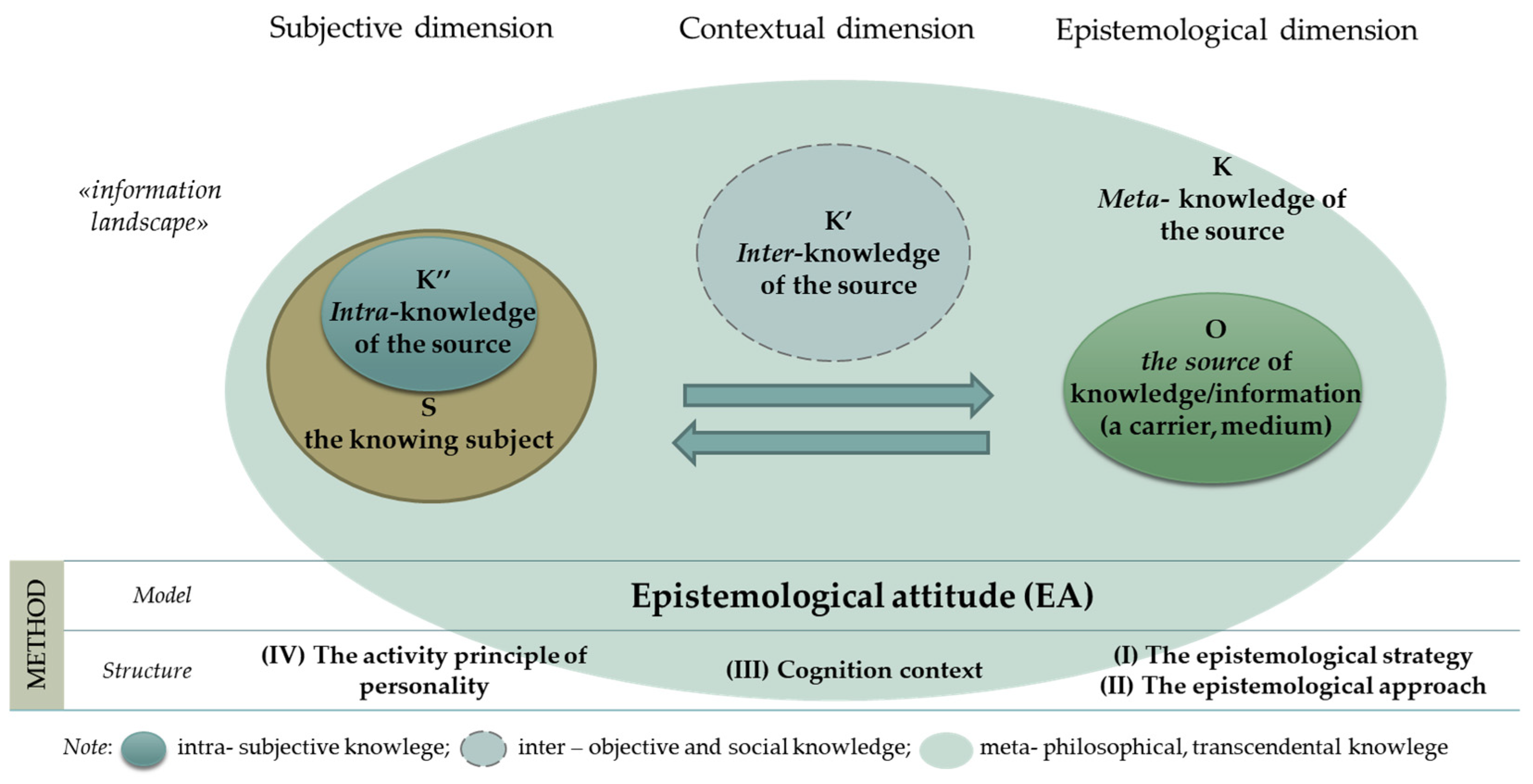
Figure 1 illustrates an event of cognition: the knowing subject’s (S) interaction with the source (O) and reflection on this interaction are represented through three phenomenological structures—the subjective (intentional), the social-objective (presence and utility in the environment) and the objective-transcendental (epistemic existence)—as illustrated in the figure as subjective, contextual, and epistemological dimensions. Within these phenomenological structures, the EA emerges through the involvement of the knowing subject (S) representing (perceiving and evaluating) the source (O) on three knowledge levels: intra-knowledge (K’’—subjective and psychological), inter-knowledge (K’—social and objective), and meta-knowledge (K—philosophical and transcendental). These levels encompass the epistemic units engaged in defining and representing the phenomenological existence of the source—its conceptual construct, articulated through the intra-, inter-, and meta-knowledge of the source in its reflection, is briefly described as follows.
Intra-knowledge represents the subjective domain, capturing individual intention, experience and personal attitude towards the conduit and its content. It manifests as volitive and adapted constructs, values, beliefs, or assessments.
Inter-knowledge constitutes the social-objective domain, comprising the societal and scientific utility of the conduit; it encompasses the shared social knowledge of how to apply the source, adhering to common representations of epistemic applicability within the specific contexts.
Meta-knowledge provides the objective-transcendental framework, derived from philosophy, specifically the field of epistemology, spanning from antiquity to contemporary thought, and engaged with cognition. These are general knowledge structures—philosophical, scientific, abstract, logical and other theoretical forms—adhered to as universal standards of credibility and validity used to evaluate the epistemic content of the conduits.
The “gestalt” of the source, situated within intra-, inter-, and meta-dimensions, presents a very broad philosophical conceptualisation, which offers wide possibilities for its specification and operationalisation. For this research project, the EA is leveraged as a model of cognition, encompassing interaction with the source and creation (evaluation, reflection) of its holistic image. By refining the relevant contexts of its elements, the EA was formalised into a four-structure model as a methodological framework, as illustrated in
Figure 1.
The main epistemological context is drawn from philosophy, wherein, as outlined in the introduction, diverse epistemological approaches and programmes have been analysed through the evolution of their conceptions and methodologies. This framework shapes two concepts within the epistemological dimension of the EA. Specifically, it is rooted in general epistemological strategies inherent in cognition, which govern the evaluation of its potential and expectations regarding the nature of knowledge.
The epistemological strategy delineates an individual’s orientation toward the knowability of the world, and their trust in and prognostic potential of knowledge conveyed by diverse conduits. This concept is operationalised through three foundational stances: optimism (scientific positivism), scepticism [
162] and agnosticism [
18].
The second concept is formulated through a synthesis of Lektorsky’s [
11,
25] evolution of philosophical paradigms and their programmes into structured epistemological approaches.
- 2.
The epistemological approach refers to an individual’s methods for addressing knowledge issues and the specific cognitive patterns employed to understand the epistemic content of the conduits. This concept is defined through a dual-set structure of eight features proposed by Lectorsky [
11]: four classical categories: criticism, fundamentalism and normativism, subject-centrism and science-centrism and corresponding non-classical categories: postcriticism, the rejection of fundamentalism and normativism, the transcendence of subject-centrism and science-centrism.
The contextual dimension has been operationalised based on the actual environments of academic and social cognition.
- 3.
The cognition context refers to the specific situations and their parameters in which individuals use and apply content from carriers and mediums. This encompasses the characteristics, frequency and intensity of such interactions. The concept is structured into two distinct domains: academic and personal contexts.
Constituting the subjective dimension, the knowing subject’s cognitive core is centred on the intentionality of cognition. The philosophical concept of intentionality is operationalised here as the subject’s principle of activity, manifesting through variables such as personal value, pragmatic orientation and utility. While the activity principle is a conceptually broad term within activity theories and personology, its structural synthesis is achieved through the following definition of the fourth concept.
- 4.
The activity principle of personality examines the underlying determinants of an individual’s engagement with sources, specifically the interplay between motivation and the perceived value and practical utility of the knowledge provided by conduits. Selection [
163,
164], homeostasis (balance) [
165,
166] and reduction [
167,
168] are identified as three distinct functional guidelines for cognition and its regulatory mechanisms [
51].
The EA structural model serves as the primary instrument for empirical investigation. These four conceptual building blocks, delineated by their constituent characteristics and categories, form the foundation of the methodology. In total, sixteen features, expressed through their denotative and connotative meanings, serve to create the epistemological and sociopsychological dimensions of the constructed source and describe its phenomenal representation as manifested through social consciousness within a representative group. This method has been designed specifically for this study and tailored for university academics, whose expertise and experience diverse conduits is essential for evaluating them within this complex model. The following
Section 4 will elaborate on the definitions of these sixteen features, the technical application of the EA method and the procedural design of the empirical study.
5. Results
The study evaluated scientific journal articles (SJAs), scholarly monographs (ScMs), university lecturers’ knowledge (ULK), textbooks and handbooks (THs), popular science books and magazines (PSc), academic social networks (ASNs) and social media (SM). Through a comprehensive analysis of EA profiles, we examined academics’ cognitive patterns, identifying key categories that represent the epistemological and sociopsychological dimensions of these conduits.
The analysis begins with a brief overview of all seven sources, followed by a thematic grouping based on content quality and conduit specificity, and also highlights the commonalities within contemporary social cognition. The following subheadings provide a structural foundation for a concise yet comprehensive and semantic interpretation of the empirical results.
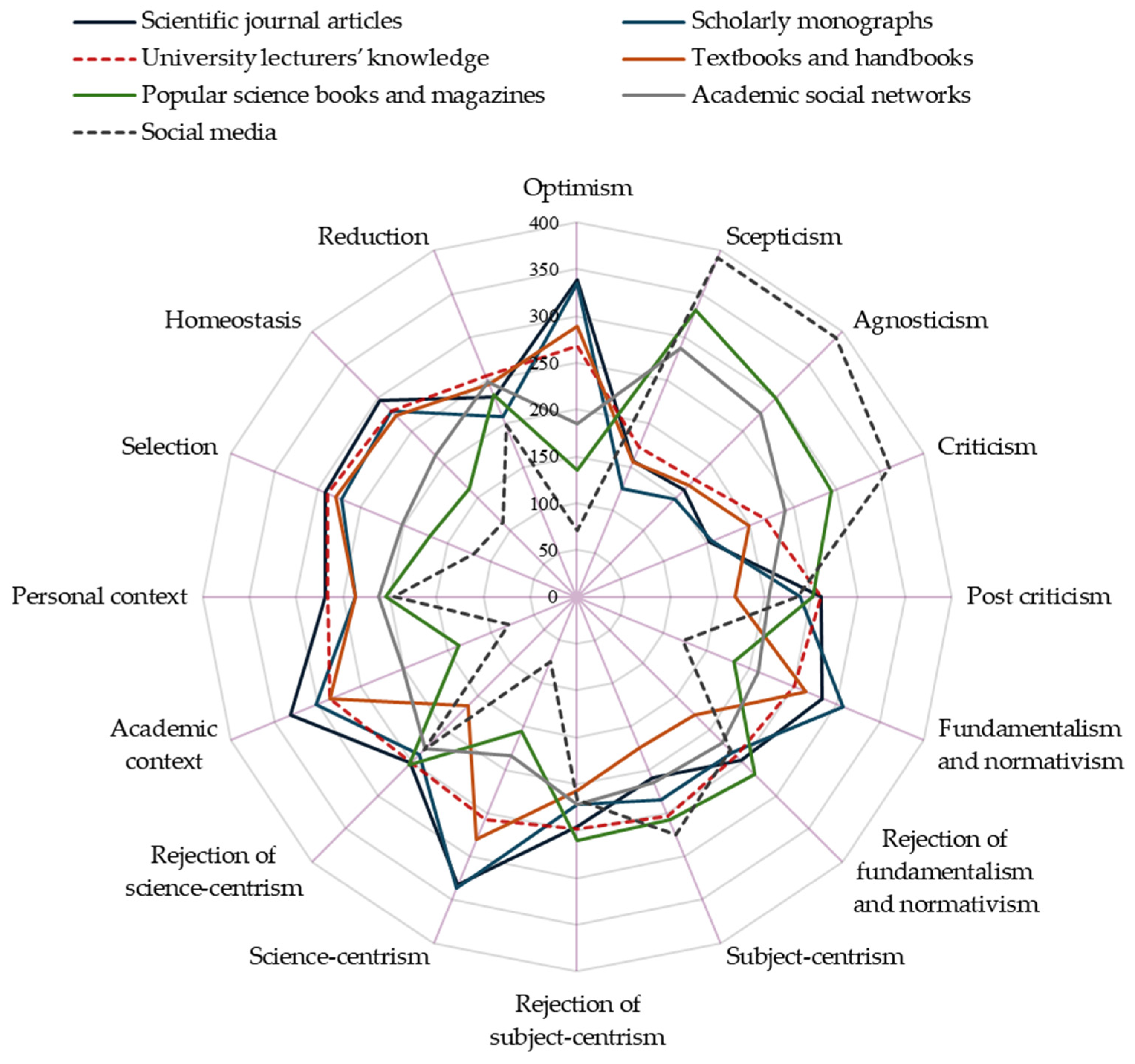
A comparative analysis using the Kruskal–Wallis H test revealed significant differences in 14 of the 16 EA features (
p < 0.05).
Figure 2 illustrates the landscape of the EA profiles across the sources, with their quantitative expression provided by the mean ranks. By these examining rankings, we identified the general patterns towards these conduits, tracing the overall tendencies while highlighting notable particularities. The specific features encapsulate and shape the distinct profiles of each conduit, reflecting the nuances in the relations between academics and these conduits.
These results indicate that academics employ distinct epistemological strategies depending on the type of source, resulting in divergent perceptions regarding the expected knowledge potential. The most pronounced variations were observed in optimism (χ2 = 236.88, p < 0.001), scepticism (χ2 = 241.28, p < 0.001) and agnosticism (χ2 = 191.04, p < 0.001). Furthermore, significant differences were identified in nearly all epistemological approaches (except for the rejection of subject-centrism): criticism (χ2 = 126.12, p < 0.001), post-criticism (χ2 = 25.18, p < 0.001), fundamentalism and normativism (χ2 = 92.12, p < 0.001), the rejection of fundamentalism and normativism (χ2 = 17.6, p = 0.007), subject-centrism (χ2 = 26.3, p < 0.001), science-centrism (χ2 = 211.38, p < 0.001) and the rejection of science-centrism (χ2 = 21.88, p = 0.001). These findings underscore the heterogeneity in the perceived epistemic potency of content within these conduits. Furthermore, they illustrate how academics’ epistemologies diverge when addressing and assigning quality parameters to the epistemological structures across the sources.
The EAs profiles underscore the significant knowledge potential that academics attribute to SJAs, ScMs, ULK and THs. A robust sense of optimism regarding their contents reflects their perceived efficacy in the acquisition of reliable and comprehensive knowledge. Notably, SJAs and ScMs are identified as carriers having the highest knowledge potential, closely followed by THs. These four academic sources are met with significantly lower levels of scepticism and agnosticism compared to PSc, ASN and SM, which are perceived as mediums of content with lower credibility and are more likely to contain general information and subjective beliefs rather than verified expertise.
Beyond the high levels of optimism, SJA, ScMs, ULK and THs also exhibited two other characteristics: the epistemological approaches of science-centrism and of fundamentalism and normativism. These two features belong to the classical epistemological standards inherent in traditional scientific knowledge conduits.
Our findings reveal a salient dimension of post-classical epistemology. Post-critical, anti-fundamentalist, and anti-normative approaches, alongside the rejection of science-centrism, serve as significant navigators in contemporary enquiry. Moreover, the boundaries between traditional scientific conduits and popular and social media appear increasingly indistinct in these categories. These findings suggest a departure from classical thought, signalling an exploration of post-classical and non-classical (modern) perspectives in academic cognition. A common theme across all seven sources is the rejection of subject-centrism. Academics favour a model of intersubjectivity, characterised by interaction, collaboration, the co-construction of knowledge through open dialogue and multiple interpretations.
Regarding the sociopsychological value of the sources, the outcomes revealed that academics’ engagement varies significantly according to specific contexts, motivations and the ascribed personal value of knowledge. This interaction is reflected in significant statistical differences in both the academic (χ2 = 200.3,
p < 0.001) and personal (χ2 = 19.35,
p = 0.004) contexts.
Figure 2 illustrates that formal scientific carriers, SJA, ScMs, ULK and THs, remain the preferred means for knowledge acquisition across professional, pedagogical and everyday interpersonal situations. Notably, the preference for these sources within the personal context appears to be influenced by academics’ professional expertise. Nevertheless, despite this scientific orientation, social and popular media such as ASNs, SM and PSc continue to exhibit high levels of interaction, suggesting that they hold complementary value in the personal lives of academics.
Furthermore, academics’ knowledge acquisition across various conduits is driven by distinct cognitive motivations. The study revealed significant differences regarding the principles of selection (χ2 = 103.47, p < 0.001) and homeostasis (χ2 = 112.04, p < 0.001). Academics demonstrated high levels of selectivity and intentionality when engaging with scientific sources (SJA, ScMs, ULK and THs). Additionally, balanced motivation —the calibration of personal needs with cognitive goals —has been shown to be a crucial driver. Notably, regardless of the source, a common principle of academic cognition identified was reduction, or a preference for rapid and effortless acquisition. This tendency reflects broader societal influences on cognition, mirroring global trends towards brevity in information and the prevailing pace of modern intellectual exchange.
Drawing upon the academics’ reflections and the theoretical framework of the EA, we synthesised these findings into distinct conceptual constructs to compile “gestalts” that represent these sources. These EA profiles were organised according to our original classification system, which serves as the conceptual umbrella for this study. The holistic analysis of these profiles has crystallised specific trends, enabling us to categorise the sources into three groups based on the theoretical stumbling block—that is, how the conceptual juxtaposition of knowledge and information is manifested in these sources: “Knowledge Sources”, “Knowledge and Information Medium”, and “Information Carriers and Mediums”.
Additionally, we have identified a post-classical orientation as a universal guideline within contemporary cognition. Rather than being tied to a specific conceptual group of sources, this orientation emerges as a systemic trend, establishing a new cognition pattern. It fundamentally reshapes how the distinction between “knowledge” and “information” is perceived and approached in the modern era.
5.1. “Knowledge Sources”: Expertise, Epistemic Authority and Scientific Testimony
Based on a holistic analysis of the EA profiles, a distinct group identified as “knowledge sources” has emerged, comprising scientific journal articles (SJAs), scholarly monographs (ScMs), university lecturers’ knowledge (ULK) and textbooks and handbooks (THs). By scrutinising the specific features and their constitutive categories (paraphrased or presented in their original form in scare quotes), we have shaped a conceptual “image of (external) knowledge source” derived from their most salient characteristics as externalised by the social consciousness of academics.
The first defining characteristic of this group is a high expectation regarding the epistemic potential of its content. Optimism stands out among the epistemological strategies, serving as a cognitive marker that classifies content as knowledge proper. This anticipation of reliability is universal across all four sources; however, internal hierarchies exist. Academics attribute the highest cognitive potential to SJAs and ScMs, perceiving them as providing “expanded and in-depth understanding” that reflects “regularities of life”. While ScMs are valued for their knowledge completeness, SJAs excel in “addressing current issues”. Conversely, THs exhibit the lowest predictive capability; their pedagogical and instructional focus results in a slower evolutionary pace that often lags behind rapid scientific advancements. Nevertheless, all sources in this category are perceived to convey the “subject’s essence” through “understandable and acceptable content”, maintaining a clear epistemic advantage over other conduits. Specific attention regarding prognostic potential is given to ULK. Academics perceive themselves as an epistemic source and medium of objective understanding, grounding this self-objectification in their profesional contributions to the field.
However, while these sources are generally marked by optimism, this anticipation is balanced by a functional degree of scepticism and agnosticism, both of which are essential in validating “knowledge as knowledge”. Although “anticipatory scepticism” does not predominate across all four sources, academics acknowledge potential “deficiencies in proofs” within each. Notably, a higher degree of scepticism is directed towards ULK; while regarded as “interesting”, it is occasionally considered “untrustworthy”, as its content may fail to provide a “plausible explanation”. This suggests that the individual subjectivity of the lecturer may act as a barrier to credibility. Nevertheless, this does not undermine the importance of the source as a knowledge provider; for example, SJAs are explicitly noted as containing content that “should be verified” and possessing “limited descriptive and explanatory potential”.
Regarding agnosticism—the inherent limitations of knowledge, all four sources exhibit limited “predictive power”. Academics observe that these conduits, particularly THs, tend to represent “transformed rather than created (original) knowledge”. Furthermore, ULK is perceived as epistemically fragile, with the risk that its content may be “less reliable than common notions”, potentially disseminating social constructs rather than evidence-based knowledge.
The second set of characteristics shaping a “knowledge source” category is grounded in specific epistemological approaches. These methods facilitate the extraction of knowledge qualities, the identification of epistemic problems and the formulation of solutions. Criticism serves as a foundational cognitive approach; however, for these sources, it operates as a functional tool rather than as a defining feature of the content itself.
Criticism identifies qualities that reduce credibility and validity, potentially disqualifying content from being categorised as knowledge proper. Although these academic sources are regarded as the most reliable, critical scrutiny focuses primarily on ULK, with THs subject to less intense but still notable evaluation. ULK is often perceived as vulnerable due to occasionally radical approaches that may blur the distinction between objective knowledge and subjective belief. Conversely, the reliability of THs can be compromised by the inclusion of outdated theories and inefficient problem-solving methodologies.
Post-criticism refers to a mode of partial criticism in which existing foundational knowledge is applied in novel ways, moving beyond strict evaluation towards interpretation and contextualisation of sources. While most academic sources demonstrate these post-critical qualities, THs remain a notable exception. Perceived as the most conventional and rigid carriers, their content is characterised by stability and the exclusion of innovative or unrecognised assumptions. In THs, “the uncertainty and contradiction of interpretations” is not viewed as an opportunity for discovery, but as a threat to truthfulness. Consequently, as instructional materials, THs avoid ambiguity to maintain their role as a stable carrier of established knowledge.
The next defining characteristic is fundamentalism and normativism, signifying that a “knowledge source” provides essential knowledge grounded in theory and methodology within a scientific paradigm. While all four academic sources meet this criterion, ScMs are distinguished by their provision of solid foundational theories, models and methods, effectively “separating subjective and objective knowledge” to achieve a holistic understanding. SJAs mirror this profile, albeit through shorter original research focused on “addressing global issues”. Notably, when comparing THs and ULK, textbooks demonstrate greater credibility and more strictly satisfy the criteria of knowledge normativity. As will be elucidated, subjective and sociopsychological factors account for this perceived disparity.
Figure 2 demonstrates that the rejection of fundamentalism and normativism is not a necessary constitutive criterion of knowledge proper. This shift signals a move beyond purely formal and conventional methods of acquisition and justification, prompting a re-evaluation of the “gold standard”. As this approach redefines both the entities under study and the methodology, it is underscored primarily by foundational sources or, alternatively, by revolutionary media. Specifically, this significance is highlighted by the role of ScMs in the philosophy of science and SJAs as dynamic, responsive carriers. They quickly adapt to field demands and offer diverse theoretical and methodological perspectives on the global landscape.
Science-centrism remains a pivotal epistemological marker of knowledge. Experts emphasise that rigorous scientific enquiry provides the necessary foundation for the credibility of academic sources. SJAs and ScMs are most closely aligned with these standards, characterised by the “endorsement of scientific authorities”, the “exclusion of subjective representations” and a reliance on “continuous scientific investigation”. Conversely, the rejection of strict science-centrism —observed in SJAs, THs and ULK —facilitates a more philosophical approach to reflection within scientific discourse. This perspective acknowledges scientific thinking as just one of many methods for exploring and interpreting reality.
The criterion of subjectivity is an intrinsic epistemological property of knowledge, applied almost equally across all identified “knowledge sources”. Here, subject-centrism is particularly crucial regarding ULK, where the “method of subjective interpretation” is naturally embedded. Similarly, ScMs contents are recognised as stemming from “the author’s theoretical perspective” and distinct “cognition style”.
However, ULK simultaneously rejects pure subject-centrism by emphasising collaboration and engagement with the present, using educational materials tailored to the “individual and target audience’s understanding”. SJAs and ScMs further exemplify this by highlighting “diverse approaches” and the “synergistic generation of knowledge through interacting perspectives”. This rejection of subject-centrism is a consistent criterion across academic conduits and aligns with broader cognitive trends to be discussed later.
Sociopsychological criteria used to evaluate sources are expressed in terms of their application and pragmatics. All academic sources are expected to serve scientific and educational purposes, reflecting their typical functional roles in the academic context. These four conduits are frequently integrated into “academic communication”, “study course and project development” and “organisational and pedagogical work”. SJAs and ScMs best exemplify these functions, facilitating “innovative solutions to research and pedagogical challenges”, enabling “in-depth analysis” and supporting higher-order reflection on cognitive activities. In contrast, the efficacy of THs is uniquely reliant on “peer and student feedback”.
While application within academia is a primary function for “knowledge sources”, a deeper philosophical perspective reveals that epistemic certainty and wisdom are inextricably linked to their integration into the personal, interpersonal and social dimensions of everyday life. These four sources, particularly SJAs and ULK, are perceived as “content of inspiration and new ideas”, providing essential guidance for “social adaptation and normative behaviour”. They further extend into the “lifeworld” by offering “practical daily life tips” and shaping “everyday discussions”, suggesting that academic identity is fundamentally integrated into the ordinary existence of scholars.
The pragmatic criteria do not merely shape the “use-value” of these sources as knowledge carriers; they also emphasise personal engagement and intrinsic cognitive value. Prioritising selectivity among these sources relates to “pure cognition” (cognition for its own sake), strong volition and a profound appreciation for content, underscored by independent and conscious choice. For example, SJAs encourage the “revision of one’s own ideas” and the pursuit of “higher and deeper knowledge”; ULK fosters “moral development” and the expansion of “personal worldview”; and ScMs, alongside ULK and SJAs, privilege “extensive focus on the subject matter”.
The second driving force of cognition, the principle of homeostasis, posits that the value of a source is determined by its content functionality and epistemic vitality in relation to specific goals. This principle applies to all four academic sources, particularly SJAs, which contribute significantly to analytical cognition. By maintaining cognitive balance and serving as a “guide in the search for knowledge”, these sources function as instruments in the active advancement of thought rather than merely preserving it.
The most utilitarian criterion in cognition is the maximisation of output while minimising cognitive effort.
Figure 2 illustrates that reduction serves as a governing principle in knowledge acquisition. For instance, the reduction principle emphasises the lecturer’s value as a channel for interactive knowledge transfer, prioritising understanding and engagement over the mere conveyance of complex knowledge systems. This personalised approach enhances cognitive satisfaction through the immediacy of person-to-person communication. Similarly, SJAs provide high utility for targeted knowledge retrieval, while THs and ULK function as efficient instructional tools, offering “quick access” to essential frameworks that academics foreground.
5.2. Knowledge and Information Medium
Academic social networks (ASNs) constitute a distinct group classified as “knowledge and information medium”. As illustrated in
Figure 2, this group occupies a unique space, differing from “knowledge sources”—the foundational carriers of scientific expertise and epistemic authority—while not fully sharing features with other social and popular media. This group, which includes but is not limited to ASNs, acts as a bridge between knowledge and information. While ASNs are diverse networking platforms that often host databases of scientific, professional and educational materials similar to those found in traditional carriers, they are neither perceived nor utilised as such. Nevertheless, they display both substantial convergence and peripheral alignment with academic sources, sharing select characteristics; the EA profile effectively delineates the unique attributes and functional boundaries of this group.
The first distinct characteristic of ASNs is ambivalence—a dualism of optimistic perception and critical approach. Both features are expressed with equal intensity. While scholars expect to obtain reliable knowledge from ASNs, akin to traditional carriers, they are demanding that available content be academically transparent, subject matter-based and focused on contemporary issues.
The critical dimension targets issues of knowledge validity, content, quality and presentation. Generally, the content of ASNs is highly susceptible to critique. In this regard, much like THs, ASNs tend to impose a specific point of view, steering users towards particular narratives. Furthermore, this medium often struggles to maintain a clear boundary between validated knowledge and assumptions—a form of ambiguity also observed in ULK, in which subjective activity is prominent and less constrained by formal structure. The hybrid nature of ASNs, merging scientific content with social networking, introduces the risk of facilitating tendentiously radical criticism. Such an environment may foster the rejection of alternative or unfavourable perspectives, emphasising ideological alignment over objective scientific discourse.
The second defining feature of ASNs is a prevailing moderate scepticism and agnosticism regarding the overall epistemological potential of their content. This cautious stance primarily arises from the scholarly imperative to “verify the content”—a necessity driven by the ambiguous nature of these platforms and the contested merit of the wide output within ASNs. This leads to philosophical questioning as to whether ASNs mediate genuine, validated knowledge or merely linguistic constructs and socially constructed narratives, rather than providing a comprehensive picture grounded in theory and evidence.
A further distinguishing characteristic of ASNs is the simultaneous integration of classical and non-classical epistemological aspects. The “knowledge and information medium” operates within a dual framework: on the one hand, it strives to align with classical rigour in knowledge organisation and presentation; yet it also embraces a contemporary outlook on cognition. ASNs incorporate current trends and technological advancements in scientific-professional discourse, even those that deviate from conventional presentation and delivery of traditional carriers, to enhance the functionality and practical application of their content.
The complementary integration of fundamentality and normativism, alongside their rejection, reflects the effort made by these platforms to align with established knowledge standards and to ensure the credibility and accuracy of conveyed content. By emphasising the distinction between subjective and objective domains in channelling, ASNs position themselves as a medium for fundamental and “world-representing” knowledge. Simultaneously, however, they advocate a departure from rigid normative standards. These digital media propose a model of justification based on a plurality of potentially knowable truths.
The “knowledge and information medium” integrates both subjective and intersubjective features, which are basic structures of social cognition. In this context, ASNs represent a hybrid of SJAs and SM (social media), as illustrated in
Figure 2. Specifically, ASNs are expected to moderately incorporate individual interpretation, paralleling the dynamic found in SJAs, where the author’s personal perspective and approach are valued. Simultaneously, the interactive dimension aligns with the paradigms of SM, characterised by “dynamic relationships with the real and current” and the implementation of diverse approaches to collaboratively address issues.
While the primary objective of ASNs is to disseminate scientific content, the nature of social networking platforms significantly alters the perception of this content. Analysis reveals that science-centric categories are less pronounced in ASN content compared to “knowledge sources”. Nevertheless, academics acknowledge ASNs as a vital space for “proactive and constructive scientific thinking” without necessarily blurring the lines between scientific and non-scientific knowledge. However, the structural reliance of these digital conduits on social networking compromises their credibility. Since their contributors are not exclusively verified scholars, the trustworthiness of these digital media remains contested.
Therefore, a fundamental distinction shapes the constructs of “knowledge sources” and “knowledge and information medium”. When a carrier or medium blends characteristics with those of another type, it risks a dilution of its constitutional epistemic structures, potentially weakening its strengths while adopting the structural vulnerabilities of the other type.
Regarding the functionality of “knowledge and information mediums”, they act as central agents in social cognition. Their specialised nature enables them to target specific creators and audiences, a dynamic exemplified by ASNs. Within the academic sphere, ASNs serve as valuable instruments for scientific organisation and collaboration, pedagogical planning and research coordination. This constitutes a significant advantage of this group, as they facilitate the efficient aggregation and selection of materials for future endeavours.
Since “knowledge and information mediums” employ fewer formal modes of presentation, they are often privileged in daily cognition, functioning effectively across personal, interpersonal and social contexts while remaining academically relevant. This informal structure is particularly well-suited to ASNs, which offer a broad range of daily discussion themes and facilitate social interactions, such as academic networking. By blending social networking with real-time events, ASNs enhance the “understanding of social, political and economic issues”. Therefore, academics frequently perceive them as a form of intellectual leisure, considering them a critical “wellspring of inspiration and innovative concepts”.
ASNs differ from traditional scientific carriers in their lower cognitive value, as selection and intentionality are less pronounced. The primary driving force is the principle of reduction, which highlights the practical benefits of using these platforms. Firstly, they offer readily available content, promoting “efficient, fast and successful cognition” and providing a sense of mental comfort by reducing the effort required for access. Secondly, their entertaining and transient content fosters social interaction and emotional engagement, which is often prioritised over long-term enquiry or the scrutinised selection of material. Additionally, since ASNs often serve as databases of scientific articles and literature, they provide distinct pragmatic professional value, balancing engagement with knowledge acquisition. In this capacity, they guide searches for content relevant to specific cognitive goals, acting as a navigational tool that helps members “advance their thought”, functioning as a heuristic bridge between information and communication flows and formal scholarly enquiry.
5.3. Information Carriers and Mediums
The third distinguished group comprises popular science books and magazines (PSc) and social media (SM). By analysing these sources, we have conceptualised them as “information carriers and mediums” rather than knowledge. The findings indicate that these conduits lack the essential characteristics of knowledge proper; most notably, the epistemic prognostic potential of their content is significantly low.
Strategic scepticism towards PSc and SM necessitates obligatory verification, highlights limited descriptive capacity and indicates the unconvincing nature of their explanations. SM, in particular, emerges as the least reliable medium, demonstrating a critical lack of evidence. Furthermore, agnosticism diminishes the perceived epistemological value of SM-mediated content, as scholars are unanimous that there is an “unknowability of reality” through these platforms and an “impossibility of obtaining reliable knowledge”. This perspective positions SM as the epitome of an “information medium” that fails to prevent the fragmentation and distortion of genuine knowledge in the information flow. Ultimately, the content within this group is viewed as “less reliable than common notions” or even “absolutely dubious”, serving as transient data and blended information layers rather than a stable foundation for valid knowledge creation.
PSc and SM disseminate scientific and factual knowledge to a broad audience, primarily functioning outside a formal scholarly environment. Their output is characterised by criteria that classify it as general information. Firstly, deep-seated criticism is evident; both mediums often “impose a predetermined point of view” and condemn the “ineffectiveness of conventional problem-solving approaches”. SM, in particular, struggles to maintain boundaries between validated fact, subjective opinion and superstition, and often faces scrutiny for facilitating extreme or radicalised viewpoints. Secondly, in terms of post-criticism, both mediums operate on the premise that they are flourishing spaces where “assumptions and ideas that have been unapprehended or underestimated” within traditional spheres can emerge. They display a high degree of openness to revising established understandings, at times discarding them entirely in favour of trends, revitalised or novel perspectives. Furthermore, they elevate the subjective dimension of enquiry, leveraging “belief and conviction in developing hypotheses and theories”, and focusing on the persuasive power of narrative.
The third notable feature is a disregard for fundamental and normative knowledge standards; consequently, categorising “information carriers and mediums” as post-classical is appropriate within this framework. Both PSc and SM demonstrate a shift away from rigid criteria, favouring content that offers “justifications without strict and fixed norms and principles” in alignment with current cognitive trends. By appealing to “various worldviews”, they spark expert debate and target “specific, specialised issues” over broader scientific imperatives.
Complementarily, “information carriers and mediums” challenge scientific superiority, prompting through their narratives a re-evaluation of knowledge within a contemporary context and emphasising its practical, enlightening and entertaining roles. While PSc conveys a derivative of scientific knowledge, it explicitly states that rational knowledge is merely one type among many. They often employ non-scientific methods to generate “new scientific theories” yet maintain classic scientific distinctions in differentiating between ideal and actual models of reality. Furthermore, PSc leverage interdisciplinary principles, while SM advocates “multiple potential truths” and a high degree of eclecticism in reasoning.
The fifth feature is that the production and dissemination of information depend on individual roles and social interactions, highlighting its influence in shaping lives and social understanding. Both PSc and SM simultaneously emphasise and reject subject-centrism. For instance, PSc highlights individual contributions to content sharing, showcasing the unique styles of influential figures in non-fiction literature and periodicals. Meanwhile, SM embraces “subjective interpretation”, acknowledging the validity of “the author’s theoretical perspective”. The shared rejection of subject-centrism focuses on “creativity dynamically interacting with reality”, prioritising audience engagement in prevailing cultural narratives and transient cognitive trends alongside individual expression.
Regarding the functionality of “information carriers and mediums”, they are primarily used for personal enrichment, as scholars generally find them to be of minimal academic efficacy. PSc and SM are commonly employed to navigate current narratives, specifically to “understand social, political, and economic issues”, and to gain rapid insight into mainstream societal life, serving as a form of intellectual and emotional leisure within social cognition.
The pragmatics of these mediums are governed by the reduction principle. The utility of PSc and SM is derived from their social currency and visibility. Accessing their content is designed to be seamless, requiring the individual to engage “without exerting too much intellectual and moral effort”, thereby offering a path of least cognitive resistance. In this context, motivation is centred on recreation and intellectual curiosity; the primary driver for PSc consumption is the “satisfaction of knowledge acquisition”. While these mediums broaden a cognisant’s worldview and foster a general “interest in gaining knowledge about the world”, they are neither intentional nor goal-oriented in their value as objective-driven enquiry. Instead, such enquiry is dictated by discursive trends and societal preferences.
5.4. Post-Classical Cognition and Its Criteria
Our findings crystallise a significant shift: contemporary cognition exhibits patterns that we term “post-classical”. While the prefix “post” is often ambiguous, here it refers literally to what follows the “classical”. It entails applying established criteria to post-classical phenomena by adapting these criteria to the current context. This transformation is evident across all three conceptual constructs—“knowledge sources”, “knowledge and information mediums”, and “information carriers and mediums”—of academic and popular sources examined in this study.
Post-classical epistemology reshapes not only our perception and understanding of these sources, but also the paradigm of cognition, by embracing post-criticism and rejecting the pillars of classical thought: fundamentalism, normativism, subject-centrism and science-centrism. This shift necessitates a re-evaluation of knowledge criteria, enabling nuanced comparisons between scientific and non-scientific knowledge, as well as between knowledge proper and the information flows present in social cognition. Such re-evaluation is crucial for adapting to evolving paradigms and for effectively addressing real-world issues. Ultimately, a post-classical approach offers the dual capacity to identify and create trends while simultaneously providing a framework for understanding them.
Contemporary cognition is challenged by post-criticism, which asserts the necessity of acknowledging multiple truths, each with a conditional basis that relates to a specific framework or goal. Within this paradigm, if these established bases are found to be ineffective, they should be revised or discarded. Rather than being regarded as failures, uncertainty, contradiction, beliefs and convictions are transformed into opportunities for deeper reflection.
By rejecting fundamentalism and normativism, this approach emphasises that the justification of knowledge should not be constrained by strict and fixed norms. Such rigid principles tend to suppress diverse perspectives and fail to adapt to evolving trends. Currency is critically important, as it connects the idealised and actual forms of reality by calibrating the scientific lens and assisting the knowing subject to navigate the world as it is, rather than as classical theory dictates it “should” be.
The transcendence of subject-centrism is pivotal in the contemporary landscape. It centres on interaction and cooperation, emphasising our responsibility to co-create and share social knowledge and individual epistemologies as members of society, while the social landscape, as a convergence of events, shapes the content we acknowledge and disseminate. This perspective highlights the dynamic interplay between the creativity of the solitary agent and the co-created, actual lived reality.
Finally, the move beyond a science-centric view of cognition recognises that science and its authorities represent only one perspective among many in the pursuit of objectivity and valid knowledge. Scientific thinking is thus repositioned as one approach to exploring reality, with even expert opinions subject to critical scrutiny. Ultimately, the post-classical framework maintains that ecologically valid models of reality should be grounded in pragmatic principles and theories that demonstrate contemporary utility.
The Principle of Reduction
Beyond the common regularities observed in epistemological structures, which reflect both the organisation of content and the means of contemporary knowledge and information acquisition, our findings identify a constitutive parameter of cognition: the principle of reduction. This sociopsychological principle is evident in the motivations of the cognisant subject, as well as in the criteria underlying the personal value of specific content and its acquisition. It helps to explain the widespread appeal of carriers and media that offer readily accessible knowledge and information, even where these are provided by conduits that may be unreliable or only partially trustworthy. In the context of contemporary, accelerated cognition, convenience and ease of consumption are prioritised, thereby effectively minimising intellectual and moral effort. This indicates that present-day cognition is driven not only by the classical pursuit of enlightenment and rigorous learning, which remain demanding, but also by an “economical” impulse, which is more entertaining and passive in nature. The contemporary subject seeks readily consumable content, whether in the form of objective knowledge or engagement with ongoing information flows, that provides immediate satisfaction and fosters social connection through shared access to popular and trending sources.
6. Discussion
This comprehensive enquiry was driven by the fundamental problem of how the conceptual relationship between knowledge and information is manifested in contemporary academic and popular cognition. Particular attention was given to mediated forms such as content carriers and media, encompassing expertise, scientific and folk testimony and authority. A central question was whether various external sources of testimony constitute genuine “knowledge sources”, embodying validated forms, or serve merely as informational mediums and channels. The research specifically focused on scientific journal articles (SJAs), scholarly monographs (ScMs), university lecturers’ knowledge (ULK), textbooks and handbooks (THs), popular science books and magazines (PSc), academic social networks (ASNs) and social media (SM).
We scrutinised these seven general types of academic and popular means and, employing the epistemological attitude (EA) methodology, examined academics’ cognitive patterns in relation to these various content conduits, aiming to represent the general characterisations of these sources. The perception of social consciousness was used as a systemic principle to capture the “gestalts” of these sources as they exist within the phenomenological domain, thereby developing conceptual constructs of how university academics, as representatives of social consciousness, perceive them.
Our analysis elucidates the intricate dynamics of knowledge within the contemporary information paradigm. The ongoing interplay between established knowledge and the continual flux of information not only generates alternative epistemic forms but also fundamentally reshapes perceptions of information itself. Through the observation and examination of patterns within epistemological and sociopsychological dimensions, we have formulated three core theses for further discussion.
The first thesis asserts that the EA reflects cognitive patterns regarding the sources, thereby elucidating both epistemological and sociopsychological particularities. Our results indicate that academic and popular sources are perceived and processed through distinct epistemological strategies and approaches, resulting in heterogeneous representations of their images. These findings underscore the inherent diversity in the objective knowledge value and quality attributed to the content of these conduits. Academics’ cognitive engagement varies according to the type of source, with each source activating distinct sociopsychological dimensions. Notable differences are observed in interaction patterns, socio-objective applications, underlying motivations and the personal value attributed to content.
The second thesis posits three conceptual groups centred on the problematic distinction between “knowledge” and “information”, revealed through a synthesis of the holistic analysis of the EA profiles of these sources. These groups are: “knowledge sources”, “knowledge and information mediums” and “information carriers and mediums”.
“Knowledge sources” are defined as constructs characterised by unique epistemological qualities, functionality and value, and are regarded as providing genuine knowledge. These encompass epistemic sources, carriers and mediums of expertise, epistemic authority and scientific testimony. Our findings indicate that four types of scientific reports and instructional materials may be classified as “knowledge sources”: scientific journal articles (SJAs), scholarly monographs (ScMs), university lecturers’ knowledge (ULK) and textbooks and handbooks (THs). The compiled conceptual image of a “knowledge source” incorporates the key characteristics of its representative examples.
A high epistemic potential is regarded as the paramount expectation for a “knowledge source” proper. Across the four source types, scholars exhibit pronounced epistemological optimism, perceiving these sources as inherently reliable, with their content considered genuine knowledge. SJAs and ScMs are widely recognised for their superior epistemic capacity, offering the most comprehensive and detailed understanding of a given subject. Their highly structured nature, embodying scientific enquiry and adherence to established criteria for scientific rigour, fundamentally underpins their epistemic value [
81,
82,
84]. ScMs, in particular, are considered pre-eminent for their expertise and completeness, a status as original, foundational carriers reflected in their high regard across diverse academic disciplines [
91]. While active engagement with the primary research in SJAs significantly influences discourse on contemporary issues, THs exhibit the lowest predictive capacity. The comparatively slower evolution of THs, attributable to their focus on the organisation of instructional content [
108,
109,
117], may impede their ability to keep pace with advances in scientific and social cognition. Nevertheless, all four source types are expected to preserve and communicate foundational knowledge within their respective subject areas, each offering distinct advantages. Particular attention is afforded to ULK, which is regarded by academia—mirroring students’ perceptions [
65], as an epistemic source of authority and a carrier of objective knowledge.
Secondly, the validity of content must be subjected to reasonable scrutiny before it can be regarded as knowledge. This process of verification does not undermine the credibility of conduits; rather, it affirms the fundamental principles of scepticism and dialectics within cognition, both of which are essential for distinguishing knowledge from mere opinion [
13]. Scepticism towards scientific sources is nuanced, given the recognition that all evidence may contain deficiencies in its proofs—a point articulated by intellectual giants such as Aristotle [
16,
17] and Kant [
18], who highlighted the inherent complexities of justification. However, scholars tend to be more sceptical of ULK, as the introduction of subjective elements by lecturers can impede credibility. Agnosticism, in this context, acknowledges the intrinsic limits of cognition, as even a “knowledge source” proper demonstrates constraints in its predictive power and in the conveyance of genuinely novel knowledge. This highlights the continual flow of the unknown, raises fundamental questions about cognition and the nature of knowledge and recognises our inability to make reliable predictions or to produce truly novel insights—a presupposition reinforced by Plato’s [
14,
15] proposition that cognition is a process of “remembering” or “recollection” of eternal truths.
Thirdly, the definition of a true “knowledge source” hinges on its approach to content, articulated through sensible criticism, fundamentalism, moderate normativism, balanced individuality and cooperation, and a commitment to contemporary scientific integrity. Academic sources are evaluated through rigorous review that remains constructive and does not distort the content itself. Such evaluation is essential for identifying qualities that may undermine credibility and validity. Although all academic sources are generally considered reliable, criticism is particularly directed at ULK and THs. ULK frequently faces scrutiny for approaches perceived as subversive, which may obscure the distinction between episteme and doxa. THs, by contrast, are often hampered by obsolete and ineffective instructional materials, reinforcing the common concern that they require frequent updates [
109,
114,
117].
The counterpart to traditional criticism, post-criticism, is even more essential for most scientific and instructional sources. Rather than merely removing “impurities” from knowledge, the post-critical approach encourages the application of foundational principles in innovative ways that correspond with contemporary paradigms. By contrast, THs tend to remain conventional and rigid, eschewing ambiguity in their role as reputable instructional materials [
109].
Fundamentality and normativism denote content grounded in elemental knowledge, rooted in theory and methodology, and aligned with a relevant scientific framework. All four academic sources meet this criterion, with ScMs and SJAs being particularly prominent. ScMs effectively delineate subjective and objective dimensions of enquiry, striving for a holistic understanding and are expected to provide in-depth analysis and highly original research [
87,
88]. SJAs, in turn, serve as critical carriers advancing the frontiers of scientific research.
A science-centric approach underpins the credibility of academic sources. SJAs and ScMs convey content most thoroughly informed by rigorous scientific standards and are endorsed by scientific authorities. However, there is an emerging shift beyond pure science-centrism towards a new integration of science and social cognition, particularly evident within SJAs, THs and ULK. Their contents increasingly favour a philosophical approach to reflection as a method in scientific discourse, acknowledging that scientific thinking is but one of many ways of engaging with reality. Consequently, scientific knowledge must be both functional and integrated with contextual demands [
75].
The criterion of subjectivity constitutes an intrinsic “epistemic cornerstone” that affirms the contribution of the knowing subject, the individual author. This principle applies almost equally to all “knowledge sources”; it is indispensable for ULK, valued for its embedded interpretative methods, and for ScMs, appreciated for the authors’ theoretical perspectives—traits typical of conduits with greater autonomy [
89]. Simultaneously, scientific and educational content is esteemed for its rejection of pure subject-centrism, instead favouring collaboration and engagement with diverse perspectives by balancing “objective subjectivity” and the dissemination of synergistically generated knowledge.
Fourthly, the sociopsychological advantages of “knowledge sources” are underscored by their academic application and value. As anticipated, academic sources serve scientific and educational purposes, with these four types being highly valued for their implementation in research, academic communication, and professional contexts. SJAs and ScMs particularly exemplify these functions in especially innovative and profound ways, cementing their status as the most foundational conduits of contemporary scientific endeavours. Furthermore, the role of THs in education is noteworthy, particularly in relation to curriculum alignment [
111].
Beyond their professional application, academic sources are regarded as a channel of wisdom for personal experience, integrating into the daily lives of scholars. All four types, particularly SJAs and ULK, contribute to individual epistemologies, serving as sources of inspiration, insight and practical guidance for social adaptation, thereby shaping everyday discourse—qualities widely appreciated within the academic community [
53,
101,
102,
103,
104].
The pragmatic and volitional criteria of “knowledge sources” emphasise the value of knowledge itself and the individual’s personal engagement with it. Academic sources are regarded as fostering pure cognition—cognition for its own sake—conscious pursuit of wisdom and a willingness to embrace personal growth. They maintain a balance between deep appreciation of the subject matter and rigorous analytical enquiry.
A “knowledge and information medium” is an intermediate construct that encapsulates the content of scientific knowledge carriers without fully intersecting with other social and popular media. This medium functions as a bridge between knowledge and information, simultaneously maintaining and blurring the boundaries between the two. Academic social networks (ASNs) are a prime example of this category.
A defining characteristic of the “knowledge and information medium” is its inherent ambivalence, balancing optimistic expectations with a critical approach. While there is an anticipation of obtaining reliable and structured knowledge from ASNs—often regarded as scientific mediums [
141]—there are also persistent concerns regarding content quality and validity, similar to those associated with traditional academic conduits. This perspective is rooted in a blend of scepticism and agnosticism, arising from the necessity to verify content, the recognition of unchecked social outputs and unvalidated information, and the acknowledgement of its limited descriptive and explanatory potential.
Another key feature is the simultaneous integration of classical and non-classical epistemologies. On the one hand, “knowledge and information media” endeavour to uphold the classical rigour of knowledge, positioning themselves as mediums for the deposit and presentation of objective, fundamental and world-representing knowledge, as widely perceived and sought after [
143]. On the other hand, they adopt a conversational model, continually prompting users to question the standards of epistemic rigour [
145], thereby advocating novel assumptions and justifications outside rigid rules, and suggesting the possibility of multiple truths being accessible through a variety of outputs beyond peer-reviewed publications. Furthermore, ASNs extend beyond traditional conduits by incorporating current trends and innovations, providing platforms with content management tools that enhance both functionality and practical application [
136].
A third defining characteristic is the integration of individual and collaborative perspectives. ASNs moderately emphasise authorial subjectivity in distinctive ways, while simultaneously highlighting interactive and dynamic relationships with contemporary issues and their audiences. Although the primary objective of ASNs is the dissemination of scientific content, these platforms extend beyond a strictly science-centric approach. This orientation aligns with technological advancements and prevailing trends in social cognition, such as the promotion of scientific collaboration through networking and mutual acquaintance [
100,
139], frequently involving public self-projection via academic profiles and providing a framework for recognising academic contributions [
138,
140].
A fourth defining characteristic is the function of ASNs as leading discursive catalysts. Within academia, ASNs are valuable tools for institutional organisation, teaching and research, facilitating the efficient collection and selection of materials for future enquiry—reflecting their intended purpose [
142]. Furthermore, the less formal and interactive presentation of ASNs is favoured for everyday cognition, serving as platforms for the discussion of socially relevant issues, academic networking and scientific inspiration [
144,
145].
The final defining feature of this category is the balance between knowledge and information and its adaptive pragmatics. In contrast to traditional carriers, ASNs exhibit less pronounced selection and intentionality, focusing on low-friction content that facilitates efficient, rapid and effective scientific cognition and communication. This often includes entertaining and emotional elements, which may compromise the necessity to ensure content quality or contribution. Nevertheless, as ASNs frequently function as databases of scientific articles and literature, they counterbalance this tendency with professional value, thereby promoting engagement with scientific knowledge.
The third group, comprising popular science books and magazines (PSc) and social media (SM), exhibits a gestalt that lacks the key attributes of “knowledge sources”. Consequently, these conduits are perceived as “information carriers and mediums”—channels characterised by informational flux rather than validated epistemic structures.
The prognostic potential of these mediums is notably limited. Strategic scepticism and agnosticism are frequently directed towards the claims made within their content. SM is regarded as the least reliable, being characterised by a pronounced lack of evidential support, which renders the acquisition of authentic knowledge highly challenging. This perspective aligns with prevailing societal attitudes, which view these media as channels of ambiguous content and misinformation [
119,
134,
135,
153], thus calling into question their contribution to knowledge creation.
Second, the prevailing conceptualisation of these media regards them as channels of multifaceted and multimodal information, characterised by fragmented evidence, an issue particularly acute in the age of generative algorithms. As they operate outside the framework of fundamental normative and scientific standards, they are consistently subjected to rigorous scrutiny. Both PSc and SM are criticised for their susceptibility to ideological imposition, often advancing predetermined or extreme viewpoints and for the inherent difficulty they pose in distinguishing empirical fact from subjective opinion. This concern is especially pronounced in relation to SM; its rapid informational flux is frequently cited as a factor that may compromise cognitive clarity, erode critical discernment and destabilise emotional equilibrium [
149,
150,
151,
152].
Third, “information carriers and mediums” are oriented towards post-classical epistemological values. They adopt a post-critical approach, in which the assumptions, beliefs and ideas conveyed by PSc and SM are regarded with scepticism yet are simultaneously considered as opportunities for future enquiry. The potential of PSc to stimulate innovative ideas and hypotheses renders it valuable for non-formal learning and general enquiry [
121,
130]. These conduits move away from the need to conform to foundational knowledge criteria and scientific frameworks, favouring contemporary cognitive trends and prioritising specialised issues over traditional scientific topics. PSc, in particular, positions science within a modern, non-expert context, emphasising its practical, enlightening and entertaining dimensions [
120,
124,
126]. SM, meanwhile, inherently advocates the existence of pluralistic truth-values and eclecticism in reasoning, thereby shaping the nature and modes of information dissemination [
145].
Fourthly, the accumulation and dissemination of both general and specific forms of informational content depend on individual roles and dynamic interactions, underscoring their significance in shaping the social landscape. Both PSc and SM correspond to their mass communication character by simultaneously embracing and contesting subject-centrism [
125,
146,
161]. While PSc content highlights individual contributions, it accords primacy to audience engagement and the construction of popular science discourse, as their widespread influence depends on societal interests and commercial models [
125,
127,
128]. SM, meanwhile, foregrounds individuality within a multifaceted, polysemous context of real-time interactions.
Finally, the unifying characteristic of “information carriers and mediums” resides in their functionality and pragmatism. PSc and SM primarily occupy the personal sphere, accompanying everyday activities such as monitoring contemporary discourse, tracking societal trends and facilitating interpersonal connectivity. Consequently, SM is recognised not only as a ubiquitous platform but also as a pivotal instrument for entertainment and socialisation [
146,
156,
157,
158], while PSc functions as a conduit for “low-threshold” enlightenment within the scientific realm [
121,
122].
From a pragmatic perspective, “information carriers and mediums” are characterised by an orientation towards cognitive parsimony and on-demand processing. Both PSc and SM have functioned as prevailing discursive forces within society since their inception [
124,
147]. Their content is designed for seamless consumption, facilitating rapid, heuristic understanding and prioritising proximal representations of knowledge over deep engagement. While these mediums may expand the knowing subject’s informational horizon and stimulate interest in global affairs, they are inherently less teleological, favouring immediate cognitive gratification over rigorous, goal-oriented enquiry.
The third thesis proposes a post-classical orientation in contemporary cognition as a crystallised, prevailing guideline. While classical epistemology has established frameworks for scientific disciplines and its epistemic standards have demonstrated their validity and universal significance, scientific enquiry is inextricably linked with social cognition; the two evolve in tandem. The present findings indicate the emergence of non-classical epistemology [
25,
26], which is manifested in the characteristics of contemporary modes of knowing. These attributes shape cognition, influencing how sources are understood, how their content is extracted and valued and how significance is ascribed to them by the representatives of social consciousness.
The post-classical structure represents a novel pattern for navigating knowledge and information, blurring established boundaries and redefining normative frameworks. Classical epistemic qualities are adapted to meet the demands of an ever-evolving social context. It influences perception and understanding by embracing a newly established critique that seeks to re-evaluate the very foundations of knowledge and scientific enquiry, departing from classical fundamentals in favour of a more attentive and subtle approach. Science itself assesses the necessity and resilience of its canons in response to continually changing natural and social regularities, thereby advancing their relevance and application. Furthermore, the knowing subject and their relations are polysemic, transcending a focus on a singular, unified individuality, to encompass a complex and dynamic network of relationships in the creation and exchange of knowledge.
Ultimately, the principle of reduction articulates a compelling perspective on information, asserting its essential role in adaptation and effective functioning within the information landscape. This foundational principle prioritises “information-how”—the capacity to navigate and operate—over “knowledge-what”—unconditional wisdom. In contemporary social cognition, “information-how” constitutes the most salient principle, supported by the utilisation of diverse means and information technologies, as it seeks to address the complex demands of the modern world.
The inherent blurring of boundaries between knowledge and information may confer negative connotations upon information mediums when contrasted with knowledge carriers. This issue seemingly arises from the unintentional extrapolation of core information science categories—such as data, stimuli and codes—to information as content. Moreover, the constant flow of raw, ambiguous, chaotic, disorganised and unprocessed content through multimodal conduits leads to the perception of such content as possessing “undefined epistemic quality”, particularly as it originates from multiple, often contradictory, contributors (e.g. users, agencies) simultaneously. Consequently, these conduits are regarded as necessary but insufficient for profound cognition, learning and knowledge acquisition.
Conversely, knowledge sources—carriers and mediums—fundamentally serve as an organisational principle, providing a context for meaning-making that is interpreted, contextualised, structured and comprehended to establish a coherent body of understanding. While remaining structurally and formally flexible to integrate into the contemporary context, they retain their requisite degree of validation, well-founded assumptions and actionable capacity.
Yet the question of whether these examined academic and popular sources convey knowledge or information continues to pose a complex philosophical challenge. From an epistemological and scientific perspective, it is, to some extent, possible to categorise content as knowledge by applying, for example, the structured criteria offered by the theoretical framework. However, these criteria are inherently paradigm-dependent. Amidst the current inter-paradigmatic flux, such frameworks serve as heuristic landscapes for critical engagement with the legacies of classical epistemology, information science and the socially dynamic sphere. Furthermore, as conceptual units, knowledge and information are abstract entities—conceptualised either as autonomous “substances” or as relational “attributes”—ensuring that their ultimate demarcation remains a philosophical endeavour. This study, therefore, does not claim to offer a formalised methodology but rather provides an alternative approach to the complex relations between knowledge and information, investigating their manifestations in contemporary cognition through a wide array of means for enquiry.
The application of the theoretical framework and empirical findings promises to enrich philosophical perspectives on cognition, the evolving constructs of information and knowledge and their meanings in society as they currently co-emerge within the social landscape. By providing a comprehensive study of contemporary content carriers and media, this study elucidates their representation in academia and may contribute to knowledge in this domain.
A critical appraisal of the project highlights limitations across all three phases. Primarily, the theoretical framework offers a highly abstract and philosophical account, reflecting more as a way of thinking about cognition than as a definitive theory. Secondly, the study of dynamic systems entails intrinsic methodological constraints; the current EA instrument provides only a snapshot of inherently complex and systemic processes. Thirdly, the empirical findings are restricted by a limited sample size and a monocultural orientation, curtailing the scope of their generalisability. Consequently, the identified conceptual constructs should be regarded as representations of these sources as ephemeral contingencies within the knowledge space, as captured and synthesised in their “gestalts”, rather than constituting an exhaustive mapping.