
The European Cohesion Funds Policy in the Regional Science Literature: A Systematic Review



Abstract
1. Introduction
2. The Systematic Literature Review Methodology
2.1. Methodological Approach
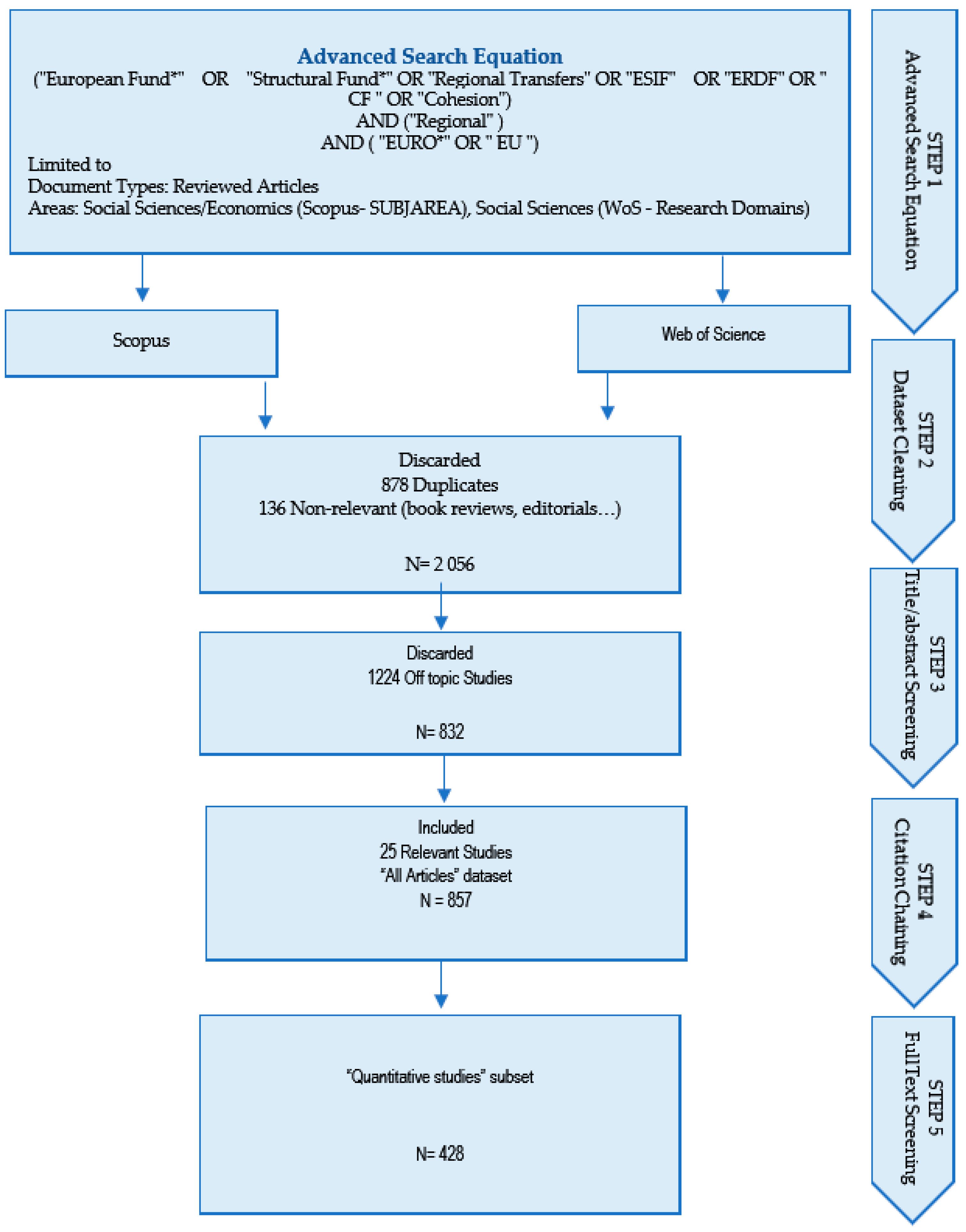
2.2. Research, Data Collection, and Treatment
3. Descriptive Analysis
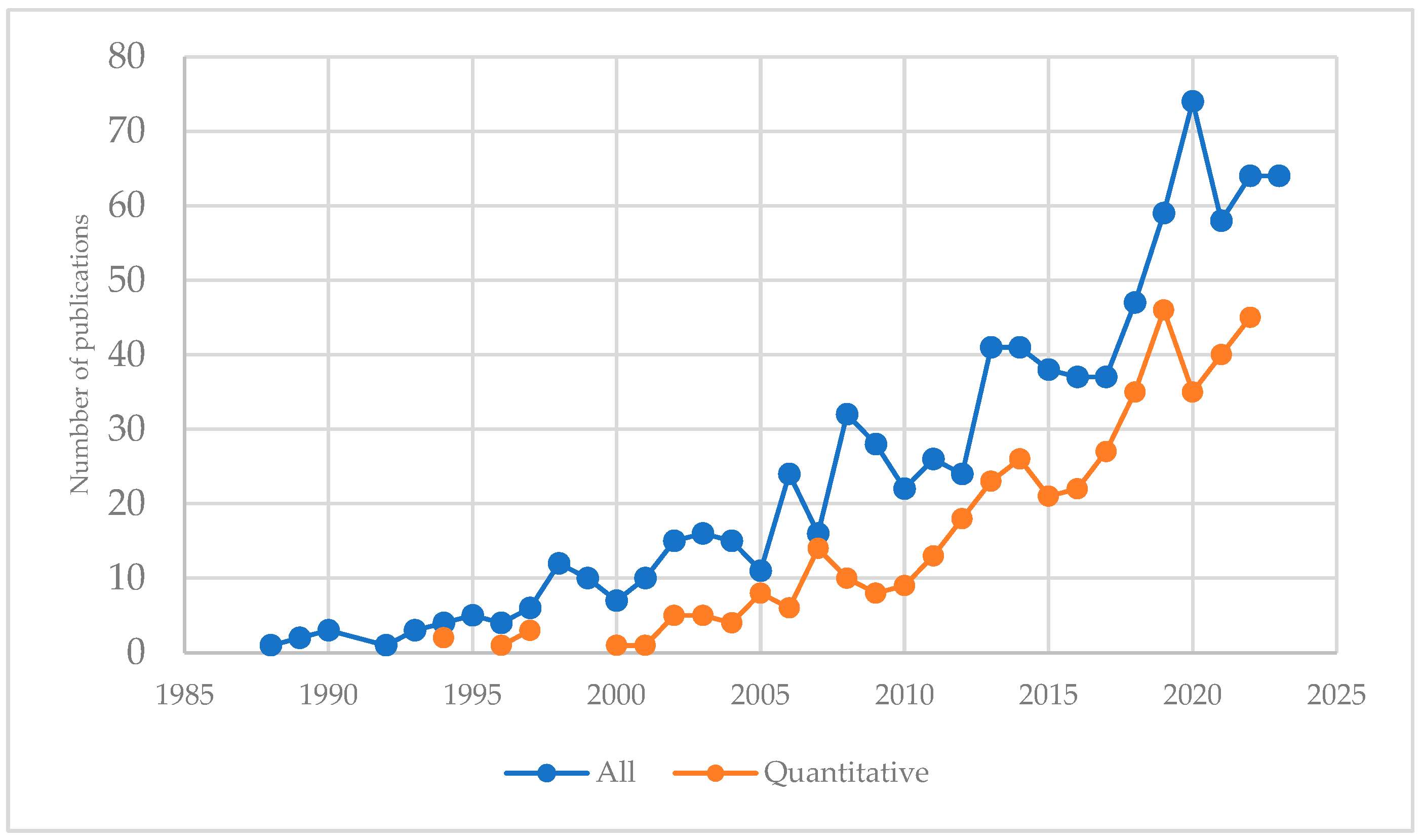
3.1. Evolution of the Scientific Production on European Cohesion Policy
3.2. Journals with the Highest Scientific Production
3.3. Authors with the Highest Scientific Production
4. Bibliometric Analysis
4.1. Keywords Co-Occurrence
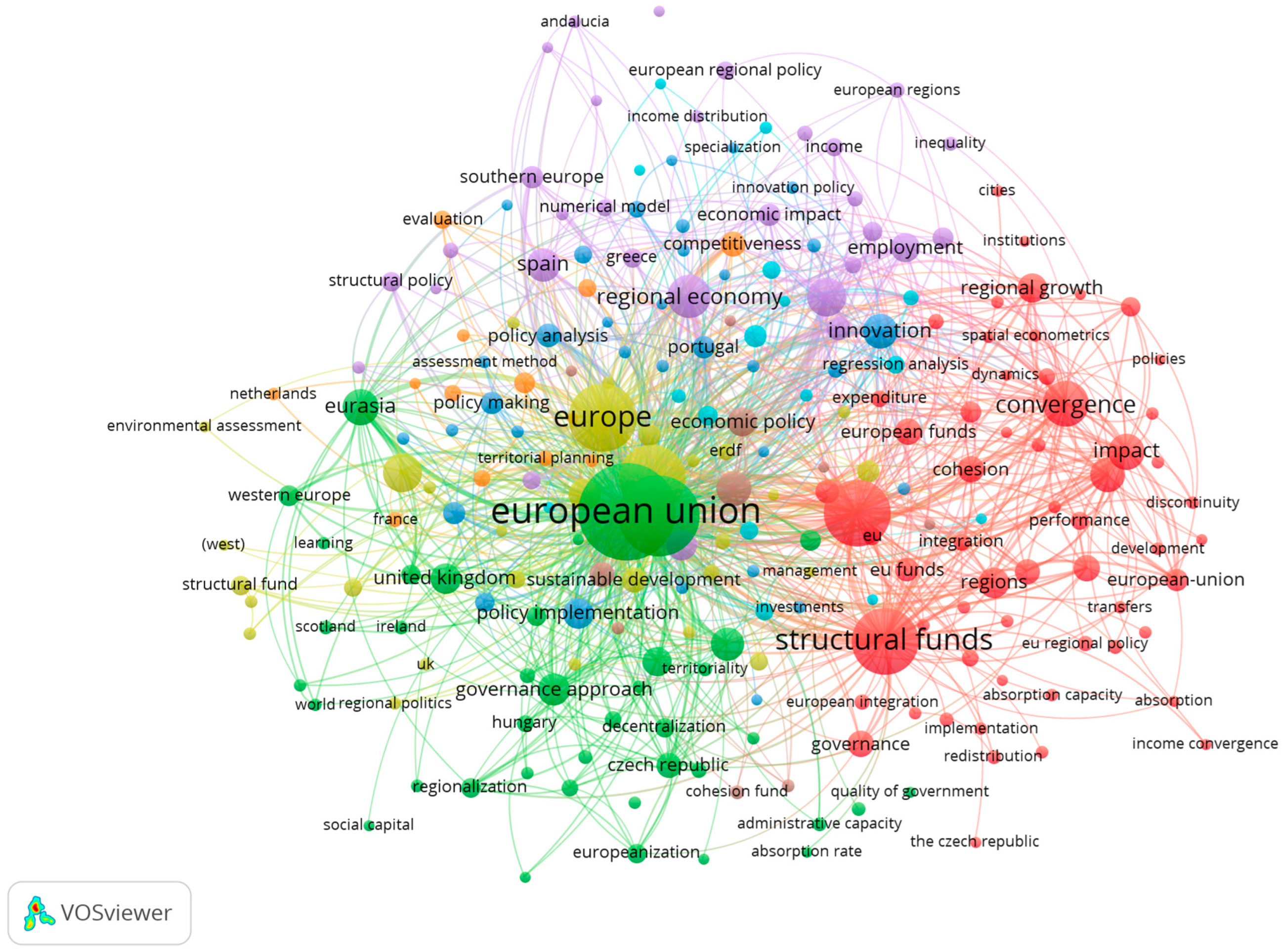
4.1.1. All Articles
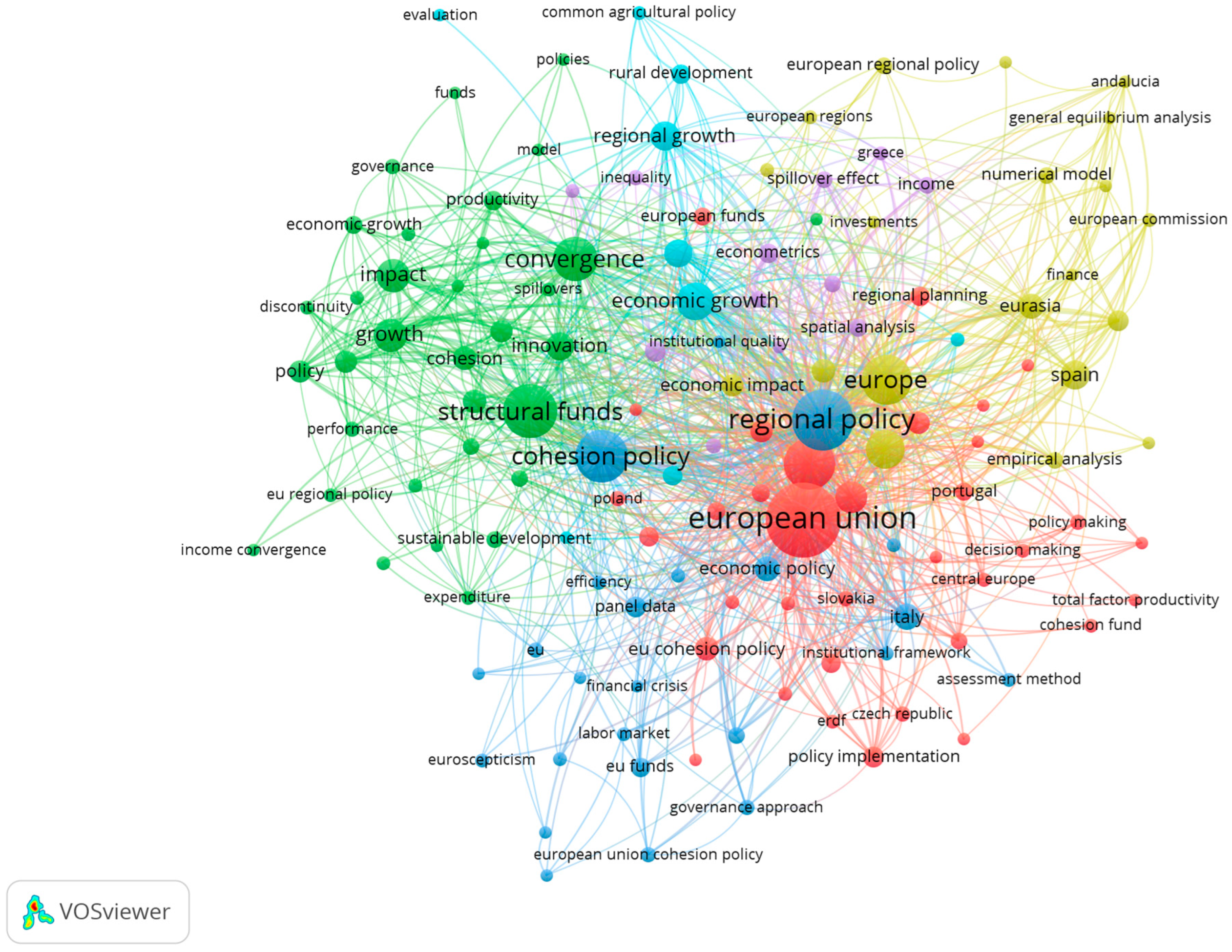
4.1.2. Quantitative Articles
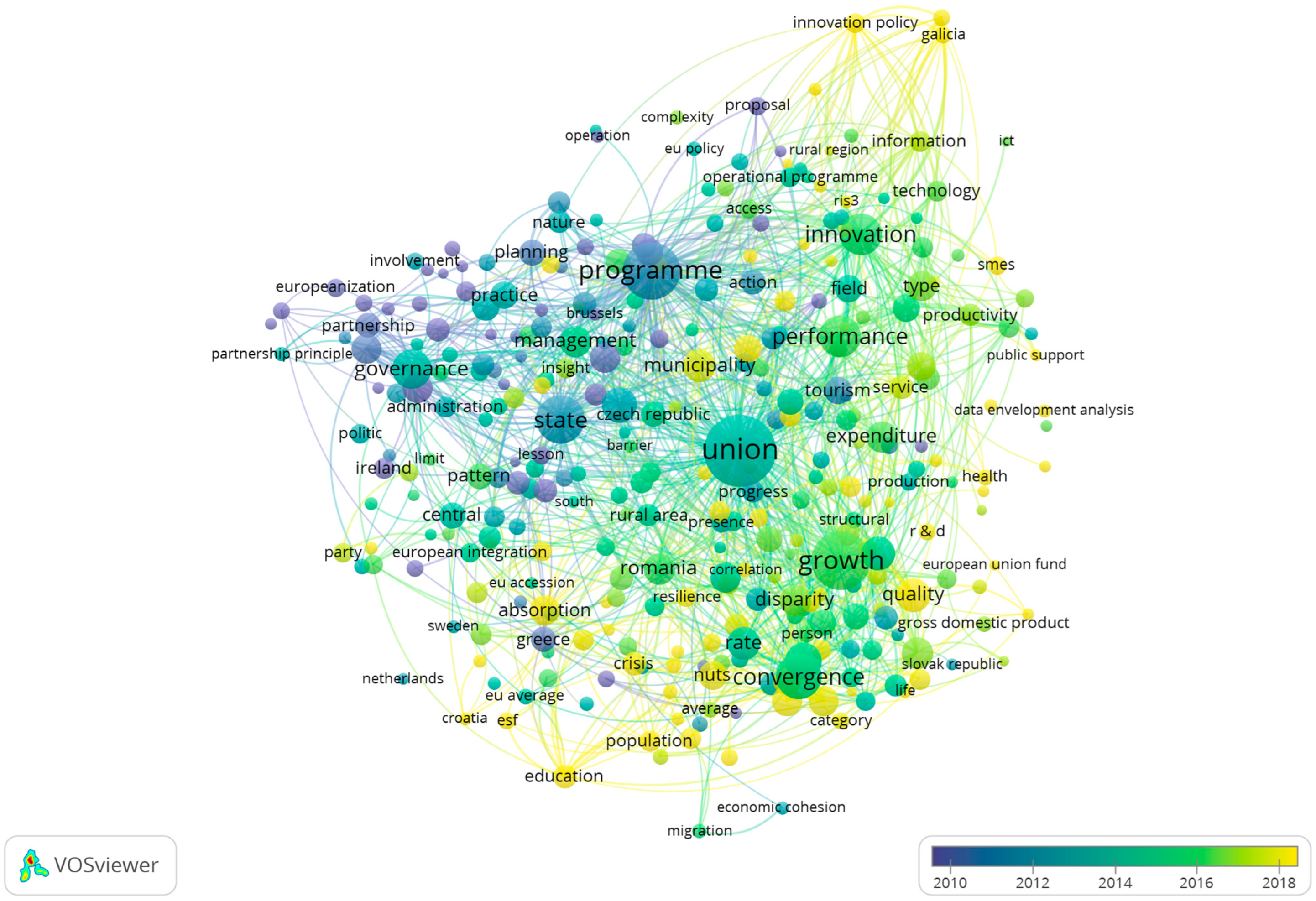
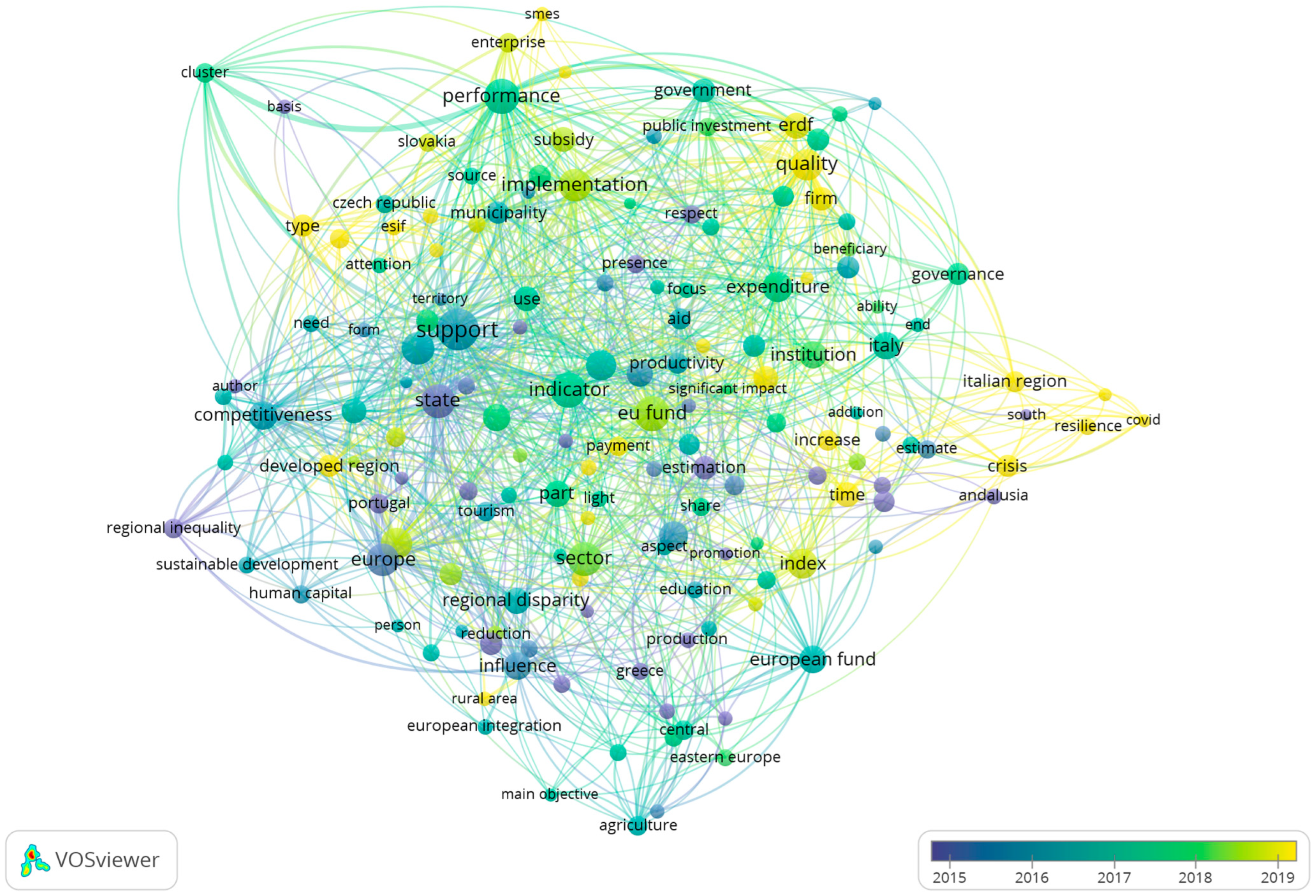
4.2. Title and Abstract Terms Co-Occurrence
4.2.1. All Articles
4.2.2. Quantitative Articles
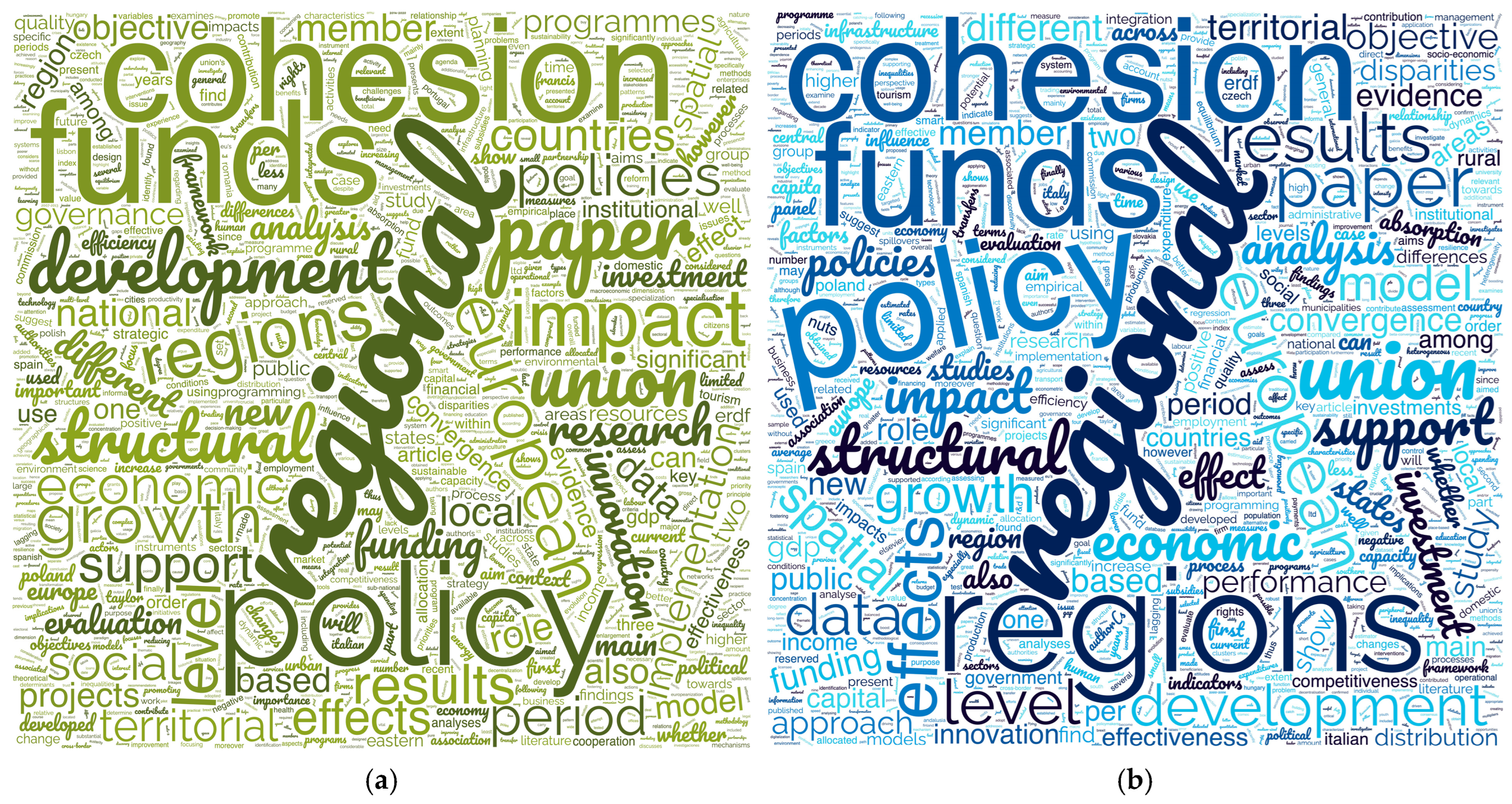
4.3. Title and Abstract Terms Word Cloud
4.4. Brief Conclusions
5. Econometric Studies on ESIF Impact
5.1. Quantifying the Impact: Econometric Analyses of ESIF Impact on Regional Growth in Europe
- Econometric Methodology: The study employs an econometric approach to assess the impact of ESIF on regional growth.
- Research Question Relevance: The study directly addresses the research question: What is the impact of ESIF on regional growth in Europe?
5.2. Characterization of the Econometric Results
6. Concluding Thoughts
Author Contributions
Funding
Institutional Review Board Statement
Informed Consent Statement
Data Availability Statement
Conflicts of Interest
Abbreviations
| DiD | Differences in Differences |
| ECP | European Cohesion Policy |
| ESIFs | European Structural and Investment Funds |
| FEs | Fixed Effects |
| GMMs | Generalized Method of Moments |
| OLSs | Ordinary Least Squares |
| MFF | Multiannual Financial Framework |
| SDM | Spatial Durbin Model |
Appendix A

| BA | Bayesian Approach: Uses Bayes’ theorem to update the probability of a hypothesis as more evidence becomes available. |
| BA PVAR | Bayesian Panel Vector Autoregressive Model: A Bayesian method that accounts for dynamic interdependencies across multiple time series and panel data. |
| DiD | Difference-in-Differences: Compares the changes in outcomes over time between a treatment group and a control group to estimate causal effects. |
| DMG | Dynamic Mean Group: Estimates long-run relationships in dynamic panel data models, allowing for heterogeneous slopes across groups. |
| FE | Fixed Effects: Controls for time-invariant characteristics in panel data by allowing individual-specific intercepts. |
| FLGS | Feasible Generalized Least Squares: An extension of GLS that estimates the covariance structure of the error terms. |
| GLS | Generalized Least Squares: Accounts for heteroskedasticity or autocorrelation in regression models. |
| GMM | Generalized Method of Moments: Uses moment conditions derived from the data to estimate parameters efficiently. |
| GMM-DIFF | Difference GMM: Applies GMM to first-differenced equations to control for unobserved fixed effects. |
| GMM-SYS | System GMM: Uses a system of equations in levels and first differences to improve efficiency in GMM estimation. |
| GWR | Geographically Weighted Regression: A local regression technique that accounts for spatial variability in the data. |
| HLATE | Heterogeneous Local Average Treatment Effect: Estimates treatment effects that vary across subpopulations. |
| IV | Instrumental Variables: Addresses endogeneity by using instruments—variables correlated with the endogenous explanatory variables but uncorrelated with the error term. |
| LSDV | Least Squares Dummy Variable: Fixed effects model with dummy variables. |
| MBA | Mean Balancing Approach: Balances treatment and control groups on observable covariates to estimate causal effects. |
| ML | Maximum Likelihood: Estimates parameters by maximizing the likelihood function, assuming a specific distribution for the error terms. |
| OLS | Ordinary Least Squares: Estimates regression parameters by minimizing the sum of squared residuals. |
| ML-SAR | Maximum Likelihood Spatial Autoregressive Model: Combines the spatial autoregressive framework with maximum likelihood estimation to determine the model parameters. |
| SEM | Spatial Error Model: Models spatial dependence in the error terms. |
| SAR | Spatial Autoregressive model: Accounts for spatial dependence by including a spatially lagged dependent variable. |
| DiD-RDD | Difference-in-Differences with Regression Discontinuity Design: Combines time-based comparisons and cutoff-based causal inference. |
| RDD | Regression Discontinuity Design: Combines time-based comparisons and cutoff-based causal inference. |
| SDPD | Spatial Dynamic Panel Data: Incorporates both spatial dependence and temporal dynamics including lagged dependent variables over time and space. |
| PSM | Propensity Score Matching: Estimates the causal effect of a treatment by matching treated and untreated units with similar propensity scores. |
| GPS | Generalized Propensity Score Matching: Extension of propensity score matching used for estimating causal effects in scenarios with multiple treatment levels or continuous treatments. |
| SDM | Spatial Durbin Model: Includes both spatially lagged dependent and independent variables to account for spatial spillover effects in the relationships between variables. |
| GAM | General Additive Mode: Allows for non-linear relationships between the dependent variable and independent variables. |
| SCM | Synthetic Control Method: Estimates causal effects by comparing the treated unit to a weighted synthetic version of untreated units. |
| RE | Random Effects Estimator: Assumes that individual-specific effects are uncorrelated with the independent variables. |
| StrEqM | Structural Equation Model: Used to test hypotheses about relationships among observed and latent variables. |
| LOGIT | LOGIT: Predicts the probability of a binary outcome. |
| MGE | Mean Group Estimator: Estimates the long-run relationships by averaging the individual coefficients obtained from time series regressions for each cross-sectional unit. |
References
- Rodríguez-Pose, A. Institutions and the fortunes of territories. Reg. Sci. Policy Pract. 2020, 12, 371–386. [Google Scholar] [CrossRef]
- Pinho, C.; Varum, C.; Antunes, M. Under What Conditions Do Structural Funds Play a Significant Role in European Regional Economic Growth? Some Evidence from Recent Panel Data. J. Econ. Issues 2015, 49, 749–771. [Google Scholar] [CrossRef]
- Butkus, M.; Mačiulytė-Šniukienė, A.; Matuzevičiūtė, K.; Cibulskienė, D. What is the return on investing European Regional Development and Cohesion Funds? Difference-in-differences Estimator Approach. Ekon. Cas. 2019, 67, 647–676. [Google Scholar]
- Dall’Erba, S.; Fang, F. Meta-analysis of the impact of European Union Structural Funds on regional growth. Reg. Stud. 2015, 51, 822–832. [Google Scholar] [CrossRef]
- Foglia, F. Is smart specialisation monopolising the research on the EU cohesion policy? Evidence from a bibliometric analysis. Scientometrics 2023, 128, 1001–1021. [Google Scholar] [CrossRef]
- Nishimura, A.Z.F.C.; Au-Yong-Oliveira, M.; Sousa, M.J. ESIF Policies and Their Impact on The Development of EU Members: A Review and Research Agenda. Qual. Access Success 2021, 22, 49–63. [Google Scholar]
- Okubo, Y. Bibliometric Indicators and Analysis of Research Systems: Methods and Examples; OECD Publishing: Paris, France, 1997. [Google Scholar]
- Kitchenham, B. Procedures for Performing Systematic Reviews; Keele University: Keele, UK, 2004; Volume 33. [Google Scholar]
- Cook, D.J.; Mulrow, C.; Haynes, R.B. Systematic Reviews: Synthesis of Best Evidence for Clinical Decisions. Ann. Intern. Med. 1997, 126, 376–380. [Google Scholar] [CrossRef]
- Wohlin, C.; Mendes, E.; Felizardo, K.R.; Kalinowski, M. Guidelines for the search strategy to update systematic literature reviews in software engineering. Inf. Softw. Technol. 2020, 127, 106366. [Google Scholar] [CrossRef]
- Cappelen, A.; Castellacci, F.; Fagerberg, J.; Verspagen, B. The Impact of EU Regional Support on Growth and Convergence in the European Union. JCMS J. Common Mark. Stud. 2003, 41, 621–644. [Google Scholar] [CrossRef]
- Ederveen, S.; de Groot, H.L.F.; Nahuis, R. Fertile Soil for Structural Funds? A Panel Data Analysis of the Conditional Effectiveness of European Cohesion Policy. Kyklos 2006, 59, 17–42. [Google Scholar] [CrossRef]
- Ederveen, S.; Gorter, J.; Mooij, R.; Nahuis, R. Funds and Games: The Economics of European Cohesion Policy; CPB Netherlands’ Bureau for Economic Policy Analysis: The Hague, The Netherlands, 2003. [Google Scholar]
- Rodríguez-Pose, A.; Fratesi, U. Between Development and Social Policies: The Impact of European Structural Funds in Objective 1 Regions. Reg. Stud. 2004, 38, 97–113. [Google Scholar] [CrossRef]
- Beugelsdijk, M.; Eijffinger, S.C.W. The Effectiveness of Structural Policy in the European Union: An Empirical Analysis for the EU-15 in 1995–2001. JCMS J. Common Mark. Stud. 2005, 43, 37–51. [Google Scholar] [CrossRef]
- Puigcerver-Peñalver, M. The Impact of Structural Funds Policy on European Regions’ Growth: A Theoretical and Empirical Approach. Eur. J. Comp. Econ. 2007, 4, 179–208. [Google Scholar]
- Bähr, C. How does Sub-National Autonomy Affect the Effectiveness of Structural Funds? Kyklos 2008, 61, 3–18. [Google Scholar] [CrossRef]
- Dall’erba, S.; Le Gallo, J. Regional convergence and the impact of European structural funds over 1989–1999: A spatial econometric analysis. Pap. Reg. Sci. 2008, 87, 219–244. [Google Scholar] [CrossRef]
- Esposti, R.; Bussoletti, S. Impact of Objective 1 Funds on Regional Growth Convergence in the European Union: A Panel-data Approach. Reg. Stud. 2008, 42, 159–173. [Google Scholar] [CrossRef]
- Ramajo, J.; Márquez, M.A.; Hewings, G.J.D.; Salinas, M.M. Spatial heterogeneity and interregional spillovers in the European Union: Do cohesion policies encourage convergence across regions? Eur. Econ. Rev. 2008, 52, 551–567. [Google Scholar] [CrossRef]
- Dall’Erba, S.; Guillain, R.; Le Gallo, J. Impact of Structural Funds on Regional Growth: How to Reconsider a 9 Year-Old Black Box. Reg. Dev. 2009, 30, 77–100. [Google Scholar]
- Becker, S.O.; Egger, P.H.; von Ehrlich, M. Going NUTS: The effect of EU Structural Funds on regional performance. J. Public Econ. 2010, 94, 578–590. [Google Scholar] [CrossRef]
- Mohl, P.; Hagen, T. Do EU structural funds promote regional growth? New evidence from various panel data approaches. Reg. Sci. Urban Econ. 2010, 40, 353–365. [Google Scholar] [CrossRef]
- Fiaschi, D.; Lavezzi, A.; Parenti, A. Productivity Growth Across European Regions: The Impact of Structural and Cohesion Funds; University of Pisa: Pisa, Italy, 2011. [Google Scholar]
- Aiello, F.; Pupo, V. Structural funds and the economic divide in Italy. J. Policy Model. 2012, 34, 403–418. [Google Scholar] [CrossRef]
- Kyriacou, A.P.; Roca-Sagalés, O. The Impact of EU Structural Funds on Regional Disparities within Member States. Environ. Plan. C Gov. Policy 2012, 30, 267–281. [Google Scholar] [CrossRef]
- Pellegrini, G.; Terribile, F.; Tarola, O.; Muccigrosso, T.; Busillo, F. Measuring the effects of European Regional Policy on economic growth: A regression discontinuity approach. Pap. Reg. Sci. 2012, 92, 217–233. [Google Scholar] [CrossRef]
- Becker, S.O.; Egger, P.H.; von Ehrlich, M. Absorptive Capacity and the Growth and Investment Effects of Regional Transfers: A Regression Discontinuity Design with Heterogeneous Treatment Effects. Am. Econ. J. Econ. Policy 2013, 5, 29–77. [Google Scholar] [CrossRef]
- Bouayad-Agha, S.; Turpin, N.; Védrine, L. Fostering the Development of European Regions: A Spatial Dynamic Panel Data Analysis of the Impact of Cohesion Policy. Reg. Stud. 2013, 47, 1573–1593. [Google Scholar] [CrossRef]
- Rodríguez-Pose, A.; Novak, K. Learning processes and economic returns in European Cohesion policy. Investig. Reg. J. Reg. Res. 2013, 25, 7–26. [Google Scholar]
- Crescenzi, R.; Giua, M. The EU Cohesion policy in context: Regional growth and the influence of agricultural and rural development policies. In LSE ‘Europe in Question’ Discussion Paper Series; European University Institute: Fiesole, Italy, 2014. [Google Scholar][Green Version]
- Fratesi, U.; Perucca, G. Territorial Capital and the Effectiveness of Cohesion Policies: An Assessment for CEE Regions. Investig. Reg. 2014, 29, 165–191. [Google Scholar]
- Pinho, C.; Varum, C.; Antunes, M. Structural Funds and European Regional Growth: Comparison of Effects among Different Programming Periods. Eur. Plan. Stud. 2014, 23, 1302–1326. [Google Scholar] [CrossRef][Green Version]
- Rodríguez-Pose, A.; Garcilazo, E. Quality of Government and the Returns of Investment: Examining the Impact of Cohesion Expenditure in European Regions. Reg. Stud. 2015, 49, 1274–1290. [Google Scholar] [CrossRef]
- Coppola, G.; Destefanis, S. Structural funds and regional convergence: Some sectoral estimates for italy. AIEL Ser. Labour Econ. 2015, 8, 307–333. [Google Scholar]
- Pellegrini, G.; Università di Roma Sapienza; DG REGIO. Measuring the Impact of Structural and Cohesion Funds Using the Regression Discontinuity Design; European Commission, Ed.; Comissão Europeia: Brussels, Belgium, 2016; Available online: https://ec.europa.eu/regional_policy/en/information/publications/evaluations/2016/measuring-the-impact-of-structural-and-cohesion-funds-using-the-regression-discontinuity-design-final-technical-report-work-package-14c-of-the-ex-post-evaluation-of-the-erd (accessed on 22 December 2025).
- Bondonio, D.; Pellegrini, G.; DG REGIO; Universitá del Piemonte Orientale; Università di Roma Sapienza. Macro-Economic Effects of Cohesion Policy Funding in 2007–2013. Executive Summary; European Commission, Ed.; Publications Office: Luxembourg, 2016. [Google Scholar]
- Crescenzi, R.; Giua, M. The EU Cohesion Policy in context: Does a bottom-up approach work in all regions? Environ. Plan. A Econ. Space 2016, 48, 2340–2357. [Google Scholar] [CrossRef]
- Gagliardi, L.; Percoco, M. The impact of European Cohesion Policy in urban and rural regions. Reg. Stud. 2016, 51, 857–868. [Google Scholar] [CrossRef]
- Pontarollo, N. Does Cohesion Policy affect regional growth? New evidence from a semi-parametric approach. In EU Cohesion Policy: Reassessing Performance and Direction; Routledge: Oxfordshire, UK, 2016; pp. 70–83. [Google Scholar]
- Arbolino, R.; Boffardi, R. The Impact of Institutional Quality and Efficient Cohesion Investments on Economic Growth Evidence from Italian Regions. Sustainability 2017, 9, 1432. [Google Scholar] [CrossRef]
- Crescenzi, R.; Fratesi, U.; Monastiriotis, V. The Eu Cohesion Policy and the Factors Conditioning Success and Failure: Evidence from 15 Regions. Reg. Mag. 2017, 305, 4–7. [Google Scholar] [CrossRef]
- Di Cataldo, M. The impact of EU Objective 1 funds on regional development: Evidence from the U.K. and the prospect of Brexit. J. Reg. Sci. 2017, 57, 814–839. [Google Scholar] [CrossRef]
- Host, A.; Zaninović, V.; Krešimir, P. Cohesion Policy Instruments and Economic Growth: Do Institutions Matter? Ekon. Misao Praksa 2017, 2, 541–559. [Google Scholar]
- Cerqua, A.; Pellegrini, G. Are we spending too much to grow? The case of Structural Funds. J. Reg. Sci. 2017, 58, 535–563. [Google Scholar] [CrossRef]
- Fiaschi, D.; Lavezzi, A.M.; Parenti, A. Does EU cohesion policy work? Theory and evidence. J. Reg. Sci. 2017, 58, 386–423. [Google Scholar] [CrossRef]
- Becker, S.O.; Egger, P.H.; von Ehrlich, M. Effects of EU Regional Policy: 1989–2013. Reg. Sci. Urban Econ. 2018, 69, 143–152. [Google Scholar] [CrossRef]
- Bourdin, S. Does the Cohesion Policy Have the Same Influence on Growth Everywhere? A Geographically Weighted Regression Approach in Central and Eastern Europe. Econ. Geogr. 2018, 95, 256–287. [Google Scholar] [CrossRef]
- Crescenzi, R.; Giua, M. One or Many Cohesion Policies of the European Union? On the Diverging Impacts of Cohesion Policy Across Member States; Spatial Economics Research Centre, LSE: London, UK, 2018. [Google Scholar]
- Piętak, Ł. Did Structural Funds Affect Economic Growth and Convergence Across Regions? Spanish Case in the Years 1989–2016; INE PAN Working Paper Series; INE PAN: Warsaw, Poland, 2018; Available online: https://inepan.pl/wp-content/uploads/2016/07/working-papers-44-Hiszpania-Pietak.pdf (accessed on 22 December 2025).
- Šlander, S.; Wostner, P. Additionality of European cohesion policy. Eur. Rev. 2018, 26, 721–737. [Google Scholar] [CrossRef]
- Bourdin, S. Analyse spatiale de l’efficacité des Fonds structurels européens sur la croissance régionale. Rev. D’économie Régionale Urbaine 2018, 2, 243–270. [Google Scholar] [CrossRef]
- Breidenbach, P.; Mitze, T.; Schmidt, C.M. EU Regional Policy and the Neighbour’s Curse: Analyzing the Income Convergence Effects of ESIF Funding in the Presence of Spatial Spillovers. JCMS J. Common Mark. Stud. 2018, 57, 388–405. [Google Scholar] [CrossRef]
- Coppola, G.; Destefanis, S.; Marinuzzi, G.; Tortorella, W. European Union and nationally based cohesion policies in the Italian regions. Reg. Stud. 2018, 54, 83–94. [Google Scholar] [CrossRef]
- Di Cataldo, M.; Monastiriotis, V. Regional needs, regional targeting and regional growth: An assessment of EU Cohesion Policy in UK regions. Reg. Stud. 2018, 54, 35–47. [Google Scholar] [CrossRef]
- Fidrmuc, J.; Hulényi, M.; Zajkowska, O. The Elusive Quest for the Holy Grail of an Impact of EU Funds on Regional Growth; CESifo Working Paper: Munich, Germany, 2019. [Google Scholar]
- Arbolino, R.; Di Caro, P.; Marani, U. Did the Governance of EU Funds Help Italian Regional Labour Markets during the Great Recession? JCMS J. Common Mark. Stud. 2019, 58, 235–255. [Google Scholar]
- Butkus, M.; Mačiulytė-Šniukienė, A.; Matuzevičiūtė, K. Heterogeneous growth outcomes of the EU’s regional financial support mediated by institutions with some empirical evidences at NUTS 3 level. Rev. Reg. Res. 2019, 40, 33–66. [Google Scholar] [CrossRef]
- Antunes, M.; Viegas, M.; Varum, C.; Pinho, C. The Impact of Structural Funds on Regional Growth: A Panel Data Spatial Analysis. Intereconomics 2020, 55, 312–319. [Google Scholar] [CrossRef]
- Butkus, M.; Cibulskienė, D.; Mačiulytė-Šniukienė, A.; Matuzevičiūtė, K. Non-Linear and Lagging Convergence Effects of the Eu’s Regional Support at Nuts 3 Level. J. Urban Reg. Anal. 2020, 12, 35–51. [Google Scholar] [CrossRef]
- Butkus, M.; Mačiulytė-Šniukienė, A.; Matuzevičiūtė, K. Mediating Effects of Cohesion Policy and Institutional Quality on Convergence between EU Regions: An Examination Based on a Conditional Beta-Convergence Model with a 3-Way Multiplicative Term. Sustainability 2020, 12, 3025. [Google Scholar] [CrossRef]
- Butkus, M.; Mačiulytė-Šniukienė, A.; Matuzevičiūtė, K.; Cibulskienė, D. Does Financial Support from ERDF and CF Contribute to Convergence in the EU? Empirical Evidence at NUTS 3 Level. Prague Econ. Pap. 2020, 29, 315–329. [Google Scholar] [CrossRef]
- Cerqua, A.; Pellegrini, G. I Will Survive! The Impact of Place-Based Policies When Public Transfers Fade Out; Mimeo: New York, NY, USA, 2020. [Google Scholar]
- Jestl, S.; Maucorps, A.; Römisch, R. The Effects of the EU Cohesion Policy on Regional Economic Growth: Using Structural Equation Modelling for Impact Assessment; The Vienna Institute for International Economic Studies, Wiiw: Wien, Austria, 2020. [Google Scholar]
- Albanese, G.; de Blasio, G.; Locatelli, A. Does EU regional policy promote local TFP growth? Evidence from the Italian Mezzogiorno. Pap. Reg. Sci. 2020, 100, 327–348. [Google Scholar] [CrossRef]
- Canova, F.; Pappa, E. What Are the Likely Macroeconomic Effects of the EU Recovery Plan? C.E.P.R. Discussion Papers: Paris, France, 2021. [Google Scholar]
- Piętak, Ł. Structural Funds and Convergence in Poland. Hacienda Publica Esp.-Rev. Public Econ. 2021, 236, 3–37. [Google Scholar] [CrossRef]
- Koudoumakis, P.; Botzoris, G.; Protopapas, A. The Contribution Of Cohesion Policy To The Development And Convergence Of The Regions Of The European Union. Reg. Sci. Inq. 2021, 13, 277–290. [Google Scholar]
- Védrine, L.; Le Gallo, J. Does EU Cohesion Policy Affect Territorial Inequalities and Regional Development? HAL: Tokyo, Japan, 2021. [Google Scholar]
- Fernández, M.; Bande, R.; Pereira, R. O Papel dos Fundos Estruturais e de Coesão no Processo de Convergência Europeia Galiza e a Região Norte. In Infraestructuras, Competitividad y Cooperación Territorial; Universidad Tecnica de Lisboa: Lisboa, Portugal, 2021; pp. 366–396. Available online: https://www.researchgate.net/publication/349408705_O_papel_dos_fundos_estruturais_e_de_coesao_no_Processo_de_convergencia_europeia_Galiza_e_a_regiao_Norte (accessed on 22 December 2025).
- Di Caro, P.; Fratesi, U. One policy, different effects: Estimating the region-specific impacts of EU cohesion policy. J. Reg. Sci. 2021, 62, 307–330. [Google Scholar] [CrossRef]
- Destefanis, S.; Di Serio, M.; Fragetta, M. Regional multipliers across the Italian regions. J. Reg. Sci. 2022, 62, 1179–1205. [Google Scholar] [CrossRef]
- Di Caro, P.; Fratesi, U. The role of Cohesion Policy for sustaining the resilience of European regional labour markets during different crises. Reg. Stud. 2022, 57, 2426–2442. [Google Scholar] [CrossRef]
- Scotti, F.; Flori, A.; Pammolli, F. The economic impact of structural and Cohesion Funds across sectors: Immediate, medium-to-long term effects and spillovers. Econ. Model. 2022, 111, 105833. [Google Scholar] [CrossRef]
- Staehr, K.; Urke, K. The European structural and investment funds and public investment in the EU countries. Empirica 2022, 49, 1031–1062. [Google Scholar] [CrossRef]
- Coppola, G.; Destefanis, S.; Marinuzzi, G.; Tortorella, W. Regional policies and sectoral outputs in Italy. Reg. Stud. 2023, 57, 2192–2206. [Google Scholar] [CrossRef]
- Fusaro, S.; Scandurra, R. The impact of the European social fund on youth education and employment. Socio-Econ. Plan. Sci. 2023, 88, 101650. [Google Scholar] [CrossRef]
- Veneri, P.; Diaz Ramirez, M.; Kleine-Rueschkamp, L. Does European Cohesion Policy affect Regional Business Dynamics? Investig. Reg. J. Reg. Res. 2023, 57, 5–31. [Google Scholar] [CrossRef]
- Hagen, T.; Mohl, P. Econometric evaluation of EU Cohesion Policy: A survey. In International Handbook on the Economics of Integration, Volume Iii: Factor Mobility, Agriculture, Environment and Quantitative Studies; Springer: Berlin/Heidelberg, Germany, 2011; pp. 343–370. [Google Scholar]


| No. | All | Quantitative | ||
|---|---|---|---|---|
| Journal | Studies | Journal | Studies | |
| 1 | Regional Studies | 85 | Regional Studies | 55 |
| 2 | European Planning Studies | 53 | European Planning Studies | 19 |
| 3 | Investigaciones Regionales | 24 | Investigaciones Regionales | 17 |
| 4 | European Urban and Regional Studies | 17 | Papers in Regional Science | 14 |
| 5 | Sustainability (Switzerland) | 16 | Journal of Regional Science | 10 |
| 6 | Regional and Federal Studies | 15 | Sustainability (Switzerland) | 10 |
| 7 | Papers in Regional Science | 15 | Journal of Common Market Studies | 8 |
| 8 | Journal of Common Market Studies | 13 | Socio-Economic Planning Sciences | 6 |
| 9 | Journal of Regional Science | 10 | Regional Science and Urban Economics | 5 |
| 10 | European Environment | 10 | - | - |
| No. | All | Quantitative | ||
|---|---|---|---|---|
| Author | Studies | Author | Studies | |
| 1 | Rodríguez-Pose, A. | 12 | Rodríguez-Pose, A. | 11 |
| 2 | Crescenzi, R. | 10 | Butkus, M. | 9 |
| 3 | Butkus, M. | 9 | Maciulyte-Sniukiene, A. | 9 |
| 4 | Fratesi, U. | 9 | Pellegrini, G. | 9 |
| 5 | Maciulyte-Sniukiene, A. | 9 | Crescenzi, R. | 8 |
| 6 | Pellegrini, G. | 9 | Fratesi, U. | 8 |
| 7 | Bachtler, J. | 8 | Matuzevičiute, K. | 8 |
| 8 | Dąbrowski, M. | 8 | Arbolino, R. | 7 |
| 9 | Dall’erba, S. | 8 | Cardenete, M. A. | 7 |
| 10 | Giua, M. | 8 | Dall’erba, S. | 7 |
| 11 | Matuzevičiute, K. | 8 | De Blasio, G. | 7 |
| 12 | Arbolino, R. | 7 | Di Caro, P. | 7 |
| 13 | Barbero, J. | 7 | Giua, M. | 7 |
| 14 | Cardenete, M. A. | 7 | Barbero, J. | 6 |
| 15 | De Blasio, G. | 7 | Cerqua, A. | 6 |
| 16 | Di Caro, P. | 7 | Gallo, J. L. | 6 |
| Number of Authors | All | Quantitative | ||
|---|---|---|---|---|
| Number of Studies | % | Number of Studies | % | |
| 1 | 274 | 32.0% | 88 | 20.6% |
| 2 | 263 | 30.7% | 127 | 29.7% |
| 3 | 210 | 24.5% | 143 | 33.4% |
| 4 | 74 | 8.6% | 47 | 11.0% |
| 5 and above | 36 | 4.2% | 23 | 5.4% |
| Cluster | Keywords | |
|---|---|---|
| 1—Core Concepts of ECP | absorption; absorption capacity; agglomeration; allocation; cities; cohesion; cohesion policy; competition; convergence; development; discontinuity; disparities; dynamics; economic geography; economic-growth; efficiency; EU; EU funds; European integration; European structural funds; European union regional policy; European-union; euroscepticism; expenditure; funds; governance; government; growth; impact; implementation; income convergence; indicators; infrastructure; institutional quality; institutions; integration; model; panel data; performance; policy; politics; redistribution; region; regional disparities; regional economic growth; regional growth; regions; spatial econometrics; spillovers; structural and cohesion funds; structural funds; the Czech Republic; transfers; union; EU regional policy; European funds; policies; productivity. | |
| 2—Governance and Implementation of ECP | absorption rate; administrative capacity; administrative framework; brexit; Bulgaria; central Europe; Czech Republic; decentralization; Eastern hemisphere; EU cohesion policy; EU structural funds; Eurasia; European Union; European Union cohesion policy; europeanisation; europeanization; financial policy; governance approach; Hungary; institutional framework; Ireland; learning; multi-level governance; multilevel governance; partnership; partnership approach; Poland; political economy; quality of government; regional policies; regional policy; regionalism; regionalization; Scotland; social capital; structural change; territoriality; United Kingdom; Western Europe; world. | |
| 3—Economic Development Strategies in ECP | assessment method; cost–benefit analysis; decision making; development strategy; eastern Europe; economics; entrepreneurship; estimation method; financial crisis; industrial policy; innovation; innovation policy; investment; modelling; peripheral region; policy analysis; policy implementation; policy making; policy strategy; Portugal; public policy; public sector; research and development; resilience; smart specialization; smart specialization; specialization; stakeholder; strategic approach; technological development; technology policy; tourism; transport infrastructure. | |
| 4—Funding instruments and sustainability | cluster analysis; data envelopment analysis; economic development; environmental assessment; ERDF; Europe; Europe, (west); European cohesion policy; European Community; European regional dev. fund; European social fund; European structural and inv.funds; financial provision; management; policy approach; regional development; regional planning; regional politics; renewable energy; resource allocation; Romania; small and medium-sized enterprise; SMES; structural adjustment; structural fund; sustainability; sustainable development; UK; urban development; west. | |
| 5—Economic Impact of ECP | Andalucia; econometrics; economic growth; economic impact; economic planning; empirical analysis; employment; European commission; European regional policy; European regions; finance; general equilibrium analysis; Greece; gross domestic product; heterogeneity; human capital; income; income distribution; inequality; Italy; numerical model; policy development; regional convergence; regional economy; social accounting matrix; Southern Europe; Spain; spillover effect; structural policy; unemployment. | |
| 6—Rural Transformation, Labour Markets, and ECP | capital; common agricultural policy; comparative study; labuor market; local government; migration; policy impact; policy reform; public spending; regression analysis; regression discontinuity design; rural area; rural development; rural policy; Slovakia; spatial analysis. | |
| 7—Cross-Border Cooperation and Territorial Development | border region; competitiveness; cross-border cooperation; evaluation; France; Germany; Interreg; Netherlands; Poland [central Europe]; socioeconomic conditions; territorial cohesion; territorial management; territorial planning. | |
| 8—Infrastructure Investment and Economic Growth in ECP | cohesion fund; economic activity; economic integration; economic policy; European regional dev. fund (ERDF); investments; spatial distribution; subsidies; total factor productivity; transportation infrastructure. | |
| Cluster | Keywords | |
|---|---|---|
| 1—Economic Convergence and Cohesion Policy | Central Europe; cohesion fund; competitiveness; Czech Republic; data envelopment analysis; decision making; economic activity; economic development; economic integration; ERDF; EU cohesion policy; European cohesion policy; European funds; European regional dev. fund (ERDF); European struct. and inv. funds; European Union; Hungary; investment; Poland; Poland [Central Europe]; policy analysis; policy implementation; policy making; Portugal; regional convergence; regional development; regional planning; Romania; Slovakia; spatial distribution; structural change; sustainability; territorial cohesion; total factor productivity; transport infrastructure. | |
| 2—Impact of Cohesion Funds on Regional Growth | agglomeration; allocation; cohesion; convergence; discontinuity; economic geography; economic-growth; EU regional policy; EU structural funds; European-Union; expenditure; funds; governance; government; growth; impact; income convergence; infrastructure; innovation; integration; model; performance; policies; policy; productivity; regional disparities; regional economic growth; regions; spillovers; structural and cohesion funds; structural funds; sustainable development; union. | |
| 3—Governance, Institutions, and Cohesion Policy Effectiveness | absorption capacity; administrative capacity; assessment method; brexit; cohesion policy; decentralization; economic policy; efficiency; EU; EU funds; European Union cohesion policy; euroscepticism; financial crisis; governance approach; institutional framework; institutional quality; Italy; labour market; modelling panel data; public spending; quality of government; regional policy; United Kingdom. | |
| 4—Econometric Analysis of Cohesion Policy Impacts | Andalucía; economic impact; empirical analysis; Eurasia; Europe; European Commission; European regional policy; European regions; finance; general equilibrium analysis; gross domestic product; investments; numerical model; regional economy; smart specialization; social accounting matrix; southern Europe; Spain; structural policy; transportation infrastructure. | |
| 5—Spatial Econometrics and Cohesion Policy | econometrics; estimation method; European structural funds; Greece; heterogeneity; human capital; income; income distribution; inequality; spatial analysis; spatial econometrics; spillover effect. | |
| 6—Rural Transformation, Labour Markets, and ECP | common agricultural policy; economic growth; employment; evaluation; policy impact; regional growth; regression analysis; regression discontinuity design; rural development. | |
| Author(s) | Year | Main Results (Impact of ESIFs) | Analysis | Econometric Methodology | Period | Units |
|---|---|---|---|---|---|---|
| Cappelen, A., et al. [11] | 2003 | Positive effect on growth, but stronger in more developed regions | Economic Growth | OLS | 1980–1997 | 105 NUTS-1/2 EU-15 |
| Ederveen, S., H.L.F. de Groot, and R. Nahuis [12] | 2003 | On average, ineffective. Positive and significant impact, but only in countries with good institutional quality | Economic Growth | OLS | 7 periods of 5 years, 1960–1995 | EU-13 Countries |
| Ederveen, S., et al. [13] | 2003 | Positive and significant impact, only in a model with specific regional effects | Economic Growth | OLS | 1981–1996 | 183 NUTS-2 EU-15 |
| Rodríguez-Pose, A. and U. Fratesi [14] | 2004 | Very weak but positive and significant impact. Support for agriculture has short-term positive effects on growth, but wanes quickly. Only investment in education and human capital has medium-term positive and significant returns | Economic Growth | OLS, LSDV, GLS | 1989–1999 | 152 NUTS-2 EU-15 |
| Beugelsdijk, M. and S.C.W. Eijffinger [15] | 2005 | Positive impact on growth and convergence | Economic Growth/ Convergence | GMM | 1984–2002 | EU-15 Countries |
| Puigcerver-Peñalver, M. [16] | 2007 | Positive and significant impact, but stronger in the first programming period | Economic Growth | OLS; FE | 1989–1993 1994–1999 | 41 Regions Obj. 1 EU-15 |
| Bähr, C. [17] | 2008 | Positive and significant impact when decentralization is accounted | Economic Growth | OLS | 1960–1995 (7 periods) | EU-13 Countries |
| Dall’erba, S. and J. Le Gallo [18] | 2008 | Positive benefit on growth, but in least developed regions that growth suffers from the small extent of regional spillover effects | Economic Growth | ML, GMM, SEM | 1989–1999 | 145 NUTS-2 EU-12 |
| Esposti, R. and S. Bussoletti [19] | 2008 | Positive impact on growth, but modest | Economic Growth | GMM-SYS; GMM-DIFF | 1989–1999 | 206 NUTS-2 EU-15 |
| Ramajo, J., et al. [20] | 2008 | faster conditional convergence in regions belonging to Cohesion Countries (Ireland, Greece, Portugal and Spain) | Convergence | OLS, ML-SAR | 1981–1996 | 163 NUTS-2 EU-12 |
| Dall’Erba, S., R. Guillain, and J. Le Gallo [21] | 2009 | Significant impact, but negative | Productivity | OLS, SAR | 1989–1999 1989–2004 | 145 NUTS-2 EU-12 |
| Becker, S.O., P.H. Egger, and M. von Ehrlich [22] | 2010 | Positive and cost effective impact on growth in Obj. 1 regions, but not significant on employment | Economic Growth/ Employment | DiD-RDD | 1989–1993 1994–1999 2000–2006 | NUTS-2/3 EU-25 |
| Mohl, P. and T. Hagen [23] | 2010 | Positive and significant impact in Obj. 1 regions | Economic Growth | LSDV, GMM, SYS-GMM, FE-SAR | 1995–2006 | 124 NUTS-1/2 |
| Fiaschi, D., A. Lavezzi, and A. Parenti [24] | 2011 | Positive effect on productivity growth, but larger impact of Obj.1 funds | Productivity | OLS, SDM | 1980–2002 | 173 NUTS-2 EU-12 |
| Aiello, F. and V. Pupo [25] | 2012 | Positive impact on convergence, but low and no impact in terms of productivity | Economic Growth/ Productivity | GMM-SYS, LSDV | 1996–2007 | Italian Macro-regions |
| Kyriacou, A.P. and O. Roca-Sagalés [26] | 2012 | Positive and significant impact in regional disparities reduction | Convergence | FGLS | 1994–1999 2000–2006 | EU-14 Countries |
| Pellegrini, G., et al. [27] | 2012 | Positive and significant impact | Economic Growth | RDD | 1994–1999 2000–2006 | NUTS-2 EU-15 |
| Becker, S.O., P.H. Egger, and M. von Ehrlich [28] | 2013 | Positive impact in 30% of regions | Economic Growth | RDD, HLATE | 1989–1993 1994–1999 2000–2006 | 186 to 251 NUTS-2 EU-25 |
| Bouayad-Agha, S., N. Turpin, and L. Védrine [29] | 2013 | Positive and significant impact | Economic Growth | GMM, SDPD | 1980–2005 | 143 NUTS-1/2 UE-14 |
| Rodríguez-Pose, A. and K. Novak [30] | 2013 | Positive, mostly insignificant impact but marked improvement between the second and third programming periods | Economic Growth | FE | 1994–1999 2000–2006 | 133 NUTS-1/2 EU-15 |
| Crescenzi, R. and M. Giua [31] | 2014 | Positive and significant impact, but more positive in regions with most favourable socio-economic environment | Economic Growth | FE, SAR | 1994–1999 2000–2006 2007–2013 | 139 NUTS-1 and NUTS-2 EU-12 |
| Fratesi, U. and G. Perucca [32] | 2014 | Positive and significant impact, more effective when there is territorial capital | Economic Growth | OLS | 2006–2010 | 108 NUTS-3 EU-14 |
| Pinho, C., C. Varum, and M. Antunes [33] | 2015 | Positive and significant impact, especially in richer regions, with higher levels of education. Cohesion regions do not convert more transfers into more growth | Economic Growth | FE | 1995–1999 2000–2006 2007–2013 | 92 NUTS-1/2 EU-12 |
| Pinho, C., C. Varum, and M. Antunes [2] | 2015 | Positive and significant impact, but in regions with low levels of human capital and innovation | Economic Growth | FE | 1995–2009 | 137 NUTS-1/2 |
| Rodríguez-Pose, A. and E. Garcilazo [34] | 2015 | Positive and significant impact but above a threshold government quality improvements are more important | Economic Growth | FE | 1996–2007 | 169 NUTS-1/2 in 18 EU Countries |
| Coppola, G. and Destefanis, S. [35] | 2015 | Weak, but significant, impact on total factor productivity change but virtually no effect on capital accumulation or employment | Productivity, Employment, TPF | FE | 1989–2006 | 20 Italian NUTS-2 |
| Pellegrini, G., EC: DG REGIO and Università di Roma Sapienza [36] | 2016 | Positive and significant impact | Economic Growth | RDD | 1994–1999 2000–2006 | 202 NUTS-2 EU-27 |
| Bondonio, D., et al. [37] | 2016 | Positive impact, more intense in Obj. 1 regions | Economic Growth | RDD, PSM, GPS | 1994–1999 2000–2006 2007–2013 | 259 NUTS-2 EU-15 |
| Crescenzi, R. and M. Giua [38] | 2016 | ESIFs associated with stronger regional growth rates in all regions; however, stronger in the regions with the most favourable socio-economic environment | Economic Growth | FE, SAR, SDM, SEM | 1994–1999 2000–2006 2007–2013 | 139 NUTS-1/2 EU-15 |
| Gagliardi, L. and M. Percoco [39] | 2016 | Positive and significant impact, particularly evident for rural areas close to the city | Economic Growth | RDD, OLS | 2000–2006 | 1233 NUTS-3 |
| Pontarollo, N. [40] | 2016 | Positive impact for both the growth of productivity and GDP per capita is not always the case | Economic Growth/ Productivity | GAM | 2000–2006 | 202 NUTS-2 EU-15 |
| Arbolino, R. and R. Boffardi [41] | 2017 | Positive and significant impact, but the magnitude depends on institutional quality | Economic Growth | FE | 2007–2015 | 20 NUTS-2 Italy |
| Crescenzi, R., U. Fratesi, and V. Monastiriotis [42] | 2017 | Positive impact, however, the magnitude is conditioned on the structure of the expenditure, more than on individual regional characteristics | Economic Growth | FE | 1989–2013 | 15 NUTS-2 |
| Di Cataldo, M. [43] | 2017 | Positive impact on growth and employment, but the effect may not be long-lasting | Economic Growth/ Employment | SCM, DiD | 1994–1999 2000–2006 2007–2013 | 134 wards from Cornwall and 94 from South Yorkshire, UK |
| Host, A., V. Zaninović, and P. Krešimir [44] | 2017 | Positive impact is significant only in those countries where the institutional quality is at a high level | Economic Growth | FE, RE, OLS | 2000–2013 | EU-27 Countries |
| Cerqua, A. and G. Pellegrini [45] | 2017 | Average positive effect on regional growth, but the estimated function is concave and presents a maximum value | Economic Growth | RDD | 1994–2006 | 208 NUTS-2 EU-15 |
| Fiaschi, D., A.M. Lavezzi, and A. Parenti [46] | 2017 | Positive impact on labour productivity, only from Obj. 1 funds and other funds different from Obj. 2 | Productivity | OLS, SDM | 1991–2008 | 175 NUTS-2 EU-28 |
| Becker, S.O., P.H. Egger, and M. von Ehrlich [47] | 2018 | Positive and significant impact (short-lived) | Economic Growth, Employment, Investment | RDD | 1989–1993 1994–1999 2000–2006 2007–2013 | 187 to 253 NUTS-2 EU-25 |
| Bourdin, S. [48] | 2018 | Differentiated effects of the cohesion policy according to EU regions and their institutional quality | Economic Growth | GWR | 2000–2014 | 248 EU NUTS-2 |
| Crescenzi, R. and M. Giua [49] | 2018 | Positive and significant effect on both growth and employment in the EU. However, the regional impacts are not uniform across the Member States | Economic Growth | RDD | 2000–2010 2010–2014 | NUTS-3 AT, BE, FI, DE, IT, ES, UK |
| Piętak, Ł [50] | 2018 | Positive and significant impact in Spanish regions. The impact on the convergence process was insignificant | Economic Growth/ Convergence | GMM, GMM-SYS, OLS, FE | 1989–2016 | 17 NUTS-2 Spain |
| Šlander, S. and P. Wostner [51] | 2018 | CP increases public development investments in target areas, which should lead to stronger growth performance | Structural Public Expense | FE | 1990–1993 1994–1999 2000–2006 | EU-15 Countries |
| Bourdin, S. [52] | 2018 | Significant positive influence of the cohesion policy on growth, higher for core regions | Economic Growth | SDM; GWR | 2000–2016 | 147 Central and Eastern NUTS-3 |
| Breidenbach, P., T. Mitze, and C.M. Schmidt [53] | 2018 | Contribution is insignificant or even negative for several peripheral EU regions, due to spatial spillovers and lower levels of institutional quality | Economic Growth | FE, GMM-SYS, Spatial GMM-SYS | 1997–2007 | 127 NUTS-2 EU-15 |
| Coppola, G., et al. [54] | 2018 | EU funds have a significant effect on GDP per capita, both with and without national co-financing | Economic Growth | FE | 1994–2013 | 20 Italian NUTS-2 |
| Di Cataldo, M. and V. Monastiriotis [55] | 2018 | ECP interventions are highly productive in the UK, irrespective of place and local conditions | Economic Growth | FE | 1994–2013 | 37 UK NUTS-2 |
| Butkus, M., et al. [3] | 2019 | No positive or negative return on investing SF if all expenditures and funds are considered together. Positive return on ERDF. CF has a negative return in terms of regional disparities | Convergence | DiD | 1995–1999 2000–2006 2007–2012 | 1251 NUTS-3 EU-25 |
| Fidrmuc, J., M. Hulényi, and O. Zajkowska [56] | 2019 | Significant and positive effect on growth. Inter-regional spillovers are important. Positive impact of institutional quality | Economic Growth | OLS, IV, SDM | 1994–2014 | 272 NUTS-2 EU-28 |
| Arbolino, R., P. Di Caro, and U. Marani [57] | 2019 | Positive contribution to the resilience of Italian regional labour markets, but significant only when institutional quality is accounted for | Labour Markets | GLS, GMM | 2007–2013 | 20 NUTS-2 Italy |
| Butkus, M., A. Mačiulytė-Šniukienė, and K. Matuzevičiūtė [58] | 2019 | Positive effect on growth, but strong conditioning by the institutional quality of the regions | Economic Growth | FE | 1995–1999 2000–2006 | 1247 NUTS-3 UE-25 |
| Antunes, M., et al. [59] | 2020 | No positive impact is detected | Economic Growth | OLS, FE, SDM | 1995–2009 | 96 NUTS-2 EU-28 |
| Butkus, M., A. Mačiulytė-Šniukienė, and K. Matuzevičiūtė [60] | 2020 | Direction, size, and significance of the effect of the CP commitment intensity on growth and productivity are conditional on institutional quality | Economic Growth/Productivity | FE | 2000–2006 2007–2013 | 270 NUTS-2 and 1326 NUTS-3 EU-25 |
| Butkus, M., et al. [61] | 2020 | 2000–2006 had an overall negative effect on convergence dynamics. Only ERDF Obj. 2 contributed positively to convergence | Convergence | DiD | 2000–2006 | NUTS-3 EU-25 |
| Butkus, M., et al. [62] | 2020 | Impact of regional support on convergence is positive with the diminishing marginal effect as the intensity of payments increases | Convergence | FE, DiD | 2000–2006 2007–2011 2009–2013 | 1251 NUTS-3 EU-25 |
| Cerqua, A. and G. Pellegrini [63] | 2020 | Results are consistent with the hypothesis that the EU regional policy is effective not only in the short term but also in the long term | Economic Growth | MBA | 1991–2015 | 37 NUTS-2 EU-15 |
| Jestl, S., A. Maucorps, and R. Römisch [64] | 2020 | Negative effect of structural laggardness growth and a statistically significant, positive effect of funding. Also, an inadequate allocation of CP funding | Economic Growth | StrEqM | 2008–2016 | 276 EU25 NUTS-2 |
| Albanese, G., G. de Blasio, and A. Locatelli [65] | 2020 | Positive effect only for the part of the ERDF expenditure devoted to infrastructure. Characteristics of local context do matter | TFP Growth | Several Methods | 2007–2015 | Southern Italy LLMs |
| Canova, F. and E. Pappa [66] | 2021 | ERDF has a positive short-term impact but gains typically dissipate within 3 years. ESF has a negative or insignificant impact, but exercises positive average effects after 2–3 years | Output, employment, productivity, investment, and labour part. | IV, BA | 1980–2017 | 279 NUTS-2 EU-28 |
| Piętak, Ł. [67] | 2021 | The influence of structural funds on convergence was positive but very weak in Poland | Economic Growth/ Convergence | FE, GMM | 2004–2016 | 16 NUTS-2 Poland |
| Koudoumakis, P., G. Botzoris, and A. Protopapas [68] | 2021 | Positive and significant impact on the development and convergence of regions with a GDP p.c. PPS lower than 90% of the EU average | Economic Growth | FE | 1986–2016 | 237 EU Regions |
| Védrine, L. and J. Le Gallo [69] | 2021 | Positive influence on growth. Trade-off between within and between regional disparities over the 2000–2014 | Economic Growth | FE, SAR | 2000–2014 | 205 NUTS-2 EU-25 |
| Fernández, M., R. Bande, and R. Pereira [70] | 2021 | Funds’ impact on the positive public stock cap in Galicia. In Portugal, the possible crowding-out of public investment | Production, Investment, Labour Demand | OLS | 1980–2001 | 23 NUTS-2 ES and PT |
| Di Caro, P. and U. Fratesi [71] | 2021 | Positive and significant effects were registered in about 40% of regions. Effectiveness does not necessarily depend on the level of assistance, but can be related to the presence of a selected number of national and regional contextual factors | Economic Growth | DMG, LOGIT | 1989–2015 | 250 NUTS-2 EU-25 |
| Destefanis, S., M. Di Serio, and M. Fragetta [72] | 2022 | ESIF provides the largest and most pervasively significant GDP multipliers. Nationally funded government investment and government consumption shocks are more limited | Economic Growth | BA PVAR | 1994–2016 | 20 NUTS-2 Italy |
| Di Caro, P. and U. Fratesi [73] | 2022 | Positive and significant effects during all the recessionary events, although with regional variation regarding regional labour market resilience. Region and crisis-specific patterns during different shocks | Employment | MGE | 1980–2015 | 255 NUTS-2 EU-28 |
| Scotti, F., A. Flori, and F. Pammolli [74] | 2022 | Different Impacts depending on Sector. Larger spillovers in Belgium, the Netherlands, and Slovakia | Economic Growth/ spillovers | OLS, FE, GMM, SDM, GPS | 2007–2014 | 258 NUTS-2 EU-27 |
| Staehr, K. and K. Urke [75] | 2022 | ERDF may have had some effect, but it cannot be estimated precisely. Other ESIF does not seem to have been related to public investment in the EU countries | Public Investment | FE | 2000–2018 | EU-28 Countries |
| Coppola, G. et al. [76] | 2023 | Significant impact on sectoral products, in particular the ERDF as well as on aggregate GDP per capita | Multi-input, multi-output transf. function | FE | 1994–2016 | 20 Italian NUTS-2 |
| Fusaro, S. and R. Scandurra [77] | 2023 | Positive impact on population with lower-secondary and tertiary education, negative impact on those with upper-secondary education. In employment, positive response for youth of all ed. levels | Youth education and employment | FE, IV | 2007–2018 | NUTS-2 EU-27 |
| Veneri, P., M. Diaz Ramirez, and L. Kleine-Rueschkamp [78] | 2023 | Regional transfers induce positive business dynamics’ outcomes. Foster the net rate of firm creation and the jobs associated, raising regional labour productivity | Business Dynamics | RDD | 2007–2013 | 159 NUTS-2 in 18 EU Countries |
Disclaimer/Publisher’s Note: The statements, opinions and data contained in all publications are solely those of the individual author(s) and contributor(s) and not of MDPI and/or the editor(s). MDPI and/or the editor(s) disclaim responsibility for any injury to people or property resulting from any ideas, methods, instructions or products referred to in the content. |
© 2026 by the authors. Licensee MDPI, Basel, Switzerland. This article is an open access article distributed under the terms and conditions of the Creative Commons Attribution (CC BY) license.
Share and Cite
Lobo, P.; Bande, R. The European Cohesion Funds Policy in the Regional Science Literature: A Systematic Review. Reg. Sci. Environ. Econ. 2026, 3, 3. https://doi.org/10.3390/rsee3010003
Lobo P, Bande R. The European Cohesion Funds Policy in the Regional Science Literature: A Systematic Review. Regional Science and Environmental Economics. 2026; 3(1):3. https://doi.org/10.3390/rsee3010003
Chicago/Turabian StyleLobo, Paulo, and Roberto Bande. 2026. "The European Cohesion Funds Policy in the Regional Science Literature: A Systematic Review" Regional Science and Environmental Economics 3, no. 1: 3. https://doi.org/10.3390/rsee3010003
APA StyleLobo, P., & Bande, R. (2026). The European Cohesion Funds Policy in the Regional Science Literature: A Systematic Review. Regional Science and Environmental Economics, 3(1), 3. https://doi.org/10.3390/rsee3010003