


Simple Summary
The Mediterranean pond turtle (Mauremys leprosa) is a species that relies heavily on the condition of the wetlands it inhabits. In the Sierra Morena Natural Park (Seville), it is found in both flowing rivers and streams, as well as in still ponds and pools, and each type of habitat affects the species in different ways. This study compares the body characteristics of turtles living in these two environments to understand how they vary according to habitat and life stage. The results suggest that flowing waters function mainly as areas for movement and reproduction, while still waters provide feeding and shelter zones for younger individuals. The statistical analysis of these patterns helps clarify the species’ ecological strategy and its ability to adapt to different habitat types.
Abstract
The Mediterranean pond turtle (Mauremys leprosa) is a native semi-aquatic species of the Iberian Peninsula, southern France, and North Africa, widely distributed across Mediterranean aquatic systems. Within these environments, M. leprosa inhabits a mosaic of lotic (flowing) and lentic (still) habitats, whose structure and connectivity may influence its spatial use, behavior, and ontogenetic development. How morphometry and age-class distribution differ between these habitat types, however, remains unclear. This study analyzed morphometric differences among individuals from both habitat types to explore potential ontogenic habitat preferences. Lotic habitats were primarily used for dispersal and breeding by adults, while lentic habitats served as foraging and residency areas for juveniles. Morphometric differences between habitat types support this functional differentiation. These findings highlight the ecological importance of habitat heterogeneity and underscore the need to preserve both habitat types to support the full life cycle of M. leprosa in Mediterranean ecosystems and suggest potential evolutionary and ecological consequences of habitat-related morphometric and demographic variation.
1. Introduction
Ontogenetic habitat segregation is a widespread ecological strategy among semi-aquatic vertebrates because it allows individuals to optimize resource use and reduce intra-specific competition across developmental stages [1,2]. In freshwater turtles, this spatial partitioning often reflects shifts in morphology, behavior, diet, and vulnerability to predation, which frequently lead juveniles and adults to occupy distinct microhabitats within the same landscape [3,4]. Such patterns are increasingly recognized as key components of population organization, especially in species exposed to heterogeneous or seasonally variable environments.
The Mediterranean pond turtle Mauremys leprosa represents a clear example of this ecological dynamic. This species shows broad ecological plasticity and is capable of exploiting a wide spectrum of aquatic habitats, including temporary streams, irrigation channels, reservoirs, and permanent ponds [5,6]. Despite this generalist nature, the species is sensitive to hydrological variability, connectivity, and structural complexity. These habitat attributes influence thermoregulatory opportunities, food availability, shelter, and exposure to predators, which in turn shape population structure [7], morphology variations [8] and life-history trajectories [9]. The Mediterranean region is characterized by strong seasonal fluctuations in water availability, creating a mosaic of aquatic patches that differ in stability, depth, vegetation cover, and productivity. Such heterogeneity provides a natural template for testing how ontogenetic stages respond to different aquatic conditions.
Lotic habitats, defined by flowing water and pronounced seasonal changes, may function as movement corridors, dispersal routes, and breeding areas for adults, particularly during favorable hydrological periods. They often present higher environmental unpredictability, reduced aquatic vegetation, and more dynamic thermal regimes [10]. Lentic habitats, in contrast, typically offer more stable conditions, slower water turnover, and greater structural complexity, features that can favor juvenile turtle survival by reducing energetic costs and predation risk [11]. This functional differentiation aligns with broader principles of landscape ecology, which propose that habitat connectivity, patch stability, and resource distribution influence individual movement decisions, site fidelity, and local demographic structure.
Within this ecological context, the present study investigates whether M. leprosa exhibits spatial ontogenetic strategies linked to habitat type in the Sierra Morena Natural Park (Seville). The study specifically evaluates whether morphometric traits and age or sex class distributions differ between individuals occupying lotic and lentic environments. By integrating habitat characterization with body measurements and population structure, this work provides a functional perspective on habitat use within a Mediterranean turtle species. These findings provide new quantitative evidence on ontogenetic habitat segregation and morphometric differentiation in Mauremys leprosa, filling a gap left by previous studies [5,6] and supporting more informed conservation planning in Mediterranean freshwater systems, which are increasingly threatened by drought intensification, habitat fragmentation, and land-use change [12].
2. Materials and Methods
2.1. Study Area
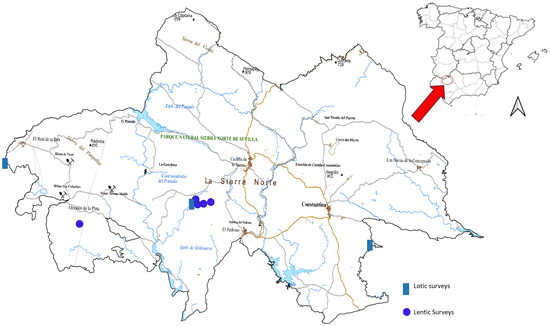
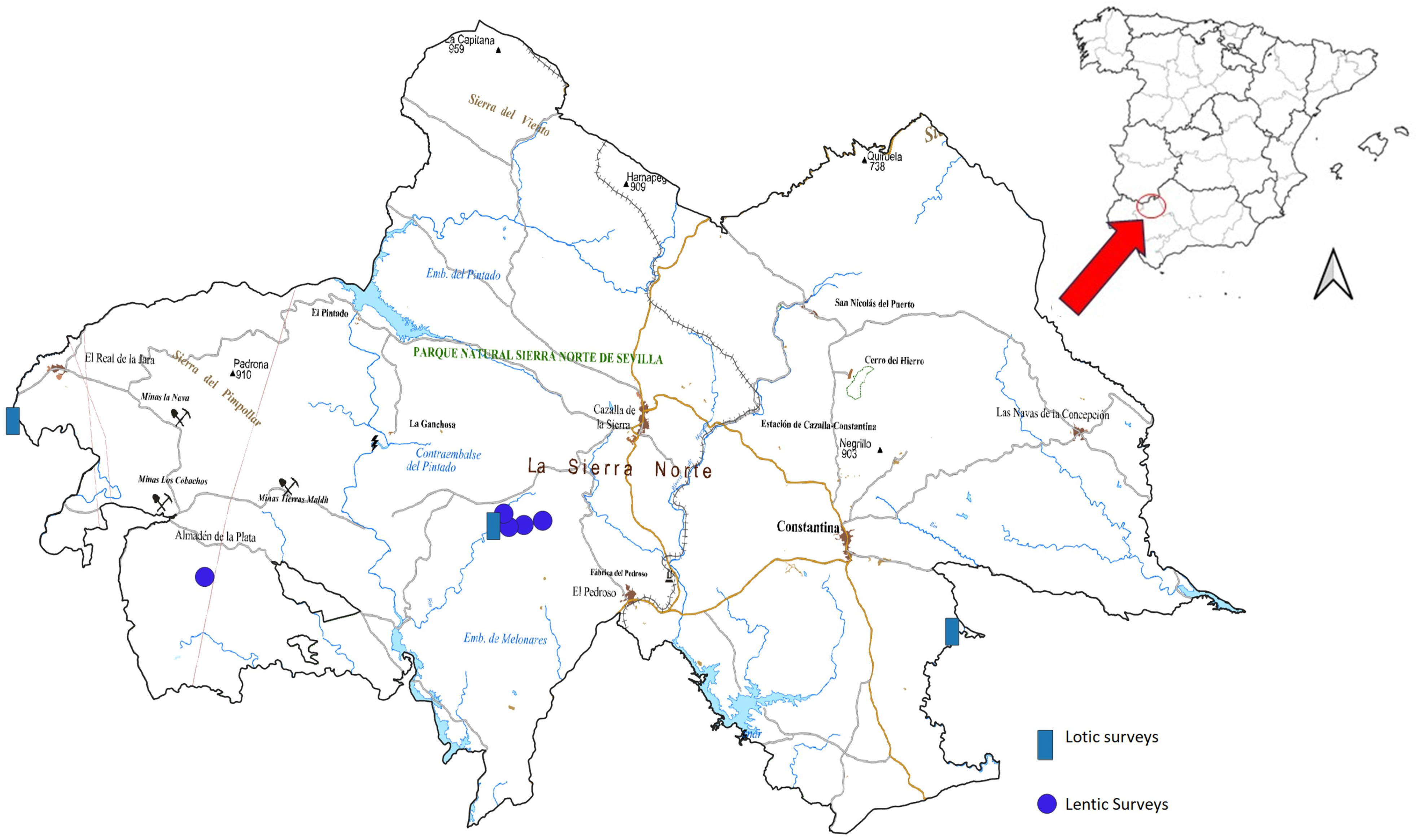
Fieldwork was conducted in the Sierra Morena of Seville Natural Park (Figure 1), located in the province of Sevilla, southern Spain. This Mediterranean landscape includes a mosaic of aquatic habitats, ranging from permanent lentic water bodies (e.g., ponds, reservoirs) to seasonal and permanent lotic systems (e.g., streams and small rivers) [13]. These habitats are known to support populations of the native Mediterranean pond turtle (Mauremys leprosa), with this species being well distributed all around the Park [14]. In this area, the mean annual temperature ranges from 15 to 16 °C, with summer maxima exceeding 40 °C and winter minima dropping below −4 °C. Annual precipitation averages between 600 and 1000 mm.
Figure 1.
Sierra Morena of Seville Natural Park with capture sites indicated. Five lentic survey places (blue dots) and three lotic survey places (turquoise-green rectangles) are indicated. Minimap indicates the location os the Natural Park in Spain.
2.2. Sampling and Data Collection
Turtles were captured using baited funnel traps (1948 trapping hours, 501 for lotic systems and 1376 for lentic) and manual searches during the active season (spring to early autumn) of 2014 and 2015 (see Supplementary Material Table S1). The differences in trapping effort were due to accessibility constraints, as lotic habitats, although selected in public lands, are mostly located areas that require coordination with park rangers and the use of locked gates, rather than intentional effort weighting.
For each individual, the following morphometric variables were recorded: Straight carapace length (cm), straight carapace width (cm), straight plastron length (cm) and body mass (g). Sex and age class were estimated based on external morphology. Individuals were classified as adult male, adult female, juvenile, or neonate (identified by a soft, not fully hardened carapace and the presence of the incubation scar, whereas juveniles had a fully hardened carapace without this mark [15]). The habitat type at the capture site was recorded as either lentic or lotic, based on hydrological characteristics. Additionally, searches for nests were conducted in the areas surrounding both habitats, systematically surveying the shoreline and the 20 meter vicinity around the locations where traps were set.
All captures and handling procedures were conducted under official authorization from the Junta de Andalucía (Expediente SGI/CC/01/18), in accordance with regional wildlife regulations.
2.3. Data Cleaning and Statistical Analysis
Data were cleaned and standardized using the R program (v4.3.1) [16]. The data-cleaning process consisted of checking morphometric variables for consistency, converting all measurements to numeric format with uniform decimal precision, and scaling variables prior to analysis using base R functions and the tidyverse package [17]. Individuals with missing values or inconsistent measurements in any morphometric variable were excluded; only two individuals were removed based on these criteria.
To assess differences between habitat types, we first evaluated the distribution of each morphometric variable using Shapiro–Wilk tests. As most variables deviated from normality, non-parametric Mann–Whitney U tests were subsequently applied to compare morphometric measurements between lentic and lotic populations. In addition, Fisher’s exact tests were used to evaluate associations between age/sex classes and habitat type.
Additionally, a Principal Component Analysis (PCA) was conducted on the scaled morphometric variables to explore patterns of variation and visualize group separation. The first two principal components were retained for plotting and interpretation. To account for potential hierarchical structure in the data, we implemented a generalized linear mixed model (GLMM) using the glmmTMB package. Morphometric variation was summarized using principal component analysis (PCA), and the first two principal components (PC1 and PC2) were included as predictors in the model. The GLMM was fitted with a binomial family, allowing the assessment of how morphometric variation relates to habitat type while considering potential random effects. Model fit was evaluated and the proportion of variance explained by the fixed effects was estimated using the marginal R2 from the performance package [18]. To complement the PCA and assess whether individuals from lentic and lotic habitats differ significantly in morphometric traits, we performed a PERMANOVA and a Linear Discriminant Analysis (LDA). Morphometric variables were first standardized to ensure comparability. PERMANOVA, based on a Euclidean distance matrix, was used to test for significant differences between predefined habitat groups. LDA was then applied to visualize and confirm group separation, providing a supervised classification of individuals according to their habitat type. This approach allows both statistical testing of group differences and graphical representation of the separation observed in PCA.
All visualizations and statistical outputs were generated using the ggplot2, ggpubr, and stats packages in R 4.5.1 [19,20]. Summary statistics, PCA loadings, and clustering results were exported for interpretation and publication.
3. Results
3.1. Sample Composition and Habitat Distribution
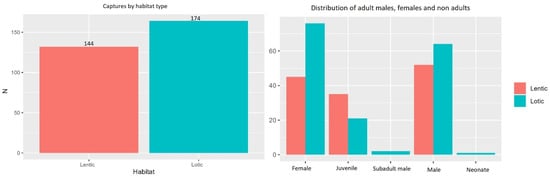
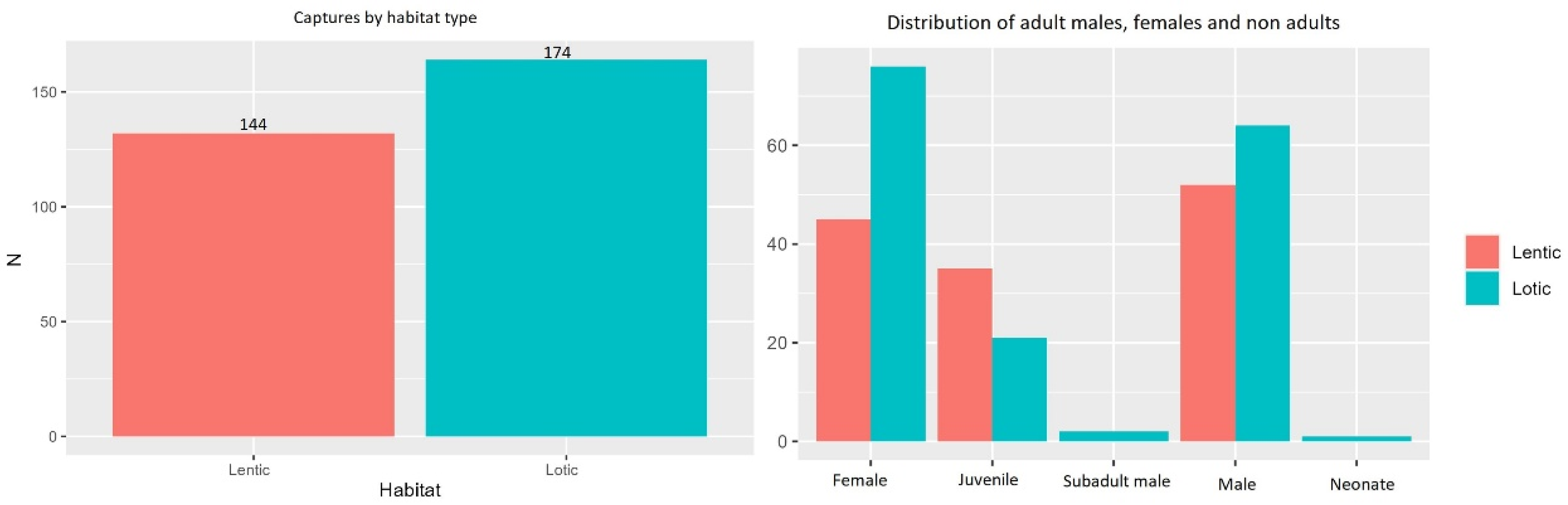
A total of 290 individuals (318 captures) of Mauremys leprosa were captured across two habitat types within the Parque Natural Sierra Morena (Sevilla): 144 captures in lotic environments and 174 in lentic environments (Figure 2). The age and sex structure varied notably between habitats. Adult males, adult females and neonates were predominantly found in lotic habitats, while juveniles were more frequent in lentic sites (Figure 2). Six nests were located, all in the vicinity of lotic habitats: three adjacent to permanent stretches, two in temporary stretches, and one in a temporary stretch retaining small pools.
Figure 2.
Distribution of captures per habitat type, sex and age.
3.2. Morphometric Comparisons
Morphometric variables differed significantly between habitat types:
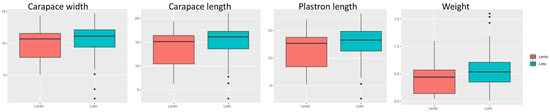
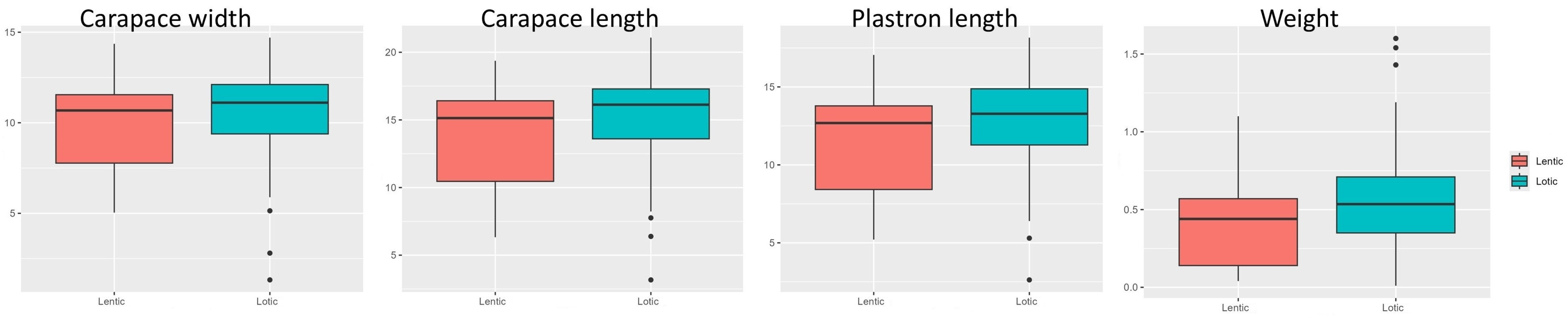
Carapace length and carapace width showed slightly higher median values in lotic populations, though with overlapping interquartile ranges. Plastron length and body mass were markedly higher in lotic individuals, indicating larger overall body size (See Figure 3).
Figure 3.
Carapace length, carapace width, plastron length, and body mass.
3.3. Statistical Tests Confirmed These Differences
Mann–Whitney U tests revealed significant differences (p = 0.02) in all four morphometric variables between lentic and lotic populations. Fisher’s exact test indicated a significant association between age/sex class and habitat type (p < 0.001), supporting the observed ontogenetic segregation.
3.4. Multivariate Analysis Results
The PCA revealed clear separation between individuals from lentic and lotic habitats:
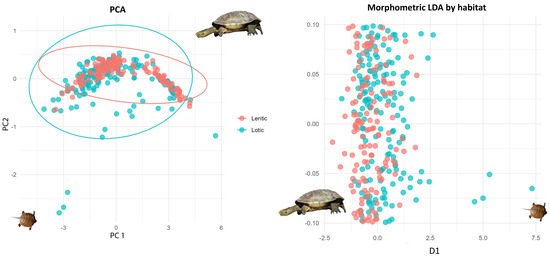
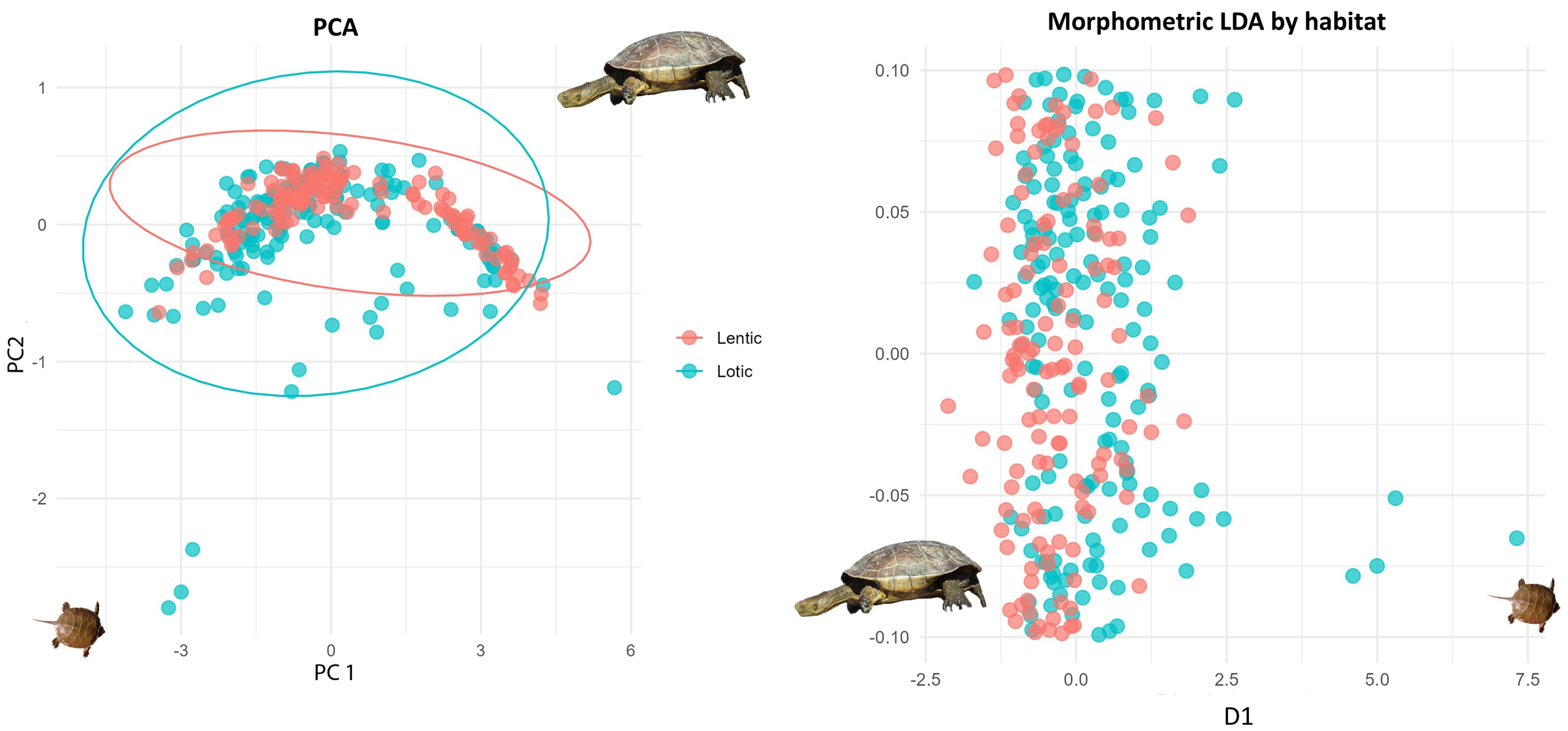
PC1 explained 60.2% of the total variance and was strongly influenced by plastron length (loading = 0.56) and body mass (loading = 0.54). PC2 accounted for 25.1% of the variance and was primarily associated with carapace length and width (variable loadings for each principal component are provided in Supplementary Material Table S2). The PCA plot revealed distinct clustering by habitat type, with lotic individuals occupying the upper-right quadrant of the PC1–PC2 space, consistent with larger body sizes (Figure 4). However, the presence of very young individuals within this cluster indicates ongoing reproduction in these habitats. The GLMM results indicate that the fixed effects, represented by PC1 and PC2, captured the main patterns of morphometric differentiation between habitat types. The marginal R2 was 0.944, showing that a large proportion of variance is explained by these fixed effects. Random effect variances were negligible, indicating that the main conclusions are robust and predominantly driven by morphometric differences.
Figure 4.
PCA of morphometry by habitat. PC1 (60.2% of variance) influenced by plastron length and body mass. PC2 (25.1% of variance) with carapace length and width. Linear Discriminant Analysis (LDA) of morphometric measurements of individuals from lentic and lotic habitats. Each point represents an individual, colored according to habitat type. The analysis shows how the linear combination of morphometric variables (carapace length and width, plastron length, and body mass) separates individuals according to habitat, highlighting morphological differentiation between lentic and lotic populations.
The PERMANOVA based on Euclidean distances of standardized morphometric variables revealed a significant separation between individuals from lentic and lotic habitats (F = 9.37, R2 = 0.031, p = 0.002). Although the proportion of variance explained by habitat is low, the difference between groups is significant, confirming that morphometric patterns differ between these environments. The Linear Discriminant Analysis (LDA) of standardized morphometric variables revealed that individuals from lentic and lotic habitats could be distinguished along a single discriminant axis (LD1) (Figure 4). The model showed that variables such as peso and plastron length contributed most strongly to group separation, with coefficients of 5.35 and 0.57, respectively. Prior probabilities reflected the sample distribution (Lentic = 0.446, Lotic = 0.554). Predicted classifications largely matched the observed groups, indicating that morphometric traits reliably differentiate individuals from lentic and lotic habitats.
4. Discussion
The results of this study provide compelling evidence for spatial ontogenetic segregation in Mauremys leprosa within the heterogeneous aquatic landscape of the Sierra Morena Natural Park. The observed distribution patterns and morphometric differences between individuals captured in lotic and lentic habitats support not only the different use of the environments as described in other species of the genus [21] but also the hypothesis that these environments may play distinct functional roles in the life history of the species.
It is well established that body morphometry plays a central role in habitat selection among semi-aquatic and aquatic vertebrates [22]. Consistent with this, our results suggest that lotic habitats (characterized by flowing water and seasonal dynamics) are occupied by individuals of all age classes, but predominantly by breeding adults. Within these habitats, neonates tended to concentrate along vegetated shores, indicating that these areas may function as recruitment zones that provide suitable microhabitats for early developmental stages. The higher body mass and plastron length observed in lotic individuals support this interpretation, reflecting the larger size typical of adult turtles. Additionally, the structural complexity and connectivity of lotic systems likely facilitate dispersal, allowing adults to explore, colonize new areas, and use them as breeding grounds. This is consistent with our observation that nests and neonates were found exclusively near lotic habitats; however, the small sample sizes (n = 6 for nests and n = 3 for neonates) warrant cautious interpretation.
In contrast, lentic habitats supported a higher proportion of juvenile (immature) individuals, which exhibited significantly lower morphometric values across all measured traits and, consequently, reduced reproductive potential. These results suggest that lentic environments may serve as residency and foraging areas for non-adult or non-breeding individuals. The stability and permanence of lentic water bodies likely provide favorable conditions for growth, analogous to the patterns reported by Gahmous et al. 2022 [23], who found that habitats with abundant resources, even when impacted, tend to favor this species. Although the lentic habitats of this natural park are not exposed to anthropogenic (waste) water, their physical and ecological characteristics do lead to greater nutrient accumulation, and thus higher nutrient availability [24,25,26]. PCA results reinforce this interpretation, revealing distinct clustering of lotic and lentic individuals along PC2, which was strongly associated with carapace length and width. The greater dispersion of these morphometric measures in lotic habitats reflects a higher diversity of age classes, indicating that populations reproduce in these areas and/or use them as movement corridors. The significant separation between lentic and lotic individuals was statistically confirmed by PERMANOVA based on Euclidean distances of standardized morphometric variables, highlighting that the differences in morphometry between habitats are unlikely to be due to random variation (F = 9.37, R2 = 0.031, p = 0.002). Furthermore, Linear Discriminant Analysis (LDA) reinforced this pattern, demonstrating that morphometric traits reliably classify individuals according to habitat type, with juveniles tending to cluster in lentic environments and adults more frequent in lotic ones. These complementary analyses strengthen the PCA-based observations, providing both statistical and visual confirmation that habitat use and morphometric variation are closely associated. The high marginal R2 (0.944) from the GLMM framework indicates that a large proportion of the observed variance is explained by the fixed effects, suggesting that the main conclusions are robust and predominantly driven by morphometric differences, rather than by random or unmeasured factors. Together, these results reinforce the interpretation that ontogenetic habitat segregation in M. leprosa is a consistent and ecologically meaningful pattern.
The significant association between age/sex class and habitat type, confirmed by Fisher’s exact test, underscores the ecological relevance of habitat partitioning in M. leprosa. Such ontogenetic strategies might enhance population resilience by reducing intraspecific competition and optimizing resource use across life stages. These findings are consistent with previous studies on semi-aquatic turtles, which have documented similar habitat-driven ontogenetic shifts in response to environmental heterogeneity [27].
From a conservation perspective, the functional differentiation between lotic and lentic habitats underscores the need to preserve both habitat types within Mediterranean aquatic systems. To support the full life cycle of Mauremys leprosa, management strategies should prioritize hydrological connectivity and habitat quality [12]. These considerations are especially critical in Mediterranean climates, which are prone to seasonal droughts and where the species shows marked sensitivity to habitat degradation and alterations in water regimes. In this context, the observed habitat partitioning may not only reflect current ecological pressures but also represent adaptive responses to the historical hydrological variability of Mediterranean landscapes, where selective forces have favored plasticity in spatial use across different life stages.
Within the Natural Park, Mauremys leprosa´s natural and original habitat has been the seasonal streams and associated ephemeral contributories. During the active season, adults seem to concentrate around deeper areas, whilst juveniles occupy the shallower and more vegetated areas in the streams. In the last century in particular, the population of Mauremys leprosa has benefited from the increased number and density of smaller and larger artificial lakes and cattle ponds [28]. The studied sites included a larger stream system and a terrestrial system with ponds and artificial lakes, with a relatively low pressure from livestock. In these sites, aquatic and embankment vegetation is relatively well developed, which provides beneficial habitat for juveniles (cover and foraging). However, it is expected that there are relatively larger animals in the vast majority of lotic sites, because aquatic and shoreline vegetation is scarcely developed. Juveniles and subadults often use shallower, heavily vegetated microhabitats and bankside refugia, whilst adults (especially larger females) use deeper water and larger basking sites, as described for Reeves’s turtle [19,29].
Future research should explore temporal dynamics of habitat use, including seasonal movements and reproductive site fidelity, to further elucidate the ecological mechanisms underlying ontogenetic segregation. While the findings presented here offer a functional perspective on habitat use by Mauremys leprosa, it is important to acknowledge that they are based on data collected over just two field seasons. As such, they represent an ecological snapshot rather than a long-term pattern, limiting our ability to assess interannual variability or detect consistent spatial strategies across years. Integrating telemetry data and long-term monitoring could provide valuable information on individual trajectories, habitat preferences, and movement plasticity over time. In particular, longitudinal approaches combining telemetry and mark–recapture techniques would allow for a more nuanced characterization of age-class dynamics throughout the annual cycle and help clarify the stability and flexibility of habitat use across life stages.
5. Conclusions
This study provides evidence of spatial ontogenetic strategies in Mauremys leprosa within a heterogeneous Mediterranean freshwater landscape. Morphometric differences and age-class distributions between lotic and lentic habitats suggest a possible functional habitat partitioning, with lotic systems acting primarily as breeding and dispersal corridors, and lentic environments serving as growth and residency areas for juveniles. These patterns seem to reflect adaptive responses to hydrological variability and highlight the ecological plasticity of the species. Overall, the findings contribute to a functional understanding of habitat use and reinforce the importance of habitat-specific conservation planning in Mediterranean landscapes, where maintaining connectivity and preserving both lentic and lotic systems is essential for supporting all life stages.
Supplementary Materials
The following supporting information can be downloaded at: https://www.mdpi.com/article/10.3390/wild3010007/s1, Table S1: Table of captures including metadata; Table S2: Variable loadings for each principal component.
Author Contributions
Conceptualization, E.J.R.-R.; methodology, E.J.R.-R.; software, E.J.R.-R.; validation, E.J.R.-R.; formal analysis, E.J.R.-R.; investigation, E.J.R.-R.; resources, E.J.R.-R.; data curation, E.J.R.-R.; writing—original draft preparation, E.J.R.-R.; writing—review and editing, E.J.R.-R., W.D.V. and A.M. All authors have read and agreed to the published version of the manuscript.
Funding
This research received no external funding.
Institutional Review Board Statement
Ethical review and approval were waived for this study. The research was conducted independently by the author, regardless of any institutional affiliation, during 2014 and 2015, under the permissions granted by the Environmental Department of the Junta de Andalucía, which addressed all relevant ethical considerations according to applicable regulations.
Informed Consent Statement
Not applicable.
Data Availability Statement
Capture data, including metadata (date, population, individual code, sex/age, and morphometric measurements), are provided as Supplementary Material for this study.
Acknowledgments
We would like to thank the Sierra Morena Natural Park (Seville) for granting research permits and providing logistical support. We also extend our gratitude to the park’s volunteers who assisted with field logistics during the capture sessions.
Conflicts of Interest
The authors declare no conflicts of interest. Author Eduardo Jose Rodríguez-Rodríguez was employed by the company TRAGSATEC. The remaining authors declare that the research was conducted in the absence of any commercial or financial relationships that could be construed as a potential conflict of interest.
References
- Luiselli, L. Mauremys leprosa (Europe assessment). In The IUCN Red List of Threatened Species 2024; IUCN: Grand, Switzerland, 2024; p. e.T158468A207995085. [Google Scholar] [CrossRef] [Scilit]
- Werner, E.E.; Gilliam, J.F. The ontogenetic niche and species interactions in size-structured populations. Annu. Rev. Ecol. Syst. 1984, 15, 393–425. [Google Scholar] [CrossRef]
- Bouchard, S.S.; Bjorndal, K.A. Ontogenetic diet shifts and digestive constraints in the omnivorous freshwater turtle Trachemys scripta. Physiol. Biochem. Zool. 2006, 79, 150–158. [Google Scholar] [CrossRef] [Scilit]
- Loulida, S.; Segurado, P.; Naimi, M.; Znari, M. Niche differentiation among genetic lineages in the Mediterranean Pond Turtle (Mauremys leprosa) across its geographical range. Amphibia-Reptilia 2021, 42, 179–192. [Google Scholar] [CrossRef] [Scilit]
- Rodríguez-Rodríguez, E.J.; Vries, W.D.; Escrivà-Colomar, I.; Trujillo, F.; Marco, A. Evolución de la distribución y estimas de abundancia para Emys orbicularis y Mauremys leprosa en la Sierra Norte de Sevilla. Bol. Asoc. Herpetol. Esp. 2015, 26, 54–57. [Google Scholar]
- Rodríguez-Rodríguez, E.J.; Carmona-González, R.; García-Cardenete, L. Actualización de la distribución de los reptiles en la provincia de Sevilla. Bol. Asoc. Herpetol. Esp. 2018, 29, 46–53. [Google Scholar]
- Le Gal, A.S.; Priol, P.; Georges, J.Y.; Verneau, O. Population structure and dynamics of the Mediterranean Pond Turtle Mauremys leprosa (Schweigger, 1812) in contrasted polluted aquatic environments. Environ. Pollut. 2023, 330, 121746. [Google Scholar] [CrossRef] [Scilit] [PubMed]
- Le Gal, A.S.; Georges, J.Y.; Sotin, C.; Charrière, B.; Verneau, O. Morphological variations and demographic responses of the Mediterranean pond turtle Mauremys leprosa to heterogeneous aquatic habitats. Sci. Total Environ. 2024, 927, 172077. [Google Scholar] [CrossRef] [Scilit] [PubMed]
- Bertolero, A.; Busack, S.D. Mauremys leprosa (Schoepff in Schweigger 1812)—Mediterranean Pond Turtle, Spanish Terrapin, Mediterranean Stripe-necked Terrapin. In Conservation Biology of Freshwater Turtles and Tortoises (Chelonian Research Monographs No. 5); Rhodin, A.G.J., Iverson, J.B., van Dijk, P.P., Buhlmann, K.A., Pritchard, P.C.H., Stanford, C.B., Goode, E.V., Saumure, R.A., Mittermeier, R.A., Eds.; Turtle Conservancy: Ojai, CA, USA, 2017. [Google Scholar] [CrossRef] [Scilit]
- Ward, J.V. The four-dimensional nature of lotic ecosystems. J. N. Am. Benthol. Soc. 1989, 8, 2–8. [Google Scholar] [CrossRef] [Scilit]
- Bodie, J.R. Stream and riparian management for freshwater turtles. J. Environ. Manag. 2001, 62, 443–455. [Google Scholar] [CrossRef] [Scilit] [PubMed]
- Toledo, M.A.; de la Concha, A.; Rubio, J.L. Space use, distribution and conservation of the Spanish pond turtle (Mauremys leprosa Schweigger, 1812): A review. Bol. Real Soc. Esp. Hist. Nat. 2021, 115, 94–110. Available online: https://dialnet.unirioja.es/servlet/articulo?codigo=8890981 (accessed on 13 September 2025). [CrossRef] [Scilit]
- López-Jurado, L.F.; Blázquez, C.; Mateo, J.A. Parque Natural de la Sierra Norte de Sevilla: Descripción del área. Ministerio para la Transición Ecológica y el Reto Demográfico (MITECO), Spain. 2025. Available online: https://www.miteco.gob.es/content/dam/miteco/es/biodiversidad/temas/conservacion-de-especies-amenazadas/SIERRA_NORTE_SEVILLA_tcm30-195290.pdf (accessed on 13 September 2025).
- Rodríguez Rodríguez, E.J.; Pérez de Guzmán Puya, R. Guía de Anfibios y Reptiles del Parque Natural de Sierra de Morena. Consejería de Sostenibilidad, Medio Ambiente y Economía Azul. Junta de Andalucía. 2024. Available online: https://www.juntadeandalucia.es/medioambiente/portal/landing-page-publicacion/-/asset_publisher/FytOUWH22K7t/content/gu%C3%ADa-de-anfibios-y-reptiles-del-parque-natural-de-sierra-de-morena/20151 (accessed on 13 September 2025).
- Keller, C. Ecología de Poblaciones de Mauremys Leprosa y Emys Orbicularis en el Parque Nacional de Doñana. Ph.D. Thesis, Universidad de Sevilla, Sevilla, Spain, 1997. [Google Scholar]
- R Core Team. R: A Language and Environment for Statistical Computing, Version 4.3.1. [Computer software]. R Foundation for Statistical Computing: Vienna, Austria, 2023. Available online: https://www.R-project.org/ (accessed on 13 September 2025).
- Wickham, H.; Averick, M.; Bryan, J.; Chang, W.; McGowan, L.D.; François, R.; Grolemund, G.; Hayes, A.; Henry, L.; Hester, J.; et al. Welcome to the tidyverse. J. Open Source Softw. 2019, 4, 1686. [Google Scholar] [CrossRef] [Scilit]
- Lüdecke, D.; Ben-Shachar, M.S.; Patil, I.; Waggoner, P.; Makowski, D. Performance: Assessment of Regression Models Performance. R Package Version 0.11.2. 2023. Available online: https://CRAN.R-project.org/package=performance (accessed on 13 September 2025).
- Wickham, H. ggplot2: Elegant Graphics for Data Analysis; Springer: Berlin/Heidelberg, Germany, 2016; Available online: https://ggplot2.tidyverse.org (accessed on 13 September 2025).
- Kassambara, A. ggpubr: ‘ggplot2’ Based Publication Ready Plots (R Package Version 0.6.0). 2023. Available online: https://rpkgs.datanovia.com/ggpubr/ (accessed on 13 September 2025).
- Chelazzi, G.; Naziridis, T.; Benvenuti, S.; Ugolini, A.; Crivelli, A.J. Use of river-wetland habitats in a declining population of the terrapin (Mauremys rivulata) along the Strymon River, northern Greece. J. Zool. 2007, 271, 154–161. [Google Scholar] [CrossRef] [Scilit]
- Xiao, F.; Lin, Z.; Wang, J.; Shi, H.T. Shell shape-habitat correlations in extant turtles: A global-scale analysis. Glob. Ecol. Conserv. 2023, 46, e02543. [Google Scholar] [CrossRef] [Scilit]
- Gahmous, S.A.; Tiar, G.; Tiar-Saadi, M.; Bouslama, Z.; Široký, P. Reproductive Traits Demonstrate How Well the Mediterranean Stripe-Necked Turtle Mauremys leprosa Can Flourish under Highly Degraded–Polluted Conditions. Biology 2022, 11, 1562. [Google Scholar] [CrossRef] [Scilit] [PubMed]
- Comín, F.A.; Menéndez, M.; Forés, E. Salinidad y nutrientes en las lagunas costeras del Delta del Ebro. Limnetica 1987, 3, 1–8. [Google Scholar] [CrossRef] [Scilit]
- Hadad, H.R.; Maine, M.A.; Mufarrege, M.D.L.M.; Di Luca, G.A.; Sanchez, G.C. Nutrient concentrations in macrophytes from lotic and lentic environments of the Middle Parana River, Argentina. Ing. Univ. 2021, 25, 1–14. [Google Scholar] [CrossRef] [Scilit]
- Romo, S.; Soria, J.; Olmo, C.; Flor, J.; Calvo, S.; Ortells, R.; Armengol, X. Nutrients and carbon in some Mediterranean dune ponds. Hydrobiologia 2016, 782, 97–109. [Google Scholar] [CrossRef] [Scilit]
- Escoriza, D.; Franch, M.; Ramos, S.; Sunyer-Sala, P.A.U.; Boix, D.A.N.I. Demographics and survivorship in the European pond turtle (Emys orbicularis): A 31–Year Study. Herpetol. Conserv. Biol. 2020, 15, 41–48. [Google Scholar]
- Junta de Andalucía. Decreto 131/2024, de 23 de Julio, Por el Que se Aprueban Los Planes de Ordenación de Los Recursos Naturales y Los Planes Rectores de Uso y Gestión de Los Parques Naturales Sierra de Aracena y Picos de Aroche, Sierra Morena de Sevilla y Sierra de Hornachuelos; Boletín Oficial de la Junta de Andalucía: Seville, Spain, 2024. [Google Scholar]
- Bu, R.; Ye, Z.; Shi, H. Habitat selection and home range of Reeves’ turtle (Mauremys reevesii) in Qichun County, Hubei Province, China. Animals 2023, 13, 1514. [Google Scholar] [CrossRef] [Scilit]
Disclaimer/Publisher’s Note: The statements, opinions and data contained in all publications are solely those of the individual author(s) and contributor(s) and not of MDPI and/or the editor(s). MDPI and/or the editor(s) disclaim responsibility for any injury to people or property resulting from any ideas, methods, instructions or products referred to in the content. |
© 2026 by the authors. Licensee MDPI, Basel, Switzerland. This article is an open access article distributed under the terms and conditions of the Creative Commons Attribution (CC BY) license.