Article

Subjective Sleep Quality and Cognitive Impairment in Dementia: An Exploratory Analysis of Sleep and Blood Pressure


by
Eleni Sideri
1,2,*,
Chrysoula V. Liantinioti
2,
Georgios N. Papadimitropoulos
2,
Claire Kelly
1 and
Konstantinos I. Voumvourakis
2
1
Applied Psychology Department, Llandaff Campus, Cardiff Metropolitan University, Western Avenue, Cardiff CF5 2YB, UK
2
2nd Neurology Disorders Department, Metropolitan Hospital, 18547 Athens, Greece
*
Author to whom correspondence should be addressed.
J. Dement. Alzheimer's Dis. 2026, 3(2), 23; https://doi.org/10.3390/jdad3020023
Submission received: 30 January 2026 / Revised: 1 March 2026 / Accepted: 10 April 2026 / Published: 6 May 2026

Abstract

Background: Sleep disturbance is highly prevalent in dementia syndromes and increasingly viewed as a correlate of disease expression, not just ageing. This study investigated associations between subjective sleep quality, cognitive performance, and structural MRI markers in a dementia syndromes sample, comparing Alzheimer’s disease (AD) and non-AD groups, with exploratory inclusion of objective sleep and nocturnal blood pressure in a sub-sample. Methods: Observational cross-sectional design with 128 memory clinic patients (41 AD, 87 non-AD). Subjective sleep quality assessed via Pittsburgh Sleep Quality Index (PSQI). Cognitive measures: Mini-Mental State Examination (MMSE) for global cognition, Symbol Digit Modalities Test (SDMT) for processing speed, Trail Making Tests (TMT-A/B), and CLOX-1/2 for executive function. MRI markers: Scheltens scale (medial temporal atrophy), Fazekas scale (white matter hyperintensities). An exploratory sub-sample (N = 24) included additional nocturnal and daytime blood pressure monitoring; these data were analyzed descriptively and are reported as hypothesis-generating only. Analyses: group comparisons, Spearman correlations, hierarchical and logistic regression models in the full sample, and descriptive analyses with Spearman correlations in the exploratory sub-sample. Results: The AD group reported poorer sleep quality (higher PSQI) and worse cognitive performance across domains compared with the non-AD group (p < 0.001). Higher PSQI scores were associated with poorer cognitive outcomes, particularly executive function and processing speed, after adjustment for demographics and structural MRI markers (e.g., β = −0.181 to −0.425 for MMSE/SDMT). In the exploratory sub-sample (N = 24), PSQI was correlated with SDMT (ρ = −0.653) and TMT-A (ρ = 0.788). Conclusions: Subjective sleep quality was associated with cognitive performance in individuals with dementia syndromes after accounting for structural MRI markers. These findings suggest that subjective sleep disturbance may represent a complementary clinical dimension warranting further longitudinal research, including evaluation of whether sleep-focused interventions may offer clinical benefits.

1. Introduction

Sleep disturbance is a highly prevalent and clinically relevant feature across dementia syndromes. Its role as a measurable correlation of disease expression rather than a nonspecific consequence of ageing is increasingly recognized [1,2]. Recent systematic reviews and meta-analyses demonstrate that both sleep quality and sleep duration are associated with Alzheimer’s disease-related pathology (AD), particularly the amyloid-β burden. On the contrary, associations with tau pathology are weaker or inconsistent across biological matrices (plasma, CSF, PET) [1,2,3]. These findings indicate that sleep disorder is differentially linked to specific neurodegenerative processes and highlight the importance of clearly defining and operationalizing sleep constructs and outcome measures in order to examine their associations with cognitive outcomes in people with diagnosed dementia.
Noteworthy is the fact that a substantial heterogeneity is observed in how sleep is operationalized across these studies mentioned above. Systematic reviews have revealed that subjective sleep quality, most commonly assessed using the Pittsburgh Sleep Quality Index (PSQI), was consistently associated with amyloid-β load, determined by PET and plasma Aβ42 levels, whereas associations with tau biomarkers were largely absent [1,2,3]. This pattern has been replicated across diverse cohort studies in which different biological platforms were used in consistency with the clinical relevance of subjective sleep quality as a construct that captures disease-relevant information beyond global cognitive status [2,4,5]. Simultaneously, reviews focusing on dementia populations emphasize that subjective sleep measures and objective sleep parameters frequently showed limited concordance, particularly in individuals with cognitive impairment and fragmented sleep [6,7,8]. This dissociation is interpreted as a reflection of the distinct dimensions of sleep disturbance, (for example, perceived sleep continuity and restorativeness versus algorithm-derived indices such as total sleep time or awakenings), rather than a simple measurement error [7,8]. Consequently, the subjective sleep quality should represent a partially independent and clinically relevant construct and not a direct indicator of the objective sleep physiology.
Nowadays, objective sleep assessment using wearable devices has expanded rapidly due to feasibility and ecological validity [9]. However, recent evaluations, including studies employing actigraphy and multi-sensor platforms in dementia populations, demonstrate important limitations related to proprietary algorithms, sensitivity to movement artefacts, and high inter-correlation among derived sleep variables [9,10]. These issues complicate multivariable modelling and can affect the interpretability of individual sleep parameters, particularly in small or clinically heterogeneous samples. Therefore, recent methodological reviews recommend cautious exploratory use of objective sleep metrics with explicit acknowledgment of multicollinearity and data dependency within the dementia research settings [11].
Beyond the sleep measurements, the emerging literature indicates that nocturnal physiological regulation may act as a potential modifier of the sleep–cognition relationship. In particular, nocturnal blood pressure patterns and autonomic cardiovascular regulation have been linked to both sleep quality and cognitive vulnerability in older adults, suggesting that vascular and autonomic pathways may play a role in integrative brain–body associations [12,13,14]. Reviews regarding ambulatory blood pressure monitoring point out that nocturnal blood pressure patterns may interact with sleep fragmentation and cognitive vulnerability through vascular and autonomic pathways proposed in the literature, although empirical findings remain inconsistent and highly sensitive to measurement protocols and sample characteristics [15,16]. Studies integrating sleep, cognition, and nocturnal blood pressure within the same dementia syndromes sample are scarce and primarily exploratory [17,18,19].
Cognitive outcomes associated with sleep disturbance also appear to show domain-specific patterns. Reviews focusing on dementia populations reveal more consistent associations between sleep disturbance and executive functioning, processing speed, and attentional control rather than with episodic memory, particularly in preclinical AD samples defined without the use of biomarkers [4,7,11]. The selection of standardized neuropsychological tools in the present study was based at this domain specificity with a focus on executive and speed-dependent processes in combination with a global cognitive screening assessment Mini-Mental State Examination (MMSE) [19].
Structural MRI markers provide an additional level of clinical characterization. Visual rating scales such as the Scheltens scale for medial temporal lobe atrophy and the Fazekas scale for white matter hyperintensities are widely used to characterize neurodegenerative and vascular-related pathology in routine clinical settings [20,21]. Recent reviews point out that combining sleep measures with clearly defined MRI indices may benefit clinical profiling, as long as the analytic models preclude over-interpretation and respect the ordinal nature of these markers [11,12].
Despite the substantial progress in sleep–dementia research, a clinically translatable framework integrating subjective sleep quality, domain-specific cognitive assessment, and routinely applied structural MRI visual ratings in studies directly comparing Alzheimer’s disease and heterogeneous non-Alzheimer’s dementia syndromes remains limited. Many prior studies have either focused on a biomarker-defined research sample not reflective of routine memory clinic practice or examined sleep and imaging variables separately rather than within a unified analytic model. As a result, it remains unclear whether subjective sleep quality explains cognitive variability beyond structural MRI markers in real-world clinical settings. Subjective sleep quality represents a construct distinct from objective sleep architecture and may capture clinically meaningful aspects of daytime fatigue, attentional fluctuation, reduced cognitive efficiency, and overall symptom burden. Perceived sleep disturbance may therefore reflect functional vulnerability that is not fully indexed by structural pathology alone. Clarifying whether subjective sleep quality explains cognitive variability beyond MRI markers is thus of particular clinical relevance.
The present study adopts a clinically grounded observational design to examine whether subjective sleep quality accounts for variance in domain-specific cognitive performance beyond demographics and structural MRI visual ratings in a dementia syndromes sample from a memory clinic. We further compare Alzheimer’s disease and heterogeneous non-Alzheimer dementias within this unified framework. Findings are interpreted strictly as associative within the limits of cross-sectional design. In a small exploratory subsample, objective sleep and nocturnal blood pressure data are examined descriptively as hypothesis-generating observations.

2. Materials and Methods

2.1. Research Design and Study Framework

For this study we used an observational, cross-sectional design in a clinically characterized dementia syndromes sample to investigate associations between subjective sleep quality, cognitive performance, and structural MRI markers. The study included two analytically distinct parts.
Primary analyses (Part 1) were conducted in the full clinical cohort (N = 128) and focused on group differences and associative models involving subjective sleep quality, cognitive outcomes, and MRI-derived markers. Secondary analyses (Part 2) were conducted in a sub-sample drawn from the main cohort (N = 24), for whom additional physiological and objective sleep-related data were available. Analyses in Part 2 were strictly exploratory for hypothesis-generating, given the limited sample size and the diagnostic imbalance. This two-tier analytical framework allowed clinically interpretable inference in the full sample and enabled additional exploratory investigation in a physiologically enriched sub-sample.

2.1.1. Participants and Diagnostic Classification

The study included 128 patients who underwent clinical evaluation for cognitive impairment in a memory clinic setting. Participants were selected based on inclusion criteria including confirmed cognitive impairment via clinical evaluation and absence of severe psychiatric disorders or contraindications for MRI. Exclusion criteria included acute medical conditions affecting participation.
Participants were classified into two groups: Alzheimer’s disease (AD; n = 41) and non-Alzheimer’s dementias (non-AD; n = 87). Diagnoses had been established prior to study inclusion through specialist clinical evaluation as part of routine memory clinic assessment. Biomarker evaluation (e.g., CSF or plasma markers) and neuroimaging had already been performed within the standard diagnostic work-up before recruitment. The present study relied on these previously established clinical classifications and did not re-assign diagnoses. The non-AD group comprised patients diagnosed with vascular dementia (VaD) and frontotemporal dementia (FTD) according to standard clinical criteria.
Demographic characteristics included age, sex, years of education, and smoking status. Age (in years) was extracted from clinical records and included as a covariate in all hierarchical regression models, given the observed between-group difference. Education was estimated by the total years of formal schooling, while smoking status was categorized as non-smoker, current smoker, electronic cigarette user, or former smoker, as documented in clinical records.
Sample characteristics, including demographic, cognitive, sleep, and MRI variables, are summarized in Table 1. Cognitive functioning was assessed using standardized measures of global cognition, processing speed, and executive functioning. Subjective sleep quality was assessed using the PSQI. Structural brain pathology was indexed using visual rating scales for medial temporal lobe atrophy (Scheltens) and white matter hyperintensities (Fazekas).

2.1.2. Exploratory Sub-Sample (Part 2; N = 24)

The exploratory sub-sample consisted of 24 participants from the main cohort who consented to additional physiological and objective sleep-related measurements after all eligible participants were invited for further investigation. This sub-sample included both non-AD (n = 20) and AD (n = 4) cases. Given the limited and imbalanced AD subgroup, Part 2 analyses were not taken into consideration for confirmatory group comparisons. Instead, the analyses in Part 2 focused on exploratory associations between cognitive, sleep, and physiological variables across the entire sub-sample. We intentionally avoided direct statistical comparisons between AD and non-AD groups due to the small and imbalanced AD subgroup (n = 4).

2.2. Measures

2.2.1. Cognitive Measures

Cognitive functioning was assessed using standard clinical neuropsychological instruments capturing global cognition, processing speed, and executive functioning. The primary cognitive outcomes were evaluated by using the Mini-Mental State Examination (MMSE) [22] for global cognitive status, the Symbol Digit Modalities Test (SDMT) [23] for processing speed, and the Trail Making Test Part A (TMT-A) and Part B (TMT-B) [24] for psychomotor speed and cognitive flexibility, respectively.
Executive functioning was additionally assessed by using the CLOX: an executive clock-drawing task, comprising two subtypes (CLOX-1 and CLOX-2). Trail Making Test outcomes were recorded as the task completion time in seconds. Outcome-specific sample sizes were reported for all analyses [25]. The battery prioritized executive functioning and processing speed, given evidence that sleep disturbance is more consistently associated with attentional-executive domains than with episodic memory in clinically characterized dementia syndromes [26,27].

2.2.2. Subjective Sleep Quality

Subjective sleep quality was assessed using the Pittsburgh Sleep Quality Index (PSQI) total score. Scores higher than 5 indicated poorer subjective sleep quality [28]. PSQI constituted the sole sleep-related measure in Part 1 and served as the principal subjective sleep indicator in Part 2. Given the cognitive impairment of the sample, the PSQI was administered via proxy-report by a primary caregiver, following recommendations from previous AD/dementia studies that highlight the questionable validity of pure self-report in this population [26,29,30].

2.2.3. Structural MRI Markers

Structural brain pathology was indexed using two established visual rating scales derived from routine clinical MRI: the Scheltens scale for medial temporal lobe atrophy and the Fazekas scale for white matter hyperintensity burden. MRI ratings were performed as part of standard clinical evaluation by experienced neuroradiologists with expertise in neurodegenerative and vascular brain pathology. Both MRI markers were considered as ordinal variables in all analyses [20].

2.2.4. Objective Sleep and Blood Pressure Variables (Part 2 Only)

Nocturnal and daytime systolic and diastolic blood pressure were recorded using ambulatory monitoring in a subset of participants. Given the limited sample size and diagnostic imbalance, these variables were examined descriptively and for exploratory associations only.

2.3. Statistical Analysis

All statistical analyses were conducted using IBM SPSS Statistics (Version 26; IBM Corp., Armonk, NY, USA, 2019). Statistical significance was set at α = 0.05 (two-tailed). Effect sizes and standardized coefficients were reported alongside p-values to support conservative interpretation. Descriptive statistics were calculated for all variables. Missing data were handled using listwise deletion within each model, meaning that analyses were conducted on complete-case samples only, with the sample size (N) reported for each analysis.
Part 1 analyses
Group differences between AD and non-AD participants were examined using Pearson’s χ2 tests for categorical variables and independent-sample t-tests for continuous variables. When homogeneity of variance assumptions were violated, Welch’s t-test was applied. Associations between MRI markers and cognitive outcomes were examined using Spearman’s rank-order correlations, given the ordinal nature of MRI ratings.
Hierarchical multiple regression analyses were conducted to examine factors of cognitive performance. Models were entered in three steps: demographic variables, subjective sleep quality (PSQI), and MRI markers (Scheltens or Fazekas). Given the cross-sectional design, the term “factor” refers to statistical association within regression modelling and does not imply causal or temporal precedence. Model fit indices, standardized regression coefficients, and multicollinearity diagnostics were inspected and interpreted conservatively.
Binary logistic regression analyses were used to examine factors of diagnostic classification (AD vs. non-AD). Model performance was evaluated using Nagelkerke R2, classification accuracy, and Hosmer–Lemeshow goodness-of-fit tests. All models were interpreted as associative rather than causal. Hierarchical regression variable ordering was based on theoretical precedence: demographic factors (age, sex, education) were entered in Step 1 as established covariates of cognition; subjective sleep quality (PSQI) was entered in Step 2 as the primary variable of interest; and structural MRI markers were entered in Step 3 to test the incremental contribution of PSQI beyond neuroanatomical burden. This ordering was determined a priori based on current sleep–cognition theories.
Part 2 analyses
Analyses in the exploratory sub-sample were predefined as hypothesis-generating. Descriptive statistics and Spearman correlations were used to examine associations between cognitive outcomes, subjective sleep quality, and nocturnal blood pressure. No model-based or multivariate analyses were conducted due to the limited sample size.

2.4. Ethical Considerations

The study was conducted in accordance with the ethical standards acquired for research involving clinical data. Ethical approval was granted by the Research Ethics Committee of Cardiff Metropolitan University (project reference number: PGT-5786). Appropriate data governance procedures were in place, and all data were handled in compliance with applicable confidentiality and privacy regulations.

3. Results

3.1. Cognitive and Sleep Outcome: Group Comparisons

Group comparisons revealed significant differences in subjective sleep quality and cognitive performance across all assessed domains. The AD group demonstrated poorer sleep quality and significantly lower performance in global cognition (MMSE), processing speed (SDMT), and executive function measures (TMT-A, TMT-B, CLOX-1, CLOX-2) compared with the non-AD group (all p < 0.001). Full descriptive and inferential statistics are presented in Table 2.

3.2. Associations Between MRI Markers and Executive Functioning

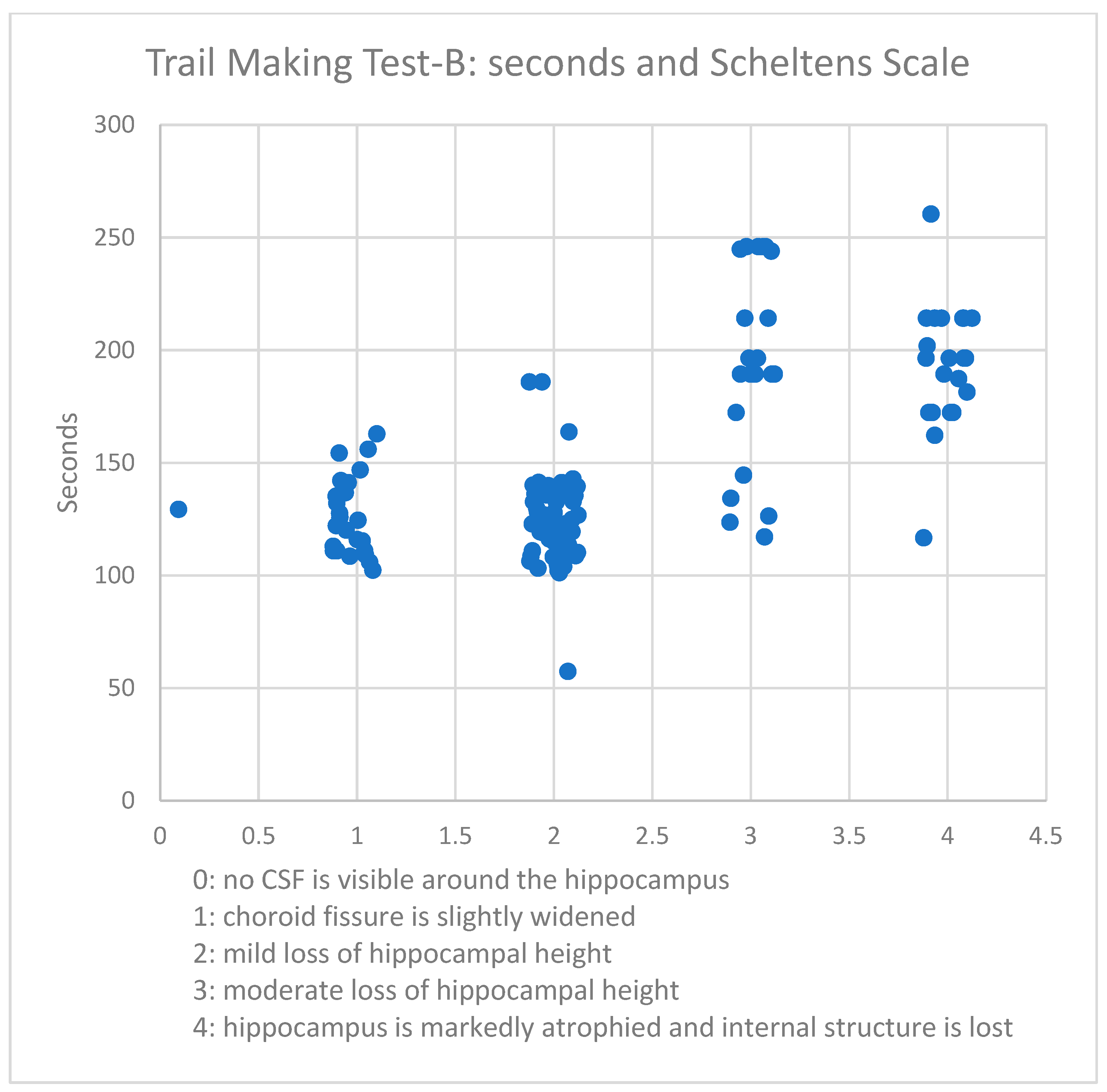
Spearman’s rank-order correlations were conducted to examine associations between MRI markers and cognitive measures. Scheltens scores showed statistically significant bivariate associations with executive functioning, including performance on the Trail Making Test Part B (ρ = 0.706, p < 0.001), CLOX-1 (ρ = −0.643, p < 0.001), and CLOX-2 (ρ = −0.592, p < 0.001). All correlations reflect unadjusted bivariate associations. In contrast, Fazekas scores demonstrated weak or non-significant associations with cognitive measures. A weak association of small magnitude was observed between Fazekas and Scheltens scores (ρ = 0.175, p = 0.048). This association is illustrated in Figure 1, where increasing Scheltens scores correspond to greater medial temporal atrophy and higher TMT-B values indicate slower executive performance.

3.3. Hierarchical Regression Analyses Associating Cognitive Performance

Hierarchical multiple regression analyses were conducted to examine the contribution of demographic variables, subjective sleep quality (PSQI), and structural MRI markers on the cognitive performance. Separate model groups were estimated using Scheltens and Fazekas scores as MRI explanatory factors. Variance inflation diagnostics indicated elevated multicollinearity in some models (condition indices approximately 50–80). Given the elevated multicollinearity (condition indices 50–80), all regression coefficients should be interpreted as indicative of statistical associations rather than independent effects. In models associating MMSE performance, the Scheltens-based model accounted for a significant proportion of variance (R2 = 0.540, F(6119) = 23.24, p < 0.001). Both Scheltens scores (β = −0.610, p < 0.001) and PSQI (β = −0.181, p = 0.014) emerged as significant explanatory factors. In the corresponding Fazekas-based model, PSQI remained a significant factor of MMSE performance (β = −0.425, p < 0.001), whereas Fazekas scores did not contribute significantly. For SDMT performance, the Scheltens-based model accounted for a significant proportion of variance (R2 = 0.322, p < 0.001); however, PSQI did not reach statistical significance in this model (β = −0.133, p = 0.132). In the Fazekas-based model, PSQI showed a significant standardized regression coefficient (β = −0.346, p < 0.001). Regression models associating executive functioning (TMT-A, TMT-B, CLOX-1, and CLOX-2) accounted for significant proportions of variance (up to R2 = 0.690).
In Scheltens-based models, Scheltens scores showed a significant standardized regression coefficient for TMT-B performance (β = 0.591, p = 0.001), whereas PSQI did not reach significance for TMT-A or TMT-B (p > 0.05). PSQI showed significant standardized regression coefficients for CLOX-1 and CLOX-2 performance across models (p ≤ 0.003). Age was significantly associated with cognitive outcomes at Step 1; however, its contribution was attenuated in final models after inclusion of structural MRI markers.

3.4. Logistic Regression Associating Diagnostic Classification

Binary logistic regression analyses were conducted to examine factors of diagnostic classification (AD vs. Non-AD). Models demonstrated good adjustment and classification accuracy ranging from 87.3% to 95.2%. Subjective sleep quality (PSQI) and medial temporal lobe atrophy (Scheltens) emerged as significant independent factors of AD classification, whereas Fazekas scores contributed weakly or non-significantly. Hosmer–Lemeshow tests indicated good model fit (p > 0.80).
Part 2. Exploratory sub-sample (N = 24): Sleep, cognition, and blood pressure.

3.5. Blood Pressure Descriptives

In the exploratory sub-sample (Non-AD n = 20; AD n = 4), descriptive inspection suggested similar nocturnal and daytime systolic and diastolic blood pressure levels across diagnostic groups. Due to the very small AD subgroup and the evidence of non-normality for some variables, no inferential group comparisons were conducted. Descriptive statistics are presented in Table 3.

3.6. Spearman Correlations Between Sleep, Cognition, and Blood Pressure

Exploratory Spearman correlation analyses indicated that higher PSQI total scores were associated with poorer SDMT performance (ρ = −0.653, p = 0.001) and slower TMT-A completion time (ρ = 0.788, p < 0.001). Associations with other cognitive measures were weaker or non-significant. Correlations involving ambulatory blood pressure indices did not demonstrate consistent patterns within this small subsample. These findings are hypothesis-generating only and should be interpreted cautiously given the limited and imbalanced sample size.

4. Discussion

4.1. Subjective Sleep Quality and Dementia-Related Cognitive Expression

The present study examined the relationships between subjective sleep quality, cognitive performance, and structural MRI markers in a clinically characterized dementia syndromes sample, with explicit comparison between Alzheimer’s disease and non-Alzheimer dementias. The principal finding was that poorer subjective sleep quality, as indexed by higher PSQI scores, was more prominent in Alzheimer’s disease and showed consistent associations with cognitive performance across multiple cognitive domains, particularly executive functioning and processing speed. Importantly, these associations remained evident in multivariable models, accounting for demographic factors and established structural MRI markers, suggesting that subjective sleep disturbance captures additional variance beyond structural MRI markers.
These findings must be interpreted within the limitations of a cross-sectional design; therefore, a causal inference is not permitted. The observed associations are consistent with the growing body of clinical literature demonstrating that sleep disturbance is closely linked to dementia risk, disease severity, and clinical expression [6,7,8,9]. Large-scale longitudinal studies and meta-analyses have shown that impaired sleep quality, abnormal sleep duration, and circadian disruption are associated with accelerated cognitive decline and increased incidence of dementia, supporting the clinical relevance of sleep disturbance as a correlate of neurodegenerative disease trajectories rather than a nonspecific consequence of ageing [2,3,10,11,31].
The emphasis on subjective sleep quality as an experiential and functional construct rather than a surrogate for objective sleep physiology represents an important interpretive consideration. Studies have highlighted that subjective and objective sleep measures frequently show limited concordance, particularly in older adults and individuals with cognitive impairment, and furthermore that this dissociation reflects distinct dimensions of sleep disturbance rather than a measurement error [32,33,34]. Subjective sleep measures such as the PSQI capture perceived sleep continuity, restorativeness, and daytime impact, which may be more proximally related to cognitive efficiency and daily functioning rather than to isolated physiological indices. The persistence of PSQI associations after adjustment for MRI markers in the present study supports the evidence that the reported sleep disturbance may represent a complementary clinical dimension which is relevant to the cognitive expression in dementia [32,33]. Importantly, the observed associations should not be interpreted as evidence of a unidirectional causal effect of sleep disturbance on cognitive impairment. Subjective sleep quality may reflect disease severity, overall symptom burden, or reciprocal processes between sleep disruption and cognitive decline. Longitudinal designs are required to disentangle temporal sequencing and potential bidirectional mechanisms.

4.2. Comparison with Heterogeneous Findings in the Literature

The literature referring to the correlation of subjective sleep quality and cognition is characterized by considerable heterogeneity. In a younger and cognitively intact sample, associations between PSQI scores and objective cognitive performance are often weak or absent after taking mood symptoms and demographic variables into account [32,33,35]. In contrast, studies focusing on older adults and clinically impaired populations more consistently report associations between poor sleep quality and deficits in attention, processing speed, and executive functioning [36,37]. The present findings align with this pattern, suggesting that the cognitive relevance of subjective sleep disturbance may become more profound as neuropathological burden and functional vulnerability increase. Meta-analytic evidence indicates that sleep disturbance represents a potentially modifiable risk factor for dementia-increased population [2,3,4,5,6], although substantial variability exists in how sleep is defined and measured across studies [8,10,18]. Intervention studies targeting sleep in clinically diagnosed dementia samples have generally reported modest and inconsistent effects on cognitive test performance, while demonstrating more reliable benefits for quality of life and daytime functioning [38,39]. These findings suggest that while sleep-focused interventions may not consistently improve global cognitive outcomes, they may still hold relevance for specific cognitive domains, daily functioning, and overall clinical management. Accordingly, sleep disturbance should be considered a potentially modifiable clinical dimension rather than a confirmed cognitive treatment target.

4.3. Executive Function, Processing Speed, and Domain-Specific Associations

A methodological advantage of the present study is the inclusion of domain-specific neuropsychological measures sensitive to executive functioning and processing speed, instead of relying exclusively on global cognitive screening. Executive dysfunction and slowed processing speed are increasingly recognized as central contributors to functional impairment in dementia, often exerting greater impact on daily autonomy than episodic memory deficits alone [40,41].
The SDMT was used to assess processing speed and attention. In regression models incorporating medial temporal lobe atrophy, subjective sleep quality did not emerge as an independent factor of SDMT performance, whereas in models incorporating white matter hyperintensity burden, PSQI scores were significantly associated with SDMT outcomes. This pattern may reflect shared variance between subjective sleep disturbance and global disease severity indexed by medial temporal atrophy, rather than inconsistency of results. Processing speed is a multidetermined construct influenced by attentional capacity, fatigue, motivation, and overall cognitive burden, and its association with sleep may vary depending on which neuropathological features dominate the model [42,43].
The CLOX executive clock drawing task provided complementary insight by differentiating executive planning and control processes from visuoconstructive abilities [25]. Across multiple models, poorer subjective sleep quality was associated with worse CLOX performance, even after accounting for structural MRI markers. This finding is consistent with prior evidence indicating that executive functions are remarkably sensitive to sleep disruption and circadian dysregulation [44,45]. At the same time, CLOX performance is known to be influenced by educational and cultural factors, and its psychometric behaviour may vary across heterogeneous clinical populations [44,45,46,47]. Accordingly, CLOX findings should be interpreted within the broader neuropsychological context rather than as isolated indicators of frontal lobe dysfunction.

4.4. Structural MRI Markers and Complementary Clinical Information

As expected, medial temporal lobe atrophy assessed using the Scheltens scale emerged as a strong factor of global cognitive impairment and executive dysfunction, consistent with established neuroanatomical models of Alzheimer’s disease [21,48]. In contrast, white matter hyperintensity burden measured using the Fazekas scale demonstrated limited incremental association value in this cohort. This likely reflects restricted variability in WMH severity and the high prevalence of vascular changes in memory clinic populations, which can reduce discriminative power between diagnostic subgroups [21,49,50]. Crucially, subjective sleep quality remained associated with cognitive outcomes even when MRI markers were included in the models. This supports a complementary rather than competing role of sleep measures in relation to structural imaging. Differences in PSQI significance across Scheltens- and Fazekas-based models likely reflect shared variance with disease severity and regional structural burden rather than analytic instability. Medial temporal atrophy and white matter hyperintensities may differentially overlap with cognitive domains, influencing the apparent contribution of subjective sleep within multivariable models. While MRI ratings capture static anatomical burden, subjective sleep quality may reflect aspects of daily cognitive experience not directly indexed by structural pathology, including daytime alertness, cognitive effort, and symptom burden, which indeed influence cognitive expression but are not directly indexed by structural pathology [21].

4.5. Methodological Heterogeneity and Interpretation of Null Findings

The heterogeneity of findings across the sleep and cognition literature highlights the importance of methodological nuance. Subjective sleep measures assess perceived sleep quality over extended time frames, whereas objective measures often capture short term physiological parameters. In dementia populations, alterations in sleep architecture and circadian regulation further complicate correspondence between subjective and objective metrics [51,52,53]. The inclusion of nocturnal blood pressure in the present study was exploratory and conceptually grounded in emerging evidence linking vascular and autonomic regulation with sleep quality and cognitive vulnerability in this population.
The present study deliberately avoided overinterpretation of exploratory findings derived from small subsamples and multivariable models with high collinearity. Null or weak associations between ambulatory blood pressure indices and cognition in the exploratory analyses should be interpreted cautiously. These findings likely reflect limited statistical power and the constraints of modelling physiological variables in a small and diagnostically imbalanced sub-sample rather than an absence of potential vascular contributions to cognitive vulnerability.

4.6. Strengths and Limitations

Key strengths of the present study include the integration of subjective sleep quality, domain-specific cognitive measures, and structural MRI markers within a clinically characterized dementia syndromes sample, as well as direct comparison between Alzheimer’s disease and non-Alzheimer dementias using a unified measurement framework. The focus on executive and processing speed outcomes enhances clinical relevance, given the functional importance of these domains.
Limitations include the cross-sectional design, which precludes causal inference, substantial missingness in selected cognitive measures, and reliance on subjective sleep assessment without concurrent polysomnographic validation. Exploratory physiological analyses were underpowered and should be interpreted as hypothesis-generating only. Medication use, mood symptoms, and sleep-disordered breathing were not systematically modelled and may contribute to residual confounding, consistent with challenges reported in prior dementia sleep research [54]. Additionally, a potential limitation concerns the use of the PSQI as a subjective sleep measure in a cognitively impaired sample. However, to address the well-documented questionable validity of self-report PSQI in moderate-to-severe dementia due to anosognosia and memory deficits [30], the questionnaire was completed by a knowledgeable caregiver (proxy-report). This method has been shown to be feasible and clinically informative in previous studies with Alzheimer’s disease and mixed dementia populations [26,29]. Also, the limitation of elevated multicollinearity in several regression models (condition indices ~50–80) constrains the precision of individual regression coefficients. Sensitivity analyses (e.g., ridge regression or bootstrap resampling) and multiple comparison corrections (e.g., Bonferroni or FDR) were not applied, given the exploratory nature of the analyses; future confirmatory studies should employ these procedures. Depressive symptoms were assessed using the 15-item Geriatric Depression Scale (GDS-15); however, GDS scores were not incorporated as covariates in the present analyses. Therefore, potential confounding by depressive symptom severity cannot be fully excluded. In addition, although the PSQI captures sleep medication use and selected breathing-related symptoms, it does not provide comprehensive pharmacological profiling or objective assessment of sleep-disordered breathing. Broader medication effects and undiagnosed sleep-disordered breathing may therefore represent residual confounders [55]. Clinical diagnostic categorisation in routine memory clinic practice may carry a degree of misclassification risk. Residual diagnostic heterogeneity within the non-AD group cannot be fully excluded and may have influenced diagnostic contrasts. The exploratory sub-sample was based on voluntary participation and was not randomly selected. Formal comparisons between participants and non-participants were not conducted; therefore, self-selection bias cannot be excluded.

5. Conclusions

In summary, poorer subjective sleep quality was associated with worse cognitive performance and Alzheimer’s disease classification in a clinically characterized dementia syndromes sample, independent of structural MRI markers. These findings align with accumulating evidence that sleep disturbance represents a meaningful dimension of dementia-related cognitive expression. Although causal mechanisms cannot be inferred from the present data, the results support further evaluation of structured sleep assessment in clinical and research settings of dementia and provide a framework for future longitudinal and mechanistic investigations.

Author Contributions

Conceptualization, K.I.V. and E.S.; methodology, E.S. and C.K.; software, E.S.; validation, E.S. and G.N.P.; formal analysis, E.S. and C.V.L.; investigation, E.S.; resources, K.I.V. and E.S.; writing—original draft preparation, E.S.; writing—review and editing, E.S. and C.V.L.; visualization, G.N.P. and E.S.; supervision, K.I.V. and C.K.; project administration, E.S. and G.N.P.; funding acquisition, E.S. All authors have read and agreed to the published version of the manuscript.

Funding

This research received no external funding.

Institutional Review Board Statement

The study was conducted in accordance with the Declaration of Helsinki, and approved by the Research Ethics Committee of Cardiff Metropolitan University (protocol code PGT-5786, approval date 22 June 2022).

Informed Consent Statement

Informed consent was obtained from all subjects involved in the study. Written informed consent has been obtained from the patient(s) to publish this paper.

Data Availability Statement

The data presented in this study are available on request from the corresponding author due to privacy and ethical restrictions.

Conflicts of Interest

The authors declare no conflicts of interest.

Abbreviations

The following abbreviations are used in this manuscript:
ADAlzheimer’s disease
PSQIPittsburgh Sleep Quality Index
PETPositron Emission Tomography
MRIMagnetic Resonance Imaging
MMSEMini-Mental State Examination
SDMTSymbol Digit Modalities Test
CLOX (1 & 2)CLOX: Executive clock-drawing task
TMT-ATrail Making Test Part A
TMT-BTMT-B: Trail Making Test Part B
WMHWhite matter hyperintensities
BPBlood pressure

References

  1. Antonioni, A.; Della Valle, A.; Leitner, C.; Raho, E.M.; Cesnik, E.; Capone, J.G.; Flacco, M.E.; Casoni, F.; Proserpio, P.; Ferini-Strambi, L.; et al. Sleep Disturbances Across Dementias and Cognitive Decline: Study Protocol for a Systematic Review and Network Meta-Analysis of Polysomnographic Findings. J. Clin. Med. 2025, 14, 7437. [Google Scholar] [CrossRef] [PubMed]
  2. Chen, C.-L.; Zhang, M.-Y.; Wang, Z.-L.; Deng, J.-H.; Bao, Y.-P.; Shi, J.; Lu, L.; Shi, L. Associations among sleep quality, sleep duration, and Alzheimer’s disease biomarkers: A systematic review and meta-analysis. Alzheimer’s Dement. 2025, 21, e70096. [Google Scholar] [CrossRef]
  3. Harenbrock, J.; Holling, H.; Reid, G.; Koychev, I. A meta-analysis of the relationship between sleep and β-Amyloid biomarkers in Alzheimer’s disease. Biomark. Neuropsychiatry 2023, 9, 100068. [Google Scholar] [CrossRef]
  4. Liu, Y.; Chen, L.; Huang, S.; Zhang, C.; Lv, Z.; Luo, J.; Shang, P.; Wang, Y.; Xie, H. Subjective Sleep Quality in Amnestic Mild Cognitive Impairment Elderly and Its Possible Relationship with Plasma Amyloid-β. Front. Neurosci. 2020, 14, 611432. [Google Scholar] [CrossRef] [PubMed]
  5. Winer, J.R.; Morehouse, A.; Fenton, L.; Harrison, T.M.; Ayangma, L.; Reed, M.; Kumar, S.; Baker, S.L.; Jagust, W.J.; Walker, M.P. Tau and β-Amyloid Burden Predict Actigraphy-Measured and Self-Reported Impairment and Misperception of Human Sleep. J. Neurosci. 2021, 41, 7687–7696. [Google Scholar] [CrossRef]
  6. Aldurdunji, M.M. Management of sleep disturbance related to Alzheimer disease and dementia: An updated review of ClinicalTrials.gov. Medicine 2025, 104, e43725. [Google Scholar] [CrossRef]
  7. Zhang, J.; Ou, J.; Lu, X.; Wang, T.; Dang, W.; Ding, L.; Liu, Y.; Xu, J.; Yan, B.; Yu, H. Sleep disorders and the risk of cognitive decline or dementia: An updated systematic review and meta-analysis of longitudinal studies. J. Neurol. 2025, 272, 689. [Google Scholar] [CrossRef]
  8. Bergamo, G.; Liguori, C. Are sleep disturbances modifiable risk factors for mild cognitive impairment and dementia? A systematic review of large studies. Sleep Breath. 2025, 29, 269. [Google Scholar] [CrossRef]
  9. Mogavero, M.P.; Lanza, G.; Bruni, O.; Ferini-Strambi, L.; Silvani, A.; Faraguna, U.; Ferri, R. Beyond the Sleep Lab: A Narrative Review of Wearable Sleep Monitoring. Bioengineering 2025, 12, 1191. [Google Scholar] [CrossRef] [PubMed]
  10. Matos, J.; Ramos, B.; Fernandes, J.; Hansen, C.; Maetzler, W.; Vila-Chã, N.; Maia, L.F. Wearable Sensors for Sleep Monitoring in Free-Living Environments: A Scoping Review on Parkinson’s Disease. Biosensors 2025, 15, 212. [Google Scholar] [CrossRef]
  11. Vitazkova, D.; Kosnacova, H.; Turonova, D.; Foltan, E.; Jagelka, M.; Berki, M.; Micjan, M.; Kokavec, O.; Gerhat, F.; Vavrinsky, E. Transforming Sleep Monitoring: Review of Wearable and Remote Devices Advancing Home Polysomnography and Their Role in Predicting Neurological Disorders. Biosensors 2025, 15, 117. [Google Scholar] [CrossRef]
  12. Toraih, E.A.; Hussein, M.H.; Alali, A.O.A.; Alanazi, A.F.K.; Almjlad, N.R.; Alanazi, T.H.D.; Alanazi, R.A.T.; Fawzy, M.S. Brain Age Acceleration on MRI Due to Poor Sleep: Associations, Mechanisms, and Clinical Implications. Brain Sci. 2025, 15, 1325. [Google Scholar] [CrossRef]
  13. Geethavani, G.; Madhuri, B.A.; Afreen, Q.S.; Sreenivas, T. Association Between Sleep Quality and Nocturnal Blood Pressure Patterns in Young Adults: An Observational Study. Res. J. Med. Sci. 2024, 18, 445–449. [Google Scholar] [CrossRef]
  14. Venkatesh, A.; Varadarajan, S. Quality of sleep among hypertensive patients attending a rural health training centre. J. Fam. Med. Prim. Care 2024, 13, 3111–3114. [Google Scholar] [CrossRef] [PubMed]
  15. Yu, J.H.; Kim, R.E.Y.; Park, S.Y.; Lee, D.Y.; Cho, H.J.; Kim, N.H.; Yoo, H.J.; Seo, J.A.; Kim, S.H.; Kim, S.G.; et al. Night blood pressure variability, brain atrophy, and cognitive decline. Front. Neurol. 2022, 13, 963648. [Google Scholar] [CrossRef]
  16. Haghayegh, S.; Hermida, R.C.; Smolensky, M.H.; Jimenez Gallardo, M.; Duran-Aniotz, C.; Slachevsky, A.; Behrens, M.I.; Aguillon, D.; Santamaria-Garcia, H.; García, A.M.; et al. Critical Review of the Methodological Shortcoming of Ambulatory Blood Pressure Monitoring and Cognitive Function Studies. Clocks Sleep 2025, 7, 11. [Google Scholar] [CrossRef]
  17. Buongiorno, M.; Sánchez-Benavides, G.; Caruana, G.; Elias-Mas, A.; Artero, C.; Cullell, N.; Delgado, P.; Giraldo, D.M.; Marzal-Espí, C.; Grau-Rivera, O.; et al. Abnormal sleep blood pressure patterns are associated with the diffusion tensor imaging along the perivascular space index in cognitively impaired individuals. Front. Aging Neurosci. 2025, 17, 1578270. [Google Scholar] [CrossRef]
  18. Siwecka, N.; Golberg, M.; Świerczewska, D.; Filipek, B.; Pendrasik, K.; Bączek-Grzegorzewska, A.; Stasiołek, M.; Świderek-Matysiak, M. Sleep Disorders in Neurodegenerative Diseases with Dementia: A Comprehensive Review. J. Clin. Med. 2025, 14, 7119. [Google Scholar] [CrossRef]
  19. Truong, Q.C.; Cervin, M.; Choo, C.C.; Numbers, K.; Bentvelzen, A.C.; Kochan, N.A.; Brodaty, H.; Sachdev, P.S.; Medvedev, O.N. Examining the validity of the Mini-Mental State Examination (MMSE) and its domains using network analysis. Psychogeriatrics 2024, 24, 259–271. [Google Scholar] [CrossRef]
  20. Wattjes, M.P. Structural mri. Int. Psychogeriatr. 2011, 23, S13–S24. [Google Scholar] [CrossRef] [PubMed]
  21. Frisoni, G.B.; Fox, N.C.; Jack, C.R., Jr.; Scheltens, P.; Thompson, P.M. The clinical use of structural MRI in Alzheimer disease. Nat. Rev. Neurol. 2010, 6, 67–77. [Google Scholar] [CrossRef]
  22. Folstein, M.F.; Folstein, S.E.; McHugh, P.R. “Mini-mental state”. A practical method for grading the cognitive state of patients for the clinician. J. Psychiatr. Res. 1975, 12, 189–198. [Google Scholar] [CrossRef]
  23. Smith, A. Symbol digit modalities test. In The Clinical Neuropsychologist; Western Psychological Services: Los Angeles, CA, USA, 1973. [Google Scholar]
  24. Reitan, R.M. Validity of the Trail Making Test as an indicator of organic brain damage. Percept. Mot. Ski. 1958, 8, 271–276. [Google Scholar] [CrossRef]
  25. Royall, D.R.; Cordes, J.A.; Polk, M. CLOX: An executive clock drawing task. J. Neurol. Neurosurg. Psychiatry 1998, 64, 588–594. [Google Scholar] [CrossRef]
  26. López-García, A.; López-Fernández, R.M.; Martínez-González-Moro, I. Analysis of Sleep Quality in People with Dementia: A Preliminary Study. Gerontol. Geriatr. Med. 2023, 9, 23337214231151473. [Google Scholar] [CrossRef] [PubMed]
  27. Overton, M.; Skoog, J.; Laukka, E.J.; Bodin, T.H.; Mattsson, A.D.; Sjöberg, L.; Hofer, S.M.; Johansson, L.; Kulmala, J.; Kivipelto, M.; et al. Sleep disturbances and change in multiple cognitive domains among older adults: A multicenter study of five Nordic cohorts. Sleep 2024, 47, zsad244. [Google Scholar] [CrossRef]
  28. Buysse, D.J.; Reynolds, C.F., III; Monk, T.H.; Berman, S.R.; Kupfer, D.J. The Pittsburgh Sleep Quality Index: A new instrument for psychiatric practice and research. Psychiatry Res. 1989, 28, 193–213. [Google Scholar] [CrossRef]
  29. Grace, J.B.; Walker, M.P.; McKeith, I.G. A comparison of sleep profiles in patients with dementia with Lewy bodies and Alzheimer’s disease. Int. J. Geriatr. Psychiatry 2000, 15, 1028–1033. [Google Scholar] [CrossRef]
  30. Brzecka, A.; Leszek, J.; Ashraf, G.M.; Ejma, M.; Ávila-Rodriguez, M.F.; Yarla, N.S.; Tarasov, V.V.; Chubarev, V.N.; Samsonova, A.N.; Barreto, G.E.; et al. Sleep disorders associated with Alzheimer’s disease: A perspective. Front. Neurosci. 2018, 12, 324683. [Google Scholar] [CrossRef]
  31. Gan, L.; Li, J.; Deng, C.; Liu, D.; Lin, H.; Zou, H.; Tang, C.; Wu, Z. Efficacy of acupuncture in ameliorating sleep disorders in patients with dementia: A systematic review and meta-analysis. J. Alzheimer’s Dis. 2025, 108, 997–1014. [Google Scholar] [CrossRef] [PubMed]
  32. Landry, G.J.; Best, J.R.; Liu-Ambrose, T. Measuring sleep quality in older adults: A comparison using subjective and objective methods. Front. Aging Neurosci. 2015, 7, 166. [Google Scholar] [CrossRef]
  33. Zitser, J.; Allen, I.E.; Falgàs, N.; Le, M.M.; Neylan, T.C.; Kramer, J.H.; Walsh, C.M. Pittsburgh Sleep Quality Index (PSQI) responses are modulated by total sleep time and wake after sleep onset in healthy older adults. PLoS ONE 2022, 17, e0270095. [Google Scholar] [CrossRef] [PubMed]
  34. Casagrande, M.; Forte, G.; Favieri, F.; Corbo, I. Sleep quality and aging: A systematic review on healthy older people, mild cognitive impairment and Alzheimer’s disease. Int. J. Environ. Res. Public Health 2022, 19, 8457. [Google Scholar] [CrossRef]
  35. Waller, K.L.; Mortensen, E.L.; Avlund, K.; Osler, M.; Fagerlund, B.; Lauritzen, M.; Jennum, P. Subjective sleep quality and daytime sleepiness in late midlife and their association with age-related changes in cognition. Sleep Med. 2016, 17, 165–173. [Google Scholar] [CrossRef] [PubMed]
  36. Glueck, J.; Pluim McDowell, C.; Quiroz, Y.T.; Cronin-Golomb, A.; Duffy, J.F. Self-Reported Insomnia and Poor Sleep Quality Are Associated with Self-Reported Cognitive Changes in Older Adults. Clocks Sleep 2025, 7, 56. [Google Scholar] [CrossRef]
  37. Ji, X.; Fu, Y. The role of sleep disturbances in cognitive function and depressive symptoms among community-dwelling elderly with sleep complaints. Int. J. Geriatr. Psychiatry 2021, 36, 96–105. [Google Scholar] [CrossRef]
  38. Blackman, J.; Morrison, H.D.; Lloyd, K.; Gimson, A.; Banerjee, L.V.; Green, S.; Cousins, R.; Rudd, S.; Harding, S.; Coulthard, E. The past, present, and future of sleep measurement in mild cognitive impairment and early dementia—Towards a core outcome set: A scoping review. Sleep 2022, 45, zsac077. [Google Scholar] [CrossRef]
  39. Crowley, P.; Flanagan, E.; O’Caoimh, R. A protocol for the systematic review and meta-analysis of clinical trials of interventions to improve sleep in people with mild cognitive impairment or dementia. HRB Open Res. 2024, 7, 63. [Google Scholar] [CrossRef]
  40. Royall, D.R.; Lauterbach, E.C.; Kaufer, D.; Malloy, P.; Coburn, K.L.; Black, K.J.; Committee on Research of the American Neuropsychiatric Association. The cognitive correlates of functional status: A review from the Committee on Research of the American Neuropsychiatric Association. J. Neuropsychiatry Clin. Neurosci. 2007, 19, 249–265. [Google Scholar] [CrossRef] [PubMed]
  41. Marshall, G.A.; Rentz, D.M.; Frey, M.T.; Locascio, J.J.; Johnson, K.A.; Sperling, R.A.; Alzheimer’s Disease Neuroimaging Initiative. Executive function and instrumental activities of daily living in mild cognitive impairment and Alzheimer’s disease. Alzheimer’s Dement. 2011, 7, 300–308. [Google Scholar] [CrossRef]
  42. Pu, L.; Zou, Y.; Wang, Y.; Lei, J.L.; Zhao, X.N.; Zeng, X.; Yan, G.J. The relationship between processing speed and remodeling spatial patterns of intrinsic brain activity in the elderly with different sleep duration. Front. Neurosci. 2023, 17, 1185078. [Google Scholar] [CrossRef] [PubMed]
  43. Holm, S.P.; Wolfer, A.M.; Pointeau, G.H.; Lipsmeier, F.; Lindemann, M. Practice effects in performance outcome measures in patients living with neurologic disorders–A systematic review. Heliyon 2022, 8, e10259. [Google Scholar] [CrossRef]
  44. Shon, J.M.; Lee, D.Y.; Seo, E.H.; Sohn, B.K.; Kim, J.W.; Park, S.Y.; Kim, S.G.; Jhoo, J.H.; Woo, J.I. Functional neuroanatomical correlates of the executive clock drawing task (CLOX) performance in Alzheimer’s disease: A FDG-PET study. Neuroscience 2013, 246, 271–280. [Google Scholar] [CrossRef]
  45. Wong, A.; Mok, V.C.; Yim, P.; Fu, M.; Lam, W.W.; Yau, C.; Chan, A.S.; Wong, K.S. The executive clock drawing task (CLOX) is a poor screening test for executive dysfunction in Chinese elderly patients with subcortical ischemic vascular disease. J. Clin. Neurosci. 2004, 11, 493–497. [Google Scholar] [CrossRef]
  46. Matsuoka, T.; Kato, Y.; Taniguchi, S.; Ogawa, M.; Fujimoto, H.; Okamura, A.; Shibata, K.; Nakamura, K.; Uchida, H.; Nakaaki, S.; et al. Japanese versions of the executive interview (J-EXIT25) and the executive clock drawing task (J-CLOX) for older people. Int. Psychogeriatr. 2014, 26, 1387–1397. [Google Scholar] [CrossRef]
  47. Supasitthumrong, T.; Herrmann, N.; Tunvirachaisakul, C.; Shulman, K. Clock drawing and neuroanatomical correlates: A systematic review. Int. J. Geriatr. Psychiatry 2019, 34, 223–232. [Google Scholar] [CrossRef]
  48. Visser, P.J.; Verhey, F.R.J.; Hofman, P.A.M.; Scheltens, P.; Jolles, J. Medial temporal lobe atrophy predicts Alzheimer’s disease in patients with minor cognitive impairment. J. Neurol. Neurosurg. Psychiatry 2002, 72, 491–497. [Google Scholar] [PubMed]
  49. Srichawla, B.S.; Barbini, M.K.; Lessard, D.; Saczynski, J.S.; McManus, D.D.; Moonis, M. Fazekas score predicts cognitive decline & frailty in older adults: Insights from the SAGE-AF cohort study. Neurol. Res. Pract. 2025, 7, 78. [Google Scholar] [CrossRef] [PubMed]
  50. Rohatgi, S.; Zhu, S.; Calle Cadavid, E.; Ford, J.N.; Kozak, B.M.; Chagui, O.G.; Vejdani-Jahromi, M.; Griffin, H.R.; Farzaneh, H.; Huang, R.Y.; et al. Are Deep White Matter Hyperintensities Associated with Amyloid-Related Imaging Abnormalities in Patients with Alzheimer Disease Treated with Lecanemab? Am. J. Neuroradiol. 2025, 46, 2324–2329. [Google Scholar] [CrossRef]
  51. Musiek, E.S.; Xiong, D.D.; Holtzman, D.M. Sleep, circadian rhythms, and the pathogenesis of Alzheimer disease. Exp. Mol. Med. 2015, 47, e148. [Google Scholar] [CrossRef]
  52. Fifel, K.; Videnovic, A. Circadian and Sleep Dysfunctions in Neurodegenerative Disorders-An Update. Front. Neurosci. 2021, 14, 627330. [Google Scholar] [CrossRef]
  53. Hu, X.; Zhan, Y.; Wang, J. Unveiling the Hierarchical Network of Sleep Quality Determinants: Linking Behavioral, Environmental, and Psychosocial Pathways. Psychol. Res. Behav. Manag. 2025, 18, 1853–1870. [Google Scholar] [CrossRef] [PubMed]
  54. Ooms, S.; Ju, Y.E. Treatment of Sleep Disorders in Dementia. Curr. Treat. Options Neurol. 2016, 18, 40. [Google Scholar] [CrossRef]
  55. Wennberg, A.M.V.; Wu, M.N.; Rosenberg, P.B.; Spira, A.P. Sleep Disturbance, Cognitive Decline, and Dementia: A Review. Semin. Neurol. 2017, 37, 395–406. [Google Scholar] [CrossRef] [PubMed]
Figure 1. Association between medial temporal lobe atrophy (Scheltens score) and executive performance (TMT-B). Note. Scatterplot illustrating the unadjusted bivariate association between Scheltens score (x-axis; higher values indicate greater medial temporal lobe atrophy) and Trail Making Test Part B completion time (y-axis; seconds), where higher values reflect slower executive performance.
Jdad 03 00023 g001
Table 1. Demographic, clinical, cognitive, sleep, and MRI characteristics of the study sample (N = 128).
VariableNon-AD (n = 87)AD (n = 41)p-Value
Demographic characteristics
n (%)n (%)
Sex 0.065
Male47 (54.0)15 (36.6)
Female40 (46.0)26 (63.4)
Smoking status0.854
-
Non-smoker
33 (37.9)17 (41.5)
-
Current smoker
30 (34.5)11 (26.8)
-
Electronic cigarette
6 (6.9)3 (7.3)
-
Former smoker
18 (20.7)10 (24.4)
mean (SD)mean (SD)
Education (years)11.94 (2.76)11.00 (2.3)0.060
Age (years)68.85 (4.39)70.80 (5.16)0.028
Neuroimaging markers
Fazekas scoren (%)n (%)0.766
Punctate foci1 (1.1)1 (1.1)
Beginning confluence46 (52.9)21 (51.2)
Large confluent areas40 (46.0)20 (48.8)
Scheltens score<0.001
Grade 01 (1.1)0 (0.0)
-
Grade 1
24 (27.6)0 (0.0)
-
Grade 2
56 (64.4)3 (7.3)
-
Grade 3
5 (5.7)18 (43.9)
-
Grade 4
1 (1.1)20 (48.8)
Note. Values are presented as n (%) for categorical variables and mean (SD) for continuous variables. Group comparisons were performed using Pearson’s χ2 tests for categorical variables and independent-sample t-tests for continuous variables. A p-value < 0.05 was considered statistically significant. Scheltens scores index medial temporal lobe atrophy severity, with higher grades indicating greater atrophy.
Table 2. Cognitive and sleep outcome characteristics of the sample by diagnostic group.
MeasureNon-AD (n = 87) Mean (SD)AD (n = 41) Mean (SD)Test Statisticp-Value
PSQI total score15.95 (2.49)19.32 (0.93)Welch’s t = −10.95<0.001
MMSE total20.61 (1.30)12.98 (1.62)t = 28.63<0.001
SDMT12.49 (2.51)7.20 (1.79)t = 12.13<0.001
TMT-A (sec)52.27 (3.75)64.29 (7.42)Welch’s t = −9.80<0.001
TMT-B (sec)123.14 (15.24)203.06 (26.32)Welch’s t = −18.07<0.001
CLOX-18.44 (1.15)4.85 (0.79)Welch’s t = −20.53<0.001
CLOX-210.45 (1.29)6.85 (0.76)Welch’s t = −19.70<0.001
Note. Values are presented as mean (SD). Group comparisons were performed using independent-sample t-tests or Welch’s t-tests where appropriate. Higher PSQI and TMT scores indicate poorer sleep quality and slower performance, respectively. The low standard deviation observed in the AD group for PSQI (SD = 0.93) was verified against the raw dataset and reflects restricted variability due to clustering of scores near the upper bound of the scale (mean = 19.32; maximum = 21), consistent with uniformly elevated subjective sleep disturbance in this subgroup rather than measurement error.
Table 3. Blood pressure characteristics in the exploratory sub-sample (N = 24).
Measure (mmHg)Non-AD (n = 20) Mean ± SDAD (n = 4) Mean ± SD
Nocturnal systolic BP126.05 ± 19.39123.00 ± 18.57
Nocturnal diastolic BP82.05 ± 12.9684.50 ± 18.86
Daytime systolic BP132.50 ± 16.66134.00 ± 9.80
Daytime diastolic BP85.70 ± 12.3287.00 ± 12.91
Note. Values are presented descriptively. No inferential comparisons were conducted due to the very small and imbalanced AD subgroup.
Disclaimer/Publisher’s Note: The statements, opinions and data contained in all publications are solely those of the individual author(s) and contributor(s) and not of MDPI and/or the editor(s). MDPI and/or the editor(s) disclaim responsibility for any injury to people or property resulting from any ideas, methods, instructions or products referred to in the content.