Review

Beyond Clinical Features: Multidimensional Insights into Eating Behavior Disturbances in Frontotemporal Lobar Degeneration and Alzheimer’s Disease


by
Serafeim Ioannidis
1,*,
Antonios Katsarolis
1 and
Panagiotis Ioannidis
2
1
School of Medicine, Aristotle University of Thessaloniki, 541 24 Thessaloniki, Greece
2
2nd Department of Neurology, AHEPA University Hospital, Aristotle University of Thessaloniki, 546 36 Thessaloniki, Greece
*
Author to whom correspondence should be addressed.
J. Dement. Alzheimer's Dis. 2026, 3(1), 8; https://doi.org/10.3390/jdad3010008
Submission received: 18 October 2025 / Revised: 5 December 2025 / Accepted: 20 January 2026 / Published: 8 February 2026

Abstract

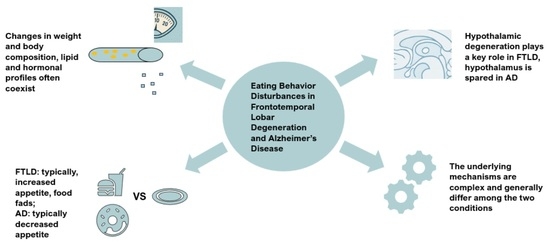
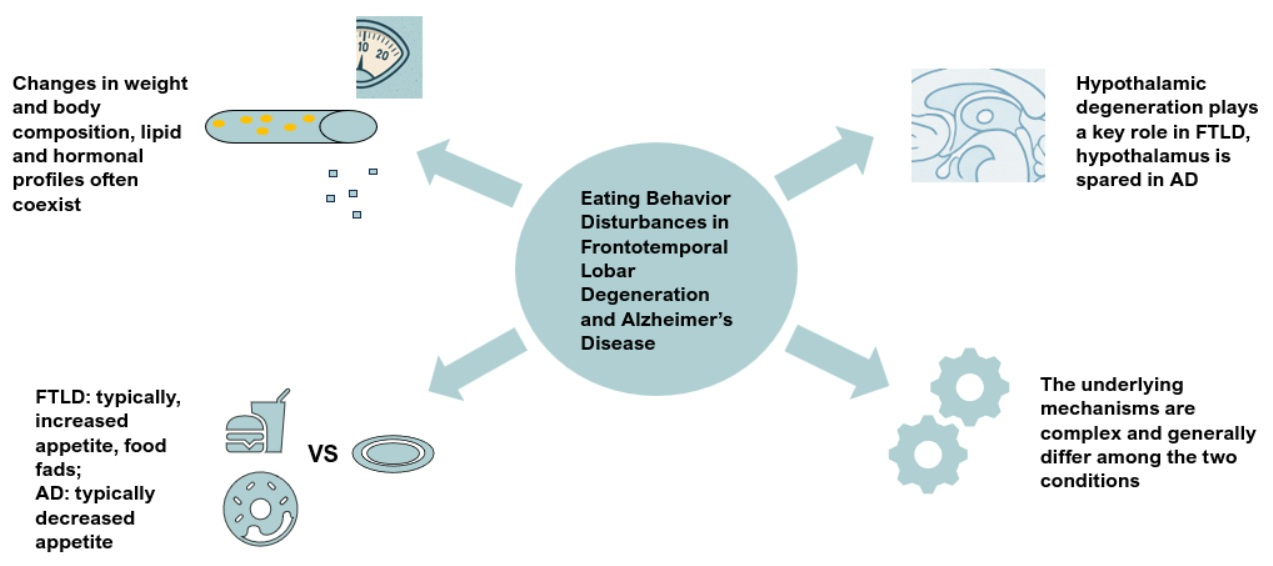
Eating behavior disturbances are increasingly recognized as clinically relevant features of dementias. Although underappreciated, such alterations affect nutritional status, metabolic state, and disease burden. Alzheimer’s disease (AD) and frontotemporal lobar degeneration (FTLD) exhibit a wide range of manifestations in eating and appetite regulation. In behavioral variant frontotemporal dementia (bvFTD), hyperorality, increased appetite, preference for sweet and high-fat foods, altered table manners, and consumption of inedible objects are common and may appear early. In contrast, AD patients usually present with decreased appetite, early dysphagia, and weight loss, although increased appetite may also occur. Beyond clinical manifestations, this review synthesizes current evidence regarding the prevalence, metabolic and hormonal profiles, and neuroimaging patterns of eating behavior disturbances in FTLD and AD, provides insight into the complex underlying mechanisms causing these changes, and underlines the lack of clear treatment strategies in these cases.

Graphical Abstract

1. Introduction

Dementia is a multifactorial syndrome with multiple etiologies, primarily defined by a progressive decline in cognitive functions such as memory, learning, praxis and language. Beyond these cognitive domains, dementia also affects many aspects of daily life including emotions, social interactions, and other basic behaviors related to eating habits and food preferences [1]. These alterations in eating behavior have gained increasing recognition and need careful assessment and management to support a more holistic approach to patient care [2].
Alzheimer’s disease (AD) and frontotemporal dementia (FTD) represent two major forms of neurodegenerative dementias, each characterized by different and distinct pathophysiological mechanisms and clinical trajectories [3]. Despite their substantial differences, both disorders have been linked to altered eating behaviors, to the extent that, in some cases, these changes form part of the diagnostic criteria [4].
Emerging evidence highlights a “two-way” relationship between nutrition and neurodegeneration. On the one hand, diet and nutritional status can influence brain structure, function, and resilience through metabolic, inflammatory, and neurotrophic pathways [5,6]. On the other hand, neurodegeneration can disrupt brain circuits linked to food intake, appetite, and reward processing, thus leading to serious changes in eating habits.
Changes in eating behavior can be assessed using multiple tools. Two of the most commonly employed instruments in recent studies focusing on eating behavior related alterations are the Cambridge Behavioral Inventory (CBI), including its revised version (CBI-R), and the Appetite and Eating Habits Questionnaire (APEHQ). The CBI is a caregiver-administered questionnaire that evaluates behavioral changes across multiple domains. Regarding eating alterations, it includes four items assessing sweet preference, repetitive consumption of the same food, appetite changes, and table manners [7,8]. The APEHQ, also completed by the caregiver, comprises 34 items divided into five categories: swallowing, appetite, eating habits (e.g., table manners), food preferences (e.g., sweet foods), and other oral behaviors (e.g., smoking) [9]. Other instruments that are used to evaluate eating or related behaviors in daily practice include the Food-Related Personality Questionnaire (FRPQ), Neuropsychiatric Inventory (NPI), and Frontal Behavioral Inventory (FBI).
Within the frontotemporal lobar degeneration (FTLD) spectrum, which includes a plethora of entities, the most prevalent ones being behavioral variant frontotemporal dementia (bvFTD), semantic dementia (SD), and primary progressive aphasia (PPA), disturbances in eating behavior are particularly prominent. In fact, such alterations form part of the diagnostic criteria for bvFTD proposed by Rascovsky et al., underscoring their clinical and diagnostic importance [7]. Nonetheless, appetite and dietary changes have also been reported in the other subtypes.
In Alzheimer’s disease, weight loss is a well-recognized clinical feature [8]. However, it is not universal, as some patients exhibit stable or even increased body weight, suggesting heterogeneity in the metabolic and behavioral profile of the disease [9].
This review aims to summarize current evidence on eating behavior and nutritional disturbances in two major causes of dementia—Alzheimer’s disease and frontotemporal dementia. Specifically, it seeks to outline the clinical features of eating abnormalities in each disorder, integrate findings from clinical and neuroimaging studies to investigate their underlying mechanisms, and compare these patterns across the two conditions. Through this synthesis, we aim to provide insights that can enhance diagnostic precision and help better understand the mechanisms and clinical implications of eating behavior changes in dementia.

2. Search Strategy

Extensive literature research of PubMed was conducted in order to retrieve relevant studies published up to October 2025, without the use of time filters. The terms “frontotemporal dementia”, “frontotemporal lobar degeneration”, and “Alzheimer’s disease” were used as keywords to describe the population of interest, and the terms “eating habits”, “appetite”, “food preference”, “hormones”, and “calories” were used as keywords regarding the scope of this review. The retrieved articles were additionally hand-searched for further potential eligible articles. Full-text original articles published in the English language investigating eating habits of FTLD and AD patients, their macronutrient intake, their biochemical and hormonal profiles, imaging findings related to these changes, and underlying possible mechanisms met the inclusion criteria. Ultimately, 46 studies were included in our qualitative synthesis.

3. Alterations in Eating Behavior in Frontotemporal Lobar Degeneration

3.1. Prevalence and Demographic Characteristics

Although eating alterations in patients with frontotemporal lobar degeneration (FTLD) have been repeatedly observed and reported, their prevalence remains unknown. In terms of sex differences, two studies investigating different cohorts of bvFTD patients (consisting of 738 and 216 patients, respectively) found no significant differences in eating behavior changes between men and women [10,11]. However, the latter showed that when matched for a similar degree of atrophy, men exhibit more pronounced eating changes than women [11]. Comparing sporadic and genetic forms, males with sporadic bvFTD demonstrated more severe eating behavior alterations than males with genetic variants, while differences between female sporadic and genetic forms were insignificant [10]. Regarding racial differences, a study encompassing 2478 patients of multiple race found that Asians with frontotemporal dementia or primary progressive aphasia (PPA) appear to exhibit more frequent and pronounced eating alterations compared to White patients, although the Asian sample in that study was considerably smaller [12].

3.2. Clinically Evident Eating Behavior Changes in Different Entities

In patients with bvFTD, changes in eating habits—such as excessive eating, sweet preference, and alterations in table manners—are reported to be more prominent and severe than other FTLD-related symptoms, and they tend to worsen as the disease progresses [13,14]. Hyperorality and changes in food preferences are also included among the diagnostic criteria for bvFTD [15].
Although closely associated with the behavioral disturbances characteristic of bvFTD, changes in eating behavior are also common in patients with semantic dementia (SD). Both earlier and recent studies have shown that SD patients exhibit strong food selectivity [16,17]. Unlike bvFTD patients, who often consume larger quantities, SD patients may refuse offered food, including typically preferred items such as sweets, and may sometimes eat very little or nothing [16,18]. Notably, stereotyped food preferences often appear as an early symptom of eating alterations in SD [4]. Recent evidence further indicates that SD patients with right-dominant anterior temporal lobe atrophy (R-SD) exhibit eating alterations as severe as those observed in bvFTD patients and significantly more pronounced than in left-dominant SD (L-SD) patients [19]. However, an earlier study did not find significant differences between R-SD and L-SD, despite comparable disease duration [20]. Compared to other PPA variants, patients with semantic variant PPA (svPPA) develop significantly more pronounced eating behavior changes [21].

3.3. Macronutrient Consumption

Several studies have investigated the macronutrients preferentially consumed by patients with FTLD. Patients with bvFTD have been shown to consume more carbohydrates and sugar than healthy controls in their daily life as measured with the Dietary Questionnaire for Epidemiological Studies (DQES) completed by caregivers [22]. Similar results were reported in a behavioral study, with both bvFTD and SD patients showing a preference for desserts high in sucrose compared to low-sucrose alternatives. In the same study, bvFTD patients consumed less protein than healthy controls when given ad libitum access to a breakfast buffet [18]. Regarding fat intake, bvFTD patients have been reported to consume more total fat, particularly saturated fat, than controls, measured with the DQES [22], and have also shown significant preference for high fat-content meals when presented with different options in another study [23]. However, a previous study by the same author suggested that protein and fat consumption, measured with the same questionnaire, did not differ significantly between bvFTD, SD patients, and controls [9].

3.4. Body Composition and Metabolic Profile

Body mass index (BMI) in FTLD patients correlates with more severe eating disturbances and a greater neuropsychiatric symptom burden, including apathy and disinhibition [24]. Furthermore, in patients with mild cognitive impairment (MCI), an increase in BMI from baseline to dementia diagnosis was associated with a 16% higher likelihood of developing FTD [24]. FTLD patients exhibit increased total fat mass, lean mass, and fat percentage, as well as greater visceral and centrally distributed fat as measured by DEXA. While these changes correlate with eating disturbances, they cannot be explained solely by altered eating behaviors. Increased visceral fat has been associated with gray matter atrophy in regions regulating autonomic nervous system function, which plays a major role in fat distribution and weight regulation [25].
Metabolic alterations have also been documented in bvFTD, including increased triglycerides and decreased HDL cholesterol, both related to disease duration [26]. Lower total cholesterol was associated with poorer survival and lower dietary fat intake, whereas patients with higher fat consumption correlated with higher cholesterol and better survival. Conversely, another study found no significant differences in triglycerides between bvFTD patients and controls; instead, bvFTD patients displayed higher HDL levels than controls and elevated LDL compared with both Alzheimer’s disease (AD) patients and controls. Higher LDL levels correlated with eating disturbance scores, suggesting that it may reflect overeating rather than primary metabolic dysregulation [27].

3.5. Imaging Patterns Related to Eating Changes

The brain regions underlying eating disturbances in FTLD remain unclear, reflecting the involvement of a complex, distributed network. Below, we present frequently implicated areas from studies that used voxel-based morphometry to investigate clinical and imaging associations. Regarding frontal regions, a large study of 712 patients with FTLD associated excessive eating with atrophy in the right anterior insula [13]. The same area has previously been correlated to binge eating by a study that included a subgroup of 6 “binge-eaters” diagnosed with FTD [28], and has also been associated with a preference for sweet foods by an older study with a small sample of 16 FTLD patients [29]. This last study also reported that atrophy of the orbitofrontal cortex (OFC) was linked to hyperphagia [29], which is in line with the findings of a more recent study by Ahmed et al., who found that patients with semantic dementia and bilateral OFC atrophy consumed significantly more calories in an ad libitum breakfast compared to the rest of semantic dementia patients in a cohort of 15 SD patients in total [18]. Concerning temporal areas, Ahmed et al. also reported that atrophy in bilateral cingulate cortices, inferior temporal lobes, and right hippocampus was associated with an increased caloric intake under the same conditions within a 19-patient bvFTD subgroup [18]. Other areas that surprisingly came up as significant in the same study were the occipital cortex and right cerebellum, as well as the nucleus accumbens, the atrophy of which significantly correlated with a higher caloric intake [18]. Lastly, the basal ganglia were also associated with such disturbances according to the aforementioned studies [28,29].
Interestingly, a recent study examining 250 patients with bvFTD reported that right-lateralized atrophy, particularly in the frontal pole, medial frontal cortex, caudate, and putamen, is associated with greater severity of eating disturbances measured with the NPI [30].
Only a few studies have utilized Single-Photon Emission Computed Tomography (SPECT) to study impaired areas related to eating behavior alterations: one study examining SPECT images of 75 FTD patients correlated right anterior and dorsolateral prefrontal cortices, left orbitofrontal cortex, orbital part of the right inferior frontal gyrus, and left parahippocampal gyrus with increasing eating disturbances measured with the Neuropsychiatric Inventory (NPI) [31], whereas another study associated same food preference with the left ventral anterior cingulate cortex (ACC) and sweet food preference with bilateral gyrus rectus and temporal pole in 43 bvFTD patients, while left inferior temporal gyrus hypoperfusion was associated with same food preference among 29 SD patients [32].
Importantly, the hypothalamus seems to play a central role in the pathophysiology of eating alterations in FTLD. Bocchetta et al. examined a cohort of 18 bvFTD patients and found that they had significantly more hypothalamic atrophy compared to controls. Additionally, patients with heavier eating disturbances measured with the Cambridge Behavioral Inventory-Revised (CBI-R) tended to have more atrophy than those with lighter alterations, although these differences did not reach statistical significance. Furthermore, two more recent studies, the first including 151 patients of the frontotemporal dementia– amyotrophic lateral sclerosis (FTD-ALS) spectrum and the second 130 patients diagnosed with bvFTD, frontotemporal dementia–motor neuron disease (FTD-MND), or PPA, correlated more significant hypothalamic atrophy to more severe CBI-R scores for eating behavior. Despite the fact that the first study by Bocchetta et al. segmented the hypothalamus manually into five different areas (superior and inferior anterior hypothalamus, superior and inferior tuberal hypothalamus, and posterior hypothalamus), whereas the other two studies used an automated machine learning model to split the hypothalamus into the same subregions, consistent preservation of the inferior tuberal area was observed [33,34,35]. Hypothalamic atrophy in bvFTD patients has also been confirmed pathologically: 12 post-mortem bvFTD cases exhibited hypothalamic atrophy in the posterior half of the hypothalamus compared to controls in a study by Piguet et al.; however, the authors did not find significant differences in the anterior half [36].

3.6. Eating-Related Hormones Changes

Hormonal alterations related to eating behavior have been investigated in FTLD. In a study by Woolley et al., peripheral eating-related hormone levels were measured before (after an 8 h fasting period), during, and after breakfast in 19 bvFTD patients. The authors reported reduced ghrelin levels—measured by radioimmunoassay—at all timepoints compared with healthy controls [37]. Similarly, cortisol levels, also measured by radioimmunoassay (RIA), were lower in bvFTD patients before beginning breakfast [37]. In contrast, post-meal peak insulin levels (measured with RIA) were elevated in bvFTD patients compared with controls. Increased insulin levels in the fasting state have also been observed in bvFTD patients (measured by Enzyme-Linked Immunosorbent Assay—ELISA) in a comparable study by Ahmed et al., who assessed eating-related hormones in 35 bvFTD patients, along with other FTD-ALS spectrum patients, after a 10 h fast [38]. Unlike Woolley et al., they found no difference in fasting ghrelin levels measured with competitive enzyme immunoassay (EIA) between bvFTD patients and controls. Another previously published study by the same first author, focusing on bvFTD and svPPA patients, reported comparable 10 h fasting ghrelin between 19 bvFTD patients and controls measured with EIA, as well as similar cholecystokinin (CCK) values measured with EIA between groups. All three studies agreed on non differentiating PYY levels between patients and controls [14,37,38].
Leptin findings are interesting: while the study by Woolley and the firstly published study by Ahmed found no overall group differences regarding fasting leptin, measured with RIA and ELISA, respectively [14,37], the second study by Ahmed focusing on the FTD-ALS spectrum found that bvFTD patients had higher fasting leptin values (also measured with ELISA) than controls. However, in the study by Woolley et al., bvFTD patients classified as overeaters exhibited significantly higher leptin concentrations than non-overeaters and controls when measured before breakfast, indicating that the hormone is not totally unrelated to eating behavior [37].
Fasting agouti-related peptide (AgRP) measurements with “sandwich” ELISA were also valuable. AgRP was found to be significantly elevated in both bvFTD and SD compared with controls by Ahmed et al. Higher AgRP levels correlated with greater functional impairment, as measured by the Frontotemporal Dementia Rating Scale [14].
Further central neuropeptides have also been implicated. Orexin A, measured in the cerebrospinal fluid of 40 bvFTD patients with EIA in the morning after overnight fasting, was significantly increased in bvFTD and correlated with compulsive behaviors [39]. Conversely, when measured with ELISA, neuropeptide Y (NPY), another key regulator of appetite and metabolism, was markedly reduced in bvFTD compared with controls, as Ahmed et al. found. Lower NPY levels were associated with longer disease duration and more severe eating disturbances [38].

3.7. Possible Mechanisms Contributing to Changes

Altered reward processing could potentially influence these changes. Decreased dopaminergic striatal response, which has been associated with binge eating, suggests that reward system dysfunction may contribute to abnormal eating in FTLD [40]. Degeneration of the hypothalamus, a structure relevant to reward processing, is consistent with this hypothesis and may further impact motivation and emotion regulation [18]. According to one study, appetite and sweet tooth changes were the most prominent alterations related to impaired reward processing. These changes were observed in nearly all bvFTD patients and the vast majority of those with semantic dementia (SD). Chokesuwattanaskul et al. [41] also identified distinct phenotypes based on responsiveness to different rewarding behaviors, including an “eating-predominant” subgroup characterized by increased appetite, higher sugar consumption, and heightened responsiveness to music, alongside reduced sexual drive and diminished responsiveness to art. This subgroup accounted for more than half of bvFTD patients and over one-third of SD patients, representing the most common phenotype among four identified clusters. Abnormal reward behavior in these patients was associated with gray matter atrophy in the anterior cingulate gyrus, both temporal poles, the right fusiform gyrus, and the right middle frontal gyrus—regions also implicated in semantic and emotional processing.
Sensory and semantic factors may also contribute. Although taste perception for fat and sugar remains normal, patients with bvFTD and SD show impairments in flavor and odor identification. Errors tend to occur when distinguishing between similar items within a category (e.g., different fruits) rather than between distinct categories (e.g., fruit vs. coffee), indicating semantic rather than perceptual deficits [42]. Flavor recognition deficits have been associated with atrophy in the left anterior temporal lobe, including the entorhinal cortex, hippocampus, parahippocampal gyrus, and temporal pole. Similar findings have been reported for olfaction: SD patients can detect odors but have difficulty identifying them due to semantic deficits, while bvFTD patients show milder impairments [43]. Such deficits could underlie the development of food fads and abnormal object eating behaviors in these populations. Additionally, errors in food-related semantic tasks, such as naming or matching food items, have been shown to predict the severity of eating behavior changes and abnormal food preferences. These deficits have been linked to atrophy in regions including the left anterior cingulate cortex, which is associated with both semantic knowledge and eating regulation, suggesting that loss of semantic representations may contribute to the pathophysiology of disordered eating in FTD [17].
Lastly, metabolic factors also seem to contribute to the pathophysiology of these changes. Increased fat consumption has been correlated with longer survival in FTD [26], possibly reflecting adaptation to higher energy expenditure in these patients. This could be related to autonomic nervous system dysfunction, as patients with FTD display elevated resting and stress-induced heart rates, suggesting greater caloric needs compared with controls [44].

4. Alterations in Eating Behavior in Alzheimer’s Disease

4.1. Clinically Evident Eating Behavior Changes

Eating behavior alterations have long been recognized in Alzheimer’s disease (AD), with patients exhibiting either reduced or increased food intake, a heightened preference for sweet or spicy foods, changes in eating style, and abnormal oral behaviors [45]. An earlier study suggested that swallowing difficulties—a well-known complication of advanced AD—often represent the first manifestation of disordered eating behavior as the disease progresses [4]. In the same study by Chokesuwattanaskul et al. [41], AD patients exhibited significantly more abnormal reward-related behaviors than healthy controls, with appetite changes being particularly prominent. Among these, decreased appetite appeared most closely linked to AD. However, multiple studies have demonstrated that eating behavior changes are generally less frequent and less pronounced in AD compared to FTD [9,23,25,27,46]. Further comparisons indicate that patients with semantic dementia (SD) display more severe eating disturbances than those with AD [4,9].
Within the cohort studied by Chokesuwattanaskul et al. [41], the “eating-predominant” behavioral cluster—characterized by increased appetite and responsiveness to food-related rewards—was observed in approximately one-quarter of AD patients, a significantly lower proportion than in bvFTD. Supporting the high prevalence of eating alterations, another study reported that 81.4% of AD patients exhibited eating disturbances when assessed with a detailed questionnaire [47]. Interestingly, analysis of symptom subdomains revealed that individuals with mild dementia displayed nearly equal rates of appetite loss and appetite increase—although the difference in appetite loss compared with controls did not reach statistical significance—suggesting that either symptom can occur early in the disease course.

4.2. Macronutrient Intake

In contrast to bvFTD, Alzheimer’s disease (AD) patients appear to display an opposing pattern of food preference. In one study, AD patients consistently chose meals with the lowest fat content and rated high-fat meals significantly less favorably than bvFTD patients, while also demonstrating an intact ability to perceive differences in fat concentration between meals [23]. Regarding habitual dietary intake, AD patients did not differ significantly from healthy controls in daily consumption of carbohydrates, sugars, fats, or proteins [9]. Similarly, in an ad libitum breakfast paradigm, their total caloric intake was comparable to that of controls but significantly lower than that of bvFTD patients. Moreover, AD participants consumed less dessert than bvFTD patients and exhibited neither a marked preference for sweeter desserts nor an avoidance of less sweet options.

4.3. Body Composition and Metabolic Profile

With respect to body mass index (BMI) in AD, several studies have demonstrated that cognitive decline correlates with lower BMI [24]. These findings suggest that weight loss may serve as an early clinical marker of emerging cognitive impairment. Consistently, a longitudinal study that followed participants with and without dementia for at least five years found that individuals who later developed AD exhibited a twofold increase in the rate of weight loss during the year preceding diagnosis, whereas cognitively stable participants maintained a steady rate of weight loss over time [48]. Beyond lower BMI, AD patients also tend to have reduced total fat, lean mass, fat percentage, and visceral fat compared with bvFTD patients [25].
Findings on lipid profiles in AD have been somewhat inconsistent across studies. One study investigating a cohort of 63 AD patients reported that, similar to bvFTD, AD patients did not differ from healthy controls in triglyceride levels after 12 h fasting; however, they exhibited higher total cholesterol, HDL, and LDL values compared with controls, although their LDL levels remained significantly lower than those of bvFTD patients [27]. These observations contrast with earlier results by Ahmed et al. [49], who found no significant differences after 10 h fasting in total cholesterol or LDL between 29 AD patients, 31 bvFTD patients, and controls, and likewise reported no differences in HDL levels between AD patients and controls.

4.4. Imaging Patterns Related to Eating Behavior Changes

Compared with frontotemporal lobar degeneration, relatively few studies have directly linked specific brain regions to eating behavior disturbances in AD.
A SPECT study involving 64 mild-to-moderate AD (mean MMSE 23.5) patients demonstrated that appetite loss was associated with hypoperfusion in the left anterior cingulate cortex (ACC) and orbitofrontal cortex (OFC), with relative sparing of the right ACC, right OFC, and left middle temporal cortex compared to patients without appetite loss. This left-hemispheric lateralization suggests that these regions may play a particularly important role in regulating eating behavior in AD [50]. More recently, another SPECT study reported that eating disturbances in 66 patients with moderate AD (mean MMSE 20.2) correlated specifically with hypoperfusion in the left inferior temporal lobe [31].
In AD, total hypothalamic volume does not significantly differ from healthy controls, yet remains considerably higher than in bvFTD patients—suggesting that the hypothalamus likely plays a less central role in the pathogenesis of eating alterations in AD [14].

4.5. Eating-Related Hormone Changes

Regarding hormones regulating hunger and satiety, the studies already analyzed in the relevant section about FTLD have reported that patients with AD exhibit normal levels of ghrelin, insulin, peptide YY (PYY), cholecystokinin (CCK), oxytocin, and leptin, with the notable exception of cortisol, which was found to be elevated compared with controls three hours after meal consumption in one of the studies [14,37].

4.6. Possible Mechanisms Contributing to Changes

In AD, psychological factors appear to play the most important role in driving eating behavior alterations, such as appetite reduction. In the study by Ismail et al. [50], higher anxiety scores on the NPI were associated with perfusion changes linked to appetite loss. Similarly, Morrow et al. [24] reported that depressive symptoms correlated with lower BMI, supporting the notion that depression and reduced motivation contribute to disordered eating in AD. Another study also linked lower appetite to depressive symptoms and lower vitality further indicating that mood disturbances influence eating behavior [51].
Taste and olfactory impairments may also contribute to these alterations. AD patients exhibit difficulties in perceiving all taste modalities except sour, with sweet and sour tastes being particularly challenging to recognize and discriminate [52]. Olfactory function is likewise severely compromised in AD, as patients demonstrate an impaired ability to distinguish between odors not only compared to healthy controls but also relative to those with FTD and SD [43].

5. Discussion

Our review summarizes the various eating disturbances observed in patients with frontotemporal lobar degeneration (FTLD) and Alzheimer’s disease (AD). In addition, it examines associated metabolic, imaging, and hormonal alterations identified and provides insight into the mechanisms most likely involved in these complex neuropsychiatric manifestations, which are not only symptoms but also significant modifiers of disease progression.
Distinct disease entities exhibit different patterns of eating behavior alterations. Patients with behavioral variant frontotemporal dementia (bvFTD) exhibit a broad spectrum of severe disturbances, often including hyperorality, changes in table manners, specific food preferences, and oral exploration of inedible objects [13,14,15]. Patients with semantic dementia (SD) frequently develop strong food preferences as their earliest eating-related symptom, although they may eventually display the full range of disturbances observed in bvFTD [4,19]. In contrast, AD patients often present initially with swallowing difficulties and appetite loss [4], although some may also experience increased appetite or other types of eating disturbances [47]. No specific eating behavior alteration is pathognomonic for any disorder. However, in combination with other clinical, laboratory, and imaging findings, they can contribute to directing clinicians toward a coherent diagnosis. Additionally, further differences exist in patients’ BMIs and metabolic profiles, appetite-related hormonal levels, and imaging patterns of areas related to eating behavior, such as the hypothalamus, although more studies are needed to systematically apply these elements as potential diagnostic biomarkers. These differences are presented in Table 1.
Regarding macronutrient consumption, FTLD patients exhibit a pronounced preference for sweet foods, desserts, and carbohydrate-rich meals. They also tend to favor high-fat foods when given a choice. However, two different surveys completed by caregivers have shown contradicting results, with one suggesting that bvFTD patients consume more fat than controls in their daily life, while the other did not show a significant difference between the groups. These differences might occur due to the low reliability of survey studies because of the caregivers’ subjectiveness and the differences in sample sizes (the study that showed significant differences between groups had a larger sample of 56 bvFTD patients compared to the 21 patients of the other study). In contrast, AD patients did not show any consistent preference for specific food types in the abovementioned studies [9]. These differences are reflected in body composition: bvFTD patients typically present with higher BMI and a dysregulated metabolic profile, characterized by increased total, visceral, and centrally distributed fat, as well as elevated LDL levels compared with controls [24,25,27]. Conversely, AD patients generally exhibit lower BMI, which is of clinical relevance since an accelerated rate of BMI decline has been shown to predict an eventual AD diagnosis [24,48].
Concerning patients’ lipid profiles, some inconsistencies emerge from the existing literature. Summarizing findings from the Results section regarding bvFTD patients, two studies by Ahmed et al. [26,49] have found increased fasting triglycerides and decreased fasting HDL values compared to healthy controls, while one study by Wang et al. [27] found no differences in triglycerides and an increase in HDL in comparison with controls. One of the two studies by Ahmed et al. also showed that their lipid profile findings correlated with disease severity. Taking this into account, it is difficult to compare the patient groups of the first two studies with the third one: regarding cognitive assessment, the first two studies measured their patients’ cognitive state using the Addenbrooke’s Cognitive Examination, while the other one used the Mini Mental State Examination; additionally, regarding the evaluation of neuropsychiatric symptoms, the first two studies used the CBI, while the second one used the NPI. It is likely that the differences concerning these findings could be attributed to patients with more advanced disease in the first two cases. However, this remains a hypothesis and further similar studies are needed to address these inconsistencies. Similarly, regarding patients with AD, the aforementioned study by Wang et al. found that AD patients had higher fasting total cholesterol (TC) than controls, and associated higher TC values with the presence of the APOE-ε4 allele [27]. A direct comparison of these results with the contradicting ones by Ahmed et al., who report no differences in TC between groups without taking patients’ genotype into account, is impossible [49].
Structural and functional brain changes have also been linked to these behavioral alterations. The hypothalamus appears to represent the central structure in the pathogenesis of these abnormalities [33,34,35]. Its role as a center controlling appetite and eating behavior is well established [53]. Degeneration of the hypothalamus is reflected in the hormonal dysregulation observed in FTLD: for instance, sparing of the inferior tuberal area may account for elevated AgRP levels, which is produced in the arcuate nucleus [54], possibly as a compensatory response for dysfunction in adjacent regions [14]. AgRP has an orexigenic effect and may contribute to the hyperorality of FTLD patients, since it has been found increased in both bvFTD and SD patients. It is worth mentioning that NPY, a neuropeptide produced from most neurons that also produce AgRP in the arcuate nucleus, has been found reduced in bvFTD patients. However, NPY is also expressed in multiple further sites of the nervous system. Along with the fact that the decrease in NPY has been linked to disease duration and severity, and that post-mortem analysis has proven preservation of hypothalamic NPY producing neurons, its reduction in contrast to increased AgRP values could be attributed to the overall nervous tissue degeneration caused by FTLD [36,54].
As noted above, the frontotemporal regions are also critical for the regulation of eating behavior. A recent PET study demonstrated that AD patients—and even individuals with other dementia types or mild cognitive impairment (MCI)—exhibited more pronounced eating and appetite disturbances when a frontotemporal hypometabolic pattern was present, particularly involving the frontal and anterior temporal regions, anterior cingulate gyrus, and insula, suggesting that these regions modulate eating behavior regardless of diagnosis [55]. Similarly, a recent MRI study reported that MCI patients with frontotemporal atrophy experienced appetite and eating changes twice as frequently as those without such atrophy, underscoring the importance of the frontal and anterior temporal lobes in these alterations [56].
With respect to patients’ peripheral hormonal profile, FTLD appears to be characterized by elevated anorexigenic hormones such as leptin and insulin (along with elevated insulin resistance). Although only one study has reported higher fasting leptin values among bvFTD patients, this study by Ahmed et al. included results from 35 patients, almost double the sample size of previous studies that did not find significant differences between groups. Additionally, as already discussed, Woolley et al. associated higher leptin values with patients who overate, indicating its relation to hyperorality caused by FTD. Physiologically, leptin is proportional to body fat and is elevated among patients with obesity. This finding is reasonable given that FTD patients with eating abnormalities such as hyperorality are often overweight or obese. Its central role in suppressing AgRP and NPY expression in the arcuate nucleus was found to be impaired in obese populations because of the possible development of resistance to the hormone [57]. For this reason, high leptin levels and FTD patients’ increased AgRP values and overeating behavior are not paradoxical. In the aforementioned study by Ahmed, patients with bvFTD had significantly higher BMI values than controls and thus it could be concluded that higher leptin values could be attributed to the groups’ BMI differences. Nevertheless, it would be interesting to compare leptin levels of bvFTD patients and controls with similar BMI values to investigate whether its value changes could be attributed to the disease itself and serve as a biomarker.
Additionally, several orexigenic hormones, such as ghrelin and cortisol, have been found to be reduced, despite the increased food intake typically observed in these patients [37]. Satiety, however, does not appear to play a major role in the pathophysiology of hyperorality and other eating behaviors, as a previous study did report insignificant differences in hunger or satiety sensations between bvFTD patients and controls [14].
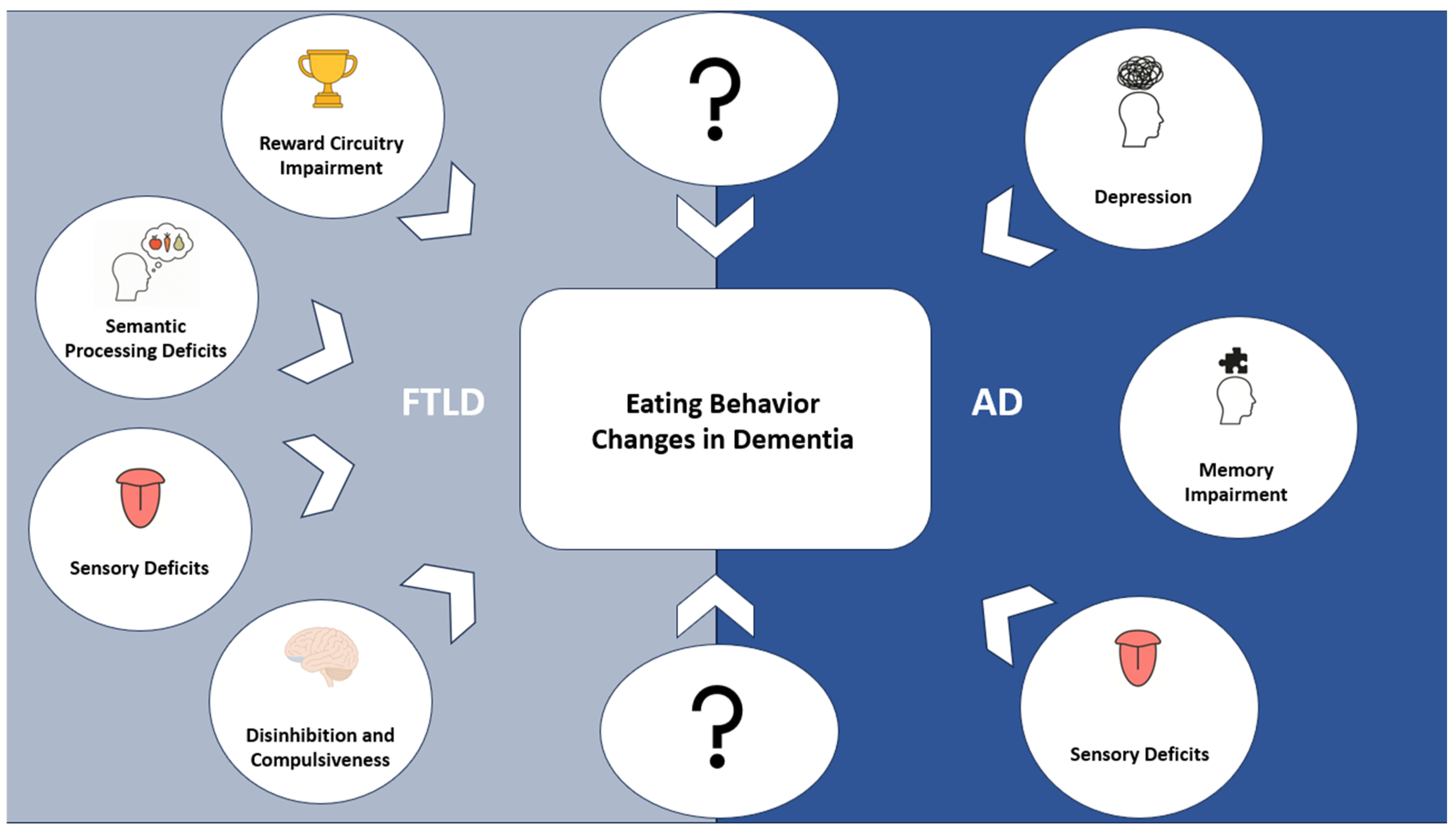
Instead, several mechanisms already analyzed may account for the observed behavioral differences between disorders. In bvFTD, impairments in reward circuitry, semantic and sensory processing, and metabolic regulation likely contribute to the disordered eating patterns, whereas in AD, depression and sensory deficits appear to play a more prominent role. Of course, these are not the only mechanisms contributing to these behaviors: for example, given that atrophy of the OFC has been linked to hyperphagia, it is reasonable to conclude that bvFTD patients’ disinhibition and compulsiveness also reinforce these behaviors. Similarly, the memory deficits of AD patients may lead them to forget their meals, leading to repetitive small-portion eating [58]. Overall, the underlying pathophysiology is highly complex and involves widespread neural networks, making it impossible to delineate it completely based on current evidence. A summary of these mechanisms is presented in Figure 1.
Lastly, it is worth mentioning that, despite the discrete main mechanisms contributing to altered eating behavior in each condition, there are still overlapping brain areas involved, such as the anterior cingulate cortices and the orbitofrontal cortices. Regardless of diagnosis, it is essential to tackle neuropsychiatric manifestations such as hyperorality. Drug categories such as SSRIs are known to generally be effective in reducing compulsiveness and disinhibition among patients [59]. Another anti-epileptic drug, topiramate, has been used in several case reports and has shown positive results in diminishing overeating among FTD patients [60,61,62]. However, no specific treatment exists for these disturbances. Further larger studies are needed in order to create clear guidelines on how to treat these symptoms.

6. Conclusions

Eating behavior disturbances are prevalent in both frontotemporal lobar degeneration and Alzheimer’s disease, reflecting distinct yet interrelated neurobiological mechanisms. Recognition and characterization of these alterations could contribute to diagnostic thinking, while also increase the understanding of patients’ nutritional and functional profiles. Integrating behavioral and metabolic assessment into diagnostic workup and patient management could ultimately promote more comprehensive patient care. Evidence-based treatment options to manage these symptoms are currently limited, and larger studies on different treatments are needed to create a clear management strategy.

Author Contributions

Conceptualization, P.I. and S.I.; methodology, S.I. and A.K.; resources, S.I. and A.K.; writing—original draft preparation, S.I. and A.K.; writing—review and editing, S.I. and A.K.; visualization, S.I. and A.K.; supervision, P.I.; project administration, P.I. All authors have read and agreed to the published version of the manuscript.

Funding

No funding was received.

Institutional Review Board Statement

Not applicable.

Informed Consent Statement

Not applicable.

Data Availability Statement

No new data were created or analyzed in this study. Data sharing is not applicable to this article.

Conflicts of Interest

The authors declare no conflict of interest.

References

  1. Arvanitakis, Z.; Shah, R.C.; Bennett, D.A. Diagnosis and Management of Dementia: Review. JAMA 2019, 322, 1589–1599. [Google Scholar] [CrossRef] [PubMed] [PubMed Central]
  2. Fostinelli, S.; De Amicis, R.; Leone, A.; Giustizieri, V.; Binetti, G.; Bertoli, S.; Battezzati, A.; Cappa, S.F. Eating Behavior in Aging and Dementia: The Need for a Comprehensive Assessment. Front. Nutr. 2020, 7, 604488. [Google Scholar] [CrossRef] [PubMed] [PubMed Central]
  3. Erkkinen, M.G.; Kim, M.O.; Geschwind, M.D. Clinical Neurology and Epidemiology of the Major Neurodegenerative Diseases. Cold Spring Harb. Perspect. Biol. 2018, 10, a033118. [Google Scholar] [CrossRef] [PubMed] [PubMed Central]
  4. Ikeda, M.; Brown, J.; Holland, A.J.; Fukuhara, R.; Hodges, J.R. Changes in appetite, food preference, and eating habits in frontotemporal dementia and Alzheimer’s disease. J. Neurol. Neurosurg. Psychiatry 2002, 73, 371–376. [Google Scholar] [CrossRef]
  5. McGrattan, A.M.; McGuinness, B.; McKinley, M.C.; Kee, F.; Passmore, P.; Woodside, J.V.; McEvoy, C.T. Diet and Inflammation in Cognitive Ageing and Alzheimer’s Disease. Curr. Nutr. Rep. 2019, 8, 53–65. [Google Scholar] [CrossRef] [PubMed]
  6. Pandareesh, M.D.; Kandikattu, H.K.; Razack, S.; Amruta, N.; Choudhari, R.; Vikram, A.; Doddapattar, P. Nutrition and Nutraceuticals in Neuroinflammatory and Brain Metabolic Stress: Implications for Neurodegenerative Disorders. CNS Neurol. Disord. Drug Targets 2018, 17, 680–688. [Google Scholar] [CrossRef] [PubMed]
  7. Nagahama, Y.; Okina, T.; Suzuki, N.; Matsuda, M. The Cambridge Behavioral Inventory: Validation and application in a memory clinic. J. Geriatr. Psychiatry Neurol. 2006, 19, 220–225. [Google Scholar] [CrossRef] [PubMed]
  8. Wear, H.J.; Wedderburn, C.J.; Mioshi, E.; Williams-Gray, C.H.; Mason, S.L.; Barker, R.A.; Hodges, J.R. The Cambridge Behavioural Inventory revised. Dement. Neuropsychol. 2008, 2, 102–107. [Google Scholar] [CrossRef] [PubMed] [PubMed Central]
  9. Ahmed, R.M.; Irish, M.; Kam, J.; van Keizerswaard, J.; Bartley, L.; Samaras, K.; Hodges, J.R.; Piguet, O. Quantifying the Eating Abnormalities in Frontotemporal Dementia. JAMA Neurol. 2014, 71, 1540–1546. [Google Scholar] [CrossRef]
  10. Liu, X.; de Boer, S.C.M.; Cortez, K.; Poos, J.M.; Illán-Gala, I.; Heuer, H.; Forsberg, L.K.; Casaletto, K.; Memel, M.; Appleby, B.S.; et al. Sex differences in clinical phenotypes of behavioral variant frontotemporal dementia. Alzheimer’s Dement. 2025, 21, e14608. [Google Scholar] [CrossRef] [PubMed] [PubMed Central]
  11. Illán-Gala, I.; Casaletto, K.B.; Borrego-Écija, S.; Arenaza-Urquijo, E.M.; Wolf, A.; Cobigo, Y.; Goh, S.Y.M.; Staffaroni, A.M.; Alcolea, D.; Fortea, J.; et al. Sex differences in the behavioral variant of frontotemporal dementia: A new window to executive and behavioral reserve. Alzheimer’s Dement. 2021, 17, 1329–1341. [Google Scholar] [CrossRef] [PubMed] [PubMed Central]
  12. Jin, H.A.; McMillan, C.T.; Yannatos, I.; Fisher, L.; Rhodes, E.; Jacoby, S.F.; Irwin, D.J.; Massimo, L. Racial Differences in Clinical Presentation in Individuals Diagnosed with Frontotemporal Dementia. JAMA Neurol. 2023, 80, 1191–1198. [Google Scholar] [CrossRef]
  13. Altomare, D.; Bracca, V.; Premi, E.; Micheli, A.; Cotelli, M.S.; Gasparotti, R.; Alberici, A.; Borroni, B. Clinical and imaging correlates of hyperorality in syndromes associated with frontotemporal lobar degeneration. Psychiatry Clin. Neurosci. 2024, 78, 818–825. [Google Scholar] [CrossRef] [PubMed]
  14. Ahmed, R.M.; Latheef, S.; Bartley, L.; Irish, M.; Halliday, G.M.; Kiernan, M.C.; Hodges, J.R.; Piguet, O. Eating behavior in frontotemporal dementia: Peripheral hormones vs hypothalamic pathology. Neurology 2015, 85, 1310–1317. [Google Scholar] [CrossRef] [PubMed] [PubMed Central]
  15. Rascovsky, K.; Hodges, J.R.; Knopman, D.; Mendez, M.F.; Kramer, J.H.; Neuhaus, J.; van Swieten, J.C.; Seelaar, H.; Dopper, E.G.; Onyike, C.U.; et al. Sensitivity of revised diagnostic criteria for the behavioural variant of frontotemporal dementia. Brain 2011, 134, 2456–2477. [Google Scholar] [CrossRef] [PubMed] [PubMed Central]
  16. Snowden, J.S.; Bathgate, D.; Varma, A.; Blackshaw, A.; Gibbons, Z.C.; Neary, D. Distinct behavioural profiles in frontotemporal dementia and semantic dementia. J. Neurol. Neurosurg. Psychiatry 2001, 70, 323–332. [Google Scholar] [CrossRef] [PubMed] [PubMed Central]
  17. Vignando, M.; Rumiati, R.I.; Manganotti, P.; Cattaruzza, T.; Aiello, M. Establishing links between abnormal eating behaviours and semantic deficits in dementia. J. Neuropsychol. 2020, 14, 431–448. [Google Scholar] [CrossRef] [PubMed]
  18. Ahmed, R.M.; Irish, M.; Henning, E.; Dermody, N.; Bartley, L.; Kiernan, M.C.; Piguet, O.; Farooqi, S.; Hodges, J.R. Assessment of Eating Behavior Disturbance and Associated Neural Networks in Frontotemporal Dementia. JAMA Neurol. 2016, 73, 282–290. [Google Scholar] [CrossRef]
  19. Zhang, X.; Irish, M.; Piguet, O.; Ahmed, R.M. Behavioural and cognitive profiles in frontotemporal dementia and Alzheimer’s disease: A longitudinal study. J. Neurol. 2025, 272, 279. [Google Scholar] [CrossRef] [PubMed] [PubMed Central]
  20. Pozueta, A.; Lage, C.; García-Martínez, M.; Kazimierczak, M.; Bravo, M.; López-García, S.; Riancho, J.; González-Suarez, A.; Vázquez-Higuera, J.L.; de Arcocha-Torres, M.; et al. Cognitive and Behavioral Profiles of Left and Right Semantic Dementia: Differential Diagnosis with Behavioral Variant Frontotemporal Dementia and Alzheimer’s Disease. J. Alzheimer’s Dis. 2019, 72, 1129–1144. [Google Scholar] [CrossRef]
  21. Foxe, D.; Irish, M.; Ramanan, S.; Stark, S.; Cordato, N.J.; Burrell, J.R.; Piguet, O. Longitudinal changes in behaviour, mood and functional capacity in the primary progressive aphasia variants. Eur. J. Neurosci. 2022, 56, 5601–5614. [Google Scholar] [CrossRef] [PubMed]
  22. Ahmed, R.M.; Caga, J.; Devenney, E.; Hsieh, S.; Bartley, L.; Highton-Williamson, E.; Ramsey, E.; Zoing, M.; Halliday, G.M.; Piguet, O.; et al. Cognition and eating behavior in amyotrophic lateral sclerosis: Effect on survival. J. Neurol. 2016, 263, 1593–1603. [Google Scholar] [CrossRef]
  23. Ahmed, R.M.; Tse, N.Y.; Chen, Y.; Henning, E.; Hodges, J.R.; Kiernan, M.C.; Irish, M.; Farooqi, I.S.; Piguet, O. Neural correlates of fat preference in frontotemporal dementia: Translating insights from the obesity literature. Ann. Clin. Transl. Neurol. 2021, 8, 1318–1329. [Google Scholar] [CrossRef] [PubMed] [PubMed Central]
  24. Morrow, C.B.; Leoutsakos, J.; Yan, H.; Onyike, C.; Kamath, V. Weight Change and Neuropsychiatric Symptoms in Alzheimer’s Disease and Frontotemporal Dementia: Associations with Cognitive Decline. J. Alzheimer’s Dis. Rep. 2023, 7, 767–774. [Google Scholar] [CrossRef] [PubMed] [PubMed Central]
  25. Ahmed, R.M.; Landin-Romero, R.; Liang, C.T.; Keogh, J.M.; Henning, E.; Strikwerda-Brown, C.; Devenney, E.M.; Hodges, J.R.; Kiernan, M.C.; Farooqi, I.S.; et al. Neural networks associated with body composition in frontotemporal dementia. Ann. Clin. Transl. Neurol. 2019, 6, 1707–1717. [Google Scholar] [CrossRef] [PubMed] [PubMed Central]
  26. Ahmed, R.M.; Highton-Williamson, E.; Caga, J.; Thornton, N.; Ramsey, E.; Zoing, M.; Kim, W.S.; Halliday, G.M.; Piguet, O.; Hodges, J.R.; et al. Lipid Metabolism and Survival Across the Frontotemporal Dementia-Amyotrophic Lateral Sclerosis Spectrum: Relationships to Eating Behavior and Cognition. J. Alzheimer’s Dis. 2017, 61, 773–783. [Google Scholar] [CrossRef]
  27. Wang, P.; Zhang, H.; Wang, Y.; Zhang, M.; Zhou, Y. Plasma cholesterol in Alzheimer’s disease and frontotemporal dementia. Transl. Neurosci. 2020, 11, 116–123. [Google Scholar] [CrossRef] [PubMed] [PubMed Central]
  28. Woolley, J.D.; Gorno-Tempini, M.L.; Seeley, W.W.; Rankin, K.; Lee, S.S.; Matthews, B.R.; Miller, B.L. Binge eating is associated with right orbitofrontal-insular-striatal atrophy in frontotemporal dementia. Neurology 2007, 69, 1424–1433. [Google Scholar] [CrossRef] [PubMed]
  29. Whitwell, J.L.; Sampson, E.L.; Loy, C.T.; Warren, J.E.; Rossor, M.N.; Fox, N.C.; Warren, J.D. VBM signatures of abnormal eating behaviours in frontotemporal lobar degeneration. Neuroimage 2007, 35, 207–213. [Google Scholar] [CrossRef] [PubMed]
  30. Sokołowski, A.; Roy, A.R.K.; Goh, S.M.; Hardy, E.G.; Datta, S.; Cobigo, Y.; Brown, J.A.; Spina, S.; Grinberg, L.; Kramer, J.; et al. Neuropsychiatric symptoms and imbalance of atrophy in behavioral variant frontotemporal dementia. Hum. Brain Mapp. 2023, 44, 5013–5029. [Google Scholar] [CrossRef] [PubMed] [PubMed Central]
  31. Valotassiou, V.; Sifakis, N.; Tzavara, C.; Lykou, E.; Tsinia, N.; Kamtsadeli, V.; Sali, D.; Angelidis, G.; Psimadas, D.; Tsougos, I.; et al. Eating Disorders in Frontotemporal Dementia and Alzheimer’s Disease: Evaluation of Brain Perfusion Correlates Using 99mTc-HMPAO SPECT with Brodmann Areas Analysis. J. Alzheimer’s Dis. 2021, 80, 1657–1667. [Google Scholar] [CrossRef]
  32. Zhou, Z.; Li, X.; Jin, Y.; Zheng, Y.; Jia, S.; Jiao, J.; Zheng, X. Regional cerebral blood flow correlates eating abnormalities in frontotemporal dementia. Neurol. Sci. 2019, 40, 1695–1700. [Google Scholar] [CrossRef]
  33. Tse, N.Y.; Bocchetta, M.; Todd, E.G.; Devenney, E.M.; Tu, S.; Caga, J.; Hodges, J.R.; Halliday, G.M.; Irish, M.; Kiernan, M.C.; et al. Distinct hypothalamic involvement in the amyotrophic lateral sclerosis-frontotemporal dementia spectrum. NeuroImage Clin. 2023, 37, 103281. [Google Scholar] [CrossRef]
  34. Bocchetta, M.; Gordon, E.; Manning, E.; Barnes, J.; Cash, D.M.; Espak, M.; Thomas, D.L.; Modat, M.; Rossor, M.N.; Warren, J.D.; et al. Detailed volumetric analysis of the hypothalamus in behavioral variant frontotemporal dementia. J. Neurol. 2015, 262, 2635–2642. [Google Scholar] [CrossRef] [PubMed] [PubMed Central]
  35. Shapiro, N.L.; Todd, E.G.; Billot, B.; Cash, D.M.; Iglesias, J.E.; Warren, J.D.; Rohrer, J.D.; Bocchetta, M. In vivo hypothalamic regional volumetry across the frontotemporal dementia spectrum. NeuroImage Clin. 2022, 35, 103084. [Google Scholar] [CrossRef]
  36. Piguet, O.; Petersén, A.; Yin Ka Lam, B.; Gabery, S.; Murphy, K.; Hodges, J.R.; Halliday, G.M. Eating and hypothalamus changes in behavioral-variant frontotemporal dementia. Ann. Neurol. 2011, 69, 312–319. [Google Scholar] [CrossRef] [PubMed] [PubMed Central]
  37. Woolley, J.D.; Khan, B.K.; Natesan, A.; Karydas, A.; Dallman, M.; Havel, P.; Miller, B.L.; Rankin, K.P. Satiety-related hormonal dysregulation in behavioral variant frontotemporal dementia. Neurology 2014, 82, 512–520. [Google Scholar] [CrossRef] [PubMed] [PubMed Central]
  38. Ahmed, R.M.; Phan, K.; Highton-Williamson, E.; Strikwerda-Brown, C.; Caga, J.; Ramsey, E.; Zoing, M.; Devenney, E.; Kim, W.S.; Hodges, J.R.; et al. Eating peptides: Biomarkers of neurodegeneration in amyotrophic lateral sclerosis and frontotemporal dementia. Ann. Clin. Transl. Neurol. 2019, 6, 486–495. [Google Scholar] [CrossRef] [PubMed] [PubMed Central]
  39. Roveta, F.; Marcinnò, A.; Cremascoli, R.; Priano, L.; Cattaldo, S.; Rubino, E.; Gallo, E.; Boschi, S.; Mauro, A.; Rainero, I. Increased orexin A concentrations in cerebrospinal fluid of patients with behavioural variant frontotemporal dementia. Neurol. Sci. 2022, 43, 313–317. [Google Scholar] [CrossRef] [PubMed] [PubMed Central]
  40. Murley, A.G.; Rowe, J.B. Neurotransmitter deficits from frontotemporal lobar degeneration. Brain 2018, 141, 1263–1285. [Google Scholar] [CrossRef] [PubMed] [PubMed Central]
  41. Chokesuwattanaskul, A.; Jiang, H.; Bond, R.L.; Jimenez, D.A.; Russell, L.L.; Sivasathiaseelan, H.; Johnson, J.C.S.; Benhamou, E.; Agustus, J.L.; van Leeuwen, J.E.P.; et al. The architecture of abnormal reward behaviour in dementia: Multimodal hedonic phenotypes and brain substrate. Brain Commun. 2023, 5, fcad027. [Google Scholar] [CrossRef] [PubMed] [PubMed Central]
  42. Omar, R.; Mahoney, C.J.; Buckley, A.H.; Warren, J.D. Flavour identification in frontotemporal lobar degeneration. J. Neurol. Neurosurg. Psychiatry 2013, 84, 88–93. [Google Scholar] [CrossRef] [PubMed] [PubMed Central]
  43. Luzzi, S.; Snowden, J.S.; Neary, D.; Coccia, M.; Provinciali, L.; Lambon Ralph, M.A. Distinct patterns of olfactory impairment in Alzheimer’s disease, semantic dementia, frontotemporal dementia, and corticobasal degeneration. Neuropsychologia 2007, 45, 1823–1831. [Google Scholar] [CrossRef] [PubMed]
  44. Ahmed, R.M.; Landin-Romero, R.; Collet, T.H.; van der Klaauw, A.A.; Devenney, E.; Henning, E.; Kiernan, M.C.; Piguet, O.; Farooqi, I.S.; Hodges, J.R. Energy expenditure in frontotemporal dementia: A behavioural and imaging study. Brain 2017, 140, 171–183. [Google Scholar] [CrossRef] [PubMed] [PubMed Central]
  45. Morris, C.H.; Hope, R.A.; Fairburn, C.G. Eating habits in dementia. A descriptive study. Br. J. Psychiatry 1989, 154, 801–806. [Google Scholar] [CrossRef] [PubMed]
  46. Schwertner, E.; Pereira, J.B.; Xu, H.; Secnik, J.; Winblad, B.; Eriksdotter, M.; Nägga, K.; Religa, D. Behavioral and Psychological Symptoms of Dementia in Different Dementia Disorders: A Large-Scale Study of 10,000 Individuals. J. Alzheimer’s Dis. 2022, 87, 1307–1318. [Google Scholar] [CrossRef] [PubMed] [PubMed Central]
  47. Kai, K.; Hashimoto, M.; Amano, K.; Tanaka, H.; Fukuhara, R.; Ikeda, M. Relationship between eating disturbance and dementia severity in patients with Alzheimer’s disease. PLoS ONE 2015, 10, e0133666. [Google Scholar] [CrossRef] [PubMed] [PubMed Central]
  48. Johnson, D.K.; Wilkins, C.H.; Morris, J.C. Accelerated Weight Loss May Precede Diagnosis in Alzheimer Disease. Arch. Neurol. 2006, 63, 1312–1317. [Google Scholar] [CrossRef] [PubMed]
  49. Ahmed, R.M.; MacMillan, M.; Bartley, L.; Halliday, G.M.; Kiernan, M.C.; Hodges, J.R.; Piguet, O. Systemic metabolism in frontotemporal dementia. Neurology 2014, 83, 1812–1818. [Google Scholar] [CrossRef] [PubMed]
  50. Ismail, Z.; Herrmann, N.; Rothenburg, L.S.; Cotter, A.; Leibovitch, F.S.; Rafi-Tari, S.; Black, S.E.; Lanctôt, K.L. A functional neuroimaging study of appetite loss in Alzheimer’s disease. J. Neurol. Sci. 2008, 271, 97–103. [Google Scholar] [CrossRef] [PubMed]
  51. Suma, S.; Watanabe, Y.; Hirano, H.; Kimura, A.; Edahiro, A.; Awata, S.; Yamashita, Y.; Matsushita, K.; Arai, H.; Sakurai, T. Factors affecting the appetites of persons with Alzheimer’s disease and mild cognitive impairment. Geriatr. Gerontol. Int. 2018, 18, 1236–1243. [Google Scholar] [CrossRef] [PubMed]
  52. Sakai, M.; Ikeda, M.; Kazui, H.; Shigenobu, K.; Nishikawa, T. Decline of gustatory sensitivity with the progression of Alzheimer’s disease. Int. Psychogeriatr. 2016, 28, 511–517. [Google Scholar] [CrossRef] [PubMed]
  53. Timper, K.; Brüning, J.C. Hypothalamic circuits regulating appetite and energy homeostasis: Pathways to obesity. Dis. Model. Mech. 2017, 10, 679–689. [Google Scholar] [CrossRef] [PubMed] [PubMed Central]
  54. Gan, H.W.; Cerbone, M.; Dattani, M.T. Appetite- and Weight-Regulating Neuroendocrine Circuitry in Hypothalamic Obesity. Endocr. Rev. 2024, 45, 309–342. [Google Scholar] [CrossRef] [PubMed] [PubMed Central]
  55. Gan, J.; Shi, Z.; Zuo, C.; Zhao, X.; Liu, S.; Chen, Y.; Zhang, N.; Cai, L.; Cui, R.; Ai, L.; et al. Analysis of positron emission tomography hypometabolic patterns and neuropsychiatric symptoms in patients with dementia syndromes. CNS Neurosci. Ther. 2023, 29, 2193–2205. [Google Scholar] [CrossRef] [PubMed] [PubMed Central]
  56. Liampas, I.; Siokas, V.; Stamati, P.; Kyriakoulopoulou, P.; Tsouris, Z.; Zoupa, E.; Folia, V.; Lyketsos, C.G.; Dardiotis, E. Neuropsychiatric Symptoms Associated with Frontotemporal Atrophy in Older Adults Without Dementia. Int. J. Geriatr. Psychiatry 2024, 39, e70008. [Google Scholar] [CrossRef] [PubMed] [PubMed Central]
  57. Perakakis, N.; Farr, O.M.; Mantzoros, C.S. Leptin in Leanness and Obesity: JACC State-of-the-Art Review. J. Am. Coll. Cardiol. 2021, 77, 745–760. [Google Scholar] [CrossRef] [PubMed] [PubMed Central]
  58. Parent, M.B.; Higgs, S.; Cheke, L.G.; Kanoski, S.E. Memory and eating: A bidirectional relationship implicated in obesity. Neurosci. Biobehav. Rev. 2022, 132, 110–129. [Google Scholar] [CrossRef] [PubMed] [PubMed Central]
  59. Tsai, R.M.; Boxer, A.L. Treatment of frontotemporal dementia. Curr. Treat. Options Neurol. 2014, 16, 319. [Google Scholar] [CrossRef] [PubMed] [PubMed Central]
  60. Pompanin, S.; Jelcic, N.; Cecchin, D.; Cagnin, A. Impulse control disorders in frontotemporal dementia: Spectrum of symptoms and response to treatment. Gen. Hosp. Psychiatry 2014, 36, 760.e5–760.e7. [Google Scholar] [CrossRef] [PubMed]
  61. Nestor, P.J. Reversal of abnormal eating and drinking behaviour in a frontotemporal lobar degeneration patient using low-dose topiramate. J. Neurol. Neurosurg. Psychiatry 2012, 83, 349–350. [Google Scholar] [CrossRef] [PubMed]
  62. Singam, C.; Walterfang, M.; Mocellin, R.; Evans, A.; Velakoulis, D. Topiramate for abnormal eating behaviour in frontotemporal dementia. Behav. Neurol. 2013, 27, 285–286. [Google Scholar] [CrossRef] [PubMed] [PubMed Central]
Figure 1. Probable underlying mechanisms causing eating behavior alterations in both conditions. Further pathophysiological routes which possibly contribute to these complex disorders remain underrecognized.
Jdad 03 00008 g001
Table 1. Eating behavior alterations and other relevant findings in frontotemporal dementia (left) and Alzheimer’s disease (right). The use of question marks (?) indicates conflicting evidence.
FTLDAD
Eating BehaviorAppetiteTypically increased in bvFTD and SD, prominent food fads in SDTypically decreased
Macronutrient PreferencePreference for foods rich in carbohydrates, sugar, fatPreference for food with low fat content
Body CompositionBMIIncreasedDecreased (change of decrease rhythm may precede diagnosis)
Body fatIncreased total fat mass, lean mass, fat percentage, visceral and centrally distributed fatLower total fat, lean mass, fat percentage, and visceral fat compared to bvFTD
Metabolic ProfileTotal Cholesterol, LDL, HDLIncreased total cholesterol/HDL, HDL may decrease (?)Total cholesterol may be elevated (?), HDL and LDL values may also be elevated compared to controls (?); LDL values may be significantly lower compared to those of bvFTD patients(?)
TriglyceridesMay be elevated
ImagingAreas linked to changesThe OFC, bilateral insuli, cingulate cortices, temporal areas, the basal ganglia, the occipital cortex and the right cerebellumGenerally little data available; left anterior cingulate cortex (ACC), orbitofrontal cortex (OFC), left inferior temporal lobe hypoperfusion
HypothalamusSignificant atrophy, sparing of the inferior tuberal areaSparing of the hypothalamus
HormonesAgRPIncreased
NPYDecreased
LeptinMay be elevated (?)Normal
Insulin and Insulin ResistanceIncreasedNormal
GhrelinMay be decreased (?)Normal
CortisolDecreasedPost-meal cortisol has been found elevated compared to controls
Disclaimer/Publisher’s Note: The statements, opinions and data contained in all publications are solely those of the individual author(s) and contributor(s) and not of MDPI and/or the editor(s). MDPI and/or the editor(s) disclaim responsibility for any injury to people or property resulting from any ideas, methods, instructions or products referred to in the content.