
Review

Dementia Support Through Football: A Scoping Review of Community-Based Interventions
1
School of Medicine, Newcastle University, Framlington Place, Newcastle upon Tyne NE2 4HH, UK
2
Population Health Sciences Institute, Faculty of Medical Sciences, Newcastle University, Campus for Ageing and Vitality, Newcastle upon Tyne NE4 5PL, UK
*
Author to whom correspondence should be addressed.
J. Dement. Alzheimer's Dis. 2026, 3(1), 6; https://doi.org/10.3390/jdad3010006
Submission received: 16 September 2025 / Revised: 14 October 2025 / Accepted: 7 January 2026 / Published: 22 January 2026

Abstract

Background: International policy increasingly recognises the importance of inclusive, community-based support for people living with dementia. Football, as a culturally significant sport, has the potential to reach older adults and communities disproportionately affected by health inequalities. The objectives of this review were to collate evidence on football-based dementia initiatives, including intervention format, delivery approaches, and reported outcomes. Methods: Seven databases (Sportdiscus, MEDLINE, Embase, Scopus, PsycINFO, CINAHL, and Web of Science) were searched for relevant peer-reviewed and grey literature from their inception to June 2025. The PICO framework was used to define eligibility criteria. Eligible studies described community-based football-themed or football-based programmes involving people living with dementia. Data were extracted on participant sample, intervention characteristics, and reported outcomes, and iteratively charted. Results: In total, 11 of the 1059 identified articles were included within this review. Initiatives were often delivered through professional football clubs and charitable foundations, with formats ranging from reminiscence therapy sessions to walking football. Common outcomes for participants included increased sociability, improved mood, enhanced communication, and a strengthened sense of identity and belonging. Some interventions also reported physical benefits, such as improved mobility. Carers highlighted respite opportunities, peer support, and enjoyment from seeing relatives more engaged. Despite positive reports, outcome measurement was inconsistent, and most studies were small-scale or descriptive pilot projects. Conclusions: Football-based dementia initiatives provide meaningful, culturally grounded opportunities for social inclusion and support. Their delivery through community clubs/organisations positions them well to address inequities in dementia care, particularly in areas of disadvantage. However, stronger evaluation methods are required to build a robust evidence base and guide sustainable implementation at scale.

1. Introduction

Amidst increasing worldwide dementia rates, there is global recognition of the need for more and improved dementia support to address inequalities within and between countries [1,2]. International priorities include the provision of person-centred care and support, which includes community care, focused on meeting the individual’s needs, priorities, and goals [2,3]. The World Health Organisation recommends that people living with dementia should maintain hobbies, as well as participate in activities that are enjoyable, offer cognitive stimulation, and promote participation in community life [4]. A recent report by the Nuffield Trust highlights the “patchy development of new or innovative services to meet changing needs, preferences and individual circumstances”, combined with a lack of choice of care which is appropriate to meet individuals’ needs and preferences [5]. Support for people living with dementia and their families through football organisations is one emergent model of support that can help to meet the growing needs for dementia support in the context of inequities in service provision.
There is growing recognition of the role community-based dementia-friendly initiatives have in supporting the health and wellbeing of people living with dementia and their carers. A review of community-based dementia-friendly initiatives highlighted a range of initiatives, including improvements to public and outdoor spaces, and activities such as music, singing, dance, swimming, exercise classes, walking, art, bowling, dementia cafes, and football-based initiatives [6]. Furthermore, the significant variation in initiatives highlights the need for adequate support structures for organisations, the collaboration of diverse partners, and the active participation of people living with dementia and their carers to both develop and sustain these emergent models of support [7].
Increasingly, these novel models of dementia-inclusive initiatives are being offered by community organisations and non-traditional providers of health and social care services, a proportion of which are delivered by local and national sporting organisations. These sports-based dementia-inclusive initiatives enable people to connect a shared experience through activities such as movement and reminiscence, including gymnastics, rugby, dance, cricket, and golf [8,9,10,11,12,13].
Football associations, clubs, and their associated charitable foundations provide a significant and growing number of these sports-based dementia-inclusive initiatives [14]. This is important as football is a cultural cornerstone in the United Kingdom (UK) and in many countries across the world [15]. Football provides a unique connection to place, people, and communities. This highlights the significance of these initiatives in supporting people to stay connected to others and communities and retain a sense of self, identity, and achievement through participation in activities such as reminiscence and exercise. This is particularly important as a means of providing continuity and connection with a condition characterised by change and loss [16].
The National Health Service (NHS) 10-year plan emphasises the need to narrow health inequalities—citing people living in de-industrialised, inner city environments and people in working class jobs amongst those most likely to experience worse access to health care, worse health outcomes, and earlier death than other social groups [17]. In the UK, football clubs have traditionally been located in the heart of such communities, which continue to face multifactorial social and economic disadvantage. In addition, football clubs are traditionally and uniquely placed to connect with older males, who are particularly at risk of isolation and less likely to engage in health-seeking behaviours, through the ‘power of the badge’ [18].
Whilst some limited information is available in academic journals and organisational websites about the details which support participation, there is a lack of evidence and scientific literature about the aims, scope, and provision of these initiatives. The objective of this current review was to systematically synthesise the literature on football-based dementia initiatives, examining intervention types and formats, as well as the organisational, social, and practical factors that shape their implementation and delivery.

2. Methods

The current scoping review is reported in accordance with the PRISMA-ScR checklist, alongside recent review guidance [19,20].

2.1. Search Strategy

The following databases were searched from their inception to June 2025: SportDiscus, MEDLINE, EMBASE, PsycINFO, CINAHL, Web of Science, and Scopus. The search strategy consisted of a football term (e.g., “soccer”) and a dementia term (e.g., “Alzheimer*”). Search strategies were kept intentionally broad to account for the heterogeneity in study designs and the exploratory nature of community-based initiatives. As many community football programmes remain largely informal, grey literature (e.g., project reports, organisational publications) was actively sought through reference list searching and database searching. No search filters or limits were set. Reference lists and review articles were hand-searched for relevant articles.

2.2. Eligibility Criteria

Inclusion and exclusion criteria were determined prior to conducting database searches. Papers employing any methodology were included in the literature search. No study was excluded based on language. Studies were selected for inclusion based on the following PICO framework:
  • Participants—any adult living with a form of dementia, mild cognitive impairment, or significant memory difficulties.
  • Intervention—any form of community-based football initiative. For the purposes of this review, the term “football” refers specifically to football (soccer). Studies detailing other forms of football (e.g., American football, rugby league, rugby union, or Australian rules football) were excluded during the screening process, as these represent distinct sports and community contexts.
  • Comparison—no specific comparison was required.
  • Outcome—no specific outcome measure was required.

2.3. Selection Process

Database results were exported to EndNote 21 to assist with screening against eligibility criteria. Duplicates were removed prior to conducting the screening process. All titles and abstracts were screened by one reviewer (A.J.H.). Full-text articles that met the inclusion criteria were obtained and were reviewed by two reviewers (A.J.H. and M.P.). Uncertainty about the relevance of any article was resolved by consensus.

2.4. Data Extraction

A data-charting form was jointly developed by two reviewers (A.J.H. and M.P.) to determine which variables to extract based upon the aims of the current review. The data-charting form was continuously updated throughout the screening and evaluative process in an iterative manner. Of articles that met the inclusion criteria, the following information was extracted: (1) participant characteristics; (2) study location; (3) study aim and design; (4) professionals involved in running the initiative (professionals specifically involved in evaluating the project, i.e., academic researchers, were not extracted); (5) details of the intervention; (6) organisations or partnerships that supported the initiative; and (7) any reported outcomes (participant and/or carer/family). Corresponding authors were contacted for relevant details if any article did not provide sufficient information.
Extracted data were summarised descriptively using narrative synthesis and organised into a structured grid to compare initiatives across key domains (e.g., delivery model and reported outcomes) [21]. Patterns, gaps, and themes were identified inductively during data charting.

3. Results

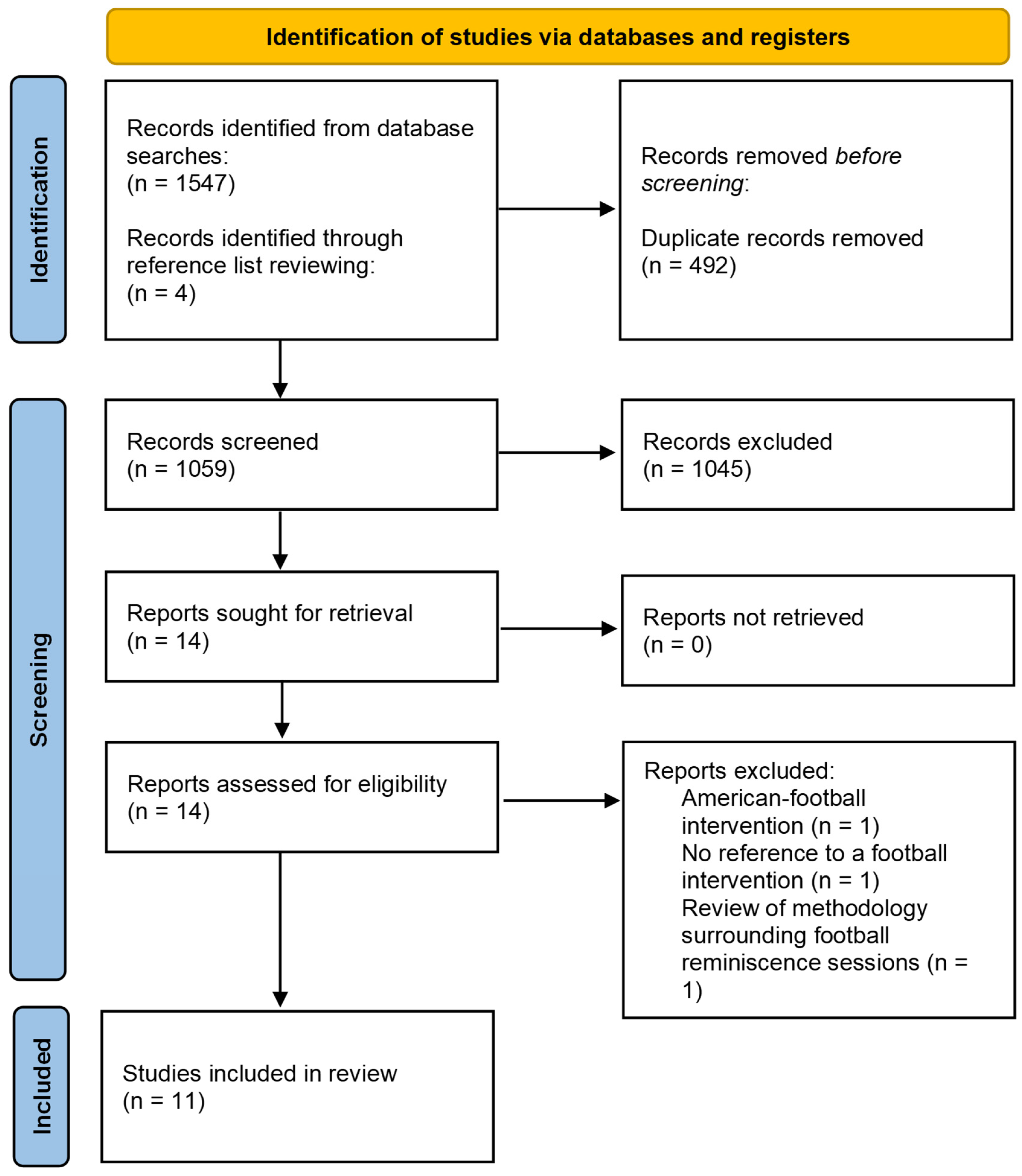
Database searches yielded 1547 articles. Following the removal of duplicates and screening against eligibility criteria, 11 studies met the inclusion criteria (see Figure 1). These studies represent a range of community football-based initiatives aimed at supporting older adults living with dementia or memory-related difficulties. The key characteristics of each study, including intervention formats, delivery contexts, and reported outcomes are presented in Table 1.

3.1. Characteristics of Included Studies

The eleven included studies were published between 2010 and 2025 and comprised a mix of peer-reviewed journal articles (n = 5) [18,22,23,24,25] and grey literature reports (n = 6) [26,27,28,29,30,31]. Most studies employed qualitative (n = 5) or exploratory (n = 4) designs, with one using a repeated-measures comparative design [27] and another adopting a mixed-methods approach [22].

3.2. Community-Based Initiatives

3.2.1. Format

Reminiscence therapy using football memorabilia (i.e., player photographs and equipment) was the core initiative in the majority of studies (n = 6) [22,27,28,29,30,31]. Three studies used reminiscence therapy alongside exercise-based components [23,25,26]. One study used multi-sport physical activity (including football) as the primary intervention [18]. Another study detailed weekly walking football sessions followed by a social element with hot drinks and snacks [24].

3.2.2. Organisations Involved

Multiagency delivery was reported in eight of the eleven studies [18,22,23,26,28,29,30,31]. Typical collaborations included football clubs (including Everton Football Club) [18,24,26], dementia charities (including Alzheimer’s Society) [18,23,28,29,30,31], NHS community health teams, care home staff, and Sporting Memories organisations [23,25,26,29]. Interventions that stemmed predominantly from a single organisation were less common [24,25,27].

3.2.3. Professionals Involved

The health professionals most commonly involved were occupational therapists and physiotherapists [18,27,31]. Other healthcare professions involved included psychologists [22,27], nurses [27], and specialised support workers [18].
The community roles most commonly involved included football club staff [18,23,24,26], volunteers [25,26,28], and care workers [22,30].

3.2.4. Location of Intervention

Most included studies were based in either Scotland (n = 5) [23,28,29,30,31] or England (n = 5) [18,24,25,26,27], with one study based in Spain [22].
The settings of initiatives included care homes [22,29,31], football stadiums or museums [22,23,26,28], or community venues (including football club affiliations) [18,24,25,27]. One study involved multiple sites across Scotland, including care homes, community groups, and sessions within the Scottish Football Museum (Hampden Park) [30].

3.2.5. Frequency/Continuity of Intervention

Many of the identified initiatives were short-term block interventions, lasting two sessions [27], six sessions [23], or 12 weeks [22,31]. Two studies describe initiatives that appear to be ongoing at the time of writing [24,25]. One further study [30] was piloted with scalability in mind. Four included studies detailed initial pilot projects; it is unclear if these initiatives continued [18,26,28,29].

3.2.6. Reported Outcomes

For people living with dementia or memory difficulties, intervention-associated benefits included increased sociability and engagement [18,23,24,25,26,29,30,31]. Several studies highlighted improvements in mood [18,22,23,27,28,30]. More specific effects included increased verbal communication, greater self-awareness [31], and improved physical fitness [18,24]. Enhanced self-esteem, sense of belonging, and reinforced personal- or football-related identity were also reported [22,25,29].
For carers and families, football-based initiatives highlighted several important benefits, including reductions in isolation and opportunities for respite [23,24,28,29,30]. Carers valued seeing their relatives more engaged and expressed enjoyment in observing this, and also reported that shared reminiscence supported communication and strengthened family relationships [30]. Some programmes created spaces for carers to share difficulties and solutions in caring for people living with dementia [18,24,26]. Sessions also fostered improved relationships between carers and the person living with dementia [22].
Table 1. Descriptive grid of included studies detailing community football-based initiatives.
Author (Year)

Article Title
ParticipantsLocation (Country)Study Aim and DesignProfessionals InvolvedInterventionOrganisation/PartnershipsOutcomes
Carone et al. (2016) [18]

Football and dementia: A qualitative investigation of a community-based sports group for men with early onset dementia

Peer-reviewed article
Five men living with early onset dementia, and five carers (all wives)Nottingham
(England, UK)
Evaluate cognitive and social benefits of a football-based reminiscence programme.

Qualitative study
NCFC coaching staff, Alzheimer’s Society support workers, occupational therapistsWeekly 90 min sessions involving multi-sport physical activity (inc. football)NCFC, Alzheimer’s Society, Nottinghamshire NHS TrustEnhanced mood, physical fitness, social connection, and peer support. Sense of normality, peer support, and respite for carers.
Chambers (2012) [26]

Old age, dementia, and Everton Football Club

Grey literature
People living with dementia in local care homesGoodison Park, Liverpool
(England, UK)
Descriptive project report of a new football-based reminiscence programme.

Observational commentary
EitC coaches, Liverpool Care Home Association staff, Sporting Memories Network, Caring Memories volunteersWeekly sessions including chair-based exercises, Everton Memory Bags, Photo Cards, CD Memories stadium tours, social visits, and events.EitC, Liverpool Care Home Association, Merseycare, Sporting Memories Network, Five Boroughs NHS Partnership, Liverpool Hope University, Life Story Network, Everton Former Players Foundation, Everton FC Heritage SocietyObserved increases in engagement, happiness, and contentment.
Coll-Planas et al. (2017) a [22]

Developing Evidence for Football (Soccer) Reminiscence Interventions Within Long-term Care: A Co-operative Approach Applied in Scotland and Spain
Peer-reviewed article
Twenty older adults living with mild cognitive impairment or dementiaBarcelona, Valencia, Bilbao
(Spain)
Evaluate how football initiatives support social inclusion and active ageing.

Mixed methods design
Psychologists, former football players, family carers, care home staff.12-week structured football programme. Eleven reminiscence sessions (2 h sessions), and 1 final stadium visit.Fundació Salut i Envelliment, FEAFV, and Universitat Autònoma de Barcelona.Improved mood, cognition, communication, social engagement, anticipation; increased self-esteem, improved sense of belonging.
Gibbons et al. (2020) [27]

Impact of intergenerational football reminiscence

Grey literature
Six males living with dementia.
Four attended both the standard and football reminiscence sessions
Cumbria, Northumberland, Tyne and Wear
(England, UK)
Compare mood/wellbeing outcomes for men living with dementia after participating in standard reminiscence versus football reminiscence

Repeated measures design
Sports coach, Clinical Psychologist, occupational therapist, and nurseTwo reminiscence sessions; one standard reminiscence (inc. music and craft activities), and one football reminiscence (inc. younger footballers)Mental Health Concern (supported recruitment)DCM mood and engagement scores were significantly higher after football reminiscence sessions compared to standard reminiscence
MacRae, Macrae, and Carlin (2020) [23]

Modifying walking football for people living with dementia: lessons for best practice

Peer-reviewed article
Fourteen males living with dementia, four family carers, two paid carers, and two programme staffGlasgow
(Scotland, UK)
Explore participant and stakeholder experiences in a national dementia-friendly football programme.

Qualitative exploratory pilot study
Alzheimer Scotland staff, Football Memories volunteers, Hampden Sports Clinic staff, care home activity coordinatorsMonthly dementia-friendly walking football sessions at Hampden Park (6 total), integrated with Football Memories programmeAlzheimer Scotland, Football Memories Scotland, Hampden Park, Scottish Football MuseumImproved mood, social engagement, sleep, and confidence. Improved self-identity and pride, positive social impact. Flexible carer respite.
Poole et al. (2025) [24]

A multi-stakeholder evaluation of a walking football group for people with dementia developed in partnership with a Premier League club

Peer-reviewed article
People living with dementia or memory problems and family carersNewcastle upon Tyne
(England, UK)
Evaluates the views and experiences of service providers and service users at a dementia-friendly walking football initiative.

Exploratory qualitative study
Newcastle United Foundation Wellbeing Team, and a staff member from a local dementia support organisationWeekly sessions with walking football and social discussion sessionsNewcastle United FoundationParticipants reported increased confidence and reduced social isolation. The initiative was viewed positively by attendees and staff, with perceived benefits for general wellbeing and accessible support.
Ramsay and Ramsay (2014) [28]

A football reminiscence group for people with dementia: the Forfar, Kirriemuir and South West Angus experience

Grey literature
People living with dementia and their carersForfar Athletic Football Club
(Scotland, UK)
Introduces football-associated reminiscence therapy for older adults living with dementia

Exploratory pilot study
Led by a social worker with assistance from support workers and volunteers.Football reminiscence using memorabilia and other football-related materials (inc. quizzes and photographs)NHS Community Mental Health Team (Older Adults), Alzheimer’s ScotlandUniversally positive feedback, with the group providing an outlet for people living with dementia. Also enabled carers to have a break from caring roles.
Sass et al. (2021) [25]

Expressions of masculine identity through sports-based reminiscence: An ethnographic study with community-dwelling men with dementia

Peer-reviewed article
Twelve men living with dementiaLancashire, Yorkshire, and Lincolnshire
(England, UK)
Evaluate the impact of the Sporting Memories intervention on men living with dementia

Longitudinal multi-method ethnographic study
Staff from host organisations (i.e., librarians, community engagement workers), and volunteersWeekly community-based Sporting Memories group (lasting 90–120 min), including physical activitiesFive Sporting Memories groups (North England)Sessions enabled participants to experience a sense of pride, meaningful social interactions, and develop contributory roles within the group
Schofield and Tolson (2010) [30]

Scottish Football Museum Reminiscence Pilot Project for People with Dementia: A Realistic Evaluation

Grey literature
Multiple case studies: care homes, community groups, and one-to-one sessions across Scotland involving people living with dementia and their carersScotland
(UK)
Evaluate the feasibility and initial outcomes of a football reminiscence pilot.

Multiple case studies
Reminiscence facilitator, Care home staff and care workers, and Scottish Football Heritage Network membersFootball reminiscence using digitised football memorabilia in group and individual sessions.
Specific formats varied depending on the setting.
Scottish Football Museum, Alzheimer Scotland, Glasgow Caledonian University, Culture and Sport Glasgow, Scottish Library and Information CouncilEnhanced wellbeing, sociability, engagement, anticipation, confidence, and self-expression.
Highlighted potential for wider rollout and benefit, especially for men.
Sullivan (2012) [29]

Tackling dementia through football

Grey literature
People living with dementia in local care homesFalkirk
(Scotland, UK)
Describe and raise awareness of football reminiscence initiatives in Scotland.

Observational commentary
Club historianFootball reminiscence sessionAlzheimer Scotland, Scottish Football AssociationParticipants were more confident, calmer, and talkative in groups. The project reduced isolation, boosted mood, and reinforced identity through shared football memories.
Watchman et al. (2015) [31]

Football reminiscence for men with dementia in a care home: a 12-week pilot study in Scotland

Grey literature
Eight male residents living with dementia from 4 care homes.
Five were regular participants, three attended sporadically
Scotland
(UK)
Implement and assess a structured 12-week football reminiscence programme in care homes.

Qualitative pilot study
Football reminiscence facilitator, Care home occupational therapist, physical therapist, and support staff12 weekly football reminiscence sessions (60–90 min each), using football memorabilia and multi-sensory promptsAlzheimer Scotland, Scottish Football Museum, NHS Lanarkshire, local care homesIncreased sociability, verbal communication, group participation, and self-awareness (e.g., improved personal care).
Some improvements in dementia symptomology (e.g., better sleep).
Key: DCM = dementia care mapping; EitC = Everton in the Community Charity; FEAFV = Spanish Federation of Former Players; NCFC = Notts County Football in the Community.
Notes: a Coll-Planas et al. (2017) [22] report on two football-related reminiscence initiatives: one based in Spain and one in Scotland. The Scottish project is the same initiative reported in full by Watchman et al. (2015) [31]. To avoid duplication, only data relating to the Spanish project have been extracted and included within this review.

4. Discussion

As the prevalence of dementia continues to rise globally, there is an increasing need for community-based initiatives that offer meaningful engagement and social support [1,2,4]. Football, as a culturally significant and community-based activity, provides a unique means of engaging groups at risk of social isolation, particularly older men in industrialised and working-class communities [25,32]. While football-based dementia initiatives have emerged more frequently in recent decades [30], there has been limited synthesis of evidence regarding their scope, formats, delivery models, and outcomes. The current review draws upon both physical (i.e., walking football) and reminiscence-based interventions, reflecting the diverse methods in which football initiatives have been embedded within the community to support people living with dementia. While these approaches differ methodologically, they share a common reliance on the social and cultural significance of football in order to promote inclusion, identity, and wellbeing.
The current review addresses the existing evidence gap by systematically collating and analysing both academic and grey literature on community-based dementia initiatives. Our findings demonstrate that football-based interventions, ranging from reminiscence therapy to walking football, can significantly enhance mood, communication, and a sense of belonging among people living with dementia. These findings highlight the potential of culturally grounded, community-based football initiatives to support person-centred care, reduce isolation, and improve quality of life for older adults in the community.

4.1. Reminiscence Therapies

While the specific aims and methodological approaches varied across studies, the current review provides novel insight into how communities in the UK have engaged older adults living with dementia and their families. Reminiscence therapies were the most frequently reported format, likely reflecting their established therapeutic value and the profound influence of early projects, most notably Schofield and Tolson’s pilot project [30]. Reminiscence therapy involves the structured evocation of personal memories through the use of tailored memorabilia (inc. photographs or familiar objects) to stimulate autobiographical memory and promote meaningful social interaction [33,34]. Meta-analyses suggest that reminiscence therapy has modest effects on cognition, mood, and quality of life, though outcomes vary by setting and modality, with care home interventions showing the greatest benefits [35,36]. The integration of football themes into reminiscence therapy broadens its accessibility, particularly for older men in underrepresented communities, thus enhancing engagement and social interaction.

4.2. Intervention Delivery

Our findings highlight the value of non-traditional and community-based organisations in promoting the health and wellbeing of older adults living with dementia and their families. As post-diagnostic care remains largely fragmented and inconsistent across the UK, the contribution of these organisations is of critical importance [37]. The majority of interventions were delivered through partnerships between local football clubs and associated foundations, dementia charities, NHS healthcare teams, care homes, and volunteer organisations, combining therapeutic expertise with integrated social support. The inclusion of care home and community staff/volunteers potentially enhances engagement by providing continuity, contextual knowledge, and familiar social support, thereby enabling more personalised and socially meaningful experiences. Furthermore, interventions were delivered across a range of settings from care homes to football stadiums, demonstrating the practical adaptability of interventions. This flexibility is particularly valuable in engaging populations who may be socially isolated, traditionally harder to reach, or less likely to access formal healthcare services. Overall, coordinated multi-agency delivery that integrates healthcare input with community partners in culturally grounded settings appears particularly effective for reminiscence-based interventions.

4.3. Implications

Our findings sit at odds with public-facing information available online, which suggests that while football-based dementia interventions exist, they are not consistently promoted or evaluated to the same standard as healthcare-based interventions. This lack of robust evidence limits the ability of healthcare practitioners to confidently signpost people living with dementia to these programmes and may constrain policy and commissioning decisions. Developing novel evaluative measures and robustly documenting outcomes is essential in order to capture the full value of these community-based initiatives, while enhancing visibility and supporting wider scalability.
Football-themed initiatives appear particularly well placed to engage older men, given the cultural significance of the sport in the UK. The cultural grounding of football aligns with international priorities for person-centred dementia care, which emphasise maintaining meaningful hobbies and social connections [2,3,4]. Alongside improving mood and social interaction, these interventions can help preserve individuals’ identity, self-esteem, and connectedness, outcomes often overlooked in other therapeutic approaches. Importantly, their delivery through football clubs, often situated in socioeconomically disadvantaged communities, aligns with the NHS Long-Term Plan to reduce health inequalities and extend support to underrepresented groups [17,18].

4.4. International Relevance

While our findings are predominantly based on UK initiatives, comparable initiatives are emerging across Europe, where the cultural importance of football is being used to offer meaningful support to people living with dementia and their carers. In Germany, Hamburger SV offers ‘memory box’ reminiscence therapy sessions [38], while Dutch Eredivisie clubs host events for carers [39]. Similarly, Belgian and Spanish clubs are working to reduce stigma and foster inclusion for older people living with dementia [40,41]. However, despite football’s global reach, there is little evidence of similar initiatives existing in Low and Middle-income countries (LMIC), where dementia care infrastructure is often limited. Strengthening international collaboration and adapting community-based football initiatives for LMIC contexts could therefore help address widening inequalities in post-diagnostic support, as highlighted by the Alzheimer’s Disease International’s reports across Africa and South America [42,43].

4.5. Strengths and Limitations

The current review offers a novel synthesis of football-based dementia initiatives, providing a comprehensive overview of intervention types, delivery models, and reported outcomes. The use of a comprehensive search strategy captured both peer-reviewed articles and grey literature, which enabled the integration of academic literature with more practical insight from community organisations. This approach enhances the ecological validity of our findings and provides a more nuanced understanding to inform future practice, policy, and research.
Nonetheless, several limitations should be acknowledged. While no search restrictions were set, all included articles were in English, and all but one were based in the UK, which inherently limits the generalisability of findings. Methodological quality across included studies was generally limited. Most studies drew upon small, convenience-based samples, employing descriptive or qualitative designs, with few using standardised pre- and post-measures used to assess change over time. Details regarding intervention implementation, recruitment, and participant characteristics were often incompletely reported. These limitations restrict the comparability of findings across studies and highlight the need for more rigorous and transparent evaluation in this emerging field. Furthermore, accurately interpreting the duration and continuity of interventions was challenging due to inconsistent reporting.
While this review aims to highlight the range of community-based football initiatives supporting people living with dementia and their families, it did not assess intervention efficacy or include formal cognitive or physiological outcome measures. Such evaluations were beyond the remit of a scoping review but would represent a valuable direction for future work. Finally, in the Spanish study, four participants in the Valencia group were included despite having no cognitive decline due to recruitment difficulties [19]. This variability in participant characteristics potentially limits comparability across studies.

5. Conclusions

There is growing recognition of the importance of non-traditional providers of dementia care. Community-based football organisations have a unique opportunity to engage local health and social care providers, local communities, and underrepresented groups to profoundly enhance the wellbeing of both the individual and their family. Future evaluative work should aim to develop robust frameworks and standardised outcomes to support scale-up activities and equitable dissemination to less resourced regions.

Author Contributions

Conceptualization, M.P. and A.J.H.; methodology, M.P. and A.J.H.; formal analysis, A.J.H. and M.P.; investigation, A.J.H.; resources, M.P. and L.R.; data curation, A.J.H.; writing—original draft preparation, M.P. and A.J.H.; writing—review and editing, M.P., A.J.H., and L.R.; visualisation, A.J.H.; supervision, M.P. and L.R.; project administration, M.P. and L.R.; funding acquisition, M.P. All authors have read and agreed to the published version of the manuscript.

Funding

This research was funded by the National Institute for Health and Care Research (NIHR) Applied Research Collaboration (ARC) North East and North Cumbria (NIHR200173) and the National Institute for Health and Care Research (NIHR).

Institutional Review Board Statement

The research did not involve any human participants.

Informed Consent Statement

Informed consent for participation is not required.

Data Availability Statement

No new data were created or analysed in this study. Data sharing is not applicable to this article.

Acknowledgments

With many thanks to our funding bodies listed above.

Conflicts of Interest

The authors declare no conflicts of interest. The funders had no role in the design of the study; in the collection, analyses, or interpretation of data; in the writing of the manuscript; or in the decision to publish the results.

Abbreviations

The following abbreviations are used in this manuscript:
ARCApplied Research Collaboration
LMICLower Middle-Income Countries
NHSNational Health Service
NIHRNational Institute for Health and Care Research
UKUnited Kingdom

References

  1. Nichols, E.; Steinmetz, J.D.; Vollset, S.E.; Fukutaki, K.; Chalek, J.; Abd-Allah, F.; Abdoli, A.; Abualhasan, A.; Abu-Gharbieh, E.; Akram, T.T.; et al. Estimation of the global prevalence of dementia in 2019 and forecasted prevalence in 2050: An analysis for the Global Burden of Disease Study 2019. Lancet Public Health 2022, 7, e105–e125. [Google Scholar] [CrossRef] [PubMed]
  2. Dementia Is Global|Age International [Internet]. Available online: https://www.ageinternational.org.uk/policy-research/expert-voices/dementia-is-global/ (accessed on 28 August 2025).
  3. World Health Organization. Global Action Plan on the Public Health Response to Dementia 2017–2025 [Internet]; World Health Organization: Geneva, Switzerland, 2017; Available online: https://iris.who.int/handle/10665/259615 (accessed on 28 August 2025).
  4. Dementia [Internet]. Available online: https://www.who.int/news-room/fact-sheets/detail/dementia (accessed on 28 August 2025).
  5. Oung, C.; Lobont, C.; Curry, N. What Needs to Improve for Social Care to Better Support People with Dementia? Nuffield Trust: London, UK, 2024. [Google Scholar]
  6. Thijssen, M.; Daniels, R.; Lexis, M.; Jansens, R.; Peeters, J.; Chadborn, N.; der Sanden, M.W.G.N.; Kuijer-Siebelink, W.; Graff, M. How do community based dementia friendly initiatives work for people with dementia and their caregivers, and why? A rapid realist review. Int. J. Geriatr. Psychiatry 2022, 37, 1–14. [Google Scholar] [CrossRef] [PubMed]
  7. Thijssen, M.; Kuijer-Siebelink, W.; Lexis, M.A.S.; Nijhuis-van der Sanden, M.W.G.; Daniels, R.; Graff, M. What matters in development and sustainment of community dementia friendly initiatives and why? A realist multiple case study. BMC Public Health 2023, 23, 296. [Google Scholar] [CrossRef] [PubMed]
  8. Bould, E.; McFadyen, S.; Thomas, C. Dementia-friendly sport and physical activity guide: Supporting people affected by dementia to lead more active lives in their community. Alzheimer’s Soc. 2019, 2019. Available online: https://www.alzheimers.org.uk/sites/default/files/2019-02/19003-Sports_Leisure_guide_online.pdf (accessed on 15 September 2025).
  9. Love to Move [Internet]. British Gymnastics Foundation. Available online: https://britishgymnasticsfoundation.org/lovetomove/ (accessed on 28 August 2025).
  10. In Touch Dementia Support Group [Internet]. Leeds Rhinos Foundation. Available online: https://www.leedsrhinosfoundation.org/health-and-wellbeing/our-health-and-wellbeing-projects/in-touch-dementia/ (accessed on 28 August 2025).
  11. Dance for Dementia Classes [Internet]. English National Ballet. Available online: https://www.ballet.org.uk/event/dance-dementia-classes/ (accessed on 28 August 2025).
  12. Boundaries & Beyond [Internet]. Dementia Adventure. Available online: https://dementiaadventure.org/green-letter-days/boundaries-and-beyond/ (accessed on 28 August 2025).
  13. Dementia Friendly Sports and Club and Venues Guide [Internet]. Available online: https://www.englandgolf.org/resource-detail/dementia-friendly-sports-and-club-and-venues-guide (accessed on 28 August 2025).
  14. Working Together for Vital Community Dementia Support Through Football|Alzheimer’s Society [Internet]. Available online: https://www.alzheimers.org.uk/blog/working-together-vital-community-dementia-support-through-football (accessed on 1 September 2025).
  15. How is Football a Culture?—Lower Block [Internet]. 2025. Available online: https://lowerblock.com/articles/how-is-football-a-culture/ (accessed on 1 September 2025).
  16. Hughes, J.; Louw, S.; Sabat, S.R. (Eds.) Dementia: Mind, Meaning, and the Person; Oxford University Press: Oxford, UK, 2005. [Google Scholar]
  17. UK Government. Fit for the Future: 10 Year Health Plan for England; UK Government: London, UK, 2025.
  18. Carone, L.; Tischler, V.; Dening, T. Football and dementia: A qualitative investigation of a community based sports group for men with early onset dementia. Dementia 2016, 15, 1358–1376. [Google Scholar] [CrossRef] [PubMed]
  19. Tricco, A.C.; Lillie, E.; Zarin, W.; O’Brien, K.K.; Colquhoun, H.; Levac, D.; Moher, D.; Peters, M.D.J.; Horsley, T.; Weeks, L.; et al. PRISMA Extension for Scoping Reviews (PRISMA-ScR): Checklist and Explanation. Ann. Intern. Med. 2018, 169, 467–473. [Google Scholar] [CrossRef] [PubMed]
  20. Lockwood, C.; dos Santos, K.B.; Pap, R. Practical Guidance for Knowledge Synthesis: Scoping Review Methods. Asian Nurs. Res. 2019, 13, 287–294. [Google Scholar] [CrossRef] [PubMed]
  21. Popay, J.; Roberts, H.; Sowden, A.; Petticrew, M.; Arai, L.; Rodgers, M.; Britten, N.; Roen, K.; Duffy, S. Guidance on the Conduct of Narrative Synthesis in Systematic Reviews: A Product from the ESRC Methods Programme; Lancaster University: Lancaster, UK, 2006. [Google Scholar]
  22. Coll-Planas, L.; Watchman, K.; Doménech, S.; McGillivray, D.; O’Donnell, H.; Tolson, D. Developing Evidence for Football (Soccer) Reminiscence Interventions Within Long-term Care: A Co-operative Approach Applied in Scotland and Spain. J. Am. Med. Dir. Assoc. 2017, 18, 355–360. [Google Scholar] [CrossRef] [PubMed]
  23. MacRae, R.; Macrae, E.; Carlin, L. Modifying walking football for people living with dementia: Lessons for best practice. Sport Soc. 2022, 25, 1405–1418. [Google Scholar] [CrossRef]
  24. Poole, M.; Killen, A.; Robinson, L. A Multi-Stakeholder Evaluation of a Walking Football Group for People with Dementia Developed in Partnership with a Premier League Club. Sports 2025, 13, 172. [Google Scholar] [CrossRef] [PubMed]
  25. Sass, C.; Surr, C.; Lozano-Sufrategui, L. Expressions of masculine identity through sports-based reminiscence: An ethnographic study with community-dwelling men with dementia. Dementia 2021, 20, 2170–2187. [Google Scholar] [CrossRef] [PubMed]
  26. Chambers, B. Old age, Dementia and Everton Football Club in Ageing Society, Ageing Culture? In Proceedings of the Sixth Annual Conference of the University Network of the European Capitals of Culture, Mariobor, Slovenia, 18 October 2012; Komlósi, L.I., Pozsgai, G., Eds.; University Network of the European Capitals of Culture (UNeECC): Nagyszeben, Romania, 2012; Volume 5, Available online: https://uneecc.org/userfiles/File/V%20UNEECC_Proceedings_Maribor.pdf (accessed on 30 June 2025).
  27. Gibbons, L.; Adamson, L.; Mahesh, M. Impact of intergenerational football reminiscence. J. Dement. Care 2020, 28, 28–31. [Google Scholar]
  28. Ramsay, S.; Ramsay, M. A football reminiscence group for people with dementia: The Forfar, Kirriemuir and South West Angus experience. Ment. Health Nurs. 2014, 34, 32–33. [Google Scholar]
  29. Sullivan, S. Tackling Dementia Through Football; FIFA World: London, UK, 2012; pp. 40–43. [Google Scholar]
  30. Schofield, I.; Tolson, D. Scottish Football Museum Reminiscence Pilot Project for People with Dementia: A Realistic Evaluation [Internet]. ResearchGate. Available online: https://www.researchgate.net/publication/228970747_Scottish_Football_Museum_Reminiscence_Pilot_Project_for_People_with_Dementia_A_Realistic_Evaluation (accessed on 28 August 2025).
  31. Watchman, K.; Tolson, D.; Gallagher, N.; Cameron, L.; Doyle, M. Football Reminiscence for Men with Dementia in a Care Home: A 12-Week Pilot Study in Scotland; Alzheimer Scotland Centre for Policy and Practice: Hamilton, UK, 2015. [Google Scholar]
  32. Bartlett, R.; Gjernes, T.; Lotherington, A.-T.; Obstefelder, A. Gender, citizenship and dementia care: A scoping review of studies to inform policy and future research. Health Soc. Care Community 2018, 26, 14–26. [Google Scholar] [CrossRef] [PubMed]
  33. Woods, R.T.; Orrell, M.; Bruce, E.; Edwards, R.T.; Hoare, Z.; Hounsome, B.; Keady, J.; Moniz-Cook, E.; Orgeta, V.; Rees, J.; et al. REMCARE: Pragmatic Multi-Centre Randomised Trial of Reminiscence Groups for People with Dementia and their Family Carers: Effectiveness and Economic Analysis. PLoS ONE 2016, 11, e0152843. [Google Scholar] [CrossRef] [PubMed]
  34. Gibson, F. The Past in the Present: Using Reminiscence in Health and Social Care; Health Professions Press: Baltimore, MD, USA, 2004. [Google Scholar]
  35. Reminiscence Therapy for Dementia—Woods, B. 2018 Cochrane Library [Internet]. Available online: https://www.cochranelibrary.com/cdsr/doi/10.1002/14651858.CD001120.pub3/full (accessed on 28 August 2025).
  36. Saragih, I.D.; Tonapa, S.I.; Yao, C.; Saragih, I.S.; Lee, B. Effects of reminiscence therapy in people with dementia: A systematic review and meta-analysis. J. Psychiatr. Ment. Health Nurs. 2022, 29, 883–903. [Google Scholar] [CrossRef] [PubMed]
  37. National Audit Office. Improving Dementia Services in England—An Interim Report; National Audit Office: London, UK, 2010. [Google Scholar]
  38. Supporting Fans with Alzheimer’s and Dementia at Hamburg [Internet]. AccessibAll. 2020. Available online: https://www.accessiball.com/news/supporting-fans-with-alzheimers-and-dementia-at-hamburg (accessed on 31 August 2025).
  39. Carers of People with Dementia Are Put in the Spotlight [Internet]. Carers People Dement. Are Put Spotlight. Available online: https://www.overons.kpn/nieuws/en/carers-of-people-with-dementia-are-put-in-the-spotlight/ (accessed on 31 August 2025).
  40. Ex-Players Tackle Dementia in Football-Mad Spain [Internet]. Available online: https://www.besoccer.com/new/ex-players-tackle-dementia-in-football-mad-spain-385182 (accessed on 31 August 2025).
  41. Basem, S. KRC Genk and KVC Westerlo: First Clubs to Support Fans with Dementia [Internet]. 2024. Available online: https://brusselsmorning.com/krc-genk-and-kvc-westerlo-first-clubs-to-support-fans-with-dementia/54873/ (accessed on 31 August 2025).
  42. Alzheimer’s Disease International; Wimo, A.; Aboderin, I.; Guerchet, M.; Prince, M.; Amoakoh-Coleman, M.; Ezeah, P.; Lloyd-Sherlock, P.; Uwakwe, R.; Mayston, R.; et al. Dementia in Sub-Saharan Africa: Challenges and Opportunities. 2017. Available online: https://www.alzint.org/resource/dementia-in-sub-saharan-africa/ (accessed on 31 August 2025).
  43. Alzheimer’s Disease International. Dementia in the Americas: Current and Future Cost and Prevalence of Alzheimer’s Disease and Other Dementias. 2013. Available online: https://www.alzint.org/resource/dementia-in-the-americas/ (accessed on 31 August 2025).
Figure 1. PRISMA flowchart of literature search.
Jdad 03 00006 g001
Disclaimer/Publisher’s Note: The statements, opinions and data contained in all publications are solely those of the individual author(s) and contributor(s) and not of MDPI and/or the editor(s). MDPI and/or the editor(s) disclaim responsibility for any injury to people or property resulting from any ideas, methods, instructions or products referred to in the content.