


Article

Multivariate Analysis of the Impact of Alzheimer’s Disease on the Cost of Long-Term Care
1
Department of Health and Welfare Services, National Institute of Public Health, 2-3-6 Minami, Wako 351-0197, Saitama, Japan
2
Department of Ophthalmology, Juntendo University School of Medicine, 3-1-3, Hongo, Bunkyo-ku 113-8431, Tokyo, Japan
3
Department of Liberal Arts Education, Faculty of Health and Welfare Science, Nayoro City University, Kita 8-1, Nishi 4-jo, Nayoro City 096-8641, Hokkaido, Japan
4
The University of Fukuchiyama, 3370, Aza Hori, Fukuchiyama-shi 620-0886, Kyoto, Japan
*
Author to whom correspondence should be addressed.
J. Dement. Alzheimer's Dis. 2026, 3(1), 16; https://doi.org/10.3390/jdad3010016
Submission received: 2 September 2025 / Revised: 11 January 2026 / Accepted: 26 February 2026 / Published: 23 March 2026

Abstract

Background: The global number of individuals living with dementia is projected to rise from 57.4 million in 2019 to 152.8 million by 2050. Alongside this increase, the worldwide economic burden of dementia continues to grow, with the overall societal cost estimated at US$1313 billion in 2019—substantially higher than earlier projections. Objectives: To analyze the impact of dementia on long-term-care costs, we conducted a multivariate analysis to take into account overlaps with various other diseases. Methods: In this study, we conducted a multivariate analysis to assess the effect of major diseases on annual expenditure on long-term care by linking Japanese National Health Insurance and long-term-care insurance claims. Results: In a two-part analysis using a hurdle model, the first stage of multivariate logistic regression analysis of the presence or absence of disease showed that Parkinson’s disease had the highest multivariate-adjusted odds ratio, followed by Alzheimer’s disease and schizophrenia. In the second stage of the generalized linear model with log link–Gamma analysis of residents with positive costs, the disease with the highest exponential function (exp(b)) was Alzheimer’s disease, followed by stroke sequelae. Conclusions: To examine the impact of dementia on long-term-care costs, it is necessary to use multivariate analysis to avoid overlap with other diseases.

1. Introduction

According to the Global Burden of Disease (GBD) 2019 Dementia Forecasting Collaborators, the global prevalence of dementia is expected to rise from 57.4 million cases in 2019 (95% uncertainty interval: 50.4–65.1 million) to 152.8 million cases by 2050 (95% uncertainty interval: 130.8–175.9 million) [1]. Alzheimer’s Disease International previously estimated the worldwide cost of dementia to be US$604 billion in 2010 and US$818 billion in 2015 [2,3]. More recent data placed the total societal cost at US$1313 billion in 2019 [4], a figure considerably higher than earlier estimates. This amount reflects not only dementia-related medical care but also overall direct expenditures and support services for individuals with dementia. Roughly half of these costs stem from informal caregiving, while the remainder represents direct expenses, including long-term care. A study by Jia et al. reported similar findings, projecting that global dementia-related costs, which were US$958 billion in 2015, could rise to US$2.5 trillion by 2030 [5].
The rising economic burden reflects both the increasing number of affected individuals and updated assessments of informal care expenses [4]. Evidence from low- and middle-income countries also highlights that the amount of time dedicated to informal care in these settings is often greater than in higher-income regions, contributing to escalating costs. As a result, health and social care policies, along with local support systems, must adapt to address the needs of individuals with dementia and their caregivers [4].
A systematic review that adjusted for comorbidities in estimating both direct and indirect costs suggested that the global economic burden of dementia was around US$600 billion in 2019 and may exceed US$2 trillion by 2050 [6]. Most cost-of-illness studies, however, do not account for comorbid conditions, despite the fact that dementia patients are generally older and more likely to have multiple health problems. Therefore, to evaluate the burden of dementia with respect to nursing-care costs, it is essential to analyze each condition while controlling for comorbidities such as stroke, diabetes, cardiovascular disease, hypertension, respiratory disease, cancer, mental illness, and arthritis through multivariate adjustment [7].
Japan’s health insurance system consists of “social insurance” for salaried employees and civil servants and national health insurance for the self-employed and freelancers (including the “medical care system for the elderly”). Deidentified data from Specified Health Checkups and medical records are stored in the National Health Insurance database [8]. Additionally, municipalities provide home- and facility-based long-term-care services to individuals in need [9,10]. Applications for long-term care are assessed by the Municipal Needs Certification Committee, which evaluates over 70 items, including daily living activities, cognitive and physical function, social adaptation, and behavioral symptoms [11]. The resulting long-term-care data include details of service use and associated costs. These national datasets can be freely utilized for research aimed at optimizing healthcare spending and improving the quality of services [12,13].
Although many studies have examined the costs of dementia care, few have compared the contribution of dementia to overall care expenses while adjusting for overlap with other diseases. This study therefore employed multivariate analysis to evaluate the impact of dementia and other major diseases on one-year long-term-care costs by matching national health insurance receipts with long-term-care claims.

2. Materials and Methods

2.1. Participants

In Japan’s health insurance system, public medical insurance is divided into three types: “Employee Health Insurance,” “National Health Insurance,” and “Health Insurance System for the Latter-Stage Elderly”. All citizens are required by law to enroll in one of these insurance plans. In addition, all citizens aged 40 or older are required to enroll in long-term-care insurance. Health insurance is insurance related to medical care, while the long-term-care insurance system is a system that supports the independence of elderly people who require care or support and reduces costs. Health insurance covers medical expenses, and the long-term-care insurance system is a system that supports the independence of elderly people who require care and support in their daily lives outside of medical care. This study targeted all residents aged 40 or over who were enrolled in the National Health Insurance or Health Insurance System for the Latter-Stage Elderly in Mishima City, Shizuoka Prefecture.
This study included 34,370 residents of Mishima City, Japan (15,330 men and 19,040 women; mean age: 73.83 ± 12.20 years; age range: 40–107 years) who were enrolled in the National Health Insurance System, including the medical insurance scheme for the elderly.
All diagnoses recorded for these residents between January 2023 and December 2023 were extracted from National Health Insurance and Late-Stage Elderly Health Insurance claims, and annual long-term-care costs were obtained from long-term-care insurance records between January 2023 and December 2023. In Japan, diagnostic criteria for health insurance are established by academic societies in each field based on international diagnostic criteria. Therefore, the diagnostic criteria are consistent with the ICD10, the international diagnostic criteria established by the World Health Organization (WHO). In Japan, long-term-care services are charged in fixed units depending on the type of service, the period of service provision, and the level of care required. The cost of one unit is exactly10 yen, and the total cost of care is calculated by adding up all the units of service received. Those who died during the study period in 2023 were excluded from this study.

2.2. Statistical Analysis

This analysis included the top 39 most frequently reported adult diseases in the National Health Insurance Database. First, we calculated the average annual long-term-care costs for those with and without these diseases. Next, we performed a multivariate analysis to examine the impact of each disease on long-term-care costs. Since many residents in this study had zero annual long-term-care expenditures, the analysis was conducted using a two-part (hurdle) model rather than a multiple regression analysis using ordinary least squares. First, a multivariate logistic regression was used to analyze the presence or absence of expenditures, and then a generalized linear model (GLM) with a log link (gamma) was used to analyze only positive expenditures. To avoid multicollinearity due to the large number of correlated disease indicators, we applied CART Advanced Analysis (variable importance analysis) and selected the top 16 diseases from the top 39 as explanatory variables for a multivariate logistic regression and GML analysis. In a multivariate logistic regression, gender and age were added as explanatory variables, and in the GLM analysis, certification level and resident’s living situation (at home or in another facility) were also added as confounding factors. To further evaluate the relationship between disease history and long-term-care costs, decision tree analysis was performed using the Classification and Regression Tree (CART) method. CART iteratively splits data into two groups to generate an optimal tree, allowing visualization of complex patterns and assessment of the impact of disease categories on care costs.
All analyses were conducted using SPSS (version 27) and Modeler (version 18.3) (IBM Japan, Tokyo, Japan).
The study protocol was reviewed and approved by the Ethics Committee of the National Institute of Public Health (NIPH-IBRA #12386) and the Mishima City Council. It adhered to the International Ethical Guidelines for Epidemiology [14], the Guidelines for Use of the National Health Insurance Claim Database, the Guidelines for Specific Health Checkups and Health Guidance [15], and the Medical Information System Security Guidelines [16]. Data were anonymized by municipal authorities before analysis.

3. Results

Table 1 presents the average annual long-term-care costs for residents with and without each disease. The highest average expenditure was observed among those with Alzheimer’s disease, at 780,633 yen (approximately US$5310), followed by Parkinson’s disease at 715,454 yen (US$4867) and schizophrenia at 487,784 yen (US$3318).
Table 2 summarizes the results of the multivariate logistic regression. Parkinson’s disease had the highest multivariate-adjusted odds ratio, at 6.26 (p < 0.001), followed by Alzheimer’s disease, at 4.83 (p < 0.001), and schizophrenia, at 3.36 (p < 0.001).
Table 3 shows the results of the generalized linear model with log link–Gamma. As shown via the GML analysis, the disease with the highest exponential function (exp(b)) was Alzheimer’s disease (1.335, p < 0.001), followed by stroke sequelae (1.151, p = 0.036) and hypertension (1.157, p = 0.004).
Figure 1 illustrates the results of the decision tree (CART) analysis. The CART splitting criterion used was GINI impurity, with a minimum impurity change of 0.0001, a maximum depth of 3, a minimum node size of 100, and no pruning/cross-validation strategy. The analysis yielded an out-of-sample error index (MAE) of 13,395. The highest annual cost node corresponded to individuals with Alzheimer’s disease aged over 90.5 years, with an average cost of 1,282,638 yen (approximately US$8300) (Node 6). The second-highest node comprised residents without Alzheimer’s disease aged over 86.5 years who had schizophrenia, with a cost of 1,084,914 yen (Node 10). In contrast, the lowest annual costs were found among residents without Alzheimer’s disease or Parkinson’s disease PD and aged 86.5 or younger, at 31,836 yen (Node 7).

4. Discussion

Long-term-care services include formal care provided by professionals in the home or in a nursing home and informal care provided by family and friends. This study focused on the costs of formal long-term care covered by the public insurance system rather than informal care costs. Japan’s long-term-care insurance program automatically enrolls all residents aged 40 years and older. Individuals aged 65 years or older who are certified as requiring care by their local government are eligible to access services, which include in-home support, community-based programs, home care assistance, and institutional care. The system sets monthly payment ceilings that vary by the certified level of care needed, classified into seven categories: Support Required 1–2 and Care Required 1–5. For example, the monthly limit for Care Level 1 is 167,650 yen, while Care Level 5—the most severe level—has a ceiling of 362,170 yen (equivalent to 4,344,000 yen per year, approximately US$30,000). Any costs beyond these limits must be paid out of pocket. As this study excluded out-of-pocket expenditures, the actual financial burden for families may be higher than reported.
In 2014, the total societal cost of dementia in Japan was estimated at 14.5 trillion yen, consisting of 1.9 trillion yen in medical costs, 6.4 trillion yen in nursing care, and 6.2 trillion yen in informal care provided by family members and others [17]. These figures highlight that nursing care represents a larger share of the overall burden than direct medical costs, while informal care expenses are of a comparable scale. Adjusted for prevalence in 2018, the annual economic burden of Alzheimer’s disease alone was estimated at 7.4 trillion yen, and this figure increased to 12.6 trillion yen when informal care was included [18].
Because multimorbidity increases with age, evaluating dementia-related costs re-quires avoiding double counting of expenditures across coexisting conditions. Multivariate approaches are therefore essential to compare the impact of dementia with other diseases on care costs. Several methodological considerations should be noted when interpreting these findings. Given the cross-sectional design of this study and the simultaneous adjustment for multiple comorbidities, the observed negative associations should not be interpreted as protective causal effects. These data characteristics can introduce bias in parameter estimates, particularly when residual confounding, differential diagnostic coding, and health behavior differences exist. Therefore, the negative associations likely reflect selection and measurement processes rather than a true reduction in care needs.
In this study, the exponential function (exp(b)) of Alzheimer’s disease was highest in a generalized linear model using log-link gamma analysis for residents with positive costs in the second stage of a two-part (hurdle) model. In Japan, the “Dementia Policy Promotion Principles” were formulated at the Ministerial Meeting on the Promotion of Dementia Policy held in June 2019. The basic concept of these principles is to delay the onset of dementia and aim to develop a society where people can live their daily lives with hope even if they develop dementia by promoting policies that prioritize “coexistence” and “prevention” as the two wheels of a cart while valuing the perspectives of people with dementia and their families. By collecting and disseminating evidence on dementia prevention and encouraging efforts to “prepare” for dementia, including prevention, the principles are intended to delay the onset of dementia in people in their 70s by one year over the next 10 years. The specific policies are based on five pillars: “Awareness-raising and support for people to communicate with others,” “Prevention,” “Support for medical, care, nursing care services, and caregivers,” “Promotion of a barrier-free dementia society, support for people with early-onset dementia, and support for social participation,” and “Research and development, industrial promotion, and international expansion.” [19].
Cardiovascular conditions, including stroke and heart disease, are known contributors to long-term-care costs. The 2019 Global Burden of Disease study ranked stroke as the second leading cause of death and the third leading cause of combined death and disability worldwide [20]. In this study, in a generalized linear model using log-link gamma analysis in the second stage of a two-part (hurdle) model, the second highest exponential function (exp(b)) after Alzheimer’s disease was stroke sequelae. Strokes greatly reduce the quality of life of patients and their caregivers. In Japan, heart disease is the sixth leading cause of a need for nursing care, accounting for 5.1% of cases, and when combined with stroke (16.1%), cardiovascular diseases surpass dementia (16.6%) as the leading cause of a requirement for nursing care [21].
Multivariate logistic regression analysis was performed on the presence or absence of disease in the first stage using a two-part (hurdle) model. The results showed that Parkinson’s disease had the highest multivariate-adjusted odds ratio, followed by Alzheimer’s disease and schizophrenia. Parkinson’s disease is the second most common neurodegenerative disease in the world [22]. According to the World Health Organization, neurodegenerative diseases, including Parkinson’s disease and Alzheimer’s disease, are expected to surpass cancer as the second leading cause of death globally by 2040 [23]. The 2015 Global Burden of Disease Study further identified Parkinson’s disease as the fastest-growing neurological disorder in terms of prevalence and disability [24]. It has been projected that 25.2 million people will be living with Parkinson’s disease by 2050, representing a 112% increase from 2021, with particularly sharp rises expected in countries with medium sociodemographic indices and in East Asia [25]. This trend underscores the increasing public health challenge posed by Parkinson’s disease, not only for patients but also for families and communities.
Epidemiological studies indicate that the incidence of Parkinson’s disease is correlated with that of Alzheimer’s disease [7]. Similarly, schizophrenia has been linked to Alzheimer’s disease [7,26]. Research has shown that middle-aged and older adults with schizophrenia experience more rapid cognitive decline and brain structural changes than healthy controls [26]. It has been hypothesized that dementia and schizophrenia share complex pathophysiological mechanisms, with disruptions in calcium and cAMP signaling pathways implicated in both disorders [27].
Taken together, these findings call for further investigation into the impact of cognitive-impairment-related diseases, such as Alzheimer’s disease, Parkinson’s disease, and schizophrenia, and strokes on long-term-care costs. Furthermore, this study showed that in Japan’s public long-term-care system, care costs tend to be higher for people with less physical disability but greater cognitive impairment than for people with physical functional disabilities. One possible reason for the higher costs may be that people with less physical disability but lower levels of dementia require 24 h supervision, but these factors require further detailed investigation.
Japan’s aging population will further intensify this economic burden. The number of individuals receiving long-term-care insurance benefits is projected to reach 6.63 million in fiscal year 2023, with expenditures of 11.5 trillion yen. Future estimates suggest that combined medical and nursing care costs could rise from 8.2% of the Gross Domestic Product (GDP) in 2019 to 13.3–16.1% by 2060 [28].
In addition to direct healthcare and long-term-care costs, dementia imposes substantial informal care burdens on families. These burdens differ widely across countries depending on health and social welfare systems. Because informal care represents roughly half of dementia-related expenditure, the economic consequences extend beyond formal healthcare spending, impacting both families and society at large. Policymakers must therefore prioritize employing sustainable dementia care strategies worldwide. Meanwhile, according to the Japanese Ministry of Health, Labor, and Welfare’s “Comprehensive Survey on National Life,” the number of single-person elderly households whose resident is 65 or older will exceed 9 million in 2024, the highest number since statistics began being compiled [21]. This could mean that in the future, more people will rely on public care rather than informal care provided by family members. One limitation of this study is that it focuses on one city rather than the data for the whole of Japan. At present, national health insurance data and long-term-care certification data cannot be completely matched across the country. To prevent increases in long-term-care costs, further large-scale cohort studies will be necessary to identify which diseases lead to increased costs. Furthermore, although a great deal of research has been conducted on risk factors for dementia [29,30], larger-scale, more detailed analyses are needed to establish stronger evidence.

5. Conclusions

In a two-part analysis using a hurdle model, the first stage of multi-variate logistic regression analysis of the presence or absence of disease showed that Parkinson’s disease had the highest multivariate-adjusted odds ratio, followed by Alzheimer’s disease and schizophrenia. In the second stage of the generalized linear model with log link–Gamma analysis of residents with positive costs, the disease with the highest exponential function (exp(b)) was Alzheimer’s disease, followed by stroke sequelae. Decision tree analysis further revealed that the group incurring the highest official annual long-term-care costs consisted of individuals with Alzheimer’s disease aged 90.5 or older, with costs reaching 1,282,638 yen (approximately US$8300). To examine the impact of dementia on long-term-care costs, it is necessary to use multivariate analysis to avoid overlap with other diseases.

Author Contributions

Conceptualization, Y.T.; methodology, Y.T., D.O. and Y.H.; investigation, Y.T.; formal analysis, Y.T. and D.O.; writing—original draft preparation, Y.T., Y.H. and T.K.; writing—review and editing, Y.T., Y.H. and T.K.; supervision, T.K. All authors have read and agreed to the published version of the manuscript.

Funding

This research was supported by grants from MEXT/JSPS KAKENHI (JP24K13299, JP23K09730).

Institutional Review Board Statement

The study protocol was approved by the Institutional Review Board of the National Institute of Public Health in Japan (NIPH-IBRA #12386, 26 August 2022) and by the Mishima City Council.

Informed Consent Statement

The dataset used in this study was anonymized by the municipal authorities prior to analysis. In Japan, national medical receipt data and results of specific medical examinations may be utilized for academic research serving the public interest, even for purposes beyond the original intent, without requiring residents’ individual consent (24 December 2010; Minister of Health, Labour and Welfare Notification No. 424).

Data Availability Statement

To protect participant anonymity, data will not be publicly shared but may be accessed through formal administrative procedures upon request.

Conflicts of Interest

The authors declare no conflict of interest.

References

  1. Meijer, E.; Casanova, M.; Kim, H.; Llena-Nozal, A.; Lee, J. Economic costs of dementia in 11 countries in Europe: Estimates from nationally representative cohorts of a panel study. Lancet Reg. Health Eur. 2022, 20, 100445. [Google Scholar] [CrossRef] [PubMed]
  2. Prince, M.; Wimo, A.; Guerchet, M.; Ali, G.C.; Wu, Y.-T.; Prina, M. The Global Impact of Dementia. An Analysis of Prevalence, Incidence, Costs and Trends. Alzheimert’s Disease International, 2015. Available online: https://www.alzint.org/u/WorldAlzheimerReport2015.pdf (accessed on 1 September 2025).
  3. Wimo, A.; Guerchet, M.; Ali, G.C.; Wu, Y.T.; Prina, A.M.; Winblad, B.; Jönsson, L.; Liu, Z.; Prince, M. The worldwide costs of dementia 2015 and comparisons with 2010. Alzheimer’s Dement. 2016, 13, 1–7. [Google Scholar] [CrossRef] [PubMed]
  4. Wimo, A.; Seeher, K.; Cataldi, R.; Cyhlarova, E.; Dielemann, J.L.; Frisell, O.; Guerchet, M.; Jönsson, L.; Malaha, A.K.; Nichols, E.; et al. The worldwide costs of dementia in 2019. Alzheimer’s Dement. 2023, 19, 2865–2873. [Google Scholar] [CrossRef] [PubMed]
  5. Jia, J.; Wei, C.; Chen, S.; Li, F.; Tang, Y.; Qin, W.; Zhao, L.; Jin, H.; Xu, H.; Wang, F.; et al. The cost of Alzheimer’s disease in China and re-estimation of costs worldwide. Alzheimer’s Dement. 2018, 14, 483–491. [Google Scholar] [CrossRef] [PubMed]
  6. Lastuka, A.; Bliss, E.; Breshock, M.R.; Iannucci, V.C.; Sogge, W.; Taylor, K.V.; Pedroza, P.; Dieleman, J.L. Societal Costs of Dementia: 204 Countries, 2000–2019. J. Alzheimer’s Dis. 2024, 101, 277–292. [Google Scholar] [CrossRef] [PubMed]
  7. Tamaki, Y.; Hiratsuka, Y.; Kumakawa, T. Evaluation of the influence of clinical history on the occurrence of dementia using the Database of National Health Insurance in Japan. J. Ageing Longev. 2023, 3, 523–531. [Google Scholar] [CrossRef]
  8. Ministry of Health, Labor and Welfare. NDB Open Data (Japan). Available online: https://www.mhlw.go.jp/stf/seisakunitsuite/bunya/0000177182.html (accessed on 1 September 2025).
  9. Japanese Ministry of Health, Labour and Welfare. Long-Term Care, Health and Welfare Services for the Elderly. Available online: http://www.mhlw.go.jp/english/policy/care-welfare/care-welfare-elderly/ (accessed on 1 September 2025).
  10. Japanese Ministry of Health, Labour and Welfare. Long-Term Care Insurance Business Situation. Available online: https://www.mhlw.go.jp/topics/kaigo/toukei/joukyou.html (accessed on 1 September 2025).
  11. Japanese Ministry of Health, Labour and Welfare. Long-Term Care Certification Survey Text. Available online: https://www.mhlw.go.jp/content/001249525.pdf (accessed on 24 December 2025).
  12. Tamaki, Y.; Hiratsuka, Y.; Kumakawa, T. Multivariate Analysis of Risk Factors for Cerebral Infarction Based on Specific Health Checkups in Japan. J. Ageing Longev. 2022, 2, 277–292. [Google Scholar] [CrossRef]
  13. Tamaki, Y.; Hiratsuka, Y.; Kumakawa, T. Factors Associated with Heart Disease in Japan: Multivariate Analysis Based on Specific Health Checkups. J. Ageing Longev. 2024, 4, 343–358. [Google Scholar] [CrossRef]
  14. Japanese Ministry of Health, Labour and Welfare. Ethical Guidelines for Epidemiological Research. Ministry of Education, Culture, Sports, Science and Technology. Available online: https://www.mhlw.go.jp/general/seido/kousei/i-kenkyu/ekigaku/sankousiryo19kaisei.html (accessed on 1 September 2025).
  15. Japanese Ministry of Health, Labour and Welfare. Guideline for Provision of Database for National Health Insurance Claim and the Specific Medical Checkup and Specific Health Guidance. Available online: https://www.mhlw.go.jp/content/12400000/000923325.pdf (accessed on 1 September 2025).
  16. Japanese Ministry of Health, Labour and Welfare. Security Guidelines for Health Information Systems. Available online: http://www.mhlw.go.jp/file/05-Shingikai-12601000-Seisakutoukatsukan-Sanjikanshitsu_Shakaihoshoutantou/0000166260.pdf (accessed on 1 September 2025).
  17. Sado, M.; Ninomiya, A.; Shikimoto, R.; Ikeda, B.; Baba, T.; Yoshimura, K.; Mimura, M. The estimated cost of dementia in Japan, the most aged society in the world. PLoS ONE 2018, 13, e0206508. [Google Scholar] [CrossRef] [PubMed]
  18. Ikeda, S.; Mimura, M.; Ikeda, M.; Wada-Isoe, K.; Azuma, M.; Inoue, S.; Tomita, K. Economic Burden of Alzheimer’s Disease Dementia in Japan. J. Alzheimer’s Dis. 2021, 81, 309–319. [Google Scholar] [CrossRef] [PubMed]
  19. Japanese Ministry of Health, Labour and Welfare. Dementia Policy Promotion Principles. Available online: https://www.mhlw.go.jp/stf/seisakunitsuite/bunya/0000076236_00002.html (accessed on 24 December 2025).
  20. GBD2019 Stroke Collaborators. Global, regional, and national burden of stroke and its risk factors, 1990–2019: A systematic analysis for the Global Burden of Disease Study 2019. Lancet Neurol. 2021, 20, 795–820. [Google Scholar] [CrossRef] [PubMed]
  21. Comprehensive Survey of Living Conditions. Ministry of Health, Labour and Welfare, Japan. Available online: https://www.mhlw.go.jp/toukei/saikin/hw/k-tyosa/k-tyosa22/index.html (accessed on 1 September 2025).
  22. GBD 2016 Parkinson’s Disease Collaborators. Global, regional, and national burden of Parkinson’s disease, 1990–2016: A systematic analysis for the Global Burden of Disease Study 2016. Lancet Neurol. 2018, 17, 939–953. [Google Scholar] [CrossRef] [PubMed]
  23. Gammon, K. Neurodegenerative disease: Brain windfall. Nature 2014, 515, 299–300. [Google Scholar] [CrossRef] [PubMed]
  24. GBD 2015 Neurological Disorders Collaborator Group. Global, regional, and national burden of neurological disorders during 1990–2015: A systematic analysis for the Global Burden of Disease Study 2015. Lancet Neurol. 2017, 16, 877–897. [Google Scholar] [CrossRef] [PubMed]
  25. Su, D.; Cui, Y.; He, C.; Yin, P.; Bai, R.; Zhu, J.; Lam, J.S.T.; Zhang, J.; Yan, R.; Zheng, X.; et al. Projections for prevalence of Parkinson’s disease and its driving factors in 195 countries and territories to 2050: Modelling study of Global Burden of Disease Study 2021. BMJ 2025, 388, e080952. [Google Scholar] [CrossRef] [PubMed]
  26. Adamowicz, D.H.; Lee, E.E. Dementia among older people with schizophrenia: An update on recent studies. Curr. Opin. Psychiatry 2023, 36, 150–155. [Google Scholar] [CrossRef] [PubMed]
  27. Bergantin, L.B. The Complex Link Between Schizophrenia and Dementia: Targeting Ca2+/cAMP Signalling. Curr. Pharm. Des. 2020, 26, 3326–3331. [Google Scholar] [CrossRef] [PubMed]
  28. Japanese Cabinet Office. Toward Consideration of a Medium- to Long-Term Sustainable Economy and Society, Part 2. Document 5, 3rd Council on Economic and Fiscal Policy. 2 April 2024, p. 8. Available online: https://www5.cao.go.jp/keizai-shimon/kaigi/minutes/2024/0402/shiryo_05.pdf (accessed on 1 September 2025).
  29. Livingston, G.; Huntley, J.; Liu, K.Y.; Costafreda, S.G.; Selbæk, G.; Alladi, S.; Ames, D.; Banerjee, S.; Burns, A.; Brayne, C.; et al. Dementia prevention, intervention, and care: 2024 report of the Lancet standing Commission. Lancet 2024, 404, 572–628. [Google Scholar] [CrossRef] [PubMed]
  30. Tamaki, Y.; Hiratsuka, Y.; Kumakawa, T. Risk Factors for Dementia Incidence Based on Previous Results of the Specific Health Checkups in Japan. Healthcare 2020, 8, 491. [Google Scholar] [CrossRef] [PubMed]
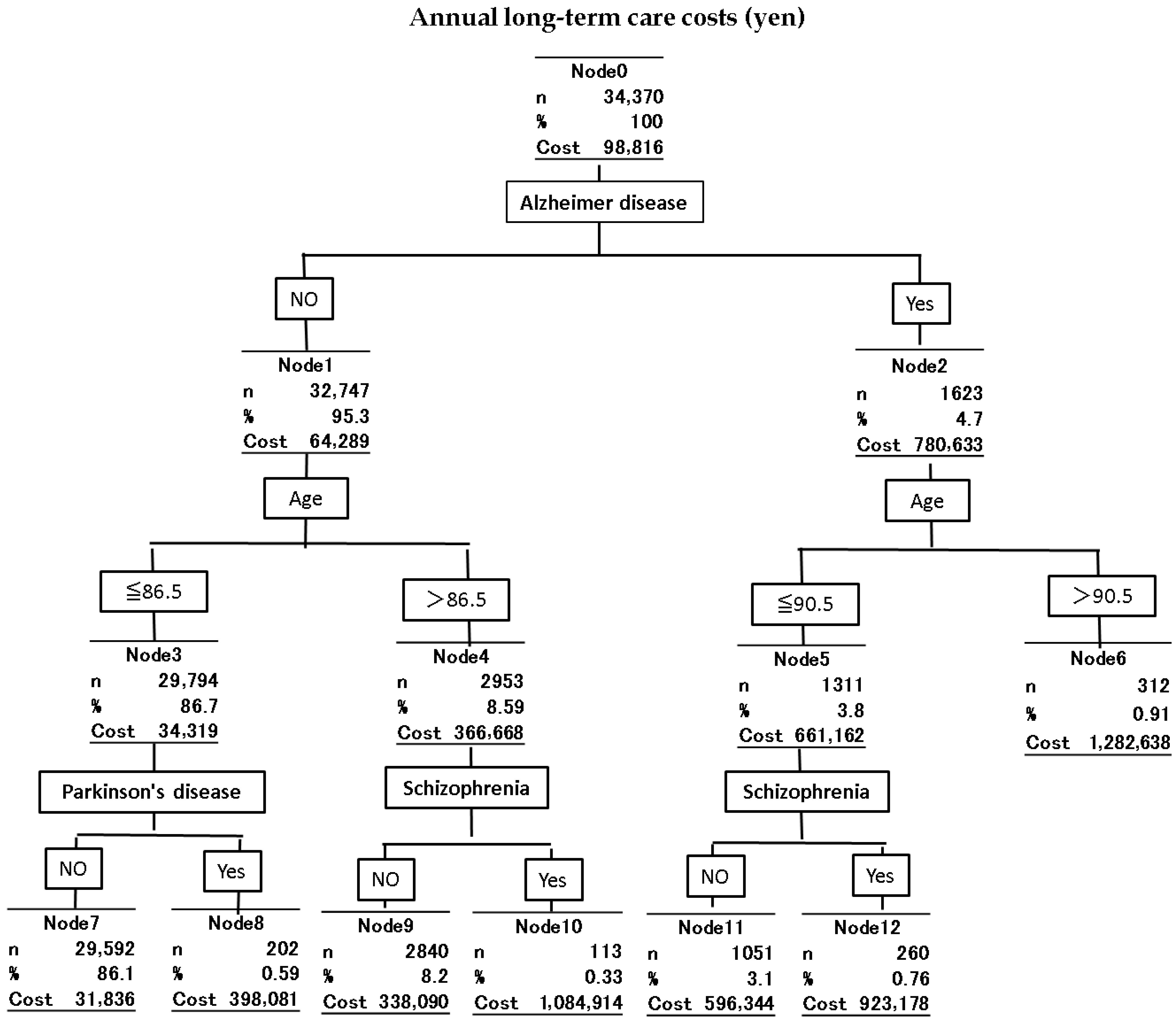
Figure 1. Decision tree (CART) analysis of factors influencing long-term-care costs (yen). The highest annual cost was for Node 6, those aged 90.5 years or older and suffering from Alzheimer’s disease, with an average cost of 1,282,638 yen. 1US$ = approximately 153JPY (4 November 2025).
Jdad 03 00016 g001
Table 1. Average annual long-term-care costs for each disease. 1US$ = approximately 153JPY (4 November 2025).
DiseaseN AbsentMean Cost (yen) AbsentSDN PresentMean Cost (yen) PresentSDN Total
Hypertension16,74455,931313,22617,626138,190487,00834,370
Hyperlipidemia17,84194,677415,82216,529101,828411,29234,370
Diabetes22,37068,146336,88912,000153,986523,21134,370
Low back pain27,76582,736380,5006605162,768525,99834,370
Osteoporosis27,92976,520370,8386441191,760553,19834,370
Knee osteoarthritis28,78489,704400,4075586141,463473,81334,370
Hepatic dysfunction29,79488,524390,1234576160,567538,37534,370
Cataract30,00899,542421,280436288,305356,73834,370
Angina pectoris30,02886,759391,1734342176,661537,84034,370
Glaucoma30,370100,734424,667400078,241317,22134,370
Acute heart failure30,49182,003376,9633879224,772617,39534,370
Hyperuricemia30,58093,363405,2363790136,465474,52334,370
Cerebral infarction30,99782,045382,3263373245,802613,37534,370
Lumbar spinal stenosis31,26794,549411,9853103134,060428,58534,370
Chronic heart failure31,51184,781381,8472859245,086653,15934,370
Fatty liver31,720102,590424,723265044,569238,76034,370
Arteriosclerosis obliterans31,79897,968417,621257299,950361,17634,370
Peripheral neuropathy31,84495,007409,5632526137,310460,48734,370
Colon cancer31,933100,400419,731243768,183322,31234,370
Stroke sequelae32,25291,189398,8162118203,596585,70934,370
Arrhythmia32,39292,976403,1381978182,285551,79434,370
Decreased renal function32,62694,712405,3671744161,794542,27234,370
Stomach cancer32,62999,265416,135174176,582363,60334,370
Alzheimer disease32,74764,289321,1591623780,6331,026,76134,370
Depression32,93593,702404,9511435199,425569,42034,370
Rheumatoid arthritis32,98197,619413,4791389109,907417,89134,370
Arteriosclerosis33,02799,443417,524134365,485301,79934,370
Hearing loss33,11298,265416,576125894,206327,78434,370
Schizophrenia33,21884,602375,6791152487,784937,65934,370
Atrial fibrillation33,28294,514406,5811088208,305580,06334,370
Cardiac infarction33,37096,548411,4851000150,435477,89234,370
Chronic renal failure33,47494,939408,381896216,817564,89834,370
Lung cancer33,50697,076412,215864138,438464,71334,370
Cerebral hemorrhage33,82294,773406,654548304,446695,27734,370
Internal carotid artery occlusion33,96197,926413,824409113,882399,90134,370
Parkinson’s disease33,98291,067395,891388715,4541,023,79534,370
Psychosomatic disorder34,00497,944413,528366114,104425,90534,370
Prostate cancer34,02198,346414,30134975,658345,18234,370
Cerebral thrombosis34,23097,489412,448140251,449628,40634,370
1US$ = approximately 153JPY (4 November 2025)
Table 2. Multivariate logistic regression analysis. In the multivariate logistic regression, gender, age, and the 16 selected diseases were simultaneously entered as explanatory variables. The VIF for multicollinearity of each disease was less than 1.19.
Disease Multivariate Adjusted Odds Ratio95% Confidence Intervalp-Value
Lower Upper
Age 1.161.151.17<0.001
Gender(Female/Male)1.231.121.35<0.001
Hypertension(+/−)1.040.941.140.443
Hyperlipidemia(+/−)0.770.680.88<0.001
Osteoporosis(+/−)1.521.381.68<0.001
Knee osteoarthritis(+/−)1.010.911.120.847
Glaucoma(+/−)0.820.730.930.002
Acute heart failure(+/−)1.311.181.46<0.001
Cerebral infarction(+/−)1.631.471.82<0.001
Chronic heart failure(+/−)1.381.231.56<0.001
Arteriosclerosis obliterans(+/−)1.090.951.260.212
Stroke sequelae(+/−)1.110.971.270.126
Alzheimer disease(+/−)4.834.255.48<0.001
Arteriosclerosis(+/−)0.580.470.72<0.001
Schizophrenia(+/−)4.063.364.91<0.001
Chronic renal failure(+/−)2.211.832.67<0.001
Cerebral hemorrhage(+/−)2.251.762.88<0.001
Parkinson’s disease(+/−)6.264.818.15<0.001
Table 3. Generalized linear model with log link–Gamma. A generalized linear model (GLM) with a log link (gamma) was used to analyze positive expenditures only. In the GLM analysis, gender, age, certification level, resident’s living situation, and the 16 selected diseases were simultaneously entered as explanatory variables. The disease with the largest exp(b) was Alzheimer’s disease. The VIF for multicollinearity of each disease was less than 1.19. 1US$ = approximately 153JPY (4 November 2025).
Item BStd. Error95% Wald Confidence
Interval
Hypothesis TestExp(b)Exp(β)95% Wald
Confidence Interval
Lower Upper Wald
Chi-Square
dfSig.Lower Upper
Age 0.0110.0030.0050.01613.8781<0.0011.0111.0051.016
Gender(F/M)0.1960.0500.0980.29415.2751<0.0011.2161.1021.342
At home or other FacilitiesFacilities/Home−0.1290.054−0.235−0.0235.69410.0170.8790.7910.977
Certification level (Lebel 1–7)0.3780.0150.3490.408628.4661<0.0011.4601.4171.503
Hypertension(+/−)0.1460.0510.0470.2458.29810.0041.1571.0481.278
Hyperlipidemia(+/−)−0.1330.064−0.259−0.0074.24810.0390.8760.7720.993
Osteoporosis(+/−)−0.0920.050−0.1900.0063.38910.0660.9120.8271.006
Knee osteoarthritis(+/−)−0.0710.051−0.1710.0291.93910.1640.9310.8431.029
Glaucoma(+/−)−0.0980.121−0.3360.1400.65210.4190.9280.8151.058
Acute heart failure(+/−)−0.0190.050−0.1180.0800.13810.7110.9810.8891.084
Cerebral infarction(+/−)−0.0040.051−0.1040.0960.00710.9350.9960.9011.101
Chronic heart failure(+/−)0.0270.055−0.0810.1350.23410.6281.0270.9221.144
Arteriosclerosis obliterans(+/−)−0.0200.071−0.1590.1200.07810.7800.9800.8531.127
Stroke sequelae(+/−)0.1400.0670.0090.2714.41810.0361.1511.0101.311
Alzheimer disease(+/−)0.2890.0500.1900.38733.1641<0.0011.3351.2101.473
Arteriosclerosis(+/−)−0.0750.067−0.2050.0561.25010.2640.9070.7151.150
Schizophrenia(+/−)−0.0640.087−0.2340.1060.54510.4610.9710.8481.112
Chronic renal failure(+/−)−0.0290.069−0.1650.1060.18010.6710.9380.7911.112
Cerebral hemorrhage(+/−)−0.0370.097−0.2270.1540.14210.7060.9640.7971.167
Parkinson’s disease(+/−)0.1440.090−0.0320.3202.57710.1081.1550.9691.377
Intercept 8.6140.2418.1429.0861279.6871<0.0015506.8393435.1118828.034
1US$ = approximately 153JPY (4 November 2025)
Disclaimer/Publisher’s Note: The statements, opinions and data contained in all publications are solely those of the individual author(s) and contributor(s) and not of MDPI and/or the editor(s). MDPI and/or the editor(s) disclaim responsibility for any injury to people or property resulting from any ideas, methods, instructions or products referred to in the content.



