


Abstract
Background: Dementia is a chronic, multifactorial syndrome with a high incidence and prevalence worldwide. The clinical assessment of these patients is challenging, imposing several barriers related to the system, the healthcare professional and the patient. While numerous assessment tools exist for dementia, few are specifically validated or widely used in palliative care. This study evaluates the relevance of using the Integrated Palliative Outcome Scale for Dementia (IPOS-Dem) in Portugal. The primary objective is to synthesize evidence on the implementation and clinical performance of IPOS-Dem in people with dementia receiving palliative care—including feasibility, acceptability, validity, reliability, and clinical applicability—while the secondary objective is to assess the instrument’s relevance and potential for cultural/linguistic adaptation to context. Methods: A systematic review of the literature was carried out, with research in evidence-based medicine databases on the use of the Integrated Palliative Outcome Scale for Dementia (IPOS-Dem) in palliative care, using the terms “dementia”, “alzheimer”, “lewy body”, “cognitive impair”, “outcome”, “IPOS-Dem”, “patient outcome assessment”, “outcome assessment”, “scale”, “palliative care”, and “palliative outcome scale”. Results: The IPOS-Dem was considered to be a useful tool for monitoring patients with dementia while receiving palliative care, allowing for a comprehensive and systematic evaluation of symptoms, as well as involving family members in the care process. It facilitates the identification of previously unknown symptoms and issues, particularly emotional and social concerns. Its use led to an improvement in symptom control and greater family involvement in care. The reduction in missing response rates and the time required to complete the scale with repeated use indicated good adaptation to the scale’s implementation. Difficulties were reported in assessing patients with communication impairments. Some staff also highlighted the need for training in using the scale. The Swiss Easy-Read IPOS-Dem showed significant variation in scores between evaluators, which raises concerns about the reliability and consistency of the scale, indicating that the tool requires further validation. Digital models, although they may present some inconveniences, were suggested as a potential improvement in acceptability. Conclusions: Our review suggests that IPOS-Dem provides initial evidence of feasibility, acceptability, and potential clinical usefulness in dementia palliative care, making its implementation beneficial for the Portuguese population. Translation and adaptation to the Portuguese population and culture will be necessary, but the scale is promising, and we recommend its national use.
1. Introduction and Objectives
Dementia refers to a situation of cognitive decline that is reflected in the patient’s life in a multidimensional way, with high existential suffering, as well as for society in general, becoming a public health problem [1,2]. It is a syndrome of a multifactorial nature, with the most important risk factors for its genesis being advanced age, an underlying genetic predisposition and the presence of systemic vascular disease [3].
According to the World Health Organization (WHO), dementia is currently one of the biggest causes of dependency and disability and represents a global cost of USD 1.3 trillion annually [2]. The number of people living with dementia in Portugal remains uncertain as a result of the variety of diagnostic criteria and underdiagnosis of the disease. Furthermore, the prevalence of dementia in institutions is very difficult to assess [4]. However, it is estimated that dementia affected, in 2019, between 3.7 and 9.5% of individuals aged 65 and over in Portugal, which corresponds to 85,162 to 217,549 people [5]. According to the Global Atlas of Palliative Care, non-oncological diseases represent 70% of Palliative Care (PC) needs, with dementia being among the most frequent (12.2%) [6]. Despite this significant need, PC services remain predominantly focused on oncology, leading to a disproportionate allocation of resources and services toward oncological conditions.
The aim of specialized PC is to provide patient-centered care, with high clinical complexity, to their family members and caregivers. Its pillars of action are the multidisciplinary approach to suffering and symptomatic control, supporting and empowering the family with the cornerstone of the communication with the individual.
The aging population and the inevitable increase in dementia incidence, along with its chronic, progressive, and complex nature, highlight the importance of integrating palliative care into its management to better address patients’ evolving needs [7].
Patients with dementia are frequently undertreated, receiving inadequate symptoms relief, and are often subjected to unnecessary life-prolonging interventions that disregard quality of life. Therapeutic goals are frequently misaligned with the individual’s clinical and personal context and preferences. In the final stages of life, common symptoms include anorexia, cachexia, delirium, dyspnea, pain, behavioral and psychological disturbances, and profound asthenia. These symptoms are often multifaceted, challenging to detect, and difficult to manage effectively [1,8].
The Palliative Outcome Scale (POS) is a scale developed for the assessment of patients with advanced-stage disease and its use aims to analyse important dimensions in PC [9]. It assesses quality of life and consists of two versions. One targets the patient, while the other is designed for the healthcare professional [10]. The POS consists of 10 items that assess the patient’s physical and psychosocial symptoms and spiritual needs and an open-ended item which allows the patient to express unaddressed problems. The final score corresponds to the sum of all items [9,10]. The benefit of using this instrument in non-cancer patients has also been proven, improving their quality of life [10].
Since its creation, the POS has been tested and improved. The Integrated Palliative Outcome Scale for Dementia (IPOS-Dem) was created to assess people with dementia living in nursing homes and was developed from the POS and the Integrated Palliative Outcome Scale (IPOS), both validated in Portugal [11,12]. This scale has three versions: one for the patient, one for family members and one for professionals and unqualified staff working in institutions. It emerges from the need for an instrument for the systematic and holistic assessment of patients with dementia and stands out, compared to other scales in the POS family, by encompassing common symptoms and specific problems of this population [9]. One of its main advantages is its ease of use, as staff in nursing homes and long-term care institutions in Europe generally have varying levels of qualification [13].
Structurally, the IPOS-Dem is very similar to the original POS, as it focuses on the main problems and concerns of the patient and their family. The key difference lies in its inclusion of a list of nineteen symptoms commonly observed in dementia which are evaluated based on their impact on the individual, along with an additional question addressing practical problem-solving. It also screens for anxiety and depression and assesses social interaction and feelings of peace [9].
Unlike the other scales in the POS family, the IPOS-Dem scale has not been translated or validated for the Portuguese population. Furthermore, there are still few studies on the relevance and applicability of this scale in clinical practice.
Studies and guidance have underscored the need for robust outcome measurement in dementia within palliative care, emphasizing holistic, person- and family-centered assessment across settings and stages of illness [1]. In Portugal, the scale of dementia and projected growth further highlight the imperative for systematic assessment to inform planning and care delivery [4,5].
Building on the international use of the POS/IPOS family in non-cancer populations and prior Portuguese validation work, this review deliberately focuses on IPOS-Dem, a dementia-specific instrument designed for residential and long-term care contexts, with the aim of informing potential cultural adaptation to Portugal [1,12]. By situating IPOS-Dem against existing outcome measures, we address a targeted evidence gap regarding its clinical utility for people with dementia in palliative care [1].
The primary objective of this study is to evaluate the implementation and clinical performance of IPOS-Dem in people with dementia receiving palliative care. The secondary objective is to discuss the instrument’s relevance and its potential for linguistic and cultural adaptation to the Portuguese context.
2. Methods
This systematic review was conducted in accordance with the methodological recommendations of the Joanna Briggs Institute (JBI) [14], aiming to ensure transparency, reproducibility, and validity of the results. The manuscript was written following the PRISMA 2020 checklist guidelines [15]. No prior registration of the protocol was carried out.
The population targeted in this review comprises patients with dementia receiving palliative care, with a focus on the assessment of symptoms, concerns, and multidimensional needs. The intervention under analysis is the use of the IPOS-Dem, a clinical assessment tool specifically designed for this population. There was no formal comparison established, although we included studies where the assessments using IPOS-Dem were compared with baseline evaluations. The outcomes considered included the clinical relevance, comprehensiveness, and feasibility of the application of the IPOS-Dem, as well as its ability to identify patient needs and symptoms. Additional outcomes included the scale’s acceptability by healthcare professionals and caregivers and its potential for cultural adaptation to the Portuguese context. Regarding the study type, this review included descriptive, quantitative, and instrument validation studies that explored the application of IPOS-Dem to people with dementia receiving palliative care across different clinical settings.
Studies were eligible if they met the following criteria: (1) evaluated the use of the IPOS-Dem scale in patients with dementia; (2) adopted a quantitative or mixed-methods design; (3) involved the application of the IPOS-Dem in palliative care contexts; (4) were published in English or Portuguese. No time restrictions were applied in the search strategy. Eligibility criteria were defined a priori using the PICO-S framework (Table 1).
Table 1.
Study criteria and main measurable outcomes.
A bibliographic search was carried out in Pubmed, using the MeSH terms “dementia” and “patient outcome assessment”, which resulted in 84 articles. A search was also carried out in PubMed Central (PMC) using the terms “dementia”, “alzheimer”, “lewy body”, “cognitive impairment”, “outcome” and “IPOS-Dem”, resulting in 23 articles. In Cochrane, a search was carried out using the terms “dementia”, “patient outcome assessment” and “IPOS-Dem”, resulting in 48 articles. A further 10 articles were obtained by searching the Index of Portuguese Medical Journals, using the terms “dementia”, “assessment” and “palliative care”, and another 10 by searching the Cumulative Index to Nursing and Allied Health Literature (CINAHL), using “dementia”, “outcome assessment”, “scale” and “palliative care”. Finally, another 5 articles were obtained by searching Google Scholar with the terms “palliative outcome scale” and “dementia” and 2 articles were taken from previous references. All searches were conducted in September 2024.
Our outcomes of interest consisted in feasibility, acceptability, validity, reliability and clinical applicability of the IPOS-Dem in palliative care for patients with dementia. When multiple results were presented for the same outcome, namely pre- and post-implementation scores, data were analysed for both time points.
A formal risk of bias assessment was not performed, based on the limited number of studies included and their predominantly descriptive nature. This limitation is acknowledged and highlights the need for future research with more robust methodologies and systematic quality assessment.
In this review, the effect measures used were primarily descriptive statistics (such as means and percentages) and observational variability metrics, given that the included studies were mostly descriptive with some quantitative components. Only one of the studies applied formal statistical measures, using Fleiss’ kappa and intraclass correlation coefficients (ICC).
The methodological quality of the included studies was assessed using the Mixed Methods Appraisal Tool (MMAT)—Version 2018 [16]. Each study was evaluated according to the set of five criteria specific to its study design. All included studies met at least four of the five criteria applicable to their methodology. None of the studies were excluded based on methodological quality. A summary of MMAT ratings is provided in Appendix A.
The American Family Physician’s Strength of Recommendation Taxonomy (SORT) scale was used to grade the evidence in this review. This scale aims to standardize and improve the quality of review articles by classifying the strength of recommendations using explicit criteria, based on patient-oriented evidence. SORT evaluates three key dimensions: quality, quantity and consistency of the studies. The Strength of Recommendation is classified into three categories (A, B, or C), depending on the robustness of the evidence and the relevance of outcomes. Individual studies are rated according to three Levels of Evidence (LE), based on methodological validity and type of outcomes assessed [17].
3. Results
3.1. Study Selection
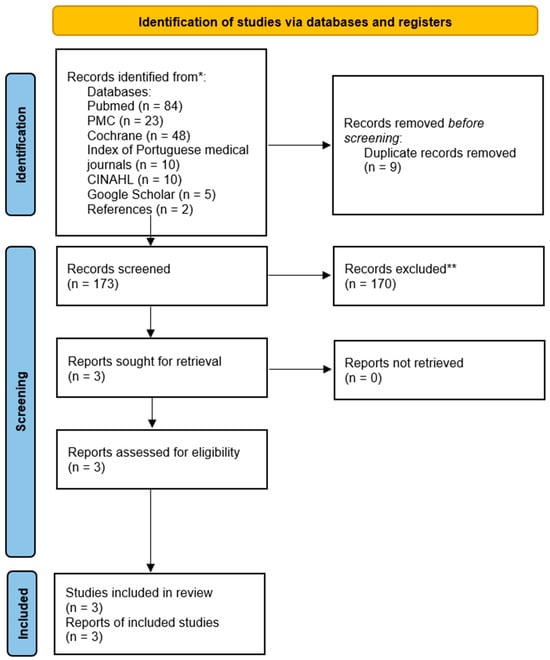
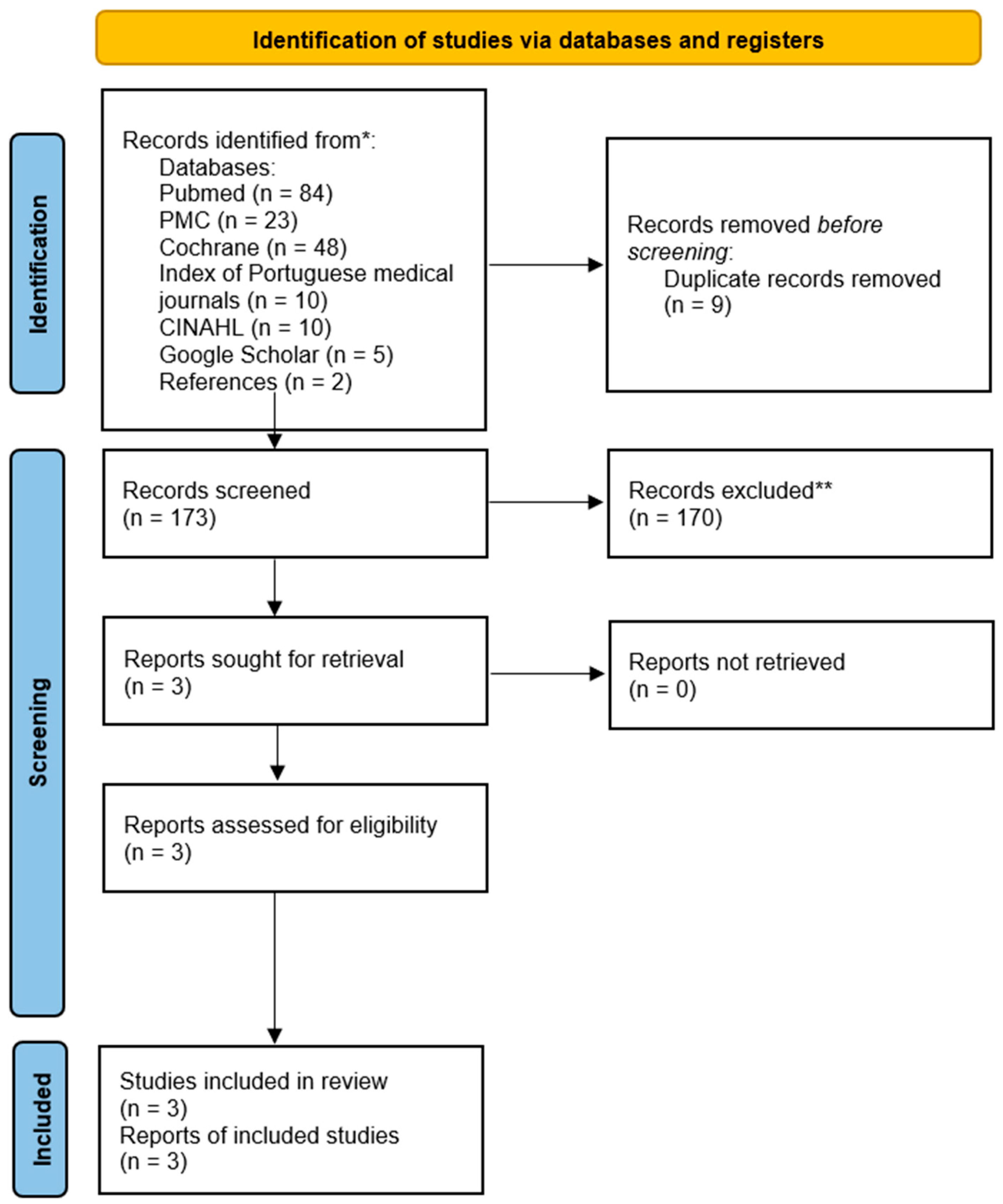
Across sources, 182 records were identified. After manual deduplication (n = 9), 173 titles/abstracts were screened, of which 170 were excluded for not addressing the review question. Three articles were retrieved for full-text assessment and all three met eligibility criteria and were included in the final synthesis. Screening was undertaken by a single reviewer; uncertainties were discussed with the second author. The selection process is shown in Figure 1.
Figure 1.
PRISMA 2020 flow diagram [15] for Process of selecting articles included in the review. * Consider, if feasible to do so, reporting the number of records identified from each database or register searched (rather than the total number across all databases/registers). ** If automation tools were used, indicate how many records were excluded by a human and how many were excluded by automation tools.
Records were excluded if they did not address the review question, including: narrative/systematic reviews; studies focused on neoplastic disease; dementia pathophysiology; biomarker-oriented research; evaluations of curative/disease-modifying therapies or improvements in screening/diagnosis; palliative interventions not using IPOS-Dem as an outcome; and the development or application of instruments other than IPOS-Dem. Studies in which outcomes were not assessed with IPOS-Dem, as well as posters and ongoing studies, were also excluded.
We also examined the dementia subsection of the POS family website and cross-checked all 14 studies listed. Of these, two had already been included in our review. After reassessment, we screened the remaining 12 studies and no one met our predefined eligibility criteria.
The selected studies analyzed the implementation of IPOS-Dem in the evaluation of patients with dementia (Table 2).
Table 2.
Main characteristics of the selected studies regarding the use of IPOS-Dem in dementia.
3.2. Study Characteristics
All three included studies reported use of IPOS-Dem with people with dementia in palliative care within institutional settings. Sample sizes were n = 32 [18], n = 225 [19], and n = 257 [20]. Modes of administration included paper and, where reported, digital completion.
Feasibility:
- Completion time decreased from 8.48 to 5.60 min over a 12-week period [18];
- Completeness improved, with “impossible to assess”/non-response falling from 2.1% to 1.1%; the items with the highest “impossible to assess” at endline were sleep problems and hallucinations/delusions (6.7% each).
Acceptability:
- Professionals generally described IPOS-Dem as accessible and comprehensible, while indicating a need for training for certain symptom domains;
- Mode preferences varied: one study reported greater acceptance of digital administration owing to ease of use/monitoring, whereas another reported a preference for paper.
Validity:
- Evidence of validity was reported in institutional settings (Ellis-Smith, 2018). No structural validity analyses were presented; validity evidence largely reflected content considerations and clinical use as described by the authors.
Reliability (including inter-rater agreement):
- The Swiss Easy-Read version demonstrated low inter-rater comparability, with 41% variation in total scores and 12% of variance attributable to between-institution differences;
- Higher agreement was observed for nausea, vomiting, and dyspnoea; lower agreement for anxiety/family concern, swallowing problems, and hallucinations/delusions;
- Items most frequently marked “don’t know” were anxiety/family concern (43.5%), loss of interest (31.3%), and inner peace (29.3%).
Clinical applicability:
- IPOS-Dem supported identification of previously unrecognised symptoms and emotional/social concerns, facilitated systematic documentation, and promoted family involvement;
- Reported improvements in symptom control occurred over the implementation period, alongside opportunities to enhance inter-professional communication and team empowerment;
- In Kinley (2019), skin changes showed the lowest non-response, whereas non-physical symptoms (e.g., loss of interest) showed higher non-response.
There were important methodological and implementation challenges in this study. Blinding of raters to clinical information and standard reference measures was not possible. There was no consensus on the temporal stability of IPOS-Dem ratings or of symptom patterns in people with dementia, making interpretation difficult. The sample was heterogeneous, with varied stages of dementia and missing formal diagnosis and severity classifications in a significant proportion of patients, limiting subgroup analyses, and possibly affecting reliability estimates. Routine data were used in place of structured dementia staging tools, which may have reduced the precision of analyses. The assignment of assessors was not standardized and there was a lack of information on their qualifications. Finally, conflicts of interest exist, with several authors being involved in the development and translation of the instrument.
4. Discussion
The findings of this review are interpreted in the context of existing evidence, care settings, and modes of administration, with attention to implications for practice and future research. Overall, IPOS-Dem shows promise for supporting person- and family-centered assessment in dementia, while important uncertainties remain—particularly regarding inter-rater reliability and the performance of subjective items. Contextual factors such as staff training, workflow integration, and the choice between paper and digital formats appear to influence both feasibility and perceived utility.
4.1. Implementation and Clinical Performance of IPOS-Dem
Across the included studies, IPOS-Dem was associated with improved identification and control of symptoms and with greater inclusion of family members in care processes, and was regarded as an accessible and comprehensive instrument for most professionals, albeit with adaptation challenges during routine use [18,19]. Time to complete the scale decreased over the study period, suggesting learning effects and potential efficiency gains with continued use [18]. These findings indicate favorable feasibility, acceptability, and clinical applicability in real-world settings.
Conversely, the Swiss Easy-Read IPOS-Dem did not meet thresholds for routine clinical integration due to low inter-rater comparability, substantial between-institution variability, and reduced agreement on items such as “anxiety or family concern”, “swallowing problems”, and “hallucinations and/or delusions”; higher rates of “don’t know” responses and a 41% variation in total scores were also reported [20]. These results underscore concerns regarding reliability and highlight items that may be harder to rate in dementia.
While Ellis-Smith et al. [18] and Kinley et al. [19] focused essentially on studying the implementation, acceptance and clinical applicability of the scale, Spichiger et al. [20] focused on analyzing the internal consistency of the assessment obtained through the same by comparing the scores obtained between observers and the variation in the final scores, which may justify the differences found. Furthermore, as it is a translation and cultural adaptation, the Swiss Easy-Read IPOS-Dem may present characteristics that are different from the original version and influence the results.
Considering that IPOS-Dem aims to systematically assess patients with dementia, with an emphasis on identifying symptoms and concerns of patients and family members, as well as improving communication and integrated patient management, it would be expected to find results like those found by Ellis-Smith et al. [18] and Kinley et al. [19] However, the study by Spichiger et al. [20] highlights the importance of robust validation of the scale and the need for training professionals to use it, to minimize the observed variance and improve the reliability of IPOS-Dem.
Other studies analyzed may help to explain some of the results obtained by these authors. Brandt et al. [21], in their study comparing the use of POS to assess patients with and without dementia, observed lower response rates in patients with dementia, particularly in items assessing anxiety, value of life and self, which suggests greater complexity in the assessment of subjective symptoms. In fact, from the analysis of the results of the three studies considered in this work, we can conclude that, in all of them, there was greater difficulty in assessing this type of symptoms, translated by higher rates of “I don’t know” or “impossible to assess”, as well as lower agreement in their assessment pointed out by Spichiger et al. [20]. In a similar study, by Puente-Fernández et al. [22], a higher total POS score was observed in patients without dementia, who scored higher in subjective items, which may reflect gaps in their assessment due to the cognitive and communication difficulties inherent to dementia.
Ellis-Smith et al. [18] mentioned in their study that the acceptability of digital models for the implementation of IPOS-Dem was improved due to their ease of use and monitoring. In turn, participants in the study by Kinley et al. [19] expressed a preference for completing the scale on paper. It was expected that participants would opt for the digital model due to its ease and the large amount of data to be managed on a scale that has three versions to be used in different contexts. The integration of IPOS-Dem into digital models (EMBED-Care model—Empowering Better End-of-Life Dementia Care) was further explored by Aworinde et al. [23], Davies et al. [24] and Gillam et al. [25] and showed promise in the assessment, monitoring and detection of deterioration in patients’ condition. This integration facilitates communication between professionals and enables staff to be empowered. However, it is important to consider that there are disparities in access to resources and technologies, that the use of tablets can divert a person’s focus and that these models require training interventions for their use.
4.2. Relevance and Potential for Cultural Adaptation in Portugal
In the context cultural and linguistic adaptation should ensure semantic and conceptual equivalence and confirm comprehensibility among professionals and family/caregivers. Cognitive interviewing is recommended to refine wording, particularly for domains with historically lower agreement, so that clarity is improved without loss of clinical nuance.
Adopting IPOS-Dem in Portugal is pertinent given the rising prevalence of dementia and the need for systematic assessment of people with dementia in palliative care across residential, community, and hospital settings [1,2,3,4,5,6,7,8]. The international and national track record of the POS/IPOS family supports the value of standardized measures to capture symptoms and concerns of people and families, providing a solid rationale for considering IPOS-Dem in the Portuguese context [9,10,11,12].
In general terms, adaptation for Portugal should ensure linguistic and cultural equivalence and confirm adequate psychometric properties prior to wider implementation; operationalization should be accompanied by staff training and integration into documentation workflows (paper or digital), recognizing that preferences and resources vary across services [13,15,16,17,18,19,20,23,24,25]. Pending robust national evidence, IPOS-Dem has the potential to strengthen person- and family-centered assessment, improve intra-team communication, and inform care planning within Portuguese palliative care services [1,6,7].
Implementation should attend to equity of access and assessment burden for the person and for family/caregivers. Appropriate consent/assent procedures and strategies to minimize burden (application time and assessment frequency) are essential to maintain ethical proportionality. The impact varies across Portuguese healthcare. In nursing homes, limited staff and training pose barriers. Community care might benefit from digital tools like tablets. Hospitals need to integrate the scale with existing assessment tools. Custom strategies are needed for different settings.
Future work in Portugal should follow a structured validation plan, including cultural adaptation, pilot testing in real-world settings, and a thorough psychometric evaluation of reliability, validity, and responsiveness. Such evidence is crucial for verifying the robustness of IPOS-Dem before recommending its widespread use. Multiple cross-cultural adaptations of IPOS-Dem, including German, Swedish, Swiss-German, Persian, and Chinese versions, have been successfully conducted. These endeavors tackled common challenges such as linguistic equivalence, subjective symptom assessment, and the feasibility of use in advanced dementia. The insights gained from these initiatives will be instrumental when developing a Portuguese version, ensuring that the adaptation leverages existing expertise and circumvents previously identified pitfalls.
4.3. Study Limitations and Main Strengths
We deliberately restricted the review to IPOS-Dem to preserve conceptual homogeneity and because a secondary objective concerned its prospective cultural adaptation for Portugal. This rationale is articulated in the Introduction and further con-textualized in the Discussion, where IPOS-Dem is compared with other outcome measures (including the POS/IPOS family) to delineate its role. Nonetheless, the narrow scope may limit comprehensiveness; broadening inclusion to additional instruments would have required protocol amendments and would likely have introduced substantial methodological heterogeneity. Accordingly, the restricted focus on IP-OS-Dem is acknowledged as a limitation and indicates a useful avenue for subsequent research employing expanded eligibility criteria.
The major limitation of this study is the scarcity of research on this topic. Most existing articles on IPOS-Dem are qualitative studies based on expert opinion and usual clinical practice, rather than controlled data or rigorous methodologies. Of the studies selected for this review, two of them presented a level of evidence of 3. This limitation reinforces the need for more robust future studies that allow for deeper knowledge in this area. Due to the limited evidence available, the three studies selected for this study have significant methodological differences, which makes their comparison challenging and limits the generalizability of the results presented. Furthermore, comparing a translated version of the scale with studies based on the original version introduces the potential for interpretative discrepancies and translation-related bias.
Additionally, the article selection process was not conducted by independent reviewers, which constitutes a potential source of selection bias. Although due to time constraints and available resources, it may have reduced the objectivity and reproducibility of the inclusion process.
Future syntheses would be strengthened by prior protocol registration, independent dual screening, and a formal, study-level risk-of-bias assessment. These steps would enhance methodological robustness and mitigate selection and interpretation biases. Robust psychometric validation, including factor analysis and reliability testing, is still necessary but was outside the scope of this review; future Portuguese adaptations should prioritize such studies.
5. Conclusions
The IPOS-Dem shows preliminary evidence of feasibility, acceptability, and potential clinical utility in dementia palliative care across different settings (LE 3). It is an instrument that facilitates the assessment of patients with dementia, allowing for a simplified and comprehensive evaluation of patients and their monitoring (LE 3). Its dimensions involve symptom control, address emotional, social and care concerns, and promote collaboration among all stakeholders in patient care (LE 3). Its application is intuitive and its relevance can lead to changes in the provision of care (LE 3). The scale also allows for improved communication between professionals, inclusion and appreciation of staff, and inclusion of the patient and family members in care (LE 3). Challenges have been highlighted in the assessment of patients with impaired communication (LE 3). Its application in digital models could improve its acceptability, particularly with the use of tablets (LE 3). The items with the highest non-response rates and lowest comparability between observers were those that assess subjective symptoms (LE 1).
The available evidence, mainly observational and small-scale, indicates potential utility of IPOS-Dem; however, significant uncertainties remain, and thorough validation is necessary before large-scale implementation in context. Additional high-quality quantitative and mixed-methods research is essential to systematically assess the psychometric properties of the instrument and confirm its suitability for broad use in clinical practice and research.
There is a significant lack of studies on the IPOS-Dem, especially large-scale quantitative studies that allow for testing of its effectiveness and robustness in a larger sample of patients and in different contexts. Furthermore, other significant problems were identified, such as low comparability of scores obtained between observers, challenges in the assessment of patients, especially those with impaired communication, and the need for training interventions on the use of the instrument. However, the scale addresses the main palliative care needs of the population with dementia and has proven useful in the assessment of these patients, so the Portuguese population could benefit from its use (Strength of Recommendation C), and the authors recommend its cultural validation and systematic quantitative and mixed-methods studies to verify its reliability, validity, and effectiveness prior to large-scale implementation.
Author Contributions
F.Q., J.B.S., D.C. (Daniela Cunha), D.C. (Daniel Canelas), J.R.N., J.P.A., M.D. and H.R.; Conceptualization—F.Q. and H.R.; Methodology—F.Q., D.C. (Daniela Cunha) and J.B.S.; Software—F.Q., D.C. (Daniela Cunha) and J.B.S.; Validation—D.C. (Daniel Canelas), J.R.N. and J.P.A.; Formal analysis—F.Q.; Investigation—F.Q. and H.R.; Resources—F.Q.; Data Curation—F.Q., J.B.S., D.C. (Daniela Cunha) and J.R.N.; Writing—Original Draft—F.Q. and H.R.; Writing—Review and Editing—J.R.N., J.P.A., M.D., D.C. (Daniela Cunha) and H.R.; Visualization—J.B.S. and D.C. (Daniel Canelas); Supervision—H.R.; Project administration—F.Q. Funding acquisition—J.R.N. and J.P.A. All authors have read and agreed to the published version of the manuscript.
Funding
The authors received no financial support for the research, authorship, and publication of this article.
Data Availability Statement
Upon reasonable request. No new data were created or analyzed in this study.
Conflicts of Interest
The authors declare no conflicts of interest.
Appendix A
Table A1.
Classification of the selected studies according to the Mixed Methods Appraisal Tool (MMAT), version 2018.
References
- Stewart, J.T.; Schultz, S.K. Palliative Care for Dementia. Psychiatr. Clin. N. Am. 2018, 41, 141–151. [Google Scholar] [CrossRef] [Scilit] [PubMed]
- Dementia. OMS. 2023. Available online: https://www.who.int/news-room/fact-sheets/detail/dementia (accessed on 24 March 2024).
- Gale, S.A.; Acar, D.; Daffner, K.R. Dementia. J. Med. 2018, 131, 1161–1169. [Google Scholar] [CrossRef] [Scilit]
- Gonçalves-Pereira, M.; Verdelho, A.; Prina, M.; Marques, M.J.; Xavier, M. How Many People Live with Dementia in Portugal? A Discussion Paper of National Estimates. Port. J. Public Health 2021, 39, 58–68. [Google Scholar] [CrossRef] [Scilit] [PubMed]
- Alves, S.; Duarte, N.; Gomes, B. Forecasted Dementia Prevalence in Portugal (2020–2080). J. Geriatr. Psychiatry Neurol. 2024, 37, 403–412. [Google Scholar] [CrossRef] [Scilit]
- Connor, S.; Morris, C.; Jaramillo, E. Global Atlas of Palliative Care, 2nd ed.; World Health Organization (WHO): London, UK, 2020. [Google Scholar]
- Gupta, E.; Patel, P. Palliative care in dementia. Ann. Palliat. Med. 2024, 13, 791–807. [Google Scholar] [CrossRef] [Scilit]
- Mahin-Babaei, F.; Hilal, J.; Hughes, J.C. The basis, ethics and provision of palliative care for dementia: A review. Maturitas 2016, 83, 3–8. [Google Scholar] [CrossRef] [Scilit] [PubMed]
- Palliative Care Outcome Scale (POS)-Home. Available online: https://pos-pal.org/maix/ (accessed on 19 December 2024).
- Rugno, F.C.; De Carlo, M.M.R.D.P. The Palliative Outcome Scale (POS) applied to clinical practice and research: An integrative review. Rev. Lat. Am. Enferm. 2016, 24, e2764. [Google Scholar] [CrossRef] [Scilit] [PubMed]
- Med, A.; Ferreira, P.L.; Pinto, A.B. Medir Qualidade de Vida em Cuidados Paliativos. Port 2008, 21, 111–124. [Google Scholar]
- Antunes, B.; Ferreira, P.L. Validation and cultural adaptation of the Integrated Palliative care Outcome Scale (IPOS) for the Portuguese population. BMC Palliat. Care 2020, 19, 178. [Google Scholar] [CrossRef] [Scilit] [PubMed]
- Hodiamont, F.; Hock, H.; Ellis-Smith, C.; Evans, C.; de Wolf-Linder, S.; Jünger, S.; Diehl-Schmid, J.; Burner-Fritsch, I.; Bausewein, C. Culture in the spotlight—Cultural adaptation and content validity of the integrated palliative care outcome scale for dementia: A cognitive interview study. Palliat. Med. 2021, 35, 962–971. [Google Scholar] [CrossRef] [Scilit] [PubMed]
- Checklist for Systematic Reviews and Research Syntheses. Critical Appraisal Checklist for Systematic Reviews and Research Syntheses 2. 2017. Available online: https://jbi.global/sites/default/files/2019-05/JBI_Critical_Appraisal-Checklist_for_Systematic_Reviews2017_0.pdf (accessed on 18 November 2025).
- PRISMA 2020 Checklist. Available online: https://www.bmj.com/content/372/bmj.n71 (accessed on 1 May 2025).
- Nha Hong, Q.; Pluye, P.; Fàbregues, S.; Bartlett, G.; Boardman, F.; Cargo, M.; Dagenais, P.; Gagnon, M.-P.; Griffiths, F.; Nicolau, B.; et al. Mixed Methods Appraisal Tool (MMAT) Version 2018-User Guide. Available online: http://mixedmethodsappraisaltoolpublic.pbworks.com/w/file/fetch/127916259/MMAT_2018_criteria-manual_2018-08-01_ENG.pdf (accessed on 1 May 2025).
- Ebell, M.H.; Siwek, J.; Weiss, B.D.; Woolf, S.H.; Susman, J.; Ewigman, B.; Bowman, M. Strength of Recommendation Taxonomy (SORT): A Patient-Centered Approach to Grading Evidence in the Medical Literature. Am. Fam. Physician 2004, 69, 548–556. [Google Scholar] [CrossRef] [Scilit] [PubMed]
- Ellis-Smith, C.; Higginson, I.J.; Daveson, B.A.; Henson, L.A.; Evans, C.J. How can a measure improve assessment and management of symptoms and concerns for people with dementia in care homes? A mixed-methods feasibility and process evaluation of IPOS-Dem. PLoS ONE 2018, 13, e0200240. [Google Scholar] [CrossRef] [Scilit] [PubMed]
- Kinley, J.; Ellis-Smith, C.; Hurt, M.; McIvor, K.; Evans, C.J. A collaborative approach in dementia care to improve clinical effectiveness and priorities for research through audit. Int. J. Palliat. Nurs. 2019, 25, 588–595. [Google Scholar] [CrossRef] [Scilit] [PubMed]
- Spichiger, F.; Volken, T.; Larkin, P.; Meichtry, A.A.; Koppitz, A. Inter-rating reliability of the Swiss easy-read integrated palliative care outcome scale for people with dementia. PLoS ONE 2023, 18, e0286557. [Google Scholar] [CrossRef] [Scilit] [PubMed]
- Brandt, H.E.; Deliens, L.; van der Steen, J.T.; Ooms, M.E.; Ribbe, M.W.; van der Wal, G. The last days of life of nursing home patients with and without dementia assessed with the palliative care outcome scale. Palliat. Med. 2005, 19, 334–342. [Google Scholar] [CrossRef] [Scilit] [PubMed]
- Puente-Fernández, D.; Campos-Calderón, C.P.; Esteban-Burgos, A.A.; Hueso-Montoro, C.; Roldán-López, C.B.; Montoya-Juárez, R. Palliative Care Symptoms, Outcomes, and Interventions for Chronic Advanced Patients in Spanish Nursing Homes with and without Dementia. Int. J. Environ. Res. Public Health 2020, 17, 1465. [Google Scholar] [CrossRef] [Scilit] [PubMed]
- Aworinde, J.; Evans, C.J.; Gillam, J.; Ramsenthaler, C.; Davies, N.; Ellis-Smith, C. Co-design of the EMBED-Care Framework as an intervention to enhance shared decision-making for people affected by dementia and practitioners, comprising holistic assessment, linked with clinical decision support tools: A qualitative study. Health Expect. 2024, 27, e13987. [Google Scholar] [CrossRef] [Scilit] [PubMed]
- Davies, N.; Sampson, E.L.; Aworinde, J.; Gillam, J.; Kenten, C.; Moore, K.; Phillips, B.; Harvey, C.; Anderson, J.; Ward, J.; et al. Co-Designing a Palliative Dementia Care Framework to Support Holistic Assessment and Decision Making: The EMBED-Care Framework. Health Expect. 2024, 27, e70011. [Google Scholar] [CrossRef] [Scilit] [PubMed]
- Gillam, J.; Evans, C.; Aworinde, J.; Ellis-Smith, C.; Ross, J.; Davies, N. Co-design of a theory-based implementation plan for a holistic eHealth assessment and decision support framework for people with dementia in care homes. Digit. Health 2023, 9, 20552076231211118. [Google Scholar] [CrossRef] [Scilit] [PubMed]

Disclaimer/Publisher’s Note: The statements, opinions and data contained in all publications are solely those of the individual author(s) and contributor(s) and not of MDPI and/or the editor(s). MDPI and/or the editor(s) disclaim responsibility for any injury to people or property resulting from any ideas, methods, instructions or products referred to in the content. |
© 2025 by the authors. Licensee MDPI, Basel, Switzerland. This article is an open access article distributed under the terms and conditions of the Creative Commons Attribution (CC BY) license (https://creativecommons.org/licenses/by/4.0/).