Article

Investigating the Contributions of Stress Appraisals and Self-Regulated Learning Practices on Student Success


1
Educational Psychology, University of Victoria, Victoria, BC V8W 2Y2, Canada
2
Psychology, University of Victoria, Victoria, BC V8W 2Y2, Canada
*
Author to whom correspondence should be addressed.
Psychol. Int. 2026, 8(3), 41; https://doi.org/10.3390/psycholint8030041
Submission received: 29 May 2026 / Revised: 23 June 2026 / Accepted: 25 June 2026 / Published: 1 July 2026
(This article belongs to the Section Neuropsychology, Clinical Psychology, and Mental Health)

Abstract

Student mental health, stress, and success are interconnected, yet the mechanisms linking them remain insufficiently understood. Drawing on Stress Optimization and Self-Regulated Learning (SRL) theories, this study examined how stress appraisals and learning practices jointly contribute to student mental health and academic functioning in post-secondary students, supporting a view of student success that comprises both feeling well psychosocially and functioning well academically. Using a sample of 226 university students, the study replicated prior work on the predictive roles of coping self-efficacy (CSE) and stress mindset (SM) across indicators of student success, including flourishing mental health, motivation-related challenges, social-emotional challenges, and GPA. It extended this work by testing whether metacognitive monitoring and adaptation, and academic social engagement, mediated these relationships. Results showed that neither CSE nor SM significantly predicted GPA, suggesting that stress appraisals alone may be insufficient to explain academic achievement. However, both CSE and SM significantly predicted flourishing mental health, and CSE was additionally associated with fewer motivation-related and social-emotional challenges. Mediation analyses indicated that metacognitive monitoring partially explained the relationship between CSE and reduced motivation challenges, while academic social engagement mediated relationships between stress appraisals and social-emotional challenges and mental health. Findings underscore the value of integrating psychosocial and educational perspectives in promoting student success.

1. Introduction

Student experiences of stress in the academic context are an important component of academic well-being and academic performance, which together contribute to student success. In an approach to student success that includes psychosocial and academic indicators, students strive to do well academically and feel well psychologically and socially in their academic context (e.g., see Keyes & Haidt, 2003; Kuh et al., 2005; Suldo et al., 2006; Tinto, 2017). Stress is inherent in motivated performance contexts such as education and arises whenever goals are pursued (Brooks, 2014; Jamieson et al., 2018). Accordingly, stress is tightly linked to student success (Park et al., 2017).
Stress is not inherently positive or negative; its impact depends on how students manage (a) academic demands and (b) their subjective experience of stress (ACHA, 2016; Keyes, 2005). Adaptive responses to both are therefore critical for success (Brooks, 2014; Denovan & Macaskill, 2017; Jamieson et al., 2018; Rudland et al., 2020). Effective self-regulatory practices support the management of academic demands (Hadwin et al., 2022; Zollanvari et al., 2017), while stress appraisals shape the adaptive experience of stress (Barrett, 2006; Gross, 2015; Uusberg et al., 2019). However, limited research has explored how stress appraisals interact with academic regulatory practices to influence student success. This study begins to address that gap.

1.1. Literature Review

Stress and Student Success

Stress is an individual’s response to perceived demand or threat (Folkman & Lazarus, 1985; Lazarus et al., 1985). As a non-specific response (Selye, 1976), stress is not inherently positive or negative. Its impact depends not only on situational demands but also on the individual’s capacity to regulate both those demands and their subjective stress experience (Bienertova-Vasku et al., 2020; Lazarus et al., 1985). Although stress commonly arises in achievement-focused contexts, its effects on students vary widely (Brooks, 2014; Jamieson et al., 2018; Jenkins et al., 2021).
Stress responses are shaped by perceptions of internal cues (e.g., physiological arousal, cognitive appraisals) and external situational factors. Cognitive appraisals, students’ perceptions and beliefs about stress, directly influence biological, psychological, and behavioral responses (Barrett, 2017; Epel et al., 2018; Jamieson et al., 2018). Thus, adaptive stress responses that support student success are likely to involve adaptive cognitive appraisals (e.g., Jamieson et al., 2018).
Stress is common in academic settings where students pursue personally meaningful goals within evaluative and performance-oriented contexts (Brooks, 2014; Jamieson et al., 2018; Park et al., 2017). Adaptive responses to stress are essential for well-being (Denovan & Macaskill, 2017), effective learning (Vogel & Schwabe, 2016), and academic performance (Yaman-Sözbir et al., 2019). When not managed well, academic-related stress can (a) reduce academic achievement, (b) decrease motivation, (c) increase risk of dropout, (d) impair memory, attention, and information recall, and (e) impact learning processes and academic outcomes (de la Fuente et al., 2020; Pascoe et al., 2020; Vogel & Schwabe, 2016).
Students’ perceptions or appraisals of stress are thought to shape how effectively they manage stress and, in turn, how stress influences broader aspects of success (Crum et al., 2017; Epel et al., 2018; Jamieson et al., 2018). Yet little research has examined how such appraisals affect both performance and psychosocial components of student success. This research posits that in the university context where stress is expected, student beliefs or appraisals about stress have the capacity to impact (a) the experience of stress, (b) subsequent adaptive learning processes, and (c) student success.
This study addresses this gap by examining how stress-related self-beliefs and regulatory learning practices jointly contribute to student success. First, it replicates prior findings regarding the predictive roles of coping self-efficacy and stress mindset across indicators of academic well-being, motivation-related challenges, social-emotional challenges, and GPA. Second, it extends this work by testing whether metacognitive and social regulatory practices help explain the relationships between stress-related self-beliefs and student success outcomes. In doing so, the study integrates psychosocial and educational perspectives to better understand how students come to both feel well and function well in academic settings.
Two aspects of student success that are sensitive to stress responses are (a) mental health and well-being and (b) academic challenges. Mental health and well-being reflect optimal functioning (Diener et al., 2017; Ryan & Deci, 2001) and are linked to psychosocial functioning (Barbayannis et al., 2022) and academic performance (Howell, 2009; Keyes, 2007). There is prior evidence that self-beliefs are predictive of (a) aspects of mental health and well-being (Freire et al., 2019; Rostampour et al., 2023; Melato et al., 2017) and positive coping (Cattelino et al., 2021). We therefore hypothesized that adaptive stress appraisals should be associated with flourishing mental health, referred to as academic well-being in this research.
Academic challenges, defined as the difficulties students encounter in their academic work (Hadwin et al., 2019), are also integral to student success (Louis & Schreiner, 2012), provide opportunities for students to engage in self-regulated learning by implementing adaptive learning practices (Hadwin et al., 2022). Such challenges predict performance, promote learning and growth, require regulatory control through adaptive learning practices, and serve as indicators of regulated learning tied to success (Hadwin et al., 2022; Koivuniemi et al., 2017). Two types of challenges, motivation and social-emotional challenges, are especially salient, as they are consistently high among students and operate independently of goal attainment (Hadwin et al., 2019; Koivuniemi et al., 2017). Motivational challenges may include students struggling to believe they are capable of completing their academic work, having difficulty persisting when they encounter obstacles, or feeling discouraged by setbacks. Social-emotional challenges may include students struggling to feel connected with other students, having difficulty finding enjoyable or meaningful moments in their academic environment, or experiencing challenges with managing their emotions.
Prior research suggests stress-related self-beliefs like stress mindset and self-efficacy impact student motivation (Bandura & Locke, 2003; Crum et al., 2017; Pascoe et al., 2020), likely by reducing perceived threat and supporting adaptive coping (e.g., Freire et al., 2016; Karademas & Kalantzi-Azizi, 2004), engagement with learning (Boekaerts & Cascallar, 2006), and mental health (Kashdan et al., 2008). Motivation and social-emotional challenges are widely experienced by students; these challenges may also be mitigated by regulatory practices in pursuit of academic goals (Hadwin et al., 2018, 2019). Although stress-related beliefs have been linked to student experiences and performance (Freire et al., 2019; Jamieson et al., 2022), few studies simultaneously examine (a) performance and psychosocial outcomes as components of student success or (b) the regulatory practices that may shape the association between stress appraisals and success.
This study conceptualizes student success as encompassing student psychosocial experiences and academic performance outcomes (Kuh et al., 2005; Louis & Schreiner, 2012; Suldo et al., 2006; Tinto, 2017). Although grade point average (GPA) is a common indicator of academic performance, it is an imperfect measure of student success given variability in course type and load. As a distal outcome, GPA does not capture specific academic challenges that impede success. Research indicates that GPA is modestly predicted by individual factors and is best explained by a combination of individual differences (Richardson et al., 2012; Robbins et al., 2004; Zollanvari et al., 2017). It correlates with prior academic achievement, academic self-efficacy, engagement, self-regulated learning (SRL) strategies, and conscientiousness (Pérez-González et al., 2022). Further, GPA is a measure of academic achievement or performance and does not adequately represent the range of factors that comprise student success (Rice et al., 2025). Evidence on the role of stress appraisals in predicting GPA is mixed (Jamieson et al., 2022; Kapil et al., 2024), whereas performance-specific cognitions such as academic self-efficacy show stronger associations (Richardson et al., 2012).
The degree to which students enact self-regulatory learning strategies may mediate the effect of psychosocial contextual influences (e.g., stress appraisals) on academic performance (see Richardson et al., 2012). Accordingly, this study examines whether SRL practices mediate the relationship between stress appraisals and broader indicators of student success. We hypothesize that stress appraisals and regulatory practices jointly shape how students manage stress and academic demands, thereby influencing success.

1.2. Theory Informed Expectations Regarding Student Experiences of Stress

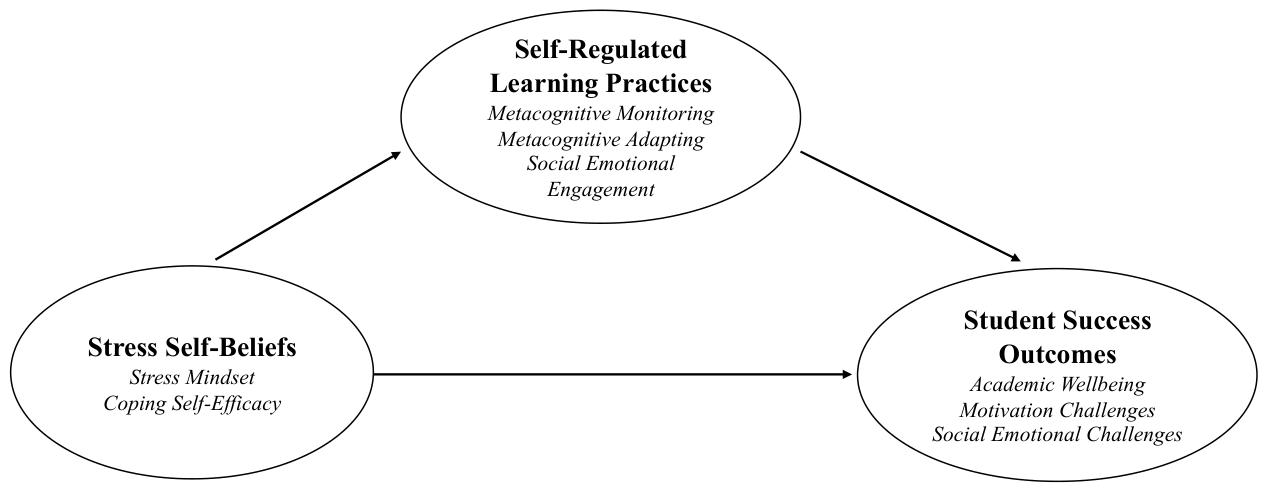
Given that stress impacts student success, three perspectives inform a useful framework for conceptualizing adaptive responses to stress in academic settings (Figure 1): (a) stress optimization theory (student experiences of stress), (b) student stress appraisals in the academic context (how a student perceives their environment), and (c) student regulatory responses to stress appraisals in the academic context (how a student manages their environment).

1.2.1. Stress Optimization Theory

Stress optimization is grounded in the view that stress is unavoidable in motivated performance contexts such as academic settings (Barrett, 2017; Jamieson et al., 2018; Jenkins et al., 2021). Rather than emphasizing avoidance, stress optimization integrates stress theories to promote benefiting from acute stressors (Jamieson et al., 2018). Its aim is to foster thriving, resilience, and adaptive coping amid the pressure and uncertainty inherent in meaningful goal pursuit in (Brooks, 2014; Jamieson et al., 2018; Park et al., 2017). Stress optimization incorporates research on stress appraisals and stress mindsets, both of which suggest that stress can (a) support physiological and psychological thriving, (b) enhance performance and well-being when interpreted as an opportunity for growth, and (c) be viewed as functional in acute performance contexts (Jamieson et al., 2018, 2022). Drawing from appraisal and psychological construction theories, the framework emphasizes that internal and external contextual cues jointly shape the experience of stress (Barrett, 2017, 2022).

1.2.2. Student Stress Appraisals in the Academic Context

Appraisals, self-efficacy, and stress mindset beliefs are key cognitive processes underlying stress and student success. Appraisals involve cognitive evaluations of events that influence emotional reactions, coping responses, and whether a situation is perceived as a challenge or threat (Lazarus, 1991; Scherer & Moors, 2019). While appraisals are typically situation specific, mindsets and self-efficacy beliefs are more stable across contexts (Poluektova et al., 2023). However, these beliefs are also malleable, experience dependent, and influenced by situational appraisals (Crum et al., 2013, 2017; Usher & Pajares, 2009; Poluektova et al., 2023). These dynamic and interrelated constructs often overlap (de Ruiter & Thomaes, 2023; Poluektova et al., 2023); thus, this study uses the terms appraisal and belief interchangeably.
Stress optimization theory posits that stress perceptions and coping are shaped by stress-related beliefs (Crum et al., 2017; Jamieson et al., 2022), processes that remain underexplored in academic contexts. The present study examines two stress appraisals expected to influence student success: stress mindset and coping self-efficacy.
Stress Mindset
Stress mindset reflects general beliefs about whether stress is enhancing or debilitating and emphasizes that stress responses can be modified even when stressors cannot (Crum et al., 2017). A stress-is-enhancing mindset predicts greater psychological and physical well-being, positive affect, cognitive flexibility, attentional bias toward positive stimuli (Crum et al., 2017; Keech et al., 2018), mental health (Khan & Shamama-Tus-Sabah, 2020), and academic performance (Keech et al., 2018), partly through approach coping and reduced distress (Jenkins et al., 2021). Although stress mindset has been understudied in education, research on growth mindset shows related effects on intelligence beliefs (Dweck, 1999), challenge seeking (Yeager & Dweck, 2012), academic performance and physiological stress responses (Yeager et al., 2016, 2022), and well-being (Howell, 2017; Tamir et al., 2007).
This study proposes that a stress-is-enhancing mindset promotes adaptive regulation and student success by predicting better mental health, fewer academic difficulties, higher GPA, and stronger regulatory practices. However, few studies have compared the predictive value of stress mindset relative to other stress appraisals or across experiential and performance outcomes. The present research addresses this gap by examining coping self-efficacy alongside stress mindset to evaluate their relative contributions to student success.
Coping Self-Efficacy
In academic contexts, students’ stress experiences are influenced by their perceived ability to cope effectively with both the emotion of stress and the demands they face, referred to as coping self-efficacy (CSE; Chesney et al., 2006). In this study, CSE reflects students’ beliefs in their capacity to manage academic stressors such as exams or presentations as well as the broader demands inherent in university learning. Because academic environments routinely involve both stress and challenge, we propose that CSE is an important contributor to student success.
One study found that CSE predicted higher academic well-being and lower motivation challenges, but not GPA (Kapil et al., 2024). CSE has been more extensively examined in other motivated performance contexts, including mental health settings (Benight & Harper, 2002; Melato et al., 2017; Midkiff et al., 2018; Singer et al., 2016; Wissing et al., 2011) and the military (Delahaij & Van Dam, 2017). Related self-efficacy constructs are well established in student success research. For example, academic self-efficacy is associated with (a) academic performance (Klassen & Klassen, 2018), (b) successfully enacting academic strategies (Bandura, 2001), (c) adaptive coping (Freire et al., 2016; Karademas & Kalantzi-Azizi, 2004), and (d) flourishing mental health (Freire et al., 2019; Kashdan et al., 2008; Melato et al., 2017). Based on this literature, we hypothesize that coping self-efficacy will be positively associated with student success outcomes and with students’ use of adaptive regulatory practices.

1.2.3. Student Regulatory Responses to Stress Appraisals in the Academic Context

In addition to self-beliefs and perceptions about stress, how students manage their academic environment also impacts experiences of stress and student success (de la Fuente et al., 2020). Specific to the academic context, stress is related to regulatory practices that exert strategic influence on the academic environment (de la Fuente et al., 2020). In stress optimization literature, attention has been given to the impact of stress-related beliefs on academic performance (e.g., Jamieson et al., 2022), while specific learning practices and behaviors enacted to manage academic demands have been underexamined. Educational psychology and self-regulated learning (SRL) literature identify processes and behaviors critical to student success, independent of stress appraisals (Winne & Hadwin, 2008). This study hypothesizes that such regulatory practices serve as key resources that mediate the relationship between stress appraisals and student success outcomes.
Metacognitive Regulatory Practices
Students’ regulatory responses to stress appraisals strongly shape their stress experiences and academic success. Adaptive appraisals foster approach motivation and behavior, supporting effective self-regulation (Freire et al., 2016; Jamieson et al., 2022; Karademas & Kalantzi-Azizi, 2004). Yet, stress optimization theory provides limited insight into specific adaptive self-regulatory practices, which can be clarified through self-regulated learning (SRL) theory.
SRL is an iterative, agentic process through which learners monitor and regulate external (e.g., tasks) and internal (e.g., cognition, motivation, emotion) environments to support planning, decision-making, goal setting, and study behaviors (Hadwin et al., 2022; Winne & Hadwin, 2008). Across models, metacognition is central, underpinning regulation throughout the learning cycle and interacting closely with emotion (Efklides et al., 2018).
Metacognitive monitoring refers to observing and reflecting on cognitive and affective states (Perfect & Schwartz, 2002), while metacognitive control or adapting involves adapting strategies based on this monitoring (Thiede & Dunlosky, 1999). These processes enable deep learning and effective study organization (Grund et al., 2024). Students engage metacognition when asking themselves questions such as, “What am I supposed to be doing?” “Am I remembering the material?” and “Do I understand it?”.
Metacognitive adaptation occurs when students adjust ineffective strategies, for instance, by redefining tasks, revising plans, or selecting alternative approaches. This study hypothesizes that adaptive stress appraisals promote metacognitive monitoring and adaptation, which mediate the relationship between stress appraisals and student success outcomes.
Social Regulatory Practices
Regulating social aspects of the academic environment enhances students’ adaptive responses to stress and management of academic demands (McLean et al., 2023; Tinto, 2017). Hadwin et al. (2022) defines social and emotional factors as overall psychological, social, and physical well-being, encompassing emotion regulation (e.g., test stress), social belonging, and physical health. The social regulatory practice examined here, academic social engagement, includes helping classmates, connecting with peers, and participating in university life.
Social and emotional well-being correlate positively with academic performance (van der Zanden et al., 2018). Students who feel accepted and valued by peers and instructors demonstrate stronger engagement (Tinto, 2017; Won et al., 2018, 2021) and greater persistence in their major (Lewis & Hodges, 2015). Social engagement also buffered academic and mental health challenges during the COVID-19 transition to online learning (Elmer et al., 2020). Consistent with stress-buffering models, high social support and access to social resources mitigate the negative effects of stress (Cohen & Wills, 1985; Southwick et al., 2016).
Although stress appraisals are theoretically linked to student success outcomes such as GPA, academic challenges, and well-being, empirical findings remain mixed. Stress mindset has been associated with academic performance (Crum et al., 2017; Jamieson et al., 2022), yet Kapil et al. (2024) found that coping self-efficacy (CSE), not stress mindset, predicted fewer motivation challenges and greater academic well-being, with neither appraisal predicting GPA. Given these unexpected and inconsistent results, replication is needed to clarify the role of stress mindset in student success.
Stress is non-specific and expected in academic contexts. Drawing on theory and prior research, this study proposes that adaptive student responses to stress are shaped by three key factors: (a) adaptive stress appraisals, (b) self-regulatory practices, and (c) social regulatory practices. The study has two aims: first, to replicate Kapil et al.’s (2024) unexpected finding regarding the predictive roles of stress mindset and coping self-efficacy on student success; second, to examine whether metacognitive and social regulatory practices mediate any associations between stress appraisals and student success.
Appraisals and beliefs regarding stress are important aspects of whether stress is experienced as helpful or harmful (Crum et al., 2017) and facilitates approach over avoidance coping behavior (Jamieson et al., 2022). Because effective management of learning and academic demands is central to student success (Hadwin et al., 2022; Winne & Hadwin, 2008), factors beyond stress self-beliefs are also likely to contribute. Preliminary findings indicated that stress mindset and CSE predicted several student success outcomes but were unrelated to GPA, ruling out GPA as a meaningful outcome for subsequent analyses. These results provided the basis for examining how self-regulatory practices may further explain the links between stress appraisals and student success.

2. Materials and Methods

2.1. Purpose and Research Questions

The purpose of this study is twofold. First, the study sought to replicate and clarify the predictive role of two stress-related self-beliefs, coping self-efficacy and stress mindset, across multiple indicators of student success, including academic well-being, motivation-related challenges, social-emotional challenges, and GPA. Four research questions were addressed: (1) Do stress-related self-beliefs predict academic well-being? (2) Do stress-related self-beliefs predict motivation challenge appraisals? (3) Do stress-related self-beliefs predict social-emotional challenges? and (4) Do stress-related self-beliefs predict GPA?
Second, the study examined whether selected regulatory practices, specifically metacognitive monitoring and adaptation and academic social engagement, help explain the relationships between stress-related self-beliefs and student success outcomes. The following additional research questions were addressed: (5) Do regulatory practices mediate the association between stress self-beliefs and motivation challenge appraisals? (6) Do regulatory practices mediate the association between stress self-beliefs and social-emotional challenges? (7) Do regulatory practices mediate the association between stress self-beliefs and academic well-being?

2.2. Research Context

Participants were undergraduate students enrolled in an educational psychology course on learning strategies for university success. The study was conducted at a mid-sized public research university in Western Canada. Data were collected through regular course activities, including self-assessments, reflections on learning and well-being, and discussions on academic success strategies. Students provided informed consent for research participation and were reminded at multiple points of their right to withdraw. Confidentiality was maintained by replacing names with numerical identifiers.

2.3. Participants

Participants were 226 consenting students enrolled in a semester-long undergraduate educational psychology elective in January 2022. Participants were from a range of faculties and included first, second, and upper-year students. The course focused on the science and strategies of self-regulated learning, motivation, emotion, behavior, and psychological and social well-being. Students represented various faculties and academic years. The mean participant age was 20 years (SD = 1.7), and 44% identified as female.

2.4. Variables and Measures

2.4.1. Stress Appraisals

Predictor variables were two stress appraisals, coping self-efficacy and stress mindset. Data for coping self-efficacy and stress mindset were collected during week eight of the term. The assessments used for data collection were included in the weekly diary tool and a component of the course requirements; thus, missing data did not occur.
Coping Self-Efficacy Scale
Coping self-efficacy was assessed using the 26-item Coping Self-Efficacy Scale (CSES; Chesney et al., 2006), where higher scores indicate greater coping self-efficacy. Participants rated each item on a 5-point Likert scale ranging from not confident to completely confident across three subscales: managing unpleasant emotions and thoughts, problem-focused coping, and seeking support from family and friends. The original prompt (“When things are not going well for you, how confident are you that you can…”) was adapted to reflect academic challenges in the academic context (“When things are not going well for you at school, how confident are you that you can…”). The CSES demonstrates high internal consistency (α = 0.95) and strong construct validity (Chesney et al., 2006), with 0.70 considered an acceptable minimum for Cronbach’s alpha (Hair et al., 2019). Following confirmatory factor analysis, only the emotion-focused and problem-focused subscales (15 items) were retained. The support subscale was excluded due to suboptimal fit indices, cross-loadings, local misspecifications, and item redundancy. The proposed two-factor structure of the Coping Self-Efficacy Scale indicated a good overall model fit, supporting the hypothesized factor structure: χ2(89) = 181.27, p < 0.001, CFI = 0.970, TLI = 0.965, RMSEA = 0.070, 90% CI [0.056, 0.086], and SRMR = 0.053. See Hu and Bentler (1999) for interpreting fit indices. This suggests that confidence in obtaining social support did not function psychometrically as part of the broader coping self-efficacy construct in this sample. As a result, findings should be interpreted as reflecting coping self-efficacy related to emotion- and problem-focused coping, or personal rather than interpersonal coping, instead of the full range of coping self-efficacy assessed in the original measure. This modification may improve model fit for the current sample, but it narrows the construct and should be considered when comparing findings with studies using the full scale.
Stress Mindset Scale
The Stress Mindset Scale (SMS; Crum et al., 2013) is an eight-item measure assessing beliefs about the nature and consequences of stress, specifically whether stress is viewed as enhancing or debilitating. Items reflect general stress mindset and domains such as health, learning, and performance. Participants rated each item on a five-point Likert scale ranging from never true to always true. Four negatively worded items were reverse scored, and mean scores were computed, with higher values indicating a stress-is-enhancing mindset. The SMS demonstrates good internal consistency (α = 0.86; Crum et al., 2013).

2.4.2. Self-Regulated Learning Practices

Self-regulated learning practices (SRL-P) refer to strategies students use to promote adaptive self-regulation. They were measured using the SRL-P subscale of the Self-Regulated Learning Assessment and Self-Diagnostic Tool (SRL-PSD-2021; Hadwin et al., 2021). Students rated their use of specific SRL practices over the past two weeks on a 5-point Likert scale from strongly disagree to strongly agree, with higher scores indicating greater engagement in practices linked to academic success. The SRL-P includes three subscales: Metacognitive Monitoring (3 items; for example, “Asked myself if I was understanding the material”), Metacognitive Adapting (6 items; for example, “Modified my plans for the task”), and Academic Social Engagement (3 items; for example, “Helped classmates”). Reported subscale reliability ranges from 0.70 to 0.84 (Hadwin et al., 2021).

2.4.3. Student Success Experiences and Outcomes

Data for SRL practices (mediator), academic well-being, and academic challenges (student success outcome variables) were collected during week 11 of the term.
Academic Challenges
Academic challenges were assessed using the 43-item Self-Regulated Learning Challenges Scale (SRL-C; Hadwin et al., 2022), a component of the Self-Regulated Learning Assessment and Self-Diagnostic Tool (SRL-PSD-2021; Hadwin et al., 2022). The SRL-C measures the degree of difficulty students experience in managing various aspects of study, with higher scores indicating greater academic challenges. Students rated their experiences over the past two weeks on a 5-point Likert scale from strongly disagree to strongly agree. The SRL-C comprises five subscales: motivation, metacognitive, cognitive, behavioral, and socio-emotional challenges, with reliability coefficients ranging from ω = 0.70 to 0.88 (Hadwin et al., 2022). For this study, only the motivation (4 items; ω = 0.70) and socio-emotional (6 items; ω = 0.83) subscales were used. Motivation items address struggles with beliefs, interest, and persistence (for example, “Believing I can do my work,” “Persisting when things got tough”). Socio-emotional items reflect difficulties with emotional and relational aspects of academic success (for example, “Feeling connected,” “Managing my emotions/feelings”).
Mental Health
Mental health was assessed using the nine-item Academic Well-Being Subscale (AWBS), which measures students’ emotional, psychological, and social flourishing within the academic context (Rostampour et al., 2023). Students rated each item on a 5-point Likert scale from never to always. The AWBS was adapted from the Mental Health Continuum–Short Form (MHC-SF; Keyes, 2002) for use in academic settings and demonstrates stronger predictive capacity than the MHC-SF, with concurrent validity evidenced by positive associations with MHC-SF scores, self-regulated learning practices, foundational academic behaviors, and GPA, as well as prediction of a broad range of academic challenges (Rostampour et al., 2023). Composite reliability (McDonald’s ω) ranges from 0.71 to 0.88 for overall and subscale scores, and only overall scores were used in this study. Students responded to the prompt “How are you doing this term?” Example items include “I am interested in my classes” (emotional well-being), “In general, I feel confident and positive about myself as a student” (psychological well-being), and “I have developed personal relationships with other students in my classes” (social well-being).
GPA
Academic performance in student success was measured by GPA and students’ self-reported motivational challenge experiences. Academic performance was measured by semester GPA. Semester GPA was obtained by institutional data and reported on a nine-point GPA scale, where 0 = E (0–48%), 1 = D (50–59%), 2 = C+ (60–64%), 4 = B− (70–72%), 5 = B (73–76%), 6 = B+ (77–79%), 7 = A− (80–84%), 8 = A (85–89%), and 9 = A+ (90–100%).

2.5. Analytic Approach

Analyses were conducted using the open-source R environment (Rosseel, 2012). For research questions 1 to 3, descriptive statistics and correlations were computed, followed by separate linear regression analyses for each student success outcome, and additional correlations of GPA with stress mindset (SM) and coping self-efficacy (CSE).
To address research questions 4 to 6, structural equation modeling (SEM) was conducted in R using the lavaan package (v. 0.6.11; Rosseel, 2012). SEM was chosen to test the hypothesized model (Figure 1) and examine mediation effects, given its ability to integrate theory, model multiple endogenous and exogenous variables, and accommodate non-normal data common in mental health research (Tomarken & Waller, 2005). To mitigate overparameterization given the small sample, four separate models were estimated, each testing coping self-efficacy and stress mindset as predictors of academic well-being, motivation challenges, and socio-emotional challenges. Please note that in cases where indirect effects approach the p = 0.05 threshold, cautious interpretation is warranted; consider conclusions regarding indirect effects in relation to the reported confidence intervals and the overall pattern of findings.

3. Results

3.1. Descriptive Statistics and Correlations

As expected (see Table 1), coping self-efficacy and stress mindset were significantly positively correlated with each other and with all student experience outcomes (academic well-being, motivation challenges, and socio-emotional challenges), and were also weakly positively associated with regulatory practices (monitoring, adapting, academic social engagement). Academic well-being was significantly related to all study variables. GPA was positively correlated with monitoring, academic social engagement, and academic well-being, and negatively correlated with motivation challenges, but showed no significant association with stress mindset or coping self-efficacy.
Linear regression analyses examined whether coping self-efficacy and stress mindset predicted academic well-being, motivation challenges, socio-emotional challenges, and GPA, with a Bonferroni-adjusted alpha of 0.025. Four main findings emerged (Table 2).
First, both coping self-efficacy and stress mindset significantly predicted academic well-being (coping self-efficacy: β = 0.47, t (226) = 7.00, p < 0.001, R2 = 0.20; stress mindset: β = 0.35, t(226) = 4.24, p < 0.001, R2 = 0.09). Second, both variables significantly predicted motivational challenges (coping self-efficacy: β = −0.40, t(226) = −4.55, p < 0.001, R2 = 0.10; stress mindset: β = −0.32, t(226) = −3.21, p = 0.002, R2 = 0.05). Third, both significantly predicted socio-emotional challenges (coping self-efficacy: β = −0.23, t(226) = −5.23, p < 0.001, R2 = 0.13; stress mindset: β = −0.23, t(226) = −3.21, p = 0.005, R2 = 0.13). Finally, neither coping self-efficacy nor stress mindset significantly predicted GPA.
Because GPA was not significantly correlated with coping self-efficacy or stress mindset (Table 3), it was excluded from subsequent analyses to conserve power given the small sample and complex SEM models. The robust predictive effects of stress mindset and coping self-efficacy on academic well-being, motivation challenges, and socio-emotional challenges supported proceeding to SEM and testing mediation.

3.2. Model One: Coping Self-Efficacy, Regulatory Practices, and Academic Challenges

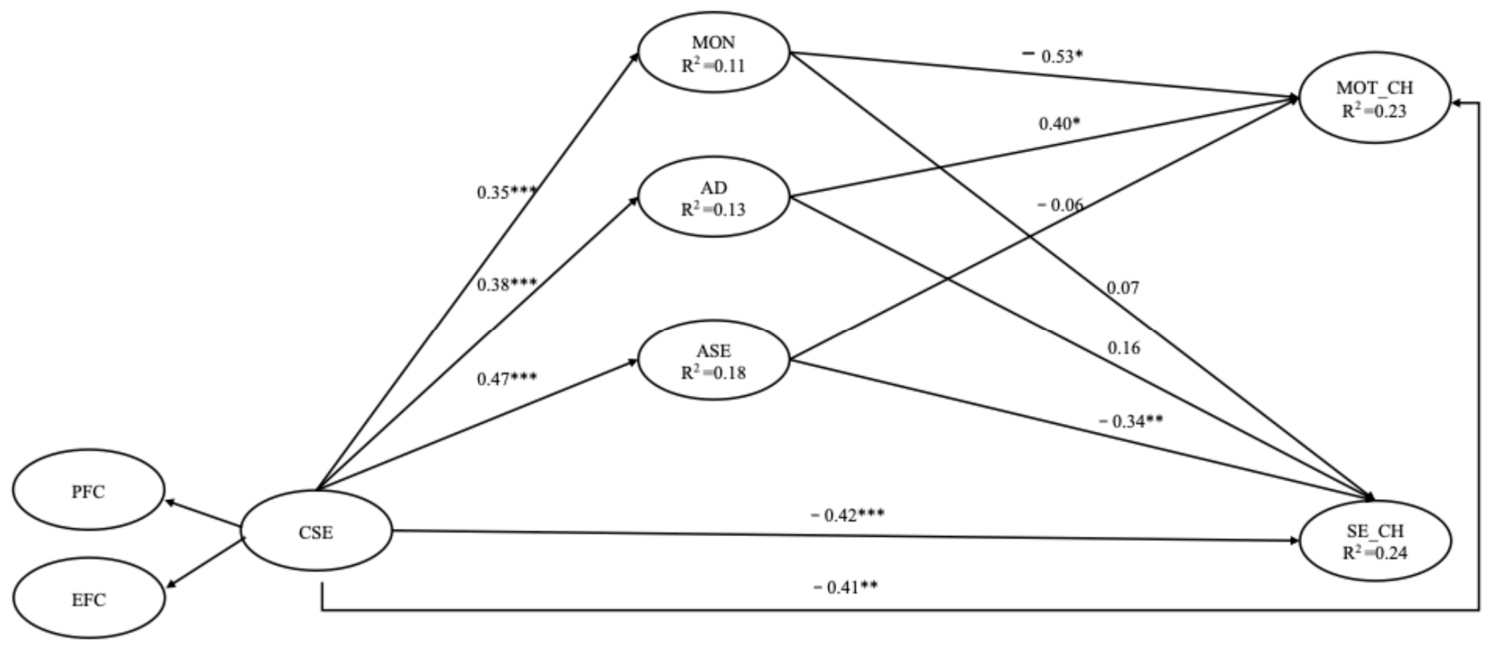
Model fit indices indicated acceptable fit χ 2 ( 613 ) = 844.90 ,   p < 0.001 ; CFI = 0.91, TLI = 0.91, RMSEA = 0.04, SRMR = 0.06; see Hu and Bentler (1999) for cutoff guidelines. Coping self-efficacy showed significant negative direct effects on both motivation and socio-emotional challenges and was positively associated with all three regulatory practices. Three significant indirect effects emerged (Figure 2, Table 4): academic social engagement mediated the association between coping self-efficacy and socio-emotional challenges; monitoring mediated the association between coping self-efficacy and motivation challenges; and adapting also mediated the relation between coping self-efficacy and motivation challenges, with this path associated with increased motivation challenges, contrary to expectations.
Coping self-efficacy significantly predicted monitoring (B = 0.35, p < 0.001), adapting (B = 0.38, p < 0.001), and academic social engagement (B = 0.47, p < 0.001). Monitoring (B = −0.53, p = 0.01) and adapting (B = 0.40, p = 0.03, 95% CI [0.044, 0.746]) significantly predicted motivation challenges, and academic social engagement predicted socio-emotional challenges (B = −0.34, p = 0.01). Direct effects from coping self-efficacy to motivation (B = −0.41, p = 0.002) and socio-emotional challenges (B = −0.42, p < 0.001) were significant, as were total effects on motivation (B = −0.47, p < 0.001) and socio-emotional challenges (B = −0.49, p < 0.001). The model explained 23% of the variance in motivation challenges and 24% in socio-emotional challenges. Indirect effects from coping self-efficacy to motivation challenges via monitoring (B = −0.18, p = 0.04, 95% CI [−0.356, −0.012]) and adapting (B = 0.15, p = 0.05, 95% CI [−0.003, 0.303]), and to socio-emotional challenges via academic social engagement (B = −0.16, p = 0.02) were all significant (Table 4).

3.3. Model Two: Coping Self-Efficacy, Regulatory Practices, and Academic Well-Being

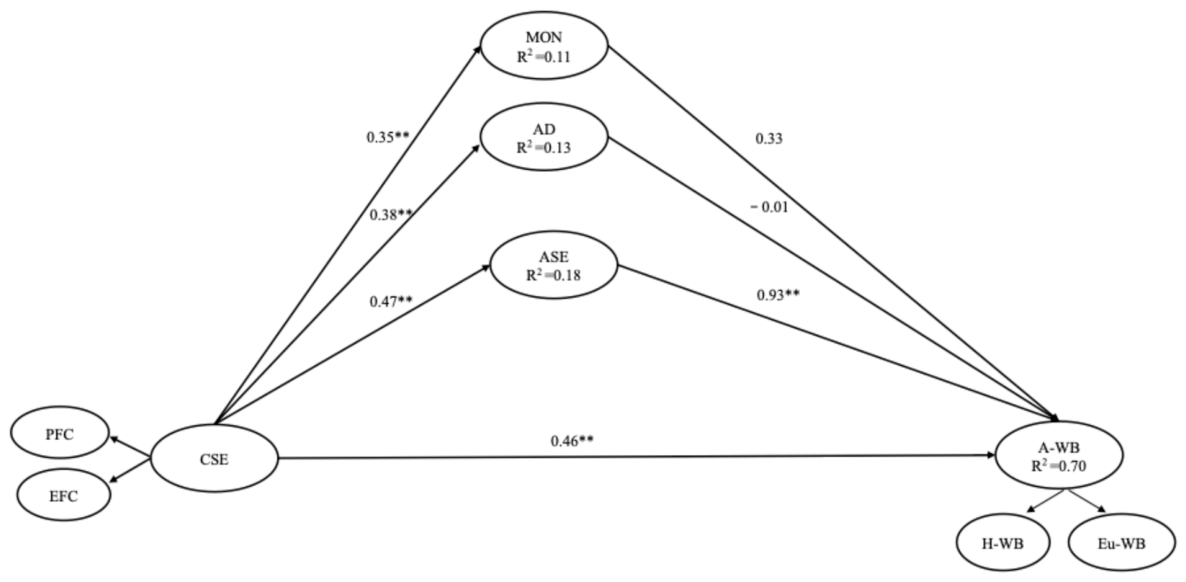
The fit indices of the model were indicative of an acceptable fit of the model to the data (χ2 = 845.05, df = 582, p < 0.001; CFI = 0.90, TLI = 0.89, RMSEA = 0.05; SRMR = 0.07). Coping self-efficacy positively predicted academic well-being and was significantly associated with all three regulatory practices. Academic social engagement significantly mediated the positive effect of coping self-efficacy on academic well-being (Figure 3, Table 5). Specifically, coping self-efficacy significantly predicted monitoring (B = 0.35, p = 0.002), adapting (B = 0.38, p < 001), and academic social engagement (B = 0.47, p < 001). Academic social engagement in turn positively predicted academic well-being (B = 0.93, p = 0.002). The indirect effect of coping self-efficacy on academic well-being via academic social engagement was significant (B = 0.46, p = 0.003), as was the direct effect (B = 1.01, p < 0.001, R2 = 0.70), yielding a total effect of B = 1.01, p < 0.001. The model accounted for 70% of the variance in academic well-being ( R 2 = 0.70 ), demonstrating strong explanatory power.

3.4. Model Three: Stress Mindset, Regulatory Practices, and Academic Challenges

The fit indices of the model were indicative of adequate fit of the model to the data (χ2 = 550.311, df = 361, p < 0.001; CFI = 0.90, TLI = 0.88, RMSEA = 0.05; SRMR = 0.07).
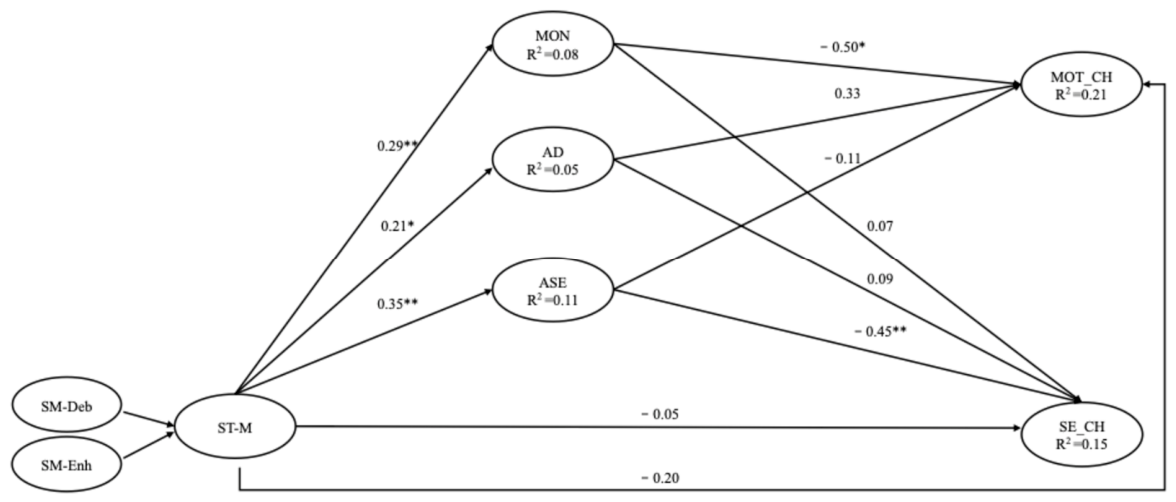
Stress mindset did not exhibit significant direct effects on motivation or socio-emotional challenges but was positively associated with all three regulatory practices. Two indirect effects emerged (Figure 4, Table 6). Academic social engagement mediated the relation between stress mindset and socio-emotional challenges, such that a stress-is-enhancing mindset predicted fewer socio-emotional challenges via greater engagement. Monitoring mediated the association between stress mindset and motivation challenges, indicating that a stress-is-enhancing mindset was linked to reduced motivation challenges through increased monitoring. Stress mindset significantly predicted monitoring (B = 0.29, p = 0.005), adapting (B = 0.21, p = 0.03, 95% CI [0.019, 0.415]), and academic social engagement (B = 0.35, p = 0.004). Monitoring negatively predicted motivation challenges (B = −0.50, p = 0.02, 95% CI [−0.908, −0.100]), and academic social engagement negatively predicted socio-emotional challenges (B = −0.45, p = 0.002). Indirect effects were significant for motivation challenges via monitoring (B = −0.15, p = 0.046, 95% CI [−0.289, −0.003]) and for socio-emotional challenges via academic social engagement (B = −0.16, p = 0.03, 95% CI [−0.303, −0.017]). The total effect on socio-emotional challenges was also significant (B = −0.31, p = 0.01, 95% CI [−0.556, −0.062]). The model explained 21% of the variance in motivation challenges and 15% in socio-emotional challenges. These results highlight the role of regulatory practices in linking a stress-is-enhancing mindset to reduced academic challenges.

3.5. Model Four: Stress Mindset, Regulatory Practices, Academic Well-Being

The fit indices of the model were indicative of adequate fit of the model to the data (χ2 = 491.66, df = 338, p < 0.001; CFI = 0.91, TLI = 0.90, RMSEA = 0.05; SRMR = 0.06).
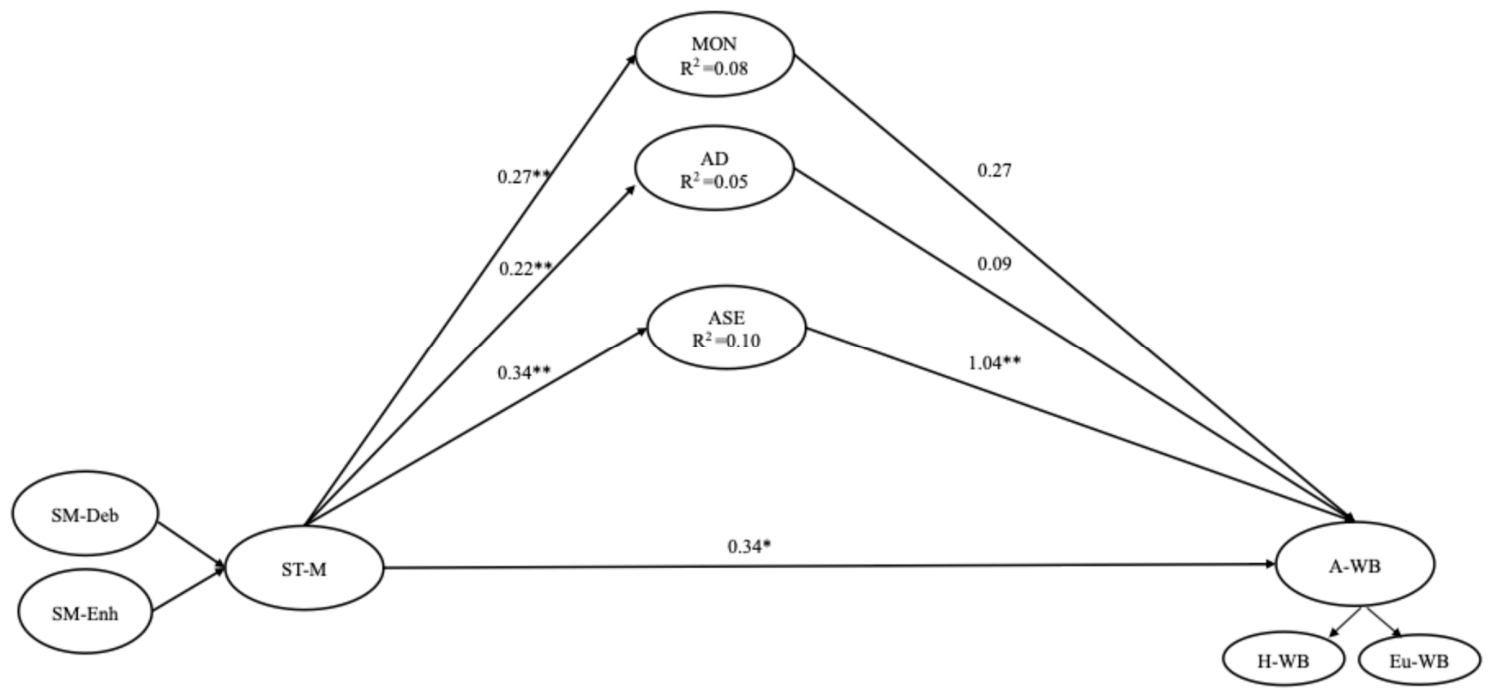
Stress mindset directly predicted higher academic well-being and was positively associated with all three regulatory practices. Academic social engagement mediated the association between stress mindset and academic well-being (Figure 5, Table 7). Stress mindset significantly predicted monitoring (B = 0.27, p = 0.01, 95% CI [0.067, 0.467]), adapting (B = 0.22, p = 0.03, 95% CI [0.019, 0.415]), and academic social engagement (B = 0.47, p < 0.001), and academic social engagement positively predicted academic well-being (B = 0.1.03, p = 0.001). The indirect effect via academic social engagement was significant (B = 0.44, p = 0.01, 95% CI [0.093, 0.779]) and the direct effect was marginally significant (B = 0.34, p = 0.05, 95% CI [0.001, 0.687]), yielding a total effect of B = 0.78 (p = 0.002). The model accounted for 69% of the variance in academic well-being (R2 = 0.69). These findings align with evidence that stress-is-enhancing mindsets support adaptive coping and proactive engagement (Keech et al., 2018; Jenkins et al., 2021) and that social connectedness is a key pathway linking positive stress beliefs to academic thriving (Crum et al., 2013).

4. Discussion

Student success is facilitated by effectively navigating academic demands and the inevitable stress that is experienced in the academic context. When managed well, stress is an important resource in navigating academic demands and goals (de la Fuente et al., 2020) and integral to well-being (Ng et al., 2009). It is not possible to eliminate either academic stress or demands in support of student success; therefore, the focus shifts to how students are managing both.
Findings indicate that student success depends on managing academic demands and associated stress effectively. When regulated constructively, stress can serve as a resource for achieving academic goals (de la Fuente et al., 2020) and supports well-being (Ng et al., 2009). As academic stress and demands are unavoidable, the focus shifts to how students regulate them. This study examined the direct effects of stress appraisals on student success and the mediating role of metacognitive and social regulatory practices. Stress mindset and coping self-efficacy represent general beliefs about stress and context-specific coping perceptions, respectively. The study explored the predictive value of these constructs for student success and how regulatory practices influence the relationship between stress appraisals and outcomes. Overall, findings highlight that adaptive responses to academic stress supporting student success are impacted by (a) adaptive stress appraisals, (b) metacognitive regulatory practices, and (c) social regulatory practices.

4.1. Adaptive Stress Appraisals

Appraisals, individual evaluations shaped by personal and contextual factors, are central to stress responses (Epel et al., 2018). Prior research shows that stress appraisals determine whether stress is perceived as a resource or detriment (Crum et al., 2017; Jamieson et al., 2022), facilitate approach motivation and behavior (Freire et al., 2016), and support higher mental health (Crum et al., 2013, 2017; Yeager et al., 2022). Consistent with these findings, the present study hypothesized that adaptive stress appraisals (e.g., stress-is-enhancing mindset, higher coping self-efficacy) predict greater student success. Results supported this hypothesis for academic well-being, motivation, and social-emotional challenges, but not academic performance.

4.1.1. Coping Self-Efficacy in the Present Study

This study examined coping self-efficacy (CSE) as a predictor of student success, extending prior research that has largely focused on other contexts (Benight & Harper, 2002; Melato et al., 2017). Consistent with findings from related self-efficacy literature (Cattelino et al., 2021; Freire et al., 2019; Won et al., 2023), CSE was directly associated with increased academic well-being and reduced social-emotional and motivational challenges, though effects were modest and unrelated to GPA. CSE, encompassing both emotion- and problem-focused coping, captures students’ perceived ability to manage stress and academic demands, promoting adaptive coping and success.
Given GPA’s distal nature and multifactorial influences (Richardson et al., 2012; Robbins et al., 2004), its relation to CSE may be indirect and detectable over longer periods through enhanced well-being and reduced challenges. The cross-sectional design limits inference about iterative regulation cycles, emphasizing the need for longitudinal research to clarify CSE’s role in promoting self-regulated learning, consistent with mastery experience theories (Usher & Pajares, 2009). These conclusions align with emerging evidence linking high coping self-efficacy to active problem-solving, help-seeking, and other adaptive regulatory behaviors that facilitate academic achievement (Freire et al., 2019; Hadwin et al., 2022).

4.1.2. Stress Mindset in the Present Study

This study examined stress mindset’s impact on student success, aligning with prior work linking it to well-being, performance, and health (Crum et al., 2013, 2017; Keech et al., 2018; Jenkins et al., 2021). Stress mindset directly predicted academic well-being and, via academic social engagement, was associated with fewer socio-emotional challenges, though its effects on student outcomes were modest and variable. Prior research similarly found limited predictive power for mental health and motivation (Kapil et al., 2024). Stress Mindset Scale items assess both general beliefs about stress (e.g., Item 1. The effects of stress are negative and should be avoided) and self-referent beliefs regarding personal experiences of stress (Item 2. Experiencing stress facilitates my learning and growth), which may differ within individuals and account for varied findings. For example, one may believe stress is generally enhancing while experiencing it as debilitating personally. This distinction may influence stress mindset’s effects on student success.
Critiques of mindset research in intelligence domains regarding effect sizes, construct validity, and inflated claims (Burnette et al., 2023; Macnamara & Burgoyne, 2023; Sisk et al., 2018; Yan & Schuetze, 2023) may also explain stress mindset’s modest impact here. Current evidence suggests stress mindset influences health and academic performance mainly indirectly through behaviors such as proactive coping and perception of somatic symptoms, underscoring the need for contextually nuanced measurement and interventions in educational settings (Keech et al., 2018).

4.2. Metacognitive Regulatory Practices

This study hypothesized that adaptive stress appraisals enhance approach motivation and support self-regulatory behaviors (Freire et al., 2016; Jamieson et al., 2022; Karademas & Kalantzi-Azizi, 2004). Given stress optimization theory’s limited guidance on specific regulatory practices, self-regulated learning (SRL) literature informed expectations, highlighting metacognitive monitoring and adapting as key components (Panadero, 2018; Perfect & Schwartz, 2002).
Findings confirmed that coping self-efficacy and stress mindset predicted monitoring and adapting. Monitoring partially mediated the negative associations between both appraisals and motivation challenges, while adapting partially mediated a positive association between coping self-efficacy and motivation challenges. Thus, self-regulation contributes to student success beyond stress appraisals alone.
Notably, adapting increased motivation challenges despite its mediation effect, possibly reflecting the resource demands or effort involved in adapting. Stress optimization theory explains this via psychological construction of emotion (resource depletion during adaptation; Barrett, 2017) and the biopsychosocial model (increased perceived demands elevating motivation challenges; Jamieson et al., 2018). In sum, stress appraisals foster motivation and self-regulation, which influence student success, though regulatory effort may temporarily increase challenges due to cognitive and behavioral adaptation demands.

4.3. Social Regulatory Practices

Student engagement with and regulation of social aspects of their academic environment is linked to multiple positive outcomes, including psychological, social, and physical well-being and stress management (Hadwin et al., 2022). Social regulatory practices contribute to mental health (Elmer et al., 2020), academic performance (Hadwin & Järvelä, 2011; Lobczowski, 2020; Won et al., 2018, 2021; van der Zanden et al., 2018), and buffer against stress’s negative effects (Cohen & Wills, 1985; Southwick et al., 2016). Among these, academic social engagement showed particular impact, demonstrating (a) moderate full mediation between stress mindset and academic well-being, (b) strong partial mediation between coping self-efficacy and academic well-being, and (c) small partial inverse mediation between coping self-efficacy and socio-emotional challenges. Thus, academic social engagement appears to promote student success beyond coping self-efficacy or stress mindset alone. These findings align with growing evidence emphasizing the critical role of social regulatory processes in student success (Elmer et al., 2020; Hadwin & Järvelä, 2011; Hadwin et al., 2022; Lobczowski, 2020; McLean et al., 2023; Tinto, 2017; Won et al., 2021; van der Zanden et al., 2018).

4.4. Implications for Practice

Practically, these findings suggest that higher education professionals move beyond approaches that focus solely on reducing student stress or improving academic performance in isolation. With stress and academic demands inherent to university learning, faculty, staff, and institutional leaders can better support student success by helping students develop adaptive stress appraisals alongside self-regulated and socially regulated learning practices. For example, instructors can explicitly normalize academic challenges, embed opportunities for metacognitive monitoring and adaptation, and structure courses to promote meaningful academic social engagement. Student support services can similarly integrate stress appraisals like coping self-efficacy and stress mindset alongside SRL strategies into advising, counseling, orientation, and academic skills programming. These approaches may be especially important because the present findings suggest that stress-related self-beliefs are most beneficial when connected to concrete regulatory practices that help students feel well and function well in academic settings.

4.5. Future Research

Future research can examine these relationships longitudinally to clarify how stress appraisals, regulatory practices, and student success outcomes influence one another over time. Because GPA is a distal and multiply determined outcome, future studies can also consider more proximal indicators of academic functioning, such as persistence, engagement, course completion, learning strategy use, and changes in motivation across the term. Intervention studies are also needed to determine whether programs that integrate adaptive stress appraisals and SRL practices can improve both student well-being and academic functioning. Finally, future work can examine whether these associations differ across student populations, disciplines, and institutional contexts.

4.6. Limitations

This study offers valuable insights into student success but has several limitations. First, the sample size, though sufficient, was modest relative to the number of variables, underscoring the need for replication with larger samples. Also, as enrollment is voluntary, it is also not clear if the participants represented a typical student with respect to indicators of student success such as engagement, motivation, mental health, and self-regulated learning capacity. Second, the cross-sectional design suits exploratory analysis of coping self-efficacy, an understudied construct in academic research, yet limits causal and temporal inference; longitudinal studies with repeated measures are warranted. Third, the variable-centered approach constrains understanding of individual differences in stress, self-regulated learning (SRL), and mental health, suggesting value in person-centered and qualitative methods. Fourth, only three regulatory practices were examined due to sample size constraints; future research should extend analysis to additional SRL-informed practices. Fifth, stress was conceptualized as embodied but assessed only through cognitive appraisals; integrating physiological indicators such as cortisol or heart rate would provide a more comprehensive perspective. Lastly, some measures (e.g., AWBS and SRL-PSD) are newly developed and require further validation across diverse samples. Several subscales contained few items and were analyzed independently, which may affect construct validity.

4.7. Conclusions

In the challenging and stressful university context, feeling capable of coping with academic stress and academic demands and engaging in adaptive self and social regulatory practices contributes to student success. Findings from this research indicated that stress appraisals and regulatory practices contribute to the student experience aspect of student success, which includes academic well-being and academic challenges. Eliminating stress is not a realistic option and may even be counter to overall mental health and performance, which are supported by adaptive responses to stress and achieving goals (e.g., see Ng et al., 2009; Ryff, 2016; Yaman-Sözbir et al., 2019). Thus, supporting students to regulate both stress and learning is integral to student success.

Author Contributions

Conceptualization, all authors; methodology, all authors; software, all authors; validation, all authors; formal analysis, all authors; data curation, all authors; writing—original draft preparation, all authors; writing-review and editing, all authors, supervision, A.H.; project administration, A.H.; funding acquisition, M.K., and A.H. All authors have read and agreed to the published version of the manuscript.

Funding

This research was funded by a Social Sciences and Humanities Research Council of Canada (SSHRC) Doctoral Fellowship awarded to Meg Kapil (#752-2022-1802) and a SSHRC Insight Grant to Allyson Hadwin (PI).

Institutional Review Board Statement

The study was conducted in accordance with the Declaration of Helsinki and was approved by Human Research Ethics Board of University of Victoria, ETHICS PROTOCOL NUMBER: 19-0038 on 20 September 2019.

Informed Consent Statement

Informed consent was obtained from all subjects involved in the study.

Data Availability Statement

The data presented in this study are not publicly available due to human research ethics restriction at the authors’ institution and the need to protect participant confidentiality. Requests to inspect the data may be directed to the corresponding author and will be considered in accordance with institutional ethics requirements and applicable restrictions.

Acknowledgments

This research was funded by a Social Sciences and Humanities Research Council of Canada (SSHRC) Doctoral Fellowship awarded to Meg Kapil (#752-2022-1802) and a SSHRC Insight Grant to Allyson Hadwin (PI).

Conflicts of Interest

The authors declare no conflict of interest.

References

  1. American College Health Association (ACHA). (2016). ACHA-national college health assessment II: Canadian reference group executive summary spring 2016. ACHA. Available online: https://www.acha.org/wp-content/uploads/2024/07/NCHA-II_SPRING_2016_CANADIAN_REFERENCE_GROUP_EXECUTIVE_SUMMARY.pdf (accessed on 28 May 2026).
  2. Bandura, A. (2001). Social cognitive theory: An agentic perspective. Annual Review of Psychology, 52(1), 1–26. [Google Scholar] [CrossRef] [PubMed]
  3. Bandura, A., & Locke, E. A. (2003). Negative self-efficacy and goal effects revisited. Journal of Applied Psychology, 88(1), 87–99. [Google Scholar] [CrossRef] [PubMed]
  4. Barbayannis, G., Bandari, M., Zheng, X., Baquerizo, H., Pecor, K. W., & Ming, X. (2022). Academic stress and mental well-being in college students: Correlations, affected groups, and COVID-19. Frontiers in Psychology, 13, 886344. [Google Scholar] [CrossRef] [PubMed]
  5. Barrett, L. F. (2006). Solving the emotion paradox: Categorization and the experience of emotion. Personality and Social Psychology Review, 10(1), 20–46. [Google Scholar] [CrossRef] [PubMed]
  6. Barrett, L. F. (2017). The theory of constructed emotion: An active inference account of interoception and categorization. Social Cognitive and Affective Neuroscience, 12(11), 1833. [Google Scholar] [CrossRef] [PubMed]
  7. Barrett, L. F. (2022). Context reconsidered: Complex signal ensembles, relational meaning, and population thinking in psychological science. The American Psychologist, 77(8), 894–920. [Google Scholar] [CrossRef] [PubMed]
  8. Benight, C. C., & Harper, M. L. (2002). Coping self-efficacy perceptions as a mediator between acute stress response and long-term distress following natural disasters. Journal of Traumatic Stress, 15(3), 177–186. [Google Scholar] [CrossRef] [PubMed]
  9. Bienertova-Vasku, J., Lenart, P., & Scheringer, M. (2020). Eustress and distress: Neither good nor bad, but rather the same? BioEssays, 42(7), 1900238. [Google Scholar] [CrossRef] [PubMed]
  10. Boekaerts, M., & Cascallar, E. (2006). How far have we moved toward the integration of theory and practice in self-regulation? Educational Psychologist Review, 18, 199–210. [Google Scholar] [CrossRef]
  11. Brooks, A. W. (2014). Get excited: Reappraising pre-performance anxiety as excitement. Journal of Experimental Psychology: General, 143(3), 1144–1158. [Google Scholar] [CrossRef] [PubMed]
  12. Burnette, J. L., Billingsley, J., Banks, G. C., Knouse, L. E., Hoyt, C. L., Pollack, J. M., & Simon, S. (2023). A systematic review and meta-analysis of growth mindset interventions: For whom, how, and why might such interventions work? Psychological Bulletin, 149(3–4), 174–205. [Google Scholar] [CrossRef] [PubMed]
  13. Cattelino, E., Testa, S., Calandri, E., Fedi, A., Gattino, S., Graziano, F., Rollero, C., & Begotti, T. (2021). Self-efficacy, subjective well-being and positive coping in adolescents with regard to COVID-19 lockdown. Current Psychology, 42, 17304–17315. [Google Scholar] [CrossRef] [PubMed]
  14. Chesney, M. A., Neilands, T. B., Chambers, D. B., Taylor, J. M., & Folkman, S. (2006). A validity and reliability study of the coping self-efficacy scale. British Journal of Health Psychology, 11, 421–437. [Google Scholar] [CrossRef] [PubMed]
  15. Cohen, S., & Wills, T. A. (1985). Stress, social support, and the buffering hypothesis. Psychological Bulletin, 98(2), 310–357. [Google Scholar] [CrossRef]
  16. Crum, A. J., Akinola, M., Martin, A., & Fath, S. (2017). The role of stress mindset in shaping cognitive, emotional, and physiological responses to challenging and threatening stress. Anxiety, Stress and Coping, 30, 379–395. [Google Scholar] [CrossRef] [PubMed]
  17. Crum, A. J., Salovey, P., & Achor, S. (2013). Rethinking stress: The role of mindsets in determining the stress response. Journal of Personality and Social Psychology, 104(4), 716–733. [Google Scholar] [CrossRef] [PubMed]
  18. de la Fuente, J., Verónica Paoloni, P., Vera-Martínez, M. M., & Garzón-Umerenkova, A. (2020). Effect of levels of self-regulation and situational stress on achievement emotions in undergraduate students: Class, study and testing. International Journal of Environmental Research and Public Health, 17(12), 4293. [Google Scholar] [CrossRef] [PubMed]
  19. Delahaij, R., & Van Dam, K. (2017). Coping with acute stress in the military: The influence of coping style, coping self-efficacy and appraisal emotions. Personality and Individual Differences, 119, 13–18. [Google Scholar] [CrossRef]
  20. Denovan, A., & Macaskill, A. (2017). Stress and subjective well-being among first year UK undergraduate students. Journal of Happiness Studies, 18(2), 505–525. [Google Scholar] [CrossRef]
  21. de Ruiter, N. M. P., & Thomaes, S. (2023). A process model of mindsets: Conceptualizing mindsets of ability as dynamic and socially situated. Psychological Review, 130(5), 1326–1338. [Google Scholar] [CrossRef] [PubMed]
  22. Diener, E., Heintzelman, S. J., Kushlev, K., Tay, L., Wirtz, D., Lutes, L. D., & Oishi, S. (2017). Finding all psychologists should know from the science on subjective well-being. Canadian Psychology/Psychologie Canadienne, 58, 87–104. [Google Scholar] [CrossRef]
  23. Dweck, C. S. (1999). Self-theories: Their role in motivation, personality, and development. Psychology Press. [Google Scholar]
  24. Efklides, A., Schwartz, B. L., & Brown, V. (2018). Motivation and affect in self-regulated learning: Does metacognition play a role? In B. J. Zimmerman, & D. H. Schunk (Eds.), Handbook of self-regulation of learning and performance (pp. 64–84). Routledge. [Google Scholar] [CrossRef]
  25. Elmer, T., Mepham, K., & Stadtfeld, C. (2020). Students under lockdown: Comparisons of students’ social networks and mental health before and during the covid-19 crisis in Switzerland. PLoS ONE, 15(7), e0236337. [Google Scholar] [CrossRef] [PubMed]
  26. Epel, E. S., Crosswell, A. D., Mayer, S. E., Prather, A. A., Slavich, G. M., Puterman, E., & Mendes, W. B. (2018). More than a feeling: A unified view of stress measurement for population science. Frontiers in Neuroendocrinology, 49, 146–169. [Google Scholar] [CrossRef] [PubMed]
  27. Folkman, S., & Lazarus, R. S. (1985). If it changes it must be a process: Study of emotion and coping during three stages of a college examination. Journal of Personality and Social Psychology, 48, 150–170. [Google Scholar] [CrossRef] [PubMed]
  28. Freire, C., Ferradás, M. D. M., Núñez, J. C., Valle, A., & Vallejo, G. (2019). Eudaimonic well-being and coping with stress in university students: The mediating/moderating role of self-efficacy. International Journal of Environmental Research and Public Health, 16(1), 48. [Google Scholar] [CrossRef] [PubMed]
  29. Freire, C., Ferradás, M. D. M., Valle, A., Núñez, J. C., & Vallejo, G. (2016). Profiles of psychological well-being and coping strategies among university students. Frontiers in Psychology, 7, 1554. [Google Scholar] [CrossRef] [PubMed]
  30. Gross, J. J. (2015). The extended process model of emotion regulation: Elaborations, applications, and future directions. Psychological Inquiry, 26(1), 130–137. [Google Scholar] [CrossRef]
  31. Grund, A., Fries, S., Nückles, M., Renkl, A., & Roelle, J. (2024). When is learning “Effortful”? Scrutinizing the concept of mental effort in cognitively oriented research from a motivational perspective. Educational Psychology Review, 36(1), 11. [Google Scholar] [CrossRef]
  32. Hadwin, A. F., Bakhtiar, A., & Miller, M. (2018). Challenges in online collaboration: Effects of scripting shared task perceptions. International Journal of Computer-Supported Collaborative Learning, 13(3), 301–329. [Google Scholar] [CrossRef]
  33. Hadwin, A. F., Davis, S. K., Bakhtiar, A., & Winne, P. H. (2019). Academic challenges as opportunities to learn to self-regulate learning. In H. Askell-Williams, J. Orrell, & M. Lawson (Eds.), Problem solving for teaching and learning: A festschrift for emeritus professor Mike Lawson (pp. 34–47). Routledge. [Google Scholar] [CrossRef]
  34. Hadwin, A. F., & Järvelä, S. (2011). Self-regulated, co-regulated, and socially-shared regulation of learning. In B. J. Zimmerman, & D. H. Schunk (Eds.), Handbook of self-regulation of learning and performance (pp. 65–84). Routledge. [Google Scholar]
  35. Hadwin, A. F., Rostampour, R., & Bahena-Olivares, L. M. (2021). Self-regulated learning profile and self-diagnostic tool (SRL-PSD-2021). [Poster Presentation]. American Educational Research Association. [Google Scholar]
  36. Hadwin, A. F., Sukhawathanakul, P., Rostampour, R., & Bahena-Olivares, L. M. (2022). Do self-regulated learning practices and intervention mitigate the impact of academic challenges and COVID-19 distress on academic performance during online learning? Frontiers of Psychology, 13, 813529. [Google Scholar] [CrossRef] [PubMed]
  37. Hair, J. F., Black, W. C., Babin, B. J., & Anderson, R. E. (2019). Multivariate data analysis (8th ed.). Cengage Learning, EMEA. [Google Scholar]
  38. Howell, A. J. (2009). Flourishing: Achievement-related correlates of students’ well-being. The Journal of Positive Psychology, 4, 1–13. [Google Scholar] [CrossRef]
  39. Howell, A. J. (2017). Believing in change: Reviewing the role of implicit theories in psychological dysfunction. Journal of Social and Clinical Psychology, 36(6), 437–460. [Google Scholar] [CrossRef]
  40. Hu, L., & Bentler, H. (1999). Conventional criteria versus new alternatives. Structural Equation Modeling: A Multidisciplinary Journal, 6(1), 1–55. [Google Scholar] [CrossRef]
  41. Jamieson, J. P., Black, A. E., Pelaia, L. E., Gravelding, H., Gordils, J., & Reis, H. T. (2022). Reappraising stress arousal improves affective, neuroendocrine, and academic performance outcomes in community college classrooms. Journal of Experimental Psychology. General, 151(1), 197–212. [Google Scholar] [CrossRef] [PubMed]
  42. Jamieson, J. P., Crum, A. J., Goyer, J. P., Marotta, M. E., & Akinola, M. (2018). Optimizing stress responses with reappraisal and mindset interventions: An integrated model. Anxiety, Stress, & Coping, 31, 245–261. [Google Scholar] [CrossRef] [PubMed]
  43. Jenkins, A., Weeks, M. S., & Hard, B. M. (2021). General and specific stress mindsets: Links with college student health and academic performance. PLoS ONE, 16(9), e0256351. [Google Scholar] [CrossRef] [PubMed]
  44. Kapil, M., Rostampour, R., & Hadwin, A. (2024). Coping self-efficacy and stress mindset as predictors of student success outcomes. Journal of Postsecondary Student Success, 4(1), 147–172. [Google Scholar] [CrossRef]
  45. Karademas, E. C., & Kalantzi-Azizi, A. (2004). The stress process, self-efficacy expectations, and psychological health. Personality and Individual Differences, 37(5), 1033–1043. [Google Scholar] [CrossRef]
  46. Kashdan, T. B., Biswas-Diener, R., & King, L. A. (2008). Reconsidering happiness: The costs of distinguishing between hedonics and eudaimonia. The Journal of Positive Psychology, 3(4), 219–233. [Google Scholar] [CrossRef]
  47. Keech, Hagger, M. S., O’Callaghan, F. V., & Hamilton, K. (2018). The influence of university students’ stress mindsets on health and performance outcomes. Annals of Behavioral Medicine, 52(12), 1046–1059. [Google Scholar] [CrossRef] [PubMed]
  48. Keyes, C. L. M. (2002). The mental health continuum: From languishing to flourishing in life. Journal of Health and Social Behavior, 43, 207–222. [Google Scholar] [CrossRef]
  49. Keyes, C. L. M. (2005). Mental health and/or mental illness? Investigating axioms of the complete state model of health. Journal of Consulting and Clinical Psychology, 73, 539–548. [Google Scholar] [CrossRef] [PubMed]
  50. Keyes, C. L. M. (2007). Promoting and protecting mental health as flourishing: A complementary strategy for improving national mental health. The American Psychologist, 62, 95–108. [Google Scholar] [CrossRef] [PubMed]
  51. Keyes, C. L. M., & Haidt, J. (Eds.). (2003). Flourishing: Positive psychology and the life well-lived. American Psychological Association. [Google Scholar]
  52. Khan, S., & Shamama-Tus-Sabah, S. (2020). Perceived stress and its association with positive mental health and academic performance of university students. Pakistan Armed Forces Medical Journal, 70(5), 1391–1395. [Google Scholar]
  53. Klassen, R. M., & Klassen, J. R. L. (2018). Self-efficacy beliefs of medical students: A critical review. Perspectives on Medical Education, 7(2), 76–82. [Google Scholar] [CrossRef] [PubMed]
  54. Koivuniemi, M., Panadero, E., Malmberg, J., & Järvelä, S. (2017). Higher education students’ learning challenges and regulatory skills in different learning situations/desafíos de aprendizaje y habilidades de regulación en distintas situaciones de aprendizaje en estudiantes de educación superior. Infancia Aprendizaje 40, 19–55. [Google Scholar] [CrossRef]
  55. Kuh, G., Kinzie, J., Schuh, J., & Whitt, E. (2005). Student success in college: Creating conditions that matter. Jossey-Bass. [Google Scholar]
  56. Lazarus, R. S. (1991). Cognition and motivation in emotion. American Psychologist, 46(4), 352–367. [Google Scholar] [CrossRef] [PubMed]
  57. Lazarus, R. S., DeLongis, A., Folkman, S., & Gruen, R. (1985). Stress and adaptational outcomes: The problem of confounded measures. American Psychologist, 40, 770–779. [Google Scholar] [CrossRef]
  58. Lewis, K. L., & Hodges, S. D. (2015). Expanding the concept of belonging in academic domains: Development and validation of the ability uncertainty scale. Learning and Individual Differences, 37, 197–202. [Google Scholar] [CrossRef]
  59. Lobczowski, N. G. (2020). Bridging gaps and moving forward: Building a new model for socioemotional formation and regulation. Educational Psychologist, 55(2), 53–68. [Google Scholar] [CrossRef]
  60. Louis, M. C., & Schreiner, L. A. (2012). Helping students thrive: A strengths development model. In L. A. Schreiner, M. C. Louis, & D. D. Nelson (Eds.), Thriving in transitions: A research-based approach to college student success. University of South Carolina, National Resource Center for the First-Year Experience and Students in Transition. [Google Scholar]
  61. Macnamara, B. N., & Burgoyne, A. P. (2023). Do growth mindset interventions impact students’ academic achievement? A systematic review and meta-analysis with recommendations for best practices. Psychological Bulletin, 149(3–4), 133–173. [Google Scholar] [CrossRef] [PubMed]
  62. McLean, L., Gaul, D., & Penco, R. (2023). Perceived social support and stress: A study of 1st year students in Ireland. International Journal of Mental Health and Addiction, 21(4), 2101–2121. [Google Scholar] [CrossRef] [PubMed]
  63. Melato, S. R., van Eeden, C., Rothmann, S., & Bothma, E. (2017). Coping self-efficacy and psychosocial well-being of marginalised South African youth. Journal of Psychology in Africa, 27(4), 338–344. [Google Scholar] [CrossRef]
  64. Midkiff, M. F., Lindsey, C. R., & Meadows, E. A. (2018). The role of coping self-efficacy in emotion regulation and frequency of NSSI in young adult college students. Cogent Psychology, 5(1), 1520437. [Google Scholar] [CrossRef]
  65. Ng, W., Diener, E., Aurora, R., & Harter, J. (2009). Affluence, feelings of stress, and well-being. Social Indicators Research, 94(2), 257–271. [Google Scholar] [CrossRef]
  66. Panadero, E. (2018). A review of self-regulated learning: Six models and four direction for research. Frontiers in Psychology, 8, 422. [Google Scholar] [CrossRef] [PubMed]
  67. Park, D., Yu, A., Metz, S. E., Tsukayama, E., Crum, A. J., & Duckworth, A. L. (2017). Beliefs about stress attenuate the relation among adverse life events, perceived distress, and self-control. Child Development, 62, 1269. [Google Scholar] [CrossRef] [PubMed]
  68. Pascoe, M. C., Hetrick, S. E., & Parker, A. G. (2020). The impact of stress on students in secondary school and higher education. International Journal of Adolescence and Youth, 25(1), 104–112. [Google Scholar] [CrossRef]
  69. Perfect, T. J., & Schwartz, B. L. (2002). Applied metacognition. Cambridge University Press. Available online: http://tinyurl.com/y4vtmqzf (accessed on 30 January 2023).
  70. Pérez-González, J.-C., Filella, G., Soldevila, A., Faiad, Y., & Sanchez-Ruiz, M.-J. (2022). Integrating self-regulated learning and individual differences in the prediction of university academic achievement across a three-year-long degree. Metacognition and Learning, 17(3), 1141–1165. [Google Scholar] [CrossRef]
  71. Poluektova, O., Kappas, A., & Smith, C. A. (2023). Using Bandura’s self-efficacy theory to explain individual differences in the appraisal of problem-focused coping potential. Emotion Review, 15(4), 302–312. [Google Scholar] [CrossRef]
  72. Rice, K., Larsen, S. A., Davies, R. L., & Rock, A. J. (2025). Beyond GPA: A quantitative evaluation of York et al.’s model of academic success in higher education: York et al. Australian Educational Researcher, 52(6), 4683–4702. [Google Scholar] [CrossRef]
  73. Richardson, M., Abraham, C., & Bond, R. (2012). Psychological correlates of university students’ academic performance: A systematic review and meta-analysis. Psychological Bulletin, 138, 353–387. [Google Scholar] [CrossRef] [PubMed]
  74. Robbins, S. B., Lauver, K., Le, H., Davis, D., Langley, R., & Carlstrom, A. (2004). Do psychosocial and study skill factors predict college outcomes?: A meta-analysis. Psychological Bulletin, 130(2), 261–288. [Google Scholar] [CrossRef] [PubMed]
  75. Rosseel, Y. (2012). lavaan: An R package for structural equation modeling. Journal of Statistical Software, 48(2), 1–36. [Google Scholar] [CrossRef]
  76. Rostampour, R., Kapil, M., & Hadwin, A. F. (2023, August 22–26). Academic well-being: Construct validation of an instrument to measure student mental health and well-being in academic settings [Paper Presentation]. EARLI Conference, Thessaloniki, Greece. [Google Scholar]
  77. Rudland, J. R., Golding, C., & Wilkinson, T. J. (2020). The stress paradox: How stress can be good for learning. Medical Education, 54(1), 40–45. [Google Scholar] [CrossRef] [PubMed]
  78. Ryan, R. M., & Deci, E. L. (2001). On happiness and human potential: A review of research on hedonic and eudaimonic well-being. Annual Review of Psychology, 52, 141–166. [Google Scholar] [CrossRef] [PubMed]
  79. Ryff, C. D. (2016). Beautiful ideas and the scientific enterprise: Sources of intellectual vitality in research on eudaimonic well-being. In Handbook of eudaimonic well-being (pp. 95–107). Springer International Publishing. [Google Scholar] [CrossRef]
  80. Scherer, K. R., & Moors, A. (2019). The emotion process: Event appraisal and component differentiation. Annual Review of Psychology, 70, 719–745. [Google Scholar] [CrossRef] [PubMed]
  81. Selye, H. (1976). Stress without distress. In G. Serban (Ed.), Psychopathology of human adaptation. Springer. [Google Scholar] [CrossRef]
  82. Singer, M. J., Humphreys, K. L., & Lee, S. S. (2016). Coping self-efficacy mediates the association between child abuse and ADHD in adulthood. Journal of Attention Disorders, 20(8), 695–703. [Google Scholar] [CrossRef] [PubMed]
  83. Sisk, V. F., Burgoyne, A. P., Sun, J., Butler, J. L., & Macnamara, B. N. (2018). To what extent and under which circumstances are growth mind-sets important to academic achievement? two meta-analyses. Psychological Science, 29(4), 549–571. [Google Scholar] [CrossRef] [PubMed]
  84. Southwick, S. M., Sippel, L., Krystal, J., Charney, D., Mayes, L., & Pietrzak, R. (2016). Why are some individuals more resilient than others: The role of social support. World Psychiatry, 15(1), 77–79. [Google Scholar] [CrossRef] [PubMed]
  85. Suldo, S. M., Riley, K. N., & Shaffner, E. J. (2006). Academic correlates of children and adolescents’ life satisfaction. School Psychology International, 27(5), 567–582. [Google Scholar] [CrossRef]
  86. Tamir, M., John, O. P., Srivastava, S., & Gross, J. J. (2007). Implicit theories of emotion: Affective and social outcomes across a major life transition. Journal of Personality and Social Psychology, 92(4), 731–744. [Google Scholar] [CrossRef] [PubMed]
  87. Thiede, K. W., & Dunlosky, J. (1999). Toward a general model of self-regulated study: Analysis of selection of items for study and self-paced study time. Journal of Experimental Psychology: Learning, Memory, and Cognition, 25, 1024–1037. [Google Scholar] [CrossRef]
  88. Tinto, V. (2017). Reflections on student persistence. Student Success, 8, 1–8. [Google Scholar] [CrossRef]
  89. Tomarken, A. J., & Waller, N. G. (2005). Structural equation modeling: Strengths, limitations, and misconceptions. Annual Review of Clinical Psychology, 1, 31–65. [Google Scholar] [CrossRef] [PubMed]
  90. Usher, E. L., & Pajares, F. (2009). Sources of self-efficacy in mathematics: A validation study. Contemporary Educational Psychology, 34(1), 89–101. [Google Scholar] [CrossRef]
  91. Uusberg, A., Taxer, J. L., Yih, J., Uusberg, H., & Gross, J. J. (2019). Reappraising Reappraisal. Emotion Review, 11(4), 267–282. [Google Scholar] [CrossRef]
  92. van der Zanden, Petrie, J. A. C., Denessen, E., Cillessen, A. H. N., & Meijer, P. C. (2018). Domains and predictors of first-year student success: A systematic review. Educational Research Review, 23, 57–77. [Google Scholar] [CrossRef]
  93. Vogel, S., & Schwabe, L. (2016). Learning and memory under stress: Implications for the classroom. npj Science of Learning, 1(1), 16011. [Google Scholar] [CrossRef] [PubMed]
  94. Winne, P. H., & Hadwin, A. F. (2008). The weave of motivation and self-regulated learning. In D. H. Schunk, & B. J. Zimmerman (Eds.), Motivation and self-regulated learning: Theory, research, and applications (pp. 297–314). Lawrence Erlbaum Associates. [Google Scholar]
  95. Wissing, Khumalo, I. P., Oosthuizen, T. M., Nienaber, A., Kruger, A., Potgieter, J. C., & Temane, Q. M. (2011). Coping self-efficacy as mediator in the dynamics of psychological well-being in various contexts. Journal of Psychology in Africa, 21(2), 165–172. [Google Scholar] [CrossRef]
  96. Won, S., Hensley, L. C., & Wolters, C. A. (2021). Brief research report: Sense of belonging and academic help-seeking as self-regulated learning. Journal of Experimental Education, 89(1), 112–124. [Google Scholar] [CrossRef]
  97. Won, S., Kapil, M., Drake, B., & Paular, R. (2023). Investigating the role of academic, social, and emotional self-efficacy in online learning. The Journal of Experimental Education, 92, 485–501. [Google Scholar] [CrossRef]
  98. Won, S., Wolters, C. A., & Mueller, S. A. (2018). Sense of belonging and self-regulated learning: Testing achievement goals as mediators. Journal of Experimental Education, 86(3), 402–418. [Google Scholar] [CrossRef]
  99. Yaman-Sözbir, Ş., Ayaz-Alkaya, S., & Bayrak-Kahraman, B. (2019). Effect of chewing gum on stress, anxiety, depression, self-focused attention, and academic success: A randomized controlled study. Stress and Health, 35(4), 441–446. [Google Scholar] [CrossRef] [PubMed]
  100. Yan, V. X., & Schuetze, B. A. (2023). What is meant by “Growth Mindset”? Current theory, measurement practices, and empirical results leave much open to interpretation: Commentary on Macnamara and Burgoyne (2023) and Burnette et al. (2023). Psychological Bulletin, 149(3–4), 206–219. [Google Scholar] [CrossRef]
  101. Yeager, D. S., Bryan, C. J., Gross, J. J., Murray, J. S., Krettek Cobb, D., Santos, P. H. F., Gravelding, H., Johnson, M., & Jamieson, J. P. (2022). A synergistic mindsets intervention protects adolescents from stress. Nature, 607(7919), 512–520. [Google Scholar] [CrossRef] [PubMed]
  102. Yeager, D. S., & Dweck, C. S. (2012). Mindsets that promote resilience: When students believe that personal characteristics can be developed. Educational Psychologist, 47(4), 302–314. [Google Scholar] [CrossRef]
  103. Yeager, D. S., Lee, H. Y., & Jamieson, J. P. (2016). How to improve adolescent stress responses: Insights from integrating implicit theories of personality and biopsychosocial models. Psychological Science, 27(8), 1078–1091. [Google Scholar] [CrossRef] [PubMed]
  104. Zollanvari, A., Kizilirmak, R. C., Kho, Y. H., & Hernandez-Torrano, D. (2017). Predicting students’ GPA and developing intervention strategies based on self-regulatory learning behaviours. IEEE Access, 5, 23792–23802. [Google Scholar] [CrossRef]
Figure 1. Proposed Testable Model.
Psycholint 08 00041 g001
Figure 2. Model One: Coping Self-Efficacy to SRL Practices to Academic Challenges. Note: denotes significance level of * p < 0.05, ** p < 0.01, *** p < 0.001. CSE = coping self-efficacy; MOT_CH = motivation challenges; SE_CH = social-emotional challenges; PFC = problem focused coping; EFC = emotion focused coping.
Psycholint 08 00041 g002
Figure 3. Model Two: Coping Self-Efficacy to SRL Practices to Academic Well-Being. Note: denotes significance level of ** p < 0.01. CSE = coping self-efficacy; PFC = problem focused coping; EFC = emotion focused coping; SM = stress mindset; AWB = academic well-being; AD = metacognitive adaptation; Mon = metacognitive monitoring; ASE = academic social engagement; A-WB = academic well-being; H-WB = hedonic well-being; Eu-WB = eudaimonic well-being.
Psycholint 08 00041 g003
Figure 4. Model Three: Stress Mindset to SRL Practices to Academic Challenges. Note: denotes significance level of * p < 0.05, ** p < 0.01. SM = stress mindset; SM-Deb = stress is debilitating mindset; SM-Enh = stress is enhancing mindset; AD = metacognitive adaptation; Mon = metacognitive monitoring; ASE = academic social engagement; Mot_Ch = motivation challenges; SE_Ch = social-emotional challenges.
Psycholint 08 00041 g004
Figure 5. Model Four: Stress Mindset to SRL Practices to Academic Well-Being. Note: denotes significance level of * p < 0.05, ** p < 0.01. SM = stress mindset; SM-Deb = stress is debilitating mindset; SM-Enh = stress is enhancing mindset; AD = metacognitive adaptation; Mon = metacognitive monitoring; ASE = academic social engagement; A-WB = academic well-being; H-WB = hedonic well-being; Eu-WB = eudaimonic well-being.
Psycholint 08 00041 g005
Table 1. Descriptive Statistics and Correlations.
VariableMeansdαGPACSESMAWBMOT_CHSE_CHMONADASE
GPA4.82.2n/a-
CSE3.110.630.90−0.08-
SM2.70.600.780.0270.40 ***-
AWB3.440.670.880.24 ***0.45 ***0.29 ***_
MOT_CH2.90.870.78−0.21 **−0.31 ***−0.23 *−0.37 ***-
SE_CH2.870.840.87−0.12−0.35 ***−0.14 *−0.41 ***0.62 ***-
MON3.680.720.780.18 *0.27 ***0.20 **0.46 ***−0.27 ***−0.10-
AD3.580.530.850.100.29 ***0.23 *0.49 ***−0.13−0.100.60 ***-
ASE3.110.870.760.19 **0.32 ***0.22 ***0.62 ***−0.22 **−0.30 ***0.43 ***0.47 ***-
Note: N = 226; * p < 0.05, ** p < 0.01,*** p < 0.001. GPA = grade point average; CSE = coping self-efficacy; SM = stress mindset; AWB = academic well-being; MOT_CH = motivation challenges; SE_CH = social-emotional challenges; MON = monitoring; AD = adaptation; ASE = academic social engagement.
Table 2. Linear Regression Summary for Preliminary Analysis.
PredictorOutcomeBSEβtpR2
CSE AWB0.470.070.457.00<0.0010.20
SM0.350.080.294.24<0.0010.09
CSE Mot_Ch−0.400.09−0.31−4.55<0.0010.10
SM−0.320.10−0.23−3.210.0020.05
CSE SE_Ch−0.460.09−0.35−5.23<0.0010.12
SM−0.210.10−0.14−2.000.0050.15
CSE GPA−0.270.23−0.08−1.140.260.00
SM0.100.270.030.390.700.00
Note: N = 226; GPA = grade point average; CSE = coping self-efficacy; SM = stress mindset; AWB = academic well-being; MOT_CH = motivation challenges; SE_CH = social-emotional challenges.
Table 3. Correlation of GPA, CSE, and SM.
VariablesEstimateStd. Errorz-Valuep95% Confidence Interval
LowerUpper
CSE–GPA−0.090.08−1.120.26−0.250.07
SM–GPA0.060.090.590.56−0.280.23
Note: N = 226; GPA = grade point average; CSE = coping self-efficacy; SM = stress mindset.
Table 4. Model One: Coping Self-Efficacy to SRL Practices to Academic Challenges Indirect and Total Effects.
Mediation RelationshipsBSEp
CSE to Mon to MOT_CH−0.180.090.04 *
CSE to AD to MOT_CH0.150.080.05 *
CSE to ASE to MOT_CH−0.030.070.70
CSE to MOT_CH total effect−0.470.13<0.001 ***
CSE to MON to SE_CH0.030.050.62
CSE to AD to SE_CH0.060.060.33
CSE to ASE to SE_CH−0.160.070.02 *
CSE to SE_CH total effect−0.490.12<0.001 ***
Note: denotes significance level of * p < 0.05, *** p < 0.001. CSE = coping self-efficacy; SM = stress mindset; AWB = academic well-being; MOT_CH = motivation challenges; SE_CH = social-emotional challenges; AD = metacognitive adaptation; Mon = metacognitive monitoring.
Table 5. Model Two: Coping Self-Efficacy to SRL Practices to Academic Well-Being Indirect and Total Effects.
Mediation RelationshipsBSEp
CSE to Mon to AWB0.110.090.23
CSE to AD to AWB−0.0040.090.96
CSE to ASE to AWB0.440.170.01 **
CSE to AWB total indirect effect0.550.180.003 **
CSE to AWB total effect1.010.25<0.001 ***
Note: denotes significance level of ** p < 0.01, *** p < 0.001. CSE = coping self-efficacy; AWB = academic well-being; AD = metacognitive adaptation; Mon = metacognitive monitoring; ASE = academic social engagement; A-WB = academic well-being.
Table 6. Model Three: Stress Mindset to SRL Practices to Academic Challenges Total and Indirect Effects.
Mediation RelationshipsBSEp
SM to Mon to MOT_CH−0.150.070.05
SM to AD to MOT_CH0.070.050.14
SM to ASE to MOT_CH−0.040.050.45
SM to MOT_CH total indirect effect−0.110.060.06
SM to MOT_CH total effect−0.310.130.01 **
SM to MON to SE_CH0.030.050.62
SM to AD to SE_CH0.020.040.60
SM to ASE to SE_CH−0.160.070.03 *
SM to SE_CH total indirect effect−0.120.060.05 *
SM to SE_CH total effect−0.170.120.16
Note: denotes significance level of * p < 0.05, ** p < 0.01. SM = stress mindset; AD = metacognitive adaptation; Mon = metacognitive monitoring; ASE = academic social engagement; Mot_Ch = motivation challenges; SE_Ch = social-emotional challenges.
Table 7. Model Four: Stress Mindset to SRL Practices to Academic Well-Being Indirect and Total Effects.
Mediation RelationshipsBSEp
SM to Mon to AWB0.070.070.31
SM to AD to AWB−0.020.050.72
SM to ASE to AWB0.350.160.03 *
SM to AWB total indirect effect0.440.180.01 **
SM to AWB total effect0.780.250.002 **
Note: denotes significance level of * p < 0.05, ** p < 0.01. SM = stress mindset; AD = metacognitive adaptation; Mon = metacognitive monitoring; ASE = academic social engagement; AWB = academic well-being.
Disclaimer/Publisher’s Note: The statements, opinions and data contained in all publications are solely those of the individual author(s) and contributor(s) and not of MDPI and/or the editor(s). MDPI and/or the editor(s) disclaim responsibility for any injury to people or property resulting from any ideas, methods, instructions or products referred to in the content.