1. Introduction
Aggressive behavior in organizations has long been explained as a defensive response to threats to the self. According to the threatened egotism model (
Baumeister et al., 1996), individuals with high but unstable self-evaluations experience a discrepancy between their self-concept and negative evaluations from others, leading them to perceive ego threat (in the present study, ego threat was operationally defined not as an externally manipulated negative evaluative event per se, but as “a temporary decrease in state self-esteem”—that is, a subjective psychological reaction that arises when a discrepancy in self-evaluation is perceived). When ego threat is perceived, individuals are thought to adopt coping strategies aimed at compensating for or maintaining self-evaluation in order to prevent a decline in self-esteem (
Tabata & Ikegami, 2011). As a result, behaviors such as withdrawal from interpersonal relationships, aggression, or violence may occur.
Within organizational contexts, such processes have been widely examined in relation to abusive supervision, workplace aggression, and harassment. A central assumption underlying much of this research is that social support—particularly from supervisors or organizations—functions as a protective buffer that mitigates the negative consequences of ego threat.
From a broader perspective on research on aggressive behavior and harassment in the workplace, it has been noted that theoretical convergence is emerging across various fields. In the healthcare field, studies focusing on nurses and physicians have shown that workplace bullying and aggressive behavior are widely prevalent (
Quine, 2002). These studies suggest that bullying and aggression are not merely interpersonal problems but are closely related to power relations and workplace culture within organizations (
Hutchinson et al., 2006). Similarly, research in the hospitality and service industries has reported that employees who perceive that they have received negative evaluations or experienced a loss of status are more likely to respond with aggressive or deviant behaviors (
Grandey et al., 2004). Furthermore, studies in the field of education have also pointed out that, within hierarchical professional environments, ego threat and perceptions of being undervalued are important factors that shape defensive or aggressive responses (
Espelage & Swearer, 2003;
Swearer et al., 2010).
At the same time, understanding of the role of social support has become increasingly refined in recent years. Traditionally, social support has been conceptualized as a protective factor that buffers the effects of stress. However, more recent research suggests that depending on how support is interpreted, it may evoke feelings such as indebtedness, shame, or evaluative threat (
Nadler & Fisher, 1986). Nevertheless, systematic research examining the conditions under which social support may paradoxically strengthen defensive aggression under ego-threatening situations—particularly within cultural contexts where hierarchy is strongly emphasized—remains limited.
In the present study, narcissism is examined as a primary self-regulatory mechanism. Narcissism has been shown to shape aggressive responses when individuals confront ego threats such as negative evaluation or derogation (
Bushman & Baumeister, 1998). In the Japanese context,
Oshio (
2004,
2006) conceptualized narcissism as comprising three factors: Self-Assertion, Need for Attention and Praise, and Sense of Superiority and Competence. These factors reflect distinct self-regulatory strategies for maintaining self-worth. Empirical studies have demonstrated that these factors show differential associations with aggressive behavior and anger responses (e.g.,
Tanaka, 2008;
Hibino et al., 2005), suggesting that patterns of reaction following ego threat vary across dimensions. Taken together, narcissistic tendencies may function as differentiated self-regulatory strategies that shape how situational cues—such as social support—are interpreted and translated into behavior under conditions of ego threat.
As reviewed above, prior research has distinguished narcissistic types characterized by different regulatory emphases, such as reliance on self-assertion, sensitivity to external evaluation, or perceived superiority. These dominant self-regulatory strategies become especially salient under ego-threatening conditions, guiding how situational cues—such as social support—are interpreted and acted upon. From this perspective, social support may not merely interact with ego threat at a situational level but may differentially activate narcissistic self-regulatory strategies.
Cultural context further shapes these processes. In East Asian societies, including Japan, the self is often conceptualized as relational and embedded within hierarchical social structures (
Markus & Kitayama, 1991). Evaluation by significant others carries particular psychological weight, and supportive actions by superiors may be experienced as both benevolent guidance and implicit control (
Farh & Cheng, 2000). Within such contexts, the boundary between support and intervention is often ambiguous, increasing the likelihood that supportive behavior is interpreted through the lens of self-evaluation. This cultural configuration provides a theoretically meaningful setting in which to examine the dual nature of support as both a potential buffer and a potential source of ego threat.
In Japan, these behaviors have been institutionalized in the form of “power harassment,” referring to aggressive behavior rooted in superiority within the workplace. Although the term is culturally specific to Japan, it conceptually overlaps with constructs examined in Western research, such as abusive supervision (
Tepper, 2000), workplace bullying (
Einarsen et al., 2010), and mobbing (
Leymann, 1996). All of these share common features, including repeated negative acts, abuse of hierarchical power, and adverse effects on subordinates’ well-being and job performance. Furthermore, a recent meta-analytic study (
Zhong et al., 2025) demonstrated that self-evaluation and the quality of interpersonal relationships serve as key mechanisms in understanding how workplace aggression affects employee outcomes, confirming their cross-cultural relevance. By situating power harassment in Japan within the broader international literature on workplace aggression, it becomes possible to clarify both its cultural specificity and its broader theoretical significance.
Examining power harassment within a Japanese context thus allows for a theoretically grounded test of whether and how social support may paradoxically facilitate aggression.
Taken together, several points of consensus have emerged in the study of aggressive behavior in the workplace. Ego threat has been consistently identified as a predictor of defensive hostility and aggressive behavior (
Baumeister et al., 1996), and social support has generally been conceptualized as a resource that buffers stress-related outcomes. However, more recent research suggests that receiving support—particularly within hierarchical relationships—may also evoke feelings of indebtedness, shame, or evaluative pressure (
Nadler & Fisher, 1986). This theoretical tension raises an unresolved question: Does support invariably reduce threat-related aggression, or can it, under certain conditions, instead reinforce self-regulatory defensive reactions? Despite this issue, few studies have examined both buffering and evaluative mechanisms within a single integrated model. Moreover, research systematically investigating how narcissism-based self-regulation shapes these potentially opposing effects remains limited.
The present study integrates ego threat theory, narcissism as a self-regulatory system, and cultural perspectives on support to examine when and for whom social support inhibits or facilitates workplace aggression. Specifically, the study investigate how perceived supervisor and organizational support interact with ego threat and dominant narcissistic strategies in predicting power harassment tendencies among Japanese employees. By focusing on the conditional and interpretive nature of support, this study aims to move beyond the assumption of support as a universally protective factor and to clarify the psychological mechanisms through which support may backfire in cultural contexts.
2. Materials and Methods
2.1. Research Flow
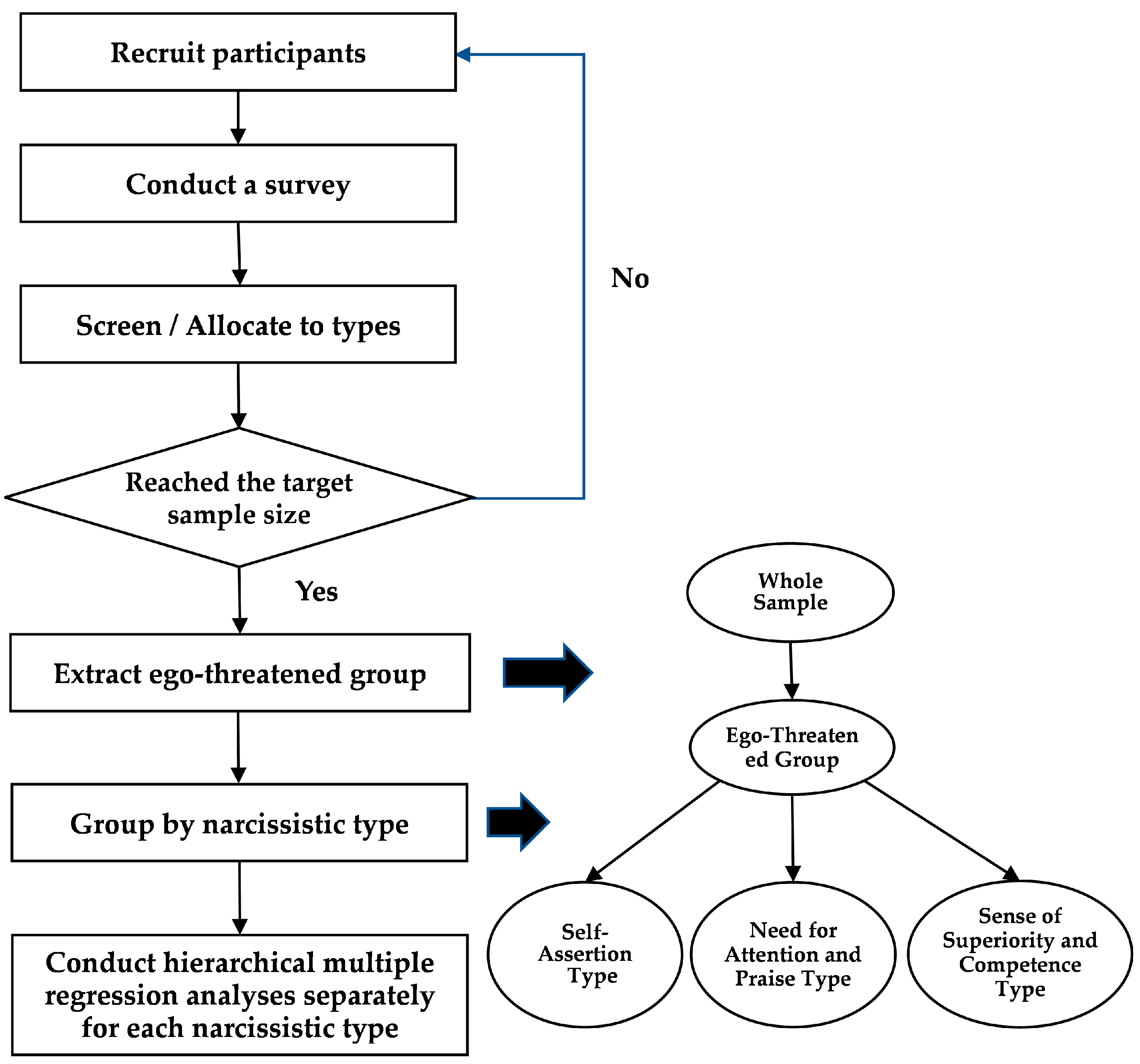
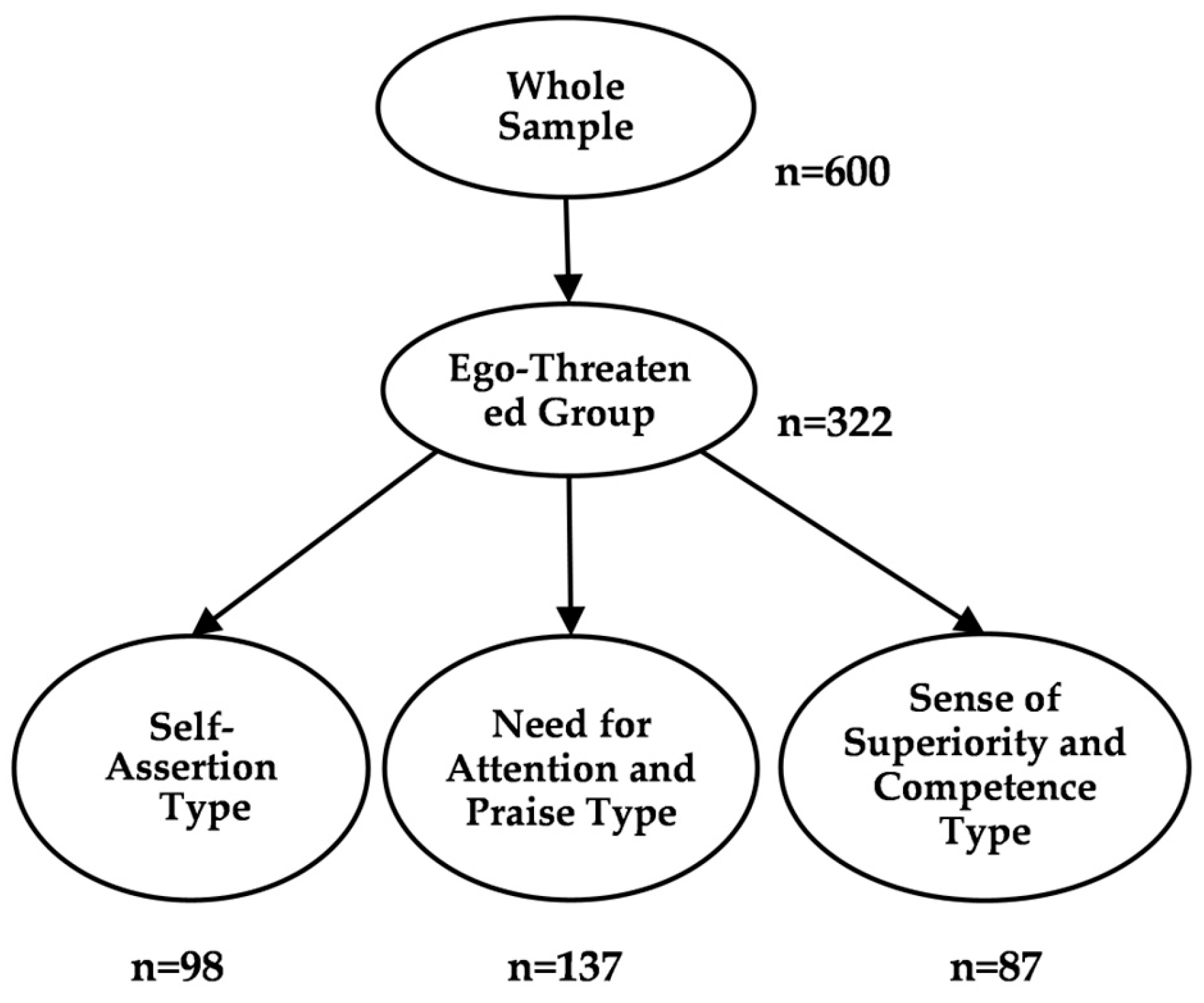
This survey was conducted in May 2024 through an online survey platform operated by Company A. Company A recruited respondents and administered a questionnaire survey. The collected data were screened to select cases that met the quality control criteria (i.e., passed attention checks), could be classified by narcissistic type (i.e., among the three subscales of the Narcissistic Personality Inventory Short version (
Oshio, 1998) (hereafter NPI-S), only one had the highest score), and contained no missing values. Qualified cases were then distributed into each quota group. This process was repeated across all quotas—defined by gender, age, and narcissistic type—until the target sample size was achieved. The sample was then divided into high and low groups based on the median of the State Self-Esteem Scale; the high group was defined as the “ego-threatened group.” Finally, the ego-threatened group was classified into three groups based on narcissistic type and hierarchical multiple regression analyses were conducted separately for each group (see
Figure 1).
Informed consent was obtained through Company A’s system by presenting participants with an explanatory statement describing the research purpose, the voluntary nature of participation, the right to withdraw, and procedures for the handling of personal information. Participants provided consent by checking a box (responses could not be submitted without providing consent). All data were anonymized by Company A, and no personally identifiable information (e.g., IP addresses) was disclosed to the author.
The study was conducted in accordance with the Declaration of Helsinki and approved by the Ethics Committee of author’s University (Approval No. 24-11, dated 13 May 2024).
In the preparation of this manuscript, generative artificial intelligence (ChatGPT, version 4.1) was used solely for the translation from the original Japanese manuscript into English.
2.2. Classification by Narcissistic Types
This study was based on the premise that behavioral strategies for maintaining positive self-evaluation differ depending on the factors of narcissism. Accordingly, participants were classified using the three subscales of the NPI-S: Self-Assertion, Need for Attention and Praise, and Sense of Superiority and Competence.
For each participant, total scores on the three subscales were calculated, and the subscale with the highest score was identified as the dominant characteristic, determining the participant’s narcissistic type. This classification method follows prior studies (
Semba, 2017,
2018,
2024,
2025), which have demonstrated that individuals exhibit different response patterns under ego-threatening situations according to their dominant narcissistic factor.
It should be noted that this classification method has the limitation of not fully reflecting reality. Personality traits in reality are continuous and overlapping, and some individuals may score highly on both Self-Assertion and Need for Attention and Praise. Therefore, this classification procedure results in the exclusion of participants with mixed trait profiles and may entail a theoretical inconsistency with frameworks that conceptualize narcissism as a dynamic self-regulatory system. Future research should employ approaches such as latent profile analysis to incorporate mixed trait structures into the analyses.
2.3. Survey Items
The survey in this study consisted of a fact sheet, scales assessing narcissism, power harassment, ego threat, and supervisor and organizational support. Except for the fact sheet, all instruments used were developed or modified in Japan to ensure that the psychological states of workers were accurately assessed within the Japanese linguistic and cultural context.
2.3.1. Fact Sheet
This section asks respondents to indicate their gender, age, and occupation.
2.3.2. Narcissism Scale
The NPI-S (
Oshio, 1998,
1999) was used in this study. This instrument consists of 30 items and includes three subscales: Self-Assertion, Need for Attention and Praise and Sense of Superiority and Competence (
Oshio, 2004). The NPI-S is an adaptation of the original NPI (
Raskin & Hall, 1979), modified to better reflect the Japanese cultural context. In this survey, participants rated each item on a five-point Likert scale ranging from 1 (
does not apply at all) to 5 (
applies very well). The total score for each subscale was calculated, and participants were classified into the narcissistic type corresponding to the subscale on which they scored the highest.
2.3.3. Power Harassment Scale
To the best of the author’s knowledge, although several scales for measuring power harassment exist, none adequately reflect the six types of workplace power harassment defined by
MHLW (
2020): physical attack, psychological attack, social isolation, excessive demands, insufficient demands, and invasion of privacy. Accordingly, this study developed a scale based on them. Behaviorally specific items were generated to reflect these categories in ways appropriate to Japan’s legal and cultural context.
The development process proceeded in several steps. First, a prior study (
Japan Institute for Women’s Empowerment & Diversity Management, 2011) and a government document (
MHLW, 2020) were reviewed in detail to generate an initial pool of candidate items covering all six types of power harassment. Second, two certified senior industrial counselors and the author (also certified) conducted an expert review. Each item was evaluated on four criteria—validity, clarity of meaning, and workplace appropriateness. Items were revised or removed based on the evaluation results. Third, cognitive interviews were conducted with a diverse sample of employees (
n = 10) to examine item comprehension and response interpretation. A small pilot survey (
n = 20) was then conducted to assess response burden and score distribution. These procedures produced the final set of items (see
Table 1).
The final scale comprised 12 items, each rated on a 10-point Likert scale ranging from 1 (strongly disagree) to 10 (strongly agree). Higher total scores indicated a stronger tendency to select or engage in power harassment behaviors. For the purposes of this study—namely, theoretical validation of the proposed framework and the provision of policy and practical implications—the total score across all 12 items was used as the index of power harassment tendencies, rather than analyzing the six subscales separately.
It should be noted that the development of a new psychometric scale per se was not the primary objective of this study; therefore, the development process was intentionally limited to the essential procedures required for generating a valid measure.
2.3.4. Ego Threat Scale
The State Self-Esteem Scale developed by
Heatherton and Polivy (
1991) was used to measure ego threat. Following
Tabata and Ikegami (
2011), eight items from the performance and social subscales were selected, while items irrelevant to the study’s purpose (e.g., “I am concerned about my weight”) were excluded. This scale measures an individual’s self-evaluation at the present moment (
Abe & Konno, 2007) and has been used in prior studies as a measure of ego threat (e.g.,
Watanabe & Karasawa, 2012).
Consistent with these prior studies, participants were instructed as follows to restrict their responses to their current emotional state: “The following questions are designed to assess what you are thinking right now. Please respond based on how you feel at this moment, rather than how you usually feel.” Items were rated on a five-point Likert scale ranging from 1 (
does not apply) to 5 (
applies). Because all items on the scale were reverse-coded except for Item 5, which was excluded for the reasons described in
Section 3.2, higher total scores indicate greater perceived ego threat.
It is generally recommended that psychological scales be treated as continuous variables. However, the present study is not primarily an explanatory investigation aimed at the precise estimation of effect sizes; rather, it is intervention-oriented and seeks to identify the conditions under which the risk of aggressive behavior increases in order to generate insights applicable to organizational intervention. In practical settings, decisions are required not on the basis of subtle score differences, but on whether an individual is in a state that warrants support or attention. Accordingly, in this study, ego threat was conceptualized not merely as a difference in the degree of self-evaluation, but as a psychologically activated “risk state.” Based on this conceptualization, a distribution-based threshold was established, and ego threat was operationalized as a risk condition.
2.3.5. Supervisor Support Scale
Supervisor support was measured using the Social Support Scale developed by
Komaki (
1994). This scale consists of 14 items and includes two subscales: emotional support and instrumental support. In this survey, the total score across all items was used for analysis. Participants rated the support they received from their immediate supervisors on a five-point Likert scale ranging from 1 (
strongly disagree) to 5 (
strongly agree). Higher total scores indicate greater perceived supervisor support.
2.3.6. Organizational Support Scale
Perceived organizational support was assessed using a Japanese translation of the Organizational Support Scale developed by
Eisenberger et al. (
1986). This scale measures employees’ beliefs regarding the extent to which their organization values their contributions and cares about their well-being. The scale has a one-factor structure, with several items sharing similar content. Therefore, considering the purpose of the present study and the response burden on participants, three items with high factor loadings were selected: “The company (organization) takes pride in my accomplishments at work” (loading: 0.76), “The company (organization) really cares about my well-being” (0.83), and “The company (organization) values my contributions to its well-being” (0.71). Participants rated on a seven-point Likert scale ranging from 1 (
strongly disagree) to 7 (
strongly agree). Higher total scores indicate greater perceived organizational support.
2.3.7. Organizational Dysfunctional Scale
To examine the criterion-related validity of the Power Harassment Scale, the Organizational Dysfunctional Behavior Scale (
Semba & Haraguchi, 2014) was employed. Respondents rated 10 items on a five-point Likert scale ranging from 1 (
not at all applicable) to 5 (
very applicable). The scale consists of three subscales: Aggressive Assertiveness, Criticism of Others, and Rebellious Attitude. Higher scores indicate a greater tendency to engage in the respective behavioral style.
2.4. Statistical Analysis
First, basic descriptive statistics were calculated for the whole sample. Next, factor analyses using principal axis factoring with Promax rotation were conducted for all scales, and items deemed inappropriate were removed. Correlation analyses were then conducted among the variables included in the hierarchical multiple regression analyses for the ego-threatened group. Finally, hierarchical multiple regression analyses were conducted separately for each narcissistic group to examine (a) how the effects of ego threat and supervisor/organizational support on power harassment vary by narcissistic type, and (b) how the moderating effects of the two forms of support on the relationship between ego threat and power harassment vary by narcissistic type (see
Figure 1).
Power harassment was entered as the dependent variable, and gender, age, occupation, ego threat, and the interaction terms of ego threat with supervisor and organizational support (ego threat × supervisor support, ego threat × organizational support, and ego threat × supervisor support × organizational support) were entered as independent variables.
Specifically, in Step 1, gender, age, and occupation were entered as independent variables. In Step 2, ego threat, supervisor support, and organizational support were added. In Step 3, the interaction terms between ego threat and the support variables were included. To avoid multicollinearity, the interaction terms were centered following
Aiken and West (
1991). The significance level was set at 5%, and SPSS ver. 28 was used for the statistical analyses.
It should be noted that, because the present study employed a cross-sectional design based solely on self-report measures, causal inferences cannot be drawn from the observed associations. In particular, caution should be exercised in interpreting the interaction effects identified in the hierarchical multiple regression analyses.
4. Discussion
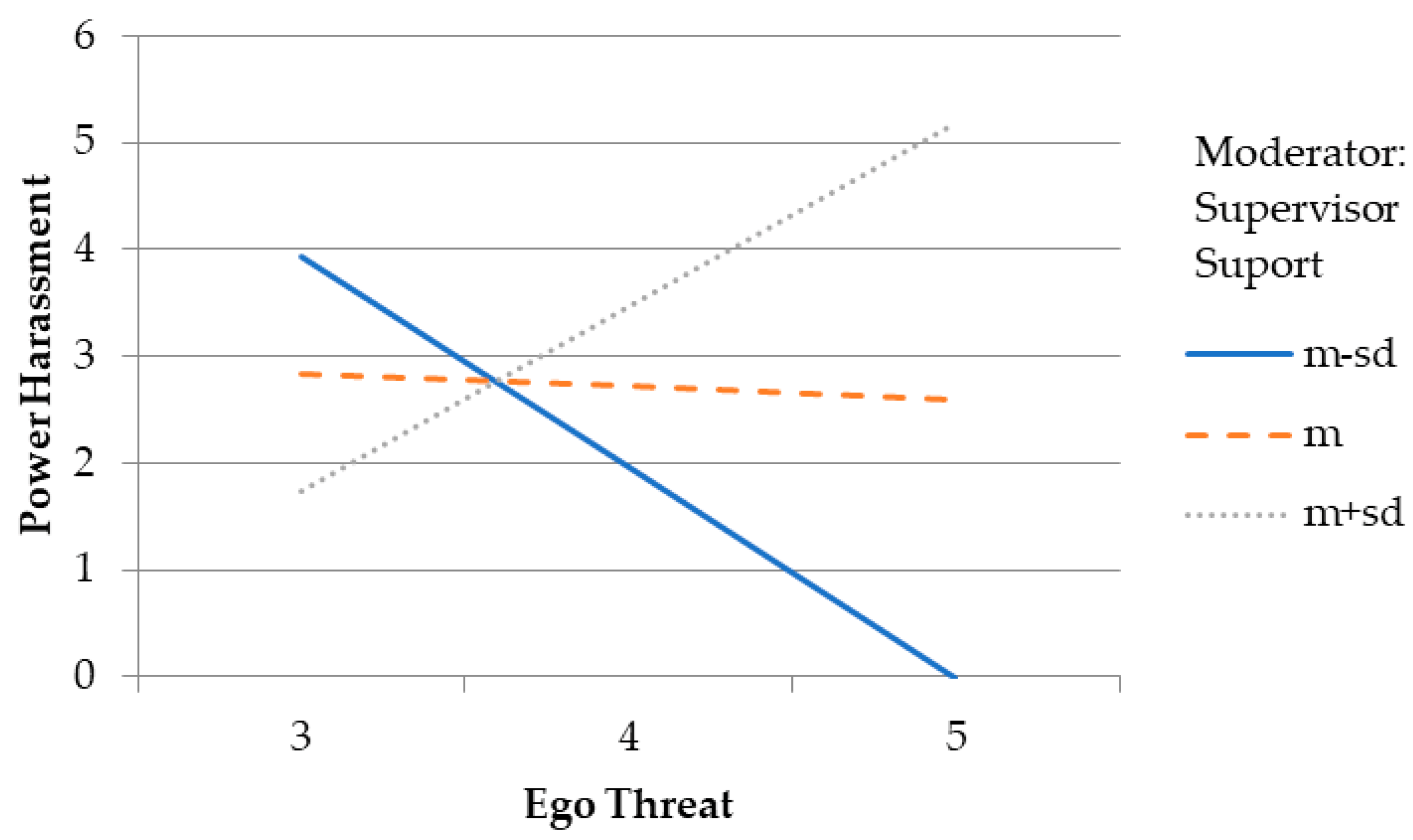
The present study examined when and for whom social support inhibits or facilitates aggressive behavior in organizational contexts by integrating ego threat theory, narcissism as a self-regulatory system, and cultural perspectives. Contrary to the widespread assumption that social support uniformly buffers the negative effects of ego threat, the findings of the present study demonstrate that the effects of support are conditional on both individual self-regulatory strategies and the social meaning of support within a hierarchical context. Specifically, ego threat did not exhibit a significant main effect on aggressive behavior across all narcissistic types. However, among individuals characterized by superiority-based narcissistic strategies, a significant interaction effect emerged: ego threat had a significant positive effect on aggressive behavior when perceived supervisor support was high, indicating that the association between ego threat and aggressive behavior was stronger under conditions of higher perceived supervisor support.
Consistent with prior stress-buffering models, the present study did not find that social support was uniformly harmful. Rather, its effects depended on individuals’ self-regulatory tendencies. However, in contrast to the traditional buffering perspective, the results of this study indicate that when narcissism grounded in a sense of superiority and competence is high, supervisor support may not suppress aggression but may instead amplify it. This finding theoretically extends existing research by identifying the psychological mechanism through which support can function as a threat—namely, the process of attributing evaluative meaning to support.
4.1. Social Support as an Ambiguous Social Signal
A central contribution of this study is the reconceptualization of social support as an inherently ambiguous social signal rather than a uniformly protective resource. Prior research has emphasized the stress-buffering role of support, implicitly assuming that supportive actions are interpreted as affirming and non-threatening. The findings of the study challenge this assumption by demonstrating that support may simultaneously convey care and evaluation. For individuals whose self-worth depends on maintaining a sense of superiority, such evaluative implications may heighten ego threat rather than alleviate it, thereby facilitating defensive aggression.
This interpretation extends existing social support theories by highlighting the importance of meaning attribution. Support does not operate solely through its objective features but through how it is subjectively construed in relation to the self. In this sense, support may function as a contextual cue that is interpreted as threatening under certain conditions. By identifying conditions under which support backfires, the present study refines the theoretical understanding of support as a relational and interpretive phenomenon.
4.2. Implications for Ego Threat Theory
The present findings also contribute to ego threat theory by demonstrating that the consequences of ego threat are not only situationally contingent but also dependent on the interaction between personality-based self-regulatory strategies and social cues. While ego threat theory has robustly linked threats to self-worth with aggressive responses, it has paid less attention to how ostensibly positive contextual factors, such as support, may alter this relationship. The results of the present study suggest that support does not universally attenuate ego threat but may be associated with stronger ego threat–aggression links when it accentuates evaluative asymmetries or challenges perceived dominance.
This insight calls for the refinement of ego threat models to incorporate the conditional role of social signals. Rather than assuming that protective contexts invariably reduce threat responses, future models should consider how contextual cues interact with individual differences in self-regulation to shape behavioral outcomes. From this perspective, aggression can be understood not merely as a reaction to threat, but as a strategic attempt to restore a threatened self-concept in environments where support is interpreted as evaluative or controlling.
4.3. Narcissism as a Self-Regulatory System
By conceptualizing narcissism as a set of functionally distinct self-regulatory strategies, the present study moves beyond trait-based explanations of aggression. The findings of the present study indicate that superiority-based narcissistic strategies are particularly sensitive to the social meaning of support under ego threat. For these individuals, support from a superior may underscore dependency or status asymmetry, thereby undermining the very self-image that they seek to protect. Aggressive behavior in such cases may reflect attempts to restore a threatened self-concept aimed at reasserting dominance of narcissistic factors or restoring threatened self-worth.
Importantly, these results do not imply that narcissism is inherently maladaptive. Rather, they suggest that the adaptiveness of narcissistic strategies depends on contextual fit. Support that affirms autonomy or minimizes evaluative implications may not provoke defensive responses, whereas support that highlights hierarchical dependence may do so. This functional perspective underscores the importance of examining how personality systems interact with situational cues, rather than treating narcissism as a uniform risk factor.
4.4. Cultural Context and Hierarchical Relationships
The Japanese organizational context provides a theoretically meaningful setting in which to examine the dynamics of power harassment, ego threat and support. In cultures where the self is deeply embedded in social relationships and hierarchical structures, evaluation by significant others carries heightened psychological significance. Support from superiors may therefore be particularly likely to be interpreted as an evaluative act rather than a purely benevolent one. The present findings suggest that such cultural configurations can amplify the ambiguity of support and shape its psychological consequences.
Regarding power harassment, it should be noted that the power harassment scale used in the present study includes items based on the Japanese legal framework, such as questions concerning privacy. However, these behaviors are not limited to norms unique to Japan; rather, they can also be situated within the theoretical frameworks of international research on workplace aggression. For example, workplace incivility is defined as low-intensity deviant interpersonal behavior with ambiguous intent that involves violations of norms of mutual respect in the workplace (
Andersson & Pearson, 1999). Similarly, workplace aggression has been conceptualized as a broad construct encompassing not only physical violence but also verbal aggression and psychological harm (
Schat & Kelloway, 2005).
Intrusive questioning about privacy may, depending on the context, be understood as discriminatory behavior or incivility. However, when such behavior is repeated within a relationship characterized by power asymmetry and causes psychological distress to the target, it may align with the definitional criteria of workplace bullying proposed by
Einarsen et al. (
2002)—namely, repetition, persistence, and power imbalance—and thus be interpreted as a form of psychological aggression. Accordingly, the scale items employed in this study should be viewed not merely as reflecting Japan-specific legal definitions, but as positioned within the broader theoretical continuum of international constructs of workplace aggression. Nevertheless, the cross-cultural equivalence of this scale warrants further empirical examination in future research.
Although power harassment is a culturally specific term, it represents a form of workplace aggression that is conceptually comparable to abusive supervision and workplace aggression studied internationally. By situating power harassment within broader social-psychological frameworks, this study illustrates how culturally grounded phenomena can inform and refine general theories of self, support, and aggression. Rather than limiting generalizability, the cultural specificity of the present context helps identify boundary conditions under which support may backfire.
4.5. Sensitivity Analysis
The results of the sensitivity analysis in this study indicated that for two of the three types, the effect of support did not significantly vary depending on the level of ego threat, suggesting that the effect of support possesses a certain degree of robustness. On the other hand, because an interaction effect was observed for one type, it is possible that for individuals with particular psychological characteristics, the way support is perceived and its effects may be influenced by the level of ego threat. This finding suggests that, in order to maximize the effectiveness of support, it is important to provide support in a flexible manner that takes individual differences into account.
4.6. Practical Implications
From a practical standpoint, the present findings caution against one-size-fits-all approaches to organizational support and intervention. While support is often promoted as an unequivocal remedy for workplace stress and aggression, the results of the present study suggest that poorly calibrated support may inadvertently exacerbate aggressive tendencies among certain individuals. Interventions should therefore be sensitive to how support is delivered and interpreted, particularly in hierarchical contexts. Emphasizing autonomy-supportive practices and minimizing evaluative overtones may reduce the likelihood that support is perceived as threatening.
4.7. Limitations and Future Directions
The present study has several limitations. First, because it employed a cross-sectional design, strong causal inferences cannot be drawn from the observed associations. In particular, the interaction effects identified in this study represent statistical patterns consistent with the theoretical framework, but they do not provide direct evidence of causal buffering or amplifying processes through which support influences aggressive behavior. This point should be carefully considered in the methodological positioning and interpretation of the results.
Second, all measures relied on cross-sectional self-report data, which increases the possibility of common method bias. The constructs examined in this study—such as perceived supervisor support and self-reported tendencies toward power harassment—may have been influenced by respondents’ temporary emotional states or self-presentation motives. In particular, the failure to measure and control for negative affectivity or social desirability constitutes a limitation of the present study. Future research should incorporate these individual difference variables.
In ego threat processes, subjective interpretations—such as perceived support and perceived aggression—are themselves theoretically central constructs. However, to enhance validity, future research would benefit from research designs that combine multi-source data (e.g., coworker or supervisor ratings), behavioral indicators, and experimental manipulations.
Furthermore, although the Japanese cultural context provides theoretically important insights, it is necessary to examine whether similar processes can be observed in other cultural and organizational contexts. In particular, comparative research in cultures characterized by greater power distance or stronger relational interdependence would be useful for clarifying the boundary conditions of the theory, especially with regard to the potential paradoxical effects of social support.
From a practical standpoint, the findings suggest that organizational leaders should carefully consider employees’ self-regulatory orientations and narcissistic tendencies when designing supportive practices. Rather than assuming that social support uniformly functions as a protective resource, organizations should remain mindful that support may carry evaluative implications, which in turn could unintentionally amplify defensive aggression.