Article

Cognitively Processing Covert Aggression from a Target’s Perspective

1
Independent Researcher, Brisbane, QLD 4000, Australia
2
Department of Management, Griffith University, Brisbane, QLD 4000, Australia
3
Department of Management, Griffith University, Nathan, QLD 4111, Australia
*
Author to whom correspondence should be addressed.
Psychol. Int. 2026, 8(1), 7; https://doi.org/10.3390/psycholint8010007
Submission received: 5 October 2025 / Revised: 15 December 2025 / Accepted: 6 January 2026 / Published: 21 January 2026

Abstract

This article sets out to investigate how individuals process their experiences of covert aggression in their workplace. Covert aggression is operationalized within this article as behaviors that are subversive, mal-intended behaviors which attempt to undermine an individual’s confidence within the social milieu of their workplace and their capabilities and knowledge within the context of their job role. Using the critical incident technique embedded in a semi-structured interview format, the findings pointed to the targets of covert aggression undergoing a process of realizing they are experiencing covert aggression, sensemaking of why this is happening to them, self-monitoring their behaviors and responses around the aggressor, and creating scripts as a way to manage their working relationship with their aggressor. This cognitive process that we unveil in this article establishes a baseline for further investigations into the experiences of being targeted by covert aggression.

1. Introduction

I felt like I was walking on eggshells and I wasn’t able to be myself when she was working, but when she wasn’t there I had no problem and I felt comfortable”.
(John, retail, 13 years, at the point where he realized he was a target of covert aggression)
Workplace antisocial behavior such as bullying, undermining, harassment, and aggression have attracted research attention because they influence the health and wellbeing of organizational denizens (Pilch & Turska, 2015). One area of increasing interest for researchers and managers is the experience of aggression in the workplace (Baillien et al., 2016). While there has been significant research into aggressive behaviors at work (Harvey et al., 2009), an area that has received less attention is covert aggression (Burnett, 2020; Lagerspetz et al., 1988). Covert aggression comprises a range of indirect behaviors intended by the aggressor to create uncertainty, destabilize, and ultimately socially isolate targeted individuals (Baron et al., 1999; Keashly, 2001; Leiter, 2013). Covert aggression goes beyond incivility. Incivility encompasses mindlessly discourteous behaviors, such as failing to hold a door open or saying good morning in the corridor, with no ill intent, while covert aggression has a negative intention from the outset (Cortina et al., 2017; Kent et al., 2014; Leiter, 2013). Covert aggression is a commonplace and largely accepted form of bullying, because it is subversive and invisible and therefore difficult to report, encompassing other forms of aggression (i.e., relational aggression), because it sets out to destroy the individual’s psychosocial wellbeing through various forms, such as destroying interpersonal relationships at work or school (see Mayhew et al., 2004; Baron et al., 1999; Geldart et al., 2018; Hart & Ostrov, 2020; Kent et al., 2014). For example, the Public Service Alliance of Canada, a Canadian national labor union, found that 45% of full-time employed Canadians experienced instances of aggression and did not report it. Covert aggression is important to understand and address because it has been associated with employee burnout, reduced work effort, lower job commitment, and ultimately increasing turnover for organizations (Baldwin, 1992; Buss, 1991; Leiter, 2013; Mayer, 2007).
This article examines how individuals cognitively process indirect/covert aggression at work, including the roles of sensemaking, negative affect, and the development of behavioral scripts used to manage ongoing interactions with their aggressor. That is, our objective is to identify the sensemaking processes that targets of covert aggression undertake to understand if and why this form of aggression is occurring and why it is being directed at them. The importance of this research is two-fold: (1) Identifying the organizational-level effects of workplace aggression is an important contribution to the literature because it cannot be assumed that various forms of aggression, specifically covert aggression, impact organizations in the same way that they do individuals (Johnson et al., 2018; Schneider & Chein, 2003). (2). Aggression scholars (e.g., Johnson et al., 2018; Kuenzi & Schminke, 2009) argue that there is growing confirmation that organizational-level effects have progressive malignant implications beyond the individual level as there is a flow-on effect from covert aggression that shapes behaviors and attitudes within organizations. Before outlining our study and findings, we first review extant research on covert aggression, its sensemaking, and cognitive, affective, and behavioral scripts.
In summary, our study sets out to identify and explain the cognitive processes that individuals engage in when they experience covert aggression at work. This study clarifies three main points: (1) how targets recognize the early stages of covert aggression; (2) what sensemaking and self-monitoring processes they follow; and (3) what the behavioral scripts that shape a response to covert aggression are. Clarifying these three points lays a conceptual foundation of analysis for our findings.

1.1. Understanding Covert Aggression as a Form of Bullying

The nebulous nature of covert aggression makes it difficult for targets to be certain that it has occurred and also to explain it to others. This is because covert aggressive acts can be easily interpreted in a number of ways and are often, by nature, ambiguous (Kent et al., 2014). For instance, being ignored by a team member or not being invited to a work social occasion could be perceived as a mistake or it might be viewed as a form of covert aggression intended to harm the individual. A hallmark of covert aggression is that perpetrators inflict harm to the extent that they can avoid detection (Kent et al., 2014). Research reveals that aggressors often weigh the costs of covertly aggressive acts compared to the social, physical, and psychological price of the direct aggression (Björkqvist et al., 1994; R. T. Lee & Brotheridge, 2006). Scholars argue that these individuals engage in covert aggression because it carries lower risk compared to direct aggression, they can avoid retaliation from the target of the aggression, and it is difficult to pinpoint (Archer & Coyne, 2005).
Covert aggression is a relatively sophisticated form of aggression in that the dissipated behaviors and ambiguous nature of the behaviors make it problematic for targets to explain to others their experience. Examples of covert aggression can include a range of different behaviors such as saying something hurtful that appears rational when the aggressor is questioned, openly dismissing an individual’s opinion or expertise in a public forum, spreading false stories about the target, using derisive body language toward the target, or socially isolating targets (Björkqvist et al., 1992, 1994; Crick & Grotpeter, 2005). Another hallmark of covert aggression is the propensity for these acts to be able to be interpreted as ‘normal’ behavior. The intentional nature of these behaviors is what determines the covert nature of the aggression.
The psychological impact of covert aggression includes damage to self-esteem, anger, anxiety, damaged reputation, shame, and avoidance of others (Velotti et al., 2014). This type of aggression has been linked to negative outcomes on the targeted individual’s wellbeing and workplace performance (Baron et al., 1999; Keashly, 2001; Leiter, 2013). For example, targets of aggression experience reduced concentration, which increases their chance of making mistakes and reduces work quality, ultimately resulting in creating a cascading effect threatening the productivity of the organization (Hoel et al., 2003). These behaviors are a form of hypervigilance, which is a honed skill the target has so they are aware or realize the aggressor’s process and the purpose of their subtly aggressive behavior. Targets observe their aggressor in what they do and understand their purpose of being indirectly/covertly aggressive, which is to control and deflect the responsibility for the target’s behavior. Ultimately, the aggressor’s purpose is to cause frustration and anger in order to escalate conflict. This covert aggression is calculated to cause the target to behave in an unreasonable way in order to create as much damage to their social reputation as possible, to ensure that they are socially starved within their workplace. Therefore, the first research question is as follows:
How do individuals realize that they are targets of covert aggression in the first place?
This article investigates this essential question in order to pinpoint the aggressor’s purpose and process through the respondents’ the moment of realization that they are a target of covert aggression. The main key ‘takeaway’ message from this article is to understand that covert aggressive behavior is to look blameless while doing as much damage to the target as they can in order to get a response from the target that will escalate the situation to make them look like ‘the bad guy’ and suffer the consequences for their responses to their aggressor.

1.2. Making Sense of Covert Aggression

Research suggests that experiencing covert aggression at work is a shocking, unexpected, emotionally charged event for most individuals (Kent, 2015). The emotional reaction drives the desire to understand why the covert aggression happened and to create an understanding of the event (Kent, 2015). Sensemaking theory informs the cognitive process by which individuals give meaning to their experience, as it involves manufacturing a cognitive model of the situation (Howard et al., 2015). Individuals engage in sensemaking of covertly aggressive behaviors because they are unexpected events filled with ambiguity and a multiplicity of meanings (Zabrodska et al., 2016). These ambiguous, unexpected events threaten the targeted individual’s psychosocial welfare. Targets, therefore, anchor explanations from prior knowledge about covertly aggressive behaviors or their prior social interactions with the aggressor, and they adjust their assessments accordingly as they seek out answers as to why they are experiencing covert aggression (Oh & Farh, 2017). In sum, individuals confronted by covert aggression in the workplace are motivated to make sense of the situation and their experiences.
Psychosocial strain and personal resource depletion (e.g., cognitive effort and positive affect) occur when people cannot make sense of why they are targets of covert aggression (Geldart et al., 2018). Targets may seek social support through sensemaking conversations (Lutgen-Sandvik & McDermott, 2011). These conversations can help to separate them from the negative affect that they experience during their sensemaking of these types of situations. Sensemaking as a reflective process can help the target to understand their contribution to the acts of the aggression (if any) and may assist them in deciding how to respond to the aggression. Thus, the aim of this study is to examine the sensemaking affective and cognitive processes that targets of covert aggression undertake in the workplace and how they process their negative discrete emotions through constructing behavioral scripts in order to deal with covert aggression.

1.3. Targets’ Schemas and Scripts When Experiencing Covert Aggression

Schemas are mental maps that result from sensemaking and guide targets’ future reactions to covert aggression (Mandler, 2014). Thus, individual schemas are mental templates that map the key features of situations or events and guide a process of recognizing and understanding new information by organizing expectations of what should occur (Mandler, 2014). Schemas are based on an individual’s previous experiences and help simplify these experiences into a set of expectations about similar future situations as well as predicting outcomes. People rely on schemas to understand how relationships between things, people, and situations are interrelated (Mandler, 2014; Schank & Abelson, 1977). Schemas are static elements of one’s experiential repertoire, and scripts in relation to the experience of aggression may provide dynamic ways of reacting to future acts of aggression. Thus, scripts provide a type of ‘action plan’ or template for feeling, thinking, and behaving in future similar situations.
Given that covert aggression is a triggering event that produces negative discrete emotions (e.g., anger, disgust, or anxiety), it can lend an individual to giving more impulsive responses to their aggressor (Michalak & Ashkanasy, 2013). However, if repeatedly exposed to covert aggression, an individual could potentially create scripts in order to ‘survive’ the situation. As such, scripts are built on reactions to emotions (Baldwin, 1992). They are recalled from memory, are well-rehearsed, and guide a person in how they process their behaviors and thinking. Cognitive and behavioral scripts are based on past experiences (e.g., covert aggression), with the cognitive structures representing expectations, the manner in which their actions will be perceived, and the other individual’s responses to the scripts (Baldwin, 1992).
Applying scripts requires three conditions. First, an individual must be able to mentally process the actors and the environment in which they are participating to understand the context of the situation. Second, an event recalling a prior script must be present (Abelson, 1981). Within the context of this research, the event prompts the target’s memory of previous experiences of covert aggression and the target then applies a relevant script that informs their responses to the covert aggression. Third, the individual must have a script that applies to the situation.
Individuals can process present situations from past situations through behavioral and cognitive scripts. For example, people who experience repeated situations of covert aggression create and use generalized scripts (Abelson, 1981; Anderson, 1983). That is, if the individuals repeatedly find themselves in a situation where they are repeatedly experiencing covert aggression, their scripts become ingrained in their cognitive processing and their responses are automatic, rather than considered (Aquino & Bradfield, 2000; Aquino & Lamertz, 2004; Aquino & Thau, 2009; Demorest, 1995; Tomkins, 1979, 1987). Therefore, the second research question for this study is as follows:
How do targets of covert aggression manage their aggressors?
In the current study, we explore a target’s management style through the different types of scripted responses they have to their aggressor. Again, the aggressor’s purpose is calculated in such a way as to make the target feel and behave in an unreasonable way and for the aggressor to avoid responsibility for their covertly aggressive behavior. This leaves the target feeling doubtful and lending themselves to have emotive responses that are not socially acceptable (i.e., yelling, swearing, or physical aggression as responses) in order to socially deplete them within their workplace by turning colleagues or leadership against them. Therefore, the third research question in this study is as follows:
What are the target’s behavioral outcomes?
The process of sensemaking—developing schemas and scripts—may inform how people process the experience of covert aggression. Understanding how people cognitively process these events contributes to a more complete understanding of the covert aggression experience from the target’s perspective. The present study therefore engages a qualitative procedure to interrogate how individuals make sense of, and cognitively organize, the covert aggression experience. We choose a qualitative approach, so that we can capture in-depth, contextual experiences of covert aggression within the workplace from the target’s perspective.

1.4. Restating the Research Questions

It is important that we restate the purpose and the direction of this article by restating the research questions. Research and theory are unclear about how targets make sense of and cognitively process their experiences of covert aggression from: how they realize that they are being targeted, shift from realization to sensemaking, build cognitive scripts, and, finally, behave, and how these phases are guided by the negative affectivity the target endures. Therefore, in the following sections, we explain how we went about conducting our study in order to answer the following research questions:
Research Question 1: 
How do individuals realize that they are targets of covert aggression in the first place?
Research Question 2: 
How do targets of covert aggression manage their aggressors?
Research Question 3: 
What are the target’s behavioral outcomes?
Our study seeks to answer these questions to better understand how covert aggression affects targeted individuals, their emotional experience, how they process it psychologically and emotionally, and how their behavioral responses are shaped.

2. Materials and Methods

We used qualitative and inductive methods to understand a target’s cognitive processes when experiencing covert aggression (E. Lee, 2009; Strauss & Corbin, 1998). Using the critical incident technique (Flanagan, 1954), interviews were used to collect data in order to elicit rich, detailed stories of a target experiencing covert aggression. Due to the nature of covert aggression, we focused our interviews on how targets cognitively process their experiences of covert aggression while at work, rather than focusing on the different types of covertly aggressive behaviors and whether the target was treated justly or unjustly.

2.1. Respondents

We used a purposive sampling methodology to recruit participants. Respondents were 31 full-time working professionals across various industries (17 females and 14 males). Their work experience ranged from 2 years to 45 or more years. The informants were at various levels of seniority within their respective organizations. To understand how targets dealt with covert aggression, we focused on their description of the aggression, the targets’ responses to it, and how they felt about the covert aggression at the time. We then asked respondents how they behaved after they experienced covert aggression and to differentiate between their aggressor’s behaviors and a person they really enjoyed working with at the time.
Participants were recruited through purposeful discussions about indirect or covert workplace aggression, either through direct contact or referral to the interviewer. To ensure transparency, participants were eligible to engage in this study if they met the inclusion criteria outlined in the latter part of this section. Specifically, the participants had to experience indirect/covert aggression during working hours, and their aggressor needed to be a colleague, subordinate, or line supervisor/manager within their organization. Additional informants were added to the study using the snowball technique until saturation was met during the data collection, that is, when stories began to sound similar to one another and no new information was being revealed (Corbin & Strauss, 2008). The snowball approach afforded us a breadth of information on how people dealt with covert aggressors from a wide range of industries. This study was approved through a University Ethical Review process.

2.2. Data Sources

The interviewer conducted semi-structured interviews with each of the 31 respondents in this study (Kvale & Brinkman, 2009). These interviews allowed the interviewer to understand the informant’s story telling by hearing their perceptions of the covertly aggressive acts, how they interpreted them, and what their thoughts and feelings were in the moment of experiencing the covertly aggressive acts. Doing so enabled the interviewer to uncover phenomena that would not be found using more directive methods such as surveys or experiments (Arino et al., 2016). Interviews lasted 45 min to an hour and focused on the cognitive experience of informants and how they reacted to their aggressor. All interviews were digitally recorded and transcribed verbatim.
Prior to participation in the study, respondents completed a short screening questionnaire to ensure that they met the two inclusion criteria: (1) they had experience of indirect/covert aggressive behavior within their workplace during working hours; and (2) the aggressor was a colleague, subordinate, or manager within the same organization. The interviewer began the interviews by asking the respondents about their work experience and the different types of positions they held during their careers. Then, the respondents were asked to describe in detail a time when they experienced aggressive behavior within the workplace where the behaviors were hard to describe or ambiguous, but they knew that the behaviors were intentional. To minimize retrospective bias, the interviewer asked the respondents about these types of aggressive behaviors that they experienced in the recent past and then the most salient aggressive incident of this nature that they could recall. The interviewer paraphrased the respondents’ answers in order to gain clarity of the respondent’s story and as a technique to draw out more detail in their story. Paraphrasing the respondent’s story was helpful to the interviewer as a way of ensuring that the respondent was recounting powerful, clear events of covert aggression.
The critical incident technique (Flanagan, 1954) helped to uncover who was present during the covert aggression, what the incidents of covert aggression were, and what their thoughts were while they were in the moments of being covertly aggressed against, why they believed they were targets of covert aggression, when the covert aggression would happen, how the aggressor behave, and how the respondent would behave before, during, and after the incident occurred. Thus, the critical incident technique helped to uncover the behavioral, emotional, and cognitive strategies that the respondent implemented in subsequent dealings with their aggressor.

2.3. Data Analysis

Strauss and Corbin (1998) argued emphatically that there is a need for flexibility and creativity when coding (see Mills et al., 2006). While several permutations of grounded theory have evolved over time, we used traditional (Glaser & Strauss, 1967), evolved (Strauss & Corbin, 1998), and constructivist (Charmaz, 1994) grounded theory to analyze the interview data collected within this study (Mills et al., 2006). We analyzed the data with an iterative, constant comparative method (Corbin & Strauss, 1990; Strauss & Corbin, 1998; Cowan & Fox, 2015). Each iteration of analysis returned to the relevant literature on emotions, cognition, or aggression and related themes in order to bring it closer to discovery. The first author coded in NVivo in the manner they deemed appropriate using field notes. The incidents of covert aggression were placed under tacit categories (e.g., vendetta, female aggression, or feeling like a victim) using intuition (i.e., what feels right). As the first author spelled out the properties of the categories, they shifted from tacit to explicit categories. As more memos were written for the categories, the categories became more provisional in terms of what was to be included and what not to be included. As a result, more memos were written for each covert aggression story; the first author developed the definitions and would then confer with the covert aggression, emotion, and cognition literature, after which the definitions were given explicit labels. Following this, the second author independently conducted open coding on seven of the interviews, three of which involved male and four female respondents, to ensure reliability. The second author read the stories and intuitively categorized them in their words (e.g., looking back, being retrospective, or locked in script).
As an extension of the qualitative coding, we generated descriptive numerical summaries (e.g., frequency counts of child nodes, co-occurrence patterns, and distribution of codes across research questions) to supplement the inductive analysis and proffer greater transparency regarding thematic substance. There has been a debate about using quantitative analysis in qualitative studies (Trafimow, 2014). In line with Trafimow (2014), we consider that trying to quantify qualitative data may distort the purpose of qualitative research, which is to provide a rich understanding of phenomena.
In keeping with the constant comparative methods, the first and second author reshaped the provisions of each category and integrated overlapping categories through various discussions about the data. After the final discussions about the data, there were no further changes after the first and second author came to an agreement on the labels and definitions of the seven interviews. We integrated some of our categories that overlapped, such as “locked in scripts” into “scripted responses”, “looking back” into “why me”, “seeking social support” under the label “sensemaking”, and “the point of knowing” into “realization”.
The coding labels were modified to accommodate the differences in meaning between coders. Once these were agreed, the interviews, along with the review of the literature, were imported into NVivo to enable the reorganization of the themes and further coding of the interview responses. NVivo helps in the effective management and formalization of research (Sinkovics & Alfoldi, 2012), such as using the comparative analysis technique (i.e., iteration between emotion/cognitive/aggression literature and the interviews). According to Anderson (1983), an amalgam approach to thematic analysis is compelled inductively and deductively. Boyatzis (1998) refers to thematic exploration as “codable” verbatim data (i.e., transcribed interviews). This study generates results deductively and inductively. The point of saturation was accomplished when no new child nodes were produced (Corbin & Strauss, 1990, 2008) and the research questions could be addressed (Table 1). From the target’s story, we demonstrate how we coded child nodes and grandchild nodes within NVivo.

2.4. Findings and Interpretation

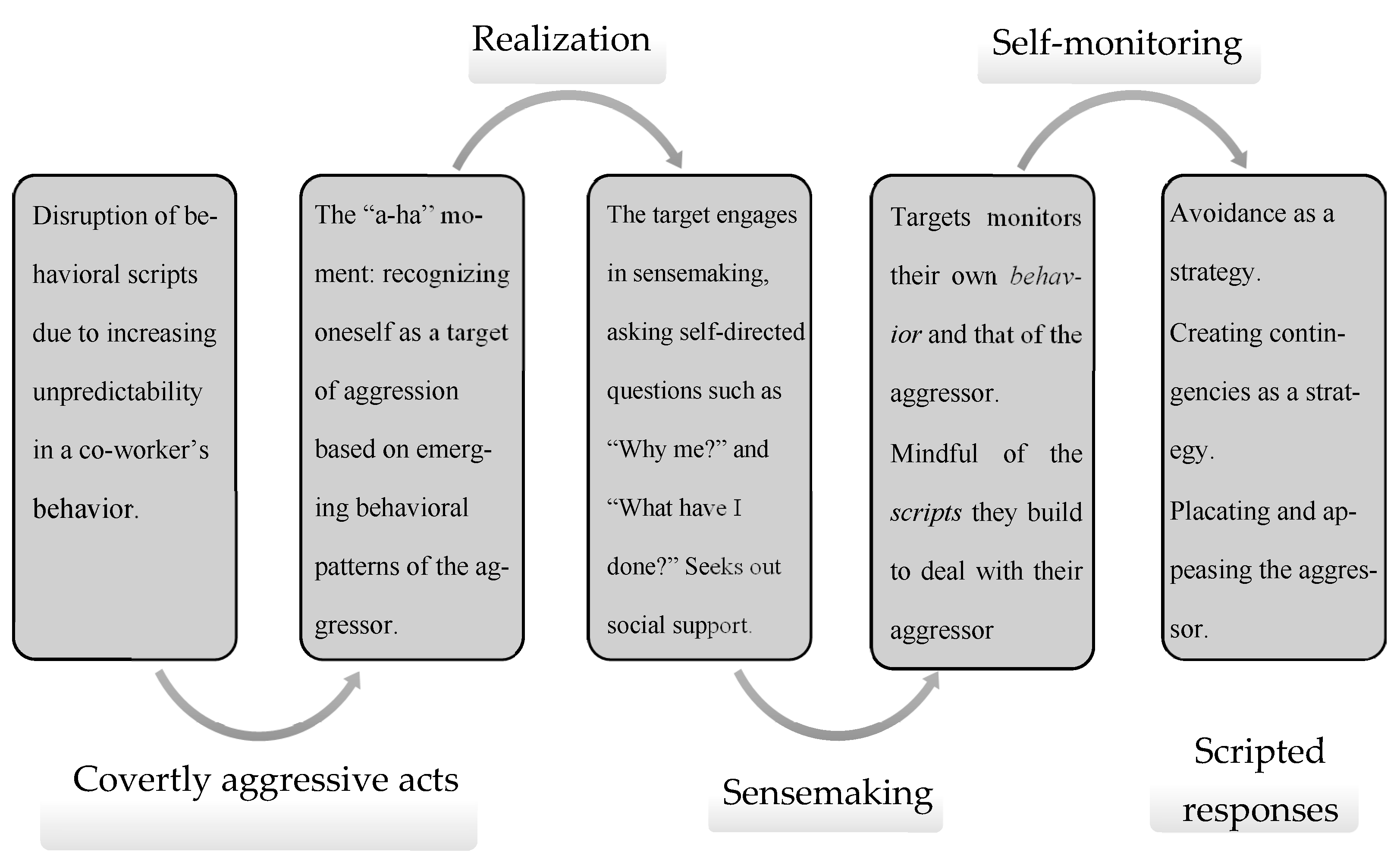
The analyses produced four distinct phases of covert aggression: (a) realization, (b) sensemaking, (c) monitoring own behavior, and (d) scripted responses. The first phase is often subtle and sudden due to the indirect nature of covert aggression. After that first realization phase, people attempted to make sense of the situations, seeking to answer and process the why me? questions. Then, they re-evaluated their own behavior in relation to the aggressor’s behavior. The final phase grows out of this sensemaking, and it includes the targets’ development of behavioral strategies for coping with their aggressor, answering the question of what to do about the aggression.

2.5. Realization

Several respondents reported the initial moment in which the behaviors they faced from their aggressor were laced with malicious intent towards them. Targets critically noticed by having a flash of an “a-ha!” moment when it was clear to them that an individual was exhibiting aggressive behavior towards them. This becomes a significant “a-ha!” moment due to the ambiguous nature of covert aggression. The data suggest that the awareness of covert aggression occurred over various lengths of time. For example, Jenny (Information Systems, 28 years) faced repetitive patterns of indirect/covert aggressive behavior by her colleague and became aware she was being targeted after the fourth experience, “I’m like “Okay, this is a personal vendetta against me.” However, Jane (Human Resources, 30+ years) became aware of covert aggression when trying to apply for a job in the same company, “I think it was the fact that when I applied to that job and it was apparently clear to me my aspiration was not welcome….”, and constant criticism of the quality of her work, which would be ultimately be given to someone who had very little training. For example, Jane states “there was constant criticism, because my work was being unduly delayed, because my work would be given to somebody else to rebatch, by rebatch I mean my work would be given to somebody else who was pretty much not really trained”.
Like Jane, it became obvious to Craig (Researcher, 9 years) that he was being targeted by his colleague when he was given information via email that he would not have normally received, “being Cc’d in the email was the event that made me realize that it was happening (the covert aggression by his male colleague)…because prior to that I didn’t know that it was, so it was just kind of like a wakeup call to me….”. Typically, targets experienced acts of covert aggression more than once before becoming aware they are a center of interest for covert aggression. One consistent theme was that awareness often emerges when stimulated by an emotional reaction. This stems from the target experiencing the effect of the aggressor’s behavior. For instance, Cara (Administration, 17 years) recollected her emotions when she was experiencing aggression by her colleague, “Anger was the first and most dominant emotion and, yes, disappointment and betrayal by my superior” (see Table 2 for more illustrative examples). For many targets, their physical response triggered the target’s realization of the aggressor’s malicious intent and that a harmful dynamic existed between the two people. The covert aggressive events elicited discrete negative emotions.
These data reflect a concept like the experience of realization. Gillett (2002) defines realization as arriving at an understanding that an everyday event is certain and blatant. Participants realized that they were targets of indirect aggression once the target understood that the aggressor’s intent was threatening and meant to undercut the target’s psychosocial wellbeing. Events often catalyzed the realization. For example, every target had their personal moment of realization of covert aggression being aimed at them, which encompassed feelings of suspicion (Jane, Human Resources, 30+ years), experiencing repetitive aggressive behaviors (Jenny (Information Systems, 28 years), and being aware of the aggressor’s subtle aggressive behavior (e.g., body language). Anne (Executive Assistant, 30+ years) explained that “…more and more I came to realize that I wasn’t actually given enough information and then I was belittled for it….” Like Anne, Olena (Hospital Administration, 5 years) realized she was a target “…when she’d offer to go get the paper for me, and then she was going to tell my boss that I wasn’t doing it….” What was common to all interviewees is the negative emotion associated with the indirect aggression acted as a point or moment of “realization” for the individual that they were being targeted by another (see Table 2 for further examples).

2.6. Sensemaking

Once realizing that they were targets of indirect aggression, interviewees tried to understand why they were targets in terms of the aggressor’s underlying motivations for engaging in the behaviors. Respondents reported asking themselves critical questions about the aggression they were experiencing, such as how they become a target, why they were being a target, or what they had done or were doing in an individual’s context of time (i.e., past, present, or future), valence of emotion (i.e., good, bad, neutral), and entity that underpins the situation (i.e., the target themselves, the aggressor, processes within the organization, or inanimate objects) (Maitlis et al., 2013). Participants filled the gaps of missing information after experiencing covert aggression, and then tried to find patterns of behavior within their interactions with their aggressor. There were three main ways this was achieved: (a) asking why me?, (b) seeking social support, and/or (c) monitoring one’s own behavior.
Why me? Using this approach, targets asked themselves the critical questions of how and why they had become targets of aggression. This helped them to make sense of their experience by examining how they thought, felt, and cognized a situation. Maria (Travel Agent, 30+ years) moved through the process of asking herself the critical questions when she stated, “I guess the questions were why? Why was she treating me so badly? What had I done to want her to move me to a different spot or to do more work? What was her justification for wanting to do it even after I explained it wouldn’t work?” Mike (Administration, 30+ years) expressed a similar experience: “…Well, I was just wondering why me? What have I done?” Kay (Administration, 7 years) was very clear in explaining her experience of covert aggression: “I didn’t understand why she was attacking me the way she was and…my brain tends to replay things over and over again until I come to some kind of an understanding of what was actually going on….”
In Kay’s effort to make sense of why she was a focus of hostility, she attributed it to the aggressor having a domineering personality. When the interviewees were asked if they had dialogues with themselves vis-à-vis their experiences of covert workplace aggression, many of the respondents reported that they had to understand why or how they became a target of covert aggressive behavior. As such, Jenny (Information Systems, 28 years) indicated that she would wonder what she could have done to her aggressor for them to be so upset with her thinking, “Well, what have I done? What have I done to make her feel upset with me?”, thinking that perhaps she has “done something wrong.”
Seeking social support. Some respondents verbalized their sensemaking with their partner, network of friends, family members, or coworkers. Neils (Researcher, 41 years) identified that the way he attempted to make sense of his aggressor’s behavior was distinctive because he discussed the events he experienced “with my friends. My friends got a blow-by-blow account of the latest happenings. I felt that was extremely helpful to me.” In the end, Neils ascribed his aggressor’s behaviors to numerous causes that ranged from jealousy to greed to self-doubt.
Each of these respondents identified asking questions of themselves as it helped in their sensemaking of the covert aggression. Scholars argue that sensemaking enables individuals to understand situations of ambiguity and assists them in interpreting their experiences, particularly when sharing with others (Weick, 1995; Zabrodska et al., 2016). For example, Maria (a travel agent with over 30 years of experience) resolved that she was targeted because her aggressor was envious. Contemplation accounts for the context of time, as the process of sensemaking is about occurrences an individual faced in the past (Maitlis & Sonenshein, 2010; Weick, 1995). Reflecting on past events is integral in the practice of sensemaking (Maitlis & Sonenshein, 2010; Weick, 1995).
To restate, our data suggest that the experience of a covertly aggressive act led our respondents to have an emotional reaction (Maitlis et al., 2013; Weiss & Cropanzano, 1996). This emotional reaction acted as a signal prompting the individual to want to understand the event they had just experienced (Maitlis et al., 2013). Sensemaking began at the first hostile interactions that a target had with their aggressor (Zabrodska et al., 2016). Once the targets had made sense of their situation, the next question to emerge was how to respond to the situation.

2.7. Monitoring Own Behavior: What Should I Do?

The common next step among respondents dealing with covert aggression was for them to decide how to respond to their aggressors. A few of the interviewees became conscious of their own behaviors and what their responses were to the aggressive acts directed towards them. Others reported that they became more aware of their aggressor and assessed that person on a regular basis. The results show that being conscious of the aggressor allows the target to be heedful and aware of their interactions with their aggressor.
The conscious and cautious response helped targets determine their future interactions with their aggressor. The responses that the targets prepared seemed vital to their method of problem-solving. As one respondent reported, “…like going over the scripts in my head of what I should say to her, how I would say it, what I would say exactly, that sort of thing…I think you have to be careful of how you worded something towards her because she’d pick up on something and kind of rip it apart” (Rory, Travel Agent, 3 years).
Once targets went through the process of realization and sensemaking, they practiced what they would say or not say to their aggressor or around their aggressor. Cara (Administration, 17 years) reported, “…I became more cautious in my working relationship with her and certainly more withdrawn in sharing personal data.” Craig (Researcher, 9 years) reported that he “…could approach it in a kind of rational order or fashion you know I was approaching it you know with a calmness and clarity rather than coming from an angry place.” Other respondents reported that their focus was on becoming more vigilant of the aggressor’s behavior. Neils (Researcher, 41 years) said he had to do a barometer test everyday by putting “his toe in the water” in order to gauge how he needed to behave with his female aggressor. Neils was attentive to his emotions around her and able to modify the office dynamics as they arose in order to manage his aggressor. He was acutely aware that the poor supervision he and his aggressor received was a contributing factor to her behavior. Similarly, Olena (Medical Administration, 5 years) reported, “I guess I’m a lot more cautious when I deal with her…”
Pacheco et al. (2021) investigated how individuals exposed to indirect/covert aggression engage in heightened self-monitoring and cognitive strategies to adjust their emotional displays to minimize their experiences of harm by their aggressor. They report that targets of indirect/covert aggression often engage in behaviors that maintain their psychological safety. This aligns with Zhong et al.’s (2023) investigation into mitigating the harmful effects of aggression, where targets engage in surface acting, emotional suppression, and appearance management, thereby reducing their exposure and preserving their psychological resources. These findings complement our study’s evidence that targets will cognitively script, emotionally script, and engage in hypervigilance to survive the aggression that they are experiencing at work.

2.8. Scripted Responses

Respondents revealed that preparing behavioral responses was one way in which targets managed their aggressors. The desired outcome was to alleviate the destructive emotions that they were experiencing and to form a distance between themselves and their aggressors. The most common kinds of behaviors that were reported in these interviews were (a) avoiding the aggressor, (b) the preparation of contingency plans for dealing with the aggressor, and (c) placating and appeasing responses to the aggressor. These behaviors were employed as strategies to manage the relationship between the target and the aggressor.
This supports recent research on how targets of indirect/covert aggression construct behavioral scripts to respond to nebulous aggressive behaviors. Williams (2025) investigated how nurses respond to incivility in situ and found that pervasive workplace incivility significantly impacts team dynamics, leadership, and decenters patient care. Similarly, Bieleke et al. (2021) examined the implementation of intention to goal achieving using the “if–then” strategy planning and how it impacts decision making in critical situations. These developments in behavioral research strengthen the theoretical grounding that we note in this study.
Avoidance as a strategy. The interviewees reflected on their avoidant behaviors that included withdrawing psychologically, emotionally, or physically. The findings suggest that some of the targets mentally withdrew from their aggressors after going through their process of sensemaking. These targets decided that they were not responsible for the aggressor’s behavior (i.e., “it’s their problem not mine!”; Walter, Retail, 41+ years) and decided not to invest in the aggressor. Emotional withdrawal was also evident when the target no longer had the desire to emotionally invest (e.g., be angry, upset, or hurt) in pursuing the aggressor’s validation. For instance, in terms of avoidance, Maria was acutely aware of her aggressor’s maliciousness and, as a survival mechanism, continually noted her aggressor’s location within the office. Maria explained that she displayed body language that signaled she was closed off particularly toward her aggressor while staying open to the rest of the team and her clientele. Rory (Travel Agent, 3 years) reported that her behavior reflected her outlook of resentment for her aggressor. Rory was mindful that she experienced negative emotions in relation to her aggressor and had to be continuously aware when having to deal with her aggressor and therefore avoided those situations.
Avoidant behavior often included crafting a deliberate effort to tangibly withdraw in order to avoid the aggressor’s physical presence. These avoidant behaviors help individuals concentrate on the situation at hand with their aggressor (Watson et al., 2016). Another characteristic of the avoidance strategy was sequestering emotions, as indicated by Rory (Travel Agent, 3 years), “Afterwards is when the emotions kicked in, but at that time it was kind of just focusing on getting out of the situation”, and the same for Gina (Research Assistant, 2 years), “…there was no emotion, it didn’t give me butterflies…I was probably a little more standoffish and a less willing to comply and less cooperative.” Avoiding was a way to survive the aggressor, and for a few respondents it became an everyday behavior built into their cognitive schemas.
Neils (Researcher, 41 years) recalled how he extracted himself from his aggressor by essentially discounting her presence despite the small office they shared. Rory (Travel Agent, 3 years) experienced the same mental withdrawal from her female aggressor. Rory’s withdrawal script was constructed into her cognitive framework and helped her to completely disengage. Rory indicated that she was more guarded and cautious with her aggressor because she was avoiding her as much as she possibly could. To illustrate, Rory stated,
I’m going to deal with her if I really, really have to and being very straight to the point and not putting any emotion into what I’m talking to her about, and just seeing her as someone that I only have to deal with at work, and that’s it.
Mike (Administration, 30+ years) had a similar strategy where he “found to work effectively was actually to do was just work through a third party just to find the person…just work through them…setting up a strategy” in order to keep his emotions on an even and reported “…that definitely became a part of the process…it in the end ends up going through a third person is strangely the most effective is what I did in the end…”.
Scott (Teacher, 19 years) relied on avoidance like Rory and Neils but subsequently developed his emotional detachment to lessen the impact on his emotions, “…strategies are just a bit more like avoidance number 1 and emotionally disengaged (from the aggressor)….” Maria’s desire to physically avoid her aggressor was strong enough that she did not want to be in her aggressor’s presence and, consequently, Maria changed her work station and seating at meetings, so that she would not have to look at her aggressor. She states, “Yeah, I did, I behaved to the point that I probably ignored her as much as she ignored me. And when we had staff meetings and things, I would sit in a position that I didn’t have to look at her.” Maria ultimately left her job, because she could not resolve the situation with her aggressor.
Creating contingencies as a strategy. Procedural scripts guide recipients’ expected behavior (e.g., if I yell at this person, then they will yell at me) (Baldwin, 1992). These “if–then” possibilities stem from repeated past dealings and are reliant upon the response of the recipient (Fehr & Harasymchuk, 2005). To illustrate, Katy (Executive Assistant, 30+ years) said that she constructed her behavior on past interactions with her aggressor. For instance, she stated, “…if I really tell her exactly how I’m feeling then this will be irretrievable … I do not believe that I would have any backing from (the aggressor).” Equally, Rory said that she would premise her contingency behavior to manage her aggressor, on the possibility that her aggressor would ask her work process questions, “I’d actually plan it before I even went to work for the day so I’d say ‘Well, if this happens, I will say to her “Please refer to’”, you know, and give her an item.” Rory indicated that she would frequently review her contingency behaviors as there was no improvement to her working environment. Tom explained that his contingency behaviors were based on his history of interaction with his aggressor: “…if I’m always upbeat and happy, it will rub off on them. But there were times when it was hard to do….”
In another example, Jobe (Marketing, 16 years) stated that he would prepare himself for when he returned to work knowing that he would have to justify his absenteeism to his aggressor (who was also his colleague). He devised a contingency behavior to get his aggressor to “back off” and leave him alone. Walter (Retail, 41 years) used contingency behaviors that involved staying busy by finding small jobs around the shop to “look busy” as a way of making his aggressor interact less with him (see Table 2 for further examples).
Placating and appeasing the aggressor as a strategy. Finally, targets sought to placate the aggressor by engaging in polite and appeasing behavior. These placating behaviors serve as a method of emotional regulation (see Salin et al., 2014, and Sloan & Geldenhuys, 2021, for further examples). Emotion regulation entailed the target exercising response-focused strategies (to modify their own affective expression) when around their aggressor to not display that they (the target) were feeling helpless. Some of these behaviors included being cheerful, sharing a laugh with a colleague, and greeting the aggressor when passing them. As such, the targets used this strategy to produce internal emotional resolve to prevent indulging their aggressor. For instance, the target would not react with obvious anger, even when facing negative affectivity such as resentment, irritation, or sadness.
Jobe (Marketing, 16 years) explained his surface acting (i.e., faking happiness; see Dan-Glauser & Gross, 2013; Salin et al., 2014) as emotionally uncomfortable. Irrespective of how bad-mannered he believed his aggressor to be, Jobe behaved in a professional manner by being approachable and having a jovial disposition, “Well, one of the things that I do is I smile, because if you smile at them, they think you’re really happy and so they don’t realize that they have an impact… I don’t say anything that’s going to give them an opportunity to get aggressive towards me.” Of Neils’s (Researcher, 41 years) two strategies, one was to approach his aggressor in placating manner, “I mean I developed a single strategy with her. I mean to be fair, two strategies; placating and silence.” Olena (Hospital Administration, 5 years) was clear that she did not want to seem to be as unscrupulous as her aggressor and would, therefore, interact with her aggressor in a gracious and conciliatory way to keep herself psychologically and socially safe.
Walter (Retail, 41 years) was more about including everyone within his workplace in his approach, so he could expect cordial and appeasing behavior to lessen the aggressive behavior he had been facing. Walter’s polite and appeasing behavior was to ensure that all his colleagues felt a sense of inclusion. For instance, his baked goods were offered to all as opposed to offering them to certain selected people (i.e., excluding his aggressor as a form of retaliation), as he believed that it showed that it was his aggressor with the aggressive behavior and not him. Walter illustrates this when he states that “normally if I just if I am going to interact with someone and I don’t like them I will be nice I won’t be nasty…even after work….” Placating behavior may not mend the situation for the respondents of this study. However, for their aggressor not to see they were destabilizing and ‘conquering’ their target, the most satisfaction for the target was to manage their emotions as though they were not being impacted by the aggressor’s behavior.

3. Discussion

We formulated research questions to guide this study, which are as follows:
Research Question 1: 
How do individuals realize that they are targets of covert aggression in the first place?
Research Question 2: 
How do targets of covert aggression manage their aggressors?
Research Question 3: 
What are the target’s behavioral outcomes?
By collecting, analyzing, and presenting the data, we answered these questions in the way of understanding that targets of covert aggression undergo a process of experiencing covert aggression in the following sequence: (a) realization, (b) sense-making, (c) monitoring own behavior, and (d) scripted responses. They realize that they have become targets, usually with an “a-ha!” moment; then, they try to make sense out of the situation by asking themselves why they were targeted; then, they monitor their own behavior to avoid becoming targeted again; and, finally, they develop scripted responses to cope with the aggressor in the future. The following subsections will explain more in depth how we answered the research questions.

3.1. Realization

With regard to Research Question 1 (How do individuals realize that they are targets of covert aggression in the first place?), emotional reactions to the respondents’ experience of covert aggression triggered a cognitive process. Emotions socially guide individuals (Izard, 2011), and all respondents experienced strong emotions with their experiences of covert aggression. Emotions are brief and are targeted at a person or at an object or experience. Consistent with emotion theory and research, emotions (1) inform the individual about the nature of a social encounter and (2) help an individual to prepare their response to the situation that emerges from the social encounter (Elfenbein, 2007; Izard, 2011; Keltner & Haidt, 1999; Weiss & Cropanzano, 1996).
Negative emotions such as fear, anxiety, and sadness were experienced by targets when they were confronted with covert aggression (Kent et al., 2014). The negative emotions experienced by covert aggression targets have a greater, longer-lasting effect compared to positive emotions (Weiss & Cropanzano, 1996). The negative emotions experienced by targets led them to take cognitive notice of the situations and to realize that they are targets, which led them to the next phase of attempting to make sense of the situation. This finding, that emotional reactions initiate the cognitive sequence, deviates from dominant workplace aggression research, which has relied heavily on social identity theory. Whereas social identity theory suggests that individuals respond to aggression in ways that protect their social status and group membership. The present analysis suggests a more fine-grained understanding of the cognitive process that people experience as they process aggression as victims.

3.2. Sensemaking: Why Me?

To answer Research Question 2, How do targets of covert aggression manage their aggressors?, we found that shortly after recognizing themselves as targets of indirect/covert aggression, individuals reflectively questioned what they might have done to warrant such treatment. Emotional reactions to indirect or covert aggression signal to the target the need to make sense of the situation. (Maitlis et al., 2013). Zabrodska et al. (2016) claim that sensemaking starts “during the first occasions of hostile interactions” (p. 4). The critical point of sensemaking is to appreciate how people process missing information related to specific events of their reality as they live their existence. Sensemaking allows accounts of individuals’ experiences to be extracted and analyzed within the framework of their reality (Maitlis & Sonenshein, 2010). Individuals tend to fill these gaps of missing information with different types of critical questions, such as “why”, “how”, or “what”, in their context of time (past, present, or future), valence (good, bad, neutral), and entity (self, other, process, or objects) (Maitlis et al., 2013). These critical questions help people to understand their world by examining how they contemplate, understand, and appreciate a situation.
The empirical data demonstrates that a target’s experiences of covert aggression begin with cognitive and emotional experiences. Targets of covert aggression often experience bewilderment as to why their aggressors are indirectly/covertly aggressive with them, because aggressors rarely provide their reasons. As such, this study empirically demonstrates that this bewilderment creates cognitive gaps for the target, and for some targets, it makes them seek out social support from family members, friends, and colleagues to help make sense of the aggressive event.
Targets seek social support as part of their sensemaking process to formulate responses to their aggressor; however, this is not the only response to covert aggression. Seeking social support from family and friends aids the target in alleviating the discomfort of experiencing negative emotions of sadness, despair, shame, and anger and to calculate what their next course of action should be when having future interactions with their aggressor (Asher et al., 2017).
Recent studies give insight into ambiguous aggression, intensifying a target’s rumination and cognitive fatigue (Kim & Park, 2022), especially when they do not have a clear, linear explanation for the aggressive behavior. Aggression scholars (e.g., Abramson, 2014; Sweet, 2019) note that gaslighting and manipulative behaviors at work also demonstrate how ambiguity forces targets into cognitive spaces of self-doubt and cognitive burnout. As such, these patterns of behaviors (i.e., self-doubt and cognitive burnout) support our findings that indirect/covert aggression generates gaps in the target’s cognition which they attempt to fill via internal scripts, sensemaking, and attributional reasoning. According to self-monitoring scholars, people who engage in high self-monitoring are concerned about situational appropriateness of their behavior and attentive to social cues (Mill, 1984; Snyder, 1974). Social cues guide high self-monitoring individuals in formulating a suitable self-presentation (Mill, 1984; Snyder, 1974). Once they determine the appropriate social behavior, high self-monitors employ their skill to portray a variety of affective states to express a suitable social image to their audience (Mill, 1984; Snyder, 1974). The empirical findings extend beyond Research Question 2, How do targets of covert aggression manage their aggressors?, as we discovered that the targets engaged in self-monitoring, as they were concerned about how they should behave around their aggressor for them to be less of a focal point for aggression. They paid particular attention to their aggressor’s social cues, decoded the aggressor’s behaviors, and then built scripts as a way of formulating a suitable self-presentation in front of their aggressor (see Mill, 1984). The targets may not behave in a way consistent with their authentic selves. Conversely, low self-monitoring individuals are controlled from within by their affectivity and mindsets (Snyder, 1974). We argue that before the participants realized that they were targets of covert aggression, they reported that they could express their true attitudes and feelings (see Table 2) and tended to expect the same from other individuals within their workplace.

3.3. Scripted Reactions to Covert Aggression

We answered Research Question 3, What are the target’s behavioral outcomes?, by examining the types of responses the targets had for their aggressors. The targets tended to use one of three types of responses: avoidance, developing contingency plans, and appeasing behaviors. Scripts are information configurations that fit certain repeatedly encountered occurrences (Gioia & Poole, 1984) and schemas that aid in understanding behaviors (within oneself and in others) and experienced events. Relational scripts include cognitive, behavioral, and emotion scripts. Cognitive scripts are about thoughts and rationalizations that stem from an individual’s various daily experiences and events (Knapp et al., 1997; Wasti & Cortina, 2002).
An emotional script expresses an individual’s emotions such as feelings of happiness, sorrow, or anger. Behavioral scripts are patterns of behaviors that are specific to an individual’s social context (Fitness, 2000). Targets’ memories of their past experiences with aggressors help to predict the aggressor’s future behaviors, which, in turn, influences cognitions, emotions, and behaviors towards the aggressor (Matos et al., 2013; Robinson & Swanson, 1990). The comparative method helped us to uncover how targets engage in cognitive script building.
Targets developed “if–then” scripts based on the emotion, the occurrence, and their anticipated result of the situation (Baldwin, 1992; Matos et al., 2013). The “if” is the likelihood of performing certain behaviors and “then” is the probable result of those behaviors. For example, Katy (40+ years, Executive Assistant) demonstrated the “if–then” script when she recalled how she would strategize her interactions with her aggressor by stating “If I do this then I’m pretty sure that’s going to happen.” Walter (41 years, Retail) strategized the same way when he stated, “if I be nice to this person then this person won’t have any reason to be nasty to me.” Illustrations like these enforce the notion that scripts are goal-driven, with the intention of a specific outcome being achieved through the use of the script (Baldwin, 1992; Fehr et al., 1999), particularly when individuals are dealing with indirect/covert aggressive behaviors at work.
Pragmatically, these findings suggest the need for multi-level interventions (LeNoble & Hudson, 2022). In the case of HR practitioners, the multi-level interventions include an implementation of training modules that guide managers to identify subtle forms of aggression, establishing confidential early reporting systems, and reinforcing restorative justice (i.e., conflict management structures). Organizations need to prioritize psychological safety and routinely audit cultural risk factors associated with indirect/covert aggression, as this provides a surety that there is value in adaptive coping, strategies in self-regulation, and support from within the organization (e.g., mentors, psychologists, and EAP).

3.4. Implications

This article illustrates targets’ cognitive processes. We focus on how targets feel during aggression, how they use sensemaking to interpret the aggressor’s action, and how they manage the aggressor via self-monitoring and scripts. The findings and resulting framework to better understand the cognitive and emotional processes of targets make a notable contribution to the covert aggression field of study in several ways.
Figure 1 offers an illustrative summary in the form of a conceptual model that we developed from the data, which visually depicts the sequential cognitive process from realizing indirect/covert acts of aggression to the scripted behavioral responses to the aggressor. First, we extended the application of script theory (Glasø et al., 2011; Weiss & Beal, 2005) from routine scripts in daily life happenings (e.g., the classic restaurant scripts) to individuals cognitively processing indirect aggression within their workplace. Combining Weick’s (1995) and Abelson’s (1981) script theory, we describe the psychological process (which includes affectivity) and the scripted responses as behavioral outcomes; see Figure 1. Cognitive–emotional processing models that are characterized by toxic leadership (e.g., Edmondson & Bransby, 2023) reinforce that indirect/covert aggression indeed depletes psychological safety and affords patterns of indirect/covert aggression (e.g., derisive body language, stonewalling, or silent treatment) to grow.
To interpret their work experiences, individuals engage in sensemaking—both consciously and unconsciously—from the moment they recognize themselves as targets of aggression and can label their emotional responses, as illustrated in Figure 1. (Olson et al., 2006; Weick, 1995). It is noteworthy to point out that this figure is not a testable, positivist model, but simply an illustration of the process individuals undergoes when experiencing covert aggression, from the moment they realize to the manifestations of their behavior vis-á-vis behavioral scripts. In this article, we posit that individuals who experience covert aggression as an external stimulus will have a physiological reaction. The individual will have an “a-ha” moment, where they realize that they are a target of covert aggression (i.e., constant criticism of work, negative glances, being ignored, or being the subject of gossip); they then can label their emotions about the covertly aggressive experiences (anger, frustration, sadness, etc.; see Table 2 for illustrative examples). After they label their emotions, individuals will often go into sensemaking, trying to understand how and why they are the targets of covert aggression, often with questions such as “why me?” or “what have I done?”, and will seek out social support to gain some semblance of understanding. From our data, we consistently noted that individuals will then create strategies to ‘survive’ or ‘deal’ with their aggressor, which we label in our cognitive process in Figure 1 as behavioral responses to the aggression. These strategies often consist of procedural scripts and hierarchical scripts. The procedural scripts are made up of the “if–then” formula where the target will base their responses on their aggressor’s behavior toward them (i.e., if they say this, then I will respond with that). Targets will formulate hierarchical scripts as a way of streamlining their work processes by creating contingency plans, such as avoiding any further exposure to negative behavior by their aggressor, or of alleviating any further psychological distress.

3.5. Contributions

The impact of this study lies in its finding that cognitive scripts form the dominant response to covert aggression in the workplace. We demonstrate that people engage scripts as strategies to resolve the aggression that they experience and to alleviate the emotional burden. Targets construct cognitive frameworks to organize their understanding of how the succession of events evolved when experiencing covert aggression, consistent with cognitive script theory (Abelson, 1981). Targets use scripts to help characterize and anticipate the sequence of behaviors that the aggressor uses, particularly when they are repeated occurrences. Our data suggest that the repetition of covert aggression creates an internalized “pattern” for targets of the likely sequence of indirect/covert aggressive acts into the future. As such, if a human resource practitioner (HRP) is able to identify how a target can report and cognitively process covertly aggressive behaviors within the workplace, they will better understand how it has a negative impact on an individual’s job performance, particular behaviors they exhibit that are associated with stress, and ultimately how it impacts their psychosocial wellbeing in and out of the workplace.

4. Conclusions

The present work provokes future research by suggesting a series of stages in which targets evaluate and act on episodes of aggression. One of the interesting contributions is the comparison of our findings with Salin et al. (2014). We focus on the scripts that targets formulate while they are in the instant of experiencing covert aggression as opposed to Salin et al. examining retrospective scripts (e.g., “I wish I had….”) when reflecting on their experiences of covert aggression. The findings of the present study suggest a hybrid in which people develop scripts that have negative and positive components and help them to cope with aggressors. The way individuals proceed through the cognitive phases suggested in the present article requires triangulation, and we suggest that experience sampling has the potential to tap and more fully understand the dynamic processes of realizing, evaluating, and reacting to covert aggression. One way of capturing this empirically in future research is to use the experiential sample method (ESM) to capture targets’ emotions as they experience covert aggression. This method would help to understand the emotional roller-coaster of targets’ experience of covert aggression, supporting or further developing the present constant comparison method.
Beyond theoretical contributions, we believe that our findings carry practical implications for HR practitioners and departments. For HR practitioners, understanding the cognitive sequence identified in this study calls attention to the need for clearer reporting methods, front-line supervisor training on indirect/covert aggression, and early intervention channels. For HR departments, the results reinforce the value of strengthening anti-aggression policies, fostering psychologically safe climates, and monitoring informal power dynamics among employees. For targets of indirect or covert aggression, the findings underscore the importance of adaptive coping strategies and emotion regulation, supported through accessible wellbeing programs and coaching.
Going forward, research should be built on these findings by conducting longitudinal studies examining how indirect/covert aggression evolves, cross-cultural studies that compare cognitive responses in different societal contexts, as mentioned above, experimental designs investigating how individuals interpret ambiguous indirect/covert aggression, and personality-based studies exploring personality traits using Costa and McRae’s Big Factor Five personality model (i.e., openness, conscientiousness, extraversion, agreeableness, and neuroticism).
Our intention with this article is to build on recent scholarship and to suggest new directions for future inquiries on indirect/covert aggression at work. Cross-cultural research on indirect or covert workplace aggression provides a foundation for understanding how cultural variation shapes the interpretation of these behaviors. Experimental studies of indirect or covert aggression offer novel methodological approaches (e.g., experience sampling methods) for examining how perceptual biases shape targets’ navigation of covert aggression at work. As such, personality-driven perspectives, particularly research on the Dark Triad, are an avenue that needs exploration when examining prolific perpetrators. These avenues align with and extend the future research directions outlined in this study.

Author Contributions

Conceptualization, S.K.; methodology, S.K., P.J.J., and A.C.T.; software, S.K.; validation, S.K., P.J.J., and A.C.T.; formal analysis, S.K.; investigation, S.K.; resources, S.K.; data curation, S.K.; writing—original draft preparation, S.K.; writing—review and editing, S.K., P.J.J., and A.C.T.; visualization, S.K.; supervision, P.J.J. and A.C.T.; project administration, S.K.; funding acquisition, S.K. All authors have read and agreed to the published version of the manuscript.

Funding

This research received no external funding.

Institutional Review Board Statement

The study was conducted in accordance with the Declaration of Helsinki and received ethical approval from Griffith University Human Research Ethics Committee (protocol code GU Ref No: EHR/24/11/HREC date of approval: 14 November 2011).

Informed Consent Statement

Informed consent was obtained from all subjects involved in the study.

Data Availability Statement

The original contributions presented in this study are included in the article. Further inquiries can be directed to the corresponding author.

Conflicts of Interest

The authors declare no conflicts of interest.

References

  1. Abelson, R. P. (1981). Psychological status of the script concept. American Psychologist, 36, 715–729. [Google Scholar] [CrossRef] [Scilit]
  2. Abramson, K. (2014). Turning up the lights on gaslighting. Philosophical Perspectives, 28, 1–30. [Google Scholar] [CrossRef] [Scilit]
  3. Anderson, C. A. (1983). Imagination and expectation: The effect of imagining behavioral scripts on personal influences. Journal of Personality and Social Psychology, 45, 293–305. [Google Scholar] [CrossRef] [Scilit]
  4. Aquino, K., & Bradfield, M. (2000). Perceived victimization in the workplace: The role of situational factors and victim characteristics. Organization Science, 5, 525–537. [Google Scholar] [CrossRef] [Scilit]
  5. Aquino, K., & Lamertz, K. (2004). A relational model of workplace victimization: Social roles and patterns of victimization in dyadic relationships. Journal of Applied Psychology, 6, 1023–1034. [Google Scholar] [CrossRef] [Scilit]
  6. Aquino, K., & Thau, S. (2009). Workplace victimization: Aggression from the target’s perspective. Annual Review of Psychology, 60, 717–741. [Google Scholar] [CrossRef] [Scilit]
  7. Archer, J., & Coyne, S. M. (2005). An integrated review of indirect, relational, and social aggression. Personality and Social Psychology Review, 9, 212–230. [Google Scholar] [CrossRef] [Scilit]
  8. Arino, A., LeBaron, C., & Milliken, F. J. (2016). Publishing qualitative research in academy of management discoveries. Academy of Management Discoveries, 2(2), 109–113. [Google Scholar] [CrossRef] [Scilit]
  9. Asher, Y., Stark, A., & Fireman, G. D. (2017). Comparing electronic and traditional bullying in embarrassment and exclusion scenarios. Computers in Human Behavior, 76, 26–34. [Google Scholar] [CrossRef] [Scilit]
  10. Baillien, E., Camps, J., Van den Broeck, A., Stouten, J., Godderis, L., Sercu, M., & De Witte, H. (2016). An eye for an eye will make the whole world blind: Conflict escalation into workplace bullying and the role of distributive conflict behavior. Journal of Business Ethics, 137(2), 415–429. [Google Scholar]
  11. Baldwin, M. W. (1992). Relational schemas and the processing of social information. Psychological Bulletin, 112, 461–484. [Google Scholar] [CrossRef]
  12. Baron, R. A., Neuman, J. H., & Geddes, D. (1999). Social and personal determinants of workplace aggression: Evidence for the impact of perceived injustice and the Type A behavior pattern. Aggressive Behavior: Official Journal of the International Society for Research on Aggression, 4, 281–296. [Google Scholar] [CrossRef]
  13. Bieleke, M., Keller, L., & Gollwitzer, P. M. (2021). If-then planning. European Review of Social Psychology, 32(1), 88–122. [Google Scholar] [CrossRef] [Scilit]
  14. Björkqvist, K., Lagerspetz, K., & Kaukiainen, A. (1992). Do girls manipulate and boys fight? Developmental trends in regard to direct and indirect aggression. Aggressive Behavior, 18, 117–127. [Google Scholar] [CrossRef] [Scilit]
  15. Björkqvist, K., Osterman, K., & Lagerspetz, K. M. (1994). Sex differences in covert aggression among adults. Aggressive Behavior, 20, 27–33. [Google Scholar] [CrossRef] [Scilit]
  16. Boyatzis, R. E. (1998). Thematic analysis and code development: Transforming qualitative information. Sage Publications. [Google Scholar]
  17. Burnett, K. A. (2020). Covert psychological abuse and the process of breaking free: A transformative mixed-methods study on female survivors of male partners (order No. 27998660). (2418752474). ProQuest Dissertations & Theses Global. Available online: http://search.proquest.com.libraryproxy.griffith.edu.au/dissertations-theses/covert-psychological-abuse-process-breaking-free/docview/2418752474/se-2?accountid=14543 (accessed on 14 December 2025).
  18. Buss, D. M. (1991). Evolutionary personality psychology. Annual Review of Psychology, 42(1), 459–491. [Google Scholar] [CrossRef]
  19. Charmaz, K. (1994). Identity dilemmas of chronically ill men. The Sociological Quarterly, 35(2), 269–288. [Google Scholar] [CrossRef] [Scilit]
  20. Corbin, J., & Strauss, A. (1990). Grounded theory research: Procedures, canons, and evaluative criteria. Qualitative Sociology, 13, 3–21. [Google Scholar] [CrossRef] [Scilit]
  21. Corbin, J., & Strauss, A. (2008). Basics of qualitative research: Techniques and procedures for developing grounded theory. SAGE Publications. [Google Scholar]
  22. Cortina, L. M., Kabat-Farr, D., Magley, V. J., & Nelson, K. (2017). Researching rudeness: The past, present, and future of the science of incivility. Journal of Occupational Health Psychology, 22, 299–313. [Google Scholar] [CrossRef] [Scilit]
  23. Cowan, R. L., & Fox, S. (2015). Being pushed and pulled: A model of US HR professionals’ roles in bullying situations. Personnel Review, 44, 119–139. [Google Scholar] [CrossRef] [Scilit]
  24. Crick, N. R., & Grotpeter, J. K. (2005). Relational Aggression, Gender, and Social-Psychological Adjustment. Child Development, 66(3), 710–722. [Google Scholar] [CrossRef]
  25. Dan-Glauser, E. S., & Gross, J. J. (2013). Emotion regulation and emotion coherence: Evidence for strategy-specific effects. Emotion, 13, 832–842. [Google Scholar] [CrossRef] [Scilit] [PubMed]
  26. Demorest, A. P. (1995). The personal script as a unit of analysis for the study of personality. Journal of Personality, 3, 569–592. [Google Scholar] [CrossRef] [Scilit]
  27. Edmondson, A. C., & Bransby, D. P. (2023). Psychological safety comes of age: Observed themes in an established literature. Annual Review of Organizational Psychology and Organizational Behavior, 10(1), 55–78. [Google Scholar] [CrossRef] [Scilit]
  28. Elfenbein, H. A. (2007). Emotion in organizations: A review and theoretical integration. The Academy of Management Annals, 1, 315–386. [Google Scholar]
  29. Fehr, B., Baldwin, M., Collins, L., Patterson, S., & Benditt, R. (1999). Anger in close relationships: An interpersonal script analysis. Personality and Social Psychology Bulletin, 25, 299–312. [Google Scholar] [CrossRef] [Scilit]
  30. Fehr, B., & Harasymchuk, C. (2005). The experience of emotion in close relationships: Toward an integration of the emotion-in-relationships and interpersonal script models. Personal Relationships, 12, 181–196. [Google Scholar]
  31. Fitness, J. (2000). Anger in the workplace: An emotion script approach to anger episodes between workers and their superiors, co-workers and subordinates. Journal of Organizational Behavior, 21, 147–162. [Google Scholar] [CrossRef] [Scilit]
  32. Flanagan, J. C. (1954). The critical incident technique. Psychological Bulletin, 51(4), 327–358. [Google Scholar] [PubMed]
  33. Geldart, S., Langlois, L., Shannon, H. S., Cortina, L. M., Griffith, L., & Haines, T. (2018). Workplace incivility, psychological distress, and the protective effect of co-worker support. International Journal of Workplace Health Management, 2, 96–110. [Google Scholar] [CrossRef] [Scilit]
  34. Gillett, C. (2002). The dimensions of realization: A critique of the standard view. Analysis, 62, 316–323. [Google Scholar] [CrossRef]
  35. Gioia, D. A., & Poole, P. P. (1984). Scripts in organizational behavior. Academy of Management Review, 9, 449–459. [Google Scholar] [CrossRef] [Scilit]
  36. Glaser, B. G., & Strauss, A. L. (1967). The discovery of grounded theory: Strategies for qualitative research. Aldine de Gruyter. [Google Scholar]
  37. Glasø, L., Vie, T. L., Holmdal, G. R., & Einarsen, S. (2011). An application of affective events theory to workplace bullying. European Psychologist, 16, 198–208. [Google Scholar] [CrossRef] [Scilit]
  38. Hart, E. J., & Ostrov, J. M. (2020). Relations between forms and functions of aggression and moral judgments of aggressive transgressions. Aggressive Behavior, 46, 220–231. [Google Scholar] [CrossRef] [Scilit]
  39. Harvey, M., Treadway, D., Heames, J. T., & Duke, A. (2009). Bullying in the 21st century global organization: An ethical perspective. Journal of Business Ethics, 85(1), 27–40. [Google Scholar] [CrossRef] [Scilit]
  40. Hoel, H., Einarsen, S., Keashly, L., Zapf, D., & Cooper, C. (2003). Bullying at work. The way forward. In Bullying and emotional abuse in the workplace. International perspectives in research and practice (pp. 412–416). Taylor & Francis. [Google Scholar]
  41. Howard, M. D., Bhattacharyya, R., Chelian, S. E., Phillips, M. E., Pilly, P. K., Ziegler, M. D., Sun, Y., & Wang, H. (2015, March 7–14). The neural basis of decision-making during sensemaking: Implications for human-system interaction. IEEE Aerospace Conference (pp. 1–16), Big Sky, MT, USA. [Google Scholar]
  42. Izard, C. E. (2011). Forms and functions of emotions: Matters of emotion-cognition interactions. Emotion Review, 3(4), 371–378. [Google Scholar] [CrossRef] [Scilit]
  43. Johnson, A., Nguyen, H., Groth, M., & White, L. (2018). Workplace aggression and organisational effectiveness: The mediating role of employee engagement. Australian Journal of Management, 43(4), 614–631. [Google Scholar] [CrossRef] [Scilit]
  44. Keashly, L. (2001). Interpersonal and systemic aspects of emotional abuse at work: The target’s perspective. Violence and Victims, 16(3), 233–268. [Google Scholar] [CrossRef] [Scilit] [PubMed]
  45. Keltner, D., & Haidt, J. (1999). Social functions of emotions at four levels of analysis. Cognition & Emotion, 13, 505–521. [Google Scholar]
  46. Kent, S. (2015). Understanding indirect/covert aggression within the workplace context: The target’s cognitive process [Doctoral thesis, Griffith University]. Griffith University Research Repository. [Google Scholar]
  47. Kent, S., Troth, A., & Jordan, P. J. (2014). Mapping the terrain of aggression within the workplace context. In N. M. Ashkanasy, W. J. Zerbe, & C. E. J. Härtel (Eds.), Research on emotion in organizations (Vol. 10, pp. 111–136). Emerald. [Google Scholar]
  48. Kim, J. Y., & Park, K. (2022). The effects of intrusive rumination on post-traumatic growth of high-risk post-traumatic stress of university students: Indirect effects of emotional approach coping and deliberate rumination. Korean Journal of School Psychology, 19(2), 53–80. [Google Scholar]
  49. Knapp, D. E., Faley, R. H., Ekeberg, S. E., & Dubois, C. L. (1997). Determinants of target responses to sexual harassment: A conceptual framework. Academy of Management Review, 22, 687–729. [Google Scholar] [CrossRef] [Scilit]
  50. Kuenzi, M., & Schminke, M. (2009). Assembling fragments into a lens: A review, critique, and proposed research agenda for the organizational work climate literature. Journal of Management, 35(3), 634–717. [Google Scholar] [CrossRef] [Scilit]
  51. Kvale, S., & Brinkman, S. (2009). Interviews: Learning the craft of research interviewing (2nd ed.). Sage. [Google Scholar]
  52. Lagerspetz, K., Björkqvist, K., & Peltonen, T. (1988). Is indirect aggression typical of females? Gender differences in aggressiveness in 11- to 12-year-old children. Aggressive Behavior, 14, 403–414. [Google Scholar] [CrossRef] [Scilit]
  53. Lee, E. (2009). The relationship of aggression and bullying to social preference: Differences in gender and types of aggression. International Journal of Behavioral Development, 33(4), 323–330. [Google Scholar] [CrossRef] [Scilit]
  54. Lee, R. T., & Brotheridge, C. M. (2006). When prey turns predatory: Workplace bullying as a predictor of counter aggression/bullying, coping, and well-being. European Journal of Work and Organizational Psychology, 15, 352–377. [Google Scholar] [CrossRef] [Scilit]
  55. Leiter, M. (2013). Analyzing and theorizing the dynamics of the workplace incivility crisis. Springer. [Google Scholar]
  56. LeNoble, C. A., & Hudson, M. F. (2022). A multilevel approach for advancing organizational interventions. Industrial and Organizational Psychology, 15(1), 105–109. [Google Scholar] [CrossRef] [Scilit]
  57. Lutgen-Sandvik, P., & McDermott, V. (2011). Making sense of supervisory bullying: Perceived powerlessness, empowered possibilities. Southern Communication Journal, 4, 342–368. [Google Scholar] [CrossRef] [Scilit]
  58. Maitlis, S., & Sonenshein, S. (2010). Sensemaking in crisis and change: Inspiration and insights from Weick (1988). Journal of Management Studies, 47, 551–580. [Google Scholar] [CrossRef] [Scilit]
  59. Maitlis, S., Vogus, T. J., & Lawrence, T. B. (2013). Sensemaking and emotion in organizations. Organizational Psychology Review, 3, 222–247. [Google Scholar] [CrossRef] [Scilit]
  60. Mandler, J. M. (2014). Stories, scripts, and scenes: Aspects of schema theory. Psychology Press. [Google Scholar]
  61. Matos, M., Pinto-Gouveia, J., & Gilbert, P. (2013). The effect of shame and shame memories on paranoid ideation and social anxiety. Clinical Psychology & Psychotherapy, 20(4), 334–349. [Google Scholar]
  62. Mayer, J. D. (2007). Asserting the definition of personality. The Online Newsletter for Personality Science, 1, 1–4. [Google Scholar]
  63. Mayhew, C., McCarthy, P., Chappell, D., Quinlan, M., Barker, M., & Sheehan, M. (2004). Measuring the extent of impact from occupational violence and bullying on traumatised workers. Employee Responsibilities and Rights Journal, 3, 117–134. [Google Scholar] [CrossRef] [Scilit]
  64. Michalak, R., & Ashkanasy, N. M. (2013). Emotions and deviance. In S. M. Elias (Ed.), Psychology and crime. Deviant and criminal behavior in the workplace (pp. 19–49). New York University Press. [Google Scholar]
  65. Mill, J. (1984). High and low self-monitoring individuals: Their decoding skills and empathic expression. Journal of Personality, 52, 372–388. [Google Scholar] [CrossRef] [Scilit]
  66. Mills, J., Bonner, A., & Francis, K. (2006). The development of constructivist grounded theory. International Journal of Qualitative Methods, 5(1), 25–35. [Google Scholar] [CrossRef] [Scilit]
  67. Oh, J. K., & Farh, C. I. (2017). An emotional process theory of how subordinates appraise, experience, and respond to abusive supervision over time. Academy of Management Review, 42(2), 207–232. [Google Scholar] [CrossRef] [Scilit]
  68. Olson, B. J., Nelson, D. L., & Parayitam, S. (2006). Managing aggression in organizations: What leaders must know. Leadership & Organization Development Journal, 27(5), 384–398. [Google Scholar] [CrossRef] [Scilit]
  69. Pacheco, E. C., Bártolo, A., Rodrigues, F., Pereira, A., Duarte, J. C., & Silva, C. F. (2021). Impact of psychological aggression at the workplace on employees’ health: A systematic review of personal outcomes and prevention strategies. Psychological Reports, 124(3), 929–976. [Google Scholar] [CrossRef] [Scilit] [PubMed]
  70. Pilch, I., & Turska, E. (2015). Relationships between machiavellianism, organizational culture, and workplace bullying: Emotional abuse from the target’s and the perpetrator’s perspective. Journal of Business Ethics, 128(1), 83–93. [Google Scholar] [CrossRef] [Scilit]
  71. Robinson, J. A., & Swanson, K. L. (1990). Autobiographical memory: The next phase. Applied Cognitive Psychology, 4, 321–335. [Google Scholar] [CrossRef] [Scilit]
  72. Salin, D., Tenhiälä, A., Roberge, M.-É., & Berdahl, J. L. (2014). “I wish I had …” Target reflections on responses to workplace mistreatment. Human Relations, 67, 1189–1211. [Google Scholar] [CrossRef] [Scilit]
  73. Schank, R., & Abelson, R. (1977). Scripts, plans, goals, and understanding: An inquiry into human knowledge. Lawrence Erlbaum Associates. [Google Scholar]
  74. Schneider, W., & Chein, J. M. (2003). Controlled & automatic processing: Behavior, theory, and biological mechanisms. Cognitive Science, 27(3), 525–559. [Google Scholar] [CrossRef] [Scilit]
  75. Sinkovics, R. R., & Alfoldi, E. A. (2012). Progressive focusing and trustworthiness in qualitative research. Management International Review, 52, 817–845. [Google Scholar] [CrossRef] [Scilit]
  76. Sloan, M., & Geldenhuys, M. (2021). Regulating emotions at work: The role of emotional intelligence in the process of conflict, job crafting and performance. SA Journal of Industrial Psychology, 47(1), 1–14. [Google Scholar] [CrossRef] [Scilit]
  77. Snyder, M. (1974). Self-monitoring of expressive behavior. Journal of Personality and Social Psychology, 30, 526. [Google Scholar] [CrossRef] [Scilit]
  78. Strauss, A., & Corbin, J. M. (1998). Basics of qualitative research: Techniques and procedures for developing grounded theory. Sage Publications, Inc. [Google Scholar]
  79. Sweet, P. L. (2019). The sociology of gaslighting. American Sociological Review, 84(5), 851–875. [Google Scholar] [CrossRef] [Scilit]
  80. Tomkins, S. S. (1979). Script theory: Differential magnification of affects. Nebraska Symposium on Motivation, 26, 201–236. [Google Scholar]
  81. Tomkins, S. S. (1987). Script theory. In J. Aronoff, A. I. Rabin, & R. A. Zucker (Eds.), The emergence of personality (Vol. 3). Springer Publishing Company. [Google Scholar]
  82. Trafimow, D. (2014). Considering quantitative and qualitative issues together. Qualitative Research in Psychology, 11(1), 15–24. [Google Scholar] [CrossRef] [Scilit]
  83. Velotti, P., Elison, J., & Garofalo, C. (2014). Shame and aggression: Different trajectories and implications. Aggression and Violent Behavior, 19(4), 454–461. [Google Scholar] [CrossRef] [Scilit]
  84. Wasti, S. A., & Cortina, L. M. (2002). Coping in context: Sociocultural determinants of responses to sexual harassment. Journal of Personality and Social Psychology, 83, 394–405. [Google Scholar] [PubMed]
  85. Watson, H., Rapee, R., & Todorov, N. (2016). Imagery rescripting of revenge, avoidance, and forgiveness for past bullying experiences in young adults. Cognitive Behaviour Therapy, 45(1), 73–89. [Google Scholar]
  86. Weick, K. E. (1995). Sensemaking in organizations. Sage Publications. [Google Scholar]
  87. Weiss, H. M., & Beal, D. J. (2005). Reflections on affective events theory. Research on Emotion in Organizations, 1, 1–21. [Google Scholar]
  88. Weiss, H. M., & Cropanzano, R. (1996). Affective Events Theory: A theoretical discussion of the structure causes and consequences of affective experiences at work. Research in Organisational Behavior, 18, 1–74. [Google Scholar]
  89. Williams, L. G. (2025). Nurse leaders’ processes and responses to witnessed incivility within workplace relationships: A descriptive study [Doctoral dissertation, Grand Canyon University]. [Google Scholar]
  90. Zabrodska, K., Ellwood, C., Zaeemdar, S., & Mudrak, J. (2016). Workplace bullying as sensemaking: An analysis of target and actor perspectives on initial hostile interactions. Culture and Organization, 22, 136–157. [Google Scholar] [CrossRef] [Scilit]
  91. Zhong, R., Lian, H., Hershcovis, M. S., & Robinson, S. L. (2023). Mitigating or magnifying the harmful influence of workplace aggression: An integrative review. Academy of Management Annals, 17(2), 516–545. [Google Scholar] [CrossRef] [Scilit]
Figure 1. Cognitive process diagram for an individual who is a target of indirect/covert aggression.
Psycholint 08 00007 g001
Table 1. Coding process for a target’s cognitive process.
Stage I: Pen Coding (Sample Codes)Stage II: Axial Coding (Sample Codes)Stage III: Selective Coding
Emotional expression intensity
Frequency of behavior
Ignoring
Backstabbing
Sabotage
Destructive communication
The a-ha! Moment
Repeated bad acts
Emotional Responses to aggression
Realization
The Target’s Reactions
Emotional Reaction intensity
Physical illnesses
Mood change
Discrete negative emotions
Cognition (rumination) Arguments in head with aggressor
Assumptions about aggressor’s
behavior
Seeking social support
Why me? What have I done?
Sensemaking
Assumptions about emotions about the aggressor
Assuming the aggressor is threatened by target
Aware of their environment
Needing to be thoughtful in how they act around aggressor
Being aware of emotions around the aggressor
Can’t act like themselves around aggressor
Aware of their environment
Clarity they are a target
Emotional check-in with themselves
Physical check-in with themselves
What do I do next?
Self-monitoring
“If–then” scripts
“In order to” scripts
Working hard
Using polite and appeasing scripts
Rehearsal of responses to aggressor
Contingency plans
Avoidance as a strategy
Placating
Scripted Responses
Table 2. Illustrative examples of realizing, sensemaking, self-monitoring, and scripted responses.
Realization: What is happening? “I was booking an overseas trip for my boss and I couldn’t do it—I’ve never traveled overseas—and I needed to get assistance from her… So, she just said to me “Oh, give it to me, I’ll do it”, you know, “You’re not capable of doing it”, and went and told my boss that I couldn’t do it, which I couldn’t, but I don’t know how you do something like that if you’ve never done it before” (Anne, Executive Assistant, 40+ years).
“When this person (Jacquie’s boss) went away, there was always a delegate of who would handle things whilst this person was away. This person hadn’t told me that this is part of the process, and he goes with the process. And when she realized that she needed a signature for something, she called me and said to me, “Who is the delegate?” And I said, “Oh, no, I’m so sorry I haven’t got one. I don’t know who the delegate is. There isn’t one. He hasn’t delegated someone.” And with that, she (huffs) and hung up” (Jacquie, Executive Assistant, 30+ years).
“At a staff meeting … she (Katy’s supervisor) had said to be prior to the staff meeting “I do need some help from you now to induct her and get her to meet people across the XXXX, to be able to XXXX and get by in terms of the effectiveness of the work of the committee” … I prepared an induction document, which is something that I would always do for staff; who the people are, how they could be introduced. And so, at the staff meeting, I mentioned that (to Jacquie’s supervisor). I had the document…to which I had rolling of the eyes (from the supervisor) and “Oh, really? …I mean, isn’t that going over the top?” (Katy, Executive Assistant, 40+ years).
“…she’s been ignoring me for a month or so now…” (Sarah, Marketing, 18+ years).
“…it’s triggered then that person selectively chooses to talk to you when you have something they want and then it’s like, “oh you want to talk to me now”” (Scott, Teacher, 19+ years).
“I wasn’t being engaged at all…there other people called into a team meeting and I was left out…” (Brenda, Systems Intelligence, 13 years)
“…I have experienced slowness to respond to email and ignoring email ignoring communication uh or deliberate hostile communication” (Paul, Executive, 30+ years).
“…this person wanted to exclude me from decision making, like I would be required to attend if there was some things that I would be excluded from” (Jane, Human Resources, 30+ years).
“It was her constant manipulation of—she would be nice one minute and then a total bitch the next” (Kay, Administration, 7 years).
“Oh, there’s been very, very strong word at emails to the fact that apparently, I was the only person out of 24 who didn’t understand that which had my dean copied into that as well which was degrading, belittling” (Mike, Administration, 30+ years).
“…she put in a report about something I didn’t do…” (Dana, Nurse, 10+ years).
“Being Cc’d in the email was the event that made me realize that it was happening…because prior to that I didn’t know that it was, so it was just kind of like a wakeup call to me…” (Craig, Researcher, 9 years).
“…it would have been after the three occasions that he just totally just total ignoring than actually talking to a person…not even…if you walk into someone you say ah good morning and he couldn’t even bother to say hello and that might happen three times and then it’s like okay…that would have been the point I’d say…” (Scott, Teacher, 19+ years).
“It was always gossip (about his personal life), but there was never any interest about my work ethic…” (Gezza, Nurse, 45+ years).
“I realized that she was treating me in a different way to other people. Initially, I would say, oh, maybe it’s just a bit of micromanagement gone crazy. But then I realized that she was targeting me” (Ron, Academic, 40+ years).
Emotional experiences of realizing “I would have been inwardly pissed off but—because I was young at the time too. It’s upset and all those things so it would have been inward. I would have kept it in” (Brenda, Systems Intelligence, 13 years).
“I felt uncomfortable in my workplace, depressed in a way…” (Dana, Nurse, 10+ years).
“Inferior, you always do. You’ll always feel inferior” (Gezza, Nurse, 45+ years)
“…really angry! and I don’t know I guess at work and at home and on my way to work I would think about it and just during work and then when I was finished I was relieved…just kind of none stop …” (John, Retail, 13 years).
“I withdraw from people…I feel is very embarrassed to things that are happening… I was actually depressed” (Jane, Human Resources, 30+ years).
“I felt trapped and I felt as though this is an inescapable situation if it continued… frustrated and exasperated because, like I said, there was nothing I could do” (Ron, Academic, 40+ years).
“It was one of slight bewilderment…so that is just what it is! just bewilderment and confusion!” (Mike, Administration, 30+ years).
“I felt really upset. I felt I wanted to cry because I don’t want to let people down. And for me, when someone is direct with me and I’m having to just tread on eggshells around them, I feel sad, I feel angry, I feel hurt. It’s really everything. It’s just not pleasant.” (Olena, Hospital Administration, 5 years).
Sensemaking“I do believe it was jealousy. I had a better relationship with the clients than she did …people were coming to me as troubleshooter rather than going to the manager, to her” (Marie, Travel Agent, 30+ years).
“I think it’s because she is such a control freak…” (Kay, Administration, 7 years).
“…it was just a pile of questions asking why are you doing this what’s…uhm…what sort of outcome are you looking for? Uh, why have you started acting this way? What could we do to change it?” (Adam, Administration, 17+ years).
“I was much more inexperienced in the workplace…I really didn’t understand staff room politics and all that kind of thing so I was probably more vulnerable…” (Scott, Teacher, 19+ years).
“I assume I was targeted by (a) she felt possibly a little bit resentful of me. She was not nearly as good at stats as she kept on saying she was. She probably feared getting found out” (Christiaan, Researcher, 41 years).
Self-monitoring of behavior“…it made me feel—confirm that there’s a systemic problem with my supervisory team really” (Christiaan, Researcher, 41 years).
“It made me appreciate that in this particular academic environment one needs to be more conscious of the people they are working with as opposed to the positions” (Gina, research assistant, 2 years).
“So I became more cautious in my working relationship with her and certainly more withdrawn in sharing personal data” (Cara, Administration, 17 years).
“I could approach it in a kind of rational order or fashion you know I was approaching it you know with a calmness and clarity rather than coming from an angry place” (Craig, Researcher, 9 years).
Scripted responses
Avoidance as a
strategy
“…I got to the stage where I would barely say hello when I came into the room, even after a weekend or something like that. So I didn’t—it was a disengage strategy. I practiced really heavy disengagement…” (Christiaan, Researcher, 41 years).
“I didn’t want to have any interactions with her, so I stayed away from her. I didn’t acknowledge her or anything like that. I just kind of pretend that she didn’t exist” (Jody, Travel Agent, 3 years).
“Basically, I just put a wall up. I didn’t want to really deal with her” (Jody, Travel Agent, 3 years).
“The day I left, when I actually resigned and she turned around and said to me, “Oh, you’ll come back.” And I just turned around and said, “No, I won’t” (Marie, Travel Agent, 30+ years).
Creating contingencies as a strategy“…because I have taken 4 days off work, I would say to myself, “If she says to me why have you taken that 4 days off? You know that I was going to give you this task to do.”, then I would say, “Well actually my doctor told me I had to take that 4 days off,… I was thinking that might make her back off because she might realize that she was treading on dangerous territory” (Jobe, Marketing, 16 years).
“…if you have to talk to them you have other means to busy yourself in a store that may be cleaning product arranging pamphlets or even sweeping the floor all those things…” (Walter, Sales, 41 years).
Placating the aggressor as a strategy“…I say hi to her. Because I don’t want to be as low as she is. I don’t want to stoop to being a cow. … So I treat her as I would everyone else” (Olena, Hospital Administration, 5 years).
“Well, one of the things that I do is I smile, because if you smile at them, they think you’re really happy and so they don’t realize that they have an impact… I don’t say anything that’s going to give them an opportunity to get aggressive towards me” (Jobe, Marketing, 16 years).
Disclaimer/Publisher’s Note: The statements, opinions and data contained in all publications are solely those of the individual author(s) and contributor(s) and not of MDPI and/or the editor(s). MDPI and/or the editor(s) disclaim responsibility for any injury to people or property resulting from any ideas, methods, instructions or products referred to in the content.