Article

Predictors of Clinical Outcomes in IADC Therapy

1
Child and Family Service, Azienda Sanitaria Universitaria Friuli Centrale (ASUFC), 33100 Udine, Italy
2
Network for Reparative Experience-Based Grief Therapy (REGT), 00100 Rome, Italy
*
Author to whom correspondence should be addressed.
Psychol. Int. 2026, 8(1), 14; https://doi.org/10.3390/psycholint8010014
Submission received: 1 November 2025 / Revised: 22 November 2025 / Accepted: 6 February 2026 / Published: 18 February 2026
(This article belongs to the Section Neuropsychology, Clinical Psychology, and Mental Health)

Abstract

(1) Background: Induced After-Death Communication (IADC) therapy is a brief intervention facilitating grief resolution through a perceived experience of communication with the deceased. Despite growing evidence of its efficacy, little is known about which individual characteristics may influence treatment responsiveness. (2) Methods: This pre–post study investigated psychological predictors of IADC outcomes in 73 bereaved adults. Standardized measures assessed grief severity, alexithymia, dissociation, attachment dimensions, and Big Five personality traits. Changes in grief-related distress and continuing bonds were analyzed using paired-sample t-tests and hierarchical regressions. (3) Results: IADC therapy produced substantial reductions in grief-related distress and enhanced continuing bonds. Dissociation, demographic variables, and most personality traits were unrelated to outcomes. Neuroticism showed a marginally negative association, whereas Openness predicted greater improvement. Alexithymia negatively predicted clinical gains, suggesting that limited emotional awareness may interfere with the therapeutic phase of abreaction and, in turn, limit access to the receptive state. Among attachment dimensions, only Need for Approval significantly predicted poorer outcomes, consistent with performance anxiety and self-evaluative control interfering with spontaneous mental processes. (4) Conclusions: IADC therapy appears highly effective across diverse individual profiles. Screening for alexithymia and Need for Approval may help identify these potential sources of therapeutic failure and be followed by targeted strategies aimed at counteracting their impact and mitigating their effects.

1. Introduction

Induced After-Death Communication (IADC) therapy is a relatively novel psychotherapeutic procedure that emerged from the modification of Eye Movement Desensitization and Reprocessing (EMDR) (Botkin, 2000; Shapiro, 2018). IADC was discovered in 1995 by psychologist Allan Botkin while he was treating combat veterans suffering from complicated grief and post-traumatic stress disorder (Botkin & Hogan, 2005). The diffusion of IADC therapy is characterized by its increasing recognition among clinicians worldwide (Lalla, 2021; St. Germain-Sehr & Maxey, 2019), alongside the establishment of international training programs.
The research concerning the efficacy of IADC therapy has progressed from initial clinical observations to more rigorous, comparative experimental designs, validating its potential as a specialized intervention for grief (Botkin & Hannah, 2013; D’Antoni et al., 2025; Holden et al., 2019). The initial reports on IADC were based primarily on the founder’s own clinical experiences, which showed encouraging preliminary findings regarding the procedure’s effectiveness, often resulting in the adaptive resolution of grief (Botkin, 2000; Hannah et al., 2013). Subsequent studies investigated whether these outcomes were replicable by other clinicians. A survey of psychotherapists trained in IADC reported results nearly identical to the founder’s, indicating that the method is both teachable and reliable (Botkin & Hannah, 2013). Despite these encouraging results, these initial interpretations were limited because they relied solely on clinical observations of a small number of therapists who might have been biased toward reporting positive results.
Current research has moved toward utilizing control groups and standardized measures to assess IADC efficacy. A study utilizing a true experimental pre/post-test research design compared the effects of IADC therapy against Traditional Grief Counselling (TGC) based on Worden’s approach (Holden et al., 2019). This study found a statistically significant treatment effect favoring IADC over TGC, demonstrating superior overall improvement in grief symptoms with a large effect size (η2 = 0.40) (Holden et al., 2019). The results suggest that IADC may be an effective intervention for the majority of bereaved clients, even those who do not meet the criteria for Prolonged Grief Disorder (PGD) (Holden et al., 2019). A prospective observational cohort study compared IADC therapy to standard interventions combining talk therapy and EMDR in individuals experiencing Complicated Grief (CG) symptoms (D’Antoni et al., 2025). This study found that IADC therapy led to a significantly greater reduction in grief intensity immediately after the intervention, and these improvements were sustained at the six-month follow-up. Notably, IADC effectively reduced ICG scores below the clinical cut-off threshold after just two sessions.
The D’Antoni et al. (2025) study provided preliminary evidence on the phenomenology of the IADC experience. In a subgroup of 17 cases, the experiences were substantial in duration—lasting 10 to 180 min (M = 98.53, SD = 56.62)—and were consistently described as immersive, with participants perceiving them as genuine sensory events rather than imagined imagery. Therapists also documented high emotional intensity and strong conviction on the part of the patient regarding the objective nature of the encounter. Phenomenologically, the experiences were multisensory, most frequently involving simultaneous visual and auditory/telepathic perceptions, with tactile and olfactory components that are less frequent, and gustatory components that occur only occasionally.
A subsequent study by Lalla and D’Antoni (2025) advanced this work by demonstrating a marked phenomenological overlap between IADC experiences and Near-Death Experiences (NDEs). Notably, 86% of participants exceeded the threshold on the Near-Death Experience Scale (NDES), suggesting that IADC experiences and NDEs may represent two variations in a single underlying phenomenon. This interpretation extends beyond conceptualizing IADC as an intensified form of spontaneous After-Death Communication (ADC) (Guggenheim & Guggenheim, 1995; Houck, 2005; Woollacott et al., 2022).
Although these findings consolidate the empirical foundation of IADC therapy and its frequent phenomenological overlap with NDEs, relatively little is known about which individual characteristics of patients facilitate or hinder access to this transformative experience and its therapeutic effects. The assumption that IADC is universally effective has been challenged by more recent evidence suggesting that interindividual variability— including attachment styles and emotional processing abilities—may play a moderating role in treatment outcomes (Hannah et al., 2013; Lalla & D’Antoni, 2025).
Accordingly, the present study aimed to identify psychological predictors of therapeutic change following IADC therapy, focusing on three main domains: (1) emotional processing variables (alexithymia and dissociation) (Bagby et al., 1994a, 1994b; Carlson & Putnam, 1993), (2) attachment-related styles (secure, dismissive avoidant, and anxious preoccupied) (Feeney et al., 1994), and (3) personality traits as assessed by the Big Five model (John & Srivastava, 1999). By exploring these individual differences, the study sought to clarify whether specific emotional or attachment-related characteristics are associated with greater or lesser benefit from the intervention, thus advancing both the theoretical understanding and the clinical personalization of IADC therapy.
Building on these theoretical premises, the present study formulated a series of specific hypotheses addressing the potential role of emotional processing, attachment style, and personality traits as predictors of therapeutic outcomes following IADC therapy.

1.1. Hypothesis 1: Emotional Processing Predictors

First, based on previous findings emphasizing the emotionally corrective nature of the IADC experience (e.g., D’Antoni et al., 2025), it was hypothesized that higher levels of alexithymia would hinder the emotional abreaction required by IADC therapy. Indeed, alexithymia has been consistently associated with poor outcomes in psychotherapy, largely due to a reduced capacity for awareness and identification of one’s own emotions (Ogrodniczuk et al., 2011). Because IADC requires the patient to remain in close and sustained contact with grief-related pain, a limited capacity to tolerate this emotional exposure may obstruct the process of abreaction of grief-related pain and, consequently the unfolding of the corrective emotional experience that typically follows the abreaction itself. Moreover, alexithymia has been associated with a reduced expression of positive emotions (Ogrodniczuk et al., 2011). This difficulty may extend to the IADC experience itself, where the establishment of a perceived contact or communication with the deceased is often accompanied by intense positive emotions—including feelings of warmth, joy, love, or being physically embraced. For individuals with alexithymic traits, such emotionally rich and positive states may be challenging to recognize, tolerate, or integrate, thereby limiting the full therapeutic impact of the experience. Indeed, from a cognitive–emotional perspective, the processing of personal experiences can be understood as an integrative operation involving two complementary representational levels: the representation of the event itself and the representation of the emotions it elicited. Appraisal theories of emotion (Lazarus, 1991; Scherer, 2001) posit that every emotional state arises from a cognitive evaluation of the event. Yet, the process is also bidirectional: emotional responses, once elicited, in turn inform and reshape the cognitive representation of the event, influencing how it is encoded and remembered. Similarly, in Neimeyer’s (2001, 2006) Meaning Reconstruction Model of Grief, the elaboration of loss involves cognitively reworking the traumatic event together with the emotions associated with it, thus integrating it into one’s autobiographical narrative. Only through this cognitive–affective integration can personal experience become meaningful, transformative, and accessible to reflective awareness.
Second, it was hypothesized that higher levels of dissociation—reflecting a compartmentalization rather than integration of experience—would negatively affect therapeutic outcomes (Waller et al., 1996). Dissociation has been said to adversely affect treatment outcome, as individuals with dissociative tendencies often react to distressing emotions emerging in psychotherapy by disengaging from their experience, resulting in a less favorable therapeutic process (Spitzer et al., 2007; Kleindienst et al., 2025). As in the case in EMDR, IADC patients are instructed to remain simultaneously connected to distressing emotions and to the present moment, maintaining relational contact with the therapist and verbally reporting their internal experience after each set of bilateral stimulation (Botkin, 2000; Shapiro, 2018). This process fosters a mindful observation of inner states rather than absorption into dissociative or trance-like experiences (D’Antoni et al., 2022; Solomon & Shapiro, 2008). Indeed, effective IADC engagement depends on an intact capacity for self-observation and present-moment awareness, together with the ability to sustain relational contact and verbal interaction with the therapist as the communication experience unfolds, enabling the integration of its sensory, cognitive, and emotional components.

1.2. Hypothesis 2: Attachment Predictors

In light of what is known about attachment styles (Cassidy, 1994; Mikulincer & Shaver, 2007; Fraley & Shaver, 2000), adult attachment styles profoundly influence relational behavior and emotional regulation, shaping how individuals engage with affective experiences and manage distress in close relationships. Moreover, research has highlighted that attachment styles influence the course of grief and its potential complication (Fraley & Bonanno, 2004; Jerga et al., 2011; Russ et al., 2024). Meta-analytic findings indicate that patients with secure attachment show better psychotherapy outcomes than those with insecure attachment patterns (Levy et al., 2018). In light of this, it was hypothesized that insecure attachment styles might predict smaller therapeutic improvement following IADC therapy. The factors presumed to mediate a reduction in therapeutic effectiveness were, on the one hand, a lower awareness of the emotions accompanying affective relationships in individuals with a dismissive avoidant style, and, on the other hand, a tendency to seek approval from attachment figures in individuals with an anxious preoccupied style. The lower emotional awareness typical of individuals with a dismissive avoidant attachment style might have resulted in reduced contact with the pain of loss and, consequently, a diminished abreaction of that pain. Conversely, the tendency to seek approval from attachment figures might have manifested as a form of performance anxiety aimed at achieving the communication experience with the deceased loved one.

1.3. Hypothesis 3: Personality Trait Predictors

In line with evidence linking personality traits to grief outcomes, neuroticism and extraversion emerge as the traits most strongly related to Complicated Grief (CG) symptoms, with elevated neuroticism and reduced extraversion conferring greater vulnerability (Goetter et al., 2019). Conversely, higher conscientiousness has been associated with better therapeutic response (Ogrodniczuk et al., 2003). Accordingly, one might expect that lower neuroticism, higher extraversion, and higher conscientiousness would predict more effective engagement and better emotional integration during IADC therapy.

2. Materials and Methods

2.1. Study Design

The study employed a single-group, pre–post experimental design aimed at evaluating psychological changes following participation in IADC therapy. Standardized self-report measures of grief intensity and related clinical outcomes were administered both before and after the intervention, whereas psychological predictors—including emotional processing variables, attachment dimensions, and personality traits—were assessed only at baseline (pre-intervention). This design allowed for the examination of pre–post therapeutic effects and for identifying baseline psychological characteristics associated with individual differences in treatment responsiveness.
Data were collected between 2020 and 2023 from therapists operating in different regions of Italy. In accordance with the Declaration of Helsinki and the National Board of Italian Psychologists’ Code of Ethics, all the psychotherapists obtained specific informed consent from the participants during clinical consultations. All the participants provided written informed consent before enrollment in the study. They were fully informed about the confidentiality of their data, their right to withdraw from this study at any time without consequences, the study’s objectives, and the procedures involved in the data collection. Data were collected using a pseudonymized procedure: each participant was assigned a unique identification code to link pre- and post-intervention responses. After matching, the data were aggregated in a fully anonymized form and entered into a dataset prepared by a researcher who was not directly involved in the clinical activity. This procedure ensured participant confidentiality and prevented any identification of individuals during statistical analysis.

2.2. Participants

The sample consisted of 73 participants (88% female), with a mean age of 52.42 years (SD = 12.85). Most were employed (74%) and had completed higher education (51%). The majority reported a high level of spirituality (86%) and identified with a Christian faith (64%). Thirty percent had previously experienced an ADC arising independently of therapy, and 40% were engaged in ongoing psychotherapy at the time of participation.
The most frequent cause of death was disease (73%), followed by accidents (16%) and suicide (11%). The deceased were evenly distributed by gender (51% male, 49% female). In most cases, the loss concerned a parent (40%), a spouse or partner (25%), or a child (21%). Sociodemographic and bereavement-related characteristics of the participants are summarized in Table 1.
Participants were included in the study if they met the following criteria: (1) age ≥ 18 years, (2) experience of significant grief-related distress persisting for at least six months, (3) self-reported willingness to engage in grief-focused therapy, and (4) no prior experience with IADC therapy. Exclusion criteria were: (1) a diagnosis of a severe psychiatric disorder (e.g., schizophrenia or bipolar disorder with active psychotic symptoms) that could interfere with the therapeutic process, (2) current substance abuse or dependence, and (3) concurrent participation in another structured grief intervention program.

2.3. Measures

Inventory of Complicated Grief (ICG, Prigerson et al., 1995). The ICG is a 19-item self-report questionnaire designed to assess symptoms of complicated grief, such as preoccupation with the deceased, disbelief, yearning, and emotional pain related to the loss. Each item is rated on a 5-point Likert scale ranging from 0 (never) to 4 (always), with higher scores indicating greater grief severity. Total scores range from 0 to 76, and a cut-off score of ≥30 is typically used to identify clinically significant levels of complicated grief (Carmassi et al., 2014, for the Italian validation). In the present sample, the ICG showed excellent internal consistency (Cronbach’s α = 0.93).
IADC Grief Questionnaire (IADC-GQ, D’Antoni & Lalla, 2024). The IADC-GQ is a 9-item self-report instrument developed to assess grief-related changes following IADC therapy. A tenth item evaluates participants’ satisfaction with the therapy (i.e., “I feel satisfied with the treatment I received.”). The IADC-GQ includes two subscales: Clinical Score (CS), encompassing the most distressing components of grief, and the (CB), which evaluates the quality and integration of the emotional connection with the deceased. Each item is rated on a 6-point Likert scale ranging from 0 (not at all) to 5 (completely or maximally). Higher scores on the CS subscale indicate greater suffering, while higher scores on the CB subscale indicate more adaptive integration of the relationship with the deceased. In the present sample, internal consistency was excellent for the CS subscale (α = 0.88) and acceptable for the CB subscale (α = 0.67). The lower reliability of the Continuing Bond subscale (α = 0.67) was consistent with that reported in the original validation study (D’Antoni & Lalla, 2024).
Toronto Alexithymia Scale (TAS-20, Bagby et al., 1994a, 1994b). The TAS-20 is a 20-item scale assessing difficulties in identifying and describing feelings, and a tendency toward externally oriented thinking. Items are rated on a 5-point Likert scale ranging from 1 (strongly disagree) to 5 (strongly agree), with higher scores reflecting greater alexithymia. Total scores range from 20 to 100, and a cut-off score of ≥61 indicates clinically relevant alexithymia (Bressi et al., 1996, Italian version). In the present sample, internal consistency was good for the total score (α = 0.85), and adequate for the subscales Difficulty Identifying Feelings (α = 0.80), Difficulty Describing Feelings (α = 0.72), and Externally Oriented Thinking (α = 0.70).
Dissociative Experiences Scale-II (DES-II; Carlson & Putnam, 1993). The DES-II consists of 28 items assessing the frequency of dissociative phenomena such as amnesia, depersonalization, and absorption. Respondents indicate the percentage of time they experience each phenomenon on an 11-point Likert-type scale ranging from 0% to 100%, in increments of 10%. The total score corresponds to the mean of all items, with higher values indicating greater dissociative tendencies. A cut-off score of ≥ 30 is used to identify clinically significant dissociation (Schimmenti, 2016, Italian version). In the present sample, internal consistency was excellent for the total score (α = 0.93) and acceptable for the Amnesia (α = 0.74), Depersonalization/Derealization (α = 0.79), and Absorption (α = 0.79) subscales.
Attachment Style Questionnaire (ASQ, Feeney et al., 1994). The ASQ is a 40-item measure assessing adult attachment style across five subscales: Confidence, Discomfort with Closeness, Need for Approval, Preoccupation with Relationships, and Relationships as Secondary. Each item is rated on a 6-point Likert scale ranging from 1 (totally disagree) to 6 (totally agree). Higher scores reflect greater endorsement of each attachment dimension (Fossati et al., 2003, for the Italian validation). In the present sample, internal consistency was good for Confidence (α = 0.78) and Discomfort with Closeness (α = 0.82), and acceptable for Relationships as Secondary (α = 0.61), Need for Approval (α = 0.76), and Preoccupation with Relationships (α = 0.75). As reported in previous validation studies (e.g., Fossati et al., 2003), the Relationships as Secondary subscale showed relatively lower reliability (α = 0.61), which appears to be a recurrent finding in both Italian and international samples.
Big Five Inventory (BFI, John & Srivastava, 1999). The BFI is a 44-item self-report measure that evaluates the five major dimensions of personality: Extraversion, Agreeableness, Conscientiousness, Neuroticism, and Openness to Experience. Items are rated on a 5-point Likert scale ranging from 1 (strongly disagree) to 5 (strongly agree). Higher scores indicate stronger endorsement of the corresponding personality trait (Ubbiali et al., 2013, for the Italian validation). In the present sample, internal consistency was excellent for Openness (α = 0.88) and Extraversion (α = 0.85), good for Conscientiousness (α = 0.83) and Neuroticism (α = 0.80), and acceptable for Agreeableness (α = 0.75).

2.4. Procedure

Data were collected at two time points approximately ten days apart, corresponding to the pre- and post-intervention assessments. Within this interval, participants completed two IADC therapy sessions conducted according to the standardized protocol. The IADC therapy protocol was a structured psychotherapeutic procedure designed to promote a state of mind that allows for a multisensory experience of communication with a deceased loved one. The intervention consisted of two sessions, each typically lasting between 90 min or two hours. The protocol was delineated into three phases: (1) information gathering, intensive exposure to the pain of loss and its abreaction; (2) induction of a receptive state, emergence of the IADC experience, and its initial elaboration; (3) framing (i.e., subsequent elaboration, integration, and meaning-making).
Phase 1: Information gathering, intensive exposure to the pain of loss and its abreaction. The initial aim was to prepare the patient for the corrective emotional experience. The therapist began the first session by collecting a comprehensive bereavement history, including the personality of the deceased, the nature of the relationship that existed between the patient and their loved one. The patient was then guided to identify their core sadness—that is the most distressing aspect of the loss. In therapeutic terms, accessing this core affect is considered essential for emotional abreaction. Subsequently, the therapist employed sets of Bilateral Stimulation (BLS), such as rhythmic eye movements or alternating tactile stimulation, while the patient focused intently on their sadness When a BLS sequence ended, the patient kept their eyes closed for a few more seconds. Typically, patients reported an initial intensification of emotional pain, followed by a gradual reduction that culminated in a transient sense of calm and relief.
Phase 2: Induction of a receptive state, emergence of the IADC experience, and its initial elaboration. Once the intensity of grief-related sadness had decreased substantially and a state of calm was achieved, patients were ready to enter a receptive state that facilitated the spontaneous emergence of an IADC experience. At this point, the therapist conducted new sets of alternating bilateral stimulations, inviting the patient to focus attention on their state of calm and to keep the mind free from any intentional thought. This allowed the experience to arise spontaneously. Indeed, actively trying to generate or shape the experience could have interfered with its occurrence. Additional sets of bilateral stimulation were introduced to deepen and extend the emerging experience. After each BLS sequence, patients were asked to open their eyes and describe any unfolding perceptions. The IADC experiences were generally multisensory, frequently entailing, in varying sensory combinations, visual, telepathic-verbal, telepathic-emotional, telepathic-affective, auditory, tactile, olfactory, and gustatory perceptions, and were often characterized by a sense of presence. Moreover, they were interactive, as patients could themselves communicate with their deceased loved one. The IADC experience constituted a corrective emotional experience through which the patient could process grief in a more adaptive and integrative way.
Final phase: Framing (i.e., elaboration, integration, and meaning-making). In the concluding segment of the intervention, the therapist assisted the patient in exploring the personal meaning and implications of the IADC experience. This phase aimed to consolidate the psychological integration of the experience, fostering a reorganization of the meanings attached to the loss and promoting a sense of acceptance and continuity in the relationship with the deceased.

2.5. Statistical Analysis

All statistical analyses were conducted using JASP (Version 0.19.0.0). Prior to hypothesis testing, data were screened for accuracy, missing values, and outliers. Descriptive statistics were computed for all sociodemographic and psychological variables. The assumption of normality was evaluated with the Shapiro–Wilk test, which indicated that most variables were approximately normally distributed. Given the sample size (N = 73) and the robustness of parametric procedures to moderate deviations from normality, parametric analyses were retained.
Pre- to post-intervention changes in grief-related measures were examined using paired-samples t-tests for the Inventory of Complicated Grief (ICG) and the IADC Grief Questionnaire (IADC-GQ) subscales. Effect sizes for dependent samples were calculated as Cohen’s d, with corresponding 95% confidence intervals (CIs).
To identify predictors of therapeutic change, multiple linear regression analyses were conducted in three hierarchical steps. Step 1 included emotional-processing variables (alexithymia and dissociation); Step 2 examined attachment-related dimensions; and Step 3 assessed personality traits. The hierarchical structure was determined by methodological rather than theoretical considerations. Specifically, predictors were entered blockwise according to their domain (Step 1 → emotional-processing, Step 2 → attachment, Step 3 → personality) to evaluate their incremental predictive contribution while limiting model oversaturation given the sample size and minimizing multicollinearity associated with simultaneous entry of all variables. Change scores (Δ) were computed by subtracting post-intervention from pre-intervention values, with higher positive Δ values indicating greater symptom reduction.
Significant predictors emerging from these models were subsequently entered into an integrated regression analysis to estimate their unique contributions to changes in grief intensity (ΔICG), clinical distress (ΔCS), and continuing bonds (ΔCB). Multicollinearity was evaluated using Tolerance and Variance Inflation Factor (VIF) indices, and the independence of residuals was assessed via the Durbin–Watson statistic. Statistical significance was set at p < 0.05 (two-tailed) for all analyses.

3. Results

3.1. Pre–Post Intervention Effects

A series of paired-samples t-tests were conducted to examine pre- to post-intervention changes across the ICG and IADC-GQ scales (Table 2).
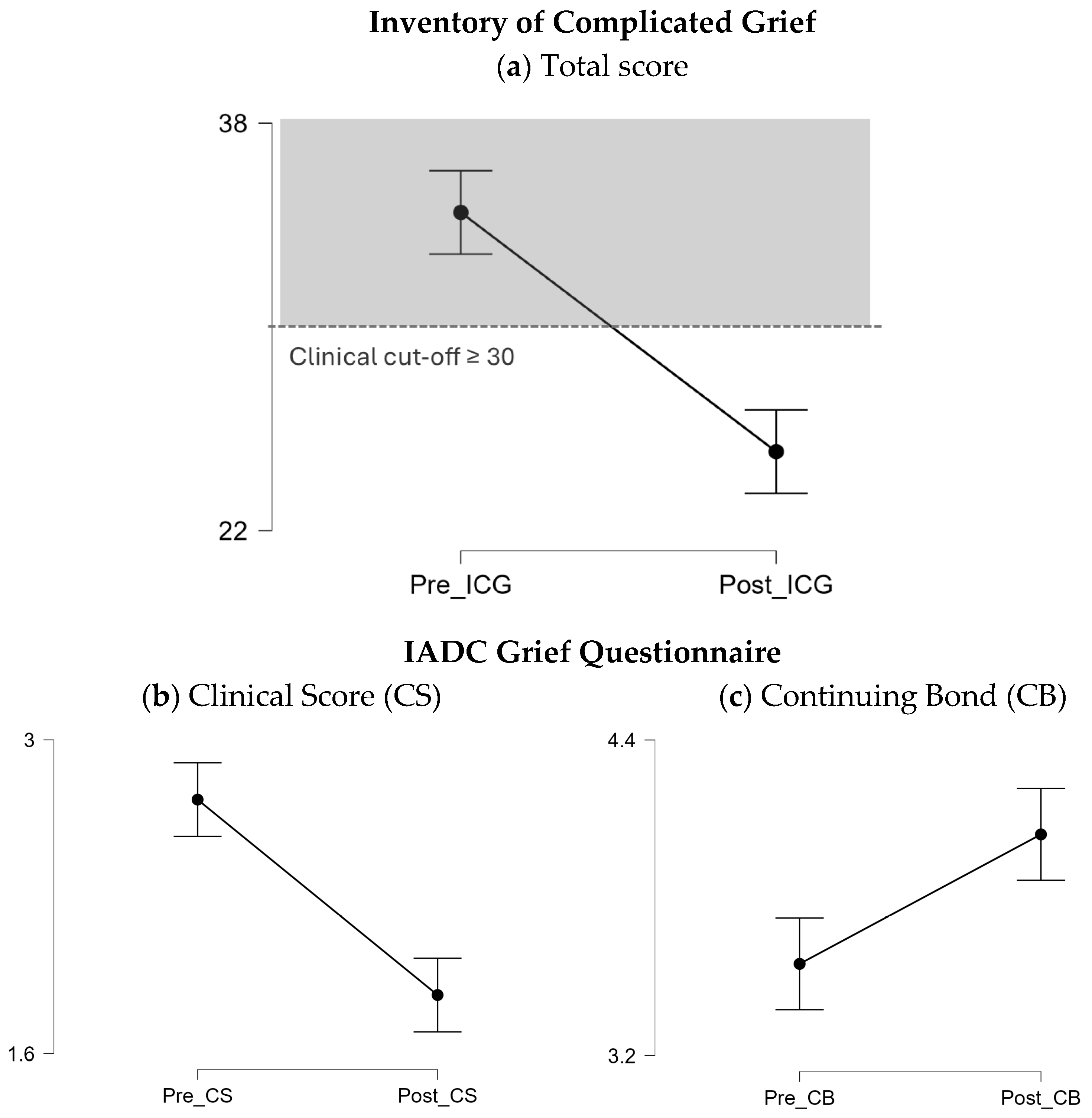
For the Inventory of Complicated Grief (ICG), results showed a significant reduction in grief symptoms from pre-intervention (M = 34.49, SD = 13.51) to post-intervention (M = 25.10, SD = 16.02) (t(72) = 8.10, p < 0.001, two-tailed, d = 0.95, 95% CI) [0.67, 1.22]. This represents a large effect size, suggesting a substantial decrease in grief-related distress following the intervention.
Similarly, a significant improvement was observed for the IADC-GQ Clinical Score (CS) subscale, with scores decreasing from pre-intervention (M = 2.73, SD = 0.91) to post-intervention (M = 1.86, SD = 1.25) (t(72) = 7.48, p < 0.001, d = 0.88, 95% CI) [0.60, 1.14]. The direction of change indicates enhanced emotional resolution and reduced suffering after the IADC process.
In contrast, the IADC-GQ Continuing Bonds (CB) subscale showed a significant increase in scores from pre-intervention (M = 3.55, SD = 1.14) to post-intervention (M = 4.04, SD = 0.97) (t(72) = –3.98, p < 0.001, d = –0.47, 95% CI) [–0.71, –0.22]. This negative t-value reflects higher post-intervention scores, consistent with the theoretical expectation of strengthened continuing bonds with the deceased.
As illustrated in Figure 1, the intervention produced a marked reduction in both clinical and grief-related distress, accompanied by an increase in adaptive continuing bonds.
Overall, these findings suggest that the therapeutic process was associated with a marked reduction in complicated grief symptoms and an adaptive reorganization of the relationship with the deceased.

Patient Satisfaction

Participant-reported satisfaction with the intervention was high. On IADC-GQ Item 10 (“Level of Satisfaction”), scores averaged M = 4.53, SD = 0.73 (range 2–5; N = 73), with no missing data. In addition to the quantitative ratings of satisfaction, participants provided open-ended comments describing their subjective experiences with IADC therapy. Thematic inspection of these responses revealed three recurrent themes: (1) perceived emotional relief and inner peace, with participants frequently reporting a profound sense of calm, reconciliation, and renewed meaning in life (e.g., “an immense inner peace,” “I feel reconciled and in harmony”); (2) a significant strengthening of the continuing bond with the deceased was observed, accompanied by an existential reorganization of the individual’s worldview, which came to encompass a renewed belief in the continuity of life beyond death (e.g., “I now believe there is something greater than us,” “my son is always with me”); and (3) appreciation of the therapist’s empathy and professionalism, which was repeatedly cited as a key factor facilitating trust and emotional openness (“the therapist worked with love and sensitivity,” “I met great humanity and empathy”).
Overall, participants described IADC as a powerful, emotionally moving, and life-changing experience that promoted acceptance of the loss and restored hope.

3.2. Associations Between Change Scores and Background Variables

3.2.1. Descriptive Statistics and Exploratory Analyses

Exploratory analyses were conducted to examine whether pre–post changes in grief-related outcomes (ICG and IADC-GQ subscales) differed across key sociodemographic or non-IADC treatment-related variables, including gender, psychotropic medication use, ongoing psychotherapy, and previous spontaneous ADC experiences. Across all comparisons, no substantial group differences emerged, indicating that the magnitude of improvement following the IADC intervention was broadly comparable regardless of these background factors or prior exposure to ADC experiences.
Additional analyses explored the potential influence of cause of death (disease, accident, suicide) and relationship to the deceased (parent, spouse/partner, child, other). One-way ANOVAs and non-parametric equivalents yielded no significant effects, suggesting that clinical improvements were not affected by the nature of the loss or the type of relationship.
Finally, Spearman’s rank correlations were computed between continuous variables (e.g., age, age of the deceased, and importance of spirituality) and clinical change indices (ΔICG, ΔCS, ΔCB). None of these associations reached statistical significance, indicating that post-intervention improvements were independent of demographic or spiritual variables. Descriptive statistics for all continuous variables and clinical cut-off frequencies are reported in Table 3.
Taken together, these exploratory findings suggest that post-intervention changes were largely independent of sociodemographic and contextual factors, providing a rationale for the subsequent regression analyses aimed at identifying specific psychological predictors of change.

3.2.2. Emotional Processing Predictors (TAS-20 and DES-II)

A series of multiple linear regressions was conducted to examine whether baseline alexithymia (TAS-20 total score) and dissociation (DES-II total score) predicted changes in grief-related outcomes, including the change in complicated grief symptoms (ΔICG), the IADC-GQ Clinical Score (ΔCS), and Continuing Bonds (ΔCB) following the intervention.
For ΔICG, the overall model was significant (F(2, 70) = 4.10, p = 0.021), accounting for approximately 10.5% of the variance (R2 = 0.105, adjusted R2 = 0.079). Higher alexithymia significantly predicted smaller reductions in grief severity (β = −0.39, p = 0.006), whereas dissociation was not a significant predictor (β = 0.18, p = 0.202).
For ΔCS, the model was not significant (F(2, 70) = 1.91, p = 0.155, R2 = 0.052, adjusted R2 = 0.025). Within this model, alexithymia showed a marginal trend toward smaller symptom reduction (β = −0.27, p = 0.062), while dissociation remained non-significant (β = 0.20, p = 0.151).
For ΔCB, the model was not significant (F(2, 70) = 0.28, p = 0.756, R2 = 0.008, adjusted R2 = −0.020). Neither alexithymia (β = −0.06, p = 0.641) nor dissociation (β = 0.10, p = 0.459) was associated with change in continuing bonds.
Across all analyses, residuals were independent (Durbin–Watson = 1.99–2.13), and multicollinearity was absent (Tolerance = 0.69, VIF = 1.45).

3.2.3. Attachment Predictors (ASQ)

Following prior validation studies of the ASQ, the five subscales were grouped into three higher-order attachment dimensions: Secure (Confidence), Anxious (Need for Approval, Preoccupation with Relationships), and Avoidant (Discomfort with Closeness, Relationships as Secondary). Mean scores for each dimension were used as predictors in regression analyses examining changes in Complicated Grief (ΔICG), Clinical Score (ΔCS), and Continuing Bonds (ΔCB) following the intervention.
For the secure dimension, the regression model predicting ΔICG approached significance (F(1, 71) = 3.57, p = 0.063), explaining 4.8% of the variance (R2 = 0.048, adjusted R2 = 0.034). Participants reporting greater confidence in close relationships tended to show larger reductions in grief intensity (β = 0.22). No significant effects emerged for ΔCS (p = 0.201) or ΔCB (p = 0.096).
For the anxious dimension, the model predicting ΔICG was significant (F(2, 70) = 4.25, p = 0.018), explaining 10.8% of the variance (R2 = 0.108, adjusted R2 = 0.083). Within this model, Need for Approval emerged as a significant negative predictor (β = −0.29, p = 0.047), indicating that higher dependence on others’ approval was associated with smaller decreases in grief symptoms, whereas Preoccupation with Relationships was non-significant (p = 0.67). The models for ΔCS (p = 0.107) and ΔCB (p = 0.325) were not significant, and none of the anxious subcomponents predicted meaningful changes in these outcomes.
Finally, for the avoidant dimension, encompassing Discomfort with Closeness and Relationships as Secondary, none of the regression models reached significance. Predictive effects were negligible for ΔICG (p = 0.611), ΔCS (p = 0.672), and ΔCB (p = 0.796), accounting for less than 2% of variance across models. No issues of multicollinearity or residual violations were detected in any analysis (VIF = 1.00 for the Secure style, VIF = 1.60 for the Anxious style, and VIF = 1.20 for the Avoidant style; Durbin–Watson ≈ 2).

3.2.4. Personality Predictors (BFI)

A series of multiple linear regression analyses was conducted to examine whether the Big Five personality traits (Extraversion, Agreeableness, Conscientiousness, Neuroticism, and Openness) predicted outcome changes following the IADC intervention. Dependent variables included changes in grief severity (ΔICG), clinical improvement (ΔCS), and continuing bonds (ΔCB).
The regression model predicting ΔICG was not statistically significant (F(5, 67) = 2.01, p = 0.088), though it explained approximately 13% of the variance (R2 = 0.13, adjusted R2 = 0.07). Among the predictors, Openness was a significant positive predictor of grief reduction (β = 0.26, p = 0.040), whereas Neuroticism showed a marginal negative association (β = −0.29, p = 0.054). The remaining traits—Extraversion, Agreeableness, and Conscientiousness—were not significant (ps > 0.16).
For ΔCS, the regression model was not significant (F(5, 67) = 1.14, p = 0.351), accounting for 7.8% of the variance (R2 = 0.08, adjusted R2 = 0.01). None of the personality traits significantly predicted clinical improvement, although lower Conscientiousness and higher Neuroticism showed non-significant tendencies toward smaller reductions in symptom severity.
Similarly, the model predicting ΔCB was not significant (F(5, 67) = 0.94, p = 0.463), explaining 6.5% of the variance (R2 = 0.07, adjusted R2 = 0.00). None of the predictors reached statistical significance, though small positive effects were observed for Extraversion (β = 0.17, p = 0.25) and Neuroticism (β = 0.19, p = 0.21).
Across all analyses, multicollinearity was absent (Tolerance = 0.59–0.82; VIF = 1.22–1.70), and residuals were independent (Durbin–Watson ≈ 2.00).
Overall, these findings indicate that stable dispositional traits, as assessed by the BFI, were not strong predictors of changes following the IADC intervention, although individuals higher in Openness appeared to experience greater grief reduction, and those higher in Neuroticism showed a weaker tendency toward improvement.
Overall, the regression analyses showed limited and small-to-moderate associations between baseline psychological variables and post–pre changes in grief-related outcomes. Alexithymia and attachment anxiety displayed the strongest, though modest, predictive effects, while personality traits contributed only marginally to the explained variance (see Table 4).

4. Discussion

The primary aim of this study was to examine individual psychological characteristics associated with the therapeutic process and outcome of Induced After-Death Communication (IADC) therapy. While previous research has established the general efficacy of IADC in alleviating grief-related distress (Botkin & Hannah, 2013; Hannah et al., 2013; Holden et al., 2019; D’Antoni et al., 2025), the present investigation sought to move beyond outcome evaluation to identify specific patient-related factors that may facilitate or hinder engagement with the intervention. In particular, the study explored the emotional dimensions (alexithymia and dissociation), attachment styles, and personality traits involved in shaping the IADC experience and its therapeutic impact. Within this framework, assessing treatment efficacy represented a necessary preliminary step for contextualizing these interindividual differences.

4.1. IADC Therapy Efficacy

The present findings provided further empirical evidence for the efficacy of Induced After-Death Communication (IADC) therapy as a brief yet highly effective intervention for individuals suffering from significant grief-related distress. The marked reduction in symptoms on both the Inventory of Complicated Grief (ICG) and the IADC-GQ Clinical Score (CS), together with large effect sizes, substantiated prior reports of IADC’s therapeutic potential (Botkin & Hannah, 2013; D’Antoni & Lalla, 2024; Hannah et al., 2013; Holden et al., 2019). The extent of improvement achieved within a two-session protocol further supported its characterization as a rapid and reliable treatment for complicated grief (Botkin, 2000). Notably, the significant increase in scores on the Continuing Bonds (CB) subscale, with a medium effect size, highlighted the capacity of IADC to foster adaptive post-loss connections. This result was consistent with contemporary grief theories emphasizing the importance of maintaining meaningful relationships with the deceased as part of healthy mourning (Klass et al., 1996; Klass & Steffen, 2018). The intervention does not deny the reality of the loss but rather reframes it through new meanings, facilitating the transformation of the relationship from one grounded on physical presence to one based on an inner sense of continued connection with the deceased loved. Such reframing allows acute grief to be transformed into integrated grief (M. Stroebe & Schut, 2010).

4.2. Influence of Participant and Loss-Related Factors on Therapeutic Outcomes

In addition to assessing overall treatment efficacy, the study examined the potential influence of individual- and loss-related variables on therapeutic outcomes. The lack of observed differences in therapeutic outcome by gender aligns with literature reporting similar prevalence rates of disturbed grief for both men and women (Lundorff et al., 2020), a finding consistent with the analysis of comparable absolute distress levels among the bereaved, which suggests that men and women suffer to a similar extent when compared directly, even though relative risk may differ (M. Stroebe, 2001).
The finding that psychotropic medication use did not correlate with therapeutic outcomes in IADC therapy is consistent with existing evidence indicating that, while pharmacological treatments may alleviate depressive symptoms in bereaved individuals, they generally do not substantially reduce the core manifestations of grief (Shah et al., 2013).
The absence of outcome differences between participants who were already engaged in psychotherapy and those who were not is consistent with previous evidence suggesting that therapeutic change in grief work depends more on the specific mechanisms activated by the intervention than on prior or concurrent treatment history (Botkin & Hannah, 2013). As highlighted by Neimeyer (2000) and Jordan and Neimeyer (2003), the effectiveness of grief therapy is largely determined by its capacity to foster meaning reconstruction and emotional integration rather than by additive effects across different psychotherapeutic approaches.
The finding that individuals who reported prior spontaneous after-death communication (ADC) experiences—phenomena often described as sources of comfort, healing, and adaptive meaning-making through the strengthening of continuing bonds with the deceased (LaGrand, 2005; Steffen & Coyle, 2011)—did not differ in their responsiveness or therapeutic outcomes following IADC therapy, suggests that the efficacy of the intervention is not contingent upon previous communication experiences. Similarly, the absence of an association between treatment outcomes and participants’ religious or spiritual background indicates that the core mechanisms of IADC operate independently of pre-existing belief systems or spiritual dispositions, underscoring the universality and psychological accessibility of the therapeutic process. Although most participants (64%) identified as Italian Catholics—a context in which intentional communication with the deceased is discouraged and deemed incompatible with the relevant theological doctrine—no differences in treatment responsiveness emerged between Catholic and non-religious participants.
The non-significant association between IADC therapeutic outcomes and established pre-loss risk factors, specifically the kinship relationship (e.g., spouse or child loss) and the circumstances of death (e.g., suddenness or illness), suggests that the intervention’s core mechanisms may effectively operate even in the presence of such factors (Hasdenteufel & Quintard, 2022; M. S. Stroebe et al., 2006).
Beyond the general efficacy of IADC therapy and its independence from demographic and contextual variables, the study also tested three hypotheses concerning potential psychological predictors of therapeutic change. These analyses explored whether emotional processing capacities, attachment dimensions, and personality traits influenced individual responsiveness to the intervention.

4.3. Emotional Processing Predictors

All participants had experienced their loss at least six months before treatment, placing the sample beyond the period typically associated with peri-loss dissociation (Bui et al., 2013). Peritraumatic or peri-loss dissociation can disrupt the encoding and storage of memories related to the death, preventing their integration into autobiographical knowledge and thereby maintaining acute grief reactions (Boelen, 2015). The DES-II scores in this study thus reflected individual differences in chronic dissociative tendencies, which may or may not have originated from peritraumatic mechanisms. Although some studies have unexpectedly reported that peritraumatic dissociation may be associated with better outcomes in grief therapy, this finding remains controversial, as dissociation is generally considered a negative predictor of psychotherapy response (Bui et al., 2013; Kleindienst et al., 2025; Mattos et al., 2016; Spitzer et al., 2007). In this study, however, no significant associations emerged between baseline dissociation and IADC therapy outcomes. This suggests that IADC may operate through mechanisms capable of overcoming or neutralizing the cognitive–emotional barriers typically linked to dissociative processes. Moreover, this finding reinforces the interpretation that the multisensory experiences reported during IADC are not indicative of hallucinatory or psychopathological phenomena associated with high dissociative absorption or depersonalization (Kamp et al., 2019; Prigerson et al., 1995) but rather reflect integrative emotional processes (D’Antoni et al., 2025). Indeed, the IADC therapy procedure explicitly anchors the patient in the present moment through continuous relational contact and verbal reporting of the experience to the therapist, thereby fostering grounded awareness and preventing dissociative detachment. Therefore, contrary to the initial hypothesis that higher dissociative tendencies would hinder engagement with the IADC process by fragmenting emotional awareness and integration, the results showed no significant association between baseline dissociation and therapeutic outcomes, suggesting the therapeutic process unfolds independently from dissociative mechanisms.
In contrast to dissociation, alexithymia emerged as a significant negative predictor of therapeutic outcome in IADC therapy, confirming the first hypothesis that higher difficulties in identifying and expressing emotions were associated with reduced clinical benefit. Indeed, alexithymia involves poor emotional awareness and reduced affective engagement, leading to a flattened emotional experience even in highly charged situations (Luminet et al., 2018). Therefore, alexithymia can be a risk factor for the development and maintenance of complicated grief, as it hinders the individual’s ability to cognitively and emotionally process the loss (Nakao et al., 2005). Within the IADC framework, it can be hypothesized that alexithymia limits the individual’s capacity to access the pain of loss during the preparatory emotional processing phase preceding the communication experience. Indeed, alexithymia emerged as a significant negative predictor of clinical improvement. It appears to limit the individual’s exposure to the pain of loss during the therapeutic process that precedes the IADC experience. This defensive restriction of emotional awareness may consequently reduce the mental receptivity that follows abreaction and, ultimately, diminish the intensity of the corrective emotional experience induced by IADC. Moreover, in such cases, the emotional component of the IADC experience may be further muted as it unfolds, with attenuated subjective feelings of joy, tenderness, or transcendence. Once again, this would reduce the intensity of the IADC experience.

4.4. Attachment Predictors

Consistent with prior evidence linking attachment security to better psychotherapy outcomes (Levy et al., 2018), results showed that greater confidence in close relationships was associated—albeit marginally—with larger reductions in grief intensity. The direction of the effect suggests that individuals with higher relational security may benefit more from the intervention, likely because they can engage emotionally and integrate the experience within a supportive internal framework.
In contrast, the anxious attachment dimension correlated negatively with outcome. However, among the attachment dimensions assessed, only the Need for Approval subscale—reflecting an anxious and dependency-based attachment orientation (Feeney et al., 1994)—emerged as a significant negative predictor of outcome, whereas Preoccupation with Relationships subscale did not. This suggests that dependence on external validation, rather than mere relational preoccupation, may be the core factor that constrains the emergence of the IADC experience. Within the IADC context, the “other” assumes two forms: the psychotherapist and the deceased loved one. The Need for Approval would appear to pertain mainly to the latter.
Patients with anxious attachment are more prone to fears of rejection, abandonment, and of not being “worthy” of the connection. They often experience inner questions and thoughts such as the following: “What if my loved one does not come because they are disappointed in me?”, “If my loved one does not come, does that mean I’m worthless to them?”, “What if they are busy elsewhere?”, “Will I be able to meet their expectations and not let them down?”, “What if I do something wrong and ruin everything?”, and “I need to try harder to deserve this experience”. The deceased tends to be perceived as a potentially judgmental presence rather than as a predominantly loving one. These concerns can be understood as manifestations of the same affective schema: an intensified need for acknowledgment, acceptance, or at least non-rejection by the significant other, even when that other is no longer physically alive. Such preoccupations may give rise to a form of performance anxiety that expresses the desire to control the outcome and avoid failure, imposing excessive top-down control. Anticipatory tension and self-monitoring may emerge, interfering with the spontaneous and receptive attitude required for the experience to occur or to reach its full development. Such preoccupations can impair the possibility, depth, and fluidity of spontaneous mental processes, including the IADC experience itself. The therapist’s function is to help the patient’s mind shift from the mode of making things happen to that of letting things happen.
As psychotherapists who accompany grieving clients through IADC therapy well know, reluctance to face one’s own pain and performance anxiety are the two main reasons why the attempt to reach the experience may fail, or why it may develop only partially.

4.5. Personality Predictors

In light of prior research, the five major personality dimensions have been shown to act as either positive or negative predictors of treatment outcome in interpretive and supportive short-term group therapy addressing complicated grief (Ogrodniczuk et al., 2003). In the present study, we examined the predictive role of the Big Five in IADC Therapy, a psychotherapeutic approach that is neither interpretive nor supportive but primarily experiential. Our results are only partially aligned with the findings of the aforementioned study. Among the Big Five traits, Openness emerged as the only significant positive predictor of grief reduction, whereas Neuroticism showed a weak and inverse association with therapeutic gains. The other traits—Extraversion, Agreeableness, and Conscientiousness—were not meaningfully related to treatment outcomes. Openness is typically characterized by intellectual curiosity, cognitive and experiential flexibility, and a rich capacity for engaging with inner experiential processes. These characteristics may support fuller engagement with the phenomenological dimensions of the IADC experience and facilitate the adaptive reorganization of meaning following the encounter. Conversely, higher Neuroticism—particularly its self-critical monitoring component—may interfere with the spontaneous and trusting stance required for the IADC experience to emerge and be consolidated at an integrative level, although this effect was marginal in our sample.
Overall, these results indicate that IADC therapy operates in a manner largely independent of enduring personality traits, reinforcing the notion that its efficacy relies on the corrective emotional experience to which it gives rise rather than on dispositional characteristics. It may therefore offer comparable therapeutic opportunities across diverse personality profiles.

4.6. Clinical Implications and Potential Refinements of the IADC Therapy Protocol

Identifying these two negative predictors—alexithymia and Need for Approval—offers valuable guidance for clinical practice. Their assessment prior to initiating IADC therapy may help clinicians anticipate potential obstacles in the unfolding of the therapeutic process. Brief pre-session evaluations can be incorporated to identify clients with high levels of alexithymia or Need for Approval. For this purpose, the TAS-20 and the ASQ may currently be used.
With regard to the therapeutic implications of the present study, one might naturally consider referring to psychotherapeutic models that have been empirically validated for the treatment of alexithymia (e.g., Tsubaki & Shimizu, 2024) or for addressing the Need for Approval (e.g., Strauß et al., 2018).
On the other hand, although the present study was not designed to test specific intervention strategies, we propose some clinically informed suggestions that may help manage and, when possible, mitigate the interfering effects of alexithymia and the Need for Approval on the process and outcomes of IADC therapy.
From an attachment–theoretical perspective, it is essential first to promote a secure base within the therapeutic relationship. The primary therapeutic goal is to foster a sense of relational safety in which the patient’s emotional expression no longer entails the risk of rejection and they feel they can rely on a strong, wise, and accepting figure.
It is also necessary to emphasize certain procedural aspects that, while generally important, become even more critical when negative predictors are present. Specific operational adaptations should therefore be implemented to address the obstacles posed by alexithymia and Need for Approval. Such adaptations differ depending on which of the two predictive factors predominates. Future research should empirically evaluate the effectiveness of these approaches.

4.6.1. When Addressing Alexithymia

In our clinical experience with IADC therapy, certain adaptations appear particularly relevant when alexithymic traits are present. The primary goal is to help the patient engage with their emotional pain during the abreactive phase of the intervention. Clinical experience suggests the following measures may be helpful:
  • First, identify which aspect of the loss is most salient for the patient, whether it concerns the loss they have suffered of their loved one, or the loss the loved one suffered of their health and life. Although this distinction is fundamental for all patients, it becomes especially critical when working with individuals who exhibit alexithymic characteristics.
  • Direct the patient’s attention back to the fact that the loved one has died. This may seem self-evident, but as Bowlby’s studies demonstrates (Bowlby, 1980), cognitive awareness of death does not always coincide with emotional acknowledgment.
  • The therapist may put the patient’s pain into words and, when appropriate, invite them to repeat those words.
  • During bilateral stimulation the therapist may use figurative or metaphorical phrases to foster contact with the loss, such as “Embrace your pain as you are now embracing your body” (if the patient is using the “butterfly hug”) or “Within you there is an ocean of tears: allow some of them to flow from your eyes.”

4.6.2. When Addressing the Need for Approval

From a pragmatic standpoint, the following interventions may help reduce the impact of the Need for Approval and performance anxiety:
  • The therapist displays confidence in the successful outcome of the process, thereby conveying reassurance to the patient and reducing performance anxiety.
  • It is important to recall what is already established within IADC therapy, namely that it may be clinically useful to convey to the patient the expectation that the first session primarily serves as a preparatory phase, whereas the experience itself is more likely to emerge during the second session. Communicating this therapeutic framework can help reduce performance-related anxiety and, in turn, may facilitate the emergence of the experience even during the first session.
  • Part of the language used in the induction can be gradually introduced during the abreaction phase, inviting the client, after each set of stimulations, to close their eyes and allow any images or thoughts to emerge spontaneously. In this way, when the time comes for the formal facilitation, the words will sound familiar and devoid of performative tension. This represents a metaphorical application of the first of the Thirty-Six Taoist Stratagems (von Senger, 1993): “Cross the sea without the sky noticing.”
  • Consistent with this approach, when the time for the facilitation arrives, the therapist proceeds without explicitly naming it, thereby making performance anxiety less likely to arise.
  • When the patient has already abreacted, their sadness has subsided, and they are in a state of emotional relief, the sets of bilateral stimulations used to induce the receptive state can be introduced by framing them as a brief restorative pause following the intense exposure to the pain of the loss.
  • If the patient appears ready but the experience does not emerge, they can be invited to mentally formulate a question for the deceased as a simple exercise rather than a genuine attempt (“If you were later given the chance to speak with your loved one, what would you ask them?”). This helps reduce performance anxiety and may facilitate the emergence of the experience of a telepathic-verbal response within the very set in which the question is asked.
  • Once the IADC experience has begun, the therapist avoids having the patient immediately address the issues most likely to provoke performance anxiety (e.g., those related to feelings of guilt), postponing them until the patient’s trust in the stability and unfolding of the experience has been established.
  • When the communication experience has just begun and the patient is uncertain whether it will continue, performance anxiety may arise. A useful strategy is to allow space for a communication experience with other affectively significant deceased loved ones toward whom no acute grief is felt. In the receptive state, these loved ones may either enter the communication experience spontaneously or be involved through a question posed to them by the patient. In such cases, experiencing a reconnection with a deceased loved one who does not evoke performance anxiety—because there is no urgent need to communicate with them—allows the patient to spend a few moments in communication, thereby strengthening trust in the overall continuation and stability of the experience and further reducing performance anxiety. Once trust in the continuation and stability of the communication experience has increased, the patient may then return to the experience of communicating with the deceased loved one toward whom the acute grief is felt. Further research is needed to systematically evaluate the effectiveness of these proposed adaptations.

4.6.3. Terminological Considerations and Conceptual Refinement

Whether the operational adaptations outlined above are understood as a microevolution within IADC therapy or as a macroevolution that gives rise to a distinct clinical model, they extend beyond the boundaries defined by the IADC protocol and the IADC® brand. To minimize conceptual and clinical ambiguity, a lexical revision is therefore required to designate this now non-standard, more versatile, and more differentiated model. Moreover, such a redefinition enhances conceptual precision by ensuring that the terminology employed accurately reflects the processes involved, including those occurring within IADC therapy itself.
The technical term “Induced After-Death Communication” (IADC) presents several conceptual and terminological limitations that reduce its adequacy within contemporary clinical and scientific discourse. The descriptor “induced” misleadingly implies a direct causal role of the therapist in generating the experience rather than facilitating a psychological state in which subjective phenomena may emerge autonomously. Likewise, the component “after” is non-idiomatic in clinical English, where post- is the standard prefix for describing phenomenological configurations. The explicit reference to “death” further shifts the conceptual focus toward the ontological status of the deceased rather than the lived experience of the bereaved individual. Finally, the term “communication” presupposes the existence of an external communicative agent—a metaphysical assumption on which scientific inquiry must suspend judgment within a scientifically neutral framework. In addition, as our findings indicate, many patients report Near-Death Experiences (NDEs) in the course of therapy, whose experiential profile is not reducible only to a communicative phenomenology involving the deceased but instead incorporates it within a broader and more complex experiential pattern. Collectively, these limitations underscore the need for terminology that remains phenomenologically descriptive and theoretically neutral, such as Emergent Post-Loss Experience (EPLE) to refer to the experience, and Reparative Experience-Based Grief Therapy (REGT) to designate the treatment model, thereby avoiding the conceptual difficulties introduced by the expression Induced After-Death Communication.
From a clinical perspective, the transition from Induced After-Death Communication to Emergent Post-Loss Experience (EPLE) supports a therapeutic model that prioritizes the patient’s subjective account without imposing assumptions about the origin or nature of the experience. By focusing on the descriptive qualities of the patient’s lived experience—its emotional tone, sensory characteristics, and personal meaning—the clinician can attend to these phenomena in a way that is both therapeutically useful and epistemologically neutral. Within this framework, EPLE provides terminology that helps clinicians explore how such experiences function in the patient’s adaptation to loss, without framing them ontologically. This, in turn, enables more flexible and patient-centered interventions, allowing the therapist to validate the experience, assess its clinical significance, and facilitate its integration into the broader grieving process.
Although the present study has retained the established term “IADC” for consistency with prior literature, our future publications will adopt EPLE as a descriptor of the corrective emotional experiences that can be elicited in grief therapy.

4.7. Limitations and Future Research

Despite its promising findings, this study presents several limitations that should be considered when interpreting the results. First, the use of a single-group pre–post design without a control condition limits the ability to infer causal effects of the IADC intervention. Although the large effect sizes observed align with previous controlled studies (e.g., Holden et al., 2019), future research should include randomized controlled trials to strengthen the evidence base. Second, all measures were self-reported and therefore subject to potential response biases, including social desirability and retrospective distortion. Incorporating clinician-rated or physiological measures of emotional regulation could enhance the objectivity of future investigations.
Another limitation concerns the predominantly female and self-selected sample, which may restrict the generalizability of findings. Future studies should aim to recruit more gender-balanced and clinically diverse samples—possibly including individuals with Prolonged Grief Disorder or comorbid conditions—to better delineate the range of applicability of both IADC and REGT. Moreover, longitudinal research is warranted to assess the long-term stability of grief reduction and continuing bond integration. Combining quantitative and qualitative methodologies would enable a richer exploration of how cognitive, emotional, behavioral, and relational processes interact over time to shape the enduring impact of the Emergent Post-Loss Experience (EPLE).
Another important direction concerns the therapeutic relationship, an underexplored variable within the IADC framework. Unlike traditional psychotherapies, experiential grief therapies are often conducted with clients previously unknown to the therapist and within only two sessions, allowing limited time for the gradual development of a therapeutic alliance. Future studies should examine how relational factors—such as perceived therapist empathy, trust, and the rapid establishment of emotional safety—mediate treatment outcomes. A deeper understanding of these relational dynamics could inform both the refinement of clinical procedure to enhance the intervention’s effectiveness and therapist training.
Finally, although all participants in this sample reported having experienced an encounter with their deceased loved one, the present study did not include a systematic qualitative or quantitative assessment of the phenomenological characteristics of these experiences. This represents a crucial direction for future research. The development of a standardized EPLE Scale would allow for the detailed examination of the contents, sensory modalities, and meaning-making processes, emotional dynamics, and existential change associated with these experiences.

5. Conclusions

In this pre–post study, Induced After-Death Communication (IADC) therapy—delivered in two sessions—was associated with substantial reductions in grief-related distress and strengthened adaptive continuing bonds, indicating a rapid transition toward integrated grief. Improvements were consistent across demographic and contextual factors, suggesting broad applicability of the IADC approach. Regarding psychological predictors, dissociation was unrelated to therapeutic outcomes, whereas alexithymia emerged as a negative predictor, consistent with the importance of accessing one’s emotional pain in the IADC therapeutic process. Among attachment dimensions, only Need for Approval consistently predicted poorer outcomes, as it generates performance anxiety in relation to an experience that is, by its very nature, completely spontaneous. Personality traits, by contrast, showed limited influence.
Collectively, these findings suggest that the therapeutic benefits of IADC Therapy are mediated by an experience that promotes meaning reconstruction and that can be impeded by alexithymia and Need for Approval. Brief screening for alexithymia and Need for Approval can help identify these potential sources of absent or diminished treatment response. Tailored procedural adaptations may then help mitigate—and, when possible, neutralize—their interfering and antitherapeutic effects.
Taken together, these targeted adaptations characterize the framework of Reparative Experience-Based Therapy (REGT).

Author Contributions

Conceptualization, F.D. and C.L.; methodology, F.D.; software, F.D.; validation, F.D. and C.L.; formal analysis, F.D.; investigation, F.D. and C.L.; resources F.D. and C.L.; data curation, F.D.; writing—original draft preparation, F.D. and C.L.; writing—review and editing F.D. and C.L.; visualization, F.D.; supervision, C.L.; project administration, C.L. All authors have read and agreed to the published version of the manuscript.

Funding

This research received no external funding.

Institutional Review Board Statement

The study was conducted in accordance with the guidelines of the Declaration of Helsinki. Ethical review and approval were waived for this study because it involved a non-interventional, observational pre–post design conducted within routine psychotherapeutic practice in private clinical settings, without randomization or experimental manipulation, and with no additional risks or burden for participants beyond standard psychotherapeutic care. All participants provided written informed consent prior to participation. Data were collected using a pseudonymized procedure and subsequently analyzed in a fully anonymized form. The study complied with the Italian Psychologists’ Code of Ethics (Article 9): https://www.psy.it/la-professione-psicologica/codice-deontologico-degli-psicologi-italiani/codice-deontologico-vigente/ (accessed on 30 December 2025).

Informed Consent Statement

In accordance with the National Board of Italian Psychologists’ Code of Ethics, informed consent was obtained from all participants involved in the study.

Data Availability Statement

Data is contained within the article.

Conflicts of Interest

The authors declare no conflicts of interest.

Abbreviations

The following abbreviations are used in this manuscript:
EPLEEmergent Post-Loss Experience
REGTReparative Experience-Based Grief Therapy
IADCInduced After-Death Communication
NDENear Death Experience
ICGInventory of Complicated Grief
IADC-GQIADC Grief Questionnaire
TASToronto Alexithymia Scale
DESDissociative Experiences Scale
ASQAttachment Style Questionnaire
BFIBig Five Inventory

References

  1. Bagby, R. M., Parker, J. D., & Taylor, G. J. (1994a). The twenty-item Toronto Alexithymia scale—I. Item selection and cross-validation of the factor structure. Journal of Psychosomatic Research, 38(1), 23–32. [Google Scholar] [CrossRef] [PubMed]
  2. Bagby, R. M., Taylor, G. J., & Parker, J. D. (1994b). The twenty-item Toronto Alexithymia scale—II. Convergent, discriminant, and concurrent validity. Journal of Psychosomatic Research, 38(1), 33–40. [Google Scholar] [CrossRef]
  3. Boelen, P. A. (2015). Peritraumatic distress and dissociation in prolonged grief and posttraumatic stress following violent and unexpected deaths. Journal of Trauma & Dissociation, 16(5), 541–550. [Google Scholar] [CrossRef]
  4. Botkin, A. L. (2000). The induction of after-death communications utilizing eye-movement desensitization and reprocessing: A new discovery. Journal of Near-Death Studies, 18(3), 181–209. [Google Scholar] [CrossRef]
  5. Botkin, A. L., & Hannah, T. M. (2013). Brief Report: Psychotherapeutic Outcomes Reported by Therapists Trained in Induced After-Death Communication. Journal of Near-Death Studies, 31(4), 221–224. [Google Scholar] [CrossRef]
  6. Botkin, A. L., & Hogan, R. C. (2005). Induced after-death communication: A new therapy for healing grief and trauma. Hampton Roads Publishing. [Google Scholar]
  7. Bowlby, J. (1980). Attachment and loss: Vol. 3. Loss, sadness and depression. Basic Books. [Google Scholar]
  8. Bressi, C., Taylor, G., Parker, J., Bressi, S., Brambilla, V., Aguglia, E., Allegranti, I., Bongiorno, A., Giberti, F., Bucca, M., Todarello, O., Callegari, C., Vender, S., Gala, C., & Invernizzi, G. (1996). Cross validation of the factor structure of the 20-item Toronto Alexithymia scale: An Italian multicenter study. Journal of Psychosomatic Research, 41(6), 551–559. [Google Scholar] [CrossRef] [PubMed]
  9. Bui, E., Simon, N. M., Robinaugh, D. J., Leblanc, N. J., Wang, Y., Skritskaya, N. A., Mauro, C., & Shear, M. K. (2013). Periloss dissociation, symptom severity, and treatment response in complicated grief. Depression and Anxiety, 30(2), 123–128. [Google Scholar] [CrossRef]
  10. Carlson, E. B., & Putnam, F. W. (1993). An update on the dissociative experiences scale. Dissociation: Progress in the Dissociative Disorders, 6(1), 16–27. [Google Scholar]
  11. Carmassi, C., Shear, M. K., Massimetti, G., Wall, M., Mauro, C., Gemignani, S., Conversano, C., & Dell’Osso, L. (2014). Validation of the Italian version Inventory of Complicated Grief (ICG): A study comparing CG patients versus bipolar disorder, PTSD and healthy controls. Comprehensive Psychiatry, 55(5), 1322–1329. [Google Scholar] [CrossRef]
  12. Cassidy, J. (1994). Emotion regulation: Influences of attachment relationships. Monographs of the Society for Research in Child Development, 59(2–3), 228–249. [Google Scholar] [CrossRef]
  13. D’Antoni, F., Feruglio, S., Matiz, A., Cantone, D., & Crescentini, C. (2022). Mindfulness meditation leads to increased dispositional mindfulness and interoceptive awareness linked to a reduced dissociative tendency. Journal of Trauma & Dissociation: The Official Journal of the International Society for the Study of Dissociation (ISSD), 23(1), 8–23. [Google Scholar] [CrossRef]
  14. D’Antoni, F., & Lalla, C. (2024). The IADC grief questionnaire as a brief measure for complicated grief in clinical practice and research: A preliminary study. Psych, 6(1), 196–209. [Google Scholar] [CrossRef]
  15. D’Antoni, F., Pulvirenti, I., D’Orlando, A., Claudio, V., & Lalla, C. (2025). Induced After-Death Communication (IADC) therapy: An effective and quick intervention to cope with grief. Psychology International, 7(1), 25. [Google Scholar] [CrossRef]
  16. Feeney, J. A., Noller, P., & Hanrahan, M. (1994). Assessing adult attachment. In M. B. Sperling, & W. H. Berman (Eds.), Attachment in adults: Clinical and developmental perspectives (pp. 128–152). Guilford Press. [Google Scholar]
  17. Fossati, A., Feeney, J. A., Donati, D., Donini, M., Novella, L., Bagnato, M., Acquarini, E., & Maffei, C. (2003). On the dimensionality of the attachment style questionnaire in Italian clinical and nonclinical participants. Journal of Social and Personal Relationships, 20(1), 55–79. [Google Scholar] [CrossRef]
  18. Fraley, R. C., & Bonanno, G. A. (2004). Attachment and loss: A test of three competing models on the association between attachment-related avoidance and adaptation to bereavement. Personality & Social Psychology Bulletin, 30(7), 878–890. [Google Scholar] [CrossRef]
  19. Fraley, R. C., & Shaver, P. R. (2000). Adult romantic attachment: Theoretical developments, emerging controversies, and unanswered questions. Review of General Psychology, 4(2), 132–154. [Google Scholar] [CrossRef]
  20. Goetter, E., Bui, E., Horenstein, A., Baker, A. W., Hoeppner, S., Charney, M., & Simon, N. M. (2019). Five-factor model in bereaved adults with and without complicated grief. Death Studies, 43(3), 204–209. [Google Scholar] [CrossRef]
  21. Guggenheim, B., & Guggenheim, J. (1995). Hello from heaven: A new field of research—After-death communication confirms that life and love are eternal. Bantam Books. [Google Scholar]
  22. Hannah, M. T., Botkin, A. L., Marrone, J. G., & Streit-Horn, J. (2013). Induced after-death communication: An update. Journal of Near-Death Studies, 31(4), 213–220. [Google Scholar] [CrossRef]
  23. Hasdenteufel, M., & Quintard, B. (2022). Psychosocial factors affecting the bereavement experience of relatives of palliative-stage cancer patients: A systematic review. BMC Palliative Care, 21(1), 212. [Google Scholar] [CrossRef] [PubMed]
  24. Holden, J. M., St. Germain-Sehr, N. R., Reyes, A., Loseu, S., Schmit, M. K., Laird, A., Weintraub, L., St. Germain-Sehr, A., Price, E., Blalock, S., Bevly, C., Lankford, C., & Mandalise, J. (2019). Comparative effects of induced after-death communication and traditional talk therapy on grief. Grief Matters: The Australian Journal of Grief and Bereavement, 22(1), 4–9. [Google Scholar]
  25. Houck, J. A. (2005). The universal, multiple, and exclusive experiences of after-death communication. Journal of Near-Death Studies, 24, 117–127. [Google Scholar] [CrossRef]
  26. Jerga, A. M., Shaver, P. R., & Wilkinson, R. B. (2011). Attachment insecurity and disordered grief. Journal of Social and Personal Relationships, 28(5), 684–706. [Google Scholar]
  27. John, O. P., & Srivastava, S. (1999). The Big-Five trait taxonomy: History, measurement, and theoretical perspectives. In L. A. Pervin, & O. P. John (Eds.), Handbook of personality: Theory and research (Vol. 2, pp. 102–138). Guilford Press. [Google Scholar]
  28. Jordan, J. R., & Neimeyer, R. A. (2003). Does grief counseling work? Death Studies, 27(9), 765–786. [Google Scholar] [CrossRef]
  29. Kamp, K. S., O’Connor, M., Spindler, H., & Moskowitz, A. (2019). Bereavement hallucinations after the loss of a spouse: Associations with psychopathological measures, personality and coping style. Death Studies, 43(4), 260–269. [Google Scholar] [CrossRef]
  30. Klass, D., Silverman, P. R., & Nickman, S. (Eds.). (1996). Continuing bonds: New understandings of grief (1st ed.). Taylor & Francis. [Google Scholar] [CrossRef]
  31. Klass, D., & Steffen, E. M. (Eds.). (2018). Continuing bonds in bereavement: New directions for research and practice. Routledge/Taylor & Francis Group. [Google Scholar]
  32. Kleindienst, N., Steil, R., Priebe, K., Müller-Engelmann, M., Lindauer, P., Krause-Utz, A., Friedmann, F., Schmahl, C., Enning, F., & Bohus, M. (2025). Is dissociation predicting the efficacy of psychological therapies for PTSD? Results from a randomized controlled trial comparing Dialectical Behavior Therapy for PTSD (DBT-PTSD) and Cognitive Processing Therapy (CPT). Psychological Medicine, 55, e59. [Google Scholar] [CrossRef]
  33. LaGrand, L. E. (2005). The nature and therapeutic implications of the extraordinary experiences of the bereaved. Journal of Near-Death Studies, 24(1), 3–20. [Google Scholar] [CrossRef]
  34. Lalla, C. (2021). Perdita e ricongiungimento: Comunicare con i propri cari oltre il tempo della loro vita. Edizioni Mediterranee. [Google Scholar]
  35. Lalla, C., & D’Antoni, F. (2025). Induced After-Death Communication (IADC) experience and Near-Death Experience (NDE): Two variations of a single phenomenon. Psychology International, 7(3), 66. [Google Scholar] [CrossRef]
  36. Lazarus, R. S. (1991). Emotion and adaptation. Oxford University Press. [Google Scholar]
  37. Levy, K. N., Kivity, Y., Johnson, B. N., & Gooch, C. V. (2018). Adult attachment as a predictor and moderator of psychotherapy outcome: A meta-analysis. Journal of Clinical Psychology, 74(11), 1996–2013. [Google Scholar] [CrossRef]
  38. Luminet, O., Bagby, R. M., & Taylor, G. J. (Eds.). (2018). Alexithymia: Advances in research, theory, and clinical practice. Cambridge University Press. [Google Scholar]
  39. Lundorff, M., Bonanno, G. A., Johannsen, M., & O’Connor, M. (2020). Are there gender differences in prolonged grief trajectories? A registry-sampled cohort study. Journal of Psychiatric Research, 129, 168–175. [Google Scholar] [CrossRef]
  40. Mattos, P. F., Pedrini, J. A., Fiks, J. P., & de Mello, M. F. (2016). The concept of peritraumatic dissociation: A qualitative approach. Qualitative Health Research, 26(7), 1005–1014. [Google Scholar] [CrossRef] [PubMed]
  41. Mikulincer, M., & Shaver, P. R. (2007). Attachment in adulthood: Structure, dynamics, and change. Guilford Press. [Google Scholar]
  42. Nakao, M., Kashiwagi, M., & Yano, E. (2005). Alexithymia and grief reactions in bereaved Japanese women. Death Studies, 29(5), 423–433. [Google Scholar] [CrossRef]
  43. Neimeyer, R. A. (2000). Searching for the meaning of meaning: Grief therapy and the process of reconstruction. Death Studies, 24(6), 541–558. [Google Scholar] [CrossRef] [PubMed]
  44. Neimeyer, R. A. (2001). Meaning reconstruction and the experience of loss. American Psychological Association. [Google Scholar] [CrossRef]
  45. Neimeyer, R. A. (2006). Lessons of loss: A guide to coping. Center for the Study of Loss and Transition. [Google Scholar]
  46. Ogrodniczuk, J. S., Piper, W. E., & Joyce, A. S. (2011). Effect of alexithymia on the process and outcome of psychotherapy: A programmatic review. Psychiatry Research, 190(1), 43–48. [Google Scholar] [CrossRef] [PubMed]
  47. Ogrodniczuk, J. S., Piper, W. E., Joyce, A. S., McCallum, M., & Rosie, J. S. (2003). NEO five factor personality traits as predictors of response to two forms of group psychotherapy. International Journal of Group Psychotherapy, 53(4), 417–442. [Google Scholar] [CrossRef] [PubMed]
  48. Prigerson, H. G., Maciejewski, P. K., Reynolds, C. F., 3rd, Bierhals, A. J., Newsom, J. T., Fasiczka, A., Frank, E., Doman, J., & Miller, M. (1995). Inventory of Complicated Grief: A scale to measure maladaptive symptoms of loss. Psychiatry Research, 59(1–2), 65–79. [Google Scholar] [CrossRef]
  49. Russ, V., Stopa, L., Sivyer, K., Hazeldine, J., & Maguire, T. (2024). The relationship between adult attachment and complicated grief: A systematic review. Omega, 89(4), 1293–1319. [Google Scholar] [CrossRef]
  50. Scherer, K. R. (2001). Appraisal considered as a process of multilevel sequential checking. In K. R. Scherer, A. Schorr, & T. Johnstone (Eds.), Appraisal processes in emotion (pp. 92–120). Oxford University Press. [Google Scholar]
  51. Schimmenti, A. (2016). Dissociative experiences and dissociative minds: Exploring a nomological network of dissociative functioning. Journal of Trauma & Dissociation: The Official Journal of the International Society for the Study of Dissociation (ISSD), 17(3), 338–361. [Google Scholar] [CrossRef]
  52. Shah, S. M., Carey, I. M., Harris, T., DeWilde, S., Victor, C. R., & Cook, D. G. (2013). Initiation of psychotropic medication after partner bereavement: A matched cohort study. PLoS ONE, 8(11), e77734. [Google Scholar] [CrossRef]
  53. Shapiro, F. (2018). Eye movement desensitization and reprocessing (EMDR) therapy: Basic principles, protocols, and procedures (3rd ed.). The Guilford Press. [Google Scholar]
  54. Solomon, R. M., & Shapiro, F. (2008). EMDR and the adaptive information processing model: Potential mechanisms of change. Journal of EMDR Practice and Research, 2(4), 315–325. [Google Scholar] [CrossRef]
  55. Spitzer, C., Barnow, S., Freyberger, H. J., & Grabe, H. J. (2007). Dissociation predicts symptom-related treatment outcome in short-term inpatient psychotherapy. The Australian and New Zealand Journal of Psychiatry, 41(8), 682–687. [Google Scholar] [CrossRef]
  56. St. Germain-Sehr, N. R., & Maxey, G. A. (2019). Case studies in Induced After-Death Communication (IADC). Grief Matters: The Australian Journal of Grief and Bereavement, 22(1), 18–21. [Google Scholar]
  57. Steffen, E., & Coyle, A. (2011). Sense of presence experiences and meaning-making in bereavement: A qualitative analysis. Death Studies, 35(7), 579–609. [Google Scholar] [CrossRef] [PubMed]
  58. Strauß, B., Altmann, U., Manes, S., Tholl, A., Koranyi, S., Nolte, T., Beutel, M. E., Wiltink, J., Herpertz, S., Hiller, W., Hoyer, J., Joraschky, P., Nolting, B., Ritter, V., Stangier, U., Willutzki, U., Salzer, S., Leibing, E., Leichsenring, F., & Kirchmann, H. (2018). Changes of attachment characteristics during psychotherapy of patients with social anxiety disorder: Results from the SOPHO-Net trial. PLoS ONE, 13(3), e0192802. [Google Scholar] [CrossRef]
  59. Stroebe, M. (2001). Gender differences in adjustment to bereavement: An empirical and theoretical review. Review of General Psychology, 5(1), 62–83. [Google Scholar] [CrossRef][Green Version]
  60. Stroebe, M., & Schut, H. (2010). The dual process model of coping with bereavement: A decade on. Omega, 61(4), 273–289. [Google Scholar] [CrossRef]
  61. Stroebe, M. S., Folkman, S., Hansson, R. O., & Schut, H. (2006). The prediction of bereavement outcome: Development of an integrative risk factor framework. Social Science & Medicine, 63(9), 2440–2451. [Google Scholar] [CrossRef]
  62. Tsubaki, K., & Shimizu, E. (2024). Psychological Treatments for Alexithymia: A Systematic Review. Behavioral Sciences, 14(12), 1173. [Google Scholar] [CrossRef]
  63. Ubbiali, A., Chiorri, C., Hampton, P., & Donati, D. (2013). Psychometric properties of the Italian adaptation of the Big Five Inventory (BFI). Bollettino di Psicologia Applicata, 266, 37–48. [Google Scholar]
  64. von Senger, H. (1993). The book of stratagems: Tactics for triumph and survival. Penguin Books. [Google Scholar]
  65. Waller, N., Putnam, F. W., & Carlson, E. B. (1996). Types of dissociation and dissociative types: A taxometric analysis of dissociative experiences. Psychological Methods, 1(3), 300–321. [Google Scholar] [CrossRef]
  66. Woollacott, M., Roe, C. A., Cooper, C. E., Lorimer, D., & Elsaesser, E. (2022). Perceptual phenomena associated with spontaneous experiences of after-death communication: Analysis of visual, tactile, auditory and olfactory sensations. Explore, 18(4), 423–431. [Google Scholar] [CrossRef] [PubMed]
Figure 1. Pre- and post-intervention changes in grief-related measures. Notes: Panels illustrate (a) the Inventory of Complicated Grief (ICG), (b) the IADC-GQ Clinical Score (CS), and (c) the IADC-GQ Continuing Bonds (CB) subscale.
Psycholint 08 00014 g001
Table 1. Sociodemographic and bereavement-related characteristics of the participants (N = 73).
VariableCategoryn%
GenderMale912
Female6488
EducationLower education (Primary and Middle School)1014
Secondary education (High School Diploma)2636
Higher education (Bachelor’s, Master’s, Doctorate)3751
Employment statusEmployed5474
Unemployed1216
Retired710
Importance of spiritualityLow importance (Not at all/Slightly important)1014
High importance (Very/Extremely important)6386
FaithNo faith1115
Christian faith4764
Other religions1521
Previous ADC experiencesYes2230
No5170
Psychotropic medication useYes1926
No5474
Current non IADC psychotherapyYes2940
No4460
Cause of deathDisease5373
Accident1216
Suicide811
Gender of the deceasedMale3751
Female3649
Relationship to the deceasedChild1521
Spouse/Partner1825
Parent2838
Other family member1216
Table 2. Paired-samples t-tests comparing pre- and post-intervention scores on grief-related measures.
MeasurePre-InterventionPost-Interventiont(72)p-ValueCohen’s d95% CI
MSDMSD
Inventory of Complicated Grief (ICG)34.4913.5125.1016.028.10<0.0010.95[0.67, 1.22]
IADC-GQ Clinical Score (CS)2.730.911.861.257.48<0.0010.88[0.60, 1.14]
IADC-GQ Continuing Bonds (CB)3.551.144.040.97−3.98<0.001−0.47[−0.71, −0.22]
Table 3. Descriptive statistics for all continuous variables and clinical cut-off frequencies.
VariableMeanSDMinimumMaximumAbove Cut-Off (n, %)
Age
Total sample52.4212.8525.5780.64
Male63.7914.2032.3280.64
Female50.8211.9225.5771.99
Age of the deceased54.5924.269.6399.32
IADC Grief Questionnaire (IADC-GQ)
Level of satisfaction4.530.7325
Toronto Alexithymia Scale (TAS-20, Alexithymia cut-off > 60)56.459.78358225 (34%)
Dissociative Experiences Scale-II (DES-II, Dissociation cut-off > 30)18.6314.450.3665.0014 (23%)
Attachment Style Questionnaire (ASQ)
Confidence3.890.901.635.63
Discomfort with closeness3.810.931.405.70
Need for approval2.831.051.005.00
Preoccupation with relationships3.430.991.005.50
Relationships as secondary1.910.711.003.86
Big Five Inventory (BFI)
Extraversion2.970.871.004.50
Agreeableness3.790.651.894.89
Conscientiousness3.690.711.784.89
Neuroticism3.600.751.635.00
Openness3.850.811.805.00
Table 4. Summary of linear regression models predicting pre–post changes in grief-related outcomes following IADC therapy.
Predictor SetDependent VariableR2Adj. R2F(df1, df2)p-ValueSignificant Predictors (β, p)ToleranceVIF
Alexithymia and DissociationΔICG0.1050.0794.10 (2, 70)0.021Alexithymia (β = −0.39, p = 0.006)0.691.45
ΔCS0.0520.0251.91 (2, 70)0.155Alexithymia (β = −0.27, p = 0.062); Dissociation (β = 0.20, p = 0.151)0.691.45
ΔCB0.008–0.0200.28 (2, 70)0.7560.691.45
Attachment Style (ASQ)ΔICG—Secure0.0480.0343.57 (1, 71)0.063Confidence (β = 0.22, p = 0.063)11
ΔCS—Secure0.0230.0091.67 (1, 71)0.20111
ΔCB0.0650.0000.94 (5, 67)0.46311
ΔICG—Anxious0.1080.0834.25 (2, 70)0.018Need for Approval (β = −0.29, p = 0.047)0.631.60
ΔCS—Anxious0.0620.0352.30 (2, 70)0.1070.631.60
ΔCB—Anxious0.0320.0041.14 (2, 70)0.3250.631.60
ΔICG—Avoidant0.014–0.0140.50 (2, 70)0.6110.831.20
ΔCS—Avoidant0.011–0.0180.40 (2, 70)0.6720.831.20
ΔCB—Avoidant0.006–0.0220.23 (2, 70)0.7960.831.20
Personality Traits (BFI)ΔICG0.1310.0662.01 (5, 67)0.088Openness (β = 0.26, p = 0.040); Neuroticism (β = −0.29, p = 0.054)0.59–0.821.22–1.70
ΔCS0.0780.0091.14 (5, 67)0.3510.59–0.821.22–1.70
ΔCB0.0650.0000.94 (5, 67)0.4630.59–0.821.22–1.70
Note. ΔICG = change in grief intensity (Inventory of Complicated Grief); ΔCS = change in Clinical Score (IADC-GQ); ΔCB = change in Continuing Bonds (IADC-GQ). All regression blocks were tested separately for emotional processing (TAS-20, DES-II), attachment (ASQ), and personality (BFI) predictors. Bolded coefficients denote significant predictors (p < 0.05). Collinearity diagnostics indicated no multicollinearity (Tolerance > 0.50, VIF < 2.0).
Disclaimer/Publisher’s Note: The statements, opinions and data contained in all publications are solely those of the individual author(s) and contributor(s) and not of MDPI and/or the editor(s). MDPI and/or the editor(s) disclaim responsibility for any injury to people or property resulting from any ideas, methods, instructions or products referred to in the content.