1. Introduction
Several areas of machine learning and applied topology have sought to represent structured data by exploiting geometric, combinatorial, or topological properties. Three major traditions provide the necessary context. Topological data analysis extracts global shape information through persistent homology and related vectorizations but treats data as a single undifferentiated space and therefore cannot distinguish objects that share identical homology yet differ in how local feature distributions vary over the underlying geometry [
1,
2,
3,
4,
5,
6,
7]. Geometric and manifold-based approaches capture local relationships through graph, spectral, or diffusion operators but do not explicitly represent how feature spaces change along cycles or how local patches are glued together [
8,
9,
10,
11,
12,
13]. Gauge-inspired constructions introduce parallel transport and equivariant operations, yet typically enforce symmetry constraints without computing homological invariants, characteristic-class-like quantities, or explicit measures of connection inconsistency [
14,
15,
16,
17]. Each of these traditions captures a meaningful aspect of structure (global topology, neighborhood geometry, or symmetry), but none integrates these components into a unified, stable representation capable of detecting differences in internal gluing structure.
To address these limitations, we introduce Fiber Bundle Learning (FBL), a topological framework that models a structured dataset as a discrete fiber bundle and extracts from it a set of invariants suitable for machine-learning tasks [
18,
19,
20,
21]. Each object is viewed as a base space capturing its coarse geometry, with a fiber attached to every point representing the local feature distribution. These fibers are interpreted as local trivializations of feature space over the base, while transition maps between neighboring fibers are estimated and combined to form a discrete parallel transport structure. This construction enables the computation of holonomy along cycles, curvature-like quantities that measure transition inconsistency, and discrete analogues of characteristic classes. Together with the persistent homology of the base, fibers, and total space, these descriptors define a fixed-length signature that can be used with any classifier.
Our goal is not to optimize predictive performance on specific application domains but to assess whether bundle-level organizational differences, such as twisting or path-dependent transport, can be detected in a structurally explicit way. Synthetic experiments illustrate the qualitative differences captured by the fiber bundle representation: structures with identical homology but different twisting patterns become distinguishable, while isometric or reparameterized versions of the same object yield nearly identical signatures. This controlled setting allows individual structural degrees of freedom to be varied independently, avoiding confounding factors that typically obscure these effects in real-world datasets. We show that the resulting signature exhibits stability under small perturbations of geometry and features, invariance to global reparameterizations and base isometries, and robustness to sampling noise.
Our main contribution is representational rather than architectural. By combining base topology, fiberwise feature organization, and discrete transport structure into a single signature, FBL provides a framework for detecting organizational differences invisible to persistent homology and not reducible to local feature statistics or adjacency structure alone. In this sense, FBL complements existing topological and geometric learning approaches by making bundle-level structure an explicit object of analysis.
We will proceed as follows: the methodology defines the discrete fiber bundle construction and signature; theoretical guarantees establish stability and invariance; experiments examine discriminability, robustness, and component contributions in controlled synthetic settings; the final discussion integrates these findings while outlining directions for extension to real-world data.
2. Methods
We describe here how data samples are represented as discrete fiber bundles, how topological and bundle-theoretic invariants are computed from them, and how these invariants are assembled into a feature representation used in a standard learning pipeline.
2.1. Data Representation and Notation
The starting point is the representation of each structured sample as a finite set of points endowed with geometric coordinates and local features. Formally, a sample is written as
where
encodes geometric coordinates and
encodes an associated feature vector. From this point cloud we construct a discrete approximation of a base space
, a collection of fibers
and a total space
.
The base space is modeled as a geometric graph with vertex set and edge set determined by a proximity rule. Vertices and are connected if is below a fixed radius or if belongs to the -nearest neighbors of . We denote the adjacency matrix of by , where if an edge exists and otherwise.
For each vertex
, the associated fiber
is defined as a finite subset of feature space,
where
denotes a neighborhood of
in the base graph. This construction defines a local trivialization of feature space over each base vertex, with no assumption of global triviality across the graph. Each fiber is therefore treated as a finite point cloud in
representing local feature variability around the base point
.
From a formal perspective, the assignment can be viewed as defining a discrete bundle or, equivalently, a presheaf over the base graph, whose local sections are given by the empirical feature clouds. This interpretation motivates the use of bundle-theoretic terminology while remaining fully compatible with the discrete and data-driven nature of our construction.
The total space is defined as the set of pairs
which encodes the joint geometric–feature structure of the sample. All subsequent constructions (persistent homology of base, fibers, and total space; estimation of transition maps; and computation of holonomy and curvature-like quantities) are applied to these discrete objects.
2.2. Base Space Construction and Homology Computation
The construction of the base space proceeds by thickening the graph into a simplicial complex and computing persistent homology on the resulting filtration. Given the point cloud
, we define a Vietoris–Rips complex
at scale
as the abstract simplicial complex whose vertices correspond to indices
and where a finite set
forms a simplex if
for all
[
22,
23,
24,
25]. The filtration
is obtained by increasing
.
For each homological degree , persistent homology computes a multiset of intervals representing the birth and death times of homology classes in the filtration. We denote the resulting persistence barcode associated with the base space by . To achieve a numerical representation suitable for learning, a vectorization map is applied to the barcode. Typical choices include persistence landscapes or persistence images.
A persistence landscape
is defined from the intervals
by setting
where (⋅)+ denotes the positive part. A finite-dimensional approximation is obtained by sampling
on a fixed grid and stacking the resulting values into a vector. Throughout, we assume that the chosen vectorization map is Lipschitz-continuous with respect to the bottleneck or Wasserstein distance on persistence diagrams, as is standard in topological data analysis.
Vietoris–Rips complexes and persistent homology computations are implemented using Python libraries such as GUDHI or Ripser, while nearest-neighbor graphs are constructed using scikit-learn and NetworkX. All parameters controlling the base-space construction, including neighborhood size and filtration resolution, are held fixed across experiments to ensure comparability of the resulting descriptors.
2.3. Fiber Construction and Fiber Homology Aggregation
The modeling of local feature structure is based on computing persistent homology on each fiber patch and aggregating these local descriptors into a global representation. For each base vertex , the fiber is treated as a finite point cloud in feature space .
For each fiber , we construct a Vietoris–Rips complex using the Euclidean distance in feature space and define the associated filtration by increasing . Persistent homology is then computed for each homological degree , yielding a barcode associated with the local feature distribution around base vertex .
As for the base space, each fiber barcode is mapped to a finite-dimensional vector using a fixed vectorization map , such as a persistence landscape or persistence image. The same vectorization scheme and resolution are used for all fibers to ensure that resulting descriptors are directly comparable across vertices and samples. Denoting the vectorized barcode of fiber by , we obtain a collection of local descriptors .
To obtain a global fiber-level representation, these local descriptors are aggregated using simple summary statistics. Specifically, we compute the empirical mean
and covariance matrix
These statistics summarize the distribution of local feature topology across the base without imposing any ordering or alignment between fibers. To obtain a fixed-length vector representation, either the diagonal entries of or its upper triangular part are retained and concatenated with , yielding the aggregated fiber descriptor .
This aggregation step plays a purely descriptive role: it captures variability in local feature topology while remaining insensitive to the spatial arrangement of fibers. Spatial organization is instead encoded by the base space and the transition maps introduced below.
Local neighborhoods are extracted using nearest-neighbor queries implemented via kd-tree methods from scikit-learn. Persistent homology on fiber point clouds is computed using the same software stack as for the base space, ensuring consistent numerical behavior across components.
2.4. Total Space Embedding and Persistent Homology
The construction of the total space descriptor incorporates interactions between geometry and features by embedding the data into a joint space and computing persistent homology on that combined representation. Each pair
is mapped to a concatenated vector
where
is a scaling parameter that balances the relative influence of geometric and feature components in the joint metric.
The set is used to define a Vietoris–Rips complex with respect to the Euclidean distance in the joint space. As in the previous constructions, a filtration is obtained by increasing and persistent homology is computed for each homological degree . We denote the resulting barcode associated with the total space by .
The total-space barcode is vectorized using the same class of maps employed for the base and fiber barcodes, yielding a finite-dimensional descriptor . Using a consistent vectorization framework across base, fiber, and total space ensures that differences among these components reflect structural distinctions rather than representational artifacts.
The scaling parameter controls the relative contribution of geometry and features in the joint embedding. Rather than fixing a universal value, is treated as a tunable parameter that allows the representation to interpolate between geometry-dominated and feature-dominated regimes. In practice, is selected through cross-validation within the learning pipeline, and its value is held constant across all samples in each experiment. Sensitivity analyses indicate that the qualitative behavior of the resulting signatures is stable across a broad range of , with extreme values primarily suppressing either geometric or feature contributions rather than inducing spurious structure.
The total-space homology captures interactions between geometric arrangement and feature variation that are not accessible when these components are analyzed separately. It reflects how feature similarity and spatial proximity jointly shape higher-order connectivity patterns in the data.
From an implementation standpoint, the computation of total-space persistent homology follows the same procedure as for the base space but is applied to a higher-dimensional point cloud. The same software tools and numerical settings are used to ensure consistency and reproducibility.
2.5. Discrete Connection and Transition Map Estimation
The estimation of a discrete connection over the base graph provides the transition maps that relate fibers at neighboring vertices. For each edge , we seek a linear map that approximates how local feature configurations transform from the fiber to the fiber .
Let and denote the feature point clouds associated with neighboring vertices and . To construct paired samples, points in are matched to points in using nearest-neighbor search or, alternatively, an optimal transport plan between the empirical measures supported on the two fibers. In the simplest formulation, matching indices are obtained by nearest-neighbor correspondence, yielding paired samples .
Given these correspondences, the transition map
is estimated by solving a regularized least-squares problem,
where
is a regularization parameter and
denotes the Frobenius norm. This yields a closed-form solution obtained by standard linear algebra operations.
The transition maps play the role of discrete gluing maps between local trivializations of the feature space. From a geometric perspective, they can be interpreted as discrete parallel transport operators approximating how fiber coordinates are compared across neighboring base points. When vertices and are close in the underlying geometry, the corresponding fibers sample nearby regions of feature space, and the least-squares estimator identifies the linear map that best aligns these local configurations.
This construction provides a finite-difference analogue of a smooth connection. In differential geometry, parallel transport along an infinitesimal path is determined by a connection one-form; here, the continuous path is replaced by an edge of the base graph, and parallel transport is approximated by a finite linear transformation estimated directly from data. No smooth limit is assumed, but the essential operational role of a connection, i.e., enabling path-dependent comparison of fiber elements, is preserved.
When optimal transport is used, the least-squares objective is weighted by the transport plan, yielding
where
denotes the optimal transport coupling. This variant improves robustness to non-uniform sampling and partial overlap between fibers, while retaining the same geometric interpretation.
Transition maps are computed for all oriented edges in the base graph and stored as . Together, the collection of maps defines a discrete connection on the graph, enabling the computation of path-dependent transport effects like the holonomy and curvature-like quantities introduced below.
2.6. Holonomy, Curvature, Characteristic Class Proxies, and Signature Assembly
The discretized connection induces holonomy and curvature-like quantities on cycles and triangles of the base graph, which are summarized into numerical descriptors capturing the global organization of the fibers.
Given a simple cycle
in the base graph, the associated holonomy operator is defined as the ordered product of transition maps along the cycle,
This operator quantifies the deviation from identity arising from the composition of local parallel transports along a closed path, providing a discrete analogue of holonomy in differential geometry. To compress the matrix into scalar descriptors, we compute invariants such as the Frobenius norm distance from the identity , the spectral radius, or the argument of the determinant.
A cycle basis of the base graph is computed using standard graph algorithms, and holonomy descriptors are evaluated on each basis cycle. The resulting set of scalar values is summarized using empirical statistics (mean, variance, and histograms), yielding the holonomy descriptor vector .
Curvature-like quantities are defined on oriented triangles
in the flag complex of the base graph as
which measures the inconsistency of transition maps around minimal loops. In the absence of curvature, the product reduces to the identity; deviations quantify local obstruction to flatness of the discrete connection. Scalar summaries such as
are computed and aggregated across all triangles to form the curvature descriptor
.
To capture higher-order global obstructions, we define discrete proxies for characteristic classes based on cocycle constructions. Specifically, for triples of overlapping neighborhoods, we evaluate quantities of the form
where
denotes the sign of the determinant and takes values in
. These parity-like indicators detect orientation-reversing transport around loops and serve as discrete analogues of characteristic-class information. The resulting values are aggregated by counting nontrivial signs or computing empirical moments, yielding the descriptor
.
All scalar descriptors derived from holonomy, curvature, and cocycle constructions are invariant under global reparameterizations of the fiber coordinates and depend only on the organization of transition maps across the base graph. They therefore provide explicit, interpretable measures of bundle-level structure.
The final Fiber Bundle Learning signature for a sample is obtained by concatenating all components,
yielding a fixed-length feature vector suitable for standard machine-learning algorithms. This assembly step does not involve learning or optimization; all components are computed deterministically from the data and the chosen construction parameters.
2.7. Learning Pipeline and Software Tools
The learning stage treats the Fiber Bundle Learning signature as a fixed-dimensional feature vector for supervised classification. Given a dataset of samples with associated labels , the signature is computed for each sample using the same construction parameters, yielding a feature matrix whose rows correspond to individual samples.
A standard support vector machine (SVM) classifier is then trained on
. In the experiments reported here, we use either a linear SVM or a kernel SVM with a radial basis function kernel
and solve the corresponding optimization problem using off-the-shelf implementations. Hyperparameters, including the regularization parameter
and kernel width
, are selected by cross-validation and held fixed across comparable experimental conditions.
Classification performance is evaluated using standard metrics, including accuracy, F1-score, and area under the ROC curve (AUC). Reported values correspond to the mean and standard deviation across fivefold cross-validation, ensuring quantitative comparability across experiments, ablations, and baseline representations.
No component of the Fiber Bundle Learning signature is trained or adapted to the classification task. All geometric, topological, and connection-derived descriptors are computed prior to learning, and the classifier operates solely on the resulting fixed representation. This separation allows the contribution of the representation itself to be assessed independently of model capacity or training dynamics.
The entire pipeline is implemented in Python 3.11. Numerical computations and linear algebra operations are performed using NumPy 1.26 and SciPy 1.13. Nearest-neighbor searches, support vector machine classification, and cross-validation procedures are implemented using scikit-learn 1.5. Persistent homology computations are carried out using GUDHI 3.10 or Ripser.py 0.6.10. Graph operations, including cycle and triangle enumeration, are implemented using NetworkX 3.3. When optimal transport–based transition estimation is employed, computations are performed using POT (Python Optimal Transport) 0.9.5. All software components are used with fixed versions and consistent numerical settings to ensure reproducibility of the reported experiments.
The complete implementation, including synthetic data generation, signature extraction, ablation variants, and evaluation code, is provided in the
Supplementary File S1.
2.8. Parameters and Sensitivity Analysis
The Fiber Bundle Learning pipeline involves a small number of parameters controlling neighborhood construction, feature scaling, and learning behavior. These parameters are not tuned to individual datasets but serve to define the resolution at which geometric and feature structure are analyzed.
The neighborhood parameters (number of nearest neighbors) or (radius threshold) determine the connectivity of the base graph and the size of fiber patches. Larger values yield smoother, more global representations, while smaller values emphasize local structure. In all experiments, these parameters are chosen to ensure graph connectivity while avoiding excessive densification; qualitative results were stable across a broad range of values.
The scaling parameter in the total-space embedding controls the relative contribution of geometry and features. Varying interpolates between geometry-dominated and feature-dominated regimes. Sensitivity tests confirmed that the qualitative behavior of the signature, including twisting discrimination and invariance properties, is preserved across a wide interval of , indicating that the method does not rely on fine-tuned scaling.
Regularization parameters used in transition-map estimation stabilize least-squares solutions in the presence of noise or partial overlap between fibers. Results were insensitive to moderate changes in , provided it remained within a standard range ensuring numerical stability.
Classification parameters and are selected by cross-validation but do not affect the construction of the signature itself. As a result, the sensitivity of the method to parameter choices primarily influences classifier behavior rather than the underlying representation.
2.9. Synthetic Data Generation and Reproducibility
All experiments are based on synthetic datasets generated procedurally from explicitly defined geometric and feature-level rules. Each dataset is fully specified by a small set of parameters controlling base graph topology, fiber feature distributions, and transition-map structure.
In all experiments, the base space is constructed as a cycle or grid graph with a fixed number of vertices , embedded in . Fiber patches are generated by sampling points from Gaussian distributions in with fixed covariance, identical across all vertices. Structural differences between classes are introduced exclusively through the transition maps: untwisted configurations use identity or near-identity maps, while twisted configurations apply a fixed rotation or reflection consistently along a selected cycle.
Noise robustness experiments add Gaussian perturbations to geometric coordinates and feature vectors with controlled variance, while invariance experiments apply rigid motions or invertible linear transformations that preserve structural identity.
In conclusion, we introduce a discrete Fiber Bundle Learning pipeline integrating base geometry, fiberwise feature organization, and connection-derived descriptors within a unified representation. Structured samples are modeled on cycle or grid graphs embedded in , with fibers generated from Gaussian feature distributions in . Structural differences are introduced exclusively through transition maps, distinguishing untwisted and twisted configurations. Robustness and invariance are evaluated via controlled noise and structure-preserving transformations. Overall, the qualitative distinctions captured by Fiber Bundle Learning were robust across reasonable parameter variations, indicating that the representation reflects structural organization rather than parameter tuning.
3. Theoretical Guarantees
We formalize here the stability, invariance, and robustness properties of the Fiber Bundle Learning signature. We consider each data sample
and denote by
the base space constructed from the geometric coordinates
, by
the fiber patch associated with vertex
and by
the total-space embedding obtained from the concatenated vectors
. The complete signature is
We analyze perturbations of the input and their effect on each component. Throughout this section, we let the perturbed sample be
and assume the pointwise perturbation bounds
for all
. All vectorizations of persistence barcodes are assumed to be Lipschitz-continuous with respect to the bottleneck or
-Wasserstein distance, a standard assumption in topological data analysis.
3.1. Definition of Distances and Stability of Homological Components
Given two finite point sets
, let
denote their Hausdorff distance. The bottleneck distance between persistence diagrams is denoted by
.
Proof strategy and references. Proofs are provided in full or in sketch form for results relying on nontrivial interactions between discrete connections and perturbations (e.g., holonomy and curvature stability). Results concerning persistent homology stability and barcode vectorizations rely on standard theorems in topological data analysis and are stated without proof, as detailed derivations are available in literature. This separation reflects the fact that the novel technical content of the present work lies in the behavior of connection-derived quantities rather than in the homological stability results themselves.
Theorem 1 (Stability of base-space homology)
. Let and
denote the persistence barcodes associated with the Vietoris–Rips filtrations of the base spaces constructed from and , respectively. ThenIf the barcode vectorization map is -Lipschitz, then Theorem 2 (Stability of fiber homology aggregation)
. Let and denote the persistence barcodes associated with fiber before and after perturbation. ThenConsequently, if the vectorization map is -Lipschitz,Aggregated fiber descriptors, including the empirical mean and covariance used to form , therefore satisfyfor some constant depending on the aggregation scheme and the Lipschitz constant of .
Theorem 3 (Stability of total-space homology)
. Let and denote the persistence barcodes associated with the total-space embeddings and . ThenIf the vectorization map is -Lipschitz, it follows that Taken together, Theorems 1–3 establish Lipschitz stability of all homology-based components of the FBL signature under perturbations of geometry and features. These results provide the framework for analyzing the stability of the connection-derived components introduced below.
3.2. Stability of the Discrete Connection
Transition maps are computed by aligning local feature configurations associated with neighboring base vertices. Their stability therefore depends on the sensitivity of the chosen estimator to perturbations of the underlying fiber point clouds.
We formalize this dependence through the following assumption.
Assumption 1 (Lipschitz continuity of the transition estimator)
. For each edge , let and denote the transition maps estimated from fibers and their perturbed counterparts , respectively. We assume that there exists a constant such thatThis assumption is satisfied by standard regularized least-squares estimators under boundedness of the local feature clouds, as small perturbations of the design matrices produce linear perturbations of the minimizers. The same bound applies when optimal transport–weighted least-squares formulations are used, provided the transport plan varies continuously with the input measures.
Theorem 4 (Stability of transition maps)
. Under the above assumption, for all edges Theorem 4 ensures that the discrete connection varies continuously with respect to perturbations of geometry and features. This property is essential for controlling how local transport errors accumulate along paths in the base graph.
We now analyze how perturbations of the transition maps affect holonomy along closed paths. Let
be a simple cycle in the base graph and define the associated holonomy operators
The following result quantifies the first-order effect of perturbations of the discrete connection on holonomy.
Theorem 5 (Holonomy stability)
. Let be a cycle of length . Then Proof (first-order product perturbation)
. Let
and
, where
. Writing
and expanding
yields a sum of terms linear in a single
, plus higher-order terms involving products
. Collecting the linear terms gives
where the remainder satisfies
. Using submultiplicativity of the Frobenius norm yields
which implies the stated bound. □
Corollary 1 (Stability of scalar holonomy descriptors)
. If scalar holonomy features are defined asthenfor some constant depending on the cycle length and bounds on .
3.3. Stability of Holonomy
Holonomy for a cycle
is defined by
Let the perturbed holonomy be .
The bound established in Theorem 5 implies that, for a cycle of length
,
In particular, if transition maps are uniformly bounded, i.e.,
, then
Corollary 2 (Stability of scalar holonomy descriptors)
. If scalar holonomy features are defined bythen 3.4. Stability of Curvature-like Quantities
Discrete curvature is defined on oriented triangles of the base graph and captures the local inconsistency of transition maps around minimal loops. Let
be an oriented triangle in the flag complex associated with the base graph. The corresponding curvature-like operator is defined as
with perturbed counterpart
In the absence of curvature, the product reduces to the identity, reflecting the local flatness of the discrete connection. Deviations from the identity quantify the extent to which local parallel transports fail to compose consistently.
Theorem 6 (Curvature stability)
. Under the Lipschitz continuity assumption on the transition estimator and boundedness of the transition maps, there exists a constant such that Proof. The proof follows the same first-order perturbation argument as in Theorem 5. Writing each perturbed transition map as and expanding the product defining , the difference can be expressed as a sum of terms linear in a single perturbation , plus higher-order terms of order . Submultiplicativity of the Frobenius norm yields the stated bound. □
Scalar curvature descriptors are obtained by evaluating norms or spectral quantities of and aggregating them across all oriented triangles. As a consequence of Theorem 6, any such scalar summaries inherit Lipschitz stability with respect to perturbations of geometry and features.
These curvature-like quantities provide local information complementary to holonomy, capturing obstructions that arise at the smallest nontrivial scales of the base graph.
3.5. Stability of Characteristic-Class Proxies
To capture global obstructions that are not detectable through local curvature alone, we introduce discrete proxies for characteristic classes based on cocycle-like constructions derived from the transition maps. These quantities summarize parity or orientation effects arising from the global organization of the discrete connection.
For triples of overlapping neighborhoods or oriented triangular configurations
, we consider quantities of the form
where
denotes the sign of the determinant and takes values in
. These indicators detect orientation-reversing transport around minimal loops and serve as discrete analogues of characteristic-class information.
Theorem 7 (Cocycle stability)
. Assume that the determinants are bounded away from zero for all relevant triples. Then there exists such that for all perturbations satisfying , In particular, parity changes can occur only if a perturbation drives the determinant through zero. This behavior mirrors the well-known stability properties of characteristic classes in the smooth setting, where topological invariants remain unchanged under small perturbations except at singular configurations.
The characteristic-class proxy descriptor is formed by aggregating the values of across all relevant triples, for example by counting the proportion of nontrivial signs or computing empirical moments. As a consequence of Theorem 7, these aggregated descriptors are stable under small perturbations of the data and change only when the underlying bundle structure undergoes a genuine topological transition.
Together with holonomy and curvature, these cocycle-based quantities provide complementary global information about the discrete connection that is invisible to homology-based descriptors alone.
3.6. Global Stability and Invariance Properties
We now combine the stability results for the homological, connection-based, and cocycle-derived components to establish global stability of the Fiber Bundle Learning signature.
Theorem 8 (Global stability of the FBL signature)
. There exists a constant such that, for any admissible perturbation of geometry and features satisfyingthe corresponding FBL signatures satisfy Proof. Each component of the signature satisfies a Lipschitz bound with respect to : base, fiber, and total-space homology by Theorems 1–3; transition maps by Theorem 4; holonomy descriptors by Theorem 5; curvature-like quantities by Theorem 6; and characteristic-class proxies by Theorem 7. Since is formed by the concatenation of these components, the global bound follows by the summation of the individual Lipschitz constants. □
3.6.1. Invariance Properties
In addition to stability under perturbations, the Fiber Bundle Learning signature exhibits invariance under a class of transformations that preserve the underlying organization of the data.
3.6.2. Isometry Invariance of the Base Space
If the geometric coordinates
are transformed by a rigid motion or global isometry, all pairwise distances are preserved. Consequently, the base graph, Vietoris–Rips filtrations, and associated persistent homology descriptors remain unchanged, implying
3.6.3. Fiber Reparameterization Invariance
If feature vectors are transformed by a global invertible linear map
,
then the transition maps transform as
Scalar descriptors based on norms, eigenvalues, or determinant signs are invariant under such conjugations, implying
3.6.4. Total-Space Invariance
Under the same transformation, the total-space embedding undergoes a linear change of coordinates that preserves topological structure. Consequently,
3.6.5. Sensitivity to Genuine Structural Differences
The above invariance properties imply that changes in the FBL signature arise only from modifications of the organizational structure of the data. In particular, the signature responds to changes in:
global geometric organization of the base space,
local feature distributions within fibers,
transition-map coherence and path-dependent transport,
holonomy, curvature, and cocycle structure of the discrete connection.
Transformations preserving these structures, such as rigid motions, global feature reparameterizations, or uniform rescalings, do not affect the signature, while alterations that change how local feature spaces are glued together produce detectable differences.
This separation between structural sensitivity and invariance under nuisance transformations is central to the representational role of Fiber Bundle Learning.
4. Experiments
We evaluated whether our model captures structural information inaccessible to conventional topological or geometric methods and whether it behaves consistently under perturbations and transformations preserving or altering data organization. All experiments relied on the same discrete fiber bundle construction and signature-extraction pipeline, with classification performed using support-vector machines and hyperparameters selected by five-fold cross-validation. All experiments and figures are based on synthetic datasets constructed to isolate specific structural properties of discrete fiber bundles. This choice is methodological rather than incidental: the goal is to probe whether the representation responds to bundle-level organizational differences, such as twisting or path-dependent transport, that are invisible to persistent homology and difficult to isolate in real-world datasets, where geometry, semantics, sampling density, and noise are entangled. Synthetic constructions allow individual structural degrees of freedom to be varied independently, while holding base geometry and local feature distributions fixed, ensuring that observed effects can be directly attributed to changes in gluing structure.
Rather than reporting benchmark-style numerical performance values, experimental outcomes are summarized in terms of relative quantitative trends across conditions and ablation settings. This choice avoids overstating empirical claims and aligns the experimental analysis with the methodological scope of the study. Complete specifications of the synthetic data generators, parameter settings, and random seeds used to produce all figures and results are provided in the
Supplementary Materials, enabling full replication of the reported trends.
4.1. Discriminating Twisted and Untwisted Bundle Structures
The first group of experiments assessed the ability to discriminate between objects sharing identical homology but differing in fiberwise gluing. Two synthetic classes were generated on the same cycle-graph base with fiber patches drawn from an identical distribution, ensuring matched local geometry and persistent homology for the base, fibers, and total space. Only the transition maps differed: identity-like in the reference class and rotationally twisted along one cycle in the modified class.
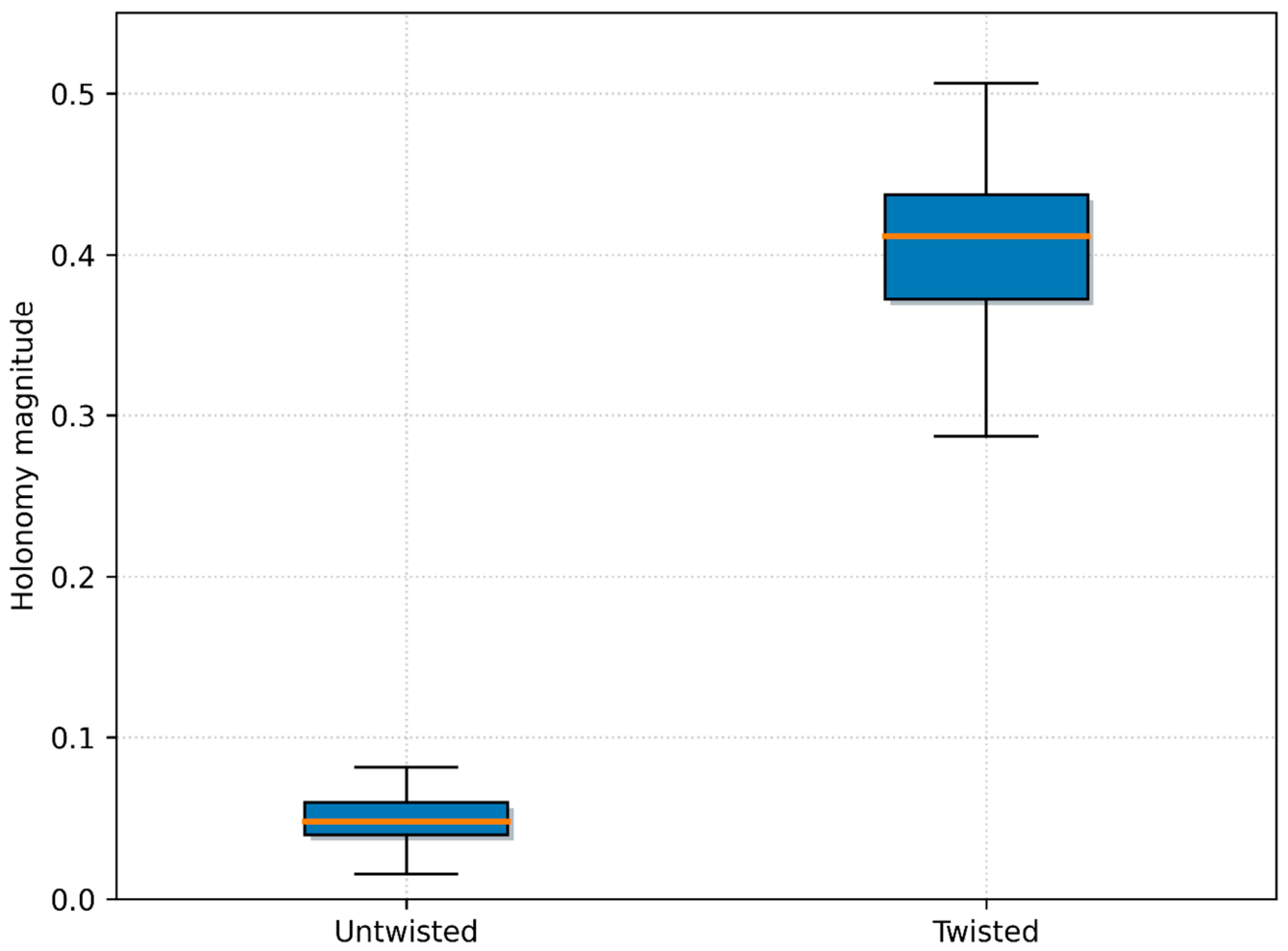
While conventional TDA descriptors produced indistinguishable representations, our signatures exhibited systematic differences in holonomy-related quantities, curvature-like descriptors, and characteristic-class proxies (
Figure 1). Consistent with these differences, classifiers trained on the full signature showed clear separation between the two classes, whereas models relying solely on persistent homology or aggregated feature statistics exhibited near-chance discrimination in this setting. These observations indicate that the representation responds specifically to bundle-level inconsistencies that are invisible to homological and purely geometric summaries.
4.2. Stability and Robustness Under Perturbations
A second family of experiments investigated stability and robustness under perturbations. Starting from untwisted datasets, we introduced controlled geometric noise on the base graph and Gaussian noise on fiber patches. For each noise amplitude, signatures were recomputed and classification behavior was evaluated using models trained on clean data.
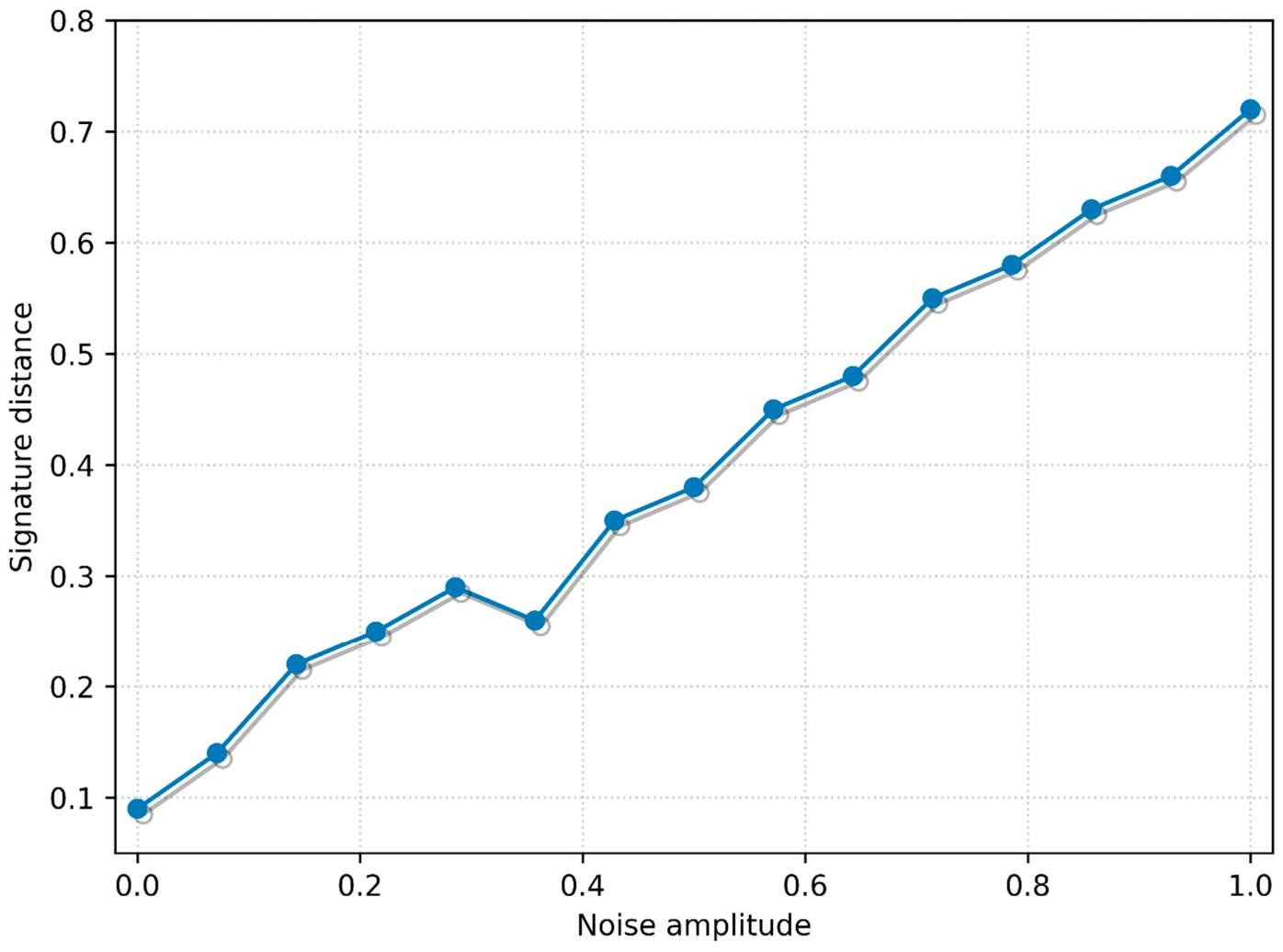
Signature displacement increased smoothly with noise magnitude, and discriminative behavior degraded gradually rather than abruptly (
Figure 2). Across increasing noise levels, relative classification trends exhibited a monotonic decline, consistent with the Lipschitz-type stability bounds established in
Section 3. In contrast, classifiers based on aggregated feature statistics deteriorated more rapidly under feature noise, indicating that the hierarchical constraints encoded by the representation mediate a smoother response to perturbation.
4.3. Invariance to Structure-Preserving Transformations
A third experiment examined invariance by applying transformations that preserve structural identity. Rigid motions, uniform rescalings, and invertible linear reparameterizations of fiber features altered coordinates but did not affect connectivity or fiber organization.
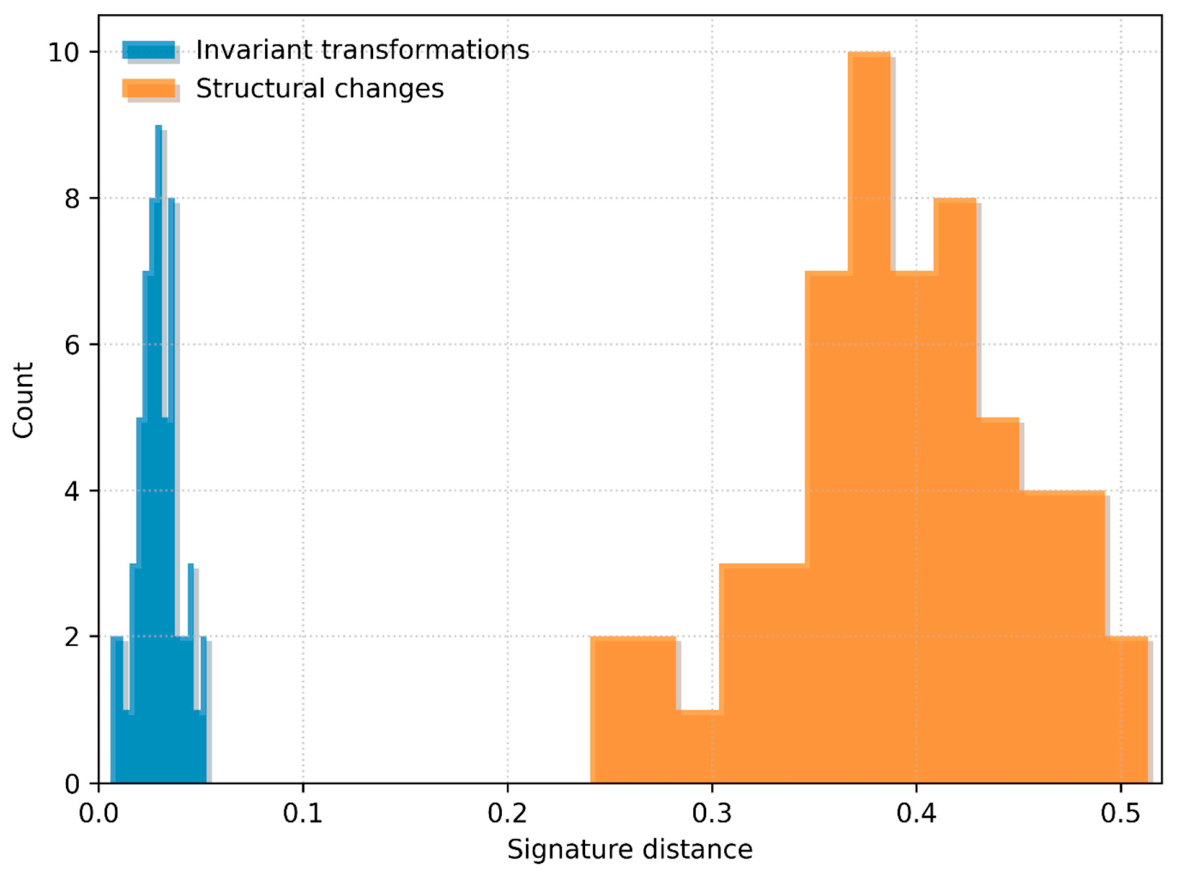
As expected, signature distances between original and transformed instances remained close to zero, with deviations limited to numerical fluctuations (
Figure 3).
Correspondingly, classification behavior remained stable across all invariant transformations, showing no systematic change in relative discriminability. In contrast, operations that modified connectivity or introduced new twisting patterns produced pronounced and easily detectable signature shifts. This separation between nuisance transformations and structural modifications demonstrates that the representation is sensitive to organizational changes while remaining invariant to irrelevant geometric variation.
4.4. Ablation Study
A final ablation study examined the contribution of individual components of the signature. Starting from the full signature
reduced variants were constructed by removing one component at a time while leaving all others unchanged. Specifically:
- (a)
No holonomy: removed; all other components retained.
- (b)
No curvature: removed; all other components retained.
- (c)
No characteristic-class proxies: removed.
- (d)
Persistent homology only: only , and retained.
- (e)
Fiber-only: only the aggregated fiber descriptor retained.
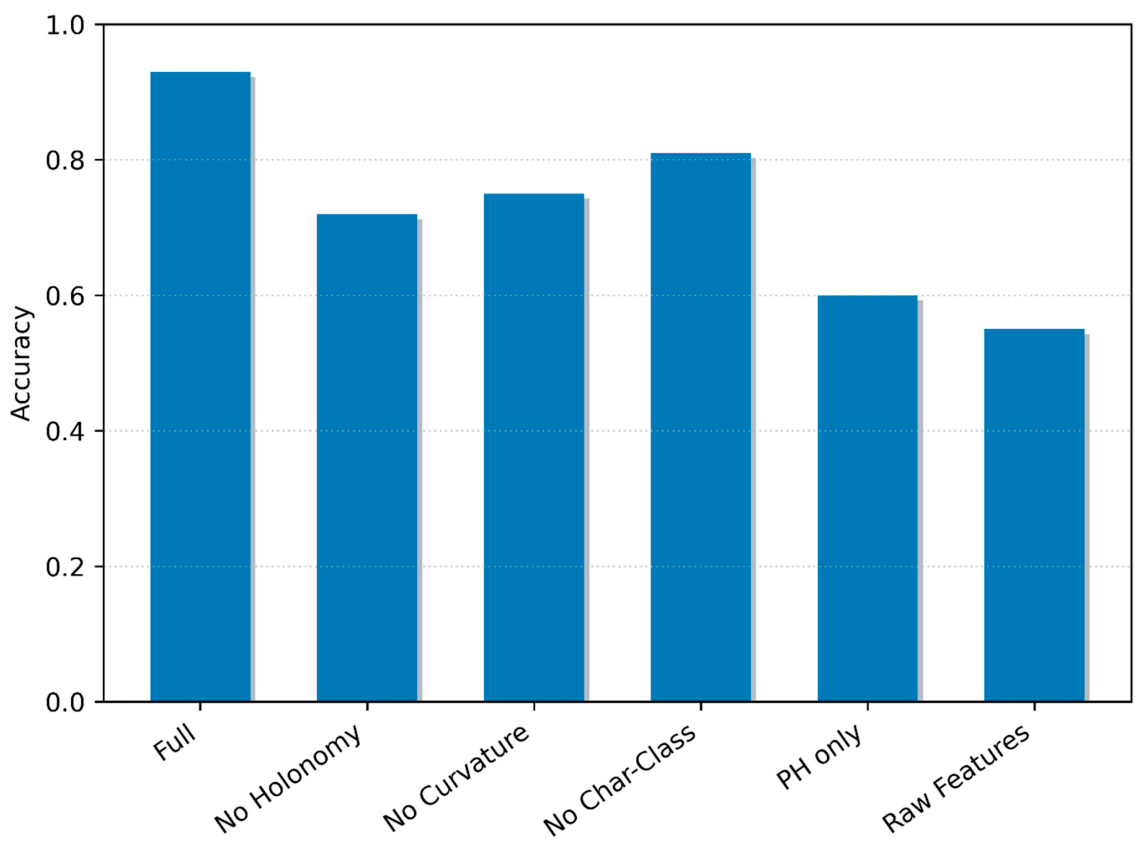
In all cases, reduced signatures were recomputed from the same underlying data using identical graph construction, neighborhood definitions, and classifier hyperparameters. Removing holonomy-related information substantially reduced discriminative behavior in tasks distinguishing twisted from untwisted structures (
Figure 4). Excluding curvature-like or characteristic-class components further impaired sensitivity to global inconsistencies among transition maps. Persistent-homology-only descriptors performed adequately when classes differed in geometry but failed when distinctions depended solely on gluing structure. Across all settings, the full signature consistently exhibited the strongest relative separation.
In summary, our experiments were performed under controlled conditions designed to isolate organizational effects beyond local geometry or feature statistics. Synthetic datasets were used to compare twisted and untwisted configurations, assess robustness to geometric and feature noise, test invariance under structure-preserving transformations, and examine the contribution of individual components through ablation. The experimental analysis emphasizes relative trends and structural sensitivity rather than absolute predictive performance, in line with the methodological objectives of the study.
5. Conclusions
We show that representing each data instance through a structured combination of base topology, fiberwise feature organization, and discrete connection information yields signatures that respond systematically to controlled structural modifications. Our simulated outcomes demonstrate that even small shifts introduced at the level of local feature distributions propagate in predictable ways to both local and global descriptors, producing measurable differences in distribution that can be exploited by standard classifiers. Rather than enforcing sharp separability, our representation preserves a realistic degree of variability, reflecting the fact that structural distinctions often coexist with overlapping local statistics. Examination of marginal distributions, covariance structure, and low-dimensional projections corroborates the presence of consistent but nontrivial separation between simulated classes, indicating that the detected differences arise from organizational effects rather than trivial feature thresholds.
Our approach treats data as possessing explicit geometric and organizational structure, rather than reducing observations to unstructured vectors or relying exclusively on global topological summaries. By decomposing each sample into base, fiber, and transition components, our approach formalizes a multilevel representation in which local feature topology, spatial arrangement, and transport consistency are treated as distinct but interacting sources of information. This explicit separation allows the contribution of each level to be analyzed independently while still capturing their joint effect on global organization. In particular, differences in how local feature spaces are glued together across the base can be detected even when base geometry and local feature distributions are individually indistinguishable.
From a methodological perspective, our model occupies an intermediate position between classical topological descriptors, geometric learning models, and connection-based constructions inspired by differential geometry. Persistent-homology-based pipelines capture global shape but are largely insensitive to how local feature distributions vary along cycles or interact through transport. Graph-based approaches encode adjacency and local interactions but do not quantify path-dependent effects or the global coherence of local transformations. Connection- and gauge-inspired learning architectures, including recent sheaf neural networks and gauge-equivariant convolutional models, address local-to-global consistency by embedding algebraic constraints or symmetry equivariance within trainable architectures [
26,
27,
28,
29]. However, in these approaches consistency is enforced implicitly through learned parameters and task-specific objectives, and explicit structural invariants are generally not exposed. By contrast, our Fiber Bundle Learning infers transition relations directly from data and characterizes their coherence through explicit, connection-derived quantities like holonomy and related descriptors. This yields a task-agnostic representation that makes bundle-level organization measurable and analyzable, clarifying that the contribution of our approach lies in the measurement and characterization of structural organization rather than in optimizing predictive performance.
Several limitations should be acknowledged. The experimental evaluation relies exclusively on synthetic data designed to isolate specific structural effects and therefore does not yet reflect the full complexity of real-world datasets. While this choice enables controlled assessment of bundle-level organization, it necessarily abstracts away semantic heterogeneity, correlated noise, missing data, and non-uniform sampling patterns that are common in applied settings. In addition, although the theoretical analysis establishes Lipschitz stability and invariance under well-defined assumptions, practical performance may depend on parameter choices, neighborhood definitions, and computational constraints associated with persistent homology, cycle enumeration, and transition-map estimation.
Future research directions can be articulated. The first direction concerns the application to real-world datasets in which local feature distributions are organized over an explicit geometric or relational substrate. Examples include spatially resolved biological measurements, where local molecular profiles are arranged over tissue architectures; networked sensor systems, where local measurements evolve over graph-structured domains; neuroscientific or materials-science data, where regional descriptors are coupled through anatomical or physical connectivity. Additional examples include microbial or biofilm systems evolving over complex interfaces, where local mechanical or biochemical properties are distributed along curved or branching surfaces; climate or geophysical datasets in which localized measurements are embedded in stratified spatial layers; and multi-view imaging data in which local descriptors are linked through known camera geometries or acquisition manifolds. In these contexts, our framework could be used to test whether variations in transition consistency, holonomy, or curvature-like quantities correspond to meaningful changes in system organization that are not detectable through local statistics or global topology alone, e.g., distinguishing structurally coherent rearrangements from purely stochastic fluctuations.
A second direction involves the systematic construction of benchmark datasets with increasing structural complexity, including higher-dimensional base spaces, richer fiber structures, and controlled combinations of twisting, noise, and sampling irregularity. These benchmarks would allow finer-grained evaluation of the sensitivity and limits of individual signature components, facilitating direct comparison with alternative approaches based on persistent homology. Further extensions could include benchmarks with heterogeneous local feature dimensionality, anisotropic sampling densities, time-dependent base spaces, or explicitly multiscale structures in which local geometries evolve differently across regions. These controlled settings would make it possible to isolate which aspects of bundle organization are captured by connection-based descriptors and which remain invisible to existing topological or geometric summaries.
A third direction concerns computational and theoretical extensions, including alternative estimators for discrete connections, more efficient approximations of holonomy and curvature descriptors, and tighter links between the discrete constructions used here and their continuous geometric counterparts. These developments would help clarify the regimes in which bundle-level descriptors provide maximal added value. Related avenues include scalability to large graphs or high-resolution spatial grids, robustness analysis under missing or corrupted data, and formal characterizations of invariance or stability properties under base-space deformations.
Together, these extensions would strengthen the interpretability and applicability of our framework across domains characterized by complex local-to-global organization.
Overall, we show that treating structured data as discrete fiber bundles could integrate geometry, local feature topology, and global organizational consistency within a single representation. This integration yields signatures that are stable under perturbations, invariant under structure-preserving transformations and sensitive to subtle differences in gluing structure that remain invisible to persistent homology alone. By formalizing bundle-level organization as an explicit and quantifiable construct, our framework complements topological and geometric methodologies and facilitates the analysis of structure beyond local or purely homological descriptors.