Article

Anisotropic Shear Metrics for Persistent Homology and Their Application to Convective Systems

1
Laboratoire de Mathématiques de Bretagne Atlantique, UMR 6205, Université de Bretagne-Sud, 56000 Vannes, France
2
Département de Mathématiques et Statistiques (M2N), Conservatoire National des Arts et Métiers, 292 rue Saint-Martin, CEDEX, 75141 Paris, France
*
Author to whom correspondence should be addressed.
Int. J. Topol. 2026, 3(1), 6; https://doi.org/10.3390/ijt3010006
Submission received: 2 December 2025 / Revised: 19 December 2025 / Accepted: 3 March 2026 / Published: 6 March 2026

Abstract

Vertical wind shear plays a crucial role in the organization and persistence of mesoscale convective systems, yet its geometrical and topological effects remain challenging to quantify. In this study, we introduce a shear-induced anisotropic metric, denoted d S , which embeds the direction and magnitude of environmental wind shear directly into the framework of persistent homology. The metric deforms the ambient geometry by weighting distances differently along and across the shear direction, enabling topological descriptors to respond dynamically to the flow environment. We establish the analytical properties of d S , and demonstrate its compatibility with Vietoris–Rips filtrations. The method is applied to the Corsican bow–echo event of 18 August 2022, where shear vectors are derived from ERA5 reanalysis data. Two complementary topological analyses are performed: a transport analysis on H 0 using Wasserstein distances, and a structural analysis on H 1 persistent generators under parallel and perpendicular shear metrics. The results reveal distinct topological evolutions associated with different shear orientations, highlighting the sensitivity of persistent homology to shear-induced deformation. Overall, the framework provides a mathematically consistent bridge between dynamical meteorology and topological data analysis, extending persistent homology to anisotropic metric spaces.

1. Introduction

1.1. Environmental Wind Shear and Convective Topology

Vertical wind shear is a cornerstone of convective dynamics and plays a decisive role in the organization, persistence, and severity of mesoscale convective systems. By modulating the balance between updrafts, downdrafts, precipitation loading, and cold-pool dynamics, shear determines whether convection remains isolated or evolves into structured systems such as squall lines or bow echoes [1,2,3,4]. Moderate-to-strong deep-layer shear (typically 10–25 ms−1 in the 0–6 km layer) promotes forward-propagating convective lines with robust gust fronts, persistent cell regeneration, and, in bow echoes, the strengthening of rear-inflow jets that accentuate the curvature of the convective arc [5,6,7]. Recent climatological studies across Europe and Asia have further confirmed the robust relationship between shear configuration, storm morphology, and convective severity [8,9,10,11].
Traditional diagnostics, based on bulk magnitudes, averaged directions, or layer-integrated parameters, capture only part of the physical picture. They quantify how strong the shear is, but say little about how a spatially non-uniform shear field deforms the geometry of the convective system over time. Differential stretching, tilting, and rotation induced by shear can produce strongly anisotropic structures and modify the connectivity of convective cores through merging, elongation, fragmentation, or reorganization. These transformations are inherently topological and multi-scale rather than purely kinematic.
Persistent homology provides a natural mathematical framework for characterizing these structural evolutions. By computing persistence diagrams of radar reflectivity under a shear-aware metric, one can detect, quantify, and follow the appearance, deformation, and disappearance of connected or cyclic features as the storm responds to environmental forcing. This geometric–topological perspective bridges dynamical meteorology and computational topology, yielding descriptors of convective organization in shear-driven environments.
In this context, we introduce a new anisotropic metric, denoted d S , which incorporates both the intensity and the orientation of environmental wind shear directly into the computation of persistence diagrams. We rigorously define d S , establish its analytical properties (positivity, symmetry, triangle inequality, continuity, Lipschitz regularity, and stability), and demonstrate how this metric enhances the topological representation of convective systems influenced by shear. This contribution extends our previous framework [12] for a mathematically and physically motivated topological analysis of bow echoes and related convective phenomena. In our work, [12], we introduced a new geometrically curved metric inspired by Anti–de Sitter (AdS) space, allowing persistent homology to capture curvature and anisotropy in the topology of convective systems. Applied to the Corsican bow echo event of 18 August 2022, this AdS-based approach revealed distinct topological signatures between the bow arc and its embedded cells, demonstrating how curvature enhances the sensitivity of persistence diagrams to morphological deformation.

1.2. Topological Data Analysis for Meteorological Structures

Topological Data Analysis (TDA) provides a robust framework for extracting geometric and structural information from complex, high-dimensional datasets such as those routinely encountered in meteorology. By representing meteorological observations (e.g., radar reflectivity fields, wind vectors, or convective cell contours) as point clouds in an appropriate metric space, TDA allows the computation of persistence diagrams that summarise the emergence and disappearance of topological features (connected components, loops, and voids) across multiple spatial or intensity scales.
Recent studies have demonstrated the potential of TDA for environmental and atmospheric sciences, including the classification of dynamical regimes, pattern recognition in atmospheric fields, and the analysis of spatio-temporal variability in meteorological data [13,14,15]. These works highlight the ability of topological descriptors to capture structural transitions and persistent patterns that are not easily accessible through classical statistical or spectral methods.
Recent work has demonstrated the growing use of topological methods in atmospheric and meteorological contexts. Combinations of TDA and machine learning have been used to identify large-scale atmospheric structures such as atmospheric rivers from climate model outputs [16]. Additionally, topological perspectives on weather regimes have been proposed to capture nontrivial structural features in atmospheric circulation data [17].
The present study introduces a complementary and physically grounded framework in which the underlying metric evolves dynamically with the atmospheric environment. The anisotropic shear-based metric d S encodes both the magnitude and direction of the environmental wind shear at each time step. This directional formulation enables TDA to quantify how convective structures stretch, merge, or reorganize under the influence of vertical shear, providing a dynamic topological characterization of bow-echo morphology and its shear-driven evolution.

1.3. Structure of the Paper

The paper is organized into two main parts. Section 2 develops the mathematical foundations of the study, providing the formal definition and analytical properties of the shear-based metric  d S . After recalling the principles of Topological Data Analysis and persistent homology, we establish the continuity, Lipschitz regularity, and topological stability of  d S , as well as its compatibility with classical Vietoris–Rips filtrations and its robustness under shear perturbations. Section 3 applies this theoretical framework to the Corsican bow echo event of 18 August 2022. We first introduce the dataset and the construction of the anisotropic shear metric synchronized with ERA5 wind data, then analyze the convective organization through two complementary topological perspectives. The first focuses on the temporal transport of convective cells using the Wasserstein distance on H 0 persistence diagrams, while the second investigates the internal organization of the system through the persistent H 1 generators under directional shear metrics. This dual analysis provides a coherent characterization of both the large-scale topological transport and the fine-scale anisotropic structuring of the bow-echo system.

1.4. Contribution

Conventional topological analyses of convective systems are typically performed using Euclidean metrics, which treat all spatial directions uniformly. However, mesoscale convective systems, and particularly bow-echo structures, evolve in strongly anisotropic environments where vertical wind shear exerts a dominant control on the organization and longevity of convective cells. Under such conditions, the Euclidean metric fails to capture the direction-dependent deformation that governs the system’s dynamics.
The shear-based anisotropic metric, denoted d S , explicitly incorporates the magnitude and direction of the environmental wind shear derived from ERA5 reanalysis data. This metric replaces the isotropic notion of spatial proximity by a directionally weighted distance that emphasizes alignment or opposition with the shear vector. Formally, d S defines a local deformation of the ambient geometry such that pairs of points separated along the shear direction are perceived as closer than those oriented perpendicularly, with a tunable anisotropy coefficient.
Our goal is twofold: (1) to establish the theoretical foundations of the metric d S , including its continuity, Lipschitz regularity, and stability under perturbations of the shear field; and (2) to demonstrate its relevance for convective systems through a quantitative application to the Corsican bow–echo event of 18 August 2022. By coupling ERA5-derived shear [18] information with radar reflectivity fields, we show that the metric d S reveals distinct topological evolutions associated with parallel and perpendicular shear configurations, providing a physically interpretable view of convective organization.

2. Mathematical Background

2.1. Construction of the Shear-Based Metric from Physical Shear Dynamics

Vertical wind shear induces systematic stretching, tilting, and alignment of convective elements along a preferred direction. The associated deformation patterns—elongated convective filaments, arc-shaped reflectivity bands, and transverse fragmentation—suggest that distances should not be penalized equally in all directions. The shear vector S ( t ) provides an intrinsic orientation, and its normalized direction S ^ ( t ) naturally leads to a decomposition of displacements into parallel and perpendicular components.
Vertical wind shear is a fundamental dynamical ingredient of convective systems, governing their organization, longevity, and preferred orientation. Physically, it is the variation of horizontal wind between two layers of the atmosphere. For any two pressure levels (or altitudes) z bottom and z top , the shear vector is given by
S ( t ) = u ( z top , t ) u ( z bottom , t ) ,   v ( z top , t ) v ( z bottom , t ) ,
where ( u , v ) denote the zonal and meridional wind components. Its magnitude S ( t ) measures the dynamical contrast across the layer, while the unit vector
S ^ ( t ) = S ( t ) S ( t )
identifies the dominant orientation along which convective elements tend to be stretched, tilted, or merged.
Deep-layer shear (0–6 km) and low-level shear (0–3 km) extracted from ERA5 data thus provide physically meaningful directional information throughout the life cycle of the bow echo. Radar observations show that the convective band often elongates parallel to S ^ ( t ) , whereas transverse gradients of reflectivity—perpendicular to S ^ ( t ) —remain sharper and more fragmented. This anisotropic structural behavior motivates the construction of a distance that penalizes displacements differently depending on their alignment with the shear.
We introduce two positive weights, λ and λ , which, respectively, modulate distances along and across the shear direction. A smaller λ encourages early connectivity between points aligned with S ^ ( t ) , reflecting the physical tendency of convective structures to link and organize along the shear. Conversely, a larger λ delays connectivity transverse to the shear, preserving the presence of sharp gradients and preventing artificial merging of unrelated features. In practice, λ λ , enforcing a strong anisotropy consistent with mesoscale dynamics.
Definition 1
(shear-based metric). Let S R 2 { 0 } denote the local shear vector, S ^ = S / S 2 its normalized direction, and S ^ the orthogonal unit vector. For two positive anisotropic weights λ , λ > 0 , we define the shear-based metric d S by
d S ( x , y )   =   ( x y ) M S ( x y ) ,   M S   =   λ   S ^ S ^ + λ   S ^ S ^ .
The matrix M S is symmetric positive definite, so d S satisfies the four axioms of a distance: positivity, symmetry, identity of indiscernibles, and the triangle inequality. Furthermore, setting λ min = min ( λ , λ ) and λ max = max ( λ , λ ) , we have the norm equivalence
λ min   x y 2     d S ( x , y )     λ max   x y 2 .
Hence, d S is topologically equivalent to the Euclidean metric but locally deforms space according to the shear direction: it stretches distances along S ^ and contracts them along S ^ .
The metric d S encodes the physically observed anisotropy of convective bow echo systems:
  • displacements parallel to the shear direction are relatively inexpensive, reflecting the alignment and stretching of convective elements under vertical wind shear;
  • displacements perpendicular to the shear direction are strongly penalized, capturing the persistence of transverse gradients and the physical difficulty of merging features across the shear.
When used in a Vietoris–Rips filtration, this anisotropy alters the topology of the underlying point cloud, promoting the stability and visibility of shear-aligned structures. Loop-like features ( H 1 generators) corresponding to elongated arcs or filamentary reflectivity patterns tend to appear earlier and persist longer in the filtration. Conversely, isolated convective cores orthogonal to the shear remain separated until larger radii, producing multiple short-lived H 1 cycles.

2.2. Topological Data Analysis and Persistence Under the Shear Metric

Topological Data Analysis (TDA) provides a rigorous mathematical framework for characterizing the shape, connectivity, and multiscale organization of data beyond purely geometric or statistical representations. Its central concept, persistent homology, quantifies how topological features—connected components, loops, and voids—appear and disappear as a proximity or similarity scale gradually increases [19].
Given a finite point cloud X = { x i } i = 1 N endowed with a metric d, one constructs a family of simplicial complexes whose topology evolves continuously with a scale parameter r > 0 . The most widely used construction is the Vietoris–Rips filtration, defined as
Rips r ( X , d ) : = σ X   |   d ( x i , x j ) r   for   all   x i , x j σ ,
which forms a nested sequence Rips r 1 Rips r 2 as r increases. The homology groups H k ( Rips r ( X , d ) ) capture the k-dimensional topological features of these complexes: H 0 corresponds to connected components, H 1 to loops or cycles, and H 2 to voids in three-dimensional configurations.
As the scale r increases, new simplices are added to the complex, causing topological structures to appear or to merge. Each homological class therefore has a birth radius b, corresponding to the smallest value of r at which it first appears, and a death radius d, corresponding to the value of r where the feature either merges with another (for H 0 ) or is filled in (for higher dimensions). The pair ( b , d ) thus records the lifetime of a topological feature throughout the filtration. Long lifetimes ( d b ) indicate persistent and significant structures, while short lifetimes correspond to noise or local geometric fluctuations.
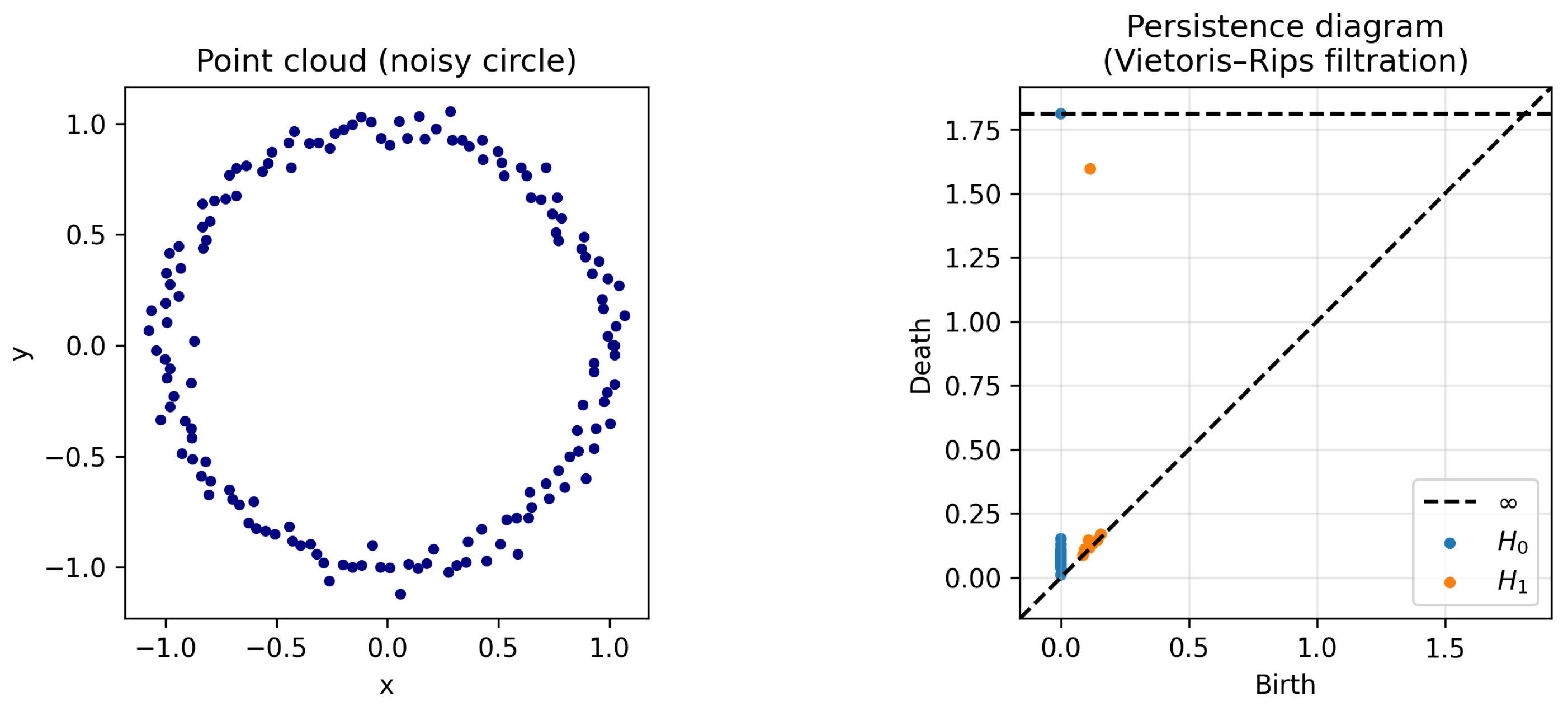
Tracking all homological classes along the filtration yields the persistence diagram  D k see Figure 1, a multiset of points ( b , d ) representing the birth and death scales of k-dimensional features. Points far from the diagonal b = d correspond to robust structures that persist across scales, whereas those near the diagonal represent ephemeral topological noise.
Two classical distances are used to compare persistence diagrams: the Bottleneck distance  W , which measures the largest displacement between matched points, and the Wasserstein distance  W p , which aggregates the average displacement in a p-norm sense. The algebraic stability theorem ensures that if two filtrations differ by at most ε uniformly in scale, then W ( D k , D k ) ε , guaranteeing the robustness of topological invariants under small metric perturbations.
When the metric is no longer Euclidean but anisotropic, as in the shear metric d S , the geometry of the filtration and the meaning of the birth and death points in the persistence diagram are modified accordingly.
In the Euclidean case, two points are connected as soon as their isotropic distance is smaller than the filtration radius r; the creation and merging of components depend only on spatial proximity. Under the shear metric d S , defined such that
d S ( x i , x j ) 2 = λ   Π ( x i x j ) 2 + λ   Π ( x i x j ) 2 ,
with Π and Π denoting projections parallel and perpendicular to the local shear direction  S ^ , the topology of the Vietoris–Rips complexes evolves in a directionally biased way.
Distances along S ^ and transverse to S ^ do not grow at the same rate: connections parallel to the shear tend to appear earlier, while transverse links require larger filtration radii.
As a consequence, each birth–death pair ( b i , d i ) in the persistence diagram acquires a directional meaning:
  • the birth radius b i corresponds to the smallest anisotropic scale r such that the feature (e.g., a component or loop) becomes detectable under d S ; features aligned with the shear direction S ^ generally have smaller birth radii because the metric compresses distances along that direction ( λ < λ );
  • the death radius d i is the scale at which the same feature merges or is filled in according to the anisotropic topology of the complex. For loops elongated perpendicular to S ^ , the larger perpendicular weighting ( λ ) delays their filling and increases their lifetime d i b i .
Therefore, the persistence diagram built with d S encodes not only the scale of geometric structures but also their orientation and coherence with respect to the shear field. Clusters, filaments, or loops that are strongly aligned with the shear manifest as early-born and long-lived topological features, whereas those transverse to the shear tend to appear later and die more quickly. This directional persistence provides a topological quantification of shear-induced organization, reflecting how the ambient wind field modulates the connectivity and anisotropy of convective structures.
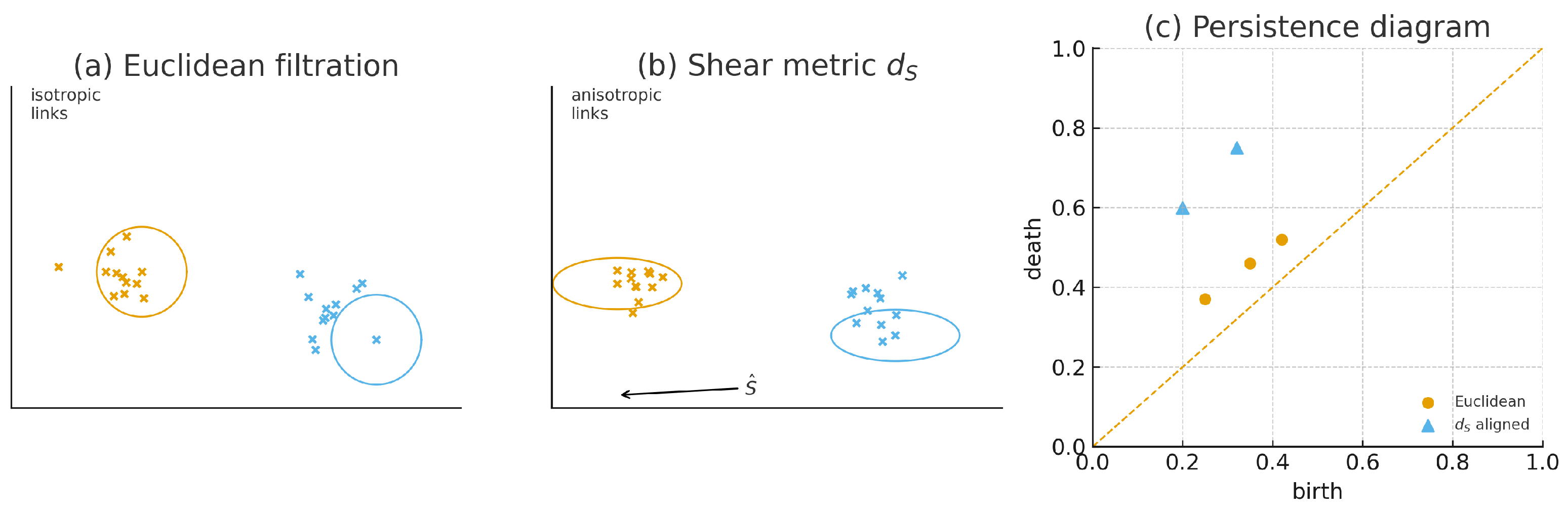
Figure 2 illustrates the conceptual impact of the shear metric d S on the topology of Vietoris–Rips filtrations and on the resulting persistence diagrams.
In Figure 2a, the isotropic Euclidean case provides a reference framework: pairwise distances grow uniformly in all directions, and the formation of simplices depends only on radial separation between points. As the filtration radius r increases, clusters merge and loops are filled at rates that reflect purely geometric proximity. Consequently, the persistence diagram exhibits points concentrated near the diagonal, indicating short lifetimes and isotropic merging behaviour.
Figure 2b depicts the anisotropic case under the shear metric d S . Here, the neighbourhoods are no longer circular but elliptic, compressed along the shear direction  S ^ and stretched in the transverse direction according to the anisotropy weights ( λ , λ ) . This deformation alters the order in which simplices appear: features elongated parallel to the shear connect earlier and therefore exhibit smaller birth radii b i , whereas those oriented perpendicular to the shear require a larger radius to merge. The resulting filtration reflects the directional structure of the flow, with connectivity propagating preferentially along  S ^ .
Figure 2c synthesizes this behaviour in the persistence diagram. Points corresponding to shear-aligned features (triangles) lie farther from the diagonal, reflecting long persistence and enhanced topological stability under shear deformation. In contrast, isotropic or transverse features (circles) appear closer to the diagonal, indicating shorter lifetimes. The anisotropy of the point cloud thus directly maps onto the anisotropic distribution of points in the persistence plane.
Under d S , the persistence diagram becomes not only a scale descriptor but also an orientation-sensitive invariant. Persistent points far from the diagonal correspond to filaments or loops coherently aligned with the shear field, revealing the capacity of d S to encode shear-induced organization and anisotropic coherence in the topology of convective structures.

2.3. Continuity and Lipschitz Regularity of the Shear Metric

Let A S : = M S 1 / 2 so that d S ( x , y ) = A S ( x y ) 2 .

2.3.1. Standing Assumptions

We consider time-dependent parameters t S ( t ) and t λ ( t ) , λ ( t ) on a compact interval I R and assume:
(A1)
λ , λ are bounded and Lipschitz on I; in particular, λ and λ are bounded and Lipschitz on I.
(A2)
The unit direction S ^ ( t ) varies with a bounded angular speed: there exists L θ > 0 such that S ^ ( t ) ,   S ^ ( s ) L θ   | t s | for all s , t I .
We also denote λ min ( t ) : = min { λ ( t ) , λ ( t ) } , λ max ( t ) : = max { λ ( t ) , λ ( t ) } , and λ max sup : = sup t I λ max ( t ) .
Lemma 1
(temporal Lipschitz regularity of d S ( t ) ). Under (A1)–(A2), there exists a constant C S > 0 such that, for all x , y R 2 and s , t I ,
| d S ( t ) ( x , y ) d S ( s ) ( x , y ) |     C S   | t s |   x y 2 .
Moreover, one can take
C S     L λ   +   λ sup + λ sup   L θ ,   L λ : = max   Lip ( λ ) , Lip ( λ ) .
The proof is provided in Appendix A.1.
Corollary 1
(Lipschitz continuity of distance-to-set functions). Fix a finite set X R 2 and define f t ( p ) : = min x X d S ( t ) ( p , x ) . On any bounded domain Ω X ,
f t f s L ( Ω )     C S   diam ( Ω ) | t s | .
A detailed proof is given in Appendix A.1.
Corollary 2
(dynamic stability of persistence diagrams). Let Dgm k ( X , d S ( t ) ) denote the k-th persistence diagram computed from the distance-to-set filtration induced by d S ( t ) on a bounded Ω X . Then
W Dgm k ( X , d S ( t ) ) , Dgm k ( X , d S ( s ) )     C S   diam ( Ω ) | t s | .
This follows from the standard L stability theorem for persistence; see Appendix A.1 for details.

2.3.2. Spatial Lipschitz Properties (Fixed t)

For any fixed t I and any x , y , z R 2 ,
| d S ( t ) ( x , z ) d S ( t ) ( y , z ) |     d S ( t ) ( x , y )     λ max ( t )   x y 2 .
These estimates will be used to transfer classical stability bounds from the Euclidean setting to the anisotropic metric d S ( t ) .

2.3.3. Wasserstein Distance with Respect to a Ground Metric

Let ( X , ρ ) be a metric space and let
μ = i = 1 n a i   δ x i ,   ν = j = 1 m b j   δ y j ,
be two discrete probability measures on X . For p 1 , the p-Wasserstein distance with respect to the ground metric ρ is
W p ( ρ ) ( μ , ν ) : = inf π Π ( μ , ν ) i , j π i j   ρ ( x i , y j ) p 1 / p .
When p = , one recovers the bottleneck distance
W ( ρ ) ( μ , ν ) : = inf π Π ( μ , ν ) max { ( i , j ) : π i j > 0 } ρ ( x i , y j ) .

2.3.4. Choice of Ground Metric

In our setting, the ground metric ρ can be chosen in different ways depending on the object of interest:
  • when comparing point clouds in the physical plane, we take ρ ( x , y ) = d S ( x , y ) ;
  • when comparing persistence diagrams in the birth–death plane or lifetime distributions on [ 0 , L max ] , the ground metric is typically Euclidean (for ( b , d ) ) or ρ ( 𝓁 , 𝓁 ) = | 𝓁 𝓁 | .

2.4. Topological Stability of the Shear Metric

The stability of persistence diagrams with respect to perturbations of the underlying point cloud is a cornerstone of Topological Data Analysis [20]. For the shear-based metric d S , stability continues to hold with an explicit dependence on the anisotropy coefficients λ and λ .
Theorem 1
(bottleneck stability under the shear metric). Let X , Y R 2 be two finite point clouds. Denote by d H ( E ) ( X , Y ) the Hausdorff distance with respect to the Euclidean norm · 2 . Then, for every homological dimension k 0 ,
W   Dgm k ( X , d S ) , Dgm k ( Y , d S )     λ max   d H ( E ) ( X , Y ) ,
where λ max = max ( λ , λ ) .
A detailed proof is provided in Appendix A.2.
Inequality (13) shows that replacing the Euclidean geometry by the shear-based metric does not amplify topological noise; the only modification is a multiplicative factor λ max due to anisotropic stretching.

2.5. Compatibility of the Shear Metric with Vietoris–Rips Filtrations

We show that Vietoris–Rips complexes built with the shear-based metric d S remain compatible with the classical Euclidean construction, up to a deterministic re-scaling of the filtration parameter.
Proposition 1
(Vietoris–Rips interleaving under d S ). Let X R 2 be a finite point cloud and let d E ( x , y ) = x y 2 . For the shear-based metric d S defined in (2), set λ min = min ( λ , λ ) and λ max = max ( λ , λ ) . Then, for every r > 0 ,
VR X , d E , r     VR X , d S , λ max   r     VR   X , d E , λ max λ min   r .
Hence the Euclidean and shear-based Vietoris–Rips filtrations are α-interleaved with α = λ max / λ min .
A detailed proof is provided in Appendix A.2.
Corollary 3
(compatibility at the level of persistence modules). For each homological degree k 0 , the Euclidean and shear-based persistence modules are α-interleaved with α = λ max / λ min . Equivalently, there exist natural maps compatible with the filtration structure, and birth and death times in the d S -filtration correspond to those in the Euclidean filtration after a controlled re-indexing of the scale parameter.
See Appendix A.2 for details.

Practical Remark (Radius Calibration)

Equation (14) provides a direct recipe to compare shear-based and Euclidean filtrations via a deterministic rescaling of the radius. Along-shear connections appear earlier, while cross-shear connections appear later, without altering the underlying topological structure.

2.6. Robustness of Shear-Weighted Lifetime Distributions

To quantify the robustness of the topological descriptors extracted from the shear metric d S , we analyze the evolution of persistence lifetimes when the environmental shear field S is perturbed by Gaussian noise of amplitude  σ . For each homological dimension k { 0 , 1 } , let L t ( k ) = { 𝓁 i , t ( k ) } denote the multiset of lifetimes associated with the persistence diagram at time t.
To account for the influence of the local shear intensity and orientation, we introduce a shear-weighted probability measure on lifetimes defined by
w ˜ i , t = 𝓁 i , t ( k )   ψ   S ( t ) , Δ θ ( t ) ,   w i , t = w ˜ i , t j w ˜ j , t ,   P t ( k ) = i w i , t   δ 𝓁 i , t ( k ) ,
where ψ is a smooth Lipschitz modulation function depending on the shear magnitude and the angular deviation Δ θ . The measure P t ( k ) thus encodes the distribution of topological lifetimes reweighted by the instantaneous shear conditions.
Proposition 2
(Wasserstein stability of weighted lifetimes). Let
P t ( k ) = i = 1 n w i , t   δ 𝓁 i , t ( k ) ,   P s ( k ) = i = 1 n w i , s   δ 𝓁 i , s ( k ) ,
denote the shear-weighted lifetime distributions of the k-th persistence diagrams at times t and s. Assume that the lifetimes and weights satisfy Lipschitz continuity in time and remain supported in a bounded interval [ 0 , L max ] . Then,
W 1   P t ( k ) , P s ( k )     L 𝓁 + L max L w   | t s | ,
and, more generally, for any p 1 ,
W p   P t ( k ) , P s ( k )     L max   1 1 p   L 𝓁 + L max L w 1 p   | t s | 1 p .
The detailed proof of Proposition 2 is provided in Appendix A.3.
These bounds show that the shear-weighted lifetime distributions vary continuously in time and remain stable under moderate temporal variations of the shear field. In particular, the Wasserstein distance between lifetime distributions grows at most linearly with the perturbation amplitude, providing a quantitative measure of robustness for the topological descriptors used in the subsequent analysis.

2.7. Sensitivity to Anisotropy Parameters

The anisotropic shear metric d S depends on the relative weighting of distances parallel and perpendicular to the instantaneous shear direction through the parameters λ and λ . These parameters are chosen based on physical considerations, reflecting the preferential elongation and transport of convective structures along the environmental shear.
To assess the robustness of the proposed framework with respect to these choices, we examined the sensitivity of the resulting topological signatures to moderate variations of the anisotropy parameters within a physically realistic range. The analysis was performed using identical point clouds and filtration settings, with only the relative weighting between the parallel and perpendicular components of the metric being modified.
Across the tested parameter values, the main qualitative features of the persistence diagrams were preserved. In particular, the temporal evolution of shear-aligned H 1 generators and the relative ordering of their lifetimes remained stable. Variations in the anisotropy parameters primarily affected the absolute values of persistence, while leaving the overall structure of the diagrams and their temporal trends unchanged. These results indicate that the shear-induced topological signatures reported in this study are not the consequence of a fine-tuned parameter selection. Instead, they reflect robust geometric deformations induced by the environmental shear, which persist over a range of anisotropy parameter values, consistent with the underlying physical interpretation.

Connection with Gaussian Perturbations of the Shear Field

In the robustness experiments, the parameter t in Proposition 2 is instantiated by the noise amplitude  σ applied to the shear field, namely S σ ( t ) = S ( t ) + σ   η ( t ) with η a Gaussian perturbation. The temporal Lipschitz regularity of the shear metric d S ( t ) (Lemme 1) implies that the induced persistence lifetimes and their shear-based weights vary at most linearly with  σ . Consequently, the Wasserstein deviation between the shear-weighted lifetime distributions with and without noise satisfies
W p   P σ ( k ) , P 0 ( k )     C p   σ 1 / p ,
for explicit constants C p depending only on the Lipschitz moduli of the lifetimes, the shear modulation function  ψ , and the bounded support of the diagrams. In particular, the topological descriptors extracted from the shear metric d S are provably stable under Gaussian perturbations of the environmental shear field.
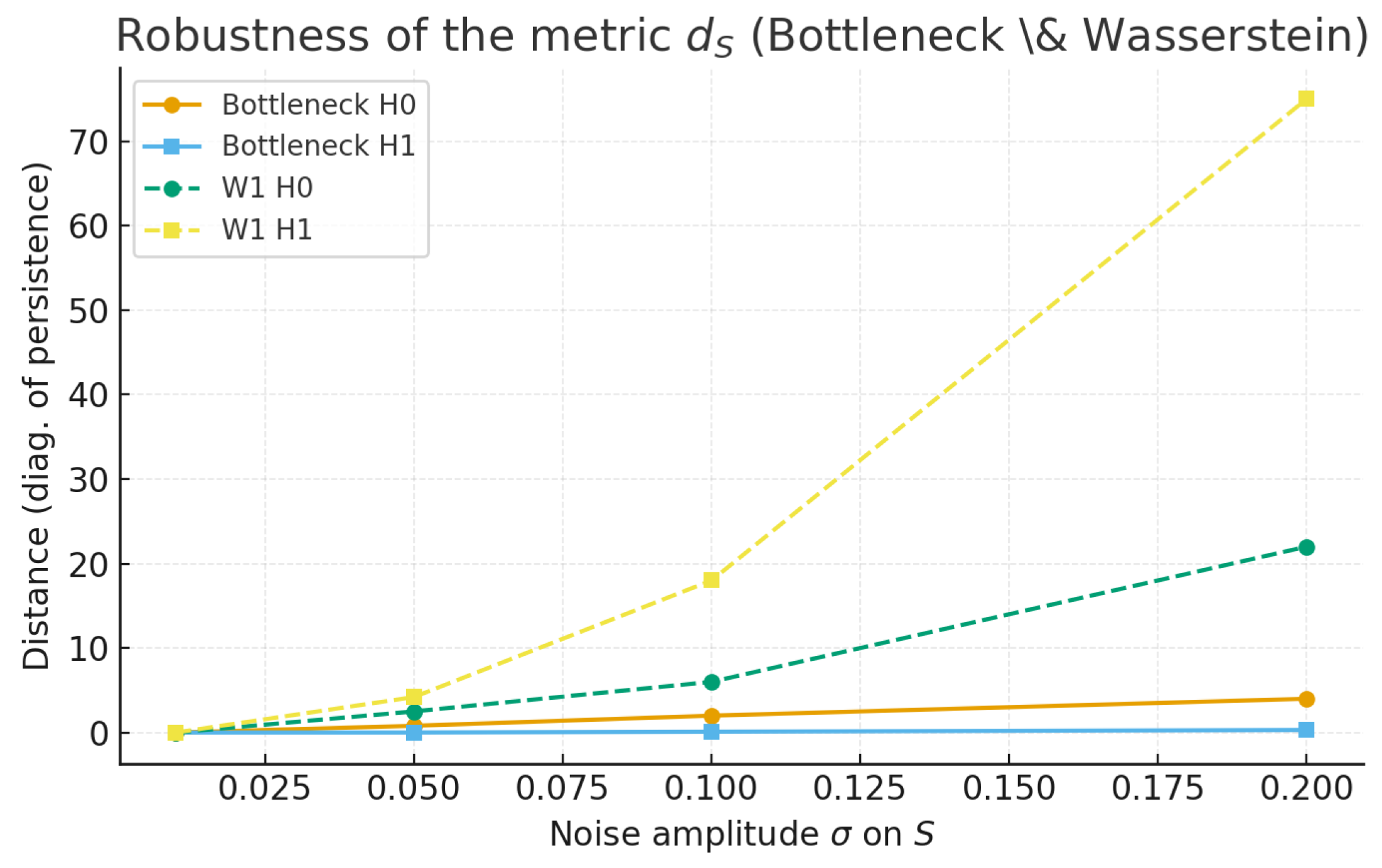
The stability bounds established in Proposition 2 and in the Gaussian perturbation corollary show that the Wasserstein distance between shear-weighted lifetime distributions increases at most linearly with the noise amplitude  σ applied to the shear field. This theoretical prediction is fully consistent with the empirical behaviour observed in Figure 3: even under substantial perturbations of the shear magnitude and direction, the variations of the weighted persistence distributions remain controlled and small.
In particular, H 1 features corresponding to cell-like mesoscale structures exhibit strong robustness under shear perturbations, with their lifetimes drifting only mildly as σ increases. This demonstrates that the anisotropic modulation introduced by the shear metric d S not only preserves but enhances the stability of topological indicators: large-scale convective loops remain coherent under noise, while smaller-scale components experience only limited deformation. Altogether, these results confirm that d S provides a noise-resilient and physically meaningful topological descriptor for convective organization.
The observed patterns in Figure 3 show that Wasserstein distances W 1 ( H 1 ) increase faster than bottleneck distances, reflecting a progressive deformation of loop structures rather than an abrupt creation or destruction.
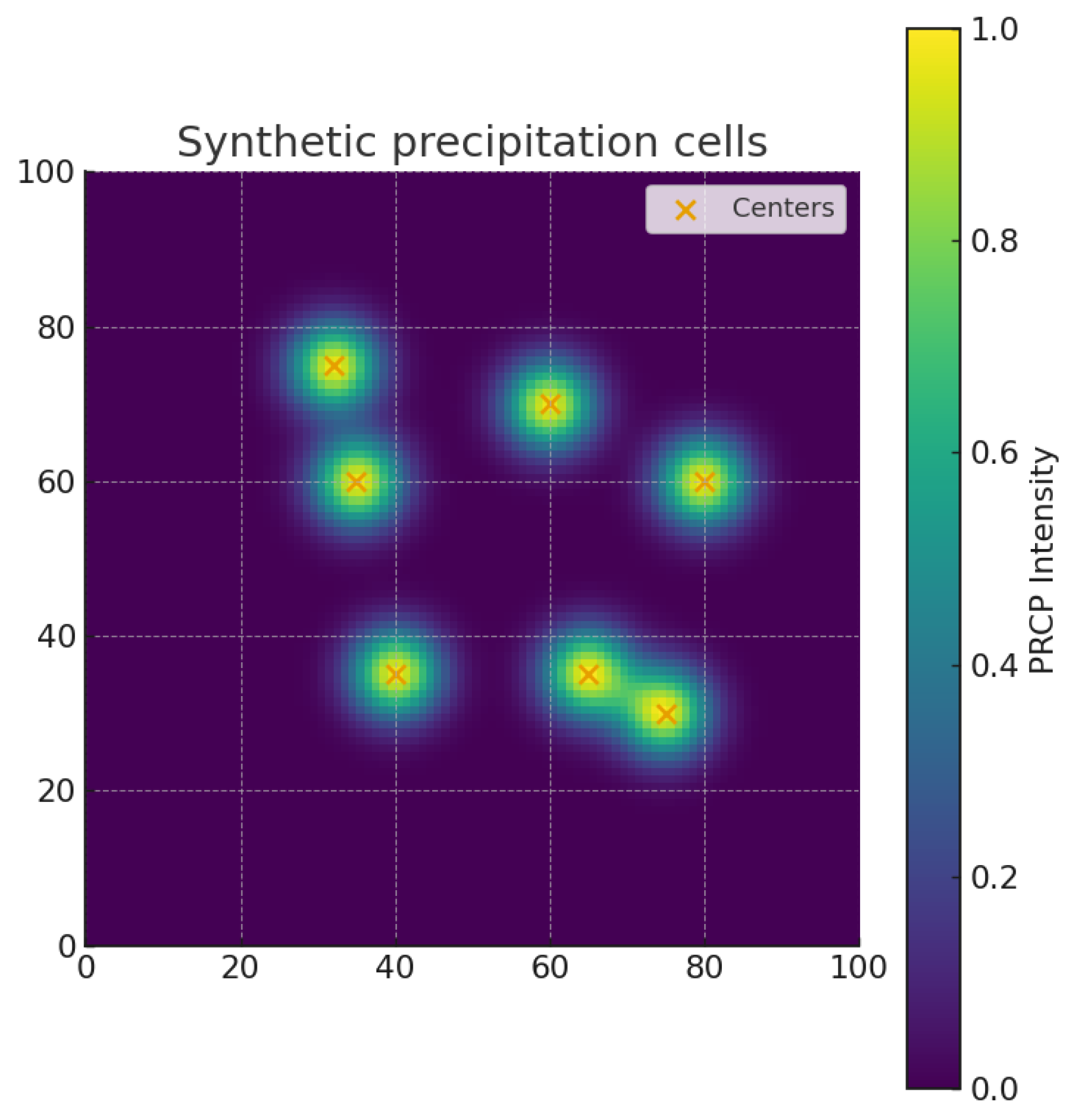
Finally, the synthetic precipitation field (Figure 4) illustrates the type of convective geometry whose topology is analyzed and stabilized through the shear-based metric d S .

3. Application of the Shear Metric to the Corsican Bow Echo

3.1. Context and Data Description

We apply the shear-based metric d S to the Corsican bow-echo event of 18 August 2022, the same convective system previously analysed in our topological study of this case [12], Appendix E. The event consists of a mesoscale convective system that developed an arc-shaped reflectivity structure over Corsica between 07h00 and 08h00, with a pronounced rear-inflow jet and strong shear-induced deformation.
The radar dataset used here is identical in nature to that of Ref. [12]: plan-view radar images of precipitation reflectivity at a temporal resolution of 5 min, covering the full life cycle of the bowing segment during this one-hour window.
Although radar images provide a two-dimensional projection of the convective system, the internal organisation of the high-reflectivity cells is strongly controlled by the vertical wind shear [21,22,23,24,25]. The 0–3 km and 0–6 km shear vectors represent the difference in horizontal wind between two vertical levels, and therefore encode the preferred direction along which convective updrafts are tilted, stretched, or laterally displaced. As a consequence, the morphology of the intense precipitation cores observed in radar reflectivity—their elongation, fragmentation, or cavity formation—directly reflects the anisotropic deformation imposed by the vertical shear.
It is therefore physically consistent to apply the shear metric d S to two-dimensional point clouds extracted from radar images: the observed cells are the horizontal footprint of shear-driven dynamical processes occurring within the lower and mid-troposphere.

3.2. Wind-Shear Dataset (0–3 km and 0–6 km)

The directional information required by d S is derived from the ERA5 reanalysis, from which the horizontal wind components ( u , v ) are available on an hourly basis. We focus on the 07h00–08h00 interval, during which the Corsican bow echo formed and reached its mature stage.
For this period, the horizontal wind components are extracted at each grid point covering the bow-echo region, and the corresponding low-level (0–3 km) and deep-layer (0–6 km) shear vectors are reconstructed as the difference between the mean wind near the top and near the surface of each layer. Because the radar reflectivity data are provided every 5 min, the shear vectors—originally hourly in ERA5—are linearly interpolated to a 5-minute temporal resolution in order to align them with the radar images and ensure temporal coherence in the subsequent TDA computations.
The resulting time series of shear vectors thus provide a temporally consistent description of the environmental shear evolution during the life cycle of the bow echo. At each time step t k , both the low-level s 0 3 ( t k ) and the deep-layer s 0 6 ( t k ) shear vectors are projected onto the horizontal radar plane and normalized to obtain the corresponding unit directions s ^ 0 3 ( t k ) and s ^ 0 6 ( t k ) . These instantaneous unit vectors serve as the directional reference for constructing the anisotropic shear metric d S used in the computation of persistence diagrams at each 5-minute interval.
With the shear field now temporally synchronized with the radar observations, each 5-minute snapshot of the convective system can be analysed under the corresponding anisotropic geometry defined by d S ( · , · ; t k ) . The point clouds extracted from radar reflectivity represent the instantaneous morphology of the bow echo, while the shear vectors provide the dynamic frame in which their topological organisation is evaluated.

3.3. Extraction of Convective Structures and Point Cloud Construction

Convective structures were identified using a simple threshold-based procedure applied to radar reflectivity fields. Regions exceeding the chosen reflectivity threshold were extracted, and their outer contours were then computed to define the geometry of the bow echo arc and of the individual convective cells.
From the extracted contours, point clouds were generated by sampling the pixel coordinates along each contour. The sampling density was chosen to preserve the geometric structure of the arc and the cells while avoiding excessive redundancy. The same point cloud construction procedure was applied consistently at each 5-minute time step.
These point clouds constitute the input data for the computation of persistence diagrams under both the Euclidean metric and the shear-induced anisotropic metric d S .

3.3.1. Construction of the Shear Metric and Persistence Diagrams

At each time step t k and for each point cloud { x i ( t k ) } i = 1 N R 2 , we define the anisotropic shear metric d S that weights distances differently along and across the instantaneous shear direction. Given a unit shear vector s ^ ( t k ) (either s ^ 0 3 ( t k ) or s ^ 0 6 ( t k ) ), the vector difference between two points x and y is decomposed into parallel and perpendicular components,
Δ = y x ,   Δ = Δ , s ^ ( t k ) ,   Δ = Δ Δ   s ^ ( t k ) .
The shear-based distance is then defined by
d S ( x , y ; t k ) = λ   Δ 2 + λ   Δ 2 1 / 2 ,
with positive weights λ and λ .
For each point cloud and each configuration (0–3 km and 0–6 km shear), we compute the Vietoris–Rips filtration induced by d S ( · , · ; t k ) and the associated persistence diagrams. The filtration is truncated at a maximum radius r max chosen to exceed the typical inter-point spacing within convective cells while preventing spurious large-scale connections. Homology is computed up to dimension one, focusing on H 0 and H 1 , which capture, respectively, the transport, fusion–splitting processes, and the formation of cavities within the convective structures.
The resulting persistence diagrams thus encode, at every 5-minute interval, the evolution of topological features under the directional influence of shear.

3.3.2. Persistent Homology Computations with Ripser

All persistent homology computations were carried out using Ripser [26], a state-of-the-art library for fast Vietoris–Rips persistence on point clouds. In all experiments, persistence was computed up to homological dimension one, with a fixed maximum filtration radius r max applied consistently across all time steps and metrics. This truncation ensures numerical stability and restricts the analysis to mesoscale convective structures.
Environmental wind shear vectors derived from ERA5 reanalysis are originally available at an hourly temporal resolution. To match the 5-minute radar sampling, shear magnitude and direction were interpolated linearly in time. Given the smooth temporal evolution of the large-scale environment during the event, interpolation errors are expected to remain small compared to the characteristic spatial scales of the convective cells.
The impact of this temporal interpolation on the resulting persistence diagrams was assessed qualitatively and found to be negligible with respect to the dominant topological signatures reported in this study.
To assess the added value of the proposed shear-induced metric, we now provide a quantitative comparison with the standard Euclidean metric.

3.4. Comparison with the Euclidean Metric

To evaluate the contribution of the proposed shear-induced metric d S , we perform a quantitative comparison with the standard Euclidean metric d E using identical point clouds extracted from radar images of convective cells. All persistence diagrams are computed with the same filtration parameters, so that differences arise exclusively from the underlying metric.
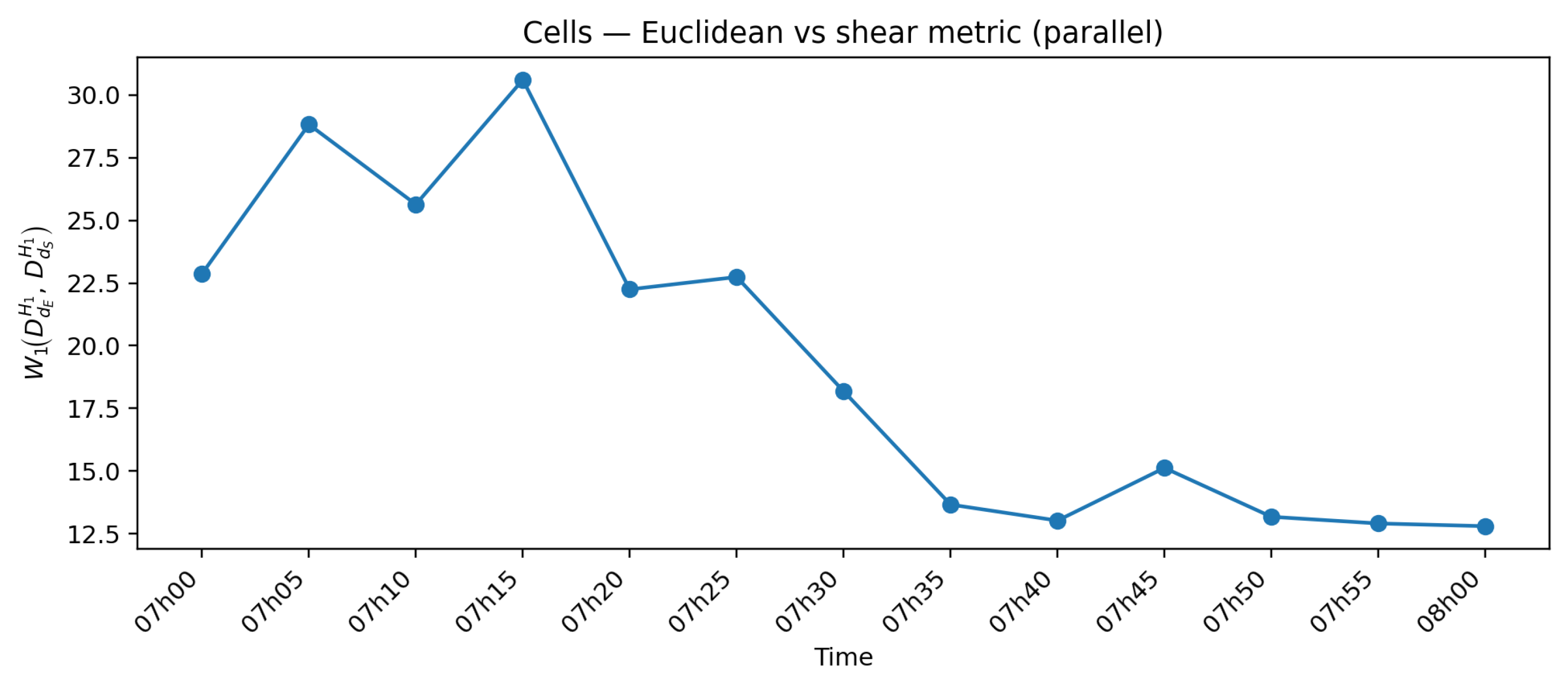
For each time step between 07h00 and 08h00, persistence diagrams associated with the first homology group H 1 are computed using both metrics. The discrepancy between the Euclidean and shear-based descriptions is quantified using the 1-Wasserstein distance
W 1   D d E H 1 , D d S H 1 .
Figure 5 shows the temporal evolution of this distance for the parallel shear variant, in which distances aligned with the shear direction are reinforced.
Large Wasserstein distances are observed during the early phase of the system evolution (07h05–07h20), indicating significant topological differences between the two metrics. After 07h30, the distance decreases progressively, suggesting a reduction in the contribution of shear-aligned topological features as the cellular structures lose their individual coherence.
The Euclidean metric provides a geometrically isotropic baseline, whereas the shear-induced metric introduces a physically motivated anisotropy. The observed temporal variations of the Wasserstein distance demonstrate that the shear metric enhances the sensitivity of persistent homology to flow-aligned structures during dynamically active phases, while converging toward the Euclidean description as the system evolves toward a more organized state.
Having established the added value of the shear-induced metric with respect to the Euclidean baseline, we now investigate the resulting topological transport properties of the system.

3.5. Topological Transport Analysis on H 0 via the Wasserstein Distance

3.5.1. Wasserstein Distance on H 0

In our setting, using Vietoris–Rips filtrations under the shear metric d S , all H 0 classes are born at b = 0 and die at the merging scales; these death times coincide with the edge lengths of the d S -minimum spanning tree. Hence, W p ( D 0 ( t ) , D 0 ( t ) ) measures the optimal transport [27,28,29,30] between merging scales of connected components at times t and t , with diagonal matching handling birth/death imbalance. Large values indicate strong cell transport or merge/split events, while small values correspond to a quasi-stationary configuration. This makes W 1 ( H 0 ) a natural quantitative proxy for the dynamical reorganization of convective cells.
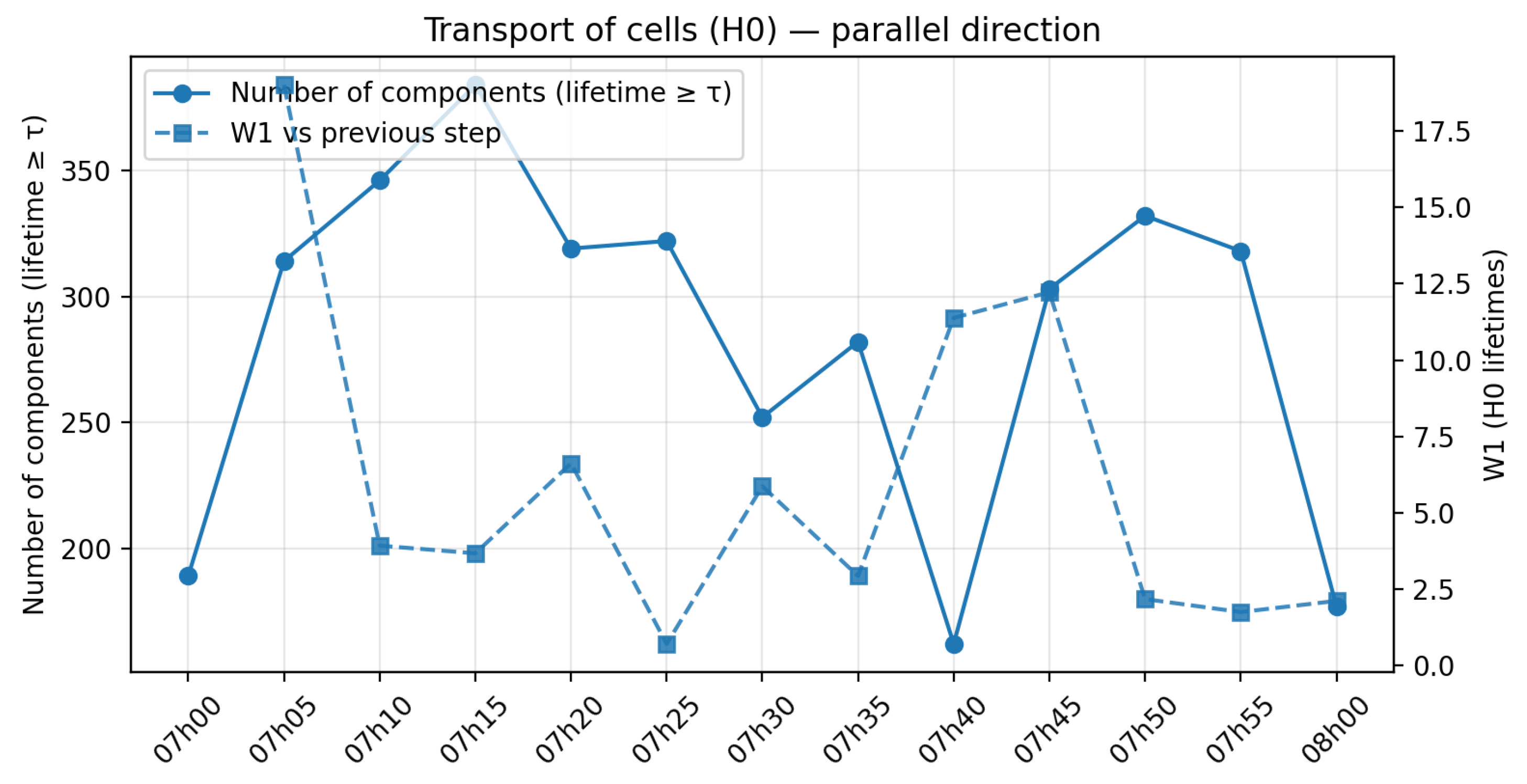
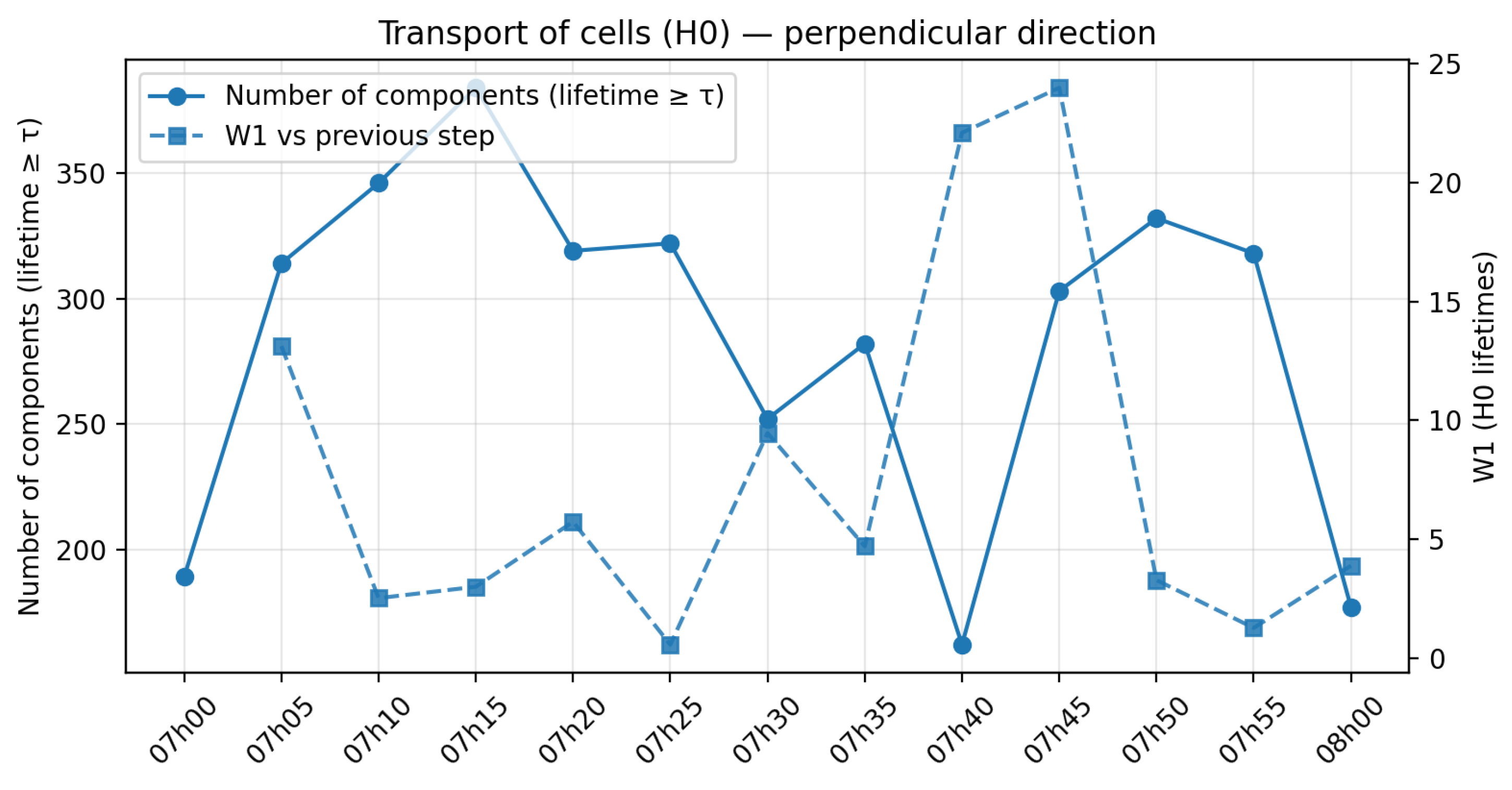
In Figure 6 and Figure 7, the solid blue line represents the number of connected components (i.e., precipitation cells) whose lifetime exceeds a persistence threshold τ at each time step. This quantity reflects the instantaneous stability of the convective structure. The dashed line labelled W1 vs. previous step corresponds to the Wasserstein distance W 1 ( H 0 ( t ) , H 0 ( t Δ t ) ) computed between consecutive persistence diagrams of dimension H 0 . It quantifies the topological transport of connected components between two radar images separated by Δ t (5 min). A large value of W 1 indicates significant rearrangements of the cells, such as merging or splitting events, whereas small values correspond to a quasi-stationary organisation of the convective pattern. This temporal Wasserstein tracking thus provides a quantitative proxy of the dynamical transport of convective cells during the bow-echo event.
We now turn to the analysis of H 0 persistence diagrams, which capture the evolution of connected components and thus the transport of convective cells in time.
In the parallel direction (Figure 6), the number of components increases rapidly between 07h00 and 07h15, reaching a local maximum around 07h15–07h20, consistent with the fragmentation of the main convective line into several intense cells during the early bow formation stage. This growth is followed by a moderate decline between 07h25 and 07h40, suggesting partial merging of the convective cores as the system organizes into a coherent arc.
The Wasserstein distance W 1 ( H 0 ) exhibits several pronounced peaks, notably around 07h05, 07h35, and 07h45. These maxima correspond to moments of strong topological reconfiguration when the spatial connectivity of the radar reflectivity field changes abruptly—in other words, when convective cells merge, split, or migrate significantly along the bow’s main axis. Conversely, the minima (e.g., 07h25, 07h55–08h00) correspond to quasi-stationary intervals, during which the number and spatial distribution of cells remain stable.
Overall, the parallel component of W 1 ( H 0 ) captures the longitudinal transport of the cells—their displacement and coalescence along the direction of the shear. The amplitude of the Wasserstein peaks, up to W 1 18 , confirms that the main structural reorganizations occur along the flow-parallel axis of the bow echo.
In the perpendicular direction (Figure 7), the global pattern is similar but with noticeably larger W 1 amplitudes (up to 25). This reflects the transverse deformation of the convective line, i.e., lateral spreading and inward collapse associated with the rear-inflow jet (RIJ) and the shear-induced curvature of the bow.
The sharp peaks of W 1 at 07h05, 07h40, and 07h45 indicate short-lived but intense reconfigurations across the transverse axis—corresponding to episodes of cell fusion or scission under differential advection. The synchronous timing of these peaks with those in the parallel curve suggests a coupling between longitudinal and transverse dynamics: both components react coherently to the bow echo’s structural reorganization.
The comparison between the two directions shows that:
  • the parallel component reflects the propagation and coalescence of cells along the line of maximum shear;
  • the perpendicular component captures the lateral entrainment and vortex-driven deformation behind the gust front.
Taken together, these two projections of W 1 ( H 0 ) delineate a complete picture of the anisotropic transport within the bow-echo system. The alternation between peaks and troughs of W 1 ( H 0 ) mirrors the succession of convective bursts and reorganizations, quantitatively confirming that the shear-based metric d S is sensitive to both directional advection and cellular fusion–fission processes.

3.5.2. Tracking of High-Intensity Convective Cells

The analysis of W 1 ( H 0 ) over time provides a direct proxy for the tracking of high-intensity convective cells within the bow-echo system. Each connected component in H 0 represents a coherent convective entity, and its persistence reflects the stability of that structure under the shear metric d S . The temporal variations of the Wasserstein distance between consecutive diagrams capture the merging and splitting events that mark the evolution of convective cores.
During the most active phase of the event, peaks in W 1 ( H 0 ) correspond to rapid reconfigurations of the radar reflectivity field, indicating the displacement or fusion of major cells along the shear axis. Conversely, intervals of low W 1 values identify stable phases, during which the spatial organization of the cells remains nearly invariant. This dynamic alternation between stability and topological reorganization demonstrates that the H 0 persistence framework can effectively delineate and follow the strongest convective structures through purely topological indicators, without relying on any geometric or threshold-based segmentation.

3.6. Persistent H 1 Generators Under Shear Metric

3.6.1. Interpretation of the H 1 Generators on Radar Images

In the topological analysis of radar reflectivity fields, the H 1 generators represent the emergence of one-dimensional homological cycles—that is, closed loops that are not boundaries of filled regions at a given filtration scale. Formally, a generator in H 1 is an equivalence class of 1-cycles (mod 2 combinations of edges) modulo the boundaries of 2-chains, characterized by a birth and a death scale along the filtration. The persistence of a given H 1 generator quantifies the geometric robustness of the associated loop with respect to the scale parameter.
In the present study, the filtration metric incorporates the low-level (0–3 km) wind shear, with two directional configurations:
  • In the parallel configuration, points aligned with the shear direction are metrically closer. Persistent H 1 generators thus highlight elongated cavities and corridors oriented along the shear, corresponding to regions of differential inflow or stratiform intrusions.
  • In the perpendicular configuration, the metric emphasizes transverse contrasts in reflectivity. The resulting H 1 generators delineate lateral notches and separations between adjacent convective cores, revealing the transverse segmentation induced by the environmental shear.
Consequently, the spatial distribution of H 1 generators on the radar maps provides a quantitative and directional signature of the internal organization of the convective system. The most persistent cycles correspond to stable mesoscale substructures—such as internal voids, horseshoe patterns, or shear-induced notches—whose topology remains invariant under small perturbations of the metric or of the radar signal.
An H 1 generator on a radar map precisely identifies and traces a persistent cavity or indentation within a convective cell, revealing the internal organization and dynamic deformation of the cell under shear.

3.6.2. Visualization of H 1 Generators on Radar Heatmaps

In order to visualize the spatial meaning of these topological structures, we superimpose the H 1 generators onto the radar reflectivity fields of the convective cells. The resulting heatmaps indicate, in red or orange shades, the exact spatial paths traced by the persistent homological loops.
Each heatmap can thus be interpreted as a topological footprint of the internal organization of the cell: the highlighted contours delineate the regions where the radar field exhibits a closed cavity or indentation robust to the filtration process. The spatial coherence of these contours provides a clear indication of how the convective intensity is distributed and organized within the cell.
By comparing these two sets of heatmaps, one can assess how the low-level shear governs the anisotropic organization of convection: persistent H 1 loops aligned with the shear indicate structural stretching along the flow, whereas perpendicular loops reveal lateral fragmentation and potential initiation of shear-induced subcells. These visualizations therefore offer a direct, quantitative link between the radar morphology and the underlying dynamical environment.

3.6.3. Comparative Analysis of H 1 Generators Under (0–3 km) Shear Metrics

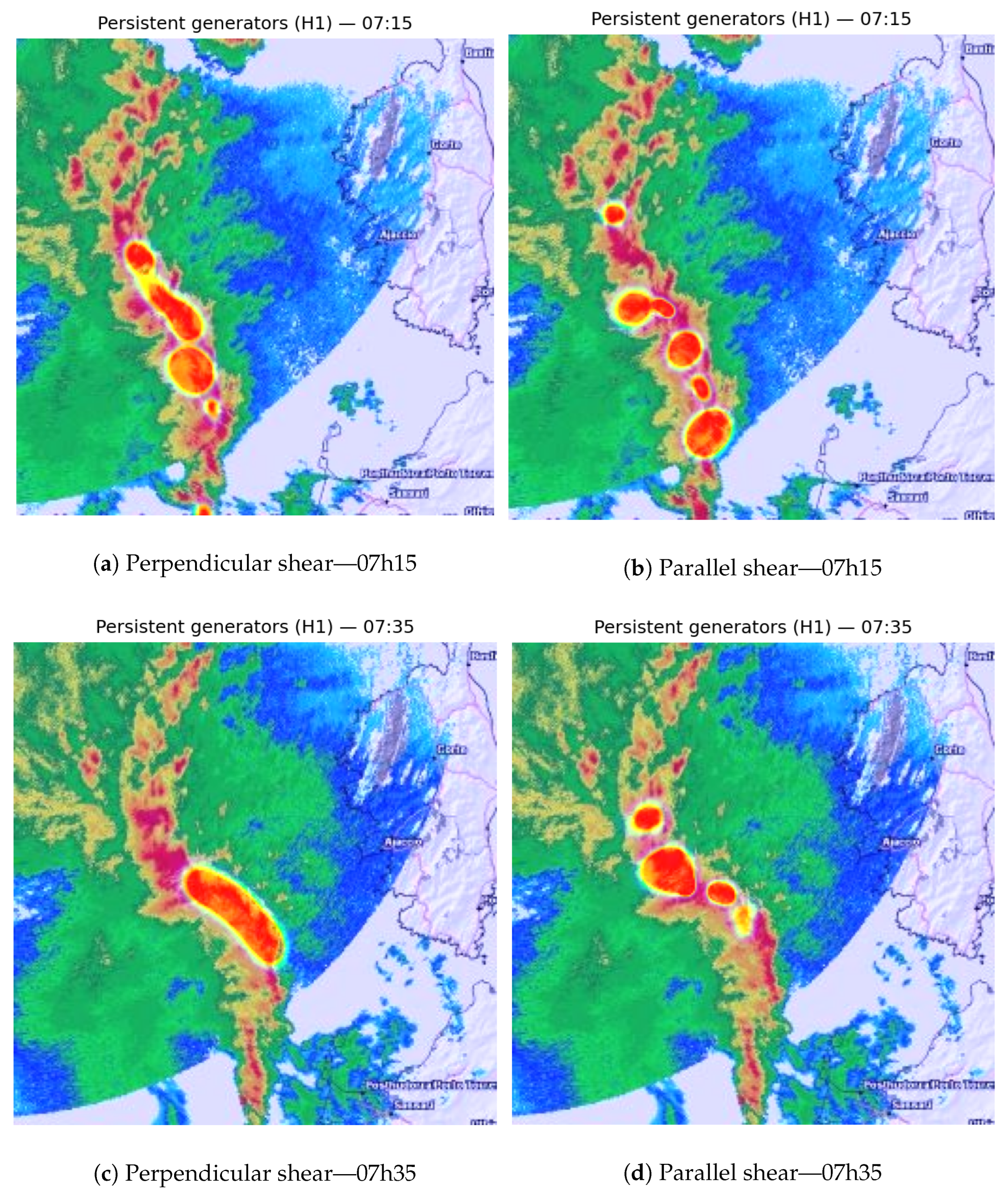
Figure 8 shows the spatial distribution of the persistent H 1 generators superimposed on the radar reflectivity fields of the convective cells at 07h15 and 07h35. The comparison between the two directional metrics (0–3 km shear parallel and perpendicular) highlights both the anisotropy and the temporal evolution of the topological structures within the bowing convective line.
At 07h15, the perpendicular-to-shear metric reveals several well-defined H 1 generators located along the high-reflectivity cores, forming a chain of quasi-circular loops from south to north. These loops correspond to internal voids and lateral notches between adjacent red cores, suggesting the early stage of transverse segmentation induced by the environmental shear. In contrast, the parallel-to-shear configuration at the same time exhibits more elongated generators aligned along the main convective axis, emphasizing the existence of longitudinal corridors of weaker reflectivity inside the line. This difference indicates that the parallel metric captures the initial stretching of the convective elements along the low-level wind shear, whereas the perpendicular metric isolates the emerging lateral separations between subcells.
By 07h35, both configurations show a clear intensification and reorganization of the H 1 generators. In the parallel case, the persistent cycle merges into a single large, elongated loop enclosing the main southern core, a pattern consistent with the onset of a bowing segment and a local enhancement of inflow along the shear direction. Conversely, the perpendicular metric displays fewer but broader generators, one of which delineates a pronounced transverse cavity behind the leading edge. This evolution reflects a dynamical transition from multiple small-scale cavities to a more coherent arc-shaped void, characteristic of the formation of a mesoscale bow echo structure.
Overall, the comparison demonstrates that the two directional filtrations provide complementary insights into the morphology and dynamics of the convective system: the parallel-to-shear metric quantifies the longitudinal organization and elongation of the convective line, while the perpendicular-to-shear metric emphasizes the lateral instabilities and structural fragmentation responsible for the bowing evolution. The persistent H 1 generators therefore act as robust topological indicators of the anisotropic deformation of the convective cells under the influence of the 0–3 km environmental shear.
Perpendicular to the shear (07h15 → 07h35): The H 1 generators are broad, elongated, and continuous, extending along the main convective front. This reflects a longitudinal topological organization of the storm line: the perpendicular metric accentuates transverse contrasts and merges several local cavities into a stretched and robust structure. Physically, this means that the lateral wind shear tends to segment the cells while connecting them along the front, producing persistent H1 loops that follow the arcuate shape of the system.
Parallel to the shear (07h15 → 07h35): The H 1 generators appear more numerous but smaller, often localized on each red core. The parallel metric primarily connects points aligned with the shear direction, resulting in the emergence of several small, independent cycles rather than a single extended loop. These micro-generators represent local internal voids (sub-cells, reflectivity minima) that reflect the internal stretching and fine structuring of the cells in the direction of the flow.
The series of images clearly shows that the perpendicular metric captures the overall coherence of the convective line, while the parallel metric isolates the internal details of individual cells. The two approaches are complementary: together, they describe both the macroscopic topology of the system (convective arc) and its internal micromorphology (subcellular structures).

3.6.4. Low-to-Mid-Tropospheric Wind Shear (0–6 km)

The 0–6 km wind shear quantifies the vector difference between the horizontal wind at the surface (or 0.5 km) and at 6 km altitude, thus representing the integrated shear through the depth of the troposphere. It controls the organization and longevity of convective systems by determining the relative motion between updrafts and downdrafts. Strong 0–6 km shear (typically > 20   m   s 1 ) favors the development of supercellular and bow-echo structures, as it promotes the separation between inflow and precipitation cores, enhances the rear-inflow jet (RIJ), and supports mesoscale rotations. From a dynamical standpoint, this deep-layer shear governs the tilting and stretching of vorticity columns, ensuring the persistence and propagation of the convective line within the environmental flow.
In this study, the topological analysis is performed on plan-view radar reflectivity fields, i.e., two-dimensional horizontal projections of a fully three-dimensional convective system. As a consequence, the vertical structure of the updrafts and downdrafts is not directly observed, and the 0–6 km wind shear cannot be inferred from the radar images themselves. Instead, the deep-layer shear is provided by environmental soundings or reanalysis data and is used as an external dynamical parameter to modulate the metric in the horizontal plane. The TDA therefore quantifies how the horizontal organization of reflectivity footprints responds to a given column-integrated shear, without attempting to reconstruct the full 3D convective motion. This choice must be viewed as a projection of a three-dimensional dynamical constraint onto the two-dimensional radar morphology.
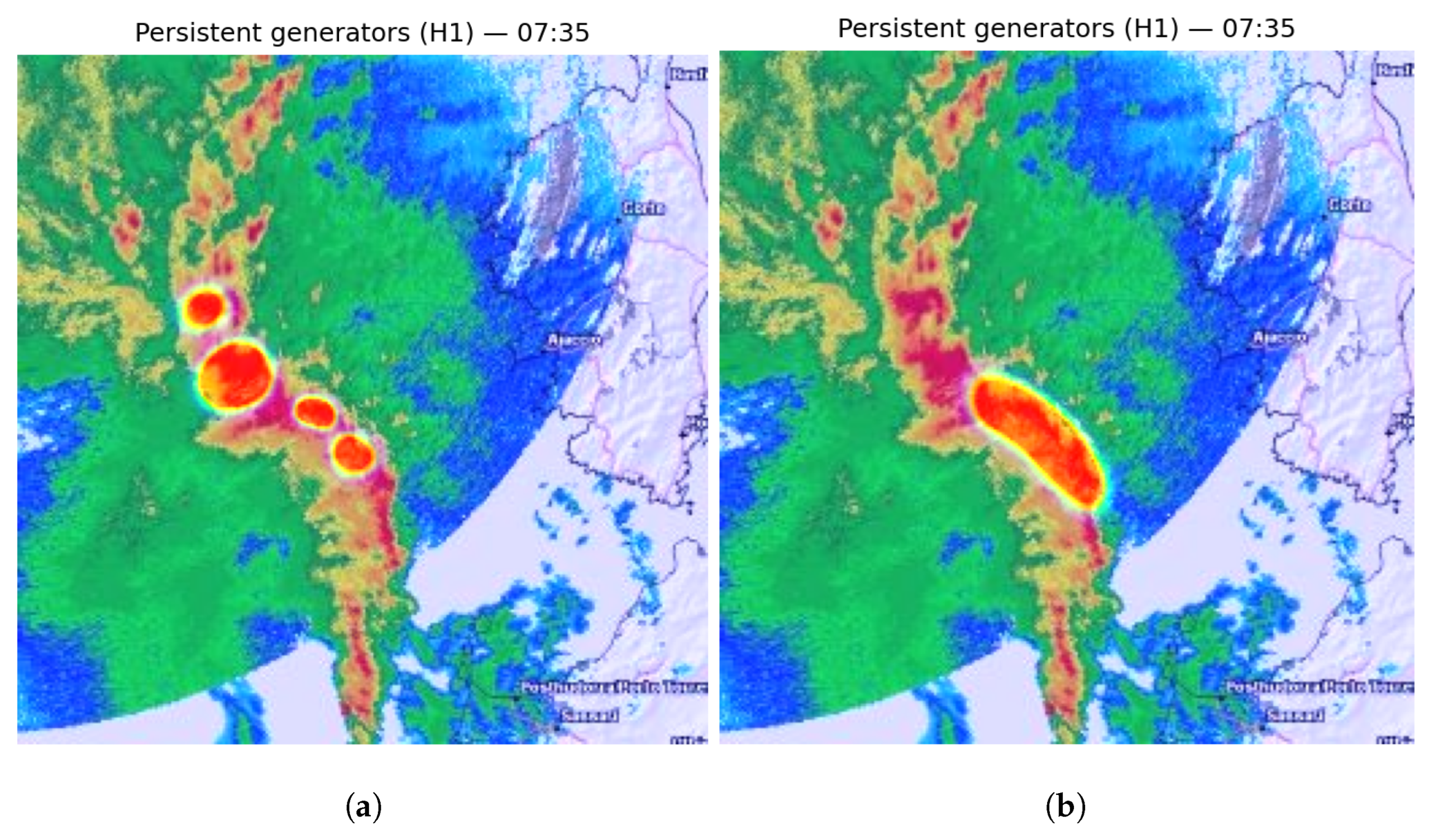
At 07h35, the analysis based on the 0–6 km wind shear reveals a marked difference between the perpendicular and parallel metrics. In the perpendicular see Figure 9b, the H 1 generators form a single elongated loop enclosing the southern convective core, closely following the curvature of the bowing segment. This persistent, arc-shaped cycle indicates a topologically coherent cavity, likely associated with the onset of a deep rear-inflow channel or an organized subsidence region on the trailing side of the system. The coherence of this H 1 loop suggests that the deep-layer shear acts to organize the entire convective structure into a unified, bow-shaped entity.
In contrast, under the parallel-to-shear configuration see Figure 9, the H 1 generators appear more fragmented and concentrated within individual reflectivity maxima. This distribution indicates that the deep shear aligns the internal updraft cores but does not yet merge them into a single mesoscale organization. The presence of several smaller, short-lived loops points to local heterogeneities within the convective cells, consistent with the early phase of structural consolidation.
Overall, the 0–6 km shear enhances the topological anisotropy: the perpendicular metric captures the large-scale curvature and bowing of the convective line, while the parallel metric retains the imprint of internal vertical alignment. The persistence of the main H 1 generator in the perpendicular case can therefore be interpreted as a robust topological signature of the deep-layer shear coupling between the low-level inflow and the mid-level rear inflow jet.

3.6.5. Synthesis and Concluding Remarks

The comparison between the 0–3 km and 0–6 km shear configurations highlights a consistent deepening of the topological organization with altitude. At low levels, the shear primarily controls the segmentation and horizontal alignment of the convective cells, whereas at mid-levels it governs their curvature and mesoscale coherence. In both cases, the H 1 generators provide a quantitative signature of how the environmental shear shapes the geometry of convection: from a collection of locally independent cores to a unified, bow-shaped structure. This topological continuity across vertical shear layers confirms the robustness of TDA metrics as a diagnostic of dynamical organization within severe convective systems.

3.6.6. Robustness Analysis of the Shear-Based Metric

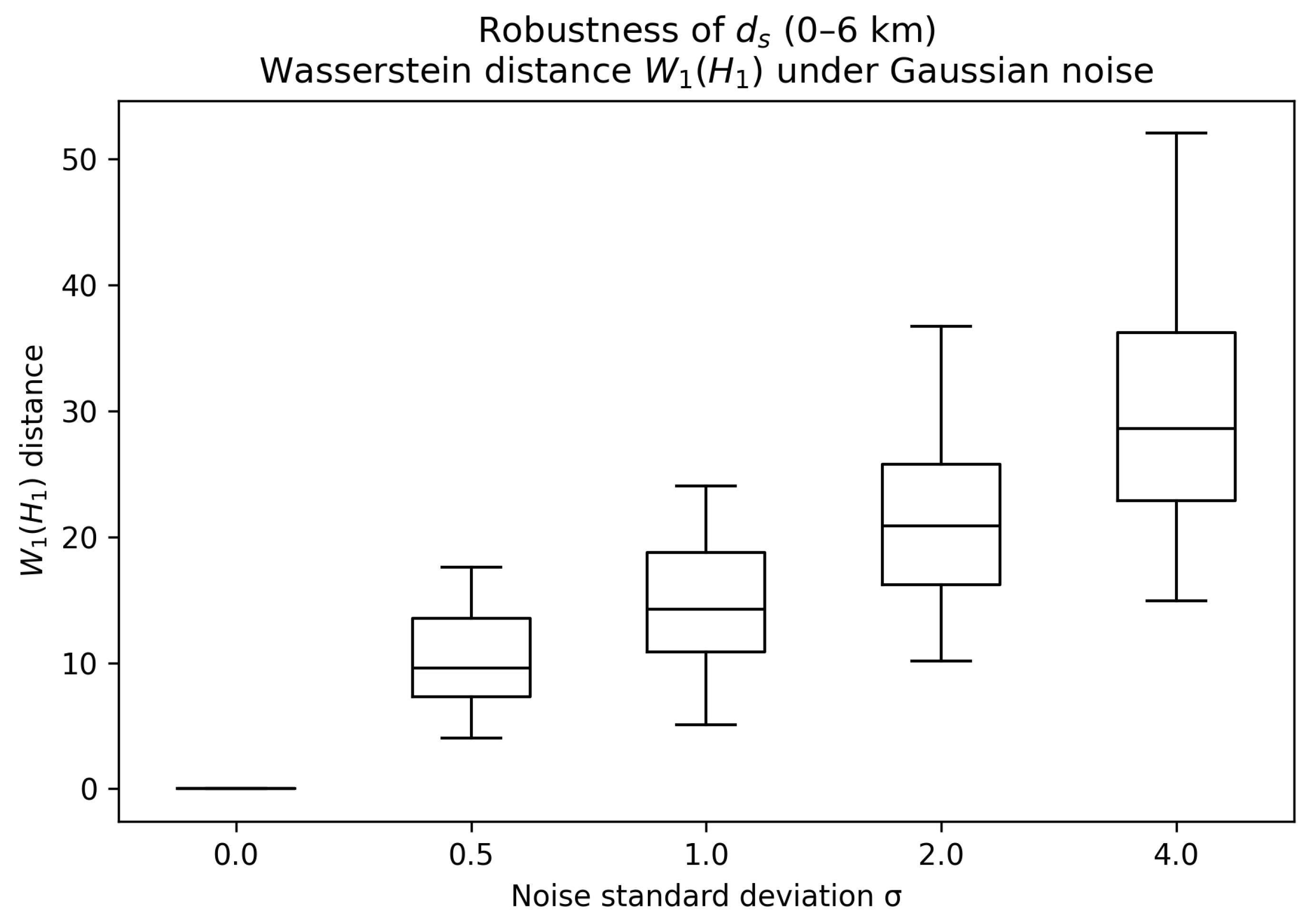
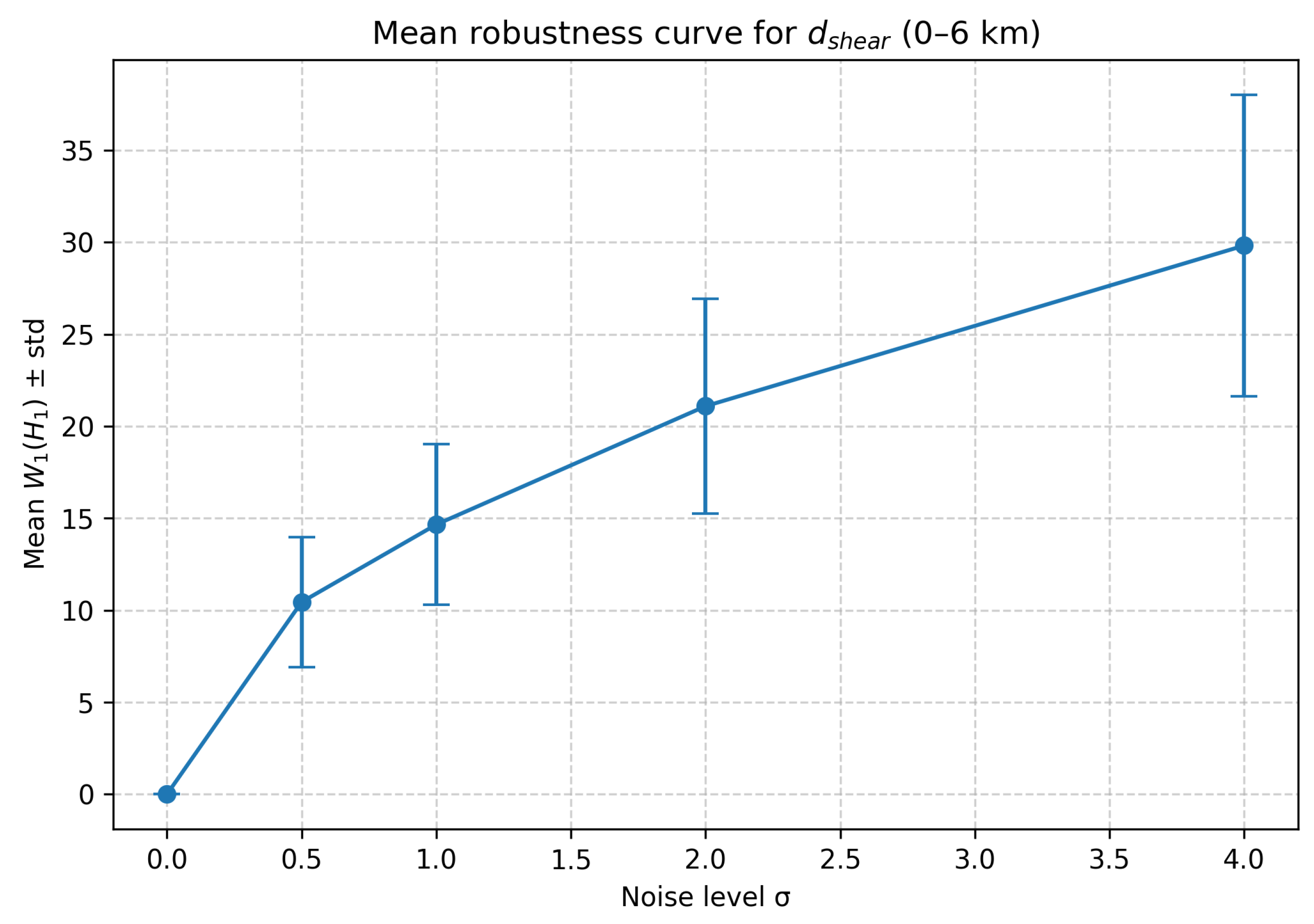
Figure 10 and Figure 11 summarize the robustness of the shear-based distance d shear computed for the 0–6 km layer under Gaussian perturbations of increasing variance applied to the radar-derived point clouds of convective cells. The boxplot of the Wasserstein distances W 1 ( H 1 ) (Figure 10) shows a clear monotonic and quasi-linear increase with the noise level σ . For weak perturbations ( σ 1 ), the median values remain low ( W 1 ( H 1 ) 10 –15) with narrow interquartile ranges, indicating that small-scale geometric noise induces only minor deformation in the persistence diagrams. This confirms that the major H 1 generators—associated with convective cell boundaries and internal voids—are preserved under realistic uncertainty levels.
As the noise amplitude increases ( σ > 2 ), the distribution of W 1 ( H 1 ) broadens slightly, but the overall growth remains regular and continuous, without any abrupt topological transitions. The mean robustness curve (Figure 11) illustrates this trend quantitatively: the average W 1 ( H 1 ) grows linearly with σ , while the standard deviation remains moderate across all noise levels. This linear behavior indicates a proportional response of the metric to perturbations, which can be interpreted as a form of topological elasticity: the shear metric resists isotropic deformation by privileging distortions along the dominant shear direction.
Such stability confirms that the anisotropic nature of d shear preserves the essential mesoscale organization of the bow echo, even when spatial uncertainty is introduced. Compared with isotropic Euclidean metrics, the shear-based distance demonstrates higher resilience of the topological signatures to noise, making it a physically consistent and robust choice for analyzing convective structures governed by environmental wind shear.

4. Limitations and Perspectives

The present study has several limitations that should be acknowledged. First, the analysis is based on two-dimensional radar reflectivity images, which provide a horizontal representation of inherently three-dimensional convective structures. Vertical organization and tilting effects are therefore only indirectly captured through their horizontal projection. Extending the proposed framework to volumetric radar data or three-dimensional numerical model outputs would allow a more complete characterization of convective dynamics.
Second, the construction of point clouds relies on image segmentation and sampling choices that may influence the detection of small-scale or weakly persistent topological features, particularly in H 1 . Although the main topological signatures discussed in this work were found to be robust with respect to reasonable variations in sampling density, a systematic sensitivity analysis remains outside the scope of the present study.
Third, the application presented here focuses on a single, well-documented bow echo event, while this case study is sufficient to illustrate the methodological contribution and physical relevance of the proposed metric, further validation across a broader range of convective systems would be required to assess its general applicability.
Finally, the interpretation of individual persistent topological features in terms of specific physical processes is partly qualitative. Establishing a fully quantitative correspondence between topological generators and dynamical mechanisms would require larger datasets and statistical analyses, which are left for future work.

5. Conclusions

This work introduced a new class of anisotropic metrics for persistent homology, in which the geometry of the data space is explicitly modulated by the direction and intensity of vertical wind shear. The proposed shear-based metric d S generalizes the concept of distance by embedding environmental dynamics directly into the metric structure itself, thereby enabling a physically consistent topological analysis of convective systems. When applied to radar reflectivity fields combined with ERA5 shear data, the metric d S revealed distinct topological evolutions depending on whether the shear was parallel or perpendicular to the convective line. The H 0 -based transport analysis quantified the large-scale reorganization of intense precipitation cores, while the H 1 generators characterized the anisotropic structuring of the bow-echo morphology. Together, these complementary analyses provided a unified, physically interpretable framework for describing convective organization through topological invariants.
The results presented here open several directions for further research. From a theoretical standpoint, the family of shear-induced metrics could be extended to time-dependent formulations d S ( t ) , where the anisotropy evolves continuously with the environmental flow, or to coupled multi-parameter filtrations combining intensity and shear. From an applied perspective, the integration of this topological framework into machine learning or quantum architectures could enable real-time identification of convective regimes and early warning of severe weather. Future work will also explore the comparison of shear-induced and AdS-inspired metrics to assess the respective contributions of curvature and anisotropy to persistent homology in meteorological systems. Overall, the proposed approach provides a new mathematical bridge between dynamical meteorology and topological data analysis, opening the way toward a deeper understanding of organized convection through geometry and topology.

Author Contributions

Conceptualization, H.C.; Methodology, H.C. and P.D.; Validation, E.F.; Writing—review & editing, H.C.; Visualization, P.D. All authors have read and agreed to the published version of the manuscript.

Funding

This research received no external funding.

Data Availability Statement

The original contributions presented in this study are included in the article. Further inquiries can be directed to the corresponding author.

Conflicts of Interest

The authors declare no conflicts of interest.

Appendix A. Technical Proofs

Appendix A.1. Proofs for Section “Continuity and Lipschitz Regularity”

Proof of Lemma 1.
Write d S ( t ) ( x , y ) = A t v 2 with v : = x y and
A t : = λ ( t )   P S ^ ( t ) + λ ( t )   P S ^ ( t ) ,   P u : = u u .
By the reverse triangle inequality and submultiplicativity,
| A t v 2 A s v 2 |     ( A t A s ) v 2     A t A s op   v 2 .
We expand
A t A s = λ ( t ) λ ( s ) P S ^ ( t ) + λ ( s ) P S ^ ( t ) P S ^ ( s )       + λ ( t ) λ ( s ) P S ^ ( t ) + λ ( s ) P S ^ ( t ) P S ^ ( s ) .
Using (A1) gives | λ ( t ) λ ( s ) | Lip ( λ )   | t s | . For unit vectors u , v one has P u P v op = 2 sin   1 2 ( u , v ) ( u , v ) , hence (A2) yields P S ^ ( t ) P S ^ ( s ) op L θ | t s | and the same for the orthogonal directions. Altogether,
A t A s op     L λ | t s | + λ sup + λ sup L θ | t s | ,
which implies (6) with the bound (7). □
Proof of Corollary 1.
For any p Ω ,
| f t ( p ) f s ( p ) | = | min x X d S ( t ) ( p , x ) min y X d S ( s ) ( p , y ) |     min x X | d S ( t ) ( p , x ) d S ( s ) ( p , x ) | .
Apply Lemma 1 and use min x X p x 2 diam ( Ω ) for p Ω . □
Proof of Corollary 2.
By the standard L stability theorem for persistence (distance-to-set or sublevel-set filtrations), the bottleneck distance is bounded by f t f s L ( Ω ) . Apply (8). □

Appendix A.2. Proofs for Stability and Vietoris–Rips Compatibility

Proof of Theorem 1.
Let f X S ( p ) = min x X d S ( p , x ) and f Y S ( p ) = min y Y d S ( p , y ) be the distance-to-set functions induced by d S . For any p R 2 , choose x X and y Y such that x y 2 d H ( E ) ( X , Y ) . By the norm equivalence d S ( p , x ) λ max p x 2 and the triangle inequality,
| f X S ( p ) f Y S ( p ) |     λ max   d H ( E ) ( X , Y ) .
Hence f X S f Y S L ( R 2 ) λ max   d H ( E ) ( X , Y ) . Applying the classical L stability theorem for persistence diagrams yields (13). □
Proof of Proposition 1.
By norm equivalence, λ min x y 2 d S ( x , y ) λ max x y 2 . If x y 2 r , then d S ( x , y ) λ max   r , proving the first inclusion. Conversely, if d S ( x , y ) λ max   r , then x y 2 λ max / λ min   r , yielding the second inclusion. Monotonicity of the Vietoris–Rips complex in the scale parameter completes the proof. □
Proof sketch for Corollary 3.
Apply Proposition 1 simplexwise and use functoriality of homology to obtain interleaving morphisms between the two filtrations. □

Appendix A.3. Proof of Proposition 2

Proof. 
We write the weighted lifetime distributions at times t and s as
P t ( k ) = i = 1 n w i , t   δ 𝓁 i , t ( k ) ,   P s ( k ) = i = 1 n w i , s   δ 𝓁 i , s ( k ) ,
where the lifetimes 𝓁 i , · ( k ) and weights w i , · satisfy assumptions (i)–(iii) of Proposition 2.
We construct an admissible transport plan π between P t ( k ) and P s ( k ) as follows. For each index i, we transport the common mass
m i : = min ( w i , t , w i , s )
from the atom located at 𝓁 i , t ( k ) to the atom located at 𝓁 i , s ( k ) . The remaining unmatched mass is given by
M res = 1 2 i = 1 n | w i , t w i , s |     1 2   L w   | t s | ,
where the inequality follows from assumption (ii).
  • Aligned contribution. By assumption (i), the cost associated with transporting the aligned mass is bounded by
    i = 1 n m i   | 𝓁 i , t ( k ) 𝓁 i , s ( k ) |     L 𝓁   | t s | i = 1 n m i     L 𝓁   | t s | ,
    since i m i 1 .
  • Residual contribution. By assumption (iii), all lifetimes lie in the interval [ 0 , L max ] . Therefore, any unit of mass transported in the residual part travels a distance at most L max , and the corresponding transport cost satisfies
    C res     L max   M res     L max L w   | t s | .
  • Wasserstein–1 bound. The 1-Wasserstein distance is bounded above by the total cost of any admissible coupling. For the coupling constructed above, this yields
    W 1   P t ( k ) , P s ( k )     L 𝓁   | t s | + L max L w   | t s | = L 𝓁 + L max L w   | t s | .
  • Extension to p-Wasserstein distances. Let D = L max denote the diameter of the support of the lifetime distributions. For any admissible coupling π between two probability measures supported in [ 0 , D ] , one has
    d ( x , y ) p   d π ( x , y )     D   p 1 d ( x , y )   d π ( x , y ) ,
    since d ( x , y ) p D p 1 d ( x , y ) for all d ( x , y ) [ 0 , D ] . Taking the infimum over all couplings gives
    W p ( P t ( k ) , P s ( k ) ) p     D   p 1   W 1 ( P t ( k ) , P s ( k ) ) .
    Combining this inequality with the W 1 bound derived above yields
    W p ( P t ( k ) , P s ( k ) )     L max   1 1 p L 𝓁 + L max L w 1 p | t s | 1 p ,
    which concludes the proof.

References

  1. Rotunno, R.; Klemp, J.B.; Weisman, M.L. A theory for strong, long-lived squall lines. J. Atmos. Sci. 1988, 45, 463–485. [Google Scholar] [CrossRef]
  2. Weisman, M.L.; Klemp, J.B. The dependence of numerically simulated convective storms on vertical wind shear and buoyancy. Mon. Weather. Rev. 1982, 110, 504–520. [Google Scholar] [CrossRef]
  3. Weisman, M.L.; Trapp, R.J. Low-level mesovortices within squall lines and bow echoes. Part I: Overview and dependence on environmental shear. Mon. Weather. Rev. 2003, 131, 2779–2803. [Google Scholar] [CrossRef][Green Version]
  4. Weisman, M.L. The genesis of severe, long-lived bow echoes. J. Atmos. Sci. 1993, 50, 645–670. [Google Scholar] [CrossRef]
  5. Corfidi, S.F. Cold pools and MCS propagation: Forecasting the motion of downwind-developing MCSs. Weather. Forecast. 2003, 18, 997–1017. [Google Scholar] [CrossRef]
  6. Markowski, P.; Richardson, Y. Mesoscale Meteorology in Midlatitudes; John Wiley & Sons: Hoboken, NJ, USA, 2010; 30p. [Google Scholar] [CrossRef]
  7. Przybylinski, R.W. The bow echo: Observations, numerical simulations, and severe weather detection methods. Weather. Forecast. 1995, 10, 203–218. [Google Scholar] [CrossRef]
  8. Púčik, T.; Groenemeijer, P.; Punge, H.J. Vertical Wind Shear and Convective Storms: An Updated Overview Across Europe; ECMWF Research Report; ECMWF: Reading, UK, 2021. [Google Scholar]
  9. Wang, Y.-C.; Wang, C.-C.; Hsu, C.-J. Study of an asymmetric and anticyclonic bow echo near Taiwan. Atmosphere 2022, 13, 331. [Google Scholar] [CrossRef]
  10. Zhou, Y.; Meng, Z.; Sun, J. A climatological study on the two types of bow echoes over Eastern China. J. Geophys. Res. Atmos. 2023, 128, e2023JD038720. [Google Scholar] [CrossRef]
  11. Chernokulsky, A.; Shikhov, A.; Zolina, O. Empirical relationships among characteristics of severe convective storms, straight-line winds, and tornadoes over Northern Eurasia. Atmosphere 2023, 14, 174. [Google Scholar] [CrossRef]
  12. Canot, H.; Durand, P.; Frenod, E. Curved Geometries in Persistent Homology: From Euclidean to AdS Metrics in Bow Echo Dynamics. Int. J. Topol. 2025, 2, 19. [Google Scholar] [CrossRef]
  13. Ver Hoef, L.; Adams, H.; King, E.J.; Ebert-Uphoff, I. A Primer on Topological Data Analysis to Support Image Analysis Tasks in Environmental Science. Artif. Intell. Earth Syst. 2023, 2, e220039. [Google Scholar] [CrossRef]
  14. Sena, C.Á.P.; da Paixão, J.A.R.; de Almeida França, J.R. A Topological Data Analysis approach for retrieving Local Climate Zones patterns in satellite data. Environ. Challenges 2021, 5, 100359. [Google Scholar] [CrossRef]
  15. Licon-Salaiz, L.I. Topological Aspects of Turbulence in the Planetary Boundary Layer. Ph.D. Thesis, Universität zu Köln, Köln, Germany, 2020. [Google Scholar]
  16. Muszynski, G.; Kashinath, K.; Kurlin, V.; Wehner, M.; Prabhat. Topological Data Analysis and Machine Learning for Recognizing Atmospheric River Patterns in Large Climate Datasets. Geosci. Model Dev. 2019, 12, 613–628. [Google Scholar] [CrossRef]
  17. Strommen, K.; Chantry, M.; Dorrington, J.; Otter, N. A Topological Perspective on Weather Regimes. Clim. Dyn. 2023, 60, 1415–1445. [Google Scholar]
  18. ERA5. Copernicus Climate Change Service, Climate Data Store Catalogue: ERA5 Hourly Data on Single Levels from 1940 to Present. Copernicus Climate Change Service (C3S) Climate Data Store (CDS). 2023. Available online: https://cds.climate.copernicus.eu/datasets/reanalysis-era5-single-levels?tab=overview (accessed on 28 August 2025).
  19. Chazal, F.; Cohen-Steiner, D.; Glisse, M.; Guibas, L.; Oudot, S. Optimal Approximation of Persistence Diagrams. Discret. Comput. Geom. 2013, 49, 727–755. [Google Scholar]
  20. Cohen-Steiner, D.; Edelsbrunner, H.; Harer, J. Stability of Persistence Diagrams. Discret. Comput. Geom. 2007, 37, 103–120. [Google Scholar] [CrossRef]
  21. Cohen, A.E.; Schultz, D.M. Contraction and expansion of convective systems in environments of varying wind shear. J. Atmos. Sci. 2017, 74, 65–81. [Google Scholar]
  22. Maybee, B.; Marsham, J.; Klein, C.; Parker, D.; Barton, E.; Taylor, C.; Lewis, H.; Sanchez, C.; Jones, R.W.; Warner, J. Wind shear effects in convection-permitting models: Impacts on MCS organisation and precipitation. Q. J. R. Meteorol. Soc. 2024, 150, 1–20. [Google Scholar]
  23. Wallace, B.; Haberlie, A.M.; Gensini, V.A.; Ashley, W.S.; Michaelis, A.C. Causes and characteristics of changes in mesoscale convective systems under climate change. J. Clim. 2024, 37, 3650–3672. [Google Scholar]
  24. Tian, Y.; Neale, R.; Morrison, H. Non-Monotonic Convective Response to Vertical Wind Shear. J. Atmos. Sci. 2025, 17, e2024MS004859. [Google Scholar]
  25. Dong, W.; Zhao, M.; Harris, L.; Cheng, K.; Zhou, L.; Ramaswamy, V. Response of Global Mesoscale Convective Systems to Shear under Warming Scenarios. Earth’s Future 2025, 13, e2024EF005776. [Google Scholar] [CrossRef]
  26. Bauer, U. Ripser: Efficient Computation of Vietoris–Rips Persistence. J. Appl. Comput. Topol. 2021, 5, 391–423. [Google Scholar] [CrossRef]
  27. Villani, C. Topics in Optimal Transportation; Graduate Studies in Mathematics; American Mathematical Society: Providence, RI, USA, 2003; Volume 58. [Google Scholar]
  28. Villani, C. Optimal Transport: Old and New. In Grundlehren der Mathematischen Wissenschaften; Springer: Berlin/Heidelberg, Germany, 2009; Volume 338. [Google Scholar]
  29. Santambrogio, F. Optimal Transport for Applied Mathematicians; Progress in Nonlinear Differential Equations and Their Applications; Birkhäuser: Basel, Switzerland, 2015; Volume 87. [Google Scholar]
  30. Peyré, G.; Cuturi, M. Computational Optimal Transport. Found. Trends Mach. Learn. 2019, 11, 355–607. [Google Scholar]
Figure 1. Illustration of the Vietoris–Rips filtration and its persistence diagram. The left panel shows a noisy circular point cloud whose underlying topology contains one significant 1-dimensional loop. The right panel displays the corresponding persistence diagram: the orange point represents the dominant H 1 class (the persistent loop), while the blue points near the diagonal correspond to short-lived H 0 components that merge as the filtration radius increases.
Ijt 03 00006 g001
Figure 2. Conceptual illustration of persistence diagrams under the shear metric d S . (a) Euclidean Vietoris–Rips filtration: the growth of simplices is isotropic, and the birth ( b i ) and death ( d i ) of topological features depend only on spatial proximity. (b) Under the shear metric d S , distances parallel to the shear direction S ^ are compressed ( λ < λ ), leading to earlier connections and smaller birth radii for shear-aligned structures, whereas transverse structures require larger filtration radii to merge, yielding delayed death and longer persistence. (c) Persistence diagram. Colors in panels (a,b) represent the two point clusters only. In panel (c), the two filtrations are distinguished by the marker types (circles for Euclidean, triangles for d S ), with matching colors used for readability. Shear-aligned features appear farther from the diagonal under d S , reflecting their enhanced topological stability in a shear-deformed geometry.
Ijt 03 00006 g002
Figure 3. Illustrative robustness of the shear metric d S under noise injected on the shear field S. We report bottleneck and Wasserstein W 1 distances between baseline and perturbed persistence diagrams for H 0 and H 1 .
Ijt 03 00006 g003
Figure 4. Synthetic precipitation cells (Gaussian blobs) with annotated centers. This toy scene is used solely to illustrate the type of convective patterns analyzed with the shear metric d S in the TDA pipeline.
Ijt 03 00006 g004
Figure 5. Temporal evolution of the W 1 Wasserstein distance between H 1 persistence diagrams computed with the Euclidean metric d E and the shear-induced metric d S (parallel variant) for convective cells.
Ijt 03 00006 g005
Figure 6. Transport of cells ( H 0 ) in the parallel direction: number of components (solid line) and Wasserstein distance W 1 (dashed line) over time.
Ijt 03 00006 g006
Figure 7. Transport of cells ( H 0 ) in the perpendicular direction: number of components (solid line) and Wasserstein distance W 1 (dashed line) over time.
Ijt 03 00006 g007
Figure 8. Persistent H 1 generators under directional shear metrics (0–3 km). Heatmaps of the persistent topological generators superimposed on radar reflectivity fields at 07h15 and 07h35 UTC. Panels (a,b) correspond to the perpendicular and parallel configurations of the 0–3 km shear for 07h15, respectively and panels (c,d) correspond to the perpendicular and parallel configurations of the 0–3 km shear for 07h35, respectively. The H 1 loops (in red–orange) delineate the internal cavities and notches within the high-reflectivity cores. Between 07h15 and 07h35, the generators evolve from multiple small-scale voids to a larger, elongated loop enclosing the southern convective core, indicating a transition toward a bow-echo configuration driven by low-level shear anisotropy.
Ijt 03 00006 g008
Figure 9. Comparison of H 1 generators at 07h35 under the 0–6 km parallel-shear (left) and perpendicular-shear (right) metrics. (a) Persistent H 1 generators at 07h35 under the 0–6 km parallel-shear metric. Distances across the shear direction are emphasised, revealing several compact H 1 cycles associated with high-intensity convective cells. (b) Persistent H 1 generators at 07h35 under the 0–6 km perpendicular-shear metric. Connectivity along the shear is favoured, producing a single elongated H 1 cycle wrapping around the main core.
Ijt 03 00006 g009
Figure 10. Robustness of d shear (0–6 km): boxplot of the Wasserstein distance W 1 ( H 1 ) under Gaussian noise. The metric exhibits a linear and stable response to increasing perturbations.
Ijt 03 00006 g010
Figure 11. Mean robustness curve of d shear (0–6 km): average W 1 ( H 1 ) (blue line) and standard deviation (error bars) as a function of the Gaussian noise level σ .
Ijt 03 00006 g011
Disclaimer/Publisher’s Note: The statements, opinions and data contained in all publications are solely those of the individual author(s) and contributor(s) and not of MDPI and/or the editor(s). MDPI and/or the editor(s) disclaim responsibility for any injury to people or property resulting from any ideas, methods, instructions or products referred to in the content.