1. Introduction
The role that topology plays in theoretical physics, General Relativity (GR) in particular, is an unclear one. On the one hand, there is the foundational work of Hawking and Ellis [
1] on the large-scale and causal structure of spacetime, and corresponding observations coming from the cosmic microwave background [
2]. On the other hand, we have several no-go theorems regarding the topology change of spatial sections of a Lorentzian manifold (e.g., [
3]). Observationally, although exotic options have been explored [
4,
5], the general consensus is that the topology of the Universe is something akin to
.
However, the story is quite different in quantum gravity. The essential philosophical principle is that just as quantum fields vary wildly on small scales, the same should be true of the geometrical structure of the Universe, and that these wild fluctuations should extend to topology as well (often described as a spacetime foam). Further, a defining feature of GR is background independence; the theory does not exist on a fixed background, but rather the background is determined by the dynamics of the theory. However, this background independence does not apply to topology as GR is only a local theory—it does not provide us with a mechanism to directly probe the topological structure. The topology must be set ahead of time by the theorist, a situation which is also true of the dimension, as well as the differentiable structure (an issue that is more well-studied in recent years; see Asselmeyer-Maluga and Brans [
6,
7], Duston [
8,
9]).
This expectation about the behavior of quantum gravity needs to be compared to the reality of specific modern approaches. Prime among them is Loop Quantum Gravity (LQG), which is well-developed enough for introductory textbooks to be dedicated to it (e.g., [
10]). Another interesting approach is Causal Dynamical Triangulations (CDT), which is a direct attempt to simulate the thermal physics of discrete spacetimes [
11,
12]. In both of these approaches, however, the spatial topology is fixed to be trivial, and is not allowed to change—thus, the full vision of the spacetime foam described in the previous paragraph is explicitly not realized. Even in the case of Causal Set Theory, which aims to build up spacetime from fundamentally topological units, it is not clear that the foam structure is manifest [
13]. Without the ability to track the spatial topology, one cannot even explore the most basic questions like the probability amplitude for the spatial section to transition between a sphere and a torus.
With this background in hand, we now discuss a new approach that proposes to include changing topologies into quantum gravity, LQG and CDT in particular. It is based on representing the spatial sections (or the spacetime manifold as a whole) as branched covering spaces. This approach has been studied in LQG (topspin networks [
14,
15,
16]), and a few explicit calculations have been done [
17,
18]. We are working on moving these ideas to CDT, but the statistical tools used in that approach pose different challenges than the analytical calculations that can be successfully completed in LQG. This paper will address this technical problem by demonstrating an implementation of an algorithm that can “track” the topology in the critical dimension 3, and will apply these calculations over a particular collection of graphs. The choice of the graphs is for demonstration purposes, and we will present all the fundamental groups that can be realized over a set of graphs from a particular family (the wheel graphs) at a fixed order of the cover. This result is a technical one, but is absolutely required in order to make progress including topology change in quantum gravity via branched covering spaces.
We would also like to briefly mention that the algorithm we will present belongs to the realm of computational topology, and therefore could find use in topological data analysis. We point the interested reader to a few introductory papers on the subject. For an introduction to persistent homology (with applications to DNA structure), see [
19]. For an introduction to the Mapper algorithm (with a focus on high-dimensional data), see [
20]. For a specific application of rough sets to COVID-19 diagnosis, see [
21].
The rest of this paper is organized as follows:
Section 2 will present the key mathematical construction we will be using, as well as introduce several new graphical clarifications.
Section 3 will present the specifics of the model, and some of the technical details about the software used.
Section 5 will present the results of the simulations, and we will finish in
Section 6 by summarizing and giving some perspective on where we envision this project going from here.
2. Spacetime as a Branched Covering Spaces
Most of the pertinent technical details on this material can be found in Denicola et al. [
14] or Duston [
15], so here we will just sketch the main ideas, and try to add some new clarity to the conceptual understanding of these structures. The key classical result upon which the construction is based is the following [
22]:
Theorem 1 (Alexander’s Theorem).
Any compact oriented 3-manifold can be described as a branched covering of , branched along a graph.
We can roughly describe this result as presenting a way to reparameterize the geometric and topological degrees of freedom for arbitrary manifolds in such a way that we can be guaranteed to describe them all. It can be generalized to dimension 4 [
23], the number of covers can be restricted [
24], and one can find complete sets branched over special types of knots [
25]. A key feature of these results that should be noted is that the branch locus is codimension 2—smaller choices of codimension will typically not result in the covers being well-defined manifolds.
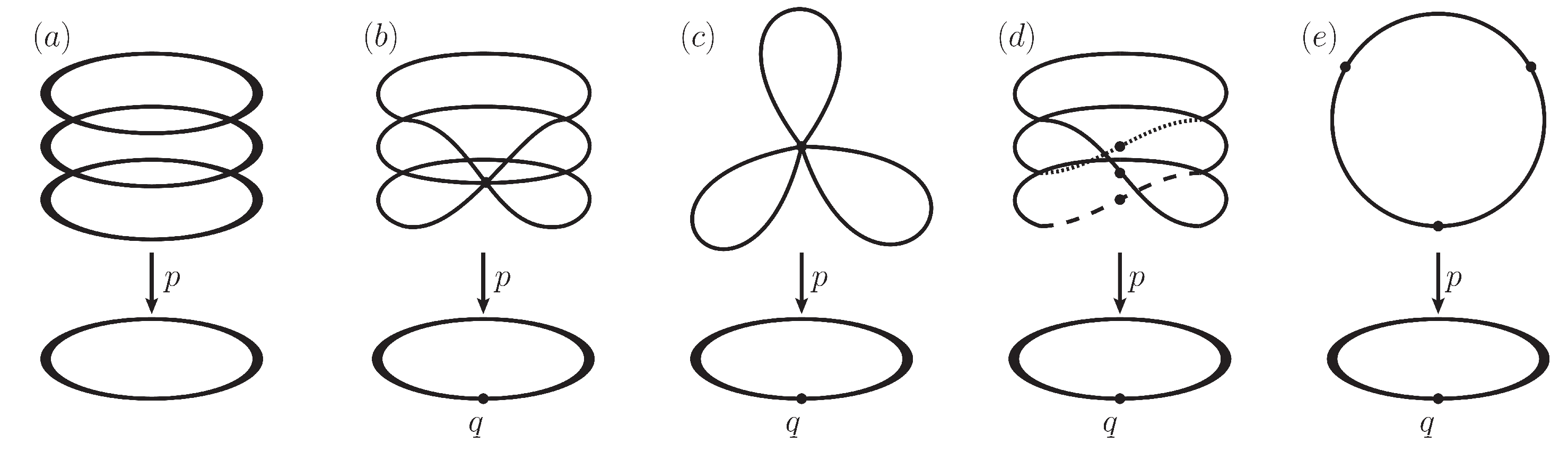
The first of our conceptual sketches can be found in
Figure 1, which shows both unbranched and branched 1-dimensional 3-fold covers over a sphere
. Note that in the unbranched case, the number of inverse images
of an open set
is constant (that is, three), but in the first branched example this fails over a particular point
q (the “branch locus”;
is the “ramification locus”). We have chosen this illustration to also demonstrate that in this codimension (one), you do not generally get nice manifolds, and also that the manner in which these constructions are presented can obscure their true identity (in
Figure 1d,e the cyclic cover
is actually an unbranched manifold).
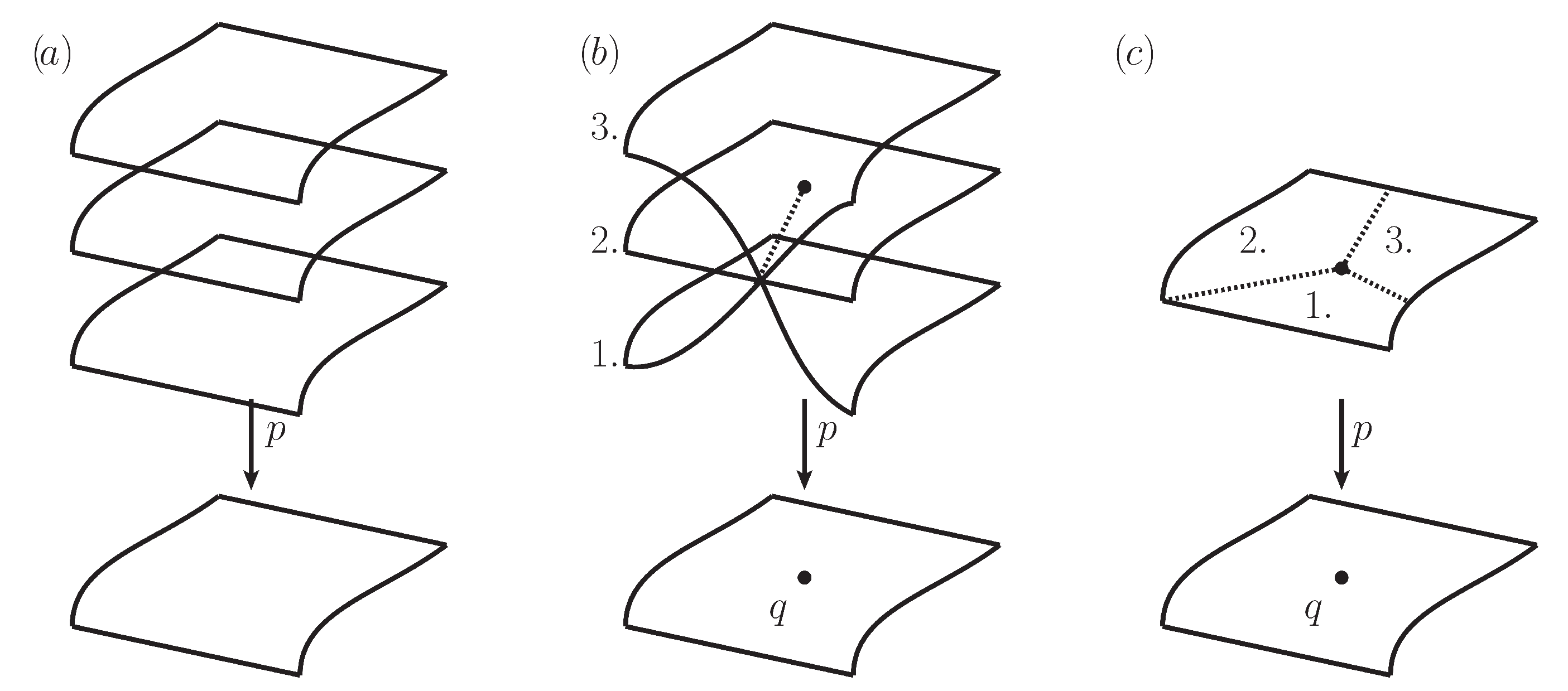
By moving to dimension two, we can illustrate the codimension two situation (
Figure 2). In this case, the “base view” in
Figure 2b looks very much like a non-manifold structure, but the “cover view” in
Figure 2c shows that the branching is actually contained in the map
p, not the cover itself (We do not know if there are conventional labels for these representations, and are just proposing “base view” and “cover view” to offer some additional clarity). In dimension 2, prototypical examples of these objects are Riemann surfaces, typically described as
nth roots of the complex plane,
In this way we see the problem with our
Figure 2b; the surfaces cannot be embedded in
, but are represented as graphs in
. For an excellent introduction to this perspective on Riemann surfaces, we suggest Teleman [
26].
Of course, the branch locus does not have to be restricted to a single point; in
Figure 3 we show three regions of such a space with a single branch point in each, and also an irregular valency
(number of solutions) over the branch point. Again, we demonstrate in
Figure 3b that this seemingly complicated surface is just
, and the branching is a property of the map, not the space.
One classifies such examples with a branch index
, which enumerates the “missing solutions” in the inverse image of the covering map, and is related to the valency via
for an
n-sheeted cover. In dimension 2, the total branch index
b tells us all the topological information about an
n-fold cover
S over a base
B via the Riemann-Hurwitz formula,
This formula is trivial to see in this dimension, as
for a chosen triangulation.
At this point it should be emphasized what is being implied by the branched cover construction, which is explicit in Alexander’s Theorem—the covering space can be completely reconstructed with knowledge of the base (an
n-sphere, in our case) and knowledge of the local representation of the covering map. There is a convenient way to parameterize this structure, using a labeling of the vertices with elements of the permutation group
(we believe this parameterization of the monodromy is due to Piergallini [
27]), and we have included these labels in
Figure 3. The intuition behind these labels is immediate—as a path travels around the branch point, crossing the branch cut, the path transitions from one sheet to another. This transition is described by an action of a permutation (element of
), as shown in
Figure 3, and illustrate how this monodromy interacts with multiple branch loci in
Figure 3b. There are conditions on the choice of these permutation elements, based on global consistency, which we discuss later.
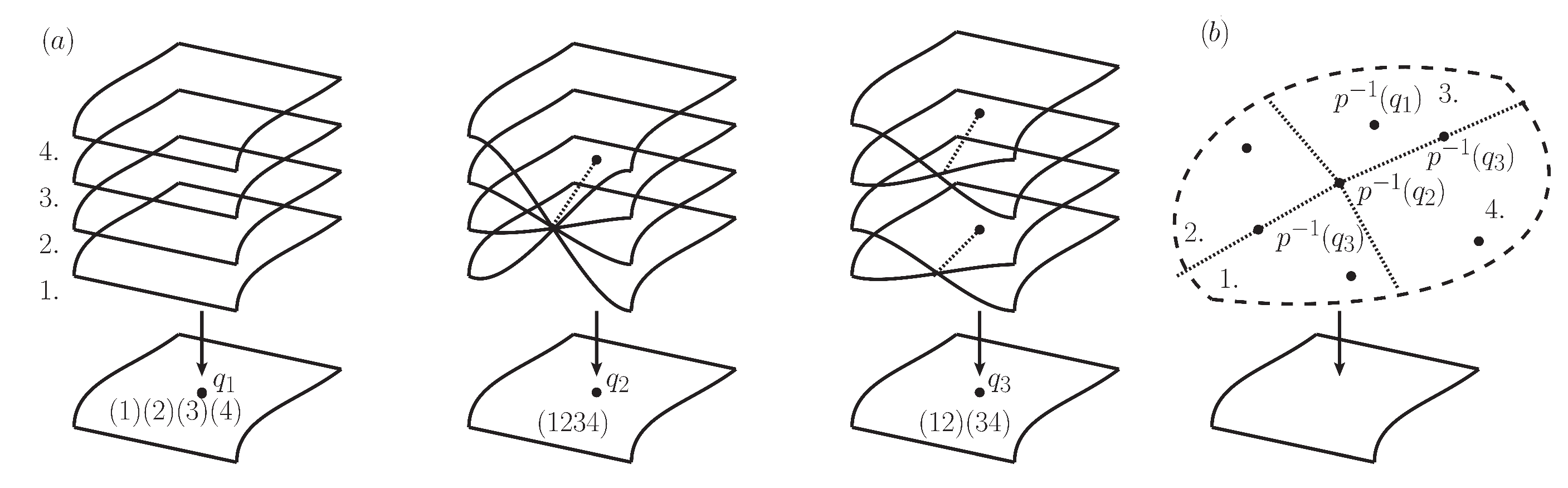
Finally, we discuss the dimension 3 case in
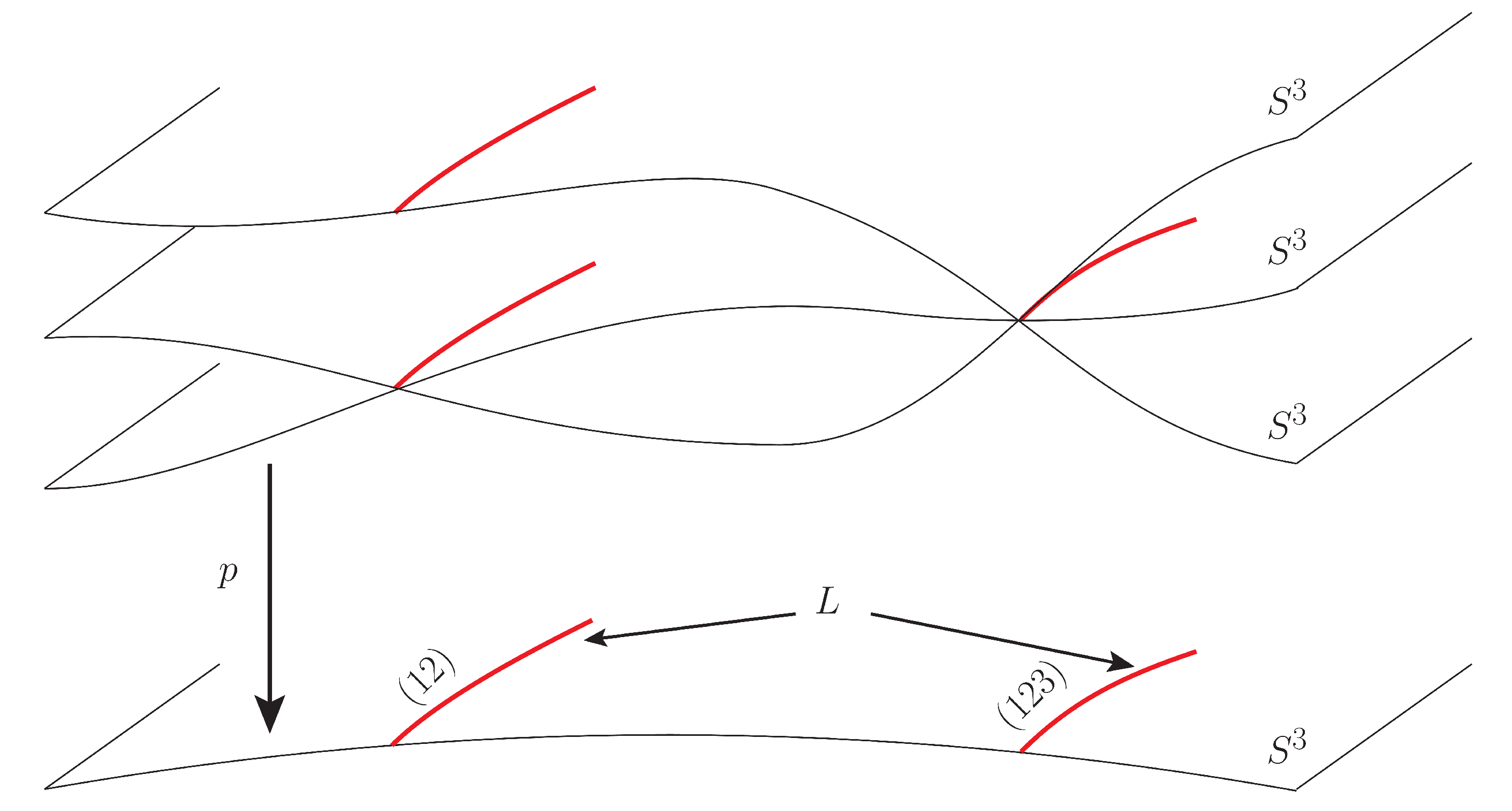
Figure 4, which will occupy the rest of this work. Note that while we cannot represent the
sheets well on the page, we have tried to make it clear that the branch locus is still codimension 2: a 1-dimensional submanifold. These are also labeled by elements of the permutation group, with the interpretation that traveling along a path around the locus is what causes the transitions between sheets. We hope the significance of the earlier figures in lower dimensions is clear at this point—although the cover appears to be very pathological, all the branching is occurring in the map, not in the covering space itself. Roughly speaking, in codimension 2 there is “enough room” to travel around the ramification locus in the cover, traversing the individual sheets and returning to the initial point without encountering any non-manifold behavior. The covering spaces are parts of spheres, glued along codimension 2 submanifolds.
3. Statistical Model
With the technical details regarding branched covering spaces in hand, we move on to the statistical model we are presenting. It is motivated by a particular approach to quantum gravity, CDT, as discussed in
Section 1. However, our main goal is to illustrate the concrete realization of these spaces. Therefore, we will not be allowing the branch locus to be changed, and will only be altering the topological labels. Specifically, we are going to choose relatively simple graphs as the branch loci, and establish what fundamental groups we can detect over them. We do point out that, as we discussed earlier, such restrictions to a finite number of covers (even 3, see Hilden [
24]) may not restrict the available topological structures at all.
When thinking about the physical theories for which this technique will be applicable (e.g., topological versions of LQG and CDT), the graphs are expected to be arbitrarily complex. However, both of those specific theories have “base cases”, which we can use for demonstration. For LQG, inhomogeneous early universe models (“Dipole Cosmology”) can be constructed as graphs that are dual to the triangulation of a 3-sphere, consisting of two vertices (tetrahedrons) and four edges (shared faces for a given pair of tetrahedrons) [
29,
30], and subsequent generalizations to
n edges [
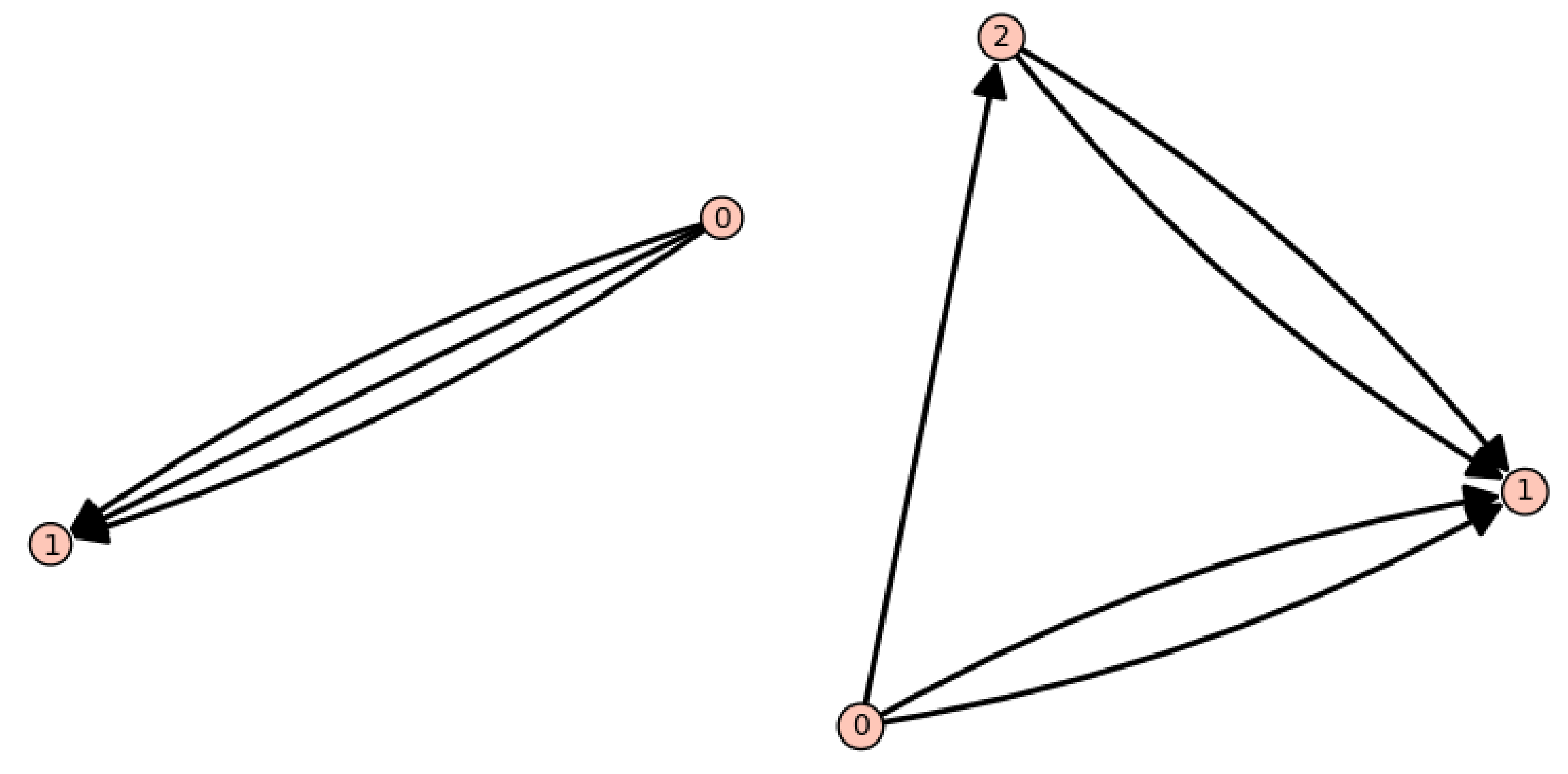
31]. We refer to these graphs as “bubble” graphs
, although we note that this is not a previously defined family.
Alternatively, simple structures that make up the triangulations themselves, as used in CDT (and some models of LQG), can be investigated directly. There is an existing family of well-known graphs, the wheel graphs
, which can be subgraphs of (the edges of) triangulations of CDT [
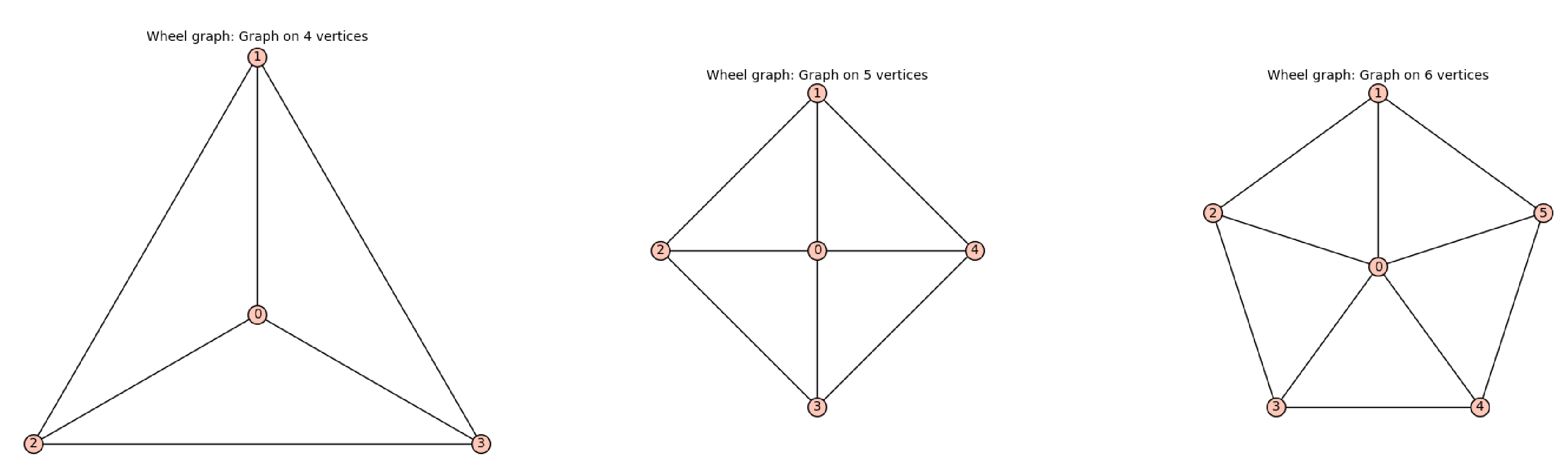
32]. These graphs are constituted as a single vertex with edges connected to every other vertex of an
cycle, examples of which are shown in
Figure 5. It should also be mentioned that the first member of this family (
) does match the tetrahedral models often used in quantum gravity (and topological approaches to LQG specifically, see Duston [
16], Villani [
18]). Since this family is more connected to the topological structure of the triangulation (rather than the dual graph), we will focus on the wheel graphs in what remains of this paper, although we have results for the dual graphs discussed earlier as well.
In CDT, the space of quantum states is typically explored with a Monte Carlo-style algorithm, by stepping around elements of phase space and recording parameters of the system. We have the advantage that the total number of topologies in our system is finite, specifically , since each of the edges can be labeled with an element of . Of course, not all of these arrangements of edges will be valid, but this is the maximum number. Thus, we can simply check them all.
The conditions on the permutations are the Wirtinger relations—in our context, where there are intersections but no crossings, this is simply done by picking a direction around vertices (say, clockwise) and ensuring the product of all of the edges is unity, , where the is used for ingoing edges and the is used for outgoing edges. Our simulations are going to find all of the possible topologies that can be realized over particular graphs, and in the next section we will discuss the technical tools used to describe and analyze this system.
4. Technology: SageMath and GAP
The primary technology used in this work is SageMath [
33], in particular the functions related to graph theory that allow the user to reference, modify, and analyze graphs. We would like to present in more detail how we have used the implementation of the Groups, Algorithms, and Programming [
34] software package in SageMath, because it gives us the ability to determine some physical parameters of these spaces to which we would not otherwise have easy access.
Our routine defines the graph
and creates an initial free group
H, with the same number of elements as the edges in the graph. We then create the “graph group” (This terminology is apparently not standard, but means the same thing as “knot group”)
G—the fundamental group of the complement
—using the Wirtinger relations in the free group (for details on this and other aspects of topology and knots, we recommend the excellent text of Fox [
35]). For
, this is equivalent to
for
generators in
H. GAP can simplify this set—in particular, it can determine that these four relations are not independent, and actually only fixes three of the generators in
H.
Now, to create all the covers, we assign permutation labels to all the edges. For E edges and g covers, there are apparently total possible ways this can be done. However, these labels must respect the same Wirtinger relations as the elements of the free group. In the example of above, we can only choose three elements freely, using the relations to set the other three. Throughout this paper we will be using 3-fold covers, so the number of possible fundamental groups realized as topological spaces branched over will be . This will be the size of our parameter space.
To determine the fundamental groups realized, we will utilize an algorithm first presented in Fox [
35], and discussed in more detail in Duston [
17]. The essential idea is to add generators to the fundamental group in the cover
that model how the sheets of the cover are “glued together”, and then add generators corresponding to moving along the graph
. This gives us the fundamental group of the cover. To our knowledge, our implementation of this algorithm is the first one done on a modern computer, and the publicly available code for which can be found on GitHub (
https://github.com/cduston44/FoxAlgorithm (accessed on 20 February 2026)).
However, these are now presented as finite groups—a list of generators and a list of relations. Since some of these might be different presentations of the same group, we would like to compare them to each other. This is an example of a “word problem” in group theory, and is generally an undecidable problem. However, GAP can at least tell us how big each group is, in terms of the number of generators. For more details, and some explicit examples of this algorithm, we refer to our earlier work [
17]. Indeed, we checked our algorithm against the “by hand” calculations presented there for validation.
We note here that GAP can sometimes describe the structure of the group beyond the rank using the routine
StructureDescription, and we find that for these small groups (rank
), it does a reasonably good job. However, we should be very clear that the GAP manual says this function “is not intended to be a research tool, but rather an educational tool” (
https://docs.gap-system.org/doc/ref/chap39.html (accessed on 20 February 2026)). One specific reason is that most finite groups do not actually have such decompositions. Hence, we present it here merely as a demonstration—more advanced techniques will need to be developed for these classifications to be considered more robust.
5. Results of Simulations
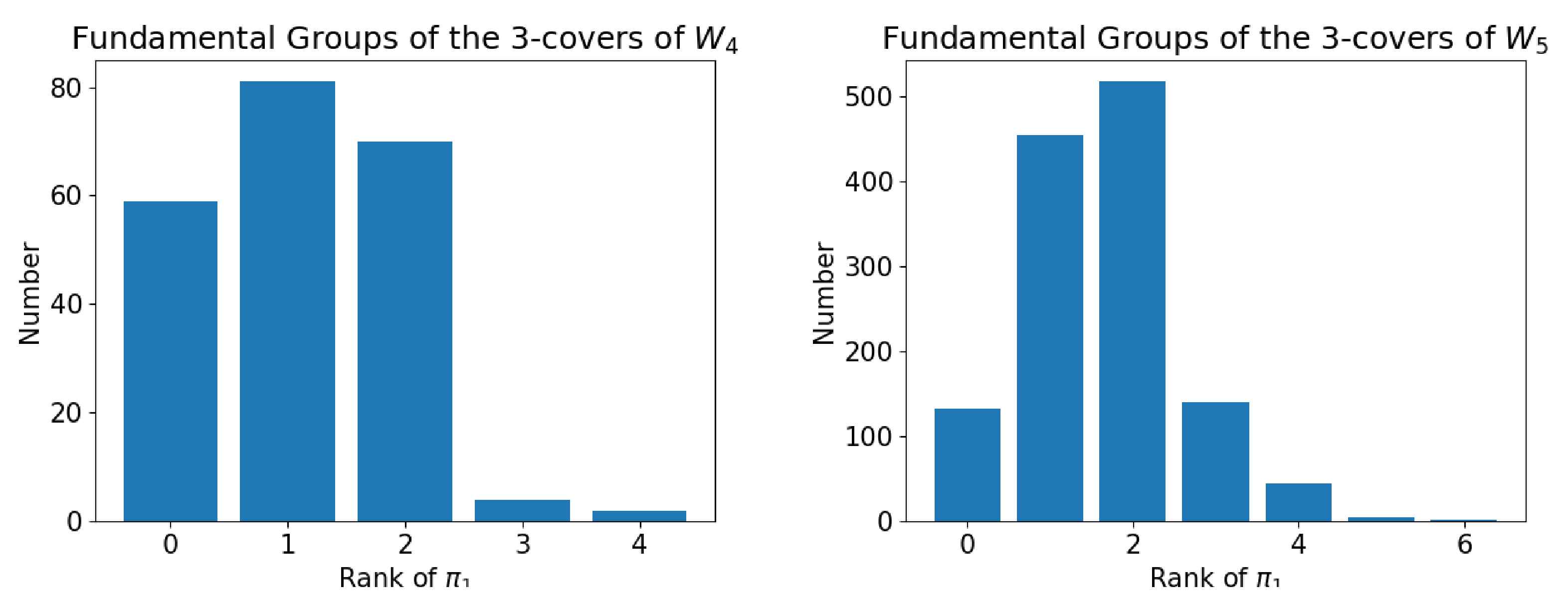
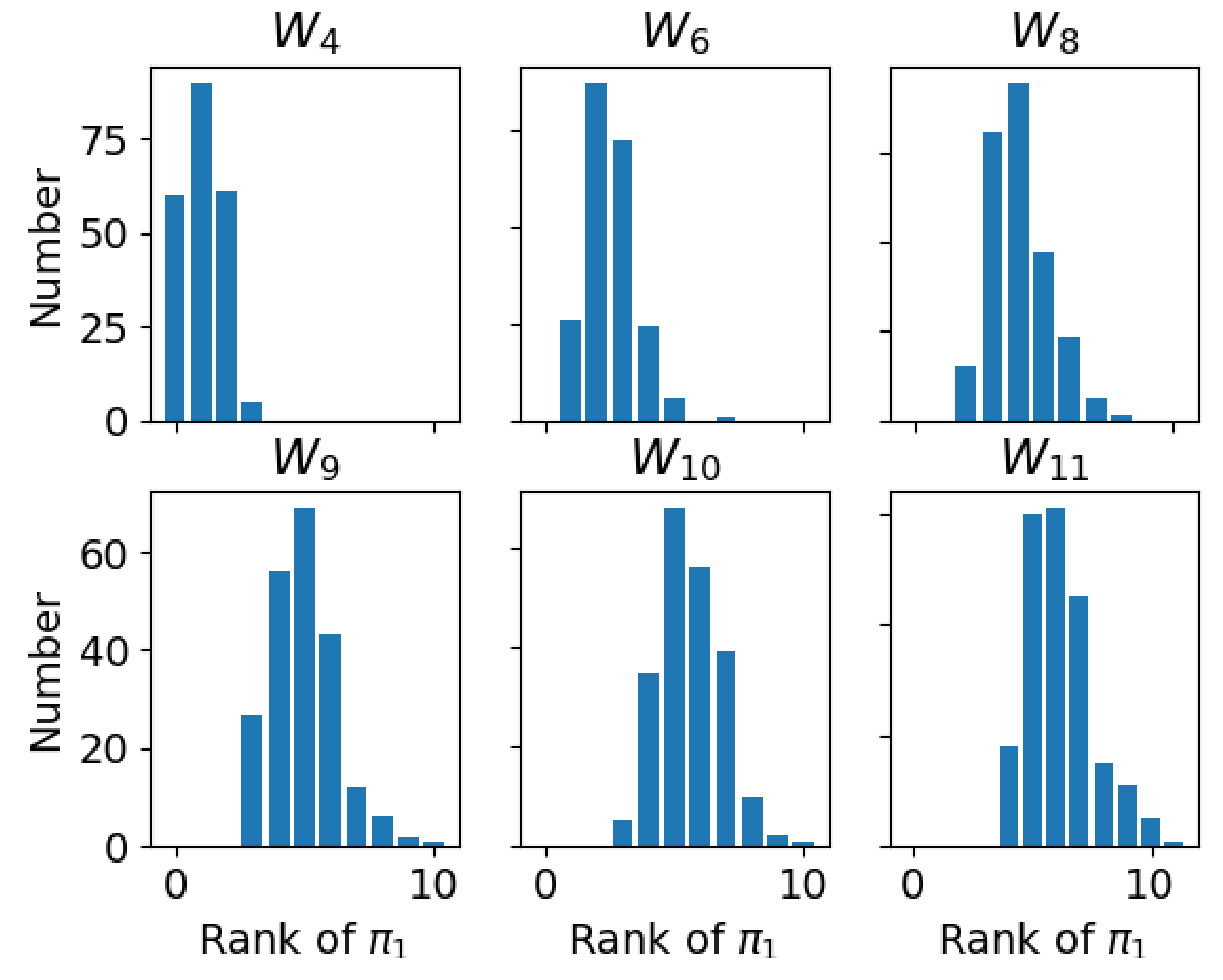
The first results of this study, the fundamental groups that can be realized as 3-fold covers of the first few wheel graphs, are shown in
Figure 6 and
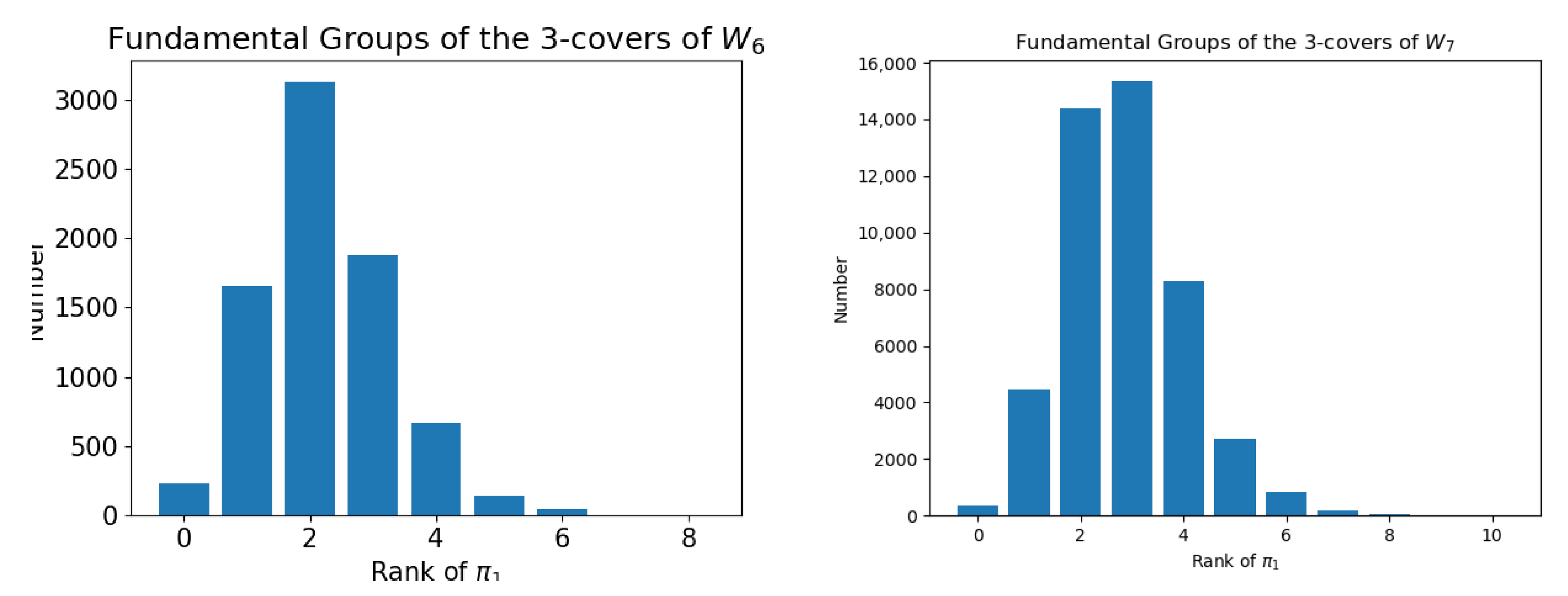
Figure 7. This behavior matches our rough expectations—there are far more simple fundamental groups than complex ones, and the smaller ones are harder to produce as the complexity of the graph increases. These first figures show all the fundamental groups that can be created over
for
, but to illustrate the distribution for higher
n we include
Figure 8 as well.
The 3-manifolds in
Figure 6 and
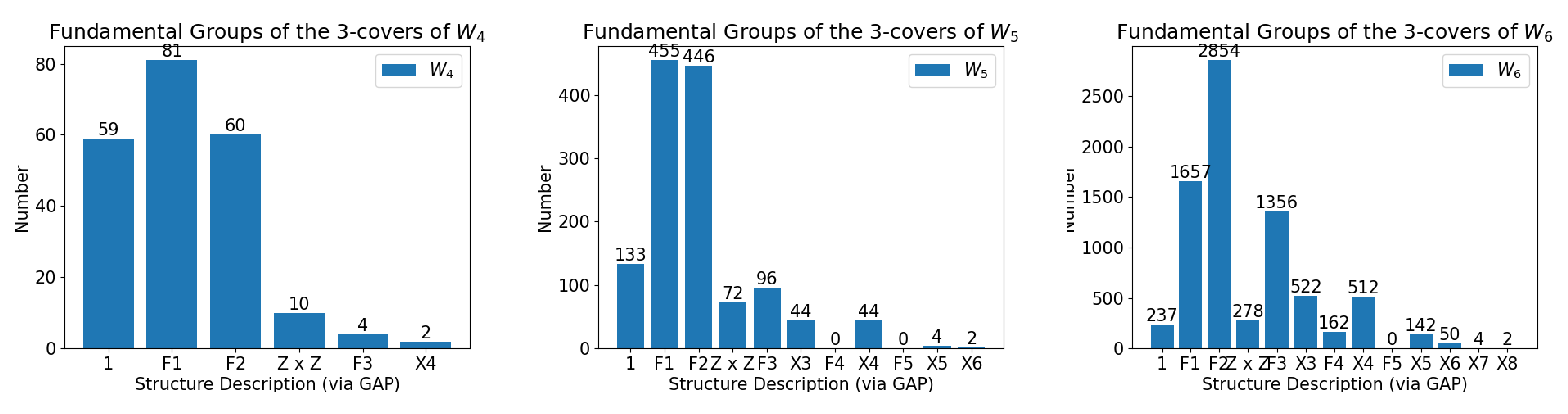
Figure 7 are differentiated by the rank of their fundamental groups. This is a good start, but far from a complete classification because the rank is only a partial invariant (groups with different ranks are not isomorphic, but equal rank does not imply isomorphism). As discussed in the previous section, we can use GAP to partially lift this degeneracy, which we demonstrate in
Figure 9. A further improvement would be to use the first homology group
to further differentiate between fundamental groups with similar rank (for a nice introduction to the topology of 3-manifolds, we recommend Hatcher [
36]). Other invariants (such as
or the torsion) might be accessible via existing SageMath routines, but would require the translation of our branched covers into chain complexes. Even then, we note that the complete classification of 3-manifolds is still an open problem [
37].
For the purposes of illustration, we have applied the algorithm to the bubble graphs
in dipole cosmology (discussed in
Section 3), shown in
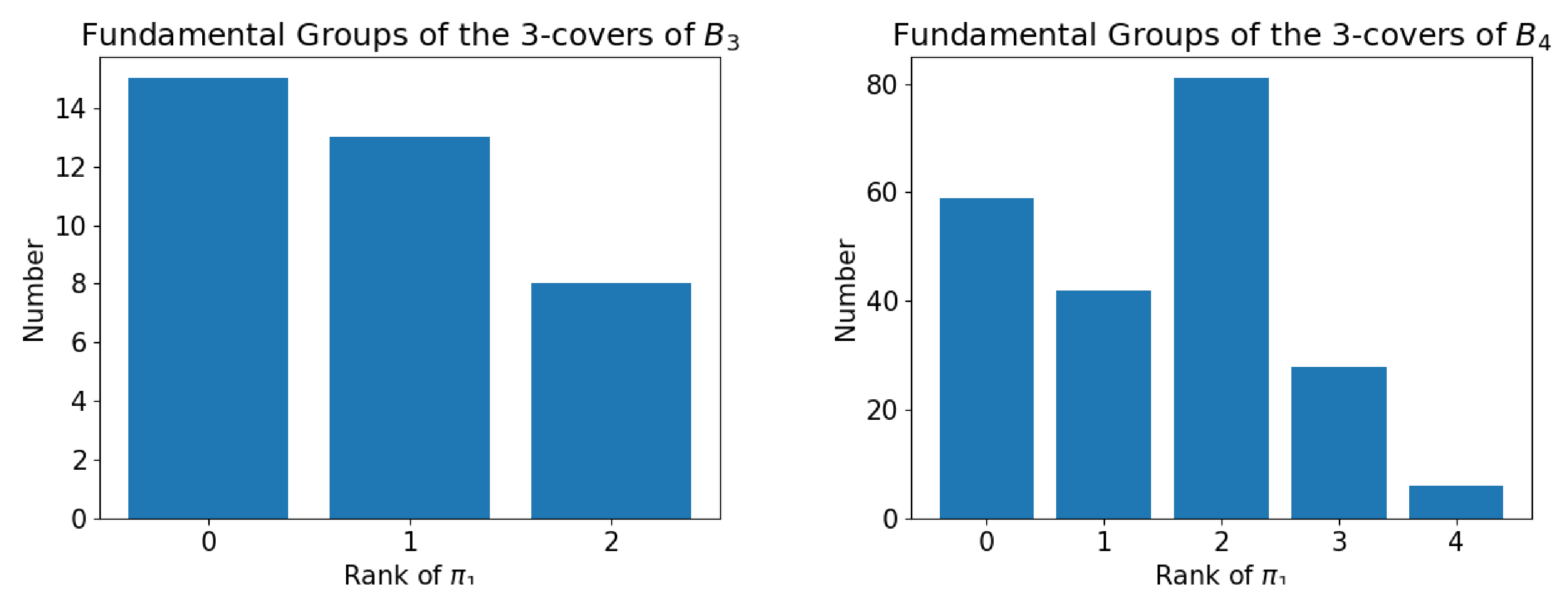
Figure 10. A primary difference is that these are multigraphs, with multiple edges between the same two vertices. The complete set of fundamental groups that can be realized over 3-fold coverings of these is shown in
Figure 11. We do not consider the detailed differences between these and the wheel graphs as substantive—the realization of a particular spacetime over a particular graph is probably mostly related to the number of vertices and edges present in the graph, not any special properties of the graphs. Further, the specific nature of the graphs used will, in the end, depend on the details of the physical model.
Finally, we note that the speed of the algorithm does not depend strongly on the sizes of the graphs in question. For , , the fundamental group is found in roughly a second on a commercial machine running fully interactive SageMath. This apparent efficiency will be important when the graph sizes get very large (up to some cutoff set by the particular theory), such as for applications in quantum gravity.
6. Summary and Outlook
The main goal of this paper was to demonstrate a key technical requirement of the statistical approach to studying topology in quantum gravity, the algorithmic determination of topological structure. This general requirement exists for any approach to the “spacetime foam” which includes topology, although our specific solution only applies to the branched covering space reparametrization. It was not at all obvious to us that it was possible to realize something like the Fox Algorithm on a computer system, which would be required to automatically determine an appropriate topological description of spacetime. It turns out that, because of the existence of tools like SageMath and (in particular) GAP, it was straightforward to implement directly, i.e., in a symbolic language.
We then used this routine to find all the branched covers that could be realized over some special graphs as branch loci, the wheel graphs
. For comparison, we did this for another family of graphs, inspired by models of weakly inhomogeneous quantum cosmology. We do not claim that understanding the topological structures over these particular graphs is significant on their own, just that it was not possible to answer such questions before the computer implementation existed. This statement is emphasized by
Figure 9, in which the structure of some of the fundamental groups is identified by GAP.
Our next goal in this area is to directly apply this routine to the problem of topology in CDT. With a (partial) specification of the topology, it is now possible to start asking (model-dependent) questions like “what was the topology of the early Universe?”, “could ‘small’ topological structures exist in the Universe today?”, or “was there a mechanism that drove the Universe to be topologically trivial?” in the context of CDT. This same routine could be used in LQG, following the by-hand approaches from Duston [
17] and Villani [
18].
Of course, one could also use this routine to study branched covering spaces over graphs and knots themselves. For example, Prasolov and Sossinsky [
25] have proven that the Borromean rings represent a
Universal Link, in that any compact, oriented 3-manifold without boundary can be realized as a branched covering space over them. With our routine, one could imagine statistically looking for more such Universal Links, or studying general properties that such links (or graphs, knots, etc.) are suspected to have. Generalizing to higher dimensions would be straightforward (as long as one kept the codimension of the locus to be two, as required by Alexander’s theorem), so extensions of, e.g., Piergallini’s results in dimension 4 [
23], or of higher dimensional knots more generally [
38], are statistically accessible using this routine.