
Article

Preliminary Development and Clinical Evaluation of a Locally Produced ELISA for Urinary Histoplasma Antigen Detection in Argentina

by
Agustín Videla Garrido
1,
Víctor Fernández Briceño
1,2,
Carolina Rodríguez Laboccetta
1,2,
Gladys B. Posse
3,
Alejandro D. Nusblat
2 and
María L. Cuestas
1,*
1
Consejo Nacional de Investigaciones Científicas y Técnicas (CONICET), Instituto de Investigaciones en Microbiología y Parasitología Médica (IMPaM), Universidad de Buenos Aires, Buenos Aires C1121 ABG, Argentina
2
Facultad de Farmacia y Bioquímica, Instituto de Nanobiotecnología (NANOBIOTEC), Universidad de Buenos Aires, Buenos Aires C1113 AAD, Argentina
3
Laboratorio de Micología, Hospital Nacional Profesor Alejandro Posadas, Buenos Aires 1684, Argentina
*
Author to whom correspondence should be addressed.
J. Pharm. BioTech Ind. 2026, 3(2), 10; https://doi.org/10.3390/jpbi3020010
Submission received: 12 March 2026 / Revised: 17 April 2026 / Accepted: 6 May 2026 / Published: 8 May 2026

Abstract

Background: Histoplasmosis is a major opportunistic fungal infection in immunocompromised individuals, particularly people living with HIV in Latin America. Early diagnosis is essential to reduce morbidity and mortality, but commercial urinary Histoplasma antigen assays are not consistently accessible in many endemic settings. Methods: We developed a locally produced enzyme-linked immunosorbent assay (ELISA) to detect urinary Histoplasma antigen in urine and performed a preliminary clinical evaluation. The assay is based on a sandwich ELISA format using rabbit polyclonal antibodies raised against whole-killed yeast cells of Histoplasma capsulatum. Receiver operating characteristic (ROC) analysis was performed with urine samples from patients with progressive disseminated histoplasmosis (PDH) (n = 37) and healthy controls (n = 20). An exploratory disease-control panel (n = 11) was also tested to assess cross-reactivity. Preliminary analytical characterization included blank-based estimation of the limit of detection (LOD) and limit of quantification (LOQ). Results: Using a Youden-derived cutoff of OD492 = 0.243, the in-house ELISA showed a sensitivity of 73.0% (27/37; 95% CI: 55.9–86.2%) and a specificity of 100.0% (20/20; 95% CI: 83.2–100.0%) in the main ROC dataset, with an area under the curve of 0.856. In the exploratory disease-control panel, 2 of 11 specimens were reactive (one paracoccidioidomycosis and one cryptococcosis sample). Preliminary LOD and LOQ estimates were 4.46 ng/mL and 8.15 ng/mL, respectively. Conclusions: This locally developed ELISA represents a feasible and cost-effective alternative for urinary antigen detection of Histoplasma, with potential to improve access to early diagnosis in resource-limited settings. However, its current performance should be considered preliminary. Additional optimization and broader validation, including direct comparison with commercial assays, inter-assay precision, reagent stability, and larger multicenter control panels, are required before routine clinical implementation.

1. Introduction

Histoplasmosis is a widespread endemic disease in several areas of the Americas, as well as in certain regions of Asia and Africa, and is caused by the thermally dimorphic fungus Histoplasma capsulatum [1]. While it can infect immunocompetent individuals, severe disease is most common in patients with impaired T-cell immunity, particularly people living with HIV (PLHIV) [2]. In this population, progressive disseminated histoplasmosis (PDH) is the predominant clinical manifestation and can result in high morbidity and mortality when diagnosis and treatment are delayed [3,4].
Despite its clinical impact, histoplasmosis remains underrecognized and underreported as a public health problem [5]. In Latin America, PDH represents a major threat among HIV-infected individuals [6], and Argentina is a high-burden country, where histoplasmosis is a frequent systemic mycosis in PLHIV [7].
Diagnosis of PDH is challenging because the clinical presentation is nonspecific and may mimic other infections, including disseminated tuberculosis [8]. Conventional diagnostic methods such as culture and histopathology remain important reference methods, but they are limited by low sensitivity, require trained personnel and biosafety infrastructure, and may delay diagnosis for days to weeks.
Immunodiagnostic assays provide practical advantages. Complement fixation and immunodiffusion are standard serologic tests, but they show limited sensitivity (38–70%) in immunocompromised patients [9,10].
Urinary Histoplasma antigen detection is recommended by the WHO and the Pan American Health Organization for the diagnosis of PDH in PLHIV, owing to its high sensitivity, rapid turnaround time, and clinical value [11]. This method is also included in the second WHO Model List of Essential In Vitro Diagnostics [12]. These assays show high sensitivity (67.3–95.0%) and are commercially available in parts of Latin America [10,13,14,15]. In Argentina, available options are limited to the Clarus Histoplasma Galactomannan Enzyme Immunoassay (Clarus HGM, IMMY, Norman, OK, USA) and the Histoplasma Urine Antigen Lateral Flow Assay (MiraVista Diagnostics, Indianapolis, IN, USA), both targeting Histoplasma galactomannan (GM) [16,17]. Reported sensitivities and specificities are 72.0–98.0% and 91.0–100.0% for the Clarus HGM, and 78.8–96.0% and 73.9–100.0% for the LFA [4,14,16,18,19,20,21,22]. These platforms have improved access to rapid diagnosis, but availability and cost remain uneven across endemic settings.
Against this background, local development of antigen detection platforms remains of interest, particularly as an initial step toward context-adapted diagnostics. Here we describe the development and preliminary clinical evaluation of a locally produced sandwich ELISA for Histoplasma urinary antigen detection. In this work, we also included preliminary analytical and clinical performance results obtained in our laboratory using this assay.

2. Materials and Methods

2.1. Study Specimens

A total of 68 urine samples were analyzed, including 31 from PLHIV with proven PDH, 6 from PLHIV with probable PDH, and 11 from patients with other infectious diseases with clinical features similar to histoplasmosis—specifically paracoccidioidomycosis (n = 3), cryptococcosis (n = 5), tuberculosis (n = 2), and Pneumocystis jirovecii pneumonia (n = 1). An additional 20 samples were obtained from healthy individuals residing in a histoplasmosis-endemic area. All specimens were blinded prior to testing.
Proven PDH cases were defined by either isolation of H. capsulatum in culture or microscopic identification of the organism in clinical specimens, in accordance with the modified criteria of the European Organization for Research and Treatment of Cancer/Invasive Fungal Infections Cooperative Group and the National Institute of Allergy and Infectious Diseases Mycoses Study Group [23]. Probable cases were defined as patients with compatible clinical and epidemiological features and supportive mycological evidence—such as antigen detection or positive serology—without direct confirmation by culture or microscopy.
Diagnostic testing was conducted at two centers in Argentina: Hospital Posadas and the Mycology Center at the School of Medicine, University of Buenos Aires. Samples were collected between 2019 and 2025 and stored at −80 °C until analysis.
The study received approval from the institutional review board “Dr. Vicente Federico Del Giúdice” at Hospital Nacional Alejandro Posadas (Ref. 395 EMnPES0/20) and from the institutional review board of the Faculty of Pharmacy and Biochemistry, University of Buenos Aires (EXP-UBA 58003/18, Resolution No. 821).

2.2. Rabbit Immunization, Antibody Purification and Biotinylation

The H. capsulatum strain Hc17641 clade LAm A1, isolated from a biopsy of a palate ulcer from a patient with chronic disseminated histoplasmosis (culture collection of the Mycology bank of the Center of Mycology of the School of Medicine, University of Buenos Aires), was used for rabbit immunization, as previously reported [24]. Briefly, two female New Zealand rabbits (2–3 kg) were injected intravenously with 1 mL of a suspension of whole-killed yeast cells on days 0,1, 8, 10, 15, 23, 29, and 32. Rabbit antisera were screened by indirect ELISA using the yeast-derived GM (yGM) ELISA previously developed by our research group [25]. Briefly, the indirect ELISA was performed using 96-well flat-bottom plates (Nunc MaxiSorp™, Thermo Scientific, Roskilde, Denmark) coated with 0.1 µg/well of yGM in PBS (pH 7.4) and incubated overnight at 4 °C. Plates were washed with PBS–0.05% Tween 20 (PBST) and blocked with 3% non-fat dry milk in PBS for 1 h at room temperature. Serum samples were tested in duplicate at a 1:1000 dilution and incubated for 1 h at room temperature. After washing, horseradish peroxidase-conjugated goat anti-rabbit IgG (1:10,000; Jackson ImmunoResearch, West Grove, PA, USA) was added and incubated for 1 h. Following a final wash, OPD substrate (2 mg/mL in 0.1 M citrate buffer, pH 5.0, with 0.03% H2O2) was added for 10 min in the dark. The reaction was stopped with 4 N H2SO4, and absorbance was read at 492 nm using a microplate reader (Multiskan GO™, Thermo Scientific, Vantaa, Finland).
Total rabbit IgG antibodies were then purified by protein A affinity chromatography using a HiTrap™ rProtein A FF column (Cytiva, MA, USA), following the manufacturer’s instructions. One half of the purified IgG preparation was labeled with biotin using EZ-Link™ Sulfo-NHS-Biotin (Thermo Scientific, Rockford, IL, USA) at an IgG:biotin ratio of 1:50.

2.3. Double Antibody Sandwich ELISA

Purified rabbit IgG was diluted to 25 µg/mL in 0.01 M Tris-HCl buffer (pH 7.0), and 100 µL were added to each well of high-binding ELISA strips (Ivema, Buenos Aires, Argentina). Plates were incubated overnight at 4 °C. After blocking with 5% (w/v) BSA in 0.01 M Tris-HCl buffer (pH 7.0), 100 µL of urine samples were added to each well and plates were incubated at 37 °C for 1 h. Positive and negative run controls consisted, respectively, of 100 µL of a 0.01 µg/mL solution of yGM preparation obtained as previously reported [25], and 100 µL of 0.01 M Tris-HCl buffer (pH 7.0). Briefly, the yeast phase was obtained by culturing cells in tryptic soy broth (1 L) at 37 °C for 7 days under shaking (200–250 rpm). Cells were harvested by centrifugation, washed, and inactivated with 4% thimerosal for 7 days at room temperature. The suspension was centrifuged, and the supernatant was sequentially filtered, diafiltered to 20 mL, acidified to pH 3.5, and clarified by centrifugation. The soluble extract was subjected to ion-exchange chromatography at pH 3.5; the flow-through was treated with proteinase K, followed by diafiltration and lyophilization. Plates were then incubated with biotinylated rabbit anti-H. capsulatum IgG antibodies in 0.1 M Tris-HCl buffer (pH 8.0) at 37 °C for 1 h. After washing, streptavidin-horseradish peroxidase (1:1000, Sigma-Aldrich, St. Louis, MO, USA) diluted in 0.1 M Tris-HCl buffer (pH 8.0) containing 5% (w/v) BSA, was added and incubated at 37 °C for 1 h. The reaction was developed with 3,3′,5,5′-tetramethylbenzidine (TMB; BioRad, Hercules, CA, USA), stopped with 4 N H2SO4, and absorbance at 492 nm was measured with a Multiskan GO™ microplate reader.

2.4. Preliminary Analytical Characterization

A yGM reference preparation [25] was used to generate a preliminary concentration-response curve ranging from 0.375 to 100 ng/mL. Calibration points were tested in duplicate, and four blank replicates were included. The mean blank optical density (OD) and standard deviation were used to estimate the limit of detection (LOD = mean blank + 3 SD) and the limit of quantification (LOQ = mean blank + 10 SD). OD values were converted to concentration by interpolation using the calibration curve generated during assay setup.

2.5. Statistical Analysis

Statistical analyses were conducted using GraphPad Prism version 8.4.2. The discriminatory ability and diagnostic accuracy of the ELISA assays were assessed by constructing receiver operating characteristic (ROC) curves based on the ELISA data set. Cutoff values were established using Youden’s index [26].
Samples were classified as true positive (TP; PDH patients with positive results in the Histoplasma immunoassays), false positive (FP; control individuals with positive results), true negative (TN; control individuals with negative results), and false negative (FN; PDH patients with negative results).
Sensitivity, specificity, positive and negative predictive values, and overall accuracy were calculated for each assay using standard formulas: sensitivity = TP/(TP + FN) × 100; specificity = TN/(TN + FP) × 100; positive predictive value = TP/(TP + FP) × 100; negative predictive value = TN/(TN + FN) × 100; and accuracy = (TP + TN)/(TP + TN + FP + FN) × 100. All estimates were reported with their corresponding 95% confidence intervals.

3. Results

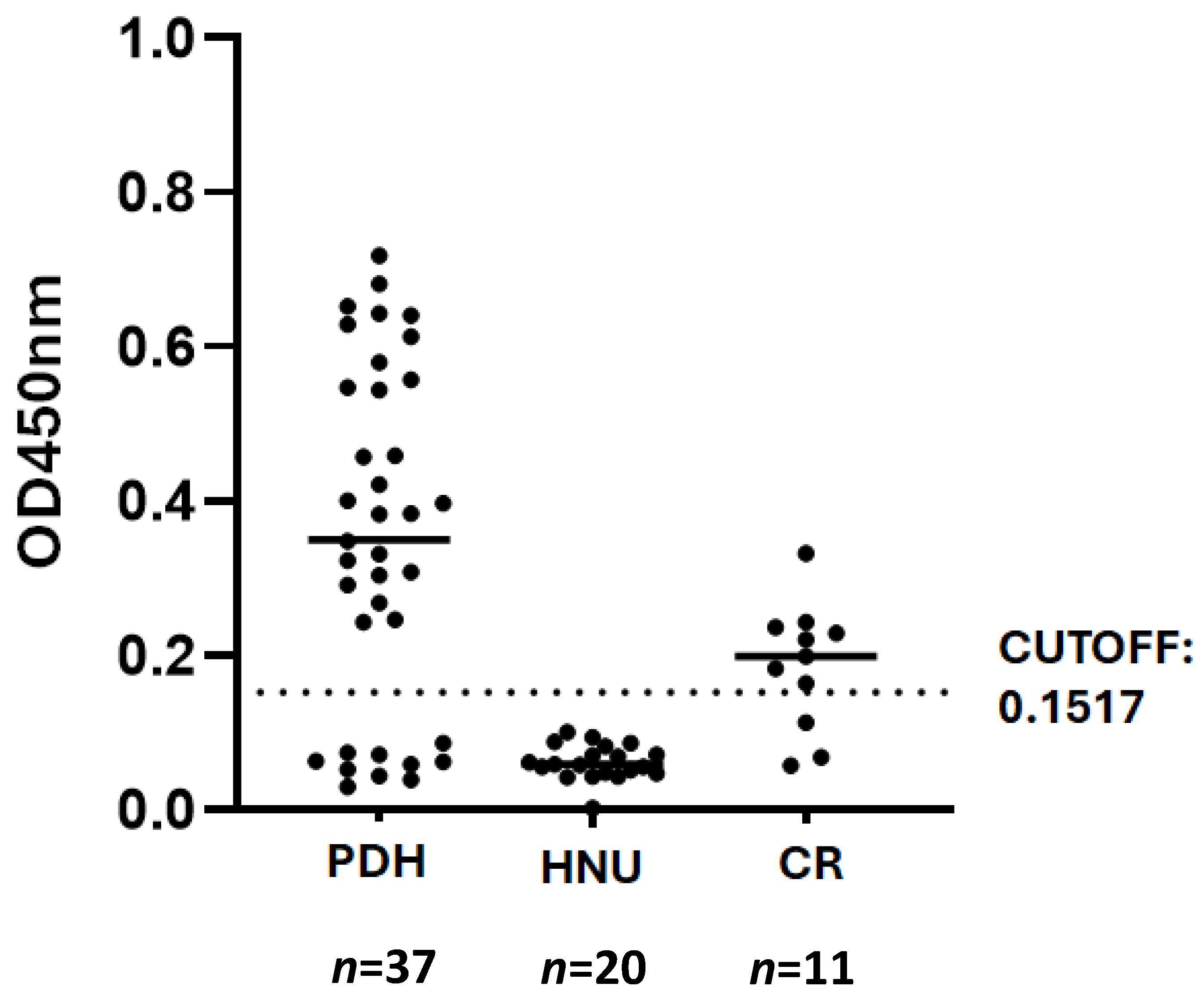
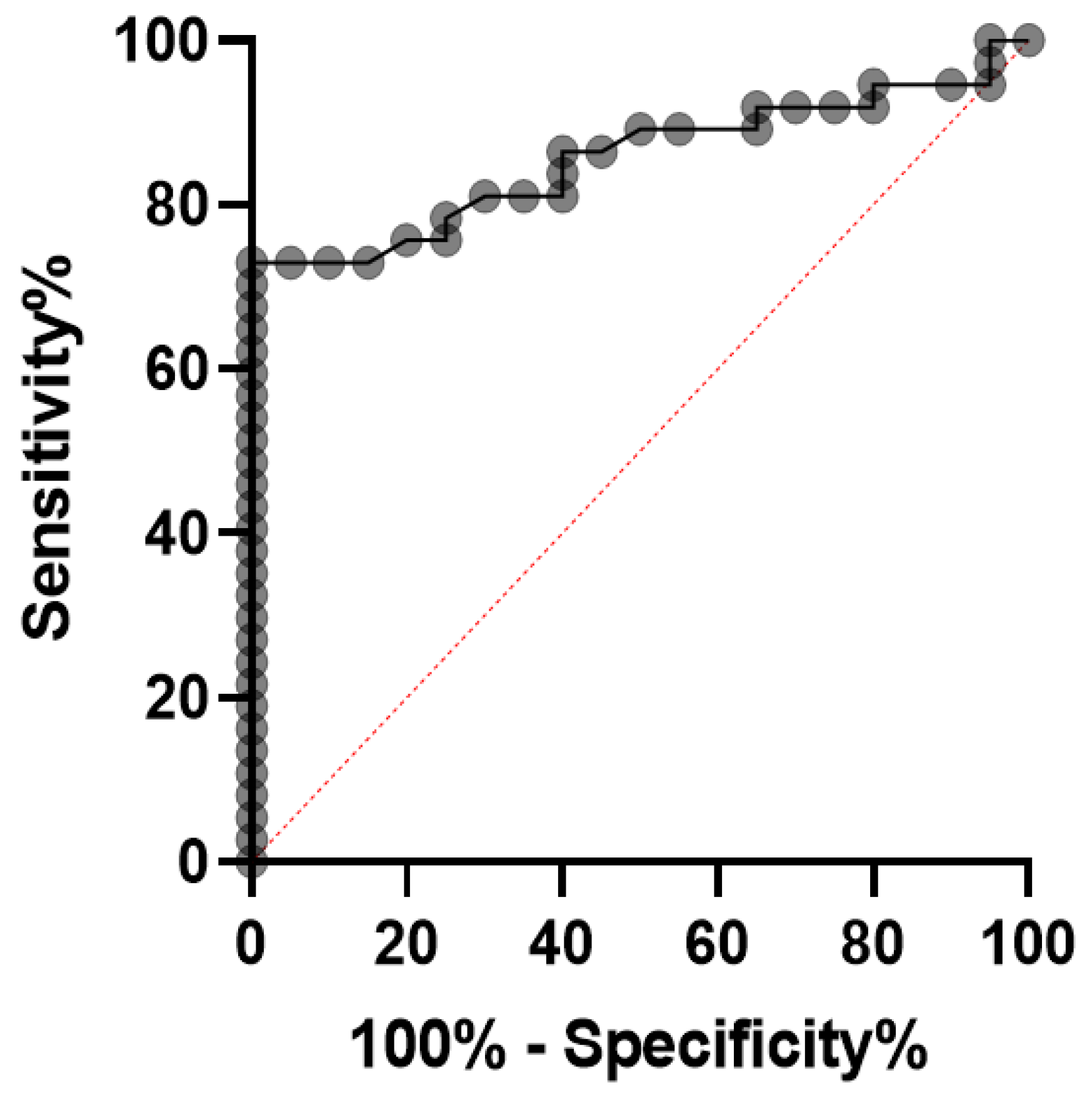
In the double-antibody sandwich ELISA, healthy-control urine specimens showed OD492 nm values from 0.002 to 0.100, whereas PDH urine specimens ranged from 0.0.3 to 0.718 (Figure 1). The PDH group had a mean OD492 of 0.350 ± 0.221 and a median of 0.348 (Figure 1). ROC analysis of the main diagnostic performance set yielded an area under the curve (AUC) of 0.856 (95% CI: 0.760–0.952). The cutoff selected by Youden’s index was OD492 = 0.243 (Figure 2). At this threshold, the ELISA showed a sensitivity of 73.0% (27/37; 95% CI: 55.9–86.2%) and a specificity of 100.0% (20/20; 95% CI: 83.2–100.0%).
Overall accuracy was 82.5% (47/57; 95% CI: 70.1–91.3%). The positive predictive value was 100.0% (95% CI: 87.2–100.0%) and the negative predictive value was 66.7% (95% CI: 54.1–77.3%).
Of the 11 urine samples from patients with other infectious diseases, reactivity was observed in 1 of 3 paracoccidioidomycosis specimens and 1 of 5 cryptococcosis specimens, whereas no reactivity was observed in the small tuberculosis (0/2) and Pneumocystis jirovecii pneumonia (0/1) subsets.
Preliminary analytical characterization yielded an estimated LOD of 4.46 ng/mL and an LOQ of 8.15 ng/mL for the yGM reference preparation.

4. Discussion

The development of accessible diagnostic tools for histoplasmosis remains a priority, particularly in endemic regions where access to commercial antigen detection assays is limited. In this study, we evaluated an in-house double-antibody sandwich ELISA for the detection of H. capsulatum antigen in urine samples from patients with PDH. The assay showed a sensitivity of 73.0% and a specificity of 100.0%, with an overall diagnostic accuracy of 82.5%. Compared with published commercial assays, the performance of our ELISA is modest. The sensitivity observed in our assay is lower than that reported for current monoclonal antibody-based commercial EIAs and lateral flow assays [14,16,17,18,19,20,21], but remains within the range described for earlier polyclonal Histoplasma antigen detection assays based on rabbit IgG antibodies against H. capsulatum, which detect GM-containing antigenic components in urine [27,28]. In particular, the IMMY ALPHA Histoplasma antigen EIA, a commercially available sandwich ELISA based on polyclonal rabbit antibodies, has shown limited sensitivity across independently evaluated, clinically characterized cohorts, with reported values ranging from 61.9% [27] to 67.1% [28] and 67.3% [14]. These findings consistently indicate variable and suboptimal diagnostic performance, which has limited broader clinical uptake. Notably, the IMMY ALPHA assay shares conceptual similarities with the ELISA evaluated herein, as both are based on polyclonal antibodies raised against whole H. capsulatum yeast cells.
The differences in performance are biologically plausible. Our assay relies on total rabbit polyclonal IgG raised against whole-killed yeast cells, which recognizes a broad and heterogeneous antigenic repertoire compared with monoclonal GM-targeting systems. While this broad reactivity may enhance signal detection, it may also reduce analytical specificity due to increased background reactivity. In this context, assay refinement strategies such as affinity purification of anti-Histoplasma antibodies using a GM-based matrix may help enrich GM-reactive immunoglobulins and improve analytical sensitivity.
The exploratory disease-control panel confirmed that cross-reactivity remains an important issue. Reactive signals were observed in one paracoccidioidomycosis specimen and one cryptococcosis specimen. This finding is consistent with the long-recognized tendency of Histoplasma antigen assays to cross-react with other endemic mycoses and some fungal infections [9,27]. At the same time, the limited size of our disease-control panel prevents definitive statements regarding clinical specificity.
The study also has other important limitations. First, the sample set is relatively small and enriched for cases, which inflates predictive values and widens confidence intervals. Second, we did not perform a direct head-to-head comparison with a commercial assay on the same archived specimens, largely because paired testing of all residual samples was not feasible during the study period. Third, formal analytical validation remains incomplete: we added preliminary LOD/LOQ estimates and an exploratory selectivity assessment, but inter-assay precision, reagent stability, lot-to-lot reproducibility, operator-to-operator variability, and multicenter transferability still need to be established.
Several strategies may improve sensitivity in future assay iterations. Urine concentration by ultrafiltration has been shown to rescue antigen detection in 73.8% of previously false-negative Histoplasma urine specimens [29]. Further optimization of the capture/detection reagents, including affinity enrichment or replacement with monoclonal antibodies, is also likely to improve analytical performance [30,31]. In addition, recent literature indicates that antigen excess can occasionally yield weak or false-negative urine antigen results; therefore, testing serial urine dilutions in clinically suspected samples may be useful in future versions of the method [29,30,31]. Other practical avenues include optimization of coating density, detector biotinylation, blocking conditions, and specimen pretreatment. Overall, our results support the feasibility of developing locally produced ELISA platform for urinary Histoplasma antigen detection in Argentina, but they should be interpreted as preliminary. Although further optimization is required to improve sensitivity, this approach may represent a promising strategy to expand access to histoplasmosis diagnosis in endemic regions. Future studies including larger cohorts and multicenter evaluations will be necessary to validate the clinical performance of this assay and to assess its potential role as a complementary diagnostic tool in routine laboratory practice.

Author Contributions

Conceptualization, A.D.N. and M.L.C.; methodology, A.V.G., V.F.B., C.R.L. and G.B.P.; validation, G.B.P., A.D.N. and M.L.C.; formal analysis, A.V.G., V.F.B., C.R.L., A.D.N. and M.L.C.; investigation, A.V.G., V.F.B., C.R.L., A.D.N. and M.L.C.; resources, G.B.P.; data curation, A.V.G. and C.R.L.; writing—original draft preparation, A.V.G. and M.L.C.; writing—review and editing, A.V.G., V.F.B., C.R.L., G.B.P., A.D.N. and M.L.C.; visualization, A.V.G., C.R.L. and M.L.C.; supervision, A.D.N. and M.L.C.; project administration, A.D.N.; funding acquisition, M.L.C. All authors have read and agreed to the published version of the manuscript.

Funding

This research was funded by Agencia Nacional de Promoción Científica y Técnica (ANPCyT, Grant PICT 2021-I-A-00557).

Institutional Review Board Statement

The study was conducted in accordance with the Declaration of Helsinki, and approved by the Institutional Review Board “Dr Vicente Federico Del Giúdice” at Hospital Nacional Alejandro Posadas, Buenos Aires, Argentina (Ref. 260 EMnP0S0/19, approval date 30 August 2019) and by the institutional review committee at Facultad de Farmacia y Bioquímica, Universidad de Buenos Aires (EXP-UBA 58003/18, Resolution N° 821, approval date 16 July 2019).

Informed Consent Statement

Informed consent was obtained from all subjects involved in the study.

Data Availability Statement

The datasets used and/or analyzed during the current study are available from the corresponding author on reasonable request.

Acknowledgments

A.D.N. and M.L.C. are staff members of CONICET. A.V.G., V.F.B. and C.R.L. thank CONICET for their doctoral scholarships. We dedicate this work to the memory of Osvaldo Cascone, in recognition of his outstanding scientific career and his lasting contributions to science.

Conflicts of Interest

The authors declare no conflicts of interest.

References

  1. Bahr, N.C.; Antinori, S.; Wheat, L.J.; Sarosi, G.A. Histoplasmosis infections worldwide: Thinking outside of the Ohio River valley. Curr. Trop. Med. Rep. 2015, 2, 70–80. [Google Scholar] [CrossRef]
  2. Lockhart, S.R.; Toda, M.; Benedict, K.; Caceres, D.H.; Litvintseva, A.P. Endemic and other dimorphic mycoses in the Americas. J. Fungi 2021, 7, 151. [Google Scholar] [CrossRef]
  3. Cáceres, D.H.; Tobón, Á.M.; Restrepo, Á.; Chiller, T.; Gómez, B.L. The important role of co-infections in patients with AIDS and progressive disseminated histoplasmosis (PDH): A cohort from Colombia. Med. Mycol. Case Rep. 2018, 19, 41–44. [Google Scholar] [CrossRef]
  4. Falci, D.R.; Monteiro, A.A.; Braz Caurio, C.F.; Magalhães, T.C.O.; Xavier, M.O.; Basso, R.P.; Melo, M.; Schwarzbold, A.V.; Ferreira, P.R.A.; Vidal, J.E.; et al. Histoplasmosis, an underdiagnosed disease affecting people living with HIV/AIDS in Brazil: Results of a multicenter prospective cohort study using both classical mycology tests and Histoplasma urine antigen detection. Open Forum Infect. Dis. 2019, 6, ofz073. [Google Scholar] [CrossRef] [PubMed]
  5. Araúz, A.B.; Papineni, P. Histoplasmosis. Infect. Dis. Clin. N. Am. 2021, 35, 471–491. [Google Scholar] [CrossRef] [PubMed]
  6. Perez, F.; Caceres, D.H.; Ford, N.; Ravasi, G.; Gomez, B.L.; Pasqualotto, A.C.; Hine, P.; Adenis, A.A.; Nacher, M.; Chiller, T.; et al. Summary of guidelines for managing histoplasmosis among people living with HIV. J. Fungi 2021, 7, 134. [Google Scholar] [CrossRef]
  7. Frola, C.; Bermejo, V.; Pérez, H.; Guelfand, L.; Spadaccini, L. Impacto de la histoplasmosis diseminada en pacientes HIV positivos. Actual. Sida Infectol. 2013, 21, 37–41. [Google Scholar]
  8. Queiroz-Telles, F.; Fahal, A.H.; Falci, D.R.; Caceres, D.H.; Chiller, T.; Pasqualotto, A.C. Neglected endemic mycoses. Lancet Infect. Dis. 2017, 17, 367–377. [Google Scholar] [CrossRef] [PubMed]
  9. Toscanini, M.A.; Nusblat, A.D.; Cuestas, M.L. Diagnosis of histoplasmosis: Current status and perspectives. Appl. Microbiol. Biotechnol. 2021, 105, 1837–1859. [Google Scholar] [CrossRef]
  10. Cáceres, D.H.; Knuth, M.; Derado, G.; Lindsley, M.D. Diagnosis of progressive disseminated histoplasmosis in advanced HIV: A meta-analysis of assay analytical performance. J. Fungi 2019, 5, 76. [Google Scholar] [CrossRef]
  11. Pan American Health Organization. Guidelines for Diagnosing and Managing Disseminated Histoplasmosis Among People Living with HIV; Pan American Health Organization: Washington, DC, USA, 2020. [Google Scholar]
  12. WHO. Second WHO Model List of Essential In Vitro Diagnostics. 2019. Available online: https://www.who.int/docs/default-source/nutritionlibrary/complementary-feeding/second-who-model-list-v8-2019.pdf?sfvrsn=6fe86adf_1 (accessed on 3 March 2026).
  13. Cáceres, D.H.; Adenis, A.; de Souza, J.V.B.; Gomez, B.L.; Cruz, K.S.; Pasqualotto, A.; Ravasi, G.; Perez, F.; Chiller, T.; de Lacerda, M.V.G.; et al. The Manaus Declaration: Current situation of histoplasmosis in the Americas, Report of the II Regional Meeting of the International Histoplasmosis Advocacy Group. Curr. Fungal Infect. Rep. 2019, 13, 244–249. [Google Scholar] [CrossRef]
  14. Martínez-Gamboa, A.; Niembro-Ortega, M.D.; Torres-González, P.; Santiago-Cruz, J.; Velázquez-Zavala, N.G.; Rangel-Cordero, A.; Crabtree-Ramírez, B.; Gamboa-Domínguez, A.; Reyes-Gutiérrez, E.; Reyes-Terán, G.; et al. Diagnostic accuracy of antigen detection in urine and molecular assays testing in different clinical samples for the diagnosis of progressive disseminated histoplasmosis in patients living with HIV/AIDS: A prospective multicenter study in Mexico. PLoS Neglected Trop. Dis. 2021, 15, e0009215. [Google Scholar] [CrossRef] [PubMed]
  15. Cáceres, D.H.; Echeverri Tirado, L.C.; Bonifaz, A.; Adenis, A.; Gomez, B.L.; Flores, C.L.B.; Canteros, C.E.; Santos, D.W.; Arathoon, E.; Soto, E.R.; et al. Current situation of endemic mycosis in the Americas and the Caribbean: Proceedings of the first international meeting on endemic mycoses of the Americas (IMEMA). Mycoses 2022, 65, 1179–1187. [Google Scholar] [CrossRef] [PubMed]
  16. Cáceres, D.H.; Samayoa, B.E.; Medina, N.G.; Tobón, A.M.; Guzmán, B.J.; Mercado, D.; Restrepo, A.; Chiller, T.; Arathoon, E.E.; Gómez, B.L. Multicenter validation of commercial antigenuria reagents to diagnose progressive disseminated histoplasmosis in people living with HIV/AIDS in two Latin American countries. J. Clin. Microbiol. 2018, 56, e01959-17. [Google Scholar] [CrossRef]
  17. Cáceres, D.H.; Gómez, B.L.; Tobón, A.M.; Chiller, T.M.; Lindsley, M.D. Evaluation of a Histoplasma antigen lateral flow assay for the rapid diagnosis of progressive disseminated histoplasmosis in Colombian patients with AIDS. Mycoses 2020, 63, 139–144. [Google Scholar] [CrossRef]
  18. Andreani, M.; Frola, C.E.; Caceres, D.H.; Canteros, C.E.; Rolón, M.J.; Chiller, T.; Guelfand, L. Validation of a lateral flow assay for rapid diagnosis of histoplasmosis in advanced HIV disease, Buenos Aires, Argentina. Appl. Microbiol. 2022, 2, 950–955. [Google Scholar] [CrossRef]
  19. dos Santos Blan, B.; Poester, V.R.; Basso, R.P.; Benelli, J.L.; Sanchotene, K.O.; Caceres, D.H.; Doherty, B.; Pasqualotto, A.C.; Xavier, M.O. Optimization of a commercial Histoplasma galactomannan EIA test in a population from an endemic area of histoplasmosis in southern Brazil. Mycoses 2022, 66, 304–307. [Google Scholar] [CrossRef]
  20. Abdallah, W.; Myint, T.; LaRue, R.; Minderman, M.; Gunn, S.; Wheat, L.J.; Hage, C.A. Diagnosis of Histoplasmosis using the MVista Histoplasma galactomannan antigen qualitative lateral flow–based immunoassay: A multicenter study. Open Forum Infect. Dis. 2021, 8, ofab454. [Google Scholar] [CrossRef]
  21. Cáceres, D.H.; Gómez, B.L.; Tobón, Á.M.; Minderman, M.; Bridges, N.; Chiller, T.; Lindsley, M.D. Validation and concordance analysis of a new lateral flow assay for detection of Histoplasma antigen in urine. J. Fungi 2021, 7, 799. [Google Scholar] [CrossRef]
  22. Rodríguez Laboccetta, C.; Toscanini, M.A.; Videla Garrido, A.; Posse, G.B.; Capece, P.; Valdez, R.M.; Chacón, Y.A.; González Maglio, D.; Nusblat, A.D.; Cuestas, M.L. Evaluation of the Histoplasma capsulatum 100-kilodalton antigen dot blot for the rapid diagnosis of progressive histoplasmosis in HIV/AIDS patients. Diagn. Microbiol. Infect. Dis. 2023, 107, 116060. [Google Scholar] [CrossRef]
  23. Donnelly, J.P.; Chen, S.C.; Kauffman, C.A.; Steinbach, W.J.; Baddley, J.W.; Verweij, P.E.; Clancy, C.J.; Wingard, J.R.; Lockhart, S.R.; Groll, A.H.; et al. Revision and update of the consensus definitions of invasive fungal disease from the European Organization for Research and Treatment of Cancer and the Mycoses Study Group Education and Research Consortium. Clin. Infect. Dis. 2020, 71, 1367–1376. [Google Scholar] [CrossRef]
  24. Lindsley, M.D.; Holland, H.L.; Bragg, S.L.; Hurst, S.F.; Wannemuehler, K.A.; Morrison, C.J. Production and evaluation of reagents for detection of Histoplasma capsulatum antigenuria by enzyme immunoassay. Clin. Vaccine Immunol. 2007, 14, 700–709. [Google Scholar] [CrossRef]
  25. Rodriguez Laboccetta, C.; Briceño Fernandez, V.; Videla Garrido, A.; Posse, G.B.; Cuestas, M.L.; Nusblat, A.D. Histoplasma antigens as novel players for the development of new enzyme immunoassays for the serodiagnosis of histoplasmosis: A comparative study of their analytical performance. Med. Mycol. 2024, 62, myae023. [Google Scholar] [CrossRef]
  26. Hughes, G. Youden’s index and the weight of evidence revisited. Methods Inf. Med. 2015, 54, 576–577. [Google Scholar] [CrossRef] [PubMed]
  27. Zhang, X.; Gibson, B.; Daly, T.M. Evaluation of commercially available reagents for diagnosis of histoplasmosis infection in immunocompromised patients. J. Clin. Microbiol. 2013, 51, 4095–4101. [Google Scholar] [CrossRef]
  28. Torres-González, P.; Niembro-Ortega, M.D.; Martínez-Gamboa, A.; Ahumada-Topete, V.H.; Andrade-Villanueva, J.; Araujo-Meléndez, J.; Chaparro-Sánchez, A.; Crabtree-Ramírez, B.; Cruz-Martínez, S.; Gamboa-Domínguez, A.; et al. Diagnostic accuracy cohort study and clinical value of the Histoplasma urine antigen (ALPHA Histoplasma EIA) for disseminated histoplasmosis among HIV infected patients: A multicenter study. PLoS Neglected Trop. Dis. 2018, 12, e0006872. [Google Scholar] [CrossRef] [PubMed]
  29. Egan, L.; Connolly, P.A.; Fuller, D.; Davis, T.E.; Witt, J., 3rd; Knox, K.S.; Hage, C.A.; Wheat, L.J. Detection of Histoplasma capsulatum antigenuria by ultrafiltration of samples with false-negative results. Clin. Vaccine Immunol. 2008, 15, 726–728. [Google Scholar] [CrossRef][Green Version]
  30. Swartzentruber, S.; LeMonte, A.; Witt, J.; Fuller, D.; Davis, T.; Hage, C.; Connolly, P.; Durkin, M.; Wheat, L.J. Improved detection of Histoplasma antigenemia following dissociation of immune complexes. Clin. Vaccine Immunol. 2009, 16, 320–322. [Google Scholar] [CrossRef]
  31. Zhang, C.; Lei, G.S.; Lee, C.H.; Hage, C.A. Evaluation of two new enzyme immunoassay reagents for diagnosis of histoplasmosis in a cohort of clinically characterized patients. Med. Mycol. 2015, 53, 868–873. [Google Scholar] [CrossRef] [PubMed]
Figure 1. Anti-H. capsulatum double-antibody sandwich ELISA for urinary antigen detection. Optical density (OD) values obtained by ELISA from urine samples of patients with progressive disseminated histoplasmosis (PDH) (n = 37) and from healthy individuals (NHU) used as negative controls (n = 20). CR: Cross-reactions with other fungal infections. The boxplots show the median and the 25th–75th percentiles, while the whiskers represent the minimum and maximum values for each group. The dotted line (----) indicates the assay cutoff value.
Jpbi 03 00010 g001
Figure 2. Receiving Operating Characteristic (ROC) curves for the anti-H. capsulatum double-antibody sandwich ELISA for urinary antigen detection. The area under the curve (AUC) estimates the discriminative power the ELISA. The dashed line represents the line of no discrimination, and the dark gray dot indicates the optimal cutoff point. The dashed line represents the reference line, and the dark gray dot indicates the selected cutoff value.
Jpbi 03 00010 g002
Disclaimer/Publisher’s Note: The statements, opinions and data contained in all publications are solely those of the individual author(s) and contributor(s) and not of MDPI and/or the editor(s). MDPI and/or the editor(s) disclaim responsibility for any injury to people or property resulting from any ideas, methods, instructions or products referred to in the content.