1. Introduction
Introducing a novel pharmaceutical product to the market entails a multifaceted, financially demanding, and protracted process, typically spanning approximately ten years of research and development, with an average expenditure of
$2.6 billion [
1]. There are multiple stages defined for this process, each with its own associated challenges, timelines, and costs.
This paper will discuss the entire process, from the discovery of the biological target to clinical trials and post-approval monitoring for the development of a new drug.
The severity and nature of diseases evolve rapidly, and therefore new responses need to be generated at the same pace.
For this, one of the essential factors for a new drug to be discovered and introduced on the market is undoubtedly innovation. This is largely determined by the interaction of pharmaceutical sciences with other sciences such as biochemistry, biology, physiology, electronic engineering, and artificial intelligence—this interdisciplinarity being a fertile ground for innovative approaches.
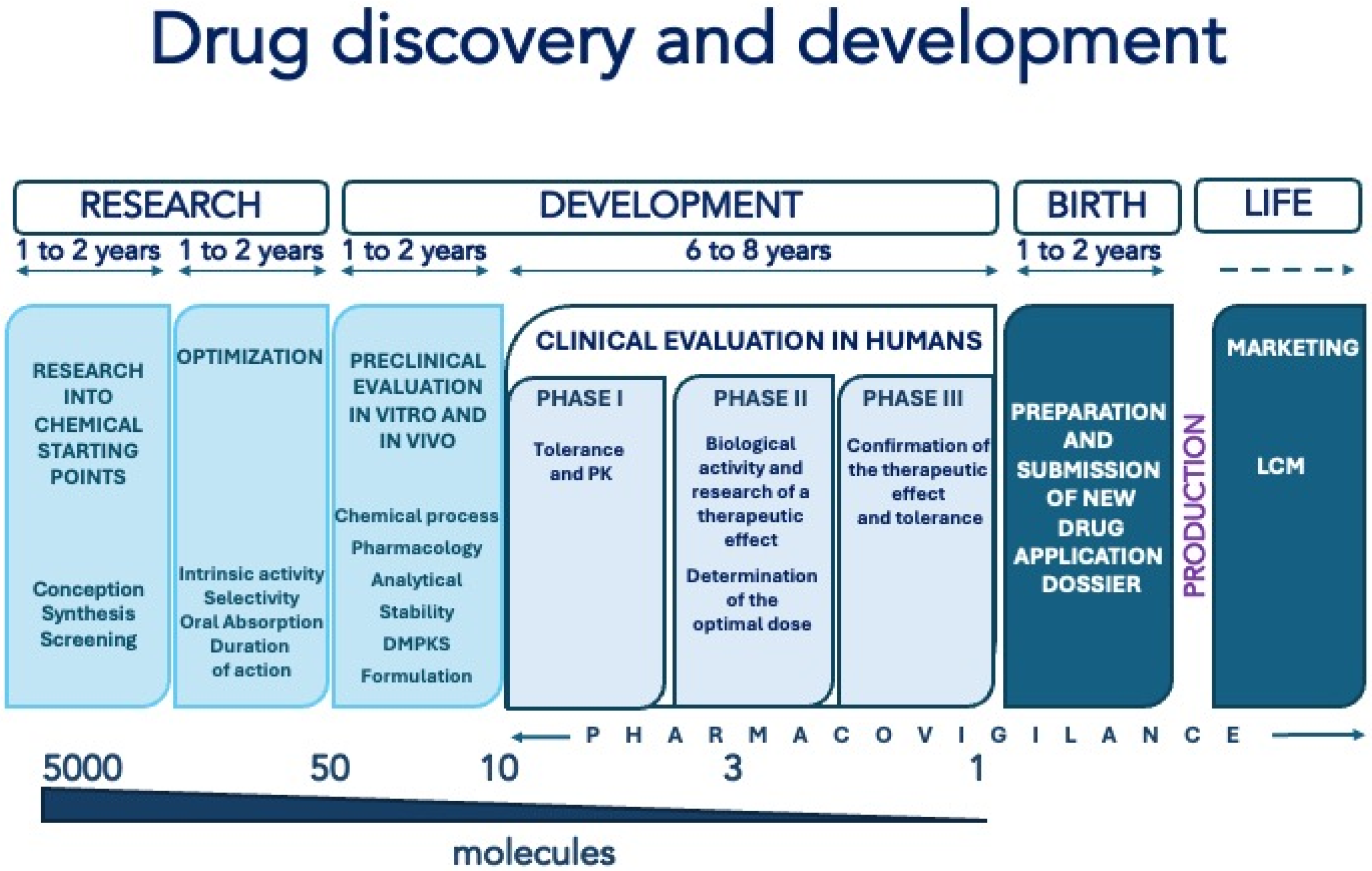
Drug discovery is a long and complex process that can be divided globally into four main stages: 1. Selection and validation of targets, 2. Screening of compounds and chemical optimization, 3. Preclinical studies and 4. Clinical trials.
First, it is necessary to identify the target related to a specific disease. This requires the evaluation of cellular and genetic targets; genomic and proteomic analyses, and bioinformatic predictions.
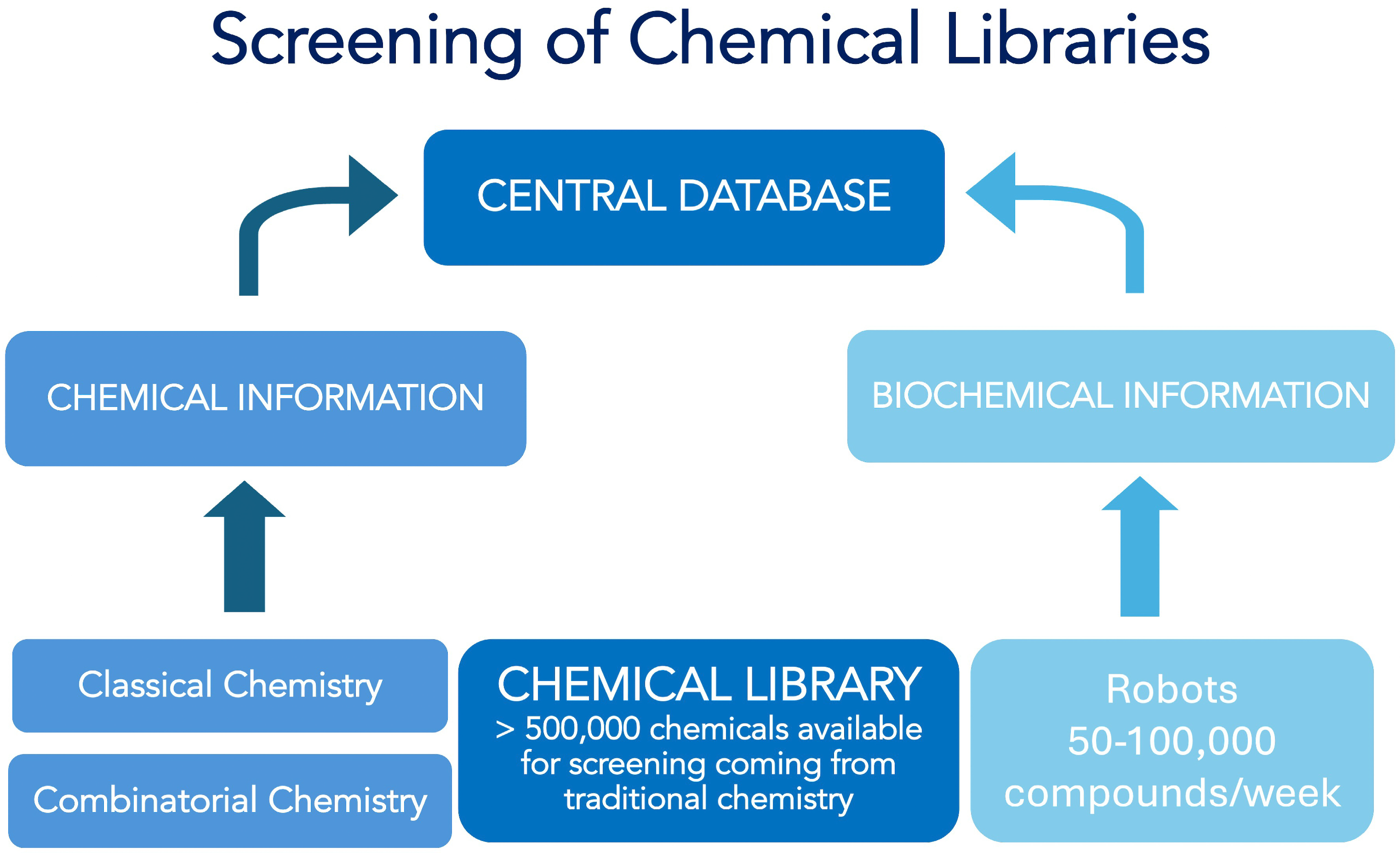
The next step is hit identification, where compounds are identified from molecular libraries using methods such as combinatorial chemistry, high-throughput screening, and virtual screening.
Structure-activity and in silico studies in combination with cellular functional tests are used in an iterative cycle to improve the functional properties of new candidates. Subsequently, in vivo studies, such as pharmacokinetic research, pharmacodynamics and toxicity tests are performed in animal models.
Finally, the drug candidate, which has now successfully passed all preclinical tests, will be administered to patients in clinical trials. This step is in turn marked by three phases that the drug candidate needs to pass sequentially and mandatorily, namely: Phase I, safety tests, with a small number of human subjects; Phase II, drug efficacy testing with a small number of patients affected by the disease under study; and Phase III, efficacy studies with a larger number of patients.
Once the safety and efficacy of the drug candidate in the different clinical phases have been determined, the compound is reviewed by the main international agencies such as the FDA (Food and Drug Administration) or the EMA (European Medicines Agency) for approval and marketing.
These relatively small chemical molecules have provided important advances in the treatment of diseases for more than a century. In large part, their success as drugs has been due to their properties, including their ability to cross biological barriers and modulate several different biological targets. Oral bioavailability and ease of access through chemical synthesis are key features of most of these drugs. This allows for rapid variation in the chemical structure and systematic improvement of its properties. Finally, small molecules generally show high stability and are compatible with most drug formulations and routes of administration.
In recent years, the development of macromolecules (proteins, monoclonal antibodies, mRNAs) as drugs gave new impulse to research into new drugs [
2]. Proof of this is the development in record time of the different vaccines and drugs for the prevention and treatment of COVID, where once again innovation was the key element to reach these results in such a short time [
3]. The advantage of these molecules is their high specificity and, therefore, few side effects.
This biopharmaceutical industry has undergone notable changes in recent decades, for example, in 2020, 55 NMEs (New Medical Entities) received the green light from the FDA’s Center for Drug Evaluation and Research. One-third of these drugs (18/55) were biologics (derived using recombinant DNA technologies) [
4]. For comparison, in 2000, these types of drugs accounted for only 10% of FDA-approved products.
2. Stages in Drug Development
2.1. Identification and Validation of Biological Targets
As mentioned above, there are several phases that take place during the discovery of new drugs (
Figure 1).
It begins with the identification of the possible biological target and the elucidation of its role in the disease.
During this first phase, known as “target discovery”, in vitro research is carried out to identify macromolecules involved in specific diseases.
A target is a biochemical entity (a protein, RNA, or gene) to which a drug can bind and cause physiological changes. It must have an active site or binding site to which a therapeutic agent (small molecule or biopharmaceutical) can bind, and this interaction modulates its activity (antagonism, agonism, expression or repression).
In other words, to design a “good” drug, having a clear understanding of the clinical spectrum of a disease and the exact role the target plays in that disease are key factors.
These targets can be discovered in several ways: by reviewing the published scientific literature, searching the available databases, or by genomics or proteomics studies.
After selecting a potential target, researchers must demonstrate that it is involved in the progression of a given disease and that its activity can be regulated.
Once this objective is identified, its suitability is verified, that is, to know the cell or tissue location and the presence of isoforms, which may cause possible side effects. Conducting precise target validation experiments is essential for successful drug development in the next stages.
2.2. Identifying and Validating Hits
In parallel to the validation of the target, simple and automatable in vitro assays will be prepared and optimized, using, for example, membranes or recombinant cells containing the target in large quantities, this will allow the starting of a screening campaign designed to identify hits.
A hit can be defined as a compound that interacts with the target of interest. There are several strategies that can be used for its identification, including screening or high-throughput screening, phenotypic detection, virtual detection, fragment-based detection, and structure-based design (
Figure 2).
2.3. Hit-to-Lead and Lead Optimization
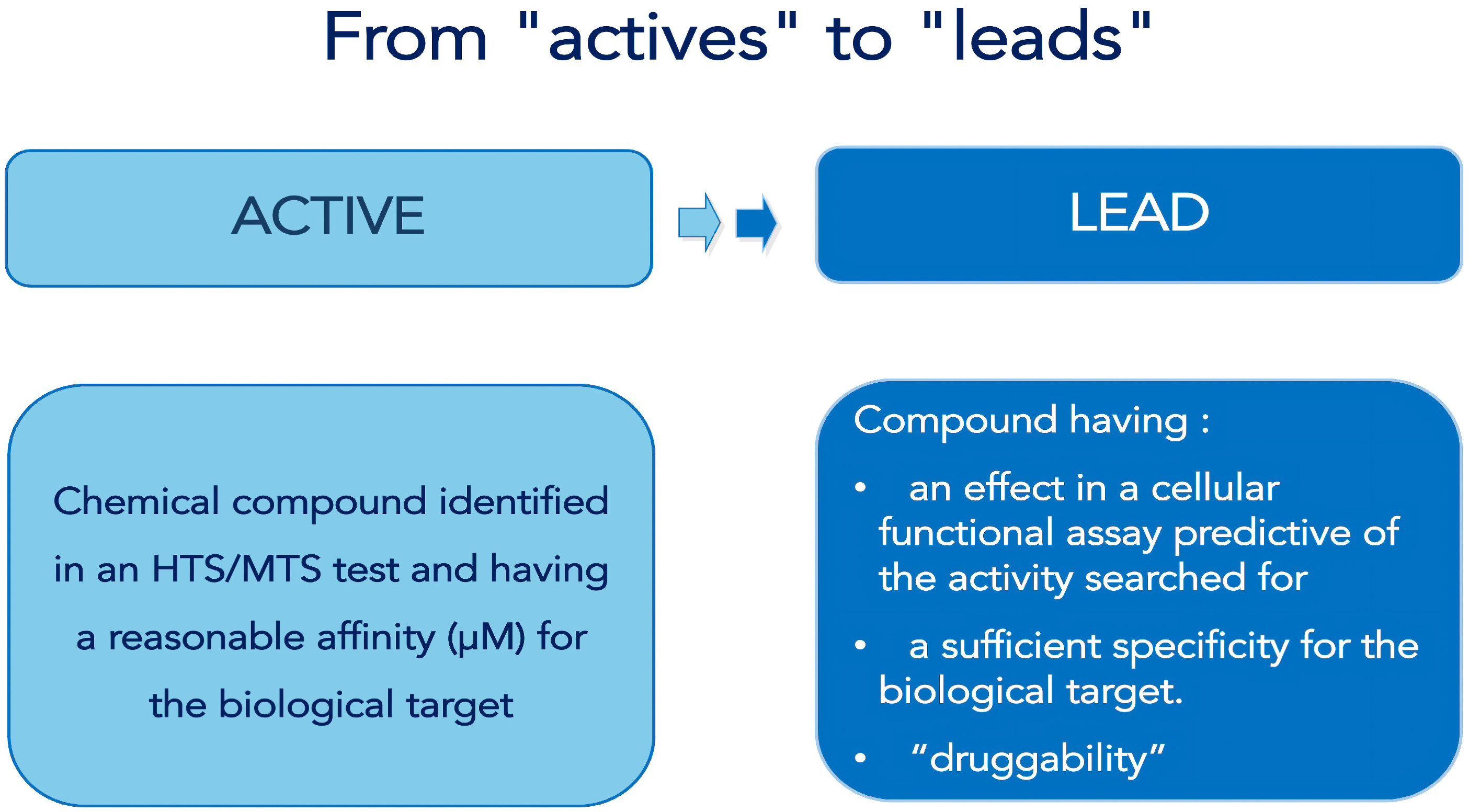
The main goal at this stage is to refine several of the most promising hits to create more potent and selective candidates with “optimized” pharmacokinetic properties.
In general, the “original hits” have very little affinity with the target (at most the micromolar order). Medicinal chemists must work to increase the affinity by several orders of magnitude (of the nanomolar order) by modifying the chemical structure (
Figure 3). With advances in artificial intelligence (AI), an increasing number of pharmaceutical companies are realizing the value of adopting AI approaches [
5,
6] encouraging their medicinal chemists to work together with AI systems to quickly accumulate large amounts of valuable biological, structural, and chemical data.
Interactions other than with the specific target are another key consideration at this stage, as these can cause adverse effects, so the improvement of the selectivity of the molecule while maintaining its affinity and other properties should be investigated and addressed.
2.4. Selection of Candidates
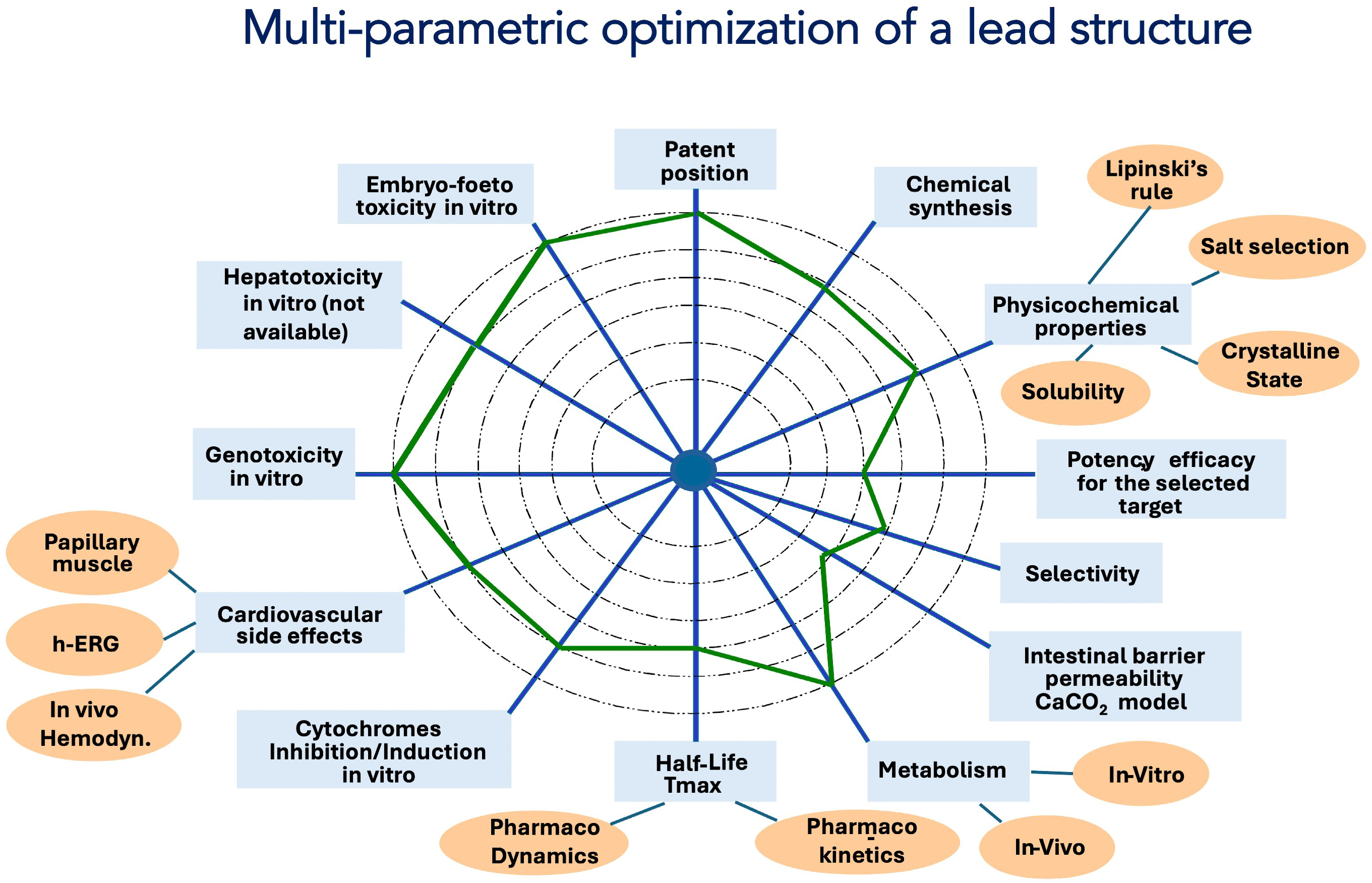
At this stage, it will be necessary to determine, based on several promising clues, which one you want to carry out as a clinical candidate. For a drug candidate to be considered suitable for preclinical and clinical trials, it must: bind selectively and with high affinity to the target, elicit the desired functional response by interacting with this macromolecule, and it must have adequate bioavailability and bio-distribution. It should also have a good toxicity and selectivity profile. In addition to the above properties, you should also consider the following factors: suitability and scale-up of future manufacturing, commercial viability, and cost-effectiveness, as these will have a major impact on the long-term success of the drug (
Figure 4).
2.5. Preclinical Research
Preclinical testing is designed to provide important information about the efficacy and safety of a drug candidate before it is tested in human subjects.
Both in vitro and in vivo models are typically used to provide evidence of a candidate’s biological effect. Preclinical studies are required by regulatory authorities such as the FDA and the EMA before submitting an investigational new drug (IND) application that is required to progress to clinical development.
The preclinical stage of drug development involves extensive testing in animal models to determine if the drug is safe for human trials and if it works as it should. Specifically, the side effects of the drug should be monitored and addressed.
To move from this stage to clinical trials, the FDA requires extensive testing and data. At this point, companies have spent an average of $500 million on research and development for this drug candidate. Since the next stages of development will cost more than twice that amount, it is essential that preclinical testing can be as accurate as possible to determine the potential success of the future drug.
Animal models that mimic human conditions, such as knockout or genetically modified mice, are used during this stage. While the chances of a drug reaching Phase III clinical trials are only 12%, the company is also expected to produce estimates for the expansion of the use of this drug (other therapeutic applications, routes of administration, patient population) if successful.
It is extremely important that the most appropriate animal model is used at this stage, as well as considering the gender of the animals that will be used to prevent sex-specific bias. A drug could elicit a different response in a male animal compared to a female. You will also need to consider species-specific physiology and similarities in terms of metabolic pathways and genetics.
2.6. Investigational New Drug (IND) Application
Before clinical trials begin, an investigational new drug application must be submitted to the FDA. This document should include:
Data from animal studies and toxicity
Manufacturing information
Clinical protocols for proposed human trials
Data from any previous human research
Information about the principal investigator(s)
After conducting a thorough review of the investigational new drug for thirty days, the FDA may:
Approve the application and clinical trials can be started immediately
Propose a temporary stay by requesting additional information
Decide on the permanent suspension of clinical research
Due to the nature of the drug development process and the cost of research up to this point, it is rare for the FDA to cancel a trial. Most of the time, the FDA suggests improvements to the clinical protocol.
2.7. Clinical Trials
Clinical trials are designed to answer specific questions related to the investigational drug. These trials must follow a study protocol, a document that describes exactly how the clinical trial will be conducted. It will detail the key objectives of the study, the study design and statistical considerations, to ensure the safety of the participants and the integrity of the data collected during the study. All these aspects must be duly approved by ad hoc ethics committees before being implemented.
This clinical stage of drug development is organized into a series of “Phases”.
2.7.1. Phase I Trials
Phase I clinical trials are the first clinical studies conducted in healthy humans and typically last six to nine months.
The primary objective of the study is to examine the pharmacokinetics (absorption, distribution, metabolism, and excretion) and safety (adverse events and side effects) of investigational drugs in a small number of healthy subjects (usually 20–80 subjects).
2.7.2. Phase II Trials
Phase II clinical trials continue to monitor the safety of the drug being studied, as well as evaluate its appropriate dosage to achieve its intended purpose.
In Phase II, volunteers have the condition for which the new drug is being tested. The study, which can extend from several months to two years, examines efficacy, safety and pharmacokinetics in addition to confirming the dose on a limited number of patients (usually 100–300 subjects). The information obtained from these trials is used to optimize the design of the larger Phase III study.
2.7.3. Phase III Trials
Phase III trials determine safety and efficacy in a sufficiently large number of patients presenting with the condition/disease for which the candidate is intended. Several hundreds or thousands of participants are involved in this phase. Depending on the condition being treated and the type of medication, this phase can last from one to four years. This phase objectively verifies efficacy and safety compared to existing approved medicines (or placebos) in many patients. If the safety and efficacy of this new drug are properly achieved during intermediate analyses planned, clinical trials can be stopped at this step, and the new drug application (NDA) stage can be advanced.
Many times, due to the increase in the number of participants during Phase III, long-term or rarer side effects are usually detected that may not have been detected in Phase I and Phase II. The largest proportion of safety information is collected during Phase III.
2.8. Regulatory Review and Approval—New Drug Application
The marketing authorization application process in the United States is known as the new drug application (NDA). In the European Union and other countries around the world, this same process is known as a Marketing Authorization Application (MAA).
The regulatory authority is responsible for the scientific assessment of the NDA or MAA. The aim of the application is to provide the regulator with sufficient information, collected during preclinical and clinical studies, to enable them to determine whether:
(a) The drug is safe and effective as a treatment for the condition for which it has been developed
(b) The therapeutic benefits of the drug outweigh the risks
(c) The labeling of the medicinal product is fit for purpose and whether all required details are included
(d) The methods used to manufacture the medicinal product and the measures to ensure the quality of the medicinal product are satisfactory.
Application for License of Biological Products
For the approval of biological products, the laboratory that manufactures this biological product must have a special license for its production. These products for therapeutic use include (but are not limited to): monoclonal antibodies (for in vivo use), cytokines, growth factors, enzymes, immunomodulators, proteins and therapeutic immunotherapies.
Regulatory requirements for biologics are also different from those requested for small molecules as they are products derived from in vitro cell culture (cytokines, hormones, monoclonal antibodies, recombinant DNA by-products, recombinant subunit vaccines) [
7,
8].
For example, for monoclonal antibodies (MAb), it must be evaluated whether their specificities have consequences on their clinical development and, consequently, their evaluation by health authorities and their long-term follow-up. With respect to the structure-activity relationship, it is more relevant to classify them according to their mechanism of action (neutralizing or agonist, cytolytic) than according to their degree of humanization. On the other hand, pharmacokinetics is very different from those of other drugs. The study of the concentration–effect relationship is difficult because biomarkers are often not related to the therapeutic effect.
The risk of viral contamination is a common characteristic of all biotech products derived from cell lines. Such contamination could have serious clinical consequences and may result from contamination of the source cell lines themselves (cell substrates) or from accidental introduction of the virus during production. The safety of these products with respect to viral contamination is ensured through the implementation of programs including viral detection tests, evaluation, removal and inactivation during the manufacturing process (EMA guideline).
2.9. Post-Market Security Surveillance
Post-market safety surveillance is the term used for monitoring a drug after it has received approval and reached the market.
It is designed to evaluate a drug’s long-term safety and efficacy, potential “real-world” issues with formulation, and use for unapproved or “off label” conditions (e.g., use in an age group or at a dose outside of what is recommended on the product label).
Phase IV Studies
Phase IV studies are carried out on several thousand patients, after the drug has been approved.
The purpose of a Phase IV study is to learn more about the long-term risks and benefits of taking a drug now that it is being used more widely. “Real-world” data can also help determine if there is scope to further develop the drug, for example, exploring the use of the drug for additional indications/additional age groups or developing an alternative route of administration.
While thousands of drugs have been approved, annually a dozen are subsequently withdrawn from the market when real-world evidence reveals risks that were undetectable during initial clinical trials. Many adverse drug reactions only become apparent once a drug enters wide-scale distribution; essentially, the greater the patient exposure and the longer a drug remains on the market, the more comprehensive its safety profile becomes.
Recently, Craveiro N.S. et al. [
9] reported that nearly 70% of all drug withdrawals were attributed to four major issues: hepatotoxicity (27.1%), cardiac disorders (18.8%), hypersensitivity (12.8%), and nephrotoxicity (9.8%).
The early 2000s marked a pivotal turning point with the high-profile withdrawal of Vioxx (rofecoxib) in 2004 (
Table 1). This blockbuster painkiller was pulled after data demonstrated a significantly increased risk of myocardial infarction and stroke [
10].
Similarly, Acomplia (rimonabant) stands as one of the most significant cautionary tales in the history of weight-loss medication. Its brief lifespan between 2006 and 2008 represents a crossroads in how regulators weigh metabolic benefits against psychiatric risks.
The primary driver for Acomplia’s removal was a severe psychiatric safety signal. Because the drug blocked the brain’s reward and pleasure centers to curb appetite, it inadvertently “muted” other essential neurological signals, leading to increased rates of depression and suicidality [
11].
By contrast, the Mediator (benfluorex) scandal is widely considered one of the most significant medical and political disasters in European history, particularly in France. While Acomplia was a relatively short-lived disappointment, Mediator remained on the market for over 30 years (1976–2009). Its eventual withdrawal followed a public health catastrophe that fundamentally restructured French drug regulation.
3. Discussion
Drug discovery and development are among the most important translational scientific activities that contribute to human health and well-being. However, despite phenomenal progress in the life sciences, including achievements in genomics and systems biology, there has been no major change in drug discovery and the process of developing new drugs remains slow and expensive.
In general, for the introduction of a new drug in clinical studies, robust pre-clinical data obtained under GLP (Good Laboratory Practices) conditions are needed, accompanied by a manufacturing process (comprising both the active pharmaceutical ingredient and the final pharmaceutical product) executed under appropriate quality control and documented in accordance with the format of the common technical document following national and international regulations (FDA, EMA).
Currently, the “therapeutic arsenal” at our disposal is based on fewer than 500 macromolecular targets (approximately 48% G-protein-coupled receptors, 30% enzymes, 12% hormones, 7% ion channels, 3% nuclear receptors), while functional genomics indicated that there could be at least an order of magnitude larger [
12]. Therefore, many more viable therapeutic targets are still waiting to be discovered and finding their possible ligands is a subject of formidable complexity, but at the same time exciting.
The chemical space, which includes all possible structures, is extremely large; even the fraction containing only small molecules up to 500 Da of molecular weight adds up to at least 10
60 compounds [
13] is unmanageable as a library of structural diversity by any laboratory, except for virtual searches.
In recent years, a greater trend has been described to design drug-like properties in silico, and to use bioinformatics methods intensively for modeling and predictions, in all segments of biological activity testing [
14]. Computational prediction of atomic and molecular properties is the basis of most de novo design strategies.
More recently, the development of artificial intelligence (AI) combined with new experimental technologies is expected to make the search for new pharmaceuticals faster, lower-cost, and more effective [
5,
6].
Machine learning, one of the branches of AI, can now predict the physical and chemical properties of small molecules with great accuracy at a much lower time cost [
15]. AI is also capable of looking for correlations between molecular representations and biological and toxicological activities. AI-based algorithms are also being developed to efficiently probe the synthesis pathways of new drug candidates.
As mentioned before, an interesting avenue of innovation is biopharmaceuticals, which represent one of the greatest achievements of modern science. These drugs are increasingly used in virtually every branch of medicine and have become one of the most effective clinical treatment modalities for a wide range of diseases, including cancers and metabolic disorders.
In recent years, the biopharmaceutical market has developed much faster than the market for all drugs and is believed to have great potential for further dynamic growth due to the tremendous demand for these drugs.
These products have many advantages, for example, they interact with specific macromolecules and therefore cause limited side effects as is the case with conventional drugs. In addition, compared to these drugs, biopharmaceuticals exhibit high specificity and activity. The application of these biopharmaceuticals has made it easier to treat patients who respond poorly to traditional synthetic drugs.
However, one feature of biopharmaceuticals that distinguishes them from synthetic drugs is their sensitivity to degradation in the digestive system and limited penetrability through the intestinal epithelium. As a result, they are usually administered parenterally via direct injection rather than orally. Biopharmaceuticals also require complex stabilization systems due to their temperature sensitivity.
In addition, unlike synthetic drugs, biopharmaceuticals are potentially immunogenic. Even relatively small differences in the structure of the active ingredient can significantly affect the immunogenicity of a drug.
For the development of new drugs, the use of new pathological models is very important—or those involving transgenic animals, as well as the use of appropriate biomarkers—to evaluate the biological effect of these drugs and toxicity on certain organs, particularly myocardial tissue damage, liver toxicity and nephrotoxicity.
In conclusion, the research and development of new drugs requires, more than ever, an effective and timely coordination of pharmaceutical sciences with other sciences such as medicinal chemistry, biochemistry, biology, physiology, biotechnology, bioinformatics, electronic engineering and more recently, artificial intelligence—these interactions being the ideal substrate for new innovative approaches.
However, innovation should not be programmed according to short-term, cost-effective goals; on the contrary, it should be organized according to slow processes and over longer periods of time. Take the case of the Pfizer-BioNTech or Moderna vaccines, which were developed in twelve months, which is in fact unprecedented. According to some analyses, this would be a “breakthrough”, because, until then, the development of a vaccine took about ten years. However, these analyses rarely mention the cumulative aspect of research conducted over five decades, thanks to the work of François Jacob, André Lwoff, and Jacques Monod, among others. Pharmaceutical laboratories in this case benefited from the initial effort of basic public research.
“Basic science,” said Bernardo Houssay (Nobel Prize for Physiology and Medicine in 1947), “is undoubtedly the source that incessantly feeds the applied techniques; if basic science stops, they languish or deteriorate soon… the great practical advances come from disinterested fundamental scientific research” [
16].
The transformation that is coming is immense; it is urgent to innovate in a different way. It is not enough to introduce “quickness” into methods or the mandate for innovation in discourses, but it is necessary to mobilize the right processes with full awareness of the values we carry when we innovate.