


Exploring Factors of Dog Temperament Impacting Pass/Fail Outcomes in Therapy Dog Aptitude Tests

Abstract
1. Introduction
2. Materials and Methods
3. Results
3.1. Neuter Status
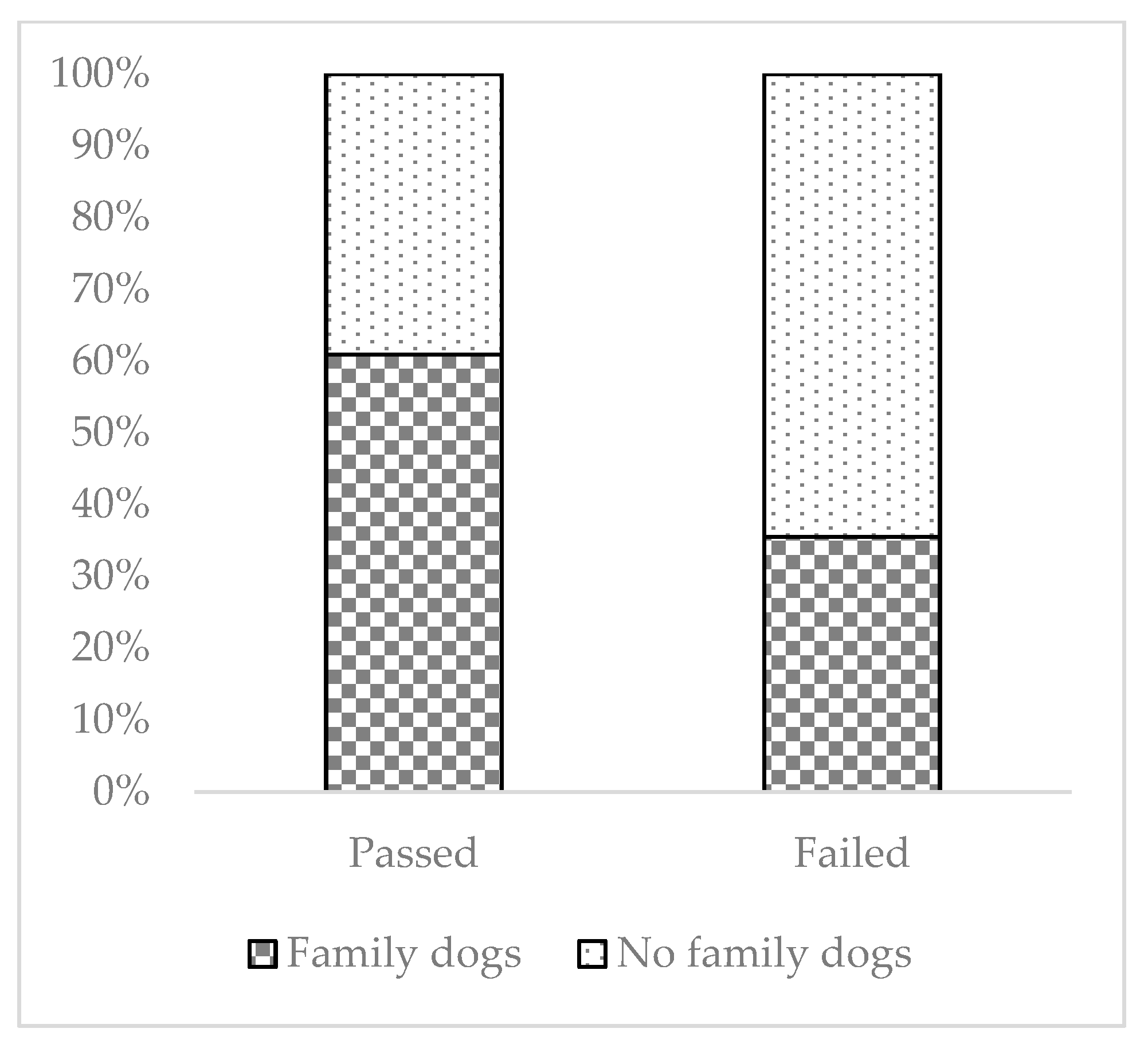
3.2. Presence of Family Dogs
3.3. Factors Influencing the Suitability of Therapy Dogs
3.3.1. Factor 1: Trainability and Obedience
3.3.2. Factor 6: Territorial Aggression
3.3.3. Factor 11: Excitability
4. Discussion
4.1. Sex and Neuter Status
4.2. Impact of Family Dogs
4.3. Factors with Significant Differences Between Passed and Failed Dogs
4.3.1. Trainability and Obedience
4.3.2. Territorial Aggression
4.3.3. Excitability
4.4. Does TC-BARQ Support Aptitude Tests?
5. Conclusions
Author Contributions
Funding
Institutional Review Board Statement
Informed Consent Statement
Data Availability Statement
Acknowledgments
Conflicts of Interest
Correction Statement
Abbreviations
| NPO | Nonprofit organization |
Appendix A

| Number | Dog Breeds | Passed/Tested Head | Pass Rate (%) |
|---|---|---|---|
| 1 | Labrador Retriever | 17/20 | 85 |
| 2 | Toy Poodle | 11/13 | 84.6 |
| 3 | Golden Retriever | 8/10 | 80 |
| 4 | Beagle | 2/5 | 40 |
| 5 | Shih Tzu | 2/5 | 40 |
| 6 | Shiba Inu | 1/4 | 25 |
| 7 | Samoyed | 2/3 | 66.7 |
| 8 | Tibetan Terrier | 2/3 | 66.7 |
| 9 | Border Collie | 2/2 | 100 |
| 10 | Chihuahua | 2/2 | 100 |
| 11 | Papillon | 2/2 | 100 |
| 12 | French Bulldog | 2/2 | 100 |
| 13 | Shetland Sheepdog | 2/2 | 100 |
| 14 | Cavalier King Charles Spaniel | 3/3 | 100 |
| 15 | Boston Terrier | 1/2 | 50 |
| 16 | Miniature Dachshund | 1/3 | 33.3 |
| 17 | Pekingese | 1/2 | 50 |
| 18 | Maltese | 1/2 | 50 |
| 19 | Bichon Frise | 1/1 | 100 |
| 20 | Bernese Mountain Dog | 1/1 | 100 |
| 21 | Brussels Griffon | 0/1 | 0 |
| 22 | Miniature Schnauzer | 0/1 | 0 |
| 23 | Great Pyrenees | 0/2 | 0 |
| 24 | Mix breeds | 4/9 | 44.4 |
| p Value | Effect Size (Effect) | Sample Size | df | |
|---|---|---|---|---|
| Neuter Status | 0.343 | w = 0.1853264 (small) | 317 | 3 |
| Presence of Family Dogs | 0.0327 | w = 0.2602082 (small) | 115 | 1 |
| p Value | Cohen’s d (Effect) | Power | Sample Size | |
|---|---|---|---|---|
| 1. Trainability and obedience | ||||
| When off the leash, returns immediately when called. | 0.031 | −0.485 (small) | 0.612 | 67 |
| 6. Territorial aggression | ||||
| When strangers walk past the home while the dog is in the yard. | 0.017 | 0.576 (medium) | 0.76 | 48 |
| 11. Excitability | ||||
| When visitors arrive at its home. | 0.004 | 0.667 (medium) | 0.87 | 36 |
| Just before being taken on a car trip. | 0.022 | 0.497 (small) | 0.634 | 64 |
| p Value | Cohen’s d (Effect) | Power | Sample Size | |
|---|---|---|---|---|
| 6. Territorial aggression | ||||
| Toward unfamiliar persons visiting your home. | 0.078 | 0.394 (small) | 0.445 | 102 |
| When an unfamiliar person approaches the owner or a member of the owner’s family at home. | 0.078 | 0.528 (medium) | 0.685 | 57 |
| 9. Resource guarding-related aggression | ||||
| When food is taken away by a member of the household. | 0.062 | 0.422 (small) | 0.497 | 89 |
| 11. Excitability | ||||
| Just before being taken for a walk. | 0.087 | 0.375 (small) | 0.411 | 112 |
| When you or other members of the household come home after a brief absence. | 0.075 | 0.389 (small) | 0.436 | 104 |
| When playing with you or other members of your household. | 0.086 | 0.377 (small) | 0.415 | 111 |
References
- Rodríguez-Martínez, M.D.C.; De la Plana Maestre, A.; Armenta-Peinado, J.A.; Barbancho, M.Á.; García-Casares, N. Evidence of animal-assisted therapy in neurological diseases in adults: A systematic review. Int. J. Environ. Res. Public Health 2021, 18, 12882. [Google Scholar] [CrossRef] [PubMed]
- Antonioli, C.; Reveley, M.A. Randomised controlled trial of animal facilitated therapy with dolphins in the treatment of depression. BMJ 2005, 331, 1231. [Google Scholar] [CrossRef] [PubMed]
- Huber, A.; Klug, S.J.; Abraham, A.; Westenberg, E.; Schmidt, V.; Winkler, A.S. Animal-assisted interventions improve mental, but not cognitive or physiological health outcomes of higher education students: A systematic review and meta-analysis. Int. J. Ment. Health Addict. 2024, 22, 1597–1628. [Google Scholar] [CrossRef] [PubMed]
- Ward, S.C.; Whalon, K.; Rusnak, K.; Wendell, K.; Paschall, N. The association between therapeutic horseback riding and the social communication and sensory reactions of children with autism. J. Autism Dev. Disord. 2013, 43, 2190–2198. [Google Scholar] [CrossRef] [PubMed]
- Nelson, C.; Dossett, K.; Walker, D.L. Equine-assisted therapy for posttraumatic stress disorder among first responders. Psychol. Rep. 2024, 127, 2203–2219. [Google Scholar] [CrossRef] [PubMed]
- Hediger, K.; Thommen, S.; Wagner, C.; Gaab, J.; Hund-Georgiadis, M. Effects of animal-assisted therapy on social behaviour in patients with acquired brain injury: A randomised controlled trial. Sci. Rep. 2019, 9, 5831. [Google Scholar] [CrossRef] [PubMed]
- O’Haire, M.E.; McKenzie, S.J.; Beck, A.M.; Slaughter, V. Social behaviors increase in children with autism in the presence of animals compared to toys. PLoS ONE 2013, 8, e57010. [Google Scholar] [CrossRef] [PubMed]
- IAHAIO. The IAHAIO Definitions for Animal Assisted Intervention and Guidelines for Wellness of Animals Involved in AAI. 2018. Available online: https://iahaio.org/iahaio-white-paper-updated-april-2018/ (accessed on 30 September 2025).
- Kumasaka, T.; Masu, H.; Kataoka, M. Attitude Survey of Nursing Personnel Working at Hospitals Towards Animal Assisted Intervention: Focus on a Psychiatric Hospital Planning to Introduce Animals. J. Jpn. Assoc. Rural. Med. 2008, 57, 34–49. [Google Scholar]
- Suzuki, S.; Sakuramoto, M. Healthcare costs reduction through an introduction of Animal Assisted Therapy. Hokkai-Gakuen Organ. Knowl. Ubiquitous Through Gaining Arch. 2013, 13, 9–15. [Google Scholar]
- Japan Pet Food Association. Available online: https://petfood.or.jp/data-chart/ (accessed on 30 September 2025).
- Hokkaido Volunteer Dog Association. About the Aptitude Test. Available online: http://www.volunteer-dog.com/therapy/application.html (accessed on 30 September 2025).
- Sakurama, M.; Ito, M.; Nakanowataru, Y.; Kooriyama, T. Selection of appropriate dogs to be therapy dogs using the C-BARQ. Animals 2023, 13, 834. [Google Scholar] [CrossRef] [PubMed]
- Hsu, Y.; Serpell, J.A. Development and validation of a questionnaire for measuring behavior and temperament traits in pet dogs. J. Am. Vet. Med. Assoc. 2003, 223, 1293–1300. [Google Scholar] [CrossRef] [PubMed]
- Cavalli, C.M.; Carballo, F.; Dzik, M.V.; Underwood, S.; Bentosela, M. Are animal-assisted activity dogs different from pet dogs? A comparison of their sociocognitive abilities. J. Vet. Behav. 2018, 23, 76–81. [Google Scholar] [CrossRef]
- McCullough, A.; Jenkins, M.A.; Ruehrdanz, A.; Gilmer, M.J.; Olson, J.; Pawar, A.; O’Haire, M.E. Physiological and behavioral effects of animal-assisted interventions on therapy dogs in pediatric oncology settings. Appl. Anim. Behav. Sci. 2018, 200, 86–95. [Google Scholar] [CrossRef]
- Kubinyi, E.; Turcsán, B.; Miklósi, Á. Dog and owner demographic characteristics and dog personality trait associations. Behav. Process. 2009, 81, 392–401. [Google Scholar] [CrossRef] [PubMed]
- Serpell, J.A.; Duffy, D.L. Aspects of juvenile and adolescent environment predict aggression and fear in 12-month-old guide dogs. Front. Vet. Sci. 2016, 3, 49. [Google Scholar] [CrossRef] [PubMed]
- Fine, A.H. 10-Incorporating Animal-Assisted Therapy into Psychotherapy: Guidelines and Suggestions for Therapists. In Handbook on Animal-Assisted Therapy: Theoretical Foundations and Guidelines for Practice; Aubrey, H.F., Ed.; Academic Press: Amsterdam, The Netherlands, 2010; pp. 169–191. [Google Scholar]
| Intact Female | Neutered Female | Intact Male | Neutered Male | |
|---|---|---|---|---|
| Passed | 10 | 23 | 5 | 31 |
| Failed | 2 | 8 | 5 | 16 |
| Factors and Questionnaire | Failed | Passed | p Value | ||
|---|---|---|---|---|---|
| Mean | SD 1 | Mean | SD 1 | ||
| 1. Trainability and obedience | |||||
| When off the leash, returns immediately when called. | 2.67 | 1.03 | 3.13 | 0.93 | 0.031 * |
| Obeys a stay command immediately. | 3.00 | 0.74 | 3.06 | 0.88 | 0.573 |
| Slow to learn new tricks or tasks. | 1.93 | 1.11 | 1.88 | 1.06 | 0.987 |
| 2. Separation-related anxiety behaviors | |||||
| Restlessness/agitation/pacing. | 0.84 | 1.16 | 0.72 | 0.98 | 0.742 |
| Whining. | 1.03 | 1.28 | 0.72 | 1.01 | 0.341 |
| Barking. | 0.71 | 1.04 | 0.62 | 0.81 | 0.980 |
| 3. Separation-related physiological reactions | |||||
| Excessive salivation. | 0.32 | 0.54 | 0.23 | 0.60 | 0.176 |
| Chewing/scratching at doors, floor, windows, curtains, etc. | 0.35 | 0.88 | 0.12 | 0.37 | 0.315 |
| Loss of appetite | 0.39 | 0.80 | 0.17 | 0.51 | 0.192 |
| 4. Aggression towards people | |||||
| When stepped over by a member of the household. | 0.07 | 0.25 | 0.06 | 0.29 | 0.664 |
| When approached directly by an unfamiliar child while being walked or exercised on a leash. | 0.19 | 0.40 | 0.16 | 0.44 | 0.463 |
| When stared at directly by a member of the household. | 0.03 | 0.18 | 0.04 | 0.21 | 0.813 |
| When approached directly by an unfamiliar adult while being walked or exercised on a leash. | 0.23 | 0.50 | 0.10 | 0.31 | 0.204 |
| When an unfamiliar person tries to touch or pet the dog. | 0.21 | 0.49 | 0.12 | 0.32 | 0.443 |
| 5. Fear and anxiety towards strangers, dogs, and unfamiliar situations | |||||
| When approached directly by an unfamiliar male adult while away from home. | 0.45 | 0.72 | 0.37 | 0.57 | 0.800 |
| When approached directly by an unfamiliar child while away from home. | 0.42 | 0.67 | 0.29 | 0.57 | 0.349 |
| When an unfamiliar person tries to touch or pet the dog. | 0.39 | 0.56 | 0.21 | 0.41 | 0.111 |
| When approached directly by an unfamiliar dog of the same or larger size. | 0.52 | 0.77 | 0.51 | 0.74 | 0.993 |
| When approached directly by an unfamiliar dog of a smaller size. | 0.35 | 0.71 | 0.44 | 0.66 | 0.376 |
| When first exposed to unfamiliar situations (e.g., first car trip, first time in elevator, first visit to veterinarian, etc.). | 1.00 | 1.10 | 0.88 | 0.91 | 0.767 |
| In response to wind or wind-blown objects. | 0.65 | 0.88 | 0.40 | 0.76 | 0.157 |
| When having nails clipped by a household member. | 1.24 | 1.41 | 0.95 | 1.10 | 0.505 |
| When barked, growled, or lunged at by an unfamiliar dog. | 1.23 | 1.12 | 1.03 | 1.07 | 0.411 |
| 6. Territorial aggression | |||||
| When strangers walk past the home while the dog is in the yard. | 0.68 | 0.83 | 0.29 | 0.57 | 0.017 * |
| When mailmen or other delivery workers approach the home. | 0.77 | 1.02 | 0.47 | 0.70 | 0.243 |
| Toward unfamiliar persons visiting your home. | 0.65 | 0.75 | 0.38 | 0.62 | 0.078 § |
| When joggers, cyclists, roller skaters, or skateboarders pass the home while the dog is in the yard. | 0.48 | 0.72 | 0.41 | 0.60 | 0.805 |
| When an unfamiliar person approaches the owner or a member of the owner’s family at home. | 0.71 | 1.04 | 0.30 | 0.61 | 0.082 § |
| Toward cats, squirrels, and other animals entering its yard. | 0.80 | 0.96 | 0.56 | 0.78 | 0.259 |
| 7. Hyperactivity | |||||
| Active, energetic, always on the go. | 1.13 | 1.01 | 1.17 | 1.00 | 0.880 |
| Playful, puppyish, boisterous. | 1.35 | 1.25 | 1.61 | 1.23 | 0.355 |
| Hyperactive, restless, has trouble settling down. | 1.30 | 1.18 | 1.53 | 1.17 | 0.341 |
| 8. Aggression towards approaching unknown dogs | |||||
| When approached directly by an unfamiliar male dog while being walked or exercised on a leash. | 0.48 | 0.72 | 0.43 | 0.68 | 0.766 |
| When approached directly by an unfamiliar female dog while being walked or exercised on a leash. | 0.45 | 0.72 | 0.39 | 0.63 | 0.808 |
| 9. Resource guarding-related aggression | |||||
| When food is taken away by a member of the household. | 0.47 | 0.94 | 0.18 | 0.54 | 0.062 § |
| 10. Abnormal behavior | |||||
| Licks people or objects excessively. | 1.03 | 0.87 | 1.09 | 1.03 | 0.975 |
| Rolls in animal droppings or other “smelly” substances. | 0.61 | 0.88 | 0.83 | 1.11 | 0.462 |
| 11. Excitability | |||||
| When visitors arrive at its home. | 2.16 | 1.29 | 1.38 | 1.11 | 0.004 * |
| Just before being taken for a walk. | 1.77 | 1.26 | 1.32 | 1.19 | 0.087 § |
| Just before being taken on a car trip. | 1.97 | 1.25 | 1.39 | 1.11 | 0.022 * |
| When you or other members of the household come home after a brief absence. | 1.87 | 1.36 | 1.36 | 1.28 | 0.075 § |
| When playing with you or other members of your household. | 1.90 | 1.25 | 1.49 | 1.01 | 0.086 § |
| When the doorbell rings. | 1.65 | 1.43 | 1.26 | 1.38 | 0.186 |
| 12. Attachment behavior to family members | |||||
| Tends to follow a member of the household from room to room about the house. | 2.35 | 1.05 | 2.26 | 1.15 | 0.573 |
| Tends to sit close to or in contact with a member of the household when that individual is sitting down. | 2.81 | 1.28 | 2.61 | 1.13 | 0.345 |
| Tends to nudge, nuzzle, or paw a member of the household for attention when that individual is sitting down. | 2.26 | 1.24 | 1.96 | 1.12 | 0.215 |
| Becomes agitated when a member of the household shows affection for another dog or animal. | 1.13 | 1.34 | 1.22 | 1.08 | 0.446 |
| 13. Vigilant aggression towards family dogs | |||||
| Towards another (familiar) dog in your household. | 0.18 | 0.60 | 0.12 | 0.40 | 1.000 |
| When approached at a favorite resting/sleeping place by another (familiar) household dog. | 0.09 | 0.30 | 0.17 | 0.59 | 0.930 |
| 14. Resource guarding-related aggression towards family dogs | |||||
| When approached while eating by another (familiar) household dog. | 0.73 | 1.10 | 0.27 | 0.67 | 0.136 |
| When approached while playing with/chewing a favorite toy, bone, object, etc., by another (familiar) household dog. | 0.45 | 0.82 | 0.31 | 0.64 | 0.631 |
Disclaimer/Publisher’s Note: The statements, opinions and data contained in all publications are solely those of the individual author(s) and contributor(s) and not of MDPI and/or the editor(s). MDPI and/or the editor(s) disclaim responsibility for any injury to people or property resulting from any ideas, methods, instructions or products referred to in the content. |
© 2025 by the authors. Licensee MDPI, Basel, Switzerland. This article is an open access article distributed under the terms and conditions of the Creative Commons Attribution (CC BY) license (https://creativecommons.org/licenses/by/4.0/).
Share and Cite
Kawai, S.; Terashima, S.; Ebashi, N.; Sakurama, M.; Ito, M.; Nakanowataru, Y.; Kooriyama, T. Exploring Factors of Dog Temperament Impacting Pass/Fail Outcomes in Therapy Dog Aptitude Tests. Pets 2025, 2, 42. https://doi.org/10.3390/pets2040042
Kawai S, Terashima S, Ebashi N, Sakurama M, Ito M, Nakanowataru Y, Kooriyama T. Exploring Factors of Dog Temperament Impacting Pass/Fail Outcomes in Therapy Dog Aptitude Tests. Pets. 2025; 2(4):42. https://doi.org/10.3390/pets2040042
Chicago/Turabian StyleKawai, Shiori, Saki Terashima, Natsuki Ebashi, Mayu Sakurama, Miki Ito, Yumiko Nakanowataru, and Takanori Kooriyama. 2025. "Exploring Factors of Dog Temperament Impacting Pass/Fail Outcomes in Therapy Dog Aptitude Tests" Pets 2, no. 4: 42. https://doi.org/10.3390/pets2040042
APA StyleKawai, S., Terashima, S., Ebashi, N., Sakurama, M., Ito, M., Nakanowataru, Y., & Kooriyama, T. (2025). Exploring Factors of Dog Temperament Impacting Pass/Fail Outcomes in Therapy Dog Aptitude Tests. Pets, 2(4), 42. https://doi.org/10.3390/pets2040042

