Case Report

Severe Bleeding Due to an Acquired FXIII Inhibitor in an Otherwise Healthy Patient

1
Department of Pathology and Laboratory Medicine, University of Rochester Medical Center, Rochester, NY 14642, USA
2
Mayo Clinic, Jacksonville, FL 32224, USA
3
Division of Hematology and Oncology, Department of Medicine, University of Rochester Medical Center, Rochester, NY 14642, USA
*
Author to whom correspondence should be addressed.
Submission received: 18 December 2025 / Revised: 9 January 2026 / Accepted: 10 February 2026 / Published: 13 February 2026

Abstract

A 75-year-old male was admitted with worsening anemia and spontaneous bruising in the left abdominal wall and paraspinal region. Laboratory workup revealed low factor XIII (FXIII) activity levels. Cryoprecipitate transfusions raised his FXIII level, but still fluctuated drastically, ranging from 4 to 43% was discharged 3 days later once his bleeding was managed. Three days later, he was readmitted for severe pain and new bruising in his latissimus dorsi and lateral right thigh. CT-scan revealed hemothorax and arterial bleeding requiring an urgent angiogram with embolization. Chromogenic and functional FXIII assays were unable to elucidate an inhibitor at this time. Management included FXIII concentrate, rituximab, and prednisone; the patient was discharged 12 days later with FXIII levels of 50%. After prednisone tapering, FXIII levels decreased drastically. This case exemplified that higher levels of FXIII are required to prevent bleeding diatheses rather than the previously reported minimum of 5% activity. Despite the diagnostic uncertainty of laboratory testing, the shortened half-life of FXIII activity following replacement therapy and favorable response to immunotherapy indicates that the bleeding diathesis was caused by an acquired inhibitor.

1. Case Report

A 75-year-old male with no previous significant medical history presented to the ED with spontaneous right-sided abdominal bruising, back pain, and swelling near his right scapula. He denied any trauma, new medical conditions, medications, or recent travel. A month earlier, he visited his PCP with a spontaneous nontender left abdominal wall hematoma. His laboratory screening tests were essentially normal. The hematoma resolved on its own a few weeks later.
On admission, laboratory workup was significant for hemoglobin of 7.7 g/dL. Abdominal CT-scan showed band-like high attenuation fluid compatible with a layering hematoma along the abdominal wall and moderate contusions in the subcutaneous fat and mild left-sided hydronephrosis. No retroperitoneal/intra-abdominal hematoma was observed. Chest CT-scan with contrast revealed enlargement and attenuation of right paraspinal muscles extending to the right scapula, most likely due to hematoma.
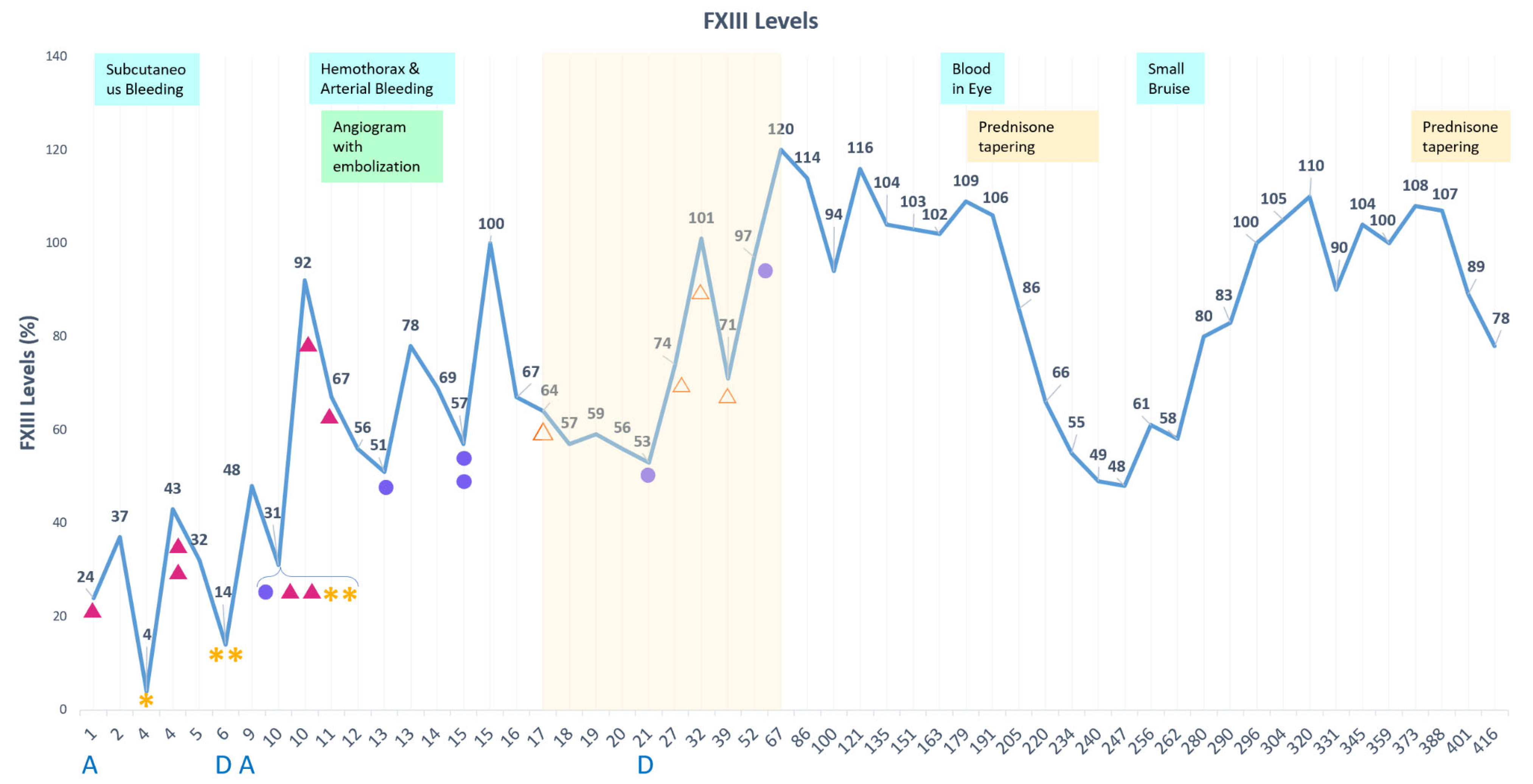
Further laboratory tests revealed low FXIII antigen levels of 24% as determined by immunoassay (Table 1). A unit of RBC and FFP was administered, and the patient was started on prednisone (1 mg/kg). Two days later, the right flank hematoma expanded and new ecchymoses were observed in his right groin and belt line along with a drop in Hgb (6.7 g/dL) and FXIII to 4% (Figure 1). Aminocaproic acid and 40 U/Kg of FXIII concentrate (Corifact, CSL Behring, King of Prussia, PA, USA) were added to his treatment, along with two RBCs and two cryoprecipitate doses.
The acute bleeding history and critically low FXIII indicated a possible acquired inhibitor; however, supporting laboratory evidence was unable to be obtained. In addition to a severely low FXIII antigen result, a qualitative send-out FXIII assay demonstrated lysis (Table 1). He was discharged on day six with aminocaproic acid and prednisone (60 mg/day). It is important to note that there are no FDA-approved laboratory tests to determine the presence of an inhibitor. Our laboratory performed a modified mixing study and mimicked an FVIII inhibitor Bethesda assay; both of which yielded inconclusive results due to the patient starting immunosuppressive therapy. No samples were available prior to the start of treatment.
Three days later, he returned to the ED complaining of discomfort and swelling in the right scapular area, right lateral thigh with diffuse ecchymoses, numbness in his distal right thigh, and worsening bruising of the scrotum and left flank.
Abdominal CT-scan revealed a hematoma along the abdominal wall, swelling in the scapula, and bilateral hemothorax. Abdominal angiogram revealed active arterial bleeding with a large retroperitoneal hematoma centered in the right psoas muscle and extending into surrounding regions with multiple areas of active contrast extravasation.
The severe bleeding of the right T11 and T12 intercostal branches and L2–4 lumbar arteries required embolization. This was followed by transfusion of two RBCs, three cryoprecipitate doses, tranexamic acid (TXA), and multiple doses of FXIII concentrate (40 U/Kg) infusions (Figure 1).
Follow-up laboratory tests revealed FXIII of 46% and Hgb of 8.1 g/dL. A send-out functional FXIII assay indicated <1% of normal activity, consistent with severe deficiency (Table 1).
A course of Rituximab infusions at 375 mg/m2/week for 4 weeks was initiated. He was discharged 12 days later with FXIII of 53% on daily prednisone, weekly rituximab infusions, and FXIII concentrate as needed.
Four weeks later, aminocaproic acid was discontinued, and he experienced no further bleeding until day 179 when prednisone was tapered down to 5 mg/day; FXIII dropped to 48% (Figure 1). Increasing prednisone dose to 10 mg/day increased FXIII to 110%.

2. Discussion

In 1948, a serum protein responsible for the formation of insoluble fibrin clots was identified [1,2]. Decades later, further investigations helped purify this protein and revealed its mechanism of action [3,4]. The clinical characteristics of this protein deficiency remained unknown until 1961 when the first patient with decreased ‘protein fibrin stabilizing factor’ presented with impaired wound healing, abnormal scarring, and severe bleeding [5]. This factor was later recognized as ‘Factor XIII’ [6].
FXIII is a crucial coagulation factor that stabilizes fibrin clots. It catalyzes the formation of covalent bonds between fibrin monomers and protects it from premature fibrinolysis. FXIII deficiency, which is extremely rare, can be congenital or acquired and is characterized by increased bleeding tendency due to impairment of clot stability.
FXIII circulates in plasma as a heterotetramer composed of two catalytic A-subunits and two carrier B-subunits [7]. It is mainly responsible for the stabilization of fibrin monomers during clot formation. As a multifunctional molecule, it also plays roles in wound healing, angiogenesis, pregnancy maintenance, bone metabolism, and cardio protection [8,9]. Both congenital and acquired deficiency of FXIII may result in severe bleeding diatheses, which commonly present as delayed bleeding episodes along with normal basic coagulation screening studies [10].
FXIII is present in platelets, megakaryocytes, monocytes, and monocyte-derived cells. Subunit A is generated by hematopoietic cells and subunit B is created in the liver [11]. As a zymogen and transglutaminase, FXIII covalently cross-links fibrin molecules together once the enzyme is cleaved by thrombin and the cysteine active site is exposed [12].
Regarding its role in pregnancy, maternal FXIII A-subunits are thought to accumulate in the placenta and stabilize the fibrinoid layer surrounding the cytotrophoblastic shell [9]. In FXIII deficiency, this shell is not properly formed, which can lead to placental displacement and subsequent miscarriage [9].
FXIII also plays a role in wound healing by regulating collagen production and fibroblast proliferation [13]. Fibrin cross-linking protects the injury from invading bacteria and reduces the risk of infection, so patients with FXIII deficiency may experience wound healing defects [9,14]. Despite this, wound healing was found to be both normal in some FXIII-deficient mice and delayed in others, suggesting that other mechanisms may play a greater role in regulating healing [9,14].
Congenital FXIII deficiency is an autosomal recessive disorder that affects 1:1–3 million individuals [15]. Severe cases may result in undetectable levels of FXIII, while heterozygous deficiency is usually asymptomatic, with an activity range of 50–70% [9]. Congenital deficiencies initially and commonly present as delayed umbilical cord bleeding. Subcutaneous bleeding, intracranial hemorrhages, and muscle hematomas are also strongly suggestive of FXIII deficiency [15,16].
There has been widespread debate over classification of FXIII deficiencies. The ISTH refers to inherited FXIII deficiency as Type IA, Type IIA, and Type IIB, with Type IA being most common [15]. Among the reported 153 mutations, missense mutations of the A-subunit are the most common, followed by deletions, insertions, nonsense mutations, and splice site mutations [9].
Acquired FXIII deficiency, which is much less common, can occur in cases of increased FXIII consumption, such as in bleeding, disseminated intravascular coagulation (DIC), decreased synthesis (as seen in liver failure), or due to autoantibodies. Many immune-related disorders, including but not limited to leukemia, liver disease, rheumatoid arthritis, and systemic lupus erythematosus, are reported to be associated with decreased FXIII activity [9,17]. Furthermore, FXIII deficiency may be attributed to long-term treatment with drugs such as isoniazid penicillin, phenytoin, practolol, and amiodarone [9,18]. Up to 70% of patients with acquired FXIII deficiencies present with soft tissue hematomas, mucocutaneous, and intramuscular bleeding [9,19]. With the development of new antibodies, many patients experience a drastic fall in FXIII activity and, consequently, life-threatening intracranial, intra-thoracic, or intra-peritoneal hemorrhages can occur [9,19].
Acquired FXIII deficiency manifests when anti-FXIII antibodies neutralize activated FXIII, increase its clearance, or interfere with FXIII-fibrin interactions. Most of these antibodies are directed against the A-subunit rather than the B-subunit [9,11,18]. Neutralizing antibodies against the A-subunit cause a severe decrease in activity, but maintain almost normal antigen concentrations, resulting in normal quantities of FXIII in circulation [9]. Non-neutralizing A-subunit antibodies cause a severe decrease in both activity and antigen levels [9]. Antibodies directed against the B-subunit result in decreased FXIII activity and considerably decreased antigens [9]. It is uncertain whether antibodies directed against subunit B are fatal or present milder symptoms and are more likely to be overlooked, as both instances have been reported [9,18]. Nevertheless, clinically, both A-type and B-type antibodies are associated with severe bleeding events.
Our case report is novel among others already published due to the rapid integration of immunosuppressive therapy prior to laboratory diagnosis. This was a crucial step that was necessary to limit the bleeding seen in our patient and further supports the notion that clinical evidence should drive treatment decisions if laboratory diagnosis is not possible. In managing the case this way, the patient saw a significant improvement in FXIII levels sooner than what would be expected if waiting for laboratory confirmation, if one were to be conclusive at all.
Screening for FXIII deficiency up until recently utilized a clot solubility test based on the same properties described in the 1920s when it was first discovered. However, due to the high rates of false negatives in milder forms of FXIII deficiency, this test is no longer used [20]. Other testing options include photometric assays, incorporation assays, fluorometric assays, Bethesda assays, clot-based inhibitor assays, antigen immunoassays, and mixing studies. It is thought that thrombin generation and thromboelastometry studies could be beneficial in monitoring hemostasis and clot strength [11]. However, there are no FDA-approved inhibitor tests available.
Prophylactic treatment in FXIII deficiency is crucial due to the variable nature of the associated symptoms. Though clinical guidelines are limited, many utilize a combination of FFP, cryoprecipitate, FXIII concentrates, and/or antifibrinolytic agents [14,17]. In cases of acquired deficiencies, most patients are treated with recombinant-FXIII concentrates and immunosuppressive medication. This may include steroids, cyclophosphamide, or rituximab, which have all been shown to eradicate FXIII antibodies [10,17]. Plasma exchange therapy is an alternative option in some cases [18].

3. Conclusions

In congenital cases, severe bleeding is reported at FXIII levels of <1–3%. Historically, FXIII levels of >5% was thought to be adequate for prophylaxis, though newer case reports have found that these levels are not always sufficient to prevent spontaneous bleeding. In acquired deficiencies, the guidelines are even less clear. Between 2012 and 2022, only 36 articles were published about FXIII inhibitors [21]. With no consensus on a standard FXIII level, various recommendations suggest maintaining levels above 5%, 10%, or even as high as 30% to ensure hemostasis [10,14]. Maintaining higher levels is recommended for severe acute bleeds, including levels as high as 50% or more for major surgeries [9,22,23].
In this case, laboratory determination of the presence of antibodies directed against FXIII was unsuccessful. Factor XIII has a half-life of approximately 9–14 days. This patient exhibited significant decreases in FXIII levels within 1–3 days prior to starting prednisone. Given that the patient has been on prednisone since the initial incident, both chromogenic and functional assays failed to reveal the presence of FXIII antibodies. However, the presence of FXIII antibody in this case is clinically evident. This is indicated by numerous significant bleeding episodes, persistently low FXIII levels with rapid clearance, suboptimal response to cryoprecipitate and FXIII concentrate replacement therapy, and the favorable response to immunotherapy. Specifically, the rapid clearance observed while on corticosteroids strongly suggests a clearance-enhancing antibody. This would explain the overall difficulty in ascertaining laboratory evidence of an inhibitor. Thus, the rapid decrease in FXIII activity demonstrates the vastly shortened half-life, which was ultimately attributed to the presence of an inhibitor.

Author Contributions

B.S. collected data and took the lead in writing the manuscript. H.S. collected data and wrote the manuscript. C.C. and K.R. assisted in writing and reviewing the manuscript. F.A., J.J.I. and G.G. reviewed the manuscript and followed up with the patient. M.A.R. assisted in writing, editing, and reviewing the manuscript. All authors have read and agreed to the published version of the manuscript.

Funding

This manuscript received no external funding.

Institutional Review Board Statement

Not applicable.

Informed Consent Statement

Informed consent has been obtained from the patient to publish this paper.

Data Availability Statement

The original contributions presented in this study are included in the article. Further inquiries can be directed to the corresponding author.

Conflicts of Interest

The authors declare no conflicts of interest.

Abbreviations

The following abbreviations are used in this manuscript:
FXIIIFactor XIII

References

  1. Lorand, L. Fibrin clots. Nature 1950, 166, 694–695. [Google Scholar] [CrossRef]
  2. Laki, K.; Lorand, L. On the Solubility of Fibrin Clots. Science 1948, 108, 280. [Google Scholar] [CrossRef]
  3. Chandrasekhar, N.; Osbahr, A.; Laki, K. The Mode of Action of the Laki-Lorand Factor in the Clotting of Fibrinogen. Biochem. Biophys. Res. Commun. 1964, 15, 182–187. [Google Scholar] [CrossRef]
  4. Lorand, L.; Credo, R.B.; Janus, T.J. Factor XIII (fibrin-stabilizing factor). Methods Enzym. 1981, 80, 333–341. [Google Scholar]
  5. Duckert, F.; Jung, E.; Shmerling, D.H. A hitherto undescribed congenital haemorrhagic diathesis probably due to fibrin stabilizing factor deficiency. Thromb. Diath. Haemorrh. 1960, 5, 179–186. [Google Scholar] [CrossRef] [PubMed]
  6. Giangrande, P.L. Six characters in search of an author: The history of the nomenclature of coagulation factors. Br. J. Haematol. 2003, 121, 703–712. [Google Scholar] [CrossRef]
  7. Mangla, A.; Hamad, H.; Kumar, A. Factor XIII Deficiency. In StatPearls; StatPearls Publishing: Treasure Island, FL, USA, 2023. [Google Scholar]
  8. Muszbek, L.; Yee, V.C.; Hevessy, Z. Blood coagulation factor XIII: Structure and function. Thromb. Res. 1999, 94, 271–305. [Google Scholar] [CrossRef] [PubMed]
  9. Dorgalaleh, A.; Rashidpanah, J. Blood coagulation factor XIII and factor XIII deficiency. Blood Rev. 2016, 30, 461–475. [Google Scholar] [CrossRef]
  10. Dorgalaleh, A.; Kazemi, A.; Zaker, F.; Shamsizadeh, M.; Rashidpanah, J.; Mollaei, M. Laboratory Diagnosis of Factor XIII Deficiency, Routine Coagulation Tests with Quantitative and Qualitative Methods. Clin. Lab. 2016, 62, 491–498. [Google Scholar] [CrossRef]
  11. Marco, A.; Marco, P. Autoimmune Acquired Factor XIII Deficiency: A Case Report. J. Blood Med. 2021, 12, 63–68. [Google Scholar] [CrossRef]
  12. Pisano, J.J.; Finlayson, J.S.; Peyton, M.P. Cross-link in fibrin polymerized by factor 13: Epsilon-(gamma-glutamyl)lysine. Science 1968, 160, 892–893. [Google Scholar] [CrossRef]
  13. Nahrendorf, M.; Hu, K.; Frantz, S.; Jaffer, F.A.; Tung, C.-H.; Hiller, K.-H.; Voll, S.; Nordbeck, P.; Sosnovik, D.; Gattenlöhner, S.; et al. Factor XIII deficiency causes cardiac rupture, impairs wound healing, and aggravates cardiac remodeling in mice with myocardial infarction. Circulation 2006, 113, 1196–1202. [Google Scholar] [CrossRef]
  14. Kleber, C.; Sablotzki, A.; Casu, S.; Olivieri, M.; Thoms, K.-M.; Horter, J.; Schmitt, F.C.F.; Birschmann, I.; Fries, D.; Maegele, M.; et al. The impact of acquired coagulation factor XIII deficiency in traumatic bleeding and wound healing. Crit. Care 2022, 26, 69. [Google Scholar] [CrossRef]
  15. Kohler, H.P.; Ichinose, A.; Seitz, R.; Ariens, R.A.S.; Muszbek, L.; on behalf of the Factor XIII and Fibrinogen SSC Subcommittee of the ISTH. Diagnosis and classification of factor XIII deficiencies. J. Thromb. Haemost. 2011, 9, 1404–1406. [Google Scholar] [CrossRef]
  16. Naderi, M.; Dorgalaleh, A.; Alizadeh, S.; Tabibian, S.; Hosseini, S.; Shamsizadeh, M.; Bamedi, T. Clinical manifestations and management of life-threatening bleeding in the largest group of patients with severe factor XIII deficiency. Int. J. Hematol. 2014, 100, 443–449. [Google Scholar] [CrossRef]
  17. Chou, S.C.; Lin, C.Y.; Yen, C.T.; Hsieh, H.N.; Huang, Y.C.; Li, K.J.; Lin, S.W.; Shen, M.C. Acquired FXIII inhibitor: Patient characteristics and treatment outcome, a case series in Taiwan. J. Formos. Med. Assoc. 2021, 120, 411–414. [Google Scholar] [CrossRef] [PubMed]
  18. Ichinose, A.; Japanese Collaborative Research Group on AH13. Autoimmune acquired factor XIII deficiency due to anti-factor XIII/13 antibodies: A summary of 93 patients. Blood Rev. 2017, 31, 37–45. [Google Scholar] [CrossRef] [PubMed]
  19. Ichinose, A.; Kohler, H.P.; Philippou, H. Recommendation for ISTH/SSC Criterion 2015 for autoimmune acquired factor XIII/13 deficiency. Thromb. Haemost. 2016, 116, 772–774. [Google Scholar] [CrossRef]
  20. Jennings, I.; Kitchen, S.; Menegatti, M.; Palla, R.; Walker, I.; Makris, M.; Peyvandi, F. Detection of Factor XIII deficiency: Data from multicentre exercises amongst UK NEQAS and PRO-RBDD project laboratories. Int. J. Lab. Hematol. 2017, 39, 350–358. [Google Scholar] [CrossRef] [PubMed]
  21. Duranteau, O.; Tatar, G.; Demulder, A.; Tuna, T. Acquired factor XIII deficiency: A scoping review. Eur. J. Anaesthesiol. Intensive Care 2023, 2, e0035. [Google Scholar] [CrossRef]
  22. Lim, W.; Moffat, K.; Hayward, C.P. Prophylactic and perioperative replacement therapy for acquired factor XIII deficiency. J. Thromb. Haemost. 2004, 2, 1017–1019. [Google Scholar] [CrossRef] [PubMed]
  23. Franchini, M.; Castaman, G.; Coppola, A.; Santoro, C.; Zanon, E.; Di Minno, G.; Morfini, M.; Santagostino, E.; Rocino, A. Acquired inhibitors of clotting factors: AICE recommendations for diagnosis and management. Blood Transfus. 2015, 13, 498–513. [Google Scholar] [PubMed]
Figure 1. FXIII levels (chromogenic). Labmed 03 00006 i003: Red Blood Cells; *: Cryoprecipitate; Labmed 03 00006 i004: FXIII Concentrate; Labmed 03 00006 i005: Rituximab; A: Admission; D: Discharge.

Labmed 03 00006 g001
Table 1. Initial laboratory work-up for both admissions.
TestDay 1
(1st Admission)
Day 9
(2nd Admission)
Reference Range (Units)
WBC5.711.9 Labmed 03 00006 i0014.2–9.1 (×103/µL)
RBC2.3 Labmed 03 00006 i0022.5 Labmed 03 00006 i0024.6–6.1 (×106/µL)
Hemoglobin7.7 Labmed 03 00006 i0028.1 Labmed 03 00006 i00213.7–17.5 (g/dL)
Hematocrit23 Labmed 03 00006 i00225 Labmed 03 00006 i00240–51 (%)
Platelet240253150–330 (×103/µL)
PT12.313.710–12.9 (s)
INR1.11.20.9–1.1
PTT25.122.925.8–37.9 (s)
Fibrinogen227N/A172–409 (mg/dL)
D-Dimer0.32N/A0–0.5 (µg/dL)
FVIII189 Labmed 03 00006 i001203 Labmed 03 00006 i00159–163 (%)
vW Activity211 Labmed 03 00006 i001N/A55–167 (%)
vW Antigen230 Labmed 03 00006 i001N/A56–166 (%)
FXIII24 Labmed 03 00006 i00246 Labmed 03 00006 i00275–155 (%)
Lupus AnticoagulantNegativeN/ANegative
Thrombin Time12.3N/A13.0–17.7 (s)
UN37 Labmed 03 00006 i00133 Labmed 03 00006 i0016-- (mg/dL)
Creatinine1.35 Labmed 03 00006 i0011.000.67–1.17 (mg/dL)
eGFR BY CREAT55 !78 !<60 (mL/min/1.73 m2)
Calcium8.68.58.6–10.2 (mg/dL)
AST29100–50 (U/L)
ALT9350–50 (U/L)
Total Protein6.57.26.3–7.7 (g/dL)
Albumin3.53.83.5–5.2 (g/dL)
Reference Laboratory FXIII Functional Assay
(Qualitative Solubility Assay)
Lysis; Results suggest severe
FXIII deficiency
(<1% of normal activity)
No lysis
Labmed 03 00006 i001: Elevated Value; Labmed 03 00006 i002: Decreased Value; !: Abnormal Value.
Disclaimer/Publisher’s Note: The statements, opinions and data contained in all publications are solely those of the individual author(s) and contributor(s) and not of MDPI and/or the editor(s). MDPI and/or the editor(s) disclaim responsibility for any injury to people or property resulting from any ideas, methods, instructions or products referred to in the content.