Article

Contemporary Patterns of Surgical Drain Use After Colectomy for Colon Cancer: Predictors of Drain Placement and Associated Outcomes


by
Mattias Wei Ren Kon
1,*,
Lydia Li Yeh Tan
2,
Neng Wei Wong
3 and
Choon Seng Chong
1,4,*
1
Yong Loo Lin School of Medicine, National University of Singapore, 10 Medical Dr, Singapore 117597, Singapore
2
Department of Surgery, National University Hospital, 5 Lower Kent Ridge Rd, Singapore 119074, Singapore
3
Department of Surgery, Changi General Hospital, 2 Simei St 3, Singapore 529889, Singapore
4
Ark Surgical Practice, Mount Elizabeth Medical Centre, 3 Mount Elizabeth, Singapore 228510, Singapore
*
Authors to whom correspondence should be addressed.
J. Oman Med. Assoc. 2026, 3(2), 19; https://doi.org/10.3390/joma3020019 (registering DOI)
Submission received: 28 April 2026 / Revised: 23 July 2026 / Accepted: 26 August 2026 / Published: 3 September 2026

Abstract

Despite guideline recommendations against routine prophylactic drainage following elective colectomy, surgical drains continue to be used selectively in colorectal practice. This study aimed to identify factors associated with drain placement and describe post-operative outcomes associated with selective drain use following colectomy for colon cancer. A retrospective cohort study of 400 patients undergoing colectomy for colon cancer between 2015 and 2021 at a tertiary academic centre was performed. Baseline, pre-operative, intra-operative and post-operative variables were compared between patients who received surgical drains (n = 267) and those who did not (n = 133). Univariable and multivariable regression analyses were performed to evaluate associations between drain placement and post-operative outcomes. Patients receiving drains had higher ASA scores, neoadjuvant chemoradiotherapy, longer operations, greater blood loss, and more emergency and open procedures. After multivariable adjustment, drain insertion was associated with higher Clavien–Dindo classification or post-operative morbidity, longer post-operative stay, delayed mobilisation, post-operative ileus, and re-operation within 30 days. Patients receiving drains represented a higher-risk surgical population with greater operative complexity and experienced poorer post-operative outcomes. These findings likely reflect selective drain placement in more complex cases rather than a causal effect of drainage itself. Prospective studies are needed to define the role of selective drainage in high-risk colorectal surgery.

1. Introduction

Surgical drains are typically used either as a therapeutic or diagnostic tool [1]. When used as a therapeutic tool, it can allow potentially infected fluid accumulation such as blood and pus to leave the body [2,3]. Meanwhile, when used as a diagnostic tool, it can allow faecal matter to emerge through the drain, enabling clinicians to make a diagnosis of anastomotic leakage which would warrant a re-operation to correct [4,5,6,7,8]. However, the routine usage of surgical drains in the context of colorectal surgery has often been a topic of contention.
On the one hand, surgical drainage has been associated with beneficial outcomes, such as the prompt detection of anastomotic leaks, prevention of the formation of abscesses, and facilitation in the diagnosis of intra-peritoneal haemorrhages, leading to decreased severity of further complications [9,10,11,12,13]. A meta-analysis conducted by Rondelli et al. found that surgical drainage reduced the incidence of extra-peritoneal colorectal anastomotic leakage (OR = 0.51, 95% CI: 0.36–0.73), and also reduced the reintervention rates (OR = 0.29, 95% CI: 0.18–0.46) [14].
Yet, numerous studies have produced contrasting evidence to deny these beliefs regarding the prophylactic effects of surgical drainage. A meta-analysis conducted by Urbach et al. found that the usage of drains did not significantly reduce the occurrence of any post-operative complications, which is consistent with other studies [15,16,17]. In addition, Mujagic et al. found through a prospective observational study that the risk of surgical site infections was also increased with surgical drainage (OR = 2.41, 95% CI: 1.32–4.30) [18]. Some studies also found that routine use of prophylactic drainage was significantly associated with other complications, such as pain, bleeding, and even small bowel evisceration [19,20,21,22].
Despite recommendations against routine prophylactic drainage, drains continue to be used selectively in real-world clinical practice in local institutions [23]. The factors influencing this decision remain incompletely described in routine colorectal practice, particularly in retrospective cohorts reflecting everyday surgical decision-making. Understanding which patients undergo drain placement and the outcomes associated with this selective approach may provide insight into current practice patterns and identify areas for future investigation. Thus, there exists a gap in the literature which when met could benefit our regional population. This is especially so given the pervasiveness of colorectal cancer in 21st century Singapore, with colorectal cancer being the number one most prevalent type of cancer in men [24].
This study aims to characterise contemporary drain utilisation following colectomy for colon cancer procedures by identifying patient and operative factors associated with drain placement and describing post-operative outcomes among patients who did or did not receive drains within routine clinical practice.

2. Materials and Methods

2.1. Study Design and Population

The study obtained ethical approval by the by the National University Hospital Domain-Specific Review Board, with reference code NUH-DSRB-2020/00937. Electronic medical records of patients who underwent colectomy procedures between 1 January 2015 and 31 December 2021 at the National University Hospital were reviewed. The inclusion criteria are patients who underwent colectomy for primary colon cancer, including selected rectosigmoid junction tumours discussed at the multidisciplinary tumour board and managed surgically as colon cancers. The exclusion criteria are patients who had primary rectal cancer, non-malignant pathologies (e.g., diverticular disease, inflammatory bowel disease), and those with incomplete data sets for any variables. Patients with rectosigmoid junction tumours managed according to multidisciplinary tumour board recommendations were retained within the cohort. No restrictions on any baseline characteristics (e.g., age, BMI, gender, race) were imposed on any of the patients in the study. Patients with missing values for variables required for the analyses were excluded using complete-case analysis, and no data imputation was performed.
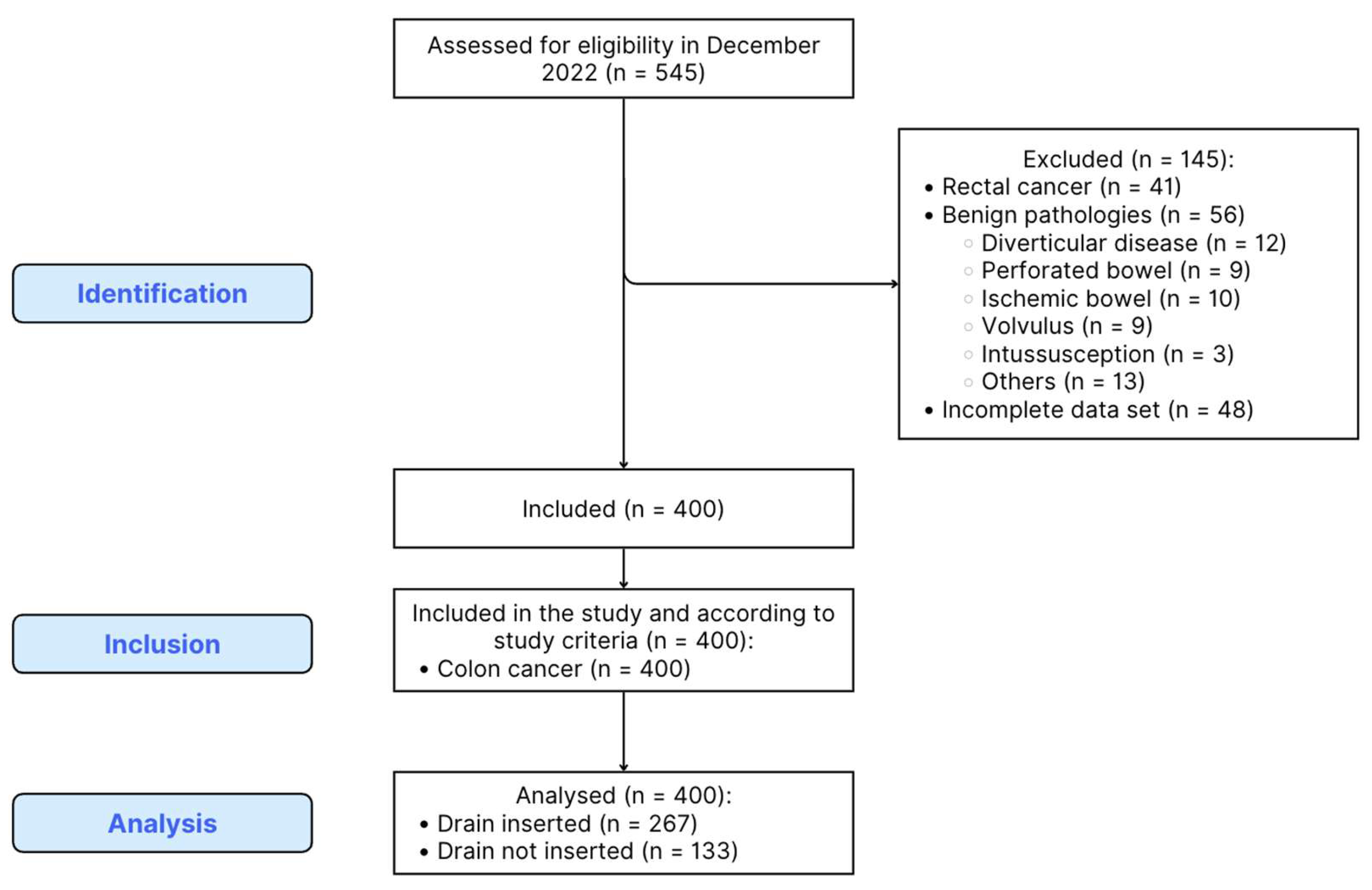
Among the entire data set of patients who underwent colectomy procedures within the study timeframe and were considered for inclusion, n = 41 had rectal cancer, n = 56 had benign pathologies, and n = 48 had an incomplete data set (Figure 1). Patients who were eventually included and analysed were divided into two groups: the first group included patients with surgical drains inserted intra-operatively or post-operatively (n = 267), while the other group included patients with no surgical drain inserted throughout their recovery process (n = 133). This retrospective observational cohort study is guided by the STROBE methodology, and the STROBE reporting checklist can be found in Table S1 [25].

2.2. Data Collection

The collected parameters included the patients’ baseline characteristics and pre-operative factors, such as their demographics, past medical history, use of antiplatelets or anticoagulants, ASA and ECOG score, TNM staging of the cancer, as well as whether neoadjuvant chemotherapy or radiotherapy was administered. In addition, intra-operative factors were also included, such as surgical urgency (elective or emergency), surgical approach (laparoscopic, open, robotic, or taTME), surgery duration, estimated blood loss, number of blood transfusions, as well as any response to the neoadjuvant chemoradiotherapy where applicable. Lastly, we measured various post-operative outcomes and complications, including days to drain removal, days of post-operative stay, days to mobilisation, Clavien–Dindo classification, as well as any occurrences of post-operative ileus, wound infection, anastomotic leak, anastomotic bleed, per-rectal bleed, acute myocardial infarcts, venous thromboembolic complications, re-operations within 30 days, re-admissions within 30 days, local recurrences, and mortality over the long-term. The primary outcome was taken to be overall post-operative morbidity as measured by Clavien–Dindo classification, while the secondary outcomes were taken to be all other post-operative outcomes.

2.3. Data Analysis

Statistical analysis was conducted via IBM SPSS (Version 26, SPSS Inc., Chicago, IL, USA). p values less than 0.05 were interpreted as statistically significant. Basic descriptive statistics were presented, with continuous variables displayed as either mean with standard deviation (SD) or median with inter-quartile range (IQR), while categorical variables were displayed as frequencies with percentages, split between the no drain (n = 133) and drain (n = 267) groups.
Firstly, independent samples analysis between both groups was conducted for all variables. Continuous variables were analysed for parametricity using the Shapiro–Wilk test for normality and Levene’s test for equality of variances, though the results of these tests were not reported. Variables meeting both the criteria were analysed by Student’s t test, while those which did not were analysed by the non-parametric Mann–Whitney U test. All ordinal categorical variables were analysed by Mann–Whitney U test as well, while all nominal categorical variables were analysed by Pearson’s Chi-Squared test. Baseline characteristics, pre- and intra-operative factors were compared using standardised mean differences (SMDs), with an absolute SMD < 0.10 considered indicative of negligible imbalance between groups.
Next, univariable and multivariable logistic regression were conducted on all the post-operative primary and secondary outcomes with drain insertion as the predictor, adjusting for baseline characteristics in the multivariable regression as covariates or confounders. These covariates include age, gender, BMI, ASA score, ECOG score, TNM stage, hypertension, hyperlipidemia, diabetes mellitus, ischaemic heart disease, stroke, smoking status, alcohol use, antiplatelet therapy, anticoagulant therapy, and neoadjuvant chemoradiotherapy. Intra-operative variables may also reflect operative complexity and surgeon decision-making; thus, they were intentionally not included to minimise over-adjustment so residual confounding by indication remains possible. Post-operative variables and complications were not considered predictors of drain placement as they occur after the exposure.
For continuous variables, generalised linear model (GLM) was used with Gamma distribution and log link function to more appropriately handle cells with small counts. The median and interquartile range (IQR) were reported, alongside the adjusted ratios of means (Exp(B)), 95% confidence interval (95% CI), and p values. For ordinal and nominal categorical variables, ordinal and nominal logistic regression was used respectively. The counts and percentage, odds ratio (OR), 95% CI, and p values were also reported. For the ordinal and nominal logistic regressions, the reference set was taken to be the smallest ordered category and the nil groups respectively.

3. Results

Of both the continuous variables analysed in Table 1, only age met the parametricity criteria and was analysed with Student’s t test, while BMI was analysed by the non-parametric Mann–Whitney U test. Drain insertion was not associated with any of the baseline characteristics in Table 1.
Among the pre-operative variables analysed in Table 2, patients with drain inserted were associated with only 2 variables, higher ASA score (SMD 0.04–0.23, p = 0.016) and administration of neoadjuvant chemoradiotherapy (SMD 0.51, p < 0.001).
For the intra-operative factors in Table 3, drain insertion was associated with 5 out of 6 analysed variables. Patients with drain inserted were associated with longer duration of operation (SMD 0.86, 285 ± 114 vs. 208 ± 54, p < 0.001), higher volume of estimated blood loss (SMD 0.47, 217 ± 408 vs. 78 ± 99, p < 0.001), neoadjuvant chemoradiotherapy (SMD 0.15–0.51, p = 0.001), surgical urgency (SMD 0.17–0.38, p < 0.001), and surgical approach (SMD 0.17–0.64, p < 0.001).
Among the post-operative outcomes and complications included in the analysis in Table 4, drain insertion was associated with 6 out of 16 of them. For the primary outcome, drain insertion was associated with higher Clavien–Dindo classification (p < 0.001). For the secondary outcomes, drain insertion was associated with longer duration of post-operative stay (7 (IQR: 5–11) vs. 4 (IQR: 3–6), p < 0.001), longer duration to mobilisation (2 (IQR: 1–2) vs. 1 (IQR: 1–2), p < 0.001), more blood transfused post-op (p = 0.013), post-operative ileus (p = 0.019), and re-operation within 30 days (p = 0.041). Days to drain removal was not analysed statistically as the analysis holds no value when compared against the no drain group.
Drain insertion was associated with 6 post-operative outcomes and complications included in Table 5 on multivariable regression analysis when adjusting for baseline characteristics. For the primary outcome, there was 5.05 times higher odds of attaining a higher Clavien–Dindo classification (p < 0.001, 95% CI: 2.70–10.22) than patients with no drain inserted, adjusting for baseline characteristics. For the secondary outcomes, patients with drain inserted had 106% longer post-operative stay (p < 0.001, 95% CI: 0.55–0.89), and 55% longer days to mobilisation (p < 0.001, 95% CI: 0.21–0.66) than patients with no drain inserted, adjusting for baseline characteristics. Patients with drain inserted had 2.20 times higher odds of post-operative ileus (p = 0.011, 95% CI: 1.19–4.05), 0.27 times lower odds of per-rectal bleed (p = 0.036, 95% CI: 0.08–0.92), and 5.17 times higher odds of re-operation within 30 days (p = 0.028, 95% CI: 1.19–22.41) than those with no drain inserted as well, adjusting for baseline characteristics. Multivariable regression analysis could not be performed on anastomotic leak, AMI, and venous thromboembolic complications as the small cell counts rendered the regression model unstable.

4. Discussion

Our study found that patients who received surgical drains were more likely to have a higher Clavien–Dindo classification, longer post-operative stay, delayed mobilisation, higher rates of post-operative ileus, and re-operation within 30 days compared with patients who did not receive drains on multivariable regression. However, these findings should be interpreted as associations within a retrospective observational cohort rather than evidence that drain placement itself causes these adverse outcomes.
These findings are broadly consistent with previous observational studies reporting poorer post-operative outcomes among patients receiving drains [15,17,26,27]. For instance, a large multicentre, multi-national study conducted by EuroSurg Collaborative on n = 1805 from 22 countries found that drain insertion was similarly associated with delayed hospital discharge (p < 0.001) and an increased risk of developing surgical site infections (p < 0.001) [26]. However, it is of note that our study did not find statistically significant association between drain insertion and surgical site infections, though this variable plays a small role in the Clavien–Dindo classification alongside various other variables. Many studies have also similarly reported comparable rates of anastomotic leakage, reintervention, wound infection, and mortality, such as the two meta-analyses conducted by Karliczek et al. and Zhang et al. [19,28].
Meanwhile, patients with drain inserted were more likely to have a longer duration of operation and higher volume of estimated blood loss. Drain insertion was also associated with administration of neoadjuvant chemoradiotherapy, surgical urgency, and surgical approach. When taken as a whole, our findings likely reflect selective drain placement in patients perceived by surgeons to have greater operative complexity or higher post-operative risk. This phenomenon, commonly referred to as confounding by indication, is inherent to retrospective observational studies evaluating discretionary surgical interventions. As evident in the study, the drain inserted group generally comprised more severe or high-risk patients than the no drain inserted group, which likely influenced the clinical team to lean towards leaving drains in situ as a prophylactic measure, or directly influenced the patient’s post-operative outcomes and likelihood of complications as confounding variables [4].
For example, patients who received drains generally had features suggestive of greater operative complexity, including higher ASA scores, longer operations, greater blood loss, more emergency procedures, and a higher proportion of open surgery. These characteristics likely influenced the surgeon’s decision to place a drain and are themselves recognised predictors of post-operative morbidity. Although multivariable adjustment was performed, residual confounding from unmeasured factors, including intra-operative judgement and technical complexity, are challenging to properly quantify or take into consideration and are likely to remain. Additionally, neoadjuvant chemoradiotherapy was more frequently observed among patients receiving drains, likely reflecting greater disease complexity and surgeon selection of higher-risk cases. Although neoadjuvant therapy has been associated with favourable post-operative outcomes in selected patient populations [29,30], the present study was not designed to evaluate its independent effects. Therefore, this finding should be interpreted as a marker of case complexity rather than evidence regarding the impact of neoadjuvant therapy itself.
Overall, our findings suggest that drain placement in routine practice reflects surgeon selection of patients perceived to have greater operative complexity or higher post-operative risk, consistent with confounding by indication [31]. Whether such selective drainage improves outcomes in these high-risk subgroups remains uncertain and warrants prospective evaluation.
Our study has several limitations. For starters, the data we collected stems from a single academic medical centre and database. Thus, the sample size is comparably limited. In addition, this study was done retrospectively. Hence, no active screening or investigations could be done to better evaluate for post-operative outcomes and complications. For instance, post-operative ileus that did not require medical intervention or ceased prematurely would likely have been overlooked. Additionally, this study was not able to obtain retrospective data on several factors surrounding intra-operative drain placement, such as drain type and drain location which were noteworthy variables analysed in past studies, limiting adjustment for confounding [32,33,34]. Moreover, selection bias was introduced as a considerable number of patients were excluded due to the incomplete data set.
Our data set also did not distinguish prophylactic intra-operative drain placement from post-operative therapeutic drain insertion, with the study reflecting overall drain utilisation rather than prophylactic drainage alone. Consequently, temporal relationships between certain peri-operative variables and drain placement cannot always be established with certainty. Another limitation is that elective and emergency colectomies were analysed together. Although surgical urgency was adjusted for in the multivariable analyses, these populations differ substantially in operative complexity, indications for drain placement, and baseline risk of post-operative complications. Thus, residual confounding by indication may remain, and the present findings should be interpreted as reflecting overall patterns of drain utilisation rather than the effect of prophylactic drainage within either operative setting.
Beyond the decision to place a drain, optimal post-operative drain management is also an important consideration. Previous studies have suggested that early removal of non-productive drains may reduce drain-related complications, including patient discomfort, impaired mobilisation, and local inflammatory complications, while maintaining patient safety [35,36]. Conversely, in carefully selected patients with low-output anastomotic leaks, a functioning drain may facilitate adequate source control and permit successful non-operative management, potentially avoiding re-operation and temporary stoma formation [37,38]. As our study did not collect detailed information regarding drain indication, output, or removal criteria, these important aspects could not be evaluated and warrant further prospective investigation.
The generalisability of the study is moderate. Since the study was conducted in a single tertiary academic centre, the findings are likely generalisable to similar tertiary colorectal units with comparable patient demographics, surgical expertise, and peri-operative care protocols. However, caution should be exercised when extrapolating these results to other populations, particularly in different geographic regions where patient profiles, disease burden, and healthcare resources may differ. In addition, surgical decision-making regarding drain insertion is influenced by institutional practices and individual surgeon preference, which may vary across centres. Finally, given the observational nature of this study and the potential for confounding by indication, the findings are most applicable in understanding real-world associations rather than establishing causal effects of drain use on post-operative outcomes.
Future studies should focus on identifying clinical scenarios in which surgeons continue to selectively use drains despite guideline recommendations, particularly emergency surgery and other high-risk settings where evidence remains comparatively limited. Subgroup analyses and sensitivity analyses can also be conducted on these populations. Prospective multicentre studies with detailed operative data, including drain indication, type, and timing of insertion, would help clarify whether specific patient subgroups derive benefit from selective drainage [39].

5. Conclusions

In conclusion, our study provides a contemporary description of real-world drain utilisation following colectomy for colon cancer. Patients receiving surgical drains in this retrospective cohort were more likely to represent complex operative cases and experience poorer post-operative outcomes than those managed without drains. These findings likely reflect selective drain placement in higher-risk patients rather than the independent effect of drainage itself. Future work could explore prospective studies evaluating selective drainage strategies in clearly defined high-risk patient populations.

Supplementary Materials

The following supporting information can be downloaded at: https://www.mdpi.com/article/10.3390/joma3020019/s1, Table S1: STROBE reporting checklist.

Author Contributions

Conceptualization, N.W.W. and C.S.C.; methodology, N.W.W. and C.S.C.; formal analysis, M.W.R.K.; investigation, M.W.R.K.; data curation, M.W.R.K.; writing—original draft preparation, M.W.R.K.; writing—review and editing, L.L.Y.T., N.W.W. and C.S.C.; supervision, L.L.Y.T., N.W.W. and C.S.C.; project administration, N.W.W. and C.S.C. All authors have read and agreed to the published version of the manuscript.

Funding

This research received no external funding.

Institutional Review Board Statement

The study was conducted in accordance with the Declaration of Helsinki, and approved by the by the National University Hospital Domain-Specific Review Board, with reference code NUH-DSRB-2020/00937.

Informed Consent Statement

Patient consent was waived during ethical approval as the study is a retrospective study on past electronic medical records.

Data Availability Statement

The data presented in this study are available on request from the corresponding authors due to ethical constraints surrounding the presence of patient-identifying information in the dataset which are highly confidential.

Acknowledgments

The authors thank Liang Shen for her kind assistance and advice with regard to the statistical techniques employed in this study.

Conflicts of Interest

The authors declare no conflicts of interest.

References

  1. Lennox, M.S. Prophylactic drainage of colonic anastomoses. Br. J. Surg. 1984, 71, 10–11. [Google Scholar] [CrossRef] [Scilit]
  2. Salib, M.; Salib, J.; Kondilis, E.; Music, A.; Phillips, M.; Phillips, M.D. Optimizing Surgical Drain Removal: A Narrative review of Timing, Criteria, and Evidence-Based Practices. Cureus 2025, 17, e94492. [Google Scholar] [CrossRef] [Scilit]
  3. Emile, S.H.; El-Hamed, T.M.A. Routine Drainage of Colorectal Anastomoses: An Evidence-Based Review of the Current Literature. Gastroenterol. Res. Pract. 2017, 2017, 6253898. [Google Scholar] [CrossRef] [Scilit]
  4. Rekavari, S.G.; Mahakalkar, C. Prophylactic intra-abdominal drains in major elective surgeries: A Comprehensive review. Cureus 2024, 16, e54056. [Google Scholar] [CrossRef] [Scilit]
  5. Peeters, K.C.M.J.; Tollenaar, R.A.E.M.; Marijnen, C.A.M.; Klein Kranenbarg, E.; Steup, W.H.; Wiggers, T.; Rutten, H.J.; Van de Velde, C.J.H. Risk factors for anastomotic failure after total mesorectal excision of rectal cancer. Br. J. Surg. 2004, 92, 211–216. [Google Scholar] [CrossRef] [Scilit]
  6. Qu, H.; Liu, Y.; Bi, D.S. Clinical risk factors for anastomotic leakage after laparoscopic anterior resection for rectal cancer: A systematic review and meta-analysis. Surg. Endosc. 2015, 29, 3608–3617. [Google Scholar] [CrossRef] [Scilit]
  7. Taflampas, P.; Christodoulakis, M.; Tsiftsis, D.D. Anastomotic leakage after low anterior resection for rectal cancer: Facts, obscurity, and fiction. Surg. Today 2009, 39, 183–188. [Google Scholar] [CrossRef] [Scilit]
  8. Tsujinaka, S.; Kawamura, Y.J.; Konishi, F.; Maeda, T.; Mizokami, K. Pelvic drainage for anterior resection revisited: Use of drains in anastomotic leaks. ANZ J. Surg. 2008, 78, 461–465. [Google Scholar] [CrossRef] [Scilit]
  9. Kawada, K.; Hasegawa, S.; Hida, K.; Hirai, K.; Okoshi, K.; Nomura, A.; Kawamura, J.; Nagayama, S.; Sakai, Y. Risk factors for anastomotic leakage after laparoscopic low anterior resection with DST anastomosis. Surg. Endosc. 2014, 28, 2988–2995. [Google Scholar] [CrossRef] [Scilit]
  10. Samaiya, A. To Drain or Not to Drain after Colorectal Cancer Surgery. Indian J. Surg. 2015, 77, 1363–1368. [Google Scholar] [CrossRef] [Scilit]
  11. Akiyoshi, T.; Ueno, M.; Fukunaga, Y.; Nagayama, S.; Fujimoto, Y.; Konishi, T.; Kuroyanagi, H.; Yamaguchi, T. Incidence of and risk factors for anastomotic leakage after laparoscopic anterior resection with intracorporeal rectal transection and double-stapling technique anastomosis for rectal cancer. Am. J. Surg. 2011, 202, 259–264. [Google Scholar] [CrossRef] [Scilit]
  12. Baig, M.K.; Zhao, R.H.; Batista, O.; Uriburu, J.; Singh, J.; Weiss, E.; Nogueras, J.; Wexner, S. Percutaneous postoperative intra-abdominal abscess drainage after elective colorectal surgery. Tech. Coloproctol. 2002, 6, 159–164. [Google Scholar] [CrossRef] [Scilit]
  13. Ishinuki, T.; Shinkawa, H.; Kouzu, K.; Shinji, S.; Goda, E.; Ohyanagi, T.; Kobayashi, M.; Kobayashi, M.; Suzuki, K.; Kitagawa, Y.; et al. Recent evidence for subcutaneous drains to prevent surgical site infections after abdominal surgery: A systematic review and meta-analysis. World J. Gastrointest. Surg. 2023, 15, 2879–2889. [Google Scholar] [CrossRef] [Scilit]
  14. Rondelli, F.; Bugiantella, W.; Vedovati, M.C.; Balzarotti, R.; Avenia, N.; Mariani, E.; Agnelli, G.; Becattini, C. To drain or not to drain extraperitoneal colorectal anastomosis? A systematic review and meta-analysis. Colorectal Dis. 2013, 16, O35–O42. [Google Scholar] [CrossRef] [Scilit]
  15. Urbach, D.R.; Kennedy, E.D.; Cohen, M.M. Colon and rectal anastomoses do not require routine drainage. Ann. Surg. 1999, 229, 174–180. [Google Scholar] [CrossRef] [Scilit]
  16. Tsujinaka, S.; Konishi, F. Drain vs No Drain After Colorectal Surgery. Indian J. Surg. Oncol. 2011, 2, 3–8. [Google Scholar] [CrossRef] [Scilit]
  17. Petrowsky, H.; Demartines, N.; Rousson, V.; Clavien, P.-A. Evidence-based value of prophylactic drainage in gastrointestinal surgery. Ann. Surg. 2004, 240, 1074–1085. [Google Scholar] [CrossRef] [Scilit]
  18. Mujagic, E.; Zeindler, J.; Coslovsky, M.; Hoffmann, H.; Soysal, S.D.; Mechera, R.; von Strauss, M.; Delko, T.; Saxer, F.; Glaab, R.; et al. The association of surgical drains with surgical site infections—A prospective observational study. Am. J. Surg. 2018, 217, 17–23. [Google Scholar] [CrossRef] [Scilit]
  19. Zhang, H.-Y.; Zhao, C.-L.; Xie, J.; Ye, Y.-W.; Sun, J.-F.; Ding, Z.-H.; Xu, H.-N.; Ding, L. To drain or not to drain in colorectal anastomosis: A meta-analysis. Int. J. Colorectal Dis. 2016, 31, 951–960. [Google Scholar] [CrossRef] [Scilit]
  20. Hoffmann, J.; Shokouh-Amiri, H.M.; Damm, P.; Jensen, R. A prospective, controlled study of prophylactic drainage after colonic anastomoses. Dis. Colon Rectum 1987, 30, 449–452. [Google Scholar] [CrossRef] [Scilit]
  21. Komuta, K.; Haraguchi, M.; Inoue, K.; Furui, J.; Kanematsu, T. Herniation of the Small Bowel through the Port Site following Removal of Drains during Laparoscopic Surgery. Dig. Surg. 2000, 17, 544–546. [Google Scholar] [CrossRef] [Scilit]
  22. Loh, A.; Jones, P.A. Evisceration and other complications of abdominal drains. Postgrad. Med. J. 1991, 67, 687–688. [Google Scholar] [CrossRef] [Scilit]
  23. Irani, J.L.; Hedrick, T.L.; Miller, T.E.; Lee, L.; Steinhagen, E.; Shogan, B.D.; Goldberg, J.E.; Feingold, D.L.; Lightner, A.L.; Paquette, I.M. Clinical Practice Guidelines for Enhanced Recovery After Colon and Rectal Surgery from the American Society of Colon and Rectal Surgeons and the Society of American Gastrointestinal and Endoscopic Surgeons. Dis. Colon Rectum 2023, 66, 15–40. [Google Scholar] [CrossRef] [Scilit]
  24. Dee, E.C.; Laversanne, M.; Bhoo-Pathy, N.; Ho, F.D.V.; Feliciano, E.J.G.; Eala, M.A.B.; Ting, F.I.L.; Ginsburg, O.; Moraes, F.Y.; Gyawali, B.; et al. Cancer incidence and mortality estimates in 2022 in southeast Asia: A comparative analysis. Lancet Oncol. 2025, 26, 516–528. [Google Scholar] [CrossRef] [Scilit]
  25. von Elm, E.; Altman, D.G.; Egger, M.; Pocock, S.J.; Gotzsche, P.C.; Vandenbroucke, J.P. Strengthening the reporting of observational studies in epidemiology (STROBE) statement: Guidelines for reporting observational studies. BMJ 2007, 335, 806–808. [Google Scholar] [CrossRef] [Scilit]
  26. EuroSurg Collaborative. Intraperitoneal drain placement and outcomes after elective colorectal surgery: International matched, prospective, cohort study. Br. J. Surg. 2022, 109, 520–529. [Google Scholar] [CrossRef] [Scilit]
  27. Groothoff, M.S.; Kelley, M.S.; de Simone, B.; Deeken, G.; Biffl, W.L. Prophylactic drain placement after emergency general surgery procedures? A scoping review of the literature challenging common practice. Am. J. Surg. 2025, 247, 116462. [Google Scholar] [CrossRef] [Scilit]
  28. Karliczek, A.; Jesus, E.C.; Matos, D.; Castro, A.A.; Atallah, A.N.; Wiggers, T. Drainage or nondrainage in elective colorectal anastomosis: A systematic review and meta-analysis. Colorectal Dis. 2006, 8, 259–265. [Google Scholar] [CrossRef] [Scilit]
  29. Liang, Z.; Li, Z.; Yang, Q.; Feng, J.; Xiang, D.; Lyu, H.; Mai, G.; Wang, W. The role of neoadjuvant chemotherapy in patients with locally advanced colon cancer: A systematic review and meta-analysis. Front. Oncol. 2022, 12, 1024345. [Google Scholar] [CrossRef] [Scilit]
  30. Zhang, J.; Deng, J.; Hu, J.; Zhong, Q.; Li, J.; Su, M.; Liu, W.; Lv, M.; Xu, T.; Lin, D.; et al. Safety and feasibility of neoadjuvant chemotherapy as a surgical bridge for acute left-sided malignant colorectal obstruction: A retrospective study. BMC Cancer 2022, 22, 806. [Google Scholar] [CrossRef] [Scilit]
  31. Meckler, A.; Künert, S.; Poggi, L.; Jeske, J.; Schipper, L.; Selvamoorthy, T.; Nensa, F.; Hosters, B.; Berger, M.F.; Siaj, R.; et al. Intelligent surgical drainage—Digitizing the analysis of drainage fluid in patients with surgical drains. PLoS ONE 2025, 20, e0325072. [Google Scholar] [CrossRef] [Scilit]
  32. Loon, M.M.; Mohamed, E.H.; Lima, S.R.O.S.; Hassan, B.D.; Abbas, T. Comparative effectiveness of surgical drainage techniques and postoperative interventions for reducing complications: A systematic review of randomized controlled trials. Cureus 2024, 16, e73364. [Google Scholar] [CrossRef] [Scilit]
  33. Meyerson, J.M. A brief history of two common surgical drains. Ann. Plast. Surg. 2016, 77, 4–5. [Google Scholar] [CrossRef] [Scilit]
  34. Durai, R.; Ng, P.C.H. Surgical vacuum drains: Types, uses, and complications. AORN J. 2010, 91, 266–274. [Google Scholar] [CrossRef] [Scilit]
  35. Allegranzi, B.; Zayed, B.; Bischoff, P.; Kubilay, N.Z.; de Jonge, S.; de Vries, F.; Gomes, S.M.; Gans, S.; Wallert, E.D.; Wu, X.; et al. WHO Guidelines Development Group. New WHO recommendations on intraoperative and postoperative measures for surgical site infection prevention: An evidence-based global perspective. Lancet Infect. Dis. 2016, 16, e288–e303. [Google Scholar] [CrossRef] [Scilit]
  36. ACOG. Committee Opinion No. 750: Perioperative Pathways: Enhanced Recovery After Surgery. Obstet. Gynecol. 2018, 132, e120–e130. [Google Scholar] [CrossRef] [Scilit]
  37. Challine, A.; Lefèvre, J.H.; Creavin, B.; Benoit, O.; Chafai, N.; Debove, C.; Voron, T.; Parc, Y. Can a Local Drainage Salvage a Failed Colorectal or Coloanal Anastomosis? A Prospective Cohort of 54 Patients. Dis. Colon Rectum 2020, 63, 93–100. [Google Scholar] [CrossRef] [Scilit]
  38. Walsh, R.; Murphy, E.; Ryan, É.J.; Cahill, R.A. Management of anastomotic leak after elective anterior resection for rectal cancer: A systematic review and pooled analysis. Colorectal Dis. 2025, 27, e70335. [Google Scholar] [CrossRef] [Scilit]
  39. Yoshimura, K.; Ohge, H.; Watadani, Y.; Uegami, S.; Nakashima, I.; Hirano, T.; Shimbara, K.; Doi, H.; Takahashi, S. Safety of early pelvic drain removal in colorectal surgery based on drainage quantity. BMC Surg. 2023, 23, 130. [Google Scholar] [CrossRef] [Scilit]
Figure 1. STROBE flow diagram.
Joma 03 00019 g001
Table 1. Descriptive statistics of baseline characteristics of patients.
CharacteristicsDrain Insertion, n (%)Standard Mean Differencep-Value
No (n = 133)Yes (n = 267)
Mean Age (in years) (SD)67.5 (9.8)68.3 (11.3)0.080.466 a
Mean BMI (SD)23.5 (4.2)24.1 (5.3)0.130.367 b
Gender
Male63 (47.4)136 (50.9)0.070.501 c
Female70 (52.6)131 (49.1)
Ethnicity
Chinese111 (83.5)212 (79.4)0.100.116 c
Malay6 (4.5)31 (11.6)0.26
Indian6 (4.5)8 (3.0)0.08
Others10 (7.5)16 (6.0)0.06
Smoking
Never115 (86.5)220 (82.4)0.110.583 c
Yes (Currently)10 (7.5)26 (9.7)0.08
Yes (Quit)8 (6.0)21 (7.9)0.07
Alcohol
Never125 (94.0)245 (91.8)0.090.886 c
Yes (Addiction)6 (4.5)16 (6.0)0.07
Yes (Social)1 (0.8)3 (1.1)0.04
Yes (Quit)1 (0.8)3 (1.1)0.04
Hypertension (HTN)
No60 (45.1)106 (39.7)0.110.301 c
Yes73 (54.9)161 (60.3)
Hyperlipidemia (HLD)
No63 (47.4)140 (52.4)0.100.340 c
Yes70 (52.6)127 (47.6)
Diabetes Mellitus (DM)
No99 (74.4)193 (72.3)0.050.648 c
Yes34 (25.6)74 (27.7)0.05
Acute Myocardial Infarct (AMI)/Ischemic Heart Disease (IHD)
No114 (85.7)221 (82.8)0.080.452 c
Yes19 (14.3)46 (17.2)0.08
Cerebrovascular Accident (CVA)/Transient Ischemic Attack (TIA)
No124 (93.2)251 (94.0)0.030.763 c
Yes9 (6.8)16 (6.0)0.03
Statistically significant (p < 0.05); a Student’s t test; b Mann–Whitney U test; c Chi-Squared test.
Table 2. Descriptive statistics of pre-operative factors.
CharacteristicsDrain Insertion, n (%)Standard Mean Differencep-Value
No (n = 133)Yes (n = 267)
ASA Score
15 (3.8)8 (3.0)0.040.016 *a
292 (69.2)155 (58.1)0.23
336 (27.1)98 (36.7)0.21
≥40 (0.0)6 (2.2)0.21
ECOG Score
089 (66.9)155 (58.1)0.180.140 a
127 (20.3)78 (29.2)0.21
215 (11.3)27 (10.1)0.04
≥32 (1.5)7 (2.6)0.08
Neoadjuvant Chemoradiotherapy
No131 (98.5)226 (84.6)0.51<0.001 *b
Yes2 (1.5)41 (15.4)
Antiplatelet Usage
No110 (82.7)214 (80.1)0.070.539 b
Yes23 (17.3)53 (19.9)
Anticoagulant Usage
No130 (97.7)250 (93.6)0.200.075 b
Yes3 (2.3)17 (6.4)
Final TNM Staging
07 (5.3)8 (3.0)0.110.839 a
116 (12.0)39 (14.6)0.08
241 (30.8)83 (31.1)0.01
356 (42.1)104 (39.0)0.06
413 (9.8)33 (12.4)0.08
* Statistically significant (p < 0.05); a Mann–Whitney U test; b Chi-Squared test.
Table 3. Descriptive statistics of intra-operative factors.
CharacteristicsDrain Insertion, n (%)Standard Mean Differencep-Value
No (n = 133)Yes (n = 267)
Mean Duration of Operation (in min) (SD)208 (54)285 (114)0.86<0.001 *a
Mean Estimated Blood Loss (in mL) (SD)78 (99)217 (408)0.47<0.001 *a
Blood Transfusion Intra-Operation (in units)
0130 (97.7)253 (94.8)0.160.163 b
≥13 (2.3)14 (5.2)
Response to Neoadjuvant Chemoradiotherapy
Not Applicable131 (98.5)226 (84.6)0.510.001 *b
Good0 (0.0)11 (4.1)0.29
Poor1 (0.8)10 (3.7)0.20
Partial1 (0.8)17 (6.4)0.31
Not Reported0 (0.0)3 (1.1)0.15
Surgery Urgency
Elective120 (90.2)205 (76.8)0.37<0.001 *b
Bleeding3 (2.3)1 (0.4)0.17
Perforation1 (0.8)23 (8.6)0.38
Obstruction9 (6.8)38 (14.2)0.25
Surgery Approach
Laparoscopic111 (83.5)148 (55.4)0.64<0.001 *b
Open22 (16.5)108 (40.4)0.55
Robotic0 (0.0)7 (2.6)0.23
TATME0 (0.0)4 (1.5)0.17
* Statistically significant (p < 0.05); a Mann–Whitney U test; b Chi-Squared test.
Table 4. Descriptive statistics of post-operative outcomes and complications.
CharacteristicsDrain Insertion, n (%)p-Value
No (n = 133)Yes (n = 267)
Median Days to Drain Removal (IQR)-5 (4–7)-
Median Days of Post-Op Stay (IQR)4 (3–6)7 (5–11)<0.001 *a
Median Days to Mobilisation (IQR)1 (1–2)2 (1–2)<0.001 *a
Blood Transfusion Post-Operation (in units)
0127 (95.5)234 (87.6)0.013 *b
≥16 (4.5)33 (12.4)
Post-Op Ileus
No117 (88.0)209 (78.3)0.019 *b
Yes16 (12.0)58 (21.7)
Wound Infection
No128 (96.2)245 (91.8)0.241 b
Superficial4 (3.0)17 (6.4)
Deep1 (0.8)5 (1.9)
Anastomotic Leak
No131 (98.5)253 (94.8)0.085 b
Radiological1 (0.8)1 (0.4)
Clinical1 (0.8)1 (0.4)
Both0 (0.0)12 (4.5)
Anastomotic Bleed
No127 (95.5)258 (96.6)0.572 b
Yes6 (4.5)9 (3.4)
Per-Rectal Bleed
No125 (94.0)260 (97.4)0.092 b
Yes8 (6.0)7 (2.6)
Acute Myocardial Infarct (AMI)
No133 (100.0)263 (98.5)0.156 b
Yes0 (0.0)4 (1.5)
Venous Thromboembolic Complications
No133 (100.0)263 (98.5)0.570 b
Deep Vein Thrombosis (DVT)0 (0.0)2 (0.7)
Pulmonary Embolism (PE)0 (0.0)1 (0.4)
Both0 (0.0)1 (0.4)
Re-Operation Within 30 Days
No131 (98.5)251 (94.0)0.041 *b
Yes2 (1.5)16 (6.0)
Re-Admission Within 30 Days
No124 (93.2)238 (89.1)0.188 b
Yes9 (6.8)29 (10.9)
Local Recurrence
No130 (97.7)260 (97.4)0.825 b
Yes3 (2.3)7 (2.6)
Mortality
No125 (94.0)240 (89.9)0.172 b
Yes8 (6.0)27 (10.1)
Clavien–Dindo Classification
0122 (91.7)174 (65.2)<0.001 *a
16 (4.5)58 (21.7)
21 (0.8)7 (2.6)
32 (1.5)16 (6.0)
40 (0.0)3 (1.1)
52 (1.5)9 (3.4)
* Statistically significant (p < 0.05); a Mann–Whitney U test; b Chi-Squared test.
Table 5. Univariable and multivariable logistic regression for post-operative outcomes and complications with statistically significant difference between drain vs. no drain groups on independent samples analysis.
Characteristics UnivariableMultivariable
Median (IQR)Exp(B)95% CIp-ValueExp(B)95% CIp-Value
Days of Post-Op Stay6 (4–9)2.070.55–0.90<0.001 *2.060.55–0.89<0.001 *
Days to Mobilisation1 (1–2)1.550.18–0.68<0.001 *1.550.21–0.66<0.001 *
Characteristics UnivariableMultivariable
n (%)OR95% CIp-ValueOR95% CIp-Value
Post-Op Ileus
No326 (81.5)ReferenceReference
Yes74 (18.5)2.151.18–3.890.012 *2.201.19–4.050.011 *
Wound Infection
No373 (93.3)ReferenceReference
Superficial21 (5.3)2.130.73–6.220.1682.190.71–6.710.170
Deep6 (1.5)2.470.31–19.370.3902.440.27–22.250.430
Anastomotic Leak
No384 (96.0)ReferenceReference
Radiological2 (0.5)0.510.03–8.240.639---
Clinical2 (0.5)0.510.03–8.240.639---
Both12 (3.0)14.711.24–174.010.033 *---
Anastomotic Bleed
No385 (96.3)ReferenceReference
Yes15 (3.8)0.730.26–2.090.5620.750.25–2.250.601
Per-Rectal Bleed
No385 (96.3)ReferenceReference
Yes15 (3.8)0.420.15–1.180.1000.270.08–0.920.036 *
Acute Myocardial Infarct (AMI)
No396 (99.0)ReferenceReference
Yes4 (1.0)12.500.30–517.580.184---
Venous Thromboembolic Complications
No396 (99.0)ReferenceReference
Deep Vein Thrombosis (DVT)2 (0.5)12.500.07–2188.300.338---
Pulmonary Embolism (PE)1 (0.3)12.500.01–17,289.640.494---
Both1 (0.3)12.500.01–17,289.640.494---
Re-Operation Within 30 Days
No382 (95.5)ReferenceReference
Yes18 (4.5)3.730.96–14.560.0585.171.19–22.410.028 *
Re-Admission Within 30 Days
No362 (90.5)ReferenceReference
Yes38 (9.5)1.630.76–3.500.2081.530.69–3.380.297
Local Recurrence
No390 (97.5)ReferenceReference
Yes10 (2.5)1.150.30–4.430.8401.140.26–4.940.865
Mortality
No365 (91.3)ReferenceReference
Yes35 (8.8)1.710.77–3.790.1901.310.54–3.140.551
Clavien–Dindo Classification
0296 (74.0)ReferenceReference
164 (16.0)5.593.05–11.10<0.001 *5.052.70–10.22<0.001 *
28 (2.0)
318 (4.5)
43 (0.8)
511 (2.8)
* Statistically significant (p < 0.05).
Disclaimer/Publisher’s Note: The statements, opinions and data contained in all publications are solely those of the individual author(s) and contributor(s) and not of MDPI and/or the editor(s). MDPI and/or the editor(s) disclaim responsibility for any injury to people or property resulting from any ideas, methods, instructions or products referred to in the content.