


Abstract
Atherosclerosis is a progressive cardiovascular disease characterized by lipid accumulation, oxidative stress, and inflammation within the arterial walls. Environmental pollutants, including particulate matter (PM), diesel exhaust particles (DEPs), and heavy metals, contribute directly to the initiation and progression of arterial plaques by promoting LDL oxidation, endothelial dysfunction, foam cell formation, and vascular inflammation, whilst high-density lipoprotein (HDL) provides protective effects. This review examines the mechanistic links between environmental exposures, lipid dysregulation, and plaque formation, highlighting how both gaseous and particulate pollutants and toxic and essential metals, as well as endocrine disrupting chemicals, influence atherosclerotic risk. Potential antioxidant and lifestyle interventions to mitigate these pollutant-driven effects are also discussed.
1. Introduction
Atherosclerosis is the leading cause of cardiovascular diseases (CVDs), including coronary artery disease, stroke, and peripheral arterial disease. It is a chronic condition characterized by lipid accumulation in the arterial walls, inflammation, and plaque formation. The condition arises due to a combination of genetic predisposition, metabolic disorders, and environmental influences.
Among the well-established risk factors, dyslipidaemia—specifically, elevated LDL cholesterol and low HDL cholesterol—is a primary contributor to atherosclerosis progression. LDL transports cholesterol to peripheral tissues, and its oxidation leads to inflammatory responses in the arterial wall. HDL, in contrast, facilitates reverse cholesterol transport, reducing plaque burden and exerting anti-inflammatory effects.
Beyond traditional risk factors, environmental exposures such as air pollution, heavy metals, and oxidative stress-inducing agents have been recognized as additional contributors to atherosclerosis. These pollutants generate reactive oxygen species (ROS), disrupt lipid metabolism, and accelerate vascular damage. Understanding how these environmental factors interact with lipid metabolism is crucial for developing strategies to mitigate their impact on cardiovascular health.
This review examines the role of LDL, HDL, and lipoproteins in atherosclerosis, how environmental pollutants exacerbate lipid oxidation and plaque formation, and potential interventions to mitigate environmental damage.
2. The Role of Lipids in Atherogenesis
2.1. Low-Density Lipoprotein (LDL), Apolipoprotein B (ApoB) and Atherosclerosis
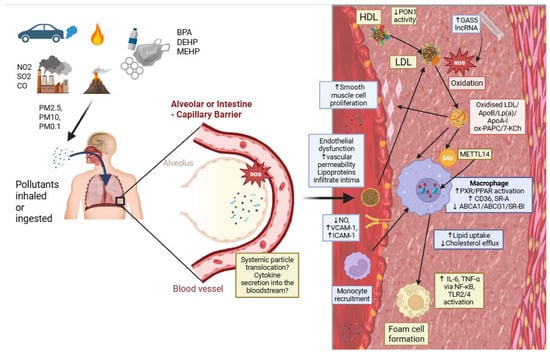
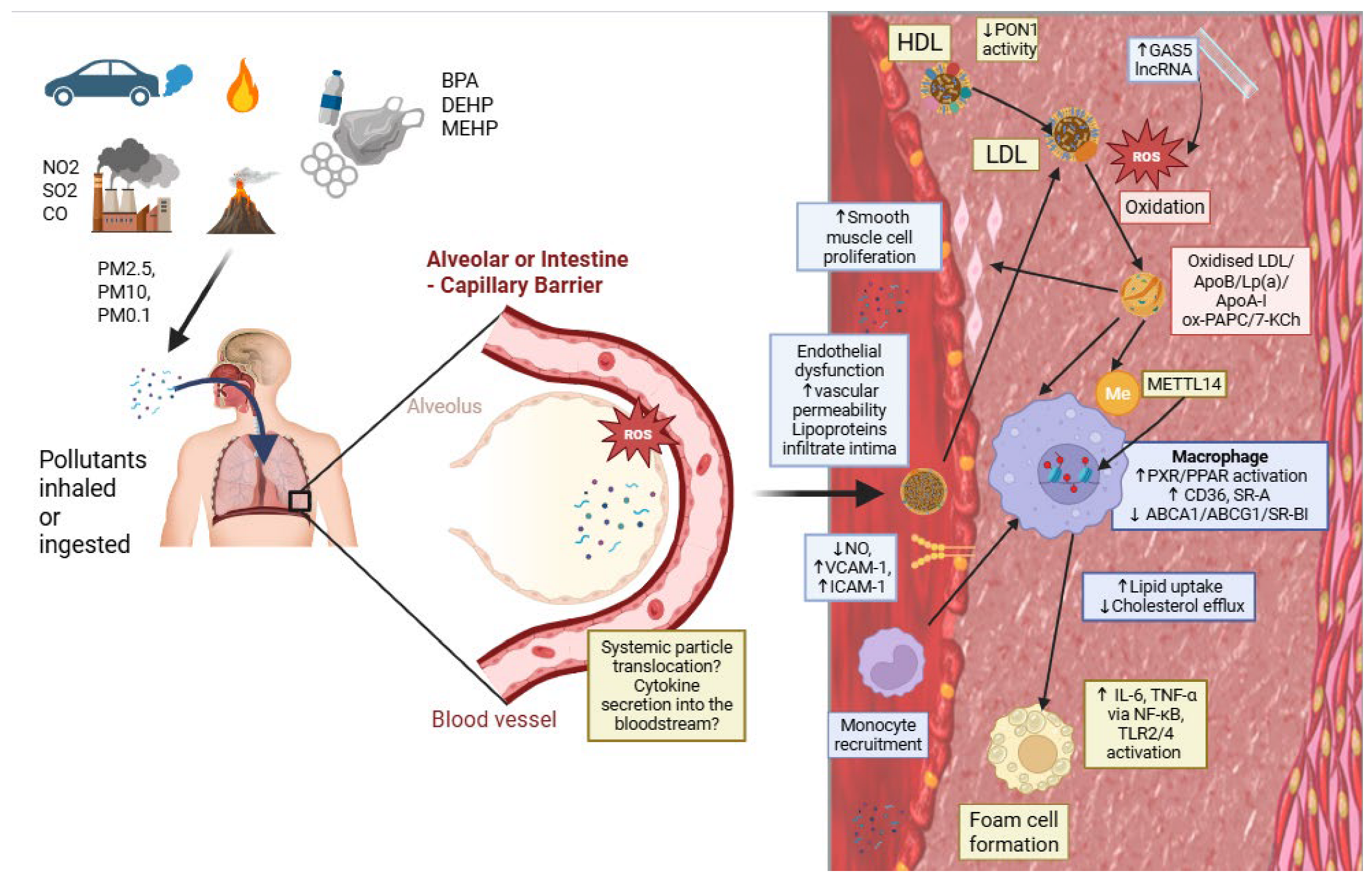
LDL plays a central role in atherosclerosis development. Hyperlipidaemia is a risk factor and high plasma LDL concentrations are required to initiate atherogenesis [1]. High levels of LDL tend to accumulate in vascular regions experiencing complex blood flow patterns such as curvatures where blood flow is slow, causing low shear stress, and branch points where turbulent blood flow causes oscillatory shear stress [2]. The tendency of blood to recirculate at low or oscillatory shear stress regions creates a stagnation point, increasing lipid retention. The resulting diffusion of fluid across the endothelium – or transmural water flux - leads to an accumulation of lipids on the luminal surface of the endothelium, referred to as an LDL concentration polarization layer. When LDL levels are elevated in circulation, they penetrate the endothelial layer and become trapped in the arterial intima (Figure 1) [3].
Figure 1.
Schematic of lipoprotein changes in the arterial intima following exposure to air pollutants, and the subsequent inflammation and foam cell macrophage formation that can increase atherosclerosis. Arrows denote direction of particle movement from inhalation to the artery wall. Created in BioRender. Seneviratne, A. (2026) https://BioRender.com/ty3vlot.
Lipoprotein lipase modifies LDL into smaller cholesterol ester-rich particles, which more readily infiltrate the arterial wall and adhere to proteoglycans [4]. This enhances LDL retention and contributes to plaque progression. Additionally, vascular regions with a high surface concentration of LDL exhibit increased intimal thickening [5], further predisposing these sites to atherosclerosis.
LDL retention is aided by ApoB, and the higher the number of ApoB-containing particles, the greater the LDL infiltration into the arterial wall, which correlates with cardiovascular risk [6]. Apolipoprotein B (ApoB) is a key marker of atherogenic potential. Each LDL particle contains one ApoB molecule, making ApoB levels a direct indicator of the number of atherogenic particles in circulation [7]. ApoB exists in two isoforms—ApoB-100 and ApoB-48. ApoB-100 is a 4536-amino-acid glycoprotein synthesized in the liver, essential for the assembly and secretion of very-low-density lipoprotein (VLDL) and LDL while ApoB-48 is a truncated molecule produced in the intestine via mRNA editing, critical for chylomicron formation [8]. ApoB mediates LDL binding to the LDL receptor (LDLR) for hepatic clearance [9]. Arterial proteoglycans such as biglycan and decorin bind ApoB via electrostatic interactions, trapping LDL in the intima [10]. The positively charged domains of ApoB-100 facilitate these interactions by binding to negatively charged glycosaminoglycans, promoting subendothelial LDL retention [11].
Elevated ApoB levels also indicate a predominance of small, dense LDL particles, which are more susceptible to oxidation and glycation, amplifying their atherogenicity and persistence in circulation [12]. Furthermore, remnant lipoproteins containing ApoB, such as intermediate-density lipoproteins (IDL) and VLDL remnants, contribute significantly to cholesterol deposition within macrophages even without prior oxidation, underscoring ApoB’s role not only as a structural component but also as an active driver of lipid accumulation and inflammation in the arterial wall [7].
Once LDL becomes trapped within the subendothelial space, it undergoes oxidative and enzymatic modifications, generating oxidized LDL (oxLDL), which is highly atherogenic. OxLDL promotes endothelial cell activation, leading to the expression of adhesion molecules such as VCAM-1 and ICAM-1, and the recruitment of circulating monocytes [13,14]. These monocytes differentiate into macrophages that engulf modified LDL via scavenger receptors (e.g., CD36, SR-A), forming lipid-laden foam cells, a hallmark of early fatty streak formation [15]. Moreover, oxLDL stimulates the release of pro-inflammatory cytokines (e.g., IL-1β, TNF-α) and reactive oxygen species [16].
In addition to oxidative modification, the aggregation and acetylation of LDL particles also enhance their atherogenic potential by reducing their affinity for LDL receptors and increasing their uptake by macrophages [17]. The imbalance between LDL influx, modification, and clearance drives a chronic inflammatory state, endothelial dysfunction, and smooth muscle cell migration, contributing to plaque progression and instability [18]. Therefore, LDL not only serves as a cholesterol transporter but also as a potent modulator of vascular inflammation and immune activation in atherosclerosis.
2.2. Lipoprotein(a) [Lp(a)] and Cardiovascular Risk
Lp(a) is a genetically determined lipoprotein structurally similar to LDL but distinguished by its additional apolipoprotein(a) (Apo(a)) component. Lp(a) is strongly associated with cardiovascular disease risk, independent of LDL levels, as it binds to extracellular matrix components and delivers oxidized phospholipids to plaques, exacerbating inflammation [19]. This affinity for extracellular matrix glycosaminoglycans enhances its retention within the arterial wall, similar to LDL but with greater pro-inflammatory potential due to its oxidized phospholipid content [20]. Moreover, the Apo(a) component interferes with fibrinolysis by competing with plasminogen binding sites, thereby promoting thrombosis and plaque stability disruption [21,22].
Lp(a) also consists of ApoB-100 in the core of the molecule alongside cholesterol and triglycerides. The Lp(a) tail consists of Apo(a), which is structurally similar to plasminogen as it contains loop-like structures called kringles [23]. These kringle IV type-2 repeats vary in number between individuals, explaining interindividual variation in plasma Lp(a) concentrations and cardiovascular risk [24]. Furthermore, the covalent disulfide bond linking Apo(a) to ApoB-100 confers additional atherogenicity by stabilizing the particle and increasing its resistance to hepatic clearance [21].
Lp(a) contributes to cholesterol accumulation in the intima as it carries a disproportionately high content of oxidized phospholipids [25]. These act as damage-associated molecular patterns (DAMPs), triggering inflammation via Toll-like receptors (TLR-2 and TLR-4) [26,27]. The engagement of these receptors activates NF-κB signaling, stimulating the release of pro-inflammatory cytokines such as IL-6 and TNF-α, which further recruit monocytes and enhance foam cell formation. Lp(a)-derived oxidized phospholipids also impair endothelial nitric oxide bioavailability, contributing to endothelial dysfunction and vascular stiffness. Statin therapy has limited efficacy in reducing Lp(a)-related plaques [24], highlighting the need for alternative interventions. Emerging therapeutic strategies, such as antisense oligonucleotides targeting Apo(a) mRNA, have shown promise in significantly lowering plasma Lp(a) concentrations and may represent the next generation of lipid-lowering therapy [28].
2.3. High-Density Lipoprotein (HDL) and Atheroprotection
HDL is considered a protective factor against atherosclerosis. HDL particles are very heterogeneous, consisting of various levels of cholesteryl esters and triglycerides in the core, and phospholipids, free cholesterol, and apolipoproteins at the surface. The primary structural apolipoprotein is ApoA-I which comprises 70–80% of the HDL particle. Other apolipoproteins include ApoA-II, ApoE and ApoC [29]. The lipid composition and apolipoprotein profile of HDL determine its functionality, including its capacity for cholesterol efflux, antioxidative activity, and anti-inflammatory potential [30]. Dysfunctional HDL, often observed in metabolic or inflammatory conditions, may lose these protective properties and even become pro-atherogenic [31].
HDL counteracts atherosclerosis by facilitating reverse cholesterol transport or cholesterol efflux—the process of removing cholesterol from macrophages and foam cells in plaques and delivering it to the liver for excretion. This is mediated by the ATP-binding cassette transporters A1 and G1 (ABCA1 and ABCG1) and scavenger receptor (SR-)BI [30]. The esterification of free cholesterol on HDL by lecithin-cholesterol acyltransferase (LCAT) creates a concentration gradient that promotes continued cholesterol efflux from cell membranes [32]. HDL particles are taken up by the liver via SR-BI or transferred to ApoB-containing lipoproteins by cholesteryl ester transfer protein (CETP) for hepatic clearance [33]. Impaired activity of LCAT or CETP imbalance can alter HDL particle size and functionality, thereby influencing its atheroprotective efficiency [34].
In addition to cholesterol clearance, HDL exerts anti-inflammatory effects by, for example, inhibiting inflammasome signaling in macrophages through activating transcription factor 3 (ATF3) [35]. In addition to cholesterol clearance, HDL exerts potent anti-inflammatory and antioxidative effects. HDL-associated enzymes such as paraoxonase-1 (PON1) and platelet-activating factor acetylhydrolase (PAF-AH) degrade oxidized lipids, preventing LDL oxidation and subsequent endothelial activation [36]. Furthermore, HDL stimulates endothelial nitric oxide synthase (eNOS) via the PI3K/Akt pathway, enhancing nitric oxide (NO) bioavailability and improving vascular tone and endothelial repair [37].
2.4. Oxidation of Lipids in Atherosclerosis
Oxidative stress plays a crucial role in the pathogenesis of atherosclerosis, where there is excessive production of reactive oxygen species (ROS). Key sources include NADPH oxidases and endothelial nitric oxide synthase (eNOS), which can produce types of ROS such as superoxides (O2−), hydrogen peroxide (H2O2), hydroxyl radicals (HO) and peroxynitrite (ONOO-) [38]. Mitochondrial dysfunction and xanthine oxidase activity also contribute to ROS generation within vascular cells, amplifying the local oxidative burden [39]. Excess ROS not only damages lipids but also oxidizes proteins and nucleic acids, thereby aggravating endothelial injury and vascular inflammation [40].
The oxidation of LDL by ROS is a critical step in atherogenesis. ROS target polyunsaturated fatty acids in LDL, initiating lipid peroxidation, which are broken down into reactive aldehydes that modify ApoB-100 [38]. The early stages of lipid oxidation that preserves ApoB-100 result in minimally modified LDL (mmLDL) that can still bind to the LDL receptor and activate endothelial cells. OxLDL forms following more advanced oxidation and significant modification of ApoB-100. These oxidative modifications generate epitopes recognized by scavenger receptors rather than the LDL receptor, leading to uncontrolled lipid uptake by macrophages [14]. OxLDL also stimulates the expression of adhesion molecules as mentioned earlier, and chemokines such as MCP-1, enhancing leukocyte recruitment to the endothelium [41]. OxLDL activates scavenger receptors (CD36, LOX-1, SR-A) on macrophages, driving foam cell formation and inflammatory cytokine release [1].
Lp(a) is also prone to oxidation, and when carrying oxidized phospholipids, is more readily taken up by macrophages and promotes foam cell formation [20]. The oxidized phospholipids on Lp(a) act as potent pro-inflammatory mediators, activating endothelial cells and vascular smooth muscle cells through Toll-like receptor signalling and NF-κB activation. This process enhances the release of interleukins (IL-1β and IL-6) and promotes further oxidative stress via a positive feedback loop.
Oxidised lipids lead to endothelial dysfunction, activation of inflammatory pathways, and proliferation of vascular smooth muscle cells (VSMCs) [42]. These oxidized products also impair nitric oxide (NO) bioavailability by reacting with eNOS-derived NO to form peroxynitrite, reducing vasodilation and contributing to vascular stiffness [43]. Moreover, lipid peroxidation by-products such as malondialdehyde (MDA) and 4-hydroxynonenal (4-HNE) form adducts with cellular proteins, altering their function and perpetuating chronic inflammation in the arterial wall [40].
HDL can also be oxidatively modified, impairing its atheroprotective functions (Figure 1). The oxidation of methionine and tryptophan residues in ApoA-I reduces HDL’s cholesterol efflux capacity. Oxidative stress can inactivate Paraoxonase 1, an HDL-associated enzyme that protects against LDL oxidation. Oxidized HDL becomes dysfunctional by losing its anti-inflammatory properties and may even become pro-inflammatory [29]. Such dysfunctional HDL not only fails to promote reverse cholesterol transport but may also deliver pro-oxidant lipids to macrophages, further enhancing foam cell formation [44].
Emerging evidence suggests that antioxidant defence systems, including superoxide dismutase (SOD), glutathione peroxidase (GPx), and catalase, are downregulated in advanced plaques, shifting the redox balance toward a pro-oxidative state [39]. Enhancing endogenous antioxidant pathways or targeting lipid oxidation intermediates has therefore become a promising therapeutic strategy to attenuate plaque progression and instability [45].
The generation of oxidative stress is a key mechanism by which harmful environmental exposures can exacerbate atherosclerosis. As discussed in the next section, harmful exposures have been linked to increased lipid oxidation and atherogenesis.
3. Environmental Exposures and Atherosclerosis
3.1. Air Pollution
Air pollution is air contaminated with chemicals or biological material. Most research has so far focused on outdoor or “ambient” pollution which can have many origins, including natural (e.g., wildfires and volcanic eruptions) and man-made sources (e.g., traffic emissions and fossil fuel combustion). Natural sources, such as wildfires, generate fine and ultrafine particles that can enter the circulation and trigger oxidative stress and inflammation, promoting early plaque formation [46]. Similarly, volcanic eruptions release particulate matter and gases like SO2 that can alter lipid metabolism and endothelial function [47]. Air pollutants are usually categorized into gases and particles. The main gases include nitrogen dioxide (NO2) or nitrogen oxides (NOx), sulphur dioxide (SO2), carbon monoxide (CO) and ozone (O3). Particles or particulate matter (PM) are broadly categorised by their size: PM10 (diameter less than 10 micrometres), PM2.5 (diameter less than 2.5 micrometres), and PM0.1 or ultrafine particles (UFPs; diameter of less than 100 nm, also called nanoparticles) [48].
Air pollution has emerged as a significant environmental risk factor for atherosclerosis. Man-made sources, such as traffic and industrial emissions, contribute PM and diesel exhaust particles that induce endothelial dysfunction, oxidative stress, and lipid oxidation, directly promoting atherogenesis [49]. Most studies have so far focused on PM; in particular, PM2.5 exposure is linked to increased oxidative stress, lipid peroxidation, systemic inflammation, and endothelial dysfunction, all of which contribute to the development and progression of atherosclerosis (Figure 1) [48]. However, some harmful effects have also been demonstrated with gaseous pollutants.
3.1.1. Gaseous Pollutants
Exposure to petrol emissions, which include PM, CO and NO2, increases the expression of heme oxygenase-1, nitrotyrosine and lipid peroxides in the arteries of ApoE−/− mice (Table 1). Similar changes occurred with the gaseous components only [50]. Exposure of ApoE−/− mice to diesel emissions, with PM filtered out, alters lipid peroxidation in the aorta [51]. Higher SO2 levels are linked with higher levels of triglycerides and with lower levels of HDL [52]. Increased NO2, SO2, and CO concentrations have also been linked to decreased HDL, apoA-I, and reduced cholesterol efflux capacity [53]. Long-term exposure to ozone was linked to increased triglycerides and LDL and decreased HDL [54]. Hence, exposure to NO2, SO2, and CO has been associated with endothelial activation, increased arterial stiffness, and systemic inflammation, which promote atherosclerotic plaque formation independently of particulate matter [55]. Research on the impact of gaseous pollutants on lipids and atherosclerosis is generally lacking due to the technical challenges of performing such studies.
Table 1.
Overview of the effects of gaseous pollutants on lipid metabolism and atherosclerosis.
3.1.2. Particulate Matter
Particulate matter exposure has been associated with changes in lipid profiles, including increased levels of LDL and triglycerides, and decreased levels of HDL [53]. These changes contribute to the development of dyslipidaemia, a key risk factor for atherosclerosis (Table 1). Its biological impact depends on how deeply it penetrates the body, surface area, and chemical reactivity within tissues [67]. To provide clarity, the following section groups PM-related effects according to particle type and summarizes key mechanisms influencing lipid metabolism, oxidative stress, and vascular pathology (Table 2).
Among PM fractions, PM2.5 is the most extensively studied and strongly associated with atherogenic lipid remodelling. Exposure to PM2.5 in particular has been shown to trigger systemic inflammation and oxidative stress [68]. PM2.5 contributes to oxidative stress by increasing the formation of ROS and reactive nitrogen species (RNS). Studies have demonstrated that rat aortic rings exposed to diesel exhaust particles (DEPs) generate oxygen-centred free radicals [69], all of which are capable of oxidizing lipids. These oxidative mechanisms represent early events that prime lipid modification and endothelial activation.
The ROS generated from complex particles like DEPs is due to the innate ability of these particles to generate free radicals as well as stimulate cellular enzymes to produce free radicals, such as NADPH oxidase [70]. The adsorbed organic compounds, such as polyaromatic hydrocarbons, quinones, and redox-active metals, found in DEP are believed to play a significant role in ROS generation [71], thus increasing the oxidation of LDL, leading to the formation of oxLDL. DEPs and oxidized 1-palmitoyl-2-arachidonyl-sn-glycero-3-phosphorylcholine (ox-PAPC) in combination induce inflammatory gene expression by human microvascular endothelial cells [72].
PM2.5 exposure can increase multiple circulating sphingolipids [73], which promote the production of pro-atherogenic Apolipoprotein B (ApoB)-containing lipoproteins [6], a marker of cardiovascular risk. Lipidomic analysis of the serum of ApoE−/− mice exposed to PM2.5 revealed increases in cholesterol ester, phosphatidylcholine, phosphatidylethanolamine and sphingomyelin while lysophosphatidylethanolamine, lysophosphatidylcholine, diacylglycerol and triacylglycerol decreased, suggesting glycerophospholipid, glycerolipid and sphingolipid metabolism is disrupted by PM2.5 [74].
PM2.5 exposure in cardiac patients increases LDL, triglycerides and total cholesterol [75]. PM2.5 enhances circulating fatty acids such as palmitate, palmitoleate, and myristate, while decreasing phospholipid species, possibly through the activation of lipolysis, dysregulation of hepatic lipid metabolism, and induction of mitochondrial dysfunction [76]. PM2.5 exposure increases LDL and oxLDL in the circulation and subsequent migration of monocytes to atherosclerotic plaques [76]. Epidemiological studies have shown that long-term exposure to fine and ultrafine PM correlates with increased carotid intima–media thickness and coronary artery calcification in adults, indicating accelerated plaque development [77,78]. PM2.5 can trigger the modification of cholesterol into 7-ketocholesterol (7-KCh), present on circulating LDL. This is in turn stimulates CD36 scavenger receptor expression on macrophages, leading to phagocytosis. 7-KCh is the most abundant modified sterol in atherosclerosis, promoting endothelial dysfunction and oxidative stress via the activation of NOX enzymes [76].
HDL cholesterol is protective against atherosclerosis by promoting reverse cholesterol transport from plaques to the liver [30]. However, ambient air pollution impairs HDL function by increasing HDL oxidation and reducing circulating apolipoprotein A-I (ApoA-I) [79], thereby diminishing cholesterol efflux via the ABCA1 pathway and promoting foam cell formation. Similarly, PM2.5 impairs the anti-inflammatory function of HDL, reducing its ability to counteract LDL-induced chemotaxis in macrophages [80]. A decrease in HDL with increasing exposure to multiple air pollutants in children in the US has been shown; however, this was not found in Italian or Chinese cohorts, which could be due to a different incidence of obesity between the cohorts [58].
In comparison, ultrafine particles (PM0.1) possess a greater capacity to penetrate vascular and cellular barriers due to their small size. Exposure of ApoE−/− mice to PM0.1 increases plasma cholesterol and plaque size in the aortic root [81]. PM0.1 exposure also leads to mitochondrial damage and apoptosis in macrophages, effects that are primarily linked to oxidative stress and inflammation rather than direct lipid level alterations [82].
Coarser particles (PM10), although less able to enter the circulation, induce systemic inflammation through pulmonary cytokine release, indirectly disturbing lipid metabolism [83]. Exposure to PM, particularly fine and ultrafine fractions, promotes lipid accumulation, mitochondrial damage in foam cell macrophages, and apoptosis within atherosclerotic plaques. These effects appear to be more closely associated with systemic oxidative stress and inflammation rather than isolated changes in plasma lipid profiles [50]. In vivo studies have shown that exposure of ApoE−/− or LDLR−/− mice to ambient PM2.5 enhances 7-KCh accumulation [30]. PM2.5-induced oxidative stress further increases mitochondrial damage in macrophages, promoting apoptosis [58]. The combined impact of oxLDL accumulation, impaired cholesterol efflux, and mitochondrial damage drives the formation of the thrombogenic necrotic core, contributing to plaque instability and acute cardiovascular events.
Collectively, these observations highlight that PM10, PM2.5, and PM0.1 exert differential but overlapping effects on lipid metabolism and vascular pathology. A summarized table of PM type, mechanistic pathways, and cardiovascular outcomes is presented below (Table 1).
Table 2.
Summary of particulate matter (PM) types, mechanistic effects on lipid metabolism, and cardiovascular impact.
3.2. Heavy Metals
Exposure to heavy metals, such as lead, cadmium, and mercury, has been associated with an increased risk of atherosclerosis and cardiovascular disease (Table 3). Lead exposure has been linked to the inactivation of paraoxonase activity, leading to reduced antioxidant effects of HDL [93] and an increase in pro-atherogenic ROS. Epidemiological studies have linked higher urinary levels of lead and cadmium with increased LDL cholesterol and carotid intima–media thickness (CIMT), indicating a direct association with subclinical arteriosclerosis [94]. Higher levels of lead and cadmium were also associated with increased triglycerides and decreased HDL levels [95]. The presence of heavy metals in the blood, including cadmium, copper, mercury, lead, manganese, molybdenum, nickel, selenium, and zinc, should be considered with caution, as essential elements such as selenium (Se) and zinc (Zn) have been reported in several studies to exert beneficial effects on lipid metabolism. For instance, adequate Se and Zn intake has been associated with decreased triglycerides, increased HDL, and improved ApoA1 levels, which may counteract atherosclerotic risk [96,97]. Thus, unlike toxic heavy metals such as cadmium, lead, and mercury, Se and Zn can contribute to the amelioration of lipid profiles when present at physiological levels. Serum cadmium levels are positively linked to increased levels of carotid artery atherosclerosis [98]. In Korea, blood cadmium, lead and mercury levels are associated with atherosclerotic cardiovascular disease risk [99]. Mercury worsens hypercholesterolemia and alters the immune cell profile in LDL receptor (LDLR) knockout mice [100]. However, exposing ApoE−/− mice to a combination of arsenic and cadmium is not significantly pro-atherogenic compared to either metal alone [101].
Table 3.
Overview of the effects of heavy metals on lipid metabolism and atherosclerosis.
Studies in this area are very much in their infancy but, as discussed, further investigation is required to understand the impact of heavy metals on lipid profiles, and therefore atherosclerotic risk particularly, as many of these heavy metals can be found on particles such as indoor dust, which is of increasing concern to health.
3.3. Endocrine Disrupting Chemicals
Endocrine Disrupting Chemicals (EDCs) were first defined by the Environmental Protection Agency, USA in the 1990s as “an exogenous agent that interferes with the synthesis, secretion, transport, binding, action, or elimination of natural hormones in the body that are responsible for the maintenance of homeostasis, reproduction, development, and/or behavior.” Common sources of EDCs include plastic packaging, electronics, pesticides and personal care products [115]. There is a large growing body of evidence that shows a link between EDCs and increased CVD risk, with several signalling mechanisms having been proposed to decipher this. Nuclear receptor activation, particularly the pregnane X receptor (PXR), PPAR-α and PPAR-γ are known to be activated by EDCs and have various effects on gene expression and the epigenome, affecting lipid metabolism, inflammation and vascular homeostasis [116,117].
Bisphenol A (BPA), commonly used in the production of synthetic polymers, is one of the most common EDCs to be detected in humans due to its widespread use. BPA was shown to increase the atherosclerotic lesion area in the aortic root of humanised PXR ApoE-deficient (huPXR∙ApoE−/−) mice with corresponding increased foam cell formation and CD36 expression on macrophages [118]. Further mechanistic studies showed that perinatal exposure to BPA significantly increased levels of H3K4me3 (activation mark), whilst levels of H3K27me3 (repression mark) decreased in the CD36 promoter, highlighting the PXR-dependent epigenetic regulation of CD36 expression [118].
Phthalates are a series of chemicals used in the plastic manufacturing process and solvents in consumer products such as cosmetics and toiletries. Several mechanisms have been proposed to highlight the development of atherosclerosis by phthalates. Di(2-ethylhexyl) phthalate (DEHP) is one of the most common phthalates found. One study found that ApoE−/− mice treated with DEHP for 4 weeks showed increased atherosclerotic lesion size, macrophage infiltration and a larger lipid core in the aortic root. Serum total cholesterol, non-HDL-c, HDL-c and triglycerides were also elevated. Additionally, DEHP was shown to promote malondialdehyde (MDA) oxidation of LDL [119]. Another study found DEHP promotes atherosclerosis by increasing ox-LDL uptake, leading to foam cell formation. Growth-Arrest Specific transcript 5 (GAS5), a long non-coding RNA (lncRNA), has its main functions involved in the regulation of gene expression, apoptosis and cell proliferation. Silencing of GAS5 was shown to reduce the effect of DEHP-promoted ox-LDL uptake and foam cell formation [120].
Mono-(2-ethylhexyl) Phthalate (MEHP), a bioactive metabolite of DEHP, was found to decrease the expression of SR-B1, a critical pathway for cholesterol efflux and foam cell formation; however, ABCA1 and ABCG1 remained unchanged. Additionally, MEHP decreased mRNA M6A methylation modification of SR-B1 and found that knockdown of Methyltransferase-like 14 (METTL14), a key component of the m6a methylated transferase complex, reduced SR-B1 gene expression, affecting cholesterol efflux capacity [121].
To date, there are limited proposed mechanisms to show the effects of EDCs in atherosclerosis. Only the most common EDCs have been tested. Further study is needed to determine whether the interplay of other mechanisms and pathways leads to atherosclerosis. There are also many other chemicals in the environment from human activity that still have not been identified or classified that need further investigation.
3.4. Mitigation Strategies for Pollution-Induced Atherosclerosis
Traditional pharmaceutical interventions for the prevention and treatment of cardiovascular disease include statins, PCSK-9 inhibitors and Ezetimibe to reduce LDL-C and ACE inhibitors to reduce blood pressure; however, in this section of the review, we will explore alternative approaches.
In a government and community context, more strategies, legislation and mandates should be introduced to ensure the reduction of pollutants in the environment. For example, in the UK, the Clean Air Strategy 2019 is a government plan aimed at improving air quality for human and environmental health by aiming to reduce pollution sourced from homes, transport, farming and industry through higher standards, cleaner technology and changes in law. It has been shown that since 2016, NO2 has fell by an average of approximately 35% and PM2.5 fell by 30% from 500 monitoring sites, indicating these strategies do have an effect; however, it is important to note that breaching of targets still regularly occurs [122].
Planting of trees has long been a strategy globally to reduce air pollution. Trees intercept and trap PM, where they eventually wash off by the rain, end up in the soil and are metabolized into less harmful substances by microbes. They can also absorb gaseous pollutants such as CO2, NOx, SO2 and O3 via leaf stomata, where they are metabolized into harmless by-products from the plant itself. Continuous planting of trees in a well-planned and effective manner should be encouraged, especially in high pollution areas [123]. In terms of indoor air pollution, HEPA filters and/or indoor plants should be used, as well as ensuring indoor spaces are well-ventilated to prevent the buildup of pollutants [124,125].
Nutritional intervention in the reduction and/or prevention of atherosclerosis has been extensively explored in the past. A randomized, double-blinded placebo-controlled trial involving 65 healthy college students in Shanghai, China showed the intervention group that received omega-3 fatty acid supplementation in the form of fish oil had beneficial effects when looking at biomarkers (particularly in relation to inflammation) implicated in CVD [126]. Pomegranate juice, a major source of polyphenols (punicalagin being the main one) was shown to reduce the pro-atherogenic effects of acrolein, an aldehyde by-product from the burning of organic materials in ApoE−/− mice. Additionally, acrolein induced a change in the gut microbiota composition, where certain types were found to positively correlate with atherosclerosis [127]. A prospective cohort study in the USA showed there was an association between fine particulate matter and NO2 exposure with cardiovascular disease. However, these associations were modified when Mediterranean diet index scores were incorporated into the models, where a higher score had significantly lower rates of cardiovascular disease mortality as a result of air pollution exposure [128].
4. Conclusions
Environmental pollutants, such as gases, particulate matter and heavy metals, significantly contribute to atherosclerosis by promoting LDL oxidation, endothelial dysfunction, and inflammation. However, studies in this field are lacking considerably, and significant effort is required to understand exactly how harmful pollutants affect lipid metabolism, how closely this is related to obesity, and the molecular and cellular mechanisms by which this may impact the development of atherosclerosis and the subsequent risk of cardiovascular disease.
This review is limited by the lack of mechanistic studies connecting the effects of pollution on lipids with the subsequent inflammatory mechanisms that can worsen atherosclerotic disease. Interactions between essential and toxic metals, as well as other environmental factors, are not fully understood. Additionally, epidemiological studies may be confounded by diet, lifestyle, and co-exposure to multiple pollutants. Future research which explores cellular mechanisms in further detail, uses more clinically relevant models to translate findings to human disease, and includes human exposure studies are needed to clarify causal relationships.
Author Contributions
Conceptualization, A.N.S.; writing—original draft preparation, M.V.C.-A. and A.N.S.; writing—review and editing, M.V.C.-A., N.N.D. and A.N.S. All authors have read and agreed to the published version of the manuscript.
Funding
This research received no external funding.
Data Availability Statement
No new data were created or analyzed for this review. Data sharing is not applicable to this article.
Conflicts of Interest
The authors declare no conflicts of interest. Funders had no role in the writing of the manuscript.
Abbreviations
The following abbreviations are used in this manuscript:
| ApoE−/− | apolipoprotein E knockout |
| CIMT | carotid intima–media thickness |
| CO | carbon monoxide |
| DEPs | diesel exhaust particles |
| HDL | High-density lipoprotein |
| LDL | Low-density lipoprotein |
| LDLR−/− | Low-density lipoprotein receptor knockout |
| NO2 | nitrogen dioxide |
| O3 | ozone |
| oxLDL | oxidised low-density lipoprotein |
| PM | particulate matter |
| PM10 | particulate matter with a diameter of less than 10 micrometres |
| PM2.5 | particulate matter with a diameter of less than 2.5 micrometres (“fine PM”) |
| PM0.1 | particulate matter with a diameter of less than 0.1 micrometres (“ultrafine PM” or “nanoparticles”) |
| ROS | reactive oxygen species |
| SO2 | sulphur dioxide |
References
- Glass, C.K.; Witztum, J.L. Atherosclerosis. the Road Ahead. Cell 2001, 104, 503–516. [Google Scholar] [CrossRef] [Scilit]
- Nakashima, Y.; Plump, A.S.; Raines, E.W.; Breslow, J.L.; Ross, R. ApoE-Deficient Mice Develop Lesions of All Phases of Atherosclerosis throughout the Arterial Tree. Arterioscler. Thromb. 1994, 14, 133–140. [Google Scholar] [CrossRef] [Scilit]
- Nielsen, L.B. Transfer of Low Density Lipoprotein into the Arterial Wall and Risk of Atherosclerosis. Atherosclerosis 1996, 123, 1–15. [Google Scholar] [CrossRef] [Scilit]
- Williams, K.J.; Tabas, I. The Response-to-Retention Hypothesis of Early Atherogenesis. Arterioscler. Thromb. Vasc. Biol. 1995, 15, 551–561. [Google Scholar] [CrossRef] [Scilit]
- Wada, S.; Koujiya, M.; Karino, T. Theoretical Study of the Effect of Local Flow Disturbances on the Concentration of Low-Density Lipoproteins at the Luminal Surface of End-to-End Anastomosed Vessels. Med. Biol. Eng. Comput. 2002, 40, 576–587. [Google Scholar] [CrossRef] [Scilit] [PubMed]
- Glavinovic, T.; Thanassoulis, G.; de Graaf, J.; Couture, P.; Hegele, R.A.; Sniderman, A.D. Physiological Bases for the Superiority of Apolipoprotein B Over Low-Density Lipoprotein Cholesterol and Non–High Density Lipoprotein Cholesterol as a Marker of Cardiovascular Risk. J. Am. Heart Assoc. 2022, 11, e025858. [Google Scholar] [CrossRef] [Scilit]
- Sniderman, A.D.; Thanassoulis, G.; Glavinovic, T.; Navar, A.M.; Pencina, M.; Catapano, A.; Ference, B.A. Apolipoprotein B Particles and Cardiovascular Disease: A Narrative Review. JAMA Cardiol. 2019, 4, 1287–1295. [Google Scholar] [CrossRef] [Scilit]
- Tiwari, S.; Siddiqi, S.A. Intracellular Trafficking and Secretion of VLDL. Arterioscler. Thromb. Vasc. Biol. 2012, 32, 1079–1086. [Google Scholar] [CrossRef] [Scilit] [PubMed]
- Véniant, M.M.; Zlot, C.H.; Walzem, R.L.; Pierotti, V.; Driscoll, R.; Dichek, D.; Herz, J.; Young, S.G. Lipoprotein Clearance Mechanisms in LDL Receptor-Deficient “Apo-B48-Only” and “Apo-B100-Only” Mice. J. Clin. Investig. 1998, 102, 1559. [Google Scholar] [CrossRef] [Scilit] [PubMed]
- Schönherr, E.; Zhao, B.; Hausser, H.; Müller, M.; Langer, C.; Wagner, W.D.; Goldberg, I.J.; Kresse, H. Lipoprotein Lipase-Mediated Interactions of Small Proteoglycans and Low-Density Lipoproteins. Eur. J. Cell Biol. 2000, 79, 689–696. [Google Scholar] [CrossRef] [Scilit]
- Skålén, K.; Gustafsson, M.; Knutsen Rydberg, E.; Hultén, L.M.; Wiklund, O.; Innerarity, T.L.; Boren, J. Subendothelial Retention of Atherogenic Lipoproteins in Early Atherosclerosis. Nature 2002, 417, 750–754. [Google Scholar] [CrossRef] [Scilit]
- Moore, K.J.; Sheedy, F.J.; Fisher, E.A. Macrophages in Atherosclerosis: A Dynamic Balance. Nat. Rev. Immunol. 2013, 13, 709–721. [Google Scholar] [CrossRef] [Scilit] [PubMed]
- Libby, P.; Buring, J.E.; Badimon, L.; Hansson, G.K.; Deanfield, J.; Bittencourt, M.S.; Tokgözoğlu, L.; Lewis, E.F. Atherosclerosis. Nat. Rev. Dis. Primers 2019, 5, 56. [Google Scholar] [CrossRef] [Scilit] [PubMed]
- Steinberg, D. The LDL Modification Hypothesis of Atherogenesis: An Update. J. Lipid Res. 2009, 50, S376–S381. [Google Scholar] [CrossRef] [Scilit] [PubMed]
- Moore, K.J.; Tabas, I. Macrophages in the Pathogenesis of Atherosclerosis. Cell 2011, 145, 341–355. [Google Scholar] [CrossRef] [Scilit]
- Hansson, G.K.; Hermansson, A. The Immune System in Atherosclerosis. Nat. Immunol. 2011, 12, 204–212. [Google Scholar] [CrossRef] [Scilit]
- Hevonoja, T.; Pentikäinen, M.O.; Hyvönen, M.T.; Kovanen, P.T.; Ala-Korpela, M. Structure of Low Density Lipoprotein (LDL) Particles: Basis for Understanding Molecular Changes in Modified LDL. Biochim. Biophys. Acta 2000, 1488, 189–210. [Google Scholar] [CrossRef] [Scilit]
- Tabas, I.; García-Cardeña, G.; Owens, G.K. Recent Insights into the Cellular Biology of Atherosclerosis. J. Cell Biol. 2015, 209, 13–22. [Google Scholar] [CrossRef] [Scilit]
- Reyes-Soffer, G.; Ginsberg, H.N.; Berglund, L.; Duell, P.B.; Heffron, S.P.; Kamstrup, P.R.; Lloyd-Jones, D.M.; Marcovina, S.M.; Yeang, C.; Koschinsky, M.L. Lipoprotein(a): A Genetically Determined, Causal, and Prevalent Risk Factor for Atherosclerotic Cardiovascular Disease: A Scientific Statement from the American Heart Association. Arterioscler. Thromb. Vasc. Biol. 2022, 42, E48–E60. [Google Scholar] [CrossRef] [Scilit]
- Van Der Valk, F.M.; Bekkering, S.; Kroon, J.; Yeang, C.; Van Den Bossche, J.; Van Buul, J.D.; Ravandi, A.; Nederveen, A.J.; Verberne, H.J.; Scipione, C.; et al. Oxidized Phospholipids on Lipoprotein(a) Elicit Arterial Wall Inflammation and an Inflammatory Monocyte Response in Humans. Circulation 2016, 134, 611. [Google Scholar] [CrossRef] [Scilit]
- Boffa, M.B.; Koschinsky, M.L. Lipoprotein (a): Truly a Direct Prothrombotic Factor in Cardiovascular Disease? J. Lipid Res. 2016, 57, 745–757. [Google Scholar] [CrossRef] [Scilit]
- Loscalzo, J.; Weinfeld, M.; Fless, G.M.; Scanu, A.M. Lipoprotein(a), Fibrin Binding, and Plasminogen Activation. Arterioscler. Thromb. Vasc. Biol. 1990, 10, 240–245. [Google Scholar] [CrossRef] [Scilit] [PubMed]
- Schmidt, K.; Noureen, A.; Kronenberg, F.; Utermann, G. Structure, Function, and Genetics of Lipoprotein (a). J. Lipid Res. 2016, 57, 1339–1359. [Google Scholar] [CrossRef] [Scilit] [PubMed]
- Tsimikas, S. A Test in Context: Lipoprotein(a): Diagnosis, Prognosis, Controversies, and Emerging Therapies. J. Am. Coll. Cardiol. 2017, 69, 692–711. [Google Scholar] [CrossRef] [Scilit]
- Qin, T.; Ma, T.Y.; Huang, K.; Lu, S.J.; Zhong, J.H.; Li, J.J. Lipoprotein (a)-Related Inflammatory Imbalance: A Novel Horizon for the Development of Atherosclerosis. Curr. Atheroscler. Rep. 2024, 26, 383–394. [Google Scholar] [CrossRef] [Scilit] [PubMed]
- Monaco, C.; Gregan, S.M.; Navin, T.J.; Foxwell, B.M.J.; Davies, A.H.; Feldmann, M. Toll-like Receptor-2 Mediates Inflammation and Matrix Degradation in Human Atherosclerosis. Circulation 2009, 120, 2462–2469. [Google Scholar] [CrossRef] [Scilit]
- Lundberg, A.M.; Ketelhuth, D.F.J.; Johansson, M.E.; Gerdes, N.; Liu, S.; Yamamoto, M.; Akira, S.; Hansson, G.K. Toll-like Receptor 3 and 4 Signalling through the TRIF and TRAM Adaptors in Haematopoietic Cells Promotes Atherosclerosis. Cardiovasc. Res. 2013, 99, 364–373. [Google Scholar] [CrossRef] [Scilit]
- Viney, N.J.; van Capelleveen, J.C.; Geary, R.S.; Xia, S.; Tami, J.A.; Yu, R.Z.; Marcovina, S.M.; Hughes, S.G.; Graham, M.J.; Crooke, R.M.; et al. Antisense Oligonucleotides Targeting Apolipoprotein(a) in People with Raised Lipoprotein(a): Two Randomised, Double-Blind, Placebo-Controlled, Dose-Ranging Trials. Lancet 2016, 388, 2239–2253. [Google Scholar] [CrossRef] [Scilit]
- von Eckardstein, A.; Nordestgaard, B.G.; Remaley, A.T.; Catapano, A.L. High-Density Lipoprotein Revisited: Biological Functions and Clinical Relevance. Eur. Heart J. 2022, 44, 1394. [Google Scholar] [CrossRef] [Scilit]
- Rosenson, R.S.; Brewer, H.B.; Davidson, W.S.; Fayad, Z.A.; Fuster, V.; Goldstein, J.; Hellerstein, M.; Jiang, X.C.; Phillips, M.C.; Rader, D.J.; et al. Cholesterol Efflux and Atheroprotection: Advancing the Concept of Reverse Cholesterol Transport. Circulation 2012, 125, 1905–1919. [Google Scholar] [CrossRef] [Scilit]
- Besler, C.; Lüscher, T.F.; Landmesser, U. Molecular Mechanisms of Vascular Effects of High-Density Lipoprotein: Alterations in Cardiovascular Disease. EMBO Mol. Med. 2012, 4, 251–268. [Google Scholar] [CrossRef] [Scilit] [PubMed]
- Norum, K.R.; Remaley, A.; Miettinen, H.E.; Strøm, E.H.; Balbo, B.E.P.; Sampaio, C.A.T.L.; Wiig, I.; Kuivenhoven, J.A.; Calabresi, L.; Tesmer, J.J.; et al. Lecithin:Cholesterol Acyltransferase: Symposium on 50 Years of Biomedical Research from Its Discovery to Latest Findings. J. Lipid Res. 2020, 61, 1142. [Google Scholar] [CrossRef] [Scilit]
- Collet, X.; Tall, A.R.; Serajuddin, H.; Guendouzi, K.; Royer, L.; Oliveira, H.; Barbaras, R.; Jiang, X.C.; Francone, O.L. Remodeling of HDL by CETP in Vivo and by CETP and Hepatic Lipase in Vitro Results in Enhanced Uptake of HDL CE by Cells Expressing Scavenger Receptor B-I. J. Lipid Res. 1999, 40, 1185–1193. [Google Scholar] [CrossRef] [Scilit] [PubMed]
- Rader, D.J.; Hovingh, G.K. HDL and Cardiovascular Disease. Lancet 2014, 384, 618–625. [Google Scholar] [CrossRef] [Scilit] [PubMed]
- De Nardo, D.; Labzin, L.I.; Kono, H.; Seki, R.; Schmidt, S.V.; Beyer, M.; Xu, D.; Zimmer, S.; Lahrmann, C.; Schildberg, F.A.; et al. High-Density Lipoprotein Mediates Anti-Inflammatory Reprogramming of Macrophages via the Transcriptional Regulator ATF3. Nat. Immunol. 2014, 15, 152–160. [Google Scholar] [CrossRef] [Scilit]
- Mackness, M.I.; Arrol, S.; Abbott, C.; Durrington, P.N. Protection of Low-Density Lipoprotein against Oxidative Modification by High-Density Lipoprotein Associated Paraoxonase. Atherosclerosis 1993, 104, 129–135. [Google Scholar] [CrossRef] [Scilit]
- Mineo, C.; Shaul, P.W. HDL Stimulation of Endothelial Nitric Oxide Synthase: A Novel Mechanism of HDL Action. Trends Cardiovasc. Med. 2003, 13, 226–231. [Google Scholar] [CrossRef] [Scilit]
- Batty, M.; Bennett, M.R.; Yu, E. The Role of Oxidative Stress in Atherosclerosis. Cells 2022, 11, 3843. [Google Scholar] [CrossRef] [Scilit]
- Madamanchi, N.R.; Vendrov, A.; Runge, M.S. Oxidative Stress and Vascular Disease. Arterioscler. Thromb. Vasc. Biol. 2005, 25, 29–38. [Google Scholar] [CrossRef] [Scilit]
- Madamanchi, N.R.; Runge, M.S. Mitochondrial Dysfunction in Atherosclerosis. Circ. Res. 2007, 100, 460–473. [Google Scholar] [CrossRef] [Scilit]
- Libby, P.; Ridker, P.M.; Hansson, G.K. Progress and Challenges in Translating the Biology of Atherosclerosis. Nature 2011, 473, 317–325. [Google Scholar] [CrossRef] [Scilit]
- Soehnlein, O.; Libby, P. Targeting Inflammation in Atherosclerosis—from Experimental Insights to the Clinic. Nat. Rev. Drug Discov. 2021, 20, 589–610. [Google Scholar] [CrossRef] [Scilit] [PubMed]
- Förstermann, U.; Münzel, T. Endothelial Nitric Oxide Synthase in Vascular Disease: From Marvel to Menace. Circulation 2006, 113, 1708–1714. [Google Scholar]
- Kontush, A.; Chapman, M.J. Functionally Defective High-Density Lipoprotein: A New Therapeutic Target at the Crossroads of Dyslipidemia, Inflammation, and Atherosclerosis. Pharmacol. Rev. 2006, 58, 342–374. [Google Scholar] [CrossRef] [Scilit]
- Stocker, R.; Keaney, J.F. Role of Oxidative Modifications in Atherosclerosis. Physiol. Rev. 2004, 84, 1381–1478. [Google Scholar] [CrossRef] [Scilit] [PubMed]
- Williams, V.A.; Perreault, L.R.; Yazbeck, C.T.; Micovic, N.A.; Oakes, J.M.; Bellini, C. Impact of Wildfires on Cardiovascular Health. Circ. Res. 2024, 134, 1061–1082. [Google Scholar] [CrossRef] [Scilit]
- Churilov, L.P.; Gurevich, V.S.; Sadovnikov, P.S.; Soprun, L.A.; Stroev, Y.I. Seasonality of Atherosclerotic Cardiovascular Disease: Role of Natural and Anthropogenic Factors. Adv. Biochem. Health Dis. 2024, 30, 95–132. [Google Scholar]
- Miller, M.R.; Newby, D.E. Air Pollution and Cardiovascular Disease: Car Sick. Cardiovasc. Res. 2019, 116, 279–294. [Google Scholar] [CrossRef] [Scilit]
- Campen, M.J.; Lund, A.; Rosenfeld, M. Mechanisms Linking Traffic-Related Air Pollution and Atherosclerosis. Curr. Opin. Pulm. Med. 2012, 18, 155–160. [Google Scholar] [CrossRef] [Scilit]
- Lund, A.K.; Knuckles, T.L.; Obot Akata, C.; Shohet, R.; McDonald, J.D.; Gigliotti, A.; Seagrave, J.C.; Campen, M.J. Gasoline Exhaust Emissions Induce Vascular Remodeling Pathways Involved in Atherosclerosis. Toxicol. Sci. 2007, 95, 485–494. [Google Scholar] [CrossRef] [Scilit]
- Campen, M.J.; Lund, A.K.; Knuckles, T.L.; Conklin, D.J.; Bishop, B.; Young, D.; Seilkop, S.; Seagrave, J.C.; Reed, M.D.; McDonald, J.D. Inhaled Diesel Emissions Alter Atherosclerotic Plaque Composition in ApoE−/− Mice. Toxicol. Appl. Pharmacol. 2010, 242, 310–317. [Google Scholar] [CrossRef] [Scilit]
- Zhang, Y.; Shi, J.; Ma, Y.; Yu, N.; Zheng, P.; Chen, Z.; Wang, T.; Jia, G. Association between Air Pollution and Lipid Profiles. Toxics 2023, 11, 894. [Google Scholar] [CrossRef] [Scilit] [PubMed]
- Zhang, K.; Wang, H.; He, W.; Chen, G.; Lu, P.; Xu, R.; Yu, P.; Ye, T.; Guo, S.; Li, S.; et al. The Association between Ambient Air Pollution and Blood Lipids: A Longitudinal Study in Shijiazhuang, China. Sci. Total Environ. 2021, 752, 141648. [Google Scholar] [CrossRef] [Scilit]
- Wang, L.; Chen, G.; Pan, Y.; Xia, J.; Chen, L.; Zhang, X.; Silang, Y.; Chen, J.; Xu, H.; Zeng, C.; et al. Association of Long-Term Exposure to Ambient Air Pollutants with Blood Lipids in Chinese Adults: The China Multi-Ethnic Cohort Study. Environ. Res. 2021, 197, 111174. [Google Scholar] [CrossRef] [Scilit]
- Song, X.; Liu, Y.; Hu, Y.; Zhao, X.; Tian, J.; Ding, G.; Wang, S. Short-Term Exposure to Air Pollution and Cardiac Arrhythmia: A Meta-Analysis and Systematic Review. Int. J. Environ. Res. Public Health 2016, 13, 642. [Google Scholar] [CrossRef] [Scilit]
- Lu, C.; Liu, Q.; Deng, M.; Liao, H.; Yang, X.; Ma, P. Interaction of High Temperature and NO2 Exposure on Asthma Risk: In Vivo Experimental Evidence of Inflammation and Oxidative Stress. Sci. Total Environ. 2023, 869, 161760. [Google Scholar] [CrossRef] [Scilit] [PubMed]
- Li, J.; Zhou, C.; Xu, H.; Brook, R.D.; Liu, S.; Yi, T.; Wang, Y.; Feng, B.; Zhao, M.; Wang, X.; et al. Ambient Air Pollution Is Associated with HDL (High-Density Lipoprotein) Dysfunction in Healthy Adults. Arterioscler. Thromb. Vasc. Biol. 2019, 39, 513–522. [Google Scholar] [CrossRef] [Scilit]
- Ossoli, A.; Cetti, F.; Gomaraschi, M. Air Pollution: Another Threat to HDL Function. Int. J. Mol. Sci. 2022, 24, 317. [Google Scholar] [CrossRef] [Scilit]
- Roy, A.; Saqib, U.; Wary, K.; Baig, M.S. Macrophage Neuronal Nitric Oxide Synthase (NOS1) Controls the Inflammatory Response and Foam Cell Formation in Atherosclerosis. Int. Immunopharmacol. 2020, 83, 106382. [Google Scholar] [CrossRef] [Scilit] [PubMed]
- Zhang, H.; Yang, J.; Zhang, Y.; Xiao, K.; Wang, Y.; Si, J.; Li, Y.; Sun, L.; Sun, J.; Yi, M.; et al. Age and Sex Differences in the Effects of Short- and Long-Term Exposure to Air Pollution on Endothelial Dysfunction. Environ. Health 2024, 23, 63. [Google Scholar] [CrossRef] [Scilit]
- Huang, Y.; Zhang, H.; Lv, B.; Tang, C.; Du, J.; Jin, H. Sulfur Dioxide: Endogenous Generation, Biological Effects, Detection, and Therapeutic Potential. Antioxid. Redox Signal. 2022, 36, 256–274. [Google Scholar] [CrossRef] [Scilit]
- Li, Y.; Han, Z.; Zhao, X.; Liu, Y.; Wu, Z.; Wang, J.; Li, X.; Guo, X.; Tao, L. Association between Joint Exposure to Ambient Air Pollutants and Carotid Plaque: The Mediating Role of Cardiometabolic Risk Factors. Ecotoxicol. Environ. Saf. 2025, 290, 117755. [Google Scholar] [CrossRef] [Scilit]
- Wentworth, P.; Nieva, J.; Takeuchi, C.; Galve, R.; Wentworth, A.D.; Dilley, R.B.; DeLaria, G.A.; Saven, A.; Babior, B.M.; Janda, K.D.; et al. Evidence for Ozone Formation in Human Atherosclerotic Arteries. Science 2003, 302, 1053–1056. [Google Scholar] [CrossRef] [Scilit]
- Zhang, W.; Gao, M.; Xiao, X.; Xu, S.L.; Lin, S.; Wu, Q.Z.; Chen, G.B.; Yang, B.Y.; Hu, L.W.; Zeng, X.W.; et al. Long-Term PM0.1 Exposure and Human Blood Lipid Metabolism: New Insight from the 33-Community Study in China. Environ. Pollut. 2022, 303, 119171. [Google Scholar] [CrossRef] [Scilit] [PubMed]
- Zhang, Y.; Xu, J.; Shi, J.; Ma, Y.; Yu, N.; Zhou, X.; Li, X.; Wang, T.; Jia, G.; Chen, Z. PM2.5 and O3 Co-Exposure Affecting Serum LDL-C: Evidence from Epidemiology and Animal Models. J. Environ. Expo. Assess. 2025, 4, 22. [Google Scholar] [CrossRef] [Scilit]
- Cole, M.P.; Freeman, B.A. Promotion of Cardiovascular Disease by Exposure to the Air Pollutant Ozone. Am. J. Physiol. Lung Cell. Mol. Physiol. 2009, 297, 205–208. [Google Scholar]
- Brook, R.D.; Rajagopalan, S.; Pope, C.A.; Brook, J.R.; Bhatnagar, A.; Diez-Roux, A.V.; Holguin, F.; Hong, Y.; Luepker, R.V.; Mittleman, M.A.; et al. Particulate Matter Air Pollution and Cardiovascular Disease: An Update to the Scientific Statement from the American Heart Association. Circulation 2010, 121, 2331–2378. [Google Scholar] [CrossRef] [Scilit]
- Kampfrath, T.; Maiseyeu, A.; Ying, Z.; Shah, Z.; Deiuliis, J.A.; Xu, X.; Kherada, N.; Brook, R.D.; Reddy, K.M.; Padture, N.P.; et al. Chronic Fine Particulate Matter Exposure Induces Systemic Vascular Dysfunction via NADPH Oxidase and TLR4 Pathways. Circ. Res. 2011, 108, 716–726. [Google Scholar] [CrossRef] [Scilit] [PubMed]
- Miller, M.R.; Borthwick, S.J.; Shaw, C.A.; McLean, S.G.; McClure, D.; Mills, N.L.; Duffin, R.; Donaldson, K.; Megson, I.L.; Hadoke, P.W.F.; et al. Direct Impairment of Vascular Function by Diesel Exhaust Particulate through Reduced Bioavailability of Endothelium-Derived Nitric Oxide Induced by Superoxide Free Radicals. Environ. Health Perspect. 2009, 117, 611–616. [Google Scholar] [CrossRef] [Scilit]
- Miller, M.R.; Shaw, C.A.; Langrish, J.P. From Particles to Patients: Oxidative Stress and the Cardiovascular Effects of Air Pollution. Future Cardiol. 2012, 8, 577–602. [Google Scholar]
- Romieu, I.; Castro-Giner, F.; Kunzli, N.; Sunyer, J. Air Pollution, Oxidative Stress and Dietary Supplementation: A Review. Eur. Respir. J. 2007, 31, 179–197. [Google Scholar] [CrossRef] [Scilit]
- Gong, K.W.; Zhao, W.; Li, N.; Barajas, B.; Kleinman, M.; Sioutas, C.; Horvath, S.; Lusis, A.J.; Nel, A.; Araujo, J.A. Air-Pollutant Chemicals and Oxidized Lipids Exhibit Genome-Wide Synergistic Effects on Endothelial Cells. Genome Biol. 2007, 8, R149. [Google Scholar] [PubMed]
- Xu, Y.; Han, Y.; Wang, Y.; Gong, J.; Li, H.; Wang, T.; Chen, X.; Chen, W.; Fan, Y.; Qiu, X.; et al. Ambient Air Pollution and Atherosclerosis: A Potential Mediating Role of Sphingolipids. Arterioscler. Thromb. Vasc. Biol. 2022, 42, 906–918. [Google Scholar] [CrossRef] [Scilit]
- Zhang, J.; Liang, S.; Ning, R.; Jiang, J.; Zhang, J.; Shen, H.; Chen, R.; Duan, J.; Sun, Z. PM2.5-Induced Inflammation and Lipidome Alteration Associated with the Development of Atherosclerosis Based on a Targeted Lipidomic Analysis. Environ. Int. 2020, 136, 105444. [Google Scholar] [CrossRef] [Scilit]
- McGuinn, L.A.; Schneider, A.; McGarrah, R.W.; Ward-Caviness, C.; Neas, L.M.; Di, Q.; Schwartz, J.; Hauser, E.R.; Kraus, W.E.; Cascio, W.E.; et al. Association of Long-Term PM2.5 Exposure with Traditional and Novel Lipid Measures Related to Cardiovascular Disease Risk. Environ. Int. 2019, 122, 193–200. [Google Scholar] [CrossRef] [Scilit]
- Montone, R.A.; Rinaldi, R.; Bonanni, A.; Severino, A.; Pedicino, D.; Crea, F.; Liuzzo, G. Impact of Air Pollution on Ischemic Heart Disease: Evidence, Mechanisms, Clinical Perspectives. Atherosclerosis 2023, 366, 22–31. [Google Scholar] [CrossRef] [Scilit] [PubMed]
- Kaufman, J.D.; Adar, S.D.; Barr, R.G.; Budoff, M.; Burke, G.L.; Curl, C.L.; Daviglus, M.L.; Roux, A.V.D.; Gassett, A.J.; Jacobs, D.R.; et al. Association between Air Pollution and Coronary Artery Calcification within Six Metropolitan Areas in the USA (the Multi-Ethnic Study of Atherosclerosis and Air Pollution): A Longitudinal Cohort Study. Lancet 2016, 388, 696–704. [Google Scholar] [CrossRef] [Scilit]
- Diez Roux, A.V.; Auchincloss, A.H.; Franklin, T.G.; Raghunathan, T.; Barr, R.G.; Kaufman, J.; Astor, B.; Keeler, J. Long-Term Exposure to Ambient Particulate Matter and Prevalence of Subclinical Atherosclerosis in the Multi-Ethnic Study of Atherosclerosis. Am. J. Epidemiol. 2008, 167, 667–675. [Google Scholar] [CrossRef] [Scilit] [PubMed]
- Bell, G.; Mora, S.; Greenland, P.; Tsai, M.; Gill, E.; Kaufman, J.D. Association of Air Pollution Exposures With High-Density Lipoprotein Cholesterol and Particle Number. Arterioscler. Thromb. Vasc. Biol. 2017, 37, 976–982. [Google Scholar] [CrossRef] [Scilit]
- Holme, S.A.N.; Sigsgaard, T.; Holme, J.A.; Holst, G.J. Effects of Particulate Matter on Atherosclerosis: A Link via High-Density Lipoprotein (HDL) Functionality? Part. Fibre Toxicol. 2020, 17, 36. [Google Scholar] [CrossRef] [Scilit]
- Møller, P.; Mikkelsen, L.; Vesterdal, L.K.; Folkmann, J.K.; Forchhammer, L.; Roursgaard, M.; Danielsen, P.H.; Loft, S. Hazard Identification of Particulate Matter on Vasomotor Dysfunction and Progression of Atherosclerosis. Crit. Rev. Toxicol. 2011, 41, 339–368. [Google Scholar] [CrossRef] [Scilit]
- Traboulsi, H.; Guerrina, N.; Iu, M.; Maysinger, D.; Ariya, P.; Baglole, C.J. Inhaled Pollutants: The Molecular Scene behind Respiratory and Systemic Diseases Associated with Ultrafine Particulate Matter. Int. J. Mol. Sci. 2017, 18, 243. [Google Scholar] [CrossRef] [Scilit]
- Van Eeden, S.F.; Hogg, J.C. Systemic Inflammatory Response Induced by Particulate Matter Air Pollution: The Importance of Bone-Marrow Stimulation. J. Toxicol. Environ. Health A 2002, 65, 1597–1613. [Google Scholar] [PubMed]
- Qian, T.; Guo, D.; Sun, L.; Chi, M.; Ma, X.; Jin, J. Crosstalk between Lipid Metabolism and Macrophages in Atherosclerosis: Therapeutic Potential of Natural Products. Front. Cardiovasc. Med. 2025, 12, 1529924. [Google Scholar] [CrossRef] [Scilit] [PubMed]
- Liu, J.; Liang, S.; Du, Z.; Zhang, J.; Sun, B.; Zhao, T.; Yang, X.; Shi, Y.; Duan, J.; Sun, Z. PM2.5 Aggravates the Lipid Accumulation, Mitochondrial Damage and Apoptosis in Macrophage Foam Cells. Environ. Pollut. 2019, 249, 482–490. [Google Scholar] [CrossRef] [Scilit] [PubMed]
- AL-Lami, N.J.K.; Awad, N.A.N.; Al-Taher, S.S.H. Clinical Study on the Relationship between Exposure to Ultrafine Particles (PM0.1) and Cardiovascular Diseases in Petroleum Workers. Toxicol. Rep. 2025, 15, 102119. [Google Scholar] [CrossRef] [Scilit]
- Luo, M.; Xie, X.; Wu, J.; Zhang, L.; Zheng, X.; Xie, M.; Lin, N.; Xiao, H.; Zeng, J.; Lan, G.; et al. Association of Ambient PM10 and PM2.5 with Coronary Stenosis Measured Using Selective Coronary Angiography. Ecotoxicol. Environ. Saf. 2023, 262, 115338. [Google Scholar] [CrossRef] [Scilit]
- Rizzo, A.M.; Corsetto, P.A.; Farina, F.; Montorfano, G.; Pani, G.; Battaglia, C.; Sancini, G.; Palestini, P. Repeated Intratracheal Instillation of PM10 Induces Lipid Reshaping in Lung Parenchyma and in Extra-Pulmonary Tissues. PLoS ONE 2014, 9, e106855. [Google Scholar]
- Park, S.; Nam, H.; Chung, N.; Park, J.D.; Lim, Y. The Role of Iron in Reactive Oxygen Species Generation from Diesel Exhaust Particles. Toxicol. In Vitro 2006, 20, 851–857. [Google Scholar] [CrossRef] [Scilit]
- Srivastava, A.; Sharma, A.; Yadav, S.; Flora, S.J.S.; Dwivedi, U.N.; Parmar, D. Gene Expression Profiling of Candidate Genes in Peripheral Blood Mononuclear Cells for Predicting Toxicity of Diesel Exhaust Particles. Free Radic. Biol. Med. 2014, 67, 188–194. [Google Scholar] [CrossRef] [Scilit]
- Quan, C.; Sun, Q.; Lippmann, M.; Chen, L.C. Comparative Effects of Inhaled Diesel Exhaust and Ambient Fine Particles on Inflammation, Atherosclerosis, and Vascular Dysfunction. Inhal. Toxicol. 2010, 22, 738. [Google Scholar] [CrossRef] [Scilit]
- Shaw, C.A.; Robertson, S.; Miller, M.R.; Duffin, R.; Tabor, C.M.; Donaldson, K.; Newby, D.E.; Hadoke, P.W.F. Diesel Exhaust Particulate--Exposed Macrophages Cause Marked Endothelial Cell Activation. Am. J. Respir. Cell Mol. Biol. 2011, 44, 840–851. [Google Scholar] [CrossRef] [Scilit]
- Solenkova, N.V.; Newman, J.D.; Berger, J.S.; Thurston, G.; Hochman, J.S.; Lamas, G.A. Metal Pollutants and Cardiovascular Disease: Mechanisms and Consequences of Exposure. Am. Heart J. 2014, 168, 812–822. [Google Scholar] [CrossRef] [Scilit] [PubMed]
- Lin, C.Y.; Hsu, S.H.J.; Chen, C.W.; Wang, C.; Sung, F.C.; Su, T.C. Association of Urinary Lead and Cadmium Levels, and Serum Lipids with Subclinical Arteriosclerosis: Evidence from Taiwan. Nutrients 2023, 15, 571. [Google Scholar] [CrossRef] [Scilit]
- Obeng-Gyasi, E.; Ford, Y.R. Combined Effects of Environmental Metals and Physiological Stress on Lipid Dysregulation. Med. Sci. 2024, 12, 51. [Google Scholar] [CrossRef] [Scilit]
- Ma, X.; Jiang, S.; Yan, S.; Li, M.; Wang, C.; Pan, Y.; Sun, C.; Jin, L.; Yao, Y.; Li, B. Association Between Copper, Zinc, Iron, and Selenium Intakes and TC/HDL-C Ratio in US Adults. Biol. Trace Elem. Res. 2019, 197, 43–51. [Google Scholar] [CrossRef] [Scilit]
- Tanita, A.; Namiuchi, S.; Onodera, K.; Sunamura, S.; Ogata, T.; Noda, K.; Takii, T. Serum Zinc Concentration in Patients with Myocardial Infarction: A Retrospective Study. BMC Cardiovasc. Disord. 2024, 24, 107. [Google Scholar] [CrossRef] [Scilit]
- Kim, K.; Kim, D.J.; Ha, K.H.; Kim, H.C. Relationship between Cadmium Exposure, Triglyceride-Glucose Index and Carotid Artery Atherosclerosis. ISEE Conf. Abstr. 2022, 2022, e215–e216. [Google Scholar]
- Choi, S.; Kwon, J.; Kwon, P.; Lee, C.; Jang, S.I. Association between Blood Heavy Metal Levels and Predicted 10-Year Risk for A First Atherosclerosis Cardiovascular Disease in the General Korean Population. Int. J. Environ. Res. Public Health 2020, 17, 2134. [Google Scholar] [CrossRef] [Scilit] [PubMed]
- Queiroz, M.I.C.; Lazaro, C.M.; dos Santos, L.M.B.; Rentz, T.; Virgilio-da-Silva, J.V.; Moraes-Vieira, P.M.M.; Cunha, F.A.S.; Santos, J.C.C.; Vercesi, A.E.; Leite, A.C.R.; et al. In Vivo Chronic Exposure to Inorganic Mercury Worsens Hypercholesterolemia, Oxidative Stress and Atherosclerosis in the LDL Receptor Knockout Mice. Ecotoxicol. Environ. Saf. 2024, 275, 116254. [Google Scholar] [CrossRef] [Scilit] [PubMed]
- Subramaniam, N.K.; Gagnon, N.; Makhani, K.; Kukolj, N.; Mouradian, M.H.; Giles, B.H.; Srikannan, H.; Fruh, V.; Meliker, J.; Wellenius, G.A.; et al. In Vitro and in Vivo Approaches to Assess Atherosclerosis Following Exposure to Low-Dose Mixtures of Arsenic and Cadmium. Toxicol. Appl. Pharmacol. 2023, 481, 116763. [Google Scholar] [CrossRef] [Scilit]
- Li, W.-F.; Pan, M.-H.; Chung, M.-C.; Ho, C.-K.; Chuang, H.-Y. Lead Exposure Is Associated with Decreased Serum Paraoxonase 1 (PON1) Activity and Genotypes. Environ. Health Perspect. 2006, 114, 1233. [Google Scholar] [CrossRef] [Scilit]
- Jomova, K.; Alomar, S.Y.; Nepovimova, E.; Kuca, K.; Valko, M. Heavy Metals: Toxicity and Human Health Effects. Arch. Toxicol. 2024, 99, 153–209. [Google Scholar] [CrossRef] [Scilit]
- Kristal-Boneh, E.; Coller, D.; Froom, P.; Harari, G.; Ribak, J. The Association between Occupational Lead Exposure and Serum Cholesterol and Lipoprotein Levels. Am. J. Public Health 1999, 89, 1083. [Google Scholar] [CrossRef] [Scilit] [PubMed]
- Wan, Y.; Mo, L.; Huang, H.; Mo, L.; Zhu, W.; Li, W.; Yang, G.; Chen, L.; Wu, Y.; Song, J.; et al. Cadmium Contributes to Atherosclerosis by Affecting Macrophage Polarization. Food Chem. Toxicol. 2023, 173, 113603. [Google Scholar] [CrossRef] [Scilit]
- Zhuang, Y.; Wang, Y.; Sun, P.; Ke, J.; Chen, F. Association between Blood Lead, Cadmium, Selenium Levels and Hyperlipidemia: A Population-Based Study. PLoS ONE 2024, 19, e0306573. [Google Scholar] [CrossRef] [Scilit]
- Zhou, Y.; Addai, F.P.; Zhang, X.; Liu, Y.; Wang, Y.; Lin, F.; Tuffour, A.; Gu, J.; Liu, G.; Shi, H. Heavy Metal-Induced Lipogenic Gene Aberration, Lipid Dysregulation and Obesogenic Effect: A Review. Environ. Chem. Lett. 2022, 20, 1611–1643. [Google Scholar] [CrossRef] [Scilit]
- Farzan, S.F.; Eunus, H.M.; Haque, S.E.; Sarwar, G.; Hasan, A.R.; Wu, F.; Islam, T.; Ahmed, A.; Shahriar, M.; Jasmine, F.; et al. Arsenic Exposure from Drinking Water and Endothelial Dysfunction in Bangladeshi Adolescents. Environ. Res. 2022, 208, 112697. [Google Scholar] [CrossRef] [Scilit] [PubMed]
- Sagha, A.; Shiri, H.; Juybari, K.B.; Mehrabani, M.; Nasri, H.R.; Nematollahi, M.H. The Association Between Arsenic Levels and Oxidative Stress in Myocardial Infarction: A Case–Control Study. Cardiovasc. Toxicol. 2023, 23, 61–73. [Google Scholar] [CrossRef] [Scilit] [PubMed]
- Cheng, Y.; Zhao, Y.; Chen, C.; Zhang, F. Heavy Metals Toxicity: Mechanism, Health Effects, and Therapeutic Interventions. MedComm 2025, 6, e70241. [Google Scholar] [CrossRef] [Scilit]
- Okechukwu Ohiagu, F.; Chikezie, P.C.; Ahaneku, C.C.; Chikezie, C.M. Human Exposure to Heavy Metals: Toxicity Mechanisms and Health Implications. Material Sci. Eng. 2022, 6, 78–87. [Google Scholar]
- Li, C.-P.; Song, Y.-X.; Lin, Z.-J.; Ma, M.-L.; He, L.-P. Essential Trace Elements in Patients with Dyslipidemia: A-Analysis. Curr. Med. Chem. 2023, 31, 3604–3623. [Google Scholar]
- Renu, K.; Mukherjee, A.G.; Wanjari, U.R.; Vinayagam, S.; Veeraraghavan, V.P.; Vellingiri, B.; George, A.; Lagoa, R.; Sattu, K.; Dey, A.; et al. Misuse of Cardiac Lipid upon Exposure to Toxic Trace Elements—A Focused Review. Molecules 2022, 27, 5657. [Google Scholar] [CrossRef] [Scilit]
- Vera, E.; Vallvé, J.C.; Linares, V.; Paredes, S.; Ibarretxe, D.; Bellés, M. Serum Levels of Trace Elements (Magnesium, Iron, Zinc, Selenium, and Strontium) Are Differentially Associated with Surrogate Markers of Cardiovascular Disease Risk in Patients with Rheumatoid Arthritis. Biol. Trace Elem. Res. 2024, 203, 3570–3584. [Google Scholar]
- Kavlock, R.J.; Daston, G.P.; DeRosa, C.; Fenner-Crisp, P.; Gray, L.E.; Kaattari, S.; Lucier, G.; Luster, M.; Mac, M.J.; Maczka, C.; et al. Research Needs for the Risk Assessment of Health and Environmental Effects of Endocrine Disrupters: A Report of the U.S. EPA-Sponsored Workshop. Environ. Health Perspect. 1996, 104, 715–740. [Google Scholar]
- Helsley, R.N.; Zhou, C. Epigenetic Impact of Endocrine Disrupting Chemicals on Lipid Homeostasis and Atherosclerosis: A Pregnane X Receptor-Centric View. Environ. Epigenet. 2017, 3, dvx017. [Google Scholar]
- Lin, T.-A.; Zhou, C. Epigenetic Impact of Endocrine-Disrupting Chemicals on Atherosclerosis. Essays Biochem. 2025, 69, 211–228. [Google Scholar] [CrossRef] [Scilit] [PubMed]
- Sui, Y.; Park, S.H.; Helsley, R.N.; Sunkara, M.; Gonzalez, F.J.; Morris, A.J.; Zhou, C. Bisphenol A Increases Atherosclerosis in Pregnane X Receptor-Humanized ApoE Deficient Mice. J. Am. Heart Assoc. 2014, 3, e000492. [Google Scholar] [CrossRef] [Scilit] [PubMed]
- Zhao, J.F.; Hsiao, S.H.; Hsu, M.H.; Pao, K.C.; Kou, Y.R.; Shyue, S.K.; Lee, T.S. Di-(2-Ethylhexyl) Phthalate Accelerates Atherosclerosis in Apolipoprotein E-Deficient Mice. Arch. Toxicol. 2014, 90, 181–190. [Google Scholar] [CrossRef] [Scilit] [PubMed]
- Shen, S.; Zheng, X.; Zhu, Z.; Zhao, S.; Zhou, Q.; Song, Z.; Wang, G.; Wang, Z. Silencing of GAS5 Represses the Malignant Progression of Atherosclerosis through Upregulation of MiR-135a. Biomed. Pharmacother. 2019, 118, 109302. [Google Scholar] [CrossRef] [Scilit]
- Park, M.H.; Jeong, E.; Choudhury, M. Mono-(2-Ethylhexyl)Phthalate Regulates Cholesterol Efflux via MicroRNAs Regulated M6A RNA Methylation. Chem. Res. Toxicol. 2019, 33, 461–469. [Google Scholar] [CrossRef] [Scilit] [PubMed]
- Weber, J.; Dacre, H.F. UK Air Quality Showed Clear Improvement from 2015 to 2024 but Breaching of Targets Remains Very Common. Environ. Sci. Atmos. 2025, 5, 987–997. [Google Scholar] [CrossRef] [Scilit]
- Nowak, D.J.; Hirabayashi, S.; Bodine, A.; Greenfield, E. Tree and Forest Effects on Air Quality and Human Health in the United States. Environ. Pollut. 2014, 193, 119–129. [Google Scholar] [CrossRef] [Scilit]
- Kajbafzadeh, M.; Brauer, M.; Karlen, B.; Carlsten, C.; Van Eeden, S.; Allen, R.W. The Impacts of Traffic-Related and Woodsmoke Particulate Matter on Measures of Cardiovascular Health: A HEPA Filter Intervention Study. Occup. Environ. Med. 2015, 72, 394–400. [Google Scholar] [CrossRef] [Scilit]
- Kumar, R.; Verma, V.; Thakur, M.; Singh, G.; Bhargava, B. A Systematic Review on Mitigation of Common Indoor Air Pollutants Using Plant-Based Methods: A Phytoremediation Approach. Air Qual. Atmos. Health 2023, 16, 1501–1527. [Google Scholar] [CrossRef] [Scilit]
- Lin, Z.; Chen, R.; Jiang, Y.; Xia, Y.; Niu, Y.; Wang, C.; Liu, C.; Chen, C.; Ge, Y.; Wang, W.; et al. Cardiovascular Benefits of Fish-Oil Supplementation Against Fine Particulate Air Pollution in China. J. Am. Coll. Cardiol. 2019, 73, 2076–2085. [Google Scholar] [CrossRef] [Scilit] [PubMed]
- Rom, O.; Korach-Rechtman, H.; Hayek, T.; Danin-Poleg, Y.; Bar, H.; Kashi, Y.; Aviram, M. Acrolein Increases Macrophage Atherogenicity in Association with Gut Microbiota Remodeling in Atherosclerotic Mice: Protective Role for the Polyphenol-Rich Pomegranate Juice. Arch. Toxicol. 2017, 91, 1709–1725. [Google Scholar] [CrossRef] [Scilit]
- Lim, C.C.; Hayes, R.B.; Ahn, J.; Shao, Y.; Silverman, D.T.; Jones, R.R.; Thurston, G.D. Mediterranean Diet and the Association between Air Pollution and Cardiovascular Disease Mortality Risk. Circulation 2019, 139, 1766–1775. [Google Scholar] [CrossRef] [Scilit]

Disclaimer/Publisher’s Note: The statements, opinions and data contained in all publications are solely those of the individual author(s) and contributor(s) and not of MDPI and/or the editor(s). MDPI and/or the editor(s) disclaim responsibility for any injury to people or property resulting from any ideas, methods, instructions or products referred to in the content. |
© 2026 by the authors. Licensee MDPI, Basel, Switzerland. This article is an open access article distributed under the terms and conditions of the Creative Commons Attribution (CC BY) license.