
Brief Report

Possible Sauropod Tracks from the Lower Cretaceous Penglaizhen Formation of the Sichuan Basin, China


1
Zigong Dinosaur Museum, Zigong 643000, China
2
State Key Laboratory of Geomicrobiology and Environmental Changes, School of Earth Sciences and Resources, Frontiers Science Center for Deep-Time Digital Earth, China University of Geosciences, Beijing 100083, China
3
Dinosaur Odyssey Science Museum, Nanning 530200, China
4
BLM Wyoming State Office, 5353 Yellowstone Road, Cheyenne, WY 82009, USA
*
Author to whom correspondence should be addressed.
Foss. Stud. 2026, 4(2), 16; https://doi.org/10.3390/fossils4020016 (registering DOI)
Submission received: 29 April 2026 / Revised: 29 May 2026 / Accepted: 11 June 2026 / Published: 16 June 2026

Abstract

The Sichuan Basin is a pivotal region for understanding the transition and evolution of Jurassic–Cretaceous dinosaur faunas in China. Despite a rich skeletal record, the quadrupedal track record from the Penglaizhen Formation remains scarce. This study reports a new sauropod tracksite discovered near Zhoujiagou in the Shuangliu District of Chengdu, Sichuan Province. The tracks occur within the upper strata of the Lower Cretaceous Penglaizhen Formation. The tracksite preserves at least three tracks constituting a possible trackway. These medium-sized impressions are characterized by a sub-circular morphology, a weak heteropody, and a potential wide-gauge trackway pattern. Based on these morphological attributes, the tracks are preliminarily referred to the Brontopodus morphotype. This discovery fills a critical gap in the sauropod ichnological record of the Penglaizhen Formation and provides evidence suggesting that mamenchisaurid dinosaurs, or their functional equivalents, persisted in the Sichuan Basin into the Early Cretaceous.

1. Introduction

The Sichuan Basin of southwestern China is a pivotal region for the study of terrestrial dinosaur evolution across the Jurassic and Cretaceous periods. The Early Jurassic assemblages, such as those from the Zhenzhuchong and Ziliujing formations, are characterized by a dominance of basal sauropodomorphs (e.g., Lufengosaurus). In contrast, the Middle-to-Late Jurassic record is defined by the diversification of the Shunosaurus and Mamenchisaurus faunas [1,2]. Complementing the skeletal record, Mesozoic dinosaur tracks are exceptionally abundant throughout the basin [3]. These occurrences date back as early as the Late Triassic Xujiahe Formation, where theropod tracks have been identified [4]. Furthermore, saurischian-dominated ichnofaunas are prevalent throughout the Jurassic and Lower-to-Middle Cretaceous strata, providing critical data on dinosaur distribution and behavior in the region [5,6,7,8,9].
Traditionally, the Penglaizhen Formation has been regarded as the uppermost Upper Jurassic unit in the Sichuan Basin; however, recent investigations suggest an Early Cretaceous age for these strata [10]. The formation also hosts a significant record of tetrapod fossils. Notably, the ichnogenus Jialingpus, identified in Huanglong Township, Yuechi County, represents the characteristic small- to medium-sized theropod tracks of this unit [11,12,13].
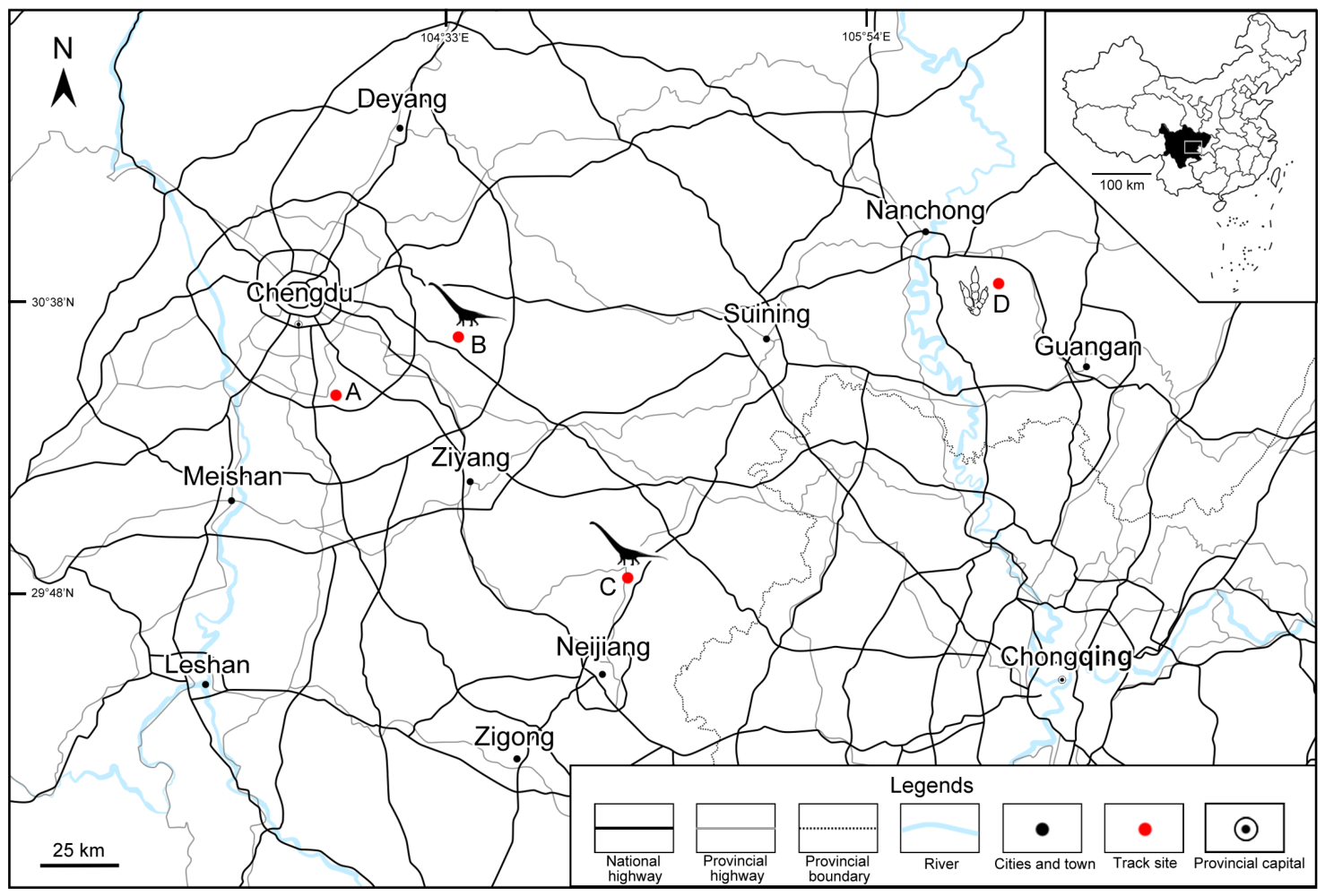
Furthermore, large sauropod skeletal remains have been recovered from the Penglaizhen Formation (Figure 1). This includes relatively complete specimens of giant sauropods excavated in 1987 by the Chengdu College of Geology Museum and the Anyue County Cultural Relics Management Office from the contact between the top of the Suining Formation and the base of the Penglaizhen Formation in Anyue County. These remains were subsequently named Mamenchisaurus anyuensis [14]. Recent U-Pb dating yielded an age of 114.4 Ma for M. anyuensis, making it approximately 30 million years younger than its Late Jurassic congeners [15]. Additional Mamenchisaurus material discovered in 2003 at the top of the Penglaizhen Formation in Jianyang City further corroborates the hypothesis that mamenchisaurids persisted in the Sichuan Basin well into the Early Cretaceous.
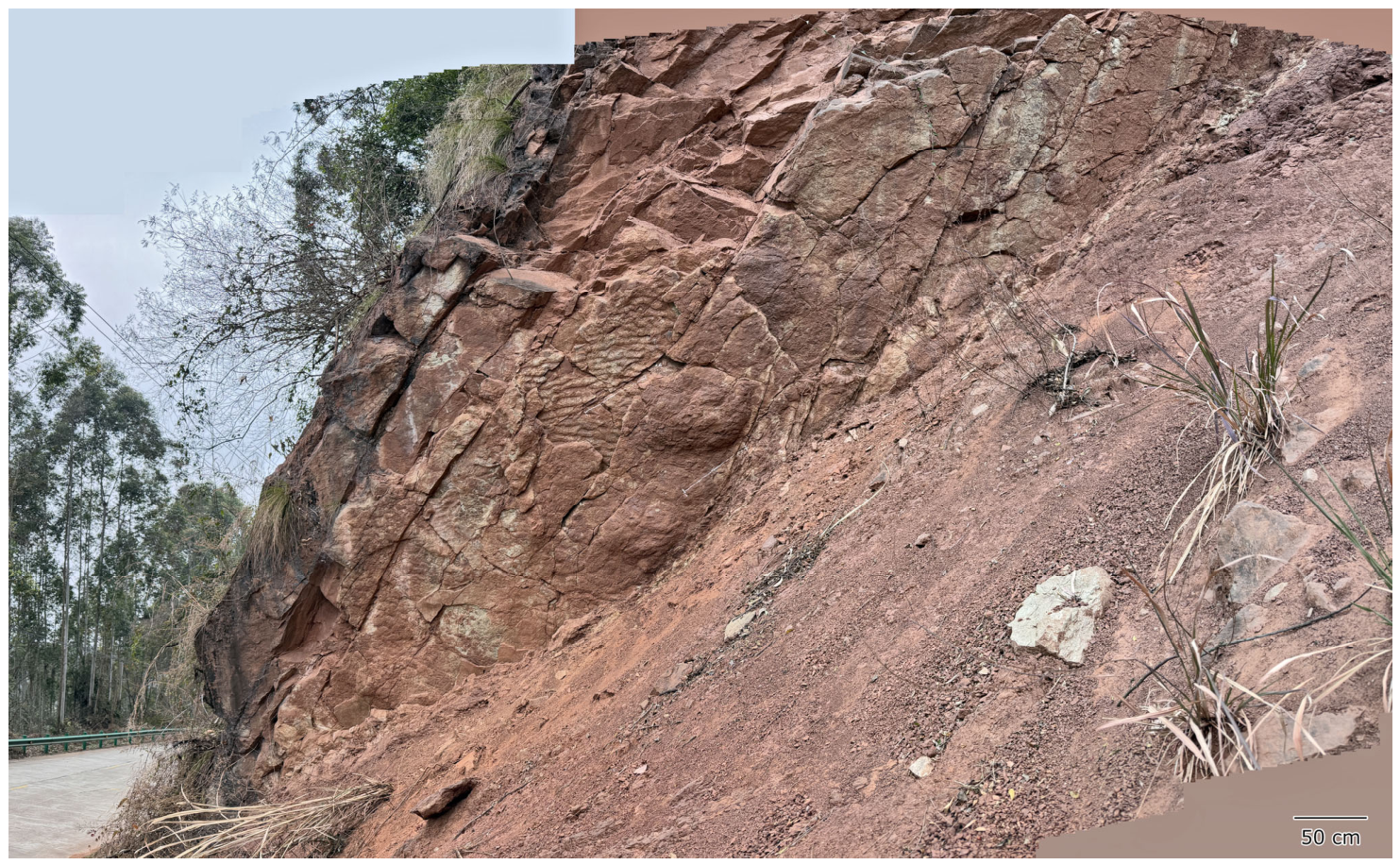
Here, we report a new Lower Cretaceous tetrapod tracksite (GPS: 30°22′2.80″ N, 104°11′48.66″ E) discovered within the Penglaizhen Formation of the Sichuan Basin (Figure 2). The site was initially identified by Mr. Jun Li on 10 August 2025, near Zhoujiagou in the Shuangliu District (Tianfu New Area) of Chengdu, Sichuan Province. A formal investigation was subsequently conducted by the lead author on 7 February 2026. The Zhoujiagou tracksite represents only the second tetrapod track occurrence reported from the Penglaizhen Formation and the first non-theropod record, thereby expanding the known diversity and abundance of sauropods, such as mamenchisaurids, within this stratigraphic unit.

2. Methods

The maximum length (ML) and maximum width (MW) of the sauropod pes and manus tracks were measured following the standardized protocols established by Leonardi [17], Lockley and Hunt [18], and Lallensack et al. [19]. The Pes Trackway Ratio (PTR) was utilized to determine the trackway gauge, with thresholds tentatively defined as ≤35% for wide-gauge, 36–49% for medium-gauge, and ≥50% for narrow-gauge trackways [20]. Hip height was estimated using the empirical methodologies established by Alexander [21] and Thulborn [22].
To facilitate detailed morphological analysis, in situ surfaces were documented for photogrammetric modeling using techniques outlined by Matthews et al. [23], Romilio [24] and Lallensack et al. [25]. A 3D digital outcrop model of the track-bearing horizon was generated from a dataset of 53 high-resolution photographs. The photogrammetric workflow was executed using Agisoft Metashape Professional (v. 1.6.3), with subsequent mesh processing, repositioning, and centering performed in MeshLab [26]. Surface topography and depth-color maps were visualized using ParaView (v. 5.8.0; [27]) and CloudCompare (v. 2.10.2) filters.

3. Geological Setting

The Sichuan Basin is situated on the western margin of the Yangtze Block, encompassing an area of 1.8 × 10⁵ km2. The Mesozoic lithostratigraphy within the basin is exceptionally well-developed, widely distributed, and extensively exposed. In the eastern sector of the basin, the Jurassic to Early Cretaceous succession reaches thicknesses of 1500 to 3500 m. This sequence includes the Lower Cretaceous Penglaizhen Formation, the Upper Jurassic–Lower Cretaceous Suining Formation, the Middle Jurassic Shaximiao and Xintiangou formations, and the Lower Jurassic Ziliujing and Zhenzhuchong formations. Chronostratigraphically, the Zhenzhuchong Formation is assigned to the early Early Jurassic. The Zhenzhuchong and Ziliujing formations are dated to the late Early Jurassic (Toarcian and Hettangian–Toarcian). The Xintiangou Formation corresponds to the early Middle Jurassic (Aalenian–Bajocian), while the Shaximiao Formation is attributed to the middle-to-late Middle Jurassic (Bajocian–Callovian) [28,29,30].
Traditionally, the Jurassic–Cretaceous (J/K) boundary in the Sichuan Basin was placed at the contact between the Penglaizhen Formation and the overlying Cangxi Formation. However, recent isotopic geochronological analyses have fundamentally revised this interpretation. Detrital zircon U-Pb dating of sandstones from the lower Suining Formation in the Daba Mountain area yielded age distributions between 148 and 110 Ma, with comprehensive analysis suggesting a maximum depositional age younger than 120 Ma [31]. Furthermore, Wang et al. [15] obtained a precise zircon U-Pb age of 114.4 ± 1.1 Ma from tuffaceous sandstones in the upper Suining Formation. Based on integrated stratigraphic correlation, Huang [32] proposed shifting the J/K boundary downward into the upper Suining Formation, using the first appearance of the early ostracod Djungarica as a biostratigraphic marker for the Cretaceous. Huang et al. [10] further suggested that the Suining and Penglaizhen formations are roughly correlative with the Tuchengzi Formation of the Yanliao area in northeastern China. In this framework, the regional unconformity between the Penglaizhen Formation and overlying units (such as the Cangxi Formation) corresponds to Phase B of the Yanshanian Movement. This tectonic interface is geochronologically constrained to 137–135 Ma, situated between the Tuchengzi and Zhangjiakou formations in the Yanliao area of northeastern China [10].
The Zhoujiagou tracksite is situated on Longquan Mountain, a prominent ridge-like anticline with a northeast (NE) trend and elevations ranging from 600 to 1000 m. Geomorphologically, this range serves as the boundary between the Chengdu Plain and the hills of central Sichuan, extending approximately 210 km in length and 10–18 km in width. The terrestrial “red beds” of the Chengdu region belong to the western sub-basin, where the stratigraphic sequence is dominated by the Penglaizhen Formation and the Cretaceous Tianmashan and Guankou formations [33]. Based on regional lithological characteristics and the 1:200,000 Chengdu Sheet (H-48-IX) geological map, the Zhoujiagou tracksite is assigned to the Penglaizhen Formation, which reaches a thickness of up to 1200 m in this area. The lithology of the formation primarily comprises rhythmic interbeds of thick-bedded massive sandstone and purplish-red mudstone, with occasional intercalations of lacustrine dark shale and marl. It maintains a conformable contact with the underlying Suining Formation [34].
The Penglaizhen Formation is conventionally divided into four members: Member 1, predominantly brown mudstone interbedded with grayish-brown siltstone and argillaceous siltstone. Member 2, characterized by unequal-thickness interbeds of grayish-brown to pale greenish-gray siltstone and brown mudstone. Member 3, comprising unequal-thickness interbeds of pale gray to grayish-brown siltstone and brown mudstone. Member 4, consisting of approximately equal-thickness interbeds of pale green to pale brownish-gray siltstone and reddish-brown mudstone [35].
The dinosaur tracks at Zhoujiagou are preserved on the bedding surface of a grayish-brown siltstone within the upper sequence of the Penglaizhen Formation, a unit characterized by frequent siltstone-mudstone interbedding. Due to intense compression and tectonic drag associated with the western limb of the Longquan Mountain anticline, the strata at this locality exhibit a sub-vertical orientation, with a dip angle exceeding 80°. The presence of well-developed symmetrical ripple marks and mud cracks on the track-bearing surface indicates that the tracks were impressed within a typical littoral to shallow lacustrine depositional environment.

4. Description

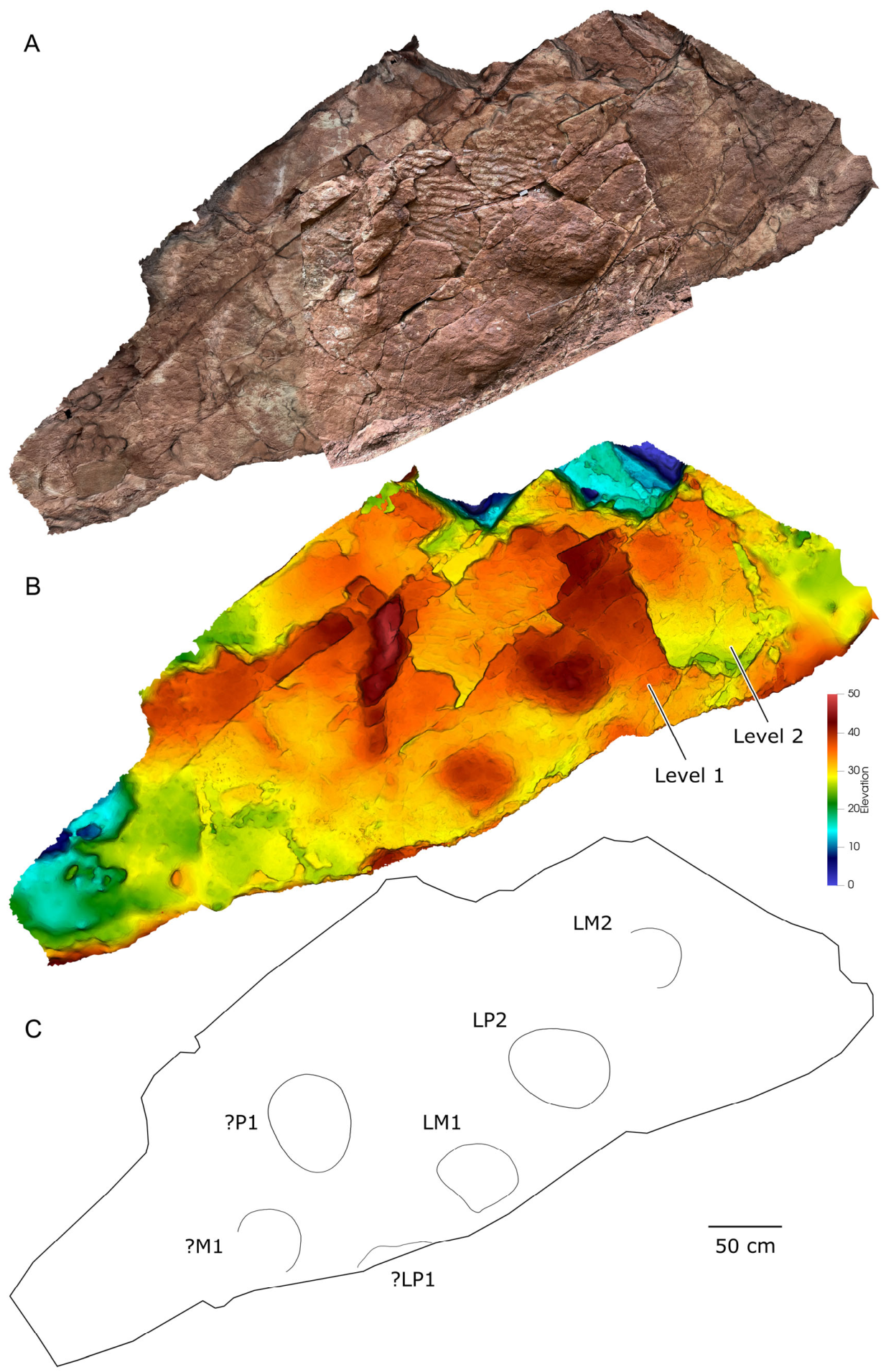
The Zhoujiagou tracksite preserves at least three tracks, including one pes-manus set (LP2 and LM2) and a manual track (LM1), all occurring as convex hyporeliefs (Figure 3). The tracks exhibit a morphological preservation (MP) grade of 1, characterized by the absence of digital pads and claw marks, though manus and pes imprints remain distinguishable [36]. These three tracks are linearly aligned and collectively form a single trackway, designated ZJG-S1, which measures at least 2.5 m in length and indicates a travel direction of approximately 270° (modern compass bearing), and all the tracks are rotated outward. These tracks are inferred to belong to the left side of the trackmaker based on the distinct outward rotation of the pes track LP2. Furthermore, a partial protrusion in the sediment proximal to LM1 may represent a potential LP1 impression.
Stratigraphically, LP2 and LM1 occur on the same bedding plane, with the pes track (approx. 20 cm thick) being notably deeper than the manus track (approx. 10 cm). In contrast, LM2 is preserved as an undertrack on an adjacent stratigraphic horizon and is significantly shallower, with a thickness of approximately 5–6 cm.
Most of the track dimensions from Zhoujiagou are medium-sized (50 cm ≤ P’L < 75 cm; [37]). Among the manus tracks, LM1 is the most completely preserved, while the others are only partially represented. Track LM1 is subcircular, with a length of 46.7 cm, a width of 54.5 cm, and a length/width ratio of 0.86. Its distal margin is rounded, and a proximolateral bulge is present, possibly representing the trace of digit V. The pes track LP2 is elliptical, measuring 51.6 cm in length and 69.6 cm in width, with a length/width ratio of 0.74, and it lacks any discernible digit or claw impressions. Additionally, there are two low-relief hollows cataloged as ?P1 and ?M1. The morphology of ?P1 is consistent with LP2, although it is slightly longer at 60.7 cm, yielding a length/width ratio of 1.0. The dimensions and morphology of ?M1 are likewise similar to those of LM1.
Only the single-sided trackway composed of LP2, LM2, and LM1 is clearly visible. Two possibilities exist regarding the opposite side of trackway ZJG-S1: it is either buried by strata, or represented by the poorly preserved ?P1 and ?M1. The latter hypothesis is based on the morphologies and outward rotation patterns of ?P1 and ?M1, which occupy positions corresponding to the opposite side of trackway ZJG-S1. Although the presence of the opposite side within the buried strata cannot be ruled out, the authors favor the second possibility. Therefore, if ?P1 and ?M1 are interpreted as representing the opposite side of the trackway, the ratio of the PTR for ZJG-S1 is approximately 31%. This value indicates a relatively wide-gauge trackway pattern according to the classification criteria of Romano et al. [20].

5. Discussion

Distinguishing sauropod tracks preserved as convex hyporeliefs from abiotic structures, such as weathered pit fills, concretions, or inorganic sedimentary features, presents a taphonomic challenge, particularly when diagnostic anatomical details like digit and claw impressions are subdued. Generally, abiotic features tend to exhibit stochastic distributions, circular or highly irregular geometries, and a lack of biological symmetry. While concretions may occasionally occur in linear arrangements, their spacing typically fails to conform to the biomechanical constraints of a quadrupedal gait [38]. In contrast, the potential tracks at the Zhoujiagou tracksite display relatively stable inter-track distances, and their lithology is consistent with the overlying bedding plane. Furthermore, the spatial distribution of these features aligns with the expected size trends and positioning of a manus-pes suite, with certain specimens exhibiting clear displacement rims. These combined lines of evidence support a biogenic origin for these structures.
The manus and pes tracks from Zhoujiagou exhibit a subcircular morphology, with the pes area being significantly larger than the manus area (the area ratio of LP2 to LM1 is 1.6:1). These morphological characteristics clearly attribute the tracks to sauropod dinosaurs [18,39,40]. The ichnogenus Brontopodus is among the most ubiquitous sauropod track types recorded from the Cretaceous [41,42]. Most sauropod tracks discovered in China are referred to this ichnotaxon, which is typically characterized by a wide- or medium-gauge trackway and a weak heteropody [41]. In contrast, the ichnogenus Parabrontopodus, which is common in Jurassic strata of China, represents a narrow-gauge trackway pattern (PTR values typically 50%). This ichnotaxon is also characterized by a strong heteropody, often reaching 1:4 or 1:5 [43].
The most notable feature of the sauropod tracks from Zhoujiagou is the relatively large manus area, which is approximately half that of the pes. This weak heteropody is a characteristic feature of the typical Brontopodus morphotype. However, due to the limited number of tracks and the suboptimal quality of preservation (MP = 1), a more definitive ichnotaxonomic assignment is currently precluded. Based on the available evidence, the Zhoujiagou tracks are tentatively referred to the Brontopodus morphotype.
Assuming a hip-height-to-pes-length ratio for sauropods between 4.0–5.9:1 [21,22], the hip height of the Zhoujiagou sauropod trackmaker (ZJG-S1) is estimated to be between 2.2–3.3 m. Applying a body-length-to-hip-height ratio of 3.7:1 [44], the calculated body length of the trackmaker is approximately 8.1–12.2 m. This suggests that the Zhoujiagou trackmaker was a relatively medium-sized individual, particularly when compared to the 20–30 m body lengths estimated for giant Mamenchisaurus specimens, such as the skeletal mounts displayed at the Zigong Dinosaur Museum.
Wide-gauge Brontopodus tracks are closely associated in skeletal features with titanosauriforms [42,43,45]. In China, the distribution of sauropod faunas dominated by mamenchisaurids is primarily in the southwestern and northwestern regions of the country, and their temporal range is traditionally considered to be Middle to Late Jurassic [46,47]. However, Mamenchisaurus anyueensis have also been discovered in the Penglaizhen Formation of the Sichuan Basin [14]. Furthermore, mamenchisaurids were discovered at the top of the Penglaizhen Formation in Jianyang [16]. Combined with recent studies further refining the age of the Penglaizhen Formation, mamenchisaurids in the Sichuan Basin may have persisted into the Early Cretaceous (the Suining Formation age reaches 114.4 ± 1.1 Ma) [15,31]. The Zhoujiagou tracksite is located at the top of the Penglaizhen Formation, approximately 85 km in a straight line from the location of the Jianyang Mamenchisaurus fossils, and coincides highly in stratigraphic level. Therefore, the trackmaker of the sauropod tracks discovered at the Zhoujiagou tracksite has a high affinity with mamenchisaurids. In China, the Brontopodus morphotype represents a functional gait that appeared significantly earlier than the global rise of titanosauriforms. The presence of these tracks in levels yielding Early Jurassic Tonganosaurus and Middle Jurassic Chuanjiesaurus indicates that mamenchisaurids were among the earliest sauropods to develop the wide-gauge stance [44,48]. However, due to the limited and highly convergent morphological information provided by the track material, as well as the incompleteness of the regional fossil record, the slight possibility that the trackmaker belonged to other contemporaneous large sauropod lineages (particularly diplodocoids) cannot be entirely ruled out. Traditionally, diplodocoids were represented in China by only a single Middle Jurassic record, Lingwulong [46], and these diplodocoid tracks are generally considered to exhibit a narrow-gauge trackway pattern.
Dinosaur Ridge is renowned for its “Brontosaur Bulges”, which refer to downward-projecting, sand-filled structures exposed on vertical rock sections (cross-sections). These are interpreted as convex hyporeliefs of sauropod tracks [49,50]. In addition to these bulges, Dinosaur Ridge preserves sauropod natural casts, such as specimen UCM 190.16, which retains a distinct cavity left after the detachment of the pes cast. This feature is morphologically similar to the hollow observed in the area of ?P1 at the Zhoujiagou tracksite. Following the detachment of the pes cast in UCM 190.16, a raised, semi-circular sediment rim is clearly observable on the track-bearing surface. This structure is likely related to the mechanical processes of track formation and subsequent burial [50]. As the dinosaur traversed along a soft, wet substrate, the pressure of the foot displaced the sediment outward, creating a marginal rim. During diagenesis, the sediment outside the cast margin may have subsided or developed annular fractures, resulting in a concentric trough [50] and Figure 17 in [51]. Similar structures, characterized by partially raised sediment rims, are also observed flanking the Zhoujiagou track ?P1.

6. Conclusions

The Lower Cretaceous Penglaizhen Formation in the Sichuan Basin is known for harboring skeletal remains of mamenchisaurid sauropods, as well as small- to medium-sized theropod tracks assigned to the ichnogenus Jialingpus. The newly identified Zhoujiagou tracksite in the Shuangliu District of Chengdu represents the first report of potential sauropod tracks within this formation. These impressions are of medium size, characterized by a pes area significantly larger than the manus area and a notably wide-gauge trackway—features consistent with the typical ichnogenus Brontopodus morphotype. Based on the extensive skeletal record of the region, it is highly probable that the Zhoujiagou trackmaker shares close affinities with the mamenchisaurids. This discovery significantly enhances our understanding of the spatial distribution and faunal abundance of large sauropod dinosaurs in southwestern China during the Late Jurassic to Lower Cretaceous.

Author Contributions

Conceptualization, L.X.; methodology, L.X. and L.L.; software, L.L.; validation, L.X. and L.L.; formal analysis, L.X. and L.L.; investigation, S.J., Y.Y., X.S. and Q.Q.; resources, L.X. and S.J.; data curation, L.X. and L.L.; writing—original draft preparation, L.X. and L.L.; writing—review and editing, L.X., L.L., B.H.B., S.J., Y.Y., X.S. and Q.Q.; visualization, L.X. and L.L.; supervision, L.X.; project administration, L.X. and S.J.; funding acquisition, L.X. and S.J. All authors have read and agreed to the published version of the manuscript.

Funding

This research was funded by the National Natural Science Foundation of China (No. 42488201); the “Deep-time Digital Earth” Science and Technology Leading Talents Team Funds for the Central Universities for the Frontiers Science Center for Deep-time Digital Earth, China University of Geosciences (Beijing; grant 2652023001); the 111 project (B20011); and Fundamental Research Funds for Central Universities (265QZ201903).

Data Availability Statement

The original data presented in the study are openly available in https://doi.org/10.6084/m9.figshare.32122768. Further inquiries can be directed to the corresponding author.

Acknowledgments

The authors are grateful to Jun Li for discovering the dinosaur tracks and contacting the lead author through Zijie Ni. We also thank Jian Liu for his assistance during the first and second rounds of fieldwork, and Jun Yong and Xiang Gao for their help during the third round.

Conflicts of Interest

The authors declare no conflict of interest.

References

  1. Dong, Z.M. The dinosaurian faunas of China and their stratigraphic distribution. J. Stratigr. 1980, 4, 256–263. [Google Scholar]
  2. Xing, L.D.; Lockley, M.G.; Li, C.; Klein, H.; Li, J.; Wang, D. Two new dinosaur tracksites from the Jurassic Guizhou Province, China. Hist. Biol. 2023, 35, 49–57. [Google Scholar] [CrossRef]
  3. Xing, L.D.; Lockley, M.G.; Peng, G.Z.; Ye, Y.; Zhang, J.P.; Matsukawa, M.; Persons, W.S., IV. Eubrontes and Anomoepus track assemblages from the Middle Jurassic Xiashaximiao Formation of Zizhong County, Sichuan, China: Review, ichnotaxonomy and notes on preserved tail traces. N. M. Mus. Nat. Hist. Sci. Bull. 2016, 74, 345–352. [Google Scholar]
  4. Xing, L.D.; Klein, H.; Lockley, M.G.; Chen, W.; Ye, Y.; Matsukawa, M.; Zhang, J.P. Earliest records from China of theropod and mammal-like tetrapod footprints in the Late Triassic of Sichuan Basin. Vertebr. Palasiat. 2013, 51, 184–198. [Google Scholar]
  5. Jiang, S.; Xing, L.D.; Peng, G.Z.; Lockley, M.G.; Ye, Y.; Romilio, A.; Liu, C.; Persons, W.S., IV; Xu, X. The smallest non-avian dinosaur track in China (Lower Jurassic, Sichuan Province). Hist. Biol. 2022, 34, 658–662. [Google Scholar] [CrossRef]
  6. Xing, L.D.; Lockley, M.G.; Zhang, J.P.; Klein, H.; Persons, W.S., IV; Dai, H. Diverse sauropod-, theropod-, and ornithopod-track assemblages and a new ichnotaxon Siamopodus xui ichnosp. nov. from the Feitianshan Formation, Lower Cretaceous of Sichuan Province, southwest China. Palaeogeogr. Palaeoclimatol. Palaeoecol. 2014, 414, 79–97. [Google Scholar] [CrossRef]
  7. Xing, L.D.; Lockley, M.G.; Bonnan, M.F.; Marty, D.; Klein, H.; Liu, Y.Q. Late Jurassic–Early Cretaceous trackways of small-sized sauropods from China: New discoveries, ichnotaxonomy and sauropod manus morphology. Cretac. Res. 2015, 56, 470–481. [Google Scholar] [CrossRef]
  8. Xing, L.D.; Lockley, M.G.; Zhang, J.P.; Klein, H.; Kümmell, S.B.; Persons, W.S., IV; Kuang, H.W. Theropod tracks from the Lower Jurassic of Gulin area, Sichuan Province, China. Palaeoworld 2017, 26, 115–123. [Google Scholar] [CrossRef]
  9. Xing, L.D.; Lockley, M.G.; Klein, H.; Zhang, L.J.; Romilio, A.; Persons, W.S., IV; Peng, G.Z.; Ye, Y.; Wang, M.Y. The new ichnotaxon Eubrontes nobitai ichnosp. nov. and other Saurischian tracks from the Lower Cretaceous Sichuan Province and a review of Chinese Eubrontes type tracks. J. Palaeogeogr. 2021, 10, 17. [Google Scholar] [CrossRef]
  10. Huang, D.Y.; Fang, Y.N.; Li, J.G.; Li, X. Lithostratigraphic subdivision and correlation of the Jurassic in China. J. Stratigr. 2021, 45, 364–374. [Google Scholar]
  11. Zhen, S.N.; Li, J.J.; Zhen, B.M. Dinosaur footprints of Yuechi, Sichuan. Mem. Beijing Nat. Hist. Mus. 1983, 25, 1–19, (In Chinese with English abstract). [Google Scholar]
  12. Lockley, M.G.; Li, J.; Li, R.H.; Matsukawa, M.; Harris, J.D.; Xing, L.D. A review of the tetrapod track record in China, with special reference to type ichnospecies: Implications for ichnotaxonomy and paleobiology. Acta Geol. Sin. 2013, 87, 1–20. [Google Scholar] [CrossRef]
  13. Xing, L.D.; Lockley, M.G.; Klein, H.; Gierliński, G.D.; Divay, J.D.; Hu, S.M.; He, Y.P. The non-avian theropod track Jialingpus from the Cretaceous of the Ordos Basin, China, with a revision of the type material: Implications for ichnotaxonomy and trackmaker morphology. Palaeoworld 2014, 23, 187–199. [Google Scholar] [CrossRef]
  14. He, X.; Yang, S.; Cai, K.; Li, K.; Liu, Z. A New Species of Sauropod, Mamenchisaurus anyuensis sp. nov. In Proceedings of the 30th International Geology Congress, 1996; pp. 83–86. Available online: https://naturalhistory.si.edu/sites/default/files/media/translated_publications/He%26amp%3B_96.pdf (accessed on 10 June 2026).
  15. Wang, J.; Norell, M.A.; Pei, R.; Ye, Y.; Chang, S.C. Surprisingly young age for the mamenchisaurid sauropods in South China. Cretac. Res. 2019, 104, 104176. [Google Scholar] [CrossRef]
  16. Wang, Z.X.; Li, K.; Liu, J. Mamenchisaurus from Upper Jurassic of Jianyang, Sichuan. J. Chengdu Univ. Technol. (Sci. Technol. Ed.) 2003, 30, 485–490. [Google Scholar]
  17. Leonardi, G. Glossary and Manual of Tetrapod Footprint Palaeoichnology; Departamento Nacional de Produção Mineral: Brasilia, Brazil, 1987; p. 75. [Google Scholar]
  18. Lockley, M.G.; Hunt, A.P. Dinosaur Tracks and Other Fossil Footprints of the Western United States; Columbia University Press: New York, NY, USA, 1995; p. 360. [Google Scholar]
  19. Lallensack, J.N.; Leonardi, G.; Falkingham, P.L. Glossary of fossil tetrapod tracks. Palaeontol. Electron. 2025, 28, 1–105. [Google Scholar] [CrossRef] [PubMed]
  20. Romano, M.; Whyte, M.A.; Jackson, S.J. Trackway ratio: A new look at trackway gauge in the analysis of quadrupedal dinosaur trackways and its implications for ichnotaxonomy. Ichnos 2007, 14, 257–270. [Google Scholar] [CrossRef]
  21. Alexander, R.M. Estimates of speeds of dinosaurs. Nature 1976, 261, 129–130. [Google Scholar] [CrossRef]
  22. Thulborn, T. Dinosaur Tracks; Chapman and Hall: London, UK, 1990; p. 410. [Google Scholar]
  23. Matthews, N.A.; Noble, T.A.; Breithaupt, B.H. Close-range photogrammetry for 3D ichnology: The basics of photogrammetric ichnology. In Dinosaur Tracks: The Next Steps; Falkingham, P., Marty, D., Richter, A., Eds.; Indiana University Press: Bloomington, IN, USA, 2016; pp. 29–55. [Google Scholar]
  24. Romilio, A. An Instructional Guide to Visualising Dinosaur Tracks; Amazon: Columbia, SC, USA, 2020; p. 36. [Google Scholar]
  25. Lallensack, J.N.; Owais, A.; Falkingham, P.L.; Breithaupt, B.H.; Sander, P.M. How to verify fossil tracks: The first record of dinosaurs from Palestine. Hist. Biol. 2022, 35, 924–934. [Google Scholar] [CrossRef]
  26. Cignoni, P.; Callieri, M.; Corsini, M.; Dellepiane, M.; Ganovelli, F.; Ranzuglia, G. Meshlab: An open-source mesh processing tool. In Eurographics Italian Chapter Conference; Salerno Publisher: Salerno, Italy, 2008; pp. 129–136. [Google Scholar]
  27. Ahrens, J.; Geveci, B.; Law, C.; Hansen, C.; Johnson, C. 36-paraview: An end-user tool for large-data visualization. In Visualization Handbook; Academic Press: Cambridge, MA, USA, 2005; Volume 717, pp. 50038–50041. [Google Scholar]
  28. Chen, P.J.; Li, J.; Matsukawa, M. Geological ages of dinosaur-track-bearing formations in China. Cretac. Res. 2006, 27, 22–32. [Google Scholar] [CrossRef]
  29. Wang, Y.D.; Fu, B.H.; Xie, X.P. The Terrestrial Triassic and Jurassic Systems in the Sichuan Basin, China; University of Sciences and Technology of China Press: Hefei, China, 2010; pp. 19–165. [Google Scholar]
  30. Xing, L.D.; Peng, G.Z.; Ye, Y.; Lockley, M.G.; Klein, H.; Persons, W.S., IV; Hao, B. Sauropod and small theropod tracks from the Lower Jurassic Ziliujing Formation of Zigong City, Sichuan, China, with an overview of Triassic–Jurassic dinosaur fossils and footprints of the Sichuan Basin. Ichnos 2014, 21, 119–130. [Google Scholar] [CrossRef]
  31. Liu, G.; Dong, S.; Chen, X.; Cui, J.J. Detrital zircon U-Pb dating of Suining Formation sandstone from the Daba Mountains, north-eastern Sichuan and its stratigraphic implications. Palaeoworld 2017, 26, 380–395. [Google Scholar] [CrossRef]
  32. Huang, D. Jurassic integrative stratigraphy and timescale of China. Sci. China Earth Sci. 2019, 62, 223–255. [Google Scholar] [CrossRef]
  33. Zheng, L.N.; Chen, J.B.; Zhou, Q.J.; Feng, S.Q.; Lou, Y.B.; Shen, P. Experimental study on bearing capacity of moderately weathered mudstone in Chengdu area. Chin. J. Geotech. Eng. 2021, 43, 926–932. [Google Scholar]
  34. He, L.; Liu, M.; He, Z.; Zhou, Z.; Zhang, S. Sedimentary sequence characteristics and favorable reservoir facies-tract prediction for the Penglazhen Formation of West Sichuan and adjacent areas. Pet. Geol. Exp. 1999, 21, 119–127. [Google Scholar]
  35. Wang, S.Z. Characteristics of present-day stress field of Penglaizhen Formation in Luodai Structure, Western Sichuan. J. Mineral. Petrol. 2000, 20, 46–52. [Google Scholar]
  36. Marchetti, L.; Belvedere, M.; Voigt, S.; Klein, H.; Castanera, D.; Díaz-Martínez, I.; Marty, D.; Xing, L.D.; Feola, S.; Melchor, R.N.; et al. Defining the morphological quality of fossil footprints. Problems and principles of preservation in tetrapod ichnology with examples from the Palaeozoic to the present. Earth-Sci. Rev. 2019, 193, 109–145. [Google Scholar] [CrossRef]
  37. Marty, D. Sedimentology, Taphonomy, and Ichnology of Late Jurassic Dinosaur Tracks from the Jura Carbonate Platform (Chevenez-Combe Ronde Tracksite, NW Switzerland): Insights into the Tidalflat Palaeoenvironment and Dinosaur Diversity, Locomotion, and Palaeoecology; University of Fribourg: Fribourg, Switzerland, 2008; p. 278. [Google Scholar]
  38. Breithaupt, B.H.; Chan, M.A.; Seiler, W.M.; Matthews, N.A. Weathering pits versus trample marks: A reinterpretation of the “dinosaur dance floor”: A Jurassic Navajo Sandstone surface in the Vermilion Cliffs National Monument, Arizona. Palaios 2021, 36, 331–338. [Google Scholar] [CrossRef]
  39. Lockley, M.G. The Eternal Trail: A Tracker Looks at Evolution; Basic Books: New York, NY, USA, 1999; p. 352. [Google Scholar]
  40. Lockley, M.G.; Wright, J.; Giblin, R.; Manning, M. Fossil Trace trace fossils. New finds of Cretaceous tracks from the Laramie Formation Clay Pits and Golf Course in Golden. In Friends of Dinosaur Ridge Annual Report; Friends of Dinosaur Ridge: Morrison, CO, USA, 2001; pp. 18–26. [Google Scholar]
  41. Farlow, J.O.; Pittman, J.G.; Hawthorne, J.M. Brontopodus birdi, Lower Cretaceous sauropod footprints from the U.S. Gulf Coastal Plain. In Dinosaur Tracks and Traces; Gillette, D.D., Lockley, M.G., Eds.; Cambridge University Press: Cambridge, UK, 1989; pp. 371–394. [Google Scholar]
  42. Lockley, M.G.; Wright, J.; White, D.; Li, J.J.; Feng, L.; Li, H. The first sauropod trackways from China. Cretac. Res. 2002, 23, 363–381. [Google Scholar] [CrossRef]
  43. Lockley, M.G.; Farlow, J.O.; Meyer, C.A. Brontopodus and Parabrontopodus ichnogen. nov. and the significance of wide- and narrow-gauge sauropod trackways. Gaia 1994, 10, 135–145. [Google Scholar]
  44. Xing, L.D.; Lockley, M.G.; Miyashita, T.; Klein, H.; Wang, T.; Persons, W.S., IV; Pan, S.G.; Zhang, J.P.; Dong, Z.M. Large sauropod and theropod tracks from the Middle Jurassic Chuanjie Formation of Lufeng County, Yunnan Province and palaeobiogeography of the Middle Jurassic sauropod tracks from south-western China. Palaeoworld 2014, 23, 294–303. [Google Scholar] [CrossRef]
  45. Wilson, J.A.; Carrano, M.T. Titanosaurs and the origin of wide gauge trackways: A biomechanical and systematic perspective on sauropod locomotion. Paleobiology 1999, 25, 252–267. [Google Scholar] [CrossRef]
  46. Xu, X.; Upchurch, P.; Mannion, P.D.; Barrett, P.M.; Regalado-Fernandez, O.R.; Mo, J.; Liu, H. A new Middle Jurassic diplodocoid suggests an earlier dispersal and diversification of sauropod dinosaurs. Nat. Commun. 2018, 9, 2700. [Google Scholar] [CrossRef]
  47. Peng, G.; Qin, G.; Ye, Y.; Zhu, T.; Hao, B.; Jiang, S.; Tang, W.; Li, S. Discovery and research of dinosaur fossils in Sichuan. Acta Geol. Sichuan 2019, 39, 215–223. [Google Scholar]
  48. Xing, L.D.; Lockley, M.G.; You, H.L.; Peng, G.Z.; Tang, X.; Ran, H.; Wang, T.; Hu, J.; Persons, W.S., IV. Early Jurassic sauropod tracks from the Yimen Formation of Panxi Region, Southwest China: Ichnotaxonomy and potential trackmaker. Geol. Bull. China 2016, 35, 851–855. [Google Scholar]
  49. Lockley, M.G. A Field Guide to Dinosaur Ridge; Friends of Dinosaur Ridge and the University of Colorado at Denver Dinosaur Trackers Research Group: Denver, CO, USA, 1990; p. 29. [Google Scholar]
  50. Lockley, M.G.; McCrea, R.T.; Buckley, L.G. A review of dinosaur track occurrences from the Morrison Formation in the type area around Dinosaur Ridge. Palaeogeogr. Palaeoclimatol. Palaeoecol. 2015, 433, 10–19. [Google Scholar] [CrossRef]
  51. Houck, K.J. Sedimentology and stratigraphy of the Morrison Formation in the Dinosaur Ridge Area near Morrison Colorado. Mt. Geol. 2001, 38, 97–110. [Google Scholar]
Figure 1. Distribution of fossil sites in the Lower Cretaceous Penglaizhen Formation, Sichuan Basin, China. A: Location of sauropod track fossils studied herein. B: Site of Mamenchisaurus sp. skeletal fossils in Panlong Village, Sanxing Town, Jianyang City [16]. C: Site of Mamenchisaurus anyueensis skeletal fossils in Shuiyue Village, Longqiao Township, Anyue County [14]. D: Site of Jialingpus track fossils in Yuanjiayan, Huanglong Township, Yuechi County [11].
Fossstud 04 00016 g001
Figure 2. Photograph of the track-bearing outcrop at the Zhoujiagou tracksite, Sichuan Basin, China. The image is a composite of 20 photographs taken parallel to the bedding plane using a ladder and merged via the Photomerge function in Adobe Photoshop 2025 (v26.0; Adobe Inc., San Jose, CA, USA).
Fossstud 04 00016 g002
Figure 3. The colour orthographic image (A), rainbow elevation image (B), and outline drawing of the sauropod track (C) from Zhoujiagou tracksite, Sichuan Basin, China.
Fossstud 04 00016 g003
Disclaimer/Publisher’s Note: The statements, opinions and data contained in all publications are solely those of the individual author(s) and contributor(s) and not of MDPI and/or the editor(s). MDPI and/or the editor(s) disclaim responsibility for any injury to people or property resulting from any ideas, methods, instructions or products referred to in the content.