
Article

Blockchain-Enabled Human Resource Management for Enhancing Transparency, Trust, and Talent Mobility in the Digital Era


by
Mitra Madanchian
1,* and
Hamed Taherdoost
1,2,3,4,5
1
Department of Arts, Communications and Social Sciences, School of Arts, Science and Technology, University Canada West, Vancouver, BC V6Z 0E5, Canada
2
GUS Institute, Global University Systems, London EC1N 2LX, UK
3
College of Technology and Engineering, Westcliff University, Irvine, CA 92614, USA
4
Business Department, Gisma University of Applied Sciences, 10963 Berlin, Germany
5
Faculty of Information Technology, Victorian Institute of Technology, Melbourne, VIC 3000, Australia
*
Author to whom correspondence should be addressed.
Blockchains 2026, 4(1), 2; https://doi.org/10.3390/blockchains4010002
Submission received: 2 October 2025 / Revised: 18 December 2025 / Accepted: 23 December 2025 / Published: 8 January 2026
(This article belongs to the Special Issue Feature Papers in Blockchains 2025)

Abstract

Traditional Human Resource Management (HRM) systems are criticized for lacking transparency, being inefficient, and offering ample opportunities for fraud because of their centralized design and reliance on manual processes. This work proposes a blockchain-enabled framework for HRM that enhances the transparency, trust, and global mobility of talents by integrating distributed ledgers, consensus protocols, and smart contract networks into Human Resources (HR) functions. A four-layer theoretical model—data, consensus, smart contract, and application layers—is developed and comparatively examined against traditional HR systems to show how blockchain principles can be systematically mapped into HR processes. This study shows how blockchain-driven HRM can ensure tamper-evident employee records, automate contractual and payroll operations, and enhance auditability and compliance. By informing the framework with established technology adoption perspectives, this paper extends both the theoretical and managerial understanding of blockchain in HR. In comparison with previous studies that were limited to either recruitment or credential verification, this article presents an overarching, cross-layer synthesis that connects blockchain architectures with end-to-end HR functions, thus providing a clear conceptual foundation for its future enterprise adoption in the digital economy.

1. Introduction

Traditional HRM systems are centralized, and that can potentially lead to a myriad of issues. The absence of procedural transparency in activities such as recruitment, performance appraisal, and payment processing can provide a breeding ground for inefficiency and corruption. For instance, opaque personnel records can generate mismatches and conflicts between qualifications and performance measures. The use of manual procedures further increases the potential for error and delay, which in turn leads to inefficiencies in HR processes [1]. Institutional restrictions on HRM practices, particularly when HRM is conducted within highly regulated environments, can limit the functionality of traditional HRM systems. Companies operating under strict labor market regulations may struggle to implement advanced HRM practices, rendering them unable to align with dynamic market needs [2].
Blockchain technology provides a secure and decentralized ledger system that has the potential to enhance the efficiency and transparency of HRM systems significantly. Blockchain enables organizations to maintain an immutable and transparent record of employee details, including work experience, qualifications, and performance reviews. This not only fosters more trust among employees but also reduces the likelihood of fraud, as any change in information would be easily traced [3].
The driving force for implementing Blockchain in HRM is to create an effective, transparent, and secure human resource management system. Organizations become increasingly attuned to the role of trust in their HR processes, as trust is directly correlated with employee engagement and retention [4]. Reducing costs by being more efficient is a significant driving force for organizations when utilizing Blockchain. By reducing the time and effort dedicated to HR manual activities, organizations can allocate their resources more effectively, resulting in improved performance [5]. Having employees provided with real-time access to information can potentially render decision-making processes and strategic planning smoother within HR departments [6].
Opacity in HRM systems is defined by limited transparency among processes and decision-making. It may lead to distrust among employees and stakeholders because they have no idea how decisions are made or how data is used. Byun and Suh [7] explain the necessity of knowledge representation in HRM systems and argue that well-structured and well-defined information is capable of preventing opacity. The use of semantic networks to map knowledge can enhance understanding and enable better decision-making within HRM systems. Ineffective HRM systems may result from outdated procedures, inadequate automation, and poor data management.
Relying on traditional manual tasks can lead to inefficiency and errors, ultimately impacting organizational performance. Klopova et al.’s [8] research highlights the need for professional development in HRM to mitigate such inefficiencies. Through expenditure in training and reforming HR practices, organizations can enhance their operational efficiency. HR processes can be automated by implementing Human Resource Information Systems (HRIS). Bah et al. [9] concluded that HRIS has a positive impact on HR management strategies through timely and cost-effective decision-making information. Internal controls cannot be overemphasized. Research has proven that a good internal control environment significantly reduces the likelihood of fraud. For instance, the Government Internal Control System (GICS) has been identified as a key fraud prevention mechanism in public sector HRM [10]. Organizations should prioritize the formulation of comprehensive internal control systems for fraud protection.
Previous studies on Blockchain in Human Resource Management (HRM) have predominantly highlighted specialized applications, such as credential verification and recruitment fraud deterrence, with limited exploration of broader HR activities, including payroll, performance management, and global talent mobility [11,12]. The majority of studies adopt a high-level conceptual framework without clarity on smart contract design frameworks that can automate employment contracts, payroll disbursements, and performance-incentive payouts [13]. Technical limitations are also exposed, as most models do not adequately address data privacy, scalability, and interoperability challenges commonly encountered in enterprise-scale HR settings [4]. Consequently, the available literature does not support end-to-end blockchain-based HRM architectures that can be instantiated within real organizational networks.
Despite more discussion around digital HR transformation, there remains no systematic framework to map blockchain capabilities, distributed ledgers, consensus systems, and smart contracts across the full range of HR processes [14,15]. There are few comparative evaluations of blockchain-based HR systems versus traditional HR management systems, with most studies considering conceptual benefits without empirical reference points or technical foundations [16]. These knowledge gaps highlight the need for technically rigorous research that not only builds conceptual models but also develops scalable, privacy-preserving approaches and integrates legacy HR platforms.
This study presents a comprehensive blockchain-driven HRM framework that spans recruitment through broader HR processes, with a specific focus on smart contract design for automated, transparent, and trust-enabled HR processes. This paper contributes by bridging the technical architecture of blockchain with managerial processes in HRM, offering a systematic, end-to-end framework that has not been previously integrated in existing literature. This study presents a technically grounded paradigm of business HR ecosystems, comprising layers of data, consensus, smart contracts, and applications. The study also provides a comparative analysis of its merits with traditional HR systems, highlighting the advantages of enhanced transparency, auditability, and global talent mobility. The objectives are threefold: (i) to come up with a conceptual design for blockchain-enabled HRM, (ii) to establish smart contract frameworks for key HR processes, and (iii) to evaluate technical challenges and propose future research areas, particularly those related to interoperability, regulatory compliance, and decentralized identity management.

2. Background and Foundations

A distributed ledger is a shared and replicated database stored on multiple participants of a network. Unlike traditional centralized databases managed by a single authority, a distributed ledger ensures no participant has authority over the information [17]. All participants have a copy of the ledger, and any addition or modification must be consented to and approved by the network. This decentralization enhances transparency, security, and resilience, as the ledger is not subject to single points of failure or manipulation [18].
Blockchains can be public (open to anyone), private (restricted to a single organization), or permissioned (limited to approved participants). HRM contexts generally favor permissioned systems due to privacy and compliance needs. Consensus mechanisms are algorithms that enable participants in a distributed ledger to agree on the validity and order of transactions. Consensus mechanisms play an important role in ensuring the integrity and security of the Blockchain [18]. There are several consensus mechanisms, each with its strengths and weaknesses (Table 1).
Proof of Work (PoW) is the first and most widely used consensus protocol, adopted by Bitcoin [19]. In PoW, the network participants (miners) compete against one another to solve difficult computational puzzles. The first to solve the puzzle miner confirms the new block of transactions, adds it to the Blockchain, and receives a reward [18]. However, PoW is energy-hungry and can lead to scalability issues [20,21].
Proof of Stake (PoS) is more energy-efficient than PoW. In PoS, validators are chosen to create new blocks based on the number of tokens they possess (stake) [19,21]. The more significant the stake, the more likely one will be picked as a validator. PoS is more energy-efficient and can be used to increase the throughput of transactions, but may be prone to wealth concentration problems [20,22]. Microchain follows a Proof-of-Credit (PoC), a pure PoS protocol [22].
Practical Byzantine Fault Tolerance (PBFT) is a consensus algorithm that enables the tolerance of Byzantine failures, which happen when a portion of the nodes on the network are either malicious or faulty [19]. PBFT employs a pre-selected group of validators that should agree on each transaction by passing through various rounds of voting [18]. It is applied in permissioned blockchains where the participants are known and trusted [23].
Proof of Authority (PoA) is another consensus algorithm widely used in permissioned blockchains. In PoA, the creation and verification of new blocks are performed by a small group of preselected authorities [24]. The reputation of the authorities is at stake, and therefore, they are incentivized to act honestly. PoA has high throughput and low latency but relies on the honesty of the selected authorities [24,25,26].
Proof of Reputation (PoR) is one where the reputation of a node is considered in validating blocks [27,28,29]. Reputation is often calculated based on the node’s assets, transaction behavior, and participation in consensus [27]. The most reputable node is often selected to generate new blocks, and then blocks are verified through reputation-based voting [27,30]. Table 1 shows PoW and PoS fit public systems, while PBFT, PoA, and PoR suit private HRM for efficiency, control, and trust.

3. Conceptual Framework: Blockchain-Enabled HRM Ecosystem

Through the features of Blockchain, trust, security, and efficiency in HR operations can be enhanced in organizations. Table 2 identifies the four components of the blockchain-based HRM ecosystem.

3.1. Data Layer

The data layer is the foundational component of the blockchain environment, where all essential information is maintained. In the HRM scenario, this layer entails employee qualifications, contracts, and other confidential details. The security and integrity of this type of data are paramount because it contains private and personal details. For instance, Kouzinopoulos et al. [38] prioritize secure data storage in their design for Internet of Things (IoT) settings, where confidential user information is stored in a blockchain to ensure integrity and non-repudiation. Similarly, the HRM data layer can utilize Blockchain to deliver tamper-proof employee contracts and credentials, thereby reducing risks of data tampering and trust between stakeholders.

3.2. Consensus Layer

The Consensus Layer plays a critical role in fostering trust among various HR stakeholders, including employers, employees, and government regulators. The Consensus Layer utilizes consensus algorithms to validate transactions and achieve a consensus among parties regarding the state of the Blockchain. Lee et al. [39] discuss the application of consensus mechanisms in IoT platforms backed by Blockchain and how they foster trust and device interoperability. A robust consensus mechanism in HRM can facilitate open and fair decision-making processes, such as recruitment and promotion, by offering all stakeholders a chance to have their voice heard in reviewing employee records and contracts.

3.3. Smart Contract Layer

The Smart Contract Layer steps in to automate HR operations through self-enforcing contracts that are executed according to predefined conditions. The layer is highly efficient, as it eliminates the need for manual inputs in routine HR operations, including payroll processing, benefits administration, and compliance verification. Wang et al. describe the application of smart contracts to mechanize supply chain operations and check compliance with regulatory requirements [3]. In HRM, smart contracts can be utilized to automate various tasks, including automatically triggering employment contracts based on specific conditions, thereby reducing administrative work and potential conflicts.

3.4. Application Layer

The Application Layer serves as the portal through which HR professionals and employees access the blockchain system. The layer comprises various HR platforms that facilitate user experience, data querying, and process management. For example, the development of user-friendly mobile applications enables Industrial Hemp Supply Chain actors to receive and share information in real-time [40]. Similarly, in HRM, user-friendly applications can enable workers to self-manage their credentials, access contracts, and interact with HR processes with ease, thereby fostering a more positive overall user experience and satisfaction.
The layered architecture enables a modular and extensible ecosystem of HRM. The Data Layer provides raw data, which is validated and agreed upon by the Consensus Layer. Smart contracts act on this validated data to automate the processes, and the Application Layer offers interfaces for users to interact with the system [34]. This systematic methodology enables each layer to be optimized in isolation without jeopardizing the coherence of the entire ecosystem.
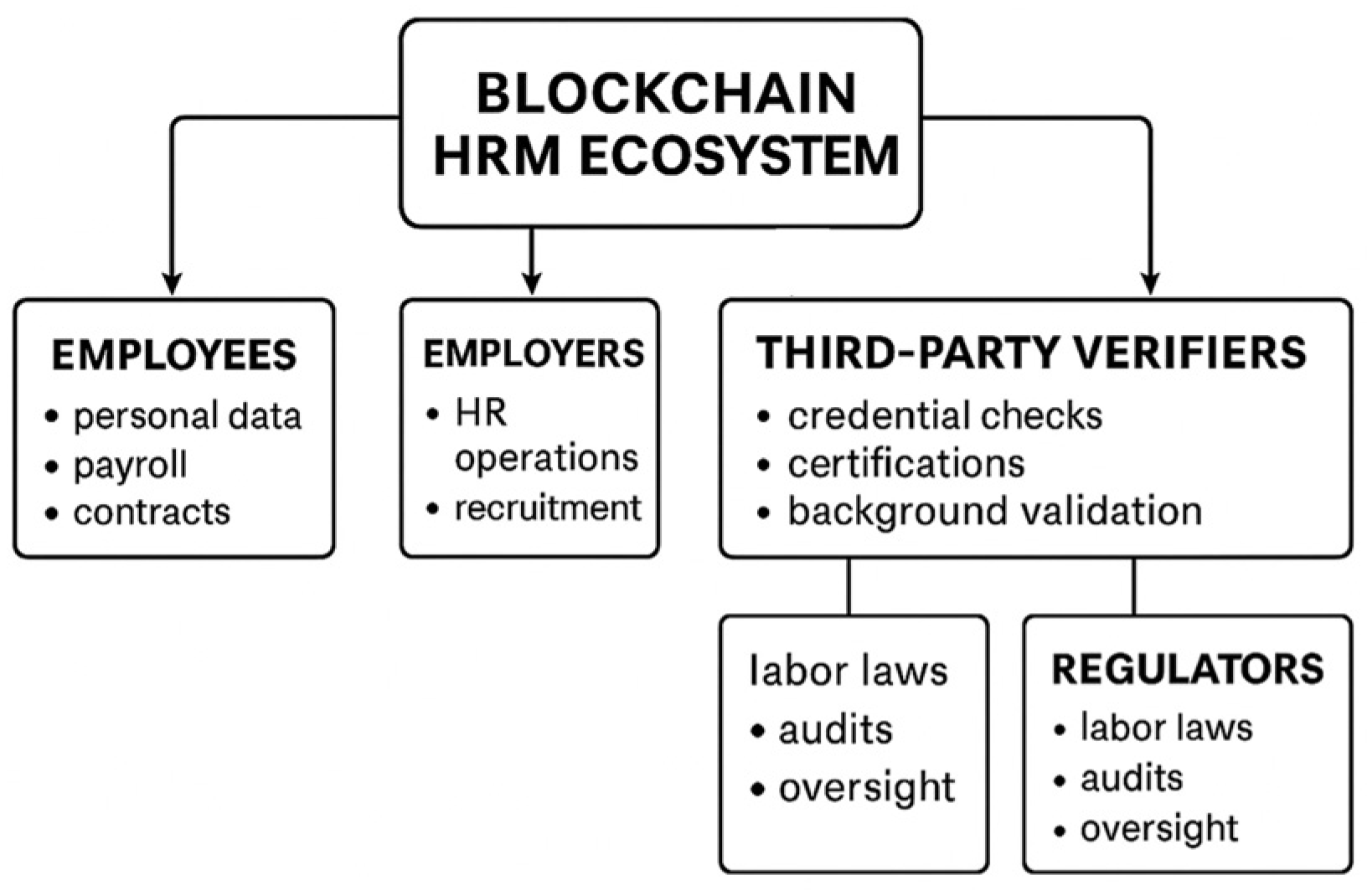
Security and scalability needs are emphasized in the literature as critical concerns in all these layers. For instance, a combination of Blockchain and artificial intelligence (AI) introduces additional layers of sophistication, including scalable consensus mechanisms and secure smart contract execution, to support more complex computations and information processing [35,41]. Permissioned blockchains, such as Hyperledger, demonstrate how layer structures can be designed to incorporate access controls and various consensus protocols, supporting specific organizational requirements [33]. Figure 1 illustrates how employees, employers, regulators, and third-party verifiers interact with the blockchain HRM system through secure data and trust flows.

4. Smart Contract Design for HR Processes

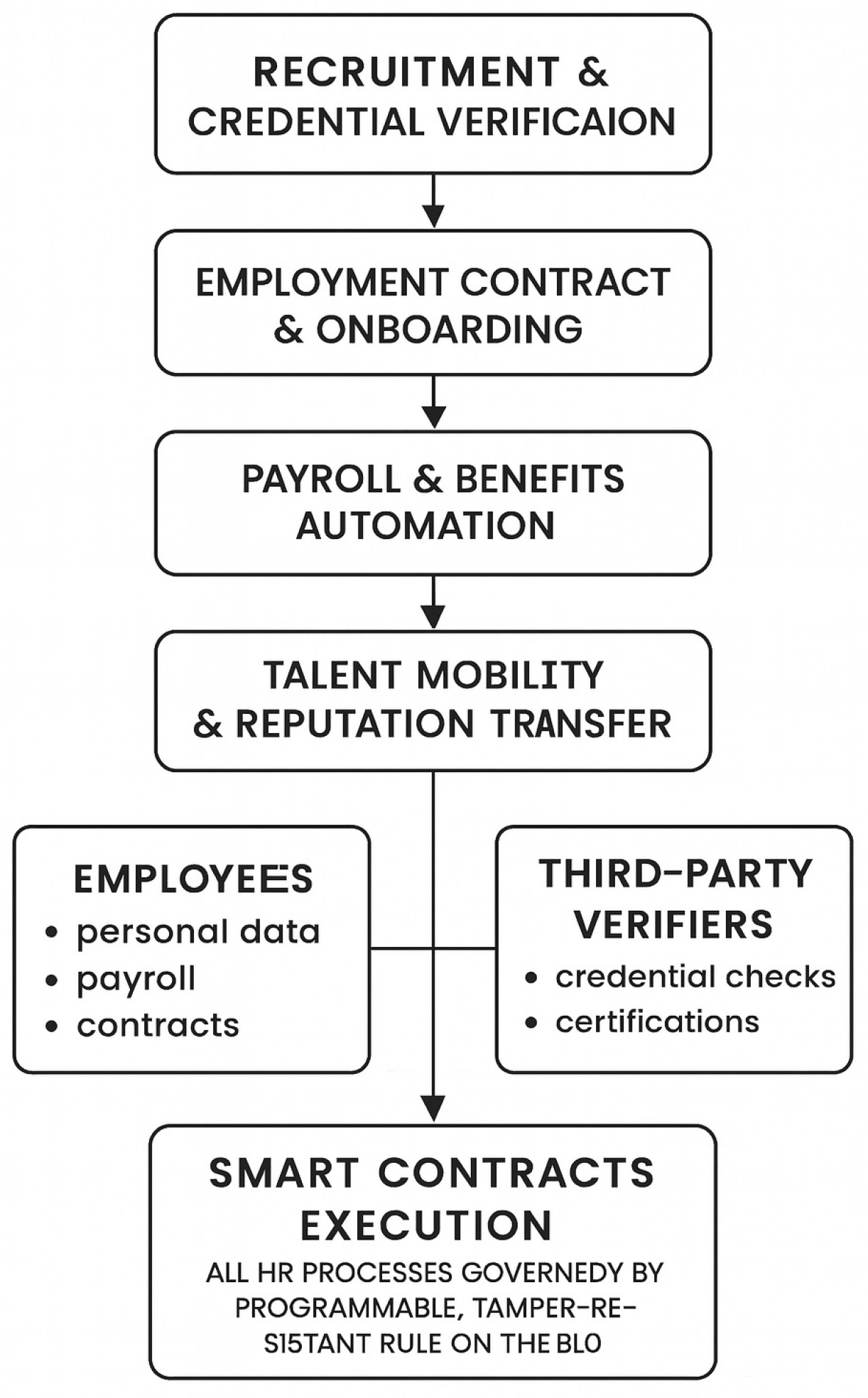
Smart contracts can offer several possible benefits for HR processes, including automation, transparency, and efficiency. Figure 2 illustrates how smart contracts automate recruitment, onboarding, payroll, performance management, and talent mobility in an HRM system. Several papers have noted the potential of smart contracts for optimizing HR functions. Sivathanu and Pillai [42] outline “Smart HR 4.0,” noting the disruption of traditional HR processes by technologies such as IoT, Big Data, and AI, as well as the automation of talent onboarding, development, and offboarding. This suggests smart contracts can be a key enabler in this transformation. Pipino et al. [43] present a blockchain-based system for digitalizing HR in Small and Medium Enterprises (SMEs), utilizing smart contracts for employment contracts in a transparent and traceable manner. Ofori-Mensah et al. [44] propose a design for a blockchain and smart contract-based system for authenticated academic certification, aiming to enhance verification processes.
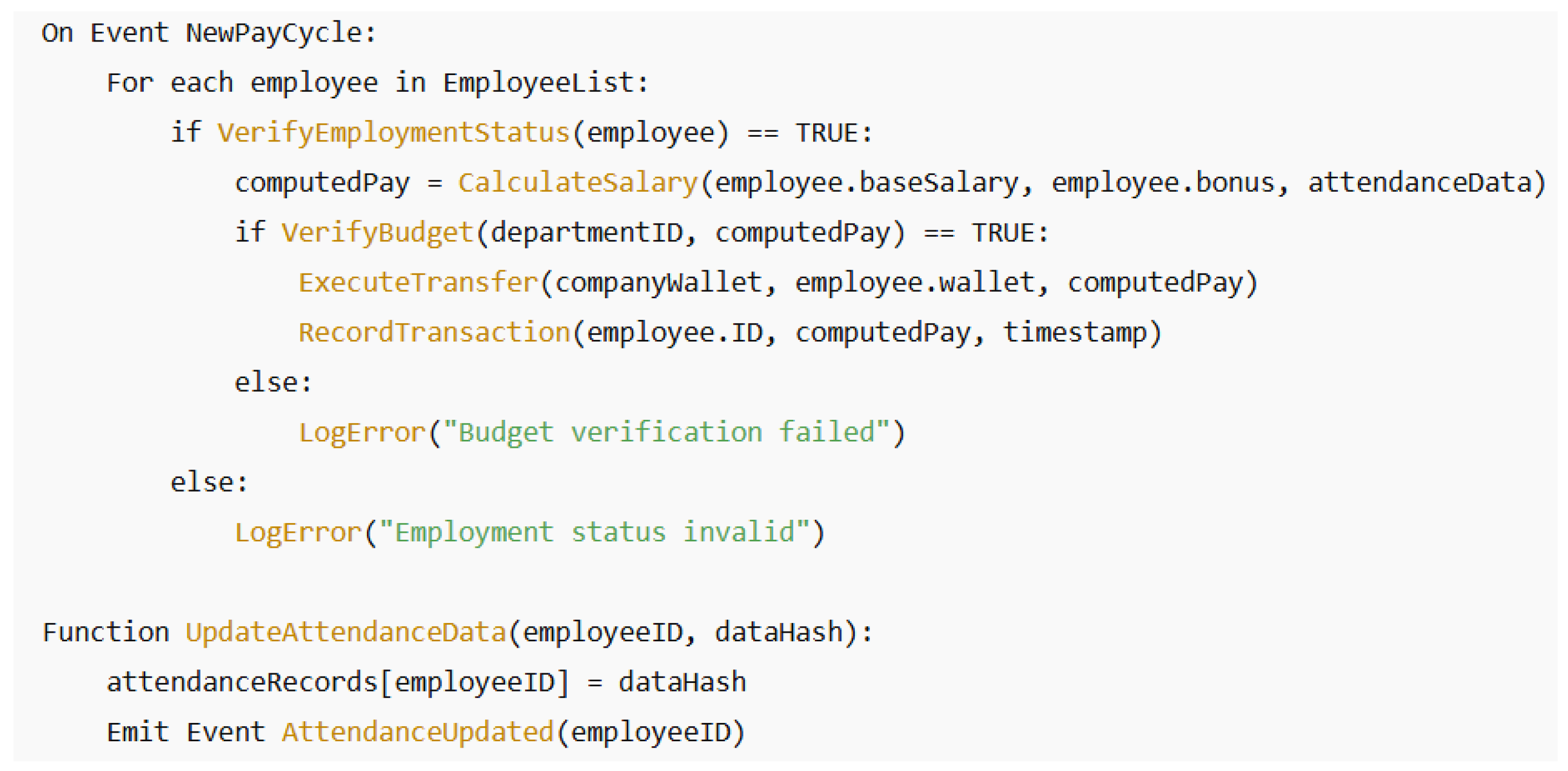
Clack et al. [45] lay the foundation for smart contracts by defining them as automatable and enforceable agreements, covering essential requirements and design decisions for legally enforceable smart contracts. Smart contracts enhance procurement efficiency in terms of cost, time, and quality, while also building trust through transparency and security [46]. These can be utilized for HR processes to promote efficiency and trust between employees and the firm. Wahab et al. [47] support this by demonstrating how smart contracts can reduce delays and disputes in construction management. In the design science research methodology, a framework integrating blockchain smart contracts is developed to address power imbalance issues in construction payment, resulting in transparent and decentralized decision-making [48]. Smart contracts offer potential benefits in several HR areas, as shown in Table 3. To demonstrate the logical feasibility of the proposed framework, the following pseudocode outlines a simplified smart contract for payroll processing within a blockchain-enabled HRM system (Figure 3):
One of the key architectural aspects of smart contracts, as described in the literature, is the development of safe and effective execution platforms. Müller et al. [54] introduce TZ4Fabric, an extension to Hyperledger Fabric that utilizes ARM TrustZone technology to enhance confidentiality and security when executing smart contracts. HR circumstances where personal employee data and contractual requirements must be protected from fraud are especially crucial. Trusted Execution Environments (TEEs) safeguard code and data, thereby overcoming significant security issues in HR smart contracts that manage sensitive data.
Smart contract design concepts remain important. Jurgelaitis et al. [55] presented MDAsmartCD, a model-driven development strategy that encompasses the entire smart contract development lifecycle, from computation-independent models to platform-specific code. Such approaches enable systematic and regular development, which HR systems need for compliance, accuracy, and audibility. Bagozi et al. [56] leverage semantic understanding and developer experience to search for smart contracts from multiple perspectives, thereby improving contract discoverability and reuse. This framework can help HR departments organize and access employment contracts, non-disclosure contracts, and benefit policies.
Smart contract upgradeability and adaptability are frequently stressed in the literature. Du et al. [57] propose a four-tier paradigm that enables on-chain upgrades, allowing contracts to be updated without interrupting ongoing activities. In HR applications, where laws and regulations frequently change, contract management must be adaptive while maintaining integrity and compliance. Security vulnerabilities and verification are top research priorities. Park, developed by Zheng et al. [58], improves smart contract vulnerability detection using parallel symbolic execution. Since HR-related smart contracts contain confidential information and penalties for breaches, they must be secure and accurate. Finding weaknesses can protect HR smart contract systems from attacks.
Real-world smart contract implementations in other areas show how HR processes use them. Shahzad et al. [59] developed a blockchain-based supply chain monitoring system incorporating smart contracts for enhanced traceability and verification. Pipino et al. [43] propose a blockchain platform for digitalizing HR with traceable relationship management in a microservices architecture. This platform demonstrates how smart contracts can make employment, certification, and performance appraisal records transparent and tamper-proof. Blockchain in HR processes help build stakeholder trust and simplify verification. In practical deployments, smart contract upgradability is essential because HR policies, regulatory requirements, and compensation structures evolve over time. Modern blockchain frameworks support upgradeability through proxy-based architectures, in which the contract’s storage is separated from its execution logic. The proxy contract remains permanent on the ledger, while the logic contract can be replaced with a new version, ensuring that historical records remain immutable while updated HR rules are applied going forward. This approach enables policy modifications without disrupting past payroll transactions, employment agreements, or auditability, thereby aligning blockchain immutability with the dynamic nature of HR governance.
External data dependencies and data integrity are discussed in the literature. Wang et al. [60] examine the complexity of smart contracts and their external data dependencies to help designers create secure and reliable contracts that utilize off-chain data. In HR applications, where external data like background screening, certification verification, and performance information is used, data integrity is crucial for contract validity and enforceability. New smart contract development and upgrading methods are also suggested. FlexiContracts, as described by Hossain et al. [61], simplify smart contract construction and upgradability, and facilitate iterative improvement. HR systems must be flexible enough to adapt to changing legal requirements, organizational policies, and technological advancements.

5. System Architecture for Blockchain-Enabled HRM

Blockchain technology could improve HRM systems. Blockchain offers security, transparency, and efficiency. For example, Nagothu et al. [61] introduce a novel secure smart surveillance system using microservices architecture and blockchain technology. Xu et al. [62] propose a Blockchain-Enabled Social Credits System (BLESS)-based approach to trustworthy and secure communities that reward inhabitants for socially worthwhile acts. Blockchain’s decentralized design enhances data privacy and security, addressing the vulnerabilities of centralized systems and their associated data breaches [63]. Blockchain’s immutable character ensures data integrity and protection against tampering, enhancing trust and accountability [64,65]. Blockchain-enabled identity verification allows secure and transparent credential and work experience verification, enabling efficient recruitment [66]. Blockchain streamlines and transparentizes HRM operations. Smart contracts can automate salary and performance reviews [61,62]. Blockchain design can make HRM operations more transparent, thereby boosting management-employee confidence [64,67].

5.1. Choice of Blockchain Type

There exist some works promoting the use of blockchain technology to enhance security and privacy in various applications, which can be translated to HRM systems. Ma et al. [68] propose a lightweight blockchain-based system for the Internet of Vehicles (IoV), focusing on hierarchical data sharing and a redesigned blockchain framework suitable for resource-constrained IoT devices. Similarly, Ismail et al. [69] introduce a lightweight blockchain solution for healthcare data management, focusing on scalability, fault tolerance, and privacy based on clustered networks and secure channels. Wan et al. [70] propose the use of blockchain architecture in smart factories as a solution to the problems inherent in traditional Industrial Internet of Things (IIoT) architectures. Since HRM deals with confidential employee data, Blockchain provides a trust mechanism [71]. Federated [72] and consortium blockchains [73,74] both offer data access management and privacy solutions, with data sharing managed by selected nodes and preselected nodes, respectively. These architectures can be tailored to meet the exact needs of an HRM system, finding a balance between data protection requirements and transparency. In addition, Blockchain offers a novel solution for securing Mobile Edge Computing (MEC) environments and protecting data [75]. The selection of the appropriate type of Blockchain, whether permissionless or permissioned, is a fundamental decision that significantly influences the system’s functionality, security, and the extent to which it meets organizational needs (Table 4).
The use of permissionless or permissioned blockchains has to consider the specific organizational environment and legal context. For instance, in heavily regulated sectors or jurisdictions with strict data privacy laws, permissioned blockchains will be preferred for their ability to enforce access controls and compliance measures. Permissionless blockchains may be better for open talent networks and decentralized autonomous organizations where decentralization and transparency are more important than confidentiality [79]. Hybrid blockchain models that customize HRM systems to both types have also been studied. Such approaches aim to combine the openness and security of permissionless blockchains with the privacy of permissioned systems. These new combinations offer significant potential for HRM applications, particularly as organizational needs become increasingly complex and diversified [80].

5.2. Data Flow Model

Some papers provide data flow models suitable for blockchain-based applications. Liang and Zhao [73] specify a system unifying “on-chain and off-chain” data storage using smart contracts, IPFS, and Web Services for effective and reliable data flow in a student quality appraisal system. Ma et al. [81] propose an edge computing and Blockchain technique-based secure distributed data aggregation and verification (SDAV) mechanism, suggesting a distributed data aggregation system that is highly appropriate for the secure collection and storage of data. Hossein et al. [82] highlight Supervisory Control and Data Acquisition (SCADA) systems, highlighting that blockchain technology has the potential to provide the essential features of decentralization, near real-time functionality, security, and privacy, while Hsiao and Sung [83] propose a blockchain-based supply chain information operation methodology to solve the current absence of business information sharing in the supply chain. These frameworks can be modified to achieve a secure and effective data flow in an HRM system, ensuring data integrity and accessibility. Blockchain interoperability can facilitate uninterrupted data flow between systems and networks [84].

5.3. Security and Privacy Mechanisms

Security and privacy are common issues in related works. Some research proposes mechanisms to achieve the same goal. Marwan et al. [85] propose the use of Attribute-Based Access Control (ABAC) with eXtensible Access Control Markup Language (XACML) policies and Blockchain for securing cloud-enabled IoT in healthcare. Similarly, Mei et al. [86] propose a blockchain-assisted privacy-preserving authentication protocol for transportation CPS, utilizing elliptic curve cryptography for anonymity and batch integrity verification. Qi et al. [87] introduce a consortium blockchain-based federated learning system with differential privacy for protecting model updates. Additionally, Chen et al. [88] propose a Decentralized Privacy-Preserving Deep Learning (DPDL) system for Vehicular Ad Hoc Network (VANET), utilizing fully homomorphic encryption and Blockchain to encrypt transportation data, thereby protecting the privacy and trustworthiness of vehicles. Khan et al. [74] proposed a blockchain-based Hyperledger Fabric-enabled consortium model called BIoMT. These frameworks can address security and privacy concerns in an HRM system, enabling compliance with regulations such as GDPR [89]. There are also other works introducing other in support of security and privacy, such as lightweight hybrid deep learning protocol [88], Blockchain and smart contract-based decentralized and dynamic consent system [90], multi-layered security federated learning [91], Blockchain-enabled Dew Servers [92], sharding-based scalable and secure approach to blockchain-based access control framework for IIoT [93], privacy protection scheme for epidemiological investigation [94], multi-agent reinforcement learning-based task-offloading strategy [95], Fog Computing Network Architecture Based on Dynamic Sharding Blockchain [96], VindSec-Llama Security Architecture [97], and Enhanced Privacy-Preserving Blockchain-Enabled Federated Learning (EPP-BCFL) [98]. In addition, homomorphic encryption and federated learning can provide secure data for medical AI systems [92,99]. The Integration of blockchain and trust chains can make processes more efficient and secure, demonstrating a double return on investment [100].
Deng et al. [101] discuss the security weaknesses of Blockchain and the potential leakage of users’ information. Rana et al. [102] caution that blockchain technology alone is insufficient for a better identity solution and that pragmatic guidelines are needed to help users make effective decisions. Another factor is the high energy consumption and low transaction throughput of permissionless blockchains, such as Bitcoin, making them unsuitable for all use cases [69]. Traditional blockchain scalability may not be able to meet the demands of real-time data processing, and the consensus algorithm may not be suitable for resource-constrained devices [75].

6. Comparative Analysis: Blockchain vs. Traditional HR Systems

Decentralization in Blockchain promotes transparency with a shared, verifiable ledger among approved parties [103,104,105,106]. Blockchain’s auditability enables easier tracing of modifications and data access, promoting accountability [105,106,107]. Smart contract integration can automate HR processes, making them more efficient and minimizing the scope for human error [108,109,110]. Smart contracts, for instance, can be used to automate payroll functions or authenticate employee credentials. Radjenovic [111] suggests that Blockchain can minimize information asymmetry and transaction costs, especially in data-intensive sectors such as e-health, mirroring HR’s requirement for secure and efficient data handling. Fraga-Lamas and Fernandez-Carames [112] refer to Blockchain’s ability to enhance data security, privacy, and authenticity, leading to improved operational efficiency in the automotive industry, and demonstrating its application across various industries.
The immutable ledger functionality ensures all transactions and input data are fixed and verifiable, with minimal opportunities for forgery and unauthorized alterations. This characteristic is particularly relevant to the management of personnel data, qualifications, and salary records, where reliability and accuracy are crucial. Tellew and Kuo [113] demonstrate how Blockchain and smart contracts can facilitate the decentralized management of healthcare training certificates, extending this to HR contexts, where staff credentials and compliance documents are examples. Such systems can significantly reduce administrative burdens and increase trustworthiness compared to paper-based or centralized digital systems. The cross-comparison by Kowsar and Mintoo [114] highlights the application of blockchain technology in banking, including loan processing, maintaining credit history, and eliminating age-old inefficiencies through automation and instant verification. The same would be held for HR systems where blockchain technology can streamline processes such as onboarding, credentialing, and payroll management. The use of smart contracts eliminates repetitive work, streamline processing, and reduces the likelihood of errors, which is a common weakness of conventional HR systems based on manual interventions and isolated data management.
The requirement to adjust transactions due to uncertainty and the necessity for accounting judgment presents a significant hindrance. Wang et al. [104] acknowledge the heterogeneity, time-variability, and non-interoperability of space-air-ground IoT systems, as well as the capacity and scalability limitations of existing blockchain solutions, as key barriers. Cost may also be a limiting factor [104,109,115]. Maurya and Dwivedi [116] recognize security and scalability issues in traditional e-voting systems as challenges, acknowledging that blockchain deployment must be well-planned to overcome these vulnerabilities. Furthermore, the technical expertise required for implementing and maintaining blockchain solutions could be an obstruction for some organizations [109].
The Integration of Blockchain with emerging technologies like AI and IoT holds the added promise of enhancing HR operations, including workforce analytics, talent management, and identity verification. The analysis of blockchain systems presents data regarding the different architectures found within various blockchain platforms that may facilitate their application in HR applications. Scalability, security, and interoperability are crucial considerations in system design for HR systems based on blockchain technology [117,118]. The choice of platform will impact not only system performance but also compatibility with legal and organizational specifications. Table 5 summarizes the comparative evaluation of blockchain and traditional HR systems across major dimensions derived from the literature.
Many studies show that blockchain provides tamper-proof, accessible repositories for employee data, automated payroll and reward management through smart contracts, and accountability with clearly visible audit trails. Such developments are believed to enhance the power of both employees and organizations while allowing secure and efficient HR operations to take place [12].
However, these benefits come with distinct trade-offs. There are recognized limitations to scalability, given current blockchain networks struggle with high throughput and large data requirements found in big organizations. The other prominent factor is cost, including substantial investments to get it running and continuous maintenance, as well as high energy usage by public blockchain networks. Adaptation and compliance with the regulatory environment keep on being an issue since organizations need to adapt to evolving regulations and ensure that best practices are put in place regarding data protection under strong laws like GDPR. Interoperability with legacy HR systems and the complexity of governance models often require careful technical and organizational alignment.
Scholarly reviews have also consistently underlined that blockchain in HR has a practical future as a complementary infrastructure and not a replacement. Successful implementation requires that an organization maintains alignment between technical architecture and regulatory and policy frameworks. In this way, an organization will ensure it is able to use blockchain as enabling infrastructure of trust and enhance its accountability, transparency, and data assurance without attempting an overall replacement of the existing HR systems [119].

7. Future Directions

Current HR technologies often operate in isolated systems, which limits their ability to scale or support transparency-driven governance. From a technology-adoption perspective, models such as the Technology–Organization–Environment (TOE) framework and Institutional Theory explain many of the barriers to blockchain adoption observed in HR contexts. Organizational resistance to transparency—for example, reluctance to expose decision-making processes, compensation rules, or audit trails—can be interpreted as a cultural and institutional barrier rather than a purely technical one. TOE highlights how perceived risks, resource constraints, and readiness influence adoption, while Institutional Theory explains how existing power structures and formal norms may resist blockchain’s decentralizing effects. Linking these perspectives clarifies why organizations may be hesitant to adopt tamper-evident HR systems, even when the technical benefits are substantial.
Smart contracts in HR automation will become more complicated and responsive. Smart contracts can incorporate AI and machine learning to respond to organizational behavior and adjust regulations in real-time. Adjustable smart contracts can remove performance reviews and customize benefit schemes based on real-time monitoring. These innovations will turn static HR workflows into smart, self-optimizing systems. The application layer will also become more user-centric, accessible, and easy to use. Future HR blockchain solutions will combine Augmented Reality (AR) and Virtual Reality (VR) to create interactive training, recruitment, and employee engagement venues. Integrating with natural language processing (NLP) tools will ease interactions, allowing HR and workers to communicate with blockchain systems, thereby reducing technical barriers to adoption.
Ethics and regulation will shape blockchain in HRM. When employee data is decentralized, privacy, international labor standards, and openness will be important priorities. There should be research to inform models of ethical stewardship, balancing innovation with responsibility. Policymakers, organizations, and technologists must collaborate to establish standards that promote trust, fairness, and equity, ensuring blockchain-enabled HRM evolves into a responsible and sustainable practice.
As future work, we will implement and validate the proposed blockchain-enabled HRM framework through multiple empirical case studies across different sectors (for example, technology and healthcare). These case studies will evaluate technical feasibility, performance (e.g., latency and throughput), privacy and regulatory compliance, and organizational adoption challenges, and will be used to refine the smart contract designs and governance models.

8. Conclusions

In this study, blockchain-based HRM has been investigated as an innovative solution to the traditional constraints of opacity, inefficiency, and distrust in traditional HR systems. After a systematic examination of the multi-layered structure, data, consensus, smart contract, and application layers of Blockchain, the paper demonstrates how each one assists in building an enterprise-level HR system that offers transparency, tamper-resistance, and accountability among stakeholders. The proposed model expands beyond niche uses, such as validating credentials, and positions Blockchain at the core of end-to-end HR functions, including payroll, performance management, and talent mobility.
One of the contributions lies in defining design patterns for smart contracts that encapsulate contract relations, payroll payments, and incentives. In contrast to descriptive accounts in the current literature, this article defines such frameworks critically as concrete for implementing HR logic into enforceable digital contracts, with a focus on upgradeability, compliance, and dispute resolution as essential design imperatives. By situating these architectures within the context of more abstract system architecture choices —such as permissioned vs. permissionless chains, on-chain vs. off-chain storage, and privacy-preserving techniques, the research provides a technology-informed agenda for implementation.
A side-by-side comparison with traditional HR systems highlights the strengths of blockchain-based HRM in terms of data integrity, auditability, and trust. While centralized HR databases are susceptible to inaccuracy, tampering, and inefficiency, Blockchain creates a tamper-evident history of employee data that is transparent to rightful stakeholders. Smart contracts further decrease administrative overhead by automating low-value tasks, and consensus protocols ensure higher trust and certification of sensitive transactions, such as payroll or promotions. These relative outcomes shed light on Blockchain’s potential not as a replacement but as an add-on value to existing HR systems.
The paper identifies the unresolved questions of scalability, regulatory adherence, and Integration with legacy systems. Legal uncertainty regarding smart contracts, energy consumption of consensus algorithms, and the need for viable governance models remain barriers to general acceptance. These questions must be resolved by interdisciplinary collaboration at the nexus of technology, law, and organizational management. Future research must also focus on interoperability standards, privacy-preserving measures such as zero-knowledge proofs, and adaptive consensus algorithms specific to HRM use cases.
Blockchain-based HRM represents a paradigm shift toward more transparent, trustworthy, and globally interoperable human capital systems. The path forward involves not only technical innovation but also ethical and regulatory leadership in reconciling efficiency with employee rights and data privacy. If these are available, Blockchain can evolve from experimental pilots to mainstream HR infrastructures that enhance workforce mobility, reinforce trust between employers and employees, and allow organizations to thrive in the digital economy.

Author Contributions

Conceptualization, M.M. and H.T.; methodology, M.M. and H.T.; formal analysis, M.M.; writing—original draft, M.M.; writing—review & editing, H.T.; visualization, H.T.; supervision, M.M. and H.T. All authors have read and agreed to the published version of the manuscript.

Funding

This research received no external funding.

Informed Consent Statement

Not applicable.

Data Availability Statement

The original contributions presented in this study are included in the article. Further inquiries can be directed to the corresponding author.

Conflicts of Interest

The authors declare no conflicts of interest.

Abbreviations

The following abbreviations are used in this manuscript:
AIArtificial Intelligence
ARAugmented Reality
DAppDecentralized Application
DLTDistributed Ledger Technology
GDPRGeneral Data Protection Regulation
HRHuman Resources
HRISHuman Resource Information System
HRMHuman Resource Management
ICPSIntelligent Cyber–Physical Systems
IIoTIndustrial Internet of Things
IPFSInterPlanetary File System
ITInformation Technology
MECMobile Edge Computing
PBFTPractical Byzantine Fault Tolerance
PoAProof of Authority
PoRProof of Reputation
PoSProof of Stake
PoWProof of Work
SMESmall and Medium Enterprises
TEETrusted Execution Environment
VANETVehicular Ad Hoc Network
VRVirtual Reality
XACMLeXtensible Access Control Markup Language

References

  1. Kossek, E.E. Human resources management innovation. Hum. Resour. Manag. 1987, 26, 71–92. [Google Scholar] [CrossRef]
  2. Muller, M. Human resource management under institutional constraints: The case of Germany. Br. J. Manag. 1999, 10, 31–44. [Google Scholar] [CrossRef]
  3. Kandpal, B.C.; Sharma, D.; Pandey, S.; Gehlot, A.; Sudhanshu, S.; Duggal, A.S. Automated Intervention of Blockchain in Human Resource Management. In Proceedings of the 2023 International Conference on Disruptive Technologies (ICDT), Greater Noida, India, 11–12 May 2023. [Google Scholar]
  4. Innocenti, L.; Pilati, M.; Peluso, A.M. Trust as moderator in the relationship between HRM practices and employee attitudes. Hum. Resour. Manag. J. 2011, 21, 303–317. [Google Scholar] [CrossRef]
  5. Zu, X.; Fredendall, L.D. Enhancing six sigma implementation through human resource management. Qual. Manag. J. 2009, 16, 41–54. [Google Scholar] [CrossRef]
  6. Budhwar, P.; Malik, A.; De Silva, M.T.T.; Thevisuthan, P. Artificial intelligence–challenges and opportunities for international HRM: A review and research agenda. Int. J. Hum. Resour. Manag. 2022, 33, 1065–1097. [Google Scholar] [CrossRef]
  7. Byun, D.H.; Suh, E.H. Human resource management expert systems technology. Expert Syst. 1994, 11, 109–119. [Google Scholar] [CrossRef]
  8. Klopova, O.; Komyshova, L.; Simonova, M. Professional development in the field of human resource management of heads and specialists of the innovative organizations. Probl. Perspect. Manag. 2018, 16, 214. [Google Scholar] [CrossRef]
  9. Bah, M.P.; Duramany-Lakkoh, E.K.; Udeh, E. Assessing the Effect of Human Resource Information Systems on the Human Resource Strategies of Commercial Banks. Eur. J. Bus. Manag. Res. 2022, 7, 304–312. [Google Scholar] [CrossRef]
  10. Jumriani, J.; Anwar, A. Pengaruh Lingkungan Pengendalian Terhadap Fraud Pada Laporan Keuangan Pemerintah Daerah Kota Parepare. J. Ekon. Dan Bisnis 2019, 2, 79–86. [Google Scholar] [CrossRef]
  11. Mohammad Saif, A.N.; Islam, M.A. Blockchain in human resource management: A systematic review and bibliometric analysis. Technol. Anal. Strateg. Manag. 2024, 36, 635–650. [Google Scholar] [CrossRef]
  12. GUNAWAN, W.B. Implications of Blockchain Technology on Strategic Human Resource Practices: Potential Losses of Key Functions. J. Inf. Syst. Digit. Bus. 2022, 1, 34–44. [Google Scholar] [CrossRef]
  13. Abdullah, A.A.; Khanom, M.; Yusuf, A.; Tanko, M. Utilizing Blockchain and Smart Contracts to Enhance Transparency and Efficiency in Human Resources Management Processes: A Conceptual Approach. Ibaf E-Proc. 2024, 11, 350–358. [Google Scholar] [CrossRef]
  14. Mathew, J.; Mer, A.; Khan, F. Blockchain Smart Contracts in Human Resource Management: Application, Implementation Challenges, and Research Agenda. In Digital HR; Chapman and Hall/CRC: New York, UK, 2025; pp. 64–88. [Google Scholar]
  15. Sharif, M.M.; Ghodoosi, F. The ethics of blockchain in organizations. J. Bus. Ethics 2022, 178, 1009–1025. [Google Scholar]
  16. Ramachandran, R.; Babu, V.; Murugesan, V.P. The role of blockchain technology in the process of decision-making in human resource management: A review and future research agenda. Bus. Process Manag. J. 2023, 29, 116–139. [Google Scholar]
  17. Islam, S.; Apu, K.U. Decentralized vs. Centralized database solutions in blockchain: Advantages, challenges, and use cases. Glob. Mainstream J. Innov. Eng. Emerg. Technol. 2024, 3, 58–68. [Google Scholar]
  18. Supreet, Y.; Vasudev, P.; Pavitra, H.; Naravani, M.; Narayan, D.G. Performance evaluation of consensus algorithms in private blockchain networks. In Proceedings of the 2020 International Conference on Advances in Computing, Communication & Materials (ICACCM), Dehradun, India, 21–22 August 2020. [Google Scholar]
  19. Zhang, C.; Wu, C.; Wang, X. Overview of blockchain consensus mechanism. In Proceedings of the 2020 2nd International Conference on Big Data Engineering, Shanghai, China, 29–31 May 2020. [Google Scholar]
  20. Bouraga, S. A taxonomy of blockchain consensus protocols: A survey and classification framework. Expert Syst. Appl. 2021, 168, 114384. [Google Scholar] [CrossRef]
  21. Cruz, W.H.; Tylinski, K.; Moore, A.; Roche, N.; Vadgama, N.; Treiblmaier, H.; Shangguan, J.; Tasca, P.; Xu, J. Evolution of ESG-focused DLT research: An NLP analysis of the literature. arXiv 2023, arXiv:2308.12420. [Google Scholar]
  22. Xu, R.; Chen, Y.; Blasch, E.; Chen, G. Microchain: A hybrid consensus mechanism for lightweight distributed ledger for IoT. arXiv 2019, arXiv:1909.10948. [Google Scholar] [CrossRef]
  23. Masaud, T.M.; Warner, J.; El-Saadany, E.F. A blockchain-enabled decentralized energy trading mechanism for islanded networked microgrids. IEEE Access 2020, 8, 211291–211302. [Google Scholar] [CrossRef]
  24. Rehman, M.; Javaid, N.; Awais, M.; Imran, M.; Naseer, N. Cloud based secure service providing for IoTs using blockchain. In Proceedings of the 2019 IEEE Global Communications Conference (GLOBECOM), Waikoloa, HI, USA, 9–13 December 2019. [Google Scholar]
  25. Rehman, M.; Khan, Z.A.; Javed, M.U.; Iftikhar, M.Z.; Majeed, U.; Bux, I.; Javaid, N. A blockchain based distributed vehicular network architecture for smart cities. In Workshops of the International Conference on Advanced Information Networking and Applications; Springer: Berlin/Heidelberg, Germany, 2020. [Google Scholar]
  26. Sajid, M.B.E.; Ullah, S.; Javaid, N.; Ullah, I.; Qamar, A.M.; Zaman, F. Exploiting Machine Learning to Detect Malicious Nodes in Intelligent Sensor-Based Systems Using Blockchain. Wirel. Commun. Mob. Comput. 2022, 2022, 7386049. [Google Scholar] [CrossRef]
  27. Zhuang, Q.; Liu, Y.; Chen, L.; Ai, Z. Proof of reputation: A reputation-based consensus protocol for blockchain based systems. In Proceedings of the 1st International Electronics Communication Conference, Okinawa, Japan, 7–9 July 2019. [Google Scholar]
  28. An, J.; Cheng, J.; Gui, X.; Zhang, W.; Liang, D.; Gui, R. A lightweight blockchain-based model for data quality assessment in crowdsensing. IEEE Trans. Comput. Soc. Syst. 2020, 7, 84–97. [Google Scholar] [CrossRef]
  29. Dehez-Clementi, M.; Rabah, M.; Ghamri-Doudane, Y. A Privacy-preserving Proof-of-Reputation. In Proceedings of the 2023 IFIP Networking Conference (IFIP Networking), Barcelona, Spain, 12–15 June 2023. [Google Scholar]
  30. Xu, Y.; Zhang, H.; Ji, H.; Yang, L.; Li, X.; Leung, V.C.M. Transaction throughput optimization for integrated blockchain and MEC system in IoT. IEEE Trans. Wirel. Commun. 2021, 21, 1022–1036. [Google Scholar] [CrossRef]
  31. Asante, M.; Epiphaniou, G.; Maple, C.; Al-Khateeb, H.; Bottarelli, M.; Ghafoor, K.Z. Distributed ledger technologies in supply chain security management: A comprehensive survey. IEEE Trans. Eng. Manag. 2021, 70, 713–739. [Google Scholar] [CrossRef]
  32. Andrew, J.; Isravel, D.P.; Sagayam, K.M.; Bhushan, B.; Sei, Y.; Eunice, J. Blockchain for healthcare systems: Architecture, security challenges, trends and future directions. J. Netw. Comput. Appl. 2023, 215, 103633. [Google Scholar] [CrossRef]
  33. Anthony Jnr, B. Distributed ledger and decentralised technology adoption for smart digital transition in collaborative enterprise. Enterp. Inf. Syst. 2023, 17, 1989494. [Google Scholar]
  34. Shi, Z.; de Laat, Z.; Grosso, P.; Zhao, Z. Integration of blockchain and auction models: A survey, some applications, and challenges. IEEE Commun. Surv. Tutor. 2022, 25, 497–537. [Google Scholar] [CrossRef]
  35. Bihani, D.; Ubamadu, B.C.; Daraojimba, A.I. Integrating Blockchain with AI: A Data-Driven Model for Secure, Scalable Decentralized Finance (DeFi) Systems. World J. Innov. Mod. Technol. 2025, 9, 58–85. [Google Scholar]
  36. Soori, M.; Dastres, R.; Arezoo, B. AI-powered blockchain technology in industry 4.0, a review. J. Econ. Technol. 2023, 1, 222–241. [Google Scholar] [CrossRef]
  37. Babu, C.S.; William, M.P. Designing and Developing a Web3 Mobile Platform: Integrating Blockchain and AI for Enhanced Functionality, Security, and User Experience. In Architecting the Digital Future: Platforms, Design, and Application; IGI Global Scientific Publishing: Palmdale, PA, USA, 2025; pp. 397–434. [Google Scholar]
  38. Kouzinopoulos, C.S.; Giannoutakis, K.M.; Votis, K.; Tzovaras, D.; Collen, A.; Nijdam, N.A. Implementing a forms of consent smart contract on an IoT-based blockchain to promote user trust. In Proceedings of the 2018 Innovations in Intelligent Systems and Applications (INISTA), Thessaloniki, Greece, 3–5 July 2018. [Google Scholar]
  39. Lee, C.; Sung, N.; Nkenyereye, L.; Song, J. Blockchain enabled Internet-of-Things service platform for industrial domain. In Proceedings of the 2018 IEEE International Conference On Industrial Internet (ICII), Seattle, WA, USA, 21–23 October 2018. [Google Scholar]
  40. Wang, K.; Xie, W.; Wu, W.; Pei, J.; Zhou, Q. Blockchain-enabled IoT platform for end-to-end supply chain risk management. J. Blockchain Res. 2022, 1, 1–17. [Google Scholar]
  41. Adabara, I.; Sadiq, B.O.; Shuaibu, A.N.; Danjuma, Y.I.; Maninti, V. Trustworthy agentic AI systems: A cross-layer review of architectures, threat models, and governance strategies for real-world deployment. F1000Research 2025, 14, 905. [Google Scholar] [CrossRef]
  42. Sivathanu, B.; Pillai, R. Smart HR 4.0–how industry 4.0 is disrupting HR. Hum. Resour. Manag. Int. Dig. 2018, 26, 7–11. [Google Scholar] [CrossRef]
  43. Pipino, C.; Rocco, G.; Pagano, C.; Cipriano, A. An innovative blockchain-based system for human resources digitalization with traceable relationship management. In Proceedings of the ITM Web of Conferences, Marrakech, Morocco, 20–22 November 2024; EDP Sciences: Les Ulis, France, 2024. [Google Scholar]
  44. Ofori-Mensah, J.; Yaokumah, W.; Sakyi, E.A. Design of authenticated and trusted academic certification using blockchain technology. Int. J. Softw. Innov. (IJSI) 2022, 10, 1–19. [Google Scholar] [CrossRef]
  45. Clack, C.D.; Bakshi, V.A.; Braine, L. Smart contract templates: Foundations, design landscape and research directions. arXiv 2016, arXiv:1608.00771. [Google Scholar]
  46. Özkan, E.; Azizi, N.; Haass, O. Leveraging smart contract in project procurement through DLT to gain sustainable competitive advantages. Sustainability 2021, 13, 13380. [Google Scholar] [CrossRef]
  47. Wahab, A.; Wang, J.; Shojaei, A.; Ma, J. A model-based smart contracts system via blockchain technology to reduce delays and conflicts in construction management processes. Eng. Constr. Archit. Manag. 2023, 30, 5052–5072. [Google Scholar] [CrossRef]
  48. Wu, L.; Lu, W.; Chen, C. Resolving power imbalances in construction payment using blockchain smart contracts. Eng. Constr. Archit. Manag. 2025, 32, 1875–1902. [Google Scholar] [CrossRef]
  49. Serranito, D.; Vasconcelos, A.; Guerreiro, G.; Correia, M. Blockchain ecosystem for verifiable qualifications. In Proceedings of the 2020 2nd Conference on Blockchain Research & Applications for Innovative Networks and Services (BRAINS), Paris, France, 28–30 September 2020. [Google Scholar]
  50. Ibrahim, R.; Harby, A.A.; Nashwan, M.S.; Elhakeem, A. Financial contract administration in construction via cryptocurrency blockchain and smart contract: A proof of concept. Buildings 2022, 12, 1072. [Google Scholar] [CrossRef]
  51. Kumar, G.; Saha, R.; Gupta, M.; Kim, T.H. BRON: A blockchained framework for privacy information retrieval in human resource management. Heliyon 2024, 10, e33393. [Google Scholar] [CrossRef] [PubMed]
  52. Herbert, B. Moving employee talent key to competitive edge. Strateg. HR Rev. 2016, 15, 65–69. [Google Scholar] [CrossRef]
  53. Natarajan, D.S.; Sattibabu, K.; Subbaiah, B.; Dhinakaran, P.D.; Kumar, J.R.; Rajalakshmi, M. AI-powered strategies for talent management optimization. J. Inform. Educ. Res. 2024, 4, 1526–4726. [Google Scholar]
  54. Müller, C.; Brandenburger, M.; Cachin, C.; Felber, P.; Göttel, C.; Schiavoni, V. TZ4Fabric: Executing smart contracts with ARM TrustZone:(Practical experience report). In Proceedings of the 2020 International Symposium on Reliable Distributed Systems (SRDS), Shanghai, China, 21–24 September 2020. [Google Scholar]
  55. Jurgelaitis, M.; Čeponienė, L.; Butkus, K.; Butkienė, R.; Drungilas, V. Mda-based approach for blockchain smart contract development. Appl. Sci. 2022, 13, 487. [Google Scholar] [CrossRef]
  56. Bagozi, A.; Bianchini, D.; De Antonellis, V.; Garda, M.; Melchiori, M. A Multi-Perspective Framework for Smart Contract Search in Decentralised Applications Design. In International Conference on Enterprise Information Systems, ICEIS-Proceedings; Science and Technology Publications, Lda (SciTePress): Setúbal, Portugal, 2023. [Google Scholar]
  57. Du, Z.; Cheng, H.; Fu, Y.; Huang, M.; Liu, L.; Ma, Y. A Four-Tier Smart Contract Model with On-Chain Upgrade. Secur. Commun. Netw. 2023, 2023, 8455894. [Google Scholar] [CrossRef]
  58. Zheng, P.; Zheng, Z.; Luo, X. Park: Accelerating smart contract vulnerability detection via parallel-fork symbolic execution. In Proceedings of the 31st ACM SIGSOFT International Symposium on Software Testing and Analysis, Virtual, Republic of Korea, 18–22 July 2022. [Google Scholar]
  59. Shahzad, A.; Wenyu, C.; Kumar, R. Blockchain based monitoring on trustless supply chain processes. In Proceedings of the 2021 IEEE 6th International Conference on Cloud Computing and Big Data Analytics (ICCCBDA), Chengdu, China, 24–26 April 2021. [Google Scholar]
  60. Wang, Y.; Li, X.; Ye, S.; Xie, L.; Xing, J. Smart contracts in the real world: A statistical exploration of external data dependencies. arXiv 2024, arXiv:2406.13253. [Google Scholar] [CrossRef]
  61. Nagothu, D.; Xu, R.; Nikouei, S.Y.; Chen, Y. A microservice-enabled architecture for smart surveillance using blockchain technology. In Proceedings of the 2018 IEEE International Smart Cities Conference (ISC2), Kansas City, MO, USA, 16–19 September 2018. [Google Scholar]
  62. Xu, R.; Lin, X.; Dong, Q.; Chen, Y. Constructing trustworthy and safe communities on a blockchain-enabled social credits system. In Proceedings of the 15th EAI International Conference on Mobile and Ubiquitous Systems: Computing, Networking and Services, New York, NY, USA, 5–7 November 2018. [Google Scholar]
  63. Begum, K.; Rashid, M.M.; Mozumder, M.A.I.; Kim, H.-C. Leveraging the power of blockchain for secure healthcare data management system. In Proceedings of the 2023 26th International Conference on Computer and Information Technology (ICCIT), Cox’s Bazar, Bangladesh, 13–15 December 2023. [Google Scholar]
  64. Agbesi, S.; Asante, G. Electronic voting recording system based on blockchain technology. In Proceedings of the 2019 12th CMI Conference on Cybersecurity and Privacy (CMI), Copenhagen, Denmark, 28–29 November 2019. [Google Scholar]
  65. Taherdoost, H. The role of blockchain in medical data sharing. Cryptography 2023, 7, 36. [Google Scholar] [CrossRef]
  66. Hariyani, D.; Hariyani, P.; Mishra, S.; Sharma, M.K. A literature review on transformative impacts of blockchain technology on manufacturing management and industrial engineering practices. Green Technol. Sustain. 2025, 3, 100169. [Google Scholar] [CrossRef]
  67. Choudhary, D.; Sangwan, K.S.; Singh, A. Blockchain-enabled architecture for lead acid battery circularity. Sci. Rep. 2024, 14, 16467. [Google Scholar] [CrossRef] [PubMed]
  68. Ma, X.; Ge, C.; Liu, Z. Blockchain-enabled privacy-preserving internet of vehicles: Decentralized and reputation-based network architecture. In International Conference on Network and System Security; Springer: Berlin/Heidelberg, Germany, 2019. [Google Scholar]
  69. Ismail, L.; Materwala, H.; Zeadally, S. Lightweight blockchain for healthcare. IEEE Access 2019, 7, 149935–149951. [Google Scholar] [CrossRef]
  70. Wan, J.; Li, J.; Imran, M.; Li, D.; Fazal-e-Amin. A blockchain-based solution for enhancing security and privacy in smart factory. IEEE Trans. Ind. Inform. 2019, 15, 3652–3660. [Google Scholar] [CrossRef]
  71. Si, H.; Sun, C.; Li, Y.; Qiao, H.; Shi, L. IoT information sharing security mechanism based on blockchain technology. Future Gener. Comput. Syst. 2019, 101, 1028–1040. [Google Scholar] [CrossRef]
  72. Danish, M.; Hasan, M.S. Robust food supply chain traceability system based on haccp using federated blockchain: Robust food supply chain traceability system based on haccp using federated blockchain. KIET J. Comput. Inf. Sci. 2020, 3, 16. [Google Scholar] [CrossRef]
  73. Liang, X.; Zhao, Q. On the design of a blockchain-based student quality assessment system. In Proceedings of the 2020 International Conference on High Performance Big Data and Intelligent Systems (HPBD&IS), Shenzhen, China, 23 May 2020. [Google Scholar]
  74. Khan, A.A.; Wagan, A.A.; Laghari, A.A.; Gilal, A.R.; Aziz, I.A.; Talpur, B.A. BIoMT: A state-of-the-art consortium serverless network architecture for healthcare system using blockchain smart contracts. IEEE Access 2022, 10, 78887–78898. [Google Scholar] [CrossRef]
  75. Wu, J.; Bu, H.; Li, G.; Tian, G. Data privacy protection model based on blockchain in mobile edge computing. Softw. Pract. Exp. 2024, 54, 1671–1696. [Google Scholar] [CrossRef]
  76. Kişi, N. Exploratory research on the use of blockchain technology in recruitment. Sustainability 2022, 14, 10098. [Google Scholar] [CrossRef]
  77. Kambur, E.; Yildirim, T. From traditional to smart human resources management. Int. J. Manpow. 2023, 44, 422–452. [Google Scholar]
  78. Chhibber, S.; Rawat, B.; Tyagi, S.; Gupta, A. Assessing the practical implications of integrating blockchain technology into human resource management in digital era: An empirical study. In Proceedings of the 2024 Sixth International Conference on Computational Intelligence and Communication Technologies (CCICT), Sonepat, India, 19–20 April 2024. [Google Scholar]
  79. Horwitz, F.M. Future HRM challenges for multinational firms in Eastern and Central Europe. Hum. Resour. Manag. J. 2011, 21, 432–443. [Google Scholar] [CrossRef]
  80. Upadhyay, N. Demystifying blockchain: A critical analysis of challenges, applications and opportunities. Int. J. Inf. Manag. 2020, 54, 102120. [Google Scholar] [CrossRef]
  81. Ma, R.; Feng, T.; Li, Q.; Xiong, J. Blockchain-enabled secure distributed data aggregation and verification mechanism for IIoT. In Proceedings of the GLOBECOM 2022—2022 IEEE Global Communications Conference, Rio de Janeiro, Brazil, 4–8 December 2022. [Google Scholar]
  82. Hossain, M.T.; Badsha, S.; Shen, H. Porch: A novel consensus mechanism for blockchain-enabled future scada systems in smart grids and industry 4.0. In Proceedings of the 2020 IEEE International IOT, Electronics and Mechatronics Conference (IEMTRONICS), Vancouver, BC, Canada, 9–12 September 2020. [Google Scholar]
  83. Hsiao, S.-J.; Sung, W.-T. Blockchain-based supply chain information sharing mechanism. IEEE Access 2022, 10, 78875–78886. [Google Scholar] [CrossRef]
  84. Onifade, M.; Adebisi, J.A.; Zvarivadza, T. Recent advances in blockchain technology: Prospects, applications and constraints in the minerals industry. Int. J. Min. Reclam. Environ. 2024, 38, 497–533. [Google Scholar]
  85. Marwan, M.; Temghart, A.A.; Sifou, F.; AlShahwan, F. A decentralized blockchain-based architecture for a secure cloud-enabled IoT. J. Mob. Multimed. 2020, 16, 389–412. [Google Scholar] [CrossRef]
  86. Mei, Q.; Xiong, H.; Chen, Y.-C.; Chen, C.-M. Blockchain-enabled privacy-preserving authentication mechanism for transportation CPS with cloud-edge computing. IEEE Trans. Eng. Manag. 2022, 71, 12463–12474. [Google Scholar] [CrossRef]
  87. Qi, Y.; Hossain, M.S.; Nie, J.; Li, X. Privacy-preserving blockchain-based federated learning for traffic flow prediction. Future Gener. Comput. Syst. 2021, 117, 328–337. [Google Scholar] [CrossRef]
  88. Almaiah, M.A.; Khan, M.K.; Jadoon, M.M.; Attique, M.; Song, H.; Farouk, A. An AI-enabled hybrid lightweight authentication model for digital healthcare using industrial internet of things cyber-physical systems. Sensors 2022, 22, 1448. [Google Scholar] [CrossRef]
  89. Sartor, G.; Lagioia, F. The impact of the General Data Protection Regulation (GDPR) on artificial intelligence. Curr. Res. Inf. Syst. 2020. [Google Scholar] [CrossRef]
  90. Alhajri, M.; Rudolph, C.; Shahraki, A.S. A blockchain-based consent mechanism for access to fitness data in the healthcare context. IEEE Access 2022, 10, 22960–22979. [Google Scholar] [CrossRef]
  91. Mahmood, Z.; Jusas, V. Blockchain-enabled: Multi-layered security federated learning platform for preserving data privacy. Electronics 2022, 11, 1624. [Google Scholar] [CrossRef]
  92. Singh, P.; Kaur, A.; Hedabou, M. Blockchain and Dew Computing-based Model for Secure Energy Trading in Smart Grids. In Proceedings of the 2023 IEEE International Conference on Communications Workshops (ICC Workshops), Rome, Italy, 28 May–1 June 2023. [Google Scholar]
  93. Li, R.; Qin, Y.; Wang, C.; Li, M.; Chu, X. A blockchain-enabled framework for enhancing scalability and security in IIoT. IEEE Trans. Ind. Inform. 2022, 19, 7389–7400. [Google Scholar] [CrossRef]
  94. Han, Y.; Gao, J.; Guan, Z.; Chen, Z.; Ren, L. Privacy Protection Scheme for Epidemiological Investigation Based on Blockchain Technology. In Proceedings of the 2023 5th Blockchain and Internet of Things Conference, Osaka, Japan, 21–23 July 2023. [Google Scholar]
  95. Liu, C.; Sun, Z. A Multi-Agent Reinforcement Learning-Based Task-Offloading Strategy in a Blockchain-Enabled Edge Computing Network. Mathematics 2024, 12, 2264. [Google Scholar] [CrossRef]
  96. Wei, C.; Lin, H.; Que, Y.; Wang, X. FCDSB: A Fog Computing Network Architecture Based on Dynamic Sharding Blockchain for Consumer Electronics in AIoT. IEEE Trans. Consum. Electron. 2024, 71, 1957–1969. [Google Scholar] [CrossRef]
  97. Bandara, E.; Bouk, S.H.; Shetty, S.; Gore, R.; Kompella, S.; Mukkamala, R. VindSec-Llama—Fine-Tuned Meta’s Llama-3 LLM, Federated Learning, Blockchain and PBOM-enabled Data Security Architecture for Wind Energy Data Platforms. In Proceedings of the 2025 International Wireless Communications and Mobile Computing (IWCMC), Abu Dhabi, United Arab Emirates, 12–16 May 2025. [Google Scholar]
  98. KR, J. Blockchain-enabled federated learning with edge analytics for secure and efficient electronic health records management. Sci. Rep. 2025, 15, 27524. [Google Scholar] [CrossRef] [PubMed]
  99. Williamson, S.M.; Prybutok, V. Balancing privacy and progress: A review of privacy challenges, systemic oversight, and patient perceptions in AI-driven healthcare. Appl. Sci. 2024, 14, 675. [Google Scholar] [CrossRef]
  100. Khan, S.; Khan, M.; Khan, M.A.; Khan, M.A.; Wang, L.; Wu, K. A blockchain-enabled AI-driven secure searchable encryption framework for medical IoT systems. IEEE J. Biomed. Health Inform. 2025, 1–14. [Google Scholar] [CrossRef] [PubMed]
  101. Deng, H.; Cheng, Y.; Qiu, H.; Pang, M.; Zhu, P.; Zhao, H. Design and Implementation of Digital Transaction System Based on Blockchain Environment. In Proceedings of the 2020 3rd International Conference on Smart BlockChain (SmartBlock), Zhengzhou, China, 23–25 October 2020. [Google Scholar]
  102. Rana, R.; Zaeem, R.N.; Barber, K.S. An assessment of blockchain identity solutions: Minimizing risk and liability of authentication. In Proceedings of the IEEE/WIC/ACM International Conference on Web Intelligence, Thessaloniki, Greece, 14–17 October 2019. [Google Scholar]
  103. Wang, S.; Tang, X.; Zhang, Y.; Chen, J. Auditable protocols for fair payment and physical asset delivery based on smart contracts. IEEE Access 2019, 7, 109439–109453. [Google Scholar] [CrossRef]
  104. Wang, Y.; Su, Z.; Ni, J.; Zhang, N.; Shen, X. Blockchain-empowered space-air-ground integrated networks: Opportunities, challenges, and solutions. IEEE Commun. Surv. Tutor. 2021, 24, 160–209. [Google Scholar] [CrossRef]
  105. Junaid, L.; Bilal, K.; Shuja, J.; Balogun, A.O.; Rodrigues, J.J.P.C. Blockchain-enabled framework for transparent land lease and mortgage management. IEEE Access 2024, 12, 54005–54018. [Google Scholar] [CrossRef]
  106. Bello, H.O.; Idemudia, C.; Iyelolu, T.V. Integrating machine learning and blockchain: Conceptual frameworks for real-time fraud detection and prevention. World J. Adv. Res. Rev. 2024, 23, 56–68. [Google Scholar] [CrossRef]
  107. Omisola, J.O.; Bihani, D.; Daraojimba, A.I.; Osho, G.O. Blockchain in supply chain transparency: A conceptual framework for real-time data tracking and reporting using blockchain and AI. Int. J. Multidiscip. Res. Growth Eval. 2023, 4, 1238–1253. [Google Scholar] [CrossRef]
  108. Ugochukwu, N.A.; Goyal, S.B.; Rajawat, A.S.; Verma, C.; Illés, Z. Enhancing logistics with the Internet of Things: A secured and efficient distribution and storage model utilizing blockchain innovations and interplanetary file system. IEEE Access 2023, 12, 4139–4152. [Google Scholar] [CrossRef]
  109. Fahdil, H.N.; Hassan, H.M.; Subhe, A.; Hawas, A.T. Blockchain technology in accounting transforming financial reporting and auditing. J. Ecohumanism 2024, 3, 216–233. [Google Scholar] [CrossRef]
  110. Chatterjee, P. Smart Contracts and Machine Learning: Exploring Blockchain and AI in Fintech. Indian J. Sci. Technol 2025, 18, 113–124. [Google Scholar] [CrossRef]
  111. Radjenovic, Z. The cost-saving role of blockchain technology as a data integrity tool: E-health scenario. KnE Soc. Sci. 2020, 2019, 339–352. [Google Scholar] [CrossRef]
  112. Fraga-Lamas, P.; Fernández-Caramés, T.M. A review on blockchain technologies for an advanced and cyber-resilient automotive industry. IEEE Access 2019, 7, 17578–17598. [Google Scholar] [CrossRef]
  113. Tellew, J.; Kuo, T.-T. CertificateChain: Decentralized healthcare training certificate management system using blockchain and smart contracts. JAMIA Open 2022, 5, ooac019. [Google Scholar] [CrossRef] [PubMed]
  114. Kowsar, M.M.; Mintoo, A.A. Blockchain in banking: A review of distributed ledger applications in loan processing, credit history, and compliance. Am. J. Sch. Res. Innov. 2025, 4, 101–138. [Google Scholar] [CrossRef]
  115. Igwe, A.N.; Ewim, C.P.-M.; Ofodile, O.C.; Sam-Bulya, N.J. Leveraging blockchain for sustainable supply chain management: A data privacy and security perspective. Int. J. 2024, 3, 61–75. [Google Scholar]
  116. Maurya, A.; Dwivedi, R.K. Designing a secure large scale e-voting system leveraging sharding blockchain with interoperability protocol and consensus mechanism. In Proceedings of the 2024 International Conference on Intelligent and Innovative Technologies in Computing, Electrical and Electronics (IITCEE), Bangalore, India, 24–25 January 2024. [Google Scholar]
  117. Ochigbo, A.D.; Tuboalabo, A.; Labake, T.T.; Buinwi, U. Legal frameworks for digital transactions: Analyzing the impact of Blockchain technology. Financ. Account. Res. J. 2024, 6, 1205–1223. [Google Scholar] [CrossRef]
  118. Huang, J.; Niu, Y.; Li, X.; Li, Z. Comparative Analysis of Blockchain Systems. arXiv 2025, arXiv:2505.08652. [Google Scholar] [CrossRef]
  119. Akbar, A.; Djamaliyah; Aisyah, N.; Anshori, M.I. Blockchain-based leadership: How blockchain technology enhances transparency and accountability in organizational leadership. J. Ilm. Manaj. Kesatuan 2025, 13, 999–1008. [Google Scholar] [CrossRef]
Figure 1. Stakeholder mapping in blockchain-enabled HRM ecosystem.
Blockchains 04 00002 g001
Figure 2. Smart contract workflow for HR processes.
Blockchains 04 00002 g002
Figure 3. A simplified smart contract for payroll processing within a block-chain-enabled HRM system.
Blockchains 04 00002 g003
Table 1. Comparison of major blockchain consensus mechanisms and their HRM suitability.
AlgorithmTypeStrengthsWeaknessesHRM Suitability
Proof of Work (PoW)Permissionless/PublicProven security; high data integrity through computational validation; resilient to malicious attacks.Very high energy consumption; low throughput; latency unsuitable for enterprise HRM.Not ideal for HRM where energy efficiency and privacy are critical.
Proof of Stake (PoS)Permissionless/Semi-publicEnergy-efficient; faster block creation; economic incentive aligns validator honesty.Risk of wealth concentration; limited governance flexibility.Suitable for open, talent-mobility platforms but not for confidential HR data.
PBFTPermissioned/PrivateHigh throughput; low latency; tolerates up to ⅓ malicious nodes; deterministic finality.Requires trusted validators; scalability limited to small networks.Appropriate for enterprise or consortium HR systems with known participants.
PoAPermissioned/PrivateEfficient and fast; minimal computation cost; validator accountability via identity.Relies on validator honesty; partial centralization risk.Fits corporate HRM needing compliance, privacy, and controlled access.
Proof of Reputation (PoR)Hybrid/PermissionedIncentivizes consistent and ethical participation; reputation-based fairness.Complex reputation scoring; potential bias if reputation metrics are opaque.Useful for performance appraisal or promotion systems where stakeholder trust is central.
Table 2. Functional layers and literature insights of the blockchain-enabled HRM ecosystem.
LayerTechnical FeaturesHRM RelevanceReferences
Data LayerDistributed ledger technology (DLT), decentralized storage, tamper-proof architecture.Provides a trusted foundation for all HR processes, preventing data manipulation and loss of integrity.[31]
Consensus LayerConsensus algorithms (PoW, PoS, PBFT, PoA); fault tolerance; permissioned protocols.Ensures the authenticity and accuracy of HR data, which is critical for payroll, contracts, and compliance.[32,33]
Smart Contract LayerOn-chain business logic, cryptographic execution, and tamper-resistant automation.Translates HR policies into self-executing rules, reducing intermediaries and errors.[31,34,35]
Application LayerdApps, Web3, dashboards, portals, mobile apps; visualization and analytics tools.Bridges technical infrastructure with practical HR functions; enhances usability and adoption.[36,37]
Table 3. Potential applications of smart contracts in HR management.
HR AreaRole of Smart Contracts/TechnologyBenefitsReferences
Recruitment and Credential VerificationEnforce decentralized verification of higher education certificatesAuthenticity, integrity, and reduced risk of counterfeit credentials[49,50]
Employment Contracts and OnboardingAutomates legal relationships and bureaucratic tasksSimplification, reduced cost, improved efficiency[43,51]
Payroll and BenefitsBlockchain-based payroll and benefits processing, SaaS integrationFaster transactions, transparency, and reduced errors[52]
Performance ManagementAI and smart contracts integrated with talent managementEnhanced feedback, real-time monitoring, and fair evaluation[53]
Talent MobilityTechnology-enabled workforce mobility optimizationEnsures the right talent placement and agility in workforce planning[52]
Table 4. Comparative characteristics of blockchain dimensions relevant to HRM implementation.
Blockchain Type/Consensus RelevanceOpportunitiesLimitationsReference
Favors permissioned blockchains for confidentiality and controlled accessImproves the integrity and transparency of recruitment data; strengthens trust in employee record managementData privacy and regulatory compliance concerns in handling sensitive HR data[76]
Permissioned blockchains are recommended due to organizational control and restricted accessProvides secure, transparent, and tamper-proof employee records (employment history, payroll, certifications)Need for managing access rights carefully to protect sensitive information[77]
Permissioned blockchains align better with HR privacy and compliance needsEnhances HR productivity, confidentiality, and regulatory compliancePermissioned blockchains require careful governance to manage access rights and validator roles. Although they enhance privacy, they may introduce partial centralization, and scalability can be constrained by the limited number of participating nodes.[78]
Table 5. Comparison of traditional vs. blockchain-enabled HR systems.
CriterionTraditional HR SystemsBlockchain-Enabled HR SystemsRelative Advantage
Transparency and AuditabilityData visible only to administrators; audit trails often manual.Immutable shared ledger; every transaction verifiable by design.High
Automation and EfficiencyManual approval chains; prone to delay and error.Smart contracts execute predefined HR rules autonomously.High
Data Integrity and TrustCentralized databases; vulnerable to alteration.Distributed consensus ensures tamper-evident records.High
Security and ComplianceControlled by internal IT; compliance relies on policy enforcement.Secured via cryptography; needs legal adaptation for data privacy.Moderate
Scalability and IntegrationEasily scalable with traditional infrastructure but limited interoperability.Dependent on consensus type; scalable via modular design and AI integration.Moderate
Disclaimer/Publisher’s Note: The statements, opinions and data contained in all publications are solely those of the individual author(s) and contributor(s) and not of MDPI and/or the editor(s). MDPI and/or the editor(s) disclaim responsibility for any injury to people or property resulting from any ideas, methods, instructions or products referred to in the content.