Review

Cultural Value or Food Culture: Critiquing the Importance of Vocabulary, Context and Meaning in Food Studies


by
Sophia Lingham-Tsiaparas
1,
Damian Maye
2 and
Louise Manning
3,*
1
Department of Agriculture, Royal Agricultural University, Stroud Road, Cirencester, Gloucestershire GL7 6JS, UK
2
Countryside and Community Research Institute, University of Gloucestershire, Francis Close Hall Campus, Swindon Road, Cheltenham GL50 4AZ, UK
3
The Lincoln Institute of Agri-Food Technology, University of Lincoln, Lincoln LN2 2DP, UK
*
Author to whom correspondence should be addressed.
Gastronomy 2026, 4(2), 12; https://doi.org/10.3390/gastronomy4020012
Submission received: 4 April 2026 / Revised: 26 May 2026 / Accepted: 5 June 2026 / Published: 10 June 2026
(This article belongs to the Special Issue Social Research and Approaches in Gastronomy and Cuisines)

Abstract

Throughout history, communities have experienced changes in their food culture and their cultural interactions and relationships with food. Weak relationships with food, and more widely with people through food, reduce the perceived cultural value of food and its role in a healthy lifestyle, which can lead to poor food-related health outcomes. This exploratory narrative review seeks to explore the extant literature as a grounding for empirical research focused on differentiating between food culture and the relational and cultural values associated with food, i.e., articulating the difference between value-based and values-based food networks. Terms emergent from the academic and grey literature were familial and cultural grounding of respect for food, through food and via food environments to develop relationships with food, trust and identity. The concepts of ‘food culture’ and an individual perceiving a ‘cultural value of food’ were found to be distinct, but not mutually exclusive. Alternative food networks (AFNs) were positioned as more able to facilitate the development of values-based food networks than conventional food systems. This work contributes to improving clarity of language when considering non-financial value and values associated with food.

1. Introduction

Throughout history, via colonisation, globalisation or migration, communities have experienced change in their cultural interactions and relationships with food [1]. These are often categorised by country or region; as an example, the Mediterranean ‘diet’ is generally seen as a healthier diet [2,3], with consumers displaying a more wholesome relationship with food, which is perceived to be vital to both community and culture [4,5]. Other regions, like Western Europe and North America, are positioned as having disconnected or unhealthier relationships with food, with a cultural focus on processed, ultra-processed and ‘fast’ food, where natural food is less intrinsic to their diets [3]. This diminished quality of the relationship with food is often linked to unsustainable, trapping food systems [6], food price volatility, lack of “trust, confidence and morale” and food scandals [7], which negatively affect mental and physical health, environmental health, and economic and food system resilience [7,8,9,10]. Weak levels of affordability of local or high-quality foods also contribute to food insecurity [11,12]. When combined with a lack of intergenerational cooking skills and food-related knowledge exchange, this can have detrimental consequences for health and wellbeing [13].
In the United Kingdom (UK) and globally, there is vast literature on alternative food networks (AFNs) or local food networks (LFNs) [14,15,16], especially the role of farmers’ markets [17,18]. Further, in recent years, there has been increased engagement by consumers to participate in AFNs and a resurgence of interest in more natural and local products [19,20], demonstrating a realignment of the value and values assigned to food and potentially the emotions surrounding it. New food environments have emerged, demonstrating how “attitudes and values are shifting and the channels through which individuals and households purchase food are diversifying” [21] (p. 39). There were fewer than 10 UK farmers’ markets in 1997, rising to over 200 in 2002 and 750 in 2012 [22]. People growing their own food, especially in urban areas [23], saw allotment demand rise, with 69% of 87 UK councils having 100–400 people on waiting lists for allotments in 2019, and the COVID-19 pandemic resulting in 90% of local authorities witnessing a rise in demand for allotments, in one local authority by 300% [24].
Whilst larger organisations are concentrating on value co-creation and value retention at scale [25], food micro, small- and medium-sized enterprises (MSMEs) often situated within these AFNs, work from the bottom up, creating social impact, through responding to societal values (such as animal welfare, environmental sustainability, circularity and fair wages and prices) as a catalyst for social change [26,27,28,29]. These societal values are framed by the cultural imperatives of a given community, as in the previous UK example. With many failings within the contemporary food system, Lingham et al. [30] suggest there is a need to intellectually and empirically go ‘back to basics’, to understand the people involved at each stage and location in the food system and what each value; to understand peoples’ emotions and the importance they give to interacting with food and to explore how this understanding is fundamental to developing a more appropriate, resilient and sustainable food system. Thus, this exploratory narrative review seeks to explore the extant academic and grey literature as a grounding to future empirical research focused on differentiating between the concepts of food culture and the relational and cultural values associated with food, informing a critique of the difference between value-based supply chains and values-based food networks.
Multiple studies and much of the literature explore consumers’ attitudinal and behavioural relationship with food. This work concentrates on both positioning financial value (e.g., willingness to pay) and consumers’ perceptions of different characterisations or claims associated with food products. Indeed, claims such as organic status (production-related value) or localised food production (supply-related value) seek to link food products with normative principles and value-based definitions, rather than the intrinsic (product quality) or emotio-cultural values [30]. Existing research often explores specific AFN examples or discrete health studies [27,31,32,33]. The contribution of the paper is to build upon the alter-values typology coined by Lingham et al. [30] and emergent themes including familial and cultural grounding of food-related values, food culture, the influence of food environment, trust and identity. Indeed, seeking to gain a better understanding of the context herein led to two specific research questions:
RQ1. What contextualization emerges of value-based supply chains and values-based food networks?
RQ2. What aspects of grounding of food-related values emerge from the literature?
The paper is structured as follows: Section 1 is the introduction and Section 2 positions the methodological and conceptual grounding of the study. Section 3 explores the narratives of AFNs and Section 4 considers trust, familial and cultural and environmental grounding of relationships with food and food environments and identity to differentiate between food culture and food-related cultural value. Section 5 concludes the paper.

2. Methodology and Conceptual Grounding

2.1. Methodology

This paper used a grounded foundational review of academic and grey literature driven by specific search terms and then emergent additional search terms to inductively derive and develop specific themes and an exploratory narrative to inform future empirical research. The alternative methodological approach would have been to rely on a deductive forcing of extant theories, which is not suitable for an emergent, cross-disciplinary study within the academic literature [34]. The search terms that emerged from the exploration of academic and grey literature using ScienceDirect, Google Scholar and Google are synthesised in Table 1. Search terms were used in multiple iterative combinations until evidence saturation was reached, i.e., no additional sources of value were derived from the searches [35]. Any inferences derived from these sources are framed within this methodological caveat. Initially, the terms values, food value and values-based were used to draw out the value versus values-based discourse. Then the search focused on the AFN literature in particular. The evidence derived from each search was screened and considered for its relevance, explanatory power, and applicability to the focus and scope of the narrative review, shaping this paper through triangulation of secondary evidence [36]. The titles and abstracts were considered to ensure the remaining papers were relevant and duplication was removed. The literature was then read, and any audio sources listened to/watched, screened once again for relevance to the research. A potential limitation of this approach is that some grey sources cited may not be academically robust in terms of their representativeness or generalisability but rather support descriptive contextualization of narrative perspectives. Evidence saturation was determined using Rahimi and Khatooni’s [37] rationale of theoretical saturation in grounded theory, i.e., evidence saturation is the point in iterative research when no additional evidence is found that allows for further development of the properties of the case, its positioning, and meaning, the associated concepts and/or to deepen the findings associated with the research questions [36]. In summary, context and thematic saturation occurred when no new themes or relationships emerged from the evidence available [38]. The Naeem et al. [36] framework has been followed:
  • Perspectivization (which has informed the structure of the paper);
  • Recapitulation (summarising the findings);
  • Integration (connection and sensemaking);
  • Crystallisation (reflection and critique);
  • Edification (synthesis and conceptual articulation).
A total of 180 sources were used to underpin the PRICE approach. Following the recapitulation phase, the generation of themes arose from a series of reflexive discussions with all authors, which informed the development of the paper’s narrative and argument. This ensured quality control and limited the subjectivity of any deductions from any one author. Initial themes related to the characterisation of the dualism between AFNs and conventional food systems, and positioning of value versus values, which led to the development of a typology [30]. Then the constructive grounding of food culture and food-related cultural values emerged.

2.2. Conflation Causes Confusion: Food Culture or Cultural Value of Food

This section provides a grounding to the distinction in this work between the cultural value of food and food culture to consider their interchangeable usage in academic literature. Mingay [39] (p. 2) defined food culture as follows:
“what we do, think and feel around food as an individual or group, within the social and environmental constructs at that time [influenced by] our surrounding environments, food socialization and cultural practices (people, place, policy and time) that interact… [it] encompasses cultivated and shared knowledge and behaviors through inherited ideas and learning and accumulated experience throughout our lives that mold our beliefs and values around, and relationship with, food and eating.”
Food culture can be linked to geography or a tradition or practice. Food culture can thus exist at a variety of levels [40], from the micro-level (family) to the macro-level (countries, regions, etc.). From a national perspective, cultural events include religious festivals and family meals and whilst participating individuals may derive non-financial value linked to, for example, connecting with family during the meal. Food-related cultural value can be associated with these foods through the positive memories aligned with them and the practices that continue within familial food culture. Further iterations of food culture, e.g., eating lunch alone at the computer rather than at a table with others, do not necessarily engender attitudinal or behavioural engagement with food-related values. Being exposed to different foods can lead to acculturation via connection and a food becoming part of an individual’s food culture. Food experiences, such as when on holiday, ensure traditions remain relevant, such as linking a food with a specific location, but individuals may choose to then experience those foods, or similar foods, at other times. This suggests that food culture is adaptive, not static, being a living expression of the ancestral practice which evolves with human need [41]. Alternatively, it is possible to experience food culture without it interfacing with one’s identity or own food culture, for example:
“Ethnic restaurants… appeal to natives of the homeland represented by offering familiarity and authenticity in foods served. For those who do not share the ethnicity of a dining establishment, the experience allows them to explore the novelty of a different and maybe even unfamiliar culinary adventure.”
[42] (p. 5)
In summary, cultural value can be associated with the social and cultural significance and symbolism of food and the connection with food through beliefs, values and identity, and sharing food (conviviality or commensality) as a form of hospitality or to show respect for others. This has been articulated as emotion–cultural value [30]. Thus, cultural value requires an element of proactivity and desire for connection, with the food and with others through the food. Food culture can be expressed as a form or descriptor of food, for example, choosing to purchase food from the Italian, Chinese or Japanese sections in the aisles of a supermarket or seeking to follow the Mediterranean Diet compared to a Westernised food diet. Food culture can be reinforced by habit and repeated behaviours and may, or may not, drive an individual to actually perceive an intrinsic value associated with the food or can align with an individual’s values, beliefs or sense of identity. This grounding of terms has informed the narrative review. The examples in the paper are given in the UK context, being the location of the research and for consistency, and supplemented when examples from other countries strengthen the narrative and argument.

3. Exploring the Narratives on AFNs

AFNs provide an ‘alternative’ to food retail supermarkets for consumers to purchase food [26]. However, they are not a new phenomenon; indeed, many major UK supermarkets originated from being MSMEs. Despite their rise in the latter half of the C.20th in the UK to a point of market domination, consumer participation in AFNs has endured with their numbers and diversity rising in recent decades, accompanied by a collective desire to reconnect consumers, producers and food [32,43].

3.1. The Dualism of AFNs and Conventional Food Systems

Financial pressures since the 2007–2008 global economic downturn have led to a loss of purchasing power within sections of the middle classes [44,45]. The impacts of Brexit, the Ukraine–Russia conflict and the COVID-19 pandemic have further exacerbated socio-economic conditions in the UK, resulting in unequal food distribution, the rise in food aid (e.g., food banks), and a questionable level of food system resilience across these crises. [46,47,48]. Politico-social disenchantment too with genetically modified foods, and the perceived importance of animal welfare, in the UK and across Europe, led to a “rejection of capitalist produced and retailed food” by some consumers [49] (p. 86) [50]. Environmental and social consumer awareness of sustainability issues and injustices has also driven the rise in AFNs in Europe [44,51,52].
The dominance of supermarkets and large corporate agribusinesses has supported physical, logistical, technical, and transport infrastructural integration, scale and capacity, and the introduction of private agri-food governance structures such as third-party certification privatising food safety and quality compliance assessment. This dominance has lead to foreign-direct investment, and multinational corporation-led retail models that have localised power, driven cost reduction and aggressive competition in a commoditised food retail market [53,54,55,56,57]. Part of the appeal of financial capital-based markets is that they allocate the value of goods non-judgmentally; if someone is willing to pay for a food product and another to sell the food product per se, “the economist does not ask whether the parties have valued the goods appropriately”, as this would require them to judge the virtue of goods and decisions and thus “violate the strictures of a purportedly value-neutral science.” [58] (p. 127). However, this transactional framing on monetary exchange value de-links economic attributes from the social and cultural value of food [59,60], whilst economics itself is perceived as “value-neutral” [58], markets debatably taint the goods they exchange, reframing the character and meaning of the associated social practice [58], even corrupting or eliminating any moral, social or cultural pre-existing beliefs in favour of monetary value. Indeed, supplying an object on purely commercial terms (value), the “commercialisation effect” will change the perceived innate or intrinsic value of the object as well as the values such as altruism or love for others, nature, etc., associated with it [61]. In summary, goods traded commercially often become revenue generators alone, changing purchasers’ perception of them, and facilitating a supply and demand market where price is king.
Equality of access to supply or purchase food within AFNs is not guaranteed to all citizens or food businesses. Indeed, lack of agri-food knowledge, the continued dominance of supermarkets, and current food cooking norms have, Lutz and Schachinger [62] (p. 4791) argued, made it difficult for LFNs to reach the “average” consumer… [or to] make healthy and sustainable food accessible to everyone.” Both supermarket supply chains and AFNs can be described as operationalising forms of food culture, as, using Mingay’s definition [39], each format presents a socially constructed food environment which promotes collective consumer behaviours. However, this does not mean that in these constructed food environments values-based interactions with food are either present or promoted. The lack of food belief and values consciousness and socialisation in some retail environments may limit the control consumers actually have over their own food choices [63]. Whilst Laroche et al. [64] demonstrate how consumers become increasingly aware of the power of their purchasing behaviour in directly impacting the agricultural environment, more recently, Chiffoleau et al. [65] argue that consumers are merely persuadable actors at the mercy of the market-based system. Further, markets force consumers to maximise what they get and minimise what they give, often triggering a form of moral decay, with markets concentrating only on the financial value of food, or other aspects influenced by food choices such as ‘time’ [60]. Indeed, markets, and the organisations within them, have disconnected consumers from the intrinsic value of food, providing food choices that include environmentally extractive and nutritionally deficient products, and also cementing convenience as a headline attribute of perceived value [66]. Arguably, perceiving a cultural value for a food cannot exist when disconnection occurs. AFNs may facilitate this connection, and thereby cultural value related to food, when value-driven supply chains cannot, but the wide-ranging diversity of AFNs means it is too simplistic to suggest a duality of conventional food networks versus AFNs [15,32,67,68]. Indeed, some food networks consist of a mixing of conventional and alternative elements such as the global Slow Food International [69] and Urgenci in Italy [70]. Thus, the concept of AFN can be considered as an umbrella term encompassing multiple production systems, marketing channels and differing actors [71], with an AFN sometimes engaging with the conventional system to provide opportunities to expand their activities beyond the niche [26], or offer the promise of difference [72]. In summary, AFNs provide a ‘food’ network that includes at least one of the following characteristics [73]: it connects producers, consumers and food; consists of non-conventional supply and distribution channels; is socially embedded; and there is an emphasis on food quality. Thereby, they are in a position to facilitate deeper non-financial values to be associated with the food sold/shared within them.

3.2. Value-Based Food Supply Chains and Values-Based Food Networks

AFNs can be led by consumers, producer–consumer partnerships, direct selling initiatives by producers, or by specialist retailers, all seeking to co-create financial and non-financial value [73,74]. Participants have been described as either engineers or bricoleurs aiming to escape the “constraints imposed by a particular state of civilization” [75] (p. 13), capitalist neoliberalism in this case, where the term ‘engineers’ relates to the designing and organising of a food system, and the resources required to deliver it. Grivins et al. [76] extend this theme, explaining how AFNs are created via bricolage, the act of self-organisation, using improvisation, available resources, opportunities and inspiration of an area (geographic, relational or financial viewpoints). This contrasts with the operationalisation of a one-size-fits-all financial value-based food system where supermarkets and their modes of operation and the resources used are increasingly similar, aligned via competition pressure and the maintenance of institutional norms to form a conventional, isomorphic assemblage [77]. Here, value is defined as the “capacity of goods, services or activity to satisfy a need or provide a benefit [either financial or non-financial] to a person or legal entity” [78] (p. 292). Further, businesses have attempted to adapt their business models to reduce the financial foci and increase the non-financial aspects via initiatives such as shared value and value co-creation [79,80,81], with some success despite the inherent internal contestation. AFNs provide a mechanism for creating food-related “circuits of value” [82] where value can take many forms and in some instances perceived value is shaped by the values held by individuals which in turn can determine the food choices they make [83].
Dagevos and van Ophem [84] suggest a series of specific food consumption values which influenced the alter-values typology work of [30], including the positioning of emotion–cultural value as an influencer of food choice. Food-related values are ‘embedded’ in food environments, where emotions and culture have significant influence on consumers’ connection with food and the people associated with it. Thus, people can connect specific values with how the food makes them feel and in what context they enjoy it, rooted in their own cultural values associated with food or through food with the people they are growing, cooking or eating food with. AFNs exhibit features such as “traceability and provenance, organic, familiarity, tradition or a connection to a specific place and culture” [85] (p. 75), allowing the ‘thickening’ of producer–consumer relationships via increased social and geographic proximity [50] that respect for food (a non-financial value), underpinned by a specific set of values [83] and gradually producing an associated financial value for the MSMEs within the AFN. This points to AFNs not only embedding values that create connection and trust, but also providing cultural value through enhancing consumer understanding, autonomy, and relationship development. AFNs therefore have a different value (and values) proposition compared to conventional supermarkets, reorganising and contesting the extant neoliberal food system, acting as a form of counterculture, placing emphasis on social values such as food democracy, environmental sustainability, or improving farmer incomes [86,87]. Efforts to improve social value through economic viability and ecological sustainability can be promoted through shared value and value co-creation strategies by transnational corporations at scale [79,80,81], but they often lack the relational person-to-person knowledge sharing and embeddedness in a specific area found in AFNs [88]. The concept of ‘values-based territorial food networks’ (VTFNs) states that they:
“connect agro-food and related stakeholders within a defined territory, operating according to a coherent set of ethical values that center on social justice and wellbeing, environmental integrity, participatory governance and economic fairness.”
[71] (p. 8)
VTFNs can be developed within transnational corporation procurement strategies to co-create value, emphasising the importance of ethical values within food systems. However, whether they are fundamentally values-based or value-based, i.e., whether the food system relationships created between primary supplier and consumer are interlinked additive features rather than a form of linear and extractive value is a moot point. In the AFN context, the defined territory can be values-based, linked to food provision and governance structures that ‘reclaim’ space and place, within “a territorial mode of food governance that reflects place differences” [86] (p. 234). Herein, VTFNs and LFNs are underpinned by an active valuation and revaluation, including determining trade-offs, in the collective co-creation of values-based food networks which are affected by the creation, negotiation and evolution of physical, relational and moral aspects and meanings which inform organisation and allocation of resources for mutual benefit [71,86,89]. In conclusion, any alterity narrative that focuses on the otherness of AFNs alone is too simplistic and binary; instead, the focus should be on the hybrid nature of AFNs derived from the bricolage that occurs in their development and redevelopment over time [90].

3.3. Democratising Food Networks Through AFNs

Food is often used as a politico-economic tool to further the aims and outcomes of other political priorities [30,91,92,93]. AFNs can contribute to increased food sovereignty, allowing communities to carve out a role in their food system [32,68]. Such reorganising of a food system is arguably the basis for a political, social, cultural and health evolution, allowing a recalibration of food value within the existing neoliberal paradigm through increasing consumer autonomy over their choices and values. Whilst the scale and scope of AFNs reduce their meaningful contribution to global food security, they impact at the micro-level of individual households and communities [86]. Food democracy reflects “citizens having the power to determine agro-food policies and practices locally, regionally, nationally, and globally” [94] (p. 79), expanding beyond the current food system orientation towards enlightened citizens and building new economic patterns [65,95]. Food democracy results from action driven by bricoleurs that pressures supermarkets for more supply chain transparency and advocates for more food security and locally produced food, for example, the pressure placed on the UK government during the free school meals campaign [94,96,97]. Empowerment includes both people’s physical access to resources and a critical understanding of the socio-political context in which they live, giving them the opportunity to control their destiny and influence decisions affecting their lives [98], and giving them power to create social change [99]. A greater respect for humans and food is paramount to achieving citizenship power: as Steel [6] stated, “food is life… if we don’t value food, we don’t value life.” Food can therefore provide a cascade effect for systems change as a natural outcome of connecting or reconnecting parts of the food system, for example:
“Interpreting food as an essential and fundamental right of the citizen will be the only way to give back the right value to food, not only as a product, but as the keystone of a more complex urban architecture.”
[100] (p. 7)
As Fourat et al. [101] (p. 51) suggest, food democracy means that all people have an “equitable contribution to make through participation.” However, obtaining food democracy in practice can be challenging, fairness often having varied interpretations [102]. Food democracy requires changes in consumer behaviour and often financial support is required for smaller producers. Cooperative forms of business can improve the finances of small producers, enhance consumer access to food and strengthen democratic mechanisms in agri-food networks [103]. Indeed, whatever theoretical descriptions are assigned to food democracy, its potential to change the food system and the cultural value derived from food from grassroots upwards depends on the ability to connect, reconnect, co-relate and plan the collective values that communities assign to food, personal participation preferences, and socio-economic lifestyles. However, whilst food insecurity in many communities in the UK still persists [104,105], following the 2008 economic crisis and recent supply shocks this has led to independent questioning of the resilience of the UK food system [7,56,91,92,93,97], and questions how poverty and food insecurity have shaped cultural aspects and relationships with food and those who produce it? Recent academic critiques of the influence of relational or institutional trust on food purchasing decisions reflect the supermarket value-based supply system focus on level of performance (price, convenience, choice, etc.), but this must not be confused with their customers either valuing the food they purchase or those who have produced it, nor the retailers themselves [106]. Thus transactional interactions around food will focus on aspects of supply–demand and willingness to pay, but this must not be confused with the degree of customers’ engagement with the food itself [30,67]. The next section of the paper expands on the theme of respecting food itself, how respect for food is grounded within individuals, and the cultural or emotional connections which can occur around food.

4. Respect for, and Through, Food

The themes explored herein extend beyond personal, physical and nutritional security to consider values-based aspects such as identity, culture, and commensality [107,108,109]. Whilst multiple influences and experiences can influence having a respect for food, three aspects are considered here: trust, familial and cultural grounding.

4.1. Trust Grounding

Trust as a concept appears regularly in the literature associated with food-related values, from building trust back into politico-economic structures and supply chains [109,110,111,112,113] to trust within specific food cultures [113], trust relating to specific production methods such as organic practices [33,114,115], and the impact of crises on consumer trust [116,117]. Trust mediates the relationship between producers and consumers through connection [67,114]. According to Thorsøe and Kjeldsen [67], three forms of trust are relevant: relationships based on reason, developed by showing competency; relationships based on routine via repeat purchase and creating habits; and trust based on reflexivity, the outcome of repeated engagement with the business or the brand. Reason, routine and reflexivity can be found within all food supply networks. In conventional systems, they exist with a power “asymmetry” in the supplier–customer relationship(s) in supply chains, often mediated by forms of institutional trust, e.g., certification, labelling or cues on packaging, verification or endorsement by third parties [114].
Relational trust, embedded within AFNs, is distinguishable from institutional trust. Trust witnessed within AFNs is a relationship connection between producers and consumers which facilitates consumers buying credence-based foods based on relational trust, because ‘I know you, so I trust you’. Relational trust, due to its degree of personalisation, is difficult to replicate at scale, although a food brand is often a transactional proxy for relational trust. Cultural aspects and requirements for trust creation differ globally. For instance, Finnish and UK consumers have been found to have higher levels of trust in food and food-related organisations than Germans or Greeks [113]. The UK has been described as having ‘dis-embedded’ trust [118], which is universalistic and institutional rather than traditional and localised [83]. Thus, merely equipping consumers with knowledge may be insufficient to reconnect them with food [119]. Arguably, however, neither trust nor vast knowledge are required when food networks are transparent, and the activities and actions within them are made visible.
Some countries may be predisposed to perceiving a greater cultural value associated with food. For instance, food sharing in Eastern Europe is based on connection, social support and mutual appreciation and facilitated through an emotional and cultural importance placed on food [120]. Food provides an opportunity for conviviality and social support, conversation, social exchange and communication between individuals, families and communities, being so intrinsic to sociocultural heritage that it cannot be separated from their lifestyles [4,5]. This means that the social practices and food traditions are as important as the food itself [4], giving a cultural value to those foods and food traditions. Community connection in the UK was aptly demonstrated during the COVID-19 pandemic [9], and food was often the medium through which community spirit flourished, with the giving of time, donating and sharing of food, and a gradual appreciation for community members experiencing difficult circumstances. However, this has proved to be short-lived, with a return to existing food-related habits and practices once the pandemic was over.

4.2. Familial and Cultural Grounding

Familial grounding is the food-related dynamics that occur between parents and children, when food practices are learned and transmitted [121], explicitly, through verbal communication regarding what to eat and exposure to familial and external information [121], and implicitly through daily routines and modelling of food behaviours [121,122,123,124,125]. Cooking together is one such transmission mechanism for engaging others in a respect for food and respect through food. The act of cooking has been described as the relational, embodied, and experiential “in-between space,” allowing meanings for food to unfold in the relationships created and fostered between people, as an intangible form of cultural heritage with a symbolism and significance that engenders food-related cultural beliefs, values and identity [126]. The physical and cognitive disconnect that arises in countries such as the UK between parents wanting to spend less time “cooking” but also desiring more “family time” is stark [127]. Familial priorities and lifestyles can mean less time spent on shopping, preparation and cooking, meaning children have limited exposure to these activities, reducing familial grounding in relationships with food [127,128,129]. Pollan and Gibney [13] ask:
“Is there any practice less selfish, any labor less alienated, any time less wasted than preparing something delicious and nourishing for the people you love?”
Indeed, at its most basic level, cooking provides an opportunity to either fulfil a duty or a desire to develop greater connection with food and to care for dependents or loved ones [129], especially if familial food provision is perceived as less of a burden and more as an enriching experience. Appreciation for the food itself is increased through more frequent food preparation and cooking activity and engendering togetherness [130]. When parents cook with their children at home, it aligns with children’s perception and increased consumption of vegetables, the so-called IKEA effect [131]. Two antithetical conditions, at least partly influenced by familial grounding, emotions and identity. These are neophobia, the reluctance to eat/avoiding new/unfamiliar foods, and neophilia, where individuals are open to trying new foods [132,133,134,135,136,137,138,139]. The propensity for each may be partly genetic, with Western cultures exhibiting lower levels of neophobia than Eastern cultures [133,134,135]. Some believe neophobia is much more emotive, encompassing a “fear or loathing (perhaps even disgust) of novel food, which may result in the rejection of the unfamiliar food item” [133] (p. 1), often deriving from childhood experiences and parental preferences [136,137]. Holding this feeling may be physically detrimental, with neophobic consumers consuming a limited, narrow and monotonous diet [138,139], leading to lower dietary quality (via lower consumption of fruit, vegetables and meats) and higher body mass index [136,138]. Conversely, neophilic consumers have more diverse diets and food experiences [133,138]. A negative association has been suggested between education, income, urbanisation, and neophobia, the latter reducing when the others increase [140]. Additionally, higher levels of neophobia were found with those who rarely visit restaurants offering different ethnic foods [133,138,141].
Commensality, the practice of eating with others, affects neophobic/neophilic behaviours; the more people eat together [142,143,144], the greater their willingness to try out new foods and the lower the neophobia. Children especially are more likely to eat new foods if their parents, or others eating companions, are eating the same type of food as them [133], suggesting the existence of a positive feedback mechanism. However, being neophobic does not mean that an emotional or cultural value cannot be developed for specific foods. For instance, consuming comfort food creates familiarity representing:
“security, home, or a link with a specific person, place, or time with which the food has a positive association, providing familiarity and psychological satisfaction.”
[145] (p. 2)
Eating together improves family cohesion [146], is linked to increased consumption of fruits and vegetables, whole grains, calcium-rich food, protein, and micronutrients, and reduced consumption of fried food and sugary drinks [147], and positive family meal attitudes and behaviours [148], and more engagement with local communities through social eating [149]. Social engagement grounds collective eating experiences and memories and personal resilience [150]; in South Korea, people eating fewer meals together were found to have poorer mental health [151]. Benefits for mental health are attributed to aspects such as laughter and storytelling triggering the endorphin system, both common when eating with others [152], facilitating social bonding (a form of conviviality). Commensality via cooking within community cooking and eating initiatives develops when “guests and volunteers enrich the repertoire of dishes by sharing recipes from their own cultural backgrounds” [153] (p. 199), providing opportunities to develop a respect for different food cultures, a cultural value for their foods, and the creation of food memories. On a wider community scale, the concept of sitting together at the same table, eating the same food, engenders and deepens social relationships. Marovelli [153] argues that the ‘ritual of the meal’ reduces anxieties around social differences, bridging between communities, because cooking and eating together creates a space that facilitates communal ways of thinking and acting.
Knowledge is also passed between generations or communities, with some concerned that food knowledge is being depleted [13,127], especially the art of growing food. Growing food contributes to food security at all income levels by encouraging a more nutritious diet [154], benefitting both physical and mental health, and economic health and family relationships, primarily because the families often garden together [155]. Growing food arguably creates a deeper appreciation or respect for the food, including wasting less [156,157]. Knowledge sharing in familial, cultural or cross-cultural settings can lead to food acculturation, allowing consumers to develop a respect and perceive cultural value for food not historically associated with their own culture. Where foods from other cultures are enjoyed without appropriation, they can provide a platform to explore other foods and can inspire cultural appreciation and respect for these foods too. Cultural appreciation thus demonstrates the ability of consumers to culturally value a food even when it is not part of their own food culture. Alternatively, food appropriation is when a particular place-based cuisine is commercialised by others. Food appropriation delinks food from its cultural roots, its cultural significance and its cultural value. Exploitation, via repositioning for mass public consumption, arguably renders the food itself as devoid of cultural context, with the focus on economic return for the appropriator [158]. Cultural appropriation can deny the origins of a cultural phenomenon, treating it disrespectfully [159,160] via power imbalance, absence of consent, and food fusion to make cultural food more palatable for other communities “can threaten the foundational stakeholders in the culinary field” [161] (p. 12). In the UK, the Chicken Tikka Masala curry is embedded within the UK food culture; available in food service and supermarkets as a ready meal or via processed sauces to use in cooking. Some might describe the curry as fusion food, a form of temporal multi-cultural culinary assimilation, but others might describe it as a culinary fiction, a form of inauthentic mimicry with ‘no precursors in Indian cuisine.’ [162]. Chicken Tikka Masala is part of the UK food culture, a living archive of fusion gastronomy and hybridised cuisine, the unofficial national dish, will be linked with food experiences and memories [163], and some argue has the ability to bridge cultural divides, create economic opportunities, and contribute to multicultural cohesion [164,165]. The narrative of cultural appreciation and cultural appropriation in food cultures [166], and respect for food has highlighted environmental grounding and context as important mediators.

4.3. Environmental Grounding

Food environments have been defined as the
“physical, economic, political and socio-cultural context in which consumers engage with the food system to make their decisions about acquiring, preparing and consuming food.”
[167] (p. 28)
The “Discovering the Role of Food Environments for Sustainable Food Systems” report (2021) highlights seven dimensions of food environments exist within three themes: economic (economic and commercial), socio-technical (demographic, local, and community based, social and cultural, physical infrastructures, trade, and technological), and environmental [168], but not explicitly the interaction between financial value and non-financial values, opportunities to connect food environments with consumers [169] nor promotion of food democracy or encouraging healthy eating. AFNs can be reformist environments for responsible consumption [156], a counter cultural cuisine, socio-political movements, that shape and are shaped both by collective identity and shared emotional experiences, [170], supporting specific food lifestyles [171,172], but arguably these only become food cultures when lifestyles, practices, and behaviours are sufficiently embedded. The “alterity” of AFNs in particular is dependent on the environment, namely social and spatial contexts, locality, scale, and food materialities [173]. Their research suggested that UK consumers participate in AFNs more for relationship value than food localisation, driving an emotional connection with other consumers and producers, through a social environment that facilitates relationships through food, whereas in Italy, probably due to existing familial and community grounding, the relationship formed is not only through food but innately with the food as well and its associated history and traditions [173]. Greek consumers prefer a direct purchaser–seller supply chain where they can see the quality of the produce, how it is made, ensure the provenance, and have a personal relationship with the producer [174,175,176,177]. Indeed, Koutsou et al. [177] found that over 76% of Greek consumers preferred to purchase milk via AFNs rather than from a conventional supply chain. However, while these studies provide insights into environmental grounding, the results are not generalisable to all populations in all given locations. Food can be a symbol of personal identity, group affiliation and cultural identity [178], and, thus, its influence on identity can exist at many levels from individual to national.

4.4. The Influence of Identity on Relationships with Food

This section will follow identity through specific levels, beginning with personal identity, towards group level through community, before scaling up to national identity. At the individual level, from a personal/individual identity perspective, gender has historically influenced food behaviours, with women developing greater emotional or cultural connection with food, especially regarding food preparation and traditions [171,179,180]. More recently, there has been evidence of changing gender influences, especially studies relating to men cooking and the concept of masculinity. A Swedish study found that, for some men, cooking with others (friends, partners, children) was considered as enjoyable as sharing the food [181]. Modern social influences have meant home cooking generally occurs alone rather than with other family members, cooking being an increasingly solitary practice [182]. From mimicking others’ behaviour to the desire to fit in, from social media to local food initiatives, society, whether that be local, national, or international, dictates much of what is acceptable in terms of an individual’s behaviour.
Social modelling is a practice where people use the eating habits and practices of others as a guide for their own behaviours through behavioural mimicry, even unconsciously [124]. Stead et al. [183] found that social and symbolic meanings associated with healthy eating conflicted with identity held in adolescence, such as self-image and fitting in by eating only peer ‘accepted’ foods. Whilst food studies explore adolescents’ relationship with and through food [184,185], the narratives relate to aspects of what is ‘cool’ rather than reflecting on the role of identity in grounding food-related values held towards and through food. Future research into how adolescents are creating their own longer-term relationships with food would be particularly pertinent here, and how they are being grounded and given meaning through familial, group and personal experiences. The relationship between food, food practices, and national identity is complex, context-dependent and sometimes heavily contested within and outside specific countries. Further, the role of identity in grounding food-related values may be limited by a number of factors including accessibility, affordability and options for utilisation of the food products purchased. If foods that are related to cultural heritage are neither accessible, affordable nor utilisable then they will neither be purchased, cooked or consumed.

4.5. Summary

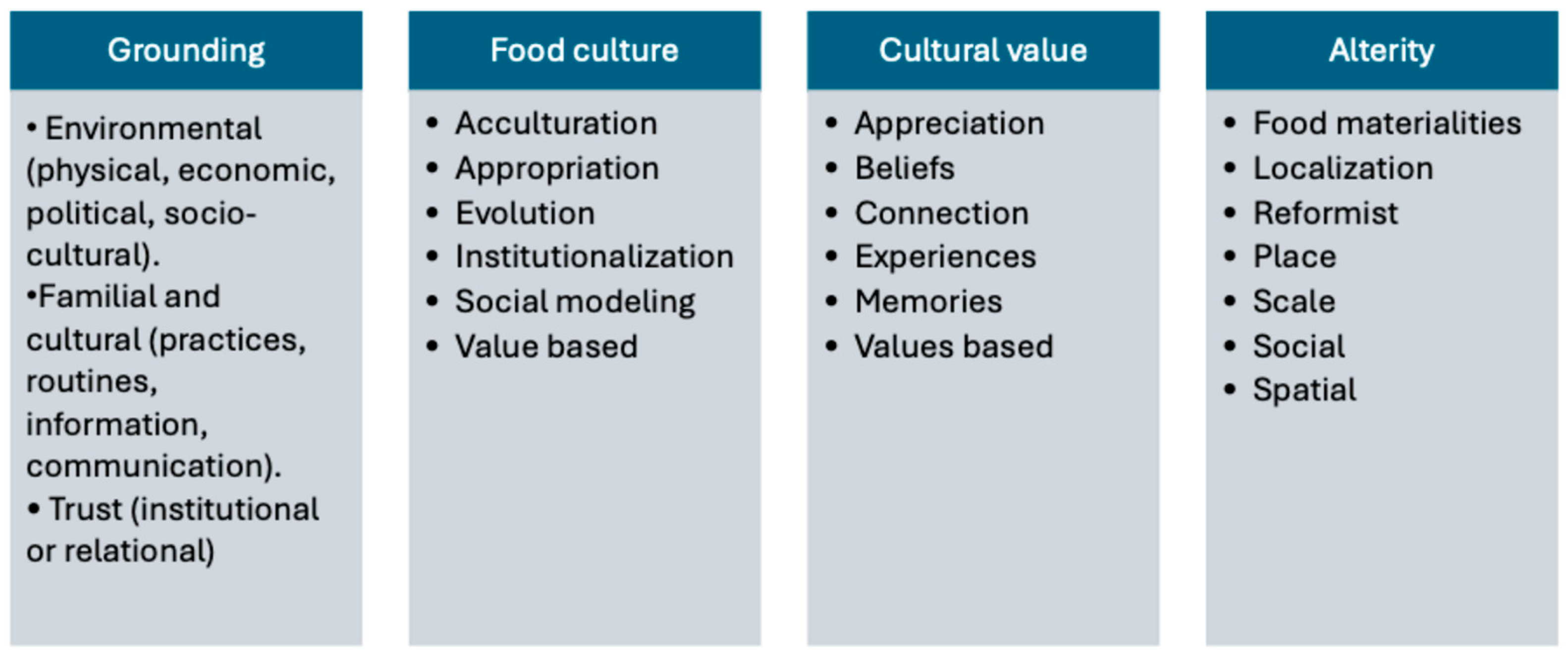
This section has considered the underpinning features of respecting food and the influence of trust, familial and cultural and environmental grounding of respect for and through food and the mediating role of identity. In this paper, the concepts of food culture and cultural value of food have been considered and compared in the context of the alterity and hybridity of food supply networks. Two research questions have been addressed. RQ1: What contextualization emerges of value-based supply chains and values-based food networks? RQ2: What aspects of grounding of food-related values emerge from the literature? Figure 1 summarises the four aspects of grounding, food culture, cultural value and alterity.
Whilst the literature often uses the two terms food culture and cultural value of food interchangeably, this work positions they are different. Table 2 outlines the distinctions that have emerged in this work between food culture and cultural value of food in terms of adaptive autonomy/identity, influences, knowledge, scale, and timescale.

5. Concluding Thoughts

Drawing together the literature, this paper has explored the concepts of food culture and cultural value through the lens of AFNs and values-based versus value-based food networks. The narratives of AFNs, value-based supply chains and valuing food are explored (RQ1) and the types of grounding (RQ2). The main findings that emerge are, firstly, that a difference exists between value-based food provision (supply chain model) and values-based food provision, which is iteratively developed or co-created between the food producer and their customers, often within AFNs. Whilst there is a focus in the literature on purchasing or consumption-based value for consumers (willingness to pay, convenience, choice, etc.), there is a knowledge gap on how values-based approaches reconnect consumers with their relationships with food and through food. Thirdly, food culture and holding a cultural value for food are positioned here as different concepts. Cultural value is associated with the social and cultural significance and symbolism of food and the connection with food through knowledge, beliefs, values and identity, and experiences and memories generated when cooking and/or sharing food (conviviality or commensality), and trust is created through relational connections and familial grounding. Memory generation, emotional reinforcement, relationship embedding, knowledge transmission, and cultural repetition all refine and change this relationship throughout people’s lives. Conversely, food culture is fluid and results from an evolving fusion of traditional foods and practices, geography, repetitive interaction, acculturation and appropriation of new foods, and hybrid foods where trust is promoted through institutionalised practices and processes and environmental grounding. The position here is that the boundaries between the two concepts can overlap, but this is context-specific.
As consumer experiences and food environments influence consumers’ relationship with food, the alterity of AFNs allows for reformist, localised approaches to food production. Whilst many examples of alterity, grounding, food culture and cultural value have been highlighted throughout the paper, they cannot be generalised. The qualitative approach to evidence gathering, analysis and interpretation in this study also impacts on generalisability. Further research could undertake a more quantitative approach considering the themes in Figure 1 and building a theoretical framework to consider grounding, alterity and cultural interaction with food more explicitly. The new research questions that emerge for further empirical work are:
  • How are food culture and cultural value of food grounded in both retailer-driven supply chains and alternative AFNs?
  • What are the dynamics that lead to evolution of food culture including acculturation, appropriation and fusion? What are the trade-offs that occur?
  • How can alterity be better framed? What are the emerging AFN models and can they be scaled?
The contribution of this paper is to provide conceptual underpinning of future empirical work which will be of value to policy makers and organisations in food supply chains.

Author Contributions

Conceptualisation, S.L.-T. and L.M.; methodology, D.M., S.L.-T. and L.M.; formal analysis, S.L.-T.; writing—original draft preparation, S.L.-T. writing—review and editing, D.M., S.L.-T. and L.M.; funding acquisition, S.L.-T. All authors have read and agreed to the published version of the manuscript.

Funding

This research received funding from the John Oldacre Foundation.

Institutional Review Board Statement

Not applicable.

Informed Consent Statement

Not applicable.

Data Availability Statement

No new data were created or analyzed in this study. Data sharing is not applicable to this article.

Conflicts of Interest

The authors declare no conflicts of interest.

Abbreviations

The following abbreviations are used in this manuscript:
AFNAlternative Food Network
LFNLocal Food Network
MSMEMicro, Small and Medium-sized Enterprises
UKUnited Kingdom
VTFNValues-based Territorial Food Network

References

  1. Wilk, R. Home Cooking in the Global Village: Caribbean Food from Buccaneers to Ecotourists; Bloomsbury Publishing: London, UK, 2006; Available online: https://www.bloomsbury.com/us/home-cooking-in-the-globalvillage-9781845203603/ (accessed on 18 January 2026).
  2. Gokhisar, O.K.; Turhan, M. Cereals and Pulses: A Duet of the Mediterranean Diet for a Healthier Future. In Cereal-Based Foodstuffs: The Backbone of Mediterranean Cuisine; Boukid, F., Ed.; Springer: Cham, Switzerland, 2021; pp. 151–165. [Google Scholar] [CrossRef] [Scilit]
  3. Martínez-González, M.Á.; Hershey, M.S.; Zazpe, I.; Trichopoulou, A. Transferability of the Mediterranean Diet to Non-Mediterranean Countries. What Is and What Is Not the Mediterranean Diet. Nutrients 2017, 9, 1226. [Google Scholar] [CrossRef] [Scilit] [PubMed]
  4. Dernini, S.; Berry, E.; Serra-Majem, L.; Vecchia, C.; La Capone, R.; Medina, F.; Aranceta-Bartrina, J.; Belahsen, R.; Burlingame, B.; Calabrese, G.; et al. Med Diet 4.0: The Mediterranean diet with four sustainable benefits. Public Health Nutr. 2017, 20, 1322–1330. [Google Scholar] [CrossRef] [Scilit]
  5. Serra- Majem, L.; Medina, F.X. Mediterranean Diet: A Long Journey Toward Intangible Cultural Heritage and Sustainability. In The Mediterranean Diet: An Evidence-Based Approach, 2nd ed.; Preedy, V., Watson, R., Eds.; Elsevier: London, UK, 2020; pp. 14–24. [Google Scholar]
  6. Steel, C. How Food Shapes Our Cities. In TED Talk; TED Global: Vancouver, BC, Canada, 2009; Available online: https://www.ted.com/talks/carolyn_steel_how_food_shapes_our_cities?language=en (accessed on 18 January 2026).
  7. Lang, T.; Millstone, E.; Marsden, T. An Open Letter on the Food Emergency to the Prime Minister and Government. 2021. Available online: https://foodresearch.org.uk/wp-content/uploads/sites/8/2021/01/Open-Letter-on-the-food-emergency-to-the-Prime-Ministerand-Government.pdf (accessed on 19 January 2026).
  8. Bruce, A.; Jackson, C.; Lamprinopoulou, C. Social networks and farming resilience. Outlook Agric. 2021, 50, 196–205. [Google Scholar] [CrossRef] [Scilit]
  9. Macaninch, E.; Martyn, K.; Lima do Vale, M. Exploring the implications of COVID-19 on widening health inequalities and the emergence of nutrition insecurity through the lens of organisations involved with the emergency food response. BMJ Nutr. Prev. Health 2020, 3, 374–382. [Google Scholar] [CrossRef] [Scilit]
  10. Swinburn, B.; Kraak, V.; Rutter, H.; Vandevijvere, S.; Lobstein, T.; Sacks, G.; Gomes, F.; Marsh, T.; Magnusson, R. Strengthening of accountability systems to create healthy food environments and reduce global obesity. Lancet 2015, 385, 2534–2545. [Google Scholar] [CrossRef] [Scilit] [PubMed]
  11. Contento, I. Overview of Determinants of Food Choice and Dietary Change: Implications for Nutrition Education. In Nutrition Education Linking Research Theory Practice, 2nd ed.; Contento, I., Ed.; Jones and Bartlett: Burlington, MA, USA, 2011; pp. 26–42. [Google Scholar]
  12. Garthwaite, K.A.; Collins, P.J.; Bambra, C. Food for thought: An ethnographic study of negotiating ill health and food insecurity in a UK foodbank. Soc. Sci. Med. 2015, 132, 38–44. [Google Scholar] [CrossRef] [Scilit]
  13. Pollan, M.; Gibney, A. Earth. In Cooked; Netflix: Los Gatos, CA, USA, 2016. [Google Scholar]
  14. Ilbery, B.; Maye, D. Food supply chains and sustainability: Evidence from specialist food producers in the Scottish/English borders. Land Use Policy 2005, 22, 331–344. [Google Scholar] [CrossRef] [Scilit]
  15. Holloway, L.; Kneafsey, M.; Venn, L.; Cox, R.; Dowler, E.; Tuomainen, H. Possible food economies: A methodological framework for exploring food production-consumption relationships. Sociol. Rural. 2007, 47, 1–19. [Google Scholar] [CrossRef] [Scilit]
  16. Goodman, D.; DuPuis, M.; Goodman, M. Alternative Food Networks: Knowledge, Practice, and Politics; Routledge: Oxfordshire, UK, 2012; Available online: https://www.routledge.com/Alternative-Food-Networks-Knowledge-Practice-and-Politics/Goodman-DuPuis-Goodman/p/book/9780415747691?srsltid=AfmBOopvjuKYJx418Mox2sv4HfIvdgHN9rq-5VxnktnjUA6qYNalVgED (accessed on 26 April 2026).
  17. Kirwan, J. The interpersonal world of direct marketing: Examining conventions of quality at UK farmers’ markets. J. Rural. Stud. 2006, 22, 301–312. [Google Scholar] [CrossRef] [Scilit]
  18. Kirwan, J. Alternative strategies in the UK agro-food system: Interrogating the alterity of farmers’ markets. Sociol. Rural. 2004, 44, 395–415. [Google Scholar] [CrossRef] [Scilit]
  19. Maye, D. Alternative Food Networks: Moving Alternative Food Networks beyond the Niche. Int. J. Sociol. Agric. Food 2013, 20, 383–389. [Google Scholar] [CrossRef] [Scilit]
  20. Zoll, F.; Specht, K.; Opitz, I.; Siebert, R.; Piorr, A.; Zasada, I. Individual choice or collective action? Exploring consumer motives for participating in alternative food networks. Int. J. Consum. Stud. 2018, 42, 101–110. [Google Scholar] [CrossRef] [Scilit]
  21. d’Angelo, C.; Ryen Gloinson, E.; Draper, A.; Guthrie, S. Food Consumption in the UK; RAND Corporation: Cambridge, UK, 2020; p. 39. Available online: https://www.rand.org/content/dam/rand/pubs/research_reports/RR4300/RR4379/RAND_RR4379.pdf (accessed on 26 April 2025).
  22. Shaw, H.J. The Consuming Geographies of Food: Diet, Food Deserts and Obesity; Routledge: Oxfordshire, UK, 2017; Available online: https://www.routledge.com/The-Consuming-Geographies-of-Food-Diet-FoodDeserts-and-Obesity/Shaw/p/book/9781138082304 (accessed on 26 April 2026).
  23. Dobson, M.; Reynolds, C.; Warren, P.; Edmonson, J. “My little piece of the planet”: The multiplicity of well-being benefits from allotment gardening. Br. Food J. 2020, 123, 1012–1023. [Google Scholar] [CrossRef] [Scilit]
  24. Association for Public Service Excellence. State of the Market Survey 2020: Local Authority Allotment Services; APSE: Manchester, UK, 2020; Available online: https://www.apse.org.uk/apse/index.cfm/members-area/briefings/2020/20-79-allotmentsstate-of-the-market-survey-2020/ (accessed on 18 January 2026).
  25. Ollivier de Leth, D.; Ros-Tonen, M.A.F. Creating Shared Value Through an Inclusive Development Lens: A Case Study of a CSV Strategy in Ghana’s Cocoa Sector. J. Bus. Ethics 2022, 178, 339–354. [Google Scholar] [CrossRef] [Scilit]
  26. Barbera, F.; Dagnes, J. Building Alternatives from the Bottom-up: The Case of Alternative Food Networks. Agric. Agric. Sci. Procedia 2016, 8, 324–331. [Google Scholar] [CrossRef] [Scilit]
  27. Fonte, M.; Cucco, I. Cooperatives and alternative food networks in Italy. The long road towards a social economy in agriculture. J. Rural. Stud. 2017, 53, 291–302. [Google Scholar] [CrossRef] [Scilit]
  28. Psarikidou, K.; Szerszynski, B. Growing the social: Alternative agrofood networks and social sustainability in the urban ethical foodscape. Sustain. Sci. Pract. Policy 2017, 8, 30–39. [Google Scholar] [CrossRef] [Scilit]
  29. Testa, R.; Galati, A.; Schifani, G.; Crescimanno, M.; Di Trapani, A.M.; Migliore, G. Are alternative food networks winning strategies to increase organic SMEs profitability? Evidence from a case study. Int. J. Glob. Small Bus. 2020, 11, 65–82. [Google Scholar] [CrossRef] [Scilit]
  30. Lingham, S.; Manning, L.; Maye, D. Reimagining Food: Readdressing and Respecting Values. Sustainability 2022, 14, 7328. [Google Scholar] [CrossRef] [Scilit]
  31. Anderson, C.; Brushett, L.; Gray, T.; Renting, H. Working Together to Build Cooperative Food Systems. J. Agric. Food Syst. Community Dev. 2014, 4, 3–9. [Google Scholar] [CrossRef] [Scilit]
  32. Bos, E.; Owen, L. Virtual reconnection: The online spaces of alternative food networks in England. J. Rural. Stud. 2016, 45, 1–14. [Google Scholar] [CrossRef] [Scilit]
  33. Curvelo, I.C.G.; Watanabe, E.A.d.M.; Alfinito, S. Purchase intention of organic food under the influence of attributes, consumer trust and perceived value. Rev. Gestão 2019, 26, 198–211. [Google Scholar] [CrossRef] [Scilit]
  34. Fusar Poli, E.; Fontefrancesco, M.F. Trends in the implementation of biopesticides in the Euro-Mediterranean region: A narrative literary review. Sustain. Earth Rev. 2024, 7, 14. [Google Scholar] [CrossRef] [Scilit]
  35. Kowalska, A.; Manning, L. Using the rapid alert system for food and feed: Potential benefits and problems on data interpretation. Crit. Rev. Food Sci. Nutr. 2021, 61, 906–919. [Google Scholar] [CrossRef] [Scilit] [PubMed]
  36. Naeem, M.; Ozuem, W.; Howell, K.; Ranfagni, S. Demystification and actualisation of data saturation in qualitative research through thematic analysis. Int. J. Qual. Methods 2024, 23, 16094069241229777. [Google Scholar] [CrossRef] [Scilit]
  37. Rahimi, S.; Khatooni, M. Saturation in qualitative research: An evolutionary concept analysis. Int. J. Nurs. Stud. Adv. 2024, 6, 100174. [Google Scholar] [CrossRef] [Scilit]
  38. Manning, L.; Grant, J.H.; Huang, Z.; Guevara, L. Agricultural robots: Using anticipatory approaches to embed appropriate hygienic design of hardware. Br. Food J. 2025, 128, 1257–1273. [Google Scholar] [CrossRef] [Scilit]
  39. Mingay, E.; Hart, M.; Yoong, S.; Hure, A. Why We Eat the Way We Do: A Call to Consider Food Culture in Public Health Initiatives. Int. J. Environ. Res. Public Health 2021, 18, 11967. [Google Scholar] [CrossRef] [Scilit]
  40. Askegaard, S.; Madsen, T.K. The local and the global: Exploring traits of homogeneity and heterogeneity in European food cultures. Int. Bus. Rev. 1998, 7, 549–568. [Google Scholar] [CrossRef] [Scilit]
  41. Martini, I. Food Culture and Translation: A Proposal for an Applied Methodological Framework. Cat. Dei Prodotti Della Ric. 2024, 2, 199–206. [Google Scholar]
  42. Almerico, G.M. Food and identity: Food studies, cultural, and personal identity. J. Int. Bus. Cult. Stud. 2014, 8, 1–8. [Google Scholar]
  43. Sage, C. Social embeddedness and relations of regard. J. Rural. Stud. 2003, 19, 47–60. [Google Scholar] [CrossRef] [Scilit]
  44. Castells, M.; Caraça, J.; Cardoso, G. Aftermath: The Cultures of the Economic Crisis; Oxford University Press: Oxford, UK, 2012. [Google Scholar]
  45. Maurano, S.; Forno, F. Alternative Food Networks in Times of Crisis. Boll. Della Soc. Geogr. Ital. 2017, 10, 134–148. [Google Scholar]
  46. Caraher, M.; Davison, R. The normalisation of Food Aid: What happened to feeding people well? Emerald Open Res. 2019, 1, 3. [Google Scholar] [CrossRef] [Scilit]
  47. Moran, D.; Cossar, F.; Merkle, M.; Alexander, P. UK food system resilience tested by COVID-19. Nat. Food 2020, 1, 242. [Google Scholar] [CrossRef] [Scilit]
  48. Shanks, S.; Van Schalkwyk, M.C.I.; McKee, M. COVID-19 exposes the UK’s broken food system. BMJ 2020, 370, m3085. [Google Scholar] [CrossRef] [Scilit] [PubMed]
  49. Bell, D.; Valentine, G. Consuming Geographies: We Are Where We Eat; Routledge: London, UK, 1997; p. 86. Available online: https://www.routledge.com/Consuming-Geographies-WeAre-Where-We-Eat/Bell-Valentine/p/book/9780415137683 (accessed on 26 April 2026).
  50. Whatmore, S.; Stassart, P.; Renting, H. What’s Alternative about Alternative Food Networks? Environ. Plan. A Econ. Space 2003, 35, 389–391. [Google Scholar] [CrossRef] [Scilit]
  51. Partalidou, M.; Anthopoulou, T. Social Economy and the Foodshed in Greece: Local Pathways and Constraints Through the Lens of SDGs. In Proceedings of the UNTFSSE International Conference, Geneva, Switzerland, 25–26 June 2019. [Google Scholar]
  52. Calvário, R.; Kallis, G. Alternative Food Economies and Transformative Politics in Times of Crisis: Insights from the Basque Country and Greece. Antipode 2017, 49, 597–616. [Google Scholar] [CrossRef] [Scilit]
  53. Arboleda, M. Towards an agrarian question of circulation: Walmart’s expansion in Chile and the agrarian political economy of supply chain capitalism. J. Agrar. Change 2020, 20, 345–363. [Google Scholar] [CrossRef] [Scilit]
  54. Pradella, L.; Cillo, R. Bordering the surplus population across the Mediterranean: Imperialism and unfree labour in Libya and the Italian countryside. Geoforum 2021, 126, 483–494. [Google Scholar] [CrossRef] [Scilit]
  55. Sanchís-Pedregosa, C.; Pennano, C. Supermarketization: Investigating determinants of customer choice in emerging markets. J. Promot. Manag. 2021, 27, 856–876. [Google Scholar] [CrossRef] [Scilit]
  56. Kowalska, A.; Lingham, S.; Maye, D.; Manning, L. Food insecurity: Is leagility a potential remedy? Foods 2023, 12, 3138. [Google Scholar] [CrossRef] [Scilit]
  57. Peddi, S.R. Multinational Corporations in Indian Food Retail: Why and How Size Matters. Millenn. Asia 2014, 5, 89–117. [Google Scholar] [CrossRef] [Scilit]
  58. Sandel, M.J. Market Reasoning as Moral Reasoning: Why Economists Should Re-engage with Political Philosophy. J. Econ. Perspect. 2013, 27, 121–140. [Google Scholar] [CrossRef] [Scilit]
  59. McMurty, J.J. Introducing the Social Economy in Theory and Practice. In Living Economics: Canadian Perspectives on the Social Economy, Co-Operatives, and Community Economic Development, 1st ed.; McMurty, J.J., Ed.; Emond Montgomery Publications: Toronto, ON, Canada, 2010; pp. 1–35. [Google Scholar]
  60. Bliss, S. The case for studying non-market food systems. Sustainability 2019, 11, 3224. [Google Scholar] [CrossRef] [Scilit]
  61. Hirsch, F. Social Limits to Growth; Harvard University Press: Cambridge, MA, USA, 1976. [Google Scholar] [CrossRef] [Scilit]
  62. Lutz, J.; Schachinger, J. Do local food networks foster socio-ecological transitions towards food sovereignty? Learning from real place experiences. Sustainability 2013, 5, 4778–4796. [Google Scholar] [CrossRef] [Scilit]
  63. Escobar-Farfán, M.; Veas-González, I.; Bernal-Peralta, J.; Saavedra García, T.; Santibáñez Labraña, C. Environmental, Health, and Social Consciousness as Drivers of Organic Food Choice. Nutrients 2026, 18, 1242. [Google Scholar] [CrossRef] [Scilit]
  64. Laroche, M.; Bergeron, J.; Barbaro-Forleo, G. Targeting consumers who are willing to pay more for environmentally friendly products. J. Consum. Mark. 2001, 18, 503–520. [Google Scholar] [CrossRef] [Scilit]
  65. Chiffoleau, Y.; Millet-Amrani, S.; Rossi, A.; Rivera-Ferre, M.G.; Merino, P.L. The participatory construction of new economic models in short food supply chains. J. Rural. Stud. 2019, 68, 182–190. [Google Scholar] [CrossRef] [Scilit]
  66. Manning, L. Determining value in the food supply chain. Br. Food J. 2015, 117, 2649–2663. [Google Scholar] [CrossRef] [Scilit]
  67. Thorsøe, M.; Kjeldsen, C. The Constitution of Trust: Function, Configuration and Generation of Trust in Alternative Food Networks. Sociol. Rural. 2016, 56, 157–175. [Google Scholar] [CrossRef] [Scilit]
  68. Lamine, C. Sustainability and Resilience in Agrifood Systems: Reconnecting Agriculture, Food and the Environment. Sociol. Rural. 2015, 55, 41–61. [Google Scholar] [CrossRef] [Scilit]
  69. Slow Food International. Available online: https://www.slowfood.com (accessed on 26 April 2025).
  70. Urgenci. Available online: https://urgenci.net/ (accessed on 26 April 2025).
  71. Nemes, G.; Reckinger, R.; Lajos, V.; Zollet, S. ‘Values-based Territorial Food Networks’—Benefits, challenges and controversies. Sociol. Rural. 2023, 63, 3–19. [Google Scholar] [CrossRef] [Scilit]
  72. Le Velly, R. Allowing for the projective dimension of agency in analysing alternative food networks. Sociol. Rural. 2019, 59, 2–22. [Google Scholar] [CrossRef] [Scilit]
  73. Venn, L.; Kneafsey, M.; Holloway, L.; Cox, R.; Dowler, E.; Tuomainen, H. Researching European “alternative” food networks: Some methodological considerations. Area 2006, 38, 248–258. [Google Scholar] [CrossRef] [Scilit]
  74. Agrawal, A.K.; Rahman, Z. Roles and Resource Contributions of Customers in Value Cocreation. Int. Strateg. Manag. Rev. 2015, 3, 144–160. [Google Scholar] [CrossRef] [Scilit]
  75. Lévi Strauss, C. The science of the concrete. In The Savage Mind; Sahlins, M., Ed.; University of Chicago Press: Chicago, IL, USA, 1962; pp. 1–22. [Google Scholar]
  76. Grivins, M.; Keech, D.; Kunda, I.; Tisenkopfs, T. Bricolage for self-sufficiency: An analysis of alternative food networks. Sociol. Rural. 2017, 57, 340–356. [Google Scholar] [CrossRef] [Scilit]
  77. Duncan, J.; Pascucci, S. Mapping the Organisational Forms of Networks of Alternative Food Networks: Implications for Transition. Sociol. Rural. 2017, 57, 316–339. [Google Scholar] [CrossRef] [Scilit]
  78. Haksever, C.; Chaganti, R.; Cook, R.G. A Model of Value Creation: Strategic View. J. Bus. Ethics. 2004, 49, 295–307. [Google Scholar] [CrossRef] [Scilit]
  79. Kramer, M.; Pfitzer, M. The Ecosystem of Shared Value. Harv. Bus. Rev. 2016, 94, 80–89. [Google Scholar]
  80. Stevenson, G.W.; Pirog, R. Values-Based Supply Chains: Strategies for Agrifood Enterprises of the Middle. In Food and the Mid-level Farm: Renewing an Agriculture of the Middle; Lyson, T., Stevenson, G.W., Welsh, R., Eds.; MIT Press: Cambridge, MA, USA, 2008; pp. 119–143. [Google Scholar]
  81. Vargo, S.L.; Lusch, R.F. Evolving to a New Dominant Logic for Marketing. J. Mark. 2004, 68, 1–17. [Google Scholar] [CrossRef] [Scilit]
  82. Gritzas, G.; Kavoulakos, K.I. Diverse economies and alternative spaces: An overview of approaches and practices. Eur. Urban Reg. Stud. 2016, 23, 917–934. [Google Scholar] [CrossRef] [Scilit]
  83. Schwartz, S.H. An Overview of the Schwartz Theory of Basic Values. Online Read. Psychol. Cult. 2012, 2, 1–20. [Google Scholar] [CrossRef] [Scilit]
  84. Dagevos, H.; van Ophem, J. Food consumption value. Br. Food J. 2013, 115, 1473–1486. [Google Scholar] [CrossRef] [Scilit]
  85. Delicato, C.; Collison, M.; Myronyuk, I.; Symochko, T.; Boyko, N. Is Local Better? Consumer Value in Food Purchasing and the Role of Short Food Supply Chains. Stud. Agric. Econ. 2019, 121, 75–83. [Google Scholar] [CrossRef] [Scilit]
  86. Kneafsey, M.; Maye, D.; Holloway, L.; Goodman, M.K. Geographies of Food: An Introduction; Bloomsbury Publishing: London, UK, 2021; p. 234. [Google Scholar]
  87. Maye, D.; Duncan, J. Understanding sustainable food system transitions: Practice, assessment and governance. Sociol. Rural. 2017, 57, 267–273. [Google Scholar] [CrossRef] [Scilit]
  88. Tregear, A. Progressing knowledge in alternative and local food networks: Critical reflections and a research agenda. J. Rural Stud. 2011, 27, 419–430. [Google Scholar] [CrossRef] [Scilit]
  89. Reckinger, R. Values-based territorial food networks: Qualifying sustainable and ethical transitions of alternative food networks. Reg. Cohes. 2022, 12, 78–109. [Google Scholar] [CrossRef] [Scilit]
  90. Xu, C. AFN as bricolage: Towards an alternative notion of “alterity” as “hybridity”. Int. J. Sociol. Agric. Food 2025, 31, 53–69. [Google Scholar] [CrossRef]
  91. Barrie, J. Brexit Will Lead to a ‘Subtle’ but ‘Tragic’ Rise in Food Prices and Increase Inequality in the UK, Experts Say. The I Paper, 4 January 2021. Available online: https://inews.co.uk/news/brexit/brexit-food-prices-rise-increase-inequality-uk-experts-816886?srsltid=AfmBOootoW7BSTmZWAM5NLnvrpuaApBxv1MkI5afMPQ-b5vz-mhwtEj9 (accessed on 26 April 2026).
  92. Lang, T.; McKee, M. Brexit poses serious threats to the availability and affordability of food in the United Kingdom. J. Public Health 2018, 40, e608–e610. [Google Scholar] [CrossRef] [Scilit]
  93. Millstone, E.; Lang, T.; Marsden, T. Food Brexit and Chlorinated Chicken: A Microcosm of Wider Food Problems. Political Q. 2019, 90, 645–653. [Google Scholar] [CrossRef] [Scilit]
  94. Hassanein, N. Practicing food democracy: A pragmatic politics of transformation. J. Rural. Stud. 2003, 19, 77–86. [Google Scholar] [CrossRef] [Scilit]
  95. Booth, S.; Coveney, J. Food Democracy: From Consumer to Food Citizen; Springer: Singapore, 2015. [Google Scholar]
  96. Renting, H.; Schermer, M.; Rossi, A. Building Food Democracy: Exploring Civic Food Networks and Newly Emerging Forms of Food Citizenship. Int. J. Sociol. Agric. Food 2012, 19, 289–307. [Google Scholar] [CrossRef] [Scilit]
  97. EndChildFoodPoverty. Let’s EndChildFoodPoverty. Available online: https://endchildpoverty.org.uk (accessed on 26 April 2026).
  98. Zimmerman, M.A. Psychological empowerment: Issues and illustrations. Am. J. Community Psychol. 1995, 23, 581–599. [Google Scholar] [CrossRef] [Scilit] [PubMed]
  99. Rappaport, J. In Praise of Paradox: A Social Policy of Empowerment over Prevention. Am. J. Community Psychol. 1981, 9, 1–25. [Google Scholar] [CrossRef] [Scilit]
  100. Fassio, F.; Minotti, B. Circular economy for food policy: The case of the RePoPP project in the City of Turin (Italy). Sustainability 2019, 11, 6078. [Google Scholar] [CrossRef] [Scilit]
  101. Fourat, E.; Closson, C.; Holzemer, L.; Hudon, M. Social inclusion in an alternative food network: Values, practices and tensions. J. Rural. Stud. 2020, 76, 49–57; p. 51. [Google Scholar] [CrossRef] [Scilit]
  102. Feyereisen, M.; Stassart, P.M.; Mélard, F. Fair Trade Milk Initiative in Belgium: Bricolage as an Empowering Strategy for Change. Sociol. Rural. 2017, 57, 297–315. [Google Scholar] [CrossRef] [Scilit]
  103. Petetin, L. The CoviD-19 crisis: An opportunity to integrate food democracy into postpandemic food systems. Eur. J. Risk Regul. 2020, 11, 326–336. [Google Scholar] [CrossRef] [Scilit]
  104. West, H.G.; Domingos, N. Gourmandizing Poverty Food: The Serpa Cheese Slow Food Presidium. J. Agrar. Change 2012, 12, 120–143. [Google Scholar] [CrossRef] [Scilit]
  105. Lang, T.; Lewis, T.; Marsden, T.; Millstone, E. Feeding Britain: Food Security After Brexit; Food Research Collaboration: London, UK, 2018; Available online: https://foodresearch.org.uk/publications/feeding-britain-food-security-after-brexit/ (accessed on 5 April 2025).
  106. Manning, L. Corporate Responsibility in a Transitioning Food Environment: Truth-Seeking and Truth-Telling. In Food Tech Transitions: Reconnecting Agri-Food, Technology and Society; Piatti, C., Graeff-Hönninger, S., Khajehei, F., Eds.; Springer: Cham, Switzerland, 2019; pp. 149–169. [Google Scholar] [CrossRef] [Scilit]
  107. Kemmer, D.; Anderson, A.S.; Marshall, D.W. Living Together and Eating Together: Changes in Food Choice and Eating Habits during the Transition from Single to Married/Cohabiting. Sociol. Rev. 2017, 46, 48–72. [Google Scholar] [CrossRef] [Scilit]
  108. Yngve, A.; Neuman, N.; Haapala, I.; Scander, H. The Project Collection Food, Nutrition and Health, with a Focus on Eating Together. Int. J. Environ. Res. Public Health 2021, 18, 1572. [Google Scholar] [CrossRef] [Scilit]
  109. Gardner, T.A.; Benzie, M.; Börner, J.; Dawkins, E.; Fick, S.; Garrett, R.; Godar, J.; Grimard, A.; Lake, S.; Larsen, R.K.; et al. Transparency and sustainability in global commodity supply chains. World Dev. 2019, 121, 163–177. [Google Scholar] [CrossRef] [Scilit]
  110. Jurgilevich, A.; Birge, T.; Kentala-Lehtonen, J.; Korhonen-Kurki, K.; Pietikäinen, J.; Saikku, L.; Schösler, H. Transition towards circular economy in the food system. Sustainability 2016, 8, 69. [Google Scholar] [CrossRef] [Scilit]
  111. Murphy, J.T. Building Trust in Economic Space. Prog. Hum. Geogr. 2016, 30, 427–450. [Google Scholar] [CrossRef] [Scilit]
  112. Rossing, W.A.H.; Kormelinck, A.G.; Alliaume, F.; Dogliotti, S.; Duncan, J.; Huenchuleo, C.; Klerkx, L.; Trienekens, J.; Gaitán-Cremaschi, D. Transitioning to the safe and just space inside ‘the doughnut’ by means of agroecological niche food systems: Insights from Chile and Uruguay. Int. J. Agric. Nat. Resour. 2020, 47, 295–311. [Google Scholar] [CrossRef] [Scilit]
  113. Murphy, B.; Benson, T.; Lavelle, F.; Elliott, C.; Dean, M. Assessing differences in levels of food trust between European countries. Food Control. 2021, 120, 107561. [Google Scholar] [CrossRef] [Scilit]
  114. Manning, L.; Kowalska, A. Considering Fraud Vulnerability Associated with Credence-Based Products Such as Organic Food. Foods 2021, 10, 1879. [Google Scholar] [CrossRef] [Scilit]
  115. Watanabe, E.A.d.M.; Alfinito, S.; Curvelo, I.C.G.; Hamza, K.M. Perceived value, trust and purchase intention of organic food: A study with Brazilian consumers. Br. Food J. 2020, 122, 1070–1184. [Google Scholar] [CrossRef] [Scilit]
  116. Abiral, B.; Atalan-Helicke, N. Trusting food supply chains during the pandemic: Reflections from Turkey and the U.S. Food Foodways 2020, 28, 226–236. [Google Scholar] [CrossRef] [Scilit]
  117. Jeżewska-Zychowicz, M.; Plichta, M.; Królak, M. Consumers’ Fears Regarding Food Availability and Purchasing Behaviors during the COVID-19 Pandemic: The Importance of Trust and Perceived Stress. Nutrients 2020, 12, 2852. [Google Scholar] [CrossRef] [Scilit]
  118. Sassatelli, R.; Scott, A. Novel food, new markets and trust regimes. Responses to the erosion of consumers’ confidence in Austria, Italy and the UK. Eur. Soc. 2001, 3, 213–244. [Google Scholar] [CrossRef] [Scilit]
  119. Eden, S.; Bear, C.; Walker, G. Understanding and (dis)trusting food assurance schemes: Consumer confidence and the “knowledge fix”. J. Rural. Stud. 2008, 24, 1–14. [Google Scholar] [CrossRef] [Scilit]
  120. Jehlička, P.; Daněk, P. Rendering the Actually Existing Sharing Economy Visible: HomeGrown Food and the Pleasure of Sharing. Sociol. Rural. 2017, 57, 274–296. [Google Scholar] [CrossRef] [Scilit]
  121. de Garine, I. The socio-cultural aspects of nutrition. Ecol. Food Nutr. 2010, 1, 143–163. [Google Scholar] [CrossRef] [Scilit]
  122. Kelly, B.; Freeman, B.; King, L.; Chapman, K.; Baur, L.A.; Gill, T. Television advertising, not viewing, is associated with negative dietary patterns in children. Pediatr. Obes. 2016, 11, 158–160. [Google Scholar] [CrossRef] [Scilit]
  123. Birch, L.L.; Doub, A.E. Learning to eat: Birth to age 2 y. Am. J. Clin. Nutr. 2014, 99, 723S–728S. [Google Scholar] [CrossRef] [Scilit]
  124. Cruwys, T.; Bevelander, K.E.; Hermans, R.C.J. Social modelling of eating: A review of when and why social influence affects food intake and choice. Appetite 2015, 86, 3–18. [Google Scholar] [CrossRef] [Scilit]
  125. Gelman, S.A. Learning from others: Children’s construction of concepts. Annu. Rev. Psychol. 2009, 60, 115. [Google Scholar] [CrossRef] [Scilit]
  126. Lee, K.-S. Cooking up food memories: A taste of intangible cultural heritage. J. Hosp. Tour. Manag. 2023, 54, 1–9. [Google Scholar] [CrossRef] [Scilit]
  127. Colatruglio, S.; Slater, J. Chapter 3 Food Literacy: Bridging the Gap between Food, Nutrition and Well-Being. In Sustainable Well-Being: Concepts, Issues, and Educational Practices; Deer, F., Falkenberg, T., McMillan, B., Sims, L., Eds.; ESWB Press: Manitoba, MB, Canada, 2014; pp. 37–55. [Google Scholar]
  128. Lichtenstein, A.H.; Ludwig, D.S. Bring Back Home Economics Education. JAMA 2010, 303, 1857. [Google Scholar] [CrossRef] [Scilit]
  129. Mills, S.D.H.; Wolfson, J.A.; Wrieden, W.L.; Brown, H.; White, M.; Adams, J. Perceptions of ‘Home Cooking’: A Qualitative Analysis from the United Kingdom and United States. Nutrients 2020, 12, 198. [Google Scholar] [CrossRef] [Scilit]
  130. Piochi, M.; Buonocore, F.; Spampani, F.; Torri, L. Impact of COVID-19 lockdown on the perception of home meals and meal-related variables: A large-scale study within the Italian population during the acute phase of the pandemic. Food Qual. Prefer. 2022, 98, 104488. [Google Scholar] [CrossRef] [Scilit]
  131. Radtke, T.; Liszewska, N.; Horodyska, K.; Boberska, M.; Schenkel, K.; Luszczynska, A. Cooking together: The IKEA effect on family vegetable intake. Br. J. Health Psychol. 2019, 24, 896–912. [Google Scholar] [CrossRef] [Scilit]
  132. de Kock, H.L.; Nkhabutlane, P.; Kobue-Lekalake, R.I.; Kriek, J.; Steyn, A.; Clarissa, V.H.; Purdon, L.; Kruger, C.; Kinnear, M.; Taljaard-Swart, H.; et al. An alternative food neophobia scale (FNS-A) to quantify responses to new foods. Food Qual. Prefer. 2022, 101, 104626. [Google Scholar] [CrossRef] [Scilit]
  133. Szakály, Z.; Kovács, B.; Soós, M.; Kiss, M.; Balsa-Budai, N. Adaptation and Validation of the Food Neophobia Scale: The Case of Hungary. Foods 2021, 10, 1766. [Google Scholar] [CrossRef] [Scilit]
  134. Choe, J.Y.; Cho, M.S. Food neophobia and willingness to try non-traditional foods for Koreans. Food Qual. Prefer. 2011, 22, 671–677. [Google Scholar] [CrossRef] [Scilit]
  135. Rabadán, A.; Bernabéu, R. A systematic review of studies using the Food Neophobia Scale: Conclusions from thirty years of studies. Food Qual. Prefer. 2021, 93, 104241. [Google Scholar] [CrossRef] [Scilit]
  136. Knaapila, A.J.; Sandell, M.A.; Vaarno, J.; Hoppu, U.; Puolimatka, T.; Kaljonen, A.; Lagström, H. Food neophobia associates with lower dietary quality and higher BMI in Finnish adults. Public Health Nutr. 2015, 18, 2161–2171. [Google Scholar] [CrossRef] [Scilit] [PubMed]
  137. Knaapila, A.; Silventoinen, K.; Broms, U.; Rose, R.J.; Perola, M.; Kaprio, J.; Tuorila, H.M. Food Neophobia in Young Adults: Genetic Architecture and Relation to Personality, Pleasantness and Use Frequency of Foods, and Body Mass Index—A Twin Study. Behav. Genet. 2010, 41, 512–521. [Google Scholar] [CrossRef] [Scilit] [PubMed]
  138. Alley, T.R.; Potter, K.A. Food Neophobia and Sensation Seeking. In Handbook of Behavior, Food and Nutrition; Preedy, V., Watson, R., Martin, C., Eds.; Springer: New York, NY, USA, 2011; pp. 707–724. [Google Scholar] [CrossRef] [Scilit]
  139. Siegrist, M.; Hartmann, C.; Keller, C. Antecedents of food neophobia and its association with eating behavior and food choices. Food Qual. Prefer. 2013, 30, 293–298. [Google Scholar] [CrossRef] [Scilit]
  140. Cardello, A.V.; Meiselman, H.L.; Schutz, H.G.; Craig, C.; Given, Z.; Lesher, L.L.; Eicher, S. Measuring emotional responses to foods and food names using questionnaires. Food Qual. Prefer. 2012, 24, 243–250. [Google Scholar] [CrossRef] [Scilit]
  141. Bäckström, A.; Pirttilä-Backman, A.M.; Tuorila, H. Willingness to try new foods as predicted by social representations and attitude and trait scales. Appetite 2004, 43, 75–83. [Google Scholar] [CrossRef] [Scilit]
  142. Fischler, C. Commensality, society and culture. Soc. Sci. Inf. 2011, 50, 528–548. [Google Scholar] [CrossRef] [Scilit]
  143. Jönsson, H.; Michaud, M.; Neuman, N. What is commensality? A critical discussion of an expanding research field. Int. J. Environ. Res. Public Health 2021, 18, 6235. [Google Scholar] [CrossRef] [Scilit]
  144. Phull, S.; Wills, W.; Dickinson, A. Is it a pleasure to eat together? Theoretical reflections on conviviality and the Mediterranean diet. Sociol. Compass 2015, 9, 977–986. [Google Scholar] [CrossRef] [Scilit]
  145. Chang, J.; Morrison, A.M.; Lin, C.T.; Lin, S.H.H. Exploring the emotions and well-being of food neophobic travelers in the consumption of comfort food. Food Qual. Prefer. 2022, 96, 104443. [Google Scholar] [CrossRef] [Scilit]
  146. Larson, N.; Wang, Q.; Berge, J.M.; Shanafelt, A.; Nanney, M.S. Eating breakfast together as a family: Mealtime experiences and associations with dietary intake among adolescents in rural Minnesota, USA. Public Health Nutr. 2016, 19, 1565–1574. [Google Scholar] [CrossRef] [Scilit]
  147. Larson, N.; Nelson, M.; Neumark-Sztainer, D.; Story, M.; Hannan, P.J. Making time for meals: Meal structure and associations with dietary intake in young adults. J. Am. Diet. Assoc. 2009, 109, 72–79. [Google Scholar] [CrossRef] [Scilit]
  148. Woodruff, S.J.; Kirby, A.R. The associations among family meal frequency, food preparation frequency, self-efficacy for cooking, and food preparation techniques in children and adolescents. J. Nutr. Educ. Behav. 2013, 45, 296–303. [Google Scholar] [CrossRef] [Scilit] [PubMed]
  149. Dunbar, R.I.M. Breaking Bread: The Functions of Social Eating. Adapt. Hum. Behav. Physiol. 2017, 3, 198–211. [Google Scholar] [CrossRef] [Scilit]
  150. Von Essen, E.; Mårtensson, F. Young adults’ use of emotional food memories to build resilience. Appetite 2017, 112, 210–218. [Google Scholar] [CrossRef] [Scilit]
  151. Son, Y.H.; Oh, S.S.; Jang, S.I.; Park, E.C.; Park, S.H. Association between commensality with depression and suicidal ideation of Korean adults: The sixth and seventh Korean National Health and Nutrition Examination Survey 2013, 2015, 2017. Nutr. J. 2020, 19, 131. [Google Scholar] [CrossRef] [Scilit] [PubMed]
  152. Dunbar, R.I.M.; Teasdale, B.; Thompson, J.; Budelmann, F.; Duncan, S.; van Emde Boas, E.; Maguire, L. Emotional arousal when watching drama increases pain threshold and social bonding. R. Soc. Open Sci. 2016, 3, 160288. [Google Scholar] [CrossRef] [Scilit] [PubMed]
  153. Marovelli, B. Cooking and eating together in London: Food sharing initiatives as collective spaces of encounter. Geoforum 2019, 99, 190–201. [Google Scholar] [CrossRef] [Scilit]
  154. Kortright, R.; Wakefield, S. Edible backyards: A qualitative study of household food growing and its contributions to food security. Agric. Hum. Values 2010, 28, 39–53. [Google Scholar] [CrossRef] [Scilit]
  155. Carney, P.A.; Hamada, J.L.; Rdesinski, R.; Sprager, L.; Nichols, K.R.; Liu, B.Y.; Pelayo, J.; Sanchez, M.A.; Shannon, J. Impact of a Community Gardening Project on Vegetable Intake, Food Security and Family Relationships: A Community-based Participatory Research Study. J. Community Health 2011, 37, 874–881. [Google Scholar] [CrossRef] [Scilit]
  156. Sovová, L.; Jehlička, P.; Daněk, P. Growing the Beautiful Anthropocene: Ethics of Care in East European Food Gardens. Sustainability 2021, 13, 5193. [Google Scholar] [CrossRef] [Scilit]
  157. O’Kane, G. A moveable feast: Contemporary relational food cultures emerging from local food networks. Appetite 2016, 105, 218–231. [Google Scholar] [CrossRef] [Scilit]
  158. Alexanian, M.G.; Kiang, L.; Lassiter, R.; Busquets, M.; Lopez Alvarez, D.M.; Stuckey, Z. Unpacking Appropriation: Examining the Effect of Actor-Related Factors on Perceptions of Cultural Appropriation in Culinary Scenarios. Race Soc. Probl. 2024, 16, 368–377. [Google Scholar] [CrossRef] [Scilit]
  159. Siems, M. The law and ethics of “cultural appropriation”. Int. J. Law. Context 2019, 15, 408–423. [Google Scholar] [CrossRef] [Scilit]
  160. Lenard, P.; Balint, P. What is (the wrong of) cultural appropriation? Ethnicities 2019, 20, 331–352. [Google Scholar] [CrossRef] [Scilit]
  161. Farrer, J.; Wang, C. Who owns a cuisine? The grassroots politics of Japanese food in Europe. Asian Anthropol. 2021, 20, 12–29. [Google Scholar] [CrossRef] [Scilit]
  162. Preetha, A.T.; Lazarus, A.D. Culinary authenticity and diaspora: A preliminary enquiry. Stud. Media Commun. 2024, 12, 50–62. [Google Scholar] [CrossRef] [Scilit]
  163. Sailesh, B.; Karthikeyan, K. Colonial encounters and culinary fusion: The evolution of Indian food through trade, empire, and globalization. J. Gastro Tour. 2025, 3, 77–90. [Google Scholar]
  164. Baral, B.; Adhikari, B.P. Exploring the Intersection of Multicultural Society and Chicken Tikka Masala in the U.K. OCEM J. Manag. Technol. Soc. Sci. 2024, 3, 35–48. [Google Scholar] [CrossRef] [Scilit]
  165. Chatterjee, A.K. The “decline” of London’s curry houses invented tradition, authenticity, gastromythology. Consum. Mark. Cult. 2023, 26, 443–465. [Google Scholar] [CrossRef] [Scilit]
  166. Mitchell, K. Gullah Cuisine: Is It a Story of Cultural Appropriation or Cultural Appreciation? Tour. Cult. Commun. 2021, 21, 55–61. [Google Scholar] [CrossRef] [Scilit]
  167. High Level Panel of Experts (HLPE). Nutrition and Food Systems. A Report by the High Level Panel of Experts on Food Security and Nutrition of the Committee of the World Food Security; High Level Panel of Experts (HLPE): Rome, Italy, 2017; Available online: www.fao.org/cfs/cfs-hlpe (accessed on 27 April 2026).
  168. EPHA European Public Health Alliance. Food Environments & EU Food Policy: Discovering the Role of Food Environments for Sustainable Food Systems; EPHA European Public Health Alliance: Brussels, Belgium, 2021; Available online: https://foodpolicycoalition.eu/wp-content/uploads/2021/10/Food-Environments-for-SFS_EU-FPC.pdf (accessed on 22 February 2025).
  169. Albrecht, C.; Smithers, J. Reconnecting through local food initiatives? Purpose, practice and conceptions of ‘value. Agric. Hum. Values 2017, 35, 67–81. [Google Scholar] [CrossRef] [Scilit]
  170. Brown, K.R. Interaction Ritual Chains and the Mobilization of Conscientious Consumers. Qual. Sociol. 2010, 34, 121–141. [Google Scholar] [CrossRef] [Scilit]
  171. Grunert, K.G.; Brunsø, K.; Bisp, S. Food-related lifestyle: Development of a cross-culturally valid instrument for market surveillance. In Values, Lifestyles, and Psychographics; Psychology Press: London, UK, 2014; pp. 337–354. [Google Scholar]
  172. Monterrosa, E.C.; Frongillo, E.A.; Drewnowski, A.; de Pee, S.; Vandevijvere, S. Sociocultural Influences on Food Choices and Implications for Sustainable Healthy Diets. Food Nutr. Bull. 2020, 41, 59S–73S. [Google Scholar] [CrossRef] [Scilit]
  173. Martindale, L.; Matacena, R.; Beacham, J. Varieties of Alterity: Alternative Food Networks in the UK, Italy and China. In Sociologia Urbana e Rurale; Franco Angeli Edizioni: Milan, Italy, 2018; Volume 115, pp. 27–41. [Google Scholar]
  174. Krystallis, A.; Chryssochoidis, G.; Scholderer, J. Consumer-perceived quality in “traditional” food chains: The case of the Greek meat supply chain. Appetite 2007, 48, 54–68. [Google Scholar] [CrossRef] [Scilit]
  175. Verinis, J. “New” Greek Food Solidarities (ALLILEGGIÍ). Ethnol. Eur. 2018, 48, 99–115. [Google Scholar] [CrossRef] [Scilit]
  176. Petropoulou, E. The Role of Short Food Supply Chains in Greece—What Opportunities for Sustainable, Just and Democratic Food Systems at Times of Crisis? Sociol. Anthropol. 2016, 4, 337–346. [Google Scholar] [CrossRef] [Scilit]
  177. Koutsou, S.; Sergaki, P.; Katsaros, K. Cooperative Products in Short Food Supply Chains: The Case Study of Milk in Greece. In Proceedings of the Second International Conference on Agriculture in an Urbanising Society—Reconnecting Agriculture and Food Chains to Societal Needs, Rome, Italy, 14–17 September 2015; pp. 555–556. [Google Scholar]
  178. Bisogni, C.A.; Connors, M.; Devine, C.M.; Sobal, J. Who we are and how we eat: A qualitative study of identities in food choice. J. Nutr. Educ. Behav. 2002, 34, 128–139. [Google Scholar] [CrossRef] [Scilit]
  179. Jensen, K.O.D.; Holm, L. Preferences, quantities and concerns: Socio-cultural perspectives on the gendered consumption of foods. Eur. J. Clin. Nutr. 1999, 53, 351–359. [Google Scholar] [CrossRef] [Scilit] [PubMed]
  180. Cairns, K.; Johnston, J.; Mackendrick, N. Feeding the ‘organic child’: Mothering through ethical consumption. J. Consum. Cult. 2013, 13, 97–118. [Google Scholar] [CrossRef] [Scilit]
  181. Neuman, N.; Gottzén, L.; Fjellström, C. Masculinity and the sociality of cooking in men’s everyday lives. Sociol. Rev. 2017, 65, 816–831. [Google Scholar] [CrossRef] [Scilit]
  182. Graf, K. Cooking with(out) others? Changing kitchen technologies and family values in Marrakech. J. North Afr. Stud. 2022, 29, 575–600. [Google Scholar] [CrossRef] [Scilit]
  183. Stead, M.; McDermott, L.; MacKintosh, A.M.; Adamson, A. Why healthy eating is bad for young people’s health: Identity, belonging and food. Soc. Sci. Med. 2011, 72, 1131–1139. [Google Scholar] [CrossRef] [Scilit] [PubMed]
  184. Beck, A.; Iturralde, E.; Haya-Fisher, J.; Kim, S.; Keeton, V.; Fernandez, A. Barriers and facilitators to healthy eating among low-income Latino adolescents. Appetite 2019, 138, 215–222. [Google Scholar] [CrossRef] [Scilit]
  185. Elliott, C. Food as people: Teenagers’ perspectives on food personalities and implications for healthy eating. Soc. Sci. Med. 2014, 121, 85–90. [Google Scholar] [CrossRef] [Scilit]
Figure 1. Aspects of grounding, food culture, cultural value and alterity.
Gastronomy 04 00012 g001
Table 1. Search terms used.
Foundational Search TermTerm Iterations and Emergent Questions
‘Food system’‘Values based food networks’
‘Value within food system’
‘Non-financial value within food system’
‘Food values’‘Food consumption value’
‘Values associated with food’
‘Non-financial food values’
‘Cultural value of food’
‘How do consumers value food?’Consumer perceptions of food value’
‘Emotions around food’
‘Food culture’‘How strong is food culture in the UK?’
‘UK food culture versus Mediterranean food culture’
‘Food and culture’
‘Emotions in food culture’
‘Alternative food networks’‘Alternative food networks and food values’
‘Food system values’
‘Is food valued differently in alternative food networks?’
‘Do people have connection with food?’
‘Linking producers and consumers’
Table 2. Distinctions and similarities between food culture and cultural value of food.
FactorFood CultureCultural Value of Food
AdaptiveFood culture adapts to new social, economic and environmental factors, trends, acculturation and appropriation evolving over time.Perceived cultural values and respect for food may adapt as a result of experiences, memories and familial and community grounding.
Autonomy/IdentitySocial modelling and mimicry drive trends, fashions and ways of purchasing, cooking and eating food. Autonomy may be limited if individuals seek to conform to socially accepted habits and practices. Strong sense of personal identity may drive acceptance or rejection of a given food culture.Values and beliefs will frame perceived cultural value of, and respect for, food. This can be grounded in familial, group or wider food culture. Identity can be personal, community or familial and associated beliefs and values will influence an individual’s relationship with food.
InfluencesSocial and environmental constructs around individuals and communities frame food culture. Wider community or familial cultural practices and food socialisation will influence food culture.Perceiving a cultural value for or respect for food will come from familial culture, experiences, memories and connections made with food and through food.
KnowledgeKnowledge is transmitted by others within the same food culture.Knowledge seeking is catalysed by values and beliefs to better understand food and how it has been produced. This is sought and gained by the consumer.
ScaleFood culture can be operationalised at an individual, familial, group or wider level [39].Focuses on the value the individual holds for the food itself, and through food.
TimescaleFood culture develops over a period of time and can change over time due to changing social, economic or political environment [39].An individual’s cultural value of food may change depending on their experiences or knowledge development/exchange, but it is less likely to depend on changing social and environmental constructs.
Disclaimer/Publisher’s Note: The statements, opinions and data contained in all publications are solely those of the individual author(s) and contributor(s) and not of MDPI and/or the editor(s). MDPI and/or the editor(s) disclaim responsibility for any injury to people or property resulting from any ideas, methods, instructions or products referred to in the content.