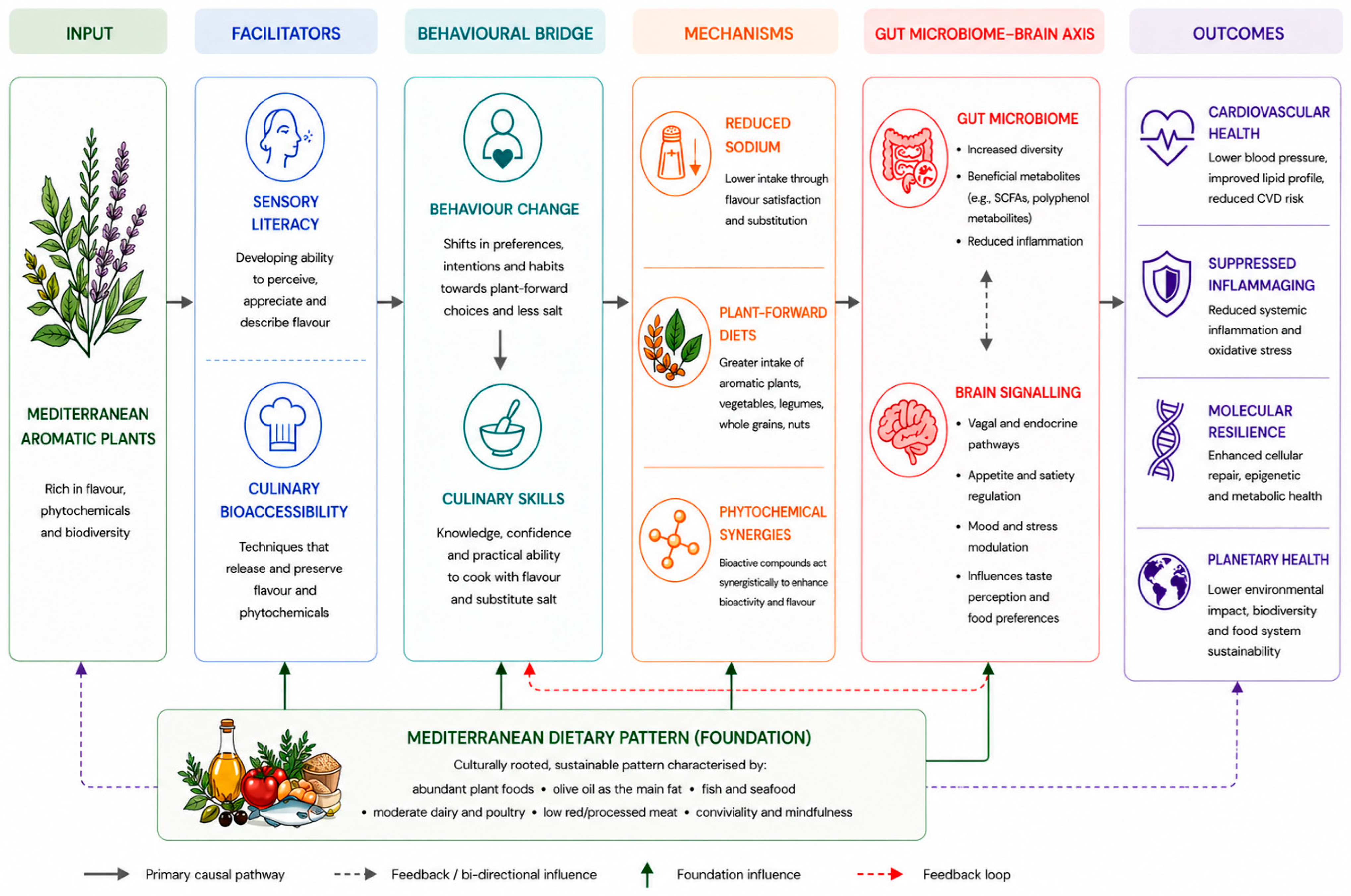



The Flavour of Sustainability: Mediterranean Aromatic Plants as Enablers of Nutrient-Dense and Low-Salt Gastronomy


Abstract
1. Introduction
1.1. The Hippocratic Legacy: Food as Medicine in the Mediterranean
1.2. The Low Impact Flavour Strategy
1.3. Small-Island Ecology and Phytochemical Priming
1.4. Knowledge Gaps and Review Objectives
2. Materials and Methods
2.1. Search Strategy and Information Sources
2.2. Temporal Scope and Inclusion Criteria
2.3. Analytical Framework
3. The Maltese Culinary Landscape
3.1. Heritage, Climate, and the Evolution of Mediterranean Foodways
3.2. Sensory Signalling; The ‘Folk–Medicine Bridge’ in Practice
4. Molecular Reality: Polyphenols and Cellular Pathways
4.1. Phytochemical Composition and Antioxidant Defence
4.2. Modulation of Inflammatory Pathways: The NF-κB Axis and Inflammaging
4.3. Microbiome Modulation and the Gut–Microbiome–Brain Axis
5. Translational Gastronomy: Salt Reduction and Bioaccessibility
5.1. The Sensory Barrier in Sustainable Diets
5.2. Sensory Compensation and Sodium Reeducation
5.3. Culinary Chemistry and Bioaccessibility of Bioactives
5.4. The TASTE-MED Model
6. From Planetary Policy to Local Food Systems
7. Conclusions and Future Directions
Supplementary Materials
Author Contributions
Funding
Data Availability Statement
Acknowledgments
Conflicts of Interest
Abbreviations
| NF-κB | Nuclear Factor kappa B |
| TNF-α | Tumor Necrosis Factor-alpha |
| IL-6 | Interleukin-6 |
| Nrf2 | Nuclear factor erythroid 2-related factor 2 |
| MAPK | Mitogen-Activated Protein Kinase |
References
- Trichopoulou, A. Mediterranean diet as intangible heritage of humanity: 10 years on. Nutr. Metab. Cardiovasc. Dis. 2021, 31, 1943–1948. [Google Scholar] [CrossRef] [PubMed]
- Dernini, S.; Berry, E.M. Mediterranean diet: From a healthy diet to a sustainable dietary pattern. Front. Nutr. 2015, 2, 130610. [Google Scholar] [CrossRef] [PubMed]
- Scalbert, A.; Johnson, I.; Saltmarsh, M. Polyphenols: Antioxidants and beyond. Am. J. Clin. Nutr. 2005, 81, 215S–217S. [Google Scholar] [CrossRef] [PubMed]
- Carocho, M.; Morales, P.; Ferreira, I.C. Antioxidants: Reviewing the chemistry, food applications, legislation and role as preservatives. Trends Food Sci. Technol. 2013, 71, 107–120. [Google Scholar] [CrossRef]
- Williamson, G. The role of polyphenols in modern nutrition. Nutr. Bull. 2017, 42, 226–235. [Google Scholar] [CrossRef] [PubMed]
- Crozier, A.; Jaganath, I.B.; Clifford, M.N. Dietary phenolics: Chemistry, bioavailability and effects on health. Nat. Prod. Rep. 2009, 26, 1001–1043. 6. [Google Scholar] [CrossRef] [PubMed]
- Al-Habsi, N.; Al-Khalili, M.; Haque, S.A.; Al Akhzami, N.; Gonzalez-Gonzalez, C.R.; Al Harthi, S.; Al Jufaili, S.M. Herbs and spices as functional food ingredients: A comprehensive review of their therapeutic properties, antioxidant and antimicrobial activities, and applications in food preservation. J. Funct. Foods 2025, 129, 106882. [Google Scholar] [CrossRef]
- Catalkaya, G.; Venema, K.; Lucini, L.; Rocchetti, G.; Delmas, D.; Daglia, M.; De Filippis, A.; Xiao, H.; Quiles, J.L.; Xiao, J.; et al. Interaction of dietary polyphenols and gut microbiota: Microbial metabolism of polyphenols, influence on the gut microbiota and implications on host health. Food Front. 2020, 1, 109–133. [Google Scholar] [CrossRef]
- Iqbal, I.; Wilairatana, P.; Saqib, F.; Nasir, B.; Wahid, M.; Latif, M.F.; Iqbal, A.; Naz, R.; Mubarak, M.S. Plant polyphenols and their potential benefits on cardiovascular health: A review. Molecules 2023, 28, 6403. [Google Scholar] [CrossRef] [PubMed]
- Cardona, F.; Andrés-Lacueva, C.; Tulipani, S.; Tinahones, F.J.; Queipo-Ortuño, M.I. Benefits of polyphenols on gut microbiota and implications in human health. J. Nutr. Biochem. 2013, 24, 1415–1422. [Google Scholar] [CrossRef] [PubMed]
- Varzakas, T.; Smaoui, S. Global Food Security and sustainability issues: The road to 2030 from nutrition and sustainable healthy diets to food systems change. Foods 2024, 13, 306. [Google Scholar] [CrossRef] [PubMed]
- Rickerby, A.; Green, R. Barriers to Adopting a Plant-Based Diet in High-Income Countries: A Systematic Review. Nutrients 2024, 16, 823. [Google Scholar] [CrossRef] [PubMed]
- Jones, P.; Spiteri, M. Editorial: Culinary nutrition: Bridging the gap between knowledge and practice. Malta J. Health Sci. 2025, 12, 4–6. [Google Scholar] [CrossRef]
- Latif, R.; Nawaz, T. Medicinal plants and human health: A comprehensive review of bioactive compounds, therapeutic effects, and applications. Phytochem. Rev. 2025, 25, 2299–2342. [Google Scholar] [CrossRef]
- Treki, Y.M.; Jones, P. Adherence to the Mediterranean dietary pattern among university students. Malta J. Health Sci. 2021, 8, 7–18. [Google Scholar] [CrossRef] [PubMed][Green Version]
- Attard, E.; Attard, H.; Tanti, A.; Azzopardi, J.; Sciberras, M.; Pace, V.; Buttigieg, N.; Randon, A.M.; Rossi, B.; Parnis, M.J.; et al. The Phytochemical Constitution of Maltese Medicinal Plants—Propagation, Isolation and Pharmacological Testing. In Phytochemicals—Isolation, Characterisation and Role in Human Health; InTech: London, UK, 2015. [Google Scholar] [CrossRef] [PubMed]
- Alrhmoun, M.; Sulaiman, N.; Pieroni, A. Phylogenetic perspectives and ethnobotanical insights on wild edible plants of the Mediterranean, Middle East, and North Africa. Foods 2025, 14, 465. [Google Scholar] [CrossRef] [PubMed]
- Bohn, T. Dietary factors affecting polyphenol bioavailability. Nutr. Rev. 2014, 72, 429–452. [Google Scholar] [CrossRef] [PubMed]
- Opara, E.; Chohan, M. Culinary Herbs and Spices: Their Bioactive Properties, the Contribution of Polyphenols and the Challenges in Deducing Their True Health Benefits. Int. J. Mol. Sci. 2014, 15, 19183–19202. [Google Scholar] [CrossRef] [PubMed]
- Boronat, Ò.; Mora, M.; Romeo-Arroyo, E.; Vázquez-Araújo, L. Unraveling the Mediterranean cuisine. What ingredients drive the flavor of the gastronomies included in the Mediterranean diet? Int. J. Gastron. Food Sci. 2023, 34, 100802. [Google Scholar] [CrossRef]
- Capurso, A. The Mediterranean diet: A historical perspective. Aging Clin. Exp. Res. 2024, 36, 78. [Google Scholar] [CrossRef] [PubMed]
- Stefanaki, A.; Andel, T. Mediterranean aromatic herbs and their culinary use. In Aromatic Herbs in Food; Galanakis, C., Ed.; Academic Press: Amsterdam, The Netherlands, 2021; pp. 93–121. [Google Scholar] [CrossRef]
- Santiago-Marrero, C.G.; Patús, C.N.; D’Agata, C.; Garnatje, T.; García-Granero, J.J. Adding ‘flavour’ to past cuisines: First steps towards a phytolith reference collection of modern Mediterranean herbs. Rev. Palaeobot. Palynol. 2025, 338, 105345. [Google Scholar] [CrossRef]
- Vincenti, F. Medicinal herbs and plants of 17th and 18th century Malta. Futouristic 2023, 6, 21–23. [Google Scholar]
- Saija, A.; Speciale, A.; Trombetta, D.; Leto, C.; Tuttolomondo, T.; La Bella, S.; Ruberto, G. Phytochemical, ecological and antioxidant evaluation of wild Sicilian thyme: Thymbra capitata (L.) Cav. Chem. Biodivers. 2016, 13, 1641–1655. [Google Scholar] [CrossRef] [PubMed]
- Bouyahya, A.; Chamkhi, I.; Benali, T.; Guaouguaou, F.-E.; Balahbib, A.; El Omari, N.; Taha, D.; Belmehdi, O.; Ghokhan, Z.; El Menyiy, N. Traditional use, phytochemistry, toxicology, and pharmacology of Origanum majorana L. J. Ethnopharmacol. 2021, 265, 113318. [Google Scholar] [CrossRef] [PubMed]
- Rather, M.A.; Dar, B.A.; Sofi, S.N.; Bhat, B.A.; Qurishi, M.A. Foeniculum vulgare: A comprehensive review of its traditional use, phytochemistry, pharmacology, and safety. Arab. J. Chem. 2012, 14, S1574–S1583. [Google Scholar] [CrossRef]
- Noreen, S.; Tufail, T.; Badar Ul Ain, H.; Awuchi, C.G. Pharmacological, nutraceutical, functional and therapeutic properties of fennel (Foeniculum vulgare). Int. J. Food Prop. 2023, 26, 915–927. [Google Scholar] [CrossRef]
- Saoulajan, C.; Boujida, N.; Mihyaoui, A.e.; Baakili, A.E.; Alshahrani, M.M.; Lee, L.; Bouyahya, A. Phytochemistry, pharmacological investigations, industrial applications, and encapsulation of Thymbra capitata L., a review. Trends Food Sci. Technol. 2022, 129, 463–491. [Google Scholar] [CrossRef]
- Shankar, A.; Ali, A.; Abdullah, H.M.; Balaji, J.; Kaur, J.; Saeed, F.; Wasiq, M.; Imran, A.; Jibraeel, H.; Raheem, M.S.; et al. Nutritional composition, phytochemical profile, therapeutic potentials, and food applications of rosemary: A comprehensive review. J. Food Compos. Anal. 2024, 135, 106688. [Google Scholar] [CrossRef]
- Aamer, H.A.; Al-Askar, A.A.; Gaber, M.A.; El-Tanbouly, R.; Abdelkhalek, A.; Behiry, S.; El-Messeiry, S. Extraction, phytochemical characterization, and antifungal activity of Salvia rosmarinus extract. Open Chem. 2023, 21, 20230124. [Google Scholar] [CrossRef]
- Veenstra, J.P.; Johnson, J.J. Rosemary (Salvia rosmarinus): Health-promoting benefits and food preservative properties. Int. J. Nutr. 2021, 6, 1–10. [Google Scholar] [CrossRef] [PubMed]
- Kontogianni, V.G.; Tomic, G.; Nikolic, I.; Nerantzaki, A.A.; Sayyad, N.; Stosic-Grujicic, S.; Tzakos, A.G. Phytochemical profile of Rosmarinus officinalis and Salvia officinalis extracts and correlation to their antioxidant and anti-proliferative activity. Food Chem. 2013, 136, 120–129. [Google Scholar] [CrossRef] [PubMed]
- Ghorbani, A.; Esmaeilizadeh, M. Pharmacological properties of Salvia officinalis and its components. J. Tradit. Complement. Med. 2017, 7, 433–440. [Google Scholar] [CrossRef] [PubMed]
- Wani, S.A.; Naik, H.R.; Wagay, J.A.; Ganie, N.A.; Mulla, M.Z.; Dar, B.N. Mentha: A review on its bioactive compounds and potential health benefits. Qual. Assur. Saf. Crops Foods 2022, 14, 154–168. [Google Scholar] [CrossRef]
- Taha, M.; Elazab, S.T.; Abdelbagi, O.; Saati, A.A.; Babateen, O.; Baokbah, T.A.; Badawy, A.M. Phytochemical analysis of Origanum majorana L. extract and investigation of its antioxidant, anti-inflammatory and immunomodulatory effects against experimentally induced colitis downregulating Th17 cells. J. Ethnopharmacol. 2023, 317, 116826. [Google Scholar] [CrossRef] [PubMed]
- Leyva-López, N.; Gutiérrez-Grijalva, E.P.; Vazquez-Olivo, G.; Heredia, J.B. Essential oils of oregano: Biological activity beyond their antimicrobial properties. Molecules 2017, 22, 989. [Google Scholar] [CrossRef] [PubMed]
- Lombrea, A.; Antal, D.; Ardelean, F.; Avram, S.; Pavel, I.Z.; Vlaia, L.; Danciu, C. A recent insight regarding the phytochemistry and bioactivity of Origanum vulgare L. essential oil. Int. J. Mol. Sci. 2020, 21, 9653. [Google Scholar] [CrossRef] [PubMed]
- Caputo, L.; Nazzaro, F.; Souza, L.F.; Aliberti, L.; De Martino, L.; Fratianni, F.; Coppola, R.; De Feo, V. Laurus nobilis: Composition, antimicrobial and antioxidant activities of essential oil and extracts. Molecules 2017, 22, 930. [Google Scholar] [CrossRef] [PubMed]
- Nabila, B.; Piras, A.; Fouzia, B.; Falconieri, D.; Kheira, G.; Fedoul, F.F.; Majda, S.R. Chemical composition and antibacterial activity of the essential oil of Laurus nobilis leaves. Nat. Product. Res. 2022, 36, 989–993. [Google Scholar] [CrossRef] [PubMed]
- Farzaei, M.H.; Abbasabadi, Z.; Ardekani, M.R.S.; Rahimi, R.; Farzaei, F. Parsley: A review of ethnopharmacology, phytochemistry and biological activities. J. Tradit. Chin. Med. 2013, 33, 815–826. [Google Scholar] [CrossRef] [PubMed]
- Shakeri, A.; Sahebkar, A.; Javadi, B. Melissa officinalis L.—A review of its traditional uses, phytochemistry and pharmacology. J. Ethnopharmacol. 2016, 188, 204–228. [Google Scholar] [CrossRef] [PubMed]
- Srivastava, J.K.; Shankar, E.; Gupta, S. Chamomile: A herbal medicine of the past with a bright future. Mol. Med. Rep. 2010, 3, 895–901. [Google Scholar] [CrossRef] [PubMed]
- Akram, W.; Ahmed, S.; Rihan, M.; Arora, S.; Khalid, M.; Ahmad, S.; Ahmad, F.; Haque, S.; Vashishth, R. An updated comprehensive review of the therapeutic properties of Chamomile (Matricaria chamomilla L.). Int. J. Food Prop. 2024, 27, 133–164. [Google Scholar] [CrossRef]
- Fekete, M.; Jarecsny, T.; Lehoczki, A.; Major, D.; Fazekas-Pongor, V.; Csípő, T.; Lipécz, Á.; Szappanos, Á.; Pázmándi, E.M.; Varga, P.; et al. Mediterranean diet, polyphenols, and neuroprotection: Mechanistic insights into resveratrol and oleuropein. Nutrients 2025, 17, 3929. [Google Scholar] [CrossRef] [PubMed]
- Farapti, F.; Sari, A.N.; Adi, A.C.; Majid, H.B.A. Culinary herbs and spices for low-salt dietary management: Taste sensitivity and preference among the elderly. NFS J. 2024, 34, 100162. [Google Scholar] [CrossRef]
- Afsheen, N.; Jahan, N.; Ijaz, M.; Manzoor, A.; Khan, K.M.; Hina, S. Cardioprotective and metabolomic profiling of selected medicinal plants against oxidative stress. Oxidative Med. Cell. Longev. 2018, 2018, 9819360. [Google Scholar] [CrossRef] [PubMed]
- Jaberi, K.R.; Alamdari-Palangi, V.; Savardashtaki, A.; Vatankhah, P.; Jamialahmadi, T.; Tajbakhsh, A.; Sahebkar, A. Modulatory effects of phytochemicals on gut–brain axis: Therapeutic implication. Curr. Dev. Nutr. 2024, 8, 103785. [Google Scholar] [CrossRef] [PubMed]
- Mikołajczak, H.; Nowicka, P. Modulating the bioavailability and bioaccessibility of polyphenolic compounds and enhancing health-promoting properties through the addition of herbal extracts to a functional beverage. Molecules 2025, 30, 4796. [Google Scholar] [CrossRef] [PubMed]
- Khatun, M.S.; Das, S.K.; Gousuddin, M. Herbal functional foods: Traditional uses and modern scientific evidence. Int. J. Biotechnol. Biomed. 2025, 2, 39–54. [Google Scholar] [CrossRef]
- Kannan, G.; Paul, B.M.; Thangaraj, P. Stimulation, regulation, and inflammaging interventions of natural compounds on nuclear factor kappa B (NF-kB) pathway: A comprehensive review. Inflammopharmacology 2025, 33, 145–162. [Google Scholar] [CrossRef] [PubMed]
- Olędzka, A.J.; Czerwińska, M.E. Role of Plant-Derived Compounds in the Molecular Pathways Related to Inflammation. Int. J. Mol. Sci. 2023, 24, 4666. [Google Scholar] [CrossRef] [PubMed]
- Martinez, K.B.; Mackert, J.D.; McIntosh, M.K. Polyphenols and Intestinal Health. In Nutritional and Functional Foods for Healthy Aging; Watson, R.R., Ed.; Academic Press: Cambridge, MA, USA, 2017; pp. 191–210. [Google Scholar]
- Mallia, A.; Jones, P. Consumer perceptions and acceptance of alternative proteins: Demographic insights from a Mediterranean context. In Proceedings of the 39th EFFoST International Conference, Porto, Portugal, 17–19 November 2025. [Google Scholar]
- Kourouniotis, S.; Keast, R.S.J.; Riddell, L.J.; Lacy, K.; Thorpe, M.G.; Cicerale, S. The importance of taste on dietary choice, behaviour and intake in a group of young adults. Appetite 2016, 103, 1–7. [Google Scholar] [CrossRef] [PubMed]
- Dana, L.M.; Chapman, K.; Dixon, H.; Miller, C.; Neal, B.; Kelly, B.; Ball, K.; Pettigrew, S. The relative importance of primary food choice factors among different consumer groups: A latent profile analysis. Food Qual. Prefer. 2021, 94, 104199. [Google Scholar] [CrossRef]
- Mustapa, M.A.C.; Kallas, Z.; Silande, C.; Gagnaire, V.; Jan, G.; López-Mas, L.; Aguiló-Aguayo, I. From taste to purchase: Understanding the influence of sensory perceptions and informed tasting on plant-based product purchases—An extension of the theory of planned behavior. J. Agric. Food Res. 2024, 16, 101188. [Google Scholar] [CrossRef]
- Onwezen, M.C.; Bouwman, E.P.; Reinders, M.J.; Dagevos, H. A systematic review on consumer acceptance of alternative proteins: Pulses, algae, insects, plant-based meat alternatives, and cultured meat. Appetite 2021, 159, 105058. [Google Scholar] [CrossRef] [PubMed]
- Kershaw, J.; Nolden, A.; Ellinger, L.; Dlamini, N.N. Consumers’ perceptions of plant-based alternatives relative to the foods they directly imitate. Food Qual. Prefer. 2025, 129, 105519. [Google Scholar] [CrossRef]
- Raghunathan, R.; Naylor, R.W.; Hoyer, W.D. The unhealthy = tasty intuition and its effects on taste inferences, enjoyment, and choice of food products. J. Mark. 2006, 70, 170–184. [Google Scholar] [CrossRef]
- Haasova, S.; Florack, A. Practicing the (un)healthy = tasty intuition: Toward an ecological view of the relationship between health and taste in consumer judgments. Food Qual. Prefer. 2019, 75, 39–53. [Google Scholar] [CrossRef]
- Forde, C.G.; de Graaf, K. Influence of sensory properties in moderating eating behaviors and food intake. Front. Nutr. 2022, 9, 841444. [Google Scholar] [CrossRef] [PubMed]
- Spence, C. Multisensory flavour perception: Blending, mixing, fusion, and pairing within and between the senses. Foods 2020, 9, 407. [Google Scholar] [CrossRef] [PubMed]
- Tamic-Obrdalj, H.; Keser, I.; Ranilović, J.; Palfi, M.; Gajari, D.; Cvetković, T. The use of herbs & spices in sodium-reduced meals enhances saltiness and is highly accepted by the elderly. Food Qual. Prefer. 2023, 105, 104789. [Google Scholar] [CrossRef]
- Dougkas, A.; Vannereux, M.; Giboreau, A. The impact of herbs and spices on increasing the appreciation and intake of low-salt legume-based meals. Nutrients 2019, 11, 2901. [Google Scholar] [CrossRef] [PubMed]
- Appleton, K.M.; Hemingway, A.; Saulais, L.; Dinnella, C.; Monteleone, E.; Depezay, L.; Morizet, D.; Perez-Cueto, F.J.A.; Bevan, A.; Hartwell, H. Increasing vegetable intakes: Rationale and systematic review of published interventions. Eur. J. Nutr. 2016, 55, 869–896. [Google Scholar] [CrossRef] [PubMed]
- Rosa, A.; Pinna, I.; Piras, A.; Porcedda, S.; Masala, C. Flavouring of sea salt with Mediterranean aromatic plants affects salty taste perception. J. Sci. Food Agric. 2022, 102, 6005–6013. [Google Scholar] [CrossRef] [PubMed]
- Ghawi, S.K.; Rowland, I.; Methven, L. Enhancing consumer liking of low salt tomato soup over repeated exposure by herb and spice seasonings. Appetite 2014, 81, 20–29. [Google Scholar] [CrossRef] [PubMed]
- Martini, S.; Conte, A.; Tagliazucchi, D. Bioactivity and cell metabolism of in vitro digested sweet cherry (Prunus avium) phenolic compounds. Int. J. Food Sci. Nutr. 2019, 70, 335–348. [Google Scholar] [CrossRef] [PubMed]
- Palermo, M.; Pellegrini, N.; Fogliano, V. The effect of cooking on the phytochemical content of vegetables. J. Sci. Food Agric. 2014, 94, 1057–1070. [Google Scholar] [CrossRef] [PubMed]
- Ortiz-Islas, S.; Espinosa-Leal, C.A.; González-Rodríguez, T.; García-Lara, S. Enhancing the antioxidant activity of tea (Camellia sinensis) through common herbal infusions. Foods 2024, 13, 3284. [Google Scholar] [CrossRef] [PubMed]
- Rinaldi de Alvarenga, J.F.; Quifer-Rada, P.; Westrin, V.; Hurtado-Barroso, S.; Torrado-Prat, X.; Lamuela-Raventós, R.M. Mediterranean sofrito home-cooking technique enhances polyphenol content in tomato sauce. J. Sci. Food Agric. 2019, 99, 6535–6545. [Google Scholar] [CrossRef] [PubMed]
- Cattivelli, A.; Conte, A.; Martini, S.; Tagliazucchi, D. Influence of Cooking Methods on Onion Phenolic Compounds Bioaccessibility. Foods 2021, 10, 1023. [Google Scholar] [CrossRef] [PubMed]
- Silva, P. Teaching Taste: The TASTE–MED Conceptual Framework for a Multisensory Mediterranean Approach to Food Literacy in Adolescence. Nutrients 2026, 18, 635. [Google Scholar] [CrossRef] [PubMed]
- EAT–Lancet Commission. The EAT–Lancet Commission on Healthy, Sustainable, and Just Food Systems: Summary Report for and with Policymakers. 2025. Available online: https://eatforum.org/publication/2025-eat-lancet-commission-summary-report-for-and-with-policymakers/ (accessed on 27 April 2026).
- Gu, X.; Bui, L.P.; Wang, F.; Wang, D.D.; Springmann, M.; Willett, W.C. Global adherence to a healthy and sustainable diet and potential reduction in premature death. Proc. Natl. Acad. Sci. USA 2024, 121, e2319008121. [Google Scholar] [CrossRef] [PubMed]
- Rockström, J.; Thilsted, S.H.; Willett, W.C.; Gordon, L.J.; Herrero, M.; Hicks, C.C.; DeClerck, F. The EAT–Lancet Commission on healthy, sustainable, and just food systems. Lancet 2025, 406, 1625–1700. [Google Scholar] [CrossRef] [PubMed]
- Costa-Camilo, E.; Cardoso, F.; Duarte, I.; Carvalho, G.P.; de Almeida, J.M.G.C.F.; Sobral, R.G.; Pinheiro, C. Mediterranean Diet as a Nutraceutical and Sustainable Model for Health and Environmental Wellbeing. Gastronomy 2025, 3, 17. [Google Scholar] [CrossRef]
- Jacobs, D.R., Jr.; Temple, N.J. Food synergy: A paradigm shift in nutrition science. In Nutritional Health: Strategies for Disease Prevention; Springer International Publishing: Cham, Switzerland, 2023; pp. 287–296. [Google Scholar]
- Lăcătușu, C.-M.; Grigorescu, E.-D.; Floria, M.; Onofriescu, A.; Mihai, B.-M. The Mediterranean Diet: From an Environment-Driven Food Culture to an Emerging Medical Prescription. Int. J. Environ. Res. Public Health 2019, 16, 942. [Google Scholar] [CrossRef] [PubMed]
- Tosti, V.; Bertozzi, B.; Fontana, L. Health Benefits of the Mediterranean Diet: Metabolic and Molecular Mechanisms. J. Gerontol. Ser. A Biol. Sci. Med. Sci. 2018, 73, 318–326. [Google Scholar] [CrossRef] [PubMed]
- Copperstone, C.; Jones, P.; Aydın, B.; Zivkovic, J.; Can Aytar, E.; Kalkan Yıldırım, H.; Knez, M. Beyond hummus—An up-to-date scientific review of chickpeas, health, and environmental impact. Front. Sustain. Food Syst. 2025, 9, 1672634. [Google Scholar] [CrossRef]
- Lisciani, S.; Marconi, S.; Le Donne, C.; Camilli, E.; Aguzzi, A.; Gabrielli, P.; Ferrari, M. Legumes and common beans in sustainable diets: Nutritional quality, environmental benefits, spread and use in food preparations. Front. Nutr. 2024, 11, 1385232. [Google Scholar] [CrossRef] [PubMed]
- Ćujić Nikolić, N.; Mutavski, Z.; Šavikin, K.; Živković, J.; Pavlović, S.; Jones, P.; Knez, M. Peas, natural resources for a sustainable future: A multifaceted review of nutritional, health, environmental, and market perspectives. Front. Nutr. 2025, 12, 1703760. [Google Scholar] [CrossRef] [PubMed]
- Ferreira, H.; Pinto, E.; Vasconcelos, M.W. Legumes as a cornerstone of the transition toward more sustainable agri-food systems and diets in Europe. Front. Sustain. Food Syst. 2021, 5, 694121. [Google Scholar] [CrossRef]
- Yanni, A.E.; Iakovidi, S.; Vasilikopoulou, E.; Karathanos, V.T. Legumes: A Vehicle for Transition to Sustainability. Nutrients 2023, 16, 98. [Google Scholar] [CrossRef] [PubMed]


| Common Name (Scientific Name) | Maltese Name | Major Phenolic Acids | Major Flavonoids | Major Essential Oil Constituents | Traditional Maltese Applications | Documented Biological Effects | Key References |
|---|---|---|---|---|---|---|---|
| Fennel (Foeniculum vulgare) | Bużbież | chlorogenic acid, caffeic acid, ferulic acid | quercetin, rutin | anethole, estragole, fenchone | Digestive teas, relief of bloating and colic, flavouring in baked goods like baked potatoes and a garnish for meat and fish dishes | carminative, antispasmodic, antioxidant | [24,27,28] |
| Mediterranean Thyme (Thymus capitata) | Sagħtar | rosmarinic acid, caffeic acid, ferulic acid | luteolin, apigenin | thymol, carvacrol, p-cymene, γ-terpinene | Herbal infusions for coughs, colds and respiratory ailments; culinary seasoning such as marinades | antimicrobial, antioxidant, anti-inflammatory, anti-cancer | [25,29] |
| Rosemary (Salvia rosmarinus) | Klin | rosmarinic acid, caffeic acid | luteolin, diosmin | camphor, 1,8-cineole, carnosic acid * carnosol * (* diterpenes found primarily in plant extracts) | Meat preservation, culinary seasoning on roasted meat, poultry and potatoes; also in marinades, soups, stews and bread, herbal tonics | antioxidant, neuroprotective, anti-inflammatory, anti-microbial, anti-fungal, anti-cancer, anti-diabetes | [30,31,32,33] |
| Sage (Salvia officinalis) | Salvja | rosmarinic acid | apigenin, luteolin | thujone, camphor, 1,8-cineole | Gargles and teas for sore throat and oral infections | anti-inflammatory, antimicrobial, antioxidant, antimutagenic, anti-dementia, anti-diabetes | [33,34] |
| Mint Mentha spp. | Nagħniegħ | rosmarinic acid | eriocitrin, luteolin | menthol, menthone | Digestive infusions; relief of stomach discomfort | antispasmodic, digestive, antimicrobial, anti-cancer, antineoplastic, antiviral, anti-histamine, anti-inflammatory, analgesic, against hypertension, urease inhibitory | [35] |
| Marjoram (Origanum majorana) | Merqtux | rosmarinic acid | apigenin, luteolin | terpinen-4-ol, sabinene hydrate | Culinary seasoning in soups, stews and salads, traditional herbal tea for digestive complaints | antimicrobial, antioxidant, anti-cancer, anti-inflammatory, antimutagenic, nephroprotective, hepatoprotective activities | [26,36] |
| Oregano (Origanum vulgare) | Origanu | rosmarinic acid, caffeic acid | quercetin, luteolin | carvacrol, thymol, p-cymene, γ-terpinene | Food preservation, culinary seasoning, herbal remedies for colds | antioxidant, antimicrobial | [37,38] |
| Bay Leaf (Laurus nobilis) | Rand | caffeic acid derivatives | quercetin, kaempferol | 1,8-cineole, sabinene, eugenol, linalool | Culinary seasoning added to broths, soups and stews; digestive aid | digestive support, antimicrobial, antioxidant | [39,40] |
| Parsley (Petroselinum crispum) | Tursin | chlorogenic acid | apigenin, luteolin | myristicin, apiol | garnishes, salads, traditional diuretic infusions | antioxidant, anti-inflammatory | [41] |
| Lemon Balm (Melissa officinalis) | Melissa | rosmarinic acid | quercetin, luteolin | citral, citronellal, geraniol | Calming teas, stress relief, sleep support | anxiolytic, antioxidant, antimicrobial | [42] |
| Chamomile (Matricaria chamomilla) | Kamomilla | caffeic acid, chlorogenic acid | apigenin, luteolin | bisabolol, chamazulene | Relaxing tea, digestive complaints, mild insomnia | anti-inflammatory, calming, antioxidant | [43,44] |
Disclaimer/Publisher’s Note: The statements, opinions and data contained in all publications are solely those of the individual author(s) and contributor(s) and not of MDPI and/or the editor(s). MDPI and/or the editor(s) disclaim responsibility for any injury to people or property resulting from any ideas, methods, instructions or products referred to in the content. |
© 2026 by the authors. Licensee MDPI, Basel, Switzerland. This article is an open access article distributed under the terms and conditions of the Creative Commons Attribution (CC BY) license.
Share and Cite
Jones, P.; Blundell, R.; Spiteri, M. The Flavour of Sustainability: Mediterranean Aromatic Plants as Enablers of Nutrient-Dense and Low-Salt Gastronomy. Gastronomy 2026, 4, 13. https://doi.org/10.3390/gastronomy4030013
Jones P, Blundell R, Spiteri M. The Flavour of Sustainability: Mediterranean Aromatic Plants as Enablers of Nutrient-Dense and Low-Salt Gastronomy. Gastronomy. 2026; 4(3):13. https://doi.org/10.3390/gastronomy4030013
Chicago/Turabian StyleJones, Petra, Renald Blundell, and Melania Spiteri. 2026. "The Flavour of Sustainability: Mediterranean Aromatic Plants as Enablers of Nutrient-Dense and Low-Salt Gastronomy" Gastronomy 4, no. 3: 13. https://doi.org/10.3390/gastronomy4030013
APA StyleJones, P., Blundell, R., & Spiteri, M. (2026). The Flavour of Sustainability: Mediterranean Aromatic Plants as Enablers of Nutrient-Dense and Low-Salt Gastronomy. Gastronomy, 4(3), 13. https://doi.org/10.3390/gastronomy4030013