1. Introduction
Exposure to airborne pollen allergens is a major environmental trigger of respiratory allergic diseases, including allergic rhinitis and asthma. Over recent decades, the prevalence of pollen-induced respiratory allergy has increased across Europe, with current estimates indicating that approximately 150 million people in the European Union are affected [
1,
2]. These conditions significantly impair patients’ quality of life and contribute to substantial socioeconomic costs, including healthcare utilisation and loss of productivity, both across Europe and in Portugal [
3,
4].
The Algarve, the southernmost region of mainland Portugal, has a Mediterranean climate characterised by mild wet winters and hot dry summers, with an average annual temperature of 17–18 °C and more than 300 days of sunshine per year [
5,
6]. This climate, together with diverse coastal, rural, and urban landscapes, supports a rich and heterogeneous vegetation. The regional aerobiological profile is dominated by olive, cypress, grasses, and
Amaranthaceae pollens, as well as fungal spores, which are particularly prevalent during the warm and dry months [
7,
8]. Notably, the Algarve is the Portuguese region with the highest atmospheric concentrations of
Amaranthaceae pollen and the only region where very high pollen counts (>100 grains/m
3) have been recorded, with a pollination period extending from April to September [
8].
The
Amaranthaceae family comprises approximately 180 genera and 2500 species and has gained increasing relevance as a cause of pollinosis, particularly in arid and saline environments where these weeds readily colonise disturbed soils. In southern Europe, the genera
Chenopodium,
Salsola, and
Amaranthus are the main allergenic sources [
9]. In the Algarve, skin prick test (SPT) data from 1800 patients evaluated in 2021–2022 showed sensitisation frequencies of 26.6% for
Chenopodium (
C.)
album and 19.9% for
Salsola (
S.)
kali, ranking among the most frequent pollen sensitisations [
10]. Three allergens have been identified for
C. album (Che a 1, Che a 2, and Che a 3) and seven for
S. kali (Sal k 1–7), with Che a 1 and Sal k 1 representing the main species-specific markers and several allergens exhibiting high sensitisation rates [
11,
12,
13,
14]. Substantial IgE cross-reactivity among
Amaranthaceae species has been described [
15,
16], complicating clinical interpretation.
Currently, in clinical practice, the two Amaranthaceae species-specific allergens are available for specific IgE (sIgE) determination using multiplex and/or singleplex assays: Che a 1, using ImmunoCAP™ ISAC technology (Termo Fischer Scientific, Uppsala, Sweden), and Sal k 1, available in both ImmunoCAP™ ISAC and ImmunoCAP™. The main aim of this study was to characterise sensitisation profiles in patients with positive SPT to C. album and/or S. kali, and to determine the frequency of true sensitisation by analysing responses to pollen extracts, species-specific allergens, and cross-reactive components.
3. Results
Among the 1800 patients who underwent SPT, 346 (19.2%) fulfilled the inclusion criteria and were analysed. Of these, 224 (64.7%) were female and 249 (72.0%) were adults (≥18 years). The mean (SD) age was 34.5 (19.0) years (range: 5–80 years). A history of atopic disease was present in 301 patients (86.9%), most frequently allergic rhinitis/rhinoconjunctivitis (n = 269; 77.7%), followed by asthma (n = 146; 42.2%) and atopic dermatitis (n = 40; 11.6%).
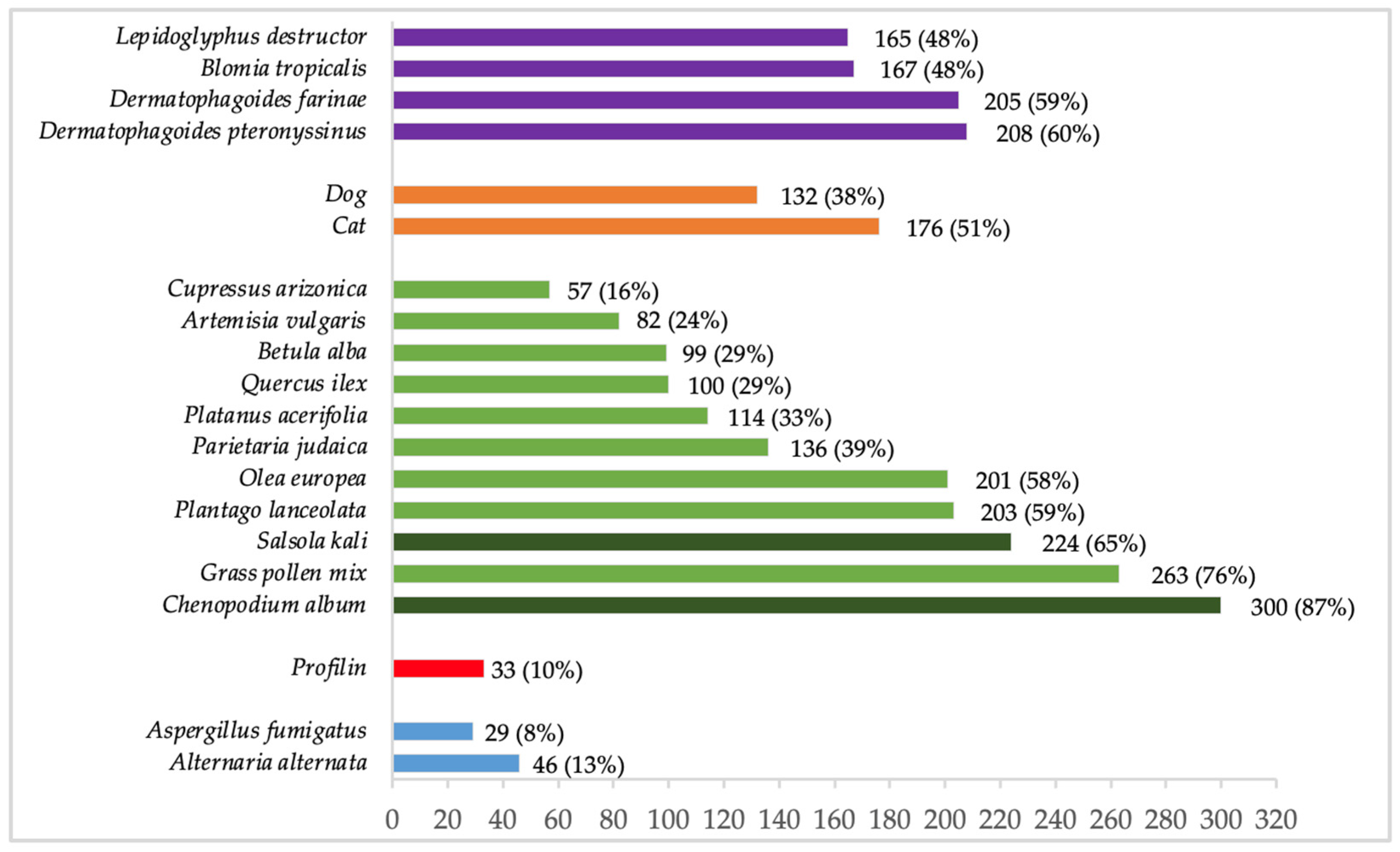
With respect to the two major pollens underpinning this study, 300 (86.7%) patients were positive for
C. album, and 224 (64.7%) were positive for
S. kali. As for the other allergens routinely included in the standard SPT panel, 247 (71.4%) patients had positive SPT for at least one of the four routinely tested mite species, namely 165 (47.6%) Lepidoglyphus destructor, 167 (48.3%)
Blomia tropicalis, 205 (59.2%)
Dermatophagoides farinae and 208 (60.1%)
Dermatophagoides pteronyssinus; 132 (38.2%) had positive SPTs to dogs and 176 (50.9%) to cats. Regarding fungal spores, 29 (8.4%) tested positive to
Alternaria alternata and 46 (13.3%) to
Aspergillus fumigatus. The frequency of sensitisation for each of the allergens in the SPT standard panel is described in
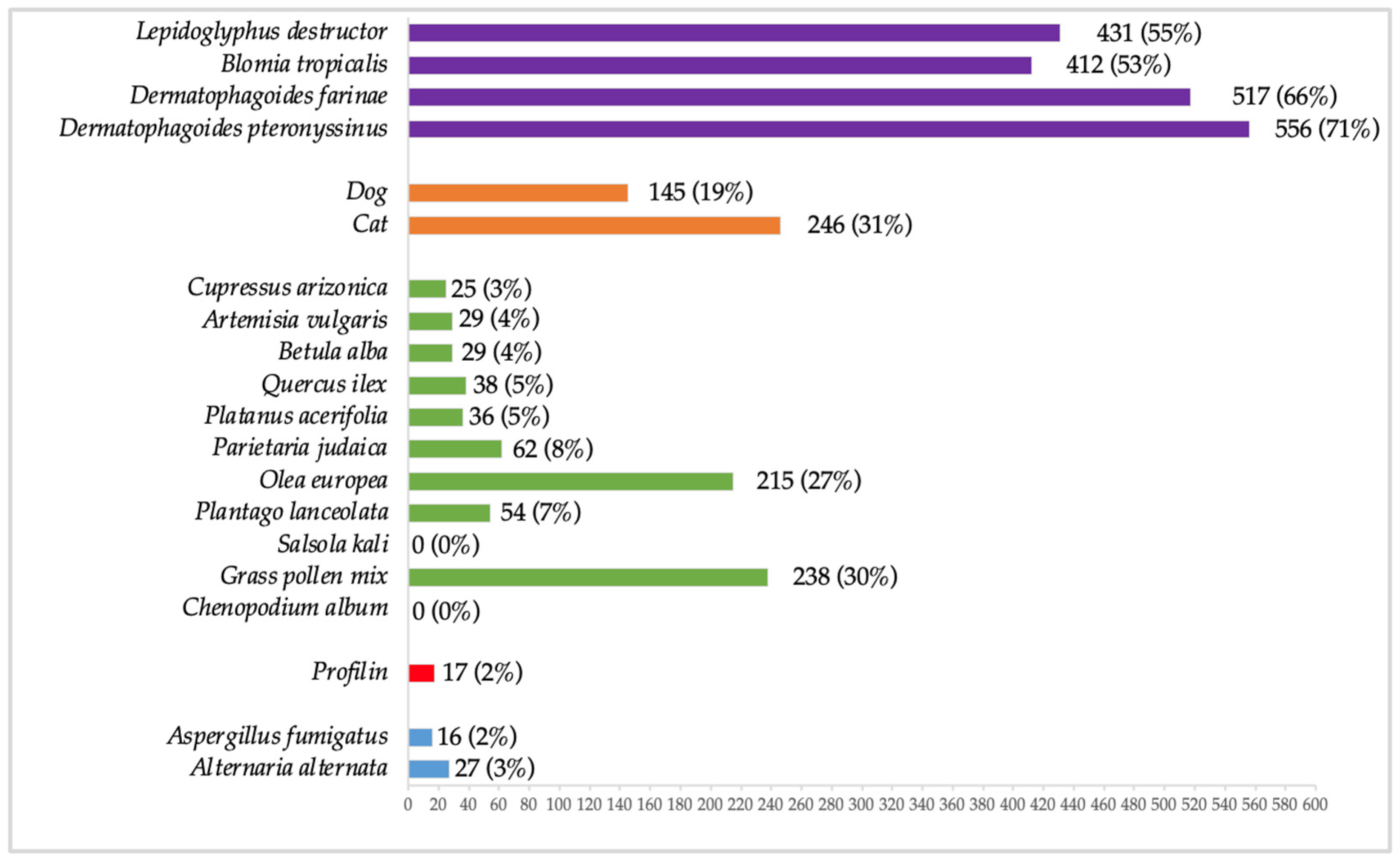
Figure 1. Additionally, the frequency of sensitisation for each of the allergens in the SPT standard panel in patients not sensitised to
Chenopodium album and
Salsola kali is described in
Figure 2.
Regarding
C. album and
S. kali, a detailed sensitisation to profilins and other pollen allergens included in the standard SPT panel is presented in
Table 1, allowing for a comparison between patients sensitised to a single
Amaranthaceae species and those with co-sensitisation. These co-sensitised individuals showed higher frequencies of sensitisation to profilins and other pollen allergens included in the standard SPT panel compared with mono-sensitised patients. Sensitisation to multiple pollen sources was common, indicating a high degree of polysensitisation within the study population.
In the 178 patients with both positive SPTs to C. album and to S. kali, there was a statistically significant positive correlation in wheal size (0.53, p < 0.0001), with mean (SD) being 6.2 (3.0) mm vs. 5.7 (2.8) mm, respectively.
Among patients with positive SPT to C. album, 22 out of the 47 (46.8%) tested had positive sIgE to C. album, but sIgE for Che a 1 was positive for only 1 of the 25 (4%) patients who performed ISAC—he was also positive to Ole e 1 and to Phl p 11 (an Ole e 1-like protein)—and he showed a wheal of ≥6 mm. From these 25 patients who performed ISAC, 23 (92%) were also sensitised to S. kali, with 10 (40%) showing sensitisation to Sal k 1, six (24%) to profilins, six (24%) to polcalcins, 15 (60%) to Ole e 1 and seven (28%) to Ole e 1-like proteins.
In the S. kali sensitisation group, 33 out of 60 (55%) were positive to Sal k 1, either by ImmunoCAP (23/35) or ISAC (10/25). The median wheal size (IQR) of the S. kali SPT was larger in patients with positive Sal k 1-specific IgE compared with those who tested negative: 7.0 (3.3) mm vs. 4.5 (1.6) mm, respectively. A wheal diameter ≥ 6 mm on the S. kali SPT showed a positive predictive value of 81.8% (18/22) for Sal k 1-specific IgE positivity, whereas a wheal diameter < 6 mm showed a negative predictive value of 60.5% (23/38).
Profilins were positive in 33 out of 252 (13.1%) patients tested with SPT and in 12 out of 45 (26.7%) tested with IgE Phl p12 using ImmunoCAP or other profilins using ISAC, reaching higher frequency (28.6%) in those with positive SPT to both C. album and S. kali. From those 27 patients tested by ISAC, 17 (63%) were positive for Ole e 1, eight (29.6%) for Ole e 1-like proteins and six (22.2%) for polcalcin.
4. Discussion
In this study, we characterised the sensitisation patterns to inhalant allergens included in the SPT panel used in our department, in patients with positive SPT to
C. album and/or
S. kali pollens, as summarised in
Figure 1. The results highlight a high prevalence of polysensitisation and frequent involvement of panallergens, supporting the presence of extensive IgE cross-reactivity in this population. These findings reflect the complex sensitisation landscape observed in a Mediterranean region with prolonged and intense exposure to diverse and overlapping pollen sources [
6].
Our data highlight novel insights into the sensitisation patterns of
C. album and
S. kali pollens in a patient cohort from southern Portugal, a region characterised by a Mediterranean climate and high prevalence of
Amaranthaceae species [
7,
8]. Both pollens emerged as major allergenic sources, with a high rate of co-sensitisation and a significant positive correlation between SPT wheal diameters (r = 0.53,
p < 0.0001). This association supports the hypothesis of immunological cross-reactivity between these closely related taxa and is consistent with molecular and immunochemical evidence demonstrating shared allergenic determinants, including profilins and Ole e 1-like proteins [
9,
17].
Profilins such as Che a 2 in
C. album and Sal k 4 in
S. kali are highly conserved panallergens capable of binding IgE across species, as confirmed by inhibition assays and epitope-mapping studies [
13]. Similarly, Ole e 1-like proteins, including Che a 1 and Sal k 5, share substantial amino acid identity and structural similarity, further contributing to cross-reactivity [
11]. These observations are in line with previous findings from Mediterranean regions, where homologous allergen structures are known to promote shared IgE recognition.
The statistically significant correlation between wheal diameters for both pollens further supports this interpretation, suggesting that stronger reactivity to one allergen is associated with enhanced reactivity to the other. Collectively, these findings are consistent with the concept of cross-reactivity among closely related species within the Amaranthaceae family and help explain the high frequency of co-sensitisation observed in this cohort.
Despite a higher frequency of SPT sensitisation to C. album compared with S. kali, molecular analysis revealed Sal k 1 as the predominant marker of genuine sensitisation, being detected in more than half of the patients tested. In contrast, Che a 1 positivity was observed in only one patient. These findings suggest that S. kali may represent the primary sensitising source in this setting, a conclusion further supported by larger wheal diameters among Sal k 1-positive individuals. The high frequency of C. album sensitisation detected by SPT may, therefore, be partly explained by IgE cross-reactivity within the Amaranthaceae family rather than true primary sensitisation.
The higher clinical relevance of
Salsola kali observed in our study may be partially explained by differences in pollen seasonality within the
Amaranthaceae family. Aerobiological studies have demonstrated that
Amaranthaceae pollen may remain in the atmosphere for more than six months, typically extending from early spring to early autumn, with considerable variability in peak concentrations [
18]. This extended seasonal presence suggests the contribution of multiple taxonomically related species with overlapping pollination periods [
19].
Given that pollen grains within
Chenopodiaceae/
Amaranthaceae are morphologically indistinguishable at the species level, pollen counting alone is limited, and the assessment of the degree of flowering represents a valuable complementary approach [
19,
20]. Although this method does not directly quantify airborne pollen concentrations, it provides relevant phenological information that enhances the interpretation of aerobiological data and allows for a more accurate characterisation of species-specific contributions to allergen exposure. Within this framework, the earlier seasonal onset of
Salsola kali flowering, preceding that of
Chenopodium album, may favour its role as a primary sensitising allergen. Early exposure to airborne allergens may be a key determinant of sensitisation, and initial contact with
Salsola pollen may promote a dominant IgE response, while subsequent exposure to later-flowering species, such as
Chenopodium album, may contribute predominantly to secondary sensitisation or cross-reactivity. Notably, airborne pollen detected over extended periods is likely to represent a composite signal derived from multiple coexisting species rather than a single dominant taxon, which supports the concept that early-flowering species may play a key role in initiating sensitisation, whereas later-flowering species contribute to the maintenance and amplification of the allergic response [
20].
From a clinical perspective, these temporal differences may influence not only the onset and persistence of symptoms, but also their interpretation in diagnostic settings, particularly in regions with prolonged or overlapping pollen seasons [
20]. This may lead to an underestimation of the role of
Salsola when
Amaranthaceae pollens are considered as a homogeneous group [
9]. Overall, our findings support the hypothesis that
Salsola kali may act as a primary sensitising source in Mediterranean environments, highlighting the importance of species-specific aerobiological patterns in both diagnosis and therapeutic decision making.
Figure 1 provides a global overview of the sensitisation landscape in this population, illustrating widespread polysensitisation and frequent panallergen involvement. In contrast,
Table 1 allows for a more detailed comparison between mono- and co-sensitised patients to
C. album and/or
S. kali. As shown in
Table 1, co-sensitised individuals exhibited higher frequencies of sensitisation to profilins and multiple pollen sources, supporting the role of cross-reactive allergens in driving positive SPT responses. In a region such as southern Portugal, characterised by prolonged seasonal exposure to
Amaranthaceae pollens, repeated allergen contact is likely to promote broad IgE sensitisation profiles. Importantly, these findings highlight a relevant clinical implication: positive SPT responses to multiple
Amaranthaceae species do not necessarily reflect true multiple primary sensitisation but may largely be mediated by panallergen-driven IgE cross-reactivity. Taken together, the data presented in
Figure 1 and
Table 1 reinforce the limitations of extract-based diagnostics in highly exposed populations and underscore the added value of component-resolved diagnosis in distinguishing genuine sensitisation from cross-reactivity.
The comparison between sensitisation profiles in patients with and without
Amaranthaceae sensitisation (
Figure 1 and
Figure 2) provides important insight into the allergenic landscape of this Mediterranean region. Profilin sensitisation was more frequent among
Amaranthaceae-sensitised patients, suggesting that exposure to these pollens may contribute to its development [
21]. This observation is consistent with the established role of profilins as ubiquitous panallergens mediating IgE cross-reactivity across multiple pollen sources [
22,
23]. Patients sensitised to profilins have a higher risk of sensitisation to other pollens, which may partly explain the polysensitisation patterns observed in our cohort (
Table 1) [
24]. Accordingly,
Amaranthaceae-sensitised patients exhibited higher frequencies of sensitisation to multiple pollen allergens compared with those not sensitised to Amaranthaceae pollens, supporting the role of panallergen-driven cross-reactivity in this setting [
9,
21]. This comparison suggests that the observed sensitisation patterns are unlikely to be purely random and may reflect a structured exposure-driven sensitisation profile in
Amaranthaceae-positive patients.
Sensitisation patterns within the same climatic region may vary according to factors such as urbanisation, season of birth, and cumulative allergen exposure [
25]. The differences observed between
Amaranthaceae-positive and -negative patients may, therefore, reflect variations in exposure intensity and individual susceptibility. In high-exposure regions such as the Algarve, sensitisation to
Amaranthaceae pollens may act as a marker of distinct allergic phenotypes, with potential implications for clinical expression, diagnosis, and management.
Sensitisation to panallergens, particularly profilins (13–27%), was notably higher than that previously reported in the overall atopic population of the same hospital unit (6%), and in atopic patients without sensitisation to
Amaranthaceae (2%) [
10]. In addition, frequent co-sensitisation to Ole e 1 and Ole e 1-like proteins, major components of olive pollen, highlights the contribution of multiple seasonal pollen exposures to the broad sensitisation profiles observed. Profilins and polcalcins, which are relevant panallergens in
Chenopodium pollen, therefore represent strong candidates for mediating IgE cross-reactivity with other pollen sources and may account for the high prevalence of polysensitisation in this population [
17,
25].
These findings provide clinically relevant evidence supporting the use of component-resolved diagnosis and molecular-based testing in regions where multiple structurally related pollens coexist and share structural homology [
26]. Both
C. album and
S. kali are complex allergen sources containing multiple isoforms and allergenic proteins with varying degrees of cross-reactivity; however, only one recombinant Sal k 1 and one recombinant Che a 1 isoform are currently available for molecular diagnosis, which limits comprehensive assessment of the sensitisation profile to these pollens [
27].
Molecular allergen characterisation is, therefore, essential to improve diagnostic accuracy, enabling differentiation between genuine sensitisation and cross-reactivity and guiding personalised therapeutic strategies, particularly in the selection of allergen-specific immunotherapy. Future research should focus on the identification of additional clinically relevant allergen components and prognostic biomarkers capable of predicting immunotherapy efficacy, monitoring treatment response, and stratifying patients according to molecular sensitisation profiles [
28,
29,
30].
Some limitations of this study should be acknowledged. Its retrospective design and reliance on a referred patient population may limit the extrapolation of the findings to the general community. In addition, molecular testing was performed in only a subset of patients, which restricts the generalisation of component-resolved sensitisation patterns. Furthermore, detailed information on daily environmental exposure and cumulative sensitisation burden was not systematically available in the retrospective clinical records and therefore could not be reliably analysed. Future prospective studies incorporating structured environmental exposure data and global sensitisation indices would be valuable to further clarify these associations.
Nevertheless, this study provides clinically meaningful evidence supporting the predominance of Salsola kali as a major allergenic source among Amaranthaceae pollens in southern Portugal. These findings contribute to a more refined understanding of regional sensitisation profiles and emphasise the importance of integrating molecular allergology into routine diagnostic pathways to improve diagnostic precision and personalise immunotherapy strategies in Mediterranean populations
5. Conclusions and Prospective Studies
This study provides a comprehensive characterisation of sensitisation patterns to Amaranthaceae pollens in a Mediterranean region with high environmental exposure. Despite higher overall skin prick test positivity to Chenopodium album, species-specific molecular sensitisation was markedly more frequent for Salsola kali, as evidenced by Sal k 1 positivity and its association with larger wheal diameters. Together with the high prevalence of panallergen sensitisation, these findings indicate that IgE cross-reactivity plays a central role in shaping sensitisation profiles in this population and that S. kali is likely the predominant primary sensitising source.
From a clinical perspective, these results highlight the limitations of extract-based diagnostics in highly exposed regions and reinforce the added value of molecular allergology in distinguishing genuine sensitisation from cross-reactivity, with potential implications for diagnostic accuracy and allergen-specific immunotherapy selection.
Future prospective and multicentre studies integrating aerobiological monitoring, detailed environmental exposure assessment, and expanded molecular profiling are warranted to confirm these findings. Systematic collection of clinical data and confirmation of molecular sensitisation profiles in larger patient cohorts would also allow for the evaluation of the impact of sensitisation to these pollens on the clinical phenotype and severity of allergic disease.
In addition, future studies incorporating detailed exposure assessment, birth seasonality data, and longitudinal follow-up may help clarify whether the observed sensitisation patterns reflect true mechanistic differences in sensitisation pathways or variations in cumulative allergen exposure over time.
In this context, future research evaluating symptom patterns—particularly the onset and duration of allergic symptoms—in relation to sensitisation to individual Amaranthaceae pollens may provide important insights into the clinical relevance of species-specific sensitisation, potentially serving as a valuable tool for both diagnosis and treatment. Such approaches may help to clarify the relative contribution of individual Amaranthaceae species and refine personalised diagnostic and therapeutic strategies in Mediterranean populations.




 ,
,