


Abstract
In this work, the sintering behavior of tapes prepared via tape casting from stainless-steel and zirconia powders is investigated by optical—as well as push-rod—dilatometry. Both methods are compared in terms of sample preparation, measurement conditions, and advantages and disadvantages. The experimental work shows the advantages of optical dilatometry in the characterization of the sintering behavior of load-free sintering tapes and the possibility of simultaneously observing sample warpage and deformation. Push-rod dilatometry requires a constant load on the sample, which influences measurement in the case of tapes with lower mechanical stability due to their sensitivity to deformation, but it has advantages because of its higher accuracy in measuring dimensional changes. In the case of warpage, shrinkage due to the sintering of the sample is superimposed by an irregular deformation process that can be separated by analytical methods. No in-plane shrinkage anisotropy of the tapes is observed for either type of tape. In the case of the push-rod dilatometer, an additional peak in the shrinkage rate is observed in the early stage of compaction, along with a slight shift and an increased maximum in the compaction rate. This is most likely due to the effects of the contact pressure of the push-rod.
Keywords:
optical dilatometry; dilatometry; tape casting; sintering shrinkage; ceramic; ZrO2; metal; 17-4PH steel; warpage 1. Introduction
Nowadays, sinter-based materials have become indispensable for industry and society. Sintered steel and ceramic tapes have a wide range of applications, including electrical ceramics, membranes, batteries, fuel cells, and electrolyzers [1,2,3,4]. A wide variety of material combinations and microstructures (including gradient microstructures, porous and gas-tight microstructures) are used. This results in complex sintering processes that require an exact determination of the sintering behavior in order to obtain defect-free components without sintering distortion.
To be able to meet the future demand for sintered materials, there are far-reaching scientific developments required in the field of sintering to optimize sintering economically as well as ecologically (reducing energy consumption). Among many other aspects (heating technique, temperature-time schedule, green body properties, powder properties, and additives [5,6,7,8,9]), modeling and computer simulation of the sintering process play a central role [10,11]. Depending on the scale considered, the sintering models are divided into microscopic and mesoscopic models, which primarily provide information about the underlying sintering physics, and macroscopic continuum models, which allow the description or fit of real macroscopic sintering processes [12]. A representative of the macroscopic continuum models is the phenomenological continuum mechanics model. It is based on the constitutive equations and correlates the shrinkage of a porous body with the viscous parameters and the generalized state of stress [13]. Such simulations, based on the continuum mechanics sintering model, could help to predict or estimate a green body shape for a defect-free sintering result without the time-consuming and expensive method of “trial and error” [11]. The development and validation of simulations based on these models usually require experimentally determined input parameters. It is of great importance to know the shrinkage behavior in terms of temperature and time. Dilatometric measurements provide direct access to the required macroscopic parameters, such as strain and strain rate, in addition to shrinkage. Other variables required for the models, such as uniaxial viscosity Poisson’s ratio and sinter stress , can be measured with special setups, or derived from the measurements [14,15,16].
Thermodilatometry is the standard method for characterizing the shrinkage behavior of metallic and ceramic materials during sintering. Depending on the shape and stability of the green bodies, the optimal thermodilatometric measurement setup must be selected or, in some cases, adapted to the specific sample requirements in order to determine the shrinkage behavior without substantial external influences. In principle, two different thermodilatometric methods can be distinguished, namely the push-rod-type dilatometry and the optical dilatometry.
With a push-rod dilatometer, the change in length of the sample is measured one-dimensionally, and the sample is exposed to the force of the push-rod, which transmits the change in length of the sample to the measuring unit (usually an inductive displacement transducer). A defined force is required to maintain permanent contact between the sample and the push-rod. This is a significant difference from the optical dilatometer, as the contact pressure can affect the sintering process and cause plastic deformation. With push-rod dilatometry, an undesirable change in the shape of the sample due to the measuring forces in the final state can only be detected, if at all, when the sample is inspected after the measurement. In some cases, stresses between the push-rod and the sample or their relaxation superimpose on the measurement signal, for example, in the form of jumps or drifts in the signal [17]. For most green bodies or already sintered samples with a large cross-section, the contact pressure of the rod has little or no effect on the measurement of the length change behavior of the sample during thermal treatment [18,19]. For materials with relatively low viscosity, such as polymers, glass powders or samples with high amounts of liquid phases, this is often not the case. The high resolution of the push-rod dilatometer allows for a highly precise measurement of small changes in length, such as the measurement of the coefficient of thermal expansion (CTE) [20,21].
The determination of sintering behavior with push-rod dilatometry methods usually uses bulk samples. The measurement of the sintering behavior of tapes is more complicated due to the specific properties of the tapes, such as their low thickness, lower mechanical stability, and in some cases, process- and microstructure-related anisotropies in the green tape [22]. This makes the use of optical dilatometry more favorable for such tasks.
An ideal thermodilatometric measurement would require zero mechanical load on the sample [17]. In the optical dilatometer, the sample can sinter as freely as possible, under its own weight and without external forces. In practice, it is not feasible to overcome the influence of gravity, and some friction remains between the sample and the support. In most cases, the influence of these interactions is negligible. In the literature, optical dilatometry is therefore also referred to as non-contact dilatometry [17,23].
In the field of the sintering and co-sintering of anisotropic green bodies, optical dilatometry plays an important role in the analysis of the sintering process. The deformation and anisotropic shrinkage of a sample can be observed and measured two-dimensionally (or even three-dimensionally) in situ. Video recordings of the sample shape (silhouette) allow the determination of shrinkage and other deformation processes as a function of temperature and time, e.g., swelling, bloating effects or distortions and their relaxation.
Further advantages of in situ high-temperature microscopy are discussed in detail by Boccaccini et al. [24] and Paganelli [25]. Other types of optical dilatometers have been developed and described by Paganelli [26] and Ayoub et al. [27]. A special optical dilatometer setup has been constructed by Kim et al. [28] to measure the sintering of films constrained by a substrate, where a laser is used to measure the change in length of the film thickness.
Some experimental challenges of optical dilatometry may include a blurred image of the sample due to the thermal expansion of the experimental setup, the darkening of the image (e.g., condensation of debinding products on the viewing windows), or brightness at high temperatures due to thermal radiation.
This work aims to evaluate and compare the usability of optical and push-rod dilatometry for measuring the sintering behavior of tapes. Therefore, green tapes of steel and zirconia, which differ in their properties regarding green density, solids content, particle size and shape, and elasticity, were investigated and discussed.
2. Experimental
2.1. Materials and Sample Production
The materials used in this work were powders of stainless steel (X5CrNiCuNb17-4-4, 17-4PH: delivered as-sieved with a mesh size of 38 µm, measured particle size d50 = 19.43 µm; Sandvik Osprey Ltd., Neath, UK) and 3 mol% yttria-stabilized zirconia (ZrO2, TZ-3YS-E: measured particle size d50 = 0.49 µm; Tosoh K.K., Tokyo, Japan).
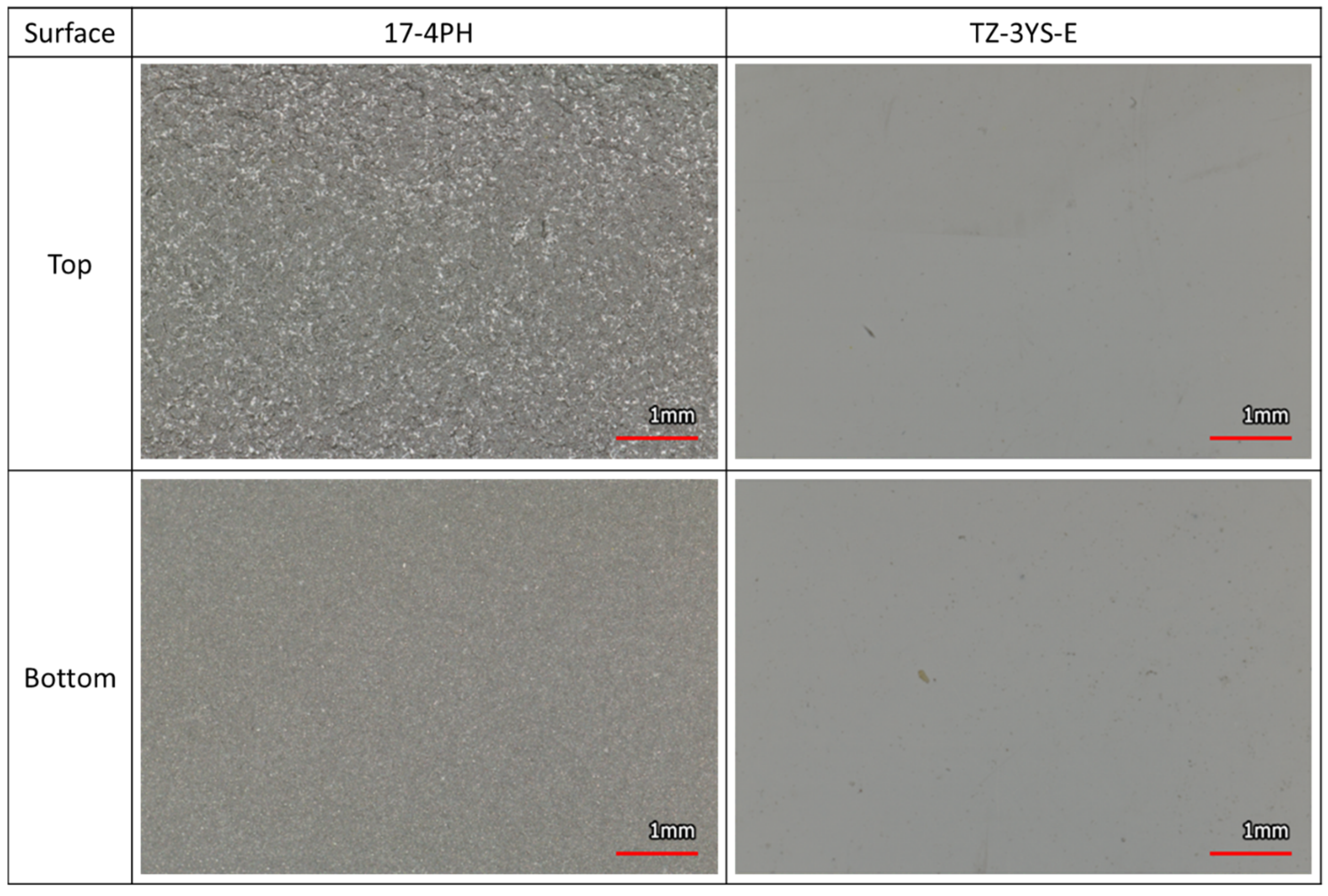
For the dilatometric investigations, tapes from both materials were prepared by tape casting using water-based systems. The suspensions used were produced by homogenizing the powder with a solvent (deionized water), a dispersing agent (Dolapix CE 64; Zschimmer & Schwarz, Lahnstein, Germany), a polyvinyl alcohol binder (PVA; Mowiol 20–98; Ter Hell GmbH, Hamburg, Germany), a plasticizing agent (glycerin; Carl Roth GmbH, Karlsruhe, Germany), and a defoaming agent (Foamaster F-111; BASF, Ludwigshafen, Germany). In case of the ceramic suspension, a wetting agent (Glydol; Zschimmer & Schwarz) was added. The tapes were cast by applying the suspension onto a carrier tape using the doctor blade method. The blade gap was adjusted to 1.0 mm. The tapes were then dried at room temperature and 50% humidity. The subsequent drying time depends on the layer thickness. The solids content of the suspensions was 23 vol% for 17-4PH and 22 vol% for TZ-3YS-E. Table 1 shows the compositions of the steel and zirconia suspensions to produce the steel and ceramic tapes used in this work. At the end of the manufacturing process, the green steel tape had a rough, less dense top side and a smoother, denser bottom side (facing the carrier tape). The roughness of the green ceramic tape was much less, and the difference between the top and bottom sides was less pronounced. Table 2 shows the general properties of the dried green 17-4PH and TZ-3YS-E tapes, such as density, relative density, thickness, and roughness (surface roughness ).
Table 1.
Approximate compositions for the steel and zirconia suspensions.
Table 2.
Properties of the green steel and zirconia tapes.
2.2. Methods
2.2.1. Optical Dilatometry
The thermal expansion and shrinkage behavior, as well as the distortion processes of the tapes during heat treatment, were characterized by optical dilatometry. For this purpose, a heating microscope EM201 from HESSE Instruments (Osterode am Harz, Germany) was used. The sample to be investigated was placed in a tube furnace and illuminated from the front side, while the shadow image of the sample was recorded by a CCD camera from the back side. The sample silhouette’s changes in length (width) and height (x- or y- and z-direction, respectively, see Section 2.3) during debinding and sintering were measured. The measurement software of the device (EMI v2.2.0 by HESSE Instruments GmbH) analyzed the shadow images. The measured values were based on a comparison of the results obtained from analyzing several images taken per second, which were smoothed using a median filter. The software outputs the maximum value determined for the sample contour as the measured value of the measured dimension.
During the measurement, the tube furnace was purged with a gas mixture of 95% argon and 5% hydrogen (Varigon H5; Linde GmbH, Pullach, Germany) at a flow rate of 10 L/h at ambient pressure.
A gas mixture of argon and hydrogen was chosen to prevent the oxidation of the steel samples. The disadvantage of a hydrogen-containing atmosphere is a more difficult debinding process. Residual carbon, which can result from incomplete pyrolysis, can interfere with the sintering process or change material properties. Hydrogen and residual carbon also have a reducing effect on zirconia. The latter can be easily identified by a gray discoloration of the zirconia component after heat treatment. However, to ensure consistent experimental conditions and consistency in the subsequent comparison of data, the same atmosphere was used for all thermal treatments on all samples.
Two temperature schedules were used for the debinding of the samples: 1 K/min from room temperature to 600 °C, or 5 K/min to 250 °C and 2 K/min to 500 °C. Both were followed by 5 K/min to 1370 °C with a 30 min dwell time for the sintering process.
If temperatures higher than 1370 °C are used, the steel will exhibit viscous flow or melting effects instead of further densification. The melting point of 17-4PH is 1425 °C ± 5 °C as determined by differential thermal analysis (DTA).
In this work, only the length of the sample was evaluated for the optical dilatometry measurements. The height measurements in the z-direction were not considered. This is due to the low height of the tapes, which led to a high measurement uncertainty. Complications included reflections on the tape surface and the deformation of the tape, resulting in a very noisy signal or a signal that could not be meaningfully evaluated.
If the sample is debinded during optical dilatometry, it is possible that the windows of the furnace may be slightly fogged by the outgassing of the sample and the image may be partially shadowed. Under certain circumstances, this can temporarily lead to undesirable measurement artifacts, so that the measurement signal is noisy. At higher temperatures, this effect disappears due to the evaporation of organic residues on the windows. Since the focus was on the sintering behavior at temperatures above 900 °C, nothing was done to improve this situation. However, this can be counteracted by a previous (external) debinding step, by direct window flushing, or by a correspondingly high gas flow of the flushing gas.
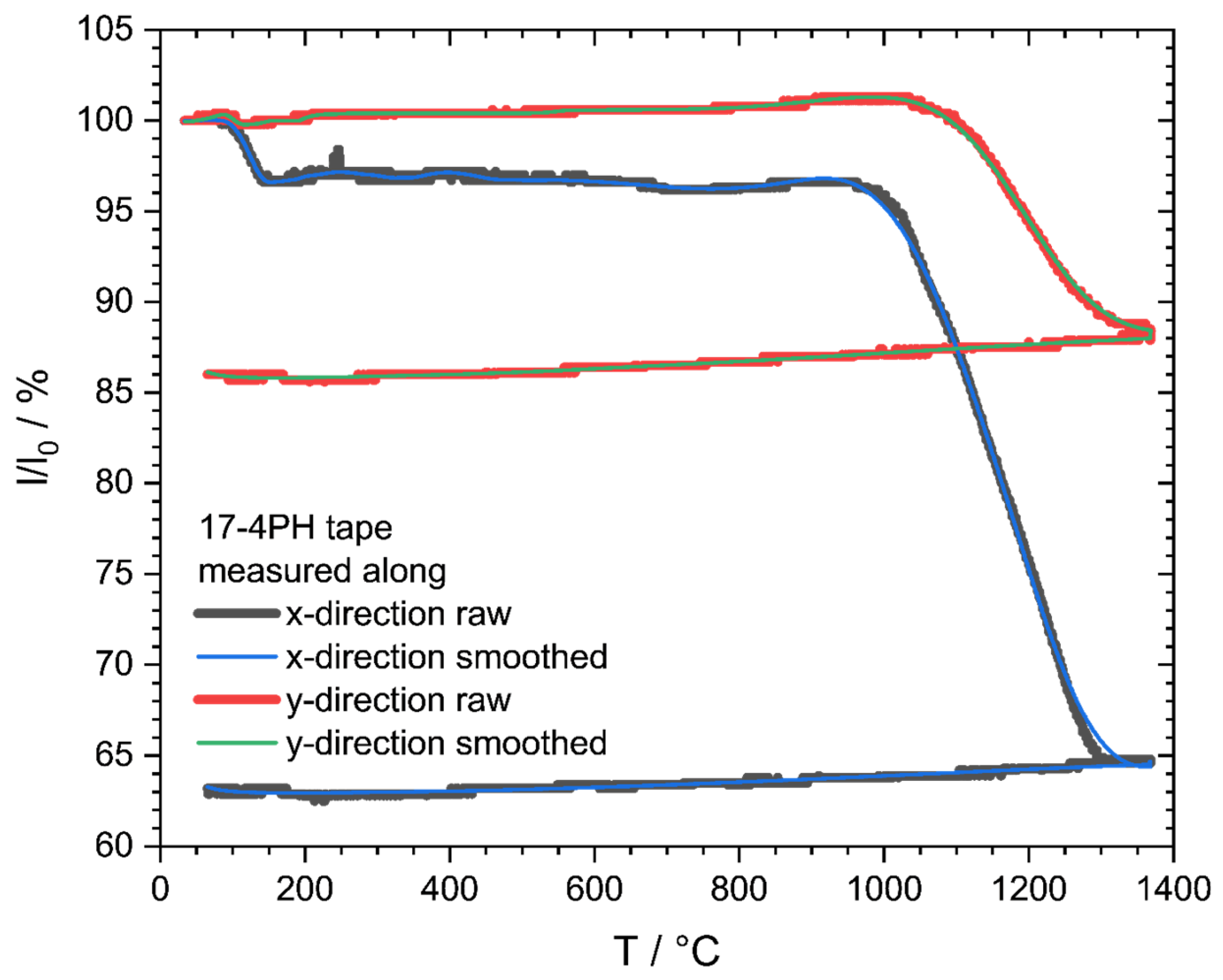
The optical dilatometry data for the plots were smoothed with Loess regression (using a 0.1 fraction of the data to estimate each relative length value). To view a raw data set and compare it to the smoothed data, see Appendix A.
2.2.2. Push-Rod Dilatometry
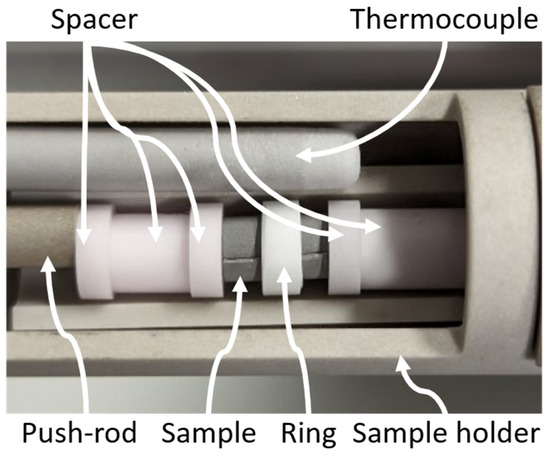
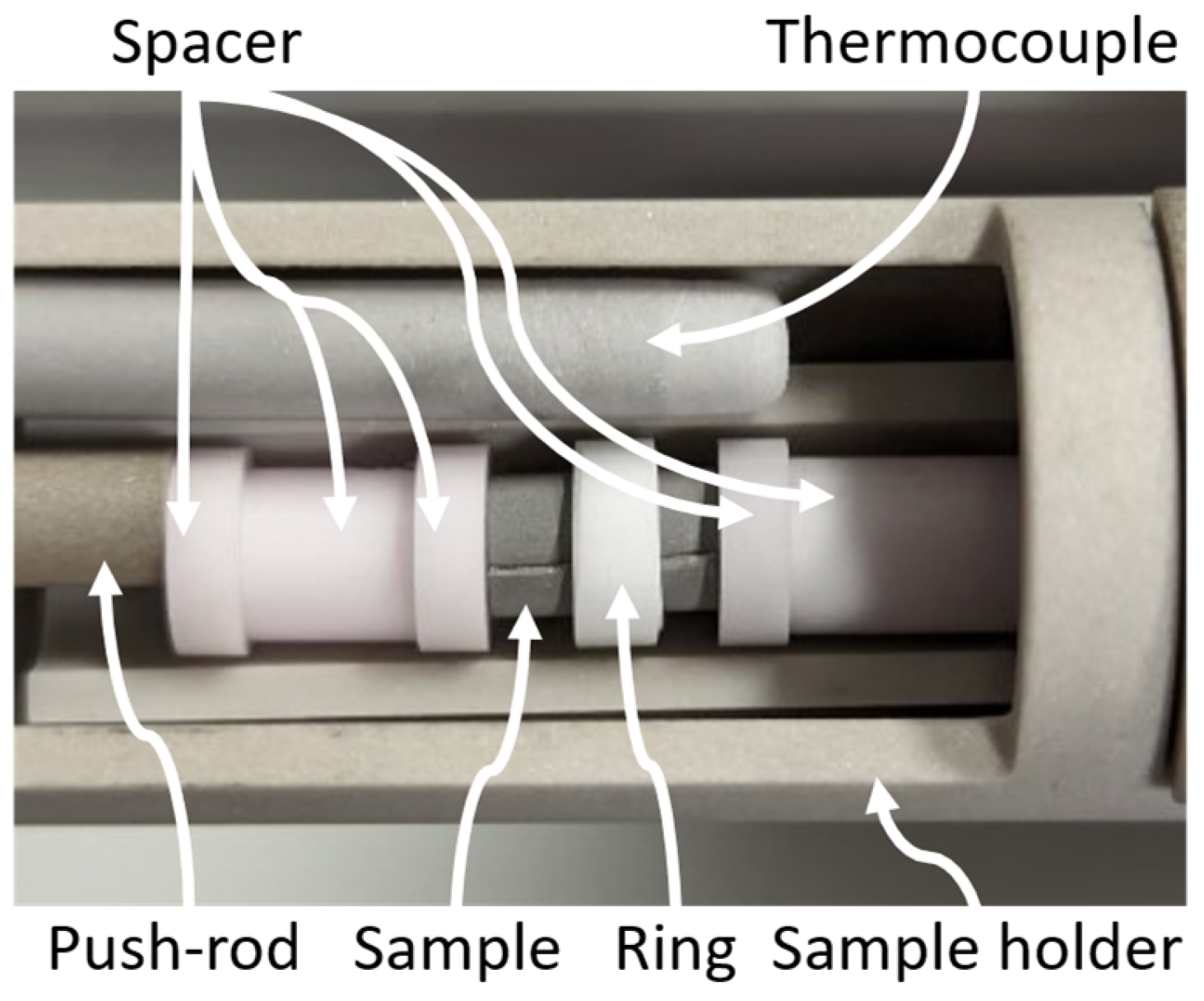
For the push-rod dilatometry measurements, a NETZSCH dilatometer (DIL 402 C, NETZSCH-Gerätebau GmbH, Selb, Germany) was used. In general, the (solid) sample to be examined is clamped with a defined force and an aluminum oxide spacer between the push-rod and the sample holder (see Figure 1). The linear change in length of the sample due to temperature change is then transferred by the push-rod to a sensor. The sensor is a strain gauge, a Linear Variable Displacement Transducer (LVDT) unit, which measures the positional displacement. The influence of the thermal expansion of the measuring system (push-rod and sample holder) was corrected by taking into account the difference between the measured and known thermal expansion values of an alumina reference sample.
Figure 1.
Sample positioning for push-rod dilatometry. The sample is usually positioned horizontally between the push-rod and the sample holder.
After a pre-vacuum of 5.2 × 10⁻² mbar, the atmosphere during debinding and the measurement consisted of 95% argon and 5% hydrogen or 80% argon and 20% hydrogen with a total flow rate of 5 L/h or 10 L/h at ambient pressure.
The organic additives were removed from the sample in a previous external debinding and pre-sintering step. This occurred with 1 K/min from room temperature to 540 °C, followed by 5 K/min to 900 °C without dwell times. The subsequent sintering schedule was 10 K/min from room temperature to 700 °C and 5 K/min to 1370 °C with a 30 min isothermal dwell time before cooling.
Push-rod dilatometry data were smoothed for the plots with a Savitzky–Golay filter in evaluation software (Proteus v6.0.0 by NETZSCH-Gerätebau GmbH).
The measurement uncertainty of the linear shrinkage for both dilatometric methods was evaluated following the Guide to the Expression of Uncertainty in Measurement (GUM, JCGM 100:2008) [29] with NIST SRM 723 and an alumina block (99.7%) as reference materials for the push-rod dilatometer and optical dilatometer, respectively. The uncertainties of both the length change and the initial sample length = 8 mm, measured with a calibrated caliper ( < 30 μm), were considered. Expanded uncertainties are reported at a coverage factor of (approximately 95% confidence level).
For both dilatometric methods, the temperature at the sample location was calibrated by observing the melting of pure metals (indium, tin, aluminum, and gold). These reference materials were selected because they serve as defining fixed points of the International Temperature Scale of 1990 (ITS-90) and their melting temperatures are therefore known with high accuracy [30]. Calibration was verified periodically using the same reference metals. This procedure yielded a temperature measurement uncertainty of < 5 K.
2.3. Sample Preparation for the Dilatometry
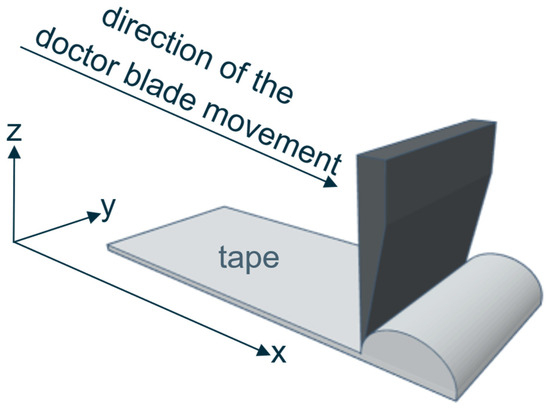
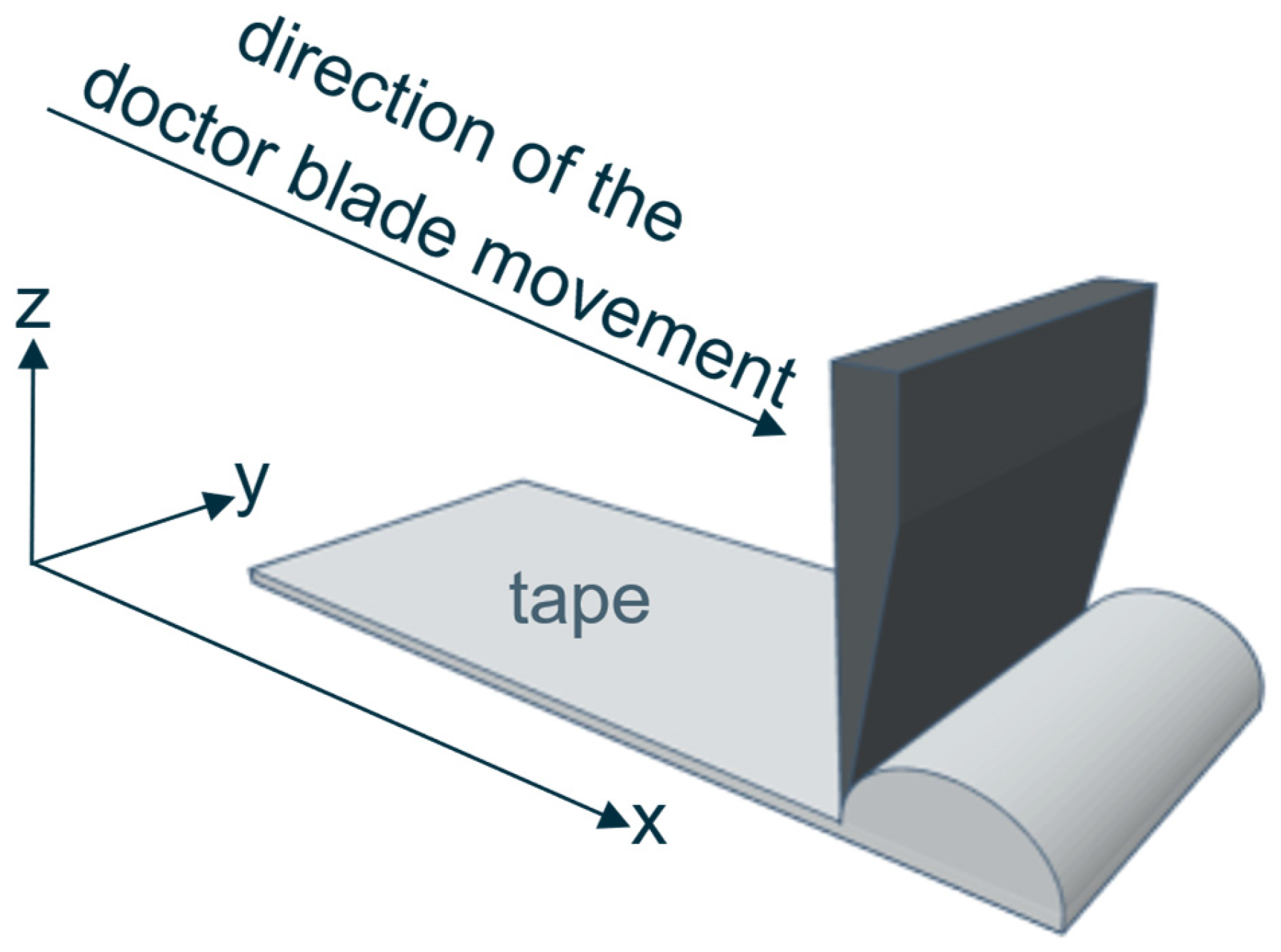
The sketch in Figure 2 serves to describe the orientation of the tape during the tape casting process and in the dilatometric experiment. In the following, the direction of the doctor blade’s movement (casting direction) is always the x-direction of the tape. When the length of the sample is measured in optical dilatometry, it is in the x- or y-direction of the tape, or perpendicular or parallel to the doctor blade’s movement direction, respectively.
Figure 2.
Description of the tape orientation during tape casting (x-, y- and z-direction). The direction of the doctor blade movement (casting direction) is always the x-direction of the tape.
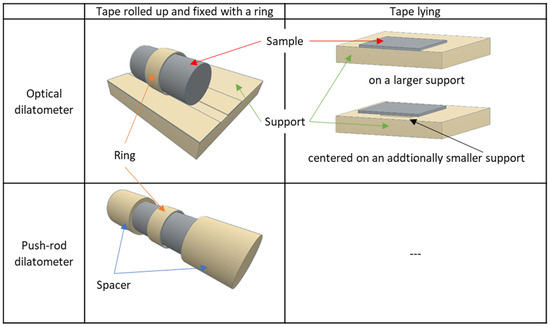
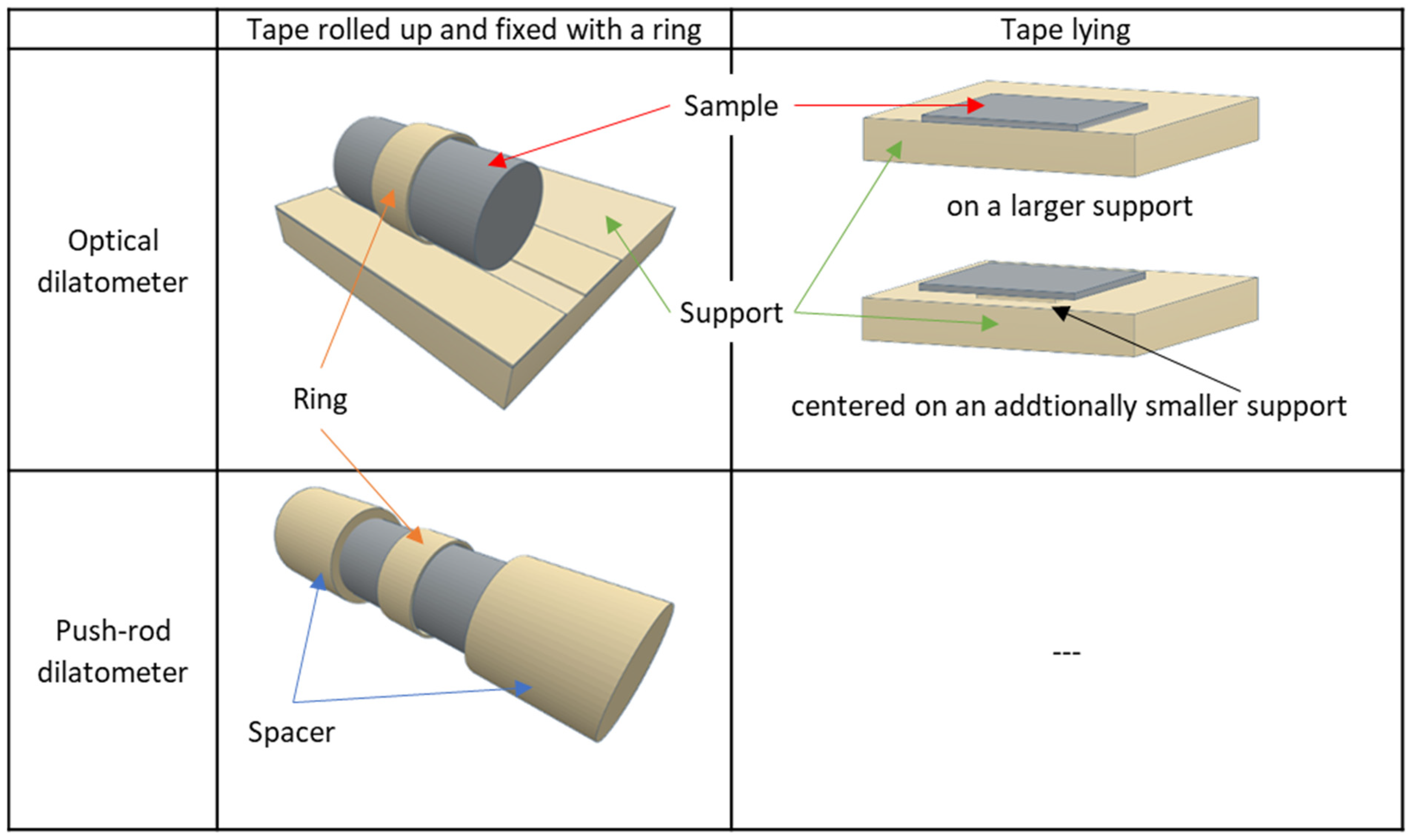
For the measurements, two different sample preparations were used as shown in Figure 3.
Figure 3.
Sample preparations for optical and push-rod dilatometry. In optical dilatometry, either the ring with the rolled tape is held in position by two alumina strips in front and behind it, or the tape lies flat on the alumina substrate. In a slight variation, the sample is raised in the center by a smaller aluminum oxide plate. For push-rod dilatometry, the rolled tape, held in place by the ring, is placed between two alumina spacers.
For the first method of preparation, stripes of green tape before binder burnout, approximately 20 mm × 7–8 mm × sample height, were cut along the x-direction from the center of the tape and then rolled up along the x-direction of the tape. This allows for the measurement of the linear change in the length of the tape in the y-direction. To measure in the x-direction, stripes were cut and rolled up along the y-direction of the tape. To prevent these rolls from unwinding, they were held together in the center by an aluminum oxide ring with an inner diameter of 4 mm. Since this geometry fits well in both types of dilatometers, this experimental arrangement can be used to compare push-rod and optical dilatometry. For the push-rod dilatometry, the sample with the ring is placed between alumina spacers and is clamped between the push-rod and the sample holder with a constant force of 20 cN (see Figure 1). Depending on the number of tape layers (typically one to three) within the rolled sample, the contact area ranges from approximately 1.3 mm2 to 2.4 mm2 (or smaller in the case of point contact). This results in an estimated contact pressure of 83 kPa to 154 kPa (0.08 MPa to 0.15 MPa). In the optical dilatometer, the ring with the rolled tape is placed between two supporting alumina strips to prevent the ring from rolling, as shown in Figure 3. To reduce the measurement uncertainty, the rolled ceramic tapes are ground to a trapezoidal shape on the sides. The distances between the lateral edges of the sample are then better defined with respect to the camera. When measuring rolled up cylindrical tapes with plane-parallel end faces, it cannot be ruled out that there is a very slight rotation of the sample. In this case, the length is measured between a side surface that is closer to the camera and a side surface that is further away. This effect would increase the measurement uncertainty and is reduced for samples with a trapezoidal shape.
The second preparation method is only used for optical dilatometry. Square green tapes measuring approximately 8 mm × 8 mm × sample height were cut from the central area of the tape. The samples were placed either on an alumina support larger than the sample dimensions or they were centered on a smaller alumina support with dimensions of 4 mm × 4 mm × 0.6 mm. These two types of placement are the simplest. Apart from gravity and interfacial friction (with the support), it allows the tape to sinter freely and allows deformations to occur. The sample deformation can be directly observed and evaluated. After measuring along the x-direction of the tape, the green tape pieces were rotated 90° in the plane to measure the sample length along the y-direction of the tape.
2.4. Measurements Before and After the Dilatometric Investigation
To double-check the dilatometric measurements or to compare them in cases with undesired or irregular deformation of the sample, the sample dimensions were measured at room temperature before and after the measurement using a digital caliper (Vogel Germany GmbH & Co. KG, Kevelaer, Germany).
The microstructures of selected tapes pre-sintered at 1000 °C were characterized by optical or electron microscopy. The optical micrographs were taken with the Nikon EPIPHOT 300 (Nikon Metrology GmbH, Düsseldorf, Germany). Higher-magnification images of the microstructures were acquired using an ULTRA 55 field emission scanning electron microscope (FESEM; Carl Zeiss Microscopy Deutschland GmbH, Oberkochen, Germany). The tapes were embedded in epoxy resin and then ground to 1 µm with a diamond suspension, followed by polishing with an oxide polishing slurry.
The geometric density of the green samples was determined after measuring their masses and dimensions. The density of the sintered sample was also determined using Archimedes’ principle with water as the medium according to DIN EN ISO 3369:2010-08 [31]. Dividing the density by the theoretical density (7.80 g/cm3 for 17-4PH and 6.05 g/cm3 for TZ-3YS-E) gives the relative density of the sample.
The surface roughness () of the green tapes was determined using a 3D optical profilometer (VR-5000, Keyence Deutschland GmbH, Neu-Isenburg, Germany). Surface roughness was quantified over a 4.8 mm × 7.0 mm measurement area using a 4-megapixel monochrome CMOS sensor and a doubly telecentric optical system (2× magnification for both illumination and imaging paths), achieving a lateral resolution of 0.1 µm. This configuration ensures distortion-free topographic reconstruction by eliminating perspective errors, which is critical for the accurate determination of areal roughness parameters. The arithmetical mean height was calculated using the instrument’s proprietary analysis software. Further details on the measurement procedure are provided in Appendix B.
2.5. Calculation of Actual Shrinkage of Warped Tapes
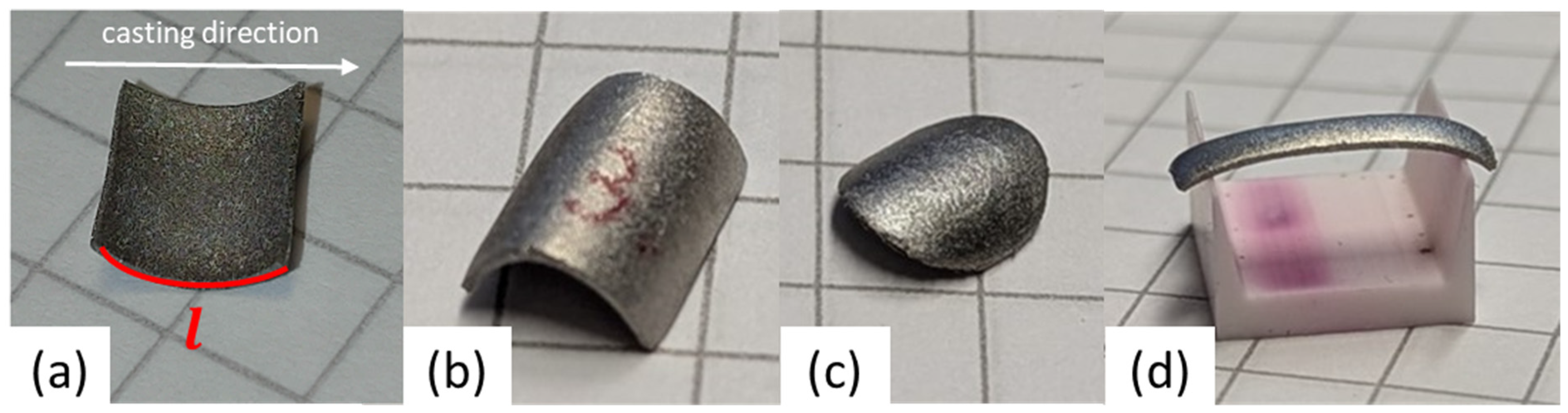
If the measured sample itself exhibits some deformation that is not attributed to the sintering shrinkage (e.g., warpage), then the measured total length change is a superposition of the sintering shrinkage and the deformation-induced length change. In this work, this superposition is only observed during optical dilatometric measurements on flat, free-sintered steel tapes. Due to the superposition, the total length change measured in situ is higher than the true shrinkage due to sintering. This is clearly visible in the images of the sintered steel samples shown in Figure 4.
Figure 4.
17-4PH tapes after sintering with different geometries and orientations. Sintered dimensions (approximate) are given as length × width × thickness. (a) Square sample (sintered: 7.0 mm × 6.1 mm × 0.3 mm) placed on the dense side: strong upward warpage in casting direction and slight transverse warpage; the red line marks the neutral axis (representing the edge of the neutral layer) along the warpage. (b) Square sample (sintered: 6.8 mm × 5.1 mm × 0.3 mm) placed on the less dense side: strong downward warpage in casting direction. (c) Round sample (sintered: 7.0 mm × 5.5 mm × 0.3 mm): strong warpage toward the less dense side in casting direction. (d) Tape stripe (sintered: 11.4 mm × 2.5 mm × 0.3 mm) on a two-point support, positioned on the less dense side: warpage directed upward (opposing gravitational sag).
However, this can be estimated with the help of Equation (1) and an image evaluation of shadow images from the optical dilatometry (e.g., with the Digitizer, a tool in the OriginPro 2025 software) of the tapes’ initial and sintered (final) states. Equation (1) represents the arc length by integration for a planar curve:
where (red line in Figure 4a), along the neutral axis (representing the edge of the neutral layer) of the sample edge, represents the approximate length of the sample during or after sintering without warping. is the first derivative of the function (e.g., a polynomial) that fits the neutral axis of the sample edge in the shadow image. The distance corresponds to the horizontal distance between the start and end points of the neutral axis from the picture of the sintered state.
A simpler method that provides the same accuracy is to split the line into small linear sections that are then added together, as shown in Appendix C.
With the initial length taken from the picture of the initial sample state, the relative length change or the linear shrinkage can now be calculated using Equations (2) and (3).
In the case of isotropic sintering shrinkage, the calculated length (in the x-direction of the tape) should be comparable to the length of the sintered sample perpendicular to it (y-direction of the tape).
An example of the whole procedure is shown in Appendix C.
3. Results and Discussion
Measurements were made with flat, lying and rolled tapes of both materials. The lying tapes were used for optical dilatometry only. To detect possible shrinkage anisotropy, the samples were prepared to measure the x- or y-direction of the tape as described in detail in Section 2.3.
3.1. Shrinkage Behavior of 17-4PH Tapes
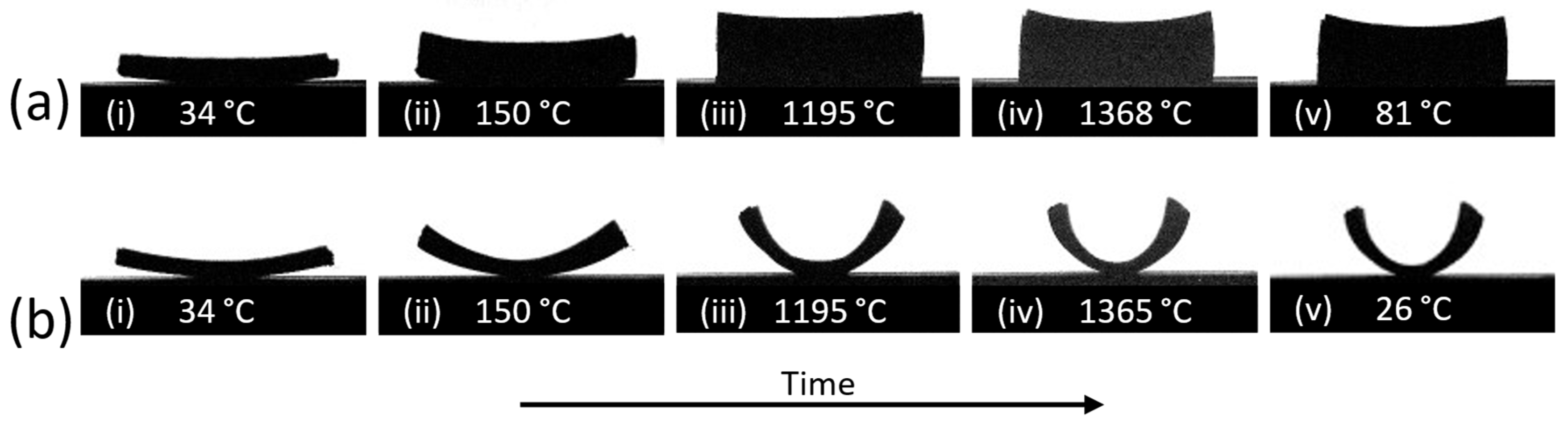
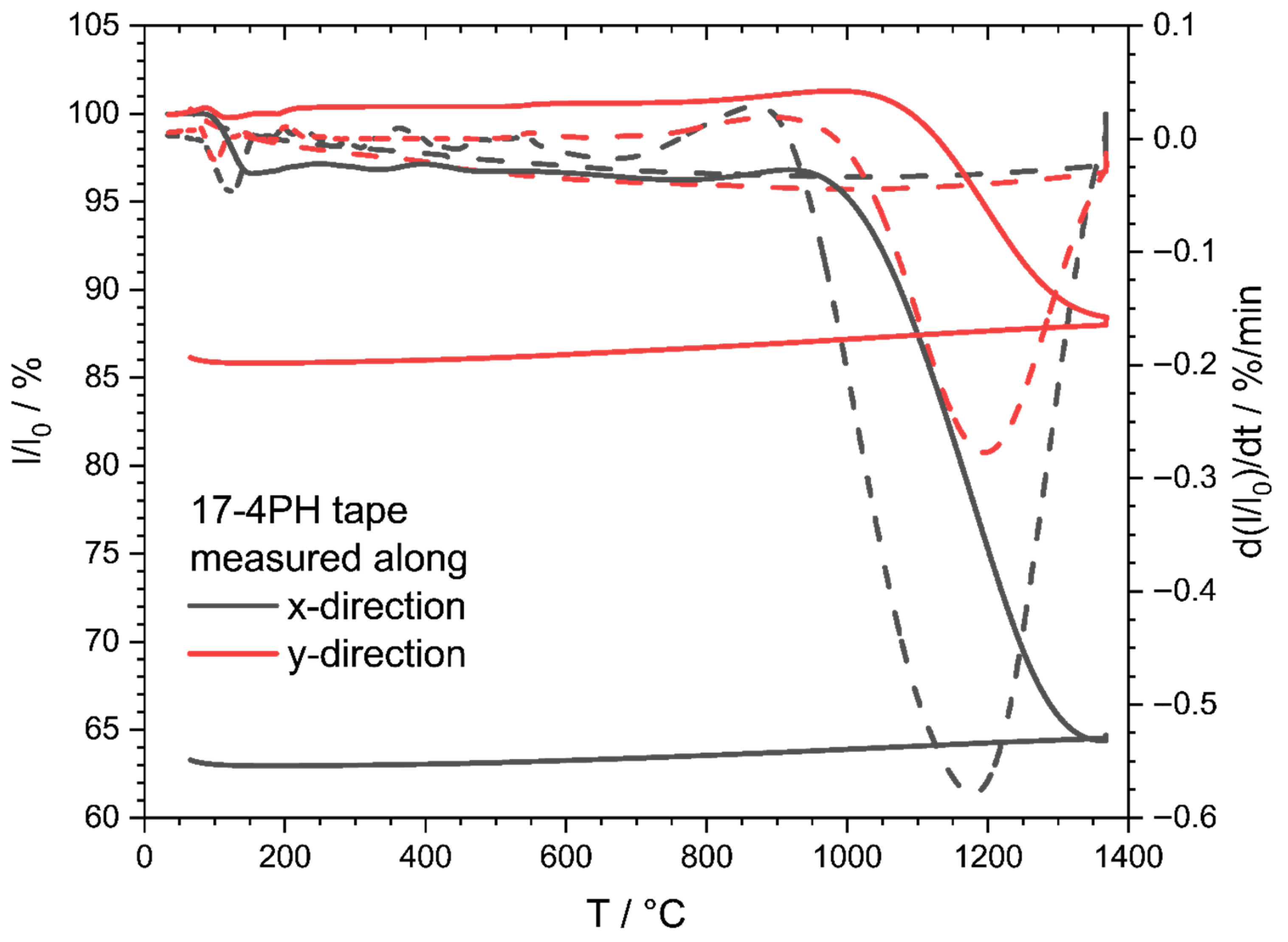
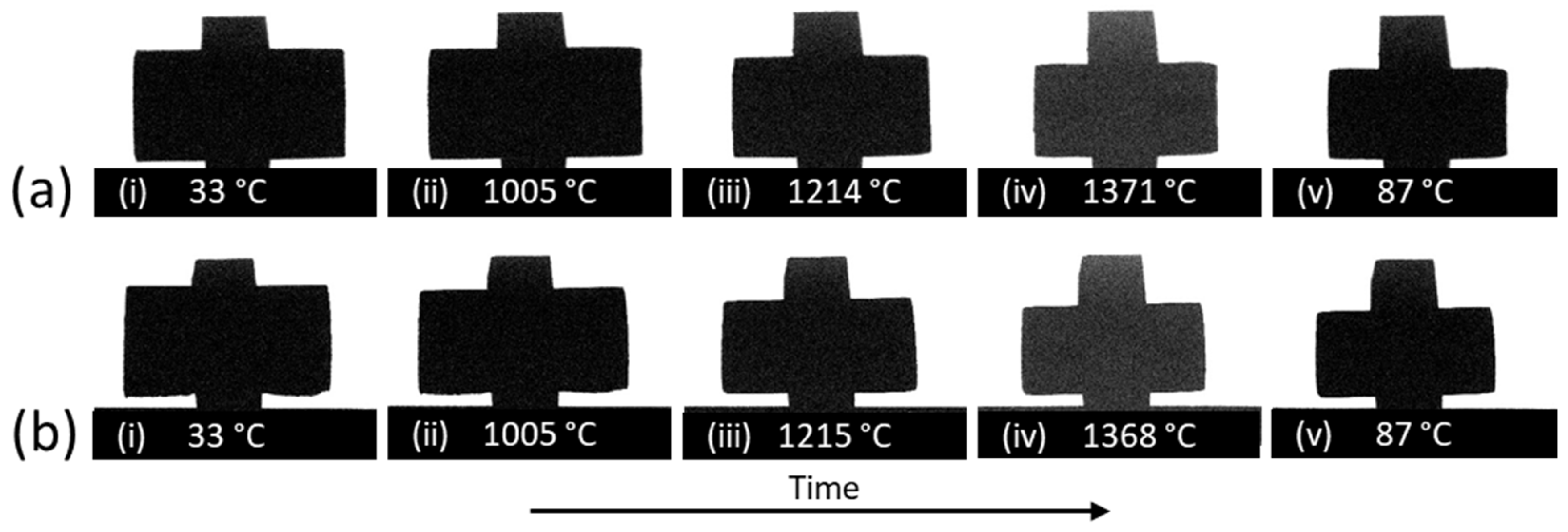
Figure 5 shows the silhouettes for two lying 17-4PH tapes measured in the optical dilatometer at selected temperatures. Figure 6 shows the corresponding relative length and relative length change rate. The sample length is measured in the x- and y-directions of the tape. In the x-direction, a change in length of −36.7% is measured, while the measured shrinkage in the y-direction is 13.9%.
Figure 5.
Silhouettes from the optical dilatometry of lying 17-4PH tapes. (a) Upper series of images, the length is measured in the y-direction of the steel tape, and (b) lower series of images, the length is measured in the x-direction. From left to right with the corresponding temperature: (i) initial state; (ii) a slight warping occurs during the debinding process; (iii) at maximum sintering temperature, strong warping upwards; (iv) end of dwell time; (v) final state, the deformation remains.
Figure 6.
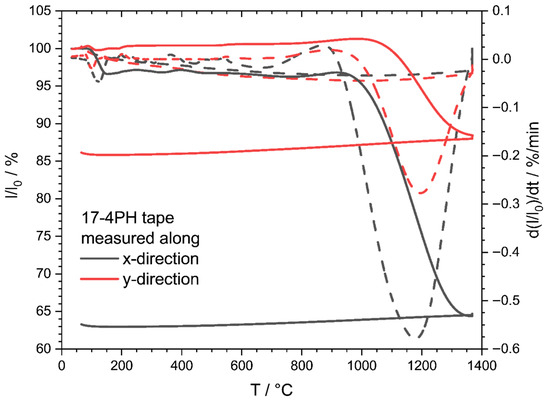
Relative length (solid lines) and relative length change rate (dashed lines) from optical dilatometry measurements of flat-lying 17-4PH tapes between room temperature and 1370 °C. The black and red curves were determined by measuring the sample length in the x- and y-directions.
For the measurement in the y-direction of the tape, the curve shows the effects of debinding up to around 600 °C with a step at around 100 °C (approximately 1%), where the organic material starts to soften. Shrinkage starts at around 980 °C. Shrinkage is not complete at the beginning of the isothermal period and continues to increase during the dwell time.
In the x-direction, a comparatively more pronounced step (approximately 3.2%) occurs at around 100 °C, followed by similar debinding effects up to 600 °C. Shrinkage starts at about 920 °C. For both directions, the relative length continues to decrease as the sample cools, due to the thermal contraction.
To understand and interpret the curves, it is necessary to look at the silhouettes in Figure 5. From Figure 5b(ii) picture, it is clear why the measured length of the tape in Figure 6 appears to decrease so much in the x-direction of the tape. The 17-4PH tape warps slightly during the melting of the organic binder and debinding, and even more during sintering.
Therefore, this change in length is not just shrinkage due to sintering. Measuring the sintered, warped 17-4PH tape with the digital caliper shows an apparent shrinkage of 36.0% in the warped x-direction. This indicates that a correction of the data is necessary to determine the shrinkage in the x-direction caused by sintering (see below).
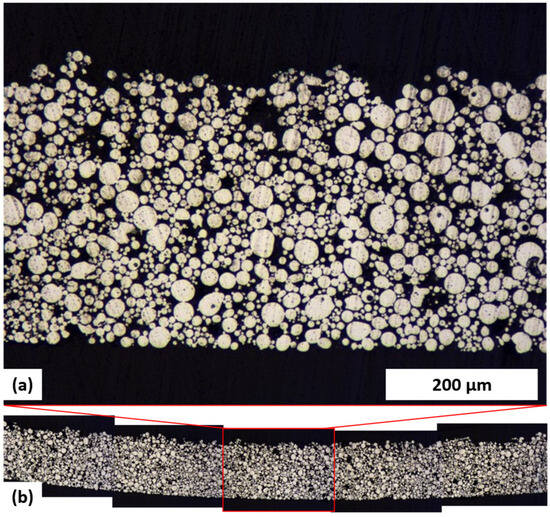
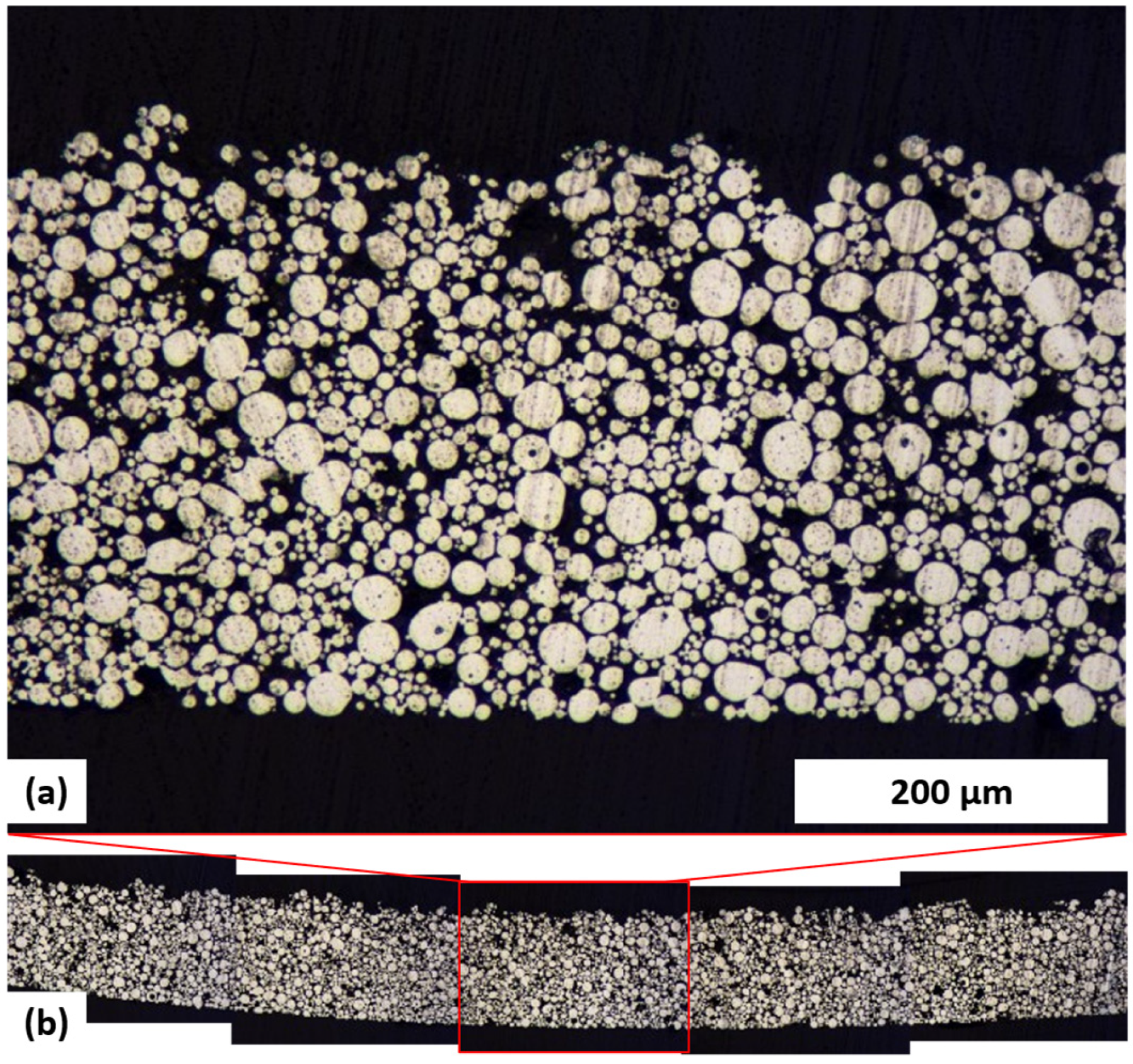
The green steel tape has a smoother, denser bottom (facing the carrier tape) and a rough, less dense top side (compare Figure 4a,b and Figure 7).
Figure 7.
Optical micrograph of a polished cross-section of a 17-4PH tape debinded and pre-sintered at 1000 °C with no dwell time or loading. The black region around the sample is epoxy filler. (a) Clearly visible are the smooth bottom side and the rough top side of the tape, as well as (b) the slight warpage that remains after cooling, which already occurs during the debinding and pre-sintering process.
Due to the softening or melting of the organic components, a slight warpage of the entire edge of the tape in the direction of the less dense tape side occurs. The abrupt change in length at approximately 100 °C is associated with this warpage process. The pictures in Figure 5a(ii),b(ii) show the samples at 150 °C when the softening of the organic components was complete. Long-chain molecules, such as the PVA binder used, probably have a higher degree of polymer orientation and are stretched along the casting direction by the doctor blade shear [32]. As a result, the tape raised slightly more in the x-direction, which means that the tape is pre-embossed in the x-direction after debinding. It is assumed that the resulting state of stress will be conserved during the drying process and is reduced by a deformation of the steel tape as solid organic binder components are melted during heating (such stress relaxation combined with linear shrinkage is observed for aging alumina tapes [32]). This warpage reduces the recorded sample length and explains why the relative length decreases even before sintering. The warpage of a debinded sample remains stable during cooling. This can be seen in Figure 7 for a 17-4PH tape that has been debinded and pre-sintered at 1000 °C without dwell time or external loading and has retained its warpage.
In addition, the strong warpage during sintering is also caused by the production process of the tapes and can be explained by a density gradient over the vertical tape profile. When the suspension is applied to the carrier tape during production, the steel particles show different sedimentation behavior depending on the particle size and shape. Consequently, an increase in porosity is observed from the bottom to the top of the tape (Figure 7). Due to the higher particle concentration on the bottom side caused by the sedimentation process during casting and drying, this region shows less in-plane shrinkage during sintering. In conjunction with the pre-embossing of the tape in the x-direction during debinding, this results in the observed warpage.
The described warpage in the x-direction occurred independently of the orientation or position of the sample in the furnace. Experimental influences, such as temperature gradients or magnetic alignment of the sample by the furnace magnetic field (below 600 °C, during binder burnout, 17-4PH is magnetizable), can thus be excluded. Experiments in the optical dilatometer were performed with different flat sample geometries and sample positioning. Round samples as well as strip-shaped samples always showed the described strong warpage to the rough, less dense side in the casting direction, independent of the upward or downward orientation of the less dense side, i.e., the deformation of the sample also takes place against gravity. Figure 4 shows examples of the warpage behavior of steel tapes with different tape geometries and experimental arrangements.
In order to prevent the influence of the warpage, the sintering of rolled tapes was tested.
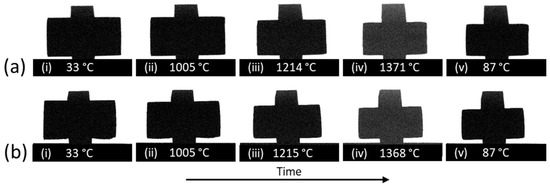
The silhouettes of the shrinkage measurements are shown in Figure 8. The rolled 17-4PH tape is fixed in the center with a vertical standing ring. Over temperature and time, the rolled tape shrinks due to sintering, while the ring remains in place without changing its shape.
Figure 8.
Silhouettes from the optical dilatometry. Images of a rolled 17-4PH tape in the vertical standing ring are visible, fixing the rolled tape in the middle. (a) Upper series of images, the length is measured in the y-direction of the steel tape and (b) lower series of images, the length is measured in the x-direction. From left to right with the corresponding temperature: (i) initial state; (ii) around onset temperature of shrinkage; (iii) at maximum sintering temperature; (iv) end of dwell time; (v) final state.
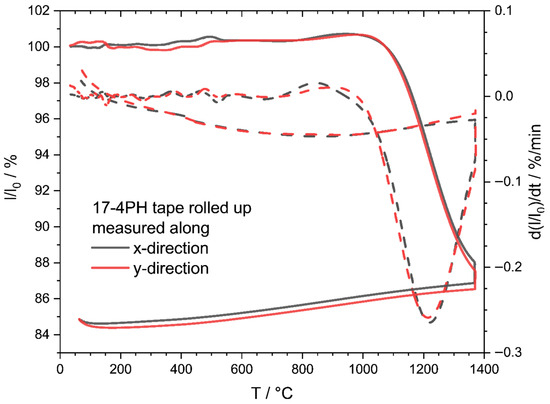
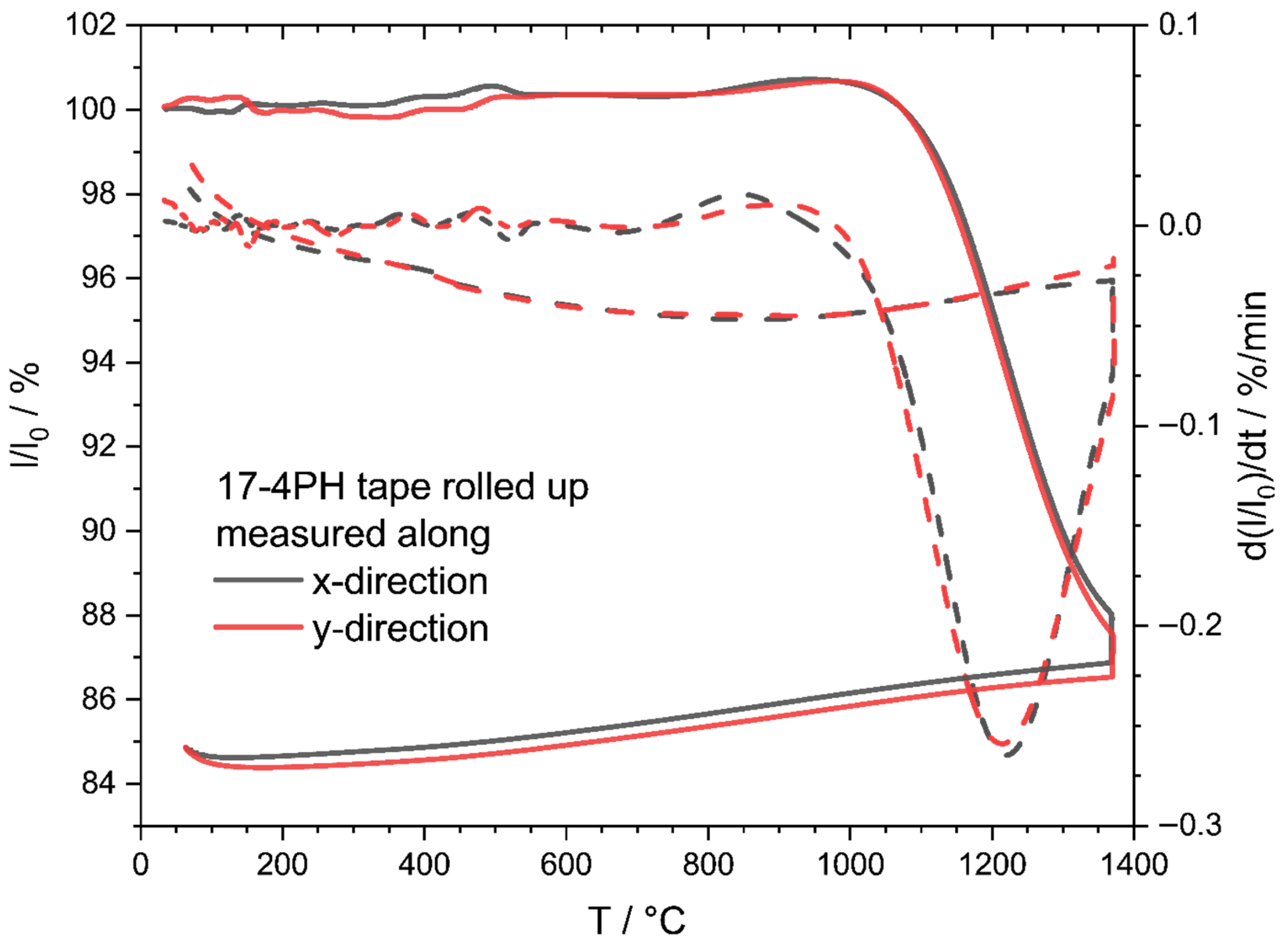
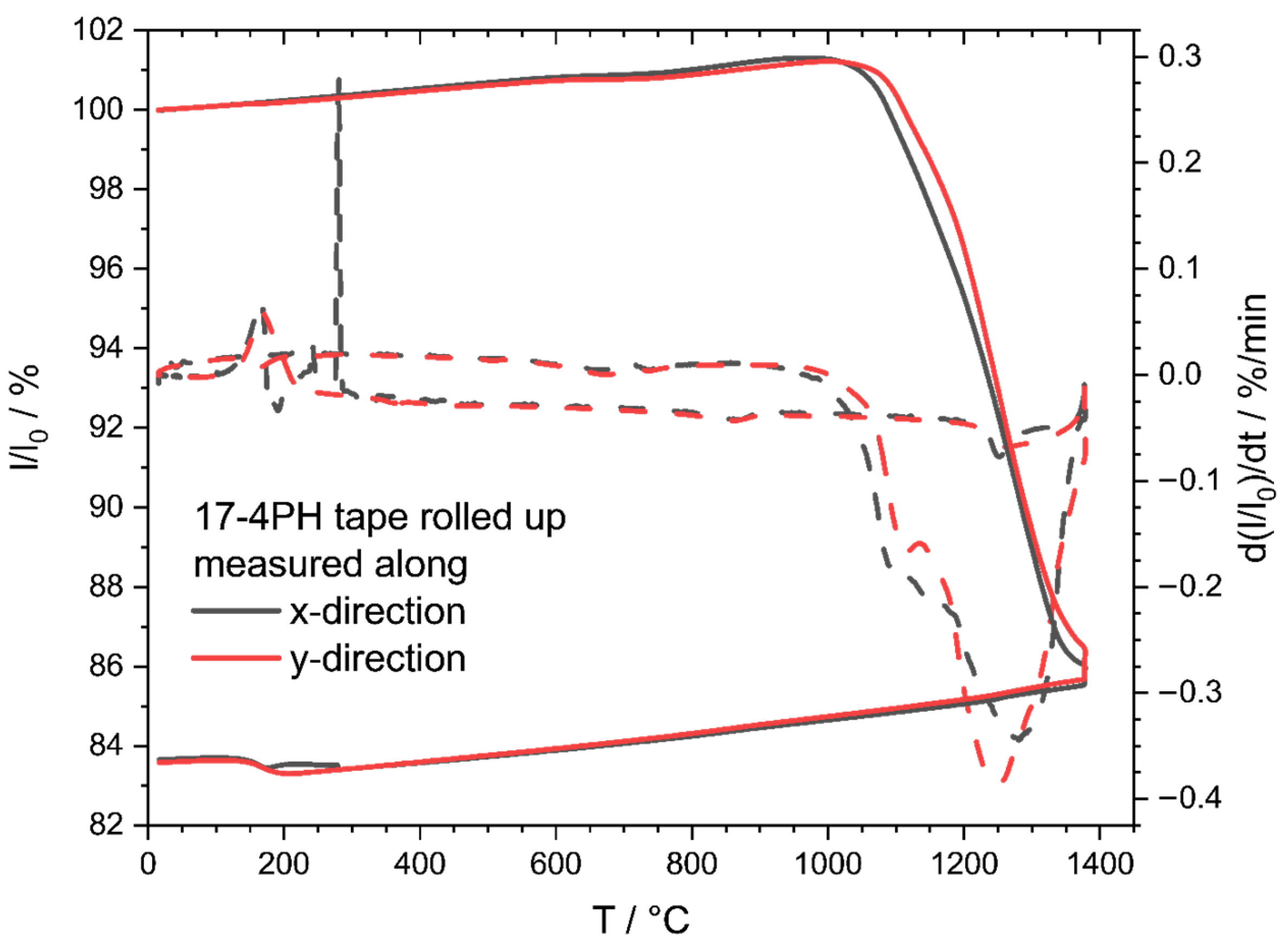
The corresponding relative length and relative length change rate curves of the rolled 17-4PH tapes measured by optical dilatometry are shown in Figure 9. The black and red curves were determined by measuring the change in sample length along the x- and y-directions of the tape, respectively. With this type of sample preparation, the 17-4PH tapes show very similar sintering behavior in both directions of the tape. The total shrinkage for both measurements is 15.2%. This means that the shrinkage of the rolled tapes is slightly greater than the values measured for the flat tapes (Figure 6). The wobbling of both curves up to around 600 °C can again be attributed to the debinding process of the tapes. In the y-direction, the debinding behavior is similar to that of the lying tape. Shrinkage starts at about 940 °C and 980 °C for the x- and y-direction, respectively. However, it is not possible to accurately determine the sintering initiation temperature for steel tapes from the optical dilatometry curves (see below). The maximum relative length change rate is observed at about 1220 °C for both directions. The values for both directions are higher than those for the lying tapes. At around 1320 °C, the two curves separate slightly, and the tape measured in the y-direction (rolled up in the x-direction) appears to shrink slightly more than in the x-direction, but not significantly. The sintering is still pronounced during the dwell time at 1370 °C. During cooling, there are deviations between the two tape directions, but these can be considered similar within the relative resolution of 0.3% of the relative length. The differences are most likely caused by scatters in the experimental data.
Figure 9.
Relative length (solid lines) and relative length change rate (dashed lines) from two optical dilatometry measurements of rolled 17-4PH tapes between room temperature and 1370 °C. The black and red curves were determined by measuring the sample length in the x- and y-directions.
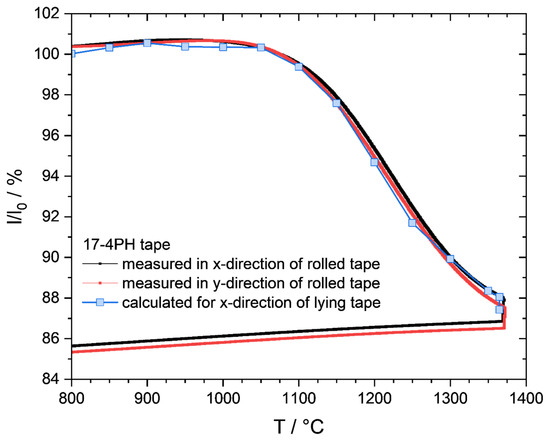
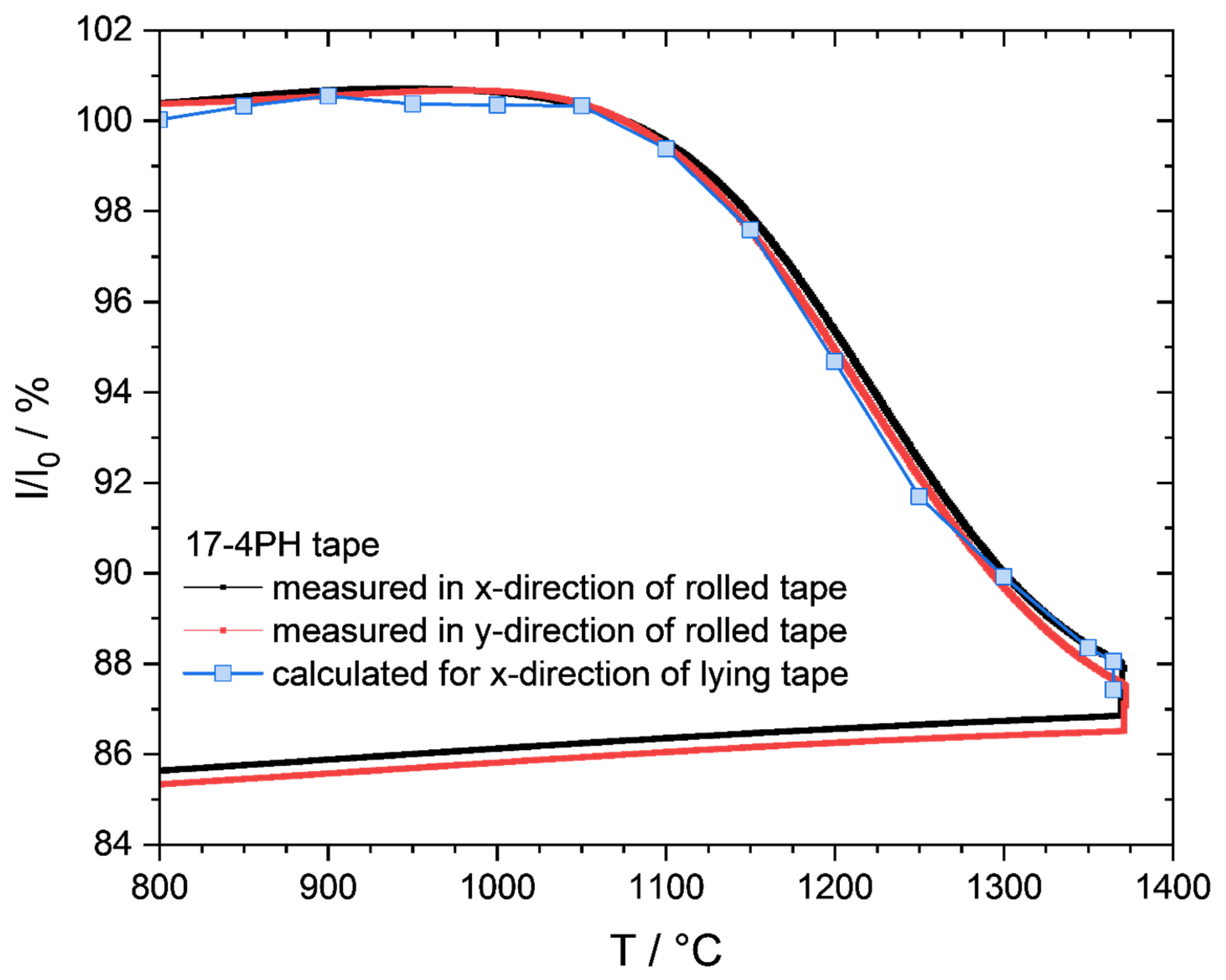
To get a true value for the shrinkage of the 17-4PH tape in the warped x-direction, the approximation as described in the previous Section 2.5 was used, resulting in a total shrinkage of 13.3%. The corrected curve for the x-direction is shown in Figure 10. It is compared to the measured values of the rolled 17-4PH tape in the x- and y-directions from Figure 9. The deviations between the calculated and measured values can be neglected in terms of measurement uncertainty. This indicates that there is no or only negligible anisotropic shrinkage in the x- and y-directions of the 17-4PH tape when warpage is prevented. However, the shrinkage caused by sintering must be separated from the overall length change by additional processing of the warped tape data. Alternatively, it can be measured on rolled tapes that do not show warpage of the measured dimension. The higher shrinkage of 13.9% in the y-direction of the lying 17-4PH tape compared to its calculated value in the x-direction is explained by the position of the tape at the beginning. The steel tape was slightly bent and lay slightly twisted until sintering (see Figure 5a).
Figure 10.
Relative length measured (solid lines) and calculated (from the experimental data for the x-direction of a lying tape; line with dots) between 800 °C and 1370 °C. Measurement data were obtained using an optical dilatometer on rolled 17-4PH tapes in the x- and y-directions.
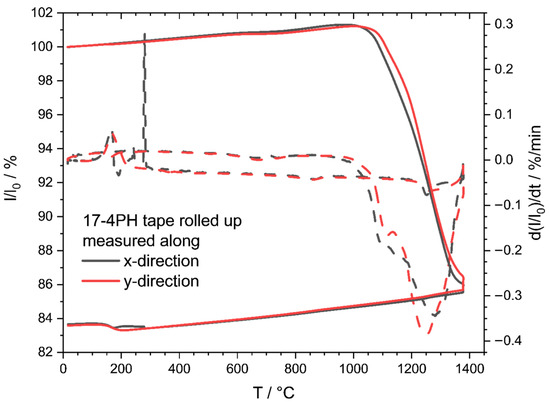
The samples of the rolled tapes can also be analyzed in the push-rod dilatometer. The measurement results for the 17-4PH tapes are shown in Figure 11. The sintering behavior is very similar in both directions, ending in a shrinkage of 16.4% for both directions of the tape. Since the samples were debinded prior to the push-rod dilatometric measurements, no similar effects of debinding are observed as with the not-debinded samples from the optical dilatometry. The slight downward slope at around 630 °C indicates the austenitization (γ-phase) of 17-4PH. The phase transition is followed by a continuous increase due to thermal expansion until sintering starts at about 970 °C and 1000 °C for the x- and y-directions, respectively. As with optical dilatometry, it is difficult to determine the correct onset of sintering, so the values shown are for orientation. In contrast to the behavior determined in the optical dilatometer, an additional peak in the relative length change rate occurs at approximately 1120 °C. This effect, along with the higher total shrinkage (16.4% versus 15.2%) and the shift in the main maximum to higher temperatures, is attributed to the contact pressure of the push-rod. However, it should be noted that the rolled tape geometry is particularly sensitive to mechanical loading. The layered structure of the rolled tape allows for rearrangement through the interlayer space, and the irregular cutting edges may create localized contact points. Therefore, the observed effects are likely related to the deformation sensitivity of this specific sample geometry rather than a fundamental modification of the sintering mechanism. For mechanically stable green bodies such as uniaxially pressed pellets, such effects are not expected at comparable contact pressures. However, it does influence the intensity and temperature ranges of the individual processes. Upon cooling below 200 °C, the γ-α-phase transition (to the martensitic α-phase) in 17-4PH takes place, accompanied by an increase in volume [33], which could not be clearly determined in the optical dilatometer due to its lower resolution (see Figure A3 in Appendix A). In the x-direction cooling curve, there is an apparent end of contraction at approximately 300 °C before the phase transition. This is a measurement artifact where the measurement signal has exceeded the measurement range of the push-rod dilatometer.
Figure 11.
Relative length (solid lines) and relative length change rate (dashed lines) of rolled 17-4PH tapes measured in the push-rod dilatometer between room temperature and 1370 °C. The black and red curves were determined by measuring the sample length in the x- and y-directions.
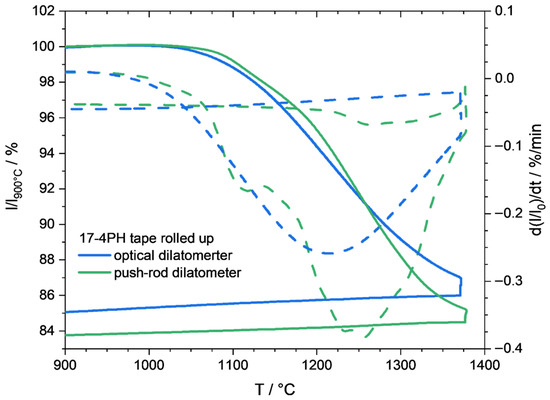
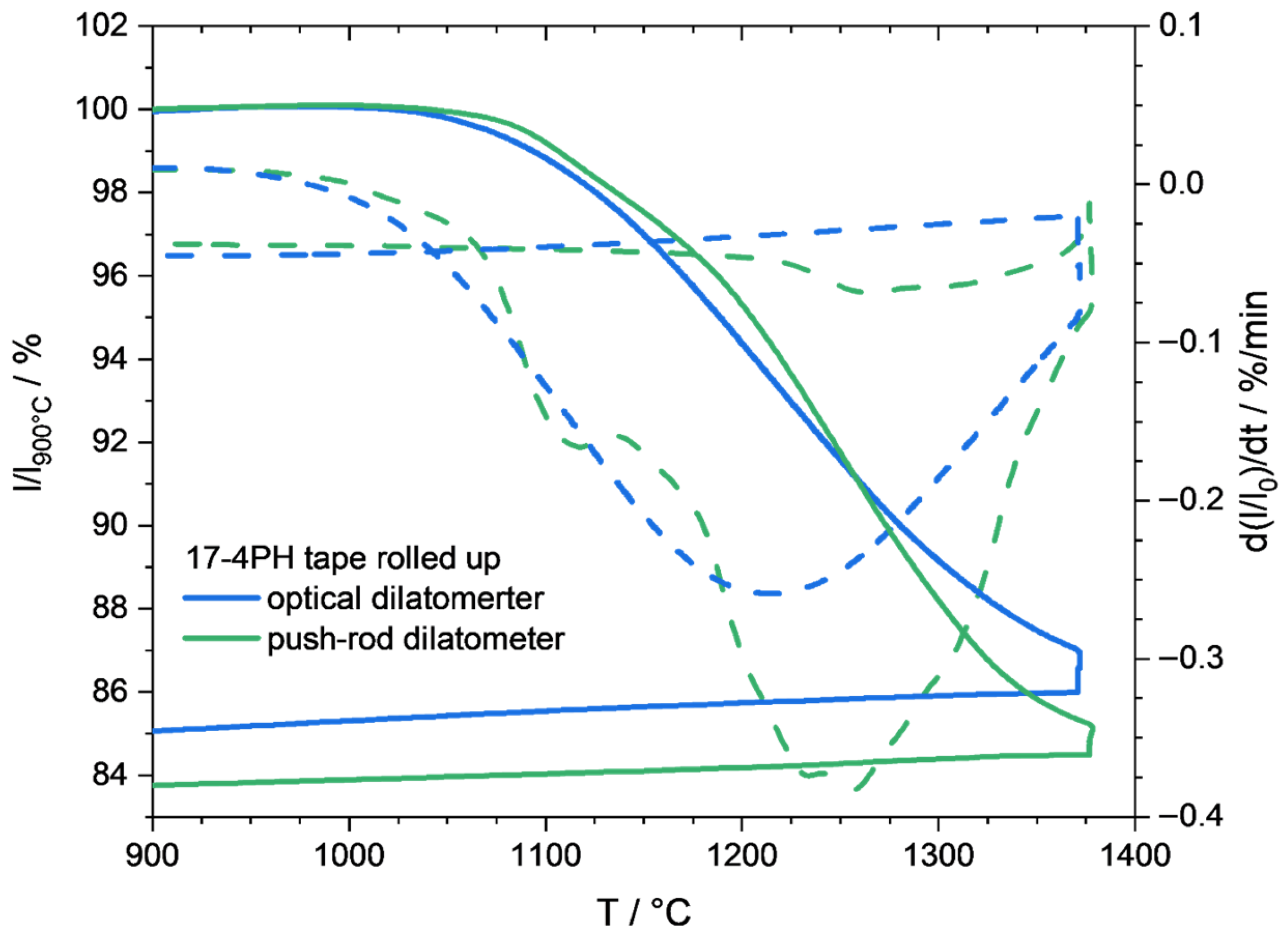
Figure 12 compares the data normalized at 900 °C in the y-direction from the rolled-up 17-4PH tapes measured by optical dilatometry and push-rod dilatometry. The data used are the same as in Figure 9 and Figure 11. The shrinkage between the two types of dilatometers differs by about 1.2%, which can be explained by the constant force of 20 cN when measuring with the push-rod dilatometer. The relative length change rate is higher and shows two peaks between 1075 °C and 1300 °C when measured with the push-rod dilatometer, while only one maximum is detected when measured with the optical dilatometer. Figure A9, Appendix D, compares the two curves when the data are not normalized to 900 °C.
Figure 12.
Relative length normalized to 900 °C (solid lines) and relative length change rate (dashed lines) of rolled 17-4PH tapes measured in an optical dilatometer (blue) and a push-rod dilatometer (green) between 900 °C and 1370 °C. Both curves were obtained by measuring the change in length corresponding to the y-direction of the tapes.
3.2. Shrinkage Behavior of TZ-3YS-E Tapes
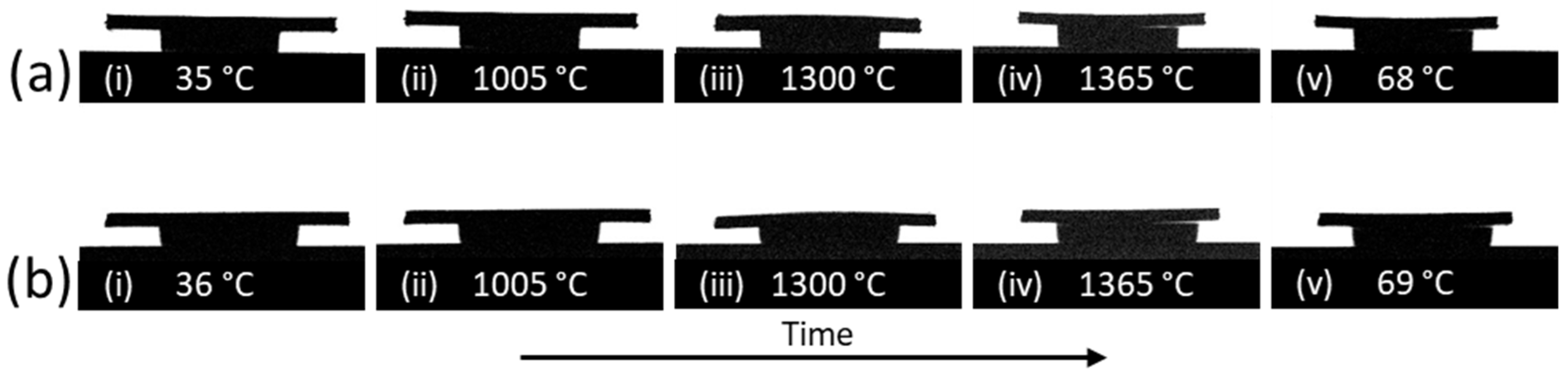
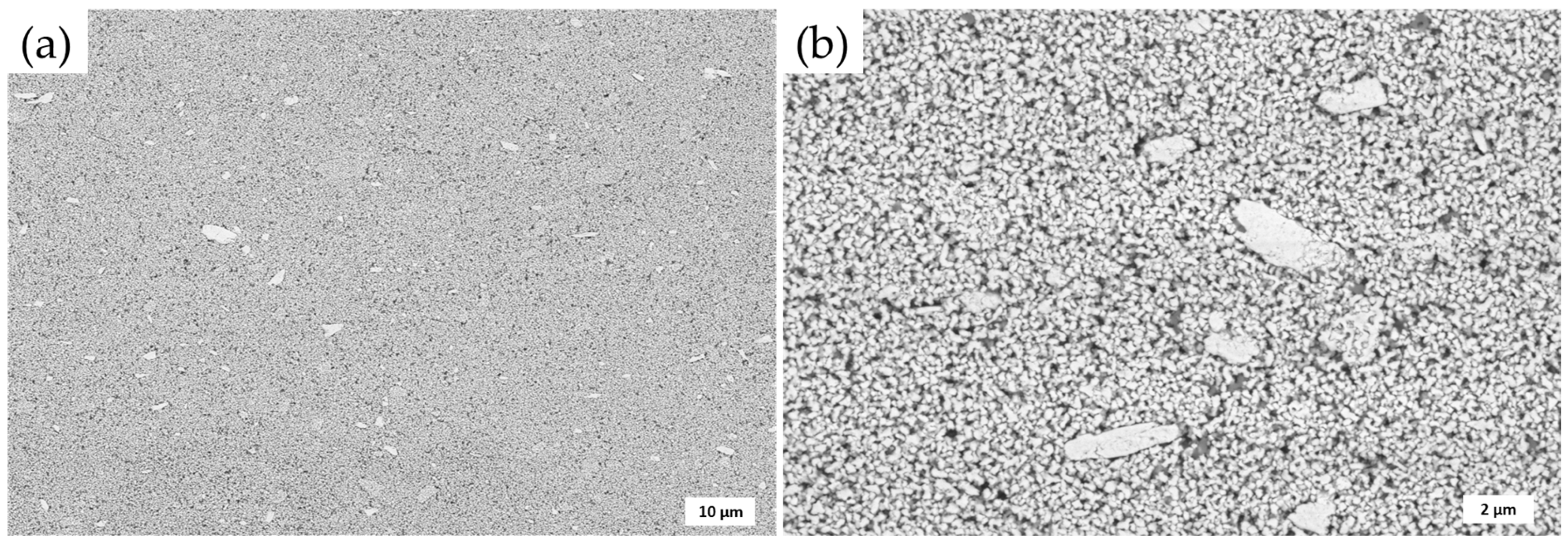
TZ-3YS-E tapes show no significant warpage during sintering, as shown in Figure 13. This indicates a high stability of the TZ-3YS-E suspension due to its much smaller grain size compared to the steel powder. Figure 14 shows the cross-section of a pre-sintered TZ-3YS-E tape at 1000 °C. Regardless of the partly large zirconia agglomerates (bright areas), the zirconia particles and agglomerates are distributed homogeneously over the volume. The small dark gray areas are pores.
Figure 13.
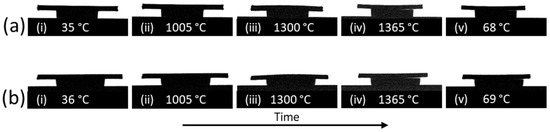
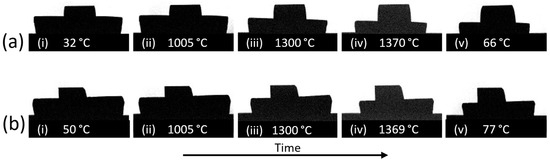
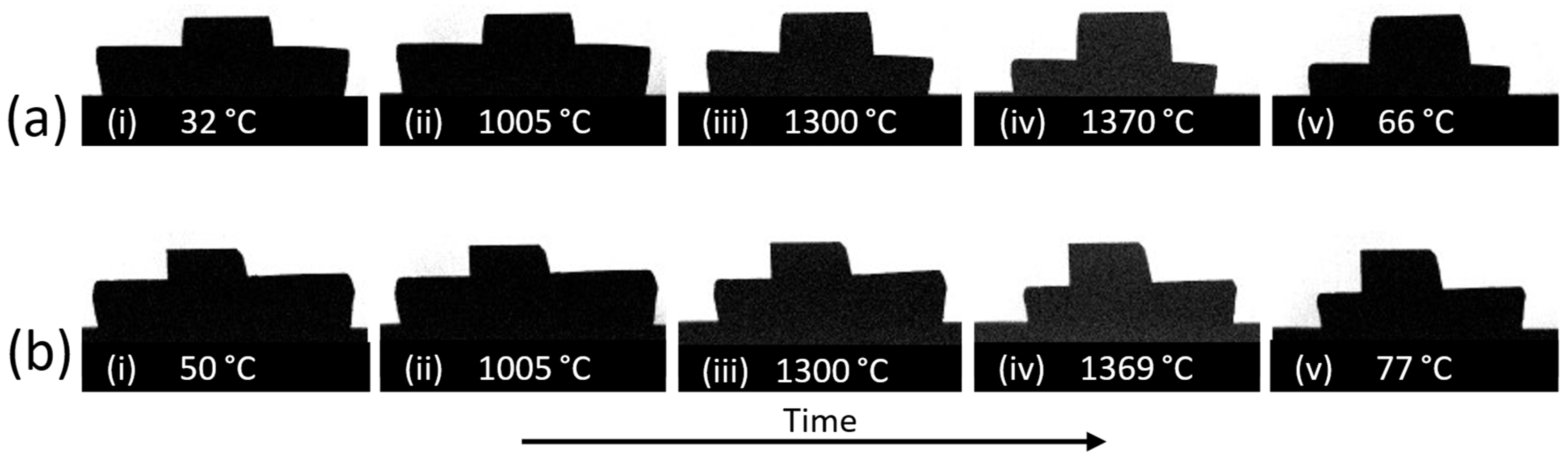
Silhouettes from the optical dilatometry for lying TZ-3YS-E tapes centered on a smaller alumina support. (a) Upper series of images, the length is measured in the y-direction of the steel tape, and (b) lower series of images, the length is measured in the x-direction. From left to right with the corresponding temperature: (i) initial state, sample at room temperature; (ii) no warping after debinding; (iii) during sintering; (iv) at maximum temperature and end of dwell time; (v) final state.
Figure 14.
FESEM images of the cross-section of a pre-sintered TZ-3YS-E tape at 1000 °C with different magnifications in (a,b).
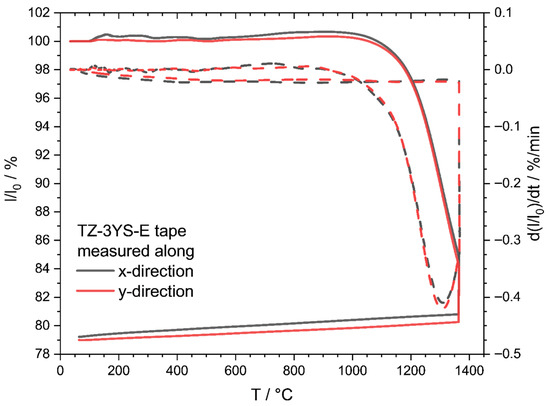
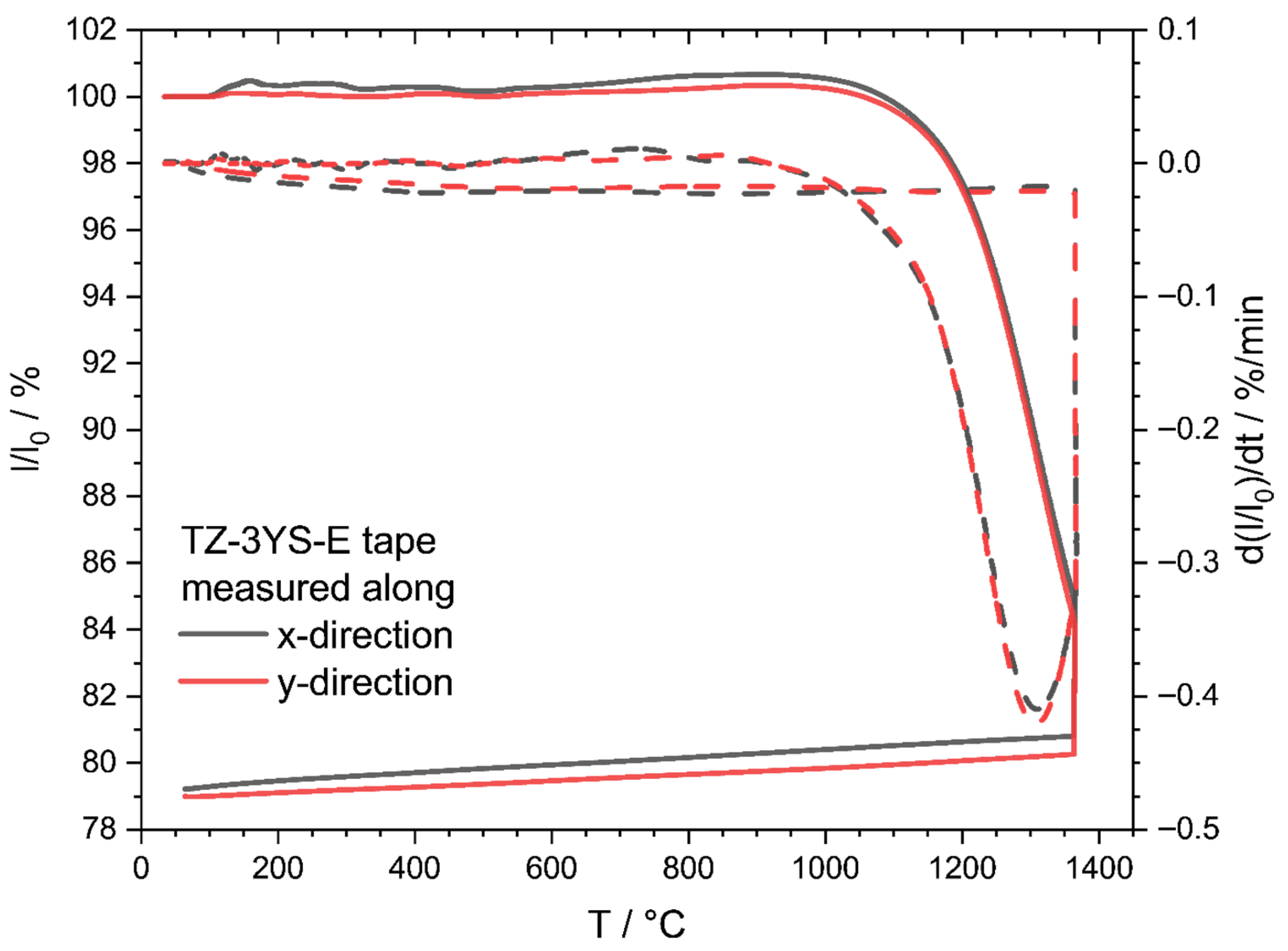
The relative length and relative length change rate while free-sintering lying TZ-3YS-E tapes, measured in the optical dilatometer in the x- and y-directions of the tape, are shown in Figure 15. The general sintering behavior in both directions is similar. The shrinkage is 20.8% and 21.0% for the x- and y-directions, respectively. The observed wobble of the curve is attributed to debinding processes and disappears above 600 °C when debinding is complete. Beyond 600 °C, the thermal expansion of the sample can be observed until sintering starts at around 1000 °C. There is only one peak in the sintering rate, which occurs at approximately 1300 °C.
Figure 15.
Relative length (solid lines) and relative length change rate (dashed lines) for TZ-3YS-E tapes between room temperature and 1370 °C measured via optical dilatometry. The black and red curves were determined by measuring the sample length in the x- and y-directions.
A transition to a slightly downward curvature is observed in Figure 13a(iii),b(iii) at 1300 °C, while after the isothermal dwell at 1365 °C (Figure 13a(iv),b(iv)), a slight upward curvature is observed, which persisted upon cooling. The exact mechanisms governing this tape-deflection reversal remain unclear at present; possible contributing factors include gravity-induced sagging due to viscous flow at elevated temperatures and slight density gradients from sedimentation during tape casting (significantly lower than for steel tapes). However, it should be noted that this minor out-of-plane deflection does not significantly affect the in-plane shrinkage measurements, which are the primary focus of this work. Further investigations would be required to fully elucidate the underlying causes of this curvature evolution.
The silhouettes of rolled TZ-3YS-E tapes are shown in Figure 16. A similar setup to that of the rolled 17-4PH tapes is shown, but the lower part of the image is covered by a thicker alumina stripe, which should hold the ring with the rolled tape in its position and provide a better baseline (required by the software) for measuring the length.
Figure 16.
Silhouettes from the optical dilatometry. Images of a rolled TZ-3YS-E tape in the vertical standing ring are visible, fixing the rolled tape in the middle. The lower edge of the tape roll is covered by an aluminum oxide strip. (a) Upper series of images, the length is measured in the y-direction of the ceramic tape, and (b) lower series of images, the length is measured in the x-direction. From left to right with the corresponding temperature: (i) initial state; (ii) around the onset temperature of shrinkage; (iii) at the maximum sintering temperature; (iv) end of dwell time; (v) final state.
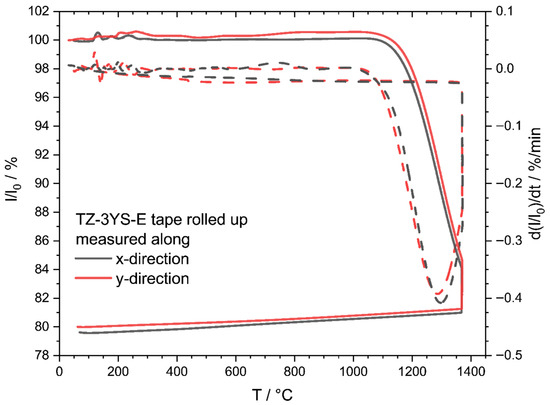
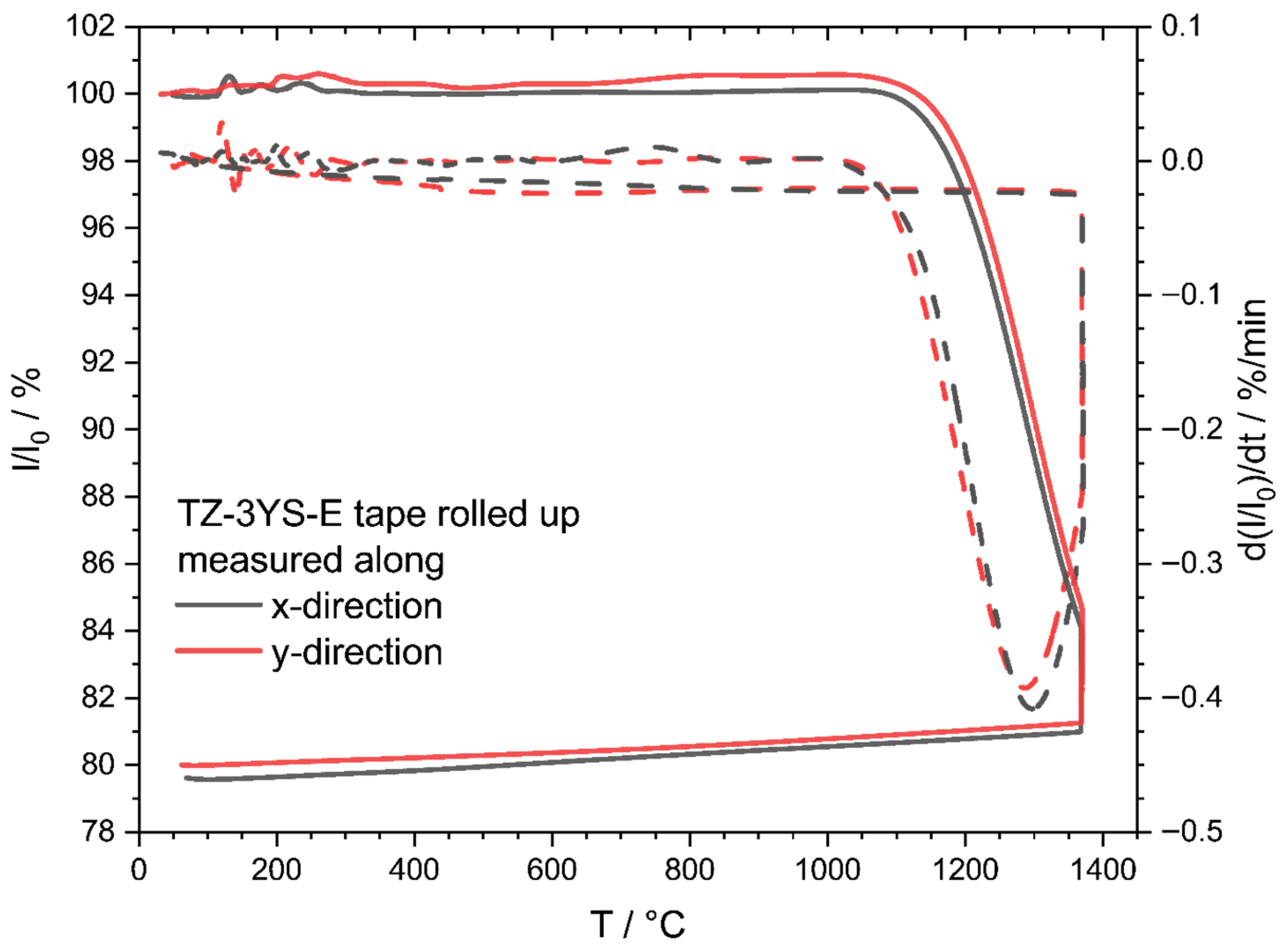
The corresponding curves of the relative length and relative length change rate of the rolled TZ-3YS-E tapes measured by optical dilatometry are shown in Figure 17. The black and red curves were determined by measuring the sample length in the x- and y-directions of the tape. The rolled tapes show similar sintering behavior to that of the lying sintered tapes for the x- and y-directions, with shrinkage of 20.4% and 20.0%, respectively. However, the shrinkage in the x-direction is slightly greater than that in the y-direction, whereas the opposite was true in the unrolled state. This indicates that these differences are due to the relative resolution of 0.3%, measurement errors, and sample preparation. Again, in both measurements, the detected relative length is influenced by the debinding process up to about 600 °C when the organic is removed. After further thermal expansion, the shrinkage process starts at about 1010 °C. Only one pronounced maximum in the sintering rate is observed, at approximately 1270 °C and 1290 °C for the x- and y-directions, respectively. These values are close to, but lower than, those of the lying ceramic tapes.
Figure 17.
Relative length (solid lines) and relative length change rate (dashed lines) of rolled TZ-3YS-E tapes between room temperature and 1370 °C measured via optical dilatometry. The black and red curves were determined by measuring the sample length in the x- and y-directions.
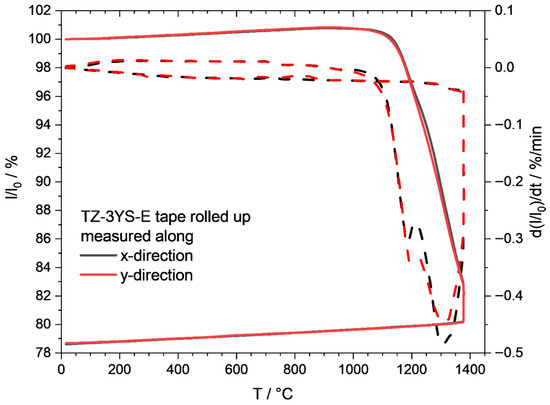
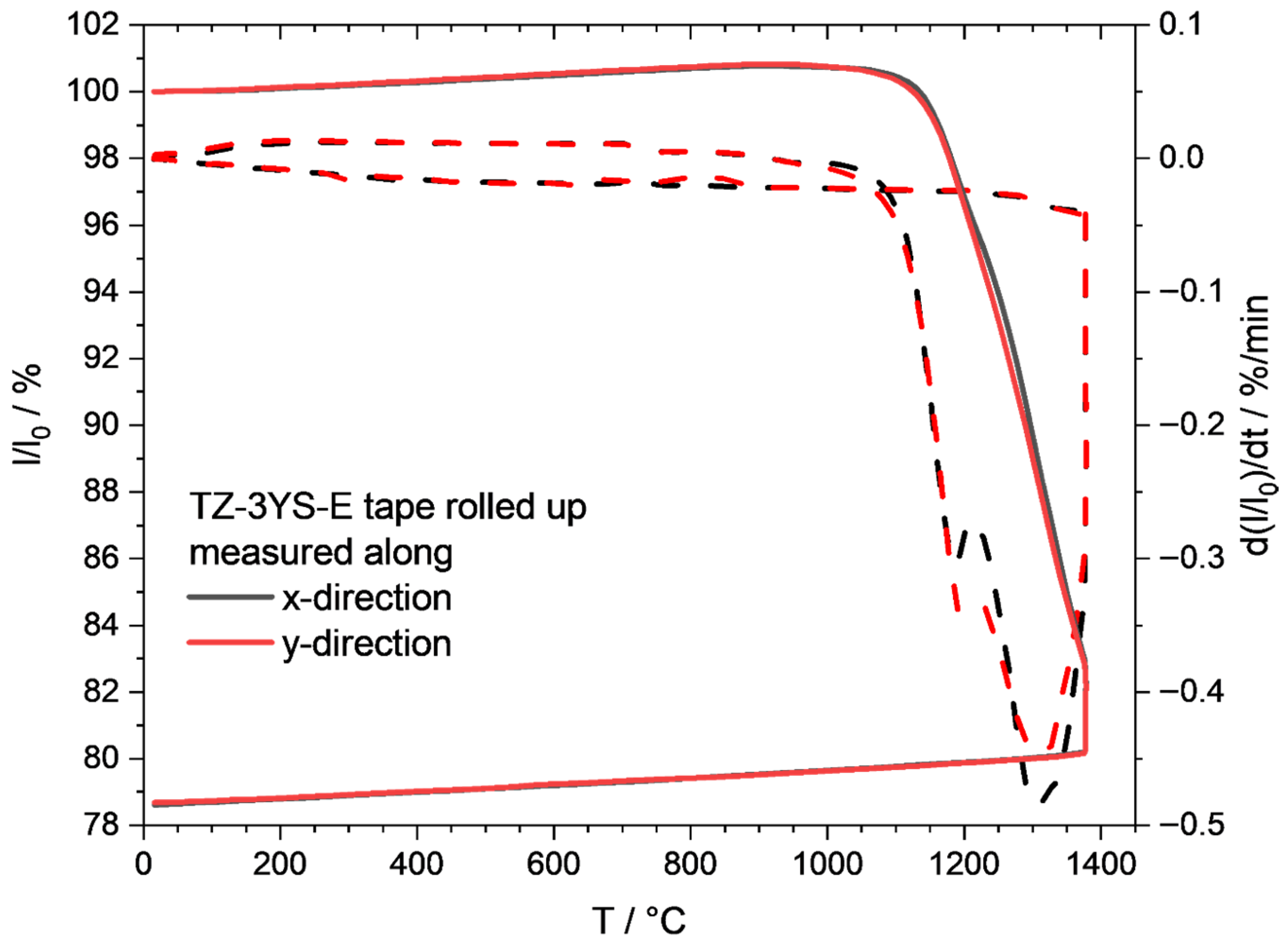
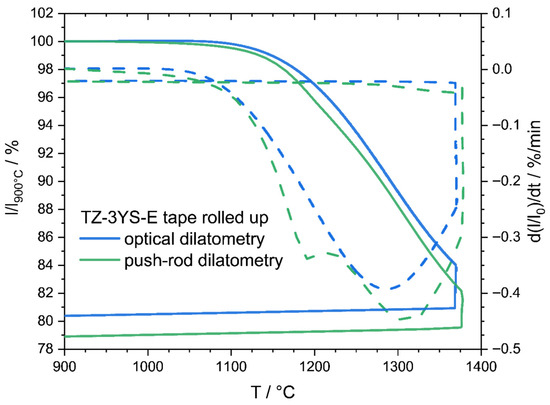
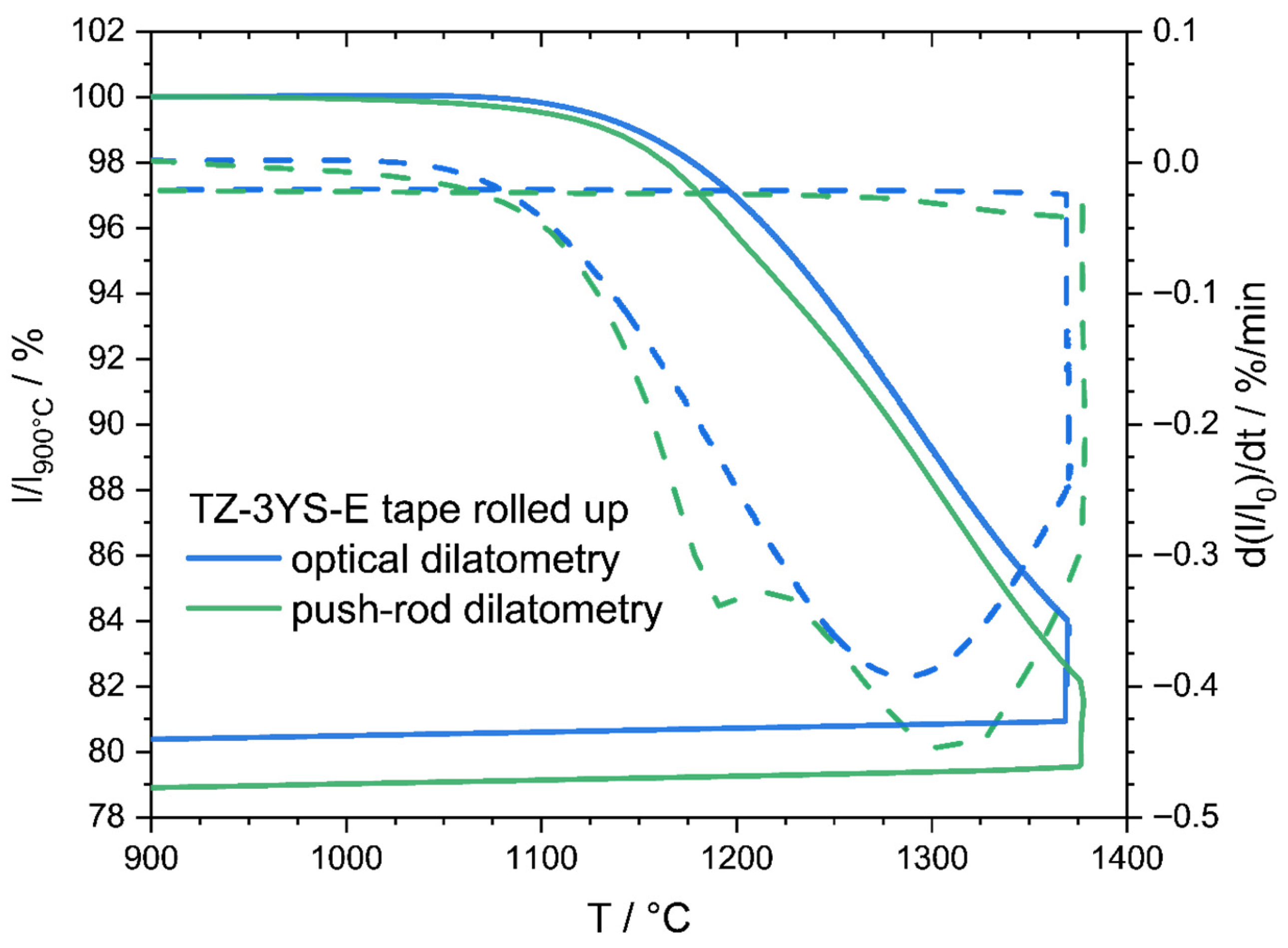
Push-rod dilatometer measurements of the rolled-up TZ-3YS-E tapes are shown in Figure 18. Overall, the two curves are similar. The shrinkage is 21.4% and 21.3% in the x- and y-directions of the tape, respectively. Since the samples were previously debinded, there was no effect other than thermal expansion prior to sintering. Figure 19 compares the data normalized at 900 °C in the y-direction of the rolled TZ-3YS-E tapes measured by optical dilatometry and push-rod dilatometry. The data used are the same as in Figure 15 and Figure 17. Slight differences can be seen at the beginning of shrinkage and during the dwell time. The two curves differ slightly in sintering rate from the optical dilatometer data. As with the steel tapes, an additional peak occurs at about 1190 °C, and the peak of the relative length change rate is shifted to higher temperatures and higher densification rates. This can be explained in a similar way to the steel tapes. As discussed above, the rolled tape geometry is susceptible to deformation under the applied contact pressure. The contact pressure results in a higher total shrinkage up to 1.3%. Figure A10, Appendix D, compares the two curves when the data are not normalized to 900 °C.
Figure 18.
Relative length (solid lines) and relative length change rate (dashed lines) of rolled TZ-3YS-E tapes measured in the push-rod dilatometer between room temperature and 1370 °C. The black and red curves were determined by measuring the sample length in the x- and y-directions.
Figure 19.
Relative length normalized to 900 °C (solid lines) and relative length change rate (dashed lines) of rolled TZ-3YS-E tapes measured in an optical dilatometer (blue) and a push-rod dilatometer (green) between 900 °C and 1370 °C. Both curves were obtained by measuring the change in length corresponding to the y-direction of the tapes.
From all the measurements made with the TZ-3YS-E tapes under different conditions, there is no shrinkage anisotropy recognizable between the x- and y-directions of the TZ-3YS-E tape. The difference in total shrinkage between the x- and y-directions is less than 0.4%.
3.3. Comparison of the Results for 17-4PH and TZ-3YS-E
Table 3 summarizes the results for linear shrinkage caused by densification and compares the measured values of the optical or push-rod dilatometer and the caliper for the materials and the measurement directions of the tape.
Table 3.
Linear shrinkage for 17-4PH and TZ-3YS-E, listed by measurement method, measured tape direction and sample preparation.
In optical dilatometry, lying 17-4PH tapes show less shrinkage than the rolled tapes, with the difference being less than 2% for both tape directions. Lying TZ-3YS-E tapes in optical dilatometry show higher shrinkage than the rolled tapes, with a difference in shrinkage of less than 1%. This difference is probably due to experimental factors and is not completely understood.
Push-rod dilatometry data for the rolled tapes of both materials show higher shrinkage by about 1.0% to 1.3% compared to optical dilatometry. This is most likely due to the contact pressure of the push-rod.
The shrinkage in the x-direction of the warped 17-4PH steel tape was corrected from 36.7% (with warpage) to 13.3%. This value is close to the value of 13.9% for the y-direction of the steel tape. In addition, the calculated curve follows the curve for the x- and y-direction of a rolled-up tape measured in the optical dilatometer (whose warpage was suppressed).
The optical dilatometry results for the rolled-up 17-4PH tapes exhibit a shrinkage of 15.2% for both measured directions of the tape. The shrinkage measured with the push-rod dilatometer is also the same in both directions at 16.4%. This reveals that there is no anisotropy in shrinkage. However, the contact pressure of the push-rod dilatometer influences the densification.
The optical dilatometry results show only a 0.2% and 0.4% difference in shrinkage between the x- and y- directions for the lying and rolled TZ-3YS-E ceramic tapes, respectively, which can be considered equal within the measurement uncertainty. The shrinkage measured with the push-rod dilatometer is similar in both directions, but also higher than with optical dilatometry, as observed with the steel tapes.
The characteristic temperatures (onset of accelerated sintering, peak of the sintering rate) were determined from smoothed dilatometric data and their temperature derivatives, as described in Appendix E. The onset of accelerated sintering was determined using the double tangent extrapolation method according to DIN 51007-1:2024-08 [34].
In optical dilatometry, the determination of the sintering onset temperature is particularly affected by data smoothing. Since the transition region between thermal expansion and the onset of sintering typically exhibits a flat curve, the smoothing process strongly influences the maximum value of the relative length and thus the temperature position of the sintering onset. Depending on the data range selected for smoothing, the sintering onset temperature may fluctuate by up to 60 K. Due to the limited resolution of the optical dilatometer, the noisy raw signal, and these smoothing effects, sintering onset temperatures obtained from optical dilatometry should be considered indicative values for orientation purposes only. The reported values are given with their largest deviation.
In contrast, for push-rod dilatometry, the determination of characteristic temperatures—including the temperature position of additional peaks—is less affected by the smoothing procedure, with differences remaining below 2 K.
All temperature values reported in this work have been rounded to the nearest ten degrees Celsius.
Table 4 summarizes the characteristic temperatures for the sintering process of the steel and ceramic tapes (onset: accelerated sintering, peak of the rate of change in relative length: maximum sintering rate). Appendix E contains an example for determining the characteristic temperatures and the total shrinkage.
Table 4.
Characteristic temperatures for the sintering process of the tapes sorted by method (ODIL: optical dilatometer and DIL: push-rod dilatometer), x- and y-direction, material of the tape, and type of sample preparation. For the determination of the points, see Figure A11 in Appendix E.
For 17-4PH, the characteristic temperatures are generally lowest in optical dilatometry for the lying tape, are higher in optical dilatometry for the rolled tape, and are even higher in the push-rod dilatometer for the rolled tape. Thermal expansion dominates up to about 950 °C. The transition to shrinkage initiation cannot be clearly determined due to measurement uncertainties.
The characteristic temperatures of the TZ-3YS-E tapes measured in the optical dilatometer and rolled-up tapes measured in the push-rod dilatometer are similar for both directions of the tape. The temperatures at the beginning of sintering and the start of accelerated sintering of the rolled-up tapes, as determined by optical dilatometry, are higher, while the temperature corresponding to the maximum relative length change rate is again comparable to those of the other prepared and measured ceramic tapes.
The differences observed between optical and push-rod dilatometry are attributed to the loosely packed multilayer structure of the rolled tape samples. For mechanically robust samples that are solid and firm, the contact pressure in push-rod dilatometry does not induce additional contraction [17]. However, for samples containing a high fraction of a liquid or glassy phase or exhibiting low mechanical stability during sintering, the contact pressure can be excessive and may cause additional shrinkage [17]. External pressure, even at very low magnitudes, triggers rearrangement into denser configurations [35].
The higher shrinkage and additional peaks observed in push-rod dilatometry for rolled tape samples are therefore attributed to pressure-induced particle rearrangement. This effect should not be confused with an acceleration of intrinsic sintering kinetics. The multilayer geometry with its initially low packing density allows for particle rearrangement and settling under the applied contact load. This manifests as additional shrinkage. For mechanically robust samples such as uniaxially pressed pellets with low organic content, particle rearrangement is constrained by the higher initial packing density and better particle interlocking from the pressing process. For such samples, push-rod dilatometry remains a suitable method.
4. Summary and Conclusions
In this work, the sintering and deformation behavior of tapes prepared by tape casting based on 17-4PH steel and 3 mol% yttria-stabilized zirconia powders were examined by optical dilatometry and push-rod dilatometry.
The tapes were measured as lying tapes in the optical dilatometer or as rolled-up tapes in the optical and push-rod dilatometers.
Freely debinded and sintered 17-4PH tape always shows warpage on the top side (during casting) of the tape during optical dilatometry. An initial small warpage occurs during debinding, and the main warpage effect is observed during sintering. Therefore, the warpage of the steel tape can be explained by the interaction of two effects. One is the slight warpage during debinding, which is related to the behavior of the organic binders (during melting and evaporation), where the anisotropic orientation of the organic binder molecules in the xy-plane of the tape most likely leads to a pre-embossing of the slightly warped tape in the x-direction. The second effect is a vertical density gradient across the tape profile caused by sedimentation processes of the steel particles during casting and drying, which then leads to severe warpage during sintering. The fine-grained homogeneous TZ-3YS-E tapes do not show such warpage. This indicates the decisive role of the homogeneity of the green tape structure.
Using the proposed correction method (see Section 2.5 and Appendix C), the shrinkage caused by sintering can be separated from the shrinkage caused by warpage. Rolled up steel tapes show a similar sintering behavior in both directions in optical dilatometry and end up with similar total shrinkage because warping is prevented.
A greater measured total shrinkage of the steel tapes in the push-rod dilatometer is observed. This effect is attributed to the sensitivity of the rolled tape to mechanical loading. The structure of the rolled tapes allows for rearrangement and deformation under the applied load. However, an additional peak in the relative length change rate is observed, indicating the influence of the applied pressure. Irrespective of this, the rolled steel tapes show a very similar sintering process for both tape directions in the push-rod dilatometer. Based on the different measurements, it can be concluded that the steel tape does not exhibit sintering shrinkage anisotropy.
The TZ-3YS-E tapes show very similar sintering shrinkage without warpage in both optical and push-rod dilatometry, and for both types of sample preparation. However, due to the contact pressure of the push-rod, the total shrinkage of the ceramic tape is also higher than that measured by optical dilatometry, and an additional peak in the relative length change rate appears. This indicates the influence of contact pressure. Nevertheless, the ceramic tape sinters in the same way in the x- and y-directions under the same experimental conditions.
In general, it is difficult to investigate the sintering of tapes using push-rod dilatometry. Deformations occur due to the force of the push-rod. From an experimental point of view, the most effective way to minimize this effect is to stabilize the tape by rolling it up. However, it is difficult to produce samples with precise end faces. In addition, the debinding of the rolled tape is made more complicated by the covered surfaces. However, in push-rod dilatometry, the onset of sintering was affected even for rolled tapes, and a small additional apparent length change was observed for both steel and zirconia.
Optical dilatometry is a comfortable tool for investigating the debinding and sintering behavior of ceramic and powder metallurgical tapes. Effects such as the slight warpage of steel tapes during debinding can be directly observed and characterized. The shrinkage of tapes can be measured using rolled tapes. This prevents warping in the measured length direction. To measure the sintering shrinkage in the z-direction across the tape thickness, a special dilatometer setup is required as described in [28].
For the investigation of phase changes (or thermal expansion), as shown for the steel tapes, push-rod dilatometry is more suitable. However, with push-rod dilatometry, it is very important to be careful when interpreting the results. Apparent changes in the sintering mechanisms (additional shrinkage peaks) may occur due to the contact pressure of the push-rod, or the total shrinkage may be overestimated.
Based on the findings of this work, several avenues for future research can be identified. First, systematically quantifying the influence of push-rod contact pressure on various tape materials would enable a better understanding of the effect of pressure on sintering. Second, the proposed warpage correction method should be validated for additional material systems and extended to predict warpage behavior based on green tape characteristics, such as density gradients. Third, the dilatometric data obtained in this work could serve as input parameters for continuum mechanics-based sintering simulations. These simulations could predict defect-free sintering of complex tape geometries and multilayer structures [36,37]. Furthermore, applying specialized optical dilatometry setups to measure shrinkage in the z-direction (tape thickness) would provide complete three-dimensional shrinkage data, which is essential for co-sintering studies. Finally, extending the comparative methodology to co-sintered multilayer systems, which are relevant for applications in solid oxide cells and membrane technology, represents a logical next step toward understanding and controlling sintering-induced stresses and deformation in functional multilayer components.
Author Contributions
Conceptualization, M.H. and C.B.; Data curation, D.G., T.G. and A.G.; Formal analysis, D.G.; Funding acquisition, T.G., A.G., M.H. and C.B.; Investigation, D.G., T.G., A.G. and J.M.; Methodology, D.G., T.G. and M.H.; Resources, T.G., A.G., J.M., M.H. and A.M.; Supervision, M.H., C.B. and A.M.; Validation, D.G., C.L. and T.G.; Visualization, D.G.; Writing—original draft, D.G.; Writing—review & editing, D.G., T.G., A.G., J.M., M.H., C.L., C.B. and A.M. All authors have read and agreed to the published version of the manuscript.
Funding
This project was funded by the German Research Foundation (DFG) under the project number 441616349.
Data Availability Statement
The original contributions presented in this study are included in the article. Further inquiries can be directed to the corresponding author.
Acknowledgments
The authors wish to thank Regina Stockmann for the preparation of the tapes and Lutz Plietz for many laboratory activities. We would like to take this opportunity to acknowledge the funding from the German Research Foundation (DFG).
Conflicts of Interest
The authors declare no conflicts of interest regarding this paper.
Abbreviations
| 17-4PH | X5CrNiCuNb17-4-4 Stainless Steel |
| CTE | Coefficient of Thermal Expansion |
| DFG | German Research Foundation |
| DIL | Push-Rod Dilatometer |
| DIN | Deutsches Institut für Normung |
| DTA | Differential Thermal Analysis |
| EN | Europäische Norm (European Standard) |
| FESEM | Field Emission Scanning Electron Microscope |
| GUM | Guide to the Expression of Uncertainty in Measurement |
| ISO | International Organization for Standardization |
| ITS-90 | International Temperature Scale of 1990 |
| JCGM | Joint Committee for Guides in Metrology |
| NIST | National Institute of Standards and Technology |
| ODIL | Optical Dilatometer |
| PVA | Polyvinyl Alcohol |
| SRM | Standard Reference Material |
| TZ-3YS-E | 3 mol% Yttria-Stabilized Zirconia |
Appendix A
Raw Data from Optical Dilatometry
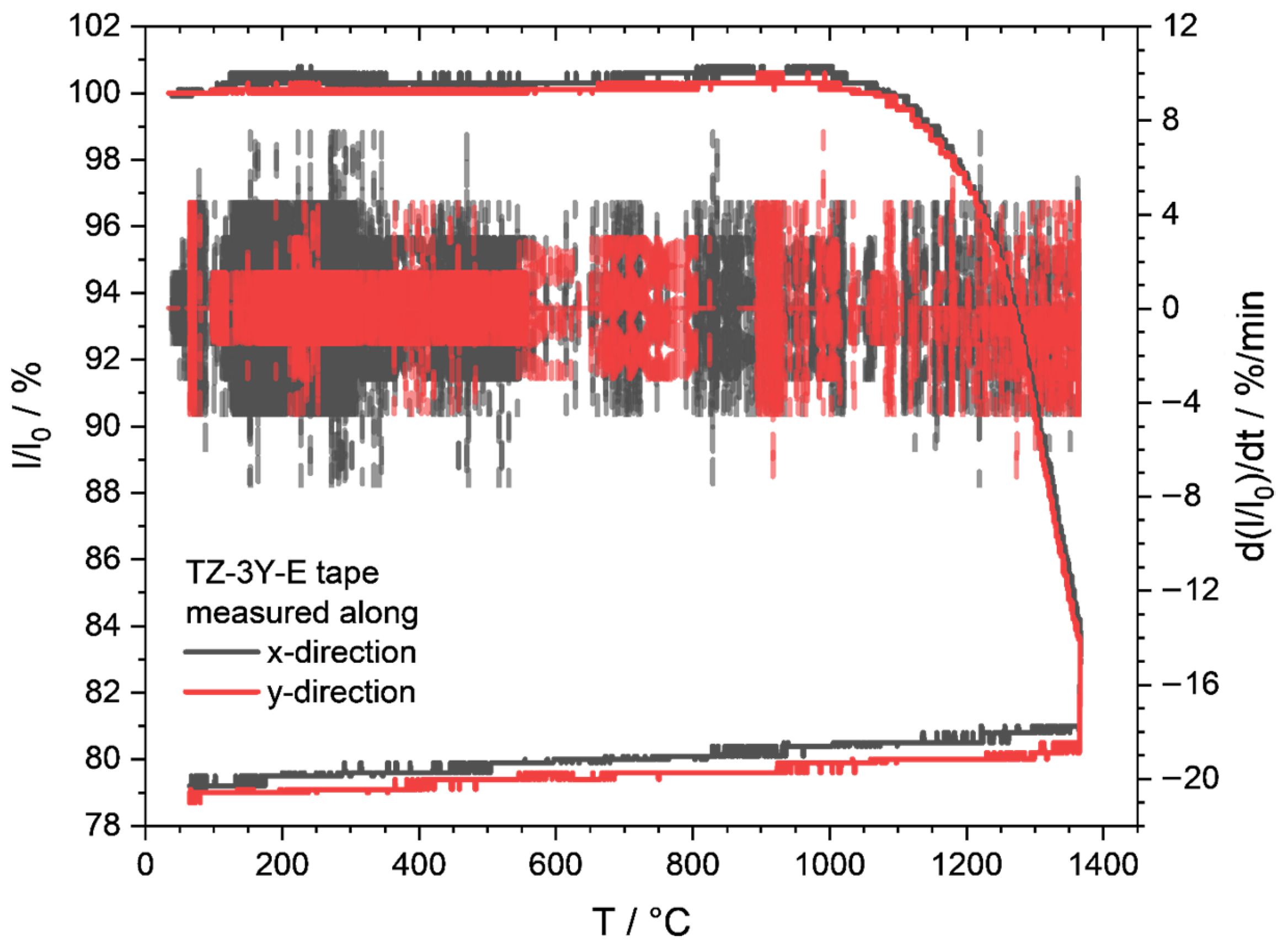
Without smoothing the optical dilatometry data, the derivative over time is not meaningful (see Figure A1 and Figure A2).
Figure A1.
Raw data on relative length (solid line) and relative length change rate (dashed line) for 17-4PH flat-lying tapes between room temperature and 1370 °C measured via optical dilatometry. The black and red curves were determined by measuring the sample length in the x- and y-directions.
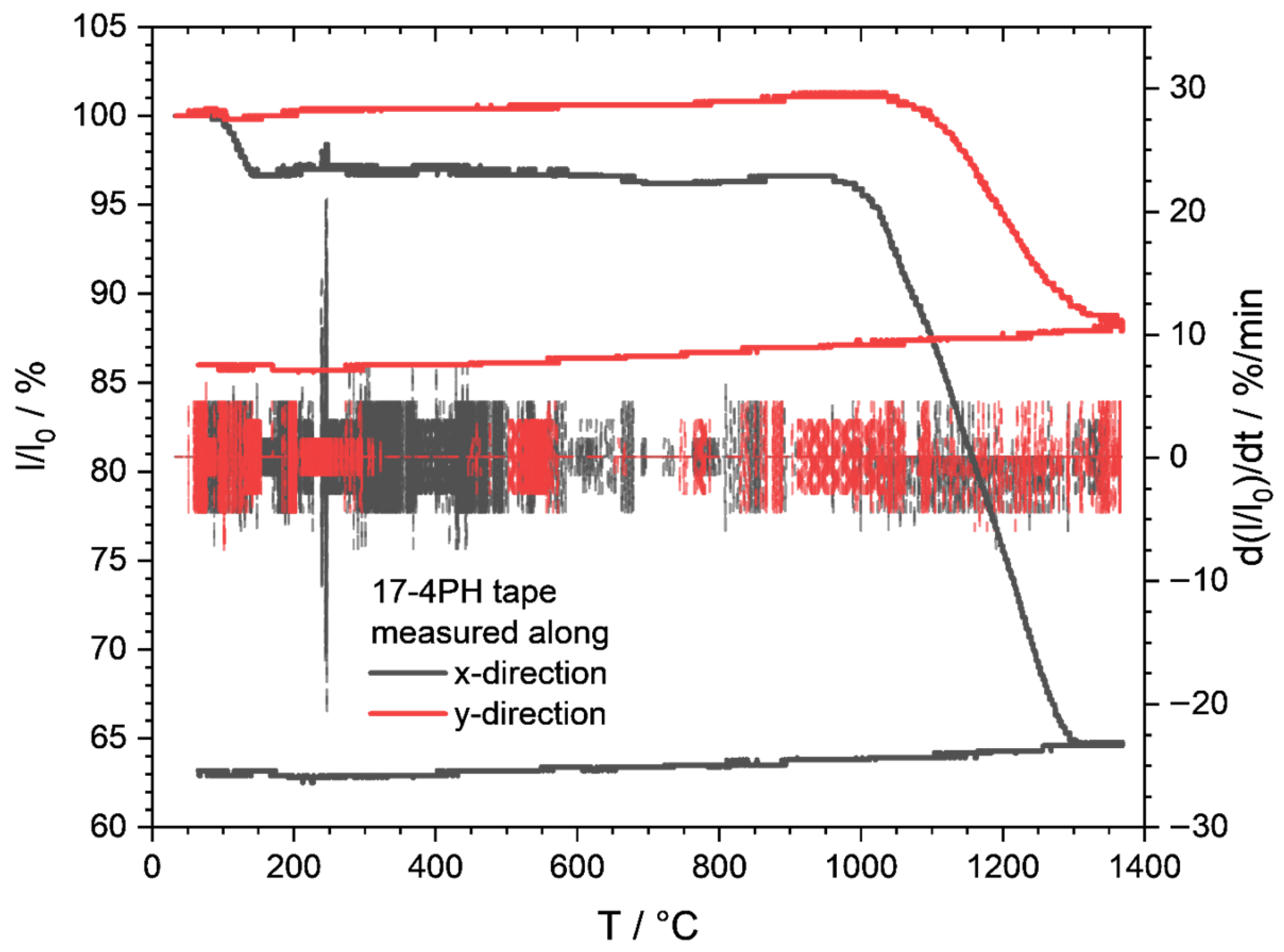
Figure A2.
Raw data on relative length (solid line) and relative length change rate (dashed line) for TZ-3YS-E flat-lying tapes between room temperature and 1370 °C measured via optical dilatometry. The black and red curves were determined by measuring the sample length in the x- and y-directions.
The effect of data smoothing on the optical dilatometry measurements is illustrated in Figure A3, showing the relative length change of flat-lying 17-4PH tapes in both x- and y-directions.
Figure A3.
Comparison of raw (bold line) and smoothed (thin line) data on the relative length of flat-lying 17-4PH tapes between room temperature and 1370 °C measured via optical dilatometry. The black and red curves were determined by measuring the sample length in the x- and y-directions.
Appendix B
Measurements of Tape Surfaces
Measurements covered an area of approximately 4.8 mm × 7.0 mm, with a vertical resolution of 0.1 µm. The arithmetical mean height was calculated using the instrument’s proprietary analysis software. Figure A4 shows the topography maps for the top and bottom surfaces of the 17-4PH and TZ-3YS-E tapes.
Figure A4.
Topography maps for the top and bottom surfaces of the 17-4PH and TZ-3YS-E tapes.
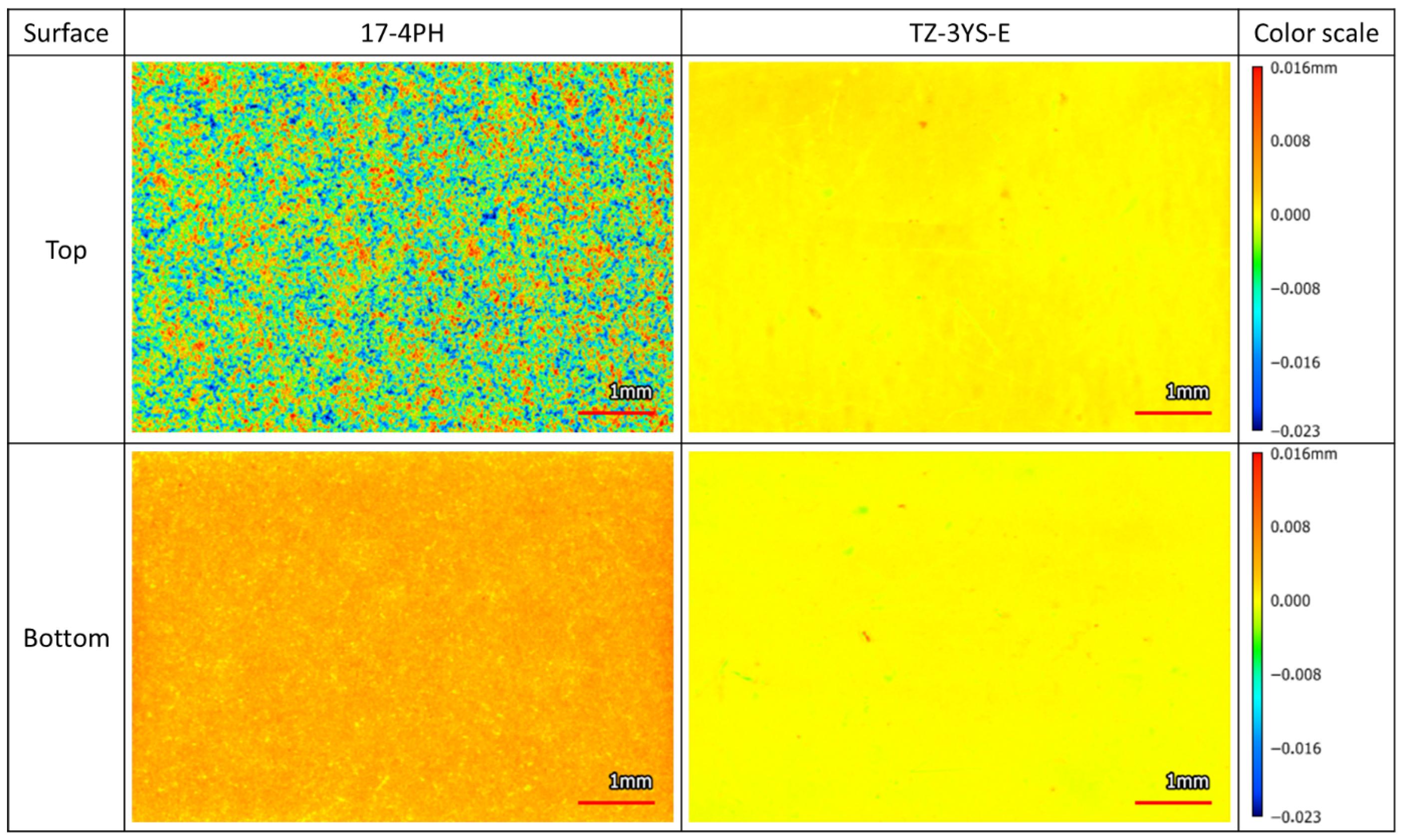
Figure A5 shows views of the top and bottom surfaces of the 17-4PH and TZ-3YS-E tapes.
Figure A5.
Views of the top and bottom surfaces of the 17-4PH and TZ-3YS-E tapes.
Appendix C
Calculation of Actual Shrinkage of a Warped 17-4PH Tape
In this example, an approximation of the final (sintered) state of a lying 17-4PH tape measured along the x-direction using optical dilatometry is calculated.
Since only ratios (relative changes) are considered, it is not necessary to convert the results into a length measurement. For this estimation, it is sufficient to calculate the respective numbers of pixels.
The first step for the approximation is to get the pixel coordinates (by counting pixels) from silhouette images of the sample in its initial and final (sintered) states. The coordinates should be chosen carefully, especially when obtaining the neutral axis. The data were gathered with the help of the Digitizer, a tool in the Origin software. Figure A6 and Figure A7 show the pictures with marked coordinates. In this work, the picture size was 320 × 240 pixels. The data picked are listed in Table A1.
Figure A6.
Silhouette of the 17-4PH tape in its initial state with the picked date (red dots) along the neutral axis along the x-direction of the tape.
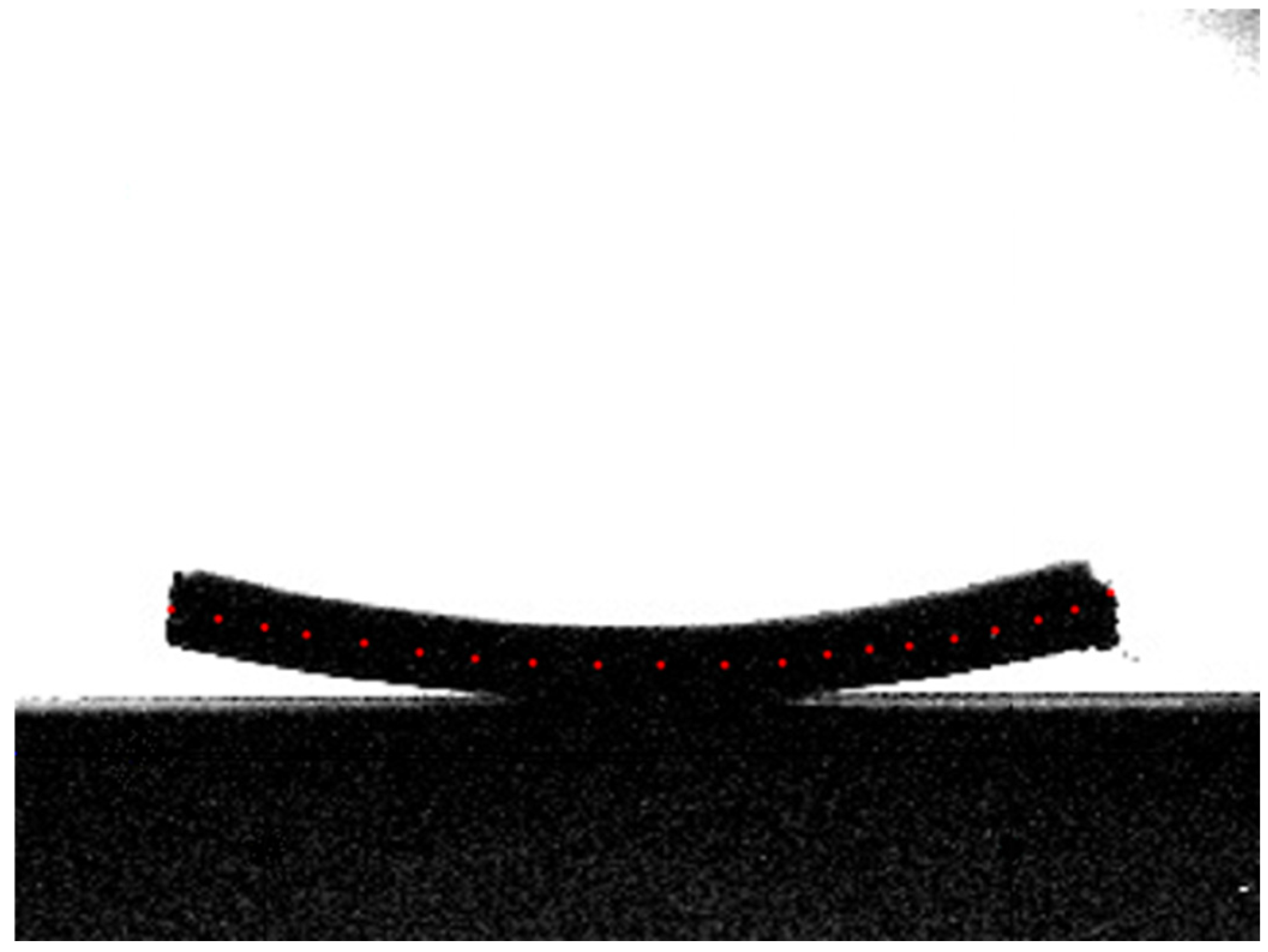
Figure A7.
Silhouette of the warped final (sintered) 17-4PH tape with the picked date (red dots) along the neutral axis along the x-direction of the tape.
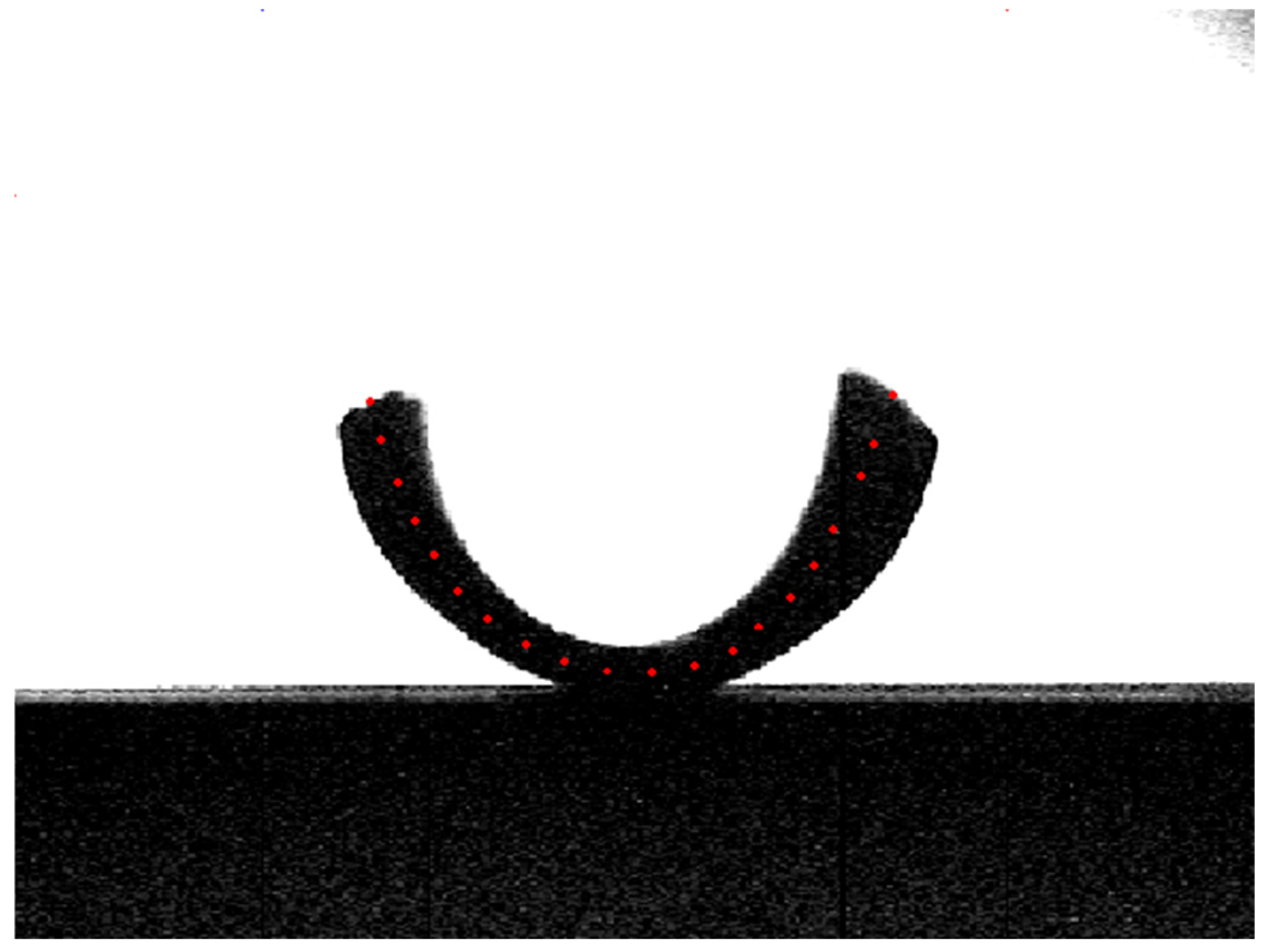
Table A1.
Picked coordinate data in number of pixels.
In the second step, the initial length of the initial state is calculated using the following expression in the Origin software, corresponding to Equation (1)
and yields . The integration interval corresponds to , the first and last x-coordinates of the initial state (see Table A1).
IntegrateXY(Col(x); sqrt(1 + DerivativeXY(Col(x); Col(y);1)^2))
In the third step, the length of the final state is calculated using the same Origin expression as for the initial state, but choosing the integration interval corresponding to , the first and last x-coordinates of the final state (see Table A1). This gives .
Finally, the approximate shrinkage is calculated with and using Equation (3).
This procedure can be done for other temperatures of interest, e.g., during sintering.
Since the original data are discrete, a pair of adjacent values is used to form a trapezoid to approximate the area under the curve segment defined by two points. To numerically integrate the definite integral, the Origin software uses the following approximation function (A1) [38].
where is the number of points. The following is the derivative function (A2) applied to the discrete data points by the Origin software [39].
In a simpler way, the length can also be calculated using the distance between two data points and the subsequent summation of the distances. The following equation (A3) was used for this.
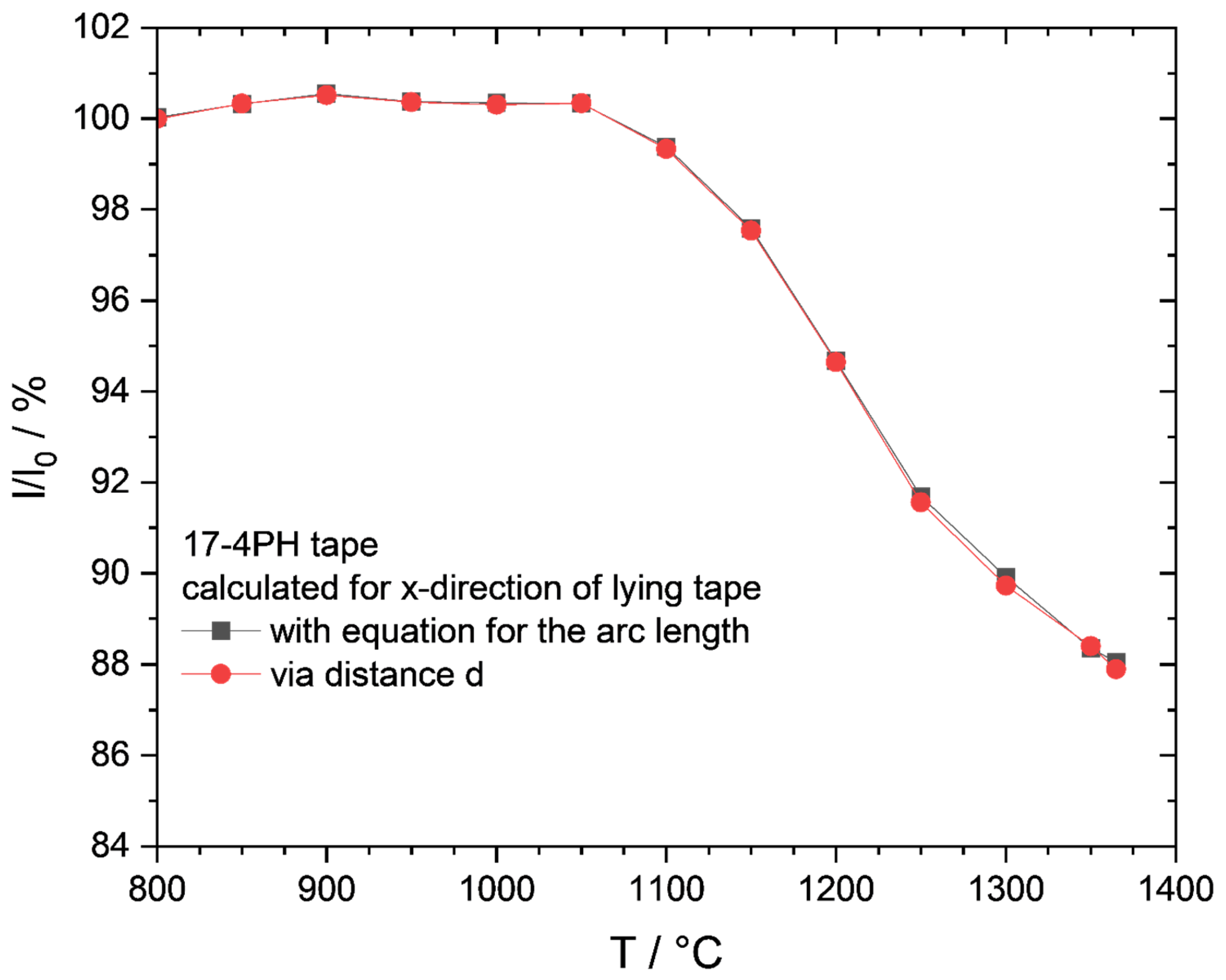
This gives and , resulting in . If more points are used, the result can be more accurate. Figure A8 compares the curves calculated by the two calculation methods.
Figure A8.
Comparison of results for actual shrinkage (for a lying 17-4PH tape measured in the x-direction) calculated using the arc length equation (squares) and using the summation of the distance d between two points (circles).
Appendix D
Comparison of Curves Without Normalization
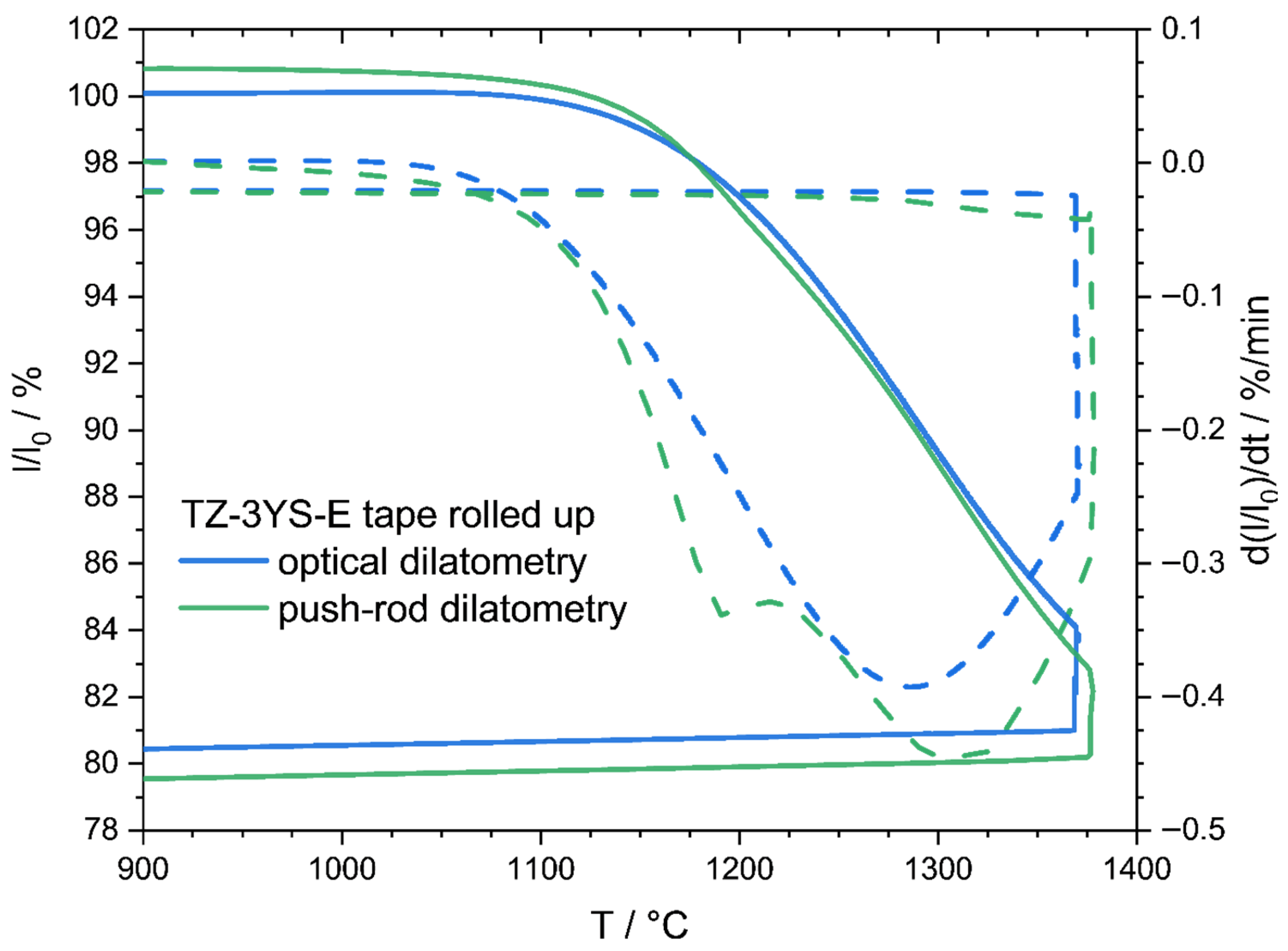
Figure A9 and Figure A10 compare the data from Figure 12 and Figure 19, respectively, without normalization at 900 °C.
Figure A9.
Relative length (solid lines) and relative length change rate (dashed lines) of rolled 17-4PH tapes measured in an optical dilatometer (blue) and push-rod dilatometer (green) between 900 °C and 1370 °C. Both curves were obtained by measuring the change in length corresponding to the y-direction of the tapes (perpendicular to the moving direction of the doctor blade).
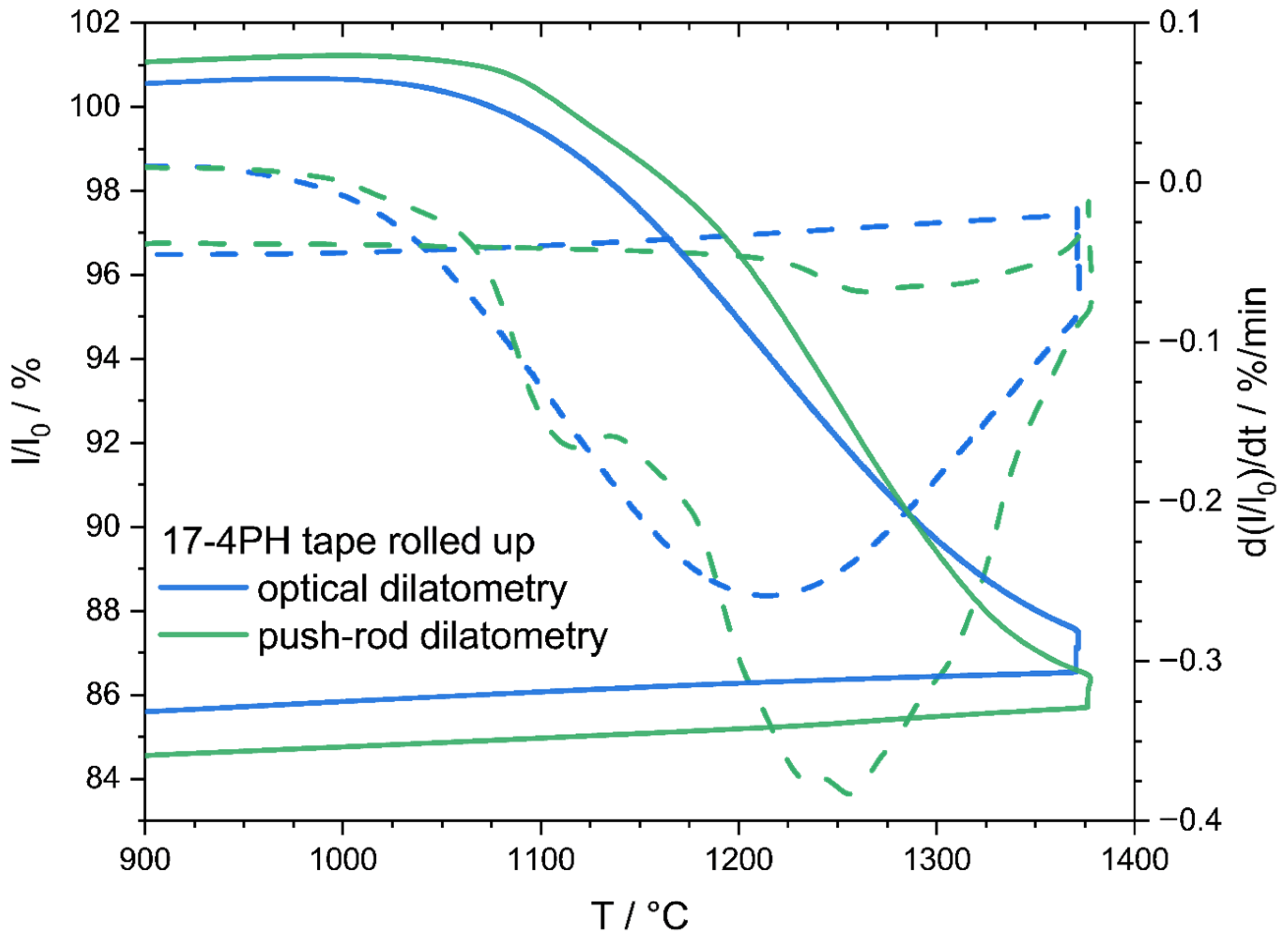
Figure A10.
Relative length (solid lines) and relative length change rate (dashed lines) of rolled TZ-3YS-E tapes measured in an optical dilatometer (blue) and push-rod dilatometer (green) between 900 °C and 1370 °C. Both curves were obtained by measuring the change in length corresponding to the y-direction of the tapes (perpendicular to the moving direction of the doctor blade).
Appendix E
How to Determine the Characteristic Temperatures
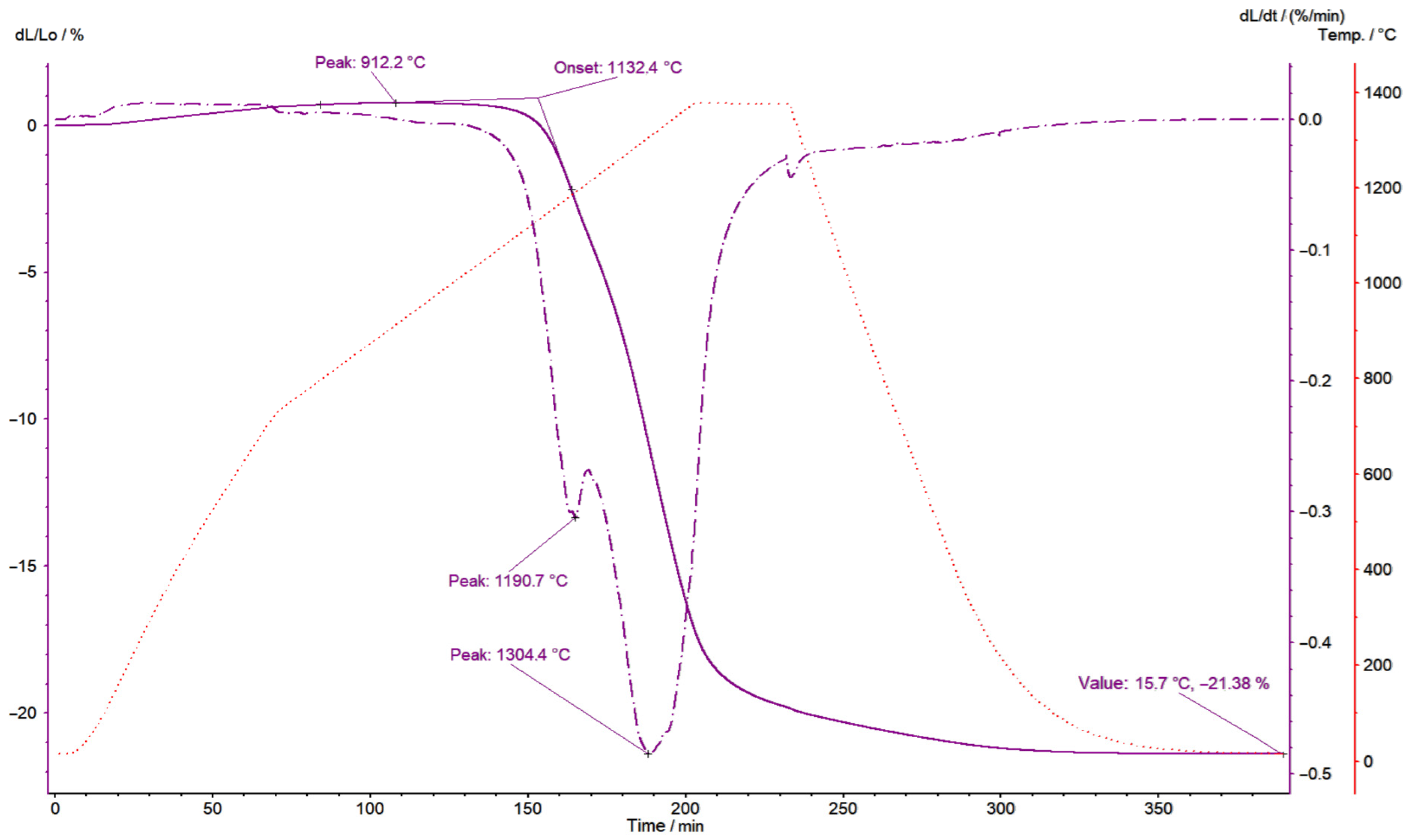
To illustrate the characteristic temperatures (peak of the relative length change: initial shrinkage, onset: start of accelerated sintering, peak of relative length change rate: maximum sintering rate) and the total shrinkage for discussion of the sintering process, a typical shrinkage curve of a ceramic tape for push-rod dilatometry is shown in Figure A11. The double tangent extrapolation method is used to determine the onset of accelerated sintering. When there is an additional local maximum in the relative length change rate, the onset temperature for accelerated sintering is extrapolated from this maximum rather than from the maximum relative length change rate.
Figure A11.
Shrinkage curve of a ceramic tape taken by the push-rod dilatometer. The purple solid line represents the linear length change, the purple dashed-dotted line represents the relative length change rate and the red dotted line represents the temperature. The characteristic data points used for the characterization of the sintering process from dilatometric experiments are shown. The total shrinkage is marked as value. Because of the additional local maximum in the relative length change rate, the onset temperature for accelerated sintering is extrapolated from this maximum rather than the maximum relative length change rate.
References
- Duan, C.; Tong, J.; Shang, M.; Nikodemski, S.; Sanders, M.; Ricote, S.; Almansoori, A.; O’Hayre, R. Readily processed protonic ceramic fuel cells with high performance at low temperatures. Science 2015, 349, 1321–1326. [Google Scholar] [CrossRef] [Scilit] [PubMed]
- Krishnan, V.V. Recent developments in metal-supported solid oxide fuel cells. Wiley Interdiscip. Rev. Energy Environ. 2017, 6, e246. [Google Scholar] [CrossRef] [Scilit]
- Tucker, M.C. Progress in metal-supported solid oxide electrolysis cells: A review. Int. J. Hydrogen Energy 2020, 45, 24203–24218. [Google Scholar] [CrossRef] [Scilit]
- Hagen, A.; Caldogno, R.; Capotondo, F.; Sun, X. Metal Supported Electrolysis Cells. Energies 2022, 15, 2045. [Google Scholar] [CrossRef] [Scilit]
- Minota-Yepes, I.C.; Álvarez-Roca, R.; Londoño-Badillo, F.A. Review: Densification process of ceramic materials. Respuestas 2020, 25, 199–212. [Google Scholar] [CrossRef] [Scilit]
- Guillon, O.; Gonzalez-Julian, J.; Dargatz, B.; Kessel, T.; Schierning, G.; Räthel, J.; Herrmann, M. Field-Assisted Sintering Technology/Spark Plasma Sintering: Mechanisms, Materials, and Technology Developments. Adv. Eng. Mater. 2014, 16, 830–849. [Google Scholar] [CrossRef] [Scilit]
- Oghbaei, M.; Mirzaee, O. Microwave versus conventional sintering: A review of fundamentals, advantages and applications. J. Alloys Compd. 2010, 494, 175–189. [Google Scholar] [CrossRef] [Scilit]
- Kuang, X.; Carotenuto, G.; Nicolais, L. A Review of Ceramic Sintering and Suggestions on Reducing Sintering Temperatures. Adv. Perform. Mater. 1997, 4, 257–274. [Google Scholar] [CrossRef] [Scilit]
- Varela, J.A.; Whittemore, O.J.; Longo, E. Pore size evolution during sintering of ceramic oxides. Ceram. Int. 1990, 16, 177–189. [Google Scholar] [CrossRef] [Scilit]
- Olevsky, E.A. Theory of sintering: From discrete to continuum. Mater. Sci. Eng. R. Rep. 1998, 23, 41–100. [Google Scholar] [CrossRef] [Scilit]
- Raether, F.; Seifert, G.; Ziebold, H. Simulation of Sintering across Scales. Adv. Theory Simul. 2019, 2, 1900048. [Google Scholar] [CrossRef] [Scilit]
- Yi, M.; Wang, W.; Xue, M.; Gong, Q.; Xu, B.-X. Modeling and Simulation of Sintering Process Across Scales. Arch. Comput. Methods Eng. 2023, 30, 3325–3358. [Google Scholar] [CrossRef] [Scilit]
- Montes, H.C.; Almeyda, Y.E.; Garay, J.G.; de León, L.B.; Vega, A. Ceramic Sintering and Properties Characterization Based on Solid Mechanics. TechConnect Briefs 2022, 1–4. [Google Scholar]
- Bordia, R.K.; Scherer, G.W. On constrained sintering—I. Constitutive model for a sintering body. Acta Metall. 1988, 36, 2393–2397. [Google Scholar] [CrossRef] [Scilit]
- Bordia, R.K.; Scherer, G.W. On constrained sintering—II. Comparison of constitutive models. Acta Metall. 1988, 36, 2399–2409. [Google Scholar] [CrossRef] [Scilit]
- Bordia, R.K.; Scherer, G.W. On constrained sintering—III. Rigid inclusions. Acta Metall. 1988, 36, 2411–2416. [Google Scholar] [CrossRef] [Scilit]
- Jankula, M.; Šín, P.; Podoba, R.; Ondruška, J. Typical problems in push-rod dilatometry analysis. Építőanyag. J. Silic. Based Compos. Mater. 2013, 65, 11–14. [Google Scholar] [CrossRef] [Scilit]
- Jagota, A.; Mikeska, K.R.; Bordia, R.K. Isotropic Constitutive Model for Sintering Particle Packings. J. Am. Ceram. Soc. 1990, 73, 2266–2273. [Google Scholar] [CrossRef] [Scilit]
- Scherer, G.W. Viscous Sintering under a Uniaxial Load. J. Am. Ceram. Soc. 1986, 69, C-206–C-207. [Google Scholar] [CrossRef] [Scilit]
- Kim, D.; Lee, S.; Lee, S.-H.; Kwon, S. Measurement of Thermal Expansion over a Wide Range of Temperatures by a Pushrod Dilatometer. J. Korean Phys. Soc. 2020, 77, 496–504. [Google Scholar] [CrossRef] [Scilit]
- Yamada, N.; Abe, R.; Okaji, M. A calibration method for measuring thermal expansions with a push-rod dilatometer. Meas. Sci. Technol. 2001, 12, 2121–2129. [Google Scholar] [CrossRef] [Scilit]
- Wang, H.; Zhang, Y.Y.; He, G.H.; Wang, B.Q.; Zhou, B.L. A Contactless CCD Dilatometer for Foil Materials. Int. J. Thermophys. 1999, 20, 743–753. [Google Scholar] [CrossRef] [Scilit]
- James, J.D.; Spittle, J.A.; Brown, S.G.R.; Evans, R.W. A review of measurement techniques for the thermal expansion coefficient of metals and alloys at elevated temperatures. Meas. Sci. Technol. 2001, 12, R1–R15. [Google Scholar] [CrossRef] [Scilit]
- Boccaccini, A.R.; Hamann, B. Review In Situ high-temperature optical microscopy. J. Mater. Sci. 1999, 34, 5419–5436. [Google Scholar] [CrossRef] [Scilit]
- Paganelli, M. Using the Optical Dilatometer: To Determine Sintering Behavior. Am. Ceram. Soc. 2002, 81, 25–30. [Google Scholar]
- Paganelli, M. Double Beam Optical Dilatometry: A Novel Research Tool for Ceramic Research. Ceram. Forum Int. 2004, 81, 50–56. [Google Scholar]
- Ayoub, H.; El-Sherif, A.; Hassan, H.; Khairy, S. Dilatometry of Refractory Metals and Alloys Using Multi- Wavelength Laser Shadowgraphy of Filament Samples. In Proceedings of the International Conference on Engineering Mathematics and Physics, Prague, Czech Republic, 15–18 June 2018; Volume 9, pp. 1–10. [Google Scholar] [CrossRef] [Scilit]
- Kim, J.-S.; Rudkin, R.A.; Wang, X.; Atkinson, A. Constrained sintering kinetics of 3YSZ films. J. Eur. Ceram. Soc. 2011, 31, 2231–2239. [Google Scholar] [CrossRef] [Scilit]
- JCGM; Bureau International des Poids et Mesures (BIPM). Evaluation of Measurement Data—Guide to the Expression of Uncertainty in Measurement, JCGM 100:2008(E). 2008. Available online: https://www.bipm.org/documents/20126/2071204/JCGM_100_2008_E.pdf (accessed on 2 February 2026).
- Preston-Thomas, H. The International Temperature Scale of 1990 (ITS-90). Metrologia 1990, 27, 3–10. [Google Scholar] [CrossRef] [Scilit]
- DIN EN ISO 3369:2010-08; Undurchlässige Sintermetallwerkstoffe und Hartmetalle—Ermittlung der Dichte (ISO 3369:2006); Deutsche Fassung EN ISO 3369:2010. DIN Media GmbH: Berlin, Germany, 2010. Available online: https://www.dinmedia.de/en/standard/din-en-iso-3369/128345823 (accessed on 7 January 2026).
- Nahass, P.; Pober, R.L.; Rhine, W.E.; Robbins, W.L.; Bowen, H.K. Prediction and Explanation of Aging Shrinkage in Tape-Cast Ceramic Green Sheets. J. Am. Ceram. Soc. 1992, 75, 2373–2378. [Google Scholar] [CrossRef] [Scilit]
- Tammann, G.; Scheil, E. Die Umwandlungen des Austenits und Martensits in gehärteten Stählen. Z. Anorg. Allg. Chem. 1926, 157, 1–21. [Google Scholar] [CrossRef] [Scilit]
- DIN 51007-1:2024-08; Thermische Analyse (TA)—Differenz-Thermoanalyse (DTA) und Dynamische Differenzkalorimetrie (DSC)—Teil 1: Allgemeine Grundlagen. DIN Media GmbH: Berlin, Germany, 2024. Available online: https://www.dinmedia.de/en/standard/din-51007-1/380196135 (accessed on 7 January 2026).
- Henrich, B.; Wonisch, A.; Kraft, T.; Moseler, M.; Riedel, H. Simulations of the influence of rearrangement during sintering. Acta Mater. 2007, 55, 753–762. [Google Scholar] [CrossRef] [Scilit]
- Liu, C.; Günther, A.; Deng, Y.; Kaletsch, A.; Herrmann, M.; Broeckmann, C. Investigation on the Curvature and Stress Distribution of Laminates Based on an Analytic Solution and FE Simulation. Materials 2022, 15, 6458. [Google Scholar] [CrossRef] [Scilit]
- Liu, C.; Deng, Y.; Gruner, D.; Kaletsch, A.; Gestrich, T.; Broeckmann, C. Densification, deformation, and delamination during co-sintering process of metal–ceramic laminates. J. Am. Ceram. Soc. 2024, 108, e20190. [Google Scholar] [CrossRef] [Scilit]
- Help Online—Origin Help—Integrieren. Available online: https://www.originlab.com/doc/de/Origin-Help/Math-Integrate (accessed on 21 January 2025).
- Help Online—Origin Help—Differenzieren. Available online: https://www.originlab.com/doc/de/Origin-Help/Math-Differentiate (accessed on 21 January 2025).

Disclaimer/Publisher’s Note: The statements, opinions and data contained in all publications are solely those of the individual author(s) and contributor(s) and not of MDPI and/or the editor(s). MDPI and/or the editor(s) disclaim responsibility for any injury to people or property resulting from any ideas, methods, instructions or products referred to in the content. |
© 2026 by the authors. Licensee MDPI, Basel, Switzerland. This article is an open access article distributed under the terms and conditions of the Creative Commons Attribution (CC BY) license.