


Abstract
This study explores how hospital location (rural/non-rural) may moderate the nurse staffing ratio’s impact on three hospital-acquired infections. This study used data from 2022 to 2024 on nurse staffing and hospital characteristics from the American Hospital Association Annual Survey and data on hospital-acquired infection rates from the Medicare Care Compare dataset provided by the Centers for Medicare and Medicaid Services. After removing missing values, the final dataset included 7997 hospital-year observations across the US. Independent variables include rural hospital designation, nursing hours per patient day, and RN FTE per adjusted day. The dependent variables included infection rates of Central Line-Associated Bloodstream Infection, Catheter-Associated Urinary Tract Infection, and Methicillin-Resistant Staphylococcus aureus. Multiple regression was performed in Stata 18. Our research found that across all three infection types, an increase in nursing hours per patient day is significantly associated with a decrease in the infection rate, and that impact was not moderated by hospital rurality. Extra time spent with patients in either a rural or non-rural hospital decreased hospital-acquired infection rates. While RN FTEs were included in the model, total nursing hours per patient day emerged as the more consistent predictor of lower hospital-acquired infection rates.
1. Introduction
Hospital-acquired infections (HAIs) present a burden on patients and hospitals. The Centers for Disease Control (CDC) reported that HAIs occur in one in every 31 hospital patients, leading to an estimated 98,000 deaths in the United States [1]. HAIs add billions of dollars annually to healthcare costs. A 2016 study by Forester et al. found that $7.2 to $14.9 billion was spent on HAIs in the United States [2]. The Agency for Healthcare Research Quality (2017) estimated that HAIs add, on average, $31,000 per case [3]. Costs associated with HAIs are not reimbursed by Medicare or Medicaid. The Centers for Medicaid and Medicare Services (CMS) Hospital-Acquired Condition (HAC) Reduction Program is part of the Medicare Value-based Purchasing Program that connects reimbursement to quality care. The HAC Reduction Program reduces payments to hospitals based on their performance with regard to HAIs, thus creating a financial incentive for hospitals to minimize the incidence of HAIs. The HAIs monitored include Central Line-Associated Bloodstream Infection (CLABSI), Catheter-Associated Urinary Tract Infection (CAUTI), Surgical Site Infection (SSI), Clostridioides difficile Infection (CDI) (or C. diff), Methicillin-Resistant Staphylococcus aureus (MRSA) Bacteremia, and Ventilator-Associated Pneumonia (VAP/VAE).
Previous studies have established a relationship between nurse staffing and the risk of HAIs. An earlier systematic review of 10 years of cross-sectional studies found a statistically significant association between nurse staffing variables and risk of HAIs for both single site-specific infections and multiple HAIs [4]. A more recent study found a positive association between understaffing and risk of HAIs [5].
Rural hospitals tend to have fewer resources than non-rural hospitals and treat large numbers of Medicaid and Medicare patients. Rural hospitals have been shown to generate less revenue per bed than non-rural hospitals, which is attributed to their small size and large overhead costs [6]. Research has found a difference in nurse staffing (nurse-to-patient ratio) between non-rural and large versus small and isolated rural hospitals [7]. With budget cuts to both Medicare and Medicaid currently proposed, the already overstretched healthcare industry, especially in rural regions, may consider cutting patient safety programs and reducing staffing as a cost containment measure. But research has shown that reducing staffing in turn increases rates of HAIs, which in turn drives up costs. A reduction in HAIs is profitable for hospitals even if it requires additional staffing. According to comprehensive incidence estimates previously published, 1.7 million HAIs occur in US hospitals, and prevention of HAIs could save $25.0 to $31.5 billion [8]. Research from 2020 found that for each HAI eliminated, the data suggests that a hospital’s costs increase by $25,008, but revenue increases by $1,518,682 in turn [9]. There have been some improvements in rates of HAIs over time, driven by the financial incentive insurers place on hospitals to reduce rates. Between 2021 and 2022, efforts to reduce HAIs led to a 9% decrease in CLABSIs, a 12% decrease in CAUTIs, and a 16% decrease in MRSA [10]. But, with the increasing age of the US population, complexity in patient care, shortages of skilled nurses, and an increase in the number of multidrug-resistant organisms, there is a concern that HAIs may increase in prevalence going forward [10].
HAIs put both a financial and operational strain on the healthcare system. For example, a single infection like CLABSI can drive up costs by tens of thousands of dollars per case due to increased hospital length of stay (LOS), extra diagnostic procedures, and expensive treatments. Research highlights the consequences of CLABSI, including higher mortality rates, prolonged hospital stays, and increased costs [11,12]. Stevens et al. reported an increased risk of mortality of 2.27-fold for patients suffering from CLABSI [13]. One study by Yu et al. (2023) found that compared with matched controls, both CLABSI and non-CLABSI hospital-onset bacteremia and fungemia cases were associated with increases in LOS and significantly higher hospital costs, mortality rates, and 30-day readmission rates [14]. A study by Fridkin et al. identified the patient-to-nurse ratio as an independent risk factor for CLABSI and concluded that the effect of staffing reductions on patient outcomes needs to be critically evaluated [15].
HAIs increase both length of stay and readmission rates, which consume scarce resources, such as hospital beds and staff time. Research has found that when nurses are able to spend more time per patient, patients are less likely to experience an adverse outcome, the length of stay is shorter, and there are cost savings for the hospital [16]. But the number of nurses alone does not, in and of itself, mean appropriate staffing. Appropriate staffing considers the relative mix of nurses providing care and their workload, levels of expertise and training, and resource availability [17]. The level of professional training among nursing staff has been reported as relevant for patient outcomes [18]. Needleman et al. (2002) found that a larger proportion of care provided by RNs, as opposed to lower-level nursing personnel, was associated with a reduction in urinary tract infections and pneumonia among patients [19], and Unruh (2003) also found an increase in the ratio of licensed nurses to total nursing staff correlated with a lower incidence of pneumonia [20]. Patient-to-nurse staffing ratios on medical–surgical units were studied, and it was found that for every additional patient, a nurse’s workload increased the odds of 30-day mortality for each patient by 16%, and the odds of an increased LOS of 1 day increased by 5% [21]. During the 1-year period, if the hospitals involved in the Lasater et al. (2021) study had been staffed at a 4:1 patient-to-nurse ratio, the research found that more than 1595 deaths would have been avoided, and the hospitals together would have saved over $117 million [21]. Research has found that not only do better patient–nurse ratios decrease lengths of stay, but they also decrease HAIs and improve hospital revenue and patient outcomes.
Studies have also found that rural hospitals often fail to meet recommended staffing thresholds, increasing HAI incidence [22,23,24]. Rural facilities struggle to recruit and retain qualified nurses amid limited budgets and heavy workloads, and the resulting staffing shortfalls undermine infection prevention efforts and elevate risks for HAIs [22]. There are evidence-based bundles of care that have been proven to reduce HAIs. For CAUTI, prevention relies on an aseptic insertion site and timely removal. There are precautions recommended to help prevent CLABSI, such as full barrier precautions at the time of insertion, use of chlorhexidine for skin antisepsis, central catheter dressing assessment, avoidance of the femoral site, the removal of unnecessary catheters, and checklists [18]. These are time-consuming procedures and require nurses to have adequate time in their schedules to ensure they can follow these protocols. Nurse shortages in rural areas, especially in critical care areas, have been shown to increase HAIs, most likely due to less time for patient monitoring and adherence to safety protocols [24]. Research indicates that addressing these disparities through targeted staffing support and infection prevention training is essential to improving patient safety in rural settings. Additionally, a report by the American Hospital Association (AHA) highlights that a large share of primary Health Professional Shortage Areas (HPSAs) are located in rural regions, intensifying the impact on nurse staffing and undermining hospitals’ ability to maintain patient safety and quality care [25].
It is important to effectively study and mitigate the relationship between staffing and HAIs within the resource constraints and structural realities of the rural healthcare environment, and our research attempts to fill that gap. It does so by exploring whether hospital rurality may moderate the nurse staffing ratio impact on HAIs. Therefore, the purpose of this paper is to investigate the relationship between nurse staffing ratios as measured by nursing hours per patient day and RN FTE per adjusted patient day and HAIs. We will be examining the above research question in the context of rural versus non-rural hospitals.
Conceptual Framework
Contingency theory is a foundational model in organizational studies that emphasizes the principle of “fit” between an organization’s internal structures and its external environment. Emerging from classical management thought, contingency theory rejected the notion of universal managerial solutions, positing instead that organizational effectiveness is situational—it depends on the alignment between structure, strategy, and contextual variables [26]. Within business forums, this theory has been instrumental in shaping strategic decision-making, highlighting how firms must adapt their internal processes—such as leadership style, communication flows, and resource allocations—in response to changing market dynamics, competition, and technological innovations [27,28].
In the private sector, particularly in manufacturing and services, contingency theory has informed models of supply chain agility, workforce design, and operational flexibility. For example, firms operating in high-velocity markets are advised to adopt decentralized structures and cross-functional teams, enabling faster decision-making and innovation [29]. In contrast, firms in stable environments may perform better under more centralized, hierarchical models. Thus, the core implication of the theory across business contexts is that organizational structures and practices must be tailored to fit the specific demands of their environments to optimize performance and mitigate risk.
When applied to the healthcare sector, contingency theory provides a compelling framework for evaluating hospital operations, particularly as they relate to quality and safety outcomes. Hospitals are complex adaptive systems characterized by dynamic patient populations, regulatory oversight, technological integration, and variable resource availability. Within this setting, nurse staffing serves as an organizational structure that significantly influences both the efficiency of care delivery and patient safety [30,31].
Contingency theory offers a useful lens to evaluate the relationship between nurse staffing structures and patient safety outcomes, particularly HAIs such as CLABSI, CAUTI, and MRSA. These infections represent critical quality indicators and are strongly influenced by front-line nursing care, making nurse staffing a key organizational structure under examination [30,31].
Hospitals differ substantially based on geographic location, population demographics, available resources, and institutional classification. Rural hospitals often face unique operational challenges, including workforce shortages, limited financial resources, and patient populations with complex, often unmanaged comorbidities [23]. These constraints may affect the extent to which nurse staffing ratios can be optimized, thus potentially influencing infection control performance. Conversely, non-rural hospitals may benefit from access to more specialized staff, higher patient volumes, and robust institutional infrastructure, all of which may mitigate or exacerbate the influence of staffing on HAI outcomes.
Contingency theory suggests that there is no universally “correct” or “fit” staffing ratio; rather, the effectiveness of staffing depends on the fit between staffing levels and the hospital’s external and internal environments [32]. This study adopts this perspective by examining how nurse staffing, as measured by RN hours per patient day and RN full-time equivalents (FTEs) per adjusted patient day, relates to HAI incidence across different hospital types. These measures are widely used indicators of nurse staffing capacity and operational output, providing a quantifiable way to examine their association with patient safety metrics [33].
By incorporating hospital type—rural versus non-rural—as a moderating variable, the framework guides hypothesis development rooted in the idea that the relationship between staffing and HAIs is context-dependent. In non-rural or better-resourced hospitals, higher staffing may lead to more consistent infection surveillance and adherence to protocols. In contrast, in rural hospitals, the same staffing levels may be insufficient to overcome structural limitations, or they may be disproportionately effective due to lower patient turnover and closer patient–nurse interactions. The moderating role of hospital type reflects a core tenet of contingency theory: that organizational variables do not operate in isolation but are shaped by and must respond to their broader operational contexts [28].
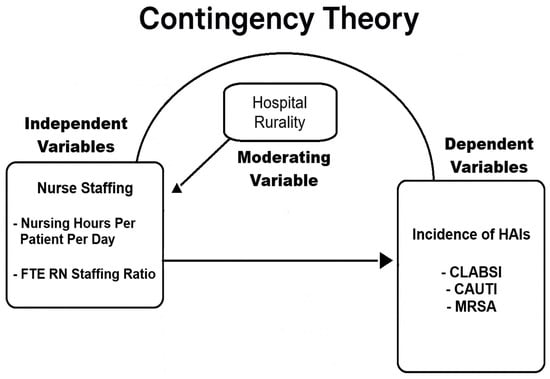
The application of contingency theory also supports the selection of specific variables for empirical testing (see Figure 1). Independent variables in this study—RN hours per patient day and RN FTE per adjusted patient day—represent internal structural elements. The dependent variable—incidence of HAIs, including CLABSI, CAUTI, and MRSA—reflects a key organizational outcome. The moderating variable—hospital location type—functions as a proxy for environmental complexity and resource variability. This alignment ensures that the theoretical model not only informs the research design but also provides a coherent structure for interpreting the results in light of organizational theory [34].
Figure 1.
Contingency theory, nurse staffing, and HAIs.
From a policy standpoint, these insights are significant. Regulatory mandates that enforce universal staffing minimums may provide baseline protection, but they risk being overly rigid if they do not account for hospital-specific conditions. Contingency theory suggests that more adaptive, data-informed staffing models may be better suited to reduce infections and improve patient outcomes across diverse healthcare settings [27]. Upadhyay et al. (2023) explicitly used contingency theory to frame the association between HAIs and hospital financial performance, suggesting that contextual factors moderate the staffing–HAI link [34]. For hospital administrators, this means that staffing should not be planned purely based on historical precedent or budget limitations but should instead be responsive to current patient needs and organizational realities.
Using contingency theory as the framework, we have formulated six hypotheses, H1a, H2a, and H3a, which all posit that increased nurse staffing (specifically with regard to nurse hours per patient days) will result in decreased infection rates across each HAI. With hypotheses H1b, H2b, and H3b, the dependent and independent variables are contingent on the situational context, which is rurality.
- Hypotheses
H1a:
Increased nurse staffing will be associated with a lower CLABSI infection rate.
H1b:
The negative relationship between nursing hours per patient day and CLABSI rates will be moderated by hospital rurality, such that the protective effect of staffing is more pronounced in rural hospitals compared to non-rural hospitals.
H2a:
Increased nurse staffing will be associated with a lower CAUTI infection rate.
H2b:
The negative relationship between nursing hours per patient day and CAUTI rates will be moderated by hospital rurality, such that rural hospitals exhibit a higher sensitivity to staffing fluctuations than non-rural hospitals.
H3a:
Increased nurse staffing will be associated with a lower MRSA infection rate.
H3b:
The negative relationship between nursing hours per patient day and MRSA rates will be moderated by hospital rurality, suggesting that the organizational “fit” between staffing and infection control is contingent upon the geographic context.
2. Materials and Methods
2.1. Data and Variables
The study used data from the American Hospital Association (AHA) Annual Survey [35] and the Care Compare dataset provided by the Centers for Medicare and Medicaid Services [36,37,38]. The AHA dataset provided the information used for nurse staffing (total nursing hours) and hospital characteristics (rural and non-rural, ownership type, system membership, teaching status, critical access designation, and bed size). The Care Compare dataset provided information on HAIs for CLABSI, CAUTI, and MRSA. The AHA and Care Compare datasets were merged using the Medicare provider number. The time period for the study was from 2022 to 2024.
The formulas we used for the CLABSI, CAUTI, and MRSA rates are from the Centers for Disease Control and Prevention’s National Healthcare Safety Network (NHSN) and used for uniform comparison of HAIs across healthcare facilities.
CLABSI rate = (Number of observed CLABSIs/Number of central line days) × 1000
CAUTI rate = (Number of observed CAUTIs/Total urinary catheter days) × 1000
MRSA rate = (Number of new hospital-acquired MRSA cases/Total number of patient days) × 1000
The denominators are specific to the population at risk. The formula for the MRSA rate, for instance, is calculated to measure the number of new hospital-acquired MRSA cases per specific number of at-risk patient days. The multiplier of 1000 makes the resulting number a rate of infections per 1000 days, making it uniform for comparison across healthcare facilities. Comparing rates is more accurate than comparing case counts. For the CAUTI rate, having catheter days in the denominator ensures that it is focused solely on the population at risk, those patients with a urinary catheter.
2.2. Measures
Dependent variables. The dependent variables included infection rates for three HAIs: CLABSI, CAUTI, and MRSA. The infection rate is the ratio of observed cases divided by the number of days or procedures per year. CLABSI, CAUTI, and MRSA were selected because they are tracked by CMS and the Centers for Disease Control (CDC) and have been shown to increase patient costs and are related to care provided by nurses, making them meaningful outcome variables.
Independent variables include rural hospital designation, nursing hours per patient day, and RN FTE per adjusted patient day (RN staffing ratio). We chose nursing hours per patient day (NHPPD) as a measure of volume of bedside care and RN FTE as a measure of professional skill mix. These are standard metrics in health services research that allow for comparison across varied hospital sizes [19]. Rural hospital designation is self-reported data from the AHA survey. Nursing hours per patient day and RN staffing ratio were calculated from the total nursing productive hours supplied by the AHA survey. Calculations for nursing hours per patient day and RN nurse staffing ratio are as follows:
Other studies have used nursing hours per patient day as a proxy for nurse staffing levels when examining nurse staffing and patient outcomes [19,39,40]. Nursing hours per patient day reflect the total time nurses and nurse assistants spend on the unit per patient day. This measure excludes time not spent attending to patients, such as personal time off, education, orientation, or committee time [39].
The RN staffing ratio accounts for all patient care provided by the hospital, not just inpatient care, and all RN hours, even those of part-time and contract RNs converted into the equivalent number of full-time employees. Because nursing staff are required across the hospital system for more than just inpatient care, it is important to consider the full spectrum of care provided so that the true workload is not understated. Adjusted patient days are a measure that converts volume of outpatient services into an equivalent number of inpatient days based on their complexity or revenue.
Moderating variable. The moderating variable was rurality. Binary values (0 = rural, 1 = non-rural) were used for analysis. The reference group was rural hospitals.
Control variables. The control variables include ownership type, system membership, teaching status, critical access hospitals, and bed size. Hospital ownership included government non-federal, government federal, not-for-profit, and investor-owned. (Government-non-federal ownership was used as the reference group.) Reference groups included system membership, teaching status, and critical access hospitals. Binary values (0 = yes, 1 = no) were used for system membership and critical access hospital designation.
2.3. Analysis
A multivariate linear regression model of nurse staffing factors that influence the CLABSI, CAUTI, and MRSA rate, with a special focus on how the effect of nurse hours per patient day is moderated by hospital rurality, was analyzed.
The data were organized in a panel format, and ordinary least squares (OLS) regression was employed for analysis. We used OLS as this allowed us to include variables that are time-invariant, such as hospital location. Fixed effects (FEs) cannot be used for this study because an FE model removes the effect of any variable that does not change over time (time-invariant), such as a hospital’s location (rurality). Location is necessary to be included in our study because our moderating variable is rurality, a key variable in our study. To address concerns regarding unobserved heterogeneity while maintaining the time-invariant rurality variable, we ran a random effects model. The results were consistent with the OLS findings, suggesting the estimates are stable. The dependent variables (CLABSI, CAUTI, and MRSA rates) exhibit right-skewed distributions with a high frequency of zero-value observations, which are characteristic of rare-event clinical outcomes. While alternative modeling strategies, such as Poisson or Zero-Inflated Negative Binomial (ZINB) regressions, are often used for count data, OLS was maintained here to facilitate the interpretation of the interaction terms. As a sensitivity check, the models were evaluated for normality of residuals. The unit of analysis was hospital-year observations. The data was checked for linearity using the linktest command. Linktest is a test for model specification to check if any relevant variables have been omitted, making the model unacceptable. The coefficient for _hatsq was insignificant, which shows that our assumption for linearity was met. We also tested for multicollinearity using the stat VIF command. The VIF quantifies the degree to which the variance of a regression coefficient is inflated due to collinearity with other predictors. The mean VIF value (3.62 < 10) indicated that no significant multicollinearity was present. Also, the tolerance factor (1/VIF) was 1/3.62 = 0.27. Since 0.27 > 0.10, it also confirmed that there was no significant multicollinearity. We ran a histogram, and the bars were normally distributed with no skewness evident. Approximately 50 missing values were removed because values for one or more variables were either implausible or not associated with viable organizations. The statistical tool removed the entire observation where missing values were found. There was no attempt to do imputations. The final sample included 7997 hospital-year observations for the three years. While the high frequency of zeros is a recognized limitation, the large sample size (n = 7997) helps mitigate the risk of violating OLS assumptions regarding the distribution of the error term.
The following models were examined:
YCLABSI = B0 + B1(Staffing) + B2(Hospital Type) + B3(Staffing) × (Hospital Rurality) + Controls + ε
YCAUTI = B0 + B1(Staffing) + B2(Hospital Type) + B3(Staffing) × (Hospital Rurality) + Controls + ε
YMRSA = B0 + B1(Staffing) + B2(Hospital Type) + B3(Staffing) × (Hospital Rurality) + Controls + ε
3. Results
- Descriptive Statistics
Table 1 summarizes the descriptive characteristics of the sample. The data are categorized into infection rates (dependent variables), nurse staffing metrics (independent variables), and hospital organizational features (control variables). This table provides the baseline means, standard deviations, and frequencies that define the study population, highlighting that the majority of the sample consists of non-rural, not-for-profit, and system-affiliated facilities.
Table 1.
Descriptive statistics (n = 7997 hospital-year observations).
The descriptive data in Table 1 reveal a high degree of variance in hospital characteristics across the 7997 observations. Notably, the mean NHPPD (12.68) suggests a broad range of staffing capacity across the sample. The high frequency of zero-value observations in the infection rates (means of 0.60 for CLABSI and 0.04 for MRSA) confirms that these HAIs are relatively rare events, which justifies the use of a large-scale dataset to ensure sufficient statistical power for the subsequent regression analyses.
As shown in Table 2, the regression model for CLABSI demonstrates a significant protective effect of nursing volume. The coefficient for nursing hours per patient day (−0.0007) is statistically significant at the p = 0.05 level, indicating that as nursing time increases, CLABSI rates decrease. Furthermore, the R2 of 0.0577 indicates that while staffing and the included controls explain a portion of the variance, the majority of CLABSI outcomes are likely influenced by clinical factors not captured in administrative data.
Table 2.
Regression analysis for the relationship between CLABSI rate and nurse staffing.
Table 3 presents the regression estimates for CAUTI rates. This analysis replicates the modeling approach used for CLABSI to determine if the impact of nursing hours per patient day remains consistent across different types of hospital-acquired infections. Table 3 displays the specific influence of independent staffing variables and organizational controls, such as teaching status and bed size, on CAUTI incidence.
Table 3.
Regression analysis for the relationship between CAUTI rate and nurse staffing.
The findings in Table 3 highlight a robust negative relationship between NHPPD and CAUTI rates (Coeff = −0.0019; p = 0.015). This relationship is nearly three times stronger than that observed for CLABSI, suggesting that CAUTI prevention may be particularly sensitive to nursing time. Additionally, the significantly lower CAUTI rates in non-teaching hospitals (Coeff = −0.2531; p = 0.042) suggest that hospital complexity and teaching status are important drivers of urinary tract infection outcomes.
Table 4 confirms that nursing hours per patient day are highly significant in predicting lower MRSA rates (p < 0.001). While non-rural hospitals exhibited significantly lower baseline MRSA rates than rural facilities (Coeff = −0.0043; p = 0.044), the non-significant interaction term (p = 0.640) confirms that the benefit of increased nursing hours remains constant regardless of hospital location. This suggests that while geographic environment influences MRSA prevalence, the efficacy of nursing care as a mitigation strategy is universal.
Table 4.
Regression analysis for the relationship between MRSA rate and nurse staffing.
4. Discussion
The underlying tenet of contingency theory, as it applies to this paper, is that there is no one-size-fits-all nurse staffing ratio to prevent HAIs, as it is contingent on the specific environment. What is the ideal nurse staffing level in a non-rural hospital may be entirely inappropriate or unrealistic in a rural hospital due to different internal and external constraints.
In order to reduce HAIs, the hospital’s structure and strategy must fit its unique internal and external contingency factors. Rural hospitals face external constraints, such as a smaller labor pool and fewer educational resources, which forces them to operate with fewer nursing resources (lower skill mix and higher patient-to-nurse ratios), whereas non-rural hospitals have greater resource availability in their external environment. Even if the internal environments are similar, depending on the acuity and complexity of the patient pools, the external resource availability will impact the ability to staff appropriately for the complexity and care needs of the patients. Considering each rural or non-rural environmental contingency, each with its own unique resources, patient complexities, and regulatory factors, the right “fit” with regard to nurse staffing would vary when it comes to minimizing HAIs.
Our research found that nursing hours per patient day shows a significant negative relationship with the CLABSI rate (−0.0007; p value = 0.0500), CAUTI rate (−0.0019; p value = 0.0150), and MRSA rate (−0.0001; p value= 0.0000). This suggests that higher nursing hours are associated with lower rates of infection across all three HAIs. Our findings align with other health services research that identifies nurse staffing levels as a critical determinant of patient outcomes [30,31]. The negative association between NHPPD and HAI (CLABSI, CAUTI, and MRSA) rates corroborates the results of previous large-scale longitudinal studies. For instance, Needleman et al. (2011) demonstrated that shifts with nursing hours below target levels were associated with increased mortality and adverse events, including infections [31]. Fridkin et al. identified the patient-to-nurse ratio as an independent risk factor for CLABSI [15]. Similarly, research by Cimiotti et al. in 2012 found that high nurse-to-patient ratios were significantly linked to increased rates of surgical site infections and CAUTI, but they associated them with nurse burnout primarily [41]. Like our findings, Blegen et al. found that higher nurse staffing protected patients from poor outcomes (however, hospital safety-net status introduced complexities in this relationship) [33]. Just as Spetz et al. found that higher registered nurse staffing per patient day had a limited impact on adverse patient outcomes, we too found that the RN staffing ratio is not significant for any of the three HAIs studied [40]. The significant negative relationship between nursing hours per patient day and all three infection rates (CLABSI, CAUTI, and MRSA) as opposed to the RN staffing ratio is a robust finding and may highlight the importance of more time spent per patient, no matter the skill level of the nurse. Sufficient time in a nurse’s schedule to allow for proper protocol, basic hygiene, and patient management may be the primary drivers to decrease HAIs, as other studies have suggested [15,16,21,22,23,24]. Lower patient-to-nurse ratios afford more time in a nurse’s schedule to remove unneeded or over-dated catheters or to follow proper hygiene to prevent the spread of bacteria, diminishing the risk of HAIs. The downside to the RN staffing ratio metric is that it does not indicate whether a low RN FTE equates to an understaffing or staffing by other levels of nursing care, such as Licensed Practical Nurses (LPNs) or Nursing Assistive Personnel (NAP), in lieu of RNs. It is possible that the impact from the lack of RNs is being masked by additional numbers of lower-level nurses and other healthcare staff. Our research indicates that more nurses, as opposed to higher-skilled nurses (RNs), seem to be the most important factor for controlling HAIs.
A systematic review from 2008 found that in many studies, lower registered nurse (RN) staffing or higher use of temporary/float nurses was significantly associated with increased HAI risk [4]. Although other research has found that the nurse skill mix makes a difference for the prevention of HAIs [4,18,19,20], our research found that the RN FTE staffing ratio is not significant for any of the three HAIs studied. Regarding the composition of the nursing workforce, our findings should not be interpreted as an indication that RN skill mix is unimportant for infection outcomes. Rather, within this specific dataset and utilizing these metrics, total nursing time per patient day (NHPPD) exhibited a more consistent and robust association with HAI reduction than RN FTEs alone. Future research utilizing more granular unit-level skill mix data may be necessary to further tease out the specific contributions of RN expertise.
We did not find that rurality was a moderator for nurse staffing and HAIs. Rurality does not appear to buffer or alter the staffing–HAI relationship. We did find that non-rural hospitals have a significantly lower MRSA rate compared to rural hospitals. But, the interaction term rural hospital × nursing hours per patient day is not significant for CLABSI, CAUTI, or MRSA, suggesting that the effect of nursing hours on CLABSI, CAUTI, or MRSA rate does not significantly differ between rural and non-rural hospitals. The finding that non-rural hospitals have a significantly lower MRSA rate suggests that the non-rural hospitals may have other resources that are independent of daily nurse staffing ratios, such as infection control teams and cutting-edge diagnostics that allow for quicker identification of MRSA and control the spread of infection. The fact that the interaction term (rural hospital × nursing hours per patient day) is not significant for CLABSI, CAUTI, or MRSA indicates that extra time from nursing staff is universally beneficial, no more so in rural or non-rural hospitals, but it is beneficial for both in reducing HAIs.
Our research also found that bed size has a significant positive relationship, meaning larger hospitals are associated with a higher CLABSI rate (0.0004; p value = 0.0000) and a higher MRSA rate (0.00004; p value = 0.0000). Non-teaching hospitals have a significantly lower CAUTI rate (−0.25314; p value= 0.0420) and a significantly lower MRSA rate (−0.00898; p value = 0.0100) compared to teaching hospitals. The significant positive relationship between bed size and CLABSI and MRSA rates, and the higher CAUTI and MRSA rates in teaching hospitals (versus non-teaching), reflects the high-acuity patient population typical of both larger and teaching hospitals. More severely ill patients are at greater risk of HAIs as they may require central venous catheterization, leading to CLABSI, or they may have longer lengths of stay, which increases their risk of exposure to MRSA and/or may require more catheterization, increasing their risk of CLABSI.
Non-system-affiliated hospitals have significantly higher CLABSI (0.0862; p value= 0.0000) and MRSA (0.0065; p value= 0.0000) rates than system-affiliated hospitals, likely due to the benefit that large system-affiliated hospitals have with standardization and economies of scale with regard to infection control teams, data infrastructure, and training.
Hospitals that are not critical access hospitals (CAHs) show a significantly higher CLABSI rate (0.3918; p value= 0.0000) and MRSA rate (0.2617; p value= 0.0000) compared to CAHs, likely due to the fact that CAHs typically refer more complicated and severely ill patients to larger hospitals, leading to shorter lengths of stays and less severely ill patients that require central venous catheterization, leading to CLABSI and limiting exposure to MRSA. Non-CAHs show a significantly lower CAUTI rate (−0.3179; p value = 0.0000) compared to CAHs. That is likely due to the fact that CAHs have limited resources and likely lack electronic medical record reminders and other technologies that may serve as reminders to change the catheters in a timely fashion.
Compared to government non-federal hospitals, both not-for-profit and investor-owned hospitals show a significantly lower CLABSI rate and lower MRSA rate. It is possible that the competitive market forces driving the private and non-profit sectors yield better results when it comes to controlling HAIs than the resource constraints and structural challenges often faced by the government sector. Or, reporting bias impacts the government sector less than the other sectors. Therefore, the government non-federal hospitals more accurately report HAIs and, therefore, show higher rates of infection.
Limitations and Future Research
While this study offers important insights into the staffing–HAI relationship, several limitations must be acknowledged. A scoping review by Shang, Stone, and Larson (2015) highlighted methodological challenges associated with research related to nurse staffing and HAIs and proposed the need for more studies, as results have been mixed [42]. Our study faced similar challenges, such as measuring staffing levels and assessing temporality. Our data also only covered a two-year period, capturing only a snapshot in time. Temporality cannot be measured in this design; it did not consider lag effects to measure staffing levels and outcomes directly associated with varying nurse staffing levels. The cross-sectional nature of the data introduces the potential for endogeneity and reverse causality. While we hypothesize that higher NHPPD leads to lower infection rates, it is possible that hospitals experiencing HAI outbreaks intentionally increased staffing as a corrective measure. Such a dynamic would suppress the observed protective effect of nursing volume in our models. Additionally, there are inherent limitations in self-reported and secondary data.
The reliance on self-reported secondary AHA and CMS data may be subject to differential reporting across hospital types. Non-rural facilities often possess more robust administrative resources for clinical surveillance than rural hospitals. If these larger facilities engage in more rigorous monitoring, they may detect and thereby report more infections, potentially biasing comparisons of HAI rates. Additionally, nursing hours per patient day estimates may include nursing hours from non-inpatient units, resulting in estimates slightly higher than direct bedside care hours. Self-reported AHA survey data can lead to response bias and issues with generalizability, as only certain hospitals choose to participate in the survey. The use of secondary data from the Medicare Care Compare limits generalizability due to the lack of validity bias. Miscalculation or lack of validity bias may exist because using self-reported codes is less precise than surveillance data. Triangulation of the data would also be beneficial to help limit bias.
Finally, the limited explanatory power of the models, particularly for CAUTI, is reflected in the low R2 values. These values indicate that HAI outcomes are complex and influenced by numerous factors beyond the scope of this dataset, such as patient comorbidities and specific clinical protocol adherence. Consequently, our findings demonstrate statistical associations rather than predictive capacity. While NHPPD is a significant factor in HAIs, it does not account for the full spectrum of organizational and clinical processes that determine infection outcomes. The lack of a patient acuity measure, such as the Case Mix Index (CMI), is a significant limitation. Higher patient acuity not only necessitates increased nursing intensity, but more complex patients are also more susceptible to HAIs. Because the AHA database does not provide patient-level clinical data, we cannot definitively state whether the observed relationship between staffing and HAIs is confounded by the underlying severity of illness. This is reflected in the low R2 values across the models, which indicate that while nurse staffing is a significant factor, it is only one component of a multifactorial clinical problem. We acknowledge the low R2 (5.7% for CLABSI). In large-scale hospital studies using administrative data, low R2 is common because clinical factors, such as patient comorbidities, drive most variance. The focus of our study is the statistical significance and direction of the staffing coefficients, which remain robust predictors, even after controlling for hospital characteristics. Future research incorporating the Case Mix Index (CMI) or electronic health record (EHR) data would allow for a more nuanced understanding of how staffing interacts with patient complexity to influence HAI outcomes.
The specific contingency factors impacting rural hospitals are not specifically considered, such as the strong financial pressure to minimize costs due to Prospective Payment System (PPS) reimbursement, staffing recruitment and retention barriers, and access to fewer resources than non-rural hospitals. Nor do we explore the specific structural adaptations rural hospitals may make to overcome contingency factors, such as a strong patient safety culture or temporary staffing options. Since we did not look at these factors specifically, research exploring the structural features that help rural hospitals overcome the contingencies they face would be important. Our research does not distinguish between temporary or permanent staffing numbers and how staffing fluctuates in regard to patient complexity or acuity, so there is much more that needs to be studied to understand the direct staffing numbers to HAIs, given the various contingencies. While this study does not include a direct patient-level acuity measure, the significant association between NHPPD and HAI reduction remains telling. In practice, hospitals included in the AHA survey likely attempt to calibrate staffing levels in response to their respective patient acuity levels. However, these efforts are often constrained by external labor market shortages and internal budgetary pressures. Our finding that increased nursing hours significantly reduces HAIs, even without explicit acuity control, suggests that when hospitals successfully increase nursing volume, they are better positioned to mitigate the infection risks inherent in their patient populations. Consequently, NHPPD may serve as a proxy for the hospital’s capacity to meet the clinical demands of its specific patient mix. Although we found that the RN FTE staffing ratio did not make a difference, in certain patient acuity situations, it may be more important than our research indicated. Future research should integrate clinical EHR data to control for patient acuity. Finally, the use of a binary rurality designation may oversimplify the diverse operational realities of hospitals along the geographic (rural–non-rural) continuum. Hospitals in more rural communities may face conditions that hospitals in less rural communities do not face. Furthermore, while the ordinary least squares (OLS) approach was theoretically necessary to examine rurality, the time-invariant location variable, it may not account for all unobserved hospital-level heterogeneity.
5. Conclusions
HAIs are one of the most common complications of hospital care, affecting millions of patients and leading to tens of thousands of deaths annually in the U.S., and they are critically important to the study of health services research. HAIs represent a significant failure in the healthcare delivery system, with major consequences for patient safety, healthcare quality, and financial stability. Additionally, there are financial penalties imposed on hospitals for HAIs as they are considered preventable, and, therefore, regulatory bodies, like CMS, penalize the hospitals with high rates of HAIs by reducing their reimbursement. Research has shown that reducing staffing in turn increases rates of HAIs, which in turn drives up costs. Our research found that across all three infection types (CLABSI, CAUTI, and MRSA), an increase in nursing hours per patient day is significantly associated with a decrease in the infection rate, and that impact was not moderated by hospital rurality. Extra time spent with patients in either a rural or non-rural hospital decreased HAIs. Our results emphasize the critical role of nursing capacity in reducing HAIs. Specifically, the total volume of nursing care (NHPPD) showed a stronger association with reduced infection rates than specific RN staffing levels. This suggests that for HAI prevention, the total time available for patient surveillance and protocol adherence may be the most significant factor independent of hospital location.
Recommendations
Implications for policymakers and administrators based on this research are innovative recruitment strategies to increase the nursing workforce in rural areas. More nursing time spent with patients matters most. These results offer a clear roadmap for hospital leadership and healthcare policymakers. While a sophisticated RN skill mix is undoubtedly vital for complex clinical oversight, our findings indicate that for the specific challenge of HAI prevention, NHPPD is the primary driver of success. For hospital administrators, the practical implication is that infection prevention “bundles” are inherently time-consuming, and nurses need time in their schedules to perform them. On the policy front, the discovery that rurality does not diminish the impact of staffing on HAIs should spark a conversation about federal reimbursement equity. Currently, programs like the HAC Reduction Program penalize facilities for safety failures, yet they often overlook the unique labor market constraints and higher recruitment costs faced by rural hospitals.
Finally, as we look toward future research, it is essential to identify the threshold for these staffing investments. At what staffing level is there no further impact on infection prevention? Since geographic rurality did not serve as the moderator we hypothesized, future studies should investigate whether other organizational factors, such as electronic health record (EHR) maturity or internal safety cultures, are the true variables shifting the relationship between nursing hours and patient outcomes.
Additionally, understanding the intersectionality of other social, structural, and system barriers that may predispose patients to HAIs is important to consider; staffing numbers alone may not make up for health inequities and lack of other resources. But clearly, our research indicates that investment in the number of healthcare workforce personnel, specifically nurses, can improve health outcomes by reducing HAIs in both rural and non-rural hospitals.
Author Contributions
Conceptualization, S.U. and K.J.-R.; methodology, S.U. and L.B.; software, S.U.; data curation, L.B. and S.U.; writing—original draft preparation, K.J.-R. and W.L.; writing—review and editing, S.U. and K.J.-R.; supervision, S.U. All authors have read and agreed to the published version of the manuscript.
Funding
This research received no external funding.
Institutional Review Board Statement
Not applicable. This is a non-human subject study.
Informed Consent Statement
Not applicable. This is a non-human subject study.
Data Availability Statement
The data that support the findings of this study were derived from the American Hospital Association (AHA) Annual Survey and the Center for Medicare and Medicaid Services (CMS) Hospital Care Compare. Although data from the CMS Hospital Care Compare are publicly available datasets, that data has been merged with data from the AHA Annual Survey, which is not publicly available due to the data purchasing agreement with the American Hospital Association.
Conflicts of Interest
The authors declare no conflicts of interest.
References
- U.S. Centers for Disease Control and Prevention. Healthcare-Associated Infections. 2024. Available online: https://www.cdc.gov/healthcare-associated-infections/about/index.html (accessed on 14 October 2025).
- Forrester, J.D.; Maggio, P.M.; Tennakoon, L. Cost of health care-associated infections in the United States. J. Patient Saf. 2022, 18, e477–e479. [Google Scholar] [CrossRef] [Scilit]
- Agency for Healthcare Research and Quality. Estimating the Additional Hospital Inpatient Cost and Mortality Associated with Selected Hospital-Acquired Conditions: Results; U.S. Department of Health and Human Services: Washington, DC, USA, 2017. Available online: https://www.ahrq.gov/hai/pfp/haccost2017-results.html (accessed on 16 October 2025).
- Weinstein, R.A.; Stone, P.W.; Pogorzelska, M.; Kunches, L.; Hirschhorn, L.R. Hospital staffing and health care–associated infections: A systematic review of the literature. Clin. Infect. Dis. 2008, 47, 937–944. [Google Scholar] [CrossRef] [Scilit]
- Shang, J.; Needleman, J.; Liu, J.; Larson, E.; Stone, P.W. Nurse staffing and healthcare-associated infection, unit-level analysis. J. Nurs. Adm. 2019, 49, 260–265. [Google Scholar] [CrossRef] [Scilit]
- Younis, M.Z. A comparison study of urban and small rural hospitals financial and economic performance. Online J. Rural. Nurs. Health Care 2003, 3, 38–48. [Google Scholar] [CrossRef] [Scilit]
- Smith, J.G.; Plover, C.M.; McChesney, M.C.; Lake, E.T. Isolated, small, and large hospitals have fewer nursing resources than urban hospitals: Implications for rural health policy. Public Health Nurs. 2019, 36, 469–477. [Google Scholar] [CrossRef] [Scilit] [PubMed]
- Mauger, B.; Marbella, A.; Pines, E.; Chopra, R.; Black, E.R.; Aronson, N. Implementing quality improvement strategies to reduce healthcare-associated infections: A systematic review. Am. J. Infect. Control. 2014, 42, S274–S283. [Google Scholar] [CrossRef] [Scilit] [PubMed]
- Shepard, J.; Frederick, J.; Wong, F.; Madison, S.; Tompkins, L.; Hadhazy, E. Could the prevention of health care-associated infections increase hospital cost? The financial impact of health care-associated infections from a hospital management perspective. Am. J. Infect. Control. 2020, 48, 255–260. [Google Scholar] [CrossRef] [Scilit]
- U.S. Centers for Disease Control and Prevention. Current HAI Progress Report. 2024. Available online: https://www.cdc.gov/healthcare-associated-infections/php/data/progress-report.html (accessed on 16 October 2025).
- Badparva, B.; Ghanbari, A.; Karkhah, S.; Osuji, J.; Kazemnejad Leyli, E.; Jafaraghaee, F. Prevention of central line-associated bloodstream infections: ICU nurses’ knowledge and barriers. Nurs. Crit. Care 2023, 28, 419–426. [Google Scholar] [CrossRef] [Scilit] [PubMed]
- Ziegler, M.J.; Pellegrini, D.C.; Safdar, N. Attributable mortality of central line-associated bloodstream infection: Systematic review and meta-analysis. Infection 2015, 43, 29–36. [Google Scholar] [CrossRef] [Scilit]
- Stevens, V.; Geiger, K.; Concannon, C.; Nelson, R.E.; Brown, J.; Dumyati, G. Inpatient costs, mortality and 30-day re-admission in patients with central-line-associated bloodstream infections. Clin. Microbiol. Infect. 2014, 20, O318–O324. [Google Scholar] [CrossRef] [Scilit]
- Yu, K.C.; Jung, M.; Ai, C. Characteristics, costs, and outcomes associated with central-line-associated bloodstream infection and hospital-onset bacteremia and fungemia in US hospitals. Infect. Control. Hosp. Epidemiol. 2023, 44, 1920–1926. [Google Scholar] [CrossRef] [Scilit]
- Fridkin, S.K.; Pear, S.M.; Williamson, T.H.; Galgiani, J.N.; Jarvis, W.R. The role of understaffing in central venous catheter-associated bloodstream infections. Infect. Control. Hosp. Epidemiol. 1996, 17, 150–158. [Google Scholar] [CrossRef] [Scilit]
- Glance, L.G.; Dick, A.W.; Osler, T.M.; Mukamel, D.B.; Li, Y.; Stone, P.W. The association between nurse staffing and hospital outcomes in injured patients. BMC Health Serv. Res. 2012, 12, 247. [Google Scholar] [CrossRef] [Scilit] [PubMed]
- Leary, K.B.; Lee, M.; Mossburg, S. Patient Safety Amid Nursing Workforce Challenges; Agency for Healthcare Research and Quality, U.S. Department of Health and Human Services: Washington, DC, USA, 2024. Available online: https://psnet.ahrq.gov/perspective/patient-safety-amid-nursing-workforce-challenges (accessed on 18 October 2025).
- Scheier, T.; Kuster, S.P.; Dunic, M.; Falk, C.; Sax, H.; Schreiber, P.W. Does continuity in nursing staff matter? A pilot study on correlation of central line-associated bloodstream infections and employee turnover. Antimicrob. Resist. Infect. Control. 2021, 10, 90. [Google Scholar] [CrossRef] [Scilit] [PubMed]
- Needleman, J.; Buerhaus, P.; Mattke, S.; Stewart, M.; Zelevinsky, K. Nurse-staffing levels and the quality of care in hospitals. N. Engl. J. Med. 2002, 346, 1715–1722. [Google Scholar] [CrossRef] [Scilit]
- Unruh, L. Licensed nurse staffing and adverse events in hospitals. Med. Care 2003, 41, 142–152. [Google Scholar] [CrossRef] [Scilit]
- Lasater, K.B.; Aiken, L.H.; Sloane, D.; French, R.; Martin, B.; Alexander, M.; McHugh, M.D. Patient outcomes and cost savings associated with hospital safe nurse staffing legislation: An observational study. BMJ Open 2021, 11, e052899. [Google Scholar] [CrossRef] [Scilit]
- Levinson, Z.; Godwin, J.; Hulver, S. Rural Hospitals Face Renewed Financial Challenges, Especially in States That Have Not Expanded Medicaid; KFF: San Francisco, CA, USA, 2025; Available online: https://www.kff.org/health-costs/rural-hospitals-face-renewed-financial-challenges-especially-in-states-that-have-not-expanded-medicaid/ (accessed on 18 October 2025).
- Nielsen, M.; D’Agostino, D.; Gregory, P. Addressing rural health challenges head on. Mo. Med. 2017, 114, 363–366. Available online: https://pmc.ncbi.nlm.nih.gov/articles/PMC6140198/ (accessed on 18 October 2025). [PubMed]
- Matthews, K.A.; Spears, K.S.; Anderson-Lewis, C. Rural health disparities: Contemporary solutions for persistent rural public health challenges. Prev. Chronic Dis. 2025, 22, 250202. [Google Scholar] [CrossRef] [Scilit]
- American Hospital Association. Improving Health Care Access in Rural Communities: Obstacles and Opportunities. 17 May 2023. Available online: https://www.aha.org/system/files/media/file/2023/05/aha-statement-to-senate-finance-committee-subcommittee-on-health-on-improving-rural-health-care-access-5-17-2023.pdf (accessed on 18 October 2025).
- Donaldson, L. The Contingency Theory of Organizations; SAGE Publications: Thousand Oaks, CA, USA, 2001. [Google Scholar] [CrossRef] [Scilit]
- Galbraith, J.R. Designing Complex Organizations; Addison-Wesley: Boston, MA, USA, 1973. [Google Scholar]
- Drazin, R.; Van de Ven, A.H. Alternative forms of fit in contingency theory. Adm. Sci. Q. 1985, 30, 514–539. [Google Scholar] [CrossRef] [Scilit]
- Burns, T.; Stalker, G.M. The Management of Innovation; Oxford University Press: Oxford, UK, 1994. [Google Scholar] [CrossRef] [Scilit]
- Aiken, L.H.; Clarke, S.P.; Sloane, D.M.; Sochalski, J.; Silber, J.H. Hospital nurse staffing and patient mortality, nurse burnout, and job dissatisfaction. JAMA 2002, 288, 1987–1993. [Google Scholar] [CrossRef] [Scilit]
- Needleman, J.; Buerhaus, P.; Pankratz, V.S.; Leibson, C.L.; Stevens, S.R.; Harris, M. Nurse staffing and inpatient hospital mortality. N. Engl. J. Med. 2011, 364, 1037–1045. [Google Scholar] [CrossRef] [Scilit]
- Van de Ven, A.H.; Drazin, R. The concept of fit in contingency theory. In Research in Organizational Behavior; Staw, B.M., Cummings, L.L., Eds.; JAI Press: Stamford, CT, USA, 1985; Volume 7, pp. 333–365. [Google Scholar]
- Blegen, M.A.; Goode, C.J.; Spetz, J.; Vaughn, T.; Park, S.H. Nurse staffing effects on patient outcomes: Safety-net and non-safety-net hospitals. Med. Care 2011, 49, 406–414. [Google Scholar] [CrossRef] [Scilit] [PubMed]
- Upadhyay, S.; Smith, D.G. Healthcare associated infections, nurse staffing, and financial performance. Inquiry 2023, 60, 00469580231159315. [Google Scholar] [CrossRef] [Scilit] [PubMed]
- American Hospital Association. AHA Annual Survey Database. 2025. Available online: https://www.ahadata.com/aha-annual-survey-database (accessed on 19 September 2025).
- Centers for Medicare and Medicaid Services. Hospital Compare; U.S. Department of Health and Human Services (2022 Data): Washington, DC, USA, 2022. Available online: https://data.cms.gov/provider-data/topics/hospitals (accessed on 19 September 2025).
- Centers for Medicare and Medicaid Services. Hospital Compare; U.S. Department of Health and Human Services (2023 Data): Washington, DC, USA, 2023. Available online: https://data.cms.gov/provider-data/topics/hospitals (accessed on 19 September 2025).
- Centers for Medicare and Medicaid Services. Hospital Compare; U.S. Department of Health and Human Services (2024 Data): Washington, DC, USA, 2024. Available online: https://data.cms.gov/provider-data/topics/hospitals (accessed on 19 September 2025).
- Kalisch, B.J.; Friese, C.R.; Choi, S.H.; Rochman, M. Hospital Nurse Staffing: Choice of Measure Matters. Med. Care 2011, 49, 775–779. [Google Scholar] [CrossRef] [Scilit] [PubMed]
- Spetz, J.; Donaldson, N.; Aydin, C.; Brown, D.S. How many nurses per patient? Measurements of nurse staffing in health services research. Health Serv. Res. 2008, 43, 1674–1692. [Google Scholar] [CrossRef] [Scilit]
- Cimiotti, J.P.; Aiken, L.H.; Sloane, D.M.; Wu, E.S. Nurse staffing, burnout, and health care–associated infection. Am. J. Infect. Control. 2012, 40, 486–490. [Google Scholar] [CrossRef] [Scilit]
- Shang, J.; Stone, P.W.; Larson, E. Studies on nurse staffing and health care-associated infection: Methodologic challenges and potential solutions. Am. J. Infect. Control. 2015, 43, 581–588. [Google Scholar] [CrossRef] [Scilit]

Disclaimer/Publisher’s Note: The statements, opinions and data contained in all publications are solely those of the individual author(s) and contributor(s) and not of MDPI and/or the editor(s). MDPI and/or the editor(s) disclaim responsibility for any injury to people or property resulting from any ideas, methods, instructions or products referred to in the content. |
© 2026 by the authors. Licensee MDPI, Basel, Switzerland. This article is an open access article distributed under the terms and conditions of the Creative Commons Attribution (CC BY) license.