
Article

Sustainable Valorization of Water Hyacinth Leaves (WHL) Holocellulose for Bioethanol Production Using Hybrid Microwave Irradiation/Ternary Deep Eutectic Solvent Pretreatment: Spectroscopic and Microscopic Structural Characterization


by
Temesgen Atnafu Yemata
1,*,
Adane Adugna Ayalew
1,
Kidanemariam Alemu Mengistie
1,
Nigus Gabbiye Habtu
1,*,
Zenamarkos Bantie Sendekie
1,
Tadele Mihret
1,
Yun Zheng
2,
Alameraw Mebrat
1,
Messele Kassaw Tadsual
1,
Tessera Alemneh Wubieneh
3,
Mengistu Damitie Chanyalew
4,
Fentahun Adamu Getie
5,
Elsabeth Tsegaye
1,
Ibrahim Musa Ibrahim
1,
Hawi Jihad Kedir
6,
Metadel Kassahun Abera
1,
Tesfaye Alamirew Dessie
1,
Agegnehu Alemu
7,
Aynadis Molla Asemu
1 and
Belay Teffera
1
1
Department of Chemical Engineering, Bahir Dar Institute of Technology, Bahir Dar University, Bahir Dar P.O. Box 26, Ethiopia
2
Key Laboratory of Flexible Optoelectronic Materials and Technology, Ministry of Education, Jianghan University, Wuhan 430056, China
3
Department of Materials Science and Engineering, Bahir Dar Institute of Technology, Bahir Dar University, Bahir Dar P.O. Box 26, Ethiopia
4
Department of Environmental Health, Bahir Dar University, Bahir Dar P.O. Box 79, Ethiopia
5
Department of Chemistry, College of Natural and Computational Science, Injibara University, Injibara P.O. Box 40, Ethiopia
6
Department of Chemistry, Arba Minch University, Arba Minch P.O. Box 21, Ethiopia
7
Department of Chemistry, College of Science, Bahir Dar University, Bahir Dar P.O. Box 79, Ethiopia
*
Authors to whom correspondence should be addressed.
Spectrosc. J. 2026, 4(3), 15; https://doi.org/10.3390/spectroscj4030015
Submission received: 19 June 2026 / Revised: 9 August 2026 / Accepted: 13 August 2026 / Published: 17 August 2026

Abstract

Water hyacinth leaves (WHL) are an inexpensive renewable fuel resource that can be employed for energy creation through hydrolysis of simple fermentable reducing sugars. In this work, a hybrid microwave irradiation (MWI)–ternary deep eutectic solvent (TNDES) system involving choline chloride (ChCl) as a hydrogen bond acceptor (HBA), triethanolamine (TEOA) as an amine-based hydrogen bond donor (HBD), monoethylene glycol (MEG), diethylene glycol (DEG), or triethylene glycol (TEG) as polyol-based HBD components was employed as an efficient and green material for pretreatment of WHL for further transformation of the polysaccharide portion. The results showed that hybrid MWI/TNDES (ChCl-TEOA-MEG, ChCl-TEOA-DEG, and ChCl-TEOA-TEG) pretreatments were very efficient for lignin removal from WHL, with efficacy ranging from 80.4 ± 3.2 to 87.7 ± 3.8% compared with pretreatment using hybrid MWI/binary NDES (ChCl-TEOA) (75.6 ± 2.4%). The higher efficacy of the hybrid MWI/TNDES pretreatment was attributed to the impacts of MWI on extracting biological materials and the lower viscosity, higher pH, and lower density associated with the TNDESs. The results indicate that WHL pretreated using hybrid MWI and ChCl-TEOA-MEG, ChCl-TEOA-DEG, and ChCl-TEOA-TEG resulted in significantly boosting cellulose digestibility (4–5 times that of pristine WHL and 1.5 times that of hybrid MWI/ChCl-TEOA-treated WHL). The effect of MWI/TNDES pretreatment was confirmed by scanning electron microscope (SEM) pictures, and lignin and hemicellulose elimination were clearly observed in Fourier transform infrared (FTIR) spectra. The lignin-rich material separated by the hybrid MWI/TNDES pretreatment was analyzed using thermogravimetric analysis (TGA) to obtain the thermal behaviors of this hybrid, pretreated WHL material. In our experimentation with hybrid MWI/TNDES, under optimum circumstances of MWI time of 6 min, MWI power of 300 W, and a temperature of 90 °C, 43–49 g/L TRS yield was achieved by acid-catalyzed hydrolysis employing WHL substrate after being optimized by the single-factor experiments (SFE) approach, while the optimized TRS for untreated WHL and hybrid MWI/binary ChCl-TEOA were estimated to be 12 g/L and 32 g/L, respectively. The hybrid MWI/ChCl-TEOA-TEG pretreated WHL resulted in a high ethanol yield (ca. 22.3 g/L) by Saccharomyces cerevisiae after 72 h of fermentation. This work demonstrates the potential of WHL as a sustainable bioenergy feedstock for bioethanol production in industrial biorefineries. The research establishes effective and green solvent pre-treatment materials and methods (based on hybrid MWI/TNDES) for the efficient removal of lignin and hemicellulose from WHL and cellulose recovery. In general, the research contributes to the development of environmentally friendly and cost-effective hybrid MWI/TNDES processes for WHL biomass conversion and offers strong evidence that hybrid MWI/TNDES processes represent a high-potential method for managing WHL infestations while generating useful products. Future studies should further investigate ways to enhance the efficacy of acid-catalyzed hydrolysis processes and assess the scalability of the technology for industrial applications.

1. Introduction

Nowadays, with the rapid expansion of industrialization, urbanization, and human exploitation of natural resources, environmental pollution is becoming the world’s most serious issue of concern. In the context of energy shortfalls and environmental hazards of fossil fuel sources, the evolution of renewable energy research and development is part of the solution [1,2]. Many research initiatives have already been launched worldwide to develop alternative and sustainable energy sources in response to growing energy demands [3,4,5,6]. More importantly, there is increased focus on the generation of biofuel from lignocellulosic biomass (LCB), since it is readily available in huge amounts at low costs, not only for the production of liquid transportation fuel but also for chemicals and raw materials [7,8,9,10]. More specifically, bioethanol is one of the most promising fossil fuel substitutes because it is renewable and is non-poisonous during combustion [11,12].
Water hyacinth (WH, Eichhornia crassipes) is a sort of LCB that may be found in tropical areas of the world [13]. In the context of Ethiopia, it was originally discovered sixty years ago at Lake Koka and the Awash River, and a large-scale WH infestation has now appeared in many of the country’s water bodies such as the Abay River Basin (Lake Tana, Blue Nile) owing to its higher reproductive rate and swift growth [14]. WH has become a series of environmental issues, including irrigation problems, water pollution, vegetation damage, and the blocking of river channels. Most importantly, an effective approach to eradicate WH has not been developed until now [15].
Nevertheless, WH, as a substrate with high cellulose (17.3 to 57%, w/w), hemicellulose (17.66–49.2%, w/w), and lignin content (1.1–12.22%, w/w), has been widely studied, as summarized by Bajpai et al. [16] and Gaurav et al. [17], and it provides a promising opportunity for its use in environmental and industrial applications [18,19,20]. Scholars of the field [13,21] have recently been looking into the potential of using WH to produce bioenergy, animal feed, and fertilizer. The exploitation of WH for bioethanol manufacturing appears to be a feasible substitute for managing WH and confronting the global environmental issues and energy crisis [22,23,24,25,26,27]. Furthermore, as an aquatic biomass, WH not only provides the benefits over terrestrial LCB, as it does not compete with crops (food) for arable lands [15], but also synthesizes bioethanol from WH, which solves the issue of weed management and provides a low-value substrate to be transformed into bioethanol for a long-term sustainable solution to alleviate the energy crisis across the globe [28].
A proper pretreatment of waste leafy materials and agricultural LCB is a vital first step in the bioconversion process [29,30,31]. A more well-designed pretreatment approach before the saccharification stage may help to address the recalcitrance of LCB structure by breaking the natural resisting barrier intrinsic to the behaviors of LCB, which facilitates fractionation of its LCB components/structural polymers and enhances the accessibility to carbohydrates by degrading the cell wall of LCB for subsequent conversion into high-yield bioenergy [30,31,32,33,34,35]. It disintegrates the lignin–carbohydrate complexes (LCCs), modifies cellulose crystallinity, and eliminates/reallocates hemicellulose and lignin. Owing to the chemical recalcitrance and physical rigidity of WH leaves (WHL), as well as the high lignin content, which hinders effective saccharification, necessitating the adoption of appropriate WH pretreatment methods to address these limitations and improve enzymatic digestibility to allow further full valorization [15,36]. Therefore, specific pretreatment procedures are considered crucial for removing the cross-linked structure of LC raw materials to enable further valorization [5].
Unfortunately, many of the LCB pretreatment strategies established to date rely on the demanding use of traditional solvents, which are usually regarded as a threat to the environment due to their nature, synthesis, and disposal [32,33,34,35]. Due to the rise in demand for eco-benign and cost-effective LCB pretreatment strategies, the development of alternative novel greener solvents and ionic liquids, especially using natural deep eutectic solvents (NDESs), has attracted special interest among scientists nowadays to overcome the constraint of conventional pretreatment chemicals that may substitute the conventional solvent [36,37,38,39,40,41].
Although NDES is a relatively new field of research, various review articles highlight the promising application of NDES in LCB pretreatment due to their excellent recyclability, low toxicity, and tailorable hydrogen-bonding networks [42,43,44,45,46,47,48]. In addition, it has been shown that NDESs can substitute other harsh chemical pretreatment agents, such as sodium hydroxide (NaOH) and hydrochloric acid (HCl) [44,49,50]. Using these advantages, several various chemicals are utilized for the formulation and preparation of NDESs, including substituted quaternary ammonium salts (often choline chloride, ChCl) as hydrogen bond acceptors (HBA), along with amino acids, organic bases and acids, polyalcohols, sugar alcohols, or sugars as hydrogen bond donors (HBD), which offer mixtures with a lower melting point (MP) than the component are excellent candidates for NDESs. The natural source of the constituents as primary metabolites in plants, which are obtained daily from fruits/vegetables, gives NDESs an excellent edge compared with DESs and ionic liquids, due to their environmentally benign and less toxic nature [45,51,52,53,54,55,56]. For instance, using these beneficial effects of NDES, Raj et al. applied choline chloride-based NADES for the pretreatment of bagasse biomass, and they achieved above 80% glucose yield within 72 h (hrs.) of enzymatic hydrolysis [57].
So far, several scientists have reported various protocols to formulate NDESs [44,51,58] for the fractionation of holocellulose (i.e., cellulose and hemicelluloses) and lignin from LCB. Nevertheless, in most cases, the discovered NDESs comprise only two components, and there is a requirement for future research in NDESs formulation based on choline chloride (ChCl) with ternary or quaternary compounds for specific uses as an advanced group of green solvents with superior performance and outstanding tunability over binary DESs [48,51,59,60,61]. Ternary NDESs are produced by adding a third component, particularly small organic molecules, including amino compounds, acids, or alcohols, into a binary NDES (i.e., a mixture of ChCl and HBD) [60,62]. For instance, Chen et al. employed choline chloride/ethylene glycol NDES to pretreat Switchgrass by incorporating a small amount of sulfuric acid (H2SO4). The authors established 71.4% cellulose enrichment for the pretreated biomass material, resulting in 180.1 g/L of sugars after 36 h of hydrolysis in an acidic environment [63]. In another study, the same authors produced and screened ternary DESs (guanidine hydrochloride (GH)-ethylene glycol (EG)-p-toluenesulfonic acid (PTSA) for effective deconstruction of Switchgrass biomass. They showed that, at 10 wt.% solid loading, they obtained a removal of 82% of lignin and recovery of 79% xylan in 6 min, and at 120 °C, showing novel and superior performance of ternary DESs for effective LCB deconstruction [59]. Similarly, Narayanan et al. [64] prepared various ternary DESs for Napier grass biomass pretreatment and achieved lignin removal efficacy ranging from 64.62% to 92.89%.
Despite the substantial advances that have been reported in DES pretreatment, the high temperatures and long times required (24 h and up to 175 °C) likely remain a major issue concerning energy efficacy [65,66]. To overcome these challenges, combining NDESs with microwave irradiation (MWI) has been shown to enhance DES pretreatment owing to rapid, uniform molecular-level heating, thereby reducing pretreatment time from several hrs. to minutes. In addition, MWI can improve the ionic behavior of DES, hence boost their molecular polarity, which in turn contributes to efficient cell wall disintegration with rapid treatment times and lower energy input, high enzymatic saccharification rates, and the removal of hazardous compounds in accordance with the principles of green chemistry [65,66,67,68]. In this regard, the present study employed hybrid MWI/ternary NDES (TNDES) pretreatment approaches for WHL biomass degradation to boost the acid-catalyzed hydrolysis rate of WHL and enhance total reducing sugar (TRS) and bioethanol production.
The pretreatment stage, which involves solubilization of hemicellulose and leaves a pretreated solid rich in cellulose and lignin, is followed by a hydrolysis step, which has received substantial attention from researchers for enhancing simple sugar levels [69,70,71,72]. Acid hydrolysis employing acids such as H2SO4 and HCl has been recognized as a very efficient approach for the transformation of recalcitrant cellulose in WHL into glucose, an indispensable stage in synthesizing bioethanol or other bioproducts [73,74]. Acids (e.g., H2SO4 and HCl) can penetrate the cellulose structure more readily than alkaline chemicals, which primarily target lignin removal. Acid hydrolysis can directly cleave or weaken the glycosidic bonds of the cellulose structure, resulting in rapid carbohydrate solubilization and improved glucose yield vital for bioethanol or bioproduct synthesis [73,75].
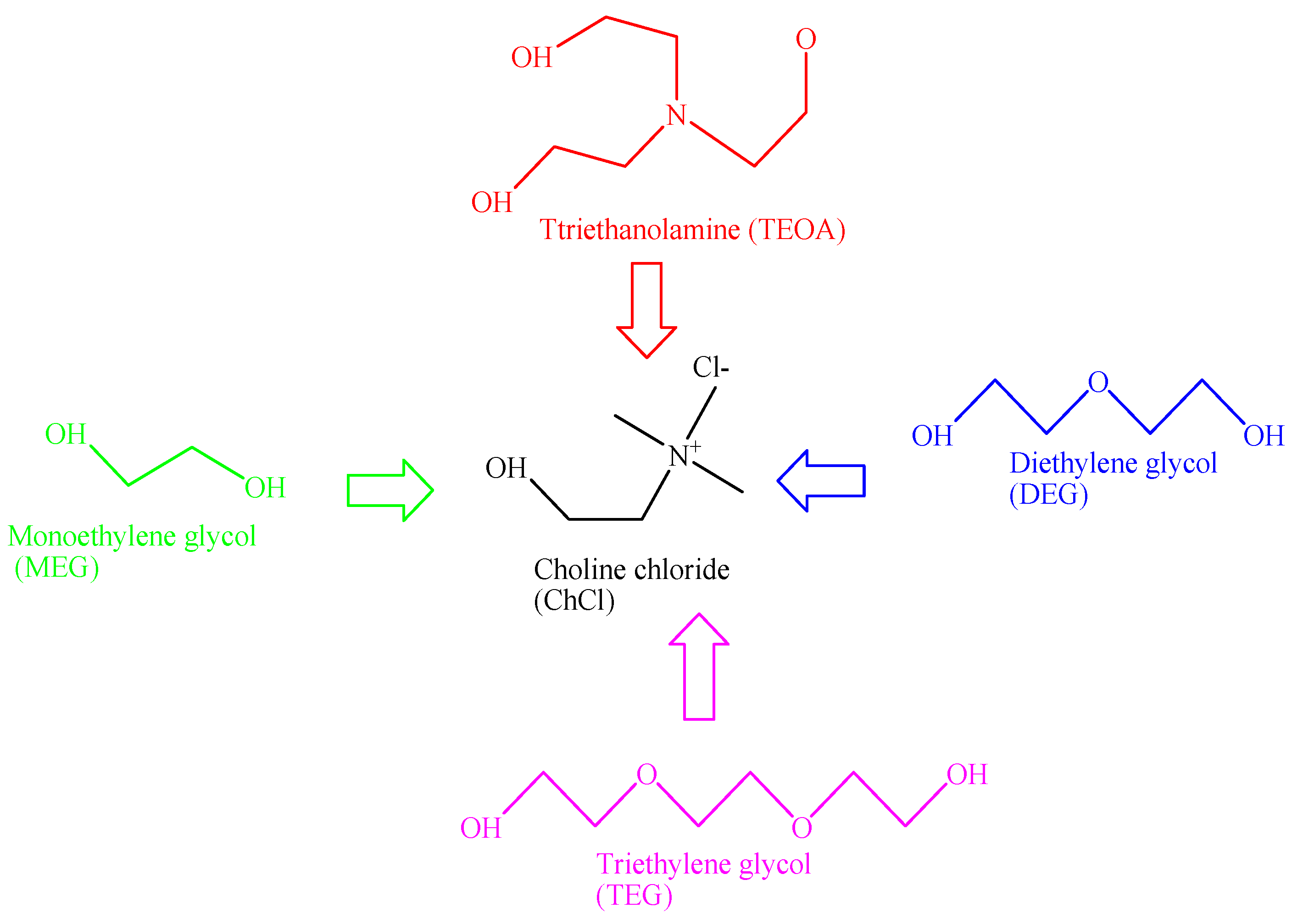
In the present work, we chose WHLs, which are sustainable, available in large quantities, grow rapidly in water, are inexpensive, and have a smooth surface as a substrate. Despite various researchers exploring the employment of WH holocellulose (cellulose + hemicellulose) for bioethanol production using harsh chemical pretreatment approaches (e.g., conventional alkali/acid use) [26,27,76], few studies have reported on the utilization of a greener method for the pretreatment of WHL biomass. Therefore, to devise a greener technique using MWI and TNDES, we investigated the use of hybrid MWI/TNDES for the pretreatment of WHL biomass (i.e., for degradation/delignification of WHL) as a greener method and further comprehended its performance on the enhancement of the TRS yield during the hydrolysis of hybrid MWI/TNDES pretreated WHL and bioethanol production [32,36,77,78]. We employed amine-based DES (i.e., triethanolamine (TEOA)), which has been rarely employed in the synthesis of NDESs [53]. ChCl as HBA, TEOA as amine-based HBD, and monoethylene glycol (MEG), diethylene glycol (DEG), or triethylene glycol (TEG) as polyol-based HBD components were employed for the synthesis of TNDESs. Thus, this study aimed to (i) formulate and screen three novel series of TNDESs of a three-component mixture of solvents, including ChCl-TEOA-MEG, ChCl-TEOA-DEG, and ChCl-TEOA-TEG (chemical structure for each component presented in Scheme 1 for the effective pretreatment of WHL biomass and compare their physical behaviors with those of their two-component mixture of solvents (ChCl-TEOA).
(ii) To evaluate the possible impacts of the hybrid MWI/TNDES pretreatment on WHL biomass disintegration. The effect of different chemical pretreatments on morphological, physical, thermal, and chemical changes was analyzed using a scanning electron microscope (SEM), thermogravimetric analysis (TGA), and Fourier transform infrared (FTIR) spectroscopy methods.
(iii) To harness H2SO4-catalyzed hydrolysis as a potential method to transform WHL cellulose into TRS following hybrid MWI/NDES pretreatment and optimize the effect of acid-catalyzed hydrolysis reaction parameters, including time, acid catalyst concentration, and temperature, by single-factor experiments (SFE) design approach from the pretreated WHL material for enhancing the TRS yield and contributing to the sustainable use of WHL.
(iv) Ultimately, the efficacy of WHL hydrolysis and bioethanol generation using the new combined approach was explored.
To the best of our knowledge, this is the first time that such a novel hybrid MWI/TNDES pretreatment of WHL holocellulose and subsequent optimization of the acid-catalyzed hydrolysis process using SFE for enhanced TRS production have been used in the present study.

2. Materials and Methods

2.1. Materials, Reagents, and Equipment

All the chemicals and reagents applied in this report were analytical-grade solvents and were employed as obtained without further purification. Chemicals, including monoethylene glycol (MEG) (purity 99.5%, Neo-Lab Life Science, India), diethylene glycol (DEG) (Sigma Aldrich, above 99%), choline chloride (ChCl) (≥98%, Sigma Aldrich), and triethanolamine (TEOA) (above 99%, Sigma Aldrich), were purchased and used for the formulation of NDESs for pretreatment of the WHLs to remove lignin and hemicellulose. H2SO4 (98%, England), sodium sulphite anhydrous purified (NaSO3, 97%, 110002, New Delhi, India), phenol (110092 Delhi, India), potassium sodium tartrate (Rochelle salt, 98%), 3,5-dinitrosalicylic acid (DNSA) (UNI-CHEM, A43930-3I), ethanol, and benzene were acquired from local suppliers or distributors. Sodium potassium tartrate (CAS 6381-59-5) and calcium carbonate (CaCO3) were procured from local suppliers in Addis Ababa, Ethiopia. Acetone was used for the determination of extractives (a non-structural component of biomass) of WHL.
Nutrients, including dextrose sugar, urea, magnesium sulfate heptahydrate (MgSO4·7H2O), and yeast extract, were procured from local suppliers in Ethiopia for fermentation media preparation.
Yeast Saccharomyces cerevisiae (S. cerevisiae) was used for fermentation. Potassium bromide (KBr) was acquired from Merck (India) and employed for the preparation of an FTIR spectroscopy standard. Distilled water was used for medium preparation in all of the experiments.
The milling machine (Fristch D-55743 Idar) was used to reduce the size of the dried WHL, and the powders were categorized by size using a sieve mesh of 2.0 mm (Sortmks-3332, PFEUFFR, Germany). A digital balance (model Sartorius with 0.01 mg sensitivity and model EP214C) was used to measure WHL biomass for pretreatment. MWI (MW1023-02D, Synix, China) and an autoclave (2340EA TUTINAUER) were employed for pretreatment and the hydrolysis process, respectively. The oven was used for drying during moisture content determination, and the muffle furnace (Nabertherm, GMH, Germany) was used as a high-heat-supplying unit during ash and volatile content determination. A centrifuge (SIGMA, 3-18KS) was used to separate the hydrolysate (liquid rich in reducing sugar) from the hydrolysis stage.

2.2. Sample Collection and Preparation

WHLs were acquired from Lake Tana, North West Ethiopia, as in our previous study [23]. The WHL samples were collected at three intervals in March, August, and December to study seasonal variation. These leaves were washed with distilled (DI) water many times after removing their stems and roots, and then air-dried for about 7 days. Subsequently, it was dried in hot air oven (binder, WTC, 78532, Tuttlingen, Germany) at 60 °C for 48 h until a constant weight was obtained, followed by milling using a grinder mill (AS PER IS: 460), and the powdered material was then passed through a 20-mesh size (1000 μm or 1 mm) to confirm uniform particle size, and finally, the crushed biomass was put in a sealed plastic bags at room temperature for further use [23,79]. The procedures for estimating the proximate analysis (including volatile matter, moisture, ash, and fixed carbon) and biochemical compositions (i.e., hemicellulose, cellulose, extractive, and lignin contents) are similar to those in our previous work [23]. The methods and instruments used to produce bioethanol from WHL were the same as in our previous report as well [23].

2.3. TNDES Preparation

In this study, three types of TNDES were prepared by combining three components: ChCl as HBA, an amine-based HBD (TEOA), and three polyol-based HBDs (MEG, DEG, TEG) (Table 1). Their skeletal chemical structures and corresponding acronyms are presented in Scheme 1. The important properties regarding the HBAs and HBDs utilized in the present work are summarized below: ChCl (2-hydroxy-N, N, N-trimethylethylammonium chloride) is a quaternary ammonium salt) with a MP of 302 °C (Scheme 1) [80]. EG or 1,2-ethanediol (monoethylene glycol, MEG) with a MP of −12.9 °C, is a toxic liquid, sweet-tasting, syrupy, colorless, odorless in its pure form [80]. Diethylene glycol (DEG), with a MP of −6.5 °C, is a clear, hygroscopic, viscous, colorless, and odorless liquid [81]. TEOA is a tertiary amine and has a MP of 0.5 °C. Similar to other amines, TEOA behaves like a weak base owing to lone electron pairs at the nitrogen (N) atom [80]. TEOA is a biodegradable substance, and ChCl, MEG, DEG, and TEG are usually considered low-toxic and safe. The mixing of TEOA (i.e., a biodegradable compound) with these substances allows the preparation of NDESs with a vast range of behaviors [82].
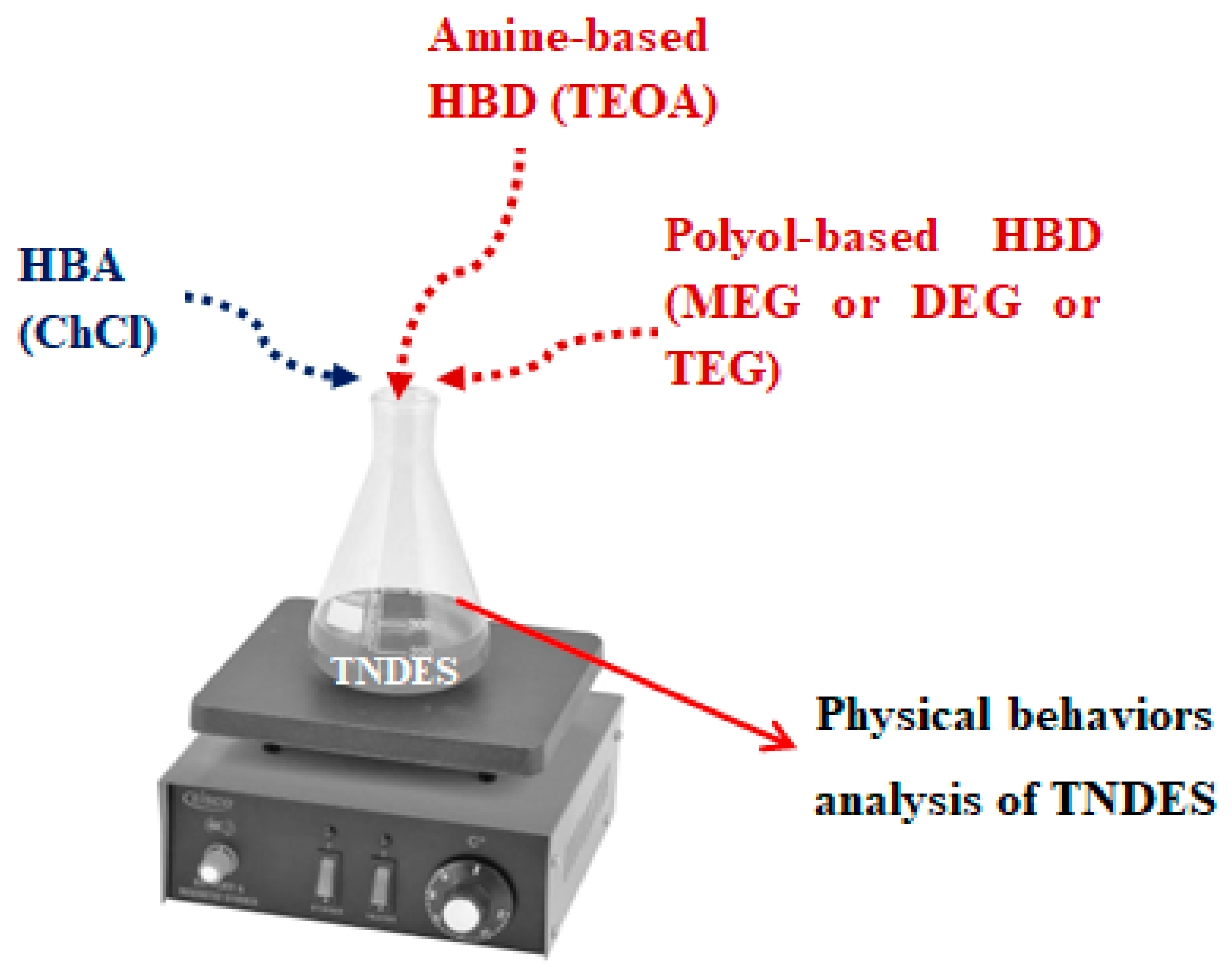
The preparation, formulation, and synthesis variables for each ChCl-based TNDES were modified from those in a previous study by Chen et al. [59] and Narayanan et al. [64] and our previous works, but for electrochemical studies as well [83,84,85,86]. A facile heating technique was used to synthesize TNDESs by combining 1ChCl salt with 2TEOA, which were then heated at 90 °C for 2 h under constant magnetic stirring at a rate of 100 rpm until clear, transparent, and homogeneous liquids were obtained, proving the successful formation of the NDES system. Then, 1% wt. of MEG, DEG or TEG was mixed into the 1ChCl-2TEOA mixture. The mixing/agitation continued for another 30 min, as presented in Figure 1. Colorless liquids were created with a ratio of 1ChCl-2TEOA to MEG, DEG or TEG of 1:3. A total of three DESs were prepared and termed/labelled as ChCl-TEOA-MEG, ChCl-TEOA-DEG, and ChCl-TEOA-TEG, as presented in Table 1. These eutectic mixtures were synthesized in a nitrogen atmosphere in a glovebox using a digital analytical balance, with known masses of each constituent compound measured into capped bottles, following the method reported elsewhere [87]. Following that, the formulated TNDESs were put at ambient temperature and, afterwards, allowed to cool down with ambient air. Ultimately, after synthesis and without further purification stages, the homogenized, cooled TNDES samples were kept in tightly closed vials and stored in a vacuum desiccator comprising silica gel to prevent moisture absorption for use in the pretreatment of WHL [64]. The physicochemical behaviors, including viscosity, pH, and density, of the synthesized TNDES were measured to elucidate their structural properties and potential applications [88]. These properties were measured using the protocol reported elsewhere [64]. Briefly, the pH of the TNDESs was evaluated employing a pH meter (Microprocessor pH/mv pHs-25CW) at 30 °C. The density of the prepared TNDES solution was determined by adding TNDES into a volumetric flask (5 mL) and measuring its weight using a weighing balance (China, model FA 2104) 70880 at 30 °C. The viscosity of the TNDES was determined using a rotational viscometer (Fungilab SA, Spain) at 30 °C [64].

Screening and Choosing of the TNDES

To identify the most efficient TNDES for WHL pretreatment, all three types of TNDES (as presented in Table 1) were screened and chosen by applying each one for the pretreatment of WHL under analogous variables/conditions, followed by acid-catalyzed hydrolysis/saccharification. The TNDEs that supported excellent lignin removal and increased the release of TRS from the main carbohydrates were further optimized by studying the influence of MWI power and MWI time on TRS yield. The cellulose-rich solid residue WHL obtained after the hybrid MWI/NDES pretreatment is the required intermediate substrate, which was further subjected to acidic saccharification to release glucose compounds for bioethanol synthesis.

2.4. Hybrid MWI/TNDES Pretreatment

In the pretreatment processes, the WHL samples and the respective TNDES were mixed in a 50 mL round-bottomed flask, and the mixture was agitated and stirred by employing a mechanical agitator to fully mix them.
For each TNDES pretreatment process experiment, 1 g of milled WHL sample and the respective TNDES solution were mixed in a 250-mL round-bottom flask with a solid loading of 10% (w/w), and the mixture was agitated employing a mechanical agitator to fully mix them [64]. Following that, the obtained mixture was subjected to MWI (MW1023-02D, Syinix, China) at optimized conditions of 6 min of MWI time, 300 W of MWI power, and a temperature of 90 °C. These experimental conditions were selected based on a few trial experiments that were optimized using the SFE approach, which offers information on the ranges of these pretreatment variables that exhibited substantial impacts (i.e., p < 0.05) [89] on the delignification of WHL biomass and increasing the release of cellulose. Afterward, the TNADES-treated samples were removed from the hot air oven and allowed to cool at ambient temperature to cease the reaction. Subsequently, the WHL pretreated solid and liquid (hydrolyte sample) were filtered under vacuum using Whatman filter paper [22,23,90]. After that, the sludges (WHL solid residues) were washed with distilled (DI) water until the solid residue turned colorless to eliminate any remaining TNDES [91,92] and were adjusted close to a neutral pH (i.e., a pH of 7). Meanwhile, the sludges (WHL solid residues) were dried at 50 °C (overnight for 24 h) in a hot air oven for subsequent ease of handling and to prevent any likely external contamination, and then kept in an airtight storage container for further structural characterization/composition analysis by FTIR, SEM, and TGA (Section 2.5) and following acid hydrolysis reaction process (Section 2.6), as described in detail ref. [23,32,90,91,93,94,95,96]. All experiments were conducted in triplicate to establish reliability, accuracy, and repeatability.

2.5. WHL Biomass Structural Characterization

The effect of various treatments on WHL biomass, including chemical, physical, and thermal characteristics, was analyzed by FTIR, SEM, and TGA analyses [97,98,99,100,101,102].

2.5.1. FTIR Analysis

FTIR analysis was performed to investigate the transformation in structural functional groups for both the untreated and TNDES-pretreated solid WHL biomass. The FTIR spectra analysis (FT/IR-6600, Japan) for the solid was carried out at a resolution of 4 cm −1, employing KBr, and was measured in the 400 to 4000 cm −1 absorption band mode. The spectral data were analyzed with the Spectrum 2.00 software [64,90,103,104].

2.5.2. SEM Analysis

Transformation in the surface morphology of native WHL biomass and the WHL after TNDES pretreatment was detected using SEM. The surface morphology images of both the pristine and TNDES-treated raw material were obtained by SEM (Inspect F50 model) [103,104].

2.5.3. TGA Analysis

It involves measuring the reduction of mass of a specimen with increasing temperature. The TGA was conducted by employing a BJHENVEN HCT-1 device. A specimen of 5 mg was put in 40 μL alumina crucibles and was heated from 30 to 650 °C at a rate of 10 °C/min [105].

2.6. Optimization and Statistical Design of Autoclave-Assisted Hydrolysis Conditions Using SFE

These experimental conditions were selected based on a few trial experiments that were optimized using the SFE approach, which offers information on the ranges of these pretreatment variables that exhibited substantial impacts (i.e., p < 0.05) [89] on the delignification of WHL biomass and increasing the release of cellulose.
As mentioned in ref. [89], the SFE design approach can offer information on the ranges of hydrolysis variables, revealing a substantial effect on the process (i.e., p < 0.05). Therefore, this work employed an SFE design method to explain the interaction effects between the factors and the response (observed variable) involved in the acid hydrolysis process. The factors involved in the hydrolysis process were hydrolysis time (30, 60, and 90 min), H2SO4 catalyst concentration (0.5, 1.25, and 2% (v/v)), and hydrolysis temperature (100, 115, and 130 °C), while the response was the TRS yield. Ultraviolet-Visible (UV-Vis) spectroscopy (Perkin Elmer, ultraviolet/visible spectrophotometer, Lambda35) was used to determine the concentration of TRS [23,106,107]. The protocol employed for TRS measurement and DNSA reagent preparation was analogous to our previous studies [23,107].

2.7. Fermentation Process

The TRS can be fermented to generate ethanol. Fermentation is a process based on the activities of microorganisms, primarily yeasts [69,108]. During this reaction, fermentable sugars are converted anaerobically to ethanol and carbon dioxide. With the rapid progress of synthetic biology engineering and the great demand for biofuels, S. cerevisiae is progressively applied in the production of biofuels because of its dominance/advantages [109]. S. cerevisiae generates ethanol with a higher yield (above 0.45 g/g) under optimal process variables. This organism also has excellent tolerance for ethanol; levels above 100 g/L have been reported for certain media and strains. Moreover, it is robust to other inhibitors and hence appropriate for the LCB substrate fermentation [69,110,111,112,113]. Therefore, for the bioethanol synthesis experiment, the fermentation was carried out using the liquid hydrolysate specimens obtained from H2SO4-catalyzed WHL-optimized hydrolysis as raw materials, neutralized by NaOH, using the procedures described elsewhere [23]. The synthesized bioethanol concentration for each specimen was measured through the UV-vis spectrophotometer employing the potassium dichromate approach described by Crowell et al. [114]. The concentration of bioethanol was then estimated according to the standard curve attained from employing absolute ethanol. The bioethanol yields found from spectrophotometric analysis were determined by Equation (1) [115].
Y i e l d % = B i o e t h a n o l   p r o d u c e d Δ S u g a r s ×   100

2.8. Physicochemical and Thermodynamic Behaviors of Synthesized Bioethanol

The procedures used to determine the viscosity, density, and purity were similar to our previous works [23,107]. Briefly, the viscosity of the bioethanol was evaluated, in accordance with D 88, using a rotational viscometer (Switzerland, Viscostar plus L). In contrast, the specific gravity was determined, as stated by the American Society for Testing and Materials (ASTM) D4052, using a hydrometer (Naruekrit R3-XIKQ-AD0G). The purity of bioethanol was determined using an alcohol meter (China; measures alcohol purity from 0–100% (v/v)). In addition, the calorific value, Reid vapor pressure (RVP), and the flash point were determined by following the procedures described in a previous work by Tadmourt et al. [69]. Briefly, the calorific value was determined, as stated by ASTM D240, using a calorimeter (Parr 6400), while RVP was measured following the standard ASTM D323 RVP using the Vapor Pressure Test R (Eralytics Eravap). The flash point was estimated based on ASTM D92.

2.9. FTIR Analyses of Synthesized Bioethanol by FTlR

The synthesized bioethanol was analysed by FTIR (FT/IR-6600, Japan) in the 400 cm−1 to 4000 cm−1 range of absorption band mode. It offers identification of functional groups like hydroxyl groups (-OH), aliphatic groups (-CH and -CH2), and carbonyl groups (C = O) [23,69,97,116].

3. Results

3.1. Characterization of Proximate and Biochemical Composition of WHL

The proximate analysis values of WHL and its respective biochemical variables obtained in this study are tabulated in Table 2 and Table 3, respectively. Here, each experimental measurement was meticulously performed in triplicate (based on a wet or dry basis (%, w/w)) to confirm accuracy, reliability, and repeatability, and the results were shown as means ± standard deviation (SD).
The initial moisture content of the WHL was determined to be 83.8 ± 0.9% w/w as described in Table 2. Sun drying of wet WHL biomass decreased the initial moisture content by ca. 80%, which further eliminated the remaining water to attain the dry WHL biomass (ca. 5.3 ± 0.4%, w/w, dry weight basis). Proximate values of the WHL biomass specimen are presented in Table 2. Table 2 shows that WHL contained 75.3 ± 1.4% w/w (dry weight basis) of volatile matter. The fixed carbon content was measured to be 9.8 ± 0.2%, whereas, as shown in Table 2, the ash content was found to be 15.2 ± 1.4%, w/w (dry weight basis).
The biochemical composition analysis of WHL biomass (Table 3) showed that the cellulose portion comprised 32.5 ± 1.4% w/w, and the hemicellulose fraction consisted of 43.2 ± 2.7, which accounted for a total of 75.7 ± 3.1% w/w holocellulose content (cellulose + hemicellulose. The lignin amount of the pristine WHL was determined to be 14.3 ± 0.5% w/w.

3.2. Physicochemical Behaviors of Synthesized TNDESs

In this work, three new three-component TNDESs, ChCl-TEOA-MEG, ChCl-TEOA-DEG, and ChCl-TEOA-TEG, were prepared by incorporating MEG, DEG, and TEG into binary ChCl-TEOA for the pretreatment of WHL. Table 4 portrays the behaviors of the prepared TNDESs, including pH, density, and viscosity of formulated TNDESs. As presented in Table 4, the lower values of density were recorded for the three TNDESs (i.e., ChCl-TEOA-MEG, ChCl-TEOA-DEG, and ChCl-TEOA-TEG) and compared with those of ChCl-2TEOA binary components. Similarly, the smaller viscosity values and higher pH values (Table 4) were determined for all three synthesized TNDESs (i.e., ChCl-TEOA-MEG, ChCl-TEOA-DEG, and ChCl-TEOA-TEG).

3.3. Chemical Composition of Pristine WHL and Hybrid MWI/TNDES Pretreated WHL

The contents of chemical structure composition, including cellulose, hemicellulose, and lignin content of the pristine (untreated) and hybrid MWI/TNDES-treated WHL, were determined in the present study (Table 4). The pristine WHL specimen employed in this study encompassed 32.5 ± 1.4% of cellulose, 43.2 ± 2.7% of hemicellulose, and 14.3 ± 0.5% of lignin.
In the present work, the WHL specimens were pretreated with a hybrid MWI/TNDES method using the three prepared TNDESs at the optimized conditions (MWI time of 6 min and MWI power of 300 W, a solid loading of 10% (w/w) corresponding to a specific energy of 10.8 MJ/kg), along with a temperature of 90 °C, which were obtained using the SFE method. As presented in Table 4, the TNDESs (ChCl-TEOA-MEG, ChCl-TEOA-DEG, and ChCl-TEOA-TEG) pretreatments were very efficient for lignin removal from WHL, with efficacy ranging from 80.4 ± 3.2–87.7 ± 3.8% (i.e., with strong basicity pH ranging from 9.8–9.9) compared with pretreatment using binary NDES (ChCl-TEOA) (77.6 ± 2.4%). The results demonstrated that the highest delignification efficacy, ca. 87.7%, was obtained by ChCl-TEOA-TEG treatment. Similarly, ChCl-TEOA-TEG pretreatment resulted in efficient removal of hemicellulose (Table 4). It removed 85.6% of the hemicellulose from WHL.
In addition, for all three effective TNDESs, cellulose loss during the hybrid MWI/TNDES pretreatment was negligible (less than 1%). As shown in Table 4, WHL pretreated by ChCl-TEOA-TEG resulted in the maximum cellulose amount (ca. 73.6 ± 2.4%). Nevertheless, the integrated cellulose, hemicellulose, and lignin contents were below 100% after the hybrid MWI/DES pretreatments of WHL (Table 4).

Effect of Acid-Catalyzed Hydrolysis on Reducing Sugar Conversion of WHL Substrate

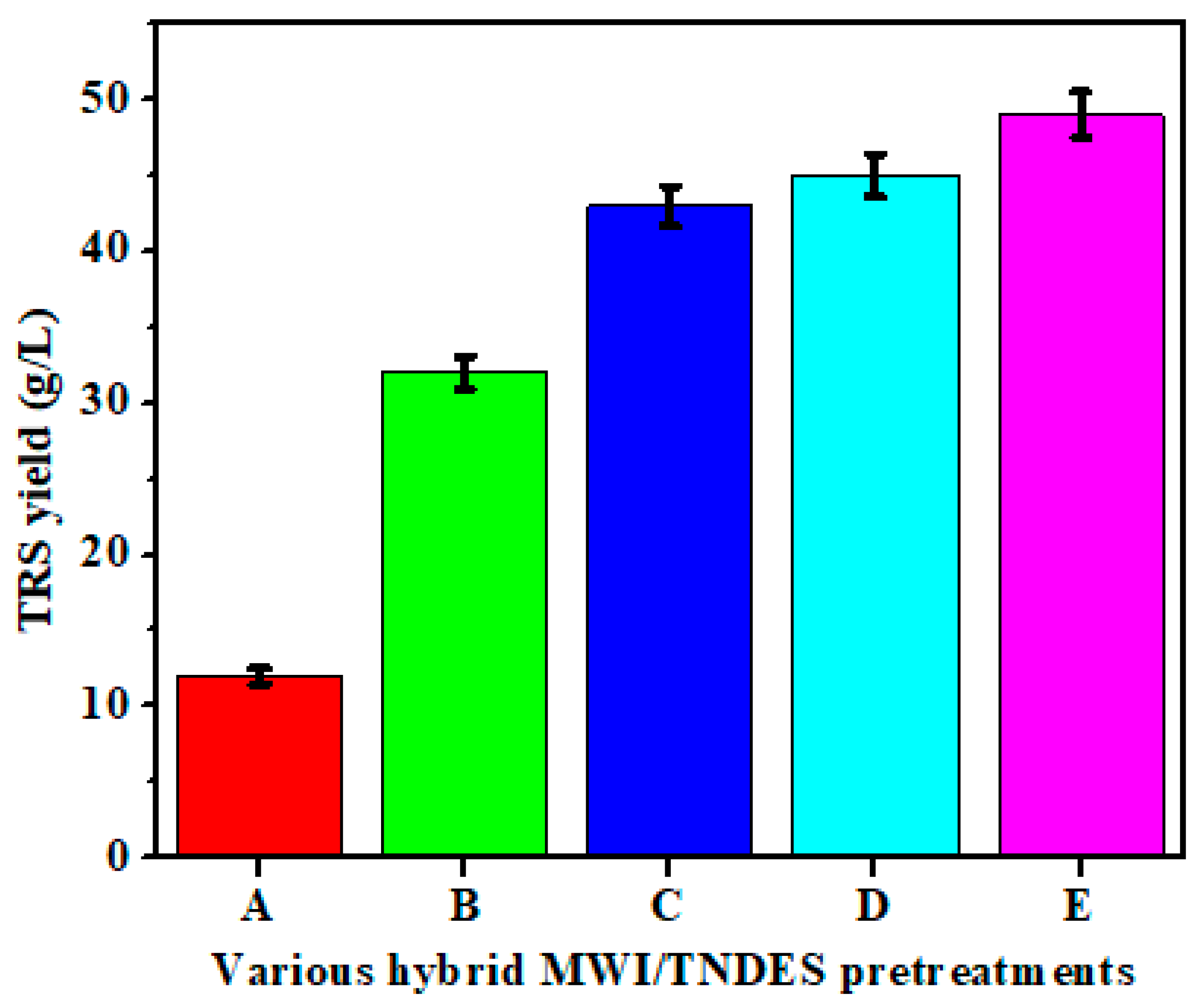
The SFE design approach was employed to optimize and investigate the effect of acid-catalyzed hydrolysis reaction parameters, including time (30–90 min), acid catalyst concentration (0.5–2%), and temperature (100–130 °C), on the hybrid MWI/TNDES pretreated WHL material to enhance the TRS yield. These maximum and minimum levels of independent parameters were selected based on values achieved in several trial tests. The optimal factors for TRS production by the acid-catalyzed hydrolysis process were hydrolysis time of 80 min, acid concentration of 1.3% v/v, and hydrolysis temperature of 130 °C. As presented in Figure 2, the optimized TRS for untreated WHL was estimated to be ca. 12 ± 0.5 g/L, whereas the TRS yields obtained for hybrid MWI and ChCl-TEOA, ChCl-TEOA-MEG, ChCl-TEOA-DEG, and ChCl-TEOA-TEG were ca. 32 ± 1.1, 43 ± 1.3, 45 ± 1.4, and 49 ± 1.5 g/L, respectively.

3.4. Spectroscopic and Morphological Structural Characterization

3.4.1. FTIR Analysis of WHL for Functional Group Identification

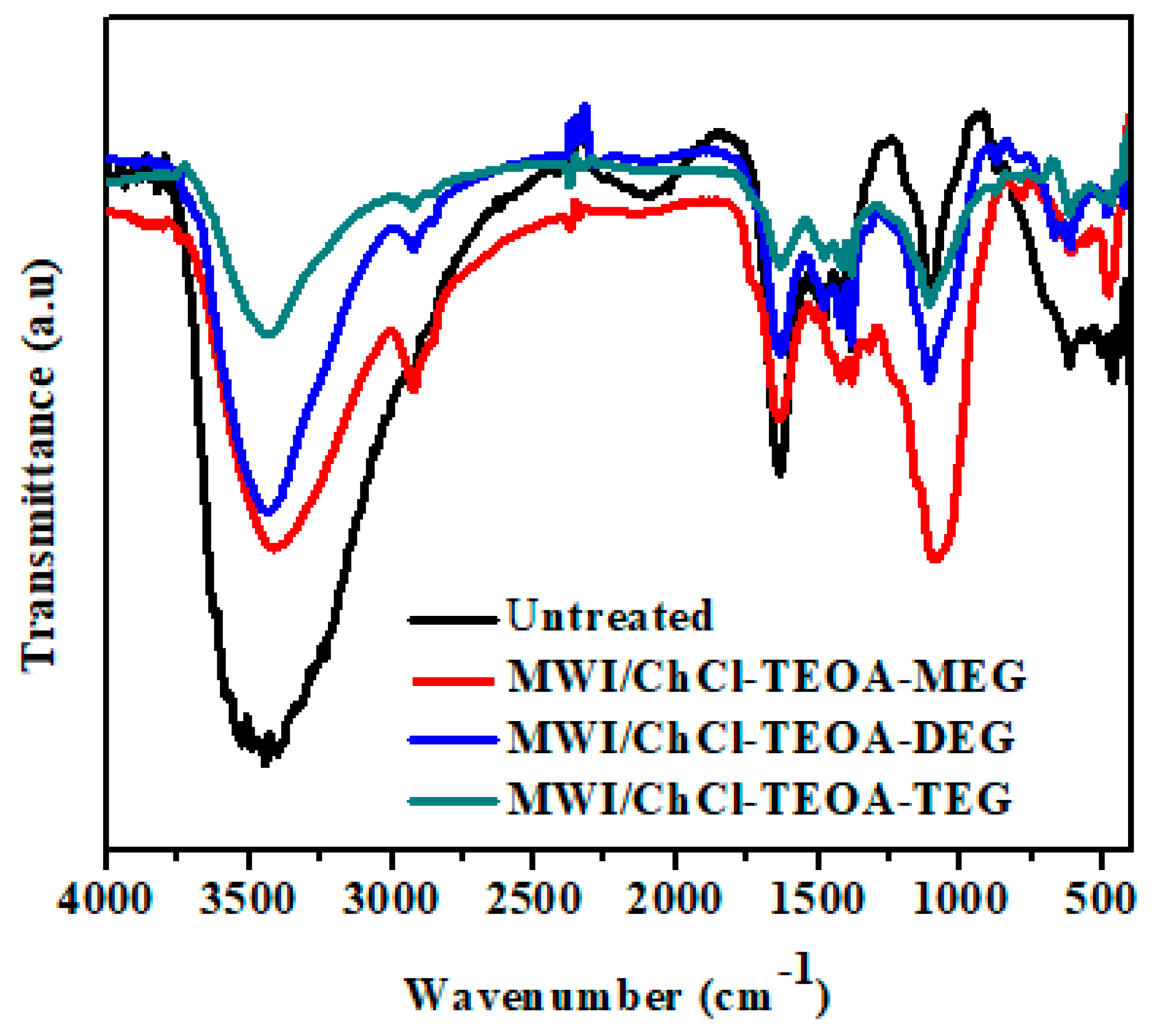
FTIR spectra revealed the structural differences between the untreated and hybrid MWI/TNDES-treated WHL (Figure 3). The functional group analysis was conducted according to the peaks (i.e., shape and intensity) obtained at different regions from 500 cm−1 to 4000 cm−1 and then compared between untreated WHL and hybrid MWI/TNDES-treated specimens (Figure 3). It was noticed that some of the positions of the bands were transformed, and no bands were present in the hybrid pretreated WHL due to combined MWI/TNDES treatment. The wide absorption band in the region ca. 3300 cm−1 to 3700 cm−1 was ascribed to the hydrogen bonds and O-H stretching, and the absorbance at ca. 3000 cm−1 was attributed to the C-H bonds in plane, which are the typical behaviors of cellulose. The absorbance peaks at ca. 1750 cm−1 are also ascribed to H-OH deformation vibrations of absorbed water. The band near ca. 1400 cm−1 may be ascribed to C-H bending in hemicellulose and cellulose. The absorbance at ca. 1100 cm−1 corresponds to C-C stretching, C-O stretching at C-6, and C-O stretching at C-3. The band peak at 1400 cm−1 was assigned to the ester linkage between hemicellulose and lignin. In addition, the band at ca. 1400 cm−1 was ascribed to the ether linkage among lignin and carbohydrates and was not observed in the pretreated specimen. Moreover, the absorbance peak at ca. 1500 cm−1 was ascribed to the C=C vibration stretching of the aromatic ring unit of lignin. The absorbance peak value of lignin spans from 1200 cm−1 to 1500 cm−1 and was significantly decreased in the pretreated specimens.

3.4.2. Surface Morphology Analysis by SEM

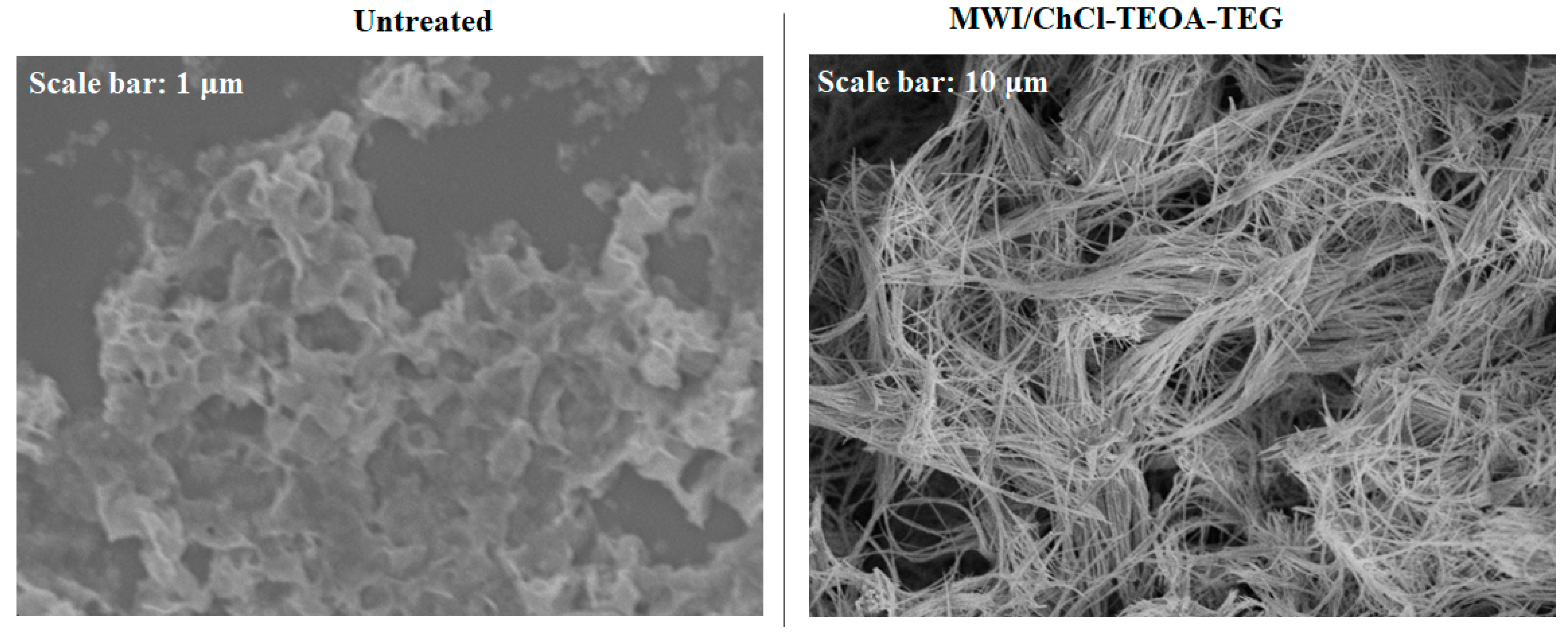
SEM analysis indicated noteworthy changes in surface morphology and structural alterations in the MWI/TNDES-treated specimen (Figure 4). As shown in Figure 4, a well-noticed alteration in the physical behaviors and microstructure of MWI/TNDES pretreated WHL was observed from imaging investigations. SEM graphs of pristine raw WHL indicated a smooth and intact surface (Figure 4, left side), while the hybrid MWI/TNDES-pretreated WHL indicated distortion and well-separated fibrils (Figure 4, right side). The present analysis missed quantitative SEM information, including particle size distribution and diameter variations.

3.4.3. TGA of the Biomass

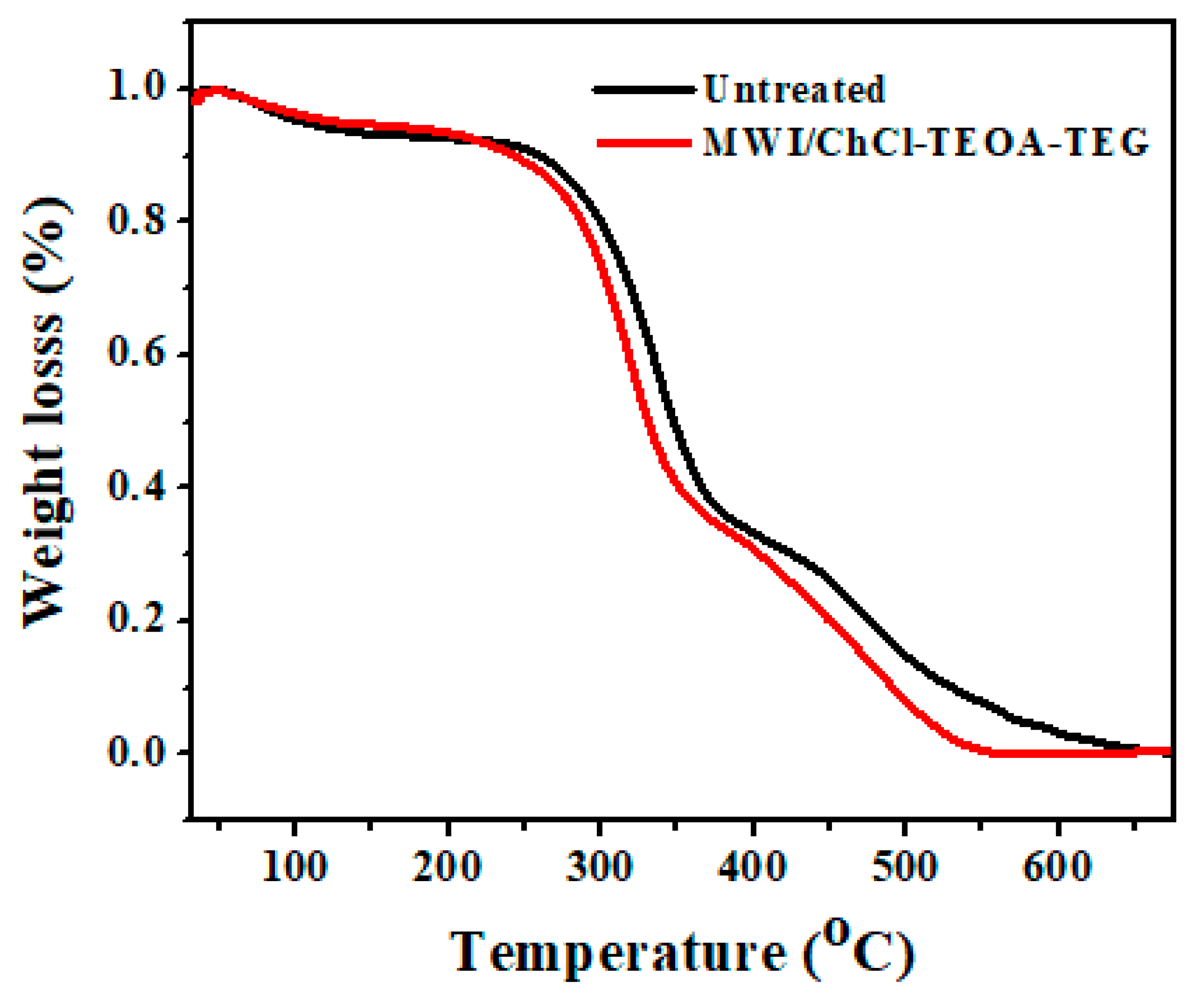
The weight loss curves of TGA profiles for the untreated and hybrid MWI/ChCl-TEOA-TEG pretreated WHL biomass are plotted in Figure 5. The thermal degradation profiles for pretreatment of biomass were divided into three temperature ranges that determine the thermal degradation of biomass. The first phase observed between ca. 30 and 165 °C features a small peak at ca. 50 °C for untreated and MWI/ChCl-TEOA-TEG pretreated WHL biomass. The second phase occurred between 165 °C and 450 °C, and the third phase spanned between 450 and 680 °C with larger mass loss. In addition, at ca. 120 °C, a minor rise in the peak was noticed after the hybrid MWI/ChCl-TEOA-TEG pretreatment, indicating no weight loss at that point. A solid residue remained undegraded at the final temperature limit of 680 °C.

3.5. Proposed Mechanisms for Hybrid MWI/TNDES Pretreated WHL to Increase Lignin and Hemicellulose Removal, and Cellulose Accessibility

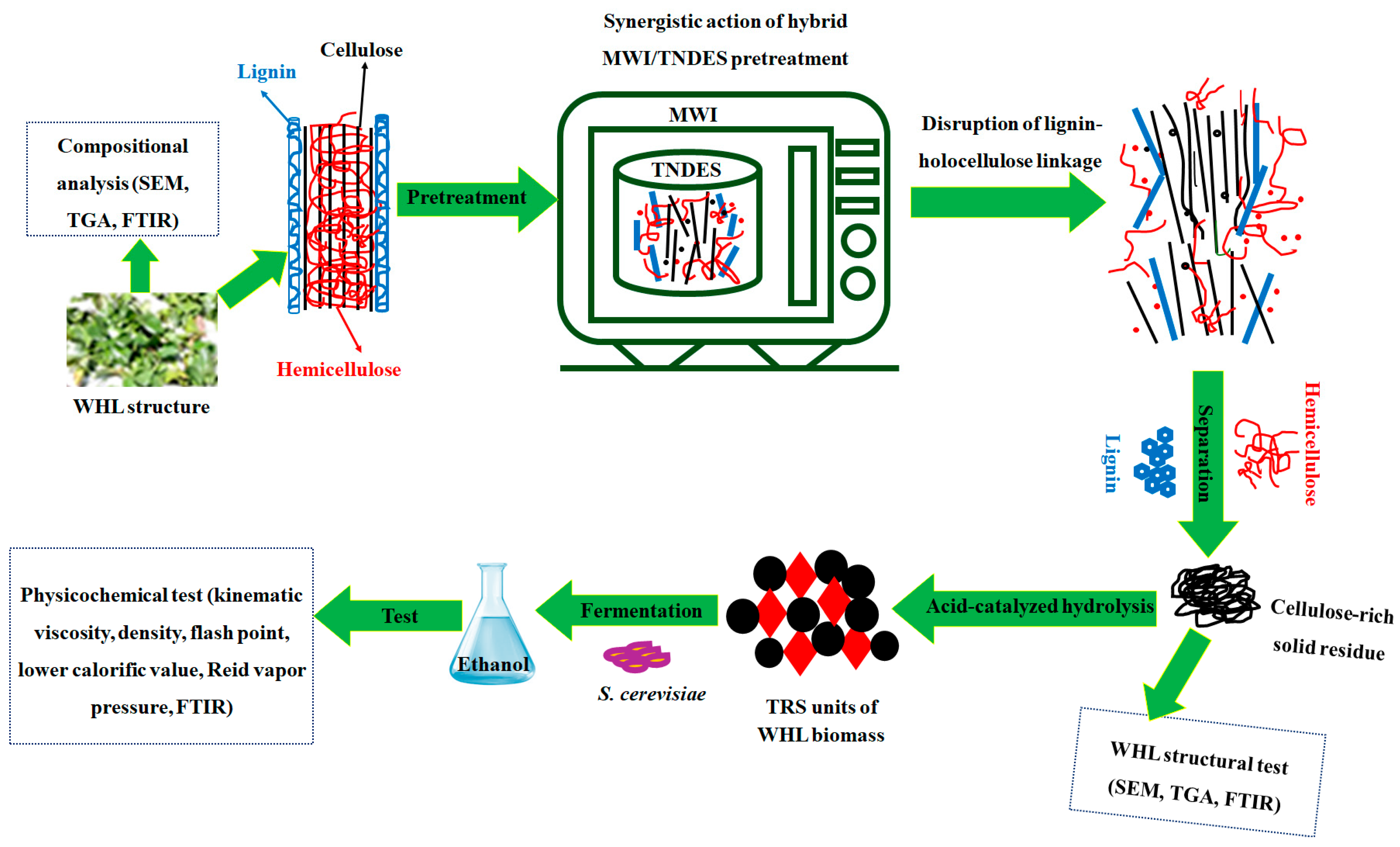
The overall synergistic process mechanism was proposed, which comprises a methodology employed in the present work during the hybrid MWI/NDES pretreatment of WHL biomass, subsequent H2SO4-catalyzed hydrolysis of pretreated WHL biomass, and the applied fermentation experiments using S. cerevisiae, as well as the multistage separation process route, as shown in the schematic diagram of Figure 6. Results from Table 4 and Figure 2 confirm that integrating MWI and TNDES (i.e., with lower solvent density (1–1.2 g/cm3), lower viscosity (198.4–205 mPa·s), and basic pH (9.8–9.9)) produces higher delignification, hemicellulose removal and TRS recovery.

3.6. Characterization of the Synthesized Bioethanol

Following H2SO4-catalyzed holocellulose hydrolysis of untreated, MWI/ChCl-TEOA, MWI/ChCl-TEOA-MEG, MWI/ChCl-TEOA-DEG, and MWI/ChCl-TEOA-TEG pretreated WHL at optimized variables (i.e., 80 min, 1.3% v/v acid concentration, and 130 °C), the resulting TRS yields (as plotted in Figure 2 above) were separately subjected to fermentation to bioethanol in shake flasks by S. cerevisiae.
The fermentation of TRS was first performed for 48, 72, and 96 h to determine the duration that yielded the fermentation broth with the maximum ethanol yield by volume. For instance, using MWI/ChCl-TEOA-TEG hydrolysate (Table 5), the optimized alcoholic fermentation time was estimated to be 72 h with 22.3 ± 0.7 g/L ethanol concentration in the fermentation broth (i.e., titer of 31.7 g/L ethanol), whereas the ethanol yields obtained at 48 and 96 h were 17.9 ± 0.5 and 19.6 ± 0.5 g/L, respectively. Table 5 shows the ethanol synthesized using the holocellulose hydrolysate (TRS) of acid-catalyzed hydrolysis for both untreated and hybrid MWI/TNDES pretreated WHL after 72 h of fermentation. Afterwards, the fermented liqueur was further purified and separated using a rotary evaporator after the fermentation process, resulting in ca. 94.1% v/v purity.
Table 6 illustrates the physicochemical and thermodynamic behaviors of the prepared ethanol from mixed hybrid MWI/TNDES pretreated WHL. The prepared bioethanol achieved 1.57 mm2/s, 0.83 g/cm3, 25.5 MJ/Kg, 19.5 kPa, and 18.3 °C of kinematic viscosity, density, lower calorific value, RVP, and flashpoint, respectively.

FTIR Analysis of Synthesized Bioethanol for Functional Group Identification

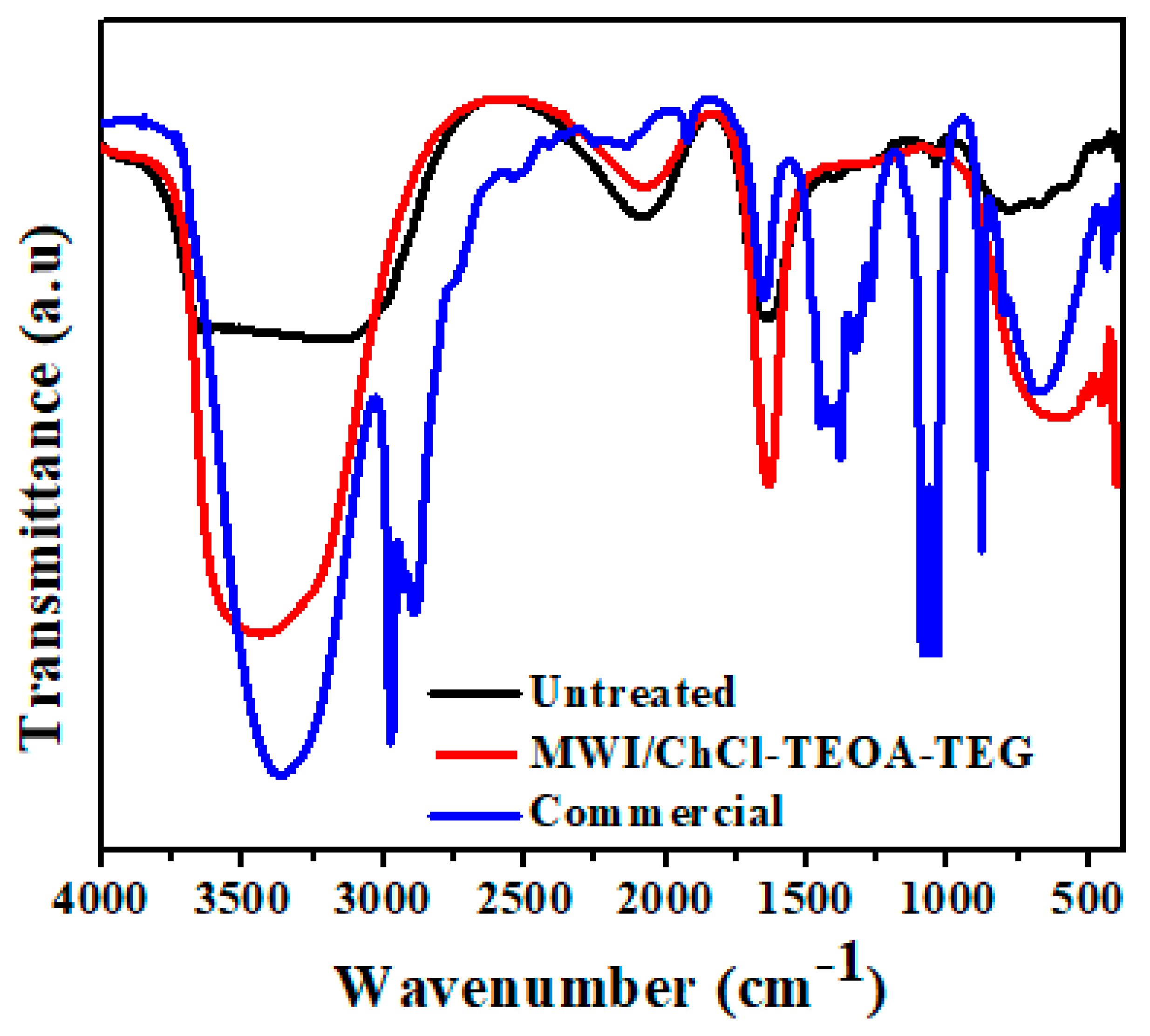
In this study, the synthesized bioethanol obtained before and after hybrid MWI/ChCl-TEOA-TEG pretreatment of WHL, as well as the respective commercial bioethanol, were characterized by FTIR analysis and are shown in Figure 7. The result verified that the wider band from 3300 cm−1 to 3600 cm−1 was assigned to OH stretching of alcohols, whereas the band in the regions between 2800–3000 cm−1 was ascribed to the C-H stretching vibration. The distinct peak measured at ca. 1631 cm−1 was attributed to the HOH bond bending vibration of water, while the minor peaks in the fingerprint regions between 1500 and 500 cm−1 were assigned to contaminants or impurities.

4. Discussion

4.1. Characterization of Raw Biomass and Physicochemical Properties of TNDESs

WHL is an example of LCB showing excessive initial moisture content, and this higher initial moisture indicates the requirement for pre-drying to extend its stability during storage and ease further processing [36]. This initial moisture result was analogous to previous results [23,36,125]. The proximate values of the WHL biomass specimen differed slightly from previous studies [23,36,117,118,123,126]. The higher volatile matter content of WHL illustrates that the WHL is rich in organic matter/compounds and confirms the capability of WHL being valorized constantly by the biological route, as verified by previous studies [36,117,127]. The lower fixed carbon content indicates that carbon emissions from this biomass are intrinsically lower. Shah and his team indicated that the low fixed carbon content of biomass makes it a better and highly reactive fuel [128]. This was due to the low carbon content, which makes biomass burn out faster. Ash content is affected by inorganic elements, which constitute a non-flammable portion of LCB and are derived from the mineral components of LCB. It is a characteristic test standard for solid fuels, which is the residue substances after LCB combustion. The measured ash content indicates a lower amount of inorganic matter, which is consistent with previous studies [23].
The biochemical composition analysis of WHL showed that the abundance of cellulose, hemicellulose, and lignin was in good agreement with the data reported by previous studies [15,28,119]. The presence of higher holocellulose content (cellulose + hemicellulose) components paved the way for using the WHL hydrolysate, which is richer in fermentable reducing sugars, in bioethanol production. Lignin components are cumbersome, and their higher lignin content hinders the hydrolysis/saccharification process. Hence, a feedstock with a lower lignin content is highly required for microbial bioconversions as it is capable of effective saccharification, which results in an increase in the recovery of TRS yields. Moreover, during saccharification, the low content of lignin reduces the creation of phenolic compounds and their derivatives and has a higher power of inhibiting microbial density (proliferation) [117,129,130]. Furthermore, the slight variation in the proximate and biochemical composition behaviors of WHL could be due to the difference in the chemical estimation approach used, the WHL cell wall maturing stage, season of harvest, and geographical location, such as water hyacinth density, climate, and water temperature [36,117,131]. In general, WHL is considered to be a promising LCB source of hemicellulose and cellulose for the transformation into vital products such as bioethanol. The comparative abundance of cellulose, hemicellulose, and lignin in WHL mainly depends on the source of the plant substrate [117,132].
NDESs are environmentally benign solvents, and owing to their involvement in LCB treatment, some behaviors, such as density, viscosity, and pH, were determined. It was demonstrated that the inclusion of a third component material into a binary (two-component) DES permits intentional control of density, viscosity, and pH, as a result enhancing the efficiency of WHL biomass delignification.
The efficacy of lignin removal/delignification of LCB by DES pretreatment is primarily impacted by the mass transfer rate of DES solvent to interact with LCB [64]. A lower value of DES density results in effective penetration of DES solvent into the matrix of natural LCB and causes effective delignification/lignin removal [64]. The smaller values of density recorded for the three synthesized were owing to the incorporation of polyol components (MEG, DEG, and TEG), which have lower values of density in comparison with that of salt (ChCl) and ChCl-2TEOA binary components, which can result in the disruption of the strong hydrogen-bond network and boost the free volume of TNDES components, yielding tinier overall density values for the TNDES mixture [133,134].
Similarly, the observed smaller viscosity values were due to the inclusion of the third component (MEG, DEG or TEG), which results in the disruption of the strongly/densely hydrogen-bonded structure created by the ChCl and TEOA (amine), yielding boosted fluidity and thereby reduced viscosity [133,135]. Additionally, the NDES solvent with a lower density has a smaller viscosity value and therefore offers boosted fluidity and decreased viscosity [47]. Furthermore, when DES mixture components are used, their basicity or acidity is indispensable, since these physicochemical properties are among the crucial factors that determine their functions in different fields. The basicity and acidity of HBA and HBD regulate the pH value of the DES mixtures. For instance, Abbott et al. discovered that the inclusion of chloride ions in the glycerol/chloride system reduces the acidity of DES mixtures and transforms the pH to a basic nature [136].
The higher pH values of the synthesized TNDESs resulted from the inclusion of TEOA (i.e., weak base amine HBD component) as a main constituent, which substantially transforms the DES mixture away from an acidic nature. In addition, the incorporation of polyol HBD component (MEG, or DEG, or TEG) provides slightly basic or neutral conditions and thereby complements the weak base nature of TEOA. Therefore, the strongly basic nature of the TNDES mixture (i.e., with higher pH values) can result in an outstanding ability to hydrolyze and selectively dissolve the hemicellulose and lignin content of WHL and preserve the polysaccharide (cellulose) fractions intact, thereby resulting in a higher delignification of WHL biomass [137].

4.2. Impact of Hybrid MWI/TNDES Pretreatment on WHL Biomass Chemical Composition

Pretreatment of LCB is an indispensable stage for effective delignification of LCB materials in the synthesis of biofuels and biochemicals from LCB [138]. DESs have been employed as a substitute for harsh chemicals (such as acid or alkali use) for the pretreatment of LCB (aiming at solubilizing lignin and increasing cellulose accessibility) with zero toxicity and lower inhibitory substance generation. They possess the merits of ionic liquids, and DES are simple to prepare, non-flammable, recyclable, non-toxic, affordable, have an ample liquid range, biodegradable, and low volatility [32,36,58,139]. NDESs display noteworthy efficacy in creating hydrogen bonds owing to their tuneable solvation behaviours, which occur from the synergistic effects of strong electron donors (e.g., choline chloride) and acceptors (e.g., acetic acid, glycerol, lactic acid, and urea) [58]. More importantly, biomass pretreatment with NDES did not release toxic inhibitory compounds, including hydroxymethylfurfural (HMF), furfural (FF), and acetic acid, harmful to cellulase enzymes [57,140]. Using the beneficial effects of NDESs, the hybrid MWI/TNDES assisted pretreatment of WHL was assessed for its performance in WHL biomass delignification and boosting cellulose digestibility in this study. The higher lignin amount in untreated WHL negatively impacts the synthesis of bioethanol, highlighting the necessity for WHL pretreatment for delignification and enhancement of LCB digestibility. Lignin components hinder/lower the saccharification process by creating steric hindrance to lignin, adsorption of non-productive cellulase onto lignin, and deactivating the cellulase. The biomass pretreatment can modify the lignin structure and result in the removal of lignin, which significantly impacts the chance of adsorption or binding of non-productive cellulase components onto lignin [64,141,142]. Since lignin is a principal base-soluble material (i.e., biopolymer) [137]; thereby, basic solvents are beneficial for its removal. It has also been demonstrated that the more powerful the basicity of the solvent, the more advantageous the lignin removal/extraction agent [137]. Under highly basic environments, the breakage of important ether linkages within lignin fractions and ester bonds between hemicellulose and lignin leads to the removal of lignin [137,143] and dissolution of lignin [144].
Using these concepts, three novel series of TNDESs of a three-component mixture of solvents, including ChCl-TEOA-MEG, ChCl-TEOA-DEG, and ChCl-TEOA-TEG with various pKaH values (basicities), were designed to boost the deconstruction and fractionation of WHL biomass through their low viscosity and enhanced solubility to promote acid-catalyzed hydrolysis in this study. The third component (i.e., MEG, DEG, or TEG) was added to binary ChCl-TEOA to investigate its impact on the rate of lignin removal and reducing sugar yields of WHL biomass. They were employed as HBD in TNDESs due to their abundant free hydroxyl groups. These hydroxyl groups inhabit hydrogen-bonding sites in LCB, reduce interactions among LCB constituents, and interact with the hydroxyl groups in lignin. This interaction can enable effective lignin and hemicellulose separation and boost accessibility of cellulose to acid-catalyzed hydrolysis [145]. Nevertheless, Kumar et al. showed that pretreatment with DES alone was ineffective, as it took ca. 12 h to eliminate >60% of the lignin [146]. To address this issue, MWI can be combined with TNDES to shorten the pretreatment time, thereby achieving a comparable or substantially higher degree of efficacy with the hybrid MWI/TNDES pretreatment compared with pretreatment employing TNDES alone [147]. Using the beneficial effects of MWI and TNDES, we employed hybrid MWI/TNDES pretreatment strategies to demonstrate the synergistic effects of hybrid MWI/TNDES pretreatment to facilitate delignification, increase cellulose release, and decrease the creation of toxic inhibitors during fermentation, which in turn enhances TRS in the subsequent acid-catalyzed hydrolysis process [117,148].
Here, optimization of the hybrid MWI/TNDES pretreatment of WHL was carried out using SFE for choosing the lower and upper limits of the design factors. Despite becoming time-consuming and having numerous demerits, such as a shortage of information on the interaction effects of the variables, SFE was able to provide fundamental information on the ranges of process parameters (factors) that showed significant impacts (i.e., p < 0.05) on the response [89]. In general, the efficiency of the hybrid MWI/TNDES pretreatment is influenced by various factors such as MWI time, solid loading, temperature, and MWI power, among others. The influence of hybrid MWI/TNDES pretreatment on WHL, such as MWI time and MWI power on the lignin and hemicellulose removal, has not yet been reported. Thus, the first stage of the trial experiment was to choose suitable conditions for efficient lignin and hemicellulose removal from WHL. In the present work, the upper and lower levels of the two design factors used in the SFE, including MWI power (300–1000 W) and MWI time (2–10 min) at a constant mixing ratio of 10% (w/v) and temperature of 90°, were determined. These lower and upper levels of independent factors were chosen based on values attained in trial experiments.
In general, these lower-limit (minimum value) and upper-limit (maximum value) variables found using SFE design for the hybrid MWI/TNDES pretreatment process can serve as fundamental information/data in the generation of a central composite design-response surface methodology (CCD-RSM) design to explore in further detail optimization of the hybrid MWI/TNDES pretreatment process variables.
Observations indicated that the efficiency of delignification of WHL treated with three ternary DESs (ChCl-TEOA-MEG, ChCl-TEOA-DEG, and ChCl-TEOA-TEG) was twice as large as that treated with binary ChCl-TEOA. These results were unsurprising to achieve higher lignin and hemicellulose removal efficacy, as the lignin fraction is a base-soluble material [137]. The explanation for the observed higher efficacy of lignin and hemicellulose removal could be the ether bond breakage between phenylpropane constituents in lignin fractions by TNDESs, which yields dissociation of lignin from the WHL LCB complex [149]. The cellulose loss (<1%) highlights the efficient selective elimination of non-cellulosic constituents over cellulose. As a result, the fraction of cellulose substantially increased after hybrid pretreatment. Nevertheless, the combined mass of cellulose, hemicellulose, and lignin contents <100% indicates the heterogeneity and complexity of the WHL composition. LCB contains not only lignin, hemicellulose, and cellulose but also other constituents. As these components comprise extractives, including different phenolic compounds, fats, tannins, resins, and waxes, which can be eliminated by employing solvents like water and various other solvents but not explicitly counted as cellulose and hemicellulose content coupled with lignin, the final summation remains below 100% [64,150]. In addition, proteins, which represent organic substances comprising nitrogen (N2), and ash, which denotes the inorganic substrate left after combustion, are also present in the LCB materials [64,90]. Other polysaccharides and pectins also contribute to the structure of LCB biomass. These constituents together contribute to the biomass mass; however, they are not quantified as lignin, hemicellulose, or cellulose in typical LCB compositional analyses, resulting in estimates <100% summation [64].
In general, the hybrid MWI/TNDES pretreatment solubilizes hemicellulose components of WHL, leaving a hybrid MWI/TNDES-pretreated solid rich in cellulose and lignin. The liquid part containing hemicellulose monomeric sugars can be further fermented to produce bioethanol or other value-added products [5,6,7]. Whereas the cellulose (i.e., solid residue part) can be hydrolyzed with superior yields compared with untreated (native) feedstocks, mostly owing to boosted accessibility (i.e., hemicellulose removal and lignin relocation) [72]. Therefore, the hybrid MWI/NADES-assisted biomass pretreatment could enable the separation of high-purity cellulose without generating degraded products, eliminate hemicellulose, and produce higher-quality lignin [57].
Digestibility of cellulose was another standard/criterion for LCB pretreatment. Therefore, the TRS yields of pretreated WHL biomass were evaluated by acid-catalyzed hydrolysis. H2SO4 is the most commonly used acid, compared with other acids such as nitric acid (HNO3) and HCl [151,152]. A main route by which numerous LC raw materials are processed is called hydrolysis, through which reducing sugars are released from the LC polysaccharides (i.e., hemicellulose and cellulose) [153,154]. This work investigated H2SO4-catalyzed hydrolysis as an effective approach for transforming the WHL cellulose component into glucose after hybrid MWI/TNDES-pretreatment. The SFE-optimized acid-catalyzed hydrolysis results indicated that WHL pretreated using hybrid MWI and ChCl-TEOA-MEG, ChCl-TEOA-DEG, and ChCl-TEOA-TEG resulted in significantly boosted cellulose digestibility (>85% TRS yields after acid hydrolysis, 4–5 times that of the pristine WHL and 1.5 times that of hybrid MWI/ChCl-TEOA-treated WHL). In addition, we found that, after MWI/DES pretreatment (i.e., hybrid pretreatment strategy) of WHL, the TRS was higher than the combined base/acid pretreatment of WH [23]. Thus, the hybrid MWI/TNDES pretreatment increases the TRS concentration in comparison with the TNDES pretreatment alone. The mechanism for these enlarged TRS yields can be due to the enlargement of the digestibility of the WHL biomass by synergistic effects of the hybrid MWI/DES pretreatment, ascribed to lignin relocation and/or removal and hemicellulose elimination, thereby offering excellent access of H2SO4 to the cellulose (solid portion) and resulting in higher TRS yields than the pristine (untreated) feedstock [72,147].
Therefore, the hybrid MWI/TNDESs designed in the present work facilitated rapid and facile pretreatment with excellent performance. The results and discussion presented demonstrate that efficient elimination of non-cellulosic components (lignin and hemicellulose) is crucial for making the cellulose fraction more hydrolysable, as higher hemicellulose and lignin contents in WHL can act as a barrier, hindering the access of cellulose, thereby negatively impacting the TRS release from WHL. Among the experimentally tested TNDESs, 1ChCl-1TEOA-1TEG TNDES demonstrated the most promising performance on the compositional transformation of WHL, and special consideration has to be given in optimizing H2SO4-catalyzed hydrolysis parameters using the CCD-RSM to maximize the release of TRS from main carbohydrates (cellulose-enriched residue) in pretreated WHL in future studies.

4.3. WHL Biomass Characterization

LCB characterization is a crucial stage to evaluate the efficacy of LCB for the sustainable and efficient creation of valued products. Here, the raw biomass and the hybrid MWI/TNDESW pretreated WHL biomass were further subjected to characterization employing FTIR, SEM, and TGA. It was noticed from the aforementioned methods that hybrid MWI/TNDES pretreated specimens resulted in delignification and a change in physicochemical behaviors of WHL [103].
The observed FTIR spectra indicated that the decrease in the absorbance peak at ca. 3300 cm−1 verified the presence of methyl and methylene groups in raw cellulose after the hybrid MWI/TNDES treatment, which underwent some cleavage by the hybrid pretreatment process. In addition, the disappearance of the band at ca. 1400 cm−1 in the pretreated specimen confirms the breakage of the ether linkage among lignin and carbohydrates, indicating the successful solubilization of the lignin component by the hybrid pretreatment process [103,104,155]. The absorbance peak value of lignin spans from 1200 cm−1 to 1500 cm−1 [103,104] and was significantly decreased in the pretreated specimens. This is strongly supported by the sharp decrease from 1200 cm−1 to 1500 cm−1, suggesting that hybrid MWI/TNDES pretreatment resulted in a substantial effect on the chemistry of WHL biomass. The lignin removal process results in a reduction of lignin aromatic skeletal vibration, which further diminishes the band absorbance [103,104]. Nevertheless, the current study did not incorporate FTIR spectral deconvolution of the signal, which is important for determining the degree of order and enabling both qualitative and quantitative determinations. This limitation is acknowledged, and FTIR spectral deconvolution will be included in future studies to offer a comprehensive characterization of the treated WHL biomass.
In this study, the SEM discussion focused on qualitative information on surface morphology and structure to support the effectiveness of the MWI/TNDES pretreatment. The smooth and intact surface of the untreated raw WHL indicated the existence of lignin coverage on the carbohydrate fibers. The formation of well-separated fibrils in the pretreated specimens confirms the solubilization of lignin by the hybrid MWI/TNDES solvent system, which helped in the effective digestion of WHL biomass. Plant cell wall disruption happens after the hybrid MWI/TNDES pretreatment, with a rise in the external surface area, thereby improving the structural accessibility of cellulose to the subsequent acid-catalyzed hydrolysis process. Therefore, SEM images indicate that hybrid MWI/TNDES pretreatment of the WHL surface morphology decreases the recalcitrant behavior of the WHL biomass by dissolving native cellulose fibers, thereby boosting the accessibility of cellulose to acid hydrolysis and enhancing the efficacy of hydrolysis. However, the present work did not incorporate quantitative information such as particle size distribution and diameter information in the SEM images of the untreated and hybrid MWI/TNDES treated samples, which is vital for determining the particle size distribution and diameter. This limitation is acknowledged, and the diameter of the obtained hybrid MWI/TNDES will be incorporated in future work to offer a complete morphological and structural characterization of the WHL biomass.
The three temperature ranges correspond directly to the thermal degradation of biomass after pretreatment of biomass [156]. Arif and colleagues [156] attributed the first phase to a characteristic dehydration stage that happened as moisture and volatile compounds were lost, as confirmed by a common peak at ca. 50 °C for untreated and pretreated WHL biomass. The second phase demonstrated devolatilization, in which the main compounds like proteins, lipids, and carbohydrates were broken down. Finally, the third phase showed the final disintegration of WHL biomass. Furthermore, we compared our findings with previous works [157] to analyze different aspects of context, such as at ca. 120 °C, a minor rise in the peak may be noticed after the hybrid MWI/ChCl-TEOA-TEG pretreatment, and thereby there was no weight loss, as the pretreatment substantially enhances the disintegration of the WHL biomass cell wall, resulting in the thermal expansion and transformation of biomolecular structures. This comparison confirmed that our study outcomes were similar to the findings of previous works reported elsewhere [157,158]. However, we observed that after the third phase, the leftover WHL biomass was contemplated as a solid residual that was not degraded within the temperature range from 30 to 680 °C.
The proposed mechanism shown above demonstrates the synergistic impacts of both MWI and TNDES (i.e., hybrid MWI/TNDES) on the removal of lignin and hemicellulose, leaving the cellulose fraction intact. This diagram can offer a reasonable clarification of the results of hybrid pretreatment obtained in the present study. When WHL was pretreated with hybrid MWI/TNDES, it separated the non-cellulosic components and made cellulose more accessible for acid hydrolysis, showing the strong screening impact of this hybrid pretreatment. The mechanism of increase in the amount of cellulose and decrease in the amount of hemicellulose and lignin after hybrid MWI/TNDES pretreatment could be due to the change in WHL conformation and structure, where the basic conditions that help in the partial hydrolysis and solubilization of both lignin and hemicellulose fractions, as well as the breakage of the α-ether bonds and ester linkages between the hemicellulose and lignin, leave the amount of cellulose intact [149,159]. In addition, the smaller viscosity yields higher solute diffusivity, and the higher solute diffusivity favors stronger mass transfer between TNDESs and WHL [137,160]. Therefore, both the viscosity and basicity of TNDES can impact their pretreatment rate. The smaller density of DESs and the destruction of the lignin and LCC intermolecular bonds also contribute to the maximum delignification of WHL [47,64,161,162]. Furthermore, MWI was verified to noticeably boost the efficacy of DES pretreatment in the hybrid MWI/DES pretreatment. The MWI yielded cleavage of WHL biomass substrates, typically via molecular collision due to dielectric polarization force by utilizing an electromagnetic field on the molecular compositions of heated WHL substrate [147,163]. Additionally, the MWI may maximize ionic behaviors and boost the DES solvent molecular polarity [162]. Hence, MWI resulted in significantly shortening the DES-mediated pretreatment time and a larger degree of efficacy [147], indicating the synergetic impacts of hybrid MWI/DES pretreatment on boosting delignification of WHL biomass. This mechanism is similar to previous studies on pretreatment of biomass by various approaches [47,64,147,161,162,163].
Overall, the results and discussion shown above demonstrate the efficiency of the pretreatment method to dissolve or disintegrate lignin and increase the release of TRSs from the main carbohydrates (holocellulose, i.e., cellulose + hemicellulose) contained in pretreated WHL through acid hydrolysis. The efficacy of pretreatment was also evaluated based on morphological and structural transformations in the pretreated WHL biomass.
The fermentation of ethanol was carried out with yeasts that had been tailored to the best possible fermentation conditions. S. cerevisiae has been the most commonly utilized microbe for the fermentation of sugar-rich feedstocks to produce bioethanol [109,164]. The decrease in bioethanol results measured at 96 h fermentation time reveals that extending fermentation time past the optimum time of 72 h results in exhaustion of TRS and decline of yeast cells within the shake flasks. The bioethanol yield obtained from WHL following hybrid MWI/TNDES pretreatment was higher than those reported in previous studies using conventional acid or base pretreatment of WH [28,119,120,165,166,167]; this suggests that the synergistic effect of hybrid MWI/TNDES pretreatment may enhance bioethanol yield compared with conventional acid and base pretreatments. The highest fermentation efficacy recorded in the present study indicated that acid-catalyzed hydrolysate can be fermented into bioethanol efficiently by S. cerevisiae.
The physicochemical and thermodynamic property observations indicated that the outcomes of these behaviors are comparable to those of the values of the previous investigations, but the composition of the substrate is not similar [23,69]. The slight variation in the physicochemical and thermodynamic properties of the synthesized bioethanol and commercial ethanol is due to the presence of residual volatile compounds and trace water within the distilled synthesized bioethanol. This is confirmed by the FTIR data, where the 1631 cm−1 HOH bending vibration and the 1500–500 cm−1 fingerprint lines show the presence of trace water and minor structural contaminants. Comparing the purity of bioethanol reveals an analogous yield to our previous work (95% (v/v) purity) [23].
The key functional groups that occur in bioethanol can be identified using FTIR analysis [23,116,167]. The functional groups in ethanol involve the carbon–hydrogen (C-H) bonds within the alkyl group and the hydroxyl group (-OH) that indicates alcohol behavior. FTIR spectra characteristically display peaks corresponding to these functional groups, which allows for quantitative and qualitative analysis. FTIR analysis includes a broad spectral range that typically ranges from 4000 cm−1 (mid-infrared) to 400 cm−1 (near-infrared region). The results demonstrated that the 1500–500 cm−1 fingerprint lines and 1631 cm−1 HOH bending vibration reveal the presence of minor structural contaminants and trace water, [23,116,167] resulting in a slight variation in the physicochemical and thermodynamic properties of the synthesized bioethanol and commercial ethanol, which could be due to the presence of residual volatile compounds and trace water within the distilled synthesized bioethanol.
Overall, our present study verified the synergistic effects of hybrid MWI/TNDES pretreatment for producing enhanced TRS yields for the potential synthesis of bioethanol from WHL biomass. Furthermore, the results and discussion presented above indicate that MWI and TNDES can be employed as substitutes for traditional heating and solvent, respectively, for efficient delignification of LCB and enrichment and recovery of cellulose, resulting in the production of a significant quantity of TRS, which will thereby be metabolized by S. cerevisiae to synthesize bioethanol [64,168]. In addition, the present work will offer insights into the more efficient transformation of WHL into TRS, enabling its utilization as a renewable resource. The findings show the potential of employing an eco-benign hybrid MWI/TNDES-based pretreatment and optimization of hydrolysis process conditions for reducing sugar and ethanol production from WHL holocellulose, showing the high potential of WHL as an indispensable substrate for reducing sugar and bioethanol production for the sustainable production of alternative fuel within the framework of green biorefinery and alleviating environmental problems encountered on Lake Tana (Ethiopia), as well as reducing the problems on aquatic life in the lake ecosystem.

5. Conclusions

This work has demonstrated the potential of WHL to be employed as a sustainable bioenergy feedstock for bioethanol production in industrial biorefineries. The research established effective and green solvent pre-treatment materials and methods (based on hybrid MWI/TNDES) for efficient removal of lignin and hemicellulose from WHL and for recovery of cellulose. It describes a hybrid MWI/TNDES system comprising ChCl, TEOA, and MEG, DEG or TEG for WHL pretreatment. The results show that hybrid MWI/TNDES (ChCl-TEOA-MEG, ChCl-TEOA-DEG, and ChCl-TEOA-TEG) pretreatments are highly efficient for lignin removal from WHL, with efficacy ranging from 80.4 ± 3.2 to 87.7 ± 3.8%, compared with hybrid MWI/binary NDES (ChCl-TEOA) pretreatment (75.6 ± 2.4%). The efficacy of the hybrid MWI/TNDES pretreatment was attributed to the effects of MWI on extracting biological materials and the lower viscosity, higher pH, and lower density associated with the TNDESs. These results indicate that WHL pretreated using hybrid MWI and ChCl-TEOA-MEG, ChCl-TEOA-DEG, and ChCl-TEOA-TEG results in significantly enhanced cellulose digestibility (4–5 times that of the pristine WHL and 1.5 times that of hybrid MWI/ChCl-TEOA treated WHL). The effect of MWI/TNDES pretreatment was supported by SEM images, and lignin and hemicellulose removal were clearly observed in the FTIR spectra. The lignin-rich material separated by the hybrid MWI/TNDES pretreatment was analyzed using TGA to determine the thermal behavior of the hybrid, pretreated WHL material. In our experimentation with hybrid MWI/TNDES, under optimum circumstances of MWI time of 6 min, MWI power of 300 W, and a temperature of 90 °C, the 43–49 g/L TRS yield was achieved by acid-catalyzed hydrolysis employing WHL substrate after being optimized by the SFE approach, while the optimized TRS for untreated WHL and hybrid MWI/binary ChCl-TEOA were estimated to be 12 g/L and 32 g/L, respectively. The hybrid MWI/ChCl-TEOA-TEG pretreated WHL after acid hydrolysis resulted in a high ethanol yield (ca. 22.3 g/L) by S. cerevisiae after 72 h of fermentation.
In general, the research underscores that WHL is a valuable substrate for further processing to create valuable bioproducts. These results, coupled with the synergistic effects of hybrid MWI/TNDES pretreatment for improving TRS for bioethanol synthesis from WHL, indicate a high potential of TNDES and MWI as promising alternatives to conventional organic solvents and heating, respectively, for the synthesis of biofuel (e.g., bioethanol) from LCB. In addition, the research contributes to the development of environmentally friendly and cost-effective processes for WHL biomass conversion, providing strong evidence for its potential as a method for managing WHL infestations while generating useful products. Future studies should focus on further enhancing the efficacy of the acid-catalyzed hydrolysis processes and assessing the scalability of the technology for future industrial applications.

Author Contributions

T.A.Y.: Designed the experiments (conceptualization), analyzed the data, supervised, wrote the original draft, edited, and reviewed the paper; N.G.H. and Z.B.S.: supervised, edited, and reviewed the paper; A.A.A., K.A.M., T.M., A.M., M.K.T., H.J.K., F.A.G., E.T. and I.M.I.: Designed the experiments, collected and analyzed the data, and edited; Y.Z. and M.D.C.: edited and reviewed the paper; T.A.W., M.K.A., T.A.D., A.A., A.M.A. and B.T.: Reviewed the paper. All authors have read and agreed to the published version of the manuscript.

Funding

This research did not receive any specific grant from funding agencies in the public, commercial, or non-profit sectors.

Institutional Review Board Statement

Not applicable.

Informed Consent Statement

Not applicable.

Data Availability Statement

The original contributions presented in this study are included in the article. Further inquiries can be directed to the corresponding authors.

Acknowledgments

The authors would like to acknowledge the Bahir Dar Institute of Technology, Bahir Dar University, for the startup fund and laboratory facilities.

Conflicts of Interest

The authors declare no conflicts of interest.

Abbreviations

The following abbreviations are used in this paper:
ASTMAmerican Society for Testing and Materials
CaCO3Calcium carbonate
CCD-RSMCentral composite design-response surface methodology
ChClCholine chloride
DEGDiethylene glycol
DIDistilled water
DNSA3,5-dinitrosalicylic acid
EGEthylene glycol
FFFurfural
FTIRFourier transform infrared spectroscopy
GHGuanidine hydrochloride
HBAHydrogen bond acceptors
HBDHydrogen bond donors
HClHydrochloric acid
HMFHydroxymethylfurfural
HNO3Nitric acid
HrsHours
H2SO4Sulfuric acid
KBrPotassium bromide
LCBLignocellulosic biomass
LCCsLignin–carbohydrate complexes
μLMicroliter
MEGMonoethylene glycol
MgSO4·7H2OMagnesium sulfate heptahydrate
mLMilliliter
MPMelting point
MWIMicrowave irradiation
NaSO3Sodium sulphite anhydrous
NDESsNatural deep eutectic solvents
N2Nitrogen
PTSAp-toluenesulfonic acid
RVPReid vapor pressure
SDStandard deviation
SEMScanning electron microscope
SFESingle-factor experiments
TEGTriethylene glycol
S. cerevisiaeSaccharomyces cerevisiae
TEOATriethanolamine
TGAThermogravimetric analysis
TNDESTernary Natural deep eutectic solvents
TRSTotal reducing sugar
UV-VisUltraviolet-visible spectrophotometry
WHWater hyacinth
WHLWater hyacinth leaves

References

  1. Ang, T.-Z.; Salem, M.; Kamarol, M.; Das, H.S.; Nazari, M.A.; Prabaharan, N. A comprehensive study of renewable energy sources: Classifications, challenges and suggestions. Energy Strategy Rev. 2022, 43, 100939. [Google Scholar] [CrossRef] [Scilit]
  2. Tessema, T.D.; Yemata, T.A. Power production using a batch double-chamber microbial fuel cell from brewery wastewater: Effects of electron acceptors. Int. J. Energy Res. 2022, 46, 19698–19709. [Google Scholar] [CrossRef] [Scilit]
  3. Falcone, P.M. Sustainable Energy Policies in Developing Countries: A Review of Challenges and Opportunities. Energies 2023, 16, 6682. [Google Scholar] [CrossRef] [Scilit]
  4. Jayabal, R. Towards a carbon-free society: Innovations in green energy for a sustainable future. Results Eng. 2024, 24, 103121. [Google Scholar] [CrossRef] [Scilit]
  5. Tessema, T.D.; Yemata, T.A. Experimental dataset on the effect of electron acceptors in energy generation from brewery wastewater via a microbial fuel cell. Data Brief 2021, 37, 107272. [Google Scholar] [CrossRef] [Scilit] [PubMed]
  6. Yemata, T.A.; Tadsual, M.K.; Habtu, N.G.; Chanyalew, M.D.; Teffera, B.; Sendekie, Z.B.; Shibesh, A.K. Recent advances in waste to wealth valorization of wastewater resources for sustainable creation of value-added products. Int. J. Environ. Sci. Technol. 2026, 23, 464. [Google Scholar] [CrossRef] [Scilit]
  7. Kaushik, V.; Kataria, R. Non-conventional strategies for pretreatment of lignocellulosic biomass for production of value-added products: A sustainable and circular economy approach. Biomass Convers. Biorefin. 2025, 15, 14697–14727. [Google Scholar] [CrossRef] [Scilit]
  8. Woźniak, A.; Kuligowski, K.; Świerczek, L.; Cenian, A. Review of Lignocellulosic Biomass Pretreatment Using Physical, Thermal and Chemical Methods for Higher Yields in Bioethanol Production. Sustainability 2025, 17, 287. [Google Scholar] [CrossRef] [Scilit]
  9. Kululo, W.W.; Habtu, N.G.; Abera, M.K.; Sendekie, Z.B.; Fanta, S.W.; Yemata, T.A. Recent Advances in Biochemical, Thermochemical, and Hybrid Conversion Approaches for Biofuel Production from Lignocellulosic Biomass: A Review. In Sustainable Development Research in Materials and Renewable Energy Engineering: Advancements of Science and Technology; Getie, M.Z., Mequanint, K., Alemu, M.A., Ashebir, G.Y., Tigabu, M.T., Eds.; Springer Nature: Cham, Switzerland, 2025; pp. 297–330. [Google Scholar]
  10. Atnafu, T. Optimization of Acid Hydrolysis in Ethanol Production from Prosopis juliflora. Am. J. Energy Eng. 2014, 2, 127–132. [Google Scholar] [CrossRef] [Scilit]
  11. Jain, S.; Kumar, S. Advancing bioethanol: Exploring feedstock diversity, production pathways, and environmental implications. RSC Sustain. 2026, 4, 1129–1159. [Google Scholar] [CrossRef] [Scilit]
  12. Mwanyesya, O.P.; Mtashobya, L.A.; Emmanuel, J.K. Value addition on bioethanol produced from different feedstocks: A review of recent outlook. Discov. Appl. Sci. 2025, 7, 1449. [Google Scholar] [CrossRef] [Scilit]
  13. Nandiyanto, A.B.D.; Ragadhita, R.; Hofifah, S.N.; Al Husaeni, D.F.; Al Husaeni, D.N.; Fiandini, M.; Luckiardi, S.; Soegoto, E.S.; Darmawan, A.; Aziz, M. Progress in the utilization of water hyacinth as effective biomass material. Environ. Dev. Sustain. 2024, 26, 24521–24568. [Google Scholar] [CrossRef] [Scilit]
  14. Enyew, B.G.; Assefa, W.W.; Gezie, A. Socioeconomic effects of water hyacinth (Echhornia crassipes) in lake tana, north western ethiopia. PLoS ONE 2020, 15, e0237668. [Google Scholar] [CrossRef] [Scilit] [PubMed]
  15. Zhang, Q.; Wei, Y.; Han, H.; Weng, C. Enhancing bioethanol production from water hyacinth by new combined pretreatment methods. Bioresour. Technol. 2018, 251, 358–363. [Google Scholar] [CrossRef] [Scilit] [PubMed]
  16. Bajpai, S.; Nemade, P.R. An integrated biorefinery approach for the valorization of water hyacinth towards circular bioeconomy: A review. Environ. Sci. Pollut. Res. 2023, 30, 39494–39536. [Google Scholar] [CrossRef] [Scilit] [PubMed]
  17. Gaurav, G.K.; Mehmood, T.; Cheng, L.; Klemeš, J.J.; Shrivastava, D.K. Water hyacinth as a biomass: A review. J. Clean. Prod. 2020, 277, 122214. [Google Scholar] [CrossRef] [Scilit]
  18. Arivendan, A.; Jebas Thangiah, W.J.; Irulappasamy, S.; N Chrish, B. Study on characterization of water hyacinth (Eichhornia crassipes) novel natural fiber as reinforcement with epoxy polymer matrix material for lightweight applications. J. Ind. Text. 2022, 51, 8157S–8174S. [Google Scholar] [CrossRef] [Scilit]
  19. Amalina, F.; Abd Razak, A.S.; Krishnan, S.; Zularisam, A.W.; Nasrullah, M. Water hyacinth (Eichhornia crassipes) for organic contaminants removal in water—A review. J. Hazard. Mater. Adv. 2022, 7, 100092. [Google Scholar] [CrossRef] [Scilit]
  20. Gebrehiwot, H.; Dekebo, A.; Annisa, M.E. Chemical composition, pharmacological activities and biofuel production of Eichhornia crassipes (Water hyacinth): A review. J. Turk. Chem. Soc. Sect. A Chem. 2022, 9, 849–866. [Google Scholar]
  21. Madhumidha, M.; Benish Rose, P.M.; Nagabalaji, V.; Das, I.; Srinivasan, S.V. Critical assessment of biorefinery approaches for efficient management and resource recovery from water hyacinths for sustainable utilization. Rev. Environ. Sci. Bio/Technol. 2024, 23, 443–469. [Google Scholar] [CrossRef] [Scilit]
  22. Krishnan, S.; Ahmad, M.F.; Zainuddin, N.A.; Din, M.F.M.; Rezania, S.; Chelliapan, S.; Taib, S.M.; Nasrullah, M.; Wahid, Z.A. Bioethanol production from lignocellulosic biomass (Water hyacinth): A biofuel alternative. In Bioreactors; Elsevier: Amsterdam, The Netherlands, 2020; pp. 123–143. [Google Scholar]
  23. Aragaw, S.A.; Yemata, T.A.; Ayalew, A.A.; Tadesse, A.A.; Fekad, A.Y.; Shibesh, A.K.; Getie, F.A.; Tessema, T.D.; Wubieneh, T.A. Improvement of bioethanol production from water hyacinth biomass by optimization of fermentation process conditions using response surface methodology. Discov. Appl. Sci. 2025, 7, 266. [Google Scholar] [CrossRef] [Scilit]
  24. Abeysuriya, D.I.; Sethunga, G.; Rathnayake, M. Process simulation–based scenario analysis of scaled-up bioethanol production from water hyacinth. Biomass Convers. Biorefin. 2024, 14, 17677–17692. [Google Scholar] [CrossRef] [Scilit] [PubMed]
  25. Ilo, O.P.; Simatele, M.D.; Nkomo, S.L.; Mkhize, N.M.; Prabhu, N.G. The benefits of water hyacinth (Eichhornia crassipes) for Southern Africa: A review. Sustainability 2020, 12, 9222. [Google Scholar] [CrossRef] [Scilit]
  26. Pandey, R.; Pal, P.; Zhang, D.; Pant, G.; Harvey, A.P.; Kushwaha, A.; Goswami, S.J.B.-B.M.; Generation, W.f.E.; Management, R. Recent advancements in treatment technologies for lignocellulosic fermentation of water hyacinth. In Bio-Based Materials and Waste for Energy Generation and Resource Management; Elsevier: Amsterdam, The Netherlands, 2023; pp. 281–297. [Google Scholar] [CrossRef] [Scilit]
  27. Gong, L.; Wu, X.; Wang, Y.; Zhu, J.; Wang, S.; Xiu, Y.; Dong, J.; Xu, G.; Ni, Y. A novel deep eutectic solvent–mediated Fenton-like system for pretreatment of water hyacinth and biobutanol production. Biomass Convers. Biorefin. 2024, 14, 8341–8351. [Google Scholar] [CrossRef] [Scilit]
  28. Das, S.P.; Gupta, A.; Das, D.; Goyal, A. Enhanced bioethanol production from water hyacinth (Eichhornia crassipes) by statistical optimization of fermentation process parameters using Taguchi orthogonal array design. Int. Biodeterior. Biodegrad. 2016, 109, 174–184. [Google Scholar] [CrossRef] [Scilit]
  29. Zhang, Q.; Huang, H.; Han, H.; Qiu, Z.; Achal, V. Stimulatory effect of in-situ detoxification on bioethanol production by rice straw. Energy 2017, 135, 32–39. [Google Scholar] [CrossRef] [Scilit]
  30. Kucharska, K.; Rybarczyk, P.; Hołowacz, I.; Łukajtis, R.; Glinka, M.; Kamiński, M. Pretreatment of lignocellulosic materials as substrates for fermentation processes. Molecules 2018, 23, 2937. [Google Scholar] [CrossRef] [Scilit] [PubMed]
  31. Beluhan, S.; Mihajlovski, K.; Šantek, B.; Ivančić Šantek, M. The production of bioethanol from lignocellulosic biomass: Pretreatment methods, fermentation, and downstream processing. Energies 2023, 16, 7003. [Google Scholar] [CrossRef] [Scilit]
  32. Cañadas, R.; Duque, A.; Bahíllo, A.; Iglesias, R.; Manzanares, P. Pretreatment of vine shoot biomass by choline chloride-based deep eutectic solvents to promote biomass fractionation and enhance sugar production. Bioengineering 2024, 11, 935. [Google Scholar] [CrossRef] [Scilit] [PubMed]
  33. Yiin, C.L.; Yap, K.L.; Ku, A.Z.E.; Chin, B.L.F.; Lock, S.S.M.; Cheah, K.W.; Loy, A.C.M.; Chan, Y.H. Recent advances in green solvents for lignocellulosic biomass pretreatment: Potential of choline chloride (ChCl) based solvents. Bioresour. Technol. 2021, 333, 125195. [Google Scholar] [CrossRef] [Scilit] [PubMed]
  34. Huang, C.; Li, R.; Tang, W.; Zheng, Y.; Meng, X. Improve enzymatic hydrolysis of lignocellulosic biomass by modifying lignin structure via sulfite pretreatment and using lignin blockers. Fermentation 2022, 8, 558. [Google Scholar] [CrossRef] [Scilit]
  35. Kululo, W.W.; Habtu, N.G.; Abera, M.K.; Sendekie, Z.B.; Fanta, S.W.; Yemata, T.A. Advances in various pretreatment strategies of lignocellulosic substrates for the production of bioethanol: A comprehensive review. Discov. Appl. Sci. 2025, 7, 476. [Google Scholar] [CrossRef] [Scilit]
  36. Umai, R.D.; Jacob, S.; Kumar, V. Deep eutectic solvent pretreatment of water hyacinth for improved holocellulosic saccharification and fermentative co-production of xylitol and lipids using Rhodosporidium toruloides NCIM 3547. Fermentation 2022, 8, 591. [Google Scholar] [CrossRef] [Scilit]
  37. Wang, W.; Lee, D.-J. Lignocellulosic biomass pretreatment by deep eutectic solvents on lignin extraction and saccharification enhancement: A review. Bioresour. Technol. 2021, 339, 125587. [Google Scholar] [CrossRef] [Scilit] [PubMed]
  38. Xia, Q.; Zhang, L.; Zhan, P.; Tong, Z.; Qing, Y.; He, J.; Wu, Z.; Wang, H.; Shao, L.; Liu, N. Combination of microwave with acid deep eutectic solvent pretreatment for reed (Phragmites australis) fractionation. Renew. Energy 2024, 225, 120286. [Google Scholar] [CrossRef] [Scilit]
  39. Cao, X.; Li, X.; Wu, R.; Liu, B.; Lin, W. Enhancing the performance of biodegradable lignin nanoparticle/PVA composite films via phenolation pretreatment of lignin using a novel ternary deep eutectic solvent. Coatings 2024, 14, 1544. [Google Scholar] [CrossRef] [Scilit]
  40. Yemata, T.A.; Zheng, Y.; Kyaw, A.K.K.; Wang, X.; Song, J.; Chin, W.S.; Xu, J. Improved thermoelectric properties and environmental stability of conducting PEDOT: PSS films post-treated with imidazolium ionic liquids. Front. Chem. 2020, 7, 870. [Google Scholar] [CrossRef] [Scilit] [PubMed]
  41. Yemata, T.A.; Zheng, Y.; Kyaw, A.K.K.; Wang, X.; Song, J.; Chin, W.S.; Xu, J. Binary treatment of PEDOT: PSS films with nitric acid and imidazolium-based ionic liquids to improve the thermoelectric properties. Mater. Adv. 2020, 1, 3233–3242. [Google Scholar] [CrossRef] [Scilit]
  42. Parveen, F.; Saxena, A.; Hussain, A.; Giri, B.S.; Ashfaque, M. Facile fractionation of lignocellulosic biomass: A review on promising green technology of deep eutectic solvent for bioethanol production. Biomass Convers. Biorefin. 2025, 15, 13303–13322. [Google Scholar] [CrossRef] [Scilit]
  43. Amesho, K.T.T.; Lin, Y.-C.; Mohan, S.V.; Halder, S.; Ponnusamy, V.K.; Jhang, S.-R. Deep eutectic solvents in the transformation of biomass into biofuels and fine chemicals: A review. Environ. Chem. Lett. 2023, 21, 183–230. [Google Scholar] [CrossRef] [Scilit]
  44. Mqoni, N.; Bahadur, I.; Singh, S.; Meng, X.; Ragauskas, A. Deep Eutectic Solvents for Pretreatment of Lignocellulose Biomass: Physical Properties, Solubility Mechanisms, and Their Interactions. Chem. Rev. 2026, 126, 1206–1257. [Google Scholar] [CrossRef] [Scilit] [PubMed]
  45. Toleugazykyzy, A.; Bekbayev, K.; Bolkenov, B.; Alwazeer, D.; Rskeldiyev, B.; Kuterbekov, K.; Bekmyrza, K.; Kabyshev, A.; Kubenova, M.; Opakhai, S. Comprehensive review of recent trends in the use of deep eutectic solvents for the valorization of secondary lignocellulosic biomass. Sustainability 2025, 17, 9492. [Google Scholar] [CrossRef] [Scilit]
  46. Jančíková, V.; Jablonský, M. Exploiting deep eutectic solvent-like mixtures for fractionation biomass, and the mechanism removal of lignin: A review. Sustainability 2024, 16, 504. [Google Scholar] [CrossRef] [Scilit]
  47. Zhang, X.; Liu, A.; Li, X.; Xu, W.; Duan, X.; Shi, J.; Li, X. Research progress of deep eutectic solvents in lignocellulosic biomass pretreatment. Cellulose 2025, 32, 4637–4650. [Google Scholar] [CrossRef] [Scilit]
  48. Zhang, Z.; Gao, Q.; He, Y.-C. Fabrication of ternary deep eutectic solvent choline chloride: P-toluene sulfonic acid: Glycerol for pretreating wheat straw to augment cellulose accessibility, xylan removal, and lignin removal. Int. J. Biol. Macromol. 2025, 330, 147895. [Google Scholar] [CrossRef] [Scilit] [PubMed]
  49. Hosta Yavuz, H.G.; Yavuz, I.; Turhan, I. Valorization of Oat Husk for the Production of Fermentable Sugars, Xylooligosaccharides, and Inulinase via Deep Eutectic Solvent and Microwave-Assisted Pretreatment. Fermentation 2025, 11, 561. [Google Scholar] [CrossRef] [Scilit]
  50. Gong, L.; Liu, J.; Li, M.; Chang, J.; Sun, L.; Zhu, J. A Novel Choline Alkali–Thiourea Pretreatment for Enhanced Enzymatic Hydrolysis of Reed Straw. Catalysts 2025, 15, 1003. [Google Scholar] [CrossRef] [Scilit]
  51. Vanda, H.; Dai, Y.; Wilson, E.G.; Verpoorte, R.; Choi, Y.H. Green solvents from ionic liquids and deep eutectic solvents to natural deep eutectic solvents. Comptes Rendus Chim. 2018, 21, 628–638. [Google Scholar] [CrossRef] [Scilit]
  52. Hussain, M.; Ashraf, H.T.; Vasudev, V.; Yasin, S.; Jamil, M.I.; Saleem, M.; Aziz, T.; Al Afroz, E.; Feichao, Z.; Huapeng, Z. Deep eutectic solvents in biomass pretreatment for green approach: A comprehensive review. Polym. Bull. 2025, 82, 10513–10552. [Google Scholar] [CrossRef] [Scilit]
  53. Troter, D. The physicochemical properties of the deep eutectic solvents with triethanolamine as a major component. J. Serbian Chem. Soc. 2020, 85, 1303–1315. [Google Scholar] [CrossRef] [Scilit]
  54. Getie, F.A.; Ayele, D.W.; Yemata, T.A.; Amogne, N.Y. Electrochemical Application of Deep Eutectic Solvents (DESs). In Deep Eutectic Solvents: Volume Two: Advanced Applications and Future Perspectives; Kuperkar, K., Kumar, D., Raghav, S., Jangir, A.K., Shahid, M., Eds.; Springer Nature: Cham, Switzerland, 2026; pp. 273–289. [Google Scholar]
  55. Getie, F.A.; Ayele, D.W.; Habtu, N.G.; Yemata, T.A.; Yihun, F.A.; Worku, A.K.; Teshager, M.A. Recent advances and various detection strategies of deep eutectic solvents for zinc air batteries. Heliyon 2024, 10, e40383. [Google Scholar] [CrossRef] [Scilit] [PubMed]
  56. Punyanuch, K.; Supawadee, S.; Malinee, S.; Vanarat, P.; Watanya, C. Lignocellulosic Pretreatment Technologies for Bioethanol Production from Agricultural Residues. J. King Mongkut S Univ. Technol. North Bangk. 2026, 36, ID–262. [Google Scholar] [CrossRef] [Scilit]
  57. Raj, T.; Singh, V. Natural deep eutectic solvents (NADES) assisted deconstruction of oilcane bagasse for high lipid and sugar recovery. Ind. Crops Prod. 2024, 210, 118127. [Google Scholar] [CrossRef] [Scilit]
  58. Raina, N.; Sriariyanun, M.; Assabumrungrat, S.; Ngamcharussrivichai, C.; Chuetor, S. Comparative evaluation of sugarcane leaf biomass pretreatment: Conventional alkali/acid vs. deep eutectic solvent approach for enhanced bioethanol production. Biomass Bioenergy 2025, 202, 108206. [Google Scholar] [CrossRef] [Scilit]
  59. Chen, Z.; Jacoby, W.A.; Wan, C. Ternary deep eutectic solvents for effective biomass deconstruction at high solids and low enzyme loadings. Bioresour. Technol. 2019, 279, 281–286. [Google Scholar] [CrossRef] [Scilit] [PubMed]
  60. Ibrahim, A.; Tshibangu, M.M.; Coquelet, C.; Espitalier, F. Ternary choline Chloride-Based deep eutectic solvents: A review. ChemEngineering 2025, 9, 84. [Google Scholar] [CrossRef] [Scilit]
  61. Yemata, T.A.; Kyaw, A.K.K.; Zheng, Y.; Xu, J.; Chin, W.S.; Zhu, Q.; Hayashi, Y. Interface engineering in polymer thermoelectric composites: Harnessing energy-filtering effects to overcome the Seebeck-conductivity trade-off. J. Mater. Chem. A 2025, 13, 35976–35998. [Google Scholar] [CrossRef] [Scilit]
  62. Shah, P.A.; Chavda, V.; Hirpara, D.; Sharma, V.S.; Shrivastav, P.S.; Kumar, S. Exploring the potential of deep eutectic solvents in pharmaceuticals: Challenges and opportunities. J. Mol. Liq. 2023, 390, 123171. [Google Scholar] [CrossRef] [Scilit]
  63. Chen, Z.; Bai, X.; A, L.; Wan, C. High-solid lignocellulose processing enabled by natural deep eutectic solvent for lignin extraction and industrially relevant production of renewable chemicals. ACS Sustain. Chem. Eng. 2018, 6, 12205–12216. [Google Scholar] [CrossRef] [Scilit]
  64. Narayanan, K.; Venkatachalam, P.; Panakkal, E.J.; Tantayotai, P.; Tandhanskul, A.; Selvasembian, R.; Chuetor, S.; Sriariyanun, M. Exploring ternary deep eutectic solvent pretreatment in a one-pot process with Napier grass for bioethanol production. BioEnergy Res. 2024, 17, 2213–2225. [Google Scholar] [CrossRef] [Scilit]
  65. Poy, H.; Lladosa, E.; Arcis, A.; Gabaldon, C.; Loras, S. Microwave-assisted ternary deep eutectic solvent pretreatment for improved rice straw saccharification under mild pretreatment conditions. Ind. Crops Prod. 2023, 206, 117639. [Google Scholar] [CrossRef] [Scilit]
  66. Álvarez, C.; Duque, A.; Sánchez-Monedero, A.; González, E.J.; González-Miquel, M.; Cañadas, R. Exploring recent advances in lignocellulosic biomass waste delignification through the combined use of eutectic solvents and intensification techniques. Processes 2024, 12, 2514. [Google Scholar] [CrossRef] [Scilit]
  67. Nomanbhay, S.; Salman, B.; Hussain, R.; Ong, M.Y. Microwave pyrolysis of lignocellulosic biomass—A contribution to power Africa. Energy Sustain. Soc. 2017, 7, 23. [Google Scholar] [CrossRef] [Scilit]
  68. Lozano Pérez, A.S.; Lozada Castro, J.J.; Guerrero Fajardo, C.A. Application of Microwave Energy to Biomass: A Comprehensive Review of Microwave-Assisted Technologies, Optimization Parameters, and the Strengths and Weaknesses. J. Manuf. Mater. Process. 2024, 8, 121. [Google Scholar] [CrossRef] [Scilit]
  69. Tadmourt, W.; Khiari, K.; Boulal, A.; Tarabet, L. Waste paper valorization for bioethanol production: Pretreatment and acid hydrolysis optimization. Energy Sources Part A Recovery Util. Environ. Eff. 2024, 46, 16145–16164. [Google Scholar]
  70. Lee, Y.Y.; Iyer, P.; Torget, R.W. Dilute-acid hydrolysis of lignocellulosic biomass. In Recent Progress in Bioconversion of Lignocellulosics; Springer: Berlin/Heidelberg, Germany, 2001; pp. 93–115. [Google Scholar] [CrossRef] [Scilit] [PubMed]
  71. Esteghlalian, A.; Hashimoto, A.G.; Fenske, J.J.; Penner, M.H. Modeling and optimization of the dilute-sulfuric-acid pretreatment of corn stover, poplar and switchgrass. Bioresour. Technol. 1997, 59, 129–136. [Google Scholar] [CrossRef] [Scilit]
  72. Siqueira, G.; Arantes, V.; Saddler, J.N.; Ferraz, A.; Milagres, A.M.F. Limitation of cellulose accessibility and unproductive binding of cellulases by pretreated sugarcane bagasse lignin. Biotechnol. Biofuels 2017, 10, 176. [Google Scholar] [CrossRef] [Scilit] [PubMed]
  73. Anwar, D.; Putri, A.C.E.; Pramesti, K.A.; Cahyono, R.B.; Prijambada, I.D.; Budhijanto, W. Optimization of Acid-Catalyzed Hydrolysis of Water Hyacinth without Delignification. ASEAN J. Chem. Eng. 2025, 25, 379. [Google Scholar] [CrossRef] [Scilit]
  74. Dahiya, S.; Chowdhury, R.; Tao, W.; Kumar, P. Biomass and lipid productivity by two algal strains of Chlorella sorokiniana grown in hydrolysate of water hyacinth. Energies 2021, 14, 1411. [Google Scholar] [CrossRef] [Scilit]
  75. Cheng, J.; Wang, X.; Huang, R.; Liu, M.; Yu, C.; Cen, K. Producing ethanol from water hyacinth through simultaneous saccharification and fermentation with acclimatized yeasts. BioResources 2014, 9, 7666–7680. [Google Scholar] [CrossRef] [Scilit]
  76. Gundupalli, M.P.; Tantayotai, P.; Chuetor, S.; Cheenkachorn, K.; Joshi, S.; Bhattacharyya, D.; Sriariyanun, M. Improvement of water hyacinth bioconversion by different organic and mineral acid pretreatment and the effect of post-pretreatment washing. Bioenergy Res. 2023, 16, 1718–1732. [Google Scholar] [CrossRef] [Scilit]
  77. Massayev, S.; Lee, K.M. Evaluation of deep eutectic solvent pretreatment towards efficacy of enzymatic saccharification using multivariate analysis techniques. J. Clean. Prod. 2022, 360, 132239. [Google Scholar] [CrossRef] [Scilit]
  78. Xu, H.; Kong, Y.; Peng, J.; Song, X.; Che, X.; Liu, S.; Tian, W. Multivariate analysis of the process of deep eutectic solvent pretreatment of lignocellulosic biomass. Ind. Crops Prod. 2020, 150, 112363. [Google Scholar] [CrossRef] [Scilit]
  79. Binod, P.; Janu, K.; Sindhu, R.; Pandey, A. Hydrolysis of lignocellulosic biomass for bioethanol production. In Biofuels; Elsevier: Amsterdam, The Netherlands, 2011; pp. 229–250. [Google Scholar]
  80. Popescu, A.M.; Donath, C.; Constantin, V. Density, viscosity and electrical conductivity of three choline chloride based ionic liquids. Bulg. Chem. Commun. 2014, 46, 452–457. [Google Scholar]
  81. Schep, L.J.; Slaughter, R.J.; Temple, W.A.; Beasley, D.M.G. Diethylene glycol poisoning. Clin. Toxicol. 2009, 47, 525–535. [Google Scholar] [CrossRef] [Scilit] [PubMed]
  82. Đorđević, B.S.; Kostić, M.D.; Todorović, Z.B.; Stamenković, O.S.; Veselinović, L.M.; Veljković, V.B. Triethanolamine-based deep eutectic solvents as cosolvents in biodiesel production from black mustard (Brassica nigra L.) seed oil. Chem. Eng. Res. Des. 2023, 195, 526–536. [Google Scholar] [CrossRef] [Scilit]
  83. Getie, F.A.; Ayele, D.W.; Habtu, N.G.; Yemata, T.A.; Yihun, F.A. Electrochemical and physicochemical properties of zinc(II) nitrate hexahydrate/urea/ethylene glycol ternary composite deep eutectic solvents. Ionics 2024, 30, 5845–5852. [Google Scholar] [CrossRef] [Scilit]
  84. Getie, F.A.; Ayele, D.W.; Habtu, N.G.; Yemata, T.A.; Yihun, F.A.; Ambaw, M.D.; Worku, A.K. Development of zinc nitrate hexahydrate salt (ZNH)/ethylene glycol (EG) binary composite deep eutectic electrolytes. Int. J. Electrochem. Sci. 2024, 19, 100616. [Google Scholar] [CrossRef] [Scilit]
  85. Getie, F.A.; Ayele, D.W.; Habtu, N.G.; Yemata, T.A.; Yihun, F.A. Zn(NO3)2·6H2O/Urea Composite Deep Eutectic Solvents Derived Through Facile and Green Synthesis Approach as an Electrolyte for Rechargeable Zinc Air Batteries. In Advancement of Science and Technology: Materials and Energy; Woldegiorgis, B.H., Mequanint, K., Getie, M.Z., Mulat, E.G., Alemayehu Assegie, A., Eds.; Springer Nature: Cham, Switzerland, 2023; pp. 253–261. [Google Scholar] [CrossRef] [Scilit]
  86. Getie, F.A.; Ayele, D.W.; Habtu, N.G.; Yihun, F.A.; Yemata, T.A.; Ambaw, M.D.; Worku, A.K. Binary glycerol-based deep eutectic solvents containing zinc nitrate hexahydrate salt for rechargeable zinc air batteries applications with enhanced properties. Heliyon 2023, 9, e17810. [Google Scholar] [CrossRef] [Scilit] [PubMed]
  87. Florindo, C.; Oliveira, F.S.; Rebelo, L.P.N.; Fernandes, A.M.; Marrucho, I.M. Insights into the synthesis and properties of deep eutectic solvents based on cholinium chloride and carboxylic acids. ACS Sustain. Chem. Eng. 2014, 2, 2416–2425. [Google Scholar] [CrossRef] [Scilit]
  88. Siddiqui, M.; Verma, S.; Naushad, M.; Ali, M. Interaction of novel betaine-PEG deep eutectic solvents with bovine and human serum albumin: Protein structure modulation and antioxidant activity. J. Mol. Liq. 2025, 437, 128494. [Google Scholar] [CrossRef] [Scilit]
  89. Zhang, Z.-S.; Li, D.; Wang, L.-J.; Ozkan, N.; Chen, X.D.; Mao, Z.-H.; Yang, H.-Z. Optimization of ethanol–water extraction of lignans from flaxseed. Sep. Purif. Technol. 2007, 57, 17–24. [Google Scholar] [CrossRef] [Scilit]
  90. Panakkal, E.J.; Cheenkachorn, K.; Chuetor, S.; Tantayotai, P.; Raina, N.; Cheng, Y.-S.; Sriariyanun, M. Optimization of deep eutectic solvent pretreatment for bioethanol production from Napier grass. Sustain. Energy Technol. Assess. 2022, 54, 102856. [Google Scholar] [CrossRef] [Scilit]
  91. Areeya, S.; Weber, F.; Sriariyanun, M.; Tawai, A.; Amornraksa, S. Optimizing the conditions of deep eutectic solvents pretreatment for the production of bioethanol from Water hyacinth using Response Surface Methodology (RSM). In the 6th Research, Invention, and Innovation Congress (RI2C 2025); EDP Science: Les Ulis, France, 2025; Volume 679, p. 01028. [Google Scholar]
  92. Pawłowska, M.; Zdeb, M.; Nieścioruk, M. Efficiency of chemical pretreatment of sugar beet pulp biomass intended to energy production via biological processes. Energies 2023, 16, 574. [Google Scholar] [CrossRef] [Scilit]
  93. Lin, Y.-C.; Shangdiar, S.; Chen, S.-C.; Chou, F.-C.; Lin, Y.-C.; Cho, C.-A. Microwave irradiation with dilute acid hydrolysis applied to enhance the saccharification rate of water hyacinth (Eichhornia crassipes). Renew. Energy 2018, 125, 511–517. [Google Scholar] [CrossRef] [Scilit]
  94. Singh, A.; Bishnoi, N.R. Comparative study of various pretreatment techniques for ethanol production from water hyacinth. Ind. Crops Prod. 2013, 44, 283–289. [Google Scholar] [CrossRef] [Scilit]
  95. Martins, R.P.; Schmatz, A.A.; de Freita, L.A.; Mutton, M.J.R.; Brienzo, M. Solubilization of hemicellulose and fermentable sugars from bagasse, stalks, and leaves of sweet sorghum. Ind. Crops Prod. 2021, 170, 113813. [Google Scholar] [CrossRef] [Scilit]
  96. Kyaw, A.K.K.; Yemata, T.A.; Wang, X.; Lim, S.L.; Chin, W.S.; Hippalgaonkar, K.; Xu, J. Enhanced thermoelectric performance of PEDOT: PSS films by sequential post-treatment with formamide. Macromol. Mater. Eng. 2018, 303, 1700429. [Google Scholar] [CrossRef] [Scilit]
  97. Yemata, T.A.; Wubieneh, T.A.; Zheng, Y.; Chin, W.S.; Tadsual, M.K.; Beyene, T.G. Spectroscopic and Microscopic Characterization of Inorganic and Polymer Thermoelectric Materials: A Review. Spectrosc. J. 2025, 3, 24. [Google Scholar] [CrossRef] [Scilit]
  98. Singh, S.S.; Lim, L.-T.; Manickavasagan, A. Imaging and spectroscopic techniques for microstructural and compositional analysis of lignocellulosic materials: A review. Biomass Convers. Biorefin. 2023, 13, 499–517. [Google Scholar] [CrossRef] [Scilit]
  99. Karimi, K.; Taherzadeh, M.J. A critical review of analytical methods in pretreatment of lignocelluloses: Composition, imaging, and crystallinity. Bioresour. Technol. 2016, 200, 1008–1018. [Google Scholar] [CrossRef] [Scilit] [PubMed]
  100. Yemata, T.A.; Lu, H.; Zheng, Y.; Kyaw, A.K.K.; Zhu, Q.; Xu, J.; Chin, W.S.; Hayashi, Y.; Tadsual, M.K. Biodegradable magnesium alloys and magnesium metal matrix composites (Mg/MMCs) in biomedical applications: A comprehensive state-of-the-art review based on materials, processing techniques, design, and application perspective. Emergent Mater. 2026, 9, 114. [Google Scholar] [CrossRef] [Scilit]
  101. Yemata, T.A. Enhanced Thermoelectric Properties and Environmental Stability of PEDOT: PSS Conducting Polymers by Various Chemical Post-Treatments. Ph.D. Thesis, National University of Singapore, Singapore, 2019. [Google Scholar]
  102. Yemata, T.A.; Zheng, Y.; Kyaw, A.K.K.; Wang, X.; Song, J.; Chin, W.S.; Xu, J. Modulation of the doping level of PEDOT: PSS film by treatment with hydrazine to improve the Seebeck coefficient. RSC Adv. 2020, 10, 1786–1792. [Google Scholar] [CrossRef] [Scilit] [PubMed]
  103. Sunkar, B.; Bhukya, B. An approach to correlate chemical pretreatment to digestibility through biomass characterization by SEM, FTIR and XRD. Front. Energy Res. 2022, 10, 802522. [Google Scholar] [CrossRef] [Scilit]
  104. Ningthoujam, R.; Jangid, P.; Yadav, V.K.; Sahoo, D.K.; Patel, A.; Dhingra, H.K. Bioethanol production from alkali-pretreated rice straw: Effects on fermentation yield, structural characterization, and ethanol analysis. Front. Bioeng. Biotechnol. 2023, 11, 1243856. [Google Scholar] [CrossRef] [Scilit] [PubMed]
  105. Singh, S.; Cheng, G.; Sathitsuksanoh, N.; Wu, D.; Varanasi, P.; George, A.; Balan, V.; Gao, X.; Kumar, R.; Dale, B.E. Comparison of different biomass pretreatment techniques and their impact on chemistry and structure. Front. Energy Res. 2015, 2, 62. [Google Scholar] [CrossRef] [Scilit]
  106. Wu, Q.; Qin, D.; Cao, H.; Bai, Y. Enzymatic hydrolysis of polysaccharide from Auricularia auricula and characterization of the degradation product. Int. J. Biol. Macromol. 2020, 162, 127–135. [Google Scholar] [CrossRef] [Scilit] [PubMed]
  107. Tadesse, H.M.; Atnafu, T.; Kassahun, E.; Tessema, I.; Abewaa, M.; Tibebu, S. Optimization of bioethanol production from a brewers’ spent grain and sugarcane molasses mixture utilizing Saccharomyces cerevisiae. Biomass Convers. Biorefin. 2025, 15, 20765–20788. [Google Scholar] [CrossRef] [Scilit]
  108. Di Donato, P.; Finore, I.; Poli, A.; Nicolaus, B.; Lama, L. The production of second generation bioethanol: The biotechnology potential of thermophilic bacteria. J. Clean. Prod. 2019, 233, 1410–1417. [Google Scholar] [CrossRef] [Scilit]
  109. Zhang, H.; Zhang, P.; Wu, T.; Ruan, H. Bioethanol production based on Saccharomyces cerevisiae: Opportunities and challenges. Fermentation 2023, 9, 709. [Google Scholar] [CrossRef] [Scilit]
  110. Brandberg, T.; Gustafsson, L.; Franzén, C.J. The impact of severe nitrogen limitation and microaerobic conditions on extended continuous cultivations of Saccharomyces cerevisiae with cell recirculation. Enzym. Microb. Technol. 2007, 40, 585–593. [Google Scholar] [CrossRef] [Scilit]
  111. Verduyn, C.; Postma, E.; Scheffers, W.A.; van Dijken, J.P. Physiology of Saccharomyces cerevisiae in anaerobic glucose-limited chemostat culturesx. Microbiology 1990, 136, 395–403. [Google Scholar] [CrossRef] [Scilit] [PubMed]
  112. Casey, G.P.; Ingledew, W.M.M. Ethanol tolerance in yeasts. CRC Crit. Rev. Microbiol. 1986, 13, 219–280. [Google Scholar] [CrossRef] [Scilit] [PubMed]
  113. Hahn-Hägerdal, B.; Jeppsson, H.; Olsson, L.; Mohagheghi, A. An interlaboratory comparison of the performance of ethanol-producing micro-organisms in a xylose-rich acid hydroysate. Appl. Microbiol. Biotechnol. 1994, 41, 62–72. [Google Scholar] [CrossRef] [Scilit]
  114. Crowell, E.A.; Ough, C.S. A modified procedure for alcohol determination by dichromate oxidation. Am. J. Enol. Vitic. 1979, 30, 61–63. [Google Scholar] [CrossRef] [Scilit]
  115. Tenkolu, G.A.; Kuffi, K.D.; Gindaba, G.T. Optimization of fermentation condition in bioethanol production from waste potato and product characterization. Biomass Convers. Biorefin. 2024, 14, 5205–5223. [Google Scholar] [CrossRef] [Scilit]
  116. Pu, Z.; Van Ooij, W.; Mark, J. Hydrolysis kinetics and stability of bis (triethoxysilyl) ethane in water-ethanol solution by FTIR spectroscopy. J. Adhes. Sci. Technol. 1997, 11, 29–47. [Google Scholar] [CrossRef] [Scilit]
  117. Alankar, S.S.L.; Sajesh, N.; Rastogi, S.; Sakhuja, S.; Rajeswari, G.; Kumar, V.; Chandel, A.K.; Jacob, S. Bioprocessing of fermentable sugars derived from water hyacinth into microbial lipids and single cell proteins by oleaginous yeast Rhodosporidium toruloides NCIM 3547. Biomass Convers. Biorefin. 2023, 13, 15435–15449. [Google Scholar] [CrossRef] [Scilit]
  118. Sukarni, S.; Zakaria, Y.; Sumarli, S.; Wulandari, R.; Ayu Permanasari, A.; Suhermanto, M. Physical and chemical properties of water hyacinth (Eichhornia crassipes) as a sustainable biofuel feedstock. In IOP Conference Series: Materials Science and Engineering; IOP Publishing: Bristol, UK, 2019; Volume 515, p. 012070. [Google Scholar]
  119. Shankar, K.; Kulkarni, N.S.; Sajjanshetty, R.; Jayalakshmi, S.K.; Sreeramulu, K. Co-production of xylitol and ethanol by the fermentation of the lignocellulosic hydrolysates of banana and water hyacinth leaves by individual yeast strains. Ind. Crops Prod. 2020, 155, 112809. [Google Scholar] [CrossRef] [Scilit]
  120. Zhang, Q.; Weng, C.; Huang, H.; Achal, V.; Wang, D. Optimization of bioethanol production using whole plant of water hyacinth as substrate in simultaneous saccharification and fermentation process. Front. Microbiol. 2016, 6, 1411. [Google Scholar] [CrossRef] [Scilit] [PubMed]
  121. Lara-Serrano, J.S.; Rutiaga-Quiñones, O.M.; López-Miranda, J.; Fileto-Pérez, H.A.; Pedraza-Bucio, F.E.; Rico-Cerda, J.L.; Rutiaga-Quiñones, J.G. Physicochemical characterization of water hyacinth (Eichhornia crassipes (Mart.) Solms). BioResources 2016, 11, 7214–7223. [Google Scholar] [CrossRef] [Scilit]
  122. Sivasankari, B.; Ravindran, D. A study on chemical analysis of water hyacinth (Eichornia crassipes), water lettuce (Pistia stratiotes). Int. J. Innov. Res. Sci. Eng. Technol. 2016, 5, 17566–17570. [Google Scholar] [CrossRef] [Scilit]
  123. Das, S.; Gangly, A.; Dey, A.; Ting, Y.P.; Chatterjee, P.H. Characterization of water hyacinth biomass and microbial degradation of the biomass under solid state fermentation using a lignocellulolytic fungus (Alterneria spp. NITDS1). J. Chem. Biol. Phys. Sci. 2014, 4, 2279–2293. [Google Scholar]
  124. Sornvoraweat, B.; Kongkiattikajorn, J. Separated hydrolysis and fermentation of water hyacinth leaves for ethanol production. J. Life Sci. 2011, 5, 212–219. [Google Scholar]
  125. Bergier, I.; Salis, S.M.; Miranda, C.H.; Ortega, E.; Luengo, C.A. Biofuel production from water hyacinth in the Pantanal wetland. Ecohydrol. Hydrobiol. 2012, 12, 77–84. [Google Scholar] [CrossRef] [Scilit]
  126. Jimoh, A.O.; Namadi, M.M.; Ado, K.; Muktar, B. Proximate and ultimate analysis of Eichornia natans (Water hyacinth), Pistia stratiotes (Water lettuce) and Nymphaea lotus (Water lily) in the production of biofuel. Adv. Appl. Sci. Res. 2016, 7, 243–249. [Google Scholar]
  127. Nigam, J.N. Bioconversion of water-hyacinth (Eichhornia crassipes) hemicellulose acid hydrolysate to motor fuel ethanol by xylose–fermenting yeast. J. Biotechnol. 2002, 97, 107–116. [Google Scholar] [CrossRef] [Scilit] [PubMed]
  128. Shah, M.A.; Hayder, G.; Kumar, R.; Kumar, V.; Ahamad, T.; Kalam, M.A.; Soudagar, M.E.M.; Mohamed Shamshuddin, S.Z.; Mubarak, N.M. Development of sustainable biomass residues for biofuels applications. Sci. Rep. 2023, 13, 14248. [Google Scholar] [CrossRef] [Scilit] [PubMed]
  129. Guerfali, M.; Saidi, A.; Gargouri, A.; Belghith, H. Enhanced enzymatic hydrolysis of waste paper for ethanol production using separate saccharification and fermentation. Appl. Biochem. Biotechnol. 2015, 175, 25–42. [Google Scholar] [CrossRef] [Scilit] [PubMed]
  130. Yu, X.; Zheng, Y.; Dorgan, K.M.; Chen, S. Oil production by oleaginous yeasts using the hydrolysate from pretreatment of wheat straw with dilute sulfuric acid. Bioresour. Technol. 2011, 102, 6134–6140. [Google Scholar] [CrossRef] [Scilit] [PubMed]
  131. Tanpichai, S.; Biswas, S.K.; Witayakran, S.; Yano, H. Water hyacinth: A sustainable lignin-poor cellulose source for the production of cellulose nanofibers. ACS Sustain. Chem. Eng. 2019, 7, 18884–18893. [Google Scholar] [CrossRef] [Scilit]
  132. Reddy, N.; Yang, Y. Biofibers from agricultural byproducts for industrial applications. Trends Biotechnol. 2005, 23, 22–27. [Google Scholar] [CrossRef] [Scilit] [PubMed]
  133. Negi, T.; Kumar, A.; Sharma, S.K.; Rawat, N.; Saini, D.; Sirohi, R.; Prakash, O.; Dubey, A.; Dutta, A.; Shahi, N.C. Deep eutectic solvents: Preparation, properties, and food applications. Heliyon 2024, 10, e28784. [Google Scholar] [CrossRef] [Scilit] [PubMed]
  134. Yusof, R.; Abdulmalek, E.; Sirat, K.; Rahman, M.B.A. Tetrabutylammonium bromide (TBABr)-based deep eutectic solvents (DESs) and their physical properties. Molecules 2014, 19, 8011–8026. [Google Scholar] [CrossRef] [Scilit] [PubMed]
  135. El Achkar, T.; Fourmentin, S.; Greige-Gerges, H. Deep eutectic solvents: An overview on their interactions with water and biochemical compounds. J. Mol. Liq. 2019, 288, 111028. [Google Scholar] [CrossRef] [Scilit]
  136. Abbott, A.P.; Alabdullah, S.S.M.; Al-Murshedi, A.Y.M.; Ryder, K.S. Brønsted acidity in deep eutectic solvents and ionic liquids. Faraday Discuss. 2018, 206, 365–377. [Google Scholar] [CrossRef] [Scilit] [PubMed]
  137. Zhao, Z.; Chen, X.; Ali, M.F.; Abdeltawab, A.A.; Yakout, S.M.; Yu, G. Pretreatment of wheat straw using basic ethanolamine-based deep eutectic solvents for improving enzymatic hydrolysis. Bioresour. Technol. 2018, 263, 325–333. [Google Scholar] [CrossRef] [Scilit] [PubMed]
  138. Prasad, B.R.; Padhi, R.K.; Ghosh, G. A review on key pretreatment approaches for lignocellulosic biomass to produce biofuel and value-added products. Int. J. Environ. Sci. Technol. 2023, 20, 6929–6944. [Google Scholar] [CrossRef] [Scilit]
  139. Zdanowicz, M.; Wilpiszewska, K.; Spychaj, T. Deep eutectic solvents for polysaccharides processing. A review. Carbohydr. Polym. 2018, 200, 361–380. [Google Scholar] [CrossRef] [Scilit] [PubMed]
  140. Dai, Y.; Van Spronsen, J.; Witkamp, G.-J.; Verpoorte, R.; Choi, Y.H. Natural deep eutectic solvents as new potential media for green technology. Anal. Chim. Acta 2013, 766, 61–68. [Google Scholar] [CrossRef] [Scilit] [PubMed]
  141. Yuan, Y.; Jiang, B.; Chen, H.; Wu, W.; Wu, S.; Jin, Y.; Xiao, H. Recent advances in understanding the effects of lignin structural characteristics on enzymatic hydrolysis. Biotechnol. Biofuels 2021, 14, 205. [Google Scholar] [CrossRef] [Scilit] [PubMed]
  142. Robak, K.; Balcerek, M. Current state-of-the-art in ethanol production from lignocellulosic feedstocks. Microbiol. Res. 2020, 240, 126534. [Google Scholar] [CrossRef] [Scilit] [PubMed]
  143. Zhao, Z.; Yang, Y.; Abdeltawab, A.A.; Yakout, S.M.; Chen, X.; Yu, G. Cholinium amino acids-glycerol mixtures: New class of solvents for pretreating wheat straw to facilitate enzymatic hydrolysis. Bioresour. Technol. 2017, 245, 625–632. [Google Scholar] [CrossRef] [Scilit] [PubMed]
  144. Miftah, A.K.; Sittijunda, S.; Imai, T.; Salakkam, A.; Reungsang, A. Biohydrogen and methane production from sugarcane leaves pretreated by deep eutectic solvents and enzymatic hydrolysis by cellulolytic consortia. Fermentation 2022, 8, 396. [Google Scholar] [CrossRef] [Scilit]
  145. Bai, Y.; Zhang, X.-F.; Yu, M.; Yao, J. A designed ZrOCl2/ethylene glycol deep eutectic solvent for efficient lignocellulose valorization. Int. J. Biol. Macromol. 2024, 275, 133507. [Google Scholar] [CrossRef] [Scilit] [PubMed]
  146. Kumar, A.K.; Parikh, B.S.; Pravakar, M. Natural deep eutectic solvent mediated pretreatment of rice straw: Bioanalytical characterization of lignin extract and enzymatic hydrolysis of pretreated biomass residue. Environ. Sci. Pollut. Res. 2016, 23, 9265–9275. [Google Scholar] [CrossRef] [Scilit] [PubMed]
  147. Chen, Z.; Wan, C. Ultrafast fractionation of lignocellulosic biomass by microwave-assisted deep eutectic solvent pretreatment. Bioresour. Technol. 2018, 250, 532–537. [Google Scholar] [CrossRef] [Scilit] [PubMed]
  148. Solarte-Toro, J.C.; Romero-García, J.M.; Martínez-Patiño, J.C.; Ruiz-Ramos, E.; Castro-Galiano, E.; Cardona-Alzate, C.A. Acid pretreatment of lignocellulosic biomass for energy vectors production: A review focused on operational conditions and techno-economic assessment for bioethanol production. Renew. Sustain. Energy Rev. 2019, 107, 587–601. [Google Scholar] [CrossRef] [Scilit]
  149. Alvarez-Vasco, C.; Ma, R.; Quintero, M.; Guo, M.; Geleynse, S.; Ramasamy, K.K.; Wolcott, M.; Zhang, X. Unique low-molecular-weight lignin with high purity extracted from wood by deep eutectic solvents (DES): A source of lignin for valorization. Green Chem. 2016, 18, 5133–5141. [Google Scholar] [CrossRef] [Scilit]
  150. Sriariyanun, M.; Kitiborwornkul, N.; Tantayotai, P.; Rattanaporn, K.; Show, P.-L. One-pot ionic liquid-mediated bioprocess for pretreatment and enzymatic hydrolysis of rice straw with ionic liquid-tolerance bacterial cellulase. Bioengineering 2022, 9, 17. [Google Scholar] [CrossRef] [Scilit] [PubMed]
  151. Chiaramonti, D.; Prussi, M.; Ferrero, S.; Oriani, L.; Ottonello, P.; Torre, P.; Cherchi, F. Review of pretreatment processes for lignocellulosic ethanol production, and development of an innovative method. Biomass Bioenergy 2012, 46, 25–35. [Google Scholar] [CrossRef] [Scilit]
  152. Taherzadeh, M.J.; Karimi, K. Enzyme-based hydrolysis processes for ethanol from lignocellulosic materials: A review. BioResources 2007, 2, 707–738. [Google Scholar] [CrossRef] [Scilit]
  153. Wyman, C.E.; Decker, S.R.; Himmel, M.E.; Brady, J.W.; Skopec, C.E.; Viikari, L. Hydrolysis of cellulose and hemicellulose. Polysacch. Struct. Divers. Funct. Versatility 2005, 1, 1023–1062. [Google Scholar]
  154. Kumar, P.; Barrett, D.M.; Delwiche, M.J.; Stroeve, P. Methods for pretreatment of lignocellulosic biomass for efficient hydrolysis and biofuel production. Ind. Eng. Chem. Res. 2009, 48, 3713–3729. [Google Scholar] [CrossRef] [Scilit]
  155. Zhao, X.B.; Wang, L.; Liu, D.H. Peracetic acid pretreatment of sugarcane bagasse for enzymatic hydrolysis: A continued work. J. Chem. Technol. Biotechnol. Int. Res. Process Environ. Clean Technol. 2008, 83, 950–956. [Google Scholar] [CrossRef] [Scilit]
  156. Arif, M.; Li, Y.; El-Dalatony, M.M.; Zhang, C.; Li, X.; Salama, E.-S. A complete characterization of microalgal biomass through FTIR/TGA/CHNS analysis: An approach for biofuel generation and nutrients removal. Renew. Energy 2021, 163, 1973–1982. [Google Scholar] [CrossRef] [Scilit]
  157. Pouliot, R.; Germain, L.; Auger, F.A.; Tremblay, N.; Juhasz, J. Physical characterization of the stratum corneum of an in vitro human skin equivalent produced by tissue engineering and its comparison with normal human skin by ATR-FTIR spectroscopy and thermal analysis (DSC). Biochim. Biophys. Acta (BBA)-Mol. Cell Biol. Lipids 1999, 1439, 341–352. [Google Scholar] [CrossRef] [Scilit] [PubMed]
  158. Matchim Kamdem, M.C.; Tamafo Fouegue, A.D.; Lai, N. A comprehensive study on DES pretreatment application to microalgae for enhanced lipid recovery suitable for biodiesel production: Combined experimental and theoretical investigations. Energies 2023, 16, 3806. [Google Scholar] [CrossRef] [Scilit]
  159. Scelsi, E.; Angelini, A.; Pastore, C. Deep eutectic solvents for the valorisation of lignocellulosic biomasses towards fine chemicals. Biomass 2021, 1, 29–59. [Google Scholar] [CrossRef] [Scilit]
  160. Hou, X.-D.; Feng, G.-J.; Ye, M.; Huang, C.-M.; Zhang, Y. Significantly enhanced enzymatic hydrolysis of rice straw via a high-performance two-stage deep eutectic solvents synergistic pretreatment. Bioresour. Technol. 2017, 238, 139–146. [Google Scholar] [CrossRef] [Scilit] [PubMed]
  161. Jablonsky, M.; Majova, V.; Ondrigova, K.; Sima, J. Preparation and characterization of physicochemical properties and application of novel ternary deep eutectic solvents. Cellulose 2019, 26, 3031–3045. [Google Scholar] [CrossRef] [Scilit]
  162. Liu, Y.; Chen, W.; Xia, Q.; Guo, B.; Wang, Q.; Liu, S.; Liu, Y.; Li, J.; Yu, H. Efficient cleavage of lignin–carbohydrate complexes and ultrafast extraction of lignin oligomers from wood biomass by microwave-assisted treatment with deep eutectic solvent. ChemSusChem 2017, 10, 1692–1700. [Google Scholar] [CrossRef] [Scilit] [PubMed]
  163. Mood, S.H.; Golfeshan, A.H.; Tabatabaei, M.; Jouzani, G.S.; Najafi, G.H.; Gholami, M.; Ardjmand, M. Lignocellulosic biomass to bioethanol, a comprehensive review with a focus on pretreatment. Renew. Sustain. Energy Rev. 2013, 27, 77–93. [Google Scholar] [CrossRef] [Scilit]
  164. Atnafu, T.; Abebaw, G. Partial substitution of barley malt by effective use of selected secondary starch crops in brewing technology by Saccharomyces cerevisiae with a case example of Dashen brewery. Am. J. Food Sci. Technol. 2015, 3, 24–26. [Google Scholar] [CrossRef] [Scilit]
  165. Mulu, D.; Yimer, F.; Mekuyie, M. Optimization of fermentation parameters for bioethanol production using water hyacinth (Eichhornia crassipes). Chem. Afr. 2025, 8, 2833–2844. [Google Scholar] [CrossRef] [Scilit]
  166. Gelaw, Z.; Ebissa, D.T.; Bantie, Z. Bioethanol from water hyacinth through coupled microwave-alkaline pretreatment method: Fermentation optimization. J. Wood Chem. Technol. 2026, 46, 198–213. [Google Scholar] [CrossRef] [Scilit]
  167. Tulu, E.D.; Duraisamy, R.; Kebede, B.H.; Tura, A.M. Anchote (Coccinia abyssinica) starch extraction, characterization and bioethanol generation from its pulp/waste. Heliyon 2023, 9, e14320. [Google Scholar] [CrossRef] [Scilit] [PubMed]
  168. Kannah, R.Y.; Sivashanmugham, P.; Kavitha, S.; Banu, J.R. Valorization of food waste for bioethanol and biobutanol production. In Food Waste to Valuable Resources; Academic Press: Cambridge, MA, USA; Elsevier: Amsterdam, The Netherlands, 2020; pp. 39–73. [Google Scholar]
Scheme 1. Skeletal chemical formula of ChCl, TEOA, MEG, DEG, and TEG.
Spectroscj 04 00015 sch001
Figure 1. Schematic representation of the experimental setup for the synthesis of ChCl-TEOA-MEG, ChCl-TEOA-DEG and ChCl-TEOA-TEG TNDES via heating approach.
Spectroscj 04 00015 g001
Figure 2. TRS yield of WHL biomass prior to and after pretreatment: A denotes untreated WHL, B denotes hybrid MWI/ChCl-TEOA-pretreated WHL, C denotes MWI/ChCl-TEOA-MEG pretreated WHL, D denotes MWI/ChCl-TEOA-DEG-pretreated WHL, and E denotes MWI/ChCl-TEOA-TEG -pretreated WHL.
Spectroscj 04 00015 g002
Figure 3. FTIR spectra of various WHL biomass prior to and after MWI/TNDES pretreatment (i.e., untreated WHL spectra (black), spectra of MWI/ChCl-TEOA-MEG-treated WHL (red), spectra of MWI/ChCl-TEOA-DEG-treated WHL (blue), and spectra of MWI/ChCl-TEOA-TEG-treated WHL (green)).
Spectroscj 04 00015 g003
Figure 4. SEM images of WHL before and after pre-treatment: untreated (left) and after hybrid MWI/ChCl-TEOA-TEG pretreatment (right).
Spectroscj 04 00015 g004
Figure 5. TGA plots of WHL biomass specimens: Untreated raw WHL (black) and hybrid MWI/ChCl-TEOA-TEG treated WHL (red).
Spectroscj 04 00015 g005
Figure 6. Diagram of the proposed mechanism of the overall process for the synergistic impact of both MWI and TNDES on the WHL structure, and valorization of WHL biomass residues in this work. Pretreatment of WHL biomass using a hybrid MWI/TNDES approach removes lignin and hemicellulose from this polymer matrix in which cellulose occurs before acid-catalyzed hydrolysis. Subsequent dilute acid (H2SO4) catalyzed saccharification of the cellulose-enriched residue after hybrid MWI/NDES pretreatment of WHL. The production of TRS from WHL biomass and fermentation transforms TRS into bioethanol. The TNDESs were formulated by adding MEG, DEG or TEG to binary 1ChCl-1TEOA with a molar ratio of 1:1,1:1, and 1:1.
Spectroscj 04 00015 g006
Figure 7. FTIR spectra of synthesized bioethanol before and after hybrid MWI/ChCl-TEOA-TEG pretreatment of WHL and the respective commercial bioethanol.
Spectroscj 04 00015 g007
Table 1. The composition of HBA and HBDs for TNDES preparation.
HBAAmine-Based HBDPolyol-Based HBDTNDESMolar RatioAbbreviation
ChClTEOA-1ChCl-2TEOA 1:2ChCl-TEOA
ChClTEOAMEG1ChCl-2TEOA-3MEG1:2:3ChCl-TEOA-MEG
ChClTEOADEG1ChCl-2TEOA-3DEG1:2:3ChCl-TEOA-DEG
ChClTEOATEG1ChCl-2TEOA-3TEG1:2:3ChCl-TEOA-TEG
Table 2. Proximate analysis values of the WHL substrate employed in the present study.
SubstrateMoisture Content
(%, w/w)
Volatile Matter
(%, w/w) b
Ash Content
(%, ww−1) b
Fixed Carbon (%, w/w) bReference
WHL83.8 ± 0.9 a
(5.3 ± 0.6 b)
75.3 ± 1.415.2 ± 1.49.7 ± 0.2This study
WH94.2 ± 0.8 a
(5.8 ± 0.8 b)
78.4 ± 0.221.5 ± 0.2-[36]
WH92.6 ± 0.697.3 ± 0.92.6 ± 0.9-[117]
WH4.9 b64.421.114.5[118]
WH89.3 ± 4.1 a (5.5 ± 1.3 b)66 ± 2.618.7 ± 2.19.8 ± 2.9[23]
WHL-water hyacinth leaves; WHS-water hyacinth; a Wet weight basis; b Dry weight basis. The results denote mean ± SD. The values are the average of triplicate experiments, and the SD is represented as (±) calculated from the mean and three independent trials.
Table 3. The biochemical components of WHL (dry weight basis).
BiomassCelluloseHemicelluloseLigninReference
WHL32.5 ± 1.443.2 ± 2.714.3 ± 0.5The present work
WHL31.444.719.5[15]
WHL24.945.1 ± 0.15.1 ± 0.2[119]
WHL19.8494.8[28]
WH11.2 ± 2.324 ± 2.215.6 ± 2.2[23]
WH26.9 ± 1.824.5 ± 1.75.7 ± 0.2[36]
WH31.6 ± 2.624.1 ± 1.15.15 ± 0.1[117]
WH9.829.8 ± 0.215.4 ± 0.1[120]
WH12.8 ± 0.324.011.5 ± 0.9[121]
WH29.931.85.5[122]
WH33.8 ± 0.226.8 ± 0.214.2 ± 0.2[123]
WH31.444.719.5[28]
WH1932.74.4[124]
The results denote mean ± SD.
Table 4. Physicochemical behaviors of synthesized TNDESs and the compositional transformation of WHL after various hybrid MWI/TNDESs pretreatments.
Hybrid MWI/TNDES Pretreatment *pHDensity (g/cm3, at 25 °C)Viscosity (mPa·s, at 25 °C)WHL Constituent Distribution (%)WHL Constituent Removal (%)
CelluloseHemicelluloseHolocelluloseLigninHemicelluloseLignin
Untreated---32.5 ± 1.443.2 ± 2.775.7 ± 4.114.3 ± 0.5--
MWI/ChCl-TEOA10.1 ± 0.41.3 ± 0.195.4 ± 4.158.4 ± 3.513.5 ± 1.171.9 ± 3.23.2 ± 0.268.8 ± 3.377.6 ± 2.4
MWI/ChCl-TEOA-MEG9.8 ± 0.31.0 ± 0.1198.4 ± 7.165.2 ± 2.59.4 ± 0.374.7 ± 2.82.878.2 ± 3.280.4 ± 3.2
MWI/ChCl-TEOA-DEG9.8 ± 0.31.1 ± 0.1201.3 ± 8.368.3 ± 3.68.0 ± 0.376.3 ± 3.82.6481.5 ± 2.281.5 ± 4.2
MWI/ChCl-TEOA-TEG9.9 ± 0.21.2 ± 0.2205.7 ± 4.473.6 ± 2.86.2 ± 0.279.8 ± 3.41.7585.6 ± 3.487.7 ± 3.8
Note: MWI: microwave irradiation; TNDES: ternary natural deep eutectic solvent; untreated: pristine or untreated WHL; ChCl: choline chloride; TEOA: triethanolamine; MEG: monoethylene glycol; DEG: diethylene glycol; and TEG: triethylene glycol. * The results shown here were the average values obtained from the analysis of the three independent experiments performed. The data for the hybrid MWI/TNDES pretreatment were obtained at the optimized conditions of MWI time of 6 min, MWI power of 300 W, and a temperature of 90 °C.
Table 5. Synthesis of ethanol by S. cerevisiae, using the acid-catalyzed holocellulose hydrolysate (TRS) of WHL after a fermentation time of 72 h.
Hybrid MWI/TNDES PretreatmentEthanol Synthesis by S. cerevisiae (g/L)
Untreated5.2 ± 0.2
MWI/ChCl-TEOA15.6 ± 0.5
MWI/ChCl-TEOA-MEG20.8 ± 0.6
MWI/ChCl-TEOA-DEG21.2 ± 0.6
MWI/ChCl-TEOA-TEG22.3 ± 0.7
Table 6. Physicochemical behaviors of bioethanol and respective commercial bioethanol.
BehaviorsSynthesized Bioethanol from WHLEthanol (Commercial)
Kinematic viscosity1.57 mm2/s1.2–1.5 mm2/s
Density0.83 g/cm30.79 g/cm3
Lower calorific value25.5 MJ/Kg28.7 MJ/Kg
RVP19.5 kPa16 kPa
Flash point18.3 °C13 °C
Disclaimer/Publisher’s Note: The statements, opinions and data contained in all publications are solely those of the individual author(s) and contributor(s) and not of MDPI and/or the editor(s). MDPI and/or the editor(s) disclaim responsibility for any injury to people or property resulting from any ideas, methods, instructions or products referred to in the content.