
Are Pre-Service Teachers Receiving Quality Mentoring in Rural Schools? A Synopsis from Research in South Africa


Abstract
1. Introduction
1.1. Significance and Contribution of the Study
1.2. Teaching Practice as a Core Requirement of Initial Teacher Education
1.3. Mentoring as a Structured Relational Process
1.4. Mentoring and the Development of Pre-Service Teacher Professional Identity
1.5. Conceptual Framework
1.5.1. Pedagogical Content Knowledge for Mentoring (PCK-M)
1.5.2. Linking the Conceptual Framework to Methodology
2. Materials and Methods
2.1. Research Design
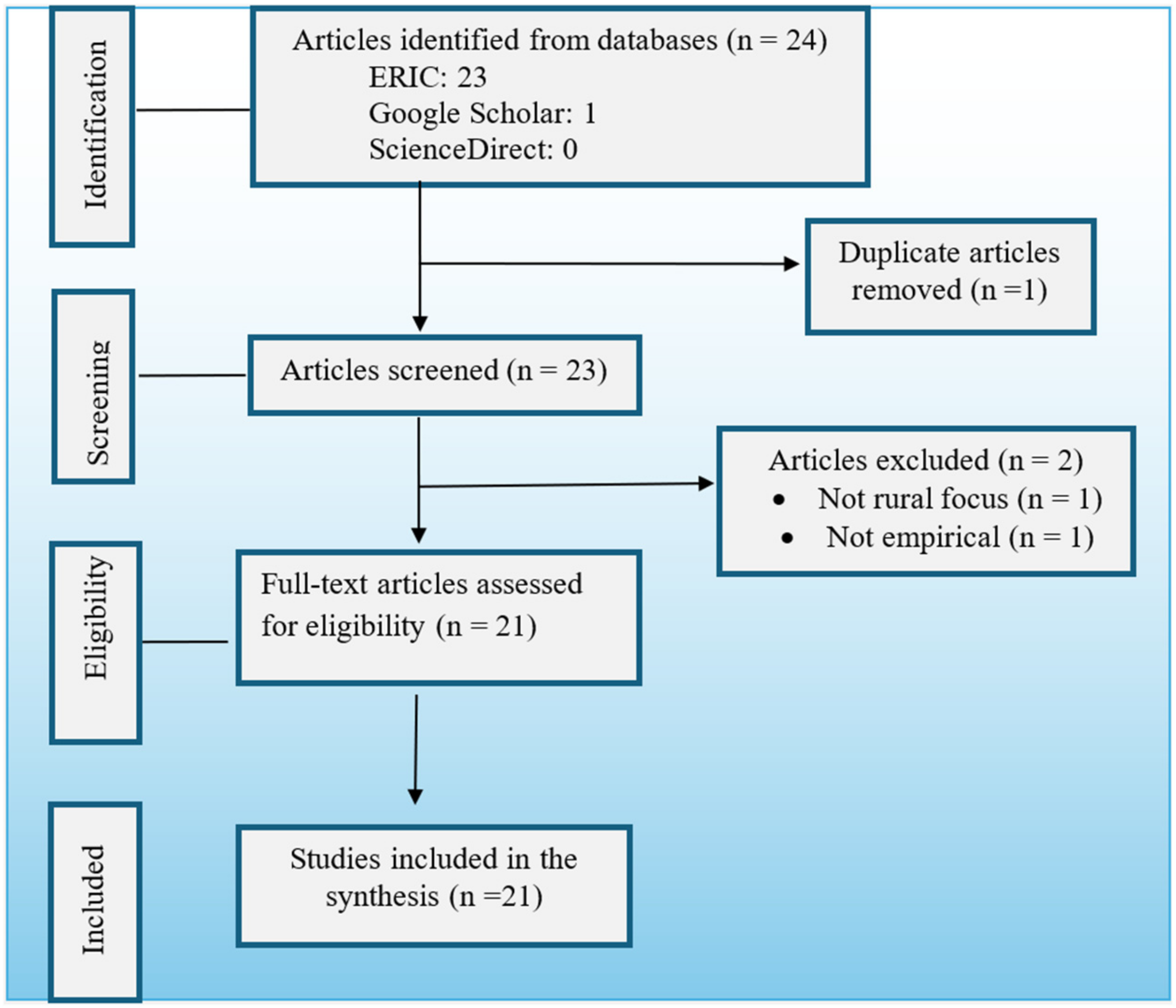
2.2. Search Strategy
2.3. Inclusion and Exclusion Criteria
2.4. Screening and Appraisal
2.5. Data Extraction and Analysis
3. Results
3.1. Theme 1: Resource-Constrained Mentoring
3.2. Theme 2: Pedagogy of Compliance
3.3. Theme 3: Absence of Digital Technology Integration Mentoring
3.4. Theme 4: Mentoring on Cultural and Linguistic Responsiveness
3.5. Theme 5: Classroom Management Mentoring
3.6. Theme 6: Assessment Mentoring
4. Discussion
4.1. Implications
4.1.1. Establish an Accredited Mentor Development Grounded in PCK-M
4.1.2. Strengthening Triadic Partnerships for Collaborative Learning
4.1.3. Provide Targeted Coaching Tools and Digital Pedagogies
4.1.4. Embed Contextualised Mentoring in Policy and Workload Models
4.1.5. Implications for Future Research
4.2. Limitations
5. Conclusions
Supplementary Materials
Author Contributions
Funding
Institutional Review Board Statement
Informed Consent Statement
Data Availability Statement
Conflicts of Interest
References
- Adebola, O. Pre-service teachers experiences during teaching practice in South Africa: Challenges and solutions. J. Educ. Teach. Learn. 2022, 7, 66–72. [Google Scholar] [CrossRef] [Scilit]
- Du Plessis, P.; Mestry, R. Teachers for rural schools—A challenge for South Africa. S. Afr. J. Educ. 2019, 39, 1774. [Google Scholar] [CrossRef] [Scilit]
- Maharaj, N.; Chauke, T.A. Teachers’ Challenges in the Rural Schools in South Africa. Educ. Process Int. J. 2025, 16, e2025235. [Google Scholar] [CrossRef] [Scilit]
- Maringe, F.; Masinire, A.; Nkambule, T. Distinctive features of schools in multiple deprived communities in South Africa: Implications for policy and leadership. Educ. Manag. Admin. Leadersh. 2015, 43, 363–385. [Google Scholar] [CrossRef] [Scilit]
- Gardiner, M. Education in rural areas. Issues Educ. Policy 2008, 4, 1–33. [Google Scholar]
- John, M. Physical sciences teaching and learning in Eastern Cape rural schools: Reflections of pre-service teachers. S. Afr. J. Educ. 2019, 39, s1–s12. [Google Scholar] [CrossRef] [Scilit]
- Thaba-Nkadimene, K.L. The influence of educational provision on teacher performance and learner outcomes among Limpopo primary schools. S. Afr. J. Educ. 2020, 40. [Google Scholar] [CrossRef] [Scilit]
- Zenda, R. The importance of teaching resources on physical sciences learners’ academic achievement in rural schools: A case of South Africa. Soc. Educ. Res. 2024, 5, 407–420. [Google Scholar] [CrossRef] [Scilit]
- Woldegiorgis, E.T.; Chiramba, O. Access and success in higher education: Fostering resilience in historically disadvantaged students in South Africa. J. Appl. Res. High. Educ. 2025, 17, 759–771. [Google Scholar] [CrossRef] [Scilit]
- Mlachila, M.; Moeletsi, T. Struggling to Make the Grade: A Review of the Causes and Consequences of the Weak Outcomes of South Africa’s Education System. In IMF Working Papers; International Monetary Fund: Washington, DC, USA, 2019. [Google Scholar] [CrossRef] [Scilit]
- Westbroek, H.B. Characteristics of Meaningful Chemistry Education: The Case of Water Quality. Ph.D. Thesis, Utrecht University, Utrecht, The Netherlands, 2005. [Google Scholar]
- Barendsen, E.; Henze, I. Relating teacher PCK and teacher practice using classroom observation. Res. Sci. Educ. 2019, 49, 1141–1175. [Google Scholar] [CrossRef] [Scilit]
- Mukeredzi, T.G. The “Journey to Becoming”: Pre-Service Teachers’ Experiences and Understandings of Rural School Practicum in a South African Context. Glob. Educ. Rev. 2016, 3, 88–107. [Google Scholar]
- Mukeredzi, T.G. Teacher preparation for rurality: A cohort model of teaching practice in a rural South African school. In Rural Education Across the World: Models of Innovative Practice and Impact; Springer: Berlin/Heidelberg, Germany, 2021; pp. 65–87. [Google Scholar]
- Nkambule, T.; Mukeredzi, T.G. Pre-service teachers’ professional learning experiences during rural teaching practice in Acornhoek, Mpumalanga Province. S. Afr. J. Educ. 2017, 37, 1–9. [Google Scholar] [CrossRef] [Scilit]
- Ntshangase, S.Z.; Nkosi, Z.P. Effective mentoring: Understanding factors affecting the holistic development of preservice teachers during teaching practice. S. Afr. J. Educ. 2022, 42, 1–10. [Google Scholar] [CrossRef] [Scilit]
- Brianza, E.; Schmid, M.; Tondeur, J.; Petko, D. The digital silver lining of the pandemic: The impact on preservice teachers’ technological knowledge and beliefs. Educ. Inf. Technol. 2024, 29, 1591–1616. [Google Scholar] [CrossRef] [Scilit]
- Cohen, D.K.; Hill, H.C. Learning Policy: When State Education Reform Works; Yale University Press: New Haven, CT, USA, 2001. [Google Scholar]
- Department of Higher Education and Training. Minimum Requirements for Teacher Education Qualifications; Department of Higher Education and Training: Pretoria, South Africa, 2011.
- Agyeman, N.; Aphena, V. The Significance of School-Based Experience for Effective Teaching and Learning in Schools: A Systematic Literature Review. Manag. Indones. J. Educ. Manag. 2023, 5, 229–243. [Google Scholar] [CrossRef] [Scilit]
- South Africa Council for Educators. Professional Teaching Standards. Available online: http://www.sace.org (accessed on 20 February 2025).
- Ariffin, T.F.T.; Bush, T.; Nordin, H. Framing the roles and responsibilities of excellent teachers: Evidence from Malaysia. Teach. Teach. Educ. 2018, 73, 14–23. [Google Scholar] [CrossRef] [Scilit]
- Hobson, A.J.; Ashby, P. Reality aftershock and how to avert it: Second-year teachers’ experiences of support for their professional development. Camb. J. Educ. 2012, 42, 177–196. [Google Scholar] [CrossRef] [Scilit]
- Kelchtermans, G.; Ballet, K. The micropolitics of teacher induction. A narrative-biographical study on teacher socialisation. Teach. Teach. Educ. 2002, 18, 105–120. [Google Scholar] [CrossRef] [Scilit]
- Symeonidis, V.; Haas, E.; Schneider, K. Personal, social and professional support for newly qualified teachers: Teacher induction in Austria. Teach. Teach. Educ. 2023, 121, 103916. [Google Scholar]
- Ben-Amram, M.; Davidovitch, N. Novice teachers and mentor teachers: From a traditional model to a holistic mentoring model in the postmodern era. Educ. Sci. 2024, 14, 143. [Google Scholar] [CrossRef] [Scilit]
- Ambrosetti, A.; Dekkers, J.; Knight, B.A. Mentoring triad: An alternative mentoring model for preservice teacher education? Mentor. Tutoring Partnersh. Learn. 2017, 25, 42–60. [Google Scholar] [CrossRef] [Scilit]
- Mwesigwa, F.; Nakato, N. Mentorship in Teacher Education Programs: A Review of Practices, Outcomes, and Challenges. Acta Pedagog. Asiana 2026, 5, 15–29. [Google Scholar] [CrossRef] [Scilit]
- Chong, J.Y.; Ching, A.H.; Renganathan, Y.; Lim, W.Q.; Toh, Y.P.; Mason, S.; Krishna, L. Enhancing mentoring experiences through e-mentoring: A systematic scoping review of e-mentoring programs between 2000 and 2017. Adv. Health Sci. Educ. 2019, 25, 195–226. [Google Scholar] [CrossRef] [Scilit] [PubMed]
- Rowland, K.N. E-mentoring: An innovative twist to traditional mentoring. J. Technol. Manag. Innov. 2012, 7, 228–237. [Google Scholar] [CrossRef] [Scilit]
- Jita, T.; Munje, P.N. Preservice Teachers’ Mentorship Experiences during Teaching Practice in a South African Teacher Preparation Program. Int. J. High. Educ. 2022, 11, 140–150. [Google Scholar] [CrossRef] [Scilit]
- Jiyane, L.; Gravett, S.J. The practice learning experiences of student teachers at a rural campus of a South African university. S. Afr. J. Child. Educ. 2019, 9, 1–9. [Google Scholar]
- Mukeredzi, T.G.; Mthiyane, N.; Bertram, C. Becoming professionally qualified: The school-based mentoring experiences of parttime PGCE students. S. Afr. J. Educ. 2015, 35, 1057. [Google Scholar] [CrossRef] [Scilit]
- Ndebele, C.; Legg-Jack, D.W. The Impact of Mentoring in the Development of Pre-Service Teachers from a University in South Africa. Int. J. Learn. Teach. Educ. Res. 2022, 21, 88–105. [Google Scholar] [CrossRef] [Scilit]
- Tsotetsi, C.T.; Mile, S.A. Mentor-Mentee Experiences amidst COVID-19: A Teaching Practice Case Study. Res. Soc. Sci. Technol. 2021, 6, 76–95. [Google Scholar] [CrossRef] [Scilit]
- Standal, Ø.F.; Moen, K.M.; Moe, V.F. Theory and practice in the context of practicum: The perspectives of Norwegian physical education student teachers. Eur. Phys. Educ. Rev. 2014, 20, 165–178. [Google Scholar] [CrossRef] [Scilit]
- Boateng, S.; Tatira, B. Voices from the field: Pre-service teachers’ first time experiences of teaching physical sciences during school-based experience. Int. J. Learn. Teach. Educ. Res. 2023, 22, 59–77. [Google Scholar] [CrossRef] [Scilit]
- Hong, J.; Greene, B.; Lowery, J. Multiple dimensions of teacher identity development from pre-service to early years of teaching: A longitudinal study. J. Educ. Teach. 2017, 43, 84–98. [Google Scholar] [CrossRef] [Scilit]
- Meyer, D.; Doll, J.; Kaiser, G. Professional identity of pre-service teachers: Actual and designated identity profiles and their relationship to teacher education programs. Front. Educ. 2023, 8, 113484. [Google Scholar] [CrossRef] [Scilit]
- Sang, Y. Seeing teacher identity through teachers’ beliefs: Narratives of pre-service EFL teachers in China. Lang. Teach. Res. 2023, 30, 1914–1937. [Google Scholar] [CrossRef] [Scilit]
- Tran, Y.; Dee, A. The Complexity of Teacher Identity: Perceptions of Pre-Service Teachers. J. Educ. Learn. 2023, 12, 40–53. [Google Scholar] [CrossRef] [Scilit]
- Zhao, H.; Zhang, X. The influence of field teaching practice on pre-service teachers’ professional identity: A mixed methods study. Front. Psychol. 2017, 8, 1264. [Google Scholar] [CrossRef] [Scilit]
- Çetin, G.; Eren, A. Pre-service teachers’ achievement goal orientations, teacher identity, and sense of personal responsibility: The moderated mediating effects of emotions about teaching. Educ. Res. Policy Pract. 2022, 21, 245–283. [Google Scholar] [CrossRef] [Scilit]
- Hanna, F.; Oostdam, R.; Severiens, S.E.; Zijlstra, B.J. Assessing the professional identity of primary student teachers: Design and validation of the Teacher Identity Measurement Scale. Stud. Educ. Eval. 2020, 64, 100822. [Google Scholar] [CrossRef] [Scilit]
- Nduduzo, G.; Thabisile, M. Challenges encountered by mentor teachers when mentoring pre-service teachers during teaching practice. Rev. Univ. Soc. 2025, 17. [Google Scholar]
- Moosa, M.; Moodley, N.P. Preparing Pre-Service Teachers for Teaching Practice: Insights from Mentor Teachers in Johannesburg. Afr. Educ. Rev. 2024, 20, 55–74. [Google Scholar] [CrossRef] [Scilit]
- Shulman, L. Knowledge and teaching: Foundations of the new reform. Harv. Educ. Rev. 1987, 57, 1–23. [Google Scholar] [CrossRef] [Scilit]
- Feiman-Nemser, S. From preparation to practice: Designing a continuum to strengthen and sustain teaching. Teach. Coll. Rec. 2001, 103, 1013–1055. [Google Scholar] [CrossRef] [Scilit]
- Schwille, S.A. The professional practice of mentoring. Am. J. Educ. 2008, 115, 139–167. [Google Scholar] [CrossRef] [Scilit]
- Hudson, P. Specific mentoring: A theory and model for developing primary science teaching practices. Eur. J. Teach. Educ. 2004, 27, 139–146. [Google Scholar] [CrossRef] [Scilit]
- Orland-Barak, L. Introduction: Learning to mentor-as-praxis foundations for a curriculum in teacher education. In Learning to Mentor-as-Praxis: Foundations for a Curriculum in Teacher Education; Springer: Boston, MA, USA, 2010; pp. 1–13. [Google Scholar]
- Hobson, A.J.; Ashby, P.; Malderez, A.; Tomlinson, P.D. Mentoring beginning teachers: What we know and what we don’t. Teach. Teach. Educ. 2009, 25, 207–216. [Google Scholar] [CrossRef] [Scilit]
- Timperley, H. Mentoring conversations designed to promote student teacher learning. Asia-Pac. J. Teach. Educ. 2001, 29, 111–123. [Google Scholar] [CrossRef]
- Korthagen, F.A. The relationship between theory and practice in teacher education. Int. Encycl. Educ. 2010, 7, 669–675. [Google Scholar]
- Van Driel, J.H.; Berry, A. Teacher professional development focusing on pedagogical content knowledge. Educ. Res. 2012, 41, 26–28. [Google Scholar] [CrossRef] [Scilit]
- Loughran, J.; Berry, A.; Mulhall, P. Understanding and Developing Science Teachers’ Pedagogical Content Knowledge; Springer Science & Business Media: Berlin/Heidelberg, Germany, 2012; Volume 12. [Google Scholar]
- Page, M.J.; McKenzie, J.E.; Bossuyt, P.M.; Boutron, I.; Hoffmann, T.C.; Mulrow, C.D.; Shamseer, L.; Tetzlaff, J.M.; Akl, E.A.; Brennan, S.E.; et al. The PRISMA 2020 statement: An updated guideline for reporting systematic reviews. BMJ 2021, 372, n71. [Google Scholar] [CrossRef] [Scilit]
- Mafugu, T. Science pre-service teachers’ experience with mentors during teaching practice. Eurasia J. Math. Sci. Technol. Educ. 2022, 18, em2170. [Google Scholar] [CrossRef] [Scilit]
- Nkambule, T. Exploring working conditions in selected rural schools: Teachers’ experiences. S. Afr. J. Educ. 2022, 42, 1–9. [Google Scholar] [CrossRef] [Scilit]
- Omodan, B.I. Challenges of pre-service teachers in rural places of teaching practice: A decolonial perspectives. Int. J. Learn. Teach. Educ. Res. 2022, 21, 127–142. [Google Scholar] [CrossRef] [Scilit]
- Pennefather, J. Student teacher learning in rural contexts: Challenges and opportunities. J. Educ. (Univ. KwaZulu-Natal) 2023, 90, 87–108. [Google Scholar] [CrossRef] [Scilit]
- Mkhize, T.R.; Ndwandwe, N.D. Swimming Against the Tide: Resource Mobilization and its Implications for Rural Schools of South Africa. Res. Educ. Policy Manag. 2024, 6, 363–392. [Google Scholar] [CrossRef] [Scilit]
- World Bank. South Africa Economic Update: Learning-Overdue Reforms and Emerging Priorities in Basic Education (English). South Africa Economic Update; No. 15; World Bank Group: Washington, D.C. Available online: http://documents.worldbank.org/curated/en/099331502032511082 (accessed on 1 April 2026).
- Haberman, M. The pedagogy of poverty versus good teaching. Phi Delta Kappan 2010, 92, 81–87. [Google Scholar] [CrossRef] [Scilit]
- Hoadley, U. Pedagogy in Poverty: Lessons from Twenty Years of Curriculum Reform in South Africa; Routledge: London, UK, 2017. [Google Scholar]
- Mpate, H.; Campbell-Evans, G.; Gray, J. Pre-service teachers’ preparedness to teach during teaching practice in Tanzania. Afr. J. Teach. Educ. 2023, 12, 95–120. [Google Scholar]
- Civís Zaragoza, M.; Díaz-Gibson, J. Exploring educational ecosystems: Insights from the implementation of SchoolWeavers tool in Catalonia. Int. J. Leadersh. Educ. 2024, 1–19. [Google Scholar] [CrossRef] [Scilit]
- Ndebele, C.; Marongwe, N.; Ncanywa, T.; Matope, S.; Ginyigazi, Z.; Chisango, G.; Garidzirai, R. Reconceptualising initial teacher education in South Africa: A quest for transformative and sustainable alternatives. Interdiscip. J. Educ. Res. 2024, 6, 1–19. [Google Scholar] [CrossRef] [Scilit]
- Mokoena, M.; Moloi, T.J. Work-Integrated Learning and Self-directed Professional Learning in a Rural Setting: What Do Pre-service English FAL Teachers Need from Their Mentor Teachers? In Work Integrated Learning Experiences: Stories from the Trenches; Springer Nature: Cham, Switzerland, 2024; pp. 39–66. [Google Scholar]
- Jita, T. Pre-service teachers’ competence to teach science through information and communication technologies in South Africa. Perspect. Educ. 2016, 34, 15–28. [Google Scholar] [CrossRef] [Scilit]
- Jita, T.; Sintema, E.J. Exploring Classroom Use of ICT Among Pre-service Science Teachers in Selected SADC Countries. Afr. J. Res. Math. Sci. Technol. Educ. 2022, 26, 218–236. [Google Scholar] [CrossRef] [Scilit]
- Sintema, E.J. Effect of COVID-19 on the performance of grade 12 students: Implications for STEM education. EURASIA J. Math. Sci. Technol. Educ. 2020, 16, em1851. [Google Scholar] [CrossRef] [Scilit]
- Nilsson, P. From PCK to TPACK-Supporting student teachers’ reflections and use of digital technologies in science teaching. Res. Sci. Technol. Educ. 2024, 42, 553–577. [Google Scholar] [CrossRef] [Scilit]
- Tanak, A. Developing preservice science teachers’ teaching practices with an emphasis on higher order thinking. Sci. Educ. Int. 2020, 31, 237–246. [Google Scholar] [CrossRef] [Scilit]
- Starkey, L. A review of research exploring teacher preparation for the digital age. Camb. J. Educ. 2020, 50, 37–56. [Google Scholar] [CrossRef] [Scilit]
- Instefjord, E.J.; Munthe, E. Educating digitally competent teachers: A study of integration of professional digital competence in teacher education. Teach. Teach. Educ. 2017, 67, 37–45. [Google Scholar] [CrossRef] [Scilit]
- Westerdale, J. 410 000 ICT Devices Given to SA Pupils Over the Last Two School Years. The Citizen. Available online: http://citizen.co.za/news/south-africa/education/410-000-ict-devices-pupils--two-school-years/ (accessed on 1 April 2026).
- Tsoka, M.; Kriek, J. Introducing Digital Technology in a Rural Classroom: One Teacher’s Experience. Athens J. Educ. 2025, 12, 423–442. [Google Scholar] [CrossRef] [Scilit]
- Mkhize, T.R.; Shembe, Z. Intoxicated in the classroom: Teachers’ experiences of teaching drug addicted learners in KwaZulu-Natal township schools, South Africa. J. Res. Innov. Teach. Learn. 2022, 6, 29–43. [Google Scholar]
- Khumalo, S.S. The role of transformational school leadership in promoting teacher commitment: An antecedent for sustainable development in South Africa. Discourse Commun. Sustain. Educ. 2019, 10, 22–32. [Google Scholar] [CrossRef] [Scilit]
- Netshitangani, T. Management style and school violence: South African perspectives. Int. J. Educ. Manag. 2018, 32, 96–106. [Google Scholar] [CrossRef] [Scilit]
- Ngidi, L.Z.; Kaye, S.B. Reducing school violence: A peace education project in KwaZulu-Natal, South Africa. S. Afr. J. Educ. 2022, 42, 1–14. [Google Scholar] [CrossRef] [Scilit]
- Singh, G.D.; Steyn, T. The impact of learner violence in rural South African schools. J. Sociol. Soc. Anthropol. 2014, 5, 81–93. [Google Scholar] [CrossRef] [Scilit]
- Bansilal, S.; Rosenberg, T. South African rural teachers’ reflections on their problems of practice: Taking modest steps in professional development. Math. Educ. Res. J. 2011, 23, 107–127. [Google Scholar] [CrossRef] [Scilit]
- Lodi, E.; Perrella, L.; Lepri, G.L.; Scarpa, M.L.; Patrizi, P. Use of restorative justice and restorative practices at school: A systematic literature review. Int. J. Environ. Res. Public Health 2021, 19, 96. [Google Scholar] [CrossRef] [Scilit]
- Staberg, R.L.; Febri, M.I.M.; Gjøvik, Ø.; Sikko, S.A.; Pepin, B. Science teachers’ interactions with resources for formative assessment purposes. Educ. Assess. Eval. Account. 2023, 35, 5–35. [Google Scholar] [CrossRef] [Scilit]
- Trumbull, E.; Lash, A. Understanding formative assessment. Insights Learn. Theory Meas. Theory 2013, 2, 2013. [Google Scholar]


| Author (Year) | Context/ Province | Design | Participants | Focus of Study | Key Findings Relevant to Mentoring | Linked Theme |
|---|---|---|---|---|---|---|
| Adebola (2022) [1] | Rural SA | Qual. | PSTs | Teaching practice challenges | Resource shortages limited PST experimentation; mentors offered minimal adaptive guidance | Theme 1 |
| Agyeman & Aphena (2023) [20] | Rural SA | Qual. | PSTs | School-based experience | Mentoring is uneven; emphasis on classroom survival over pedagogy | Theme 2 |
| Jita & Munje (2022) [31] | Various provinces | Qual. | PSTs and mentors | Mentorship experiences | Apprenticeship model dominant; limited reflective dialogue | Theme 2 |
| Jiyane & Gravett (2019) [32] | Rural | Qual. | Student teachers | Practice learning | Large classes constrained mentoring support | Theme 5 |
| John (2019) [6] | Eastern Cape-rural | Qual. | PSTs | Physical sciences TP | Lecture method reproduced; little language mediation | Themes 2 and 4 |
| Mukeredzi (2021) [14] | Rural SA | Qual. | PSTs | Rural practicum | Mentors transmitted routines rather than contextual strategies | Theme 2 |
| Mukeredzi et al. (2015) [33] | Rural SA | Qual. | PSTs | School-based mentoring | Lack of CRT and multilingual guidance | Theme 4 |
| Ndebele & Legg-Jack (2022) [34] | SA | Qual. | PSTs | Mentoring impact | Feedback is centred on control, not learning | Theme 5 |
| Ndebele et al. (2023) [68] | Rural SA | Qual. | PSTs | WIL challenges | Minimal culturally responsive mentoring | Theme 4 |
| Ntshangase & Nkosi (2022) [16] | Rural KZN | Qual. | PSTs | Effective mentoring | Assessment mentoring weak | Theme 6 |
| Omodan (2022) [60] | Rural SA | Qual. | PSTs | Decolonial view | Context is ignored in mentoring practices | Theme 4 |
| Pennefather (2023) [61] | Rural contexts | Qual. | Student teachers | Learning challenges | Overcrowding undermined mentoring | Theme 5 |
| Mafugu (2022) [58] | Rural SA | Qual. | Science PSTs | Mentor experiences | Need for mentor training | Theme 2 |
| Nkambule (2022) [59] | Rural SA | Qual. | Teachers and PSTs | Working conditions | Resource constraints shaped TP | Theme 1 |
| Zenda (2024) [8] | SA rural | Qual. | Learners and PSTs | Teaching resources | Lack of materials hindered innovation | Theme 1 |
| Jita (2016) [70] | SA | Mixed | PSTs | ICT competence | No mentoring for ICT use | Theme 3 |
| Jita & Sintema (2022) [71] | SADC incl. SA | Mixed | PSTs | ICT classroom use | Digital integration absent in TP | Theme 3 |
| Sintema (2020) [72] | Regional | Qual. | Teachers | E-learning | Technology is symbolic, not pedagogical | Theme 3 |
| Tsoka & Kriek (2025) [78] | Rural classroom | Qual. | Teacher case | CRT illustration | Need to engage cultural beliefs | Theme 4 |
| Mokoena & Hlalele (2021) [69] | Rural SA | Qual. | Schools | Enrichment programmes | Drilling over learning; mentoring gap | Theme 6 |
| Mkhize & Shembe (2022) [79] | KZN rural | Qual. | Teachers | Discipline issues | Need for restorative mentoring | Theme 5 |
Disclaimer/Publisher’s Note: The statements, opinions and data contained in all publications are solely those of the individual author(s) and contributor(s) and not of MDPI and/or the editor(s). MDPI and/or the editor(s) disclaim responsibility for any injury to people or property resulting from any ideas, methods, instructions or products referred to in the content. |
© 2026 by the authors. Licensee MDPI, Basel, Switzerland. This article is an open access article distributed under the terms and conditions of the Creative Commons Attribution (CC BY) license.
Share and Cite
Tsoka, M.; Runhare, T.; Machisi, E.; Magosha, T.A. Are Pre-Service Teachers Receiving Quality Mentoring in Rural Schools? A Synopsis from Research in South Africa. Trends High. Educ. 2026, 5, 37. https://doi.org/10.3390/higheredu5020037
Tsoka M, Runhare T, Machisi E, Magosha TA. Are Pre-Service Teachers Receiving Quality Mentoring in Rural Schools? A Synopsis from Research in South Africa. Trends in Higher Education. 2026; 5(2):37. https://doi.org/10.3390/higheredu5020037
Chicago/Turabian StyleTsoka, Maxwell, Tawanda Runhare, Eric Machisi, and Tendani Amos Magosha. 2026. "Are Pre-Service Teachers Receiving Quality Mentoring in Rural Schools? A Synopsis from Research in South Africa" Trends in Higher Education 5, no. 2: 37. https://doi.org/10.3390/higheredu5020037
APA StyleTsoka, M., Runhare, T., Machisi, E., & Magosha, T. A. (2026). Are Pre-Service Teachers Receiving Quality Mentoring in Rural Schools? A Synopsis from Research in South Africa. Trends in Higher Education, 5(2), 37. https://doi.org/10.3390/higheredu5020037