
The Question at the Heart of Assessment in Higher Education: Are We Assessing for Competency Acquisition?


Abstract
1. Introduction
1.1. The Study
- RQ1: What aspects of student learning are most commonly identified as the object of assessment in the teaching guides of three Spanish universities?
- RQ2: To what extent do teaching guides reflect the integration of the constituent elements of competencies (knowledge, know-how, know-how to be, and know-how to be around others) in assessment design?
- RQ3: Are there differences in assessment focus across universities, areas of knowledge, and subject types?
1.2. Background
1.3. Theoretical Framework
- (a)
- Knowledge: the acquisition of concepts, theories, principles, data and facts. Without a knowledge base, there is no competence, but knowledge alone is not enough.
- (b)
- Skills: technical and practical ability to apply that knowledge in real or simulated situations: problem solving, decision making and task execution.
- (c)
- Attitude, values and behaviours: values, ethics and personal disposition. This determines how knowledge is used (with responsibility, empathy, proactivity, etc.).
- (d)
- Social interaction: focuses on the social and emotional competencies necessary to live and work in society. The ability to collaborate, respect others’ opinions, communicate effectively and resolve conflicts is assessed.
2. Materials and Methods
2.1. Design
2.2. Data and Sample
- All course guides were collected from the universities’ websites.
- All course guides were imported into the ATLAS.ti software.
- Using the programme’s search tool, the software was instructed to identify where the key words (subcodes) used appeared in each of the documents (Table 1).
- In this search, the software was instructed to create a citation for each paragraph in which any of the terms appeared. This entry was coded using the subcode shown in Table 1.
- For the analysis, the course guides were selected where there was at least one citation of the codes used, resulting in a total of 5493 guides (Table 2).
2.3. Data Analysis
- An initial meeting was arranged to establish a theoretical framework for the study by identifying key concepts relevant to the research topic and developing theoretical categories and their respective subcategories. These categories guided the coding.
- Selecting and preparing the data. Data were collected from each of the public websites of the participating universities and organised using the ATLAS.ti software (25 version).
- Applying pre-defined codes. Preliminary coding was carried out using the programme’s search tool by one of the researchers, who is an expert in using the programme and an official trainer for it.
- Reviewing and refining the coding system (consensus meetings). Once the initial selection had been made, a second meeting was held to outline the steps for reviewing the citations generated by the software. Seven researchers manually organised and refined the information into 4 main categories: what is assessed; who is assessed, or for whom assessment is conducted; what assessment is for; and how assessment is conducted. A further total of 57 subcategories can be consulted in the University of Murcia repository DataSet (http://hdl.handle.net/10201/144600, accessed on 6 April 2026) or in Table 1. Once 30% of the review had been completed, a third meeting was arranged to assess the coding work carried out so far.
- Analysing coded data: Once the review was complete, a fourth meeting was held to consider how the coded fragments could be used to identify theoretical concepts, and to reflect on how the patterns observed in the data might confirm, modify or refute the predefined theoretical categories.
- Writing a report.
2.4. Quality Criteria
3. Results
3.1. What Aspects of Student Learning Are Most Commonly Identified as the Object of Assessment in the Teaching Guides of Three Spanish Universities?
3.2. Integration of Competency Components in Assessment Design and Differences Across Universities, Knowledge Areas, and Course Types
3.3. Relationships Between the Different Subcategories That Emerged in the Analysis
4. Discussion and Conclusions
4.1. Limitations
4.2. Implications
Author Contributions
Funding
Institutional Review Board Statement
Informed Consent Statement
Data Availability Statement
Conflicts of Interest
References
- OECD. El Trabajo de la OCDE Sobre Educación y Competencias. OCDE. 2019. Available online: https://www.oecd.org/content/dam/oecd/es/publications/reports/2019/05/oecd-skills-strategy-2019_g1g9ff20/e3527cfb-es.pdf (accessed on 18 December 2025).
- European Commission. Communication from the Commission to the European Parliament, the Council, the European Economic and Social Committee and the Committee of the Regions: European Skills Agenda for Sustainable Competitiveness, Social Fairness and Resilience; European Commission: Brussels, Belgium, 2020; Available online: https://eur-lex.europa.eu/legal-content/EN/TXT/?uri=celex:52020DC0274 (accessed on 6 April 2026).
- Bonnefoy Valdés, N. Evaluación de competencias en educación superior: Conceptos, principios y agentes. Educ. Rev. Univ. Costa Rica 2021, 45, 578–592. [Google Scholar] [CrossRef] [Scilit]
- Tobón, S. Evaluación de las Competencias en la Educación Básica; Santillana: Cantabria, Spain, 2011. [Google Scholar]
- Reinoso, W.A.; Ríos, C.E.; Pesantez, A.N.; Bravo, M.J.; Zambrano, S. Innovación educativa y evaluación por competencias hacia un futuro transformador. Rev. Científica Multidiscip. 2024, 8, 833–854. [Google Scholar] [CrossRef] [Scilit]
- Hincapié Parejo, N.F.; Clemenza de Araujo, C. Evaluación de los aprendizajes por competencias: Una mirada teórica desde el contexto colombiano. Rev. Cienc. Soc. 2022, 28, 106–122. [Google Scholar] [CrossRef] [Scilit]
- European Commission; EACEA; Eurydice. The European Higher Education Area in 2024: Bologna Process Implementation Report; Publications Office of the European Union: Luxembourg, 2024.
- Grant, L.W.; Gareis, C.R.; Hylton, S.P. Formative Assessment. In Oxford Bibliographies in Education; Hynds, A., Ed.; Oxford University Press: Oxford, UK, 2020. [Google Scholar] [CrossRef] [Scilit]
- Hidalgo, M. Reflexiones acerca de la evaluación formativa en el contexto universitario. Rev. Int. Pedagog. Innovación Educ. 2021, 1, 189–210. [Google Scholar] [CrossRef] [Scilit]
- OECD. Education at a Glance 2024: OECD Indicators; OECD: Paris, France, 2024. [Google Scholar] [CrossRef] [Scilit]
- Fialho, I.; Cid, M.; Coppi, M. Grounding and improving assessment in higher education: A way of promoting quality education. Front. Educ. 2023, 8, 1143356. [Google Scholar] [CrossRef] [Scilit]
- Kokkiz, R.; Inangil, D.; Turkoglu, I. The effect of formative assessment on students’ clinical knowledge, skills and self-efficacy levels. Nurse Educ. Pract. 2024, 80, 104120. [Google Scholar] [CrossRef] [Scilit] [PubMed]
- Yadav, D.K.; Bhatia, D. Effect of reflective practices on student learning in higher education- a real-life approach. Int. J. Educ. Reform 2024, 33, 308–322. [Google Scholar] [CrossRef] [Scilit]
- Organización de las Naciones Unidas para la Educación, la Ciencia y la Cultura. Education 2030: Incheon Declaration and Framework for Action for the Implementation of Sustainable Development Goal 4: Ensure Inclusive and Equitable Quality Education and Promote Lifelong Learning Opportunities for All; United Nations Educational, Scientific and Cultural Organization: Paris, France, 2016. Available online: https://unesdoc.unesco.org/ark:/48223/pf0000245656 (accessed on 18 December 2025).
- Largo, W.; Henao-Díaz, D. Evaluación formativa: Impulsar el aprendizaje contextualizado y la mejora de la práctica docente. In Revista de Investigaciones; Universidad Católica de Manizales: Manizales, Colombia, 2022; Available online: https://portal.amelica.org/ameli/journal/498/4984335004/html/ (accessed on 14 December 2025).
- Resa Ocio, A. La formación en igualdad de género en los grados de educación primaria. Rev. Electrónica Interuniv. Form. Profr. 2021, 24, 13–27. [Google Scholar] [CrossRef] [Scilit]
- Cabello-Rivera, D.; Gal, E. La selección y organización de los contenidos en las guías docentes. Relevancia de las dificultades y flexibilidad en el marco de enseñanza. Educ. Médica 2025, 26, 100996. [Google Scholar] [CrossRef] [Scilit]
- Soledad Seivane, M.; Elena Brenlla, M. Evaluación de la calidad docente universitaria desde la perspectiva de los estudiantes. Rev. Iberoam. Evaluación Educ. 2021, 14, 35–46. [Google Scholar] [CrossRef] [Scilit]
- Velasco, E.; Díaz-Iso, A.; Larruzea-Urkixo, N. La voz del profesorado universitario en las guías docentes: Un análisis de las estrategias de posicionamiento en el área de Didáctica de la Lengua y la Literatura. Círculo Lingüística Apl. Comun. 2022, 90, 47–59. [Google Scholar] [CrossRef] [Scilit]
- Arias-Rodríguez, A.; Fernández-Sánchez, A.; Lorenzo-Castiñeiras, J.J. Enfoque de Género en las Guías Docentes de las Titulaciones de Educación; Dykinson: Madrid, Spain, 2021. [Google Scholar]
- García-Jiménez, L.; Torrado-Morales, S.; Díaz Tomás, J.M. El rol de la mujer en la ciencia y la docencia en comunicación: Análisis a partir de los programas universitarios en España. Rev. Comun. 2022, 21, 91–113. [Google Scholar] [CrossRef] [Scilit]
- Seller, E.P. Construcción del conocimiento en educación superior a través de prácticas en instituciones y organizaciones sociales. Rev. Cienc. Soc. 2022, 28, 55–68. [Google Scholar] [CrossRef] [Scilit]
- Moreno, T. La evaluación de competencias en educación. Sinéctica 2012, 39, 1–20. [Google Scholar]
- Casanova Rodríguez, M.A. La Evaluación de Competencias Básicas; La Muralla: Madrid, Spain, 2012. [Google Scholar]
- European Parliament; Council of the European Union. Recommendation of the European Parliament and of the Council of 23 April 2008 on the Establishment of the European Qualifications Framework for Lifelong Learning. Off. J. Eur. Union 2008, C111, 1–7. [Google Scholar]
- Le Boterf, G. Ingeniería de las Competencias; Gestión: Gandía, Spain, 2000. [Google Scholar]
- Abelha, M.; Fernandes, S.; Mesquita, D.; Seabra, F.; Ferreira-Oliveira, A.T. Graduate employability and competence development in higher education—A systematic literature review using PRISMA. Sustainability 2020, 12, 5900. [Google Scholar] [CrossRef] [Scilit]
- González, J.; Wagenaar, R. (Eds.) Tuning Educational Structures in Europe. Final Report. Phase One; University of Deusto: Bilbao, Spain; University of Groningen: Groningen, The Netherlands, 2003. [Google Scholar]
- Boud, D.; Dawson, P. What feedback literate teachers do: An empirically-derived competency framework. Assess. Eval. High. Educ. 2023, 48, 158–171. [Google Scholar] [CrossRef] [Scilit]
- Martzoukou, K.; Fulton, C.; Kostagiolas, P.; Lavranos, C. A study of higher education students’ self-perceived digital competences for learning and everyday life online participation. J. Doc. 2020, 76, 1413–1458. [Google Scholar] [CrossRef] [Scilit]
- Castillo-Manzano, J.I.; Castro-Nuño, M.; López-Valpuesta, L.; Sanz-Díaz, M.T.; Yñiguez, R. Evaluating the design of digital tools for the transition to an e-continuous assessment in higher education. J. Comput. High. Educ. 2024, 36, 875–893. [Google Scholar] [CrossRef] [Scilit]
- De Silva, L.M.H.; Rodríguez-Triana, M.J.; Chounta, I.A.; Pishtari, G. Curriculum analytics in higher education institutions: A systematic literature review. J. Comput. High. Educ. 2024, 37, 898–944. [Google Scholar] [CrossRef] [Scilit]
- European Association for Quality Assurance in Higher Education (ENQA). Standards and Guidelines for Quality Assurance in the European Higher Education Area (ESG); ENQA: Brussels, Belgium, 2015; Available online: https://www.enqa.eu/esg-standards-and-guidelines-for-quality-assurance-in-the-european-higher-education-area/ (accessed on 6 April 2026).
- Ibarra-Sáiz, M.S.; Rodríguez-Gómez, G.; Lukas-Mujika, J.F.; Santos-Berrondo, A. Medios e instrumentos para evaluar los resultados de aprendizaje en másteres universitarios. Análisis de la percepción del profesorado sobre su práctica evaluativa. Educ. XX1 2023, 26, 21–45. [Google Scholar] [CrossRef] [Scilit]
- Cañadas, L. Evaluación formativa en el contexto universitario: Oportunidades y propuestas de actuación. Rev. Digit. Investig. Docencia Univ. 2020, 14, e1214. [Google Scholar] [CrossRef] [Scilit]
- Santos Guerra, M. La evaluación: Un proceso de diálogo, comprensión y mejora. Investig. Esc. 1993, 20, 23–35. [Google Scholar]
- Sandoval-Rubilar, P.; Maldonado-Fuentes, A.C.; Tapia-Ladino, M. Evaluación educativa de los aprendizajes: Conceptualizaciones básicas de un lenguaje profesional para su comprensión. Páginas Educ. 2022, 15, 49–75. [Google Scholar] [CrossRef] [Scilit]
- Tardif, J. L’Évaluation des Compétences. In Documenter le Parcours de Développement; Chenelière Education: Montreal, QC, Canada, 2006. [Google Scholar]
- Morales, S.; Hershberger del Arenal, E.; Acosta, E. Evaluación por competencias: ¿cómo se hace? Rev. Fac. Med. UNAM 2020, 63, 46–56. [Google Scholar] [CrossRef] [Scilit]
- Cano García, M.E. La evaluación por competencias en la educación superior. Profesorado 2008, 12, 16. [Google Scholar]
- Guba, E.G.; Lincoln, Y.S. Fourth Generation Evaluation; Sage Publications: Thousand Oaks, CA, USA, 1989. [Google Scholar]
- Brousselle, A.; Buregeya, J.-M. Theory-based evaluations: Framing the existence of a new theory in evaluation and the rise of the 5th generation. Evaluation 2018, 24, 153–168. [Google Scholar] [CrossRef] [Scilit]
- Flynn, S.; Caffrey, L.; Antosik-Parsons, K.; Whiting, S.; Byrne, J.; Conlon, C. New-materialist bricolage: Presenting an ontological position for qualitative internet-based research. Int. J. Soc. Res. Methodol. 2024, 28, 179–192. [Google Scholar] [CrossRef] [Scilit]
- Toassi, R.F.C.; Olsson, T.O.; Peduzzi, M. Interprofessional learning in an undergraduate Dentistry course in the pandemic context of remote teaching. Interface-Commun. Health Educ. 2023, 27, e220696. [Google Scholar] [CrossRef] [Scilit]
- Hemmler, V.L.; Kenney, A.W.; Langley, S.D.; Callahan, C.M.; Gubbins, E.J.; Holder, S. Beyond a coefficient: An interactive process for achieving inter-rater consistency in qualitative coding. Qual. Res. 2022, 22, 194–219. [Google Scholar] [CrossRef] [Scilit]
- Beresford, M.; Wutich, A.; du Bray, M.V.; Ruth, A.; Stotts, R.; Sturtz Sreetharan, C.; Brewis, A. Coding qualitative data at scale: Guidance for large coder teams based on 18 studies. Int. J. Qual. Methods 2022, 21, 16094069221075860. [Google Scholar] [CrossRef] [Scilit]
- Lindqvist, H.; Forsberg, C. Constructivist grounded theory and educational research: Constructing theories about teachers’ work when analysing relationships between codes. Int. J. Res. Method Educ. 2022, 46, 200–210. [Google Scholar] [CrossRef] [Scilit]
- Locke, K.; Feldman, M.; Golden-Biddle, K. Coding practices and iterativity: Beyond templates for analyzing qualitative data. Organ. Res. Methods 2022, 25, 262–284. [Google Scholar] [CrossRef] [Scilit]
- Halpin, S.N. Inter-coder agreement in qualitative coding: Considerations for its use. Am. J. Qual. Res. 2024, 8, 23–43. [Google Scholar] [CrossRef] [Scilit]
- Delve Team. Team-Based Qualitative Analysis: A Guide to Consensus and Split Coding. Delve. Available online: https://delvetool.com/blog/consensus-coding-split-coding (accessed on 18 February 2025).
- Cena, E.; Brooks, J.; Day, W.; Goodman, S.; Rousaki, A.; Ruby-Granger, V.; Seymour-Smith, S. Quality criteria: General and specific guidelines for qualitative approaches in psychology research. a concise guide for novice researchers and Reviewers. Int. J. Qual. Methods 2024, 23, 16094069241282843. [Google Scholar] [CrossRef] [Scilit]
- Malmqvist, J.; Atterström, A.; Swärd, A.-K. But was it trustworthy? methodological experiences from a study of a hard-to-reach group of students in need of a flexible research approach. Int. J. Qual. Methods 2024, 23, 16094069241234805. [Google Scholar] [CrossRef] [Scilit]
- Fernández, A. Evaluando la Evaluación de los Aprendizajes; UFG Editores: San Salvador, El Salvador, 2019. [Google Scholar]
- García Acosta, J.G.; García González, M. La evaluación por competencias en el proceso de formación. Rev. Cuba. Educ. Super. 2022, 41. [Google Scholar]
- Ibarra-Sáiz, M.S.; Rodríguez-Gómez, G.; Boud, D. Developing student competence through peer assessment: The role of feedback, self-regulation and evaluative judgement. High. Educ. 2020, 80, 137–156. [Google Scholar] [CrossRef] [Scilit]
- Kavanagh, J.M. Crisis in competency: A defining moment in nursing education. Online J. Issues Nurs. 2021, 26. [Google Scholar] [CrossRef] [Scilit]
- Liu, Z.; Wang, T.; Wu, S.; Xu, B.; Zhao, W.; Yin, X.; Sun, Y. Assessment of the competency of learner-centered teaching of clinical preceptor using the augmented Stanford Faculty Development Program Questionnaire (SFDPQ): A cross-sectional comparative study. BMC Med. Educ. 2024, 24, 883. [Google Scholar] [CrossRef] [Scilit]
- Manning, M.N.J. University lecturers’ lived experiences of teaching critical thinking in Australian university: A hermeneutic phenomenological research. High. Educ. 2024, 88, 2057–2073. [Google Scholar] [CrossRef] [Scilit]
- Sistermans, I.J. Integrating competency-based education with a case-based or problem-based learning approach in online health sciences. Asia Pac. Educ. Rev. 2020, 21, 683–696. [Google Scholar] [CrossRef] [Scilit]
- Tzafilkou, K.; Perifanou, M.; Economides, A.A. Development and validation of students’ digital competence scale (SDiCoS). Int. J. Educ. Technol. High. Educ. 2022, 19, 30. [Google Scholar] [CrossRef] [Scilit]
- Valor, C.; Antonetti, P.; Merino, A. The relationship between moral competences and sustainable consumption among higher education students. J. Clean. Prod. 2020, 248, 119161. [Google Scholar] [CrossRef] [Scilit]
- Wong, S.C. Competency definitions, development and assessment: A brief review. Int. J. Acad. Res. Progress. Educ. Dev. 2020, 9, 95–114. [Google Scholar] [CrossRef] [Scilit]
- European Commission. Horizonte Europa: Invertir para dar Forma a Nuestro Futuro; European Commission: Brussels, Belgium, 2019; Available online: https://bit.ly/3SwvWKu (accessed on 15 January 2026).




| Code | 2. What | 3. Who/For Whom | 4. Purpose | 5. How |
|---|---|---|---|---|
| Meaning | The aim is to identify what is being assessed | The aim is to identify who is carrying out the assessment and for whom | The aim is to identify the purpose of the assessment | The aim is to identify how the assessment is carried out |
| Sub-codes | 2.1. Skills 2.2. Thinking 2.3. Ability 2.4. Understanding 2.5. Team 2.6. Application 2.7. Performance 2.8. Practice 2.9. Adaptation 2.10. Values 2.11. Standards 2.12. Competencies 2.13. Quality 2.14. Learning 2.15. Progress 2.16. Results 2.17. Knowledge 2.18. Commitment 2.19. Resources | 3.1. Peers 3.2. Self-assessment 3.3. Collaborative | 4.1. Assessment for… 4.2. Integration 4.3. Knowledge 4.4. Needs 4.5. Learning 4.6. Understanding 4.7. Inclusive 4.8. Development 4.9. Holistic 4.10. Purpose 4.11. Application 4.12. Transfer 4.13. Practice 4.14. Professional 4.15. Improvement 4.16. Autonomy 4.17. Responsibility 4.18. Training 4.19. Accreditation 4.20. Classification 4.21. Employment 4.22. Selection 4.23. Assistance | 5.1. Integrated 5.2. Process 5.3. Criteria 5.4. Importance 5.5. By means of 5.6. Instruments 5.7. Tools 5.8. Procedures 5.9. Feedback 5.10. Context 5.11. Tasks |
| University | Total Number of Teaching Guides 7810 | Selected Number of Teaching Guides 5493 | |
|---|---|---|---|
| UC | 1803 23% | Initial screening using ATLAS.ti search tool | 1422 26% |
| UMU | 2610 33% | 2280 42% | |
| USC | 3397 44% | 1791 32% |
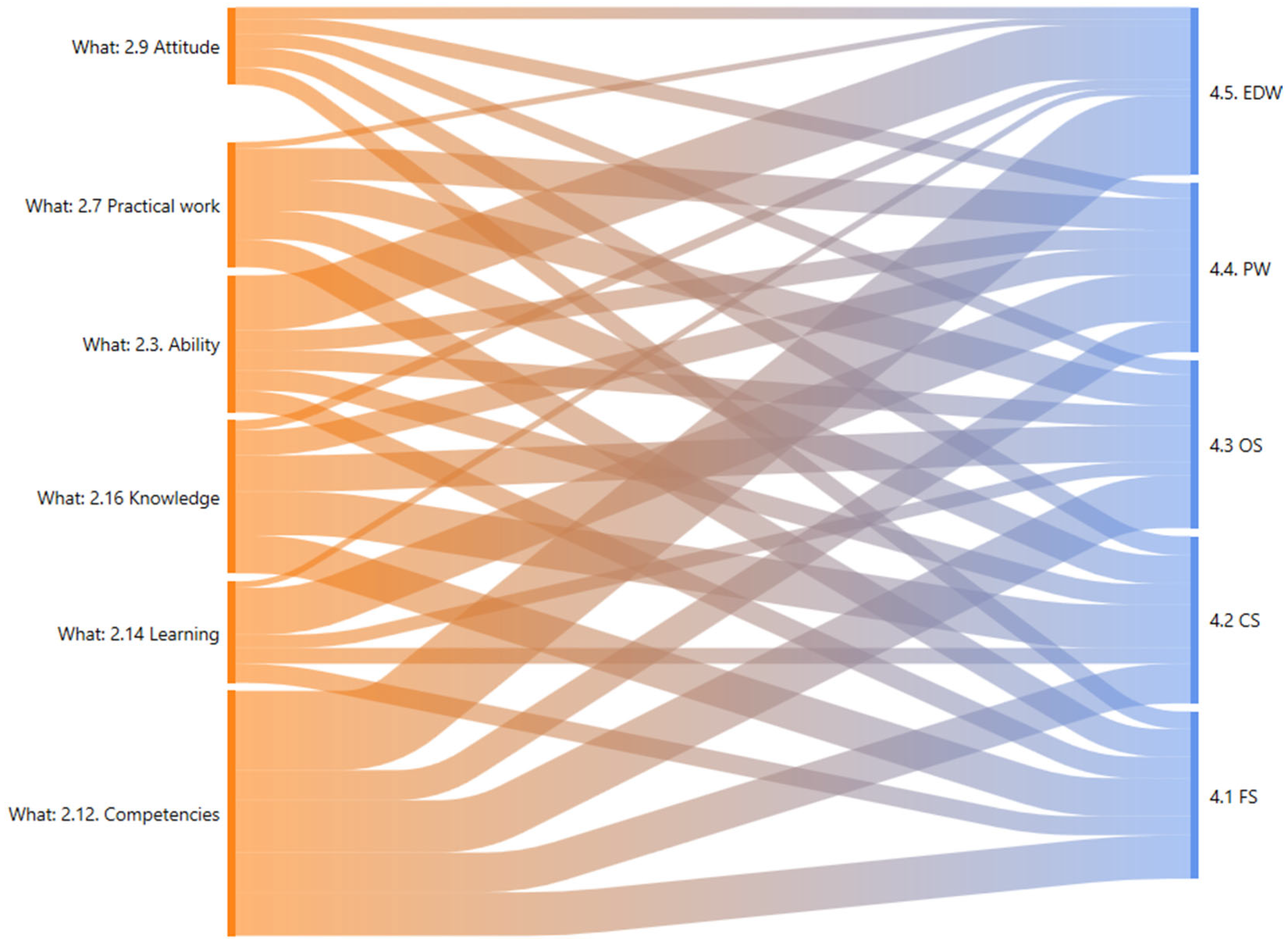
| 4.1 FS 1209 325 | 4.2 CS 2888 728 | 4.3 OS 1255 289 | 4.4 PW 73 193 | 4.5 EDW 68 129 | Totales | |
|---|---|---|---|---|---|---|
| What: 2.12. Competencies 1840 | 17.78% 26.01% | 16.31% 23.86% | 21.38% 31.27% | 12.21% 17.86% | 32.32% 47.27% | 100.00% 29.25% |
| What: 2.14 Learning 701 | 18.60% 11.16% | 15.97% 9.58% | 13.21% 7.93% | 46.15% 27.68% | 6.06% 3.64% | 100.00% 12.00% |
| What: 2.16 Knowledge 1705 | 24.99% 22.77% | 28.49% 25.96% | 23.88% 21.76% | 16.66% 15.18% | 5.99% 5.45% | 100.00% 18.22% |
| What: 2.3. Ability 891 | 15.77% 12.89% | 15.00% 12.26% | 14.99% 12.25% | 14.20% 11.61% | 40.04% 32.73% | 100.00% 16.35% |
| What: 2.7 Practical work 1210 | 22.54% 16.76% | 22.66% 16.85% | 24.70% 18.37% | 25.21% 18.75% | 4.89% 3.64% | 100.00% 14,87% |
| What: 2.9 Attitude 749 | 22.36% 10.40% | 24.71% 11.50% | 18.12% 8.43% | 19.19% 8.93% | 15.63% 7.27% | 100.00% 9.31% |
| Totales | 20.00% 100.00% | 20.00% 100.00% | 20.00% 100.00% | 20.00% 100.00% | 20.00% 100.00% | 100.00% 100.00% |
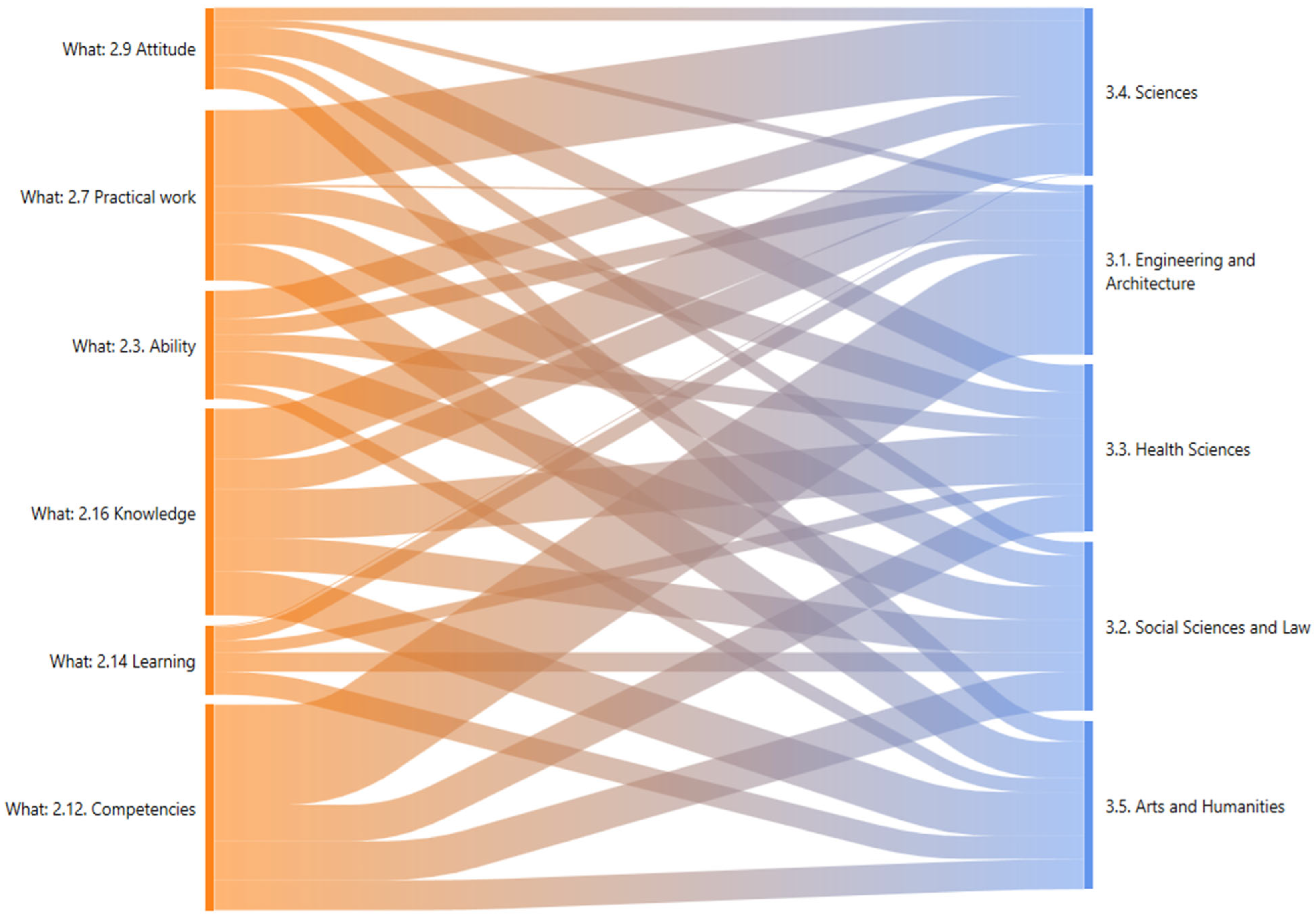
| 3.1. Engineering and Architecture | 3.2. Social Sciences and Law | 3.3. Health Sciences | 3.4. Sciences | 3.5. Arts and Humanities | ||||||
|---|---|---|---|---|---|---|---|---|---|---|
| Relative % in the Row | Relative % in the Column | Relative % in the Row | Relative % in the Column | Relative % in the Row | Relative % in the Column | Relative % in the Row | Relative % in the Column | Relative % in the Row | Relative % in the Column | |
| What: 2.12. Competency | 48.89% | 59.80% | 18.93% | 23.15% | 17.61% | 21.54% | 0.00% | 0.00% | 14.58% | 17.84% |
| What: 2.14. Learning | 20.29% | 8.19% | 27.97% | 11.28% | 17.46% | 7.05% | 0.79% | 0.32% | 33.48% | 13.51% |
| What: 2.16. Knowledge | 14.39% | 17.76% | 15.89% | 19.60% | 23.82% | 29.38% | 24.42% | 30.13% | 21.48% | 26.49% |
| What: 2.3. Ability | 14.45% | 9.29% | 30.55% | 19.65% | 16.03% | 10.31% | 26.41% | 16.99% | 12.55% | 8.07% |
| What: 2.7. Practical work | 0.91% | 0.92% | 18.57% | 18.77% | 15.30% | 15.46% | 44.08% | 44.55% | 21.14% | 21.37% |
| What: 2.9. Attitude | 8.33% | 4.05% | 15.52% | 7.54% | 33.48% | 16.27% | 16.49% | 8.01% | 26.18% | 12.72% |
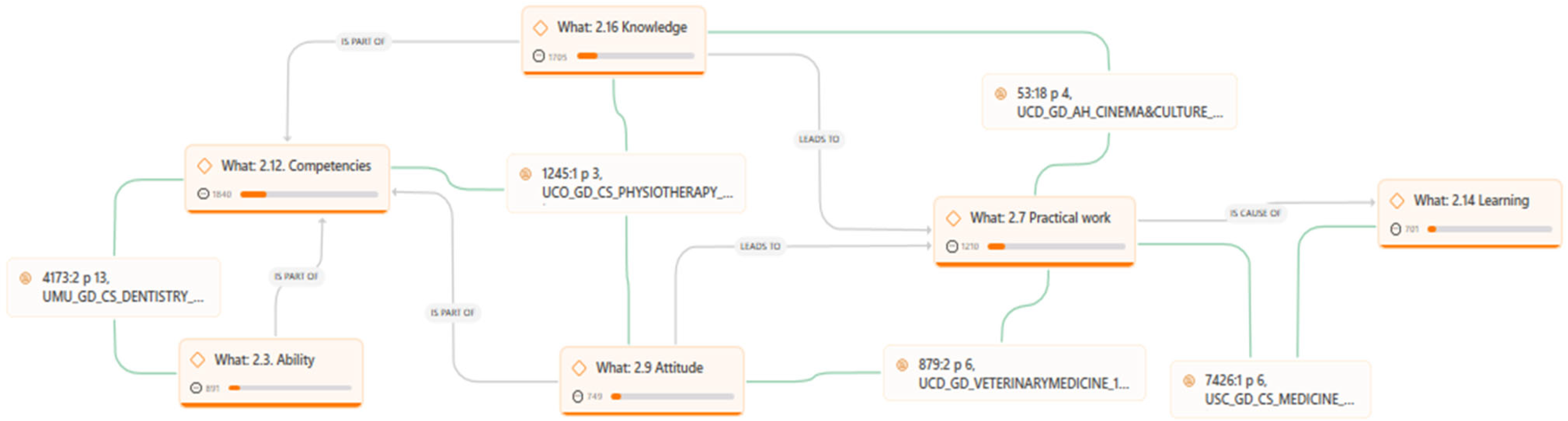
| What: 2.12. Competencies | What: 2.14. Learning | What: 2.16. Knowledge | What: 2.3. Ability | What: 2.7. Practical Work | What: 2.9. Attitude | |
|---|---|---|---|---|---|---|
| What: 2.12. Competencies | 0.00 | 0.04 | 0.05 | 0.04 | 0.05 | 0.02 |
| What: 2.14. Learning | 0.04 | 0.00 | 0.03 | 0.04 | 0.03 | 0.02 |
| What: 2.16. Knowledge | 0.05 | 0.03 | 0.00 | 0.07 | 0.04 | 0.26 |
| What: 2.3. Ability | 0.04 | 0.04 | 0.07 | 0.00 | 0.05 | 0.03 |
| What: 2.7. Practical work | 0.05 | 0.03 | 0.04 | 0.05 | 0.00 | 0.03 |
| What: 2.9. Attitude | 0.02 | 0.02 | 0.26 | 0.03 | 0.03 | 0.00 |
Disclaimer/Publisher’s Note: The statements, opinions and data contained in all publications are solely those of the individual author(s) and contributor(s) and not of MDPI and/or the editor(s). MDPI and/or the editor(s) disclaim responsibility for any injury to people or property resulting from any ideas, methods, instructions or products referred to in the content. |
© 2026 by the authors. Licensee MDPI, Basel, Switzerland. This article is an open access article distributed under the terms and conditions of the Creative Commons Attribution (CC BY) license.
Share and Cite
Bolarín Martínez, M.J.; González López, C.; Bernárdez-Gómez, A. The Question at the Heart of Assessment in Higher Education: Are We Assessing for Competency Acquisition? Trends High. Educ. 2026, 5, 34. https://doi.org/10.3390/higheredu5020034
Bolarín Martínez MJ, González López C, Bernárdez-Gómez A. The Question at the Heart of Assessment in Higher Education: Are We Assessing for Competency Acquisition? Trends in Higher Education. 2026; 5(2):34. https://doi.org/10.3390/higheredu5020034
Chicago/Turabian StyleBolarín Martínez, María José, Claudia González López, and Abraham Bernárdez-Gómez. 2026. "The Question at the Heart of Assessment in Higher Education: Are We Assessing for Competency Acquisition?" Trends in Higher Education 5, no. 2: 34. https://doi.org/10.3390/higheredu5020034
APA StyleBolarín Martínez, M. J., González López, C., & Bernárdez-Gómez, A. (2026). The Question at the Heart of Assessment in Higher Education: Are We Assessing for Competency Acquisition? Trends in Higher Education, 5(2), 34. https://doi.org/10.3390/higheredu5020034