
Abstract
Background: Academic performance among university students is shaped by multiple factors, especially during examinations. This study aimed to explore the relationship between sleep quality, executive attention, and anxiety to identify potential predictors of academic performance across different academic fields. Method: Fifty-one students, between 19 and 25 years (M = 20.04, SD = 1.11), enrolled in the second year in Medicine (27.5%), Law (39.2%), and Economics (33.3%) programs at a university in Lisbon. The sample has mostly full-time students (98.04%), and female (68.6%). Data collection took place during examination periods and included: Pittsburgh Sleep Quality Index (PSQI), Epworth Sleepiness Scale (ESE), State-Trait Anxiety Inventory (STAI), Beck Depression Inventory-II (BDI-II), Stroop Test and Go/No-Go task. Results: Our findings revealed significant differences across academic fields: medical students reported poorer sleep quality, law students demonstrated reduced executive attention, and economics students exhibited better sleep but weaker inhibitory control. Sleep quality and state anxiety significantly predicted academic performance, whereas executive attention did not. Conclusions: These results underscore the importance of addressing sleep hygiene and anxiety management among university students, regardless of academic discipline. Institutional initiatives, including structured stress-reduction programs and educational support services, may equip students with the tools to manage academic pressures and enhance cognitive functioning and overall psychological well-being.
1. Introduction
The transition to university represents a critical period marked by significant lifestyle adjustments, academic demands, and emotional challenges [1,2]. Academic performance, a central indicator of student success and future career opportunities, is shaped by a complex interplay of psychological, behavioral, and cognitive factors [3]. During examination periods, students often face increased workloads, tight deadlines, and evaluative pressure, which can escalate into chronic stress and anxiety [4,5,6,7].
The impact of these stressors extends beyond emotional well-being, influencing students ability to regulate emotions and sustain cognitive performance under pressure. These stressors affect academic outcomes, students emotional regulation, and cognitive functioning [6,8,9]. Anxiety, when poorly regulated, may disrupt sleep quality, reinforcing a cycle of cognitive overload and emotional dysregulation [10,11,12]. Sleep deprivation has been consistently associated with impairments in attention, memory, and executive functions, especially under cognitively demanding conditions. These deficits are well-documented across age groups, including in young adults and university students [13], as well as in late adolescents [14], highlighting the robust and generalized impact of poor sleep on cognitive performance.
The bidirectional relationship between poor sleep quality and elevated anxiety establishes a cyclical vulnerability that undermines students’ cognitive performance and academic potential [10]. These effects are particularly salient during exams, when demands on executive attention and emotional resilience are heightened [7,13].
During late adolescence and early adulthood—typical ages of university students—the prefrontal cortex continues to mature, particularly in regions associated with executive control, inhibitory regulation, and decision-making [15,16]. Although these studies focus on adolescents, their findings are widely recognized as applicable to individuals in the early stages of adulthood, such as university students. This ongoing neurodevelopment may limit students’ ability to self-regulate under academic stress and sleep deprivation—conditions frequently experienced during examination periods. When sleep is restricted, prefrontal functioning is further impaired, increasing impulsivity and diminishing cognitive control [13]. These impairments may manifest in maladaptive behaviors and reduced executive efficiency, particularly in demanding academic settings [17]. Taken together, these findings highlight how neurodevelopmental and behavioral vulnerabilities may converge in university contexts, exacerbating academic and emotional difficulties in students under pressure.
Although the role of sleep and anxiety has been studied within specific student populations such as medical students [17,18,19], it remains unclear how these factors interact across academic disciplines with distinct demands. Also, whether course-specific demands contribute to distinct stress profiles among students in different academic paths remains to be explored. For instance, medicine students often face rigorous practical schedules and early-morning clinical duties; law students deal with verbal overload, complex legal analysis, and oral assessments; and economics students typically engage in quantitative reasoning and data interpretation under pressure. These unique academic stressors may influence students’ sleep patterns, anxiety levels, and cognitive performance differently.
Although these characterizations are commonly acknowledged in academic and institutional contexts, there is no data that directly compares attendance patterns or absenteeism rates across different academic fields, reinforcing the need for further research that examines how discipline-specific demands may influence students’ behavioral engagement, including class attendance and self-regulatory habits.
To better understand the cognitive and emotional components influencing performance under pressure, three psychological domains have emerged as particularly relevant. Academic performance during high-stakes examinations relies not only on prior learning but also on students’ cognitive and emotional readiness. In this context, three psychological domains have shown strong empirical links to academic outcomes: sleep quality, anxiety, and executive attention. Poor sleep can impair memory, attention, and executive functioning, especially under academic stress [20,21]. Anxiety, particularly trait and test-related anxiety, has been associated with diminished cognitive efficiency and lower academic achievement [22,23]. Finally, executive attention—including inhibitory control and interference resolution—is essential for sustaining focus, managing time, and adapting to demanding academic tasks [24,25]. These variables were therefore selected as key predictors of academic performance during exams.
Therefore, the present study seeks to explore the relationship between sleep quality, anxiety, and executive attention, and to assess their predictive value in academic performance. By comparing students from three distinct academic programs—Medicine, Law, and Economics, this research aims to offer a contextualized and interdisciplinary perspective on the cognitive and emotional challenges university students face.
Specifically, the study seeks to answer the following questions: (1) To what extent do sleep quality, anxiety, and executive attention predict academic performance during examination periods? (2) Are medical students better positioned in terms of sleep, anxiety, and executive attention? (3) Do these predictors vary across academic programs with distinct cognitive and emotional demands?
2. Materials and Methods
2.1. Participants
This study involved a non-probabilistic convenience sample of 51 s-year undergraduate students from a private university in Lisbon, Portugal. The final sample included 14 students from Medicine (27.5%), 17 from Economics (33.3%), and 20 from Law (39.2%). Participants were aged between 19 and 25 years (M = 20.04; SD = 1.11), with the majority being female (n = 35; 68.6%) and full-time students (98.04%).
Inclusion criteria required students to be enrolled in the second year of one of the three selected programs, be aged 18 years or older, and have fluency in Portuguese. Exclusion criteria included repeating the academic year, having a prior diagnosis of anxiety or sleep disorders before university enrolment, or inability to complete the assessment protocol.
Due to the non-probabilistic convenience sampling method and the recruitment from a single private university, the sample is not representative of the wider university student population, which limits the generalizability of the findings.
Recruitment took place during the official summer examination period (June–July 2024). Students were approached in person the day before or on the day of final exams in high-credit curricular units: Thinking and Doing II (Medicine), Obligations Law (Law), and Finance II (Economics). Written informed consent was obtained from all participants, ensuring anonymity and data confidentiality.
Due to differences in course assessment structure, Law students were required to take the final exam regardless of prior performance, reflecting full cohort participation. In contrast, Medicine and Economics students only sat the final exam if they failed continuous assessment or voluntarily opted to improve their grades. As such, the exam-taking samples in these programs represent selective subgroups, which may introduce selection bias while maintaining ecological validity by reflecting real academic decision-making patterns.
To further contextualize the representativeness of the sample, the collaborating departments reported that the corresponding second-year cohorts included approximately 30–40 students in Economics, around 200 students in Law, and approximately 50 students in Medicine during the academic year of data collection. However, final-exam attendance does not mirror full cohort size in all programs: Medicine and Economics students only sit the final exam under specific academic circumstances, whereas Law students attend universally. Consequently, the exam-taking sample represents only a subset of the full cohort and reflects participation patterns outside the researchers’ control.
2.2. Instruments
Seven tools were used to collect sociodemographic data and to assess emotional and cognitive domains:
- ○
- Sociodemographic and Academic Questionnaire: Developed for this purpose to collect participants’ age, gender, degree program, year of enrolment, employment status, first-year final grade, and exam-related information (exam name, retake/improvement status, and final grade reported post-exam via email).
- ○
- Pittsburgh Sleep Quality Index (PSQI)—The PSQI [26] is a self-report instrument designed to assess sleep quality and patterns over the previous month. It comprises 19 items grouped into seven components: subjective sleep quality, sleep latency, sleep duration, habitual sleep efficiency, sleep disturbances, use of sleeping medication, and daytime dysfunction. Each component is scored from 0 to 3, with a global score ranging from 0 to 21. Scores between 0 and 4 indicate good sleep quality, scores from 5 to 10 suggest poor sleep quality, and scores above 10 may be indicative of a sleep disorder. The Portuguese version used was the adaptation developed by the Mapi Research Institute [27], validated for the Portuguese population by Gomes et al. [28]. This version presented a Cronbach’s alpha of 0.75, indicating a good internal consistency.
- ○
- Epworth Sleepiness Scale (ESS)—The ESS [29] evaluates the propensity to fall asleep in eight everyday situations, with each item rated from 0 to 3. Total scores range from 0 to 24, with higher scores indicating greater daytime sleepiness. According to established clinical guidelines, scores are interpreted as follows: 0–5 (low normal daytime sleepiness), 6–10 (higher normal daytime sleepiness), 11–12 (mild excessive daytime sleepiness), 13–15 (moderate excessive daytime sleepiness), and 16–24 (severe excessive daytime sleepiness). We used the Portuguese adaptation by Santos [30], wich reported a Cronbach’s alpha of 0.83.
- ○
- State-Trait Anxiety Inventory (STAI)—The STAI [31] consists of 40 items measuring two dimensions of anxiety: state anxiety (transient emotional status) and trait anxiety (general predisposition). Each subscale includes 20 items rated on a 4-point Likert scale. The Portuguese version used was the adaptation by Silva and Spielberger [32], which preserves the structure and theoretical basis of the original instrument. Internal consistency values for the Portuguese version were excellent, with Cronbach’s alpha of 0.91 for state anxiety and 0.89 for trait anxiety. No clinical cutoff score is universally established for this tool, and interpretation is typically based on relative comparisons within the sample.
- ○
- Beck Depression Inventory-II (BDI-II)—The BDI-II [33] is a 21-item self-report inventory designed to assess the presence and severity of depressive symptoms in adolescents and adults aged 13 years and older. Each item consists of 4 to 6 statements scored from 0 to 3, with higher scores reflecting greater symptom severity. According to Martins [34], the Portuguese adaptation retains the psychometric properties of the original version and presented a Cronbach’s alpha of 0.89. Interpretation of total scores follows four categories: 0–13 indicates minimal or no depression, 14–19 corresponds to mild depression, 20–28 suggests moderate depression, and 29–63 reflects severe depressive symptomatology.
- ○
- Stroop Color and Word Test—This neuropsychological task [35] assesses interference control, a core component of executive attention. The version used was adapted from the Golden and Freshwater [36] model by Fernandes [37] for the Portuguese population. It comprises three conditions: reading color names (W), naming the color of colored rectangles (C), and naming the ink color of incongruent color words (CW), requiring the suppression of automatic reading responses. The Portuguese version reported Cronbach’s alpha values ranging from 0.53 to 0.87, depending on the condition. There are no predefined cutoff scores; performance is typically analyzed based on reaction times and interference effects between conditions.
- ○
- Go/No-Go Task—Part of the Frontal Assessment Battery (FAB) developed by Dubois et al. [38], this task assesses inhibitory control and cognitive flexibility. Participants are instructed to respond to “Go” stimuli and inhibit responses to “No-Go” stimuli. The version used was the Portuguese adaptation by Lima et al. [39], wich demonstrated an internal consistency (Cronbach’s alpha) of 0.69. As with other executive function tasks, this instrument does not have established cutoff scores; interpretation relies on the number of commission errors and the individual’s inhibitory performance across trials.
The Stroop Color and Word Test and the Go/No-Go Task were selected for their validated use in assessing executive attention and inhibitory control, as well as their brevity, accessibility, and feasibility for implementation in university settings. While the Stroop test targets interference resolution (i.e., the ability to suppress automatic responses to attend to task-relevant stimuli), the Go/No-Go task assesses motor impulse inhibition and sustained attention. These instruments, although limited in ecological scope, offer robust indicators of core executive functions relevant to academic contexts and were appropriate for application during the constrained period of final exams.
2.3. Procedures
This study received ethical approval from the Ethics Committee of Universidade Católica Portuguesa (CES-UCP), under reference number 40/2024. Participants were recruited during the official examination period through a direct approach at three faculties of a private university in Lisbon. After confirming eligibility and obtaining informed consent, data collection sessions were held in classrooms and auditoriums to ensure a familiar and low-distraction environment.
Participants first completed a battery of five self-report questionnaires in group settings: the Sociodemographic Questionnaire, Pittsburgh Sleep Quality Index (PSQI), Epworth Sleepiness Scale (ESS), State-Trait Anxiety Inventory (STAI), and Beck Depression Inventory-II (BDI-II). Instructions were provided both orally and in writing to ensure consistent understanding.
Following the questionnaires, each participant completed two neuropsychological tasks—the Stroop Color and Word Test and the Go/No-Go Task—in a one-on-one setting. These tasks were conducted individually to minimize distractions and optimize cognitive focus. The data collection session lasted approximately 25 min. After final grades were published, students reported their exam scores via e-mail.
2.4. Data Analysis
All data were anonymised, coded, and stored in a secure, password-protected database. IBM SPSS Statistics (Version 29) was used for all statistical analyses, with a significance threshold set at p < 0.05.
Preliminary screening assessed the accuracy of data entry, missing values, and assumptions of normality and homogeneity using Shapiro–Wilk and Levene’s tests, respectively.
Depending on assumption testing, the following procedures were applied:
- ○
- Group comparisons: One-way ANOVAs were used for normally distributed data, and Kruskal–Wallis tests were used for non-normally distributed variables. Post hoc analyses were conducted using Tukey’s HSD.
Specifically, group comparisons aimed to examine whether students from Medicine, Law, and Economics differed significantly in sleep quality (PSQI), anxiety (state and trait), and executive attention performance (Stroop Interference and Go/No-Go tasks), thereby addressing the first research question. One-way ANOVAs were conducted for variables that met the assumptions of normality and homogeneity, including sleep quality (PSQI), state anxiety, trait anxiety, and Stroop Interference scores. In contrast, the Go/No-Go task violated these assumptions and was therefore analyzed using the non-parametric Kruskal–Wallis test. This methodological choice ensured the appropriateness of statistical procedures according to the distributional characteristics of each measure.
- ○
- Regression modeling: Multiple linear regressions assessed the predictive value of sleep quality, anxiety, and executive attention on academic performance.
This approach ensured methodological rigor and reliability, aligning the analyses with the research aims and theoretical model.
3. Results
The results are presented in alignment with the three research questions guiding this study. Specifically, the analysis explores: (1) whether sleep quality, executive attention, and anxiety differ across academic programs; (2) whether medical students demonstrate superior cognitive and emotional functioning compared to their peers; and (3) whether these psychological variables predict academic performance under evaluative conditions.
3.1. Do Sleep Quality, Executive Attention, and Anxiety Differ Between Students from Different Academic Programs?
Descriptive statistics for all key variables by academic field are presented in Table 1.
Table 1.
Descriptive Statistics by Academic Field for all domains (N = 51).
3.1.1. Sleep Quality
A group difference in sleep quality approached conventional significance levels, F (2, 48) = 3.110, p = 0.054, η2 = 0.115. Given that this effect does not meet the threshold for statistical significance, post hoc comparisons should be interpreted cautiously.
Descriptive patterns suggest that medical students reported slightly poorer sleep quality than economics students (p = 0.052), whereas no meaningful differences were observed between law students and the other groups (p < 0.005).
3.1.2. Executive Attention
Executive attention was assessed using two tasks. In the Stroop Interference Task, a significant group difference was found, F (2, 48) = 12.385, p < 0.001, η2 = 0.340. Law students exhibited significantly lower performance than both medical (p < 0.001) and economics students (p = 0.014), suggesting lower interference control.
In the Go/No-Go Task, a non-parametric test revealed significant differences across groups, H (2) = 10.455, p = 0.005. Economics students demonstrated the weakest inhibitory control, with significantly lower accuracy compared to Law (p = 0.005) and Medicine (p = 0.016).
3.1.3. Anxiety
No statistically significant differences were observed across academic programs for either state anxiety, (F (2, 48) = 0.963, p < 0.389) or trait anxiety, F (2, 48) = 0.553, p < 0.579).
3.2. Are Medical Students Better Positioned in Terms of Sleep, Anxiety, and Executive Attention?
Although not all differences reached statistical significance, the results partially support the hypothesis that medical students are better positioned cognitively and emotionally (Table 1). Despite reporting poorer sleep quality, they demonstrated stronger executive functioning in both cognitive tasks (Stroop and Go/No-Go) compared to their peers in Law and Economics. No advantage was observed in anxiety levels, which remained similar across all groups (p > 0.389).
3.3. Do Sleep Quality, Executive Attention, and Anxiety Predict Academic Performance?
Multiple linear regression analysis was conducted to examine whether sleep quality, executive attention, and anxiety predicted academic performance, measured by final exam grade. The initial model with five predictors (PSQI, STAI-E, STAI-T, Stroop Interference, Go/No-Go) was not statistically significant overall, F(5, 45) = 1.997, p = 0.097, R2adj = 0.133. However, individual coefficients for PSQI (β = −0.392, p = 0.013) and STAI-E (β = −0.317, p = 0.038) were significant, suggesting that poorer sleep quality and higher state anxiety were associated with lower final exam scores.
A refined regression model including only PSQI and STAI-E as predictors was then tested. This model was statistically significant, F(2, 48) = 4.833, p = 0.012, with an adjusted R2 of 0.168. Both predictors remained significant: PSQI (β = −0.359, p = 0.010) and STAI-E (β = −0.286, p = 0.039), indicating that lower sleep quality and higher anxiety levels independently contributed to poorer academic performance.
In contrast, executive attention—as assessed by the Stroop and Go/No-Go tasks—did not significantly predict final exam grades. This aligns with previous findings suggesting that such tasks, while useful in controlled settings, may have limited ecological validity in capturing complex academic performance under evaluative pressure.
Notably, students from Economics exhibited greater variability in final grades (range = 7.0 to 18.39), compared to Law (9.0 to 18.0) and Medicine (10.0 to 14.6). This broader distribution may reflect more pronounced individual differences in academic self-regulation or stress responsiveness within this group.
4. Discussion
This study examined whether sleep quality, executive attention, and anxiety differ between university students from different academic fields and whether these variables predict academic performance under evaluative pressure. The results partially supported our hypotheses, revealing distinct cognitive and emotional profiles among students from Medicine, Law, and Economics.
4.1. Do Sleep Quality, Executive Attention, and Anxiety Differ Across Academic Programs?
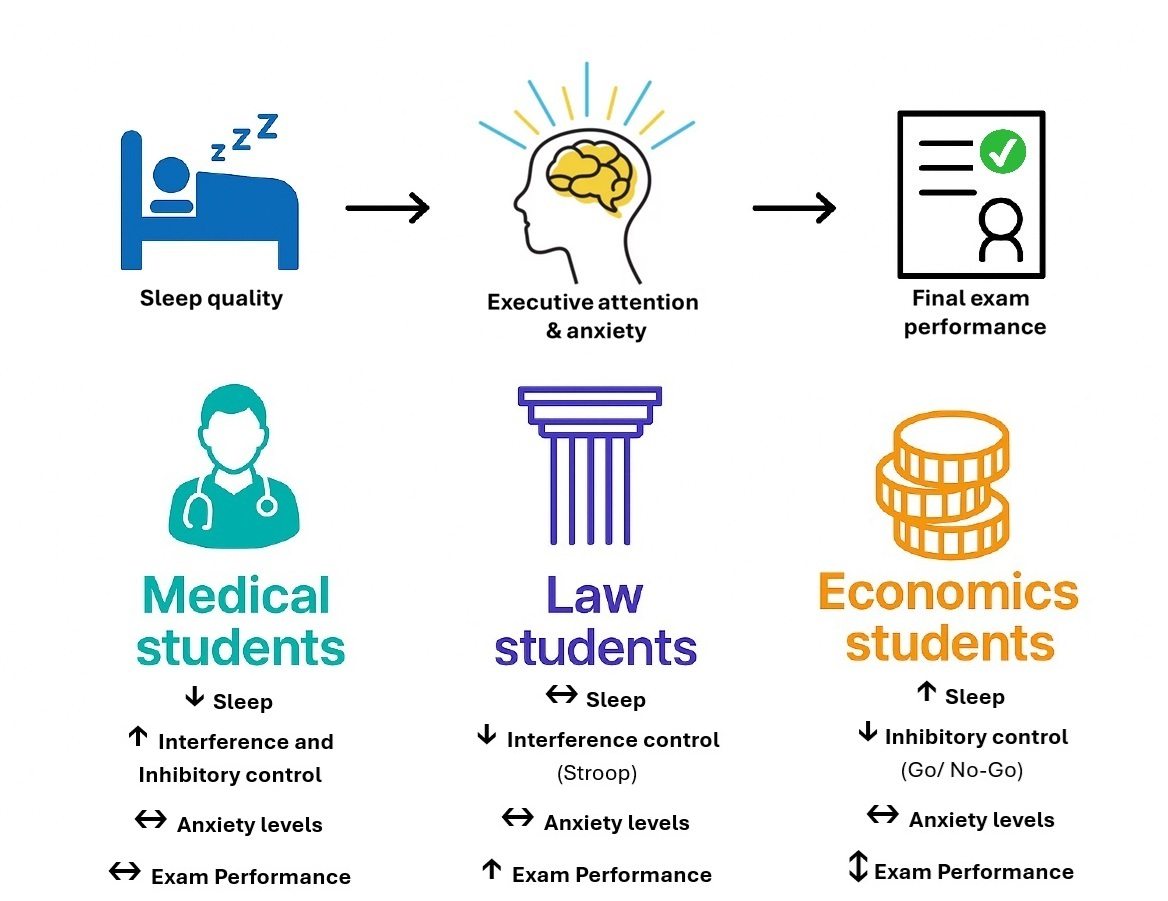
When comparing cognitive and emotional dimensions across academic programs, some relevant contrasts emerged. While significant group differences were found for sleep quality and executive attention, anxiety did not manifest differently between students by curriculum field. Medical students reported the poorest sleep quality, consistent with prior research linking medical education to irregular routines, high workloads, and limited rest [7,17,18]. Although they often possess more theoretical knowledge about health-promoting behaviors, this awareness did not seem to translate into healthier sleep practices—a paradox also discussed in the literature [7,10,40].
Conversely, Economics students reported the best sleep quality, potentially due to more flexible schedules and autonomous learning demands. However, they exhibited weaker inhibitory control in the Go/No-Go task, suggesting that better sleep does not necessarily translate into enhanced executive functioning. This dissociation reinforces that sleep quality alone may not fully explain cognitive control outcomes, especially in contexts involving emotional or attentional interference.
Beyond sleep-related differences, specific patterns of executive performance were also observed. Law students, in turn, performed significantly worse on the Stroop test, which may reflect difficulties in interference control, consistent with the analytical and verbal demands typical of legal education [2,3]. While Law students obtained the highest exam grades, these results must be interpreted with caution due to differences in assessment participation criteria across programs, which affect the representativeness of the exam-taking samples. Specifically, the exam-taking sample in Law includes the entire student cohort, whereas the Medicine and Economics samples include only students who either failed continuous assessment or opted for grade improvement. Consequently, variations in sample representativeness may also contribute to observed differences in exam performance. Nevertheless, compensatory strategies, such as academic resilience, structured learning environments, or greater verbal fluency under evaluative conditions—may also help explain the strong outcomes observed among Law students.
Taken Together, these findings may offer preliminary insights into how emotional and cognitive patterns vary across academic contexts, potentially shaped by intersecting factors such as learning demands, stress exposure, and self-regulation habits. However, given that the curricular structures were not directly assessed, future research should explore whether and how academic environments contribute to differentiated psychological functioning among students.
Such preliminary insights have practical implications, particularly insights for tailoring support strategies to the specific cognitive and emotional challenges faced by students in each academic discipline. Medical students, who reported higher anxiety and poorer sleep quality, may benefit from interventions focused on sleep hygiene, time management, and emotion regulation to mitigate the effects of academic overload [5,20]. Law students, who exhibited strong academic outcomes but weaker inhibitory control, could benefit from executive attention training and techniques to strengthen sustained focus under verbal and time-pressured conditions [24]. For Economics students, whose performance suggested more stable emotional profiles but lower inhibitory control, promoting self-regulatory strategies and consistent study routines [3] may enhance academic consistency. These differentiated approaches highlight the importance of designing field-sensitive academic support programs that address the interplay between cognitive demands, emotional readiness, and performance.
4.2. Do Medical Students Differ from Law and Economics Students in Sleep, Anxiety, and Executive Attention?
Focusing more specifically on medical students, additional findings emerged. Although medical students reported the worst sleep quality, they demonstrated superior performance on both executive attention tasks. This suggests a potential form of short-term cognitive compensation, perhaps facilitated by higher baseline cognitive resources or academic preparation. Nonetheless, such compensation may be unsustainable over time, especially under chronic stress and persistent sleep deprivation, as recent findings in medical students suggest [17]. This raises concerns about the long-term well-being of medical students and emphasizes the need to balance academic excellence with self-regulatory capacity, as highlighted in studies addressing medical student burnout and sleep-related health risks [7,10].
No significant differences were found in state or trait anxiety across groups, which is consistent with the idea that anxiety in academic settings is widespread regardless of discipline [5]. However, this does not diminish its functional impact on performance—which is explored in the following section
4.3. Do Sleep Quality, Executive Attention, and Anxiety Predict Academic Performance?
Regression models revealed that sleep quality and state anxiety significantly predicted final exam grades, while executive attention did not. These results align with literature suggesting that emotional and physiological regulation may be more influential than cognitive control in high-pressure academic contexts [10,23].
The non-significant contribution of executive attention tasks could be attributed to their limited ecological validity—a well-documented concern in neuropsychological testing [40]. These tasks may overlook real-world compensatory mechanisms utilized by students, including organizational strategies, collaborative learning, and emotion regulation. Therefore, academic success may depend more on a student’s ability to manage stress and sustain adaptive behaviors under pressure than on isolated cognitive performance in tasks like those used.
The high variability in exam grades among Economics students also points to the relevance of individual differences in self-regulation and learning strategies. This group’s more autonomous structure may intensify the role of internal motivation, discipline, and study habits in shaping academic success [3].
Limitations and future directions
Given its exploratory and observational design, the present study provides hypothesis-generating, context-specific insights rather than definitive or generalizable conclusions. This study has several important limitations.
First, the use of a small, non-random sample drawn from a one private Portuguese university restricts the generalizability of the findings. Second, variations in exam attendance policies across academic programs may have introduced selection bias: Medicine and Economics students took the final exam only to improve their grades or upon failing the continuous assessment, likely representing a more academically vulnerable subgroup. In contrast, all Law students were required to take the exam.
Related to this, the mandatory nature of final exams for Law students, compared to the optional or compensatory nature of exam participation in Medicine and Economics, may have led to selection effects that differentially shaped the cognitive and emotional profiles of each group. Specifically, Medicine and Economics subgroups may include a disproportionate number of academically vulnerable or high-achieving students seeking grade improvement, whereas the Law sample represents a broader academic spectrum. These differences should be taken into account when interpreting comparative outcomes and underscore the importance of contextualizing group comparisons within program-specific assessment frameworks.
Third, limitations were also found at the level of instrumentation. Three of the instruments used (STAI, Stroop Test, and Go/No-Go) do not have established clinical cut-off scores, which limits the interpretation of individual scores in clinical terms. As such, results should be viewed as relative comparisons within the sample, not diagnostic indicators. Moreover, the use of self-reported final exam grades may introduce bias due to memory inaccuracies or social desirability, which should be considered when interpreting academic performance outcomes.
Moreover, the small sample size, conditioned by participant availability and the number of enrolled students in each academic program, also constituted a limitation. In particular, the reduced number of medical students reflects the low registration rate for final exams in this course, as most students passed through continuous assessment. Moreover, the small size and disciplinary separation of the three groups limits the generalizability of between-group comparisons. Future studies should therefore aim to include broader and more balanced samples to ensure statistical robustness and external validity.
Regarding the cognitive measures, it is also important to consider that, despite their robust psychometric properties, the Stroop and Go/No-Go tasks may fall short in capturing the multidimensional nature of executive demands in real academic contexts. Exam situations often require prolonged attentional control, planning, decision-making under stress, and adaptive flexibility—functions that extend beyond the inhibitory and interference resolution processes measured by these tools. As such, the null findings may reflect instrument limitations rather than the absence of an executive attention effect.
Furthermore, although the Stroop and Go/No-Go tasks are well-validated and widely used in both research and clinical settings, their direct relevance to academic functioning remains limited. Future research should incorporate more ecologically valid instruments and explore variables such as coping strategies, academic self-efficacy, and emotion regulation, which may act as mediators between sleep, anxiety, and performance.
Finally, longitudinal and mixed-method designs would provide a more comprehensive picture of how these processes interact over time. Understanding the examination of course-specific dynamics is essential to inform tailored, evidence-based interventions that reflect the realities of students’ academic experiences.
Taken together, these methodological constraints indicate that the present findings should be interpreted as preliminary and context-bound, offering a foundation for future, more robust research rather than firm conclusions.
5. Conclusions
This study offers a nuanced understanding of how sleep quality and state anxiety contribute to academic performance under evaluative pressure, highlighting the interplay between emotional regulation, cognitive control, and contextual academic factors. While executive attention did not emerge as a direct predictor of exam outcomes, its patterns across disciplines revealed meaningful insights into course-specific cognitive demands and student functioning.
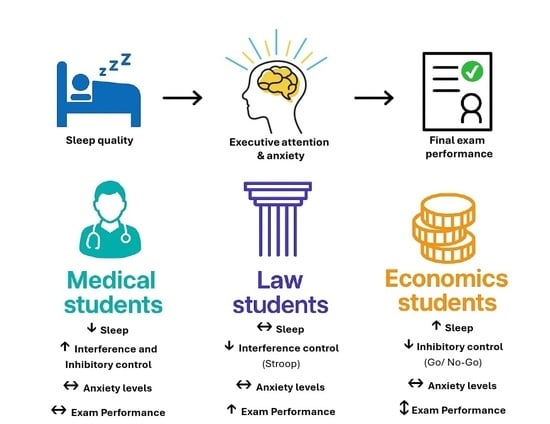
By comparing students from Medicine, Law, and Economics, this research underscores the multidimensional nature of academic performance, shaped not only by cognitive ability but also by emotional and behavioral adaptation to stress. Medical students demonstrated stronger executive performance yet poorer sleep quality, suggesting short-term cognitive compensation under pressure that may be unsustainable over time. Law students exhibited lower interference control but higher exam achievement, likely reflecting adaptive verbal reasoning and task-specific skills. Economics students, meanwhile, reported better sleep but greater variability in performance, pointing to the influence of motivational and self-regulatory factors.
Together, these findings reinforce the need to interpret academic outcomes within each program’s cognitive and emotional ecology, emphasizing that success in higher education extends beyond intellectual capability to include psychological resilience and behavioral consistency.
From an applied perspective, institutions should invest in discipline-sensitive support programs tailored to students’ distinctive challenges—including sleep hygiene promotion, stress management, time optimization, and executive attention training, to foster both academic success and mental well-being.
Ultimately, this study contributes to the growing body of evidence that academic performance cannot be decoupled from emotional and behavioral health. It calls for policies that bridge theoretical understanding and lived student experience, especially in demanding academic contexts such as medical education, where performance pressures often override health-promoting intentions.
Author Contributions
Conceptualization, C.F., J.R. and A.C.-C.; methodology, C.F. and J.R.; software, C.F.; validation, C.F. and J.R.; formal analysis, C.F.; investigation, C.F.; resources, C.F.; data curation, C.F. and A.C.-C.; writing—original draft preparation, C.F. and J.R.; writing—review and editing, J.R. and A.C.-C.; visualization, C.F.; supervision, J.R. and A.C.-C. All authors have read and agreed to the published version of the manuscript.
Funding
This research received no external funding.
Institutional Review Board Statement
The study was conducted in accordance with the Declaration of Helsinki, and approved by the Ethics Committee of Universidade Católica Portuguesa (protocol code 40/2024).
Informed Consent Statement
Informed consent was obtained from all subjects involved in the study.
Data Availability Statement
The current study was conducted as part of the master’s dissertation 378 in Neuropsychology of the first author (Carina Sofia Correia Ferreira), approved by the Ethics Com- 379 mittee of Universidade Católica Portuguesa (protocol code 40/2024). The database supporting the 380 findings of this study is available from the first author upon reasonable request.
Acknowledgments
The authors would like to thank the students and faculty members from the participating courses for their time, availability, and collaboration, which made this study possible. Special thanks are also extended to those who facilitated data collection during the examination period. The authors further acknowledge Joana Carneiro Pinto for her constructive comments and insightful feedback, which contributed to the improvement of this work.
Conflicts of Interest
The authors declare no conflicts of interest.
Abbreviations
The following abbreviations are used in this manuscript:
| AP | Academic Performance |
| PSQI | Pittsburgh Sleep Quality Index |
| ESS | Epworth Sleepiness Scale |
| STAI—S | State Anxiety Inventory |
| STAI—T | Trait Anxiety Inventory |
| BDI-II | Beck Depression Inventory |
| SPSS | Statistical Package for the Social Sciences |
References
- Almeida, L.S.; Soares, A.P.; Ferreira, J.A.G. Transição e adaptação à universidade: Apresentação de um questionário de vivências acadêmicas (QVA). Psicologia 2000, 14, 189–208. [Google Scholar]
- Matta, C.M.B.D.; Lebrão, S.M.G.; Heleno, M.G.V. Adaptação, rendimento, evasão e vivências acadêmicas no ensino superior: Revisão da literatura. Psicol. Esc. Educ. 2017, 21, 583–591. [Google Scholar] [CrossRef]
- Richardson, M.; Abraham, C.; Bond, R. Psychological correlates of university students’ academic performance: A systematic review and meta-analysis. Psychol. Bulletin. 2012, 138, 353. [Google Scholar] [CrossRef]
- Khoshhal, K.I.; Khairy, G.A.; Guraya, S.Y.; Guraya, S.S. Exam Anxiety Undergrad. Med. Stud. Taibah University Med. Teach. 2017, 39, S22–S26. [Google Scholar] [CrossRef]
- Kumari, A.; Jain, J. Examination stress and anxiety: A study of college students. Glob. J. Multidiscip. Stud. 2014, 4, 31–40. [Google Scholar]
- Beiter, R.; Nash, R.; McCrady, M.; Rhoades, D.; Linscomb, M.; Clarahan, M.; Sammut, S. The prevalence and correlates of depression, anxiety, and stress in a sample of college students. J. Affect. Disord. 2015, 173, 90–96. [Google Scholar] [CrossRef]
- Dahlin, M.; Joneborg, N.; Runeson, B. Stress and depression among medical students: A cross-sectional study. Med. Educ. 2005, 39, 594–604. [Google Scholar] [CrossRef]
- Carlesso, J.P.P. Os desafios da vida acadêmica e o sofrimento psíquico dos estudantes universitários. Res. Soc. Dev. 2020, 9, e82922092. [Google Scholar] [CrossRef]
- João, K.A.R.; Jesus, S.N.; Carmo, C.; Pinto, P. The impact of sleep quality on the mental health of a non-clinical population. Sleep Med. 2018, 46, 69–73. [Google Scholar] [CrossRef] [PubMed]
- Alrashed, F.A.; Alsubiheen, A.M.; Alshammari, H.; Mazi, S.I.; Al-Saud, S.A.; Alayoubi, S.; Dhiman, G. Stress, anxiety, and depression in pre-clinical medical students: Prevalence and association with sleep disorders. Sustainability 2022, 14, 11320. [Google Scholar] [CrossRef]
- Paiva, T. Bom Sono, Boa Vida, 7th ed.; Oficina do Livro: Alfragide, Protugal, 2015. [Google Scholar]
- Choueiry, N.; Salamoun, T.; Jabbour, H.; El Osta, N.; Hajj, A.; Rabbaa Khabbaz, L. Insomnia and relationship with anxiety in university students: A cross-sectional designed study. PLoS ONE 2016, 11, e0149643. [Google Scholar] [CrossRef]
- Goel, N.; Rao, H.; Durmer, J.S.; Dinges, D.F. Neurocognitive consequences of sleep deprivation. Semin. Neurol. 2009, 29, 320–339. [Google Scholar] [CrossRef]
- Lo, J.C.; Ong, J.L.; Leong, R.L.; Gooley, J.J.; Chee, M.W. Cognitive performance, sleepiness, and mood in partially sleep-deprived adolescents: The need for sleep study. Sleep 2016, 39, 687–698. [Google Scholar] [CrossRef] [PubMed]
- Casey, B.J.; Jones, R.M.; Hare, T.A. The adolescent brain. Ann. N. Y. Acad. Sci. 2008, 1124, 111–126. [Google Scholar] [CrossRef]
- Luna, B.; Padmanabhan, A.; O’Hearn, K. What has fMRI told us about the development of cognitive control through adolescence? Brain Cogn. 2010, 72, 101–113. [Google Scholar] [CrossRef] [PubMed]
- Mota Albuquerque, P.; Ribeiro Franco, C.M.; Sampaio Rocha-Filho, P.A. Assessing the impact of sleep restriction on the attention and executive functions of medical students: A prospective cohort study. Acta Neurol. Belg. 2023, 123, 1421–1427. [Google Scholar] [CrossRef]
- Allen Gomes, A.; Tavares, J.; Pinto De Azevedo, M.H. Padrões de sono em estudantes. Acta Med. Port. 2009, 22, 545–552. Available online: https://pubmed.ncbi.nlm.nih.gov/19944037/ (accessed on 9 December 2025).
- Carvalho, T.M.D.C.S.; da Silva Junior, I.I.; de Siqueira, P.P.S.; de Oliveira Almeida, J.; Soares, A.F.; de Lima, A.M.J. Qualidade do sono e sonolência diurna entre estudantes universitários de diferentes áreas. Rev. Neurociências 2013, 21, 383–387. [Google Scholar] [CrossRef]
- Curcio, G.; Ferrara, M.; De Gennaro, L. Sleep loss, learning capacity and academic performance. Sleep Med. Rev. 2006, 10, 323–337. [Google Scholar] [CrossRef]
- Walker, M. Why We Sleep: Unlocking the Power of Sleep and Dreams; Simon and Schuster: New York, NY, USA, 2017. [Google Scholar]
- Cassady, J.C.; Johnson, R.E. Cognitive Test Anxiety and Academic Performance. Contemp. Educ. Psychol. 2002, 27, 270–295. [Google Scholar] [CrossRef]
- Eysenck, M.W.; Derakshan, N.; Santos, R.; Calvo, M.G. Anxiety and cognitive performance: Attentional control theory. Emotion 2007, 7, 336–353. [Google Scholar] [CrossRef]
- Diamond, A. Executive functions. Annu. Rev. Psychol. 2013, 64, 135–168. [Google Scholar] [CrossRef]
- Toplak, M.E.; West, R.F.; Stanovich, K.E. Do performance-based measures and ratings of executive function assess the same construct? J. Child Psychol. Psychiatry 2013, 54, 131–143. [Google Scholar] [CrossRef]
- Buysse, D.J.; Reynolds, C.F., III; Monk, T.H.; Berman, S.R.; Kupfer, D.J. The Pittsburgh Sleep Quality Index: A new instrument for psychiatric practice and research. Psychiatry Res. 1989, 28, 193–213. [Google Scholar] [CrossRef]
- Mapi Research Institute. Questionário de Pittsburgh Sobre a Qualidade do Sono; PQSI—Portugal/Portuguese—Version of 18 Sep 08 [ID4842/PSQI_AU1.0_por-PT.doc]; Mapi Research Trust: Boston, MA, USA, 2008; Available online: https://eprovide.mapi-trust.org/instruments/pittsburgh-sleep-quality-index#languages (accessed on 9 December 2025).
- Gomes, A.A.; Marques, D.R.; Meiavia, A.M.; Cunha, F.; Clemente, V. Psychometric properties and accuracy of the European Portuguese version of the Pittsburgh Sleep Quality Index in clinical and non-clinical samples. Sleep Biol. Rhythm. 2018, 16, 413–422. [Google Scholar] [CrossRef]
- Johns, M.W. A new method for measuring daytime sleepiness: The Epworth sleepiness scale. Sleep 1991, 14, 540–545. [Google Scholar] [CrossRef] [PubMed]
- Santos, C.R. Avaliação da Sonolência Diurna Excessiva: Adaptação Cultural e Linguística da Escala de Sonolência de Epworth Para a População Portuguesa. Bachelor’s Thesis, Escola Superior de Tecnologia do Porto, Porto, Portugal, 2001. [Google Scholar]
- Spielberger, C.D.; Gorsuch, R.L.; Lushene, R.E. Manual for the State-Trait Anxiety Inventory; Consulting Psychologist Press: Palo Alto, CA, USA, 1970. [Google Scholar]
- Silva, D.R.; Spielberger, C.D. Manual do Inventário de Estado-Traço de Ansiedade (STAI); Mind Garden Inc.: Menlo Park, CA, USA, 2011. [Google Scholar]
- Beck, A.T.; Steer, R.A.; Brown, G.K. Manual for the Beck Depression Inventory-II; Psychological Corporation: San Antonio, TX, USA, 1996. [Google Scholar]
- Martins, A.M.Q. As Manifestações Clínicas da Depressão na Adolescência. 2000. Available online: https://hdl.handle.net/10216/10115 (accessed on 9 December 2025).
- Stroop, J.R. Studies of interference in serial verbal reactions. J. Exp. Psychol. 1935, 18, 643–662. [Google Scholar] [CrossRef]
- Golden, C.J.; Freshwater, S.M. Stroop Color and Word Test Kit for Adults; Frontiers Media: Lausanne, Switzerland, 2002. [Google Scholar]
- Fernandes, S. Adaptação Portuguesa do Stroop—Teste de Cores e Palavras; CEGOC-TEA: Lisboa, Portugal, 2013. [Google Scholar]
- Dubois, B.; Slachevsky, A.; Litvan, I.; Pillon, B. The FAB: A Frontal Assessment Battery at bedside. Neurology 2000, 55, 1621–1626. [Google Scholar] [CrossRef]
- Lima, C.F.; Meireles, L.P.; Fonseca, R.; Castro, S.L.; Garrett, C. The Frontal Assessment Battery (FAB) in Parkinson’s disease and correlations with formal measures of executive functioning. J. Neurol. 2008, 255, 1756–1761. [Google Scholar] [CrossRef] [PubMed]
- Lezak, M.D.; Howieson, D.B.; Bigler, E.D.; Tranel, D. Neuropsychological Assessment, 5th ed.; Oxford University Press: Oxford, UK, 2012. [Google Scholar]

Disclaimer/Publisher’s Note: The statements, opinions and data contained in all publications are solely those of the individual author(s) and contributor(s) and not of MDPI and/or the editor(s). MDPI and/or the editor(s) disclaim responsibility for any injury to people or property resulting from any ideas, methods, instructions or products referred to in the content. |
© 2025 by the authors. Licensee MDPI, Basel, Switzerland. This article is an open access article distributed under the terms and conditions of the Creative Commons Attribution (CC BY) license.