
Learning Anatomy in Disruptive Times: Physiotherapy Students’ Perspectives on Blended Pedagogy in Higher Education

 , ,
, ,
Abstract
1. Introduction
2. Materials and Methods
2.1. Study Design
2.2. Participants
2.3. Sample Size
2.4. Anatomy Education
2.5. Before the COVID-19 Pandemic
2.6. During the COVID-19 Pandemic
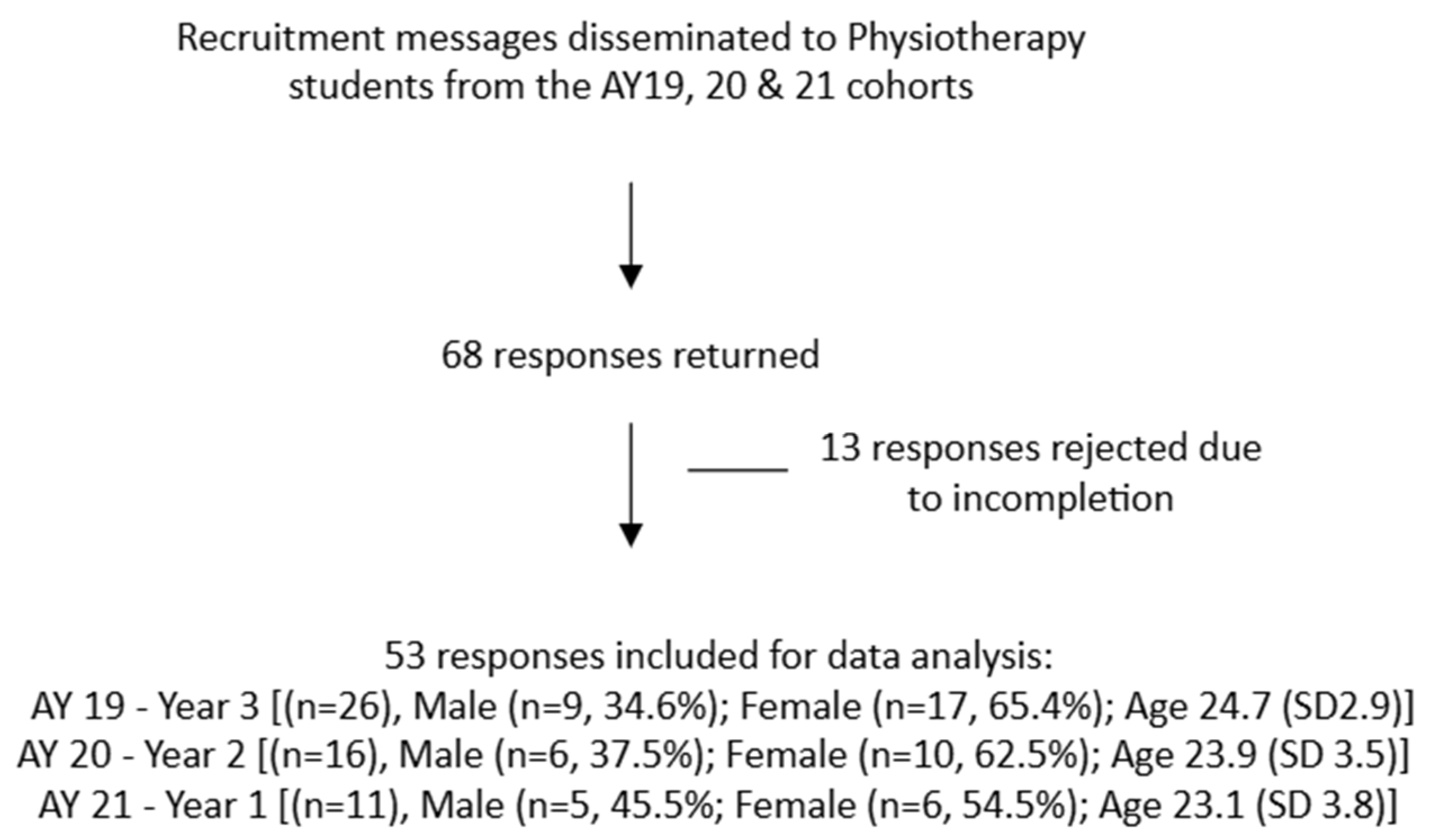
- Year 3 (2019–2020): Experienced face-to-face lectures and practicals prior to the pandemic, transitioning to online practicals mid-term.
- Year 2 (2021): Began with fully online lectures and tutorials, with limited face-to-face practical access.
- Year 1 (2022): Experienced a combination of online lectures and tutorials with progressive resumption of face-to-face practical sessions.
2.7. Instruments
- General demographic information, including age, sex, and year of study.
- Seven questions were explicitly targeted at Year 3 students who experienced both face-to-face anatomy education (from September 2019 to February 2020) and online instruction (from February to April 2020) due to the pandemic-related shift. This section explored their personal preferences and comparative experiences across the two teaching modalities.
- 14 items evaluating the quality of anatomy education during the COVID-19 pandemic.
- 5 questions assessing students’ experiences with the online OSPE, and
- 3 questions related to students’ accessibility to online resources during the pandemic.
Survey Development and Validation
2.8. Data Analysis
3. Results
4. Discussion
5. Conclusions
Supplementary Materials
Author Contributions
Funding
Institutional Review Board Statement
Informed Consent Statement
Data Availability Statement
Acknowledgments
Conflicts of Interest
Abbreviations
| AY19 | Academic Year 2019 matriculation (September 2019 to August 2020) |
| AY20 | Academic Year 2020 matriculation (September 2020 to August 2021) |
| AY21 | Academic Year 2021 matriculation (September 2021 to August 2022) |
References
- Watts Isley, J.; Gonzales, R.; Drey, J.; Ritter, E.Q.; Lawrence, W.R.; Rowe, B.; Sosa, P. Adaptability, Change, Hope: Student Perspectives During the COVID-19 Pandemic. Am. J. Public Health 2021, 111, 63–65. [Google Scholar] [CrossRef]
- Iwanaga, J.; Loukas, M.; Dumont, A.S.; Tubbs, R.S. A review of anatomy education during and after the COVID-19 pandemic: Revisiting traditional and modern methods to achieve future innovation. Clin. Anat. 2021, 34, 108–114. [Google Scholar] [CrossRef]
- Ghosh, S.K. Cadaveric dissection as an educational tool for anatomical sciences in the 21st century. Anat. Sci. Educ. 2017, 10, 286–299. [Google Scholar] [CrossRef]
- Dziedzic, M.; Ostrowski, P.; Ghosh, S.K.; Balawender, K.; Koziej, M.; Bonczar, M. Exploring the evolution of anatomy: From historical foundations to modern insights. Transl. Res. Anat. 2024, 35, 100286. [Google Scholar] [CrossRef]
- Ghosh, S.K. Human cadaveric dissection: A historical account from ancient Greece to the modern era. Anat. Cell Biol. 2015, 48, 153–169. [Google Scholar] [CrossRef] [PubMed]
- Gangata, H.; Porter, S.; Artz, N.; Major, K. A proposed anatomy syllabus for entry-level physiotherapists in the United Kingdom: A modified Delphi methodology by physiotherapists who teach anatomy. Clin. Anat. 2023, 36, 503–526. [Google Scholar] [CrossRef]
- Saladin, L.; Voight, M. Introduction to The Movement System as The Foundation for Physical Therapist Practice Education And Research. Int. J. Sports Phys. Ther. 2017, 12, 858–861. [Google Scholar] [CrossRef]
- Diaz, C.M.; Woolley, T. “Learning by Doing”: A Mixed-Methods Study to Identify Why Body Painting Can Be a Powerful Approach for Teaching Surface Anatomy to Health Science Students. Med. Sci. Educ. 2021, 31, 1875–1887. [Google Scholar] [CrossRef] [PubMed]
- Xiao, J.; Evans, D.J.R. Anatomy education beyond the Covid-19 pandemic: A changing pedagogy. Anat. Sci. Educ. 2022, 15, 1138–1144. [Google Scholar] [CrossRef]
- Adnan, S.; Benson, A.C.; Xiao, J. How virtual reality is being adopted in anatomy education in health sciences and allied health: A systematic review. Anat. Sci. Educ. 2025, 18, 496–525. [Google Scholar] [CrossRef] [PubMed]
- Emadzadeh, A.; EidiBaygi, H.; Mohammadi, S.; Etezadpour, M.; Yavari, M.; Mastour, H. Virtual Dissection: An Educational Technology to Enrich Medical Students’ Learning Environment in Gastrointestinal Anatomy Course. Med. Sci. Educ. 2023, 33, 1175–1182. [Google Scholar] [CrossRef]
- Martin, A.J.; Marsh, H.W. Academic resilience and academic buoyancy: Multidimensional and hierarchical conceptual framing of causes, correlates and cognate constructs. Oxf. Rev. Educ. 2009, 35, 353–370. [Google Scholar] [CrossRef]
- Martin, A.J. Academic buoyancy and academic resilience: Exploring ‘everyday’ and ‘classic’ resilience in the face of academic adversity. Sch. Psychol. Int. 2013, 34, 488–500. [Google Scholar] [CrossRef]
- Abdelrahman, H.; Al Qadire, M.; Ballout, S.; Rababa, M.; Kwaning, E.N.; Zehry, H. Academic Resilience and its Relationship with Emotional Intelligence and Stress Among University Students: A Three-Country Survey. Brain Behav. 2025, 15, e70497. [Google Scholar] [CrossRef] [PubMed]
- Cai, Z.; Meng, Q. Academic resilience and academic performance of university students: The mediating role of teacher support. Front. Psychol. 2025, 16, 1463643. [Google Scholar] [CrossRef] [PubMed]
- Sharma, A.; Minh Duc, N.T.; Luu Lam Thang, T.; Nam, N.H.; Ng, S.J.; Abbas, K.S.; Huy, N.T.; Marušić, A.; Paul, C.L.; Kwok, J.; et al. A Consensus-Based Checklist for Reporting of Survey Studies (CROSS). J. Gen. Intern. Med. 2021, 36, 3179–3187. [Google Scholar] [CrossRef]
- Cochran, W.G.; Cochran, W.G.; Bouclier, A.S. Sampling Techniques; Wiley: New York, NY, USA, 1977. [Google Scholar]
- Babacan, S.; Dogru Yuvarlakbas, S. Digitalization in education during the COVID-19 pandemic: Emergency distance anatomy education. Surg. Radiol. Anat. 2022, 44, 55–60. [Google Scholar] [CrossRef]
- Dost, S.; Hossain, A.; Shehab, M.; Abdelwahed, A.; Al-Nusair, L. Perceptions of medical students towards online teaching during the COVID-19 pandemic: A national cross-sectional survey of 2721 UK medical students. BMJ Open 2020, 10, e042378. [Google Scholar] [CrossRef]
- Klein, R.; Tomassoni, C.; Rajaraman, G.; Winchester, M.; Eizenberg, N.; Sinnayah, P. First Year Student Perception and Experience of Online Topographical Anatomy Laboratory Classes using Zoom Technology during the COVID-19 Pandemic. Int. J. Innov. Sci. Math. Educ. 2021, 29, 17–31. [Google Scholar] [CrossRef]
- Meryl Rachel, J.; Dhanesh Kumar, S.; Joseph Abraham, P.; Vijay Kumar, K. A Study on the Advantages and Disadvantages of the Online Teaching Program Conducted in the Department of Anatomy, AIIMS, Raipur–Students’ Perspective. Natl. J. Clin. Anat. 2021, 10, 10–16. [Google Scholar] [CrossRef]
- Roy, H.; Ray, K.; Saha, S.; Ghosal, A. A Study on Students’ Perceptions for Online Zoom-app based Flipped Class Sessions on Anatomy Organised during the Lockdown Period of COVID-19 Epoch. J. Clin. Diagn. Res. 2020, 14, AC01–AC04. [Google Scholar] [CrossRef]
- Saverino, D.; Marcenaro, E.; Zarcone, D. Teaching histology and anatomy online during the COVID-19 pandemic. Clin. Anat. 2022, 35, 129–134. [Google Scholar] [CrossRef]
- Singal, A.; Bansal, A.; Chaudhary, P.; Singh, H.; Patra, A. Anatomy education of medical and dental students during COVID-19 pandemic: A reality check. Surg. Radiol. Anat. 2021, 43, 515–521. [Google Scholar] [CrossRef]
- Totlis, T.; Tishukov, M.; Piagkou, M.; Kostares, M.; Natsis, K. Online educational methods vs. traditional teaching of anatomy during the COVID-19 pandemic. Anat. Cell Biol. 2021, 54, 332–339. [Google Scholar] [CrossRef] [PubMed]
- Turhan, B.; Yakut, Y. The opinions of physiotherapy students on online anatomy education during COVID-19 pandemic. Anatomy 2020, 14, 134–138. [Google Scholar] [CrossRef]
- Mitchell, M.K.; Burns, A.W.; Mohammed, S.; Balasalle, E.; Rikard, B.K.; Ghandour, S.; Avery, L.; Lang, M.; Uppot, R. Augmented Reality for Anatomy Training: Efficacy and Interest Among Medical Trainees. J. Med. Ext. Real. 2024, 1, 191–201. [Google Scholar] [CrossRef]
- Sinou, N.; Sinou, N.; Filippou, D. Virtual Reality and Augmented Reality in Anatomy Education During COVID-19 Pandemic. Cureus 2023, 15, e35170. [Google Scholar] [CrossRef]
- Keržič, D.; Alex, J.K.; Pamela Balbontín Alvarado, R.; Bezerra, D.d.S.; Cheraghi, M.; Dobrowolska, B.; Fagbamigbe, A.F.; Faris, M.E.; França, T.; González-Fernández, B.; et al. Academic student satisfaction and perceived performance in the e-learning environment during the COVID-19 pandemic: Evidence across ten countries. PLoS ONE 2021, 16, e0258807. [Google Scholar] [CrossRef]
- Qiang, J.; He, X.; Xia, Z.; Huang, J.; Xu, C. The association between intolerance of uncertainty and academic burnout among university students: The role of self-regulatory fatigue and self-compassion. Front. Public Health 2024, 12, 1441465. [Google Scholar] [CrossRef]
- Samarasekera, D.; Goh, D.; Yeo, S.; Ngiam, N.; Aw, M.; Lim, M.; Pillai, S.; Lee, S.; Mahadevan, M.; Kow, A.; et al. Response and Lessons Learnt Managing the COVID-19 Crisis by School of Medicine, National University of Singapore [version 1]. MedEdPublish 2020, 9, 92. [Google Scholar] [CrossRef] [PubMed]
- Wee, L.E.; Venkatachalam, I.; Sim, X.Y.J.; Tan, K.B.-K.; Wen, R.; Tham, C.K.; Gan, W.H.; Ko, K.K.K.; Ho, W.Q.; Kwek, G.T.C.; et al. Containment of COVID-19 and reduction in healthcare-associated respiratory viral infections through a multi-tiered infection control strategy. Infect. Dis. Health 2021, 26, 123–131. [Google Scholar] [CrossRef] [PubMed]
- Deng, Y.; Liu, H. To overcome test anxiety in online assessment: Unpacking the mediator roles of techno competencies, teacher support, self-efficacy, and autonomy. BMC Psychol. 2025, 13, 192. [Google Scholar] [CrossRef] [PubMed]
- Jaap, A.; Dewar, A.; Duncan, C.; Fairhurst, K.; Hope, D.; Kluth, D. Effect of remote online exam delivery on student experience and performance in applied knowledge tests. BMC Med. Educ. 2021, 21, 86. [Google Scholar] [CrossRef]
- Brewer, M.L.; van Kessel, G.; Sanderson, B.; Naumann, F.; Lane, M.; Reubenson, A.; Carter, A. Resilience in higher education students: A scoping review. High. Educ. Res. Dev. 2019, 38, 1105–1120. [Google Scholar] [CrossRef]



| Question | Strongly Disagree n (%) | Somewhat Disagree n (%) | Neither Agree nor Disagree n (%) | Somewhat Agree n (%) | Strongly Agree n (%) | Total Mean (SD) Median | |
|---|---|---|---|---|---|---|---|
| 4 | Online anatomy teaching was more effective than face-to-face lectures and tutorials. | 1 (3.9) | 17 (65.4) | 4 (15.4) | 4 (15.4) | 0 (0.0) | 2.4 (0.8) 2 |
| 5 | Online anatomy education was as interactive as listening to the lecture face-to-face. | 5 (8.3) | 12 (46.2) | 2 (7.7) | 6 (23.1) | 1 (3.9) | 2.5 (1.2) 2 |
| 6 | I missed the face-to-face interaction after the tutorials when I could clarify difficult concepts with the faculty. | 0 (0.0) | 1 (3.9) | 1 (3.9) | 12 (46.2) | 12 (46.2) | 4.4 (0.8) 4 |
| 7 | The online anatomy lab sessions with the silent mentor were as effective as the face-to-face sessions at Anatomy Hall. | 9 (34.6) | 13 (50.0) | 2 (7.7) | 1 (3.9) | 1 (3.9) | 1.9 (1.0) 2 |
| 8 | Overall, I would prefer attending online anatomy teaching than the face-to-face curriculum. | 7 (26.9) | 13 (50.0) | 1 (3.9) | 5 (8.3) | 0 (0.0) | 2.12 (1.1) 2 |
| 9 | I felt less stressed during anatomy OSPE when it was conducted online compared to face-to-face. | 2 (7.7) | 2 (7.7) | 3 (11.5) | 12 (46.2) | 7 (26.9) | 3.8 (1.2) 4 |
| 10 | I could focus better during online OSPE since I did not have to move between stations physically | 2 (7.7) | 4 (14.4) | 3 (11.5) | 11 (42.3) | 6 (23.1) | 3.6 (1.2) 4 |
| Question | Strongly Disagree n (%) | Somewhat Disagree n (%) | Neither Agree nor Disagree n (%) | Somewhat Agree n (%) | Strongly Agree n (%) | Total Mean (SD) Median | Year 1&2 Mean (SD) Median | Year 3 Mean (SD) Median | Mann–Whitney U | p Value | r_rb (r) | |
|---|---|---|---|---|---|---|---|---|---|---|---|---|
| 11 | Anatomy education via online classes was clear and easy to follow | 0 | 7 | 6 | 37 | 3 | 3.7 (0.8) 4 | 3.8 (0.9) 4 | 3.5 (0.7) 4 | 268 | 0.144 | 0.25 |
| 12 | The teaching materials used in online education were sufficient for the purpose of the module, e.g., I did not have to source my own additional materials to supplement what was provided. | 1 | 15 | 12 | 22 | 3 | 3.2 (1.0) 3 | 3.2 (1.1) 3 | 3.2 (0.9) 3 | 346 | 0.936 | 0.01 |
| 13 | The duration of the online anatomy lectures was optimal to maintain concentration throughout. | 4 | 9 | 14 | 24 | 2 | 3.2 (1.0) 3 | 3.1 (1.2) 3 | 3.3 (0.9) 4 | 318 | 0.565 | 0.09 |
| 14 | I attended most of the online anatomy lectures during the live lecture time. | 3 | 8 | 4 | 19 | 19 | 3.8 (1.2) 4 | 3.8 (1.4) 4 | 3.8 (1.1) 4 | 322 | 0.607 | 0.08 |
| 15 | I prefer viewing most of the online anatomy lectures via the recordings for flexibility (play, pause, rewind, watch at faster/slower speed) and at my own time. | 1 | 4 | 4 | 18 | 26 | 4.2 (1.0) 4 | 4.4 (0.9) 5 | 4.0 (1.1) 4 | 259 | 0.103 | 0.25 |
| 16 | Interacting with my classmates during the online lectures and tutorials was easy via Zoom. | 6 | 11 | 14 | 20 | 2 | 3.0 (1.1) 3 | 2.9 (1.2) 3 | 3.1 (1.0) 3.5 | 312 | 0.495 | 0.10 |
| 17 | I was able to post questions easily to the instructor during the online teaching. | 0 | 7 | 9 | 24 | 13 | 3.8 (1.0) 4 | 4.0 (0.9) 4 | 3.7 (1.0) 4 | 294 | 0.317 | 0.15 |
| 18 | Question and answer sessions by instructors during online teaching had similar effectiveness as face-to-face lessons. | 1 | 19 | 8 | 19 | 6 | 3.2 (1.1) 3 | 3.3 (1.2) 3 | 3.1 (1.0) 3 | 326 | 0.658 | 0.07 |
| 19 | The online anatomy education was interactive and fun. | 0 | 9 | 21 | 21 | 2 | 3.3 (0.8) 3 | 3.3 (0.8) 3 | 3.3 (0.78) 3 | 346 | 0.936 | 0.01 |
| 20 | The model visuals used in online E-museum sessions were sufficient to supplement what was taught during online lectures and tutorials. | 2 | 12 | 11 | 24 | 4 | 3.3 (1.0) 4 | 3.3 (1.1) 4 | 3.3 (1.0) 3.5 | 344 | 0.908 | 0.02 |
| 21 | The functional anatomy videos (e.g., anatomical structures used in shoulder rotation) used in online anatomy E-museum were sufficient. | 1 | 8 | 15 | 27 | 2 | 3.4 (0.9) 4 | 3.4 (1.0) 4 | 3.4 (0.8) 4 | 342 | 0.880 | 0.02 |
| 22 | Face-to-face anatomy tutorials were more effective for my learning. | 1 | 4 | 4 | 19 | 25 | 4.2 (1.0) 4 | 4.1 (1.2) 5 | 4.2 (0.8) 4 | 325 | 0.645 | 0.07 |
| 23 | The face-to-face lab environment in the anatomy hall with the silent mentors was conducive to my learning. | 0 | 0 | 1 | 17 | 35 | 4.6 (0.5) 5 | 4.9 (0.3) 5 | 4.4 (0.6) 4 | 186 | 0.004 * | 0.49 |
| 24 | The 2-dimensional cadaver photos/diagrams during online E-museum were easy to understand and aided my learning by supplementing what was taught in lectures, tutorials and anatomy lab. | 2 | 10 | 12 | 26 | 3 | 3.3 (1.0) 4 | 3.4(1.0) 4 | 3.3 (0.9) 3 | 321 | 0.601 | 0.08 |
| 25 | The online E-museum was concise and focused | 0 | 4 | 17 | 30 | 2 | 3.6 (0.7) 4 | 3.5(0.8) 4 | 3.7 (0.6) 4 | 310 | 0.473 | 0.11 |
| 26 | Having silent mentors during face-to-face lab sessions made it easier to appreciate the relationship between structure and function, as well as anatomy landmarks. | 0 | 0 | 2 | 6 | 45 | 4.8 (0.5) 5 | 4.9 (0.3) 5 | 4.7 (0.6) 5 | 294 | 0.117 | 0.22 |
| Question | Strongly Disagree n (%) | Somewhat Disagree n (%) | Neither Agree nor Disagree n (%) | Somewhat Agree n (%) | Strongly Agree n (%) | Total Mean (SD) Median | Year 1 & 2 Mean (SD) Median | Year 3 Mean (SD) Median | Mann–Whitney U | p Value | r_rb (r) | |
|---|---|---|---|---|---|---|---|---|---|---|---|---|
| 27 | The pictures shown during the online practical exam were a good representation of what I saw during the face-to-face lab sessions. | 5 | 19 | 5 | 22 | 2 | 2.9 (1.2) 3 | 2.9 (1.2) 3 | 3.0 (1.1) 3.5 | 332 | 0.736 | 0.05 |
| 28 | The markings used in the pictures during the online practical exam were readily identifiable. | 2 | 19 | 9 | 18 | 5 | 3.1 (1.1) 3 | 3.2 (1.1) 3 | 3.0 (1.1) 3.0 | 308 | 0.451 | 0.11 |
| 29 | I would have preferred OSPE to be conducted face-to-face in the anatomy hall than online. | 7 | 6 | 12 | 14 | 14 | 3.4(1.4) 4 | 3.0 (1.5) 3 | 3.9 (1.0) 4 | 240 | 0.047 | 0.28 |
| 30 | I prefer typing out my answers rather than writing them in an examination. | 1 | 5 | 13 | 17 | 17 | 3.8 (1.1) 4 | 4.0 (1.2) 5 | 3.6 (0.9) 4 | 251 | 0.078 | 0.25 |
| 31 | I find online OSPE difficult as I am not able to refer back to the previous questions (and had no rest stations unlike face-to-face OSPE). | 2 | 5 | 11 | 22 | 13 | 3.7(1.1) 4 | 3.4 (1.1) 4 | 4.0 (0.9) 4 | 244 | 0.048 | 0.28 |
Disclaimer/Publisher’s Note: The statements, opinions and data contained in all publications are solely those of the individual author(s) and contributor(s) and not of MDPI and/or the editor(s). MDPI and/or the editor(s) disclaim responsibility for any injury to people or property resulting from any ideas, methods, instructions or products referred to in the content. |
© 2025 by the authors. Licensee MDPI, Basel, Switzerland. This article is an open access article distributed under the terms and conditions of the Creative Commons Attribution (CC BY) license.
Share and Cite
Yeung, M.T.; Harve, K.S.; Chiu, C.C.; Kler, J.S.; Ahmad Lukman, R.A.B.; Leung, B.P. Learning Anatomy in Disruptive Times: Physiotherapy Students’ Perspectives on Blended Pedagogy in Higher Education. Trends High. Educ. 2026, 5, 4. https://doi.org/10.3390/higheredu5010004
Yeung MT, Harve KS, Chiu CC, Kler JS, Ahmad Lukman RAB, Leung BP. Learning Anatomy in Disruptive Times: Physiotherapy Students’ Perspectives on Blended Pedagogy in Higher Education. Trends in Higher Education. 2026; 5(1):4. https://doi.org/10.3390/higheredu5010004
Chicago/Turabian StyleYeung, Meredith T., Karthik Subramhanya Harve, Cera C. Chiu, Jatinder Singh Kler, Rania Alia Binte Ahmad Lukman, and Bernard P. Leung. 2026. "Learning Anatomy in Disruptive Times: Physiotherapy Students’ Perspectives on Blended Pedagogy in Higher Education" Trends in Higher Education 5, no. 1: 4. https://doi.org/10.3390/higheredu5010004
APA StyleYeung, M. T., Harve, K. S., Chiu, C. C., Kler, J. S., Ahmad Lukman, R. A. B., & Leung, B. P. (2026). Learning Anatomy in Disruptive Times: Physiotherapy Students’ Perspectives on Blended Pedagogy in Higher Education. Trends in Higher Education, 5(1), 4. https://doi.org/10.3390/higheredu5010004