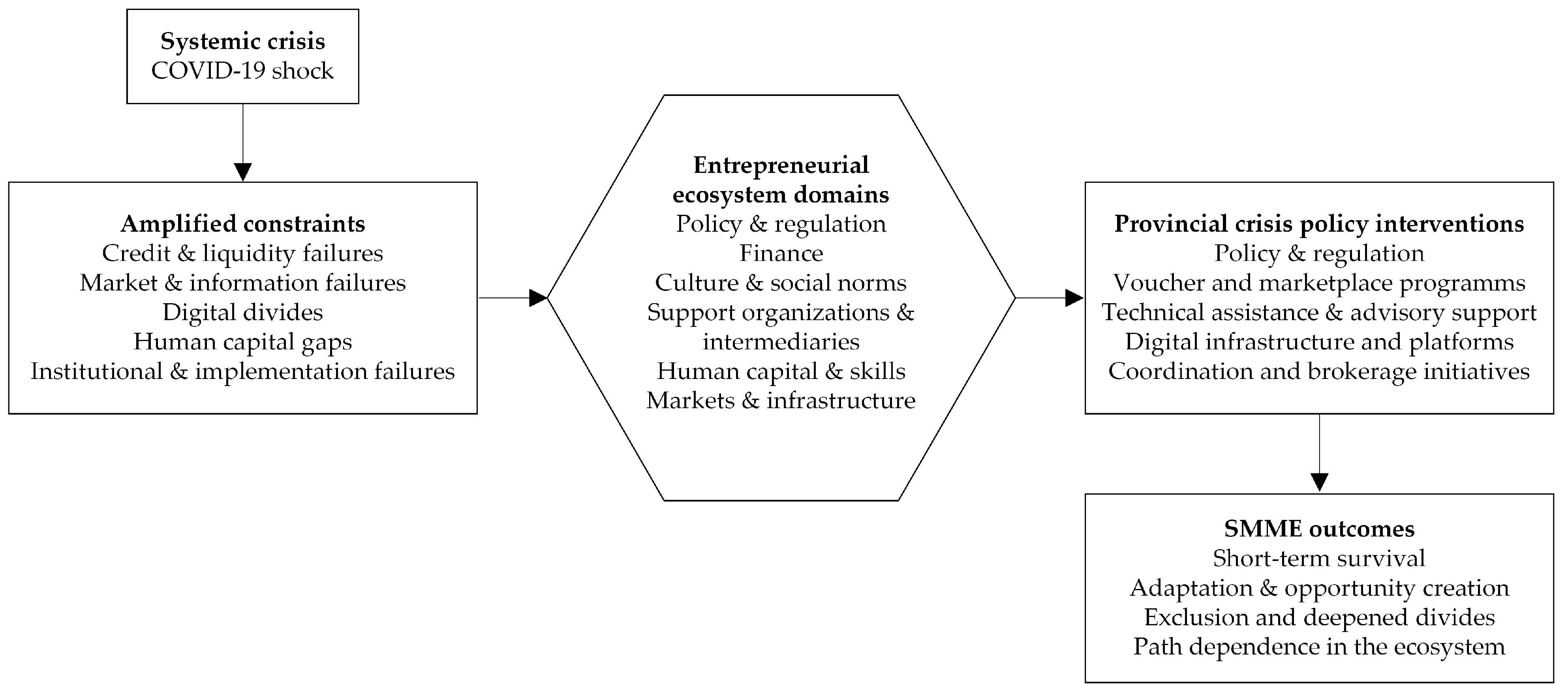

Platform-Mediated Crisis Policy and Entrepreneurial Ecosystem Resilience: Evidence from Western Cape SMME Support


Abstract
1. Introduction
2. Theoretical and Conceptual Framework
2.1. Market and Institutional Failures in SMME Crises
2.2. Entrepreneurial Ecosystems and the Isenberg Framework
2.3. Public Support as Ecosystem Policy Under Crisis
2.4. Platforms as Governance Infrastructure in Crisis Response
3. Policy and Institutional Context: Western Cape and South Africa
3.1. South African SMME Support Architecture During COVID-19
3.2. Western Cape’s Ecosystem-Oriented Provincial Response
4. Data and Methods
4.1. Original Qualitative Study and Survival Framework
4.2. Theory-Driven Secondary Analysis
5. Findings: Addressing Failures Through Ecosystem Elements
5.1. Policy, Institutions and Governance
5.2. Finance and Liquidity
5.3. Markets, Supply Chains and Digital Access
5.4. Human Capital, Culture and Networks
5.5. Synthesis: A Failure-Ecosystem Matrix
6. Comparative Discussion: Western Cape in Global Perspective
6.1. Comparing Ecosystem-Oriented Crisis Responses
6.2. Relative Strengths and Gaps of Western Cape
7. Policy Implications for South Africa and Other Middle-Income Economies
8. Limitations and Avenues for Future Research
9. Conclusions
Author Contributions
Funding
Institutional Review Board Statement
Informed Consent Statement
Data Availability Statement
Acknowledgments
Conflicts of Interest
Abbreviations
| GDP | Gross domestic product |
| OECD | Organisation for Economic Co-operation and Development |
| PPP | Paycheck Protection Program |
| SMEs | Small and medium enterprises |
| SMMEs | Small, medium, and micro enterprises |
| TERS | Temporary Employee/Employer Relief Scheme |
| WCG | Western Cape Government |
References
- Phiri, E.; Ramasimu, N.F.; Maake, G. Survival strategies and failure of SMMEs during the COVID-19 pandemic in Africa: Secondary data. Int. J. Bus. Ecosyst. Strategy 2025, 7, 1–13. [Google Scholar] [CrossRef]
- Rashid, S.; Ratten, V. Entrepreneurial ecosystems during COVID-19: The survival of small businesses using dynamic capabilities. World J. Entrep. Manag. Sustain. Dev. 2021, 17, 457–476. [Google Scholar] [CrossRef]
- Strydom, C. Developing a Framework for SMME Survival Based on Events During COVID-19 in the Western Cape of South Africa; North-West University: Potchefstroom, South Africa, 2024. [Google Scholar]
- Iwu, C.G.; Sibanda, L.; Makwara, T. African Entrepreneurial Ecosystem Resource Constraints: A COVID-19 Perspective. J. Entrep. Innov. Emerg. Econ. 2025, 12, 9–26. [Google Scholar] [CrossRef]
- Farisani, T.R. Assessing the impact of policies in sustaining rural small, medium and micro enterprises during COVID-19 pandemic in South Africa. S. Afr. J. Entrep. Small Bus. Manag. 2022, 14, a505. [Google Scholar] [CrossRef]
- Biyela, N.Y.; Utete, R. Agenda for future business resilience and survival avenues in crisis times: A systematic literature review of the effects of COVID-19 on SMEs’ productivity in South Africa. Soc. Sci. Humanit. Open 2024, 10, 100982. [Google Scholar] [CrossRef]
- Mkhonza, V.M.; Sifolo, P.P.S. Covid-19 Effect on Business Performance SMMES Perspectives in a South African Context. Int. J. Entrep. Bus. Dev. 2021, 4, 727–743. [Google Scholar] [CrossRef]
- StatsSA. Business Impact Survey of the COVID-19 Pandemic in South Africa; Statistics South Africa: Pretoria, South Africa, 2020. [Google Scholar]
- Western Cape Government. Economic Performance Indicators for Cape Town 2022 Quarter 4; Western Cape Government: Cape Town, South Africa, 2022. [Google Scholar]
- Strydom, C.; Van der Merwe, S. A survival framework for SMME’s based on COVID-19 events in the Western Cape of South Africa. S. Afr. J. Entrep. Small Bus. Manag. 2025, 17, a960. [Google Scholar] [CrossRef]
- Koekemoer, L.; de Beer, L.T.; Govender, K.; Brouwers, M. Leadership behaviour, team effectiveness, technological flexibility, work engagement and performance during COVID-19 lockdown: An exploratory study. SA J. Ind. Psychol. 2021, 47, a1829. [Google Scholar] [CrossRef]
- Stephens, S.; McLaughlin, C.; Ryan, L.; Catena, M.; Bonner, A. Entrepreneurial ecosystems: Multiple domains, dimensions and relationships. J. Bus. Ventur. Insights 2022, 18, e00344. [Google Scholar] [CrossRef]
- Yusuf, I. Entrepreneurship polices and survival of SME’s: A conceptual approach. KIU Interdiscip. J. Humanit. Soc. Sci. 2022, 3, 23–42. [Google Scholar]
- Nkontwana, P.; Amoa-Gyarteng, K.; Burns, J.; Rosa, S.; Amsterdam, K. Redesigning entrepreneurial ecosystems in South Africa: A collaborative approach to inclusion and resilience. Cogent Bus. Manag. 2025, 12, 2572429. [Google Scholar] [CrossRef]
- Wurth, B.; Stam, E.; Spigel, B. Entrepreneurial Ecosystem Mechanisms. Found. Trends® Entrep. 2023, 19, 224–339. [Google Scholar] [CrossRef]
- Bonina, C.; Koskinen, K.; Eaton, B.; Gawer, A. Digital platforms for development: Foundations and research agenda. Inf. Syst. J. 2021, 31, 869–902. [Google Scholar] [CrossRef]
- Chen, L.; Tong, T.W.; Tang, S.; Han, N. Governance and Design of Digital Platforms: A Review and Future Research Directions on a Meta-Organization. J. Manag. 2021, 48, 147–184. [Google Scholar] [CrossRef]
- Corvello, V.; Verteramo, S.; Nocella, I.; Ammirato, S. Thrive during a crisis: The role of digital technologies in fostering antifragility in small and medium-sized enterprises. J. Ambient. Intell. Humaniz. Comput. 2023, 14, 14681–14693. [Google Scholar] [CrossRef] [PubMed]
- Cueto, L.J.; Frisnedi, A.F.; Collera, R.B.; Batac, K.I.; Agaton, C.B. Digital Innovations in MSMEs during Economic Disruptions: Experiences and Challenges of Young Entrepreneurs. Adm. Sci. 2022, 12, 8. [Google Scholar] [CrossRef]
- Bai, C.; Quayson, M.; Sarkis, J. COVID-19 pandemic digitization lessons for sustainable development of micro-and small- enterprises. Sustain. Prod. Consum. 2021, 27, 1989–2001. [Google Scholar] [CrossRef]
- Isenberg, D. The Big Idea: How to Start an Entrepreneurial Revolution. Harv. Bus. Rev. 2010, 88, 40–50. [Google Scholar]
- Isenberg, D. The Entrepreneurship Ecosystem Strategy as a New Paradigm for Economic Policy: Principles for Cultivating Entrepreneurship; Institute of International and European Affairs: Dublin, Ireland, 2011. [Google Scholar]
- Brown, R.C.; Mason, C. Entrepreneurial Ecosystems and Growth-Oriented Entrepreneurship; OECD: Paris, France, 2014; pp. 1–38. [Google Scholar]
- Stam, E.; van de Ven, A. Entrepreneurial ecosystem elements. Small Bus. Econ. Group 2021, 56, 809–832. [Google Scholar] [CrossRef]
- Mcunu, L.A. An Investigation on the Effectiveness of Government Structures Established to Support Small, Medium and Micro Enterprises in eThekwini Municipality During COVID-19 Pandemic. Master’s Thesis, Durban University of Technology, Durban, South Africa, 2025. [Google Scholar] [CrossRef]
- Biyela, N.Y. The Influence of COVID-19 on the Productivity of Small and Medium Enterprises: A Case Study of Mtubatuba Local Municipality; Durban University of Technology: Durban, South Africa, 2025. [Google Scholar]
- Ramphele, M.; Msosa, S.K. Determinants of Social Media Marketing Adoption in Small, Medium and Micro Enterprises during the COVID-19 pandemic. Eur. J. Manag. Issues 2022, 30, 92–99. [Google Scholar] [CrossRef]
- Mcunu, L.; Ngibe, M. Evaluating government support structures in promoting innovation and business resilience among SMMEs Post COVID-19. Int. J. Res. Bus. Soc. Sci. 2025, 14, 15–24. [Google Scholar] [CrossRef]
- Moore, J.F. Predators and Prey: A New Ecology of Competition. Harv. Bus. Rev. 1993, 71, 75–86. [Google Scholar] [PubMed]
- Stam, E.; Spigel, B. Entrepreneurial Ecosystems; Utrecht School of Economics: Utrecht, The Netherlands, 2016. [Google Scholar]
- ITWeb. City of Cape Town Pilots e-Commerce Platform for SMEs. Available online: https://www.itweb.co.za/article/city-of-cape-town-pilots-e-commerce-platform-for-smes/KBpdgvpzk83MLEew (accessed on 20 December 2025).
- Gawer, A. Digital platforms and ecosystems: Remarks on the dominant organizational forms of the digital age. Innovation 2022, 24, 110–124. [Google Scholar] [CrossRef]
- van Dijck, J.; Poell, T.; de Waal, M. The Platform Society: Public Values in a Connective World; Oxford University Press: Oxford, UK, 2018. [Google Scholar]
- Degen, K.; Gleiss, A. Time to break up? The case for tailor-made digital platform regulation based on platform-governance standard types. Electron. Mark. 2025, 35, 5. [Google Scholar] [CrossRef]
- Lehdonvirta, V.; Kässi, O.; Hjorth, I.; Barnard, H.; Graham, M. The Global Platform Economy: A New Offshoring Institution Enabling Emerging-Economy Microproviders. J. Manag. 2018, 45, 567–599. [Google Scholar] [CrossRef]
- Farisani, T.R. The impact of social and institutional networks in sustaining South African rural small, medium and micro enterprises during the crisis. Acta Commer. 2022, 22, a1007. [Google Scholar] [CrossRef]
- Western Cape Government. Provincial Economic Review and Outlook 2020; Western Cape Provincial Treasury: Cape Town, South Africa, 2020. [Google Scholar]
- Wesgro. Invest in Cape Town: Regional Market Analysis and Intelligence Report 2019/2020; Wesgro: Cape Town, South Africa, 2020. [Google Scholar]
- Western Cape Government. Update on Western Cape Government’s Economic Recovery Interventions; Western Cape Provincial Treasury: Cape Town, South Africa, 2021. [Google Scholar]
- Western Cape Government. Provincial Economic Review and Outlook 2024; Western Cape Provincial Treasury: Cape Town, South Africa, 2024. [Google Scholar]
- Wesgro. Wesgro Annual Performance Plan 2025/26; Wesgro: Cape Town, South Africa, 2025. [Google Scholar]
- Saunders, M.N.K.; Lewis, P.; Thornhill, A. Research Methods for Business Students; Pearson Education: Harlow, UK, 2023. [Google Scholar]
- Liu, Q.; Shen, Q.; Li, Z.; Chen, S. Stimulating Consumption at Low Budget: Evidence from a Large-Scale Policy Experiment Amid the COVID-19 Pandemic. Manag. Sci. 2021, 67, 7291–7307. [Google Scholar] [CrossRef]
- OECD. One Year of SME and Entrepreneurship Policy Responses to COVID-19: Lessons Learned to “Build Back Better”; OECD Publishing: Paris, France, 2021. [Google Scholar]
- OECD. An in-Depth Analysis of One Year of SME and Entrepreneurship Policy Responses to COVID-19: Lessons Learned for the Path to Recovery; OECD Publishing: Paris, France, 2021. [Google Scholar]
- European Investment Bank. Investment Report 2022/2023—Resilience and Renewal in Europe; European Investment Bank: Luxembourg, 2023. [Google Scholar]
- European Investment Bank. Post-COVID Recovery and Green Transition—An Ecosystem View; European Investment Bank: Luxembourg, 2024. [Google Scholar]
- Katare, B.; Marshall, M.I.; Valdivia, C.B. Bend or break? Small business survival and strategies during the COVID-19 shock. Int. J. Disaster Risk Reduct. 2021, 61, 102332. [Google Scholar] [CrossRef] [PubMed]
- Chen, H.; Qian, W.; Wen, Q. The Impact of the COVID-19 Pandemic on Consumption: Learning from High-Frequency Transaction Data. AEA Pap. Proc. 2021, 111, 307–311. [Google Scholar] [CrossRef]
- Hu, F.; Qiu, L.; Xi, X.; Zhou, H.; Hu, T.; Su, N.; Zhou, H.; Li, X.; Yang, S.; Duan, Z.; et al. Has COVID-19 Changed China’s Digital Trade?—Implications for Health Economics. Front. Public Health 2022, 10, 831549. [Google Scholar] [CrossRef]
- Avalos Almanza, E.I.; Cirera, X.; Iacovone, L.; Medvedev, D.; Nayyar, G.; Reyes Ortega, S.; Vargas da Cruz, M.J. Firms’ Digitalization During the COVID-19 Pandemic: A Tale of Two Stories; World Bank Group: Washington, DC, USA, 2023. [Google Scholar]
- Zhang, X.; Li, J.; Xiang, D.; Worthington, A.C. Digitalization, financial inclusion, and small and medium-sized enterprise financing: Evidence from China. Econ. Model. 2023, 126, 106410. [Google Scholar] [CrossRef]
- Audretsch, D.B.; Belitski, M.; Cherkas, N. Entrepreneurial ecosystems in cities: The role of institutions. PLoS ONE 2021, 16, e0247609. [Google Scholar] [CrossRef] [PubMed]
- Harper-Anderson, E.; O’Hollaren, K.; Gates, S.M. Roles for City Governments in Entrepreneurial Ecosystems: An Initial Exploration; RAND Corporation: Santa Monica, CA, USA, 2023. [Google Scholar]
- Bucio-Mendoza, S.; Solis-Navarrete, J.A. Social Innovation Ecosystems in Times of Crisis: Rethinking Innovation Policy Through the COVID-19 Pandemic. Sustainability 2025, 17, 9502. [Google Scholar] [CrossRef]
- OECD. Building Local Ecosystems for Social Innovation: A Methodological Framework; OECD Publishing: Paris, France, 2021. [Google Scholar]
- Kuckertz, A.; Brändle, L.; Gaudig, A.; Hinderer, S.; Morales Reyes, C.A.; Prochotta, A.; Steinbrink, K.M.; Berger, E.S.C. Startups in times of crisis—A rapid response to the COVID-19 pandemic. J. Bus. Ventur. Insights 2020, 13, e00169. [Google Scholar] [CrossRef]
- Ratten, V. COVID-19 and entrepreneurship: Future research directions. Strateg. Change 2021, 30, 91–98. [Google Scholar] [CrossRef]


| Failure Type | Finance | Markets and Supply Chains | Digital (Tools, Data, Access) | Institutions and Policy | Human Capital and Organization |
|---|---|---|---|---|---|
| Liquidity and finance constraints | Binding: revenue collapse, fixed costs, restricted bank credit | Indirect: inability to finance inputs and fulfil orders | Indirect: limited capacity to invest in digital channels | Partly: design and targeting of relief and guarantee schemes | Indirect: stress, retrenchments, reduced managerial slack |
| Demand, supply chain and market failures | Indirect: sunk costs, stranded assets | Binding: demand collapse, logistics bottlenecks, delivery delays | Growing need for online sales, tracking and coordination tools | Partly: lockdown rules, trade restrictions, procurement procedures | Indirect: pressure to multitask and reconfigure operations |
| Digital and technological gaps | Indirect: inability to access fintech or e-commerce finance | Binding where markets move online and chains digitalize | Binding: poor connectivity, low skills, lack of suitable platforms | Partly: weak public digital infrastructure and support | Binding: insufficient digital skills and change management |
| Institutional and policy failures | Binding: slow, complex access to relief, policy uncertainty | Indirect: unclear regulations, inconsistent enforcement | Indirect: limited e-government and online application channels | Binding: red tape, opacity, weak coordination and monitoring | Indirect: time diverted from strategic adaptation |
| Human capital and organizational constraints | Indirect: weak financial management and planning | Indirect: poor supply chain and customer relationship management | Indirect: limited absorptive capacity for new technologies | Partly: under-investment in training and advisory services | Binding: skill gaps, managerial overload, weak organizational resilience |
| Crisis-Amplified Failure | Platform Governance Mechanism Activated | Ecosystem Domains Mobilized | Observed Distributional Outcome | Governance Pattern Identified |
|---|---|---|---|---|
| Liquidity and finance constraints | Application portals; eligibility screening; linkage to national wage schemes (TERS); provincial relief funds | Finance; Policy; Supports | Conditional inclusion: firms able to navigate documentation and digital processes accessed relief; micro and informal firms frequently excluded | Access-mediated mitigation |
| Demand, supply chain and market failures | Online marketplaces; digital promotion campaigns; voucher circulation mechanisms | Markets; Supports; Policy | Stratified inclusion: digitally capable and networked firms improved market reach; offline and rural firms remained marginalized | Acceleration with stratification |
| Digital and technological gaps | E-commerce portals; tech hubs; training initiatives; free Wi-Fi (limited geographic scope) | Digital; Human capital; Supports | Capability-dependent resilience: benefits concentrated among firms with pre-existing digital literacy and connectivity | Capability-threshold governance |
| Institutional and policy failures | Administrative procedures; scoring criteria; intergovernmental coordination channels | Policy; Institutions; Culture | Persistent exclusion: opaque criteria, slow communication, and fragmented national–provincial alignment functioned as de facto gatekeeping | Bureaucratic gatekeeping regime |
| Human capital and organizational constraints | Informal peer networks; ecosystem intermediaries; limited formal training schemes | Human capital; Culture; Supports | Informally mediated adaptation: survival supported through social capital rather than structured platform support | Compensatory network governance |
Disclaimer/Publisher’s Note: The statements, opinions and data contained in all publications are solely those of the individual author(s) and contributor(s) and not of MDPI and/or the editor(s). MDPI and/or the editor(s) disclaim responsibility for any injury to people or property resulting from any ideas, methods, instructions or products referred to in the content. |
© 2026 by the authors. Licensee MDPI, Basel, Switzerland. This article is an open access article distributed under the terms and conditions of the Creative Commons Attribution (CC BY) license.
Share and Cite
Loubser-Strydom, C.; Logožar, K. Platform-Mediated Crisis Policy and Entrepreneurial Ecosystem Resilience: Evidence from Western Cape SMME Support. Platforms 2026, 4, 8. https://doi.org/10.3390/platforms4020008
Loubser-Strydom C, Logožar K. Platform-Mediated Crisis Policy and Entrepreneurial Ecosystem Resilience: Evidence from Western Cape SMME Support. Platforms. 2026; 4(2):8. https://doi.org/10.3390/platforms4020008
Chicago/Turabian StyleLoubser-Strydom, Carin, and Klavdij Logožar. 2026. "Platform-Mediated Crisis Policy and Entrepreneurial Ecosystem Resilience: Evidence from Western Cape SMME Support" Platforms 4, no. 2: 8. https://doi.org/10.3390/platforms4020008
APA StyleLoubser-Strydom, C., & Logožar, K. (2026). Platform-Mediated Crisis Policy and Entrepreneurial Ecosystem Resilience: Evidence from Western Cape SMME Support. Platforms, 4(2), 8. https://doi.org/10.3390/platforms4020008