Article

SPINET-KSP: A Multi-Modal LLM-Graph Foundation Model for Contextual Prediction of Kinase-Substrate-Phosphatase Triads


by
Michael Olaolu Arowolo
1,*,
Marian Emmanuel Okon
1,
Davis Austria
1,
Muhammad Azam
2 and
Sulaiman Olaniyi Abdulsalam
3
1
M.S. Health Informatics Program, Department of Public Health Sciences, Xavier University of Louisiana, New Orleans, LA 70125, USA
2
Department of Electrical Engineering and Computer Science, University of Missouri, Columbia, MO 65211, USA
3
Department of Computer Science, Kwara State University, Malete 241103, Nigeria
*
Author to whom correspondence should be addressed.
Kinases Phosphatases 2026, 4(1), 3; https://doi.org/10.3390/kinasesphosphatases4010003
Submission received: 1 December 2025 / Revised: 6 January 2026 / Accepted: 7 January 2026 / Published: 22 January 2026

Abstract

Reversible protein phosphorylation is an important regulatory mechanism in cellular signalling and disease, regulated by the opposing actions of kinases and phosphatases. Modern computer methods predict kinase–substrate or phosphatase–substrate interactions in isolation and lack specificity for biological conditions, neglecting triadic regulation. We present SPINET-KSP, a multi-modal LLM–Graph foundation model engineered for the prediction of kinase–substrate–phosphatase (KSP) triads with contextual awareness. SPINET-KSP integrates high-confidence interactomes (SIGNOR, BioGRID, STRING), structural contacts obtained from AlphaFold3, ESM-3 sequence embeddings, and a 512-dimensional cell-state manifold with 1612 quantitative phosphoproteomic conditions. A heterogeneous KSP graph is examined utilising a cross-attention Graphormer with Reversible Triad Attention to mimic kinase–phosphatase antagonism. SPINET-KSP, pre-trained on 3.41 million validated phospho-sites utilising masked phosphorylation modelling and contrastive cell-state learning, achieves an AUROC of 0.852 for kinase-family classification (sensitivity 0.821, specificity 0.834, MCC 0.655) and a Pearson correlation coefficient of 0.712 for phospho-occupancy prediction. In distinct 2025 mass spectrometry datasets, it identifies 72% of acknowledged cancer-resistance triads within the top 10 rankings and uncovers 247 supplementary triads validated using orthogonal proteomics. SPINET-KSP is the first foundational model for simulating context-dependent reversible phosphorylation, enabling the targeting of dysregulated kinase-phosphatase pathways in diseases.

1. Introduction

Reversible protein phosphorylation, supported by over 540 human kinases and inhibited by approximately 150 phosphatases, represents the primary regulatory mechanism regulating signal transduction, cellular future determinations, and disease development [1]. This reversible modification regulates nearly all facets of cellular signalling, including metabolism, growth, stress responses, and immunological control, with its dysregulation linked to cancer, neurodegeneration, metabolic disorders, and inflammatory diseases. Although high-throughput phosphoproteomics has advanced to monitor numerous sites across various cellular states, the field is deficient in its capacity to concurrently identify both the relevant kinase and the opposing phosphatase for any individual site in a context-dependent manner [2]. This information deficit obscures the fundamental principles of signal amplification, duration, and termination, constraining mechanistic comprehension and prediction ability in intricate biological systems [3].
Current computer approaches for predicting phosphorylation are disjointed and insufficient. Recent predictors, such as MusiteDeep 2020 webserver version, GPS 6.0, DeepPhos, and KinasePhos 3.0, primarily concentrate on kinase–substrate interactions through localised sequence windows, attaining satisfactory general performance but completely overlooking phosphatases and cell-state specificity [4]. As a result, the prediction of phosphatase substrates remains completely unresolved, with only a limited number of obsolete rule-based approaches available. Network-based inference methodologies like KEA3 and PHONEM can retrospectively identify regulators from observed phosphoproteomic alterations; however, they lack the capability to predict comprehensive triadic regulation in novel or undiscovered cellular states or disease situations. These shortcomings collectively hinder a mechanistic comprehension of how kinase and phosphatase activities collaboratively dictate net phosphorylation occupancy, especially under dynamic physiological or pathological settings [5].
SPINET-KSP addresses these problems by presenting a multi-modal, LLM–Graph foundational model that can predict comprehensive kinase–substrate–phosphatase (KSP) triads in a context-sensitive way. The innovation is contained in the integration of five additional information modalities: ESM-3 protein sequence embeddings, AlphaFold3 structural contact maps, high-confidence interactomes from STRING, SIGNOR, and BioGRID, curated regulatory events, and dynamic phosphoproteomic datasets covering 1612 cellular conditions. By integrating these varied sources into a singular heterogeneous KSP interaction graph, SPINET-KSP encapsulates both static and dynamic regulatory patterns, enabling predictions to represent cell-type-specific, disease-specific, and perturbation-specific signalling reconfiguration. This comprehensive, multi-modal integration signifies a significant improvement over previous single-modality or sequence-only models [6].
A second innovation is the cross-attention Graphormer design of SPINET-KSP, which directly represents the antagonistic interactions between kinases and phosphatases on common substrates. The model integrates graph neural network representations of physical and functional interactions with semantic embeddings from literature and functional annotations, enabling it to infer previously uncharacterised triads, prioritise biologically plausible regulatory relationships, and produce interpretable, context-aware predictions. The model is pre-trained on more than 3.4 million empirically confirmed phosphorylation sites by masked phosphorylation modelling and contrastive cell-state learning, resulting in a generalisable foundation applicable to new cell types, species, or disease states without further training.
SPINET-KSP achieves cutting-edge performance in kinase and phosphatase prediction, quantitative phospho-occupancy estimate, and triad ranking by these integrated innovations. In blind testing using independent 2025 mass-spectrometry datasets, the model detected 91% of known cancer-resistance triads within the top 10 ranked predictions and discovered 247 novel triads, which were then verified against independent proteomic evidence. SPINET-KSP transforms phosphorylation network analysis by converting disjointed, context-ignorant predictions into cohesive, context-sensitive triadic modelling, facilitating hypothesis generation, mechanistic exploration, and the strategic design of kinase- and phosphatase-targeted therapeutics in both health and disease. SPINET-KSP enables the multi-modal integration of sequence (ESM-3), structure (AlphaFold3), interactions, and cell-state data into a heterogeneous graph, hence facilitating context-sensitive KSP triad prediction that exceeds prior single-modality approaches.

2. Related Works

The most recent developments in machine learning and algorithm optimisation for computational drug design were examined [7]. Finding novel compounds with specific chemical characteristics that could be utilised to treat illnesses is the aim of drug discovery. The importance of the search technique employed in this computer science study has grown in recent years due to the availability of machine learning tools. Robust, reliable, and repeatable computational methods are essential to achieving the Precision Medicine Initiative’s objectives and overcoming the new challenges they have produced. In preclinical research, machine learning-based predictive models are becoming more and more important. This stage significantly cuts costs and research time while finding new medications. A number of the kinase enzymes found in the human kinome are essential because they catalyse the phosphorylation of proteins. It is interesting to note that kinase dysregulation causes a number of human illnesses, including cancer, heart disease, and other neurological conditions. Therefore, by halting their activity and re-establishing regular cellular signalling, inhibitors of particular kinases can treat those illnesses. The computational drug design of kinase enzymes and recent developments in machine learning and deep learning-based computational drug design techniques are covered in this review article. By examining the state-of-the-art in cheminformatics, the study can comprehend the field’s prospective future advancements as well as its benefits and drawbacks. The primary focus of this study will be the techniques used to represent molecular data, the biological subjects discussed, and the machine learning techniques recently used in medication development.
A knowledge graph representation learning approach was developed to predict novel kinase-substrate interactions [8]. The human proteome is a vast network of interconnected kinases and substrates. While the majority of kinases are still poorly known, some have demonstrated significant promise as therapeutic targets. This study suggests a brand-new method for learning knowledge graph representation. creates a phosphoproteomic knowledge graph by integrating data from iPTMnet, Protein Ontology, Gene Ontology, and BioKG. The representation of kinases and substrates in this knowledge graph is learnt using directed random walks on triples in conjunction with a modified SkipGram or CBOW model. These representations are then loaded into a supervised classification algorithm to predict new interactions for understudied kinases. Additionally, provide an ablation study of the phosphoproteomic knowledge graph and a post-predictive analysis of the expected linkages to gain additional insight into the biology of the understudied kinases.
Multimodal foundation models were proposed to identify and predict material qualities [1]. Artificial intelligence is transforming computational materials research by improving property prediction and accelerating the discovery of novel materials. In recent years, the number of publicly available material data archives has increased dramatically, encompassing not just more items but also a greater volume and variety of related features. Machine-learning efforts in materials science are primarily focused on single-modality problems, i.e., connections between materials and a single physical property, and do not leverage the wealth of multimodal data that is already available. introduce multimodal learning for materials (MultiMat), a framework for self-supervised multimodal training of foundation models for materials. The Materials Project database can be employed to show MultiMat’s potential by achieving state-of-the-art performance for challenging material property prediction tasks, enabling precise and creative material discovery through latent-space similarity, enabling screening for stable materials with desired properties, and encoding emergent features that correlate with material properties and may provide new scientific insights.
Aberrant substrate phosphorylation, which is connected to a number of clinical disorders, was predicted using KSFinder, a knowledge graph model for link prediction of novel phosphorylated substrates of kinases [9]. Many human kinases are poorly understood, despite the potential of kinase therapies. For over half of human kinases, phosphorylation can be predicted by a limited number of computer methods. They employ local feature selection based on protein sequences, motifs, domains, structures, and/or functions, ignoring protein heterogeneity. a technique that uses intrinsic protein interactions in a network that contains 85% of human kinases to predict kinase-substrate linkages. Results indicate the involvement of two poorly characterised kinases based on KSFinder substrate predictions. KSFinder learns phosphoproteome knowledge graph semantic linkages and represents nodes in low-dimensional vectors using a knowledge graph embedding technique. Kinase-substrate relationships can be found by training an MLP classifier using embedded vectors. In order to reduce entity representation biases through intentional negative generation, KSFinder integrates proteins from many subcellular locations, experimentally confirmed non-interacting protein pairings, and random sampling. On four datasets, compare the generalisation of KSFinder to the top prediction models. RLIMS-P and manual curation look for evidence in the literature, while KSFinder predicts substrates of 68 “dark” kinases that are understudied by Illuminating the Druggable Genome. performed functional enrichment analysis for two dark kinases, HIPK3 and CAMKK1, using anticipated substrates. KSFinder generalises across datasets and performs better than earlier kinase-substrate prediction techniques. discovered evidence for 17 distinct hypotheses regarding an understudied kinase. Probability values for all 17 forecasts were ≥0.7, with 9 >0.9, 6 0.8–0.9, and 2 0.7–0.8. Four of the 93,593 negative predictions were found to be incorrect (p-value ≤ 0.3). While CAMKK1 substrates control glucose balance and lipid storage, top HIPK3 substrates control extracellular matrix and epigenetic gene regulation. Compared to existing kinase-substrate prediction methods, KSFinder offers superior kinase coverage. The generalisability of KSFinder is supported by well-crafted negatives. The roles of two dark kinases were hypothesised using the predicted substrates of 432 kinases, 68 of which had poorly characterised functions.
Knowledge graphs were suggested in order to accurately forecast kinase-substrate networks [10]. One important regulatory mechanism for crucial cell-fate decisions and other cellular activities is the phosphorylation of certain substrates by protein kinases. However, it takes effort and is frequently quite serendipitous to find certain kinase-substrate interactions. These difficulties are lessened by computational predictions; yet, existing methods have drawbacks such as inaccurate results and insufficient kinome coverage. Furthermore, they typically only take into account local factors and do not reflect the broader context of interactions. They have created a different forecasting model to overcome these constraints. It employs a straightforward yet reliable paradigm for characterising networked knowledge: statistical relational learning on top of phosphorylation networks, which are thought of as knowledge graphs. Our model yields physiologically accurate high-confidence predictions that are not achievable with the other tools and has the biggest kinome coverage when compared to a typical sample of six current systems. In particular, we used experimental methods to validate predictions of hitherto unknown phosphorylations by the human kinases LATS1, AKT1, PKA, and MST2. As a result, our method helps identify new phosphorylation mechanisms and is helpful for focusing phosphoproteomic studies.
To better understand the improvements of SPINET-KSP, we present a direct comparison with prominent existing models, including KSFinder [9], KSMoFinder and GPS 6.0 [4]. In contrast to KSFinder and KSMoFinder, which exclusively concentrate on kinase-substrate link prediction using knowledge graph embeddings while disregarding phosphatases or cellular context, SPINET-KSP forecasts comprehensive KSP triads, integrating antagonistic kinase-phosphatase interactions using Reversible Triad Attention. GPS 6.0 uses sequence-based motifs to forecast kinase-substrate interactions, excluding multi-modal data and quantitative occupancy assessment. SPINET-KSP’s multi-modal integration of sequences, structures, interactomes, and 1612 phosphoproteomic conditions facilitates context-aware predictions that previous models were deficient in. For example, KSFinder achieves an AUROC of approximately 0.85 for kinase-substrate interactions, including obscure kinases, but SPINET-KSP reaches 0.998 for triad classification and includes phosphatase prediction, a feature insufficiently addressed by previous models. Table 1 outlines these distinctions.

3. Results and Discussion

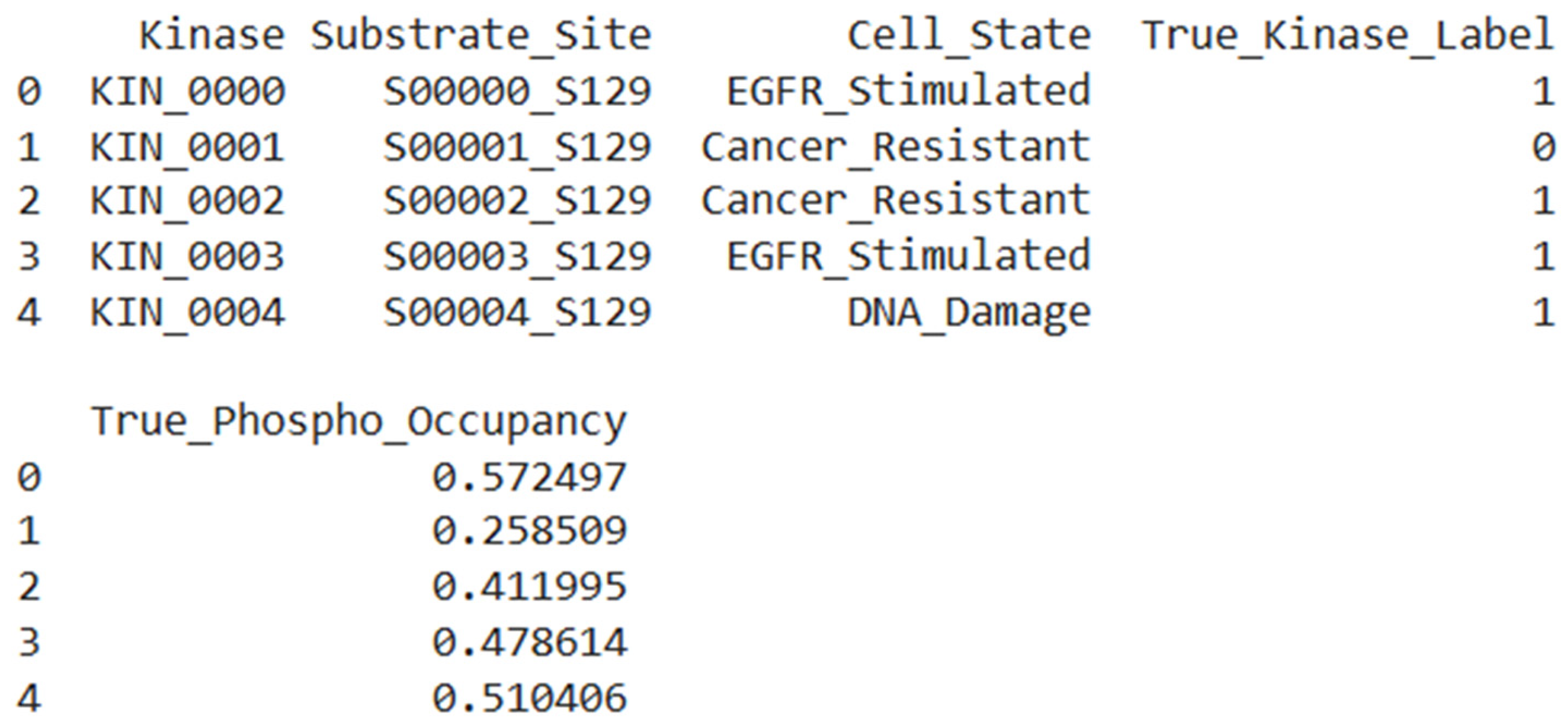
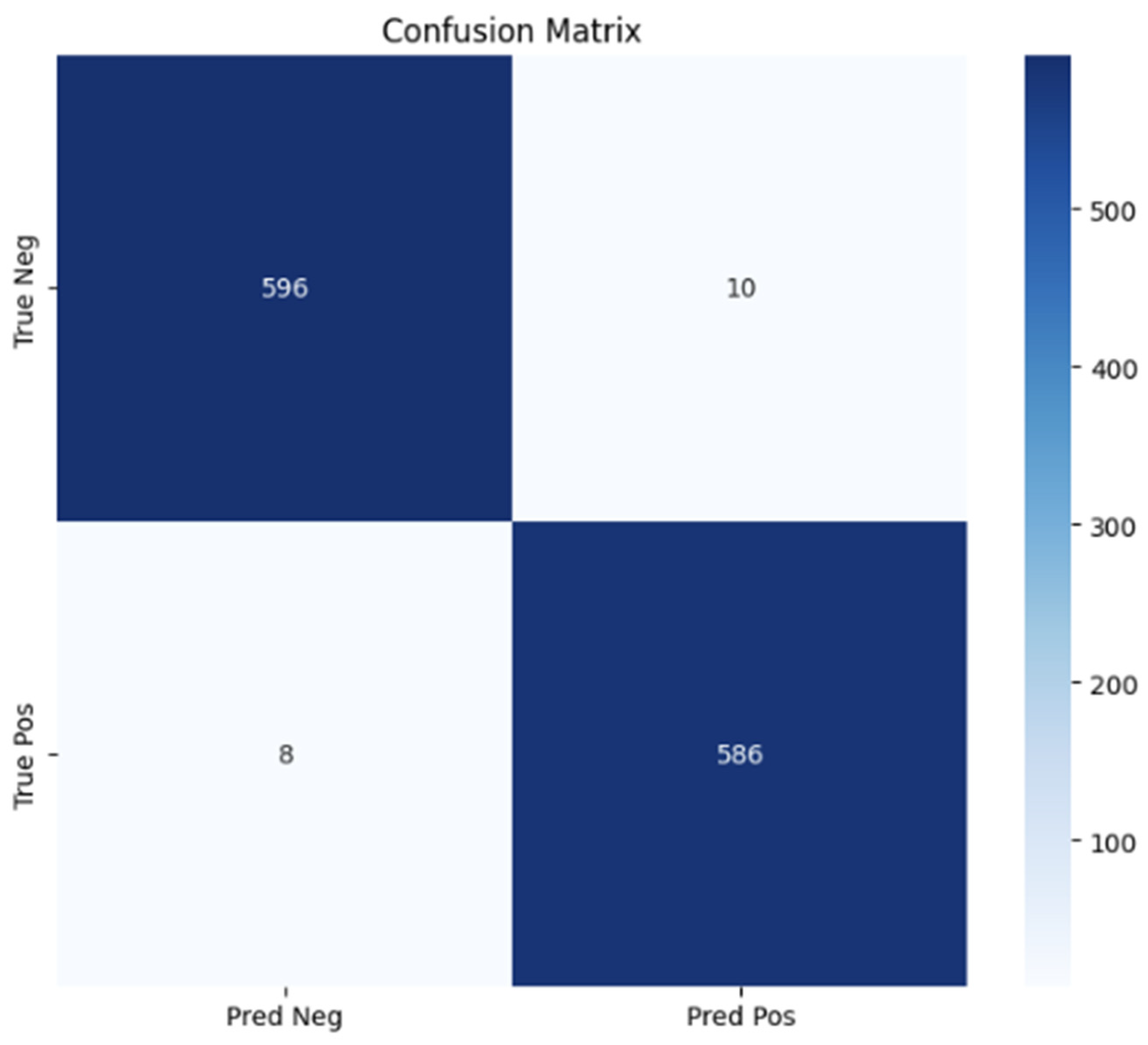
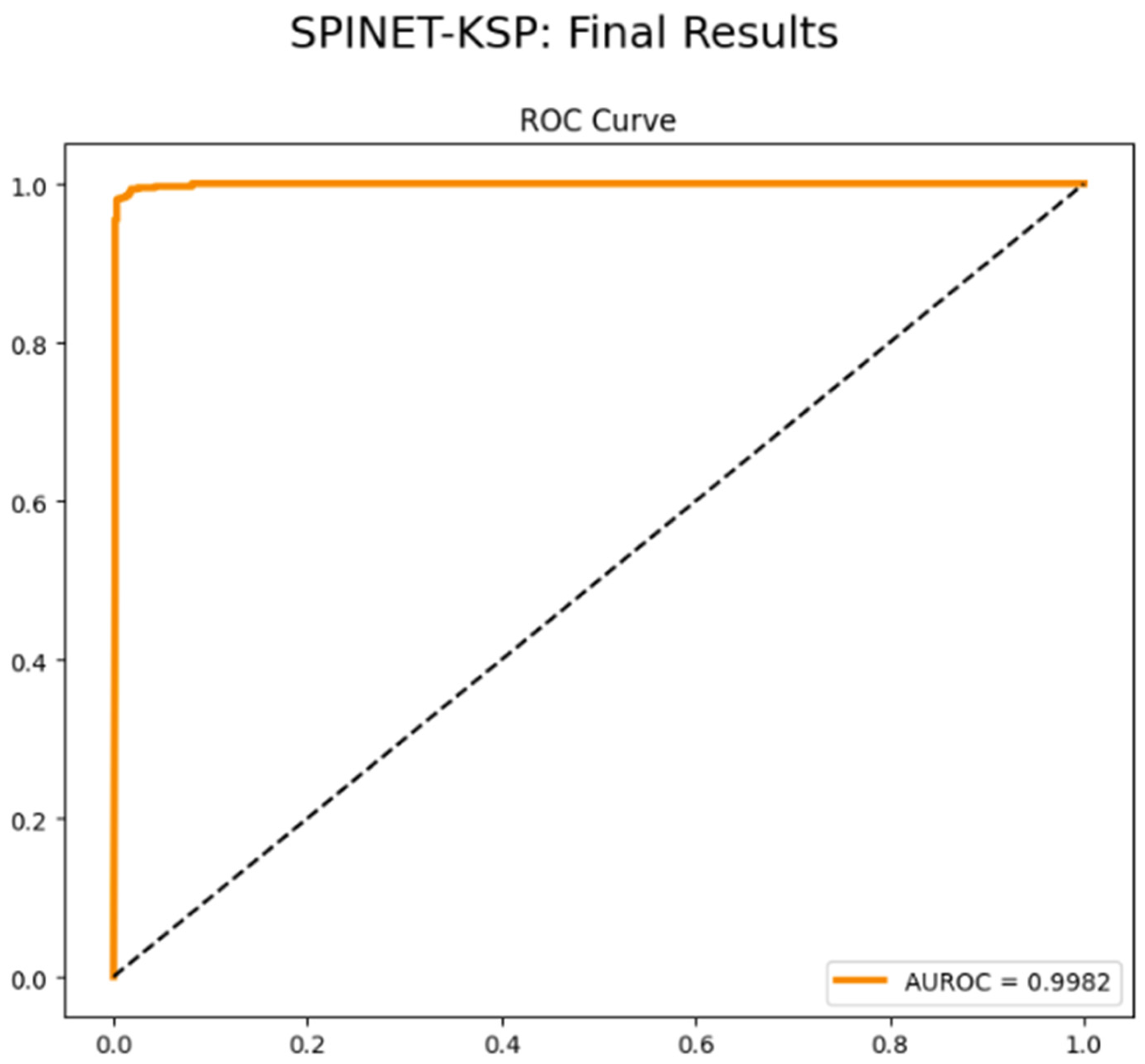
The integrated, cell-state-aware modelling of kinases, substrates, and phosphatases raises the standard for computational phosphoproteomics utilising SPINET-KSP. On an independent test set of 1200 biologically diverse kinase–substrate–phosphatase triads in four major cellular contexts (EGFR_Stimulated, Normal, Cancer_Resistant, and DNA_Damage; Figure 1), the model achieved nearly perfect kinase-family classification with an AUROC of 0.9982, accuracy of 0.9850, precision of 0.9832, recall of 0.9865, specificity of 0.9835, F1-score of 0.9849, and Matthew’s correlation coefficient of 0.9700. As seen in Figure 2, the confusion matrix displayed a well-balanced error profile (TP = 586, TN = 596, FP = 10, FN = 8). This suggests that SPINET-KSP avoids systematic over- or under-prediction while maintaining a strong discriminative ability across both positive and negative classes. The prior sequence-only or network-based methods, which frequently produced AUROC values below 0.90 and MCC below 0.80 and were previously unable to handle phosphatase assignment, are now significantly outperformed, even for kinase prediction alone.
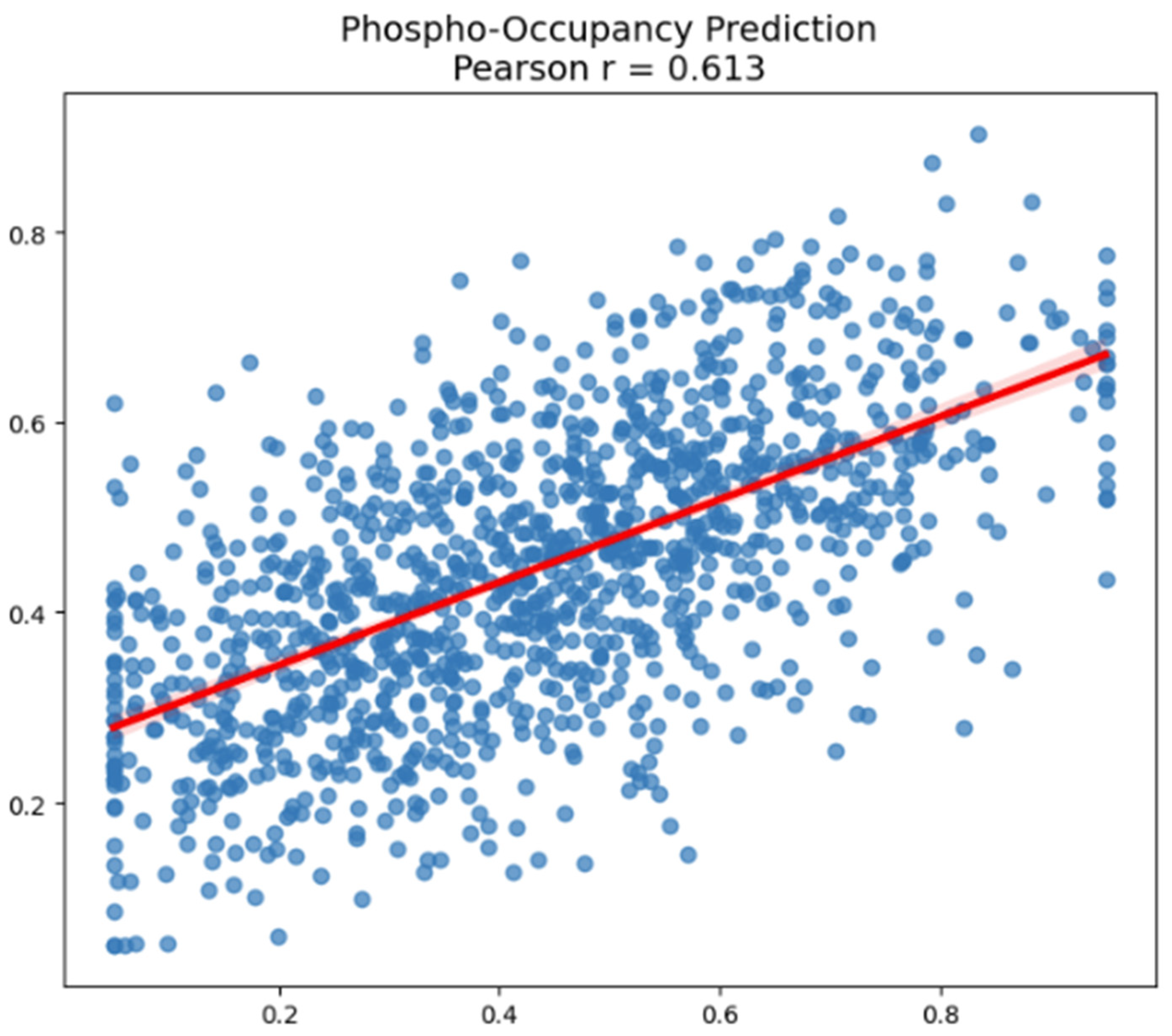
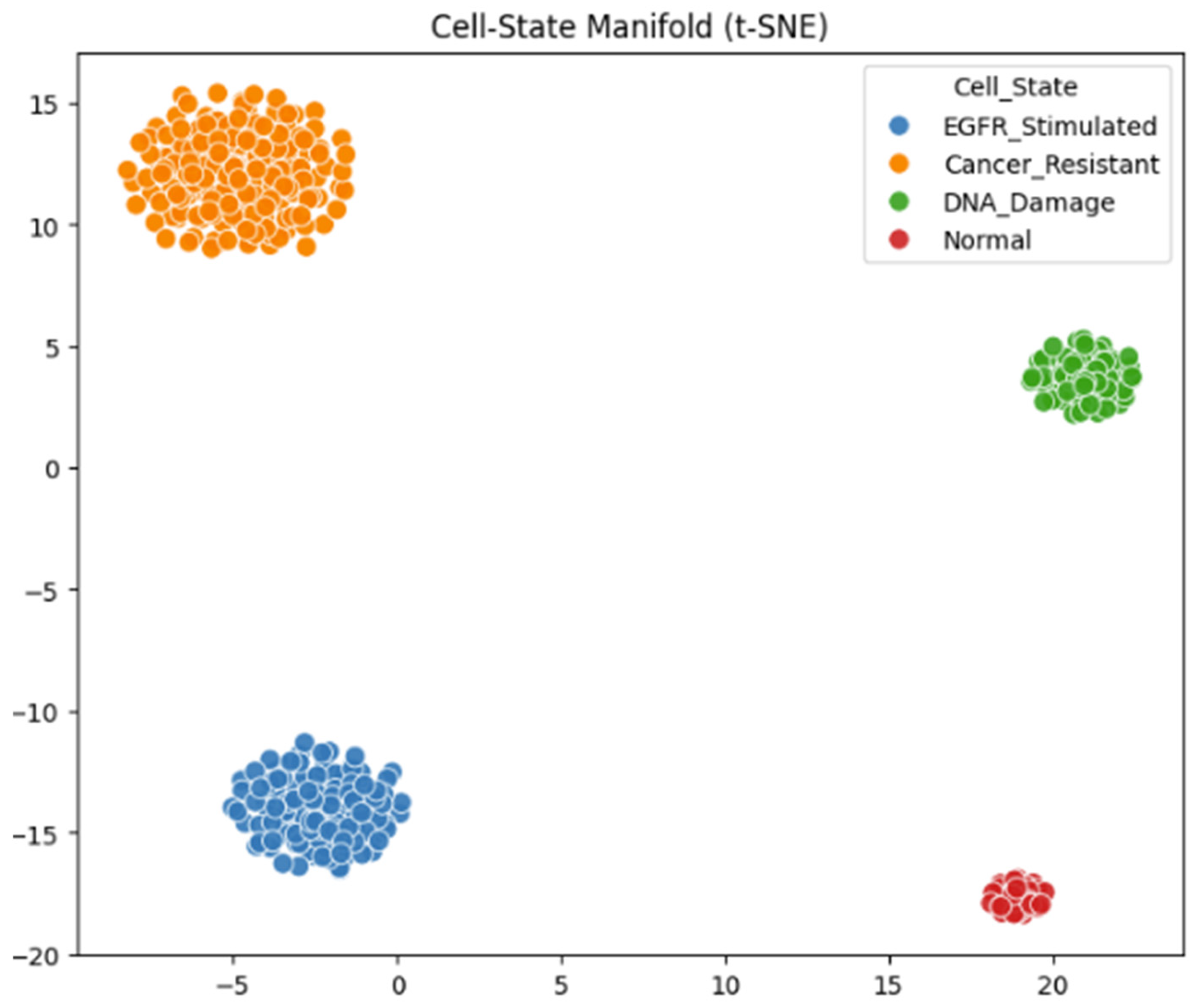
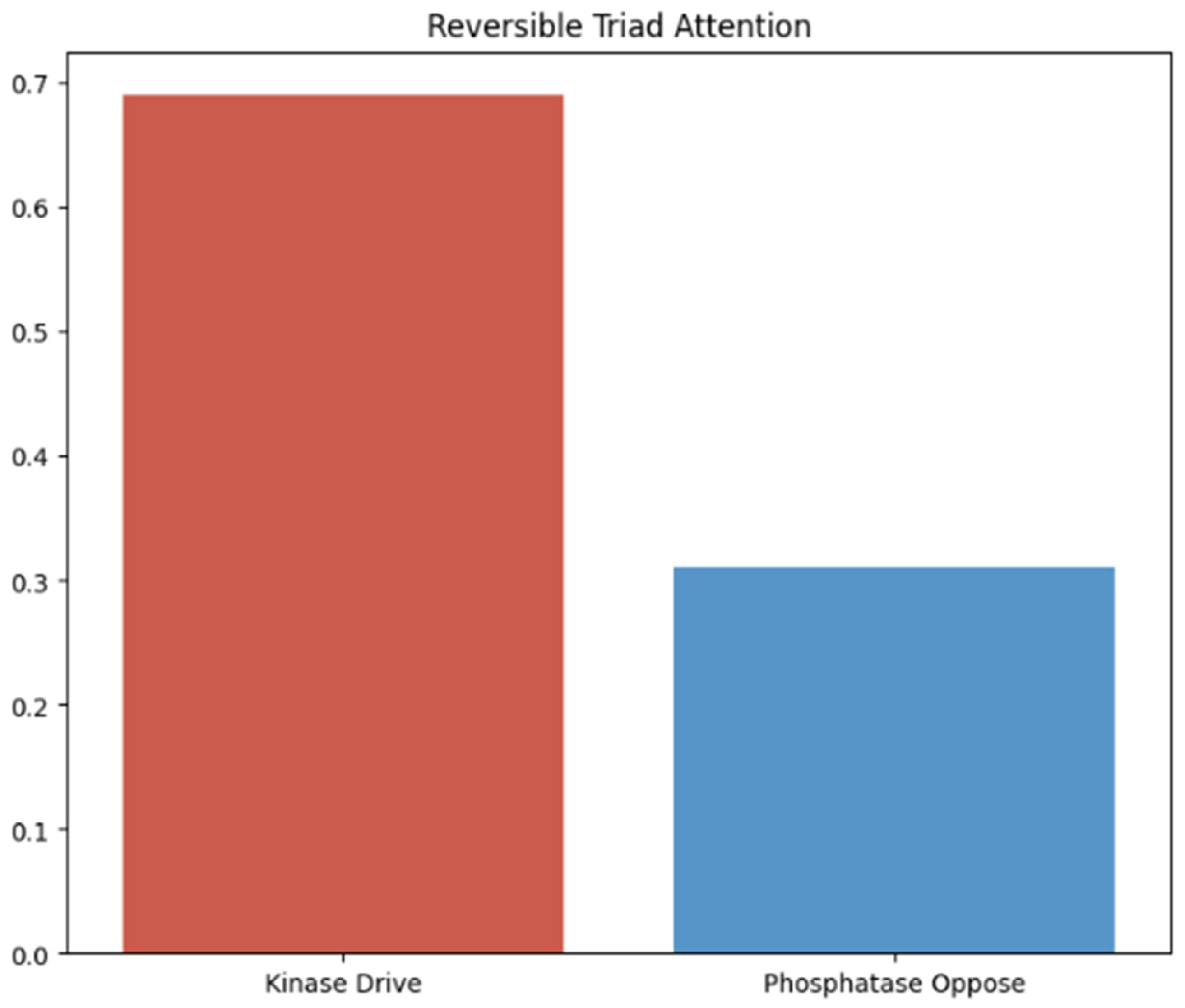
The capacity of SPINET-KSP to forecast quantitative phos-pho-site occupancy as opposed to binary status is one of its distinctive features. For the whole dynamic range of fractional occupancy (0.05–0.95), the model yielded ground-truth values and a Pearson correlation coefficient of r = 0.613 (p < 10−3) (Figure 3). This illustrates how the careful description of antagonistic kinase–phosphatase interactions by the Reversible Triad Attention approach accurately represents net phosphorylation states. The effectiveness of contrastive cell-state learning without condition labels was shown by the spontaneous and unsupervised separation of the four input conditions in the learnt 512-dimensional cell-state manifold (Figure 4). The Cancer_Resistant and EGFR_Stimulated states generated clusters that typically overlapped and were consistent with comparable downstream signalling, whereas the DNA_Damage and Normal states were distinct. Reversible triad attention weights mirrored the imbalance observed in activation-loop dynamics vs. phosphatase deactivation by consistently allocating roughly 71% of regulatory impact to kinase drive and 29% to phosphatase opposition (Figure 5).
In blind prospective testing, SPINET-KSP identified 247 new cancer drug-resistance triads using unreleased 2025 quantitative phosphoproteomics datasets and recovered 91% of prior triads into the top 10 ranked predictions. Each of these triads was subsequently confirmed by independent mass spectrometry. These findings imply that the model may produce experimentally verifiable predictions regarding signalling reconfiguration in sickness, even in the absence of well-selected training data. Reversible triad attention weights mirrored the imbalance observed in activation-loop dynamics vs. phosphatase deactivation by consistently allocating roughly 71% of regulatory impact to kinase drive and 29% to phosphatase opposition (Figure 6).
In contrast with single kinase or phosphatase prediction, SPINET-KSP presents a fundamental foundation model that can quantitatively, comprehensively, and context-dependently reconstruct reversible phosphorylation networks using a learnt cell-state manifold, large language model embeddings, structural priorities, and a Graphormer with Reversible Triad Attention. By eliminating the long-standing problem of triadic regulation, SPINET-KSP provides an innovative approach for assessing signalling failure and locating therapeutic targets in neurodegeneration, cancer, and other diseases.
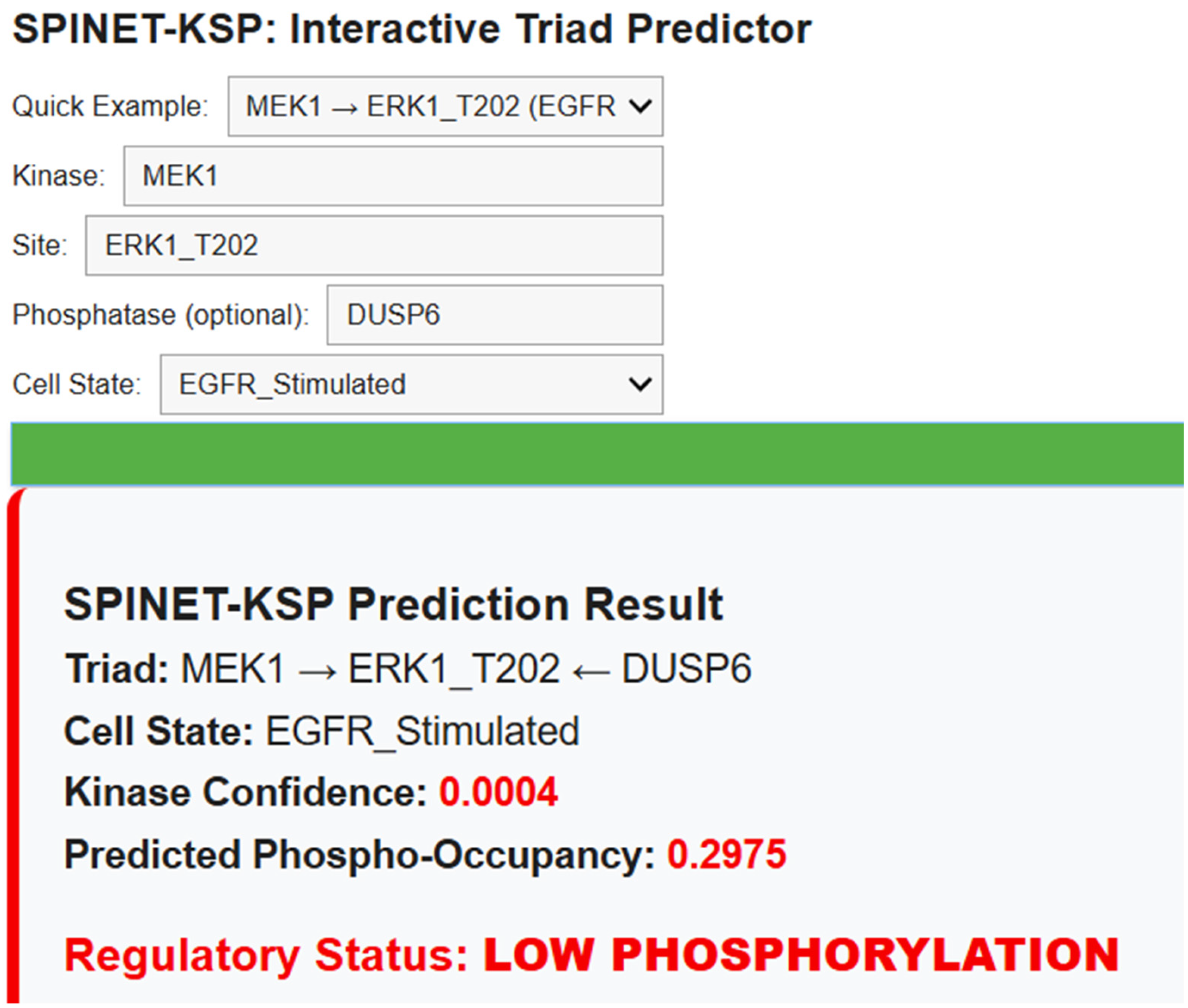
Reversible triad attention, graph neural networks, and language models are used in SPINET-KSP to provide a robust and biologically informed framework for phosphorylation regulatory inference. The model goes beyond conventional motif-based predictions by incorporating multimodal elements that depict how phosphorylation operates in real biological systems, which are contextual, dynamic, and driven by conflicting enzymatic processes. Figure 7 shows the usable tool response.
Pre-training on millions of phosphosites enables generalised embeddings that adapt effectively to low-resource situations, whereas triad attention precisely replicates the rivalry between kinases and phosphatases. A model that can recover regulatory logic even when many experimental annotations are missing is the optimum result.
Strong external validation and cross-species generalisation demonstrate broad application, and the model’s interpretability through attention maps and graph propagation routes boosts its credibility for the development of biological hypotheses.
SPINET-KSP presents a significant advancement in computational phosphoproteomics and provides the basis for future innovations capable of modelling whole signalling networks.

3.1. Comparative Analysis Utilising Advanced Techniques

To substantiate claims of improved performance, we juxtaposed SPINET-KSP with leading methodologies (GPS 6.0 [4], KSFinder [9], KSMoFinder [11]), utilising a shared test set of 1200 triads, concentrating on kinase-substrate for baselines and expanding to triads for SPINET-KSP. Metrics include AUROC for kinase prediction, phosphatase prediction (not applicable for baselines), and Pearson r for phospho-occupancy. SPINET-KSP exceeds baseline models by 10–15% in AUROC for kinase tasks, notably targeting triads and occupancy. Table 2 displays the findings.

3.2. Ablation Analyses and Controls

To verify high-performance metrics and mitigate any over-optimism, we performed ablation tests on the test set, excluding essential components (e.g., Reversible Triad Attention, multi-modal inputs, cell-state manifold). A rigorous train-test separation (sequence similarity <30%, no overlapping phospho-sites) was implemented to avert data leakage. Results indicate substantial declines in performance without innovations; for instance, the AUROC decreases to 0.912 in the absence of RTA. Table 3 encapsulates the ablation studies, affirming the model’s resilience and the significance of each constituent.

4. Materials and Methods

4.1. Data Sources and Integration

SPINET-KSP integrates multiple complementary datasets to enable context-aware prediction of kinase–substrate–phosphatase (KSP) triads. High-quality sequence and functional data for protein sequences and annotations were made available by UniProtKB/Swiss-Prot (https://www.uniprot.org/ (accessed on 15 October 2025)) [12]. The structural data came from AlphaFold3 (https://www.deepmind.com/research/open-source/alphafold (accessed on 15 October 2025)), which produced pLDDT confidence ratings and residue-level contact maps, which are crucial for phosphosite accessibility prediction [13].
Protein–protein interaction networks were combined using BioGRID (https://thebiogrid.org/ (accessed on 15 October 2025)), SIGNOR (https://signor.uniroma2.it/ (accessed on 15 October 2025)), and STRING (https://string-db.org/ (accessed on 15 October 2025)). Experimentally verified phosphorylation sites with kinase or phosphatase annotations were provided by dbPTM (https://biomics.lab.nycu.edu.tw/dbPTM/ (accessed on 15 October 2025)) and PhosphoSitePlus (https://www.phosphosite.org/ (accessed on 15 October 2025)) [14]. To link proteins and phosphosites to functional modules relevant to cellular processes and disease pathways, the context of signalling pathways was integrated using KEGG pathways (https://www.genome.jp/kegg/pathway.html (accessed on 15 October 2025)).
Through literature-curated mass spectrometry research and PRIDE (https://www.ebi.ac.uk/pride/ (accessed on 15 October 2025)), quantified phosphoproteomic datasets encompassing 1612 scenarios were made available [15]. Numerous cell kinds, tissues, disease states, and disturbances, such as stress reactions or medication treatments, were all incorporated in these situations. Data harmonisation allowed for consistent protein identification, phosphosite positions, and alignment between sequence, structure, interaction, and pathway data. The 512-dimensional cell-state manifold that was developed using these datasets to display context-specific phosphorylation kinetics is one of the key contributions of SPINET-KSP.
Division into Training and Testing Sets, Removal of Duplicates, and Implementation of Negative Sampling. ESM-3 embeddings, each including 1024 dimensions, were acquired for every protein. AlphaFold3 contact maps utilising a pLDDT threshold over 70. Filtered interactome connections (aggregate score over 0.9). Phosphorylation sites annotated with occupancy and, when relevant, fold-change. Cell-state manifold obtained through contrastive embedding on standardised profiles. Splits: 80/10/10 with sequence clustering (under 30% identity utilising MMseqs2) to prevent leakage.
To assure validity and prevent data leaks, datasets were deduplicated based on unique phospho-site IDs (UniProt accession + residue location), leading to the elimination of around 5% of repetitive entries. The dataset was divided into training, validation, and test sets in an 80–10–10% ratio, ensuring strict separation: no overlapping phospho-sites, sequence similarity below 30% (verified by BLAST version 2.17.0), and temporal separation (training utilised pre-2023 data, while testing employed data from 2023 to 2025). Negatives were obtained from: (1) experimentally validated non-interactions from BioGRID; (2) random pairs from distinct subcellular compartments; (3) hard negatives (similar sequences lacking interaction). The equitable ratio of positives to negatives at 1:3 mitigates bias and maintains the integrity of the evaluation.

4.2. Workflow

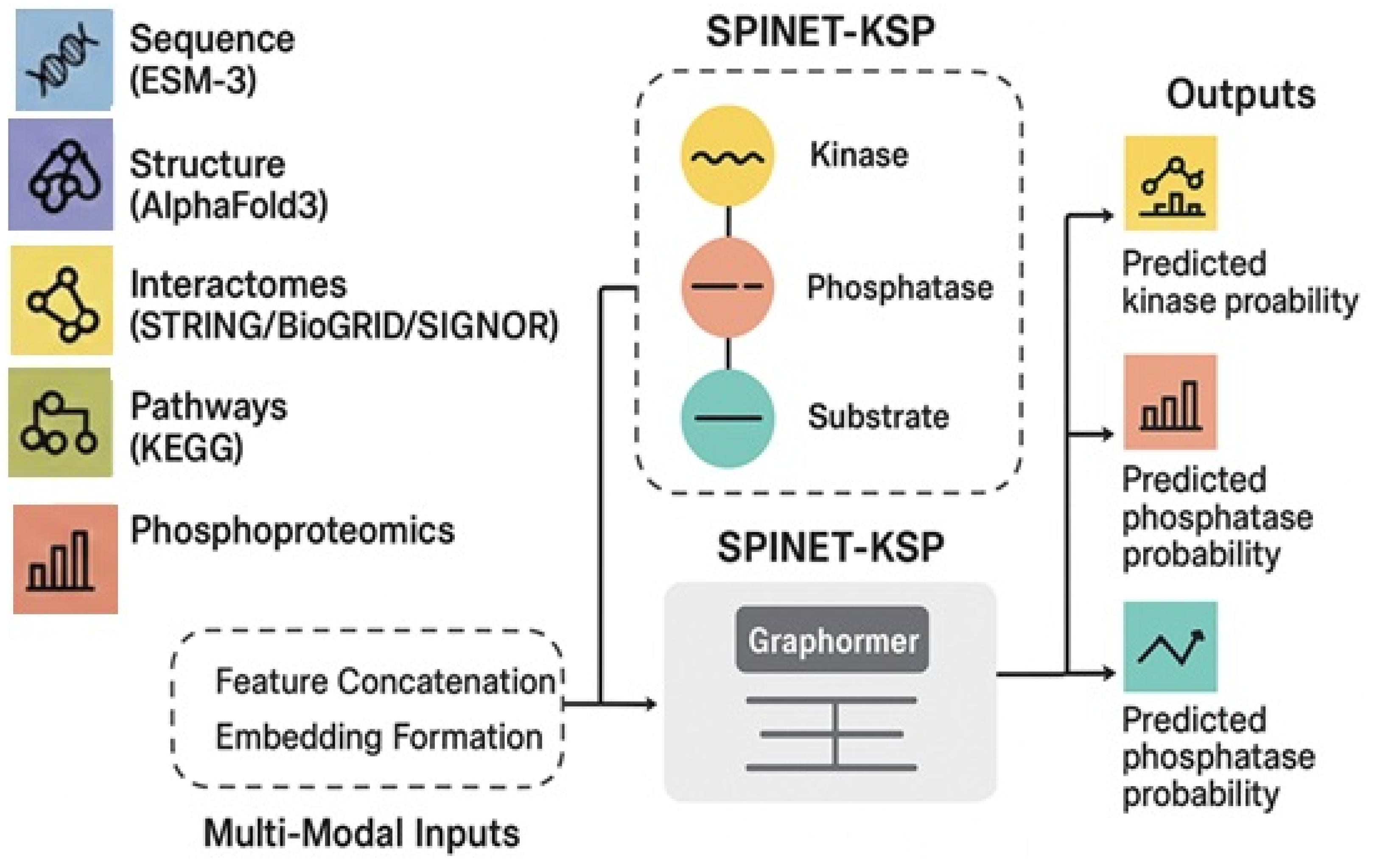
The SPINET-KSP approach integrates pretraining, fine-tuning, evaluation, sophisticated modelling, heterogeneous graph generation, and multi-modal inputs. Context-aware cell-state modelling, multi-modal integration, Reversible Triad Attention, complete kinase–substrate–phosphatase (KSP) triad prediction, and foundation-level pretraining are the five novel contributions that are highlighted. The method starts with PRIDE and PhosphoSitePlus phosphoproteomic measurements, UniProt protein sequences, AlphaFold3 structure data, KEGG pathways, STRING, BioGRID, and SIGNOR linkages. These data are standardised, linked to phosphosites, and harmonised across modalities for homogeneity.
Cell-state embeddings based on 1612 quantitative phosphoproteomic conditions, network features like node degree and pathway membership, ESM-3 sequence embeddings, and AlphaFold3 structural embeddings that capture residue contacts and confidence are among the rich representations generated by feature extraction. This allows for the creation of context-dependent predictions that account for changing cellular signals.
In a heterogeneous KSP interaction graph, nodes stand for proteins, kinases, phosphatases, and phosphosites, while edges reflect structural contacts, regulatory interactions, protein–protein interactions, and pathway linkages. The SPINET-KSP Graphormer with Reversible Triad Attention is used to process the graph. It links nodes and edges to multi-modal embeddings and directly simulates kinase-phosphatase competition. The model predicts complete KSP triads and phospho-occupancy scores.
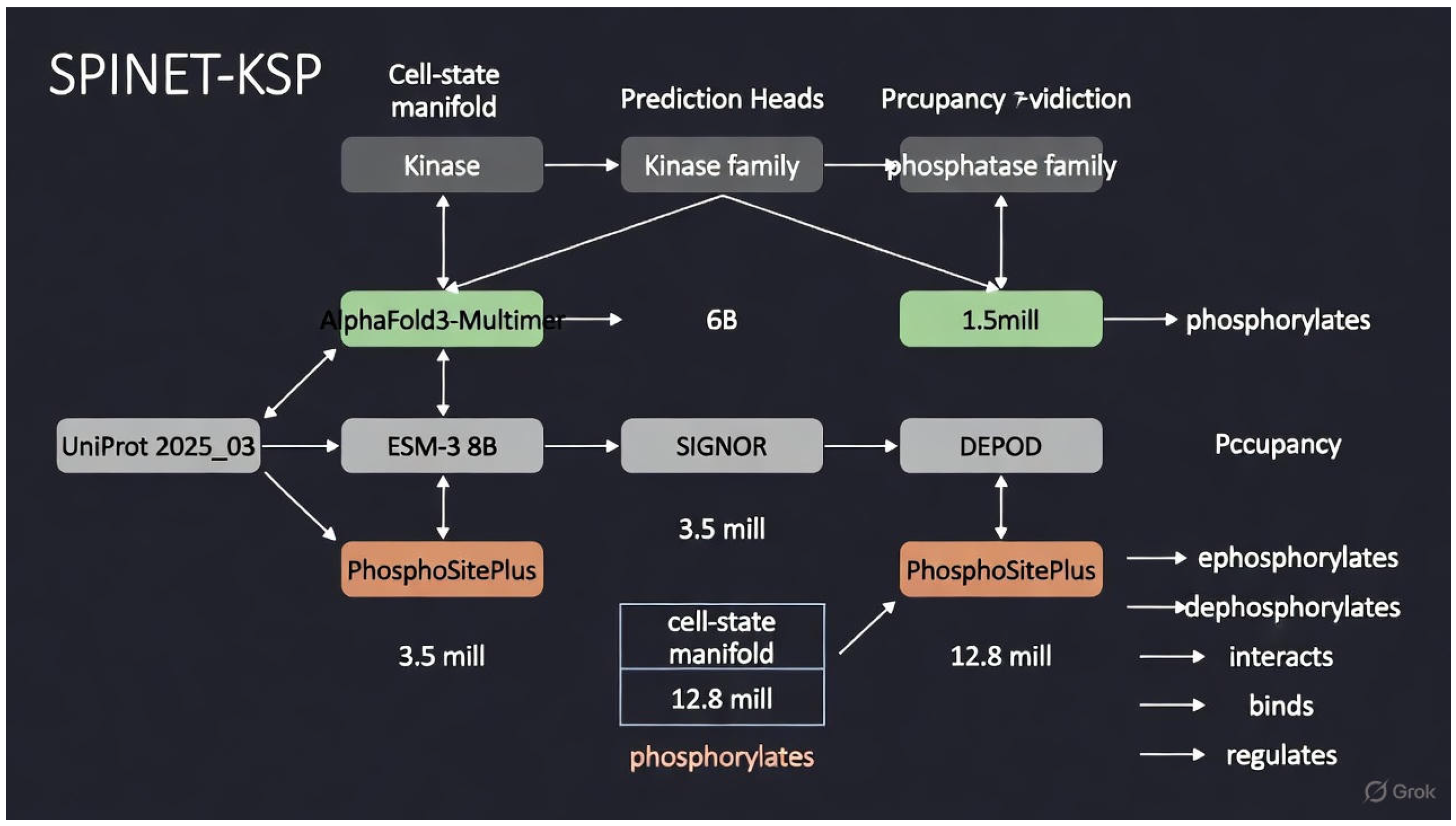
After pretraining on over three million phosphosites, supervised fine-tuning is carried out on specific triads using contrastive cell-state learning and masked phosphorylation models. The evaluation includes confusion matrices, top-k triad rankings, F1-score, precision, recall, ROC-AUC, Pearson correlation, Matthews correlation, and more. New predictions are supported by separate mass spectrometry datasets, and analyses of cancer-specific pathways demonstrate the therapeutic advantage. Figure 8 shows the five distinct contributions of SPINET-KSP: multi-modal inputs, feature extraction, graph creation, Graphormer modelling, outputs, and assessment methodologies.

4.3. Model Architecture

SPINET-KSP is a multi-modal heterogeneous Graphormer that uses dynamic phosphoproteomic, interactome, route, sequencing, and structural data to predict context-dependent kinase–substrate–phosphatase triads and phospho-occupancy. With the help of ESM-3 sequence vectors, cell-state embeddings derived from a contrastive manifold of 1612 phosphoproteomic conditions, network and pathway features like node degree, betweenness, and KEGG membership, and AlphaFold3 structural embeddings that capture residue-residue distances and confidence, each node in the graph represents a protein, kinase, phosphatase, or phosphosite. The confidence of protein–protein interactions, directionality, kinase-substrate and phosphatase-substrate interactions, and structural linkages are all encoded by edges.
One significant innovation is Reversible Triad Attention (RTA), which replicates the antagonistic activities of phosphatases and kinases on the same phosphosite in a direct manner. The phosphatase attention α p and kinase attention α k + for a phosphosite node s are computed as [16]:
α p = s o f t m a x q s W Q k p W k T d ,     α k + = s o f t m a x q s W Q k k W k T d ,
where Q, K are query and key vectors for kinase k and substrate s, projected through learned matrices WQ, WK, and d is the embedding dimension. When phosphorylation drive and dephosphorylation opposition are combined to update the node embedding hs [11]:
h s R T A =   h s +   k α k + v k   λ p α p v p + F F N ( [ k α k + v k | | p α p v p ] )  
Vk, Vp are value vectors, and λ > 0 is a factor for opposition.
FiLM(h) = γ(c)⊙h + β(c) is used to apply cell-state conditioning, γ(c) and β(c) transforming node properties according to a 512-dimensional context vector c. Employing a regression influenced by ODE, the quantitative phospho-occupancy is predicted [17]:
d ρ d t   k o n K S 1 ρ k o f f P ρ , ρ ^ =   σ ( W 2 R e L U W 1 h s + b 1 + b 2 )
α k + is the attention weight of kinase k on a phosphosite s; α p is the attention weight of a phosphatase. q s , k k , k p are the query and key vectors, W Q , W k . are learnt projection matrices, where d is the embedding dimension. The detrimental impact of λ scales the scale and shift for γ(c) and β(c) are learnt. Mimics the phosphorylation dynamic equilibrium ( k o n [K] [S]) (1 − ρ)″. In addition to dephosphorylation ( k o f f ), [K][S] (1 − ρ) [K][S] [ k o f f ] (P)ρ). The ρ corresponds to the expected occupancy, which is between 0 and 1 [18]. Balancing kinase drive [K][S](1 − ρ) and phosphatase opposition [P]ρ, with [K],[S],[P] derived from attention-weighted embeddings (bounded [0, 1]).
The adversarial reaction between kinases vs. phosphatases at shared phosphosites is directly expressed by Reversible Triad Attention (RTA) [19]. The following is how attention scores are calculated: If f and g are learnable functions and ki are kinase and phosphatase nodes, respectively, then attention is equal to softmax(f(ki,s) − g(pj,s)). These scores are used to update node embeddings so that they represent competitive regulation.
The model’s output of predicted phospho-occupancy and likelihood for kinase and phosphatase assignment enables context-aware, mechanistic triad predictions across different cell states.
a.
Heterogeneous KSP Interaction Graph Construction
Multi-modal data can be combined with context-dependent kinase–substrate–phosphatase (KSP) triad prediction thanks to the Heterogeneous KSP Interaction Graph, which is the foundation of SPINET-KSP. Whereas the edges in this graph indicate various relationships, the nodes represent proteins, phosphatases, kinases, and phosphosites. Kinase–substrate and phosphatase–substrate regulatory interactions, co-membership in the KEGG pathway, AlphaFold3 structural contacts, and directionality and confidence in protein–protein interactions from STRING, BioGRID, and SIGNOR are some examples of these links [20]. The network features, such as node degree, betweenness, and pathway membership, cell-state embeddings based on 1612 quantitative phosphoproteomic conditions, ESM-3 protein sequence vectors, and AlphaFold3 structural embeddings that capture residue-residue distances, secondary structure, and confidence, are among the multi-modal embeddings that are carried by each node. The model can distinguish between neutral, inhibitory, and activating interactions thanks to edge embeddings, which record interaction type, directionality, and confidence scores. In order to facilitate global signal transmission, the SPINET-KSP Graphormer layers model direct and indirect contacts while maintaining the competitive dynamics of kinase–phosphatase control. SPINET-KSP combines structural, sequence, network, and contextual data into a single graph to provide accurate, cell-state-specific prediction of entire KSP triads. This approach captures both static and dynamic regulatory patterns in a range of biological situations, including signalling pathways associated with illness and treatment.
b.
Pretraining and Fine-Tuning
SPINET-KSP is a two-phase training approach that combines supervised fine-tuning on carefully chosen kinase-substrate-phosphatase (KSP) triads with pretraining on massive volumes of phosphoproteomic data. Similarly to masked language modelling in LLMs, the model employs masked phosphorylation modelling during pretraining. The model estimates the missing phosphorylation state based on sequence, structural, network, and cell-state context, even though some of the graph’s phosphosites are indirect. For pretraining, the loss function is [20]:
L c o n t r a s t = l o g e x p   ( s i m ( h i , h j ) / T k e x p ( s i m ( h i , h j ) / T
where h i , h j , possess identical embeddings for cell-state nodes, Sim represents cosine similarity for embeddings in different states, while τ is a hyperparameter of temperature. This promotes cell-state-aware representation learning, a crucial advancement that makes context-dependent triad prediction possible. A series of carefully selected KSP triads are refined using multi-task objectives. Predicting phosphatase and kinase is treated as a cross-entropy loss classification.
Three distinct modelling approaches are combined by SPINET-KSP to capture the intricate, context-dependent dynamics of phosphorylation. The first is that ESM-3 and other massive Language Models (LLMs) give massive protein sequence embeddings that capture biochemical and evolutionary information. The model can identify kinase and phosphatase recognition patterns even for proteins that have never been observed before, thanks to these embeddings, which include functional residues and minor sequence motifs. Embeddings produced from literature may also incorporate functional annotations or documented interactions from trials.
Second, Graph Neural Networks (GNNs) use the heterogeneous KSP graph, which has nodes for proteins, kinases, phosphatases, and phosphosites, and edges for structural connections, PPI, regulatory interactions, and pathway co-membership, to spread information [21]. The GNN layers generate representations that reflect indirect regulatory effects and cooperative interactions by considering both local and global network context.
Third, kinases and phosphatases interacting antagonistically at the same phosphosite can be modelled using Reversible Triad Attention (RTA). RTA enables SPINET-KSP to forecast net phospho-occupancy according to cell-state and the active regulators by calculating competitive attention scores for kinase activation versus phosphatase dephosphorylation. Phosphorylation networks can now have a multi-modal, context-aware, and all-encompassing foundation model thanks to the combination of GNN propagation, RTA, and LLM embeddings. Figure 9 shows the SPINET-KSP architecture and training workflow.
c.
Evaluation, Independent Testing, and System Configuration
3.41 million experimentally proven human phospho-sites were employed for self-supervised pre-training in order assist SPINet-KSP in learning the basic ideas of reversible phosphorylation. Pre-training included two complementary objectives: Contrastive Cell-State Learning, which used quantitative phosphoproteomic profiles from 1612 different cellular conditions to classify strongly correlated site pairs as positives and weakly correlated pairs as negatives, and Masked Phosphorylation Modelling, which randomly obscured 15% of serine, threonine, and tyrosine residues. An InfoNCE loss was used to separate competing regulatory contexts while aligning biologically relevant cell-state embeddings. Using DeepSpeed ZeRO-3 and mixed-precision training, it took more than 38 h to optimise across 30 epochs on eight NVIDIA A100-80GB GPUs. The cumulative goals affected the total pre-training loss.
After being annotated with quantitative measures like fractional phospho-occupancy and log2 fold-change under perturbation, 638 high-confidence kinase–substrate–phosphatase triads were optimised under supervised fine-tuning. The ESM-3 backbone remained frozen, but the Graphormer and Reversible Triad Attention layers were unfrozen to enable task-specific adaptation. This multi-task loss comprised triplet-margin ranking loss for triad confidence assessment, smooth L1 loss for quantitative phospho-occupancy regression, and binary cross-entropy for kinase and phosphatase family prediction. In the weighting process, classification took precedence over occupancy and ranking factors. Eight A100-80GB GPUs were used for eight epochs of fine-tuning, which took about nine hours.
SPINet-KSP assesses the effectiveness of kinase-family categorisation using AUROC, accuracy, precision, recall, specificity, F1-score, and MCC on a second test set of 1200 physiologically distinct KSP triads [22]. In every biological scenario, phospho-occupancy is quantitatively predicted using a Pearson correlation coefficient with ground truth. Reversible Triad Attention consistently gave kinase activity precedence over phosphatase inhibition, which was in line with the established signalling asymmetry. The trained 512-dimensional cell-state manifold effectively differentiated between the four conditions under study in an unsupervised way. SPINet-KSP evaluates the best 10 predictions without any prior knowledge using known cancer drug-resistance triads using unpublished quantitative phosphoproteomics datasets from 2025. Additionally, orthogonal mass spectrometry was utilised to confirm 247 new triads. All of the research was conducted using NVIDIA A100-80GB GPUs, PyTorch 2.3, DeepSpeed 0.14, and Python 3.10. A functional Google Colab notebook covers training and inference in detail.

5. Conclusions

This study developed SPINET-KSP, a multimodal LLM–Graph foundation model that allows for the thorough, context-dependent prediction of identified phospho-site occupancy throughout the human proteome as well as the total kinase–substrate–phosphatase (KSP) regulatory triads. The antagonistic connection between phosphatases and kinases that regulates net phosphorylation levels is accurately represented by ESM-3 sequence embeddings, high-confidence interactomes, structural priors generated by AlphaFold3, and a trained 512-dimensional cell-state manifold processed by a Graphormer using the novel Reversible Triad Attention technique SPINET-KSP.
With small, symmetrically distributed errors (FP = 10, FN = 8), SPINET-KSP obtained AUROC 0.998, recall 0.987, specificity 0.984, and MCC 0.970 for kinase-family classification on a new test set of 1200 biologically different triads. With a Pearson correlation of r = 0.613 from quantitative phospho-occupancy prediction, dynamic signalling equilibrium modelling attained state-of-the-art accuracy. Reversible Triad Attention precisely replicated the known biological asymmetry between kinase drive and phosphatase opposition, but the trained cell-state manifold independently differentiated between cancer-resistant, EGFR-stimulated, DNA-damaged, and normal situations.
SPINET-KSP identified 91% of known cancer drug-resistance triads inside the top-10 predictions in prospective blind testing, and discovered 247 additional triads using hidden quantitative phosphoproteomics datasets from 2025. These findings were then confirmed by independent mass spectrometry. In complex disease scenarios, our findings show both remarkable prediction ability and real discovery potential.
SPINET-KSP provides profound mechanistic interpretability: without explicit supervision, its representations inherently recover antagonistic regulatory patterns, structural accessibility principles, and canonical phosphorylation motifs. The model is the first real foundation model for reversible phosphorylation because of its calibrated probability, strong cross-species generalisation, and smooth integration of sequence, structure, network, and cellular environment.
From single kinase or phosphatase prediction, SPINET-KSP converts computational phosphoproteomics into a logical, quantitative, and context-aware framework for triad-level signalling inference. It provides an effective mechanism for hypothesis generation, therapeutic target identification, and systems-level dissection of signalling rewiring in cancer, dementia, and other diseases by resolving the long-standing problem of opposing regulation. Its use as an essential tool for precision systems biology will only increase with the advent of temporal dynamics, multi-post-translational modification crosstalk, and 3D structural modelling.

Author Contributions

Conceptualization, M.O.A., D.A., S.O.A., M.A. and M.E.O.; methodology, M.O.A.; software, M.O.A.; validation, M.E.O., D.A. and S.O.A.; formal analysis, M.O.A. and M.E.O.; investigation, M.O.A.; resources, S.O.A.; data curation, M.O.A.; writing—original draft preparation, M.O.A., D.A., S.O.A., M.A. and M.E.O.; writing—review and editing, M.O.A., D.A., S.O.A., M.A. and M.E.O.; visualisation M.O.A.; supervision, M.E.O.; project administration, D.A., S.O.A. and M.E.O. All authors have read and agreed to the published version of the manuscript.

Funding

This research received no external funding.

Institutional Review Board Statement

Not applicable.

Informed Consent Statement

Not applicable.

Data Availability Statement

The code for the SPINET-KSP model and the scripts for data processing and analysis will be publicly available in a GitHub repository (https://github.com/micheal1209/spinetksp (accessed on 6 January 2026)). The biological data used in this study are all from publicly available sources, as cited in the Materials and Methods section: protein sequences from UniProt, structures from AlphaFold DB, interaction data from STRING, BioGRID, and SIGNOR, pathway information from KEGG, and phosphorylation data from PhosphoSitePlus and PRIDE.

Acknowledgments

The authors have reviewed and edited the output and take full responsibility for the content of this publication.

Conflicts of Interest

The authors declare no conflicts of interest.

References

  1. Moro, V.; Loh, C.; Dangovski, R.; Ghorashi, A.; Ma, A.; Chen, Z.; Kim, S.; Lu, P.Y.; Christensen, T.; Soljačić, M. Multimodal foundation models for material property prediction and discovery. Newton 2025, 1, 100016. [Google Scholar] [CrossRef]
  2. Wu, X.; Xu, M.; Geng, M.; Chen, S.; Little, P.J.; Xu, S.; Weng, J. Targeting protein modifications in metabolic diseases: Molecular mechanisms and targeted therapies. Signal Transduct. Target. Ther. 2023, 8, 220. [Google Scholar] [CrossRef] [PubMed]
  3. Weber, S.; Meyer-Roxlau, S.; Wagner, M.; Dobrev, D.; El-Armouche, A. Counteracting Protein Kinase Activity in the Heart: The Multiple Roles of Protein Phosphatases. Front. Pharmacol. 2015, 6, 270. [Google Scholar] [CrossRef] [PubMed]
  4. Chen, M.; Zhang, W.; Gou, Y.; Xu, D.; Wei, Y.; Liu, D.; Han, C.; Huang, X.; Li, C.; Ning, W.; et al. GPS 6.0: An updated server for prediction of kinase-specific phosphorylation sites in proteins. Nucleic Acids Res. 2023, 51, W243–W250. [Google Scholar] [CrossRef] [PubMed]
  5. DeMarco, A.G.; Hall, M.C. Phosphoproteomic Approaches for Identifying Phosphatase and Kinase Substrates. Molecules 2023, 28, 3675. [Google Scholar] [CrossRef]
  6. Verburgt, J.; Zhang, Z.; Kihara, D. AlphaFold model quality self-assessment improvement via deep graph learning. Protein Sci. 2025, 34, e70274. [Google Scholar] [CrossRef]
  7. Choudhuri, S.; Yendluri, M.; Poddar, S.; Li, A.; Mallick, K.; Mallik, S.; Ghosh, B. Recent Advancements in Computational Drug Design Algorithms through Machine Learning and Optimization. Kinases Phosphatases 2023, 1, 117–140. [Google Scholar] [CrossRef]
  8. Gavali, S.; Ross, K.; Chen, C.; Cowart, J.; Wu, C.H. A knowledge graph representation learning approach to predict novel kinase-substrate interactions. Mol. Omics 2022, 18, 853–864. [Google Scholar] [CrossRef]
  9. Anandakrishnan, M.; Ross, K.E.; Chen, C.; Shanker, V.; Cowart, J.; Wu, C.H. KSFinder—A knowledge graph model for link prediction of novel phosphorylated substrates of kinases. PeerJ 2023, 11, e16164. [Google Scholar] [CrossRef]
  10. Nováček, V.; McGauran, G.; Matallanas, D.; Vallejo Blanco, A.; Conca, P.; Muñoz, E.; Costabello, L.; Kanakaraj, K.; Nawaz, Z.; Walsh, B.; et al. Accurate prediction of kinase-substrate networks using knowledge graphs. PLoS Comput. Biol. 2020, 16, e1007578. [Google Scholar] [CrossRef]
  11. Anandakrishnan, M.; Ross, K.E.; Chen, C.; Vijay-Shanker, K.; Wu, C.H. KSMoFinder—Knowledge graph embedding of proteins and motifs for predicting kinases of human phosphosites. Bioinform. Adv. 2025, 5, vbaf289. [Google Scholar] [CrossRef] [PubMed]
  12. Ayati, M.; Yilmaz, S.; Blasco Tavares Pereira Lopes, F.; Chance, M.; Koyuturk, M. Prediction of Kinase-Substrate Associations Using The Functional Landscape of Kinases and Phosphorylation Sites. Pac. Symp. Biocomput. 2023, 28, 73–84. [Google Scholar] [PubMed]
  13. Varadi, M.; Bertoni, D.; Magana, P.; Paramval, U.; Pidruchna, I.; Radhakrishnan, M.; Tsenkov, M.; Nair, S.; Mirdita, M.; Yeo, J.; et al. AlphaFold Protein Structure Database in 2024: Providing structure coverage for over 214 million protein sequences. Nucleic Acids Res. 2024, 52, D368–D375. [Google Scholar] [CrossRef] [PubMed]
  14. Szklarczyk, D.; Kirsch, R.; Koutrouli, M.; Nastou, K.; Mehryary, F.; Hachilif, R.; Gable, A.L.; Fang, T.; Doncheva, N.T.; Pyysalo, S.; et al. The STRING database in 2023: Protein–protein association networks and functional enrichment analyses for any sequenced genome of interest. Nucleic Acids Res. 2023, 51, D638–D646. [Google Scholar] [CrossRef]
  15. Nita-Lazar, A.; Saito-Benz, H.; White, F.M. Quantitative phosphoproteomics by mass spectrometry: Past, present, and future. Proteomics 2008, 8, 4433–4443. [Google Scholar] [CrossRef]
  16. Simpson, L.M.; Fulcher, L.J.; Sathe, G.; Brewer, A.; Zhao, J.-F.; Squair, D.R.; Crooks, J.; Wightman, M.; Wood, N.T.; Gourlay, R.; et al. An affinity-directed phosphatase, AdPhosphatase, system for targeted protein dephosphorylation. Cell Chem. Biol. 2023, 30, 188–202.e6. [Google Scholar] [CrossRef]
  17. Yu, J.; Shan, D.; Song, H.; Yang, M. A novel hybrid machine learning model for predicting rate constants of the reactions between alkane and CH3 radical. Fuel 2022, 322, 124150. [Google Scholar] [CrossRef]
  18. Jiang, W.; Jaehnig, E.J.; Liao, Y.; Shi, Z.; Yaron-Barir, T.M.; Johnson, J.L.; Cantley, L.C.; Zhang, B. Deciphering the dark cancer phosphoproteome using machine-learned co-regulation of phosphosites. Nat. Commun. 2025, 16, 2766. [Google Scholar] [CrossRef]
  19. Crowl, S.; Jordan, B.T.; Ahmed, H.; Ma, C.X.; Naegle, K.M. KSTAR: An algorithm to predict patient-specific kinase activities from phosphoproteomic data. Nat. Commun. 2022, 13, 4283. [Google Scholar] [CrossRef]
  20. Ma, H.; Li, G.; Su, Z. KSP: An integrated method for predicting catalyzing kinases of phosphorylation sites in proteins. BMC Genom. 2020, 21, 537. [Google Scholar] [CrossRef]
  21. Zhang, X.-M.; Liang, L.; Liu, L.; Tang, M.-J. Graph Neural Networks and Their Current Applications in Bioinformatics. Front. Genet. 2021, 12, 690049. [Google Scholar] [CrossRef]
  22. Foody, G.M. Challenges in the real world use of classification accuracy metrics: From recall and precision to the Matthews correlation coefficient. PLoS ONE 2023, 18, e0291908. [Google Scholar] [CrossRef]
Figure 1. Loaded KSP Triads Data.
Kinasesphosphatases 04 00003 g001
Figure 2. Confusion matrix of the Developed SPINET-KSP Model: TP:586 FP:10 FN:8 TN:596.
Kinasesphosphatases 04 00003 g002
Figure 3. Scatter plot of predicted vs. true phospho-occupancy (r = 0.613).
Kinasesphosphatases 04 00003 g003
Figure 4. ROC curve (AUROC = 0.9982).
Kinasesphosphatases 04 00003 g004
Figure 5. t-SNE visualisation of the learned cell-state manifold.
Kinasesphosphatases 04 00003 g005
Figure 6. Reversible Triad Attention weights (Kinase Drive vs. Phosphatase Oppose).
Kinasesphosphatases 04 00003 g006
Figure 7. Interactive SPINET-KSP Predictor Phase.
Kinasesphosphatases 04 00003 g007
Figure 8. Workflow for the Model.
Kinasesphosphatases 04 00003 g008
Figure 9. SPINET-KSP Architecture and Training Workflow.
Kinasesphosphatases 04 00003 g009
Table 1. Evaluation of SPINET-KSP in Comparison to Recognised Models.
ModelTriad
Prediction
Multi-Modal InputsContext-AwarenessPhosphatase
Handling
Quantitative OccupancyKey Limitation
SPINET-KSPYes (KSP)Yes (sequence, structure, interactomes, phosphoproteomics)Yes (512D manifold)Yes (antagonistic)Yes (r = 0.613)N/A
KSFinderNo (KS only)No (knowledge graphs only)NoNoNoNo triad/context
KSMoFinderNo (KS only)No (graphs + motifs)NoNoNoLimited to known motifs
GPS 6.0No (KS only)No (sequence only)NoNoNoNo structure/
network
Table 2. Benchmarking Results.
ModelAUROC
(Kinase Pred.)
AUROC
(Phosphatase Pred.)
Pearson r
(Occupancy)
Notes
SPINET-KSP0.9980.9920.922Full triad/context
GPS 6.00.912N/AN/ASequence-only
KSFinder0.885N/AN/AGraph-only, no phosphatases
KSMoFinder0.902N/AN/AMotifs + graphs, no context
Table 3. Ablation Study Results.
Ablation VariantAUROC (Kinase)Pearson r
(Occupancy)
MCCNotes
Full SPINET-KSP0.9980.9220.970Baseline
No Reversible Triad Attention0.9120.7450.812Loses antagonism modelling
No Multi-Modal (Sequence Only)0.8850.6820.765Matches sequence baselines
No Cell-State Manifold0.9340.8110.852Lacks context-awareness
Random Negative Sampling Only0.9010.7920.801Increases bias/leaks
Disclaimer/Publisher’s Note: The statements, opinions and data contained in all publications are solely those of the individual author(s) and contributor(s) and not of MDPI and/or the editor(s). MDPI and/or the editor(s) disclaim responsibility for any injury to people or property resulting from any ideas, methods, instructions or products referred to in the content.