
1. Introduction
Studies on the scorpion fauna of Madagascar began early during the 19th century with the description of
Scorpio madagascariensis by Gervais in 1844 [
1], a species later transferred to the genus
Grosphus Simon. In 1889, Pocock [
2] subsequently named a second species from the island,
Buthus limbatus, which was also later transferred to the genus
Grosphus. During this same period, several additional species were described from the Malagasy fauna, with the contributions of Kraepelin [
3,
4,
5], Pocock [
6], and Birula [
7] being particularly noteworthy.
At the beginning of the 20th century, the Malagasy scorpion fauna was considered to comprise two families—the Scorpionidae (subfamily Ischnurinae) represented by the genera
Opisthacanthus Peters and
Heteroscorpion Birula, each with a single species, and the Buthidae, which included four genera:
Grosphus with seven species,
Odonturus Karsch (=
Tityobuthus) with one species,
Uroplectes Peters with one species, and the widespread species
Isometrus maculatus (De Geer), now regarded as an introduced taxon rather than a component of the endemic Malagasy fauna. For further details, refer to Lourenço [
8,
9]. The presence of the genus
Uroplectes in Madagascar has not been confirmed subsequently, and most likely corresponds to an introduction (see [
10]).
The first synthesis on the Malagasy scorpion fauna was proposed by Fage in 1929 [
11]. In his monographic study, he mainly considered previously described taxa and added only a new subspecies or variety,
Grosphus limbatus annulata. Nevertheless, this work represents the first comprehensive treatment of Malagasy scorpions. In the following years, Roewer [
12] named
Isometrus madagassus, a species whose taxonomic status remained uncertain for several decades and which was subsequently regarded as a synonym of
Isometrus maculatus (De Geer, 1778) [
9]. A few years later, Fage [
13] described
Babycurus gracilis, a cave-dwelling scorpion. Over the subsequent three decades, several syntheses of the Malagasy scorpion fauna were published, but few new taxa were described [
14,
15,
16,
17]. During this period, only a single additional species,
Grosphus griveaudi, was described by Vachon [
16].
By the mid-1990s, a number of new contributions were published, mainly by Lourenço, e.g., [
8,
9,
18], including the description of three new genera and six new species (
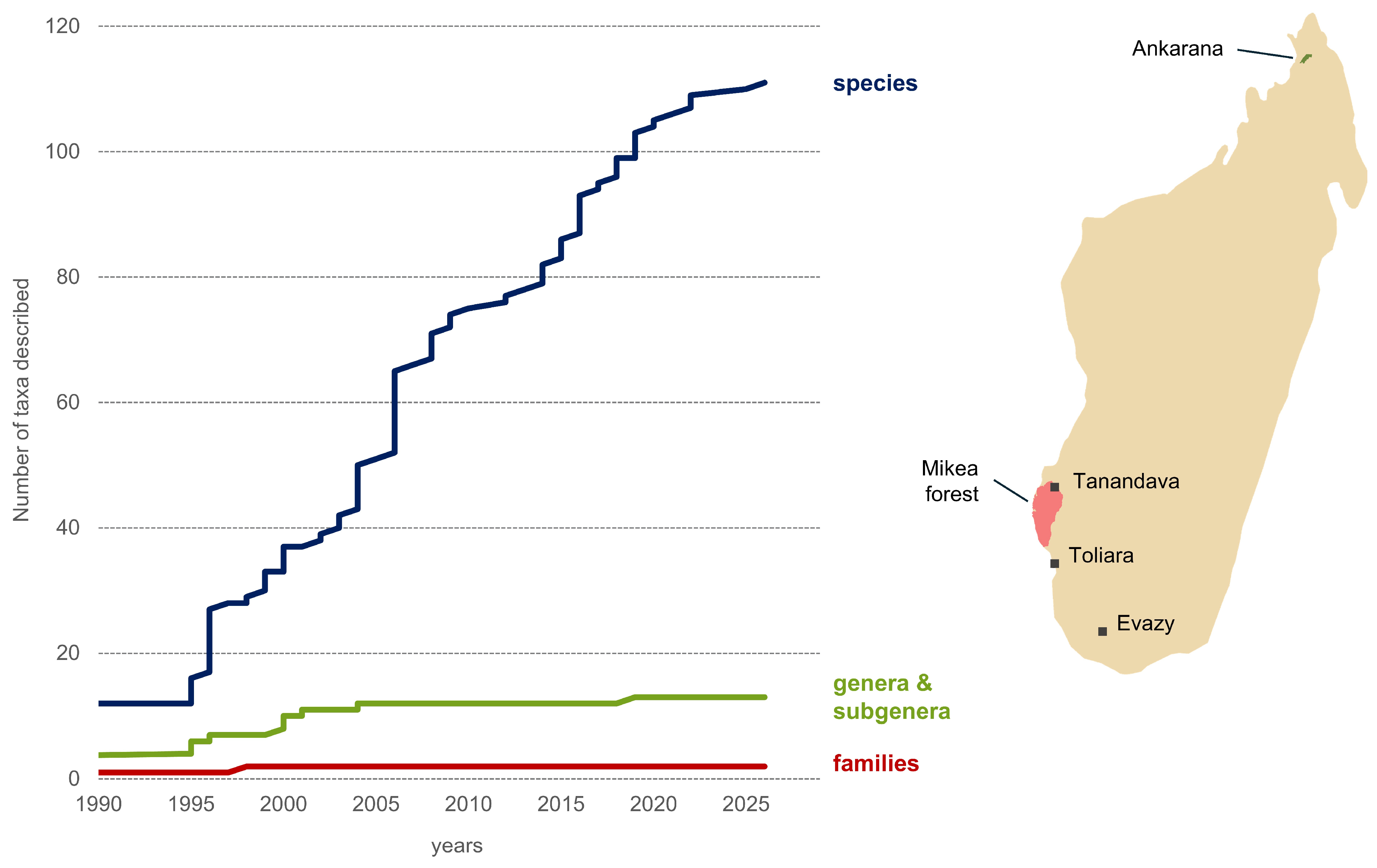
Figure 1). These taxonomic advances were synthesized by Lourenço [
9] in the ‘Fauna of Madagascar’, in which an additional new genus and nine new species were described. Furthermore, a new subfamily, the Microcharminae, was established, and the subfamily Heteroscorpioninae was elevated to the rank of family. Following the publication of this monograph, faunal inventories conducted in previously unexplored or poorly known regions of the island led to a renewed series of descriptions, including three new genera, one new subgenus, and 11 new species.
During the following two decades, the pace of new descriptions remained almost uninterrupted, as reflected in the synoptic works of Lourenço [
19] and Lourenço et al. [
20]. In more recent years, although the number of newly described taxa has decreased, new species continue to be described regularly, typically once or twice per year [
21,
22] (
Table S1).
In their contributions to the Malagasy scorpion fauna, authors such as Fage [
11] and Millot [
14,
15] appear to have overestimated the extent of contemporary knowledge of the island’s fauna. Fage (1929, p. 639, translated from the French) [
11] stated: “since scorpion species are of large size and have been collected in all regions of the island, it is possible to estimate that all populations of the island, as well as their relative density and distribution, are known.” Millot (1949/1953, p. 127, translated from the French) [
15] expressed a similar view: “Scorpions are the best-known Arachnida of Madagascar. Owing to their large size, they are easily observed and collected, and it is therefore likely that most species occurring on the Great Island are already identified.”
It is well established that, as in several zoological groups, the progressive increase in the number of described species often leads to the subsequent discovery of smaller species, resulting in a reduction in the average body size of the group [
23,
24]. The description of numerous new genera and species over the past 25 years is in most cases associated with microscorpions whose existence had not previously gone undetected. Notable exceptions can, however, be cited, such as the description of the genus
Palaeocheloctonus Lourenço (Hormuridae) from the southwest and northwest regions, as well as several new species of the giant genus
Heteroscorpion from poorly explored regions of the island [
19,
20]. In these cases, the species involved are relatively large species, reaching total lengths ranging from 65 to nearly 200 mm.
The vast majority of scorpion genera present in Madagascar are endemic [
8,
18,
25] and, in many if not most cases, represent very ancient lineages. The genus
Neogrosphus Lourenço, 1995 was established to accommodate the species
Grosphus griveaudi Vachon, 1969, originally described within the genus
Grosphus based on five males and two females collected in dry southwestern vegetation formations at two localities of the former Province de Toliara: Tanandava in the Mikea Forest, east of Lake Ihotry and north of Toliara, and Evazy, south of Toliara. According to Vachon [
16], the specimens from Tanandava were collected in a baobab (
Adansonia) forest on red sands, and those from Evazy were found in the spiny bush biome composed of Didiereaceae and Euphorbiaceae (
Figure 1).
The genus
Neogrosphus was established to accommodate
G.
griveaudi, which exhibits a combination of morphological characteristics that fall outside the range observed in typical members of the genus
Grosphus. In the original description of
G.
griveaudi, doubts regarding its generic placement were already evident. Vachon [
16] (p. 481; translated from the French) noted: “The identification of the specimens that led to the description of this new species posed numerous difficulties… It is therefore quite possible that
griveaudi belongs to a new subgenus or even a new genus.”
Shortly after the description of the genus
Neogrosphus (Lourenço, 1995), a second species,
Neogrosphus blanci Lourenço, 1996, was described based on a single male specimen held in the collections of the Muséum national d’Histoire naturelle in Paris. This species was
a priori considered to originate from an imprecise locality in Central Madagascar [
9]. However, subsequent examination of collection records at the Muséum provided additional information regarding its probable type locality. In a later contribution to this genus [
26], a preliminary synthesis of the known representatives of the genus
Neogrosphus was proposed, based on extensive new material collected during more than a decade of biological exploration. A third species,
Neogrosphus andrafiabe Lourenço, Wilmé & Waeber 2015, was subsequently described from a geographically distinct region in northern Madagascar, more precisely in the Ankarana limestones [
27]. This species proved to be at least partially related to
N. griveaudi, which is restricted to the southern and southwestern regions of Madagascar, thus representing a further example of disjunct distribution and illustrating once again the patterns of micro-endemism and vicariance observed among Malagasy scorpions.
The discovery of a new
Neogrosphus species in the southeastern region of Madagascar provides an opportunity to reassess the factors shaping the distribution and diversification of this genus within the island. Malagasy scorpions, many of which belong to archaic and low-dispersal lineages, constitute a particularly informative system for examining the interplay between geomorphology, climate, and lineage-specific traits in a heterogeneous landscape [
22,
28]. Previous studies have proposed general frameworks, such as the
Neogrosphus rule, to explain patterns of species richness and distribution in relation to dispersal ability and ancestral niche breadth [
28]. This rule, formulated to extend beyond scorpions, predicts that in highly vagile organisms, increased dispersal ability is associated with reduced species richness, regardless of niche breadth [
29] (see Table 1, cases 3 and 4 in Wilmé et al. [
29]). Comparable patterns have been documented in other groups, notably birds, where greater dispersal capacity—measured through wing morphology—correlates with expanded geographic ranges but has limited or ambiguous effects on speciation rates, consistent with the homogenizing influence of gene flow [
30]. In contrast, the strongly structured and dispersal-limited diversity of Malagasy scorpions reflects the alternative outcome predicted by this framework.
However, these models have generally not fully incorporated recent advances in geomorphological reconstruction, which highlight the long-term evolution of Madagascar’s landscapes through escarpment retreat, drainage reorganization, and spatially heterogeneous uplift [
31].
In the following sections, we first outline the methodological framework adopted in this study, then examine the biogeographic structure of the southeastern region in light of these processes, and finally describe the new species within this revised eco-biogeographical context.
3. Biogeographic Patterns and Underlying Processes
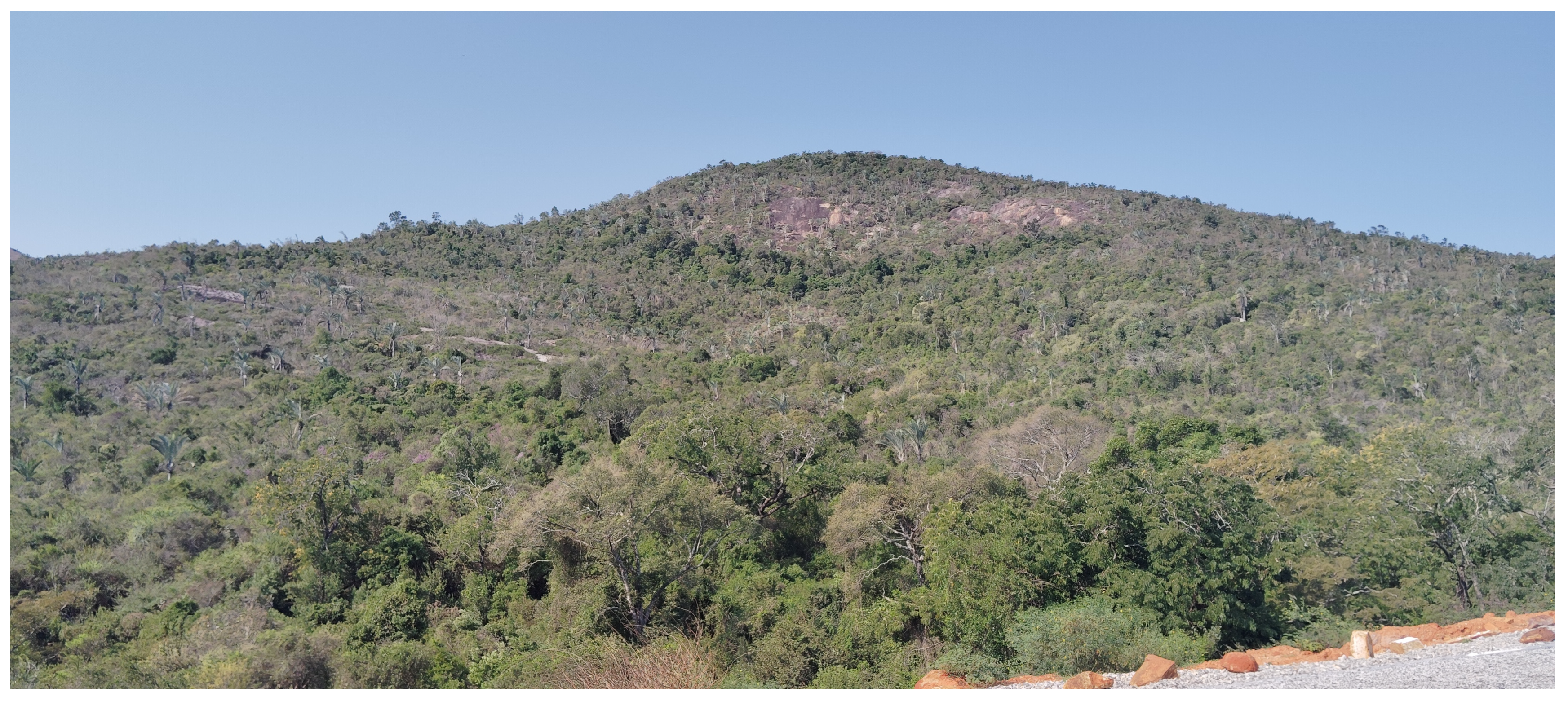
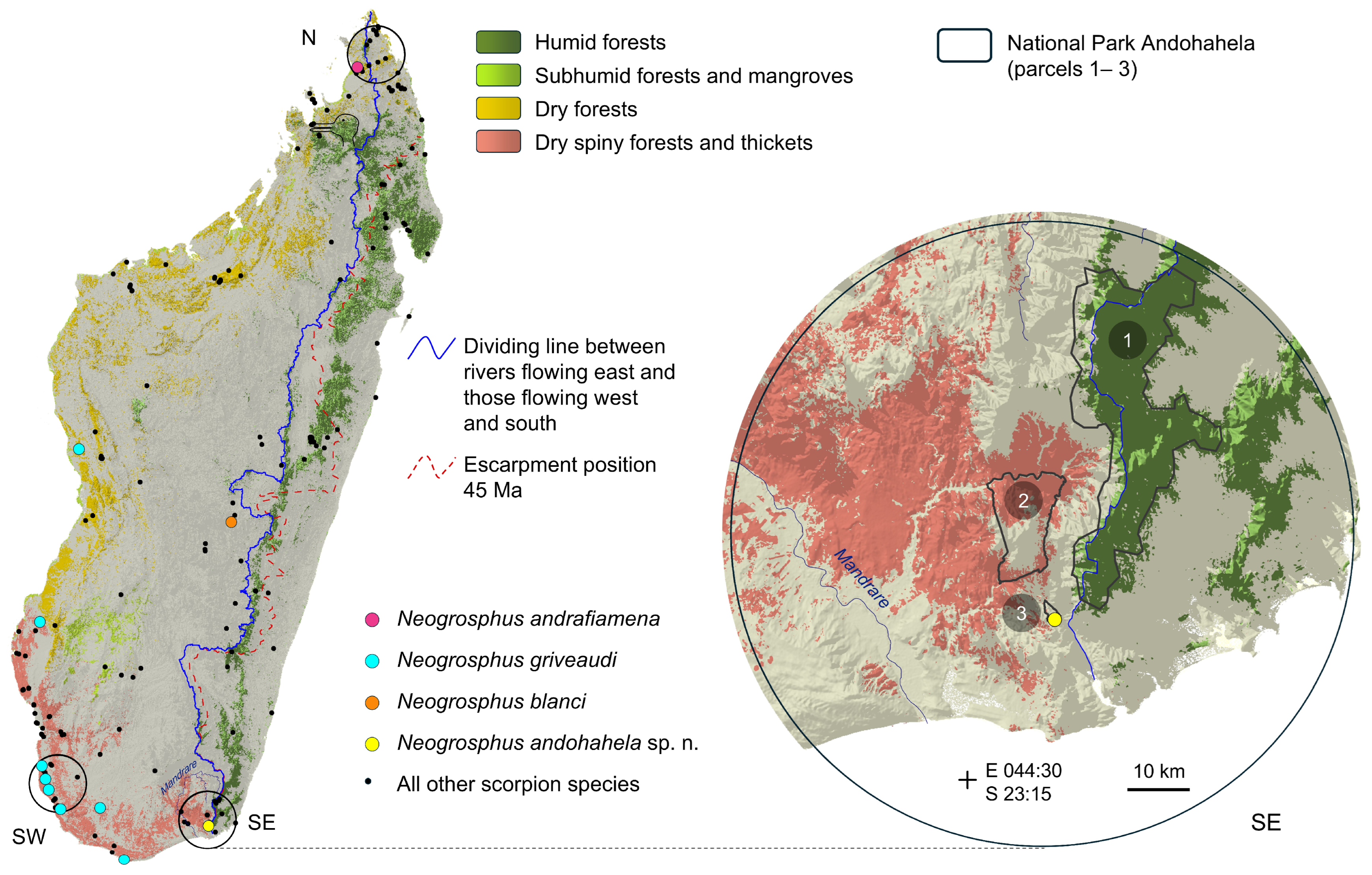
The new species was found in Parcel 3 of National Park Andohahela, a small, isolated 500 ha sector of the park situated in southeastern Madagascar, to the south of the Anosy mountain rainshadow with a forest type between humid rainforest found in parcel 1 to the east and dry spiny vegetation to the west in parcel 2 (
Figure 2 and
Figure 3). This parcel is characterized by granitic substrates, shallow acidic soils, and seasonally dry vegetation, with an open, discontinuous canopy locally dominated by the threatened endemic palm
Dypsis decaryi (Jum.) Beentje & J.Dransf., 1995 and a shrub layer including Euphorbiaceae, Didiereaceae, Apocynaceae and Rubiaceae [
38].
Interpretations linking morphological variation to ecological adaptation, and subsequently to present-day distribution patterns, should be approached with caution [
40,
41] and references therein. Such reasoning implicitly assumes that morphological traits directly reflect environmental constraints and that species distributions are primarily shaped by current ecological conditions. In Madagascar, however, the prevalence of strong micro-endemism and limited dispersal capacity in scorpions suggests that historical processes, including past climatic and geological dynamics, are likely to play a dominant role in structuring distributions, e.g., [
42,
43,
44]. Moreover, without an explicit phylogenetic framework, it remains difficult to disentangle adaptive signals from phylogenetic inertia. Consequently, in the absence of temporal calibration or spatially explicit analyses, inferences regarding the origins and diversification of these lineages remain largely speculative.
3.1. Regional Patterns of Species Richness and Turnover
The distribution of Malagasy scorpions reveals a highly structured pattern of species richness across the island, with certain regions concentrating a disproportionate share of diversity. A comparison based on standardized areas (100 km in diameter) shows that the highest richness occurs in the extreme north (20 species), followed by the southeast (12 species), with the southwest ranking third (10 species), whereas most other regions rarely exceed eight species. Considering that the Malagasy scorpion fauna comprises 110 taxa (here defined as species, subspecies, and fossil species), these values represent a substantial concentration of diversity within restricted areas. Within a total area representing only 3.3% of the island, these regions harbor 38.2% of its scorpion species (
Table S2).
The significance of this pattern lies in the marked contrast between these regions. While the northern part of the island is influenced by tectonic activity, volcanism, and complex topography, the southeastern region is comparatively restricted in extent and characterized by strong ecological heterogeneity and climatic asymmetry. The convergence of high species richness in such distinct contexts suggests that different processes may lead to similar diversity outcomes, a point consistent with recent geomorphological reconstructions emphasizing the spatial heterogeneity of landscape evolution across Madagascar [
31]. Beyond species richness, the compositional distinctiveness of these regions deserves consideration. A preliminary assessment of faunal overlap between the three richest sectors reveals limited sharing of taxa across regional boundaries, suggesting that high richness in each region reflects largely independent faunal assemblages rather than a single continuously distributed pool. This pattern is consistent with high beta diversity driven primarily by species replacement rather than nestedness, a distinction with direct implications for understanding the processes generating diversity: replacement implies independent histories of isolation and in situ persistence, whereas nestedness would suggest a shared origin with subsequent filtering [
45]. A full beta diversity analysis is not yet possible, as current distributional records are unevenly distributed across localities and insufficiently replicated to support robust pairwise comparisons. Nevertheless, the broad signal of compositional discontinuity is consistent with the geomorphological and ecological barriers discussed below, and with the phylogenetic turnover documented for Malagasy plants along comparable boundaries [
31]. This observation provides the framework for the present section, in which the geographic peculiarities of the southeast are first examined in detail.
3.2. The Southeastern Region in a Geomorphological Context
The southeastern region of Madagascar represents one of the most peculiar biogeographic sectors of the island, not merely as a peripheral area but as a zone where strongly contrasting ecological systems are compressed into a very narrow spatial extent [
46]. The transition from the humid forests of the Anosy mountains (Chaînes Anosyennes) to the dry spiny forest-thicket occurs over only a few tens of meters, without any real vegetational continuum between the two formations [
46]. This abrupt ecological juxtaposition is further reinforced by the hydrological structure of the region, notably the Mandrare River system, which originates on the western slopes of the Anosy mountains and reflects a history of drainage reorganization and asymmetry [
47,
48]. The Anosy mountains (Chaînes Anosyennes) create a marked orographic effect: their eastern slopes receive abundant rainfall intercepted from the southeastern trade winds, sustaining the humid forests of the eastern region, while their western and southern flanks lie in the rain shadow of this barrier, experiencing a sharp reduction in precipitation over a very short horizontal distance. This asymmetry is further modified towards the south, where the mountain barrier loses elevation and continuity. Rather than producing a simple extension of the rain shadow, this generates a mosaic of contrasting moisture conditions, with locally humid zones persisting in areas directly exposed to trade winds, while adjacent regions situated in partial rain shadow remain comparatively dry. Such conditions, observed for instance within the Andohahela region where humid environments occur south of the main range in close proximity to drier western slopes, highlight the strong spatial decoupling between topography and moisture distribution. The southeastern region is thus characterized by particularly steep hydroclimatic gradients over short spatial distances, driven by the interaction of relief, wind exposure, and coastal influence.
This peculiar geography must be interpreted in the broader geomorphological framework as proposed by Liu et al. [
31], who demonstrated that Madagascar is structured by two contrasting geodynamic regimes. In the north and parts of the central region, landscape evolution is strongly influenced by tectonic uplift, volcanism, and seismic activity, leading to construction of relief and complex topographic compartmentalization. In contrast, the eastern margin of Madagascar is dominated by long-term erosion and escarpment retreat, with higher erosion rates along the escarpment than on the highlands driving a progressive westward migration of the main divide. This process reorganizes drainage systems through river capture, fragments habitats, and repeatedly modifies connectivity over million-year timescales, functioning as a long-term “speciation pump” [
31]. It should be noted, however, that the diversification mechanism proposed by Liu et al. [
31] was developed for angiosperms, in which habitat patch splitting and merging on million-year timescales is broadly consistent with known speciation times. Whether the same geomorphological template generates comparable biological responses in scorpions remains an open question. Malagasy scorpions belong to archaic, bradytelic lineages characterized by markedly slower evolutionary rates than flowering plants [
22,
28], implying that speciation events are likely separated by considerably longer intervals. Under such conditions, repeated cycles of habitat fragmentation and reconnection may not translate into proportional increases in species richness, but may instead favor long-term persistence of isolated populations and relictual distributions rather than active cladogenesis. The geomorphological framework of Liu et al. [
31] is therefore adopted here as a landscape template structuring habitat availability and connectivity, rather than as a direct model of scorpion diversification dynamics. However, the far southeastern sector does not correspond to the core of this escarpment-retreat system, but rather to its terminal margin, where erosion-driven dynamics are less dominant and where climatic and ecological factors become the primary drivers of spatial structure [
31,
49].
A comparison of scorpion taxa distribution relative to the present drainage, the zone affected by westward migration of the divide, and the region east of the inferred older divide provides additional insight into the role of long-term landscape dynamics. Based on current records, the majority of taxa occur west of the present divide (68), with a substantial but lower number east of the reconstructed older divide (40), whereas the zone corresponding to divide migration contains comparatively few taxa (7). The overlap between the migration belt and adjacent regions is extremely limited: one taxon is shared across all three sectors, and one additional taxon is shared exclusively between the migration belt and the eastern sector, while none is shared exclusively with the western sector. By contrast, three taxa are shared between the western and eastern sectors without occurring in the intervening migration belt, a pattern more consistent with formerly continuous distributions subsequently fragmented by landscape reorganization than with recent dispersal across the escarpment zone. These values, based on 110 taxa (species and subspecies) and 302 distributional records, should be interpreted with caution, as they may partly reflect uneven sampling intensity, differences in detectability among taxa, and the uncertainty inherent to paleogeographic reconstructions (
Table S3). They are therefore best viewed as indicating a broad spatial signal rather than an exact measure of comparative richness. Even with these limitations, the overall pattern remains clear: the zone affected by escarpment retreat does not appear to act as a center of accumulation or diversification, but rather as a region of repeated environmental reorganization, where long-term persistence of lineages is reduced. In contrast, diversity appears to accumulate preferentially in more stable regions, particularly within the western dry domain, while the eastern sector retains a more limited but still significant fauna.
3.3. Neogrosphus and the Reinterpretation of the Neogrosphus Rule
The distribution of the four species of
Neogrosphus fits remarkably well within this framework, but only when their strict ecological confinement is taken into account. All known species are restricted to the leeward side of the island and none occurs on the eastern windward slope, indicating a strong ecological constraint at the genus level [
28]. However, within this shared geographic confinement, the mechanisms generating isolation differ markedly among regions. The northern species occurs in a tectonically and volcanically active landscape, where uplift and structural complexity likely promote local isolation [
31].
Neogrosphus blanci Lourenço, 1996 occurs west of the escarpment, within the classical western drainage system, where fragmentation across interfluves and adjacent drainage basins provides a more traditional allopatric framework consistent with the watershed-based biogeographic model of Wilmé et al. [
42,
43]. In this framework, centers of endemism correspond to groups of smaller drainage basins and interfluves located between larger retreat–dispersion watersheds whose headwaters extend to high elevations. During drier climatic phases, these major drainage systems retained permanent riparian habitats that acted as refugia and dispersal corridors, whereas neighboring lower-elevation basins became increasingly isolated, promoting local differentiation and endemism [
42,
43,
50]. Although this framework was not explicitly designed for invertebrates, the spatial congruence between vertebrate centers of endemism and the distribution of scorpion taxa suggests that the underlying landscape processes associated with the spatial and temporal availability of water, the persistence of riparian habitats, and interfluvial isolation may structure faunal distributions across taxonomic groups with limited dispersal ability, regardless of their phylogenetic affinity [
42,
43,
50]. The southeastern species, by contrast, occupies a terminal sector characterized by ecological compression, climatic asymmetry, and peripheral isolation, rather than by escarpment retreat sensu Liu et al. [
31,
49]. These observations indicate that similar patterns of micro-endemism may arise from fundamentally different processes, including tectonic compartmentalization, drainage structuring, and climatic filtering.
In this context, the so-called
Neogrosphus rule remains heuristically useful, but requires careful reinterpretation. As originally formulated, it states that in a changing environment generating geographical barriers, the lower the dispersal ability and the greater the ancestral niche breadth, the higher the species richness [
29]. However, despite its intuitive appeal, this formulation does not meet the criteria of a predictive or general biogeographic rule. It lacks a quantitative framework, does not allow prediction of spatial patterns, and is strongly dependent on historical contingencies specific to Madagascar, including geomorphological evolution, climatic oscillations, and long-term isolation. Moreover, the observed pattern of species richness is not continuous but spatially discrete and scale-dependent. The results presented above further illustrate this limitation: if fragmentation alone were sufficient to generate diversity, the zone most affected by geomorphological reorganization would be expected to harbor the highest richness. Instead, this zone contains comparatively few taxa, indicating that fragmentation without long-term persistence does not lead to accumulation of diversity. For these reasons, the “
Neogrosphus rule” should be regarded not as a rule in the strict sense, but rather as an empirical generalization describing the spatial clustering of diversity.
The Malagasy scorpion fauna further suggests that the relationship between dispersal ability, niche breadth, and diversification requires refinement. Scorpion species do not appear to be strongly specialized in a narrow ecological sense, but rather retain relatively broad yet conserved ecological tolerances, combined with extremely limited dispersal capacity. Under such conditions, species distributions are not primarily shaped by active expansion, but by the passive tracking of shifting habitats through time. As environmental conditions change under climatic and geomorphological dynamics, populations become fragmented and isolated without necessarily undergoing rapid ecological differentiation. In addition, Malagasy scorpions belong to archaic, bradytelic lineages characterized by slow evolutionary rates [
28,
51]. In such systems, fragmentation does not necessarily lead to rapid speciation, but often results in long-term persistence of isolated populations and relictual distributions. These characteristics further indicate that present-day distributions are unlikely to reflect simple equilibrium with current environmental conditions, but instead primarily record the legacy of historical fragmentation and limited dispersal.
The situation observed in the Makay massif provides a clear example of how localized geomorphological dynamics can generate and maintain highly restricted distributions [
52]. The progressive dissection of sedimentary formations, combined with drainage reorganization and river capture, has likely resulted in the long-term isolation of populations within residual reliefs. Such patterns are not isolated cases but are consistent with broader reconstructions of landscape evolution in Madagascar, where spatial configurations and connectivity among regions have shifted repeatedly through time. Under these conditions, present-day proximity between localities does not necessarily imply historical continuity, and geographically close populations may in fact represent long-isolated lineages. This reinforces the interpretation of Malagasy scorpion distributions as primarily shaped by historical fragmentation rather than by current environmental gradients or simple spatial continuity.
Accordingly, the Neogrosphus rule can be reformulated as a descriptive framework rather than a predictive law: in Malagasy scorpions, spatial patterns of diversity arise from the interaction between strong dispersal limitation, relatively conserved ecological tolerances, long-term persistence, and region-specific processes of habitat fragmentation. These processes differ across the island, including tectonic and volcanic structuring in the north, drainage-driven isolation in the western interior, and ecological compression under strong climatic gradients in the southeast. In bradytelic lineages, such conditions favor persistence and isolation over rapid diversification, producing the observed pattern of localized and historically structured diversity. The inclusion of fossil taxa further suggests that this structure reflects not only present-day distributions, but also the legacy of past range dynamics, including local persistence, extinction, and spatial reorganization through time.
4. Taxonomic Treatment
Family Buthidae C. L. Koch, 1837
Genus Neogrosphus Lourenço, 1995
Neogrosphus Lourenço, 1995: 100 (type species of the genus: Grosphus griveaudi Vachon, 1969).
4.1. New Diagnosis for the Genus Neogrosphus
Scorpions of small to median size when compared with most species of Malagasy buthids. Adults ranging from 24 to 35 mm in males and 40 to 45 mm in females. In some species, such as in
Neogrosphus griveaudi (Vachon, 1969), males can be much smaller than females with sizes of 25 mm versus 45 mm in females. In the new species, differences in size are much less marked (see table of measurements). General coloration of the species can range from pale yellow to reddish-yellow with or without dark spots over the body and appendages. Disposition of granulations on the dentate margins of the pedipalp chela fingers arranged in 8 to 9 rows of granules with a terminal tooth strongly developed and spinoid; presence of three external accessory granules. Pectines elongated in both sexes with a number of teeth ranging from 27 to 32 in males and 27 to 29 in females; presence of a basal middle lamella in each female pecten which can be weakly to moderately developed. Subaculear tooth absent both in adults and juvenile forms. Trichobothriotaxy type A, orthobothriotaxic with A-α (alpha) disposition for the dorsal trichobothria of femur as defined by Vachon [
34,
35].
4.2. The Known Species of Neogrosphus
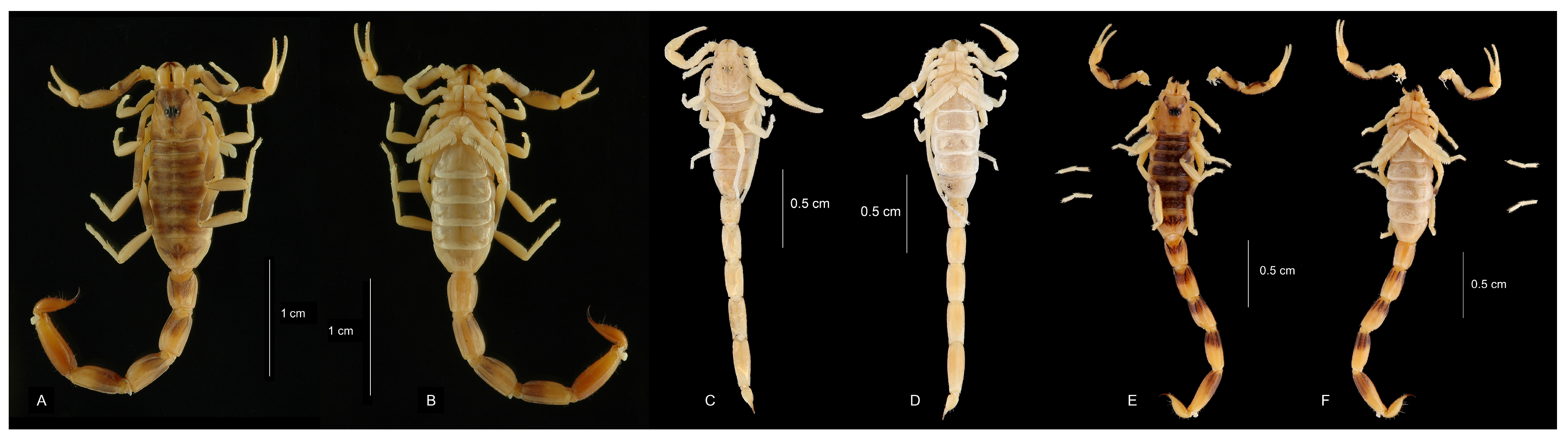
Neogrosphus griveaudi (Vachon, 1969) (
Figure 4)
Almost the same diagnosis as for the genus. General pattern of pigmentation yellow to pale yellow, with dark spots over the body and appendages. Carapace yellowish with an inverted dark triangle extending from the anterior edge to the zone behind the median eyes. Tergites with confluent dark zones, well-marked on all tergites. Metasomal segments I to V with the anterior half marked by a dark ring. Telson yellowish without spots. Pedipalps yellowish; femur and patella with spots on the internal and external faces; chela without spots. Chelicera with dark spots on the lateral edges. Legs with spots in the proximal segments. Pectinal teeth count: 27 to 29 for females and 29 to 31 for males.
Neogrosphus blanci Lourenço, 1996 (
Figure 4)
Almost the same diagnosis as for the genus. General pattern of pigmentation yellow to pale yellow without any spots over the body and appendages. Pectinal teeth count: 27–27 in male. Female unknown. This species was originally described from an imprecise locality. In the previous synopsis of the genus
Neogrosphus [
26], it was suggested that the possible site of collection could correspond to the region of Isalo. More precise subsequent investigations attested, however, that this statement was not corrected. In the registration books of the Muséum in Paris, some data was located, confirming that
N. blanci was collected together with specimens of
Grosphus limbatus (Pocock, 1889) in the Central Massifs of the island, probably between Ibity and Antsirabe, by Jacques de Saint-Ours, during some field trips performed in the 1960s. Even if no data is available about the precise ecological environment in which this species inhabits, it can be suggested that it is most certainly similar to that of
Grosphus limbatus.
Neogrosphus andrafiabe Lourenço, Wilmé & Waeber, 2015 (
Figure 4)
Almost the same diagnosis as for the genus. Scorpions of average size when compared with the other species of the genus. Male with 27.8 mm in total length. Female unknown. General coloration pale yellow to yellow with some brownish spots over the body and appendages, but much less marked than in the type species N. griveaudi. Disposition of granulations on the dentate margins of the pedipalp chela fingers, arranged in 8 rows of granules. Subaculear tooth absent. Pectines with 27–28 teeth. Trichobothriotaxy type A orthobothriotaxic with α (alpha) disposition for the dorsal trichobothria of femur.
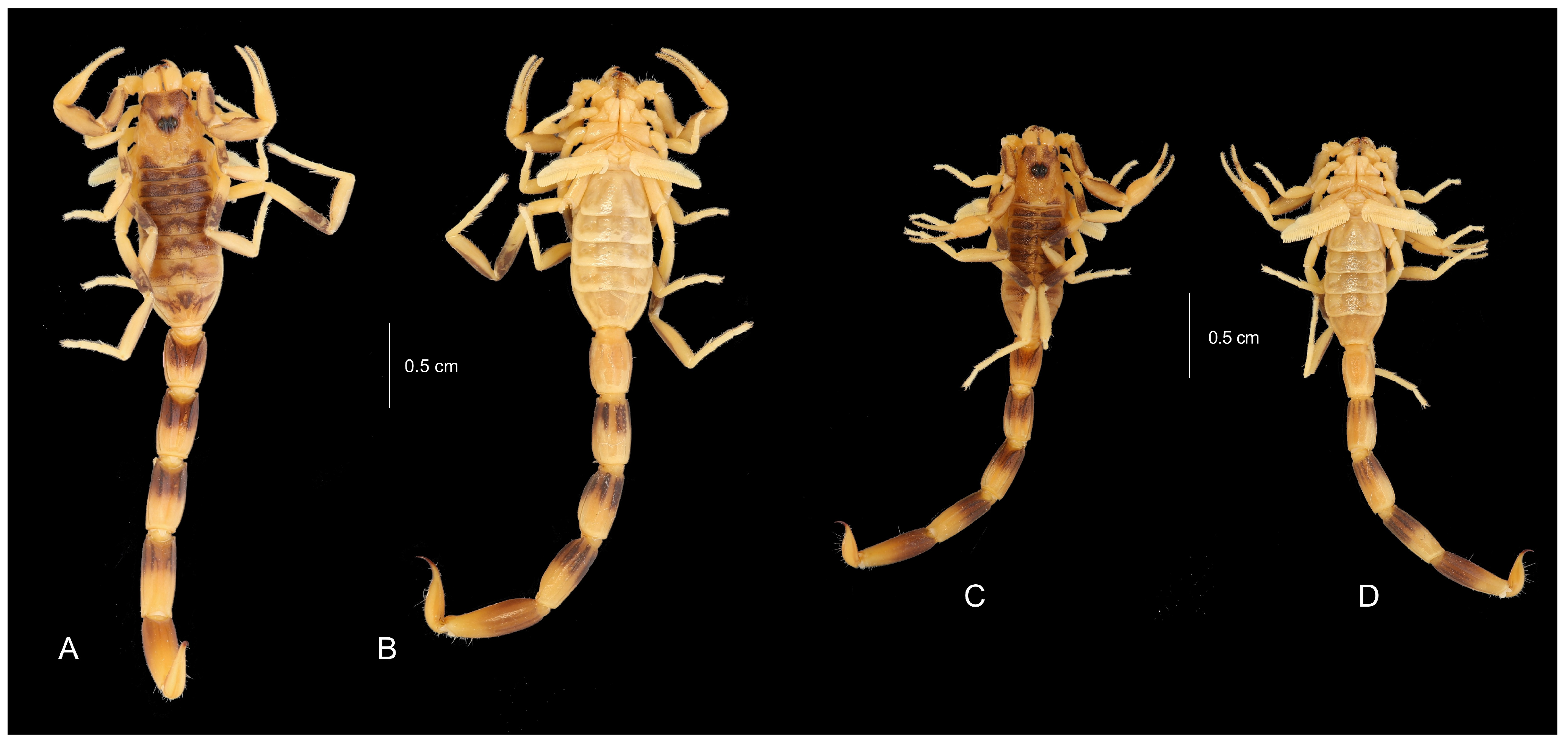
Material examined: Female holotype and male paratype. Madagascar, ex-Province Toliara, Région Anosy, P. N. d’Andohahela, in Parcel 3 in a transitional zone with dry forest, under bark in rotten log (W. R. Lourenço & J.-B. Ramanamanjato), IX/2004. Type material now deposited in the Muséum national d’Histoire naturelle, Paris.
Etymology: The specific name is a noun in apposition to the generic name and refers to the national park where the new species was found.
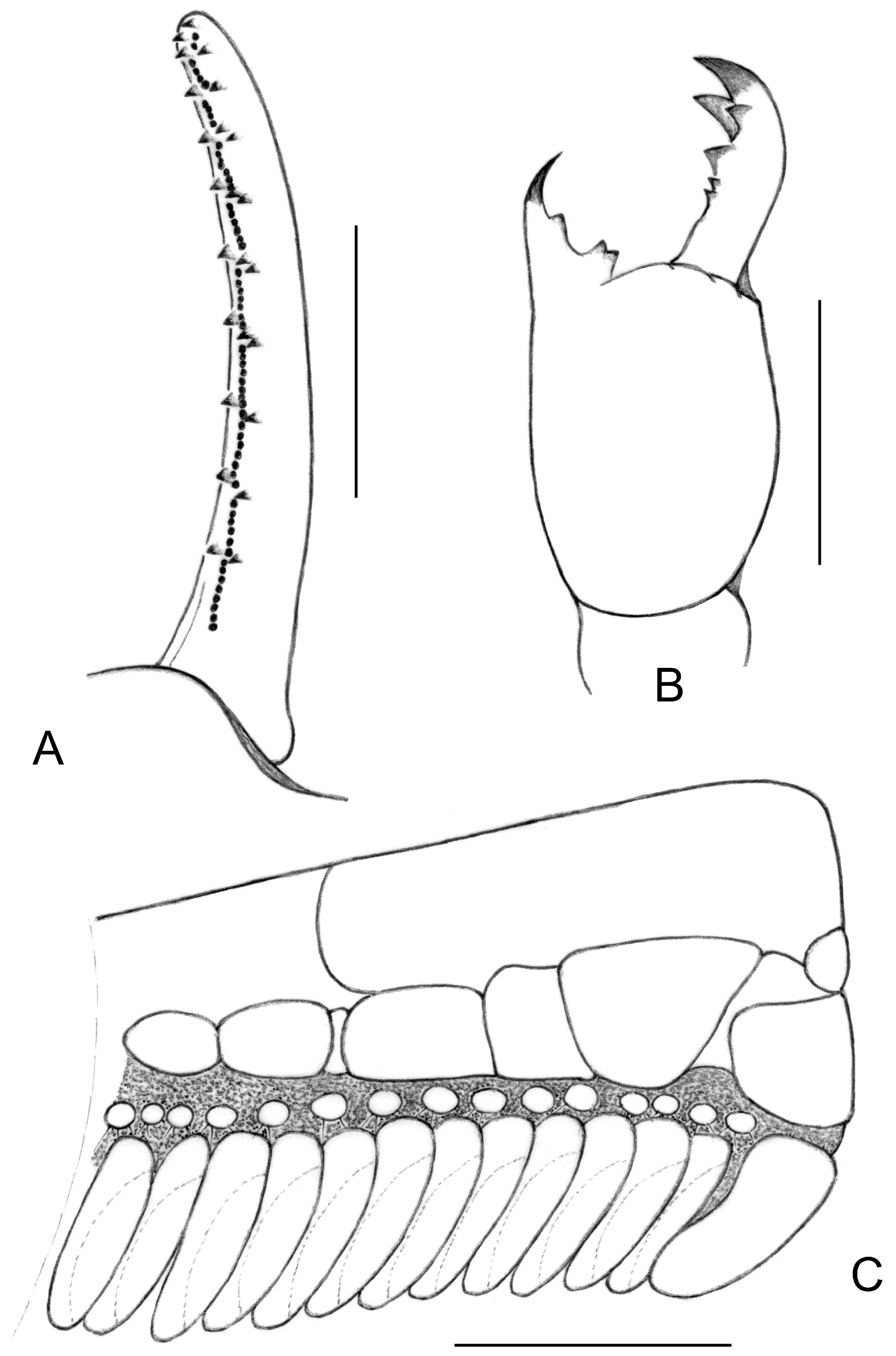
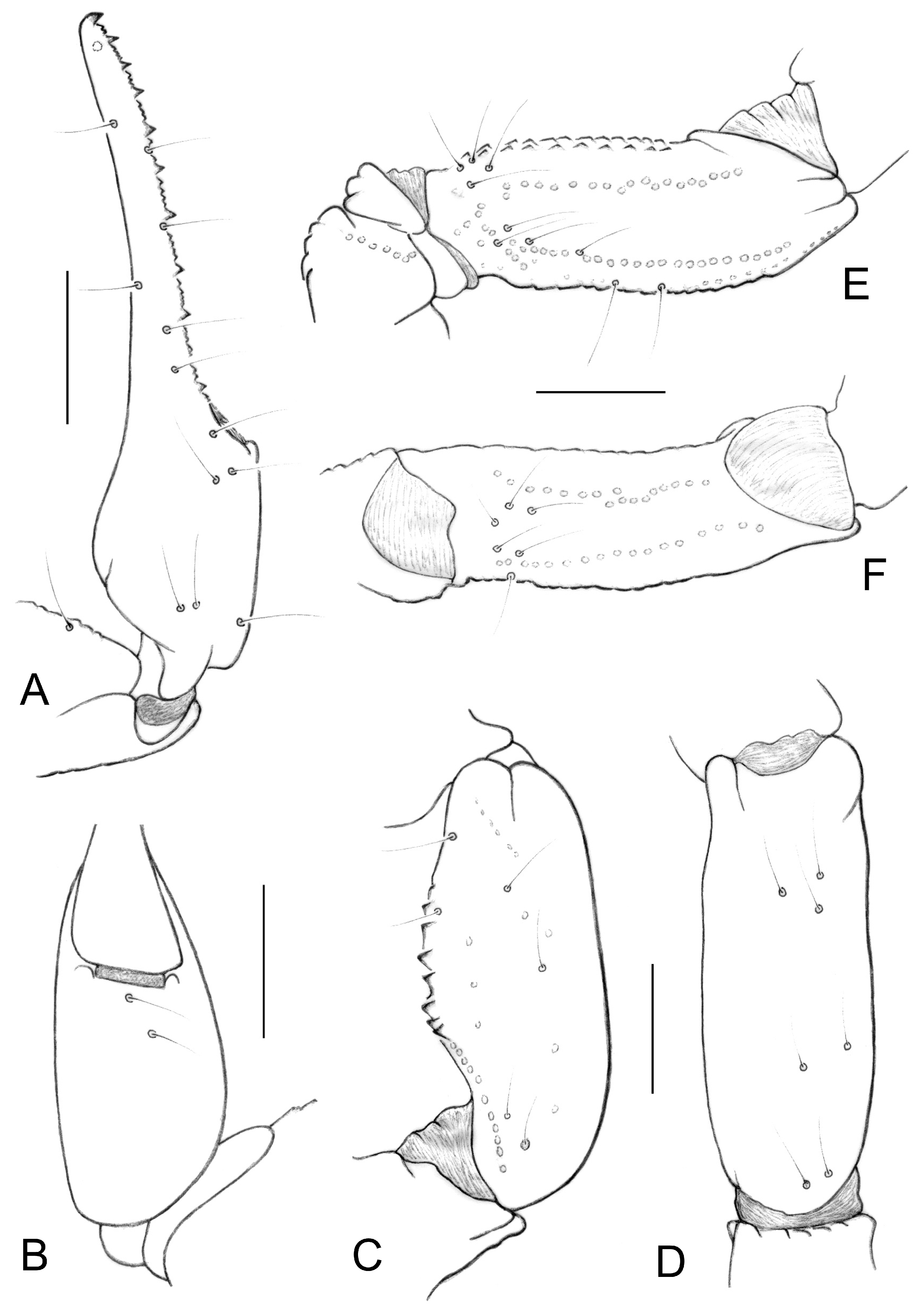
Diagnosis: Scorpions of average to large size when compared with the other three species of the genus. Female with 40.3 mm and male with 34.6 mm in total length. For this species the differences in size are weakly marked, with the global size of the male representing 86% of that of female. General coloration pale yellow to yellow with brownish spots over the body and appendages. Disposition of granulations on the dentate margins of the pedipalp chela fixed and movable fingers, arranged in 8–9 rows of granules. Subaculear tooth absent. Pectines with 27–28 teeth in female and 32–32 teeth in male; basal middle lamellae on female pectines poorly developed with a size similar to that of most internal tooth. Trichobothriotaxy type A orthobothriotaxic with
α (alpha) disposition for the dorsal trichobothria of femur [
34,
35]. Trichobothrium
d5 of the dorsal aspect of patella, almost displaced to the internal face; trichobothrium
d2 of patella extremely reduced; external trichobothria
e1 and
e2 of femur very close to each other. The new species can be distinguished from its congeners by the combination of 8–9 rows of granules on the chelal fingers with sharper accessory granules, relatively high pectinal tooth counts (27–28 in females, 32–32 in males), weakly developed basal middle lamellae in females, and the characteristic arrangement of trichobothria d
5, d
2, e
1 and e
2.
Description based on female holotype and male paratype. Morphometric values following the description.
Coloration. General pattern of pigmentation pale yellow to yellow, with dark spots over the body and appendages, but less regular than those of N. griveaudi. Carapace yellow with an incomplete inverted dark triangle extending from the lateral eyes to the zone behind the median eyes; both lateral and median eyes marked by blackish pigmentation. Chelicerae yellow without any variegated pigmentation; fingers with pale reddish teeth. Mesosoma yellow; tergites with confluent dark zones less marked on tergites V to VII. Venter: coxapophysis, sternum, genital operculum pectines and sternites pale yellow. Metasomal segments I to V with the anterior half marked by a dark ring; ring incomplete on segment I. Telson yellow without spots; tip of aculeus pale reddish. Pedipalps yellow; femur and patella slightly spotted on the internal and external faces; chela yellow without spots; rows of granules on fingers pale reddish. Legs with only vestigial spots in the proximal segments.
Morphology. Carapace weakly to moderately granular; granulations better marked on male; anterior margin with a weak median concavity. Carinae practically absent, vestigial; furrows weakly developed. Median ocular tubercle anterior to the center of the carapace; median eyes separated by approximately one ocular diameter in female, less on male. Three pairs of lateral eyes. Sternum sub-triangular in shape. Mesosomal tergites with thin but intense granulations. Median carina moderately to weakly marked in all tergites; tergite VII pentacarinate. Venter: genital operculum consisting of two sub-triangular plates. Pectinal teeth count 27–28 on female, 32–32 on male; basal middle lamellae of each pecten dilated on female but almost with the same size of the most proximal tooth. Sternites smooth, with weakly elongated stigmata; VII slightly granulated but almost acarinated. Metasomal segments I to IV with 10 carinae, moderately crenulate; intermediate carinae largely incomplete on IV; segment V with 3 carinae, rounded and smooth dorsally; dorsal carinae on all segments without any posterior spinoid granules. Intercarinal spaces with some thin granulations, better marked on male. Telson smooth; aculeus weakly curved and shorter than the vesicle; subaculear tooth absent. Cheliceral dentition characteristic of the family Buthidae [
33]; two distinct but reduced basal teeth present on the movable finger; ventral aspect of both fingers and of manus with dense, long setae. Pedipalps: femur pentacarinate with weakly marked carinae; patella with dorsointernal and ventrointernal carinae with some minor spinoid granules on the internal face of male; chela without carinae, smooth. Fixed and movable fingers with 8–9 oblique rows of granules. Trichobothriotaxy; orthobothriotaxy
A-α (alpha) [
34,
35]. Legs: tarsus with numerous short thin setae ventrally. Tibial spurs present on legs III and IV, thin and long; pedal spurs present on legs I to IV, moderately marked.
Relationships: The general morphology and pigmentation pattern of the new species indicate a closer relationship to N. griveaudi than to N. blanci or N. andrafiabe. This seems to agree with the observed pattern of geographical distribution of the four known species. The known species are distributed in the south, southeast, southwestern and central regions of Madagascar (see biogeographic section). The new species can be readily distinguished by the following characteristics: (i) 8–9 rows of granules on the cutting edges of chela fingers with sharper spinoid accessory granules; (ii) pectines with slightly higher number of teeth: 27–28 in female and 32–32 in male; (iii) basal middle lamellae on female pectines poorly developed with a size similar or inferior to that of the most internal tooth; (iv) trichobothrium d5 of the dorsal aspect of patella, almost displaced to the internal face; trichobothrium d2 of patella extremely reduced; external trichobothria e1 and e2 of femur very close to each other.
Morphometric values (in mm) of the female holotype and male paratype of Neogrosphus andohahela sp. n. Total length (including telson), 40.3/34.6. Carapace: length, 4.5/3.8; anterior width, 2.9/2.2; posterior width, 4.4/3.6. Mesosoma length, 9.2/7.9. Metasomal segments. I: length, 3.5/2.8; width, 2.5/2.0; II: length, 4.0/3.2; width, 2.4/1.9; III: length, 4.2/3.7; width, 2.3/1.8; IV: length, 4.8/4.1; width, 2.1/1.7; V: length, 5.4/5.1; width, 2.0/1.5; depth, 1.9/1.5. Telson length, 4.7/4.0. Vesicle: width, 1.2/0.9; depth, 1.2/1.1. Pedipalp: femur length, 3.0/2.5, width, 1.1/0.9; patella length, 3.5/4.0, width, 1.4/1.2; chela length, 5.0/4.5, width, 1.2/1.3, depth, 1.2/1.3; movable finger length, 3.4/2.9.