


Abstract
Supportive care is essential during chemotherapy for head and neck cancer, yet the role of traditional Japanese medicine (kampo) remains unclear; therefore, we investigated whether Ninjin’yoeito (NYT) could reduce adverse events during cisplatin-based chemotherapy. We retrospectively analyzed 47 patients treated between June 2022 and June 2024, dividing them into an NYT group and a control group. Hematological toxicities, including decreases in white blood cells, neutrophils, hemoglobin, and platelets, as well as gastrointestinal disorders such as nausea, were evaluated. Compared with controls, patients receiving NYT showed significantly lower incidences of decreased white blood cell counts (p = 0.04), decreased hemoglobin levels (p = 0.03), and gastrointestinal disorders (p = 0.04). Trends toward reduced neutropenia and thrombocytopenia were also observed, although these did not reach statistical significance. These findings suggest that NYT may help mitigate hematological and gastrointestinal toxicities associated with cisplatin-based chemotherapy in patients with head and neck cancer. However, given the retrospective design and limited sample size, prospective studies are needed to confirm the efficacy and safety of NYT in this setting.
1. Introduction
Head and neck cancers (HNCs) are the sixth most common malignant tumors worldwide, with increasing incidence, particularly of p16-positive oropharyngeal cancer [1]. An aging population has also contributed to a higher proportion of elderly patients affected by these cancers. Traditionally, the main treatments for head and neck cancer include surgery, chemotherapy, and radiation therapy. HNCs are often diagnosed at an advanced stage, where the focus of treatment shifts not only to prolonging life but also to preserving critical functions. As these cancers progress, maintaining functions such as swallowing, speech, sensory perception, and cosmetic appearance becomes paramount. This is particularly true for elderly patients, for whom post-treatment quality of life is just as important as survival. These considerations can complicate treatment choices essential for maintaining overall patient health and function.
In locally advanced HNCs, concurrent chemoradiotherapy, specifically with cisplatin (cis-dichloro-diamine-platinum [CDDP]), is considered the standard treatment [2,3]. The antitumor effect of CDDP is mediated by DNA-damage-induced apoptosis in tumor cells, and the therapeutic effects are remarkable. It can, however, produce adverse effects, such as bone marrow suppression, nephrotoxicity, gastrointestinal symptoms (such as nausea and vomiting), and ototoxicity. These effects can interrupt treatment and result in deterioration in the patient’s overall condition, which can worsen the patient’s overall well-being and recovery.
Given these challenges, there is increasing interest in supportive care that could mitigate the adverse effects of chemoradiotherapy and improve quality of life. Supportive care can be divided into preventive and symptomatic interventions. Preventive interventions attempt to stem the potential side effects of chemoradiation therapy before they occur, such as the use of steroids to prevent inflammation. Symptomatic care is used to treat side effects after they appear, such as the use of opioids for pain relief and oral care for mucositis [4,5,6]. Treatments such as antiemetics used to prevent vomiting are used in both preventive and symptomatic care. Due to the aggressive nature of chemotherapy, preventive treatments tend to be limited, and symptomatic care is often the only option.
Kampo medicine, a traditional Japanese herbal therapeutic approach, has shown promise in both preventive and symptomatic care and has the potential to improve the quality of life for cancer patients undergoing treatment. Kampo medicine has its origins in ancient Chinese medicine and was developed in Japan from the 17th to the 19th centuries [7].
Ninjin’yoeito (NYT) is a kampo medicine consisting of a mixture of 12 natural plant and fungal components [8]. This compound has been used as supportive therapy in a number of cancer types to ameliorate conditions such as anemia, loss of appetite, and fatigue in patients undergoing chemotherapy [8,9,10,11]. This study aims to evaluate the efficacy of NYT as a preventive medicine during chemotherapy for head and neck cancer.
2. Materials and Methods
This study was conducted in accordance with the Declaration of Helsinki and was approved by the Institutional Review Board of our facility (approval no. 2023-253). The participants included 47 patients who had undergone chemotherapy for head and neck cancer between June 2022 and June 2024. The control group (NYT−) consisted of patients treated with chemotherapy only between June 2022 and June 2024. Starting in January 2024, the test group (NYT+) received NYT in addition to their chemotherapy treatments. NYT was acquired from the kampo medicine manufacturer Tsumura. (Tokyo, Japan) NYT (9 g/day, oral) was started at the time of the first cisplatin administration and continued throughout the treatment course. From January 2024 onward, all eligible patients were offered NYT as part of the institutional supportive care protocol; individual physician discretion was not involved. Adherence was confirmed via pharmacy dispensing records and clinical notes at each visit.
2.1. Study Design
This was a retrospective, exploratory, case–control study to investigate the effect of NYT administration on reducing AEs during chemotherapy for head and neck cancer at a single institution in Japan.
2.2. Participants and Treatments
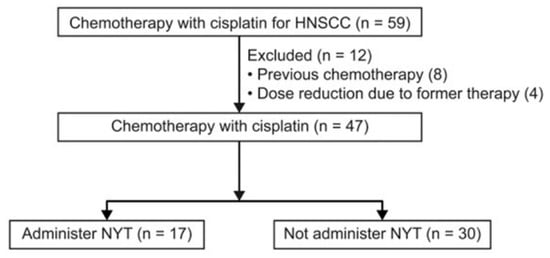
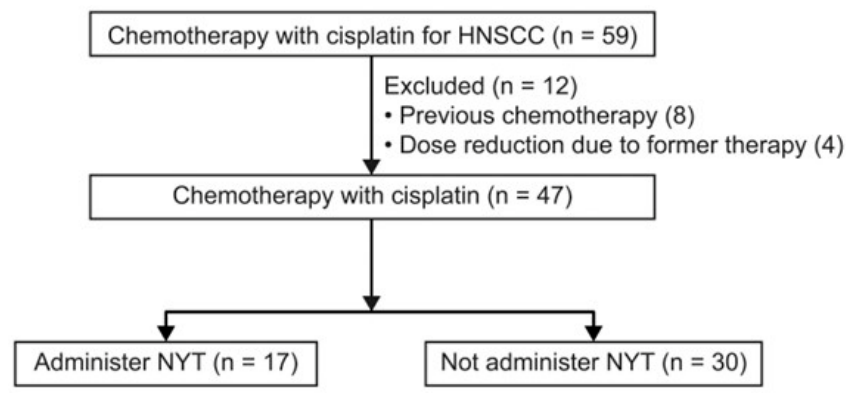
We retrospectively analyzed the outcomes of patients with head and neck cancers who were treated with chemotherapy at Gifu University Hospital, Gifu, Japan, between June 2022 and June 2024. The research protocol of Gifu University Hospital was approved by the hospital ethics committee. Criteria for inclusion were as follows: (1) receipt of platinum-based chemotherapy for head and neck cancer; (2) chemotherapy regimens of CDDP, 40 mg/m2 every week and 100 mg/m2 every 3 weeks, whereby patients received the full dosage of cisplatin-based chemotherapy at the first CDDP administration; and (3) NYT, 9 g/day, administered orally during platinum-based chemotherapy. The exclusion criteria included a history of allergy to any medications and the presence of other active malignancies. Patients who were pregnant or nursing were also ineligible. The criteria for inclusion of control patients were the same as for the experimental group but without NYT (Figure 1). Standard medications such as antiemetics, fluids, and electrolytes were administered equally to all patients.
Figure 1.
Inclusion criteria. HNSCC, head and neck squamous cell carcinoma; NYT, ninjin’yoeito.
2.3. Evaluation Criteria
The incidence of adverse events (AE) was calculated for each group. The Common Terminology Criteria for Adverse Events (CTCAE) v5.0 (https://ctep.cancer.gov/protocolDevelopment/electronic_applications/ctc.htm#ctc_50) (accessed on 9 June 2026) was used to grade AEs in this evaluation.
2.4. Outcomes
The outcomes considered in this study include white blood cells (WBC), neutrophils, hemoglobin (Hb), platelets (PLT), hepatobiliary disorders, and chronic kidney disease. In addition, gastrointestinal disorders (nausea and anorexia) and oral mucositis were also evaluated. The severity of each AE was graded from 1 to 4, where grades 1 and 2 were considered “low grade” and grades 3 and 4 were “high grade.” To evaluate the effect of NYT administration on the treatment, factors such as body weight (BW) loss, length of hospitalization, and the number or total dose of CDDP were also evaluated.
2.5. Statistical Analysis
To calculate and compare the incidences of high-grade AEs during the first cycle of the triweekly CDDP regimen (Day 1 through Day 21) and the second cycle of the weekly CDDP regimen (Week 2), as these timepoints represent the period of peak hematologic toxicity for each respective regimen, for each group, we used Fisher’s exact test. Patients who did not complete the defined evaluation period were excluded from the corresponding outcome analysis, which accounts for the variation in evaluable patient numbers across outcomes. Multiple adverse events were analyzed simultaneously without correction for multiple comparisons; given that several p-values were close to the significance threshold, false-positive findings cannot be excluded, and results should be interpreted as exploratory. To perform statistical analysis, we used East R(EZR) software (version 1.68) [12]; a p-value of <0.05 was considered significant.
3. Results
3.1. Patients and Treatment History
The analysis included 47 participants: 43 men (91.5%) and 4 women (8.5%), with a median age of 69 years (range, 23–78 years). Of these, 17 received NYT, and 30 did not. All the pathological types were squamous cell carcinomas. According to the clinical stages of cancer (TNM Classification of Malignant Tumors, 8th ed.), among the NYT recipients, none had stage I cancer, 3 had stage II, 3 had stage III, and 11 had stage IV; of the controls, 2 had stage I cancer, 10 had stage II, 4 had stage III, and 14 had stage IV. 19 received weekly CDDP, 40 mg/m2, and 28 received triweekly CDDP, 100 mg/m2 (Table 1). There were no differences in patient characteristics between the two groups.
Table 1.
Patient characteristics.
3.2. Incidence and Grade of AEs
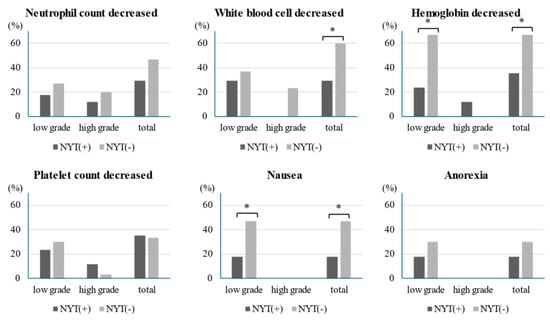
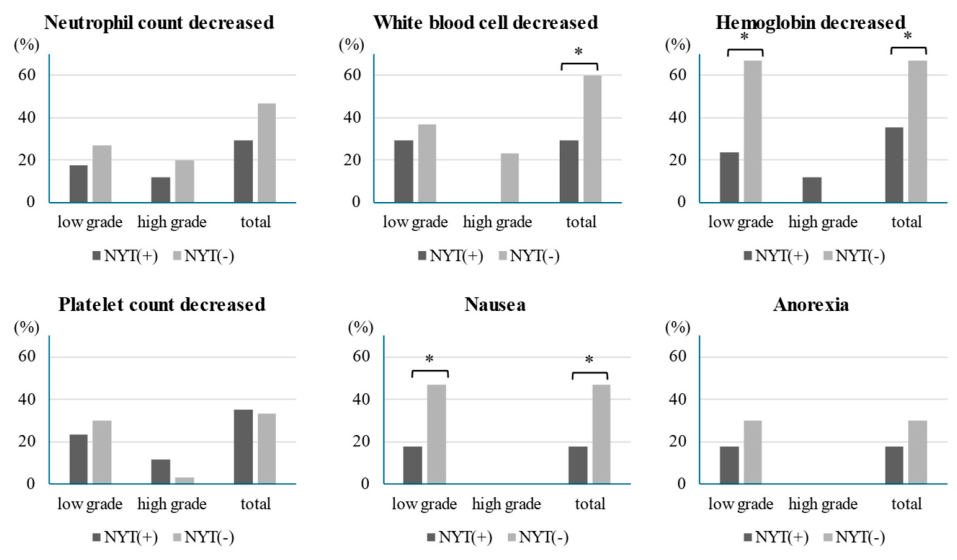
We observed the following AEs: WBC counts decreased in 5 NYT recipients and 18 controls; neutrophil counts decreased in 5 NYT recipients and 14 controls; Hb decreased in 6 NYT recipients and 20 controls; PLT counts decreased in 6 NYT recipients and 10 controls; nausea occurred in 3 NYT recipients and 14 controls; and anorexia occurred in 3 NYT recipients and 9 controls (Table 2). Oral mucositis was assessed based on clinical examination findings documented in the medical records at the time of each outpatient visit during the defined evaluation period; no cases of Grade 3 or higher oral mucositis were observed in either group during this period. The differences between the NYT and control groups were significant for WBC count (p = 0.04), Hb (p = 0.03), and gastrointestinal disorders (p = 0.04; Figure 2). We found no significant difference in incidence between low- and high-grade AEs, but the decreases in WBC and neutrophils seemed less severe in the NYT group.
Table 2.
Incidence and grade of adverse events.
Figure 2.
Incidence of adverse events. NYT, ninjin’yoeito. p < 0.01, * p < 0.05. Adverse events were classified as low grade (CTCAE Grades 1–2) or high grade (CTCAE Grades 3–4).
3.3. The Effect of NYT on the Overall Treatment Process
The effect of the NYT administration on the overall treatment course was investigated (Table 3). The median length of hospitalization was 86 days in the NYT group and 87 days in the non-NYT group, with no significant difference between the two groups (p = 0.883). The average BW loss from before treatment to the end of treatment was −2.3 kg in the NYT group and −2.9 kg in the non-NYT group. Although the non-NYT group showed a slightly greater decrease in BW, the difference was not statistically significant (p = 0.148). There was no significant difference between the two groups in the number of CDDP in the tri-weekly regimen. However, in the weekly regimen, the NYT group had a significantly higher number of patients who were able to complete 6 cycles of CDDP (p = 0.023). The total dose of CDDP tended to be higher in the NYT group, but the difference was not statistically significant (p = 0.065).
Table 3.
The effect of NYT on the overall treatment process.
4. Discussion
To our knowledge, this is the first report about the prophylactic efficacy of NYT against AEs of platinum-based chemotherapy in head and neck cancer. NYT was associated with a lower incidence of certain AEs, including decreases in WBC counts and Hb, as well as lowering the incidence of nausea caused by platinum-based chemotherapy. Because AEs may result in reducing chemotherapy doses in subsequent treatment, minimizing these side effects can improve patient prognosis by maintaining adherence to the treatment plan. In fact, our study also showed that the NYT group tended to have higher doses and more frequent administrations of CDDP, particularly in the weekly regimen, where the number of CDDP administrations was significantly higher. However, because treatment allocation was not randomized and potential confounding factors remain, these differences in cisplatin exposure and treatment adherence should be interpreted with caution and do not allow causal conclusions. Although we found no significant difference in the incidence of low- and high-grade AEs, the AEs experienced by the NYT recipients (decreased WBCs and neutrophils) tended to be lower grade, suggesting that NYT may be associated with a lower severity of AEs, though this requires confirmation in prospective studies.
NYT comprises a large number of biologically active natural products that have been shown to impact multiple systems in the body. This type of multi-component therapeutic system may play a preventive role in managing the diverse, adverse effects associated with chemotherapy. In this study, we focused on chemotherapy-related adverse events in patients with head and neck cancer; however, NYT has also been reported to exert protective effects on multiple organ systems and physiological functions, including anorexia and fatigue [8]. By mitigating the onset or severity of various chemotherapy-induced signs and symptoms, NYT may help prevent complications, reduce the need for additional medications, and support overall patient well-being [9].
The exact mechanism by which NYT exerts a preventive effect against myelosuppression and anorexia in humans remains unclear. Previous preclinical studies have shown that intraperitoneal administration of NYT in mice increases pluripotent stem cell numbers and promotes their differentiation, leading to enhanced WBC counts [13], and augments the activity of granulocyte colony-stimulating factor [14]. These findings provide a mechanistic rationale for the observed protective effect of NYT on WBC in our study. However, this preclinical data do not directly explain the prevention of hemoglobin loss, which was also observed in our patients. Regarding anorexia, NYT has been reported to act on both ghrelin-responsive and -unresponsive neuropeptide Y neurons in the arcuate nucleus, preserving food intake and body weight in CDDP-treated mice [15]. In our study, the effect on nausea was modest, and the reduction in anorexia symptoms was not statistically significant, suggesting that the translation of this mechanism from mice to humans requires further investigation. Overall, while preclinical studies support the potential hematopoietic and appetite-related effects of NYT, additional research is needed to clarify the underlying mechanisms in humans.
This study was an exploratory trial, and it had several limitations. First, patients received various platinum-based regimens during the same evaluation, and we did not consider the effect of differences in these regimens on overall condition and prognosis. Although AE evaluation timepoints were defined separately for each regimen, regimen heterogeneity is a source of potential bias, and subgroup analyses were not feasible given the limited sample sizes within each subgroup. Second, the timing and total dosage of NYT differed among patients due to variation in treatment duration, although the daily dose was standardized at 9 g/day. Third, because this study was retrospective with a limited number of participants, selection bias may have occurred. Fourth, since NYT was introduced at our institution in January 2024, the two groups were treated in different time periods. Standard supportive medications were unchanged throughout, but temporal bias from other unmeasured changes in clinical practice cannot be ruled out. Fifth, no formal power calculation was performed; this was a retrospective exploratory study using all available consecutive patients, and the small NYT group (n = 17) limits statistical power. Sixth, although stage distribution and tumor site differed somewhat between groups, multivariate adjustment was not feasible given the sample size, and residual confounding is possible. The cohort was from a single institution in Japan, so caution is needed before applying these results to elderly patients with impaired renal function, those with significant comorbidities, or patients receiving non-cisplatin regimens. Seventh, because multiple adverse events were analyzed simultaneously without correction for multiple comparisons, the risk of type I error should be acknowledged; the statistically significant findings are based on borderline p-values and must be interpreted as exploratory. Eighth, baseline hematologic and renal laboratory values were not available for all patients due to the retrospective design; the comparability of the two groups at baseline with respect to these parameters, therefore, remains uncertain and may have influenced the results. To obtain results with more reliable evidence, a prospective randomized controlled trial with a larger number of participants is necessary.
5. Conclusions
NYT may reduce the incidence of AEs during cisplatin-based chemotherapy for head and neck cancer. Prospective randomized studies are needed to confirm these preliminary findings.
Author Contributions
Conceptualization, R.I. (Ryota Iinuma) and T.O.; methodology, R.I. (Ryota Iinuma) and T.O.; software, R.I. (Ryota Iinuma) and T.O.; validation, H.O., M.K. and R.K.; formal analysis, M.K.; investigation, T.Y.; resources, R.I. (Ryota Iinuma) and T.O.; data curation, R.I. (Ryota Iinuma) and T.O. writing—original draft preparation, R.I. (Ryota Iinuma); writing—review and editing, T.H.; visualization, T.H.; supervision, R.I. (Ryoukichi Ikeda) and T.O.; project administration, T.O.; funding acquisition, T.O. All authors have read and agreed to the published version of the manuscript.
Funding
This research received no external funding.
Institutional Review Board Statement
The study was conducted in accordance with the Declaration of Helsinki and was approved by the Institutional Review Board of Gifu University Graduate School of Medicine (protocol code: 2023-253; approval date: 26 January 2024).
Informed Consent Statement
Patient consent was waived due to the retrospective nature of the study using existing clinical data, which posed minimal risk to participants. All data were anonymized prior to analysis. Instead, an opt-out approach was implemented by publicly disclosing the study information on the institutional website, allowing participants the opportunity to decline participation.
Data Availability Statement
The data supporting the findings of this study are not publicly available due to privacy and ethical restrictions but are available from the corresponding author upon reasonable request.
Conflicts of Interest
The authors declare no conflicts of interest.
Abbreviations
The following abbreviations are used in this manuscript:
| NYT | Ninjin’yoeito |
| HNCs | Head and neck cancers |
| CDDP | Cis-dichloro-diamine-platinum |
References
- Sung, H.; Ferlay, J.; Siegel, R.L.; Laversanne, M.; Soerjomataram, I.; Jemal, A.; Bray, F. Global Cancer Statistics 2020: GLOBOCAN Estimates of Incidence and Mortality Worldwide for 36 Cancers in 185 Countries. CA Cancer J. Clin. 2021, 71, 209–249. [Google Scholar] [CrossRef] [Scilit] [PubMed]
- Bernier, J.; Domenge, C.; Ozsahin, M.; Matuszewska, K.; Lefèbvre, J.L.; Greiner, R.H.; Giralt, J.; Maingon, P.; Rolland, F.; Bolla, M.; et al. Postoperative irradiation with or without concomitant chemotherapy for locally advanced head and neck cancer. N. Engl. J. Med. 2004, 350, 1945–1952. [Google Scholar] [CrossRef] [Scilit] [PubMed]
- Forastiere, A.A.; Goepfert, H.; Maor, M.; Pajak, T.F.; Weber, R.; Morrison, W.; Glisson, B.; Trotti, A.; Ridge, J.A.; Chao, C.; et al. Concurrent chemotherapy and radiotherapy for organ preservation in advanced laryngeal cancer. N. Engl. J. Med. 2003, 349, 2091–2098. [Google Scholar] [CrossRef] [Scilit] [PubMed]
- Yokota, T.; Zenda, S.; Ota, I.; Yamazaki, T.; Yamaguchi, T.; Ogawa, T.; Tachibana, H.; Toshiyasu, T.; Homma, A.; Miyaji, T.; et al. Phase 3 Randomized Trial of Topical Steroid Versus Placebo for Prevention of Radiation Dermatitis in Patients with Head and Neck Cancer Receiving Chemoradiation. Int. J. Radiat. Oncol. Biol. Phys. 2021, 111, 794–803. [Google Scholar] [CrossRef] [Scilit] [PubMed]
- Yokota, T.; Tachibana, H.; Konishi, T.; Yurikusa, T.; Hamauchi, S.; Sakai, K.; Nishikawa, M.; Suzuki, M.; Naganawa, Y.; Hagihara, T.; et al. Multicenter phase II study of an oral care program for patients with head and neck cancer receiving chemoradiotherapy. Support. Care Cancer 2016, 24, 3029–3036. [Google Scholar]
- Zenda, S.; Matsuura, K.; Tachibana, H.; Homma, A.; Kirita, T.; Monden, N.; Iwae, S.; Ota, Y.; Akimoto, T.; Otsuru, H.; et al. Multicenter phase II study of an opioid-based pain control program for head and neck cancer patients receiving chemoradiotherapy. Radiother. Oncol. 2011, 101, 410–414. [Google Scholar] [CrossRef] [Scilit] [PubMed]
- Motoo, Y.; Seki, T.; Tsutani, K. Traditional Japanese medicine, Kampo: Its history and current status. Chin. J. Integr. Med. 2011, 17, 85–87. [Google Scholar] [CrossRef] [Scilit] [PubMed]
- Miyano, K.; Nonaka, M.; Uzu, M.; Ohshima, K.; Uezono, Y. Multifunctional actions of ninjinyoeito, A Japanese kampo medicine: Accumulated scientific evidence based on experiments with cells and animal models, and clinical studies. Front. Nutr. 2018, 5, 93. [Google Scholar] [CrossRef] [Scilit] [PubMed]
- Motoo, Y.; Tomita, Y.; Fujita, H. Prophylactic efficacy of Ninjin’Yoeito for oxaliplatin-induced cumulative peripheral neuropathy in patients with colorectal cancer receiving postoperative adjuvant chemotherapy: A randomized, open-label, phase 2 trial (HOPE-2). Int. J. Clin. Oncol. 2020, 25, 1123–1129. [Google Scholar] [CrossRef] [Scilit] [PubMed]
- Kaibori, M.; Ishizaki, M.; Matsui, K.; Kwon, M.; Imai, R.; Watanabe, S.; Norimoto, H. Sorafenib alone versus a combination of sorafenib and Ninjin’Yoeito for the treatment of patients with advanced hepatocellular carcinoma: A retrospective study and pharmacological study in rats. J. Tradit. Med. 2013, 30, 221–228. [Google Scholar] [CrossRef]
- Motoo, Y.; Mouri, H.; Ohtsubo, K.; Yamaguchi, Y.; Watanabe, H.; Sawabu, N. Herbal medicine ninjinyoeito ameliorates ribavirin-induced anemia in chronic hepatitis C: A randomized controlled trial. World J. Gastroenterol. 2005, 11, 4013–4017. [Google Scholar] [CrossRef] [Scilit] [PubMed]
- Kanda, Y. Investigation of the freely available easy-to-use software “EZR” for medical statistics. Bone Marrow Transpl. 2013, 48, 452–458. [Google Scholar] [CrossRef] [Scilit]
- Miura, S.; Kuwamura, I.; Yamada, A.; Kawakita, T.; Kumazawa, Y.; Himeno, K.; Nomoto, K. Effect of a traditional Chinese herbal medicine, Ren-Shen-Yang-Rong-Tang (Japanese name: Ninjin-Youei-To) on hematopoietic stem cells in mice. Int. J. Immunopharmacol. 1989, 11, 771–780. [Google Scholar] [CrossRef] [Scilit]
- Okamura, S.; Shimoda, K.; Yu, L.X.; Omori, F.; Yoshiyuki, N. A traditional Chinese herbal medicine, ren-shen-yang-rong-tang (Japanese name: Ninjin-Yoei-To) augments the production of granulocyte-macrophage colony-stimulating factor from human peripheral blood mononuclear cells in vitro. Int. J. Immunopharmacol. 1991, 13, 595–598. [Google Scholar] [CrossRef] [Scilit] [PubMed]
- Goswami, C.; Dezaki, K.; Wang, L.; Inui, A.; Seino, Y.; Yada, T. Ninjin-yoeito activates ghrelin-responsive and unresponsive NPY neurons in the arcuate nucleus and counteracts cisplatin-induced anorexia. Neuropeptides 2019, 75, 58–64. [Google Scholar] [CrossRef] [Scilit] [PubMed]

Disclaimer/Publisher’s Note: The statements, opinions and data contained in all publications are solely those of the individual author(s) and contributor(s) and not of MDPI and/or the editor(s). MDPI and/or the editor(s) disclaim responsibility for any injury to people or property resulting from any ideas, methods, instructions or products referred to in the content. |
© 2026 by the authors. Licensee MDPI, Basel, Switzerland. This article is an open access article distributed under the terms and conditions of the Creative Commons Attribution (CC BY) license.