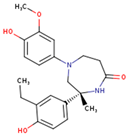

Article

Structure-Based Virtual Screening for ALOX5 Inhibitors: Combining Scaffold Hopping and Pharmacophore Approaches

1
The First Clinical College, Guangdong Medical University, Zhanjiang 524023, China
2
School of Ocean and Tropical Medicine, Guangdong Medical University, Zhanjiang 524023, China
*
Author to whom correspondence should be addressed.
These authors contributed equally to this work.
Submission received: 12 December 2025 / Revised: 23 January 2026 / Accepted: 10 February 2026 / Published: 12 February 2026

Abstract

Arachidonic acid 5-lipoxygenase (ALOX5), an enzyme critical for lipid mediator synthesis, demonstrates significant upregulation in clinically distinct disease states. Current research identifies its aberrant activity in neurodegenerative pathologies (e.g., Parkinson’s disease), solid tumors, hematological cancers, metabolic dysregulation linked to diabetic nephropathy, and vascular remodeling in hypertension and coronary artery disease. These findings collectively implicate ALOX5 as a multifunctional driver of chronic inflammation and tissue damage across organ systems. Despite the significant clinical significance of ALOX5, developing effective inhibitors for this target remains challenging, with most candidates still undergoing clinical evaluation. This study employs a multi-stage computational approach to identify novel ALOX5 inhibitors with strong drug-like properties. By compiling compounds with documented ALOX5 inhibitory activity and IC50 values from PubChem, ChEMBL, and MedChemExpress databases, we established a ligand-based pharmacophore model to virtually screen terpenoid derivatives. The selection of terpenoid compounds for virtual screening is primarily due to their dual role as natural products exhibiting significant structural diversity alongside a broad spectrum of known biological activities. This provides an ideal starting point for the efficient discovery of structurally novel lead compounds with drug potential, while also being well-suited for structure-based computational evaluation. Two lead compounds (29835 and 38032) were identified through ADMET property prediction and scaffold modification-guided optimization. Molecular docking analysis revealed superior binding affinities for these candidates (−8.31 and −10.26 kcal/mol, respectively) compared to Zileuton (−7.39 kcal/mol), indicating stable and favorable interactions within the target protein’s active site. The binding stability of these complexes was further confirmed by 100 ns molecular dynamics simulations, which demonstrated sustained structural integrity of the protein–ligand systems. Collectively, computational findings suggest these compounds as promising ALOX5 inhibitors. However, given the theoretical framework of this work, subsequent experimental validation via in vitro and in vivo pharmacological assays is imperative to verify their therapeutic potential.

1. Introduction

Polyunsaturated fatty acids (PUFAs) exhibit multifaceted biological activities, including the regulation of lipid metabolism, modulation of inflammatory and immune responses, maintenance of blood glucose homeostasis, cytoprotection, and support for neurodevelopment. Their diverse mechanisms of action have been closely linked to the pathogenesis of numerous diseases, such as neurological disorders, cancer, diabetes, and cardiovascular conditions [1,2,3,4]. PUFAs include arachidonic (AA), linoleic (LOL), and docosahexaenoic (DHA) acids [5]. Arachidonic acid (AA), a biologically active lipid and a key component of mammalian polyunsaturated fatty acids (PUFAs), serves as a precursor for signaling molecules involved in diverse physiological and pathological processes. Its metabolism is primarily mediated by three enzymatic pathways: cyclooxygenases (COX), Arachidonic acid lipoxygenase (ALOX), and cytochrome P450 (CYP450), which collectively convert AA into bioactive derivatives regulating inflammation, vascular tone, and cellular homeostasis [6]. Among enzymes involved in lipid metabolism, the lipoxygenase (ALOX) family emerges as the primary contributor to lipid peroxide biosynthesis [5]. These non-heme iron-dependent enzymes catalyze the oxidation of polyunsaturated fatty acids, generating bioactive lipid mediators critical for cellular signaling. In humans, the ALOX family comprises several isoforms, most notably ALOX12, ALOX15, ALOX5, and ALOXE3. Of these, due to its pivotal role in inflammatory pathways and its association with multiple diseases, ALOX5 has become a subject of research interest as a significant therapeutic target [7,8,9]. ALOX5 exerts its key enzymatic role by catalyzing the oxidation of arachidonic acid (AA) to form 5(S)-hydroperoxyeicosatetraenoic acid (5(S)-HPETE). This unstable intermediate is subsequently metabolized into leukotriene A4 (LTA4), which serves as a branch point for the biosynthesis of two distinct pro-inflammatory mediators: leukotriene B4 (LTB4) and cysteinyl leukotrienes (CysLTs), including leukotriene C4 (LTC4) and leukotriene D4 (LTD4) [10]. Leukotrienes function as potent bioactive lipid mediators that drive inflammatory and immune responses, including allergic reactions, bronchoconstriction, and enhanced vascular permeability, while also facilitating immune cell chemotaxis. As the rate-limiting enzyme in leukotriene biosynthesis, ALOX5 catalyzes the production of these mediators, positioning it as a critical contributor to the pathogenesis of multiple diseases. Dysregulated ALOX5 activity has been implicated in diverse conditions such as asthma, atherosclerosis, cancer, diabetes mellitus, and Alzheimer disease, underscoring its broad therapeutic relevance [11].
Ferroptosis is a distinct iron-mediated regulated cell death mechanism, first characterized in 2012 through the seminal work of Brent R. Stockwell’s laboratory. Unlike classical apoptosis or necrosis, ferroptosis is driven by iron-dependent lipid peroxidation and oxidative membrane damage, marking it as a unique pathway in cellular demise [12]. Ferroptosis has been found to be closely linked to iron, lipid, and antioxidant metabolisms [13]. Emerging evidence highlights ferroptosis as a critical pathogenic driver across diverse disease contexts, including cancer progression, ischemia/reperfusion injury, neurodegenerative disorders, and autoimmune conditions [14]. Its mechanistic uniqueness—rooted in iron-dependent lipid peroxidation and redox imbalance—aligns closely with tumor vulnerabilities such as metabolic reprogramming and antioxidant system dysregulation. This intersection has positioned ferroptosis modulation as a promising strategy for enhancing therapeutic efficacy, particularly when combined with targeted inhibitors or conventional treatments [15,16,17]. In addition, iron cell apoptosis can synergize with immunotherapy to inhibit tumor growth [18,19,20]. Many studies have shown that ALOX5 is a target of ferroptosis [21,22]. ALOX5 serves as a central mediator of ferroptosis by enzymatically generating lipid peroxides, including 5-hydroperoxyeicosatetraenoic acid (5-HPETE), through the oxidation of arachidonic acid. This process is tightly regulated by glutathione peroxidase 4 (GPX4), which neutralizes peroxides to suppress ferroptotic signaling. Conversely, GPX4 depletion results in unchecked ALOX5 activity, triggering ERK signaling axis activation and subsequent pro-inflammatory cascades. These interconnected mechanisms—sustained lipid peroxidation, Extracellular Regulated Protein Kinases (ERK)-driven inflammation, and antioxidant system failure—collectively orchestrate the biochemical hallmarks of ferroptosis [23].
As previously outlined, ALOX5 plays a dual role in potentiating inflammatory cascades and driving ferroptotic cell death through lipid peroxidation. Despite its pathophysiological significance, pharmacological targeting of ALOX5 remains limited, with Zileuton—the sole FDA-approved ALOX5 inhibitor—currently restricted to asthma maintenance therapy. This paucity of clinically viable inhibitors underscores the urgent need to identify novel ALOX5-targeting compounds, particularly for oncology applications. The aim of this experiment is to identify new ALOX5 inhibitors, thereby providing a wider range of options for the development of drugs to treat the diseases.
To achieve this, we employed computer-aided drug design (CADD), a methodology that leverages molecular docking, binding affinity simulations, and pharmacokinetic profiling to systematically screen and optimize candidate molecules against target proteins. CADD has already facilitated the development of over 70 FDA-approved therapeutics, demonstrating its transformative potential in accelerating drug discovery pipelines. Several recent studies have adopted workflows consistent with this concept [24,25,26]. By integrating these computational approaches, we seek to overcome the limitations of traditional high-throughput screening and prioritize high-confidence candidates for experimental validation [27]. This work has significantly accelerated the drug discovery pipeline while guiding researchers toward more data-driven strategies for rational drug development [28]. This study employs an integrated computational framework to discover novel ALOX5 inhibitors, combining structure-based and ligand-based drug design strategies. Specifically, we developed a pharmacophore model derived from known ALOX5 ligands, followed by rigorous Absorption, Distribution, Metabolism, Excretion, and Toxicity (ADMET) profiling to prioritize compounds with favorable pharmacokinetic properties. Molecular docking and free energy landscape (FEL)-guided molecular dynamics (MD) simulations were then applied to refine binding mode predictions and assess thermodynamic stability at the ALOX5 active site. To enhance structural novelty and bypass existing patent limitations, scaffold hopping techniques were systematically integrated into the workflow, yielding chemically diverse candidates with optimized drug-likeness. The comprehensive methodology, summarized in Figure 1, establishes a rational drug discovery process for targeting ALOX5 in disease contexts.

2. Materials and Methods

2.1. Protein Structure

The crystal structure of ALOX5 (PDB ID: 3V99) obtained from the RCSB Protein Data Bank (https://www.rcsb.org, accessed 5 June 2024) is based on human protein determination and has a resolution of 2.25 Å [29]. The protein is optimized through the Schrödinger Protein Preparation Wizard module to generate a suitable initial structure. This includes the removal of water molecules, eutectic compounds, and heteroatoms, correction of bond order and charge, and performance of energy minimization.

2.2. Data Set

We selected 4495 compounds from the terpenoid library for screening and conducted the screening process within the framework of multiligand co-characterization layer construction. Our primary objective was to identify the maximum number of ALOX5 inhibitors. To achieve this, we compiled a dataset of active molecules by curating 13 compounds with reported IC50 activity values from literature sources, including 3 clinically approved compounds and 10 candidates designated for experimental studies. For initial dataset optimization, we employed Schrödinger’s LigPrep module to account for all possible ionization states of the compounds under Epik mode at pH 7.0 ± 2.0. Additionally, the conformational flexibility and energy of the generated compounds were minimized using the OPLSe3 force field [30].

2.3. Pharmacophore Analysis

This study employed the ‘Pharmacophore Modelling’ module within the Maestro 12.8 software to construct a pharmacokinetic model based on ligand structures. Parameter adjustments required the model to match at least 25% of the active compounds, with the number of drug molecular features restricted to between four and seven. The resulting pharmacophore model (ADHRR_1) achieved its top-ranking score by aligning with 5 distinct features and was subsequently applied for compound library screening. For model validation, 9 compounds from the dataset were designated as the training set, and the remaining 4 compounds comprised the test set. The classifier’s performance was evaluated using the area under the receiver operating characteristic curve (ROC), a metric that reflects the model’s predictive reliability. By convention, an AUC > 0.7 signifies robust discriminative and classification capabilities, whereas an AUC < 0.5 indicates no discernible predictive ability [31]. Using the selected pharmacophore model (ADHRR_1), this study conducted initial pharmacophore-based virtual screening of the terpenoid compound library through the Maestro program. The feature-matching scoring criteria were adjusted to require matches of either 4 or 5 pharmacophore features, ultimately identifying 204 compounds from the terpenoid library that satisfied these parameters [32]. However, we fully recognize that due to the limited size of the training set, this internal validation may overestimate the model’s generalization ability. The reliability of the model’s predictions for structurally novel compounds outside the chemical space of the training set is uncertain. Therefore, in downstream virtual screening, we did not use pharmacophore matching as the sole rigid screening criterion but combined it with molecular docking scores and ADMET predictions to create a more robust, multi-level screening process.

2.4. Molecular Docking

Molecular docking identifies optimal binding conformations by analyzing receptor protein properties and small molecule binding patterns, enabling efficient compound library screening—a critical step in accelerating drug discovery. Schrodinger’s molecular docking employs the XP (Extra Precision) mode, distinguished by its low false-positive rate and high accuracy in predicting ligand–receptor interactions [33]. The compound library explores optimal binding conformations within a 5 Å radius of the protein receptor’s ligand binding site. The docking grid center coordinates were fixed at 18.3821, −78.7653, −33.897, with a grid size constrained to 18 Å, and the ligand box was optimized to align more closely with the co-crystal compound’s spatial orientation.

2.5. Scaffold Hopping

The Scaffold Hopping strategy applies to compounds unamenable to synthesis through side chain or substituent modifications alone. This approach enables systematic modification of heteroatom positions and quantities within the molecular framework, optimizing structural diversity and increasing the likelihood of successful drug discovery [34]. We utilized the Ligand-Based Core Hopping module in the Maestro program to perform systematic replacement of specified heteroatom fragments, with explicit binding protein constraints to confine scaffold spatial displacement ranges. Based on minimal side chain root mean square deviation (RMSD), optimal scaffold alignment, and most favorable binding conformations, we prioritized the top 100 compounds fulfilling all predefined criteria.

2.6. ADMET

ADMET pharmacokinetic methods (Absorption, Distribution, Metabolism, Excretion, and Toxicity) are critical for minimizing drug side effects and guiding safe clinical medication practices. In this study, we employed the SwissADME server (http://www.swissadme.ch/, accessed on 5 June 2024) to evaluate the pharmacokinetic properties and bioactivity of compounds identified through pharmacophore model screening. Key assessments included drug absorption, water solubility, logP values, and adherence to Lipinski’s Rule of Five, providing actionable insights for subsequent research prioritization [35].

2.7. Molecular Redocking

To ensure more precise experimental results, we conducted further refined docking analyses of 2 candidate compounds after scaffold hopping using Glide XP module in Maestro. Critically, we integrated Epik state penalty weighting into the docking score calculation and prioritized compounds achieving scores within 2% of the XP threshold for subsequent molecular dynamics simulations. To validate key interactions in the predicted binding modes, a negative control analysis was performed. For compounds 29835 and 38032, “mutant” ligands were generated by replacing hydroxyl groups with methyl groups to disrupt hydrogen bonds with Asn554 or with Phe555/Tyr558, respectively. Thus, yielding the 29835_ mutant and the 38032_ mutant. These structures were optimized and energy-minimized (Schrödinger). Docking was then carried out under the same conditions (protein structure, parameters, search space) as in the initial screening.

2.8. Molecular Dynamics Simulations

This article describes the molecular dynamics simulations conducted using GROMACS 2019.1 software, employing the AMBER99SB-ILDN force field to evaluate the atomic stability of different ligands on the protein 3V99 [36]. After 100 ns of molecular dynamics simulation of the protein–receptor system, the ligands Molecule 29835, Molecule 38032, and a positive compound were analyzed. The AMBER99SB-ILDN force field was employed to treat the protein, resulting in the generation of topology and coordinate files. The GAFF force field of software Tian Lu, Sobtop, Version [1.0 (dev5)], http://sobereva.com/soft/Sobtop (accessed on 14 February 2025) is utilized to generate ligand topology. GAFF integrates seamlessly with Amber force fields for proteins and nucleic acids, parametrizes the vast majority of drug-like organic molecules containing H, C, N, O, S, P and halogens, and achieves robust accuracy by combining a minimalist functional form with empirical and heuristic models for force constants and partial atomic charges [37]. A cubic box with a radius of 1.2 nm and the SPC216 water model were utilized to define periodic boundary conditions (PBC). Moreover, the system was neutralized using an ion tool by adding counterions (Na+ and Cl− ions). All systems underwent energy minimization for 50,000 steps using the steepest descent algorithm. The system was equilibrated in two steps at 300 K: constant number of particles, volume, and temperature (NVT) followed by constant number of particles, pressure, and temperature (NPT). Finally, a 100 ns MD simulation was performed. The analysis included the evaluation of root mean square deviation (RMSD) and root mean square fluctuation (RMSF) of atomic positions, as well as determining the radius of gyration (Rg), hydrogen bond count for each system and the solvent accessible surface area (SASA). In hydrogen bond interaction analysis, we employ the following criteria for identification and quantification: the distance threshold between donor and acceptor atoms is set at ≤3.5 Å, and the donor–hydrogen–acceptor (D–H–A) bond angle must be ≥120°. The scope of analysis extends beyond active binding sites to encompass the entire protein structure, enabling a comprehensive evaluation of potential specific hydrogen bond networks between compounds and proteins. This approach facilitates a more complete understanding of their binding patterns and underlying interaction mechanisms. Dynamic cross-correlation matrix (DCCM) and free energy landscape (FEL) were subsequently calculated for the protein–ligand dynamic complexes. In free energy landscape (FEL) analysis, we employ the first two principal components (PC1 and PC2) extracted via principal component analysis (PCA) from molecular dynamics simulation trajectories as reaction coordinates. The two-dimensional free energy is calculated using the following formula:
G ( x , y ) = k B T I n P ( x , y )
Here, P(x, y) denotes the probability distribution of the system in the reaction coordinate space, where kB is the Boltzmann constant and T is the simulation temperature (310 K). Free energy contour plots were generated using the gmx sham module (gromacs.2022) to visually compare the conformational distributions and relative stabilities of different complex systems. PCA was finally computed from the MD trajectory using the Bio3D 2.2.4 package in R 4.4.2 programming.

3. Results

3.1. Pharmacophore Model Establishment

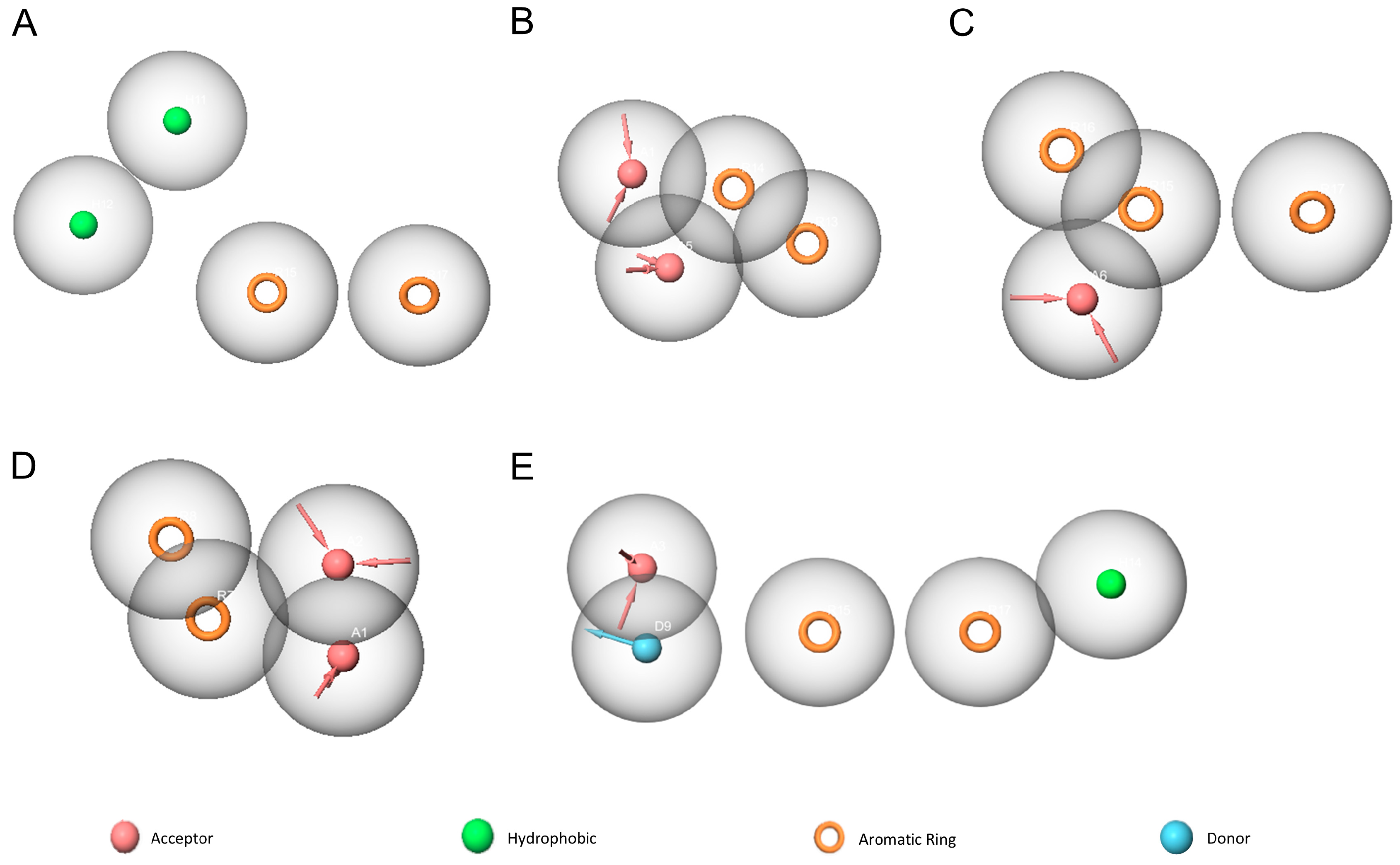
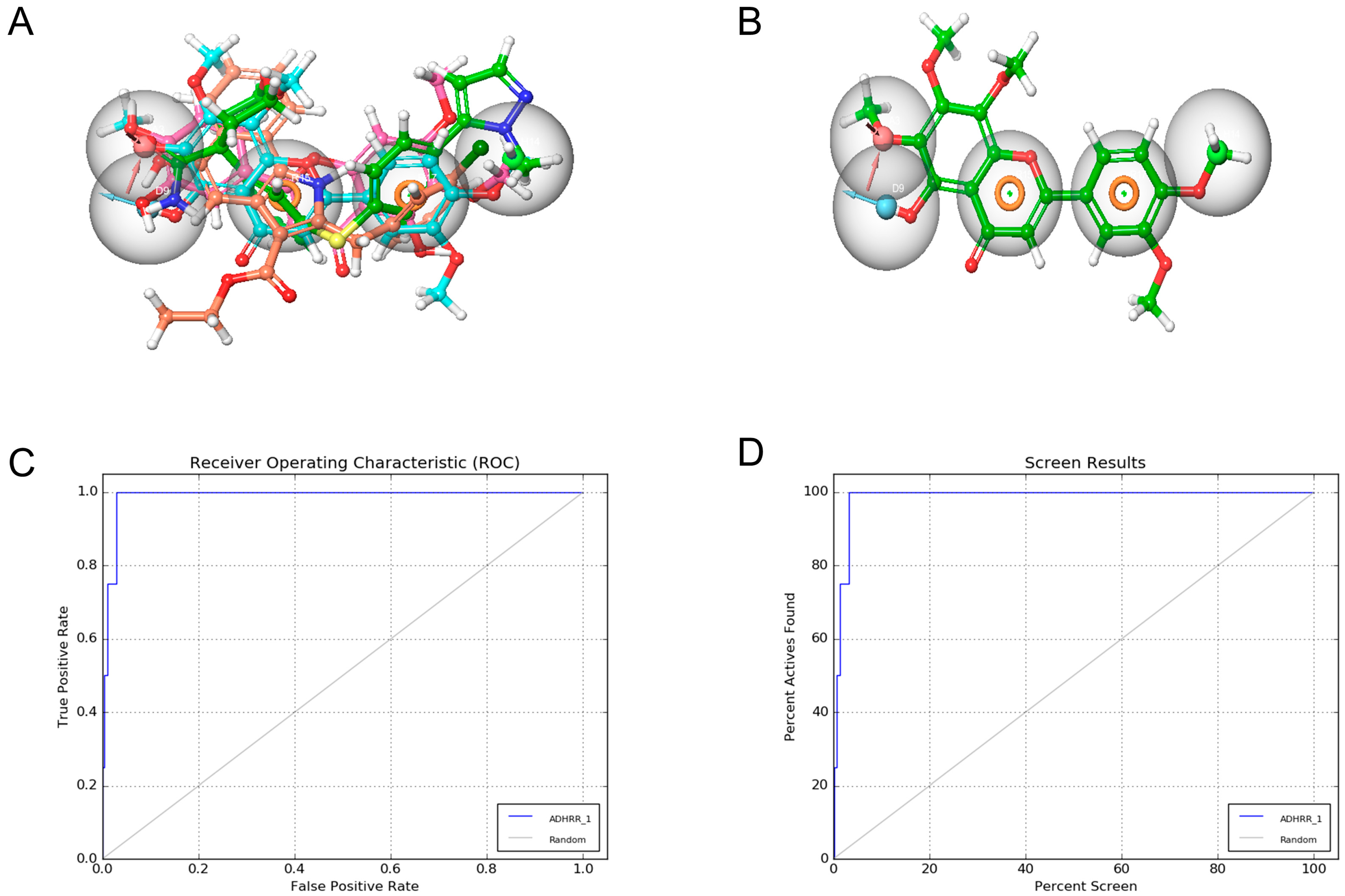
Pharmacophore modeling has emerged as a transformative computational tool in modern drug discovery, synergistically integrating ligand-based and structure-based methodologies to enhance the efficiency of screening large compound libraries. By mapping the 3D spatial arrangements of key functional groups required for bioactivity, this approach enables rapid prioritization of structurally diverse candidates with optimized target affinity. Notably, contemporary pharmacophore strategies—which incorporate dynamic molecular interactions and binding site plasticity—outperform classical receptor structure-based methods in recognizing bioactive scaffolds. This superiority stems from their ability to account for ligand conformational flexibility and multi-modal binding mechanisms, thereby bridging empirical bioactivity data with atomic-level structural insights. As a result, pharmacophore-driven workflows are increasingly adopted as a scaffold-hopping paradigm to expedite the identification of novel lead compounds while circumventing patent-clogged chemical space [38]. The pharmacophore model in this study was constructed using a ligand-based approach. Given the limited availability of active inhibitors with experimentally confirmed IC50 values, we curated 13 ALOX5 inhibitors from literature and database, categorizing them into active (pIC50 ≥ 6.4) and inactive (pIC50 ≤ 5.0) groups based on activity thresholds (Table 1). Using these compounds, 20 pharmacophore models were generated (Table 2). Parameter analysis (Table 1) revealed that five pharmacophores—HHRR_1 (Figure 2A), AARR_3 (Figure 2B), ARRR_1 (Figure 2C), AARR_2 (Figure 2D), and ADHRR_1 (Figure 2E)—exhibited superior performance, characterized by higher Phase Hypo scores and a greater number of matched pharmacophoric features. The spatial configurations of these five pharmacophores are illustrated in Figure 2. After rigorous evaluation, the optimal model (ADHRR_1) was selected, comprising five critical features: one hydrogen bond donor, one hydrogen bond acceptor, two aromatic rings, and one hydrophobic group. As shown in Figure 3A, all active molecules aligned precisely with the ADHRR_1 pharmacophore. Reference ligands fitted to the optimal model are displayed in Figure 3B. These results demonstrate that the proposed pharmacophore model effectively discriminates between active and inactive compounds, validating its utility for targeted inhibitor discovery [39]. The receiver operating characteristic (ROC) curve is a threshold-agnostic visualization tool that assesses binary classifiers by contrasting the false positive rate (FPR, x-axis) with the true positive rate (TPR, y-axis). The area under this curve (AUC) represents the probability that the model ranks a randomly chosen positive instance higher than a negative one, offering a threshold-independent performance metric scaled between 0.5 (no discriminative power) and 1.0 (flawless class separation). Models achieving AUC values approaching 1.0 demonstrate exceptional reliability in differentiating class labels, making this metric indispensable for evaluating classifiers in scenarios where decision boundaries are ambiguous or imbalanced data prevails [40]. In this study, the ROC scores (as shown in Figure 3C) and percentage screening graphs (as shown in Figure 3D) provide strong confidence in validating the optimal pharmacophore model.

3.2. Molecular Docking

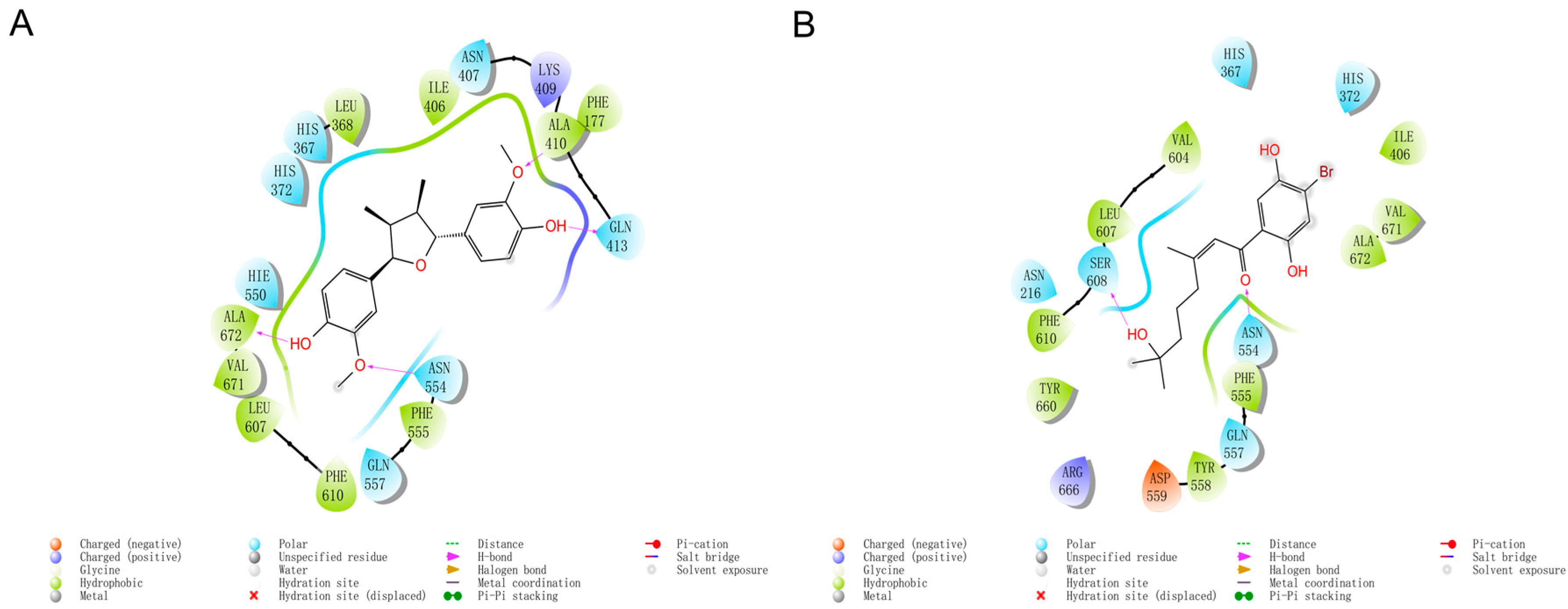
Molecular docking, a cornerstone of structure-based drug design, enables the prediction of ligand binding modes and affinity within protein active sites while elucidating key molecular interactions [41]. In this study, Zileuton—a known ALOX5 inhibitor (PDB ID: 3V99)—served as the positive control. Using the Glide XP module in Maestro, we docked all the small molecules in the terpenoids compound library into the ALOX5 binding site and prioritized candidates by docking score. Among them, the docking scores of compounds 2983 and 3803 are better than that of the positive control Zileuton. Their docking scores are shown in Table 3 and their interaction diagrams are shown in Figure 4. It should be noted that docking scores derive from highly simplified scoring functions, whose predictions cannot yet reliably reflect true binding affinity or inhibitory activity. Consequently, the differences in docking scores listed in Table 4 should only serve as preliminary reference; subsequent experimental validation remains crucial.

3.3. Replace Fragment Protocol

For compound 2983, the furan ring and oxygen atom exhibited minimal binding interactions with the protein (Figure 4A), identifying this fragment as a viable candidate for backbone hopping. Similarly, the benzene ring of compound 3803 showed negligible engagement with the active site (Figure 4B), prompting its substitution. To address these inefficiencies, we generated 1000 novel analogs for each compound by replacing the non-interacting fragments. Subsequent application of the Ligand-Based Core Hopping module in Maestro software expanded the chemical library to 20,000 derivatives.

3.4. ADMET Analysis

The absorption, distribution, metabolism, excretion, and toxicity (ADMET) profile of a compound is a critical determinant of its efficacy and safety as a drug candidate, with poor ADMET properties being a leading cause of clinical trial attrition [42]. To mitigate this risk, computational ADMET prediction tools were employed in this study. After removing three false-positive structures using the False Positive Remover tool, the remaining compounds were subjected to in silico ADMET evaluation via SwissADME. Key pharmacokinetic parameters—including the octanol–water partition coefficient (logP), gastrointestinal absorption, aqueous solubility, and blood–brain barrier permeability—were analyzed and benchmarked against established positive controls. Both evaluated compounds demonstrated favorable drug-like properties, aligning closely with reference molecules in terms of bioavailability and safety metrics [43].The results of the ADMET analyses are shown in Table 4.
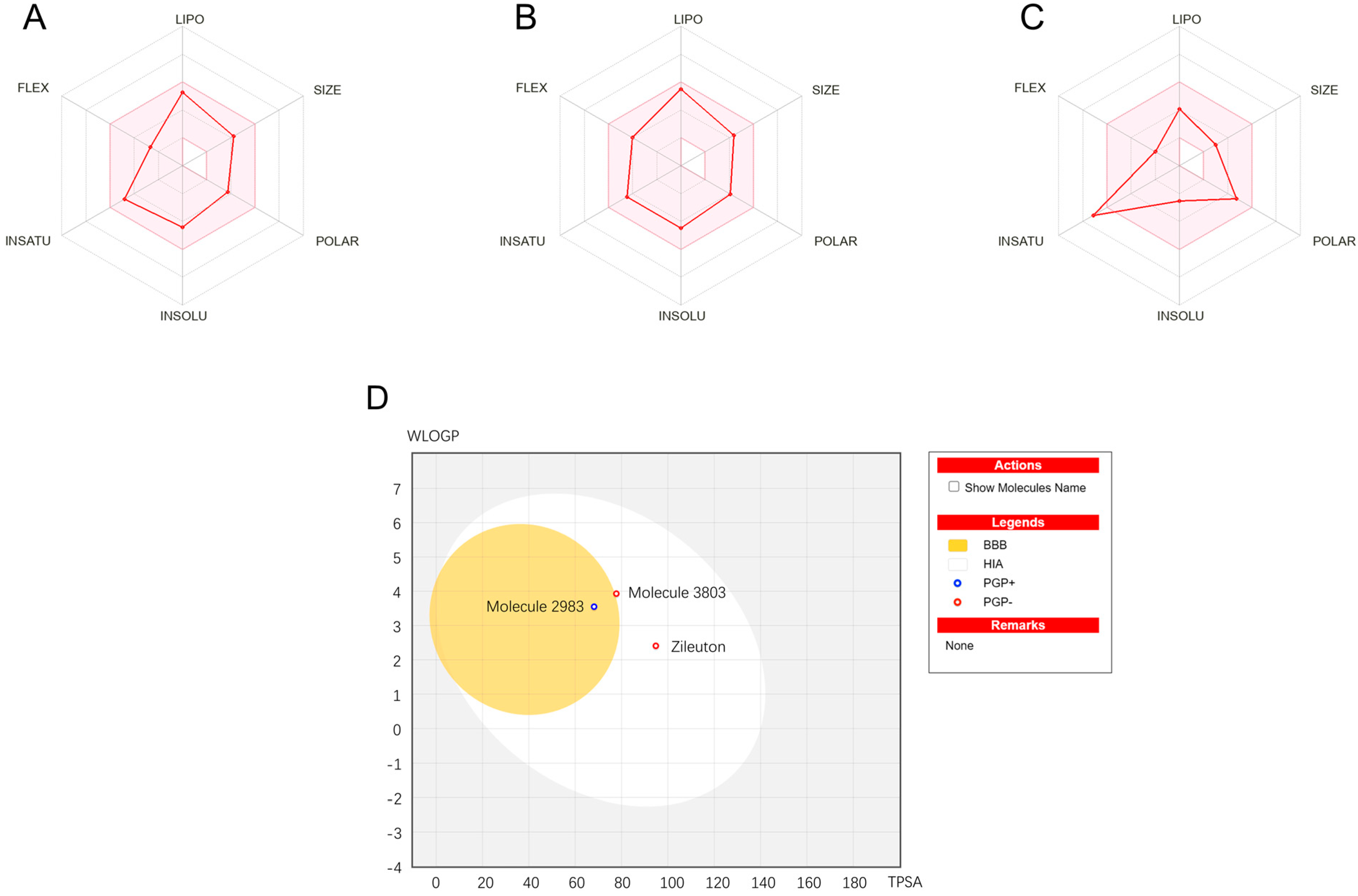
The octanol–water partition coefficient (LogP), which measures a compound’s lipophilicity, reflects its distribution between the hydrophobic (n-octanol) and hydrophilic (water) phases. Using SwissADME, which integrates five distinct algorithms for LogP prediction, we calculated average LogP values for comparative assessment. Higher LogP values correlate with increased lipid solubility, whereas lower values indicate greater aqueous solubility and hydrophilicity [44]. Computational analysis revealed distinct physicochemical profiles for the evaluated compounds: unlike Zileuton, compound 2983 exhibited pronounced hydrophilicity, while compound 3803 demonstrated stronger lipophilicity. Both compounds displayed high gastrointestinal absorption, suggesting favorable potential for oral administration. Additionally, blood–brain barrier (BBB) permeability—a key determinant of a molecule’s ability to passively diffuse into the central nervous system—differed significantly: compound 3803 showed negligible BBB penetration, whereas 29833 was BBB-permeable.
Further physicochemical characterization was performed using the bioavailability radar (Figure 5), which evaluates six critical properties: lipophilicity, molecular size, polarity, solubility, flexibility, and saturation [39]. Notably, the radar profiles of both compounds fell entirely within the optimal range (pink region), contrasting sharply with Zileuton. This alignment suggests superior drug-like properties and enhanced bioavailability for the synthesized compounds compared to the reference molecule.

3.5. Molecular Redocking

Using the Glide XP module in Maestro, we redocked 100 pre-screened small molecules into the ALOX5 binding site and prioritized candidates by docking score and ADMET compliance. According to docking model predictions, the docking scores for derivatives 29835 and 38032 outperform those of Zileuton and its parent compounds (2983 and 3803), with specific scores detailed in Table 5.
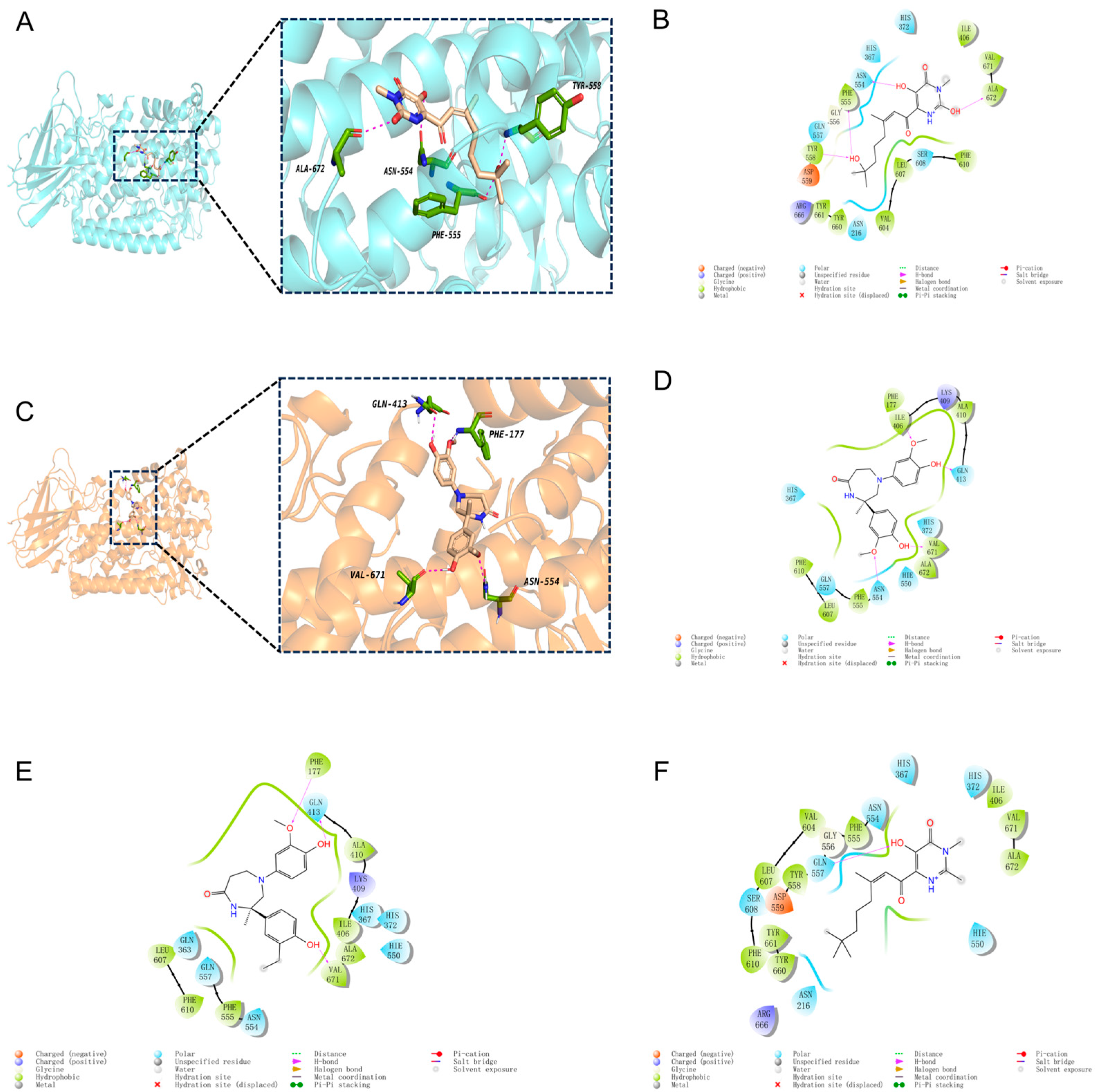
Analysis of protein–ligand interactions revealed distinct binding mechanisms: 38032 formed hydrogen bonds with ASN554, PHE555, TYR558, and ALA672 (Figure 6A,B), while 29835 engaged PHE177, GLN413, ASN554, and VAL671 (Figure 6C,D). Notably, ASN554—a residue previously implicated in ALOX5-inhibitor binding—participated in both complexes, underscoring its critical role and providing a strategic anchor for future optimizations. To assess the reliability of the predicted combination model, we performed docking simulations for the key hydrogen bond between compound 29835 and His367, incorporating negative controls based on docking poses (Figure 6E,F). As shown in Table 4, mutating the hydroxyl group of molecules 29835 and 38032 to a methyl group reduced their docking scores from −8.31 kcal/mol and −10.262 kcal/mol to −7.05 kcal/mol and −6.673 kcal/mol, respectively. This indicates that the hydrogen bond network formed between molecule 38032 and Phe555/Tyr558 constitutes a key interaction maintaining its high docking score.
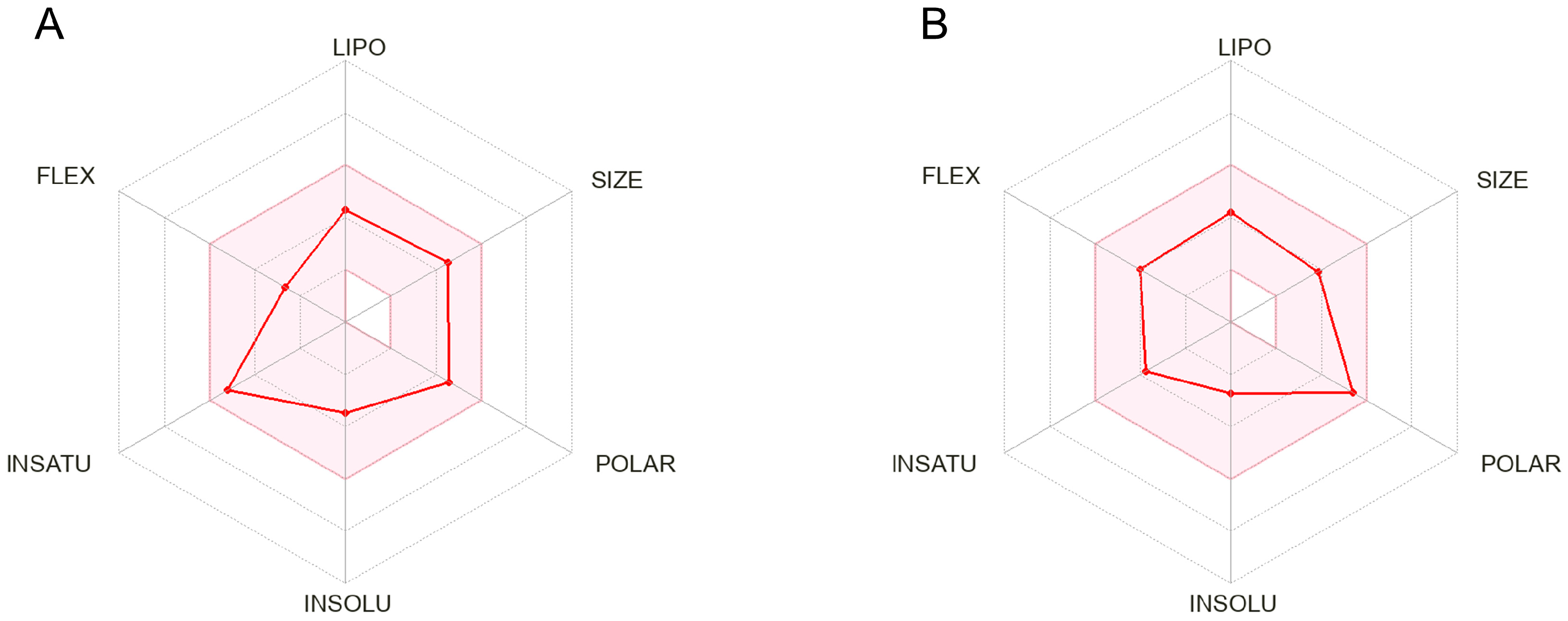
Furthermore, bioavailability radar analysis (Figure 7) confirmed that both derivatives satisfied all six physicochemical criteria, with their profiles fully contained within the optimal drug-like range (pink region). The molecular weight of compound 29835 was 372.41 g/mol, with a LogP of 1.86, 3 hydrogen bond donors, 5 hydrogen bond acceptors, and 4 rotatable bonds. Compound 38032 had a molecular weight of 311.35 g/mol, a LogP of 1.18, 5 hydrogen bond donors, 4 hydrogen bond acceptors, and 6 rotatable bonds. This indicated that both candidate compounds complied with Lipinski’s Rule of Five and exhibited favorable membrane permeability. This alignment suggests enhanced pharmacokinetic potential relative to Zileuton.

3.6. MD Simulation

Molecular dynamics (MD) simulations were utilized to evaluate the binding stability and interaction mechanisms of small molecules with ALOX5, a target protein implicated in inflammatory pathways. By modeling the dynamic behavior of pre-docked complexes over a 100 ns trajectory, this approach indicates atomistic insights into ligand–protein interactions, enabling predictions of pharmacological activity, efficacy, and safety profiles. Post-simulation analyses included RMSD and RMSF to assess structural stability and regional flexibility, radius of gyration to quantify compactness, hydrogen bond occupancy to identify critical interactions, principal component analysis (PCA) to map conformational sampling, and free energy landscapes (FEL) to characterize low-energy binding states. Collectively, these metrics revealed that Molecule 38032 exhibits sustained binding stability with ALOX5, marked by minimal conformational drift, consistent hydrogen bonding, and energetically favorable poses. This integrated methodology underscores the compound’s potential as a therapeutic candidate while aligning computational findings with rigorous biophysical validation standards.
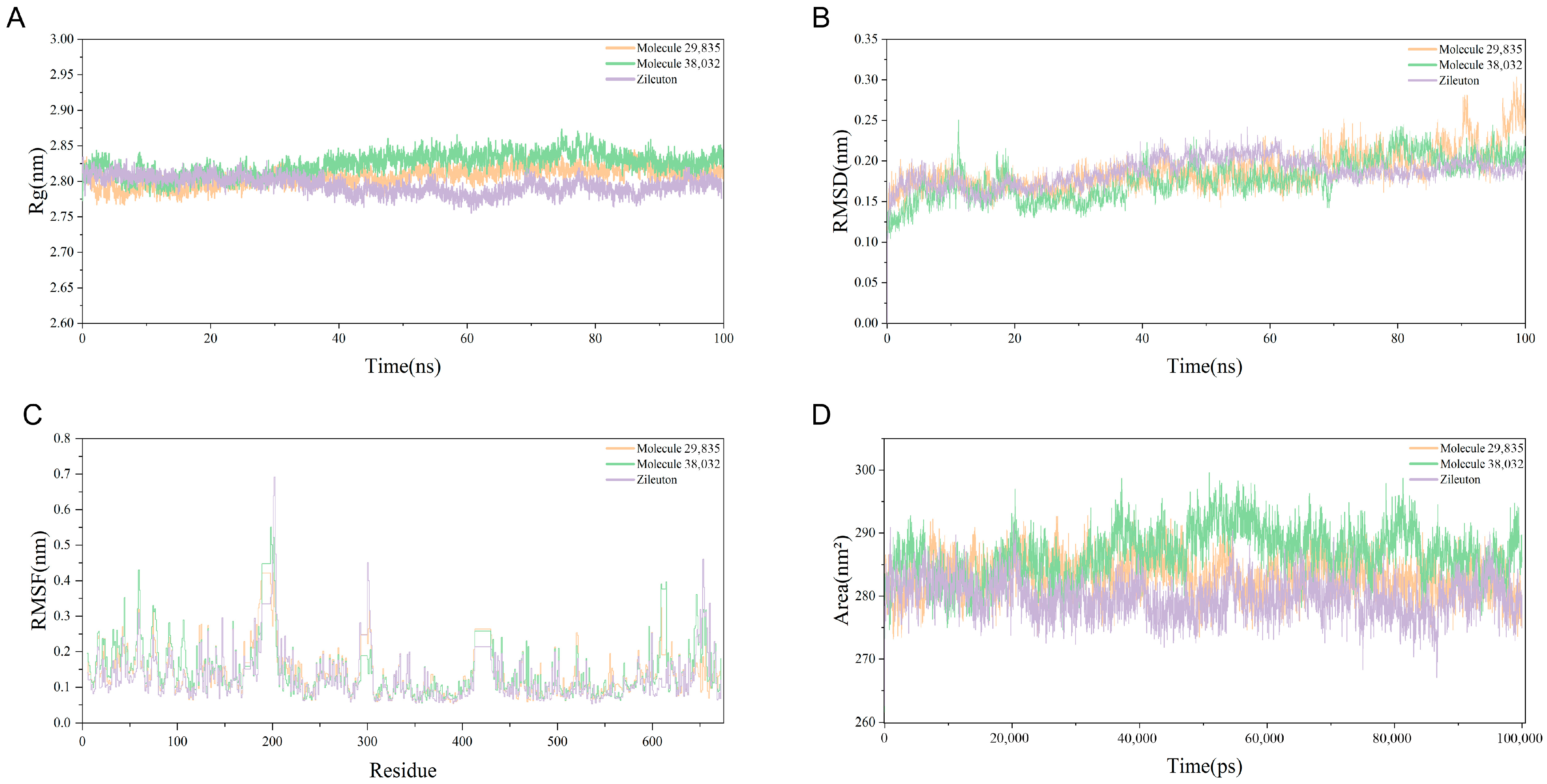
The radius of gyration (Rg) characterizes molecular spatial extension and compactness, enabling prediction of protein structural stability and integrity. As shown in Figure 8A, the Rg values for the ALOX5-Molecule 29835 complex fluctuate between 2.77 and 2.84 nm, with an average of 2.807 nm; the Rg values for the ALOX5-Molecule 38032 complex fluctuate between 2.77 and 2.86 nm, with an average of 2.823 nm; and the Rg values for the ALOX5–Zileuton complex fluctuate between 2.77 and 2.82 nm, with an average of 2.795 nm. Although both candidate compounds exhibited relatively stable and low Rg values, Zileuton showed the lowest average Rg value, suggesting it has the highest structural stability. RMSD quantifies structural similarity by calculating the root mean square deviation, which is the square root of the average of the squared differences in atomic coordinates relative to the mean structure. This measure indicates the magnitude of movement of each atom and is commonly used to determine whether the simulated system has reached a stable equilibrium state. Figure 8B presents that the RMSD of molecule 29835 stabilizes after 26 ns, with an average RMSD of 0.19468 nm thereafter. The RMSD of Molecule 38032 stabilizes after 38 ns, with a lower average RMSD of 0.19114 nm compared to Molecule 29835. The RMSD of Zileuton stabilized after 69 ns, with an average RMSD of 0.18847 nm in its stable state—the lowest among the three compounds. However, Zileuton reached equilibrium later than the others. Therefore, the AOLX5–Zileuton complex was the most stable, the AOLX5-38032 complex ranked second, and the AOLX5-29835 complex was the least stable. RMSF reflects the positional fluctuations of the protein residues during the simulation process, representing the degrees of freedom of the atoms. Overall, the RMSF values of the three compounds (0.0528–0.6918 nm) exhibit consistent fluctuation patterns in the figure (Figure 8C). Both ALOX5–38032 complex and Zileuton show a peak in RMSF at residues 180 to 202, suggesting they may share a similar binding pattern. RMSD and RMSF analyses indicate that ALOX5–38032 complex is more likely to have a more stable binding interaction with the protein, while ALOX5–29835 complex may possess relatively moderate binding stability. As shown in Figure 8D, the average SASA value of the ALOX5–Molecule 29835 complex is 283.05 nm2; the average SASA value of the ALOX5–Molecule 38032 complex is 283.67 nm2; and the average Rg value of the ALOX5–Zileuton complex is 2.795362 nm, which is the lowest among the three compounds. All three compounds exhibited relatively small SASA fluctuations, but the average SASA of the positive control was significantly lower than that of the two candidate compounds, indicating that the protein ALOX5 can maintain a tighter structure with the positive control.
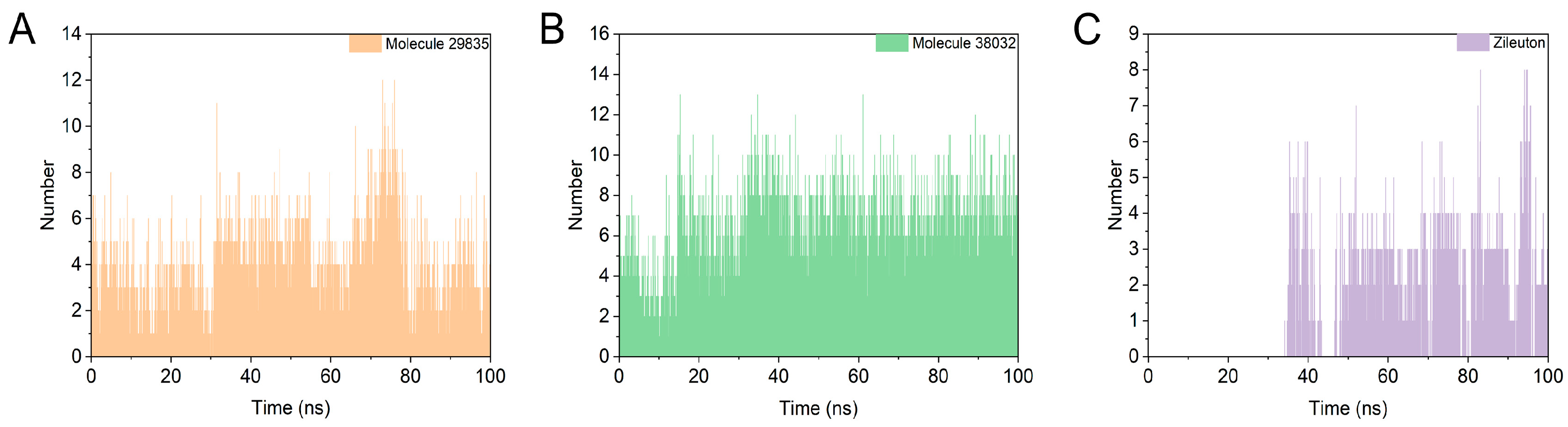
Hydrogen bonding constitutes a critical non-covalent interaction governing ligand retention within the binding pocket of receptor proteins, directly influencing binding stability and pharmacological efficacy. As illustrated in Figure 9, dynamic simulations revealed distinct hydrogen bond profiles among the tested ligands. While Zileuton exhibited sparse hydrogen bond formation with ALOX5 during the initial 30 ns, Molecules 29835 and 38032 demonstrated sustained and significantly higher hydrogen bond counts throughout the simulation. Notably, Molecule 38032 displayed the most robust interaction profile, characterized by persistent hydrogen bonding with ALOX5′s active site residues. These findings underscore hydrogen bond frequency as a key determinant of binding affinity and positional stability, consistent with the result of Molecule 38032 emerging as the superior candidate for sustained target engagement.
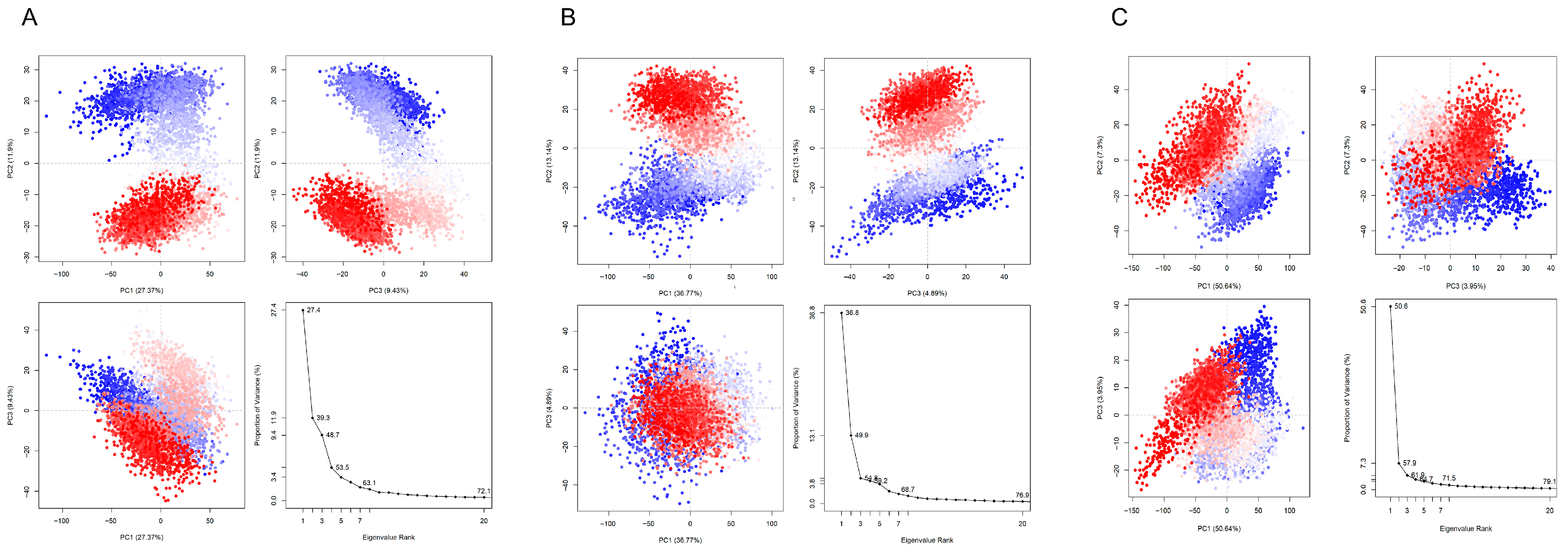
Principal Component Analysis (PCA), a cornerstone dimensionality reduction method, is pivotal for resolving conformational dynamics in protein–ligand complexes through two-dimensional subspace projections. Figure 10 presents the eigenvalue-variance ratio plot, which quantifies and contrasts the collective motions of Zileuton with candidate molecules 38032 and 29835. Structural dynamics are visualized via a tri-color gradient: high-frequency fluctuations (blue), intermediate motions (white), and low-frequency conformational rearrangements (red). This framework reveals distinct dynamic signatures, with Molecule 38032 exhibiting tighter clustering in low-frequency modes—a hallmark of enhanced structural stability—compared to Zileuton and Molecule 29835 [45].
Feature vector analysis highlights that the dominant conformational motions in all systems—captured by the first principal component (PC1)—account for 50.6–79.1% of the observed variance, underscoring its role as the primary driver of structural dynamics. Conformational evolution was mapped using the first three principal components (PC1–PC3), with PC1 displaying distinct clustering (Figure 10A–C), indicative of concerted, large-scale protein rearrangements. In contrast, PC2 (7.3% variance) and PC3 (3.95% variance) exhibited diffuse distributions, reflecting localized, intricate couplings within secondary structural elements. Comparative analysis revealed that the 3V99–Molecule 38032 complex (Figure 10C) demonstrated reduced variability across all principal components relative to both the control (3V99-Zileuton, Figure 10A) and the 3V99–Molecule 29835 system (Figure 10B). This attenuated conformational dispersion, coupled with PC1′s dominant contribution (50.64%), positions Molecule 38032 as the most likely structurally rigid ligand, suggesting enhanced binding stability through minimized entropic penalties and optimized interaction networks.
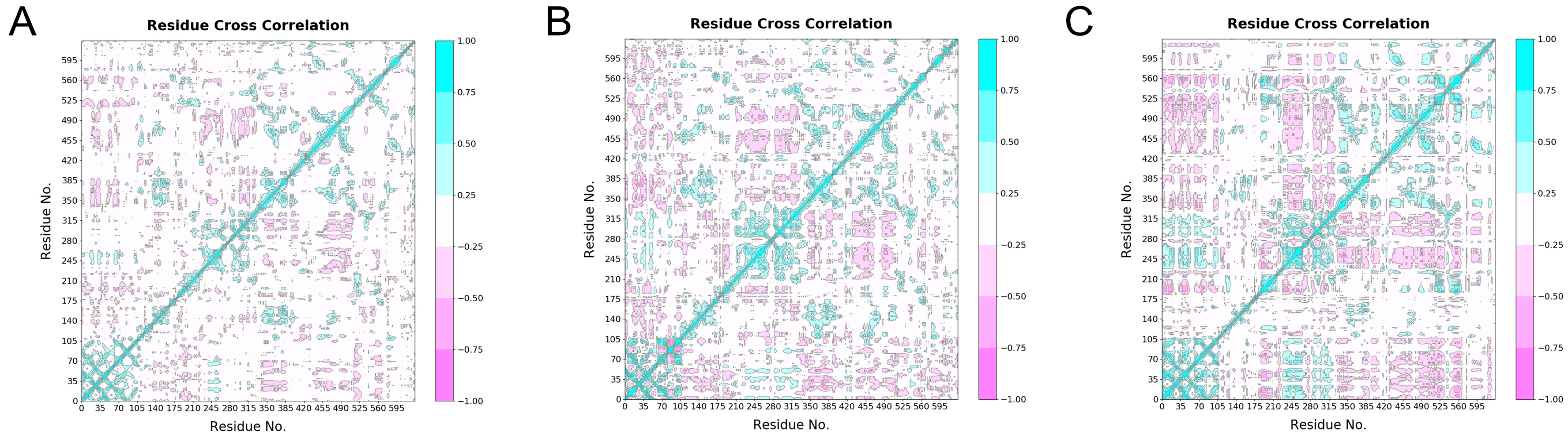
The dynamic cross-correlation matrices (DCCMs) of candidate compounds and the positive control Zileuton can reveal their interaction patterns over time by calculating the motion correlations of different residues within the molecular system [46]. As shown in Figure 11, the correlation values range from −1 to 1, where positive correlations (in blue) indicate coordinated motion between residues. The DCCM diagrams for the 3V99–Molecule 38032 (Figure 11B) and Molecule 29835 complexes (Figure 11C) show more extensive and denser regions of positive correlation along the diagonal, suggesting stronger coordinated motion among the residues of these compounds. In contrast, the DCCM of the positive control Zileuton (Figure 11A) exhibits more dispersed regions of positive correlation, indicating weaker correlations between residues. Therefore, compared to Zileuton, the dynamic complex systems 3V99–Molecule 38032 and 3V99–Molecule 29835 demonstrate stronger residue motion coordination and exhibit more stable binding interactions, highlighting their potential as candidates for ALOX5 inhibitors.
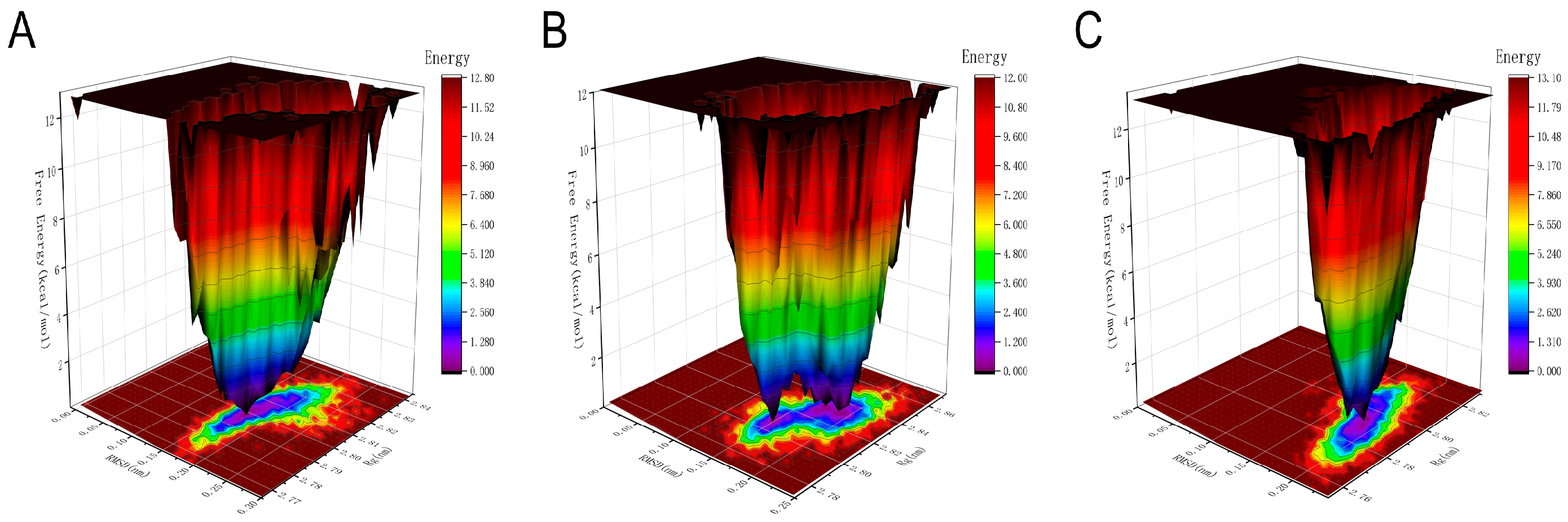
The Free Energy Landscape (FEL) is a multidimensional energy surface that describes the free energy distribution of different conformations or states of a molecular system in thermodynamic equilibrium. It can assess the thermodynamic stability and energy distribution of the complex across different conformational states throughout the entire MD simulation process [47]. Free Energy Landscape (FEL) analysis maps the conformational dynamics of protein–ligand systems by correlating root-mean-square deviation (RMSD), radius of gyration (Rg), and free energy. High-energy conformational states (red) contrast with thermodynamically stable minima (blue) in Figure 12. The 3V99–Molecule 29835 complex (Figure 12A) occupies the broadest and deepest energy basin, reflecting superior thermodynamic stabilization and restricted conformational entropy. In contrast, the 3V99–Molecule 38032 system (Figure 12B) exhibits two distinct shallow basins, signaling a dynamic equilibrium between localized rigidity and adaptive flexibility—a hallmark of optimized ligand-protein accommodation. While the 3V99–Zileuton complex (Figure 12C) demonstrates a pronounced yet narrow energy minimum indicative of stability, its confined basin suggests limited conformational plasticity compared to the candidates. Collectively, all systems form stable complexes with 3V99, but Molecules 29835 and 38032 distinguish themselves through enhanced thermodynamic stability (29835) and balanced rigidity–flexibility trade-offs (38032). These traits align with criteria for effective ALOX5 inhibition, positioning both candidates as promising leads for further development.

4. Discussion

Recent research has highlighted 5-lipoxygenase (ALOX5) as a promising therapeutic target in cancer therapy. Its role in modulating polyunsaturated fatty acid (PUFA) peroxidation—a central biochemical driver of ferroptosis, a novel form of programmed cell death—underscores its potential for tumor suppression [48]. A series of in vitro studies employing cancer cell lines that express 5-Lipoxygenase (5-LO) have indicated that ALOX5 inhibitors induce cell cycle arrest and apoptosis in 5-LO expressing cancer cells [49]. To date, researchers have identified diverse ALOX5 inhibitors spanning multiple chemical classes, including AA-861, BWA4C, C06, CJ-13,610, the FDA-approved drug Zileuton, and the non-selective lipoxygenase inhibitor nordihydroguaiaretic acid (NDGA). These compounds are widely employed to investigate the pathophysiological roles of 5-LO and its leukotriene (LT) products in inflammation, pain signaling, and oncogenesis [50]. While ALOX5-targeted inhibitors have achieved therapeutic progress in conditions including asthma, cerebral ischemia, and breast cancer, clinical translation of existing compounds remains challenging. Most candidates have failed to gain regulatory approval due to suboptimal pharmacokinetics and significant adverse effects, with Zileuton—currently approved in the U.S. for asthma—remaining the sole exception [51,52,53]. Despite demonstrating antitumor efficacy, Zileuton’s clinical utility remains constrained by its brief half-life, hepatotoxicity risk, dose-dependent immunosuppression (evidenced by 38.7% reduced CD4+ T cell counts), and metabolic complications including a 2.5-fold elevation in hepatic enzyme ALT levels [54,55,56,57]. Terpenoids, as central constituents of natural product chemistry, hold strategic importance in drug development process. Their defining isoprenoid backbone architecture—structurally grounded in organic chemistry principles—enables exceptional structural versatility and target-specific diversity, positioning these compounds as critical scaffolds for novel therapeutic discovery [58]. This study employs a computer-aided drug discovery (CADD) pipeline to systematically screen a terpenoid compound library through a multistage computational workflow, with the goal of identifying potent ALOX5 inhibitors within a rational drug design framework.
The research was conducted as follows. In the initial phase of the study, 13 ALOX5 inhibitors were identified from existing literature, and a ligand-based pharmacophore model was constructed for these compounds using Maestro software. Compounds that met four out of five pharmacophore characteristics were retained. It should be explicitly stated that the pharmacophore model constructed in this study was based on a training set containing only 13 known active compounds. Although these compounds exhibited a certain degree of diversity in both structure and activity, the relatively small sample size may have limited the statistical robustness of the pharmacophoric features extracted by the model and its coverage of chemical space. Therefore, this model was regarded as a preliminary, heuristic three-dimensional pharmacophore hypothesis based on the limited data available. Its primary purpose was to serve as a focused and rational starting point for subsequent virtual screening. Another important consideration pertained to the experimental IC50 values used for model construction and validation. These data were sourced from diverse literature, where potential variations in assay conditions represented an inherent and well-recognized challenge. Such heterogeneity may have introduced noise into the activity data, which could subsequently have affected the accuracy of activity classification and the predictive reliability of models built upon them. This limitation underscored that the model was best suited for trend-based prioritization and enrichment of potentially active compounds, rather than for providing precise quantitative predictions of binding affinity. Given the dual constraints of a limited training set for pharmacophore generation and inherent variability in the underlying experimental data, we emphasized that the model’s external predictive ability would need to be rigorously evaluated through a broader external test set and, ultimately, experimental validation. The integrated virtual screening workflow employed in this study was designed to mitigate these limitations by providing multiple layers of scrutiny. Future work would focus on expanding the training set with compounds tested under standardized conditions to build more robust and universally applicable models.
Then, through ligand–receptor interaction simulations, 21 candidate molecules were obtained with binding energies superior to the positive control Zileuton (ΔG = −7.388 kcal/mol). Negative control analysis based on docking conformations indicates that disruption of the critical hydrogen bonds between 29835 and Asn554 or between 38032 and Phe555/Tyr558 results in reduced binding affinity and loss of conformational stability. This indicates that the two lead compounds employ distinct binding modes: 29835 relies on hydrogen bonding interactions with Asn554, whereas 38032 requires the formation of a hydrogen bond network with Phe555/Tyr558. These findings provide clear guidance for subsequent experiments and structure-guided compound optimization. Compounds 2983 and 3803 exhibited good drug-like properties in ADMET predictions [59].Subsequently, to further optimize molecular characteristics, a scaffold hopping strategy was employed to design 100 novel derivatives aimed at enhancing drug similarity and docking scores. MD studies were utilized to reflect the stability of compound–protein binding [60]. Molecular dynamics simulations (100 ns) validated that Molecule 38032 and Molecule 29835 displayed robust target binding stability and dynamic conformational equilibrium (RMSD < 2.0 Å). Trajectory analysis revealed that both compounds maintained sustained interactions with the ALOX5 active site via a stable hydrogen bond network (average bonds > 3). Furthermore, the dynamic complexes 3V99–Molecule 38032 and 3V99–Molecule 29835 exhibited notable conformational flexibility, thermodynamic stability, and optimal energy distribution. These findings demonstrate that the 3V99–Molecule 38032 and 3V99–Molecule 29835 protein–ligand complexes possess exceptional long-term stability. Although these methods were able to reveal the complementarity and dynamic stability of the interactions, we did not perform quantitative binding free energy calculations, which constituted an important methodological limitation of this study. Docking scoring functions are empirical approximations of binding free energy and did not explicitly account for key thermodynamic components such as solvation effects and conformational entropy changes; meanwhile, conventional molecular dynamics simulations primarily provided dynamic descriptions and could not directly output quantitative free energy values. Therefore, the comparisons based on docking scores in this paper should be understood as qualitative trend indicators at the present computational level, rather than a precise quantitative ranking of binding affinity. The molecular dynamics simulations in this study were based on a single 100 ns trajectory. While this simulation duration was sufficient to observe system equilibration and major dynamic features, the single trajectory sampling might not have fully covered all relevant conformational spaces of the complex. This could introduce some uncertainty in the energy estimates derived from this trajectory.
It should be emphasized that computational drug design is inherently rooted in predictive analyses derived from computational chemistry principles. Although analyses such as RMSD, RMSF, RG, hydrogen bonding, SASA, PCA, DCCM, and FEL collectively depicted a picture of stable binding patterns and well-defined conformational landscapes, we emphasized the predictive and qualitative nature of these findings. These metrics mainly elucidate the mechanisms of interactions rather than precisely quantifying their absolute binding affinities. While this study confirmed the feasibility of candidate compounds through multi-scale simulations, biological system complexity and individual variability may still affect real-world efficacy. This study revealed the potential binding patterns and dynamic stability of candidate compounds through computational simulations, providing a theoretical foundation for subsequent experimental research. To build a complete evidence chain from computational predictions to biological function validation, future work should follow a progressive pathway from molecular interactions to cellular phenotypes, and from in vitro properties to in vivo evaluation. First, biophysical techniques such as isothermal titration calorimetry (ITC) or surface plasmon resonance (SPR) are needed to directly measure binding affinity to validate the docking results of this study. Further X-ray crystallography studies will provide decisive atomic-resolution evidence of the binding modes. Based on this, we will prioritize the development of ALOX5-overexpressing cell models to assess the in vitro activity of the compounds and their regulatory effects on ferroptosis pathways, thereby linking target binding to functional output at the cellular level. Concurrently, the in vivo efficacy and safety of compounds with excellent activity will be evaluated in suitable animal models, ultimately completing the systematic transition from computational discovery to potential therapeutic candidates. Notably, Molecule 38032 and Molecule 29835 demonstrate distinct binding modes with protein 3V99, potentially laying a molecular foundation to address resistance challenges observed in current inhibitors.

5. Conclusions

ALOX5 has emerged as a pivotal therapeutic target for modulating inflammation and developing anti-tumor agents. In this study, a computational model was constructed by integrating pharmacophore features of diverse ligands, followed by virtual screening of terpenoid compounds. This screening leveraged the topological characteristics of the ALOX5 crystal cavity (PDB ID: 3V99) and the electronic cloud distribution of the reference inhibitor Zileuton. Through multi-stage virtual screening, ADMET profiling, and molecular dynamics (MD) simulations, two novel ALOX5 inhibitors—Molecule 38032 and Molecule 29835—were identified. Subsequent MD simulations, dynamic cross-correlation matrix (DCCM) analysis, and principal component analysis (PCA) revealed that both compounds exhibit comparable target binding efficacy to Zileuton. Notably, MD simulations highlighted that Molecule 38032 demonstrated enhanced stability and binding energy in target interactions. ADMET evaluations further validated their drug-like potential, with Molecule 38032 emerging as particularly promising for development into an ALOX5 inhibitor. These findings provide new insights for advancing anti-inflammatory and anti-tumor therapeutics. Future experimental validation will elucidate their biological activity and inform the design of next-generation ALOX5 inhibitors.

Author Contributions

Conceptualization, X.L.; methodology, X.L. and L.L. (Liang Li); software, X.L. and L.L. (Liang Li); validation, X.L.; formal analysis, X.L. and L.L. (Liang Li); investigation, X.L., L.L. (Liang Li), N.Z. and L.W.; resources, X.L.; data curation, X.L.; writing—original draft preparation, X.L. and L.L. (Liang Li); writing—review and editing, L.L. (Lianxiang Luo), X.L. and L.L. (Liang Li); visualization, X.L. and L.L. (Liang Li); supervision, L.L. (Lianxiang Luo); project administration, L.L. (Lianxiang Luo); funding acquisition, L.L. (Lianxiang Luo). All authors have read and agreed to the published version of the manuscript.

Funding

This research received no external funding.

Institutional Review Board Statement

Not applicable.

Informed Consent Statement

Not applicable.

Data Availability Statement

The original contributions presented in this study are included in the article. Further inquiries can be directed to the corresponding author.

Conflicts of Interest

The authors declare no conflicts of interest.

Abbreviations

The following abbreviations are used in this manuscript:
5(S)-HPETE5(S)-hydroperoxyeicosatetraenoic acid
5-LO5-Lipoxygenase
ALTAlanine aminotransferase
ALOX5Arachidonic acid 5-lipoxygenase
CADDComputer-aided drug design
ADMETAbsorption, Distribution, Metabolism, Excretion, and Toxicity
MDMolecular dynamics
PDBProtein Data Bank
RCSBResearch Collaboratory for Structural Bioinformatics
ROCReceiver operating characteristic
AUCArea under the curve
XPExtra Precision
RMSDRoot mean square deviation
RMSFRoot mean square fluctuation
RgRadius of gyration
SASASolvent accessible surface area
DCCMDynamic cross-correlation matrix
FELFree energy landscape
GROMACSGROningen MAchine for Chemical Simulations
LigPrepLigand preparation
ProtPrepProtein Preparation Wizard
OPLSe3Optimized potentials for liquid simulations 3
GAFFGeneral Amber Force Field
EpikpKa prediction and tautomer generation
PCAPrincipal component analysis
LogPOctanol–water partition coefficient
TPSATopological polar surface area
GI absorptionGastrointestinal absorption
BBBBlood–brain barrier
FDAFood and Drug Administration
PUFAPolyunsaturated fatty acids
AAArachidonic acid
COXCyclooxygenases
CYP450Cytochrome P450
LTA4Leukotriene A4
LTB4Leukotriene B4
CysLTsCysteinyl leukotrienes
LTC4Leukotriene C4
LTD4Leukotriene D4
GPX4Glutathione peroxidase 4
ERKExtracellular signal-regulated kinases
IC50Half-maximal inhibitory concentration
pIC50Negative logarithm of IC50
Ro5Lipinski‘s Rule of Five
NVTConstant number, volume, temperature
NPTConstant number, pressure, temperature
NDGANordihydroguaiaretic acid
ADAlzheimer‘s disease
PDParkinson’s disease
ITCIsothermal titration calorimetry
SPRSurface plasmon resonance

References

  1. Guo, M.; Zhao, G.; Cai, Z.; Zhang, Z.; Zhou, J. The role of polyunsaturated fatty acid lipid peroxidation in ferroptosis after intracerebral hemorrhage: A review of mecha-nisms and therapeutic implications. Zhejiang Da Xue Xue Bao Yi Xue Ban 2025, 54, 694–704. [Google Scholar] [CrossRef]
  2. Artusi, I.; Rubin, M.; Cravin, G.; Cozza, G. Ferroptosis in Human Diseases: Fundamental Roles and Emerging Therapeutic Perspectives. Antioxidants 2025, 14, 1411. [Google Scholar] [CrossRef] [PubMed]
  3. Schaefer, E.; Neuenschwander, M.; Schiemann, T.; Iser, N.; Baechle, C.; Shokri-Mashhadi, N.; Schwingshackl, L.; Schulze, M.B.; Schlesinger, S. Fatty Acid Biomarkers and Incidence of Type 2 diabetes: A Systematic Review and Dose-Response Meta-analysis of Prospective Observational Studies. Adv. Nutr. 2025, 17, 100565. [Google Scholar] [CrossRef]
  4. Prater, M.C.; Cogan, B.R.; Cooper, J.A. Comparison of blood lipid responses to high polyunsaturated fatty acid compared with high monounsaturated fatty acid dietary interventions: A systematic review and meta-analysis. Am. J. Clin. Nutr. 2026, 123, 101086. [Google Scholar] [CrossRef] [PubMed]
  5. Gaschler, M.M.; Stockwell, B.R. Lipid peroxidation in cell death. Biochem. Biophys. Res. Commun. 2017, 482, 419–425. [Google Scholar] [CrossRef]
  6. Tredicine, M.; Mucci, M.; Recchiuti, A.; Mattoscio, D. Immunoregulatory mechanisms of the arachidonic acid pathway in cancer. FEBS Lett. 2025, 599, 927–951. [Google Scholar] [CrossRef]
  7. Ikonomovic, M.D.; Abrahamson, E.E.; Uz, T.; Manev, H.; Dekosky, S.T. Increased 5-lipoxygenase immunoreactivity in the hippocampus of patients with Alzheimer’s disease. J. Histochem. Cytochem. 2008, 56, 1065–1073. [Google Scholar] [CrossRef]
  8. Pratico, D.; Zhukareva, V.; Yao, Y.; Uryu, K.; Funk, C.D.; Lawson, J.A.; Trojanowski, J.Q.; Lee, V.M. 12/15-lipoxygenase is increased in Alzheimer’s disease: Possible involvement in brain oxidative stress. Am. J. Pathol. 2004, 164, 1655–1662. [Google Scholar] [CrossRef]
  9. Gilbert, N.C.; Gerstmeier, J.; Schexnaydre, E.E.; Borner, F.; Garscha, U.; Neau, D.B.; Werz, O.; Newcomer, M.E. Structural and mechanistic insights into 5-lipoxygenase inhibition by natural products. Nat. Chem. Biol. 2020, 16, 783–790. [Google Scholar] [CrossRef]
  10. Haeggstrom, J.Z.; Funk, C.D. Lipoxygenase and leukotriene pathways: Biochemistry, biology, and roles in disease. Chem. Rev. 2011, 111, 5866–5898. [Google Scholar] [CrossRef] [PubMed]
  11. Zhuravlev, A.; Gavrilyuk, V.; Chen, X.; Aksenov, V.; Kuhn, H.; Ivanov, I. Structural and Functional Biology of Mammalian ALOX Isoforms with Particular Emphasis on Enzyme Dimerization and Their Allosteric Properties. Int. J. Mol. Sci. 2024, 25, 12058. [Google Scholar] [CrossRef]
  12. Dixon, S.J.; Lemberg, K.M.; Lamprecht, M.R.; Skouta, R.; Zaitsev, E.M.; Gleason, C.E.; Patel, D.N.; Bauer, A.J.; Cantley, A.M.; Yang, W.S.; et al. Ferroptosis: An iron-dependent form of nonapoptotic cell death. Cell 2012, 149, 1060–1072. [Google Scholar] [CrossRef]
  13. Stockwell, B.R. Ferroptosis turns 10: Emerging mechanisms, physiological functions, and therapeutic applications. Cell 2022, 185, 2401–2421. [Google Scholar] [CrossRef]
  14. Jiang, X.; Stockwell, B.R.; Conrad, M. Ferroptosis: Mechanisms, biology and role in disease. Nat. Rev. Mol. Cell Biol. 2021, 22, 266–282. [Google Scholar] [CrossRef]
  15. Li, D.; Wang, Y.; Dong, C.; Chen, T.; Dong, A.; Ren, J.; Li, W.; Shu, G.; Yang, J.; Shen, W.; et al. CST1 inhibits ferroptosis and promotes gastric cancer metastasis by regulating GPX4 protein stability via OTUB1. Oncogene 2023, 42, 83–98. [Google Scholar] [CrossRef]
  16. Mao, C.; Liu, X.; Zhang, Y.; Lei, G.; Yan, Y.; Lee, H.; Koppula, P.; Wu, S.; Zhuang, L.; Fang, B.; et al. Author Correction: DHODH-mediated ferroptosis defence is a targetable vulnerability in cancer. Nature 2021, 596, E13. [Google Scholar] [CrossRef]
  17. Ouyang, S.; Li, H.; Lou, L.; Huang, Q.; Zhang, Z.; Mo, J.; Li, M.; Lu, J.; Zhu, K.; Chu, Y.; et al. Inhibition of STAT3-ferroptosis negative regulatory axis suppresses tumor growth and alleviates chemoresistance in gastric cancer. Redox Biol. 2022, 52, 102317. [Google Scholar] [CrossRef]
  18. Lang, X.; Green, M.D.; Wang, W.; Yu, J.; Choi, J.E.; Jiang, L.; Liao, P.; Zhou, J.; Zhang, Q.; Dow, A.; et al. Radiotherapy and Immunotherapy Promote Tumoral Lipid Oxidation and Ferroptosis via Synergistic Repression of SLC7A11. Cancer Discov. 2019, 9, 1673–1685. [Google Scholar] [CrossRef]
  19. Li, H.; Sun, Y.; Yao, Y.; Ke, S.; Zhang, N.; Xiong, W.; Shi, J.; He, C.; Xiao, X.; Yu, H.; et al. USP8-governed GPX4 homeostasis orchestrates ferroptosis and cancer immunotherapy. Proc. Natl. Acad. Sci. USA 2024, 121, e2315541121. [Google Scholar] [CrossRef]
  20. Wang, W.; Green, M.; Choi, J.E.; Gijón, M.; Kennedy, P.D.; Johnson, J.K.; Liao, P.; Lang, X.; Kryczek, I.; Sell, A.; et al. CD8(+) T cells regulate tumour ferroptosis during cancer immunotherapy. Nature 2019, 569, 270–274. [Google Scholar] [CrossRef]
  21. Liu, Y.; Wang, W.; Li, Y.; Xiao, Y.; Cheng, J.; Jia, J. The 5-Lipoxygenase Inhibitor Zileuton Confers Neuroprotection against Glutamate Oxidative Damage by Inhibiting Ferroptosis. Biol. Pharm. Bull. 2015, 38, 1234–1239. [Google Scholar] [CrossRef]
  22. Proneth, B.; Conrad, M. Ferroptosis and necroinflammation, a yet poorly explored link. Cell Death Differ. 2019, 26, 14–24. [Google Scholar] [CrossRef]
  23. Tran, D.D.H.; Koch, A.; Allister, A.; Saran, S.; Ewald, F.; Koch, M.; Nashan, B.; Tamura, T. Treatment with MAPKAP2 (MK2) inhibitor and DNA methylation inhibitor, 5-aza dC, synergistically triggers apoptosis in hepatocellular carcinoma (HCC) via tristetraprolin (TTP). Cell Signal 2016, 28, 1872–1880. [Google Scholar] [CrossRef]
  24. Singh, V.D.; Pal, S.; Pati, S.K.; Ghosh, N.N.; Mandal, M. Computational study on QSAR modeling, molecular docking, and ADMET profiling of pyrazole-modified catalpol derivatives as prospective dual inhibitors of VEGFR-2/BRAF V600E. J. Comput. Aided Mol. Des. 2025, 40, 22. [Google Scholar] [CrossRef]
  25. Ruiz, A.; Castañeda, C.; Sosa, E.; Rodríguez, C.; Mancipe, S.; Martínez, J.J.; Brijaldo, M.H.; Rojas, H.A. Catalytic Hydrogenation of Succinic Acid Using Materials of Fe/CeO2, Cu/CeO2 and Fe-Cu/CeO2. Croat. Chem. Acta 2024, 97, P1–P9. [Google Scholar] [CrossRef]
  26. Al-Zaydi, K.M.; Baammi, S.; Moussaoui, M. Multitarget inhibition of CDK2, EGFR, and tubulin by phenylindole derivatives: Insights from 3D-QSAR, molecular docking, and dynamics for cancer therapy. PLoS ONE 2025, 20, e0326245. [Google Scholar] [CrossRef]
  27. Yu, W.; MacKerell, A.D., Jr. Computer-Aided Drug Design Methods. Methods Mol. Biol. 2017, 1520, 85–106. [Google Scholar] [CrossRef]
  28. Sabe, V.T.; Ntombela, T.; Jhamba, L.A.; Maguire, G.E.M.; Govender, T.; Naicker, T.; Kruger, H.G. Current trends in computer aided drug design and a highlight of drugs discovered via computational techniques: A review. Eur. J. Med. Chem. 2021, 224, 113705. [Google Scholar] [CrossRef]
  29. Wang, W.; Zhang, Y.; Cao, J.; Xu, J.; Zhao, L.; Fang, X. Extracts of Waste from Poplar Wood Processing Alleviate Experimental Dextran Sulfate-Induced Colitis by Ameliorating Oxidative Stress, Inhibiting the Th1/Th17 Response and Inducing Apoptosis in Inflammatory Lymphocytes. Antioxidants 2021, 10, 1684. [Google Scholar] [CrossRef]
  30. Ahmad, S.; Nasrin, M.S.; Reza, A.; Chakrabarty, N.; Hoque, M.A.; Islam, S.; Hafez Kabir, M.S.; Tareq, S.M.; Alam, A.; Haque, M.A.; et al. Curculigo recurvata W.T.Aiton exhibits anti-nociceptive and anti-diarrheal effects in Albino mice and an in silico model. Anim. Model. Exp. Med. 2020, 3, 169–181. [Google Scholar] [CrossRef]
  31. Muschelli, J. ROC and AUC with a Binary Predictor: A Potentially Misleading Metric. J. Classif. 2020, 37, 696–708. [Google Scholar] [CrossRef] [PubMed]
  32. Lower, M.; Proschak, E. Structure-Based Pharmacophores for Virtual Screening. Mol. Inform. 2011, 30, 398–404. [Google Scholar] [CrossRef]
  33. Mohamed, L.M.; Eltigani, M.M.; Abdallah, M.H.; Ghaboosh, H.; Bin Jardan, Y.A.; Yusuf, O.; Elsaman, T.; Mohamed, M.A.; Alzain, A.A. Discovery of novel natural products as dual MNK/PIM inhibitors for acute myeloid leukemia treatment: Pharmacophore modeling, molecular docking, and molecular dynamics studies. Front. Chem. 2022, 10, 975191. [Google Scholar] [CrossRef] [PubMed]
  34. Lazzara, P.R.; Moore, T.W. Scaffold-hopping as a strategy to address metabolic liabilities of aromatic compounds. RSC Med. Chem. 2020, 11, 18–29. [Google Scholar] [CrossRef]
  35. Klimoszek, D.; Jelen, M.; Dolowy, M.; Morak-Mlodawska, B. Study of the Lipophilicity and ADMET Parameters of New Anticancer Diquinothiazines with Pharmacophore Substituents. Pharmaceuticals 2024, 17, 725. [Google Scholar] [CrossRef]
  36. Villavicencio, B.; Ligabue-Braun, R.; Verli, H. All-Hydrocarbon Staples and Their Effect over Peptide Conformation under Different Force Fields. J. Chem. Inf. Model. 2018, 58, 2015–2023. [Google Scholar] [CrossRef]
  37. Wang, J.; Wolf, R.M.; Caldwell, J.W.; Kollman, P.A.; Case, D.A. Development and testing of a general amber force field. J. Comput. Chem. 2004, 25, 1157–1174. [Google Scholar] [CrossRef]
  38. Saha, B.; Das, A.; Jangid, K.; Kumar, A.; Kumar, V.; Jaitak, V. Identification of coumarin derivatives targeting acetylcholinesterase for Alzheimer’s disease by field-based 3D-QSAR, pharmacophore model-based virtual screening, molecular docking, MM/GBSA, ADME and MD Simulation study. Curr. Res. Struct. Biol. 2024, 7, 100124. [Google Scholar] [CrossRef]
  39. Luo, L.; Zhong, A.; Wang, Q.; Zheng, T. Structure-Based Pharmacophore Modeling, Virtual Screening, Molecular Docking, ADMET, and Molecular Dynamics (MD) Simulation of Potential Inhibitors of PD-L1 from the Library of Marine Natural Products. Mar. Drugs 2021, 20, 29. [Google Scholar] [CrossRef]
  40. Tai, W.; Lu, T.; Yuan, H.; Wang, F.; Liu, H.; Lu, S.; Leng, Y.; Zhang, W.; Jiang, Y.; Chen, Y. Pharmacophore modeling and virtual screening studies to identify new c-Met inhibitors. J. Mol. Model. 2012, 18, 3087–3100. [Google Scholar] [CrossRef] [PubMed]
  41. Friesner, R.A.; Banks, J.L.; Murphy, R.B.; Halgren, T.A.; Klicic, J.J.; Mainz, D.T.; Repasky, M.P.; Knoll, E.H.; Shelley, M.; Perry, J.K.; et al. Glide: A new approach for rapid, accurate docking and scoring. 1. Method and assessment of docking accuracy. J. Med. Chem. 2004, 47, 1739–1749. [Google Scholar] [CrossRef]
  42. Ferreira, L.L.G.; Andricopulo, A.D. ADMET modeling approaches in drug discovery. Drug Discov. Today 2019, 24, 1157–1165. [Google Scholar] [CrossRef]
  43. Daina, A.; Michielin, O.; Zoete, V. SwissADME: A free web tool to evaluate pharmacokinetics, drug-likeness and medicinal chemistry friendliness of small molecules. Sci. Rep. 2017, 7, 42717. [Google Scholar] [CrossRef]
  44. Chen, J.; Li, X.; Tao, J.; Luo, L. Identification of Marine-Derived SLC7A11 Inhibitors: Molecular Docking, Structure-Based Virtual Screening, Cytotoxicity Prediction, and Molecular Dynamics Simulation. Mar. Drugs 2024, 22, 375. [Google Scholar] [CrossRef]
  45. Siddiquee, N.H.; Hossain, M.I.; Priya, F.M.; Azam, S.B.; Talukder, M.E.K.; Barua, D.; Malek, S.; Saha, N.; Muntaha, S.; Paul, R.; et al. Nature’s defense against emerging neurodegenerative threats: Dynamic simulation, PCA, DCCM identified potential plant-based antiviral lead targeting borna disease virus nucleoprotein. PLoS ONE 2024, 19, e0310802. [Google Scholar] [CrossRef]
  46. Zong, K.; Wei, C.; Li, W.; Wang, C.; Ruan, J.; Liu, X.; Zhang, S.; Yan, H.; Cao, R.; Li, X. Identification of novel inhibitors of dengue viral NS5 RNA-dependent RNA polymerase through molecular docking, biological activity evaluation and molecular dynamics simulations. J. Enzym. Inhib. Med. Chem. 2025, 40, 2463006. [Google Scholar] [CrossRef]
  47. Liu, Y.; Ding, F.; Deng, L.; Zhang, S.; Wu, L.; Tong, H. Discovery of selective ACAT2 antagonist via a combination strategy based on deep docking, pharmacophore modelling, and molecular dynamics simulation. J. Enzym. Inhib. Med. Chem. 2024, 39, 2403736. [Google Scholar] [CrossRef]
  48. Chen, M.; Wang, L.; Li, M.; Budai, M.M.; Wang, J. Mitochondrion-Mediated Cell Death through Erk1-Alox5 Independent of Caspase-9 Signaling. Cells 2022, 11, 3053. [Google Scholar] [CrossRef] [PubMed]
  49. Kahnt, A.S.; Hafner, A.K.; Steinhilber, D. The role of human 5-Lipoxygenase (5-LO) in carcinogenesis—A question of canonical and non-canonical functions. Oncogene 2024, 43, 1319–1327. [Google Scholar] [CrossRef]
  50. Kahnt, A.S.; Angioni, C.; Gobel, T.; Hofmann, B.; Roos, J.; Steinbrink, S.D.; Rorsch, F.; Thomas, D.; Geisslinger, G.; Zacharowski, K.; et al. Inhibitors of Human 5-Lipoxygenase Potently Interfere With Prostaglandin Transport. Front. Pharmacol. 2021, 12, 782584. [Google Scholar] [CrossRef] [PubMed]
  51. Avis, I.; Hong, S.H.; Martinez, A.; Moody, T.; Choi, Y.H.; Trepel, J.; Das, R.; Jett, M.; Mulshine, J.L. Five-lipoxygenase inhibitors can mediate apoptosis in human breast cancer cell lines through complex eicosanoid interactions. FASEB J. 2001, 15, 2007–2009. [Google Scholar] [CrossRef]
  52. Bruno, F.; Spaziano, G.; Liparulo, A.; Roviezzo, F.; Nabavi, S.M.; Sureda, A.; Filosa, R.; D’Agostino, B. Recent advances in the search for novel 5-lipoxygenase inhibitors for the treatment of asthma. Eur. J. Med. Chem. 2018, 153, 65–72. [Google Scholar] [CrossRef]
  53. Shi, S.S.; Yang, W.Z.; Tu, X.K.; Wang, C.H.; Chen, C.M.; Chen, Y. 5-Lipoxygenase inhibitor zileuton inhibits neuronal apoptosis following focal cerebral ischemia. Inflammation 2013, 36, 1209–1217. [Google Scholar] [CrossRef]
  54. Hu, W.M.; Liu, S.Q.; Zhu, K.F.; Li, W.; Yang, Z.J.; Yang, Q.; Zhu, Z.C.; Chang, J. The ALOX5 inhibitor Zileuton regulates tumor-associated macrophage M2 polarization by JAK/STAT and inhibits pancreatic cancer invasion and metastasis. Int. Immunopharmacol. 2023, 121, 110505. [Google Scholar] [CrossRef]
  55. Steinhilber, D.; Hofmann, B. Recent advances in the search for novel 5-lipoxygenase inhibitors. Basic Clin. Pharmacol. Toxicol. 2014, 114, 70–77. [Google Scholar] [CrossRef]
  56. Werz, O.; Steinhilber, D. Development of 5-lipoxygenase inhibitors--lessons from cellular enzyme regulation. Biochem. Pharmacol. 2005, 70, 327–333. [Google Scholar] [CrossRef]
  57. Werz, O.; Steinhilber, D. Therapeutic options for 5-lipoxygenase inhibitors. Pharmacol. Ther. 2006, 112, 701–718. [Google Scholar] [CrossRef] [PubMed]
  58. Gozari, M.; Alborz, M.; El-Seedi, H.R.; Jassbi, A.R. Chemistry, biosynthesis and biological activity of terpenoids and meroterpenoids in bacteria and fungi isolated from different marine habitats. Eur. J. Med. Chem. 2021, 210, 112957. [Google Scholar] [CrossRef] [PubMed]
  59. Zhou, L.; Ma, Y.C.; Tang, X.; Li, W.Y.; Ma, Y.; Wang, R.L. Identification of the potential dual inhibitor of protein tyrosine phosphatase sigma and leukocyte common antigen-related phosphatase by virtual screen, molecular dynamic simulations and post-analysis. J. Biomol. Struct. Dyn. 2021, 39, 45–62. [Google Scholar] [CrossRef] [PubMed]
  60. Van Der Spoel, D.; Lindahl, E.; Hess, B.; Groenhof, G.; Mark, A.E.; Berendsen, H.J. GROMACS: Fast, flexible, and free. J. Comput. Chem. 2005, 26, 1701–1718. [Google Scholar] [CrossRef]
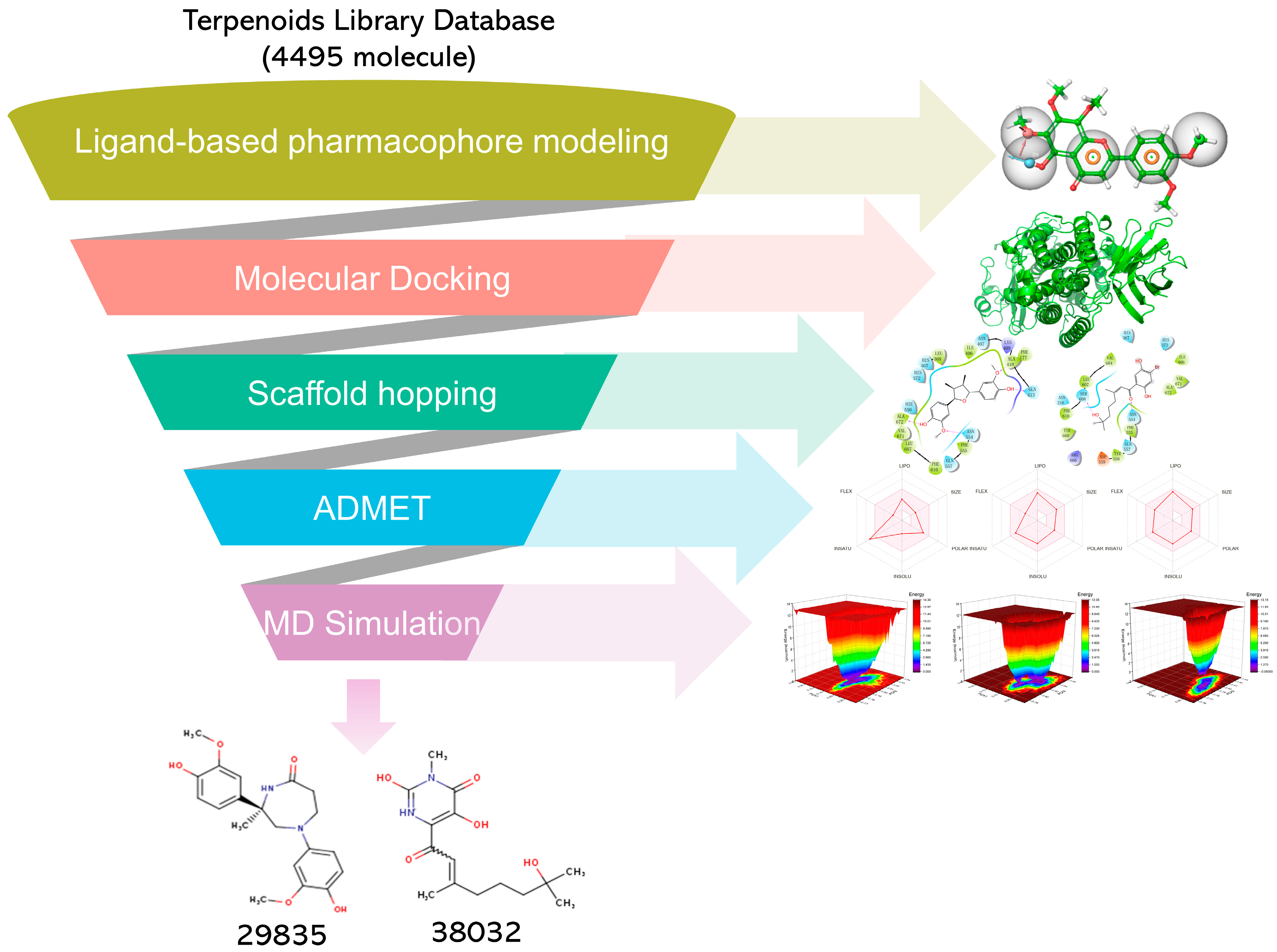
Figure 1. Virtual screening workflow for identification of potential selective inhibitors of ALOX5.
Targets 04 00008 g001
Figure 2. Hypothesis of ligand-based pharmacophore models. (A) HHRR_1. (B) AARR_3. (C) ARRR_1. (D) AARR_2. (E) ADHRR_1. A: Acceptor, D: Donor, H: Hydrophobic, R: Aromatic.
Targets 04 00008 g002
Figure 3. (A) Matched compounds fitted in hypothesis. (B) Reference ligand fitted in hypothesis. (C) ROC plot. (D) Percentage of screen plot for ADHRR_1 pharmacophore model.
Targets 04 00008 g003
Figure 4. Interactions between protein–ligand complexes. (A) 2D interaction diagram of Compound 2983 with the ALOX5 complex. (B) 2D interaction diagram of Compound 3803 with the ALOX5 complex.
Targets 04 00008 g004
Figure 5. ADMET properties of the positive control compound Zileuton and 2 molecules. (A) The Swissadme radar plot of Molecule 2983. (B) The Swissadme radar plot of Molecule 3803. (C) The Swissadme radar plot of positive control compound Zileuton. (D) BOILED-Egg model of compound Zileuton and 2 molecules. LIPO: Lipophilicity. FLEX: flexibility. INSATU: unsaturation. INSOLU: insoluble. SIZE: Dimensions. POLAR: Polarity.
Targets 04 00008 g005
Figure 6. Diagrams of interactions between protein–ligand complexes. (A) 3D binding pattern of compound Molecule 38302 with protein. (B) 2D binding pattern of compound Molecule 38302 with protein. (C) 3D binding pattern of compound Molecule 29835 with protein. (D) 2D binding pattern of compound Molecule 29835 with protein. (E) 2D binding pattern of compound Molecule 29835_mutan with protein. (F) 2D binding pattern of compound Molecule 38032_mutan with protein.
Targets 04 00008 g006
Figure 7. (A) The Swissadme radar plot of Molecule 29835. (B) The Swissadme radar plot of Molecule 38032.
Targets 04 00008 g007
Figure 8. Molecular dynamics simulations of candidate compounds and Zileuton. (A) Graph of the radius of gyration (Rg) of ALOX5 and the compound. (B) Root mean square deviation (RMSD) analysis of the complexes formed by the protein ALOX5 with three ligands, respectively. (C) Graph of the root mean square fluctuation (RMSF) of ALOX5 and the compound. (D) Graph of the solvent accessible surface area (SASA) of ALOX5 and the compound.
Targets 04 00008 g008
Figure 9. Number of hydrogen bonds between protein and compounds. (A) Molecule 29835 with ALOX5. (B) Molecule 38032 with ALOX5. (C) Zileuton with ALOX5.
Targets 04 00008 g009
Figure 10. Eigenvalues and variance proportions in principal component analysis. Three distinct panels are utilized to present the different regions, namely PC1, PC2, and PC3. (A) The eigenvalues and variance proportions in the principal component analysis of Zileuton (control). (B) The eigenvalues and variance proportions in the principal component analysis of Molecule 29835. (C) The eigenvalues and variance proportions in the principal component analysis of Molecule 38032.
Targets 04 00008 g010
Figure 11. Dynamic cross-correlation matrices: (A) Zileuton. (B) Compound Molecule 38032. (C) Compound Molecule 29835.
Targets 04 00008 g011
Figure 12. FEL of candidate compounds and Zileuton. (A) Compound Molecule 29835 with ALOX5. (B) Compound Molecule 38032 with ALOX5. (C) Zileuton with ALOX5.
Targets 04 00008 g012
Table 1. Molecular structures, IC50 and pIC50 values of dataset compounds.
CompoundIC50 (μM)pIC50Structure
10.506.30Targets 04 00008 i001
22.505.60Targets 04 00008 i002
38.005.10Targets 04 00008 i003
45.005.30Targets 04 00008 i004
57.805.11Targets 04 00008 i005
610.05.00Targets 04 00008 i006
70.107.00Targets 04 00008 i007
80.336.48Targets 04 00008 i008
90.236.64Targets 04 00008 i009
100.107.00Targets 04 00008 i010
110.406.40Targets 04 00008 i011
120.057.30Targets 04 00008 i012
130.236.64Targets 04 00008 i013
Table 2. Pharmacophore score of different hypothesis models.
NumberHypothesisPhase Hypo ScoreEF1%BEDROC160.9Total ActivesRanked ActivesMatches
1HHRR_11.0275.30.77436 of 6
2AARR_31.0375.30.72435 of 5
3ARRR_11.0275.30.70445 of 5
4AARR_20.9425.10.35435 of 5
5ADHRR_10.9150.20.5435 of 5
6AHRR_20.8950.20.58445 of 5
7AHRR_40.8950.20.58445 of 5
8AHRR_30.8825.10.32435 of 5
9ADRRR_10.8250.20.59445 of 5
10DRRR_10.7150.20.58435 of 5
11AARR_10.9725.10.39434 of 4
12AADRR_30.9150.20.63444 of 4
13AARRR_10.8975.30.77444 of 4
14AADRRR_10.8775.30.67434 of 4
15AHHRR_10.8725.10.34434 of 4
16AADRR_10.8575.30.72434 of 4
17AADRR_20.8350.20.6444 of 4
18ADRRR_20.8050.20.58434 of 4
19AHRR_10.7550.20.58444 of 4
20AAHRR_10.7450.20.58444 of 4
Table 3. Docking scores for the two selected molecules and the positive control compound.
Molecules2D StructureDocking Scores (kcal/mol)Formula
ZileutonTargets 04 00008 i014−7.388C11H12N2O2S
2983Targets 04 00008 i015−7.406C20H24O5
3803Targets 04 00008 i016−7.808C16H21BrO4
Table 4. The ADME prediction results for Zileuton and the two lead compounds.
Compound 2983Compound 3803Zileuton
Molecular weight344.4357.24236.29
Rotatable bonds463
Hydrogen bond acceptors542
Hydrogen bond donors232
Log S (ESOL)−4.42−4.47−2.54
TPSA68.1577.7694.80
Log P (Lipophilicity)−3.143.401.73
GI absorptionHighHighHigh
BBB permeantYesNoNo
Log Kp (skin permeation (cm/s))−5.75−5.55−6.60
Table 5. Docking scores for the two derivatives and two mutants.
Molecules2D StructureDocking Scores (kcal/mol)Formula
Molecule 38032Targets 04 00008 i017−10.262C15H23N2O5+
Molecule 29835Targets 04 00008 i018−8.31C20H24N2O5
Molecule
38032_mutant
Targets 04 00008 i019−6.673C17H27N2O3+
Molecule
29835_mutan
Targets 04 00008 i020−7.05C21H26N2O4
Disclaimer/Publisher’s Note: The statements, opinions and data contained in all publications are solely those of the individual author(s) and contributor(s) and not of MDPI and/or the editor(s). MDPI and/or the editor(s) disclaim responsibility for any injury to people or property resulting from any ideas, methods, instructions or products referred to in the content.